HOW I MET THE CLASH
by KRIS NEEDS
Meeting The Clash
It would be utterly predictable for me to say I was prompted to write a book about Joe Strummer and The Clash after the unbelievably sad event of December 2002. Also totally true. But I'd been working on this for years - since October 1976, to be precise, when I wrote my first article on The Clash for America's now long-gone 'New York Rocker' magazine - after witnessing them live for the first time.
After that I covered them solidly - mainly in Zigzag, the magazine I edited during most of the time The Clash were in existence. I'd always toyed with the idea of collecting together all my features and experiences into one long set of dispatches from the front line. Then I got diverted and The Clash dissolved into the farce of the final line up and I only thought about it occasionally, like when 'Should I Stay Or Should I Go' got to number one.
Then I got waylaid again. Then Joe died.
Now was the time. I didn't care who else was already on the case. I'd been in there, come out alive and it took Joe dying to realise that the only way I would let loose some of this massive swelling of grief would be to let it all out. Pay tribute to Joe, write about his life, and at the same time, try and capture some of the essence of the great band he was in. There was a story to be told here but I'd put my cards on the table and simply call it Joe Strummer & The Legend Of The Clash.
For me, the roller coaster story of The Clash is epic and fascinating, with the best soundtrack ever and peppered with some of the best memories a man could wish for. They had their faults, which some who didn't experience The Clash at close quarters are quite happy to dwell on, so why should I throw in more muck when all I had was a non-stop amazing time in their hands? In 2004, there's been so much written about them and it feels like a duty to relate my own experiences from the trenches, as well as emitting the loudest tribute to Joe that my metaphysical intestines can muster. Nothing less, but hopefully more. Tell it like I saw it.
Old friends
One rather astounding thing for me was, as the book unfolded, it took on this life of its own with the emergence of old friends I hadn't seen since the Clash days. These included legendary road manager Johnny Green, Mick's school-mate Robin Banks, who wrote some of those Zigzag pieces and was with the band constantly, even the finally-clean Topper Headon. Then there were people I had kept in touch with, such as Mick Jones, Don Letts, DJ 'Scratchy' Myers and roadie/MC Jock Scott. Then when I started talking to the guys who knew Joe after The Clash the final pieces fell into place. Richard Norris, Rat Scabies and Roger Goodman were just three who were involved in Joe's life from the mid-90s onwards and shed new light on his post-Clash life. I ended up with that Clash war diary, Joe's later life story and the desired tribute all at the same time. And aching sides in the process!
Here, I'm just going to home in on two specific and classic periods which probably provided the greatest music, bollock-blowing live sets and, on a purely personal level, the most cherished memories. Two twin tower chunks out of seven years with The Clash - the run-up to the first album and the making of London Calling. This was when the excitement levels were running riot.
Some gigs can change your life
We pick up the story when The Clash have been in existence barely six months. No record deal but a rapidly-mounting reputation born out of a handful of gigs, including the Screen On The Green and the 100 Club festival. They were still grabbing any gigs that came along - including supporting pub-rock outfits at leisure centres in Leighton Buzzard.
'Some gigs can change your life. Usually, you realise that later. The best ones are when you know it's happening right there and then. Bang! Your world is never the same again.
9 October, 1976, was one of those nights. At the time I was living in a place called Leighton Buzzard - your average original market town with amoeba-like estates, crap pubs and lairy beer monsters kicking off after closing time. But it also had a fairly vibrant gig scene. A guy I'd been to school with, Chris France, put on gigs in a pub backroom and had already brought in a virginal Jam, pub-rockers Eddie And the Hot Rods and the legendary local maniac John Otway. Bigger events took place at the local Tiddenfoot Leisure Centre, which was one of those council hangars better suited to bingo and comedians.
But that October evening Chris had booked a locally popular pub band called The Rockets...with The Clash as support.
In the run up to the gig, my anticipation was stoked by a couple of factors. Firstly, the October issue of Sniffin' Glue carried the first major Clash interview. Here they banged The Clash manifesto firmly down on the table. The band sought no favours from the press - they were urgent and aggressive, talking as if The Clash were indeed the only group that mattered and landing up with Mick leading Joe into the famous quote, 'Like trousers like brain.' Oddly, Joe's declaration of punk style would become one of the punk movement's defining declarations.
Bernie Rhodes
The week before the gig I got a string of phone-calls from Bernie Rhodes. This came about because I'd told Chris France, who booked the gig directly with Bernie [and paid him about £320], that I wanted to write a piece for New York Rocker, the US publication dedicated to punk rock. Bernie also knew I'd eventually be doing a Zigzag piece.
Having never encountered Bernie before, I had no idea about his background or personality. All I knew was he was the band's manager. Bernie gave me the whole street- credible spiel, all the while emphasising that this was the only band worth following and how they were going to turn the world upside down. At first, I thought it was the usual hype you got from managers, but there was something more here. Bernie really knew how to stir up interest. And he was dead right. I really was never the same again.
When we arrived the hall was half full of local hippies, rock fans and lager meatheads, who draped themselves over the comfy chairs. There couldn't have been more than ten punters of a punky disposition in the whole joint. First place we hit was the bar - and immediately encountered were The Clash. There were no dressing rooms to speak of so they were just hanging about waiting until the time came to go on.
Mick
For some reason, I found myself perched next to Mick - the bloke I'd seen knocking about in the Portobello Road and Camden areas. He knew he'd seen me before too. It all came out when we did that inevitable first meeting gushing about music. The Stones, the Dolls, Iggy and the Stooges...oh, and Mott The Hoople.
"That's it!", we both said at the same time. The Rainbow Theatre in '72, Elephant And Castle College in '73, Croydon...the dates kept coming. When I was running Mott's fan club, I often went backstage, and that's where I first met Mick.
We hit it off that night partly through the uncannily-similar way that we'd both grown up with rock 'n' roll. As there is only a year between our birth-dates, we both let the same landmarks stoke our passion. Those early conversations were splattered with mutual reference points: devouring the music papers every week to find out what was currently hot then tracking down imports by the likes of the Flamin' Groovies, the MC5 and, most fanatically, the New York Dolls. The Rolling Stones, the Faces, Mott, of course. Living for it and getting closer to the dream by any means necessary. For me, it was running Mott's fan club for three years - non-paid dogsbody work, but I got into gigs and hung out with the band. For Mick it was nurturing the hope of one day being in a band like that, and consequently acquiring and learning to play the guitar before [finally] running into the other pieces of that jigsaw.
The desire, the look, the instrument - Mick had the lot before he had the band that could bring it all home. Mick's attitude and musical adolescence were fairly different to Joe's, although they started off similar with a sixties love for the Stones, Kinks and Animals. Then they took different paths. Mick had the rock 'n' roll dream from an early age and continued along the route mapped out by the NME and US magazines like Creem. The Stones overseeing everything, while rock got flashier and trashier, culminating in the Dolls. Meanwhile, Joe pursued his more traditional path, reading and getting into wordsmiths of protest like Woody Guthrie and Bob Dylan, while sticking to his eternal love of Chuck Berry. The 101'ers were flying on five star rock 'n' roll petrol, while Mick wanted a high-octane collision between the trash of the Dolls and the street anthems of Mott. Those paths met again in '76 when the Ramones and the Pistols blasted the rock 'n' roll form with the spirit of punk.
In contrast to Mick's readiness to wax lyrical about the Stones or Mott The Hoople, Joe was friendly, but remained pretty quiet. It all must've been something of a culture shock for him. Six months before he'd been playing pub-rock standards with the 101'ers. Now he was at the centre of a whole new movement. Baggy suits had been replaced by Oxfam jackets, studs and boiler-suits splattered in paint. And he was already being called a spokesman for a generation.
The Clash, Leighton Buzzard
Then it was time. The Clash came on, exploded into 'White Riot' and it was like a bomb had gone off. Coruscating razor-chords and breakneck double-time rhythms topped with the amphetamined passion howling out of the incandescent singer, who was literally vibrating. The Clash's diversity and depth could evolve later. In 1976 they simply provided a declaration of all-out war on all the bullshit you'd accumulated over your whole life.'
Over the next few years I'd almost get used to how great The Clash were live. In October '76 I was a Clash virgin. I certainly didn't have a clue that I'd be spending a large chunk of the next seven years with this lot as good mates and still be hanging out with Mick Jones 28 years later - while mourning the passing of that amazing singer.
I had to review the gig for 'New York Rocker'', which was like a hip collision between the legendary Punk magazine and NME. It was the first bit of press the group got in the States. I led off with, 'The Clash taking the stage was like an injection of electricity into the smokey air. They charged headlong into a dynamite opener with shattering energy, strutting and lurching with manic, stuttering violence. Like clockwork robots out of control. [I later found out that this was 'White Riot']. Before they'd played a note the group hit you straight between the eyes with the visuals. Oxfam shirts splattered with paint and daubed with slogans like STEN GUNS IN KNIGHTSBRIDGE. The set sort of went, 'White Riot','London's Burning', '1977', 'Janie Jones', 'Protex Blue', 'Career Opportunities', '48 Hours', 'Cum Clean' and I'm So Bored With The USA' [Maybe not in that exact order].
Despite sound problems they were astounding, almost overpowering in their attack and conviction, I continued. In The Clash's 35-minute set I counted about six potential rock ''n' roll killer classics. Every song they do is their own, none over three minutes long, each razor sharp and rocking at lethal speed.
The Clash are the most devastating of the new wave British bands...bent on reforming rock 'n' roll to topple the bored and ancient heroes and replace them with high-energy rock 'n' roll played by people with their fingers on the pulse of what's REALLY going on. The Clash are riding the movement, happy to be part of something fresh and new, but with the ease of geezers who know they'll be going from strength to strength when the bandwagon- jumpers have long since fallen into the dust and clambered onto another trend.
The Clash are vital and different. Every gig they do - and so far there have been about half a dozen - is better than the last. They're great now. In three months they'll be staggering.'
That night still looms as one of the greatest experiences of my life. So many people lucky [or old enough!] to have seen The Clash have said they had their lives changed that first time. Me too. That same month I also saw the Sex Pistols up the road at Dunstable Civic Hall. Also impressive but their impact was diminished by the fact that there were about 80 people in a venue that could accommodate a couple of thousand. Plus the sound was appalling. Even in this half-full leisure centre I could stand a few feet from the stage and get knocked backwards by the energy sparking off the stage.
After the Clash's show, me and my mates hit the bar to gibber disbelievingly about what we'd just seen. The group were already there. Here I ranted endlessly about what I thought about The Clash. After all, this was the best group I'd seen in years. I knew Mick felt the same way. Slowly the rest of the group got involved in the conversation too. Joe shook my hand and gave that characteristic head-leaning back nod. He must've been drained after that performance.
Having made arrangements to meet up the following week, I left to go back to my nice house in Leighton Buzzard, but now everything suddenly seemed dull and boring. To quote Joe, it felt like a cog in the universe had indeed shifted that night.
Rehearsals Rehearsals
Three days later I met The Clash [minus Terry Chimes] at Rehearsals Rehearsals to do their second press interview. There were the pink drapes, Paul's car-dump mural and three angry young men eager to expound the same radical agenda as I'd just read about in Sniffin' Glue. We adjourned to the Caernarvon Castle pub over the road. I had some money and got 'em in.
Mick, Joe, Paul and myself sat around the table. But then Joe disappeared underneath it. Had he dropped something? Surely not pissed already? I then became aware of something pulling on my trouser leg? It was Joe. He got back in his seat with an evil, incriminating grin on his face. 'What do you call those, then?', he demanded. Joe was obviously referring to my new jeans, which I'd purchased to replace the customary flares I'd sported for the previous few years. I thought they were straight legged but they still weren't narrow enough for Joe's liking.
Even a slight flare was now taboo in punk rock - which I did find a bit odd because I thought the movement was about doing and wearing what you wanted. But he had a point. Flares meant the old regime. Hippies and all that. Plus if you look back now at old photos they did look fairly stupid.
'Like trousers, like brain'. Joe recalled his old catchphrase with a laugh on Westway To The World. 'That was the difference between the flared look that was a hangover from the sixties and the new look, which was fast and trim and going places. You could tell people a mile off what they were into.'
And I wasn't going to hear the last of this strides business. To be honest, I'd been more worried about the fact that I was 22 years old, having read all the 'old fart' comments and guessing that these boys were around the 20 mark. I didn't find out until much later that at 24 Joe was actually nearly two years older than me, while Mick was just over a year younger.
Irrespective of any prior influences, the three penniless urban warriors sitting in front of me were wiping the slate clean and starting all over again. No Elvis, Beatles or Rolling Stones'. All in the name of maximum impact. Mick would be jamming with Keith Richards ten years later, while Joe would be held up with all three when he died. But in October 1976, The Clash were on a mission.
'We're one up the arse for the rich, established groups,' declared Mick. 'There's so many useless bands around it's not even worth naming any...There's a lot of oppression around today. We're making people aware of it and opposing it...We're still rock 'n' roll though.' They talked about London. 'We love the place,' declared Joe. 'Blocks of flats, concrete...'. 'Yeah", agreed Paul. "If we get any gigs where we have to stay away we'll just have to take photos of London with us.' 'I hate the country,' chimed in Mick. 'The minute I see cows I get sick! I ain't never lived below eighteen floors.' Joe added that 'London's Burning' was, 'a celebration of the Westway under a yellow light.'
They said that the only other current music they really liked at that time was reggae and the Ramones - 'They must be really intelligent to write lyrics like that,' said Joe. As reggae voiced the discontent of black youths. The Clash saw their own music doing the same for white kids growing up in council estate ghettoes with nothing to do and no future. Okay, nigh on 30 years have passed and the situation has got much worse. But before The Clash nobody was writing songs about the harsh reality and desperation of inner city life. While bemoaning the sad state of radio - one of his favourite gripes - Joe likened The Clash to a public broadcast system bringing the truth. He always harboured a desire to start his own station. Public Enemy would later cite The Clash as a major influence in this respect when they announced that they were a hiphop version of news channel CNN. 'We weren't CNN, we just told the news,' says Mick now.
The distinct personalities of The Clash's frontline had become apparent over our two meetings. There was Joe, the ex-pub-rocker, who seemed older than the others and had obviously enjoyed a reasonable education. His passion and expression seemed drawn from deeper sources than just being pissed off with pub-rock. He was channelling the type of wired energy that came from Jerry Lee Lewis and appreciated the importance of lyrics, especially the way they'd been used in the old American protest songs. He had a way with words and a quick wit. Plus, behind the gruff exterior was the genuinely nice bloke who would open up as time went on.
Mick was more forthcoming, obviously sensitive and in love with the rock 'n' roll world. You sensed he would adapt to life as a rock star with enthusiasm, if only to live out the fantasy he'd read about every week in NME. A year later, Mick's rock star affectations
would start to bring him into conflict what propelled The Clash to greatness.
This friction was perfectly offset and silent Paul.
with Joe. But, like the Stones, this friction is complimented by the strong, street-wise and often Clash already had the essential ingredients for a
Although damning rock stereotypes, Theclassic group that none of their contemporaries could match. A frighteningly new and dangerous version of the old rock formula, which had come along almost by accident. I emerged from that meeting uplifted and elated. I could have said that I had just met the future of rock 'n' roll, if that phrase hadn't just been abused with Bruce Springsteen. I went home and got out one of my white shirts. Fished out a tub of paint and splashed it all over with a glaring red CLASH. Trouble is, I used gloss. It wouldn't dry, stank like hell and stood up on its own afterwards. I still wore it with pride though.
Institute Of Contemporary Arts
The next few weeks proved highly eventful as The Clash became part of my life. I witnessed my second Clash gig on 23 October, at the Institute Of Contemporary Arts in The Mall. Home turf and top of the bill. The evening was aptly-titled A Night Of Pure Energy.
London was buzzing as punk poetess Patti Smith was in town from New York for shows at Hammersmith Odeon and a press conference, where she hurled sandwiches at journalists who challenged her. Patti was the first female punk icon to arrive from the States. The Clash had checked out her gig at London's Roundhouse a few months earlier and were fans. The parallels between the two camps became apparent when she announced at the press conference, 'Call me Field Marshall of Rock 'n' Roll! I'm fucking declaring war, a war where everybody's fighting the same war. My guitar is my machine gun!'
The shows were great and on the afternoon of the ICA I interviewed Patti's genial guitarist Lenny Kaye. He'd heard of The Clash and, after I'd gushed my enthusiasm, said his band would try and come along that evening.
The ICA was heaving that night. I wore my new shirt and, unfortunately, those semi- flares. First on were Subway Sect, who Bernie had taken under his wing. A lot of people really liked them for their stance - four disaffected teenagers dressed down in Oxfam gear and playing monochromic dissonant reflections on a grey life. One of their songs was called 'We Oppose All Rock 'N' Roll'. Even Sid thought they were great.
The Clash were even better than Leighton Buzzard. Along with Rotten, Joe Strummer was now the most compulsive singer in rock 'n' roll - not just punk. He could barely contain his anger and emotion as he spat, slavered and shouted lyrics which were more like rhetorical slogans. Often Joe would end a song lying on his back, pouring sweat, face clenched as he wrenched the last drop of blazing soul out of his raw throat.
Then there was Mick's force-ten guitar blizzard. His classic pop harmonising with Joe was interspersed with sorties around the stage doing scissor jumps. Paul Simonon was the lean, mean bass machine.
Three diverse individuals bent on tearing the system down, shredding your preconceptions and pinning you against the wall. They were taking that primeval rock 'n' roll piledrive hump and dropkicking it off the Westway like a scatter-bomb. The Clash tore through what would make up most of the first album. This time they got the response they deserved. They were playing to their own crowd - like Tony James, who'd just joined Chelsea [later to form Generation X] with Billy Idol - Sid Vicious and the rest of the punk elite. There were a lot of record company people there, plus journalists and the simply curious who wanted to see what all the fuss was about.
The gig made the music press for a couple of reasons. First of all, a young Clash fan called Shane MacGowan had turned up to pogo with Mad Jane Crockford, who would later play bass with female band The Modettes. The pair were standing right in front of me and, at some point, got over-excited in their play-fighting. Jane gave Shane an over-affectionate nibble on the ear - and ended up causing a deep cut! Not taking the whole lobe, as was reported, but it certainly passed into punk legend after NME seized on it the following week. Joe saw what was going on and shouted from the stage: 'All of you who think violence is tough, why don't you go home and collect stamps? That's much tougher'. Shane would later tell Zigzag that Jane had bottled him - out of affection, of course.
Patti Smith had duly turned up with her entourage. Despite apparently being on another planet, she ended up leaping onstage to join in - somewhat ironically - with 'I'm So Bored With The USA'. She skipped, jumped and flung her arms around in circles while howling the chorus for all she was worth. 'I just couldn't stop myself', she told me afterwards. Patti obviously had the hots for Paul. The feeling was mutual and she ended up leaving with him.
Having missed my last train home
Having missed my last train home I ended up leaving with Mick, who said I could stay at Davis Road. The squat had now become a bit of a prime hangout - current inhabitants included Sid Vicious, Keith Levene, an occasional Johnny Rotten, Steve Walsh of Flowers Of Romance and Viv Albertine, Mick's girlfriend. But first we would have to stop off at the tower block flat which he shared with his nan.
It was those trousers again, the same ones that Strummer had ridiculed. 'Sid won't like it if you turn up in them. You might get hurt,' said Mick with concern. 'We'll go to my nan's and I'll lend you a pair.' So we trudged off into the night to Wilmcote House, on a high from the gig, swapping stories and giggling like idiots. While I was there, Mick took me out onto the little balcony and looked down at the yellow-lit bustle of the Westway snaking through West London. 'This is where me and Joe wrote 'London's Burning'', he said. A lot of the first Clash album was spawned within that perfect symbol of inner city hopelessness.
I was really warming to Mick. He was open, funny, passionate and, it was becoming increasingly more obvious, extremely talented. Also considerate, as he rummaged in his chest of drawers and emerged triumphant with a pair of faded old jeans which had been taken in at the leg. "Here's my old ones. These'll do!" I put them on and felt like Rudolph Nureyev in his ballet tights! Again we walked into the night, me doing a good John Wayne impersonation. This time it was to Davis Road.
Sid Vicious
I was a bit wary of meeting Sid Vicious as his legend had proceeded him. All the stories about him chain-whipping Nick Kent at the 100 Club festival and being marked down as the ultimate nihilistic thug. I didn't know that he was going to turn out to be a big softie, an average nice bloke who liked the music and lifestyle. Sitting in one of the rooms were Keith Levene, Steve Walsh, Viv and Sid, who was in the process of learning to play bass to the Ramones' 'Blitzkreig Bop'. They were all laughing and frazzled, firing up vast quantities of punk's drug-de-jour, amphetamine sulphate. Mick was knackered and retired fairly early with Viv. Eventually it was just me and Sid, talking about the New York Dolls and the Ramones while he soldiered on with the bass.
By the time I left around eight next morning he could play along to 'Blitzkreig Bop'. "I can play bass now!" he proudly declared as I left. It's a shame that it would be the last time I'd see him so happy.
At the this time The Clash weren't particularly looking to clamber on the ever- accelerating bandwagon of punk rock bands signing to major labels. They were simply honing their set, their style and their strategy, while focussing on playing live with maximum disturbance.
Royal College Of Art
My next Clash gig was at London's Royal College Of Art on 5 November. Appropriately the evening was called A Night Of Treason. The Clash were supported by The Rockets [who they'd supported in Leighton Buzzard] and Subway Sect. This was a different crowd from the ICA. Punk was starting to catch on now, while at the same time drawing plenty of aggression from anyone from teddy boys to lager thugs. The RCA was sprinkled with Clash faith-full but also some drunken students who apparently got a bit pissed off when Sid Vicious started heckling their mates in pub-rock support band, the Tyla Gang.
When The Clash came on, it all went off.
This one has been told many times in different versions, but I was standing ten feet from the incident and some heckling from the students was blackening the mood of the gig. This escalated as a few bottles were thrown. Joe told them to cool it a few times. When they carried on hurling, Joe and Paul leapt off the stage to sort out a couple of the main protagonists. Within seconds, Sid Vicious appeared from the back of the stage and dived in to the crowd to join in. There was a bit of a skirmish, which seemed to do the trick, then Joe and Paul returned to the stage to finish the set, now driven by adrenaline into ferocious overdrive. Mick later said he stayed up there because 'somebody had to keep in tune.' Before the gig Joe had told me they had a new song called 'Hate And War'. 'Well, it wouldn't be 'Peace And Love' would it?' he explained.
I was sporting another of my emulsion creations, plus Mick's old strides, and came in for some evil stares. After the show I was standing by the stage waiting for the band to come out when a small gaggle of herberts swaggered up. They looked suspiciously like the mob who'd been chucking bottles. They thought I was Mick and started poking me and mouthing threats and jibes. Suddenly there was an explosion of activity and ruckus as Sid appeared. He was making straight for the lunks and hurling abuse, while being held back by four people. The aggressors bolted.
Afterwards we hopped into a cab to head back to Davis Road. It soon became obvious that we were being followed by a Volkswagen, which parked up nearby when we reached our destination. Ominous figures got out and I immediately recognised them as idiots from the college. Mick also seemed to think that they were the ones who'd been starting a lot of the trouble at the gig. 'Hold on', said Sid, who promptly hopped onto the front garden wall brandishing some handy roofing slates. 'Fuck off!_ he yelled, lip curling and teeth bared, as he hurled slates at the protagonists. This they duly did. We laughed. Far from starting on me, it was the second time that Sid had saved me from a kicking in one night. It was also my first taste of lunk-on-punk aggression.
Building the Momentum, High Wycombe
The gigs continued. I next caught the band on 18 November at a pub in High Wycombe called the Nag's Head, which was run by 100 Club promoter Ron Watts. Within the space of two weeks the group had improved again. Joe had dyed his hair blonde and sported a boiler- suit on the back of which he'd daubed the title of that new song - 'Hate And War'. This time the onstage attack was even more frenzied and confrontational. The rehearsals were obviously paying off as the songs uncoiled off the stage in taut, ballistic stun-bursts while Strummer was almost consumed with righteous anger.
The set was similarly lean, and included 'White Riot', 'London's Burning', '48 Hours', 'Janie Jones', 'I'm So Bored With The USA', 'Protex Blue', 'Hate And War', 'Career Opportunities', 'What's My Name', 'Deny' and '1-2 Crush on You'.
I reviewed the show in Sounds and tried to convey the fact that The Clash excited me in a way I'd never experienced before. I'd seldom felt this passionate in years of being inspired by music. The groups I liked were rarely more than TV images, records or dots in the distance at a stadium. This time I could have reached up and touched the group if I'd wanted to, then have a drink with them afterwards.
I wrote: 'The Clash are now firing with more compressed energy than a flamethrower at full blast. They play with almost frightening conviction and intensity, each number a rapid-fire statement delivered like a knockout blow.' I was impressed by the emergence of Joe as a totally compulsive front-man enough to compare him to 'a paint spattered Greek god'!
Admittedly, my enthusiastic outpourings might not have got the nod from more restrained and scholarly observers, but I still stand by them. At the time I was gripped by the band's euphoric surge. Those gigs are still some of the best I've ever witnessed.
It was staggering to behold the emergence of what was going to be one of the greatest bands of all time in the space of just a couple of months. That night at High Wycombe clashed with the Miss World concert, and was half full. The little loft was awash with A&R men, who spent most of the set asking punters - including me and my mates - if they thought the band were any good. They were better than good and improving with every show.
Walking into the cupboard-sized dressing room afterwards, Joe was spreadeagled on a table, barely able to speak because he was so spent. Or maybe he wanted to avoid talking to the A&R men.
Record deals
In my review I also took the opportunity to ask why the group hadn't been signed yet. 'The Clash seem forced to take a back seat on the new wave recording front while groups like the Damned, Pistols and Vibrators shove singles out. Why isn't it that the hottest group this country has got hasn't yet had the chance to get themselves on vinyl? Dunno, but going on last Thursday's set, it won't be too long before some record compay wakes up.'
Polydor seemed to be front-runners at this time and stuck the band into their studios off Oxford Street to record some demos. These would be used to convince the bosses to sign the group. Simple? Not when you consider that the group's choice of producer for the sessions was Guy Stevens - the berserk ex-Mott The Hoople producer who'd sacked Mick from Violent Luck.
The first time that the rest of the band met Guy they were accompanied by Sid Vicious. Guy had just been to see Led Zeppelin's film, The Song Remains The Same and, being a fan, was appalled at the self-indulgence on display. He was so enraged he took the record and flung it across the room - hitting Joe smack in the eye. Seeking medication for Joe's injury, they found Sid rummaging in Guy's medicine cabinet.
Mick told me that Guy's way of 'method producing' could involve hurling a chair at the wall if he thought he'd get a reaction from the musician and create a more impassioned performance. They recorded five songs - 'Career Opportunities', 'White Riot', '1977', 'Janie Jones', 'London's Burning' - but didn't capture the essence of the band. Joe would later complain to NME's Tony Parsons that Guy had tried to make him sing in a clearer fashion, enunciating his words.
Guy's unconventional methods rubbed Polydor hotshots Chris Parry and Vic Smith up the wrong way. Their brief was to get an accurate representation of The Clash on tape. Guy responded by getting progressively more incapacitated, forcing engineer Vic Smith to finish the mixing. The results sounded flat compared to the gigs. 'Boring,' said Joe. As Mick revealed when we spoke the following March: "It was great recording with Guy Stevens - fantastic when we were doing it. He was really inciting us, but when it came down to the mixing it was a bit untogether."
While the record labels were hesitating to offer the band, Terry Chimes announced he was leaving. Unconvinced by the politics, and increasingly put off by the growing amount of violence around the scene, Terry agreed to fill in until a replacement could be found. As it happened, the drumming position wouldn't have a permanent incumbent until the arrival of Topper Headon the following year. In the meantime, The Clash tried out a guy called Rob Harper with Terry periodically reappearing up until March.
Anarchy Tour
On 1 December, the Sex Pistols were booked as last minute replacements for Queen on ITV's Today Show, thus sparking what has become popularly known as 'The Bill Grundy Incident' as the band rose to his pissed-up goading with a few choice words. The Press loved it. They finally had a nail on which to hang their fear and loathing of the ever-growing punk movement. The Daily Mirror blared the classic 'Filth And The Fury' headline on its front page and carried a report about the lorry driver who was so outraged that he kicked in his TV. Middle England was up in arms over the 'foul-mouthed yobs'. More to the point, the imminent Anarchy Tour of the UK was in tatters. Even Grundy was suspended for two weeks for his obvious provocation of the situation.
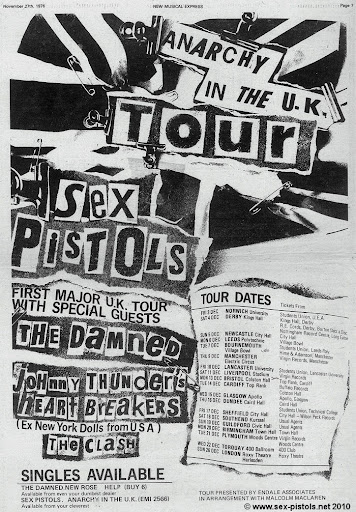
The Anarchy Tour had been put together by the Sex Pistols management to showcase their band and punk rock in general. Originally it was planned to have the Ramones and Talking Heads on the bill too, but music biz politics intervened. The Damned came in as outsiders, but with tour support from their record company. There was also proto-punk icon Johnny Thunders, flown in from New York with his new band the Heartbreakers. Finally, The Clash were slotted in as bottom of the bill to pad it out. Considering their growing reputation it was almost insulting to see their name in such tiny print at the bottom of the tour poster. Eventually, the tour would play just a handful of shows. Even the major Boxing Day gig at London's large Roxy Theatre in Harlesden was pulled.
There had already been a warm-up gig at Coventry's Lanchester Poly on 26 November, with the Pistols and The Clash, who were trying out new drummer Rob Harper. It didn't bode well for the tour when a body of students had decided that 'White Riot' and the Pistols' new song, 'No Future' - soon-to-be-called 'God Save The Queen', - were fascist and tried to hold back payment.
The first proper gig to remain from the schedule was on 6 December at Leeds Polytechnic. By now the tour was being pursued by Fleet Street's finest, just waiting for some dirt to fling. Paul and Steve from the Pistols were goaded by a photographer into uprooting a potted plant in the hotel foyer, which was promptly paid for. The Mirror subsequently reported that they'd wrecked the joint.
At that night's gig, Joe took the stage with his £39.17 weekly dole income stencilled on the front of his shirt. He exercised his fixation with '1984' again with the opening announcement of 'I've been going around for two days thinking Big Brother' is really here'. The crowd of curious students looked on in apathy - as they did for the rest of the night.
The opposition to punk rock didn't only apply to gigs. The Pistols were having problems with their record label EMI, who'd just released their debut single, 'Anarchy In The UK'. Tour support was withdrawn amidst protests from pressing plant workers. Pretty soon band and label would mutually separate. After days of waiting and being thrown out of hotels, the tour managed a gig at Manchester's Electric Circus on 10 December. It went down as one of those later-legendary affairs which probably sounds better than it was. The out- of-London masses had still to pack out punk gigs and roar their enthusiasm.
With gigs still being called off, the next show was four days later at the Caerphilly Castle Cinema, a hastily-booked replacement for the cancelled Cardiff Top Rank. It only held a hundred people and the tour was now deeply in debt. But by now the whole venture had turned into a crusade. The bus had driven back to London, then had to drive all the way to Wales for this one-off.
The gig was notable for being picketted by local council officials and members of the Pentecostal Church, who warned of eternal damnation and sang Christmas carols outside. Further last minute shows were added in Manchester and Cleethorpes, with Plymouth's Woods Centre being only the third date of the original itinerary to actually take place.
The Anarchy Tour had been prevented from becoming the trailblazing nationwide package it could've been. The furore, cancellations, disappointments and endless waiting had put pressure on everybody. EMI backing out financially halfway through had put a huge financial strain on the Pistols and the rest.
Joe later told Melody Maker's Caroline Coon, 'All that stuff with the Pistols tour! I hated it. I HATED it. It was the Pistols' time. We were in the background. The first few nights were terrible. We were just locked up in the hotel room with the Pistols, doin' nothing. And yet, for me, it was great too. We had the coach and we had hotels and we got to play - even though they didn't let us do it that often....It was good fun.
'But when I got back to London on Christmas Eve I felt awful. I was really destroyed, because I'd got used to eating - it was Holiday Inn rubbish, but it was two meals a day and that. When I got off the coach we had no money and it was just awful. I felt twice as hungry as I'd ever felt before. I had nowhere to live and I remember walking away from the coach, deliberately not putting on my woolly jumper. I walked all the way up Tottenham Court Road and it was really cold but I wanted to get as cold and as miserable as I could.'
In terms of publicity, The Clash probably came out of the tour best. But afterwards none of the participants were happy campers. 'That was soul-destroying', Mick told me later. 'We thought we were the greatest rock 'n' roll bands, conquering the world. Everyone was really excited, but the day before it started the Grundy thing went down and gigs started getting cancelled. The Pistols suffered quite terribly. It was really tragic, but we learnt so much from it. You knew the time had to come.'
'The tour turned into a cause, in a way,' added Paul. 'Us kids just wanted to play. We were stuck in hotel rooms for a couple of days waiting to play, then we'd be told the gig was cancelled and we'd wait for another three days in the hotel room.'
'It really put punk rock on the map,' reasoned Joe in Don Letts' Westway To The World documentary. 'Every truck driver and builder, and your grandmother and your uncle knew what punk rock was all about.'
The Roxy
At the end of '76, the Roxy - a former gay bar in Covent Garden - became the punk equivalent of the Marquee. The Roxy slowly caught on and was given a boost when Don Letts started playing reggae in the absence of any available punk records. In the wake of the 'Anarchy' disaster the Roxy was one of the few places the punk groups could play or hang out at without hassle. Small, dark and pokey, it was somewhere to go where you could see mates and get served - a big deal back then. The bands were often bog-standard Pistols- Clash impersonators, while the bar was usually packed with people like Sid, Thunders, Chelsea, Gen X and Clashers. Also, Mr Rotten, who said, 'It's a wankhole, but fuck, Don's on!'
There was talk of staging the pulled London date from the Anarchy Tour at the Roxy on New Year's Day with Sex Pistols and The Clash. However, McLaren wouldn't go for it. Many said this was down to him wanting to hold on to the Pistols 'banned everywhere' reputation. Plus he wasn't into endorsing a new punk club which he didn't have a stake in.
The Roxy and Beyond
So, on the first day of 1977, The Clash played instead.
I turned up about eight and encountered the band for the first time since High Wycombe. They were obviously still disappointed by the way the Anarchy Tour had panned out, but seemed determined to blow tonight's roof off to compensate. I walked into Joe and asked 'how ya doin'?' 'How do I look?' came the reply. His shirt simply had a big 1977 stencilled on it while his hair was still blonde. Joe's manner was speedy and surly. Mick was starting to look more like a rock star in his white strides and black silky shirt. His manner was speedy but friendly.
The gig was a full-on Clash classic, as they roared through the set. And then did it all a second time three hours later. They'd added a new song, 'Remote Control', which Mick had written over Christmas about the Anarchy Tour: 'Who needs remote control/From the Civic Hall?'. Even though barely three months had elapsed since their glorious ICA gig, something had changed. After the manic savaging of punk rock by authority and media, and its parallel ascension as the latest 'youth rebellion' trend, the mood amongst the shock troops seemed to have darkened. Particularly among the Davis Road hardcore. It was like their exclusive gentlemen's club had been invaded by dullards and made public property. In a sense, that's what had happened, but Sid, Keith, Alan, Steve Walsh and the rest weren't the friendly nutters I'd encountered just a couple of months before. Heroin was starting to make its presence felt - having been introduced to the scene by The Heartbreakers on the Anarchy Tour.
It was also a rather strange paradox that a lot of people were slagging off the new groups who'd taken the advice of the originators and started their own bands, myself included. I guess this was a reaction to the flow of Roxy bands who hadn't taken the other bit of advice - do something new, original and true to yourself. There were so many Clash-Pistols copyists it was starting to disappear up its own arse. As The Clash moved on in leaps, new outfits were springing up every week - but imitating not originating.
By the time 1977 became reality, it had become achingly essential that The Clash make a record. But when they signed to CBS - in a last minute Bernie Rhodes swerve away from hopeful Polydor - Mark Perry famously wrote in Sniffin' Glue that punk died that day. The band were bemused because, more than anything, they just wanted to get their message across to as many people as possible - by any means possible.
'I've been numbered wherever I go,' Mick told me a few weeks after signing. Despite some confusion and frustration at the outcry, he was excited to have the chance to record the music which was exploding live.
'I think it's important that we don't change,' he said. What is happening right now is that at last we've got the chance to make records. It all comes down to records...You've got to make records. You can do your own label and not many people will hear it. This way more people will hear our record. I don't care if they don't like it or don't buy it, as long as they hear it. We've got complete control. Everything is our own ideas.'
The Clash in the studio
The Clash were in the studio recording their first single the day after signing. They chose to do 'White Riot' backed with '1977'. Recording location was CBS's own studio in Whitfield Street, off Tottenham Court Road. They had the weekend to do it and used Micky Foote as producer. This was the place where the Stooges recorded Raw Power in '73, which impressed Joe and Mick.
Simon Humphrey, in-house engineer at these sessions and for the first album, has been called upon several times for his memories. Apart from reporting a certain sullenness in the band but Mick's avid eagerness to learn the ropes, his favourite anecdote was about Joe and his amplifier. His comments reinforce my feelings that Joe was playing his overnight punk personna to the hilt - gruff, blunt and somewhat aggressive. Joe insisted on singing while playing his guitar at the same time. He stuck his amp next to the drum kit. When Simon said he couldn't put it there because it would affect the separation, Joe replied, 'I don't know what separation is and I don't like it'. Joe later said that this was his idea of a joke, but for the rest of his life he never stopped doing his vocal takes quickly while bashing away at the unplugged-in Tele.
Simon considered Joe to be the most difficult member to work with. Whereas Mick was like a kid in a candy shop as he strived to learn the workings of the studio, Joe worked by his own rules, like delivering the song from start to finish without doing the painstaking drop-ins usually favoured by singers and producers.
Within a couple of years I watched as Joe started gliding through takes, affable and relaxed as you like. By then he'd started customising his own space in the studio to make him feel at home and would do for the rest of his life. When Joe started enjoying singing the lyrics he'd lovingly crafted while Mick developed what he'd picked up in early recording sessions is when The Clash became truly great. The first album was their declaration of intent. A snapshot of their birth capturing their first nine months. A bit like the Rolling Stones, except they only featured one original song on their first album.
The album was recorded over three consecutive four-day chunks, running Thursday to Sunday from 10 February. Whitfield Street's Studio Three was again the location, with Simon Humphreys engineering and Micky Foote in the producer's chair. Bernie Rhodes was sometimes there in his 'executive producer' role. Anybody who's asked says that Mick probably contributed more to the finished sound than anybody. 'Any guitar of note on the record is Jonesy', said Joe, while his little overdub touches and backing vocals elevated the album above just being a record of the live set.
I went along to the sessions a couple of times, but it was always after a hefty pub or club session. I think they were doing 'London's Burning' but, rather than make up a fanciful tale of being present at this historic moment, it has to be said I hardly remember a thing, other than having the usual blast and being in the lift with a bunch of girls. I do recall the place being cramped and somewhat archaic. It was like CBS had shoved this bunch of punks into the cupboard where they could be heard and not seen. Or as Joe put it, 'I got the feeling they were going to spend the price of an egg sandwich on us.'
But when it was finished, Mick couldn't hold in his enthusiasm. "Well, we're really excited about it. I mean, AN ALBUM! It_s destined to be a classic!" He added that the album had succeeded in being a real studio product, rather than just a reproduction of the stage act. "We used the studio to make it sound good".
Recording the First Album
I was almost dizzy with euphoria first time I actually experienced the full album all the way through. I'd already heard it with the band, but having the thing in your hand, to play over and over again and then rave to your mates was something else. I vented my gibberings in New York Rocker, calling it 'the most stunning debut album ever', which was 'gonna change attitudes and perceptions of rock 'n' roll'.
Zigzag opened its jail hippy doors to let me spout, 'I can't mince words here. I've only heard it once, but I know this is the most exciting album I've heard in years. I can't think about it for more than a minute without feeling like I'm going to explode [let alone write about it!]. You can hear all the words. There's the hardest guitar/drum sound ever, various studio tricks enhance the production and make some songs even more effective...but most important, it's captured the essence of The Clash. Their intense conviction is here in all its blazing glory. The whole thing's magnificent! Even if you don't buy it, at least HEAR it. It's one of the most important records ever made.'
You don't need me to run through what appeared on the first Clash album or why it was so great but, in view of what the group would get up to later, two tracks in particular stand out - 'Police And Thieves' and 'Garageland'. The former was The Clash's first personal London-style translation of the group's reggae fixation, being a cover of Junior Murvin's Lee Perry-produced Carnival anthem from '76.
"It's a logical progression', reckoned Mick when I expressed surprise around that time.
'There's obviously a lot of links between us and what's happening with the Rastas. It just seemed right to do it. We had lots of our own material, but we wanted to do one song by someone else. What would we do? Not a sixties rehash. Let's do something which is '77, right? Let's try and turn people on.'
'This is a rock 'n' roll track in 4/4, but it's experimental. We've incorporated dub reggae techniques. We'll probably get slagged to bits for it, but we don't care. They can't understand that what we're trying to do is redefine the scene and make it clear to people the way to move. You've got to take risks all the time. That's why we did it - as a risk.'
The consummate glory of 'Garageland' showed new subtleties creeping into the Clash attack. Joe was inspired to write the words by Charles Shaar Murray's damning review of their second gig, where he'd written that The Clash were 'the kind of garage band who should be speedily returned to the garage, preferably with the motor running.' The slag- off inspired the defiant chorus, while the verses deal with punk bands being signed to record companies.
At the time, Mick told me it was his favourite track. "It's where we're moving on next. The chorus is "we're a garage band and we come from garage land." That's just what we are...It'll always be rock 'n' roll, but we're hoping to improve the aura of the sound....It's also commenting on the current situation with all the groups being signed up....in a way, that song does pronounce that the next step is about to be taken.'
Who'd have guessed the magnitude of the eventual stairway to heaven, but first The Clash had to promote the LP with some highly-eventful gigs. On March 11, they celebrated its completion by playing a one-off at an Asian porno cinema in Harlesden, North London in March. This provided my first Clash feature in Zigzag, who'd I'd been pressurising since the previous October.
Some highlights which might convey some of the sense of occasion, and it has to be kept in mind that this was only six months since I'd first encountered The Clash and punk rock in the flesh and had my life changed irretrievably. Back then this was NEW.
Harlesden Coliseum
'One of the best gigs I've been to recently was The Clash's self-organised one at Harlesden Coliseum. It was an important gig for each group on the bill. The Slits, the first all-girl punk band, were making their world debut. The Subway Sect hadn't played since November. The Buzzcocks were making their first appearance since reorganising the lineup after singer Howard Devoto's departure, and The Clash were playing their first gig in three months since signing with CBS.
Harlesden Coliseum usually serves as a Pakistani porn pit, attracting vast crowds of just three a night. The Clash noticed the place when they were rehearsing for the Anarchy Tour at the Roxy theatre up the road. They liked the look of it and thought it would be a great place for a gig.
Inside, the Coliseum is the classic definition of a fleapit, all peeling paint and stained seats. The owners seemed rather bemused by the sudden invasion of punks. When I get to the Coliseum at about two-thirty, all the bands are there apart from The Clash, although Mick has come down early cos he's so excited about the gig. While the roadies build the stage and groups wheel in their gear, Mick and I adjourn to the balcony and look at the bustle of activity going on below.
'It's great, isn't it? Our own gig...I'm really excited. This is more than a gig. It's an important event!'
It was soon time for The Clash's sound-check. They ironed out the sound problems with 'London's Burning' [twice], 'Garageland' [which on first hearing live sounded like a corker] and - I recognise those chords! - Jonathan's Richman's 'Roadrunner', with the chorus changed to 'Radio One!'. Sounds fantastic Clashified. Mick says they may do it as an encore, but it doesn't happen. "We couldn't get it together". Paul says he hates the song anyway.
As The Clash retire to their dressing room - the place where they do the projecting from! - the people start to come in. Considering the place is in deepest Harlesden and it's raining, there is a good turnout. The atmosphere builds up all evening. It's electric by Clash time!'
First on were The Slits making their debut and a big impression. They overcame their sound problems with pure energy, with Ari Up stamping and screaming like a little girl throwing a tantrum at a party.
Next up were Subway Sect, who'd changed from the rambling, two-chord outfit I'd seen the previous November. They've been rehearsing a lot at The Clash's studio and had a stack of unusual new numbers. Then it was the reorganised Buzzcocks with Pete Shelley now front man. They sported the Mondrian shirts and tore through much of their classic first album with a whiff of greatness to come.
Back to me in March '77...
'It was The Clash's night, though, and they played a blinder - despite little obstacles like one of the hired hippy sound men accidentally pulling out a lead. It was great seeing them back onstage, in new zip-festooned outfits to boot. The crowd in front of the stage went potty, pogoing right up into the air, screaming the words, shaking themselves to death and falling into twitching heaps. They couldn't have been able to see what was going on, which is a show in itself.
There were some great announcements from Joe. Someone yelled something about the CBS contract. "Yeah! I've been to the South of France to buy heroin!", he yelled. Another time: "I'm Bruce Lee's son!", he declared, before slamming the band into another devastating two-minute burnup. Joe had psyched himself up so much for the show that he'd been almost frothing at the mouth before he went on. Meanwhile, Paul's bass-playing had improved in leaps and bounds. This turned out to be Terry Chimes' last gig with the band. To emphasise the point he had 'Good-Bye' stencilled on his shirt.
Next day, after staying at Mick's, we saw a video recording of the gig. A bloke called Julien [Temple] is making a video film of The Clash. He's a student at the London Film School and, using their equipment, has been filming gigs and interviews since the 'Anarchy Tour'.
Harlseden Colisum recorded by Julian Temple
The recording of Friday's gig showed just how impressive The Clash are onstage. In the excitement you're bound to miss some things. Like Mick's guitar-strap breaking and him holding up the guitar like a machine gun to finish the number; Joe jerking across the stage like an electrocuted piranha fish; or Paul ripping a giant chord from his bass with a violence so intense that his arm is nearly torn from its socket.
That's The Clash. Pushing themselves to the limit. The least you can do is give them a listen. You'll never be the same again!'
That's the first bit. There followed the milestone arrival of drummer Topper Headon, the arduous recording of controversial second album Give 'Em Enough Rope, riotous tours and the inexorable rise of The Clash to becoming one of the biggest bands in the country on their way to taking over the world as America started to fall under their spell. Then came London Calling, the second Clash time-frame I'm going to freeze and mutate out of the book. I still smile when I think about this whole mid-'79-_80 period.
London Calling Era
If the US fixation had been present even before the formation of The Clash, the Pearl Harbour tour brought it out into the open. On their return the fired-up group's main thoughts were on their next album and they embarked on a feverish writing frenzy. America had planted a seed, while Britain didn't seem so attractive since Margaret Thatcher goose-stepped her way to power. Joe was in love with the romantic notion of the States, just like he'd seen it in the movies at boarding school. Musically, he felt like he'd found the Holy Grail. American music had always been his lifeblood and now he'd visited the source.
'I got so much inspiration from America, I can't describe it,' Joe bubbled as I tried to prise snippets of info from him after the band had returned to the UK. The enthusiasm made you scour the record shops for records by obscure country singers.
'That happened with Mott The Hoople as well,' recalls Mick. 'They came back from America all full of it. They came back with guitars, records you couldn't get here and stuff...When we went to America we made sure we plugged into the heart of the city when we visited places, like Motown's Hitsville in Detroit.'
Around the same time, I was in a punk band called The Vice Creems. [Unfortunately I was singing]. Mick said he would produce us when he came back from the States. The ambitious new Zigzag record label had hired Olympic Studios - where the Stones did 'Sympathy For The Devil' - for 20 March. But the week before the session the band split up, leaving just me and and guitarist Colin Keinch. I told Mick of my plight and he just said, 'Let's go ahead. I'll get you a band.' Colin and I duly made our way to Olympic, and walked straight into Johnny Green, who was setting up some very familiar pink amplifiers. Then Mick arrived, along with Topper Headon and Tony James. 'I said I'd get you a band,' grinned Mick, as he plugged in his black Les Paul. 'Blimey, we've got half The Clash in our group', I thought. 'That's what generous people they mate. They didn't think any more of it,' Johnny told me.
Within an hour the assembled company were working up the called 'Danger Love'. Colin taught Mick the arrangement,flame-breathing, mid-period Clash-style monster. 'So this must be how The Clash work,' I thought. Setting up, jamming, shaping half songs into roof-raising anthems. With the basic song down, Mick dubbed layer upon layer of guitar, colliding and counteracting. You don't hear it at the time as the riffs and counter-riffs keep coming, but Mick has the end result in his head. When he gets on the mixing desk it all makes sense.
After that day, I could hear any Clash track and tell how it must've been built. From watching this and how the first four albums progressed I got what Joe had said about how he worked with Mick. Joe was the words and the voice, while Mick was the sound and the big picture.
Vice Creems
The flip to the Vice Creems single was a cover of Fabian's fifties rock 'n' roll classic 'Like A Tiger'. Here we let rip on some Ramones-style punk rock 'n' roll. Tony's Generation X band mate Billy Idol turned up and ended doing handclaps, while Robin Crocker joined us in some rousing Wilder-beast howls in the middle of 'Tiger'. The Clash would employ this effect later, in 'London Calling', 'Washington Bullets' and 'Should I Stay Or Should I Go'.
I was gob-smacked one afternoon in August 2004 when Robin Crocker told me that 'Danger Love' had inspired Joe when writing 'London Calling'. Come again? 'It was on that Vice Creems single, "Danger Love",' he cackled at my disbelief. 'That's where Joe got the idea for the wilder-beast noise.'
Because they were contracted to CBS and Chrysalis, Mick and the boys had to adopt false names. Mick became Michael Blair, from 1984, Topper was Nicholas Khan, while Tony became Anthony Ross. For his trouble, Mick was given two ounces of prime Jamaican weed, and to this day, 'Danger Love' remains the great lost semi-Clash single and I'm amazed to find changes hands for around £325.
I Fought The Law
Meanwhile, The Clash wanted to release their version of Bobby Fuller's 'I Fought The Law' as their new single, with 'Gates Of The West' on the flip. Instead, CBS wanted another single off 'Rope', and put out 'English Civil War' on 3 March, with the group's version of 'Pressure Drop' on the flip. Eventually, 'I Fought The Law' - plus three more non- album tracks - were released as the Cost Of Living EP on 19 May - the day of the General Election which saw Margaret Thatcher and the Conservatives voted in.
Split with Bernie and LC sessions
Now that they'd split with Bernie, The Clash had to find somewhere else to write and rehearse the growing corpus of songs that they were building up in. In March, Johnny Green and Baker turned up Vanilla Studios in Causton Road, Pimlico, which was basic but practical. It was up the stairs behind a garage. Certainly off the beaten track, which ensured that the only visitors would be invited ones. The band started working up new material through May and June. After the obsessive effort which had gone into making Give 'Em Enough Rope, the group had become close again as they shared their American adventure. So they plotted up at Vanjilla and got down to the business at hand with renewed vigour and unity. A garage band, in the true sense of the word.
Robin would phone regularly with enthusiastic progress reports, telling me about the daily football matches played over the road in a concrete playground. Mick invited me along to check it out and, being stupid, I wandered around for half an hour before I found the place. Here I encountered the re-born Clash. Hammering away at new ideas, getting on famously and riding the crest of a creative wave.
We did have a game of football. I've always been crap and flummoxed about like a beached seal, but Johnny recalls that 'Paul was quite hard and enthusiastic...Topper was skilled and nimble; Joe would be well-meaning and try hard but wasn't very good, and Jonesy was really flash, but we all laughed at his style, because he wasn't as good as he thought he was..As soon as they were back inside they'd roll a joint. Rather than sedating them it had the opposite effect - it would fire them up. Very unusual for white boys.'
Mick has credited the daily game for the eventual stunning album: 'I just think we really found ourselves at that time and it was a lot to do with the football. No, I'm serious! Because it made us play together as one.'
Everyone seemed to be pouring their new-found musical strains into one big melting pot. Joe was reliving his early Woody Guthrie and rock 'n' roll fixations and had started writing on piano. Mick strummed gentle country songs. Topper battered out the dance grooves he'd picked up. As ever, Paul was into his reggae, but - realising you could make money from songwriting royalties - made sure he wrote a song in 'The Guns Of Brixton', which evolved from a bass-line he'd been hammering at rehearsals.
Joe took the 'London Calling' title from the BBC World Service reports that he had first tuned in to whilst visiting his father in Malawi in 1960. Inspired by the view of the West End provided by Joe's daily trips to Wessex studios on the number 19 bus, the song was originally about tourism. However, Mick suggested he rewrite it against the apocalyptic fear generated by the 1979 Three Mile Island meltdown incident - where a nuclear reactor in Pennsylvania went into partial meltdown.
Mick also had an instrumental with the pithy working-title 'For Fuck's Sake', which became 'Working And Waiting' and, finally, 'Clampdown'. Joe and his piano came up with 'Death Or Glory' and a song called 'Four Horsemen'. The new songs came pouring out as The Clash wrote together as a band - for the first and last time.
'London Calling was the last album that we actually wrote, rehearsed and recorded,' Topper told me in September '04. 'That was the time I was happiest with the band and I feel that we were at our peak, musically. There was very much a band feel of four guys working together. It was an amazing thing, the four of us then.
'I do think that I allowed them to play other styles of music, like funk and jazz. I like to think that The Clash wouldn't have got as big if I hadn't been in them and, obviously, it's could've been even bigger if I hadn't fucked up.'
The most common false assumption made about London Calling was that it was designed to 'crack America'. Not so. When they poured out the new songs, The Clash were inspired by America. It had opened the door for their already-inbuilt influences. They now felt that, with punk becoming a cliched dead-end, they didn't want to - indeed, couldn't - simply recycle the first album to order. Before their time in The Clash, Joe had listened to soul and rock 'n' roll, Mick cut his teeth with the New York Dolls and the Stones,while Topper had played with a soul band. Even the ska which Paul grew up with sprang out of American R&B. The album was simply a gestalt of of these influences.
'It was there already,' says Mick. 'All we did was write a few numbers and do our thing.'
At the end of June the group were ready to demo the new songs and thus began the story of what became the fabled Vanilla Tapes. Johnny and the Baker called up their mate Bill Pridden, soundman for the Who, for advice. They knew him from hiring gear from the Who's hire company. He suggested they use a Teac four-track recorder linked to a portastudio, which were new products on the market. Bill helped them set it up and taught the Baker how to use it. They taped several rehearsals and laid down a bunch of new songs in their most basic versions.
Vanilla Tapes
When London Calling was reissued to celebrate its 25th anniversary in September '04, it came with a bonus CD called The Vanilla Tapes. For years it was believed that Johnny Green had lost the cassette on the London Underground while pissed. With the knowledge that the group taped everything, Clash-spotters slavered over the possibility there was an album's worth of material gone missing. The legend grew so the tapes became known as The Great Lost Clash Album.
'What a load of bollocks that all is - I did lose 'em!' fog-horned Johnny Green at the way such a small incident has been blown up into one of rock's great mysteries. Johnny revealed that Guy Stevens was already a candidate to produce the next album and wanted to hear the new songs. 'But he didn't have a tape recorder. I thought that was great. The previous producer had flown over on Concorde and was an expert in gourmet cuisine. So we get this new producer and he don't even have a tape recorder!'
Johnny went to Tottenham Court Road and got the cheapest mono radio-cassette player. Then he went to Vanilla where the Baker copied a cassette of the band rehearsing off the porta-studio.
'Then I had to deliver it to Guy, but first we went to the pub on the corner and had a few beers. Then I caught the train. I nodded out and woke up at Seven Sisters. It wasn't until later that I realised I'd forgotten the bag. I went back to Baker Street, where the lost property office is, but it never turned up.
'So I went back and told the band,' recalls Johnny. 'They just said, "You're a silly cunt". Then Baker ran him off a duplicate. And that's the story of the tape. Nobody thought a lot of it. The tracks were just sketches in the studio. At one point Joe wanted to release the Vanilla Tapes as the record because he was so pissed off with CBS.'
Mick laughs about it now. 'For years they told me, "Oh no, Mick, the tapes were erased. He left them too close to the train magnet near the engine of the train". And I bought that. For years. But it's only recently come out that he fell asleep on the train and left it on the platform. By the time he realised and rushed back they'd gone. Then I found them when I was moving in March [2004]. I knew exactly what was on it when I found it in a box of cassettes. I didn't know I had it until that time. We certainly hadn't heard it for 25 years.''
The 21 tracks on the CD are a fascinating glimpse of The Clash at work, laying the foundations for what would become London Calling. Not professing to be the finished article but works in progress showing the band at their most loose and relaxed. Mick always described the creation of London Calling as 'a natural, organic process'. This is where the seeds started sprouting.
Zigzag awards
We held a party in June at London's Venue to present the annual Zigzag awards - where The Clash swept the board - and also celebrate the mag's tenth birthday. Or rather the fact that this independent champion of the underdog and bad taste had made a decade. Playing were Levi and the Rockats, Jayne County, John Otway, Doll By Doll and reggae band Merger. The event, which quickly descended into a drunken, riproaring kneesup, was attended by The Clash, PiL, Siouxsie and the Banshees, Gen X and probably every punk in London.
Although they didn't perform, it turned out to be The Clash's most high profile public appearance of the year. The whole band turned out and spent most of the party talking with fans. I tried to present the awards [a selection of jokes and cuddly animals], but any sense of ceremony quickly disintegrated as only the Banshees came on stage to pick up their giraffe. Mick said he was 'too shy', while Joe was simply so pissed he couldn't find the stage. I'd seen him earlier, grinning and staggering around. By the time he found the stage, all the prizes had gone, including the pair of hairy gorilla feet I'd got him.
The songs continued to catch fire at Vanilla. As the sessions gathered momentum, it was evidently becoming clear that The Clash were creating a monster. As Robin Banks, who was there most days, explained, 'It wasn't so much what went on at Wessex later, it was what was happening at Vanilla that was interesting. It was just a very creative time. There was a real feeling of camaraderie and a lot of football. There was a real sense of freedom because they'd got rid of Bernie, so there was no money, they were skint and they could hardly afford to book the studio. But it was the most productive period for The Clash. That's when they were most relaxed. There was no friction, only creative friction. The friction before was partly because Mick was slipping into his rock star personna, but he was at the tail end of that now. Their backs were against the wall but it was an amazing time.'
'That was a great place,' remembers Johnny Green. 'Nobody came in because it was so hard to find. Nobody used to come there. I used to pay extra to keep an extra set of keys to that door. No one was allowed up when they were playing.
'But they loved it when people like you and Robin came down for the football. They really were so pleased to see you, but they'd often say, "Go and have a drink and we'll be with you in an hour." That takes quite a lot of determination. They were so hard at it.'
One day Johnny caught Annie Lennox, who was rehearsing in the downstairs room with her band the Tourists, listening behind the door while The Clash were playing. First he told her to fuck off. When she didn't move he assisted her down the steps, amidst some protest.
'She looked a bit crestfallen, but those rehearsals were tight as arseholes. We just didn't want things to degenerate into a party. We just had cups of tea on an old tea tray.'
Notre Dame Hall
On 6 July, The Clash played the second of two 'secret' gigs at Notre Dame Hall, off London's Leicester Square, to try out some of the new songs. A good night - first time I'd seen them play for a while. My trusty cassette recorder inexplicably sneaked on during the set. Here I have early versions of 'Hatefull', 'Rudi Can't Fail', 'I'm Not Down', 'Jimmy Jazz', 'Revolution Rock', 'Death Or Glory' and 'Lovers Rock', punctuated by deafening wildebeest blasts from our corner. It shows how written and arranged a lot of London Calling was before they started actual recording the following month. If I'd have known there'd be all that fuss about The Vanilla Tapes I'd have gladly come forward!
Backstage afterwards, the group obviously felt they'd taken a giant step in debuting so much new tackle. They were expecting to incur criticism, but the attitude was, 'Just wait for the album.'
Guy Stevens
Meanwhile, the group continued working at Vanilla, with Guy Stevens, having finally heard the demos, lined up as producer. As much as this came as something of a shock, it also made perfect sense. This was the madman who had knocked Mick back in his previous band and made Joe feel uncomfortable during the Polydor demos. However, Guy's manic enthusiasm was a welcome contrast to Sandy Pearlman's ascetic production methods - certainly, Joe and Paul hadn't liked the painstaking way in which Pearlman worked.
Mick didn't care - he'd been taking notes sufficiently to have the confidence to go in and do the job himself. Or as Robin Crocker puts it, 'Give 'Em Enough Rope was the sacrificial lamb to allow them to make London Calling.' Mick just needed a good technician who he got on with - which he'd found in Bill Price - a shit-hot studio like Wessex and a manic creative catalyst to make things bubble and detonate. Hello Guy.
Still keen to crack the US market, CBS wanted to engage another big name American producer. Their A&R department was horrified by the idea of letting a maverick like Stevens produce the record. The label's dismay only strengthened The Clash's resolve to hire him. More importantly, freed from Pearlman's AOR-wash, the Vanilla sessions had seen The Clash white-hot, and Guy would be in tune with that. Also, he'd worked with Bill Price on the Violent Luck sessions, which helped. The only problem was, Guy was drinking even more than usual.
'Guy Stevens brought a lot of R&B into this country,' Mick told me in '04. 'Before Mott he was doing the Sue label and responsible for bringing in a lot of R&B. Then he did Mott. I think it's all connected...turning people on and then the bands he was working with at the time. It all connects.'
Guy also had an extensive knowledge of rock 'n' roll and soul music, which would come in handy with the group's new directions. In the States, Joe had got on particularly well with Bo Diddley, a true original with yards of yarns about the golden age of R&B.
Punk's restrictions were now lifted. Joe's 'Chuck Berry Is Dead' t-shirt was in the dumper as he developed his interest in rockabilly. But, being Joe, he didn't just go out and buy a few records.
'No way could it be ordinary with Joe around,' recalls Johnny Green. 'He really got into rockabilly. He'd think nothing of jumping in a car and going to Bedford to see Ray Campi and his Rockabilly Rebels. His passion was unlimited and it communicated itself to you. He wasn't a dilettante about it.'
'Right at the height of the punk-ted wars, we would get all dressed up like teddy boys' remembered Mick in '04. 'Slick our hair back and go to a teddy boy place in Southgate, or somewhere like that, for the whole night. Seriously go! Totally anonymous. No one knew were weren't one of them.'
Joe did that and went to the Roxy afterwards.
'Yeah, he probably got away with it because he was Joe. But then, he did get bashed up by a ted in the Speakeasy in the early days as well.'
The sessions took place over six weeks in August and early September, with a short break for the quick financial injection of the Russrock festival in Finland, which provided a very necessary £37,500 towards studio expenses.
On the first day of recording Guy set out his stall by arriving equipped with a shopping bag containing two bottles of tequila. The Clash kicked off with a bang, recording twelve tracks during the first three days alone. These were mainly cover versions at guy's suggestion, such as Bob Dylan's 'Billy The Kid', a couple of Bo Diddley tunes and Vince Taylor's 'Brand New Cadillac', which was the only one to make it to the album.
Guy was in his element at the sessions, behaving with all the mania that had made his legend but got him shunned by the music biz establishment. Here, it was applauded - at first - and paid for. He could throw as many chairs as he liked, swing a ladder at Mick during a guitar solo or pour beer into the studio TV before upending it, the night they recorded 'Clampdown'.
I started making regular visits to the studio. One night I was sharing a cab with Joe, Topper, Johnny and Robin. As we rounded the bend to Wessex we spotted a familiar wild- haired figure, running frantically with a look of sheer panic on his face. It was Guy. We wound down the window and asked what he was up to. 'Got to make the off licence before it shuts!' he panted, and sprinted on. He appeared at the studio, triumphant, ten minutes later, glugged down a bottle of cheap cider and zonked out.Once, Guy turned up with a bloke who sat there for eighteen hours while the producer supplied him with drinks. The man turned out to be a cab driver! His taxi was outside with the meter running. Bill's engineer and tape op, Jerry Green, was left with the £360 bill.
Often he would insist on travelling to the studio in a cab, which would be required to pass the nearby Arsenal football ground so he could saluite the hallowed turf. He'd then crank proceedings up for the day by blasting out the commentary from Arsenal's recent dramatic Cup Final victory over Manchester United, waving a scarf and bellowing.
When CBS chief Maurice Oberstein visited the studio, Guy - full of booze and hoping to make an impression - laid down in front of his Rolls Royce until he declared the new stuff was 'brilliant.'
When Guy spoke to you it was in your face at force ten passion with phlegm flying. I was his friend for life when he discovered I'd run Mott's fan club and enjoyed many a story about Ian Hunter, who Guy often insisted on phoning for advice. But he tended to spit as he spoke, to the extent where Joe invented a device out of cardboard he could hold in front of his face for protection. 'The Spittle guard!', remembers Mick. 'Guy would be talking and spitting and Joe'd put a bit of cardboard up with his eyes poking over the top.'
Joe wasn't without his own little studio eccentricities. He still played unplugged guitar and stamped his foot so loudly during vocal takes that the others, not wishing to spoil the take, slipped a square of carpet foam under his foot. He always wore the towel and gaffa tape Strum-guard on his forearm, but the force of his strumming also took its toll on his battered fingers. Keith Richards has a similar condition, but to the extent that his fingers have developed clubbed tips, which he calls his 'hammerheads'.
The London Calling 25th anniversary reissue comes with a DVD by Don Letts about the making of the album. There's some brilliant footage of Guy in full chair-demolishing action.
'Now you can actually see it!' enthuses Mick. 'There's a film of it now. There's extras of us in the studio. Johnny, Baker and Paul shot it. There's one bit...the only bit I remember of the whole filming is, do you remember The Golden Shot? [Crossbow-dominated sixties quiz show]. Get the target, then going up a bit, left a bit, left a bit, up a bit - fire!'
It got to the point where Guy would engage Bill Price in grappling matches to win control of a fader. If Guy was perfect for extracting wired-up performances of already-written songs, he was less patient with the painstaking technicalities of mixing the results. The arguments with Bill would go past the shouting and pointing stage and often end up with the two grown men rolling around on the floor.
After a while, Guy's antics and damage did start to get in the way of the creative process. Sure, he had kickstarted much of the studio action but sometimes I would turn up and Guy would be asleep. It seems that, once the basic songs had been stuck down, Guy's job was done and he faded into the background, or simply passed out. The overdubbing and mixing process fell to Mick and Bill, with the rest of the band in attendance to make suggestions or add necessary parts.
Guy did receive much praise and respect for his work and it seemed like his career might be on the upturn. He started taking tablets to combat his alcoholism but, on 29 August, '81, took too many and died. London Calling turned out to be his parting shot - an immortal swansong. Guy's death was a great loss, not to mention waste. He was one of the true maverick geniuses and pioneers. Full marks to The Clash for daring to believe in him so he left our world on a high.
During the London Calling sessions, The Clash recorded a jam called 'Midnight To Stevens', which would eventually surface on the Clash On Broadway CD, along with two of the Polydor demos. It went, 'Guy, you finished the booze and you've run out of speed, but the wild side of life is the one that we need'.
If Guy had fulfilled his next planned project, he could have done for Jerry Lee Lewis what Rick Rubin achieved with Johnny Cash a few years later. But anyway, what a final statement!'
Take the Fifth Tour
The long-overdue release of the first album in the US after selling 100,000 copies on import was enough to prod the record company into allowing The Clash a second tour, which started in early September. This tour was dubbed The Clash Take The Fifth - after the Fifth Amendment of the American constitution, which grants the right to remain silent in the face of incrimination. Pennie Smith was there in her capacity as Clash photographer, as well as for NME. They would need a sleeve for the new album.
The tour was a near sell-out success but did not run totally smoothly, partly down to equipment malfunctioning and trying to get enough money to keep the tour afloat. A new song called 'Armagideon Time' was starting to make its presence felt. The Clash had started jamming at sound-checks on the popular Willie Williams tune of the time, which was also enjoying typical Jamaican recycling as the rhythm for 'Real Rock' by Sound Dimension and 'Jah Give' by Horace Andy. The song was tailor-made for The Clash with its words of dread and foreboding.
The New York Palladium gig ended up with Paul smashing his bass onto the stage in frustration and inadvertently providing Pennie Smith with one of the classic rock 'n' roll images of all time. Paul later said he did it because the sound was shit and the audience weren't allowed to stand up and dance.
The US jaunt finally wound up on 16 October in Vancouver with another reserved crowd and a showdown with the US crew over payment. But, despite the hardships and frayed nerves, the tour had severely boosted The Clash's profile in the US, as well as providing some top memories.
Meanwhile, go ahead London.
Back from America, finishing touches were put on to the album at Wessex. The Clash also recorded 'Armagideon Time'. I first heard it - for about eight hours straight - one night at Wessex when it was just a rumbling, dubbed-up backing track. Mick had decided that an electric sitar would suit the new melody he was working on. From time to time, I'd pop in to see how things were progressing on the album. Apart from Joe and Mick, the rest of the group had basically done their bits. Joe was a happy man as what had started life as a stream of manic activity became honed into what he felt would be a landmark record. I would often hear him booming out of the speakers unaccompanied. He sounded so relaxed compared to the previous two albums: shouting, whispering, singing and howling some of his best lyrics to date.
The Strummer-Jones song-writing partnership hit a glorious creative zenith, as the pair wrote in the same room, trading ideas, while the whole band were obviously firing on all cylinders. Later Topper looked back on those sessions as the point where he found his feet in the band. 'On London Calling I was a member of the band. I felt like a member of the band. When I joined the band I had to play the first album, which I wasn't on. By London Calling I was an integral part of the band. That's when it peaked. It was the four of us playing together, really loving what we were doing.'
At one point they were going to call the album The Last Testament but, feeling that might be a tad pretentious, eventually settled on the name of the first track, London Calling.
One afternoon in November, I rang Mick to see how the album was going. He said they might have it finished it that night, and invited me over. I duly made my way up to London for teatime. It would be over twelve hours before I finally escaped.
There was a full squad in attendance - the band, Guy, Bill, Johnny, Robin, Baker, Kosmo and others. Bill and Mick were undertaking the delicate task of sequencing the tracks and making sure of the final mixes and running order. At the last moment Mick had laid down his new 'Train In Vain'. Originally it was intended as a giveaway flexi-disc for NME, but that night they decided that they would keep it for the album.
I'd gone along expecting a mixing session, but walked in and Mick was in the vocal booth singing passionately over a contagious funky guitar groove: 'Stand my me, or not at all...'. He called it 'Train In Vain' and he'd only written it the day before, recorded the backing track with the band in the evening and was now putting on the vocals. Then he mixed it with Bill. The track was so last-minute it was too late to even list it on the sleeve, but it was sneaked onto the end of side four with the title scratched in the run- out groove. Good job too - it went on to become the group's first Top 40 hit in America.
We were all back the next night for the sequencing and final playback. While final touches were put on the mix and running order, we killed time before the big moment. I remembered that the last time I'd been present at something like this was in 1973 when Mott The Hoople were doing the same thing to their Mott album at AIR Studios - with Bill at the controls on that occasion too.
The waiting around involved those time-honoured Clash studio pursuits of drinking, getting stoned, playing endless games of 'Space Invaders' and making animal noises. It was a dementedly celebratory evening and night. These weeks of recording had been sheer fun, like a voyage of discovery, for the group. It was definitely one of the happiest nights I ever spent in their company. Joe enthused that he'd finally realised his lifelong rock 'n' roll dream.
Joe's high spirits became particularly evident when he led the others in wrapping me from head to foot in gaffer-tape so I ended up looking like a black, shiny version of the Mummy. I was dumped helplessly on top of the pool table while Joe topped things off by positioning the cue ball in the centre of my trouser-seat ['Try and fart that one off, Needsy!']. Finally, Topper's motorcycle helmet was placed on my head. Why Joe would want to subject me to such an awful indignity remains a mystery. I'd have expected such tomfoolery from Paul, Robin or Johnny, the masters of the stitch-up. It had to be the Guy Stevens influence, but he was asleep in the corner by now.
As the sun came up, it was time to hear London Calling for the first time all the way through. I didn't realise at the time that I was witnessing a piece of rock 'n' roll history - albeit in a highly unusual, not to mention very uncomfortable, position.
When the first complete playback of London Calling was over, I can only describe my initial reaction as stunned. Only when it was over did Joe remove the gaffer tape and crash helmet.
'So what'cha think?', he asked, still cackling but now also glowing with pride as this had been the first time The Clash themselves had heard their new masterpiece from top to bottom.
'Load of bollocks', I shrugged, then ran away and hand-wrote a stop-press report for the Christmas Zigzag, which I was in the process of finishing. Obviously the feature - like 'Train In Vain' it was too last-minute to list on the cover - came completely off the top of my head, as I'd hardly been in any position to take notes.
'That was an interesting way to hear the album,' sniggered Mick 25 years on. In retrospect it was, but also bloody uncomfortable. Worth it, though.
Rather than pontificate on the enormous attention foisted on The Clash with the reissue of London Calling, I'll leave the last word to Mick.
'You couldn't have known that punk would have such an effect. We were supposed to be a punk band and yet we were doing whatever we wanted to do. I never would've thought that 25 years later they'd bring London Calling out in a reissue, like it's Sergeant Pepper or something.'
Of course, The Clash would go on to conquer America, gestate the behemoth Sandinista!, tour lots more and grind shudderingly through the creation of Combat Rock. Bernie Rhodes would return, nudging the sacking of Topper and Mick and signalling the death of The Clash. From that leisure centre in Leighton Buzzard to the top of the world, then back down again. I just shared a morsel as we once again reflect and mourn on the death of Joe Strummer.
This time this awful anniversary comes at a time when the Clash name is at a higher profile than ever before, but London Calling would've still been hailed as a masterpiece on its quarter century if he was still here. The place of The Clash now transcends all the backbiting, frustration and human faults that blighted them. Joe's legacy continues to swell as much through people swapping their Strummer stories in pubs and around campfires as the records and delights like the Strummerville exhibition. I loved The Clash, loved Joe and always will. I'm not ashamed to say so and that's why I wrote my book.
The final, unimaginable sting in the tail came when I was literally writing the last page - the acknowledgements. John Peel has died. What cruel twist was that? Okay, so The Clash fucked up their Peel session and never got asked back but, in terms of propagating the group's music and - on a wider scale - global ideals and love of all music, Peel was in total sympathy. He was as influential in the formation of The Clash as anyone because he turned Strummer and Jones onto so much music, as he did myself. An original punk rocker whose loss is just too immeasurable to contemplate at this point.
That totally unexpected lightning bolt takes away any deep and profound punch-line I might've been readying to wind up this Christmas Clash special. First Joe Strummer, now John Peel.
I immediately dedicated my book to Peely's memory. Amidst memories of taking him down the Vortex and sitting in on his show, I recall that he played that Vice Creems single which Mick Jones produced. Afterwards, he commented [on air], 'Don't give up your typewriter just yet, Kris.' Sound advice, John. God bless you.
'Joe Strummer & The Legend Of The Clash' is out in mid-December via Plexus Publishing. Kris Needs tMx 96 11/04 Links


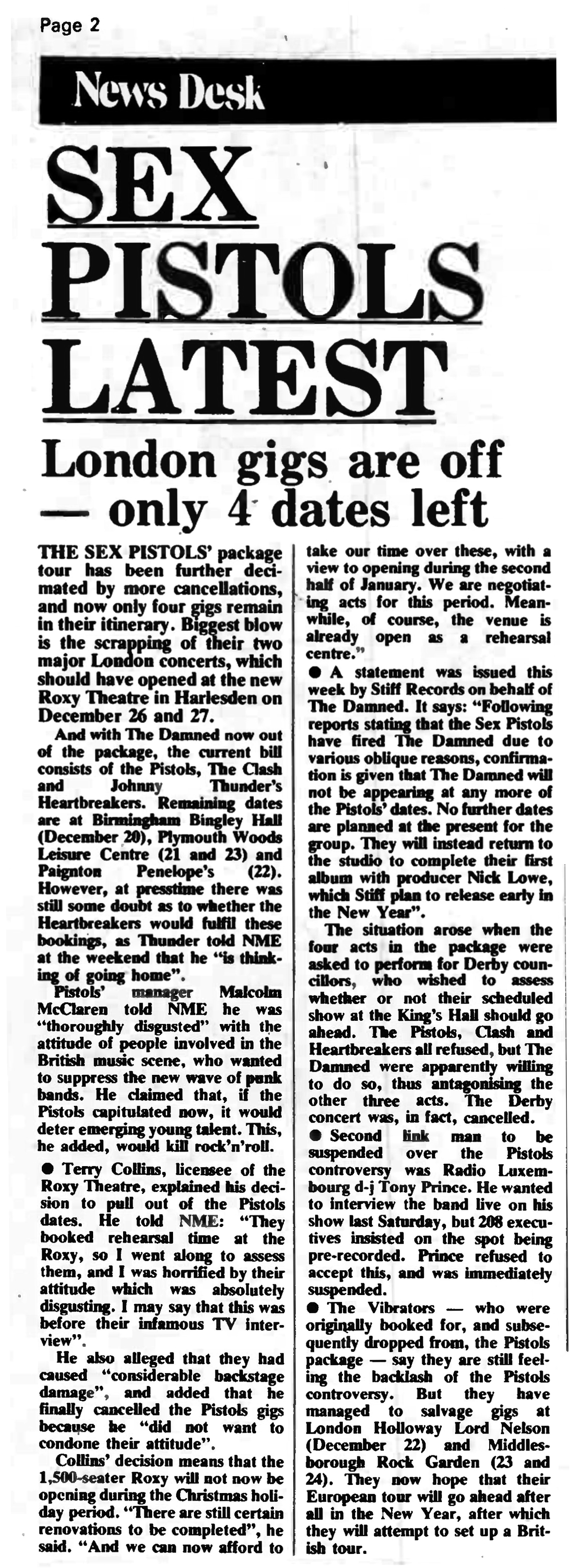


%20We%20feel%20like%20prisoners%20Punk%20Storm%20Grows/We%20feel%20like%20prisoners%20Punk%20Storm%20Grows.html/We%20feel%20like%20prisoners%20Punk%20Storm%20Grows_files%20copy/1_500h.jpg)
%20We%20feel%20like%20prisoners%20Punk%20Storm%20Grows/We%20feel%20like%20prisoners%20Punk%20Storm%20Grows.html/We%20feel%20like%20prisoners%20Punk%20Storm%20Grows_files%20copy/2_500h.jpg)
%20We%20feel%20like%20prisoners%20Punk%20Storm%20Grows/We%20feel%20like%20prisoners%20Punk%20Storm%20Grows.html/We%20feel%20like%20prisoners%20Punk%20Storm%20Grows_files%20copy/3_500h.jpg)
%20We%20feel%20like%20prisoners%20Punk%20Storm%20Grows/We%20feel%20like%20prisoners%20Punk%20Storm%20Grows.html/We%20feel%20like%20prisoners%20Punk%20Storm%20Grows_files%20copy/4_500h.jpg)

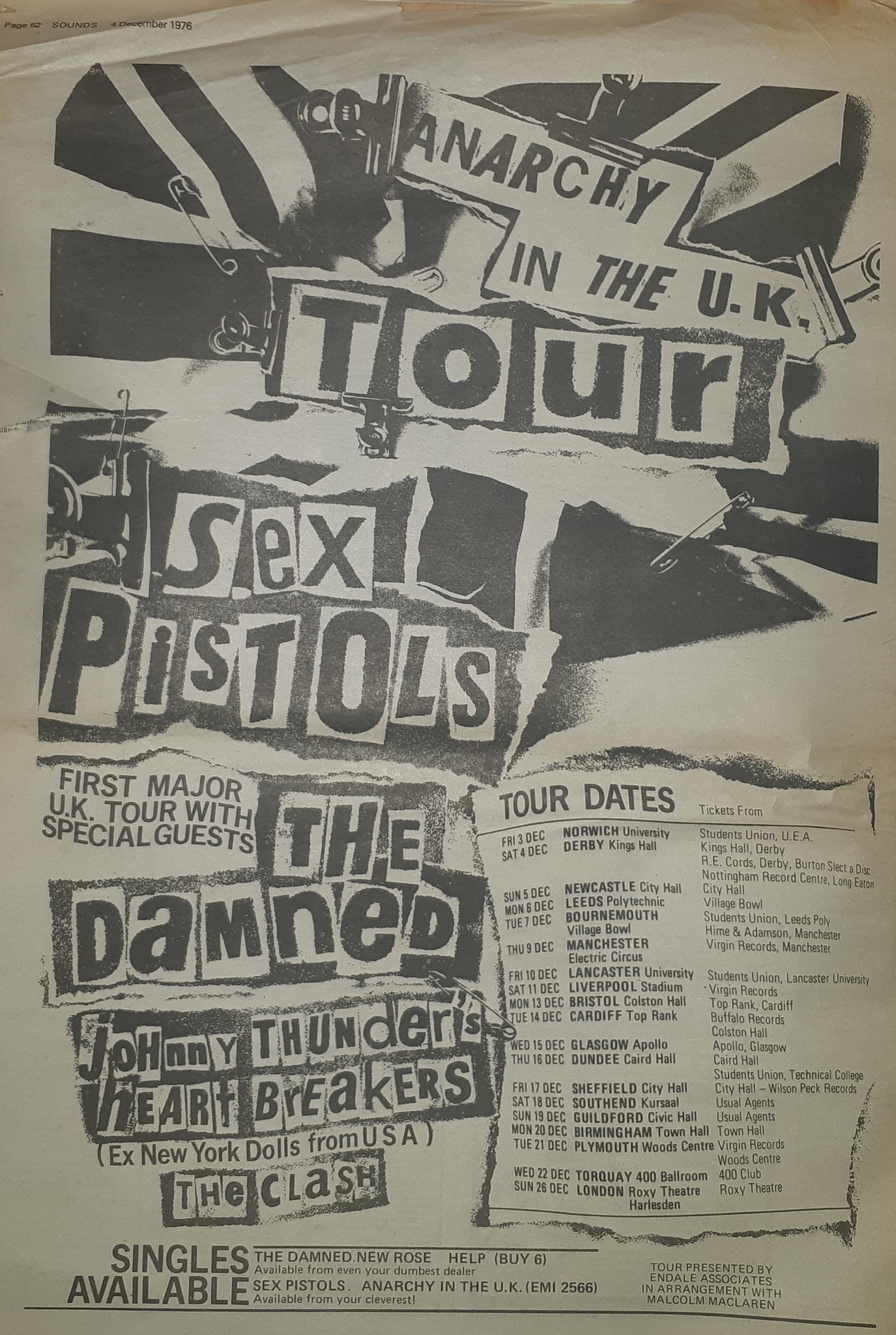
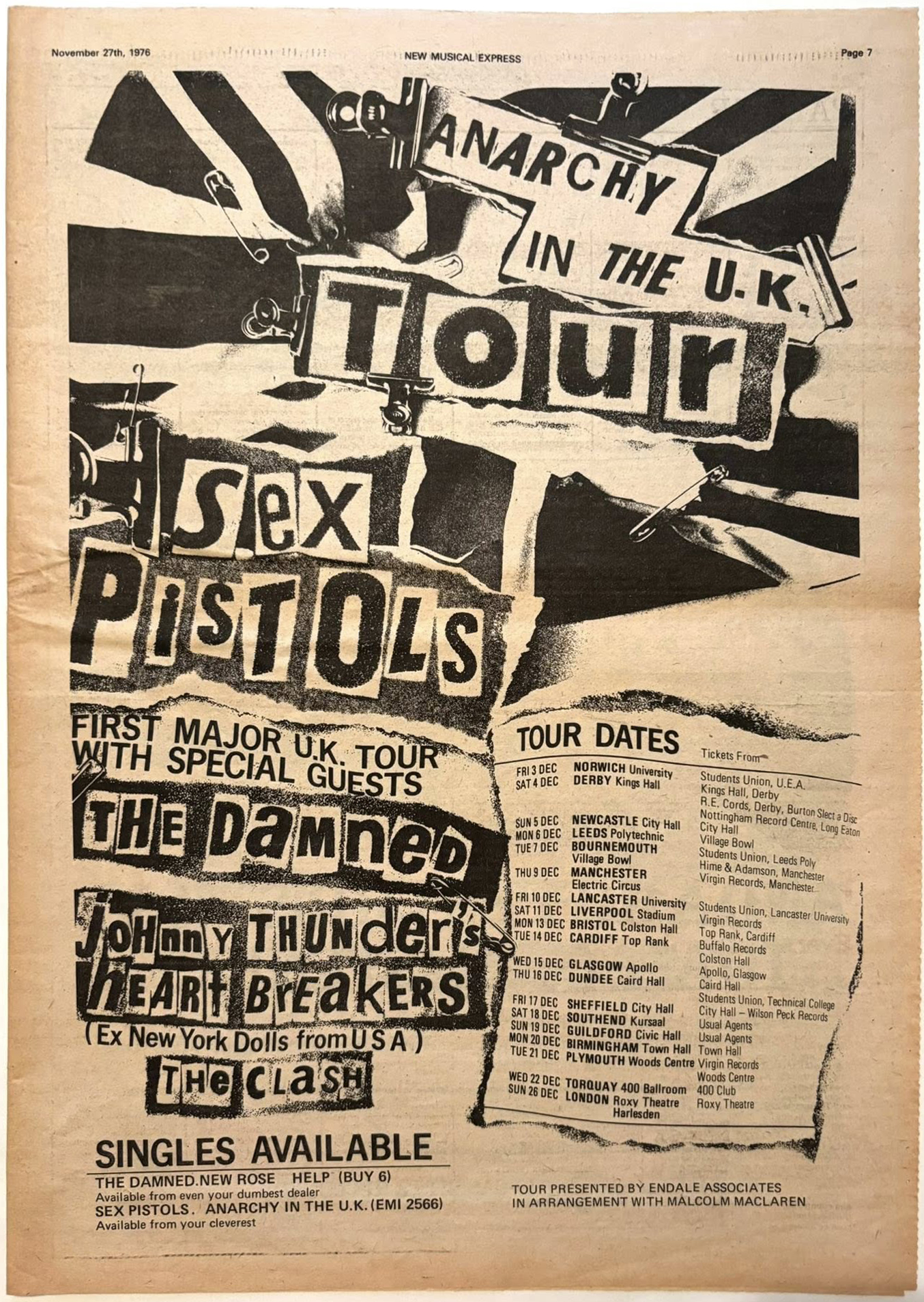
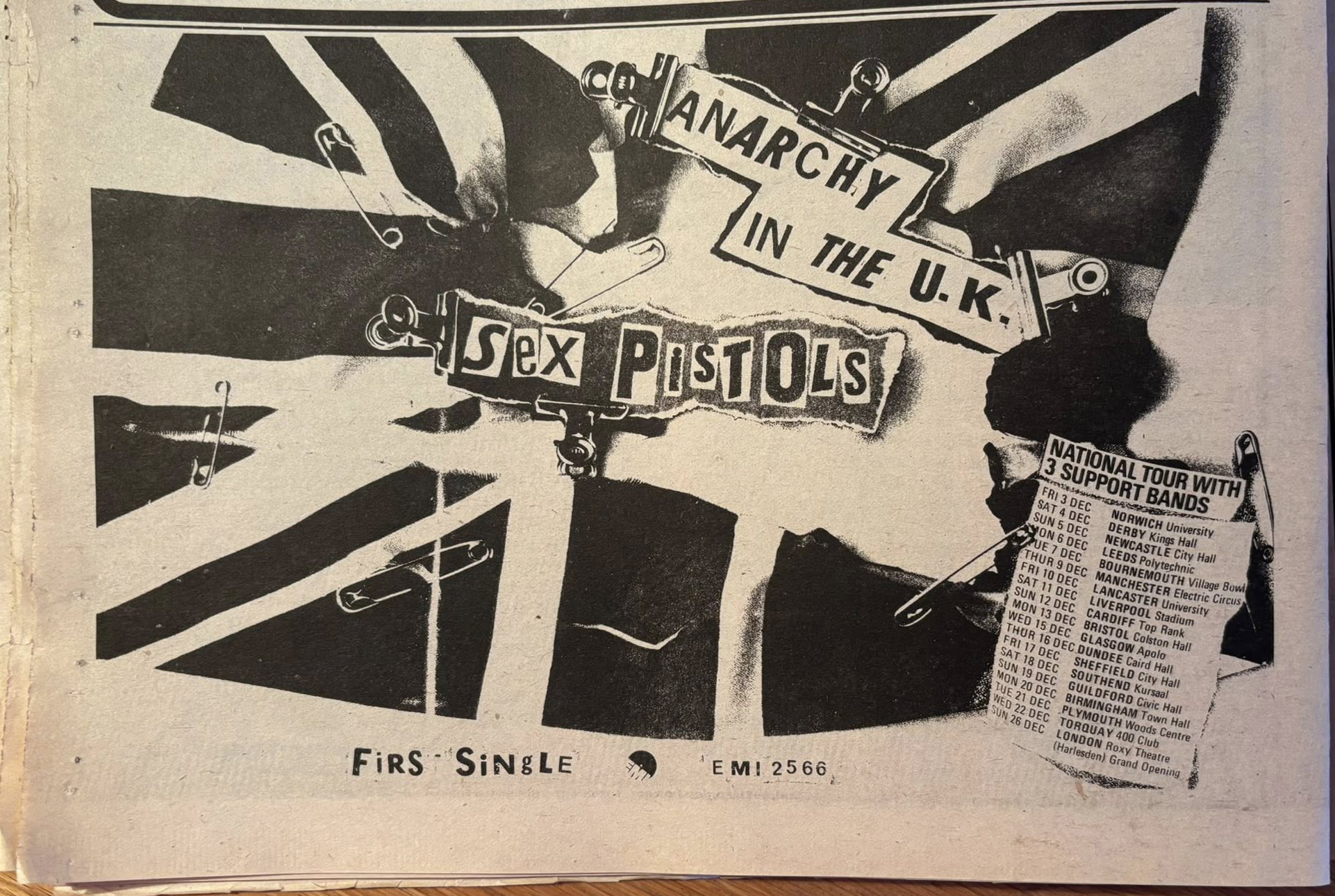
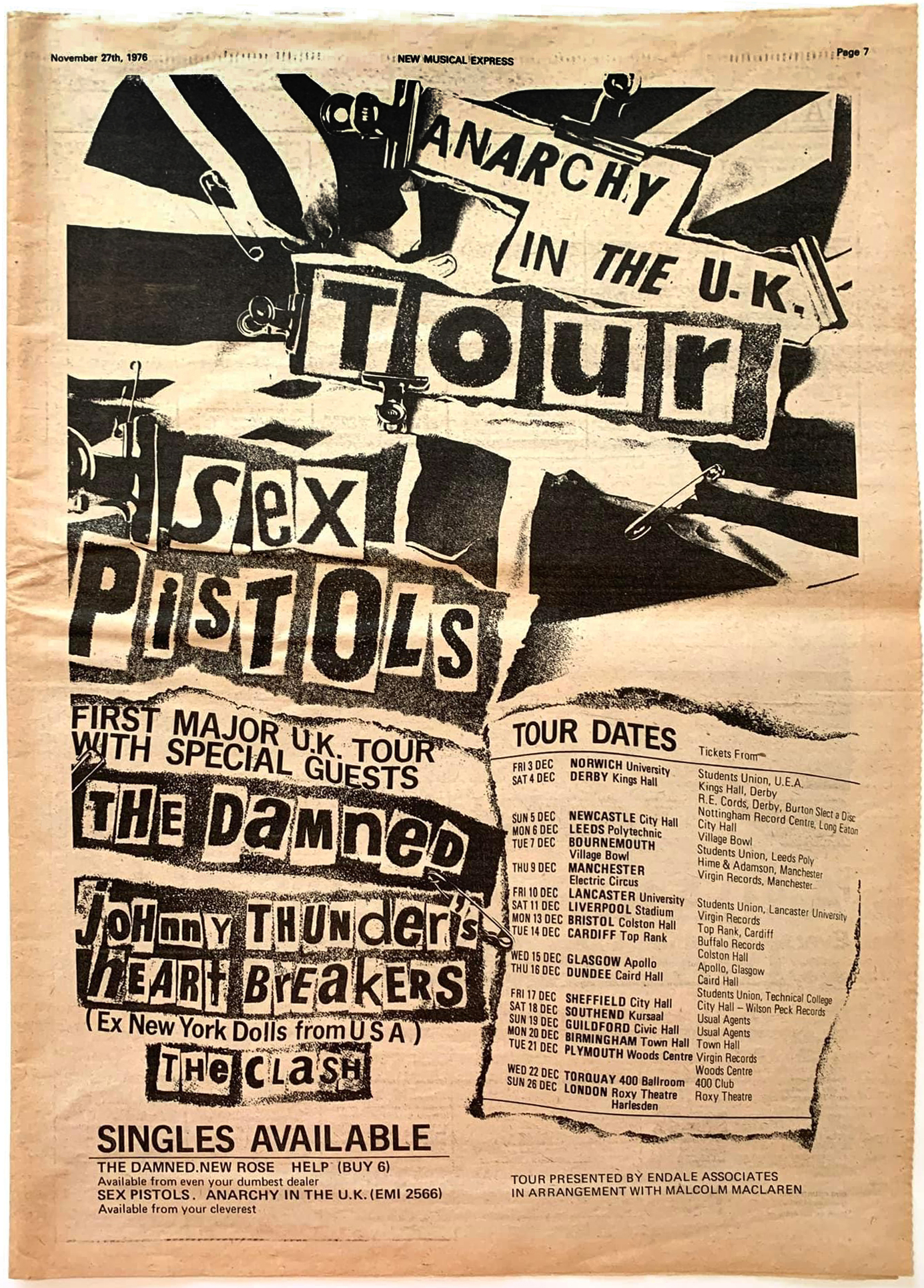


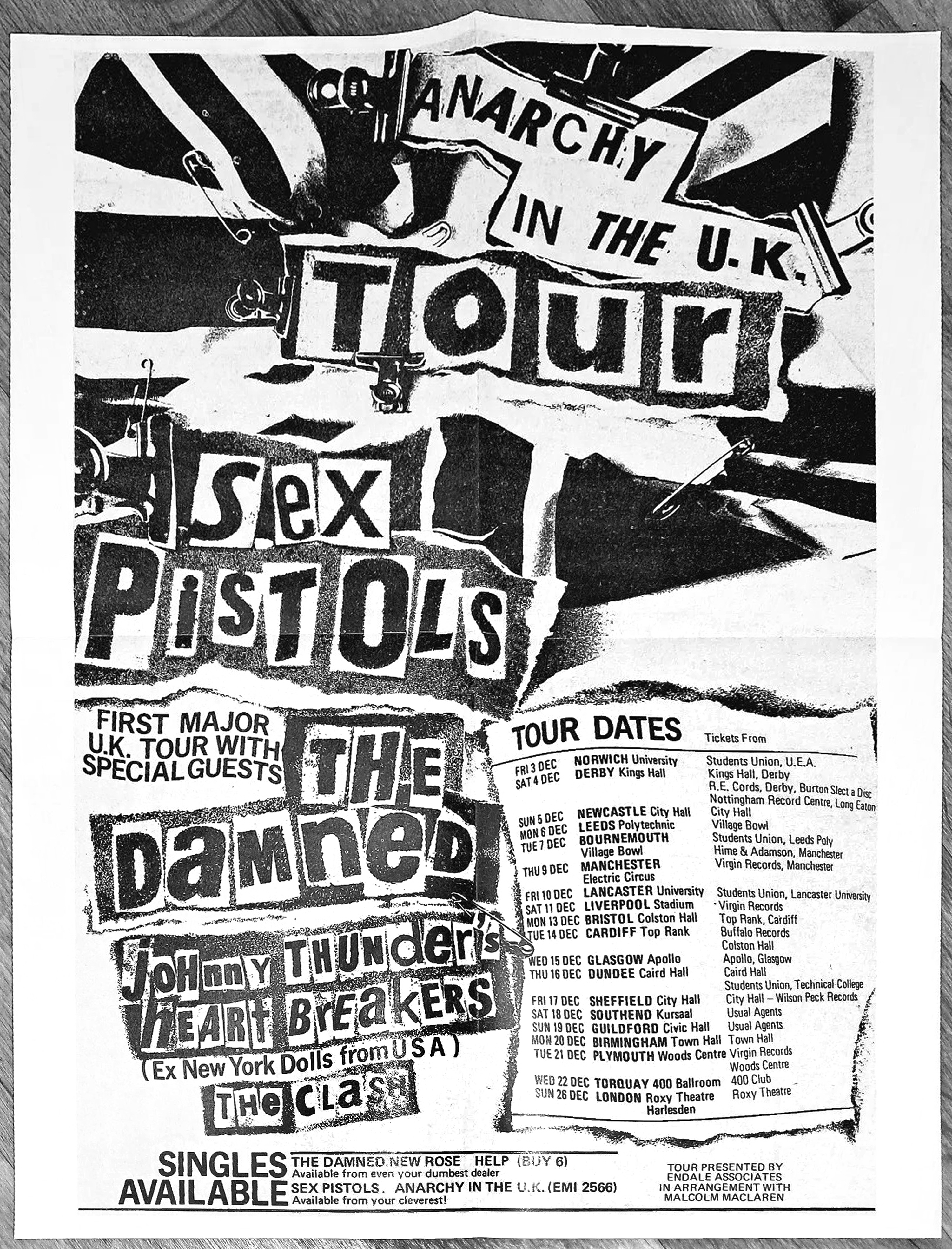


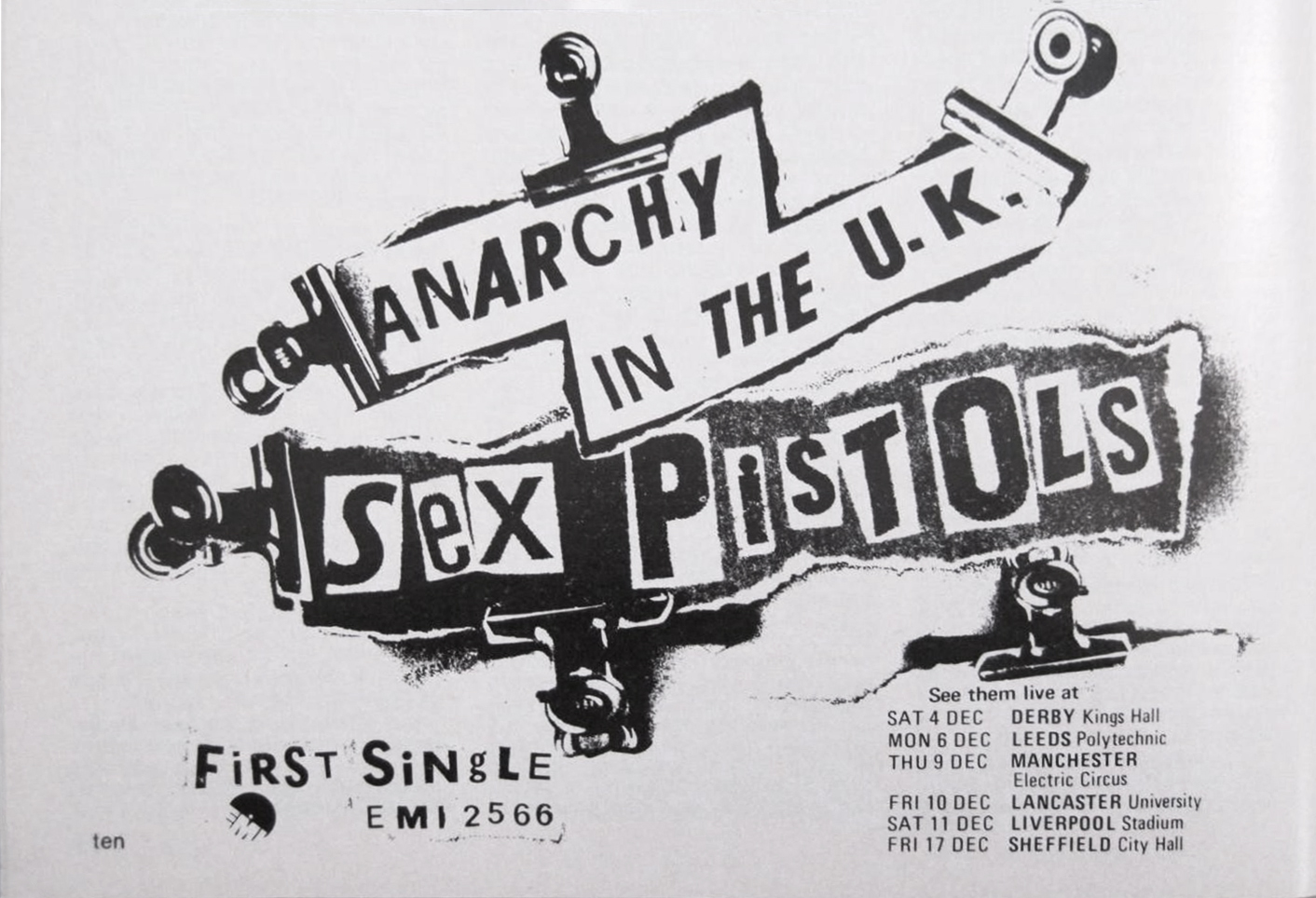
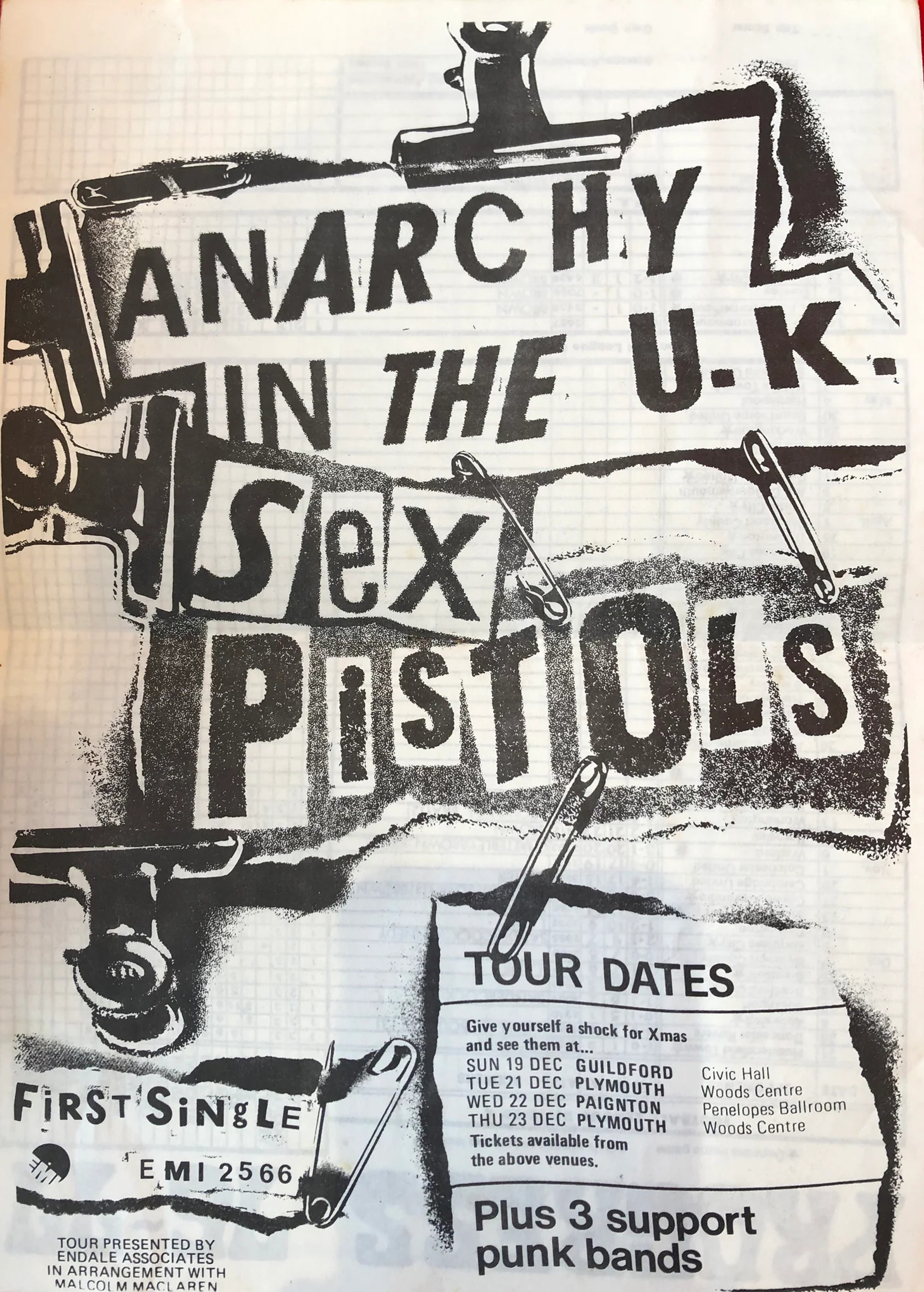

%201976%2012%2011/76-12-11%20National%20Rock%20Star%20Magazine%20(US-Canada)/Clash,%20'Student%20Chain%20Gang%20threatened%20our%20fans'%20claim,%20Sex%20Pistols%20Roxy.jpg)
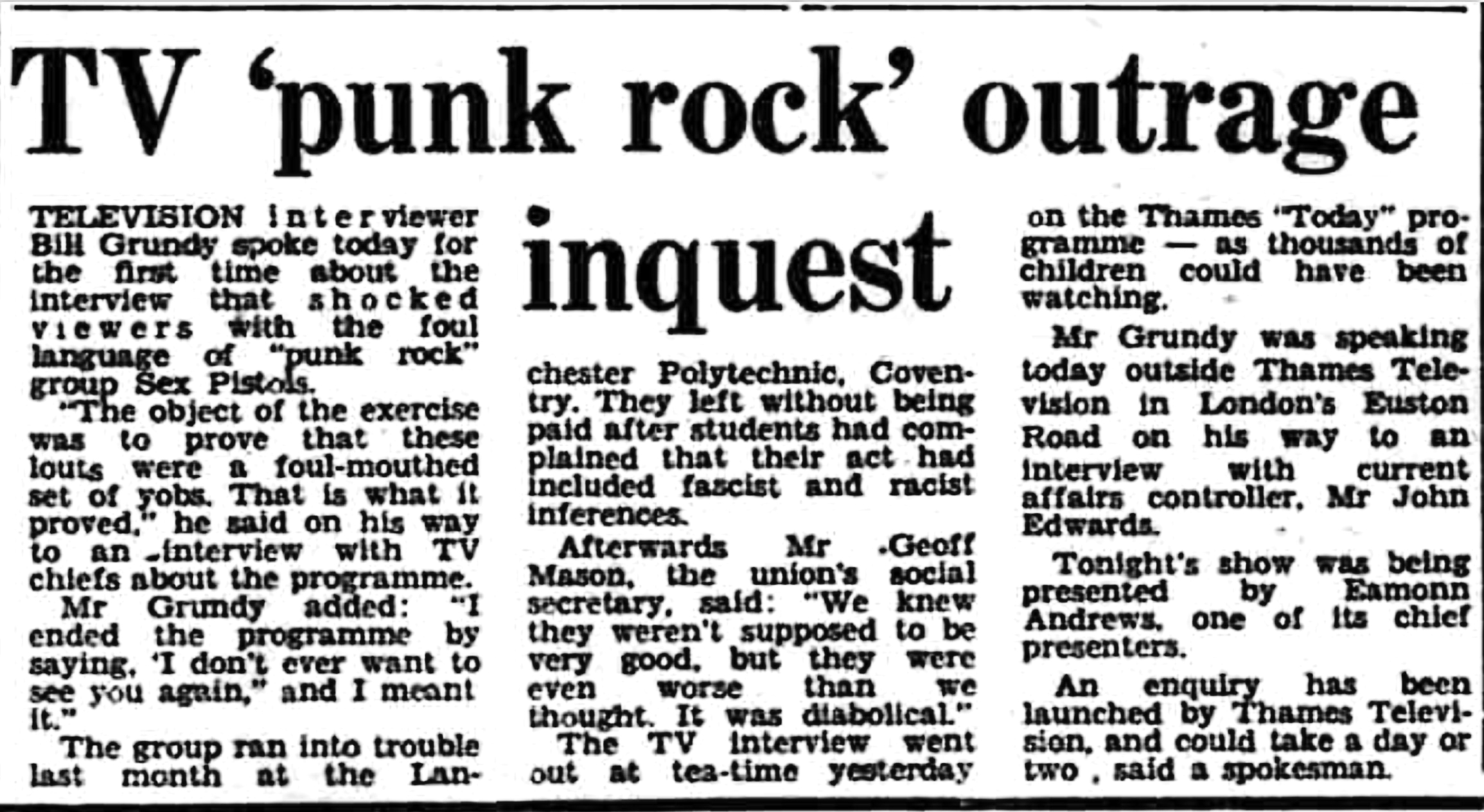
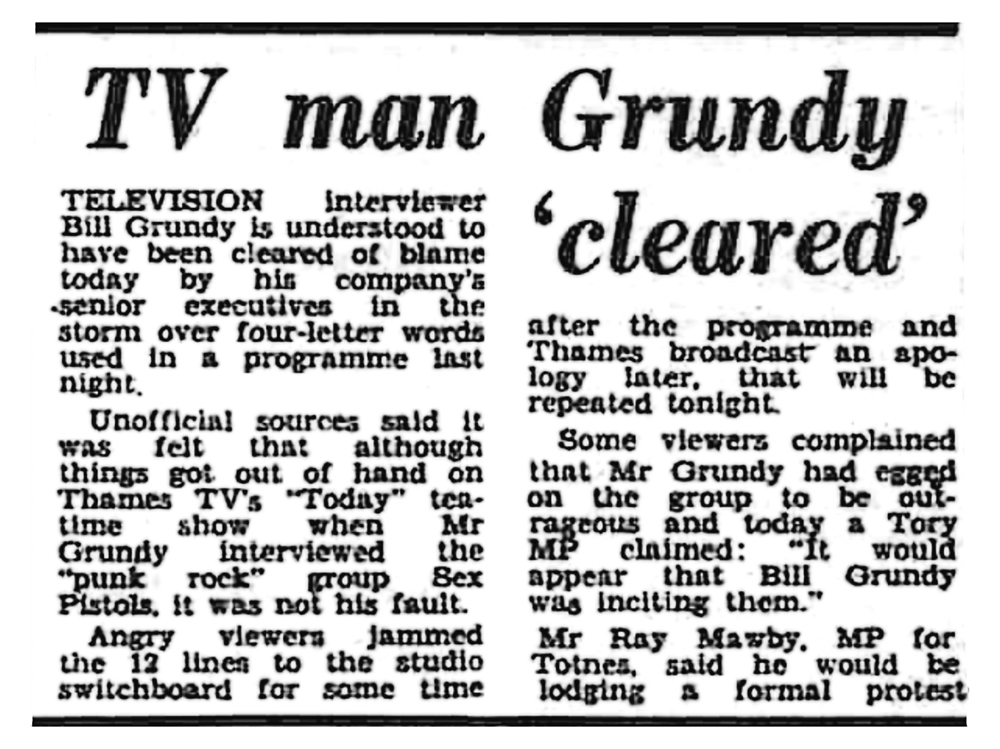
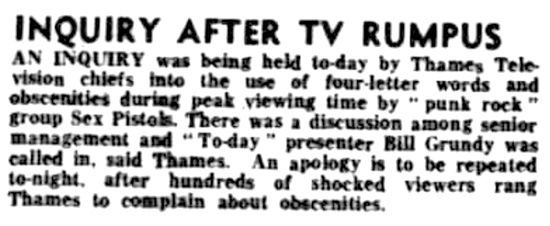


%20Best/ZIG-ZAG%201977%2004.html/ZIG-ZAG%201977%2004_files%20copy/0_500h.jpg)
%20Best/ZIG-ZAG%201977%2004.html/ZIG-ZAG%201977%2004_files%20copy/1_500h.jpg)
%20Best/ZIG-ZAG%201977%2004.html/ZIG-ZAG%201977%2004_files%20copy/2_500h.jpg)
%20Best/ZIG-ZAG%201977%2004.html/ZIG-ZAG%201977%2004_files%20copy/3_500h.jpg)


,%20JS%20int)/1.jpg)
,%20JS%20int)/2.jpg)

%20Punk%20Rock%20Explosion%20Caroline%20Coon%20Clash%20only/New%20Wave%20Punk%20Rock1.jpg)
/Punk%20The%20Whole%20Story.jpg)


/trakmarx_com_2004_05_05_needs_htm.jpg)
 [extract] "The four bands set out from London on a tour bus and drove off to play the first concert of the tour. Rather than the expected and highly anticipated tour of major concert halls, what actually followed was a tour of hotel rooms as they traveled from town to town, only to be told that each concert had been canceled, as each local council and promoter buckled to the media and public pressure in order to prevent these nasty punk bands from corrupting the young people of the United Kingdom.
 The boredom. We didn't know what the fuck was going on.
 All of these interviews were taped in 1988 and 1989, during the research for England's Dreaming: Sex Pistols and Punk Rock (London: Faber and Faber, 1991). At that time punk was only a decade old. Very few people were interested in the period, and so the interviews I got were at once vivid and untainted by layers of myth and historiography.
 The Anarchy tour was indeed in a state of flux. By midday Friday, instead of ferrying the Sex Pistols, The Heartbreakers, The Clash and their retinues to Norwich's East Anglia University for the opening show of the tour, the coach was still standing idle at the kerb on Denmark Street. While the beleaguered Sophie fielded calls from indignant council officials and anxious promoters over at Dryden Chambers, an equally irate Malcolm — sporting a silver-flecked fur coat that he'd purchased specially for the tour — was relating the constantly changing situation to the bemused musicians. He'd just spent the last half-hour or so cooped up in the public phone box outside St. Giles' Church on nearby St. Martin's Lane remonstrating with the ...