Summer 1977

European Dates


Intro
Index
Dates
Snippets
Posters
Adverts
UK Articles
US Articles
International Articles
Fanzines
Social Media
Magazines
Books
Photos
1977 Magazines
1977 Sundry


Dates

Page 4, Record Mirror, September 24, 1977

Clash leave for major European concert tour

NEWSDESK... NEWS IN BRIEF

THE CLASH leave for a major European concert tour on Monday, with dates in Holland, France, Austria, Ger-many and Sweden. The Damned will play with them in Zurich on October 1.

Enlarge image

Back to the Top


Snippets

Helen Bullen, Record Mirror, June 4, 1977, Mailman Letters Page

Letters: Punk Mum hits back

1977 Record Mirror column, the mother of Eater drummer Dee Generate defends the punk lifestyle against judgmental neighbors, celebrating her son's success and her own newfound musical passion.

Helen Bullen, Record Mirror, June 4, 1977, Mailman Letters Page

Letters: Punk Mum hits back

24 Record Mirror , June 4, 1977

Mailman

DEE GENERATE (Caption)

PUNK MUM HITS BACK

COULD YOU please give my address to Sandra Quick , the punk mum. I have a copy of RECORD MIRROR issue April 2 she can have. Being a punky mum myself I feel the same as her, and get spiteful remarks from neighbours. It was I who introduced my son to music, took him to concerts, brought his first drum kit, put up with the neighbours' complaints, introduced him to Rat Scabies , who in turn got him an audition with Eater . He is proud to be a member of a band and to be doing something with his life, and I am proud to have helped him.

Most of the people round where I live are so narrow minded that it's almost unbelievable. They think they are running their lives right and that gives them the right to criticise me. Elderly people who have never done anything with their lives, who have lived to conform, don't like to see young people who do better than they did. Or people who are drowning in marital boredom and court summonses and debt and young people who think it's big to go up the local pub with their fathers for darts' matches and see how quickly they can get as big a beer gut as dad.

I love the new interest my son has brought into my life. I used to love going to rock concerts, now I enjoy being involved behind the scenes and meeting famous interesting people — musicians, photographers, people who write for music papers, A&R men, people who are into doing what they enjoy. They are much better than "neighbours" who sit back and criticise because they have nothing better to do. I wouldn't swap my life for any of theirs. I hope Sandra , you do your thing and don't worry about anyone else, except the people you love.

Helen , Dee Generate's mum, Caterham , Surrey .

Enlarge image


Marc Bolan on New Wave and Punk: Record Mirror, August 6, 1977

MARK BOLAN ON THE SEX PISTOLS & THE CLASH

1977 Record Mirror piece, Marc Bolan distinguishes between "punkoid junk" and talented artists, specifically praising The Pistols , The Clash , The Jam , and The Damned for their originality.

Marc Bolan on New Wave and Punk: Record Mirror, August 6, 1977

MARK BOLAN ON THE SEX PISTOLS & THE CLASH

While we are on new waves, old waves and punk I think it is time to take a stand. New wave and punk are just words thrown up by the media in an attempt to bag a new generation and some fresh energies. But I am getting sick of some of the moronic, talentless new groups joining the bandwagon, after it has rolled past, with nothing to recommend them but the age - old ability to join in after it’s too late. So from here on I am drawing the line between the punkoid junk, and some of the stupid violence that accompanies it, and genuinely talented people with something new to say. The Pistols , the Stranglers , the Jam , the Damned , the Clash , Generation X and the Boomtown Rats fall in this talented category.


Bolan, Marc , Record Mirror , June 4, 1977 , Page 6 , "The music of now is NOISE !"

Mark Bolan on the Clash Tour and advert Sex Pistols single

Marc Bolan champions the energy of the 1977 punk explosion, drawing parallels to glam rock and R&B . He discusses the financial realities of touring, fashion trends, and the genre's future. Rainbow gig & ST album. Also innludes God Save The Queen 7" advert.

Bolan, Marc , Record Mirror , June 4, 1977 , Page 6 , "The music of now is NOISE !"

Mark Bolan on the Clash Tour and advert Sex Pistols single

STARTS THIS MONTH... AND EVERY MONTH... ONLY IN RECORD MIRROR!

- The music of now is NOISE !

- I like three or four loud, proud dudes erupting in three chord frenzies
- I can't see how anyone made a penny out of The Clash tour
- Loudness and energy is a great asset in the States
- The time is now right for Iggy
- Rock becomes like the Hollywood star system
- Brand new bleached jeans ain’t a new look

I LOVE the raw-edged energy and freshness new wave has brought to the British rock scene. The music of now is NOISE , be it beautiful, elaborate, complex, clean or bestial, primitive, political or raw. It’s a wild mixture of the whole lot — such cute noise from those Gibson and Fender toys!

I can understand some people being uncertain as to its place in the history of rock, but when I think back to the R&B boom — The Stones , Kinks , Beatles , The Who and many other such groups, they seemed very savage at the time.

Then you had the heavy metal boom, with groups like Led Zeppelin which appeared to be a whole new revolution in sound with skyscraping Marshall stacks.

Frenzies

And then there was glam rock. That was me, Bowie , Alice Cooper and a couple of other people. In fact, it’s got very similar roots to punk rock, if you look back.

Firstly, let's kick out one thing — the word punk to me is a totally irrelevant name for a very important stance of freshness, image plus its rock roots. I like the idea of three or four proud, loud dudes erupting in three chord frenzies and the explorative trip from $C$ to $A$ minor.

Can you imagine what it does to young new wave heads when they find out that there are symphonies in rock ’n’ roll too?

To me, it will always be the teenage dream personified. In this stale time for rock and roll maybe we’ll get freedom through punk. Let’s hope they try and do what I tried in the beginning and get the prices of tickets and records down and all that.

This terrible thing exists about instant wealth. People think that just because you fill a couple of concerts and get an album in the charts, you’re automatically rich. The implication is that if a group is successful they can no longer be punk. And if a group plays at the Rainbow like the Clash ... they also had FIVE groups on the bill with them, so I can’t see how anyone made a penny. Half the place was ripped to pieces and that has to be paid for.

Clash may have an album in the charts — fine — but even in my Tyrannosaurus Rex days when I had had four hit albums, by the end of that time I was super skint — and I’d made about 10 grand!

That sort of success didn’t change my life. I still lived in Notting Hill Gate , and so will these guys. You don’t instantly get showered in platinum albums and millions of Rolls Royces . That’s a fantasy. You work twice as hard, do twice as many gigs, get twice as many roadies and end up with twice as many headaches. But hopefully, make music that’s twice as good.

Beer belly

Sometimes you lose the music completely, because the only thing you get given you is lots of booze. It's automatically made available and you practically become an alcoholic. Take Rat Scabies ... he was on my tour for three days and got a beer belly. And he worked it off!

The long-term effects of punk rock will be exactly the same as those of glam rock. Major figures will emerge and will last as long as this planet does, like the Stones — who seem to last for ever...

And, there are a lot of groups who will never make it. Recently I mentioned that I would like to produce a new wave band in an interview and I got about a million tapes sent to me, most of which are rubbish. But I would still love to produce a good new wave band and give them freedom. If you can play three chords really fast doesn’t make you good, but I think that’s already been established.

It will probably take a year for the British new wave to be marketable in America simply because nearly all those groups are loud and have a lot of energy — that’s a great asset in the States .

And there are others — take Iggy Pop for example. He’s just broken big in America . His album went straight into the charts at Number 50 . He is amazing!

The time is now right for Iggy . He’s a very mature artist, great on stage and by far out Jaggers Jagger . He is a much bigger talent on stage and for once he has a record company behind him.

The Clash success has a lot to do with the CBS people, they did a very good job. The only reason that The Damned’s album didn’t go Top 10 was because it was the first.

So where does new wave leave me and my friends? It’s not going to affect the sales of Led Zeppelin’s records, nor is it going to stop Abba selling. New wave is a whole different section of a new market.

Led Zeppelin are currently doing a very successful tour of the States . They’ll go on to become the musical equivalents of Paul Newman , Steve McQueen and Robert Redford — then you have Al Pacino and James Caan and under them you have the new stars like Richard Dreyfus . Rock becomes like the Hollywood star system.

Bleach

It follows the same pattern of maturity and success. It does change — Led Zeppelin matured, T Rex are in the middle. Give me two more years and I’ll be mature. I’m not a punk and I don’t profess to be one. I’m not 18 and living on a council estate, I’ve done that, that’s why I can understand it but I have no category because I’m a classless person.

The punk fashion scene is also interesting. I was the first person to have Levis and then, they were a very important thing to own. I used to put a brand new pair of jeans into a bowl of bleach to get all the holes in them, so that ain’t a new look.

I wore leather jackets then. I always had a zip-up leather jacket. It was part of the look. But there was two looks — you had one for one day and the next you’d wear suits like The Jam . I just had to vary the styles a bit... I had imagination.

In the same way that I can now talk about the new sound I can go home and listen to 'My Baby Left Me' by Elvis Presley and get just as much satisfaction. In fact, I've got a song called 'Mona' from the new Beach Boys album which I think is phenomenal. I played it 25 times this morning and they're supposed to be a dinosaur group!

Open page in new window


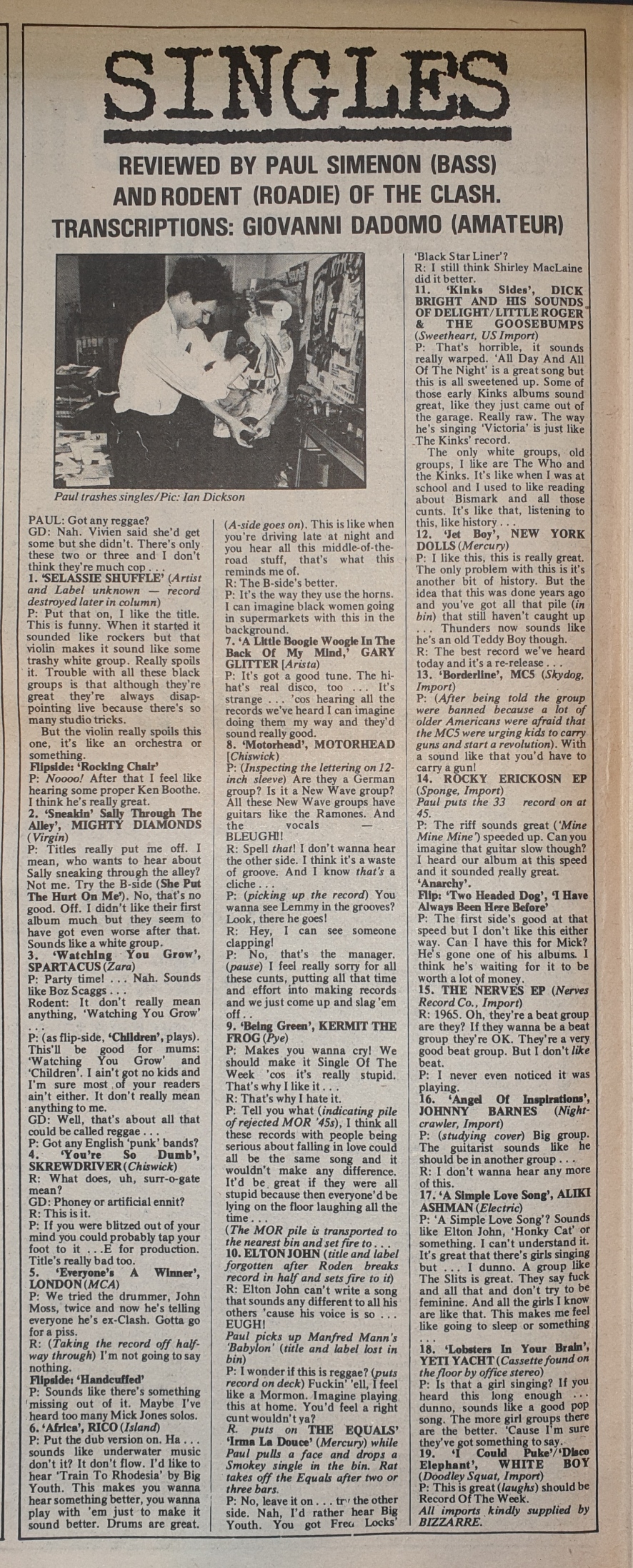
Paul Simonon, Sounds 25th, June 1977, Singles Reviews

Singles reviewed by Paul Simonon of The Clash in

Link to full review

In this brief record review, Paul Simonon dismisses a Hot Chocolate single. He mockingly mentions drummer Jon Moss future Culture Club drummer who auditioned for the Clash but now claims he was a Clash drummer!

5. 'Everyone's A Winner' , LONDON ( MCA )

P : We tried the drummer, Jon Moss , twice and now he's telling everyone he's ex- Clash . Gotta go for a piss.

R : (Taking the record off halfway through) I'm not going to say nothing.


Editor, Record Mirror , June 4, 1977 , Page unknown, Ex- Clash hits London

John Moss new band Ex Clash

LONDON : single out Friday

Ex-Clash hits London

MCA RECORDS have signed London , currently supporting The Stranglers on their British tour.

They have a single rush released on Friday 'Everyone's A Winner'. The band comprise ex- Clash drummer John Moss , Dave White on guitar, Steve Voice on bass and Riff Regan vocals.

Enlarge image


Author: Luicy (Columnist), Record Mirror, Date: June 11, 1977, Page: N/A, Juicy Luicy

BERNIE RHODES ATTACKS JOHN MOSS

This column dishes on London's 1977 punk scene, covering Blondie's party, Pat McGlynn's new band, Sid Vicious' beef with Roger Daltry , and Bernard Rhodes denying Jon Moss was in The Clash .

Author: Luicy (Columnist), Record Mirror, Date: June 11, 1977, Page: N/A, Juicy Luicy

BERNIE RHODES ATTACKS JOHN MOSS

FORGET THE Jubilee street parties (and I expect you all have by now thank goodness) the parties happening around here have been thick on the ground and occasionally thicker at head level.

First there was the little bash the Heartbreakers held for Blondie . So chic — they decided to have their little bash in Islington (so close to nature I always think). Present at the soiree were Wayne County and his group, one of whom fell off a balcony onto the crowd below. No injuries were reported. Also there were The Boys and Dave Vanian of the Damned . And there were STILL no injuries.

Then there was the miniscule party held for the unfrocked Roller , Pat McGlynn . He's not been brooding on his undignified departure from that elite little band, that's obvious. He's promptly got his own band sorted out and signed for Decca . His group are called Scottie and just so you don't forget, they all wear that slogan, plus their own names blazoned across, what could have been perfectly nice, Fair Isle sweaters. And I didn't say they were the ones with an identity crisis.

Pat declined, in his own inimitable articulate way, to say what the cause of the rift had been. We can only guess my dears. We pondered on the subject while we sipped our orange squash (having been told that real orange juice was too expensive for gatherings of this sort).

And talking of personality clashes (were we?) it seems that Roger Daltry isn't too pleased with certain comments about himself that have been voiced in print by the Pistols' Sid Vicious (another articulate young wit). It seems that Mr Daltry would like to discuss these remarks in private. Behind closed doors. Far away from the witnesses or indeed officers of the law. Could this mean violence?

I've just heard from Bernard Rhodes , manager of the Clash , and he's a bit upset about the credentials of a certain Mr John Moss . John has just joined London (haven't we all?) and the history attached to the gent gives his pedigree as ex- Clash . Mr Rhodes would like to make it clear that John was not a member of Clash. In fact, said Bernard , they auditioned 200 drummers for Clash, none of whom were suitable, and this is where the misunderstanding may have occurred.

Have you heard the ad on TV for Wimpy (the hamburger not the building constructors). It's such a brilliant ad, it could be a very successful single. Why haven't they thought about releasing the tune? If David Dundas can do it for jeans, Wimpy should take over the world. Mine's a shanty — I've always had this thing about sailors.

Well, I know times are hard for bands, but they do find ways of making money. Burlesque have just sold their touring limo to a Dutch promoter for £500 . And they only paid £350 for it.

Talking of foreign parts (aren't they divine?), new wave band 999 are planning a trip to Cyprus . As if they haven't enough problems over there, a Cypriot promoter is going to fly them out to Nicosia for a couple of dates, so impressed was he by their performances in London . But will they be a Turkish Delight ?

A recent survey has shown...

Enlarge image


Jill Palmer , Daily Mirror , July 26 1977, Page Unknown, "EUROPUNKS STORM IN FOR LONDON FIGHTS"

Europunks storm in for London fights

EUROPUNKS STORM IN FOR LONDON FIGHTS

By JILL PALMER

LONDON is fast becoming a battleground for punk rockers and teddy boys from the Continent .

They are crossing the Channel armed with flick-knives, knuckle-dusters and cut-throat razors, and itching for action.

Yesterday a special warning was given to immigration men at Britain’s ports in an attempt to stamp out the pitched battles.

The officials were urged to make special searches for weapons when punks and teds arrive in the country.

Consulates were warned that foreign youths could end up in detention centres if they became involved in street clashes.

The warning came after the fourth consecutive weekend of running battles between British and Continental punks and teds in King’s Road , Chelsea .

"This must stop before somebody is killed or maimed," said Alan Silverman , chairman of Chelsea Juvenile Court .

Among the youths who appeared in court yesterday was a 15-year-old French ted who was fined £5 and sent back to Paris for carrying a razor.

This 1977 article reports on escalating violence in London as European punks and teddy boys travel to Chelsea armed with weapons, prompting authorities to increase border security and legal warnings.

Link (clipping) - full page


Rock en Stock #3 (french fanzine) June 1977

Letters page "CLASH FLASH"

This 1977 review by Christian Louis hails The Clash as a revolutionary "war group" redefining rock with Jamaican influences and raw energy, far surpassing the era's stale pop culture.

Rock en Stock #3 (french fanzine) June 1977

Letters page "CLASH FLASH"

Translation of "CLASH FLASH"

Clash is coming! Punk is born or punk is dead, but rock’n’roll is finding its violence again. We are far from the poets in clubs or the anti-Queen provocateurs. Clash reeks of industry, old England , its anti-Nazi aviators, and its heroic beer drinkers. The Clash don't wear sneakers but big boots to walk on the English filth. These aren't kids; they are cosmic madmen decked out in medals and mini-flags that no longer mean anything. They are the Kids of an England that no longer believes. Hippies, drugs, TV, cars— Clash rejects everything in its destructive fury. Today's Kids live to assassinate comfort and old fetishes. In this black storm, only rock’n’roll remains, and the Clash play it wonderfully.

You have to see these three hysterical puppet-guitarists on stage, possessed by a violence that exceeds them. They move in every direction and slam their three guitars (it took five for Blue Oyster Cult to do as much) under the hammering of the blacksmith drummer, the blond and lanky Tory Crimes . In front of him, Paul Simonon on bass rumbles in his cheap biker jumpsuit. Mick Jones is neither Wilko Johnson nor Mick Green , but a bit of both. A failing hero of a degenerate rock’n’roll, he writes the compositions with Joe Strummer , the king of the break who has a raspy voice and who loves Johnny Hallyday , he tells us! It’s true that Joe has the face of a charming rockabilly and a way of bending his legs that Elvis Presley wouldn’t have disowned in 1956.

Clash is a war group that would appear like a poster on a khaki background cover, with its name in the foreground in blood red. Rock’n’roll is a ceremony, a black war. The Clash are not stars; they are fighters, officiants who serve their music to the public. Some rhythms come from Jamaica . The Rock International has struck again against all private property of music. Thanks to our brothers from the Caribbean . "Police and Thieves" ( Gendarmes et voleurs ) synthetic reggae with a heavy bass and a brilliant solo. There is a lot of the spontaneity of the Dolls in short and mean tracks like "Janie Jones" / "White Riot" , "48 Hours" . What punk owes nothing to the Dolls ? Other successes of the LP bring to mind the warm voices and syncopated rhythms of Blue Oyster Cult , "Remote Control" , "Cheat" , "Protex Blue" . Even if they've had enough of it— "I’m so bored with the U.S.A." ( The U.S.A. pisses me off )— Clash is obsessed with America , and not just that of the Caribbean ; it’s from the atomic energy of American groups that they draw their rock.

An armored bomb coming from England , exploding in the saturated horizon of the seventies. Don’t miss the Clash bomb!


Bien joué Alain, je crois que tu as tout compris...

« CLASH FLASH »

Clash arrive ! Lepunk est né ou le punk est mort, mais le rock’n’roll retrouve sa violence. On est loin des poètes en boîtes ou des provocateurs anti-queen. Clash pue l’industrie, la vieille Angleterre , ses aviateurs anti-nazis et ses buveurs de bière héroïques. Les Clash ne portent pas des baskets mais des grosses pompes pour marcher sur la merde anglaise. Ce ne sont pas des gosses, ce sont des déments cosmiques bardés de médailles et de mini-drapeaux qui ne signifient plus rien. Ce sont les Kids d’une Angleterre qui n’y croit plus. Les hippies, la drogue, la télé, les bagnoles, Clash rejette tout dans sa furie destructive. Les Kids d’aujourd’hui vivent pour assassiner le confort et les vieux fétiches. Dans cet orage noir, il ne reste que le rock’n’roll et les Clash le jouent à merveille.

Il faut voir sur scène ces trois guitaristes-pantins hystériques, possédés par une violence qui les dépasse. Ils s’agitent dans tous les sens et claquent leurs trois guitares (il en fallait cinq au Blue Oyster Cult pour en faire autant) sous le martèlement du batteur forgeron, le blond et longiligne Tory Crimes . Devant lui ; Paul Simonon à la basse vrombit dans sa combinaison de motard bon marché. Mick Jones n’est ni Wilko Johnson , ni Mick Green mais un peu des deux. Héros défaillant d’un rock’n’roll dégénéré, il signe les compositions avec Joe Strummer , le roi du break qui a une voix rugueuse et qui aime Johnny Hallyday , nous dit-il ! C’est vrai que Joe a une gueule de rockabilyer de charme et une façon de fléchir les jambes qu’ Elvis Presley n’aurait pas renié en 1956.

Clash est un groupe de guerre qui apparaîtrait comme une affiche sur la pochette au fond kaki, avec son nom au premier plan en rouge sang. Le rock’n’roll est une cérémonie, une guerre noire. Les Clash ne sont pas des stars, ce sont des combattants, des officiants qui servent leur musique au public. Certains rythmes viennent de la Jamaïque . L’Internationale du rock a encore frappé contre toutes les propriétés privées de la musique. Merci à nos frères des Caraïbes . « Police and thieves » ( Gendarmes et voleurs ) reggae synthétique avec une lourde basse et un solo éclatant. Il y a beaucoup de la spontanéité des Dolls dans des morceaux courts et méchants comme Janie Jones / White riot , 48 hours . Quel punk ne doit rien aux Dolls . D’autres réussites du LP font penser aux voix chaudes et aux rythmes syncopés du Blue Oyster Cult , Remote control , Cheat , Protex blue . Même s’il en a sa claque « I’m so bored with the U.S.A. » ( Les U.S.A. m’emmerdent ) Clash est obsédé par l’ Amérique et pas seulement celle des Caraïbes , c’est dans l’énergie atomique des groupes américains, qu’il puise son rock. Une bombe blindée qui vient d’ Angleterre , explose dans l’horizon saturé des seventies. Ne ratez pas la bombe Clash ! Christian LOUIS Photos Michèle Buray Christian Louis , 11 Square Albin-Cachot 75013 - Paris

Beaucoup de nos lecteurs nous demandent s’il est possible de participer au journal. Nous sommes entièrement « POUR » , « Rock En Stock » est tout d’abord la revue de ceux qui la lisent. Merci Christian pour ton article sur les « Clash » . Vous qui lisez « Rock en Stock » n’hésitez pas à nous faire parvenir vos articles, nous n’hésiterons pas à les passer, surtout lorsque ces articles correspondent parfaitement à l’optique de « Rock en Stock » . Les photos que tu nous fais parvenir sont d’exceptionnelles qualités et nous sommes content d’en publier ici quelques une ( Clash au Palais des Glaces ). Nous préparons un gros dossier sur les groupes français existants ou ayant existés et nous serions heureux de recevoir toutes documentations les concernant de près ou de loin.

Enlarge image


Steve Connelly , Tour Itinerary Notebook , October 1977, pp. 1-2, " TOUR DATES. "

Clash roadie Steve Connelly's tour book

This image contains a handwritten tour itinerary from late 1977, likely belonging to a crew member or manager for a band (historically associated with The Sex Pistols or The Slits during their United Kingdom and Europe runs). It was auctioned in 2014 for $15.60.

One page only! If you have the other pages, please could you send scans to us.

TOUR DATES.

EUROPE

26th PARADISO, AMSTERDAM, HOLLAND
27th
28th (PARIS T.V.) } FRANCE.
29th PARIS.
30th RHEIMS.
1st OCT. ZURICH SWITZERLAND.
2nd VIENNA AUSTRIA.
3rd
4th MUNICH. } GERMANY.
5th FRANKFURT
6th HAMBURG
7th MALMO
8th RONNEBY / STOCKHOLM ? } SWEDEN.
9th OREBRO

UNITED KINGDOM

OCT.

20th ~~ DUBLIN STADIUM. ~~ } BELFAST *
21 ~~ CORK T.B.A. ~~ } EIRA / DUBLIN. *
22 BELFAST ULSTER HALL. LIVERPOOL STADIUM.
23
24 NEWCASTLE POLY. DUNFERMLINE * KINEMA ( BILL DOUGLAS. )
25 GLASGOW APOLLO.
26 ~~ EDINBURGH ODEON. ~~ LEITH THEATRE *
27 LEEDS UNIVERSITY.
28 NEWCASTLE POLY *
29 MANCHESTER APOLLO.
30 STOKE VICTORIA HALLS.
31

  • NOV.

    1 SHEFFIELD TOP RANK *
    2 BRADFORD UNIV. *
    3 DARBY KINGS HALL *
    4 CARDIFF UNIVERSITY *
    5 ~~ IPSWICH CORN EXCHANGE ~~ *
    6 ~~ NORWICH ST ANDREWS HALL ~~
    7 ~~ BIRMINGHAM ODEON. ~~ GAUMONT?

    A Silvertone memo book containing nineteen pages of handwritten notes regarding The Clash's first European tour from their trusted roadie Steve "Roadent" Conolly. The notes include addresses (including one for John Lennon's Dakota New York address), phone numbers and guitar/amplifier/instrument lists, etc. Featured is an itinerary of European and UK tour dates for The Clash. These includes dates from September 26th through December 20th. Measures 4 x 6.25, some of the pages are detached from the binding. Comes with a Gotta Have Rock & Roll Certificate of Authenticity.

    Enlarge image

    Back to the Top


    Posters

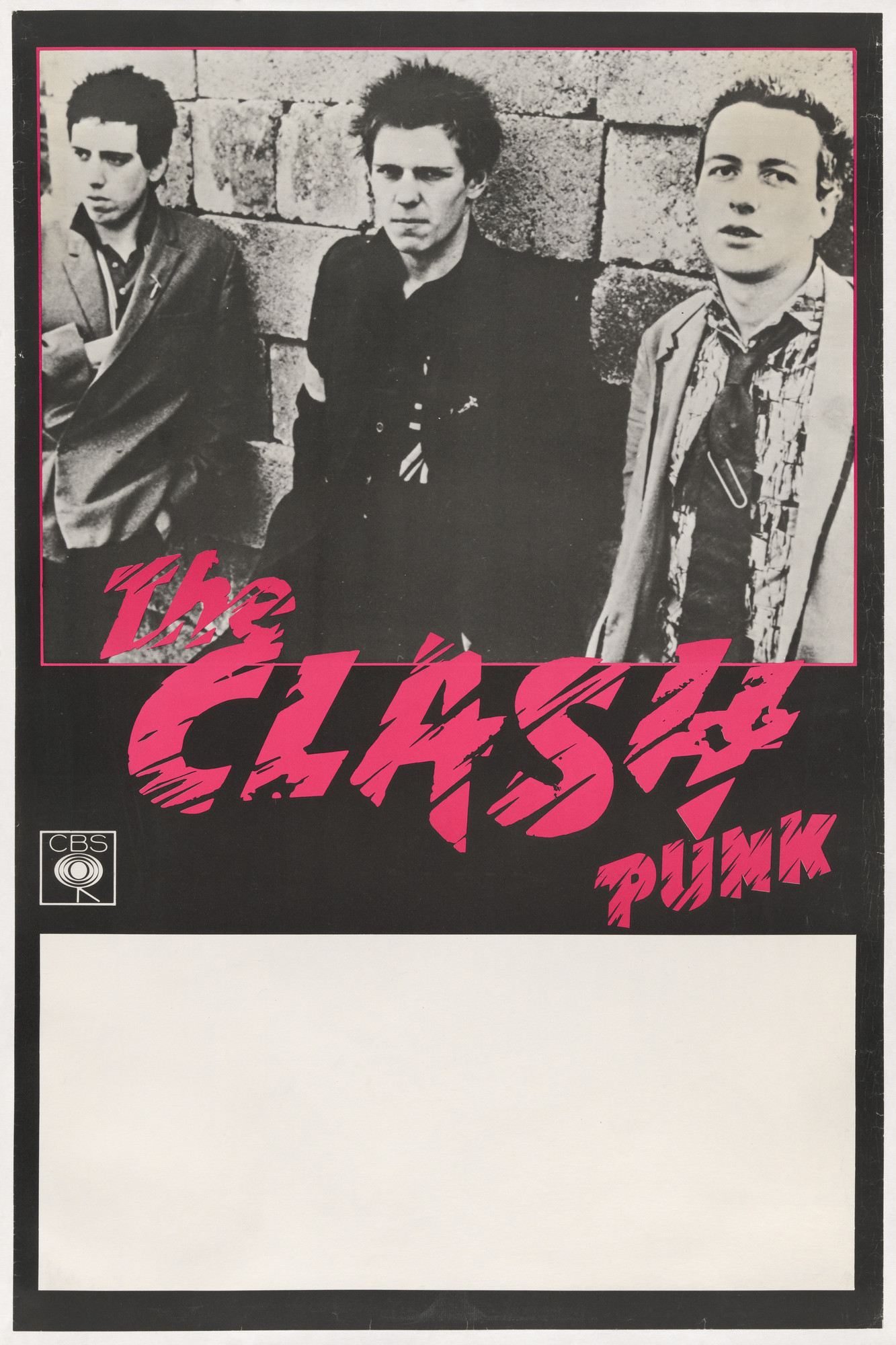
    Blank Tour Poster


    Clash Poster

    NME - 25 June 1977 - Link

    Back to the Top


    Adverts

    Back to the Top


    UK Articles

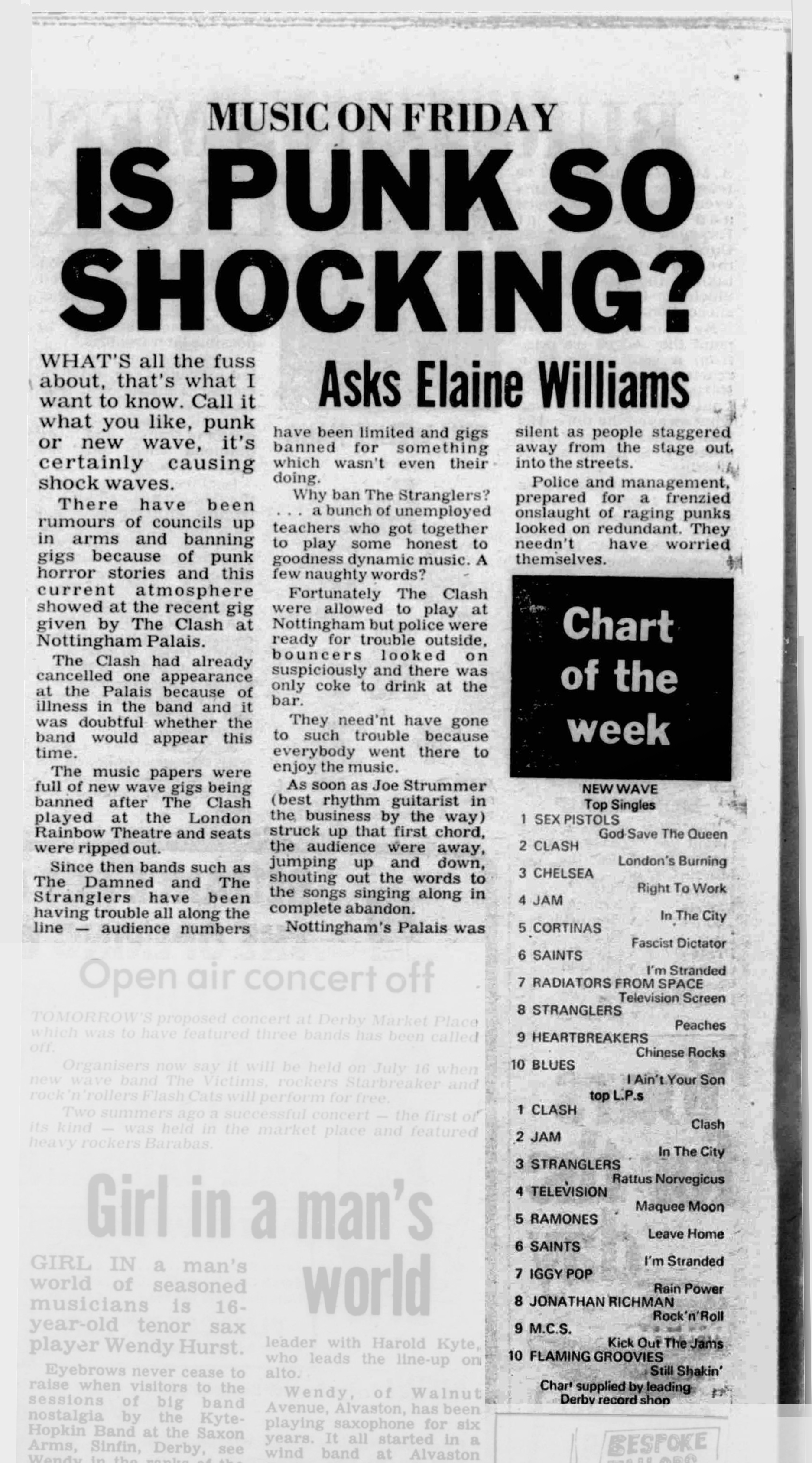
    Elaine Williams , Derby Evening Telegraph , Friday, June 17, 1977 , Page 20, " Is Punk So Shocking? "

    Music on Friday - is punk shocking

    Elaine Williams defends the punk movement, arguing that bans on bands like The Stranglers are unnecessary. She describes a peaceful, high-energy Clash gig in Nottingham as evidence of harmless fun.

    Elaine Williams , Derby Evening Telegraph , Friday, June 17, 1977 , Page 20, " Is Punk So Shocking? "

    Music on Friday - is punk shocking

    MUSIC ON FRIDAY

    IS PUNK SO SHOCKING?

    Asks Elaine Williams

    WHAT’S all the fuss about, that’s what I want to know. Call it what you like, punk or new wave , it’s certainly causing shock waves.

    There have been rumours of councils up in arms and banning gigs because of punk horror stories and this current atmosphere showed at the recent gig given by The Clash at Nottingham Palais .

    The Clash had already cancelled one appearance at the Palais because of illness in the band and it was doubtful whether the band would appear this time.

    The music papers were full of new wave gigs being banned after The Clash played at the London Rainbow Theatre and seats were ripped out.

    Since then bands such as The Damned and The Stranglers have been having trouble all along the line — audience numbers have been limited and gigs banned for something which wasn’t even their doing.

    Why ban The Stranglers ? ... a bunch of unemployed teachers who got together to play some honest to goodness dynamic music. A few naughty words?

    Fortunately The Clash were allowed to play at Nottingham but police were ready for trouble outside, bouncers looked on suspiciously and there was only coke to drink at the bar.

    They need’nt have gone to such trouble because everybody went there to enjoy the music.

    As soon as Joe Strummer ( best rhythm guitarist in the business by the way ) struck up that first chord, the audience were away, jumping up and down, shouting out the words to the songs singing along in complete abandon.

    Nottingham’s Palais was silent as people staggered away from the stage out into the streets.

    Police and management, prepared for a frenzied onslaught of raging punks looked on redundant. They needn’t have worried themselves.


    Chart of the week

    NEW WAVE Top Singles 1-10

    SEX PISTOLSGod Save The Queen
    CLASHLondon’s Burning
    CHELSEARight To Work
    JAMIn The City
    CORTINASFascist Dictator
    SAINTSI’m Stranded
    RADIATORS FROM SPACETelevision Screen
    STRANGLERSPeaches
    HEARTBREAKERSChinese Rocks
    BLUESI Ain’t Your Son

    top L.P.s

    CLASHClash
    JAMIn The City
    STRANGLERSRattus Norvegicus
    TELEVISIONMarquee Moon
    RAMONESLeave Home
    SAINTSI’m Stranded
    IGGY POPRaw Power
    JONATHAN RICHMANRock ’n’ Roll
    M.C.5.Kick Out The Jams
    FLAMING GROOVIESStill Shakin’

    Chart supplied by leading Derby record shop

    Enlarge image or Archive PDF


    Cain, Barry. "We ask you, do these men look like degenerates?" Record Mirror, no. July 22, 1977, pp. 6-7

    We ask you, do these men look like degenerates?

    Barry Cain's incendiary interview with The Clash captures the band's defiant stance amid controversy over their cancelled Birmingham Rag Market gig, branded "degenerates" by authorities

    — New tracks Complete Control, Clash City Rockers, White Man in Hammersmith Palais, and The Prisoner while dismissing political pigeonholing: "We are not the new leaders"

    Joe Strummer and Nicky Headon's three-day jail stint over a Birmingham hotel key theft, with brutal prison conditions described

    — the CBS feud over the forced Remote Control single release: "They had their way — they f----d it up"

    — Features scathing takes on imitator bands, The Pistols' "thick" criticisms, and The Jam's "conservative nonsense" during their joint tour

    Read the article (text)  |  PDF1  |  PDF2  |  PDF3 | PDF4


    Parsons, Tony, and Julie Burchill. "One little piggy went to market — three little piggies stayed in the CBS car…" New Musical Express (UK), July 23, 1977, Cover & p. 12.

    One little piggy went to market — three little piggies stayed in the CBS car…

    — Chaotic chronicle of The Clash’s aborted Digbeth Rag Market gig in Birmingham, police intervention, and eventual impromptu set at Barbarella’s.

    Joe Strummer’s interactions with soaked fans, Bernie Rhodes’ behind-the-scenes manoeuvres, tensions within the band.

    — Cameo appearances by Shag Nasty, Warhead, and Arianna of The Slits, plus disputes over equipment.

    Digbeth Rag Market performance; Barbarella’s gig, Birmingham, July 1977; concurrent The Jam show at Hammersmith Odeon.

    English.html  |  PDF1  |  PDF2


    Record Mirror , August 13, 1977, Page 10, "PUNK ROCK SURVEY: Will success buy an end to the bans?"

    PUNK ROCK SURVEY
    WILL SUCCESS BUY ABN END TO THE BANS?

    This 1977 survey explores how punk bands face venue bans across the UK. Promoters and musicians argue that council fears are exaggerated, media-driven, and increasingly outweighed by the genre's growing profitability.

    Record Mirror , August 13, 1977, Page 10, "PUNK ROCK SURVEY: Will success buy an end to the bans?"

    PUNK ROCK SURVEY
    WILL SUCCESS BUY ABN END TO THE BANS?

    PUNK ROCK SURVEY

    Will success buy an end to the bans?

    Are the punk bands managing to beat the bans? Well, according to this week's RECORD MIRROR survey, success is bringing more freedom. As the groups begin to bring in the really big audiences — and the big money — fewer towns and cities feel they can afford to turn them down. Only four of the nine city councils questioned admitted refusing bands gigs. And the promoters felt the problem had either been over-blown — for all groups except the Pistols — or was improving dramatically. Promoters and groups alike agreed there was little real trouble at their gigs — nothing like the problems with the teenybop idols — and several were looking forward to almost total acceptance by winter. So, for the latest news from the men-in-the-know, the groups and their managements, read on.

    VENUES ROUND THE COUNTRY HAVE THEY REFUSED BANDS' GIGS?

    LONDON : Yes. They don't mention any bands but they insist that it's due to safety problems. LEEDS : No. A spokesman said: "I have no knowledge of it at all. And we certainly have no policy." EDINBURGH : Yes. Mrs Wade , halls manager: "We don't allow heavy bands at all as we have trouble with them." MANCHESTER : Yes. Mr Bee , from the recreation dept.: "It's council policy not to accept any punk rock bands." LIVERPOOL : No. A spokesman for the courts who issue the licences to play said he didn't know of any refusals. But there are good club facilities. GLASGOW : Yes. Mr Horsburgh from Glasgow Council : "We make our decision according to their record at other halls. We refused the Sex Pistols because of the newspaper reports we heard." NORWICH : No. Mr Fitt , halls manager: "We go on previous gigs played. We haven't banned any groups as yet." CARDIFF : No. There have been no applications refused so far. BRISTOL : No. A spokesman said: "We've never banned a group, but we reserve that right."


    The promoters speak out

    Let them play: That was the plea from the people we asked two weeks ago, about the growing number of council bans on new wave groups. This week, we talk to people on the other side of the fence — the promoters and the groups. MEL BUSH , one of the biggest independent promoters, did the Jam 's show at Hammersmith Odeon . "I've had no problems," he told us. "The idea is to have good relations with the people in charge. If the problems are talked about, they can be overcome." "The new wave thing isn't new, we had the same with Slade and David Cassidy . In fact the teenybop thing is harder to control, because it's hysteria — new wave is just pure excitement." CHRIS PARRY , the Jam 's own promoter, isn't so happy with the Hammersmith Odeon show. City councils have the last word — they issue licences for each concert separately. But, according to Chris , council tactics don't always stop at outright bans. "They have subtle ways of either stopping or putting people off playing," he explained. "At the Odeon , the GLC wouldn't let the bar be opened." "Regulations can be interpreted as the councils' wish. They can make the show uneconomic, or very uncomfortable." "During this tour, we did 36 dates, and, of those, two were pulled out and two were changed." "Soon the acts won't be shocking any more. The media will quieten down, and even the Pistols will become respectable. New wave is big business now. The pure economics make sense — so it will become easier." JOHN JACKSON , who works as the Pistols ' promoter, told us: "People shake when they hear the name! The provinces are being very difficult. The Scandinavian tour went off without a hitch, which indicates that the band themselves are no aggravation." "We will have to find our own insurance, but the band should be able to tour by the end of the year. But we have to think very carefully about where to put them. The Clash did a one-price gig at the Rainbow , and everyone at the back stormed forward, and that was trouble." "I would never consider their act being changed. The only problem is the media — fixing up venues takes a lot of persuasion." THE STRANGLERS and Australian band the Saints don't seem to have had much trouble. Said Derek Savage , the Stranglers ' promoter: "A couple of gigs have been blacked. But the Stranglers have been on the road before and they never had any trouble." "We mainly do Top Rank ballrooms and college gigs. The ballrooms have licences for a whole year. If we get any bigger, we'll just do two nights at one ballroom. Halls with seats wouldn't suit us — people should dance to the Stranglers ." Saints ' promoter, John Bagnall said: "Being partly heavy metal instead of pure punk helped. I had very little difficulty getting venues. I'd imagine there would be problems with bigger venues, but we'll play it by ear." GENERATION X , have no complaints — even though they've just had a Glasgow show banned by the council. Their co-manager, Stuart Joseph , said: "A lot of problems are down to inexperienced promoters. The bans have been blown up out of all proportion, mainly by bands who want to make a big noise about not playing, rather than doing great gigs."


    Band stand

    BUT DO the groups go along with these statements? Here's what some of them had to say: JET BLACK , the Stranglers ' drummer: "We lost about nine dates on the last tour through the councils. It was a tremendous problem re-fixing shows. It's obviously an over-reaction — decisions are being made by people who know nothing about the music. It's a ridiculous attitude. I don't see that our songs preach corruption. Maybe they feel social comment is getting at them." CHRIS NOTT , the Victims ' lead singer: "All they're doing is jumping on the bandwagon in banning new wave. They're frightened of the kids rebelling against the system. The councils and whatever they stand for must have something against youth." BERNIE RHODES , the Clash 's manager: "It's stupid, it's like art schools being run by the guy who cleans the toilets. All the trouble between the punks and Teds is because they're bored. If they had a place to go, an all-day venue where they could see bands then they could keep out of trouble." KYM BRADSHAW , bassist with the Saints : "It's getting better. Most bands are OK — other than the Sex Pistols — and there are so many that people soon won't be able to afford to refuse them venues." "My main complaint is with the facilities. Often venues are ridiculously overcrowded. If you can't see the group, it's as bad as going to Earls Court ." KENNY STUART , lead singer with Dirty Tricks : "Promoters often don't give a damn about the band — just getting the money. They could do much more for up and coming bands, who really need better treatment to gain confidence." "It's a shame new wave bands have problems getting venues. A few places with proper facilities are needed desperately now." "Often the dressing rooms are dirty, and it can be impossible to get a glass of beer."


    The last word should go to someone with first hand experience of new wave gigs, who's put them on regularly, and is prepared to continue doing so. Tony Brainsbury owns the Brunel Rooms , Swindon , and has put on the Ramones , Talking Heads , the Damned , the Jam and the Vibrators . "And we've had no trouble," he says. "Not even a light bulb smashed. The music is aggressive, but that's what the young people want. I've seen more rowdiness at a hunt ball."

    Enlarge image


    Editor, Record Mirror , July 30, 1977, Page 8, " LET THE PUNKS PLAY! "

    Let the Punks Play!

    Record Mirror captures the cultural friction of the early punk era, featuring interviews with young people advocating for a national rock theatre.

    Editor, Record Mirror , July 30, 1977, Page 8, " LET THE PUNKS PLAY! "

    Let the Punks Play!

    LET THE PUNKS PLAY! That’s the verdict of the people we spoke to. Next week we speak to promoters and artists

    AND THE bans go on... Ever since the first ‘ Anarchy In The UK ’ tour, punk groups have found themselves out in the cold with nowhere to play. And now, following the cancellation of the Birmingham Punk Festival two weeks ago, the situation is reaching critical point. Everyone — from top bands like the Pistols and the Clash right down to local amateur bands (see Help , page 14) — is being affected. There’s just nowhere left to go.

    There is one small light at the end of the tunnel, however. In his RM column a few weeks ago, Marc Bolan stated: “It would be great if there was one really first class West End venue where the vast audience for rock music could see the best groups, films, art and fashion which has produced international results. Meanwhile the Old Vic Theatre , with all its facilities, lies empty. Rock has already proved itself to be the classical music of today, why not open it for us?”

    It’s a plea that hasn’t gone unanswered. A week later, RM received a letter from Christopher Richards , the manager of the Old Vic . He pointed out that the Old Vic is still being used regularly for drama, but added, “All this activity, however, does not preclude the possibility of the theatre being used as Marc Bolan suggests.

    “On the contrary, it is one of the uses to which I would very much like to see the theatre put, and I am delighted to have this opportunity of inviting anybody who might be interested to contact me at the Old Vic Theatre , Waterloo Road , SE1 .”

    It’s an offer that made us wonder just how many other potential venues there are up and down the country. If you know of any, let us know!

    But such rays of hope are too few and far between to be much help to the current, desperate situation. This week, RM begins a two-part investigation by asking what YOU think. Next week, we’ll be speaking to the promoters and the groups themselves.


    “THIS IS a free country. The facist members on a council don’t have the right to ban things. I appreciate that everybody’s entitled to free speech. I love the Queen but I don’t object to the Sex Pistols’ single. I was a beatnik and then a hippy and the Press gave us the same kind of coverage then. I retired at the age of 22. I’m going to Ireland to learn Gaelic .” Jessica Anson (above) 25, from Hertfordshire , member of Bubble Theatre Group .

    “WE LIKE Patti Smith and Lou Reed . If there’s a definite message then the band shouldn’t be banned, but if they’re just being obscene then they’ve got to expect it. A rock theatre would be a good idea so that new bands can come through.” Sara Fiol (below) 16, and Tina Grigs 16, Grays , Essex .

    “THEY’VE BANNED it because of violence but we’re not violent. I was helping a girl outside a gig once and these smoothies came along yelling ‘we hate punks’ and I got involved in a fight. When I got back to my flat once there were some thugs waiting for me. I tried to reason with them but they wouldn’t listen. Yeah a national rock theatre would be great, we could watch in peace.” Bill (below) 18, Leighton Buzzard .

    “IT’S NICE that young people should dress up. I used to do it. People today are so repressed they don’t like to experiment. I’m not into punk but it’s a form of expression that should not be stifled. Yes, there should be a national rock theatre.” Pamela Jenkins (right) 25, from Kentish Town , member of Bubble Theatre Group .

    “YES, I’D really like to see a rock theatre. Punk gigs don’t get enough publicity. How many councillors have actually been to a punk gig?” Mark Clissold (right) 20, Beckenham .

    “THE COUNCIL bans are really pathetic, the Sex Pistols and others are just telling people how frustrated young people are. It’s not us who start the violence. In Guildford , where many punk bands play, there’s no violence inside the club. Yeah it would be a good idea to have a national rock theatre, then nobody could disturb us.” Nick Harvey (above) 17, from Woking , Surrey .

    Record Mirror talks to fans in the street ‘STREET TALKIN’

    Enlarge image


    Ross Stapleton , Record Mirror , August 6, 1977, Page 6, "Pistol Packin!"

    THE SEX PISTOLS INTERVIEW, QUOTE ON THE CLASH

    1977 interview provides a raw look into the Sex Pistols' chaotic career, featuring Steve Jones , Sid Vicious , and Malcolm McLaren discussing record label disputes, media-driven "violence" labels, and their rivalry with The Clash.

    Ross Stapleton , Record Mirror , August 6, 1977, Page 6, "Pistol Packin!"

    THE SEX PISTOLS INTERVIEW, QUOTE ON THE CLASH

    Pistol Packin!

    WHETHER YOU love or hate them, you find the Sex Pistols irresistible. Admit it. When you see the name in print you just can't help yourself reading on to find out what they've done or said now. No? Well just try it. If you think you can resist finding out what Steve Jones and Sid Vicious said to Ross Stapleton , turn over. You don't know what you're missing... see you on page seven. The Pistols have had a rapid turnover of record companies in their brief career. How do they feel about them now?

    "It says a lot for record companies' stupidity and ignorance that two of them have dropped us," said Sid . "They ought to have known what we were like before they got involved. I know straight away if I like something or not. If I don't, I won't bother with it."

    "They were just stupid," Sid said. "They’re not doing it for a laugh."

    "Before I was in this group I could see what the Clash were doing. The Clash and the Damned , they looked at the Pistols and thought 'how can we tone this down'. They just toned it down and made it all kind of nice and dinky."

    The Pistols must be pretty fed up not being able to play gigs in this country?

    "The thing I like best is playing live," said Steve , "I hate going into the recording studios. We've hardly played at all."

    Do you think it's almost impossible to play in Britain now, or that there might be some kind of conspiracy by the authorities to stop you?

    "Yes,"Steve"They're definitely trying to get rid of us by not letting us play anywhere. But I don't see how they can last on much longer because people who book places are getting frustrated. There's all this money being wasted by not having people come. At the Marquee , whenever there's a punk group, it's packed."

    Are the Pistols getting any offers to perform live?

    "Oh yeah,"Steve"but, I mean, it's the GLC . Once it's put in the papers saying 'Pistols tour' the GLC sees it and steams in on it."

    Do you think the Pistols are misunderstood?

    "Not so much now,"Steve . "But we used to be. People used to think we were a big joke, but then they see your record at No 10 and they start to think that you're not so stupid."

    What about the people who think the band is violent?

    "Older people think we are,"Steve . "It's like anything new. I don't like to keep using their name, but look at the Teddy Boys when rock 'n' roll first started. People thought they were violent, but it's only violence in the sense that if you get excited at a concert you go a bit mad."

    "That's what they used to do when they saw Bill Haley and that. They used to smash up the halls and people thought that was shocking and violent. It's the same sort of thing. I mean we don't go out beating people up. We ain't that violent in that sense."

    Still with us, readers? Well, Sid had to leave (he was going to the pictures) and maestro/manager Malcolm McLaren has joined us. Had Malcolm tried to get Virgin Records to sign the Pistols before he went to EMI ?

    "They were the first company I approached in the early days. I went there three times and that was the end of it. So when we got their call saying they were interested, I wasn't sure of the reasons. I wasn't sure whether it was just Richard (Branson) wanting to cash in on what he thought was maybe a good thing while it was happening."

    Now the band looks as though it's getting along with Virgin , do you feel angry about the hassles with other companies?

    "If you have lived through what we've gone through you're just pleased you've got a record out and it's selling. After A&M every record company door was closed, they were terrified. I remember negotiating with CBS and the guy was given total order from America to sign this act. The guy phoned up and told them — this is the managing director here, that he thought he couldn't, it was going to bring down the walls of CBS ."

    "They eventually came round to organising some sort of contract and there was a clause that if the Sex Pistols ever entered the CBS buildings the contract would be terminated without a minute's notice. I had to agree to that."

    "And they preferred to discuss marketing with myself outside CBS . One of the guys in the legal department suggested somewhere in the vicinity of CBS , in Soho Square . The bloke said: 'Why not in the park' and I turned round and said: 'Yeah the third bench from the right'. I mean, that is a joke. That was the total extreme of the paranoia in this country at the time."

    To a lesser extent, the Stones created this sort of alarm in the Sixties and now they're part of establishment rock and roll.

    How did Malcolm get involved with the Pistols ?

    "I went, out of curiosity, to see them play and they were atrocious. They made me laugh simply because I knew what they were about. The original bass player Glen Matlock worked in my shop on Saturday , he was a schoolboy."

    "At that time Steve was singing and they were looking for someone else, so Glen joined. At this stage I still didn't take it seriously and I went to New York . I came back six months later and Paul Cook had learned to play drums and keep time. I was quite impressed."

    "I thought they needed a singer and lyricist if they were going to do anything. So we looked for a singer and I stood in my shop for weeks on end looking at kids coming in. One was Johnny Rotten , who seemed very obnoxious. I think the thing that inspired me was that he chose the most lunatic clothes."

    Rotten was invited to rehearsal to meet the band, but things didn't go very well. Eventually they got him to mime to an Alice Cooper record on the jukebox and he was so funny they decided he'd fit it.

    They talked their way into gigs, pretending to be the support act, and picked up experience. They began their high speed tour round the record companies and attracted the best Fleet Street campaign in years. But a crack was starting to show — and Glen Matlock had to go, to be replaced by Sid .

    " Glen had very big problems with his parents," said Malcolm . "After that Grundy show his mother almost had a nervous breakdown, and it affected Glen . A lot of pressures were put on him. The crunch had to come. He either had to declare his viewpoint or get out. We had to commit ourselves."

    The Pistols are undoubtedly committed. But as they're having such a hard time getting to play live, they'll be making a semi-biographical film soon to be released at Christmas . It should be finished by October . So, if the authorities make it impossible for you to see the band play live, at least you'll have this.

    (Sidebar Text) :

    "They're definitely trying to get rid of us... but I don't see how they can last out much longer because people are getting frustrated"

    "Yes, definitely!" said Sid . " The Clash take themselves incredibly seriously."

    "You see The Clash and you bore yourself to tears," said Steve . "They don't even know what they're doing it for anyway. It's their manager brainwashing them into politics."

    "They're no fun," said Sid .

    Enlarge image


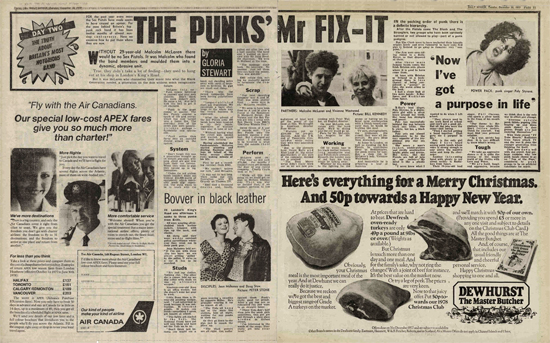
    Gloria Stewart , Daily Mirror , Tuesday, December 20, 1977, Page 23, "The Punks' Mr Fix-It"

    The Punks Mr Fix It

    1977 article profiles Malcolm McLaren as the mastermind behind The Sex Pistols , exploring punk's commercial struggles, Vivienne Westwood’s influence, and the defiant attitudes of young fans and musicians.

    Gloria Stewart , Daily Mirror , Tuesday, December 20, 1977, Page 23, "The Punks' Mr Fix-It"

    The Punks Mr Fix It

    DAY TWO: THE TRUTH ABOUT BRITAIN’S MOST NOTORIOUS BAND

    FOR the past year every move the Sex Pistols have made seems to have caused an uproar. For the man behind Britain’s top punk rock band it has been twelve months of almost nonstop controversy. Here we examine how he put them where they are now.

    THE PUNKS’ Mr FIX-IT

    By GLORIA STEWART

    WITHOUT 29-year-old Malcolm McLaren there would be no Sex Pistols . It was Malcolm who found the band members and moulded them into a dynamic, abrasive unit.

    True, they didn’t take a lot of finding—they used to hang out at his shop in London’s King’s Road .

    But it was McLaren who channelled their music into what the Blank Generation needed, a generation on the dole without much recognisable future.

    McLaren told me: "I’m into power, believing in yourself and your own abilities. Don’t think the rock crowd’s conflict ends at 30. And let’s face the fact is it’s all changed."

    "Punk is the small spark of apathy. The Sex Pistols started a spark of life and energy which has now turned into a flame fire. The everyday rose of the dole queue were poverty-stricken springs—financially and creatively."

    "Punk means they gave him an outright frontal attack on the system."

    System

    "Don't forget this was a generation brought up on distant popstars who lived like kings on the proceeds from their tax havens. When they went to gigs they turned up in big limousines."

    "Today the old system hardly makes music any more. £15,000-worth of equipment, which needs big stars and agents. The punk wants to be in touch with the band, not standing miles away with rows of amplifiers in between. So gigs are small and cheap."

    That’s why the record companies have been having palpitations lately.

    "Long-established stars are frightened. We constitute a huge challenge to the whole way the record business is organised."

    "After the advent of the Sex Pistols some 300 bands have been inspired to try their hands, regardless of whether they play in tune or not."

    "Without having what the music men needed and wanted, we would have been nothing."

    Having established the fundamentals, McLaren started wheeling and dealing. Business meetings on behalf of the band occupy almost every waking minute of his life.

    First he got a recording contract from EMI .

    "We couldn't believe our luck," said McLaren .

    It was not to last long. Not after the late Bill Grundy on Thames TV .

    " EMI paid a thousand deaths and, finally, pulled out after two and a half months. The band and I wanted an interview with Sir John Read , the chairman. We were in Holland at the time."

    "The message came back. No interview. No reasons. Just tell them they can have the money. They are surplus."

    EMI retain this, saying we mutually agreed to terminate the contract.

    Scrap

    "Our next recording company was A and M . That too soon dissolved. Seven days in all," McLaren recalls.

    "We seem to have been fired by A and M after a party at the Footlights in Margaret Street . We signed with the Sex Pistols and into a scrap with Bob Harris from BBC’s ' Old Grey Whistle Test '."

    Derek Green of A and M says: "The Sex Pistols were the quickest success I ever had. But I changed my mind. I decided that, to be involved in what they did outside their music."

    Perform

    McLaren then negotiated with Virgin Records . For months I couldn't get through the door of any record company except Virgin now,"* says McLaren .

    "While all this was going on we could not perform in Britain whatsoever. That was why we decided that if we couldn't perform to live audiences, at least we'd get the power of the band on film. We brought in American director Russ Meyer ."

    " Warners put up $800,000 for pre-production. And the U.K. end of Twentieth Century Fox were saying they were very interested indeed."

    But, at the eleventh hour, Grace Kelly and Earl Lord Jr , the major shareholders of the part of the company, decided not to proceed.

    The Russ Meyer script didn't really work out so we are now proceeding with Peter Walker , an English director. On our McLaren continues with the band still. Next he thinks and the cry would go up. "Plans for Mr. McLaren , Los Angeles for Mr. McLaren ."

    Working

    Of 29 he would tape in his black leather trousers, long aquamarine coat, and 1950s-style creepers. Beneath the tangled mop of red hair his brain would be ticking away.

    Whether he was adding to the fighting for the group or having an interview with a Dutch record company representative, he would be working like mad.

    To skin photographers, the promoters, the crowd, they were all important. So great ideas were discarded.

    At home in London , as well as running the Sex Pistols , he contributes ideas to Seditionaries , the punk centre for fashion, a shop run by McLaren's lady, Vivienne Westwood .

    And meanwhile he is preparing a tour of America .


    Bovver in black leather

    IN London’s King’s Road one afternoon I spoke to three punks from Brith .

    All were wearing silver-studded black leather jackets, trousers with zips up the back, and chains.

    All three said they were under constant police surveillance whenever they went out in their punk gear.

    Jean Mahoney told me: "If I’m out with these (the two boys) we are always getting 'pulled' by the police. If we’re in a car it has to be searched."

    Studs

    "It’s just our clothes. Nothing else. The other day a copper told me my dog collar with studs on was an offensive weapon."

    Nineteen-year-old Jean is an office worker, but she doesn’t wear her gear to work.

    Little Dave Stow , a 19-year-old printing worker, said: "I got interested in punk because it was outrageous. It shocked people. It makes you really independent when you get insulted at school."

    "We figure out we’re hated by the Teds . For National Front guys who hate the Punks and have set the Teds on to us."

    Dave says: "Because you might see a punk wearing a swastika, he supports Hitler. He's probably wearing it for no reason at all."

    "The Teds all hang out at the main line stations late at night, waiting for any punks to turn up."

    Or they go down to the gigs just to smash the place up.

    "The black punks are all right. Got nuthin' against them. Punk’s really good for people. After a gig you are so exhausted you just want to go straight home."

    "Those Teds don't half chase you through windows sometimes. One girl got put through a plate glass window in Oxford Street ."

    "I’m interested in the words of the songs. They really get into your head."


    POWER PACK: punk singer Poly Styrene.

    "Now I’ve got a purpose in life"

    IN the packing order of punk there is a definite hierarchy.

    After the Pistols come The Clash and The Stranglers , two groups who have been variously banned or not allowed to play part of a punk pedigree.

    But The Clash seem to have neglected their humble origins lately and were rumoured to have gone first class to Ireland to go away to Jamaica ; very “non punk.”

    The fans were seen riding round in a Rolls-Royce , so that disposal of them.

    After these more famous bands come the Irish Brixton area shoes where it is good to have come from.

    At last, with Brixton as a brand as a background there is less chance of being considered a “poser” or fake, the worst crime in the book.

    I had a closer look at two more bands, X-Ray Spex and Radiators From Space .

    Power

    X-Ray's lead singer, Poly Styrene , is a diminutive girl with a silver brace around her teeth. Her band has strength and power.

    Poly has successfully bridged the gap between black and white. She is white, but has a black dad.

    Poly yet set herself deliberately to be the very opposite of the traditional pop star sex symbol.

    She wears a man's jacket, ankle-socks and wildly unattractive bright pinks and grays. Her fans, like the Pistols , are full of hate at our society. "My mind is like a plastic bag."

    "I never knew what I wanted to do when I left school."

    "They always used to say work hard at school and you'll get a good job. But all the jobs were the same—jack boring."

    "Then I started getting a band together. That gave me a purpose in life."

    Poly is the only girl singer I have heard among punk bands whose voice is strong enough to soar above the massive noise and keep its sharpness.

    Another interesting band with plenty to say about society is Radiators From Space .

    Their 19-year-old lead singer, Phil Chevron , who sports a silver tooth in the front of his mouth said:

    "Our theme is: Re-evaluate your whole life. Don't follow leaders. Think for yourself. You must find your personal solution."

    "In a way, society has died. It is very difficult to know what's wrong."

    Tough

    "We take an aggressive stance—it is quite the reverse of the hippie world of the sixties with Love and Peace."

    "We are hard, tough and aggressive, because we think this is the only way to effect any change."

    "Everyone outside punk thinks pogoing (the leaping up and down punk dance) is dangerous. People are just enjoying themselves."

    With their recent " TV Tube Heart " Radiators from Venus attack TV and the way it stops the younger generation from thinking for itself.

    That goes down well with the crowd. And perhaps explains why few punk bands choose to go on " Top of the Pops ," considered by punk groups to be an artificial substitute for music.

    Would you like me to find more historical articles about the 1970s London punk scene?

    ---

    [Punks pecking order] ... The Jam were seen riding round in a Rolls- Royce, so that disposed of them. After these more famous bands comes the Irish, Brixton axis, places where it is good to have come from. At least with Brixton or - Ireland as a background there is less chance of being considered a "poseur," or fake, the worst crime in the book.

    IN the pecking order of punk there is a definite hierarchy. After the Pistols come The Clash and The Stranglers, two groups who have been variously banned or not allowed to play—part of a punk pedigree.

    But The Clash seem to have neglected their humble origins lately and were rumoured to have cane lied gigs in Ireland to go away to Jamaica: very " non punk."

    Enlarge image


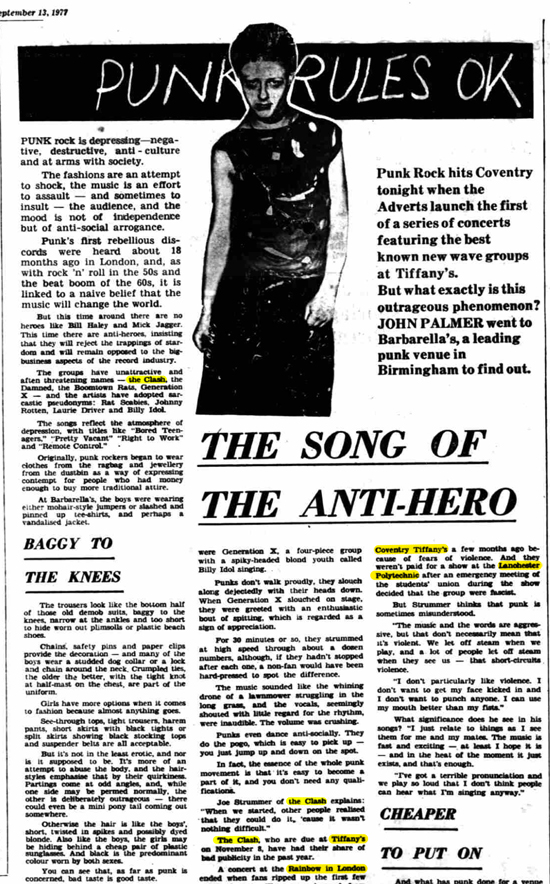
    Coventry Evening Telegraph - Tuesday 13 September 1977, PDF

    Punk Rules OK / The Song of the anti-hero / Baggy to the knees

    Lengthy piece about punk clothes, mentions Tiffany's ban, Rainbow riot and Lanchester non payment.

    Coventry Evening Telegraph, Tuesday, September 13, 1977

    Punk rules ok
    The song of the anti-hero

    Punk rock hits Coventry tonight when The Adverts launch the first of a series of concerts featuring the best known new wave groups at Tiffany's.

    But what exactly is this outrageous phenomenon? John Palmer went to Barbarella's, a leading punk venue in Birmingham to find out.

    Punk rock is depressing, negative, destructive, anti-culture and at arms with society.

    The fashions are an attempt to shock, the music is an effort to assault and sometimes to insult the audience, and the mood is not of independence but of anti-social arrogance.

    Punk's first rebellious discords were heard about 18 months ago in London, and, as with rock 'n' roll in the 50s and the beat boom of the 60s, it is linked to a naïve belief that the music will change the world.

    But this time around there are no heroes like Bill Haley and Mick Jagger. This time there are anti-heroes, insisting that they will reject the trappings of stardom and will remain opposed to the big-business aspects of the record industry.

    The groups have unattractive and often threatening names: The Clash, The Damned, The Boomtown Rats, Generation X. And the artists have adopted sarcastic pseudonyms: Rat Scabies, Johnny Rotten, Laurie Driver and Billy Idol.

    The songs reflect the atmosphere of depression, with titles like Bored Teenagers, Pretty Vacant, Right to Work and Remote Control.

    Originally, punk rockers began to wear clothes from the ragbag and jewellery from the dustbin as a way of expressing contempt for people who had money enough to buy more traditional attire.

    At Barbarella's, the boys were wearing either mohair-style jumpers or slashed and pinned up tee-shirts, and perhaps a vandalised jacket.

    Baggy to the knees

    The trousers look like the bottom half of those old demob suits, baggy to the knees, narrow at the ankles and too short to hide worn-out plimsolls or plastic beach shoes.

    Chains, safety pins and paper clips provide the decoration and many of the boys wear a studded dog collar or a lock and chain around the neck. Crumpled ties, the older the better, with the tight knot at half-mast on the chest, are part of the uniform.

    Girls have more options when it comes to fashion because almost anything goes.

    See-through tops, tight trousers, harem pants, short skirts with black tights or split skirts showing black stocking tops and suspender belts are all acceptable.

    But it's not in the least erotic, and nor is it supposed to be. It's more of an attempt to abuse the body, and the hairstyles emphasise that by their quirkiness. Partings come at odd angles, and, while one side may be permed normally, the other is deliberately outrageous — there could even be a mini ponytail coming out somewhere.

    Otherwise the hair is like the boys', short, twisted in spikes and possibly dyed blonde. Also like the boys, the girls may be hiding behind a cheap pair of plastic sunglasses. And black is the predominant colour worn by both sexes.

    You can see that, as far as punk is concerned, bad taste is good taste.

    Barbarella's guests at the weekend were Generation X, a four-piece group with a spiky-headed blond youth called Billy Idol singing.

    Punks don't walk proudly, they slouch along dejectedly with their heads down. When Generation X slouched on stage, they were greeted with an enthusiastic bout of spitting, which is regarded as a sign of appreciation.

    For 30 minutes or so, they strummed at high speed through about a dozen numbers, although, if they hadn't stopped after each one, a non-fan would have been hard-pressed to spot the difference.

    The music sounded like the whining drone of a lawnmower struggling in the long grass, and the vocals, seemingly shouted with little regard for the rhythm, were inaudible. The volume was crushing.

    Punks even dance anti-socially. They do the pogo, which is easy to pick up — you just jump up and down on the spot.

    In fact, the essence of the whole punk movement is that it's easy to become a part of it, and you don't need any qualifications.

    Joe Strummer of The Clash explains: "When we started, other people realised that they could do it, 'cause it wasn't anything difficult."

    The Clash, who are due at Tiffany's on November 8, have had their share of bad publicity in the past year.

    A concert at the Rainbow in London ended when fans ripped up the first few rows of seats. They were banned from Coventry Tiffany's a few months ago because of fears of violence. And they weren't paid for a show at Lanchester Polytechnic after an emergency meeting of the students' union during the show decided that the group were fascist.

    But Strummer thinks that punk is sometimes misunderstood.

    "The music and the words are aggressive, but that don't necessarily mean that it's violent. We let off steam when we play, and a lot of people let off steam when they see us — that short-circuits violence.

    I don't particularly like violence. I don't want to get my face kicked in and I don't want to punch anyone. I can use my mouth better than my fists."

    What significance does he see in his songs? "I just relate to things as I see them for me and my mates. The music is fast and exciting — at least I hope it is — and in the heat of the moment it just exists, and that's enough.

    I've got a terrible pronunciation and we play so loud that I don't think people can hear what I'm singing anyway."

    Cheaper to put on

    And what has punk done for a venue like Barbarella's? Manager John Tulley enthuses: "It's the biggest thing since Bill Haley and has done more for live music than The Beatles.

    We have converted two of our clubs to punk now, and there are more bands, more promoters and more venues.

    The violence that there is takes place on stage, and the kids get off on that — but there again there used to be mods and rockers a few years ago."

    And the punk audience is increasing all the time. "We had The Boomtown Rats at Barbarella's for two nights and they sold the place out — and who are they?

    Punk rock groups are cheaper to put on, and, when they get big, they don't ask for the £3,000 or £4,000 a night that some of the heavy rock bands want."

    How are Tiffany's preparing for the punk invasion? A ban on punk was lifted a month ago, and then the manager, Aubrey Marsden, said: "The only thing the company draws the line at are striptease shows."

    Enlarge image


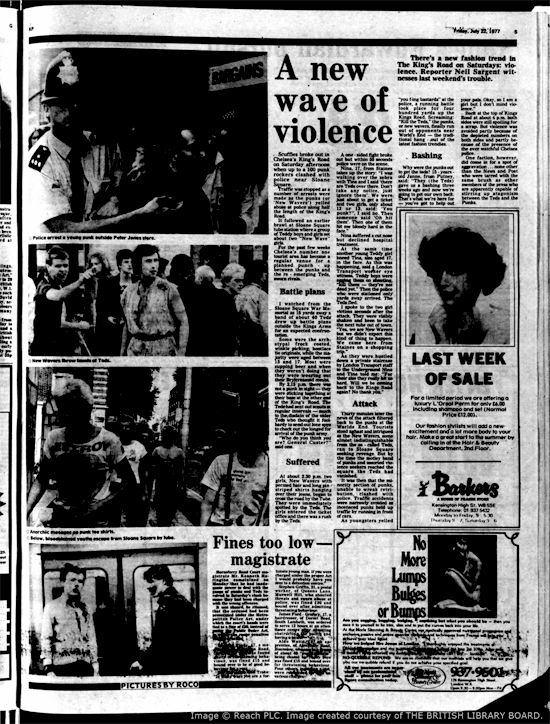
    Neil Sargent, Kensington Post, July 22, 1977, Page 5, "A new wave of violence."

    A new wave of violence

    Reporter Neil Sargent documents a series of violent clashes between rival youth subcultures—the "New Wavers" (punks) and the Teddy Boys—in Chelsea , resulting in multiple arrests and public injuries.

    Neil Sargent, Kensington Post, July 22, 1977, Page 5, "A new wave of violence."

    A new wave of violence

    A new wave of violence

    Scuffles broke out in Chelsea ’s King’s Road on Saturday afternoon when up to 100 punk rockers clashed with police near Sloane Square .

    Traffic was stopped as a number of arrests were made as the punks (or ‘New Wavers’) yelled abuse at police along half the length of the King’s Road . It followed an earlier brawl at Sloane Square tube station when a group of Teddy boys and girls set about two “New Wave” girls.

    For the past few weeks Chelsea ’s number one tourist area has become a regular venue for a planned punch-up between the punks and the re-emerging Teds, sworn rivals.

    Battle plans

    I watched from the Sloane Square War Memorial as 15 yards away a band of about 50 Teds drew up battle plans outside the Kings Arms for an expected confrontation.

    Some were the archetypal frock-coated, crinkle picking, bootlace tie originals, while the majority were aged between 13 and 17. Most were wearing beer and when they weren’t doing that they were wearing out their Brylcreemed combs.

    By 2.15 p.m. there was not a punk in sight—they were sticking together at their base at the other end of the King’s Road . The Teds had sent out scouts at regular intervals—much to the disdain of the older Teds who thought it foolhardy to send out lone spys to check out the longed-for arrival of the punk army.

    “Who do you think you are? General Custer?” said one.

    Suffered

    At about 2.30 p.m. two girls, New Wavers with permed hair and long pin-striped shirts hanging over their jeans, began to cross the road by the Tube. They were immediately spotted by the Teds. The girls entered the ticket office and there was a rush by the Teds.

    A one-sided fight broke out but within 30 seconds police were on the scene.

    Nina , 17, from Slough , takes up the story: “I was walking over the zebra with Tina and I said ‘there are Teds over there. Don't take any notice, just ignore them.’ We were just about to get a ticket and two girls, only about 12 or 13, said: ‘You punk!’, I said no. Then someone said ‘Go for them’. Then one of them hit me bloody hard in the face.”

    Nina suffered a cut nose but declined hospital treatment.

    At the same time another young Teddy girl kneed Tina , also aged 17, in the face. As this was happening, said a London Transport worker eye witness, Teddy boys were egging them on shouting, “kill them—they're not dead yet.” Then the police who were stationed only yards away arrived. The Teds fled.

    I spoke to the two girl victims seconds after the attack. They were visibly shaken and keen to take the next tube out of town. “Yes, we are New Wavers but we didn't expect this kind of thing to happen. We came here from Staines on a shopping trip.”

    As they were hustled down a private staircase by London Transport staff to the Underground , Nina and Tina told me: “For once they really hit us hard. Will we be coming back to the King’s Road again? No thank you.”

    Attack

    Thirty minutes later the news of the attack filtered back to the punks at the Worlds End . Tourists stood aghast and intrigued as the New Wavers, some almost indistinguishable from the so-called Teds, ran to Sloane Square seeking revenge. But by the time the motley band of punks and assorted violence seekers reached the square the Teds had vanished.

    It was then that the minority section of punks, unable to wreak retribution, clashed with police. Traffic accidents were narrowly avoided as incensed punks held up traffic by running in front of cars.

    As youngsters yelled “you f-ing bastards” at the police, a running battle took place for four hundred yards up the Kings Road . Screaming: “Kill the Teds,” the punks, or new wavers, finally run out of opponents near World’s End —the traditional hang-out of the latest fashion trendies.

    Bashing

    Why were the punks out to get the teds? 15-year-old Janne , from Putney , said: “They (the Teds) gave us a bashing three weeks ago and now we're going to get our own back. That's what we're here for—you've got to help out your pals. Okay, so I am a girl but I don't mind violence.”

    Back at the top of Kings Road at about 4 p.m. both sides were still spoiling for a scrap. But violence was avoided partly because of the depleted numbers on both sides and partly because of the presence of the ever watchful Chelsea police.

    One faction, however, did come in for a spot of aggravation... none other than the News and Post who were tarred with the same brush as other members of the press who are apparently capable of stirring up antagonism between the Teds and the Punks.


    Fines too low—magistrate

    Horseferry Road Court magistrate Mr. Kenneth Harrington complained on Monday that he had inadequate power to deal with the gangs of punks and Teds involved in Saturday's clash because they had been charged with the wrong offences.

    It was absurd, he claimed, that the accused had been prosecuted under the Metropolitan Police Act , under which the court’s hands were tied to a fine of £20, instead of under the Public Order Act , where higher range penalties could be imposed.

    George Punte , 17, a mechanic, of Oakington Road, Hanwell , who was found guilty of threatening behaviour, was fined £15 and bound over to be of good behaviour for a year.

    Mr. Harrington told Punte : “In many ways you are a fortunate young man. If you were charged under the proper Act I would probably have you sent to a detention centre.”

    Stephen Griffin , 21, a postal worker, of Queens Lane, Notting Hill , who shouted threats and swore abuse at police, was fined £20 and bound over after admitting threatening behaviour.

    James Ford-Grubery , 17, a hairdresser, of Dorset Road, South Lambeth , was ordered to serve 12 hours at an attendance centre after admitting obstructing the police and threatening behaviour.

    Aldo Watts , 17, an apprentice, of Alexandra Road, Hounslow , who admitted being one of about 40 “punks” who were being chased by Teddy Boys was fined £15 and bound over for threatening behaviour. Four others, including a girl, were remanded to next week on various charges.


    Advertising Copy

    LAST WEEK OF SALE For a limited period we are offering a luxury L'Oreal Perm for only £6.00 Including shampoo and set (Normal Price £12.00). Our fashion stylists will add a new excitement and a lot more body to your hair. Make a great start to the summer by calling in at the Hair & Beauty Department , 2nd Floor. Barkers A HOUSE OF FRASER STORE Kensington High St. W8 5SE

    No More Lumps Bulges or Bumps Are you sagging, bagging, bulging? At the Marie Simmons & Beauty Centre our medically approved nutritional programme and exclusive passive and active exercise techniques from France will help you achieve your ideal figure. 937-9501 176 Kensington High Street, London W.8.

    Enlarge image


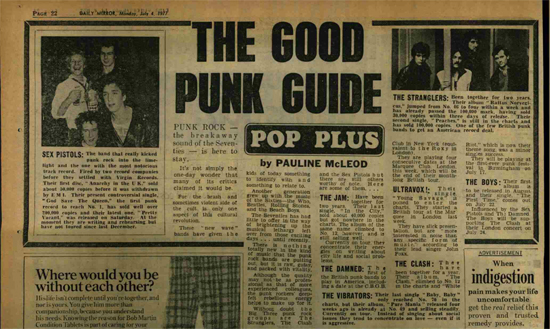
    McLeod, Pauline , Daily Mirror , July 4, 1977 , Page 22, "The Good Punk Guide"

    The Good Punk Guide by Pauline McLeod

    Pauline McLeod profiles the rising 1977 punk scene, featuring bands like the Sex Pistols and The Clash , while surrounding advertisements promote domestic products like Eno , Bismag , and Bob Martin dog tablets.

    McLeod, Pauline , Daily Mirror , July 4, 1977 , Page 22, "The Good Punk Guide"

    The Good Punk Guide by Pauline McLeod

    THE GOOD PUNK GUIDE

    POP PLUS

    by PAULINE McLEOD

    PUNK ROCK — the breakaway sound of the Seventies — is here to stay.

    It's not simply the one-day wonder that many of its critics claimed it would be.

    For the brash and sometimes violent side of the cult is only one aspect of this cultural revolution.

    These "new wave" bands have given the kids of today something to identify with and something to relate to.

    Another generation grew up with the music of the Sixtiesthe Who , Beatles , Rolling Stones , and the Beach Boys .

    The Seventies has had little to offer in the way of brightening up the musical lethargy left over from those exciting days... until recently.

    There is nothing totally new in the kind of music that the punk rock bands are punting out, but it is raw, gutsy, and packed with vitality.

    Although the quality may not be as professional as that of more experienced colleagues, the punk rockers' deep-felt rebellious energy helps to make up for it.

    Without doubt the Big Three punk rock groups are The Sex Pistols , The Clash and The Stranglers . There are still others worthy of note. Here are some of them...

    SEX PISTOLS: The band that really kicked punk rock into the limelight and the one with the most notorious track record. Fired by two record companies before they settled with Virgin Records . Their first disc, "Anarchy in the U.K.," sold about 30,000 copies before it was withdrawn by EMI . Their present controversial single, "God Save The Queen," the first punk record to reach No. 1 , has sold well over 200,000 copies and their latest one, "Pretty Vacant," was released on Saturday . At the moment they are writing and rehearsing but have not toured since last December .

    THE STRANGLERS: Been together for two years. Their album "Rattus Norvegicus," jumped from No. 46 to four within a week and has already passed the 100,000 mark, having sold 30,000 copies within three days of release. Their second single, "Peaches," is still in the charts and has sold 100,000 copies. One of the few British punk bands to get an American record deal.

    THE JAM: Have been together for two years. Their last single, "In the City," sold about 40,000 copies but got nowhere in the charts. The album of the same name climbed to No. 12 , however, and is still selling well. Currently on tour, they concentrate their energies on writing about city life and social problems.

    ULTRAVOX!: Their single "Young Savage" is poised to enter the charts. They started a British tour at the Marquee in London last week. They have slick presentation, but are "more interested in noise than any specific form of music," according to their lead singer John Foxx .

    THE DAMNED: The first of the British punk bands to play in America , including a date at the C.B.G.B. Club in New York (equivalent to the Roxy in London ). They are playing four consecutive dates at the Marquee Club , London , this week, which will be the end of their month-long British tour.

    THE CLASH: They have been together for a year. Their album, "The Clash," climbed to No. 12 in the charts and "White Riot," which is now their theme song, was a minor singles success. They will be playing at the first-ever punk festival in Birmingham on July 17 .

    THE VIBRATORS: Their last single "Baby, Baby" only reached No. 70 in the charts, but their album, "Pure Mania" released four weeks ago is already at No. 49 and selling steadily. Currently on tour. Instead of singing about social issues they tend to concentrate on love — even if it is aggressive.

    THE BOYS: Their first album is to be released in August and their single, "The First Time," comes out on July 22 . Influenced by the Sex Pistols and The Damned , The Boys will be supporting The Clash at their London concert on July 24 .

    STOP PRESS POP 30—IN THE MIRROR TOMORROW

    Enlarge Image


    Search and Destroy Fanzine No.6

    Clash Landing

    Clash Interviewed by Annette Weatherman and Vermilion Sands
    A lengthy interview with Joe, Mick & Paul in 1977. It was published in Search & Destroy mag out of San Francisco. It was the first word of the Clash in print in the U.S. Birmingham Rag Marktt & Sweden gigs referenced.

    Search and Destroy Fanzine No.6

    Clash Landing

    From: Annette <misschief-at-earthlink.net> Date: 18 November 2008

    Hello, you've got best Clash site going of course . . .

    My name is Annette Weatherman, I am American and was living in London and hanging around with the Clash some in 1977-78. I went on some tour dates with them --

    Anyway, I and my friend Vermillion Sands did a lengthy interview with Joe, Mick & Paul in 1977. It was published in Search & Destroy mag out of San Francisco. It was the first word of the Clash in print in the U.S., I think. I think it would be a good thing to recognize this early interview on your site which is the most complete ...

    Chrissy Hynde was present at the interview . . . I believe she & I were the only Americans in the British punk scene 77-78

    I hope you will respond to  this and tell me what you think

    ********************************************************

    Clash Landing

    Search and Destroy - 1977

    Clash Interviewed by Annette Weatherman and Vermilion Sands

    The Clash were interviewed in a Camden Town pub on a Saturday evening following rehearsal, a brief pastiche of new songs. Drummer NICKY HEADON was not present. ANN and VERMILION interviewed JOE, MICK, and PAUL. Friends and crew sat about, joking and laughing until the questions started.

    MICK JONES, guitarist and second vocalist, was wearing an all-black outfit, relatively "plain" (meaning only a few zippers sewn in at wild angles). His hot pink socks were as conspicuous as neon against black.

    PAUL SIMENON(sic), bassist, wears a skinny ripped t-shirt with Clash-style slogans painted on. One is "I Am A Prostitute." Over it is a cheezy-looking suit coat, black pants and shoes, and his socks are neon lime green.

    Vocalist JOE STRUMMER, who also plays rhythm guitar, is wearing a black leather jacket, black zippered Clash-style pants. All three wear the same curious style of heavy black shoe.

    It's important to know that this interview was taken in the height of (relatively unpublicized) summer "punk bashing" violence perpetrated towards people in punk gear by reactionary, 50's style Teddy Boys and other 'citizens' in an effort to squelch the burgeoning punk nation.

    Questioning starts with:

    VER: (!) Hey aren't those the shoes that the Teds wear?

    MICK: Yeah. They're called brothel creepers

    ANN: Joe, do you think Mick is a "brilliant guitar player"? (this is the remark made so often in the press)

    JOE: No, not right at the moment! I think he has been and can be again. I do think he was brilliant on "Police and Thieves" on the album.

    VER: What has been your favorite gig?

    MICK: Birmingham. That was the greatest laugh.

    ANN: It was not, it was terrible! (the gig was a last ditch, late night disaster of letdown feelings and half-operant conditions including two mikes and various amps shorting in and out, virtually canceling the possibility of good music)

    JOE: What did you expect? The whole town was against us. Police and Town Council everywhere. More cops than kids! Would it have been better if we hadn't even showed up?

    ANN: No, but the whole thing could have been more unified somehow. More organization, communication....

    MICK: People don't get together like that anymore. They did that in the 60's. (sneer)

    ANN: Well, they should. "People get ready!"

    JOE: Well anyway, my favorite gig was Sweden where we played the fastest set ever. We did a 50-minute set in 34 minutes, it was great.

    VER: Has your music disturbed anyone?

    MICK: Besides my grandmum? No, I don't know about disturbed. Spurred! maybe. (Mick lives with his grandmother on the 18th floor of a tower housing block near the Westway, London's gargantuan freeway}

    VER: Describe yourself and your band politically.

    JOE: We aren't political.

    ANN: Oh no?

    JOE: Ok, listen: what are YOUR politics?

    ANN: My politics haven't come into being yet!

    JOE: So, you don't have any politics. We don't have any politics either. Right now we're a- political (In the Melody Maker and Zig Zag, the PISTOLS slagged them off for "dole" lyrics and claim the CLASH's attitudes are confusing. Most fans do not agree)

    VER: Is this really the "Summer of Hate?"

    JOE: It's no different than any summer. You have to be prepared to punch, that's all. If you want to exist as yourself, you have to be prepared to punch. Or don't go out on the streets, which is about what it's coming to these days. It will be better when summer's over. One way it's different: Cops are now the old enemies. This year the new enemy is the people.

    ANN: Do you still get into fights?

    JOE: Yes.

    ANN: When was the last time?

    JOE: 2 nights ago.

    ANN: Do you care to talk about it?

    JOE: Nah, I don't like to talk about it. It's just something you have to do.

    ANN: So what do you do when they try to pick fights with you?

    JOE: I Run! I fuckin move it on down the high street!

    VER: How do you relate to your fans on a one-to-one basis?

    MICK: We listen to what they have to say, if they have something to say. But lately they've started to punch me. They come up and say, "Why aren't you doing this and this now?" "Why have you copped out?"-- this sort of thing. We call them "Social Conscience Botherers."

    ANN: You've said your songs were "paintings in yellow light" (referring to the yellow lights over the Westway). Will your new songs change color?

    MICK: We said that?

    JOE: RED. Red for STOP!

    ANN: How conscious are you of the military stance of your performance?

    JOE: I wouldn't call it military. Militant.

    VER: Would you have the courage to quit this band and make it another way?

    JOE: Yes - - I'd be a gun runner. Organize the sale of guns.

    PAUL: Sure, if it got boring.

    MICK: I'd stay in rock & roll til I was 28 and then I'd pop off. But I'd stay in art. I can paint, draw real good.

    ANN: Your self-created clothes style, spray-painted slogans and "clashing" colors started a youth fashion movement last fall. Do you still create your own clothes?

    MICK: Sure, some of them.

    JOE: Now we have someone to sew in all the zippers and stuff.

    ANN: Haven't you found, thought that sometimes your clothes stand between you and your fans?

    JOE: No. How do you mean?

    ANN: Well, I know I'm not the only one to feel this way. Especially when you first started wearing that really incredible leather jacket, black with red shark's tooth insets, or whatever you call them. I thought, "Oh Joe, don't wear such fantastic clothes when your fans can't possibly afford them." We want to keep you as one of the people, you know. One of us.

    JOE: No, it's up to me to set an example, if I have to put it this way. If I'm gonna feel great, I have to look great. Goes for anybody!

    ANN: Mick, what is that one shirt you wear performing, the black and white one with the interesting face?

    MICK: Oh, you mean Brigit Riley, Britain's lady painter of optical things. You could call it Op Art, but actually, she's gone beyond that.

    JOE: It's toothpaste art!

    ANN: What does poverty mean for you now?

    JOE: Right now, 54 pence in your pocket means poverty. And that's just what I've got.

    ANN: Do you expect this to get better?

    JOE: It better! Or else we're gonna fade away.

    ANN: Are you afraid of poverty?

    JOE: No. I've lived with it too long.

    ANN: Do you think the PISTOLS really can't play anywhere? We seem to have found out otherwise.

    MICK: Oh no, they can play. It's better business not to play.

    ANN: What do you think of Malcolm McLauren?

    MICK: He is the one visionary of the time.

    ANN: Will your new songs progress the dialogue with your old fans, or will they present the same ideas aimed at attracting more new people?

    BOYS: (seem baffled by question) Our songs are for everyone.

    VER: Why aren't you friends with the other bands?

    JOE: We like the PISTOLS. We just aren't very close.

    MICK: Because most bands, we just don't like as people. We can't go along with what they do or say. They dribble about like....wet fishes!

    ANN: What about the DAMNED?

    MICK: One of the wet fishes. The DAMNED in America - all that got back here from that trip was how many girls they laid. Waagh!

    JOE: Wankers! ("Wanker" - a masturbator)

    ANN: But what about the DAMNED's music? We think their songs have depth - dark, mystical, even poetic. The more we listen the more we hear.

    MICK: It's just Comedy Horror Rock.

    ANN: But the songs have some great imagery - "Can't afford no candle, can afford no gun at all." This is a great line for me. "Be a man, be a mystery man...."

    MICK (politely): You're mad as a piece of grey matter! The DAMNED are just not....essential.

    JOE: They are like Hammer Films Productions.

    ANN: Well, we think that's terrible. We think you should realize you're more together than all that.

    MICK: Why? We're individuals. If you're an individual today, you don't get along with other people.

    VER: Speaking of films, have you thought of doing them?

    MICK: We like doing Video's.

    VER: Favorite films?

    MICK: The Harder They Come, Mean Streets, Lafayette, with Jack Hawkins, about the American War of Independence. Les Enfants Terribles, by Jean Cocteau.

    VER: Favorite books?

    JOE: Narc, a pulp by Joseph Greenbaugh, cause it's got lots of action.

    ANN: Did it embarrass you when you were arrested last month? (Twice, once for stealing hotel keys and pillowcases, once for spray-painting "CLASH" on a wall).

    JOE: No. It was boring. Irritating! Spending the night in jail! Oh yeah - add another book to that list: The Rise and Fall of the Third Reich. Just finished it.

    PAUL: Looks like you've cleaned your teeth today.

    JOE: I've been smiling into the mirror.

    VER: What do you think about Wilhelm Reich?

    JOE: Who's he?

    VER: He wrote books linking sexual repression with fascism....

    MICK: He died in prison. Don't know much about him though.

    ANN: This question is hard to phrase. You know how members of bands are always talking about "pulling chicks"....

    MICK: We don't call them chicks, to start with. Girls. Women. Birds.

    JOE: When we get drunk we call them Tarts.

    MICK: The fact is we don't go to bed with all that many women. We're not into it like that. Too much of the blatantly sexual gets boring.

    ANN: (to a quiet Paul) Do you read much?

    PAUL: Oh yes. The last book I read was by Germaine Greer.

    ANN: (!) Did you like it?

    PAUL: It was great. Some of it I didn't agree with. Some of it was great.

    VER: Do you ever think about Source?

    MICK: Yeah, we think about Source. But we don't know where it is. We steal most of it!

    ANN: Don't you consider yourselves original?

    JOE: Mick steals his stuff; me and Paul are totally original. No, really we all steal a lot of our stuff, that's just the way it is.

    ANN: Do you ever get frustrated by the limitations of your art form - guitars, rock & roll songs? Don't you ever feel like doing something else up there?

    MICK (look incredulous): What?

    JOE: Yeah, I want to do something else but I want to do it in dark corners. Not where people can see.

    ANN: Won't people eventually get saturated by your singing style?

    JOE: Yeah, well I'm changing my singing style. But I ain't telling you where I'm getting it!

    ANN: "Getting it"? There you go again. Isn't it your expression, taken from your life experience?

    JOE: Well, you get it from everywhere and everybody. But it is often like a direct steal!

    ANN: So where are you "getting it" from?

    JOE: Black men.

    ANN: Do you ever get tired of reggae?

    JOE: Yeah. When they go (mimics sing-song complacent sounds). Or when they go, (sings) "Do you remember the days of slavery?" We want to shout ....

    3 BOYS IN UNISON: "No!"

    VER: Favorite records?

    JOE: Story of Ska, Trojan Free LT Package Reggae.

    MICK: MOTT THE HOOPLE: All the Young Dudes. (?)

    ANN: Your song lyrics - do you ever see the original words mutate and change into something better?

    MICK: Well, it's funny what people hear sometimes. Like this one bloke thought for months that we were singing "QUITE RIGHT" instead of "WHITE RIOT"! (Boys laugh hysterically at reminiscence and sing choruses of "QUITE RIGHT")

    ANN: Yeah, well for ages I never knew you were singing "HATE AND WAR - The only thing we got today" My positivism, I guess, colored it and all I could ever hear was "PAINT A WALL! - The only thing we got today!" (Boys laugh uproariously and sing "Paint A Wall!")

    ANN: Would you mind if I bootlegged one of your concerts?

    MICK: We won't speak to you again if you do.

    JOE: No, no. We don't care.

    JOE: People don't understand our song about being on the dole. We're not saying the dole ain't OK. What we're saying is on another level.

    ANN: Am I glad to hear you say that! I'm always telling people there's another interpretation. "I've been too long on the dole" means to me: I've been too long dependent on the pacifying food of this society, food which is absolutely without nourishment. Now "I can't work (think or do anything for myself) at all."

    VER: Are you worried?

    JOE: Yeah.

    MICK: We are despondent, uh 8 out of 10 days. Print that.

    VER: What do you do about it?

    PAUL: Do something creative.

    MICK: Play records.

    JOE: Watch TV.

    ANN: (!) But who wrote that great line in "London's Burning" - "Everybody's drowning in a sea of television"?

    JOE (sings): "Everybody's sitting 'round watching television" is how I actually sing it....I wrote it. Mick wrote the first line, "Black and white, turn it on, face the new religion..."

    PAUL: I don't write 'em.

    VER: Do you plan to tour America?

    JOE: We haven't really thought about it.

    VER: Would you rather call it Punk Rock or New Wave?

    JOE: Punk Rock! Dung Rock!

    MICK: Red Light Rock.

    ANN: A lot of people are into "Sex Rock" now.

    MICK: Sex Rock, what's that?

    VER: It's what they yell at us when we walk down the streets like King's Road. They, yell "Sex Rockers!" I think it's great.

    ANN: Lately, in the night clubs there's been a real move on this idea among the new kids joining in. All these virgins, pinheads and shy types, deciding that repressing sex is for the Real idiots. The problem is there aren't enough girls coming out that share the idea. You know, you got 300 guys pogoing together now.

    MICK: Well anyway, I think there should be a one word answer to punk rock.

    ANN: Well, give me a one-word answer to this: Are you a punk?

    JOE: No.

    MICK: No.

    (PAUL gone by this time)

    Article contribution by Tami Peterson

    Bibliography

    Link


    Dadomo, Giovanni and Coon, Caroline. "Clash in the City of the Dead" and, "The Clash in Belfast", Sounds, no. 29 Oct. 1977, pp. 25-27

    Clash in the City of the Dead

    — Dual-article spread on The Clash, with reporting from both Giovanni Dadomo in London and Caroline Coon in Belfast.

    "Clash in the City of the Dead" documents a tense CBS Records interview where the band appears bored yet revealing - discussing their European tour, fan interactions, and upcoming single recording.

    Paul Simonon details dangerous tour incidents in Sweden and Germany while handling fan mail personally.

    — Second piece "The Clash in Belfast" covers the cancelled Ulster Hall gig due to insurance withdrawal, showing the band mediating between angry punk fans and authorities.

    — Aborted Belfast show (Oct 1977), successful Dublin performances at Trinity College the following night.

    English.html  |  PDF  |  PDF2  |  PDF3  |  PDF4 | PDF5


    LONDON’S BURNING!, More Hot Product From CBS UK, August 1977

    CBS Records Promo Newspaper RARE - 4 pages London’s Burning! Issue 2 , 1977, Page 1-2, "NEW WAVE POWER: The Clash and The Vibrators lead the way"

    London's Burning - New Wave Power

    This 1977 article highlights the cultural impact of The Clash and The Vibrators . It tracks their rapid success from "White Riot" to the "Pure Mania" album and international tours.

    LONDON’S BURNING!, More Hot Product From CBS UK, August 1977

    CBS Records Promo Newspaper RARE - 4 pages London’s Burning! Issue 2 , 1977, Page 1-2, "NEW WAVE POWER: The Clash and The Vibrators lead the way"

    London's Burning - New Wave Power

    NEW WAVE POWER

    The Clash and The Vibrators lead the way

    1977 HAS been the year of new wave rock — a whole new generation of teenage rock ’n’ roll bands with a power and vitality that has brought fresh excitement to the British music scene. Leading the way are The Clash with their aggressive single "White Riot" , which charted immediately on release in the UK , followed quickly by their album.

    "If you don’t like The Clash you don’t like rock ’n’ roll," screamed the English music magazine Sounds in a full-page rave review of the album. And plenty of people must like rock ’n’ roll, with the album sales now nudging 50,000 a matter of three months after that review.

    Lead singer Joe Strummer was in a London group called the 101ers until they broke up. The other members of the three-man front line are bass player Paul Simonon and guitarist Mick Jones .

    The media attention focused on this band has been remarkable. For a few weeks The Clash were everywhere in the English music press, from front page to centre-spread. And now the front-page treatment is spreading to Europe , with major features in the Dutch , Swedish and Finnish rock press.

    New Musical Express wrote back in April : " The Clash create membrane-scorching tension, a natural feel of dynamics and exhilarating rock ’n’ roll excitement. They say something AND they make you wanna dance."

    And in the same article the writer concluded: "They have made an album that consists of some of the most exciting rock ’n’ roll in contemporary music... they chronicle our lives and what it’s like to be young in the Stinking Seventies better than any other band, and they do it with style, flash and excitement. The Clash have got it all."

    Since that powerful debut, they have been abroad to play a big open-air festival in Stockholm , headlined a major concert in Paris to rave reaction, and are set to play a South of France new wave rock festival at Mont de Marsan in early August . They also went to Amsterdam for a concert date in front of the Dutch rock media, and already offers of a Dutch tour have come through. In August they play Germany’s prestigious TV show 'Musikladen' .

    The international following for Clash is definitely building fast — not only in Europe , where French and Scandinavian sales are already significant, but also in the slightly defensive US market (see left).

    In early July The Clash were due to have topped the bill at Britain’s first major new wave festival at Birmingham , but the city council authorities pulled the plug out only a week before the date. Their feeling seemed to be that new wave music could be a corrupting, undesirable influence on the youth of Birmingham .

    But this music is already taking up a major part of both the UK album and singles charts, with at least six or seven acts solidly established. And, judged solely on their music and live performance, Clash are among the leaders and innovators. So, too, are Epic act The Vibrators .

    The Vibrators came to Epic after several months gigging in Europe and around the UK club circuit. After one single for RAK , their debut Epic album "Pure Mania" , issued in June , went right on the UK Top 50 , and the single from it "Baby Baby" has had strong radio reaction and is bubbling under.

    ... Continued on page 2

    (Page 2 Insert) London’s Burning! 2 Vibrators are rising fast Cont. from page 1

    Like The Clash , they have also attracted reams of press coverage. Dave Fudger wrote in Sounds : "The band’s music — mainly pub-rock R and B — is still very rough but delivers the necessary level of urgency and a sizeable amount of quirky originality. I mean, after a suicide-paced closing r ’n’ b toon these guys introduce their encore as a Pink Floyd number then they thwart the audience’s groans by time-warping the opening chords of "Interstellar Overdrive" into "Day Tripper" and grinding the subsequently delighted spectators into the pulsating feedback strewn ball of adrenalin climax."

    Drummer John Edwards , in the best traditions of new wave bands, had only been playing for three weeks prior to the first Vibrators gig. The other members, bassist Pat Collier , guitarist John Ellis , and the band’s main creative force, vocalist Knox , had been in various North London bands. Since recording the album they now have a new bass player 19-year-old Gary Tibbs .

    The "Pure Mania" album has already been issued throughout Europe , and release in the US is imminent. With gigs in Holland , Belgium and Germany behind them, the group are off to West Berlin in early August for a month of club dates, and a US tour has also been offered by a New York promoter.

    Their stage act is light and effective. Says John : "The songs are about all sorts of things — insanity, dead bodies, whipping... music to shake your brains to." And drummer John adds: "What we play is hard, fast high energy music — loud and fast."

    Like The Clash , this band are rising fast. On the listeners' phone-in Top 20 rock chart of London’s Capital Radio , the "Pure Mania" album recently ranked No 1 . And sales by the end of July were over 20,000.

    Link - poorish quality


    Åge Utnes (Ed.), Rockefilla , 1977, Page Unknown, "Pønk i Trondheim : Visesang er passiviserende og sløvende"

    Punk in Trondheim

    This Norweigian article introduces Rockefilla, Trondheim's first punk fanzine. The author critiques the commercialisation of the 1977 punk wave, rejects traditional folk music ( visesang ), and calls for authentic, aggressive revolutionary action.

    Åge Utnes (Ed.), Rockefilla , 1977, Page Unknown, "Pønk i Trondheim : Visesang er passiviserende og sløvende"

    Punk in Trondheim

    Punk in Trondheim

    "Folk song is passivating and numbing"

    Norway's only punk magazine is published in Trondheim and is called ROCKEFILLA . We wrote to Rockefilla and asked them to tell us about Trondheim as a punk city. Instead, there came a demand to include a free advertisement for Rockefilla . Here it comes. (?)

    For us punks here in the city, it has been a hard time with a lack of records and understanding. The record shops have finally discovered that there is money in punk too; it sells. People like having something new all the time that they can misunderstand and destroy.

    There is no punk scene here in the city. The only thing is that a few people are hung up on punk. The others, unfortunately, take the wave as a new fashion, i.e., because of all the crap written in the bourgeois press about punk. Most of the so-called punks are conservative, usually wearing fashionable clothes and listening to the other type of music.

    (Music can be divided into punk and non-punk.)

    The point of the wave is, after all, that we should have a little fun in the damn boring 1977 — the musicians still believe in what they are doing. On the other hand, it MUST also be practically revolutionary: it shall be contemptuous of authorities such as capitalism/fascism/nationalism/nazism, religions, and the sanctification of, among others, humans. The revolution must be lived in everyday life — otherwise, it’s dead, for fuck's sake. Hatred must flare up, or else it will only be another failed rebellion like the previous two. The way the hatred comes forward may seem idiotic, but it is practical. Violence is necessary in a violent society.

    At the Sex Pistols concert in Trondheim , there were a lot of reactionary kids who dug their songs. I don’t fucking like that — the band hates the audience because they refuse to understand anything. (That’s why they spit and burp.)

    Anarchy in the UK and I Wanna Be Me are among the most political lyrics I’ve heard. And what music to go with it! It’s clear that politics doesn’t suit folk songs as political music traditionally has done. "Folk song is passivating and numbing — people don’t get an energy kick, they just mumble along."

    Shoot all cozy folk singers.

    Rockefilla is Norway's only punk magazine and can be obtained by sending 2kr via postal payment slip to Åge Utnes , Vollabakken 28 , 7000 Trondheim . The next issue arrives in early September with, among other things, a report from a super-conversation with Johnny Rotten .

    Rock against fascism .


    Pønk i Trondheim

    "Visesang er passiviserende og sløvende"

    Norges eneste pønkeblad kommer ut i Trondheim og heter ROCKEFILLA . Vi skrev til Rockefilla og ba dem berette om Trondheim som pønk-by. I stedet kom et krav om å ta inn gratisannonse for Rockefilla . Her kommer den. (?)


    For oss pønkere her i byen har det vært en hard tid med mangel på plater og forståelse. Platesjappene har omsider oppdaget at det er penger i pønk også, det selger. Folk liker jo å ha noe nytt hele tiden som de kan misforstå og ødelegge.

    Det er ikke noe pønkemiljø her i byen. Det eneste er at noen få er opphengt på pønk. De andre tar beklageligvis bølgen som en ny mote, dvs. pga. all den dritten som er skrevet i borgerpressa om pønk. De fleste av de såkalte pønkere er konservative som vanligvis går i moteklær og hører på den andre typen musikk.

    (Musikk kan deles opp i pønk og ikke-pønk.)

    Meningen med bølgen er jo at vi skal få det litt moro i det drittkjedelige 1977 — musikerne tror allikevel på det de holder på med. På den annen side SKAL den også være praktisk revolusjonær: den skal være foraktelig mot autoriteter som kapitalisme/fascisme/nasjonalisme/nazisme, religioner og helliggjørelse av bl.a. mennesker. Revolusjonen må leves i hverdagen — ellers er'n dau for faen. Hatet må blusse opp ellers blir det kun et nytt mislykket opprør som de to forrige. Måten hatet kommer fram på kan virke idiotisk, men den er praktisk. Vold må til i et voldssamfunn.

    Sex Pistols -konserten i Trondheim var det en masse reaksjonære unger som digga låtene deres. Det liker jeg faen ikke — bandet hater jo publikum for at de nekter å forstå noe. (Derfor spytter og raper de.)

    Anarcy in the UK og I wanna be me er blant de mest politiske tekstene jeg har hørt. Og for en musikk til! Det er klart at politikk ikke passer til visesang slik politisk musikk tradisjonelt har gjort. "Visesang er passiviserende og nedsløvende — folk får ikke noe energikick, men bare laller med."

    Skyte alle koselige visesangere.

    Rockefilla er Norges eneste pønkeblad og kan fåes ved å sende 2kr. med postinnbetalingsblankett til Åge Utnes , Vollabakken 28 , 7000 Trondheim . Neste nummer kommer i begynnelsen av september med bl.a. referat fra en super-samtale med Johnny Rotten .

    Rock against fascism .

    ---

    Punk in Trondheim

    "Singing is passivating and dulling"

    Norway's only punk magazine is published in Trondheim and is called ROCKEFILLA. We wrote to Rockefilla and asked them to tell us about Trondheim as a punk city. Instead, there was a demand to take in free advertising for Rockefilla. Here it comes. (?)
    For us punks here in the city, it has been a hard time with a lack of records and understanding. The record companies have finally discovered that there is money in pock too, it sells. People like to have something new all the time that they can misunderstand and destroy. There is no punk environment here in the city. The only thing is that a few are up. hung on the bank. The others regrettably take the wave as a new fashion, i.e. because all the crap written in the press about bankruptcy. Most of the so-called punks are conservatives who usually wear fashionable clothes and listen to the other kind of music.

    (Music can be divided into punk and non-punk.)

    The point of the weekend is for us to have a bit of fun in the dull 1977 — the musicians still believe in what they are doing. On the other hand, it MUST also be practically revolutionary: it must be contemptuous of authorities such as capitalism/fascism/nationalism/Nazism, religions and the sanctification of e.g. human beings. The revolution must be lived in everyday life - otherwise it's dead to hell. The hatred must flare up, otherwise there will only be another failed Uprising like the two previous ones. The way the hatred comes across may seem idiotic, but it is practical. Violence is necessary in a violent society.

    At the Sex Pistols concert in Trondheim, there were a lot of reactionary kids who dug their songs. I don't like that - the band hates the audience because they refuse to understand something. (That's why they spit and belch.) Anarchy in the UK and I wanna be me are blast the most political texts I have on hand. And what more music! It is clear that politics does not suit the song of wisdom as political music has traditionally done. Singing is passivating and depressing — people don't get an energizing kick, but just sing along. Shoot all the cozy show singers.

    Rockefilla is Norway's only punk. magazine and can be obtained by sending NOK 2. with postal payment form to Äge Utnes, Vollabakken 28, 7000 Trondheim. The next issue comes at the beginning of September with, among other things, report from a super conversation with Johnny Rotten. Rock against fascism.

    James, Bob , Southend Evening Echo (likely), July 1977 , p. Unknown, " Punk Rock show: The first ever

    Southend Punk Fest

    (No Clash). Promoter Bob Mardon organizes Britain’s first all-day punk festival at Chelmsford City stadium to prevent club bankruptcy. High security and a diverse lineup, including The Damned , await 15,000 fans.

    James, Bob , Southend Evening Echo (likely), July 1977 , p. Unknown, " Punk Rock show: The first ever

    Southend Punk Fest

    Punk Rock show: The first ever

    Story by BOB JAMES Pictures by TONY TWEEN

    A MASSIVE security operation will greet Britain’s first-ever punk rock circus. At Chelmsford City stadium tomorrow at least ninety bouncers will be on guard when the non-stop nine-hour show hits town.

    Up to 15,000 fans — many of them Londoners — are expected to flock to the festival, which has been organised to save the town’s football club from bankruptcy.

    Nobody knows quite what to expect, but the punk followers have a reputation for being anti-social, and the promoters are not taking chances.

    A spokesman said: "We have enough bouncers to handle anything unless it turns into a great riot."

    "Inside the ground there will be ninety bouncers and seven patrol dogs while the police monitor activity outside the stadium."

    500 TICKETS

    Only about 500 tickets were thought to have been sold for the concert up until this week.

    But late publicity on several radio stations, all the leading music papers and on 3,500 posters splashed around central London , could lead to frantic ticket selling at the gates.

    The event will feature five top punk bands with a number of conventional rock groups like the Top Ten band Eddie and the Hot Rods .

    The line-up for the festival, hosted by disc jockey John Peel , is The Rods , Doctors of Madness , Lew Lewis Band , Chelsea , Slaughter and the Dogs , Aswad , Fruit Eating Bears , Solid Waste , Glory and The Damned .

    15-HOUR DAY

    The concert promoter is 21-year-old Bob Mardon , of Little Baddow , who set up a ‘Festival Office’ at New Writtle Street and has been working up to 15 hours a day to organise the circus.

    In his upturned-madhouse office on Tuesday , where builders were asking for more cash for their ground alteration work, a punk poet was touting for a spot on the show, and telephones were buzzing with inquiries from all-and-sundry, Bob announced: "Chelmsford was dead until about six months ago — but it’s really lifting off now."

    Concert sponsor Martin Havelin , who is hoping to raise at least £5,000 for crisis-hit Chelmsford City from the concert, gave his own prediction when I asked him about the size of tomorrow’s crowd.

    He said: "We don’t know what will happen."

    "It’s like going out to play a football match without knowing if we will win."

    "We can only hope."

    Caption: Staging Britain’s first all-day punk rock festival . . . the builders move in to prepare Chelmsford City’s New Writtle Street stadium . The football club’s perimeter fencing has been rebuilt to keep the punk fans inside.

    Link


    US Articles

    Back to the Top


    International Articles

    Papadopoulos, Dimitri. “The Clash.” New York Rocker, vol. 1, no. 10, October 1977, pp. 29, 30 & 37.

    The Clash

    — Extended interview with The Clash during autumn 1977. Paul Simonon, Mick Jones, Joe Strummer, and Topper Headon discuss violence with Teds, their rapid turnover of drummers, the debut LP, censorship on Top of the Pops, bans in Birmingham, and ambitions for touring America. They compare themselves with Sex Pistols, Subway Sect, Slits, and U.S. bands like The Ramones, Patti Smith, Talking Heads, and Blondie. The group reject disco, fashion fads, and “revivalist” bands, but champion reggae and street-level authenticity.

    Dunstable, live recording of “London’s Burning”; violent scenes at RCA art college gig; cancelled show in Birmingham; Topper mentions seeing the Sex Pistols at the Nashville and the Notting Hill Gate riot.

    BETTER COPY WANTED **** tho' easily readable

    English.html  |  PDF


    BRAVO #25, 8 June 1977, 2 pages

    Scandal at the Clash concert

    — Scandal at the Clash concert in the London Rainbow Theatre reported by Margit Rietti, detailing violent fan riots, an aggressive atmosphere fueled by the band's provocative style and music, including tracks like Janie Jones, and London's Burning.

    — Gig culminated in a major brawl, with fans tearing up seating and throwing it at the stage, leading to police intervention.

    BRAVO - All issues from 1977 for download | bravo-archiv-shop

    German.html  |  English.html  |  PDF


    BRAVO. "The Clash, the four nobody wants." BRAVO (German), no. 41, 29 Sept. 1977, pp. 54-55.

    The Clash, the four nobody wants

    — A feature on The Clash detailing their chaotic lifestyle, rehearsing in a condemned building on Camden High Street and punk violence.

    — New drummer Nicky Headon replacing Tory Crimes, and recounts incidents of on-stage violence, including a festival in Belgium where they were pelted with stones and cans, costly hotel carpet incident in Birmingham that inspired the song The Prisoner, and internal band friction, notably with guitarist Mick Jones.

    — Their appearance on the German TV show "Musikladen" is also referenced as an example of the rejection they frequently faced.

    BRAVO - All issues from 1977 for download | bravo-archiv-shop

    German.html  |  English.html  |  PDF


    Author: Franзois Ducray Hot Rocks | Publication: BEST | Date: June 1988 | Page: 48, 39, 50, 51 | Title: L’histoire d’un CLASH

    L'histoire d'un Clash

    Retrospective thatexplores The Clash’s explosive impact on rock, contrasting their raw energy against the "sermons" of U2 . It positions them alongside The Who as rock’s ultimate, visceral "electro-shock." This second page of the BEST feature focuses on the release of a Clash compilation and recounts the legendary chaos of their Paris residency at the Thйвtre Mogador .

    Ducray justifies the need for a Clash compilation ( The Story Of The Clash (vol.1) (CBS-Double) while vividly describing their 1981 Paris shows. Amidst management "madness," the band remained an authentic, urgent force in rock history. 

    Author: Franзois Ducray Hot Rocks | Publication: BEST | Date: June 1988 | Page: 48, 39, 50, 51 | Title: L’histoire d’un CLASH, 1945 words

    L'histoire d'un Clash

    The Story of a CLASH

    JOE STRUMMER , MICK JONES , PAUL SIMONON AND TOPPER HEADON WERE THEY ROCK'S LAST GREAT ELECTRO-SHOCK?

    1977

    "Things are going to get worse. I think we can arrive at a government of a fascist type, but no one will notice it, any more than you feel your hair longer on Monday than on Sunday... What I am against with all my strength is all this racist, fascist-leaning fanaticism, this so-called patriotism which is nothing but hateful fear, the price of ignorance and misery..." ( Joe Strummer , during '77.)

    "Punk died the day the Clash signed with CBS " ( Mark P. , editorialist for the fanzine Sniffin' Glue , same year.)


    Eleven years have passed, and it is still the same circus. Not funny, really not. Besides, you can see it in a multitude of holes like those of old shells in the earth, which become for a long time cesspools that no redemption, no "acquired gain" thinks to plug or clean. One of these holes is not that punk disappeared — this kind of eruption, especially the most vivid, lasts as long as flowers, etc. —, it is that the Clash no longer exist. Famous void: do you know since them a group capable of being what it says, of tripping over its own feet more often than its turn and having, as if without meaning to, pulled from it one of the most sumptuous sonic and significant explosions (yeah, significant, perfectly) of this end of the century at the soft-core (let it die!) !

    No, say nothing. Don't say U2 . U2 act as if when they talk (interminable breathless sermons on a mountain of small fish become big barges) and their hymns are everything except rock 'n' roll. Bruce has disconnected. He is an American: Americans have trouble growing up, especially those who didn't die like idiots in Vietnam as described in the song. So OTH ? Les Porte-Mentaux ? Not possible: they are French. And French groups don't leave France except on the condition of joking around prettily. The P.M. and the OTH joke around, but not prettily.

    No, decidedly, by whatever end you grasp the impetuous phenomenon, the "great rock-groups," there haven't been many. In the category that interests us, the prickly-shaky-glorious, I only see two. But then very prickly, admirably shaky and glorious from head to foot: the Who and the Clash . Englishmen, as if by chance. Deceased then, both of them — same remark and even if the first threaten us regularly with pitiful reunions, the second no longer stinging themselves (hem!) fortunately except with the juice of pure fruit pride, thanks very much.

    Why the Who and not the Stones , the Kinks , the Pretty Things or the Pink Fairies , huh? Because only the Who yelled incendiary things in three minutes of an incredible rhythmic violence that came to multiply no less fantastic melodies in a tailspin: "White Riot" has only one precedent, "My Generation" . And if Pete Townshend was the unique inspiration of the Who , it is indeed the arrogant snarl of his guitar that one finds in the fists of Mick Jones , his acid bile in the stubborn face of Joe Strummer . More trivially — and it is not indifferent — the parallel continues, breaking by means of symbols and dramas the alleged links that would encase the decades (don't forget: mods or punks at the start, the two groups want to be rock above all, and of the most seminal): Keith Moon , the improbable hitter of the Shepherd’s Bush four, died as he had lived, as a ribald madman, alcoholic and drugged, indicating by that very thing the road to follow for Topper Headon , drummer of the Camden Town gang: he is in the shade for a bunch of years and a few others of powder to sneeze! O crazy uncles, why are you coughing?? One and the other formed, incidentally, rhythmic axes properly unheard of in power and attack with their more placid partners on the four strings, John "Fantômas" Entwistle and Paul "Diplomat" Simonon . Big Bang Bands indeed. Seems they don't make them anymore...

    HOT ROCKS

    To the two beautiful citations as an introduction to the above remarks, I could have added a third: "The compilation is the negation of life!" But the Sage who pronounced it one evening of philosophical libations yielded to his taste for polemic: there are compilations that precede life (small labels grouping their independent firebrands: it is thus that one can spot the stammmerings of the Prince in gestation, the Kas Produkt of the day after tomorrow), others that prolong it — watch out! without therapeutic relentlessness: it is not to you that I will teach the difference between a Best Of Orchestral Manoeuvres In The Dark (assortment of stale petits fours for a weary election night) and a collection of Cure jewels.

    PAUL SIMONON

    ( Cure in slices of singles, it's digestible and it lasts longer) or a cameo of Costello -esque, Prince -ly or Mitsouko -esque unreleased tracks (direct to the desert island for cause of effrontedly plundering, perverse and innovative pop genius!).

    All the more reason, a Clash compilation is necessary. From, even — we will not discuss the choice of titles retained here —, this episode bearing as a subtitle the promising precaution of "Volume 1" . Just as certain high-flying medleys knew how to impose themselves among any worthy discography of the Rolling Stones , for example (a group over — and even self — compiled if there ever was one!), ( "Hot Rocks" and especially "More Hot Rocks: Big Hits And Fazed Cookies" ), or, so as not to make me a liar, some Who -series from the back of the woodpile (type "Meaty, Beaty, Big And Bouncy" ). Although, you are going to see (or at least I hope!) that of the Clash distinguishes itself from the start: no nostalgia, no oddities, no false sentiments. From the intro of "The Magnificent Seven" to the terminal rattles of "Police And Thieves" (time caught backwards, you'll tell us about that!! Not a silly solution at all by the way, and rather funny...), one has the throat held in a pincer between an urgency (intact harsh sound, rigorous conciseness, melodic fury) of this morning and a dazzling impression of "never again" . An impression-echo, a trap as old as dramaturgy, that each of the two claws of the pincer drives in inexorably at each listen (deconstructable by the hand of the mood, if I dare say, the Clash being stylists, not formalists, and besides we are still in a Republic , no ???).

    In short, one is forced suddenly to throw onto the rug of the day this livid and surprised observation that the Clash no longer wipe their feet on it and that this absurd calm makes a cruel silence — just like that of Coluche in other spheres, forgive me, purists... Refrain: were the Clash the-last-of-the-great-rock-groups? They were in any case the last to believe in what that can (could) mean, do and prove it to the point of committing suicide if this meaning got messed up, thus playing the game — for the once — to the end. Which is heard here like nowhere else and at this precise hour, neither like before, nor like after...

    MAGNIFICENT SEVEN

    JOE STRUMMER

    Paris , October '81. The Clash are in town for eight days at the Théâtre Mogador , a crimson-burnt music-hall promised for demolition. It is the "Sandinista!" tour, this triple album with colorful lyricism which is also a challenge to the laws of marketing (three records for the price of one and a half, the rascals will touch their money in hell!) Confusion in all directions: press conference two hours late and stupid scribblers, photo sessions on edge, managers in madness and our four birds changing flashy shirts more often than funky cassettes in their enormous ghetto-blasters: they don't give a damn about all that, and even the innumerable real or fake buddies (and acquaintances in black skirts) who hail them from everywhere. For the first time in their noisy and chaotic "career," the Clash seem to live only for the evening concerts.

    But then, what a slap! They are certainly dressed like princes in decay and certainly have not sucked only ice cubes during the day, but what style! A style that oozes from every pore of their skin, and comes to wet even more a music already moist and always furious that "Sandinista" carries in large and generous gushes.

    Only one extract on this first side, but it is the smashing "Magnificent Seven" , and which opens! "Armagideon Time" closes it, a staggering hypnotic pivot of the shows of the time. In the center, three set pieces from "Combat Rock" , the ultimate album (with Mick Jones , we'll stop there) whose stylized outline will earn them a first and unique platinum album in the dirty USA : "Rock The Casbah" remains confounding in its strict stripping down and "active" premonition. As a bonus, "This Is Radio Clash" , one of their seventeen English singles, and not one of the saddest, if one of the least well sold (routine)!

    TOPPER HEADON (Photos Jean-Yves Legras )

    New York , April '80. Our own Téléphone treat themselves to a tour of the clubs of the Big Apple . Applause from the locals of the vintage, curiosity from the new-wavers reigning there. Among them the Talking Heads , bits of Television , remains of the Patti Smith Group , Johnny Thunders , Richard Hell and Joe Strummer . Johnny and Joe are not in shape: backstage, when one stands up, the other collapses, a strange slow-motion ballet. They are at the same hotel as us, Mick Jones' room adjoins mine. He tinkers with cassettes all night, I am tempted, I go: "uh, 'scuse, what's all this racket,"? "Remixes," he tells me. And makes me hear them, thirteen to the dozen!! Some from "London Calling" , the double cornerstone that they have just sent to the overripe face of the rock of the time, cover inspired by Elvis and thundering content! Some older ones, panting and speeded up, by Lee Perry the king of dub or some other sorcerer they knew how to associate with, for the best (bursting, most often) or for the worst (the mayo goes plop, sometimes).

    CLASH CITY ROCKERS

    MICK JONES

    On this side two, no waste: squarely four extracts from "London Calling" , including "Train In Vain" curiously "forgotten" in the credits of the official album, the irrepressible "Guns of Brixton" , one of the rare titles signed by Simonon , and their famous cover of "I Fought The Law" by Sonny Curtis , the whole thing produced by Guy Stevens , ex-mentor-guru of Mott The Hoople , pre-punk British spoiled by Bowie . Plus "Somebody Got Murdered" salvaged from "Sandinista!" and "Bank Robber" , which could only be found on the US mini-album "Black Market Clash" , a nugget obviously!

    London , June '78. A handful of French journalists having not made this long trip just to faint upon seeing Bob Dylan at the back of the immense Earl's Court , advised that the Clash are rowing in the studio on their second album and their tongue hanging out with emotion, joins the scene of the crime. Scene of the genre: Strummer and Jones massacre a foosball table while locked in a glass cage, Topper wood-chopping on his drums under the maniacal guidance of one that was not expected there, Sandy Pearlman , a sort of Phil Spector heavy metal at the time highly (over) estimated. The pair on reprieve grumble that Pearlman is getting a bit on their nerves, that he works heavy and slow, that his idea of sound dates from Methuselah , that during this time, hey, they could have at least seen what Bob Dylan looked like, because, hey, in the end, this guy... and that above all, outside, people were perhaps going to get bored of them without them, without this string of bleeding singles that they had taken the habit of putting out in a "move-over-so-I-can-get-in" way!

    So then, on this side three, you will find only one survivor from the album in question, "Give 'Em Enough Rope" : "Tommy Gun" , incidentally a "classic" of Strummer-Jones writing, or how to empty one's pockets in the form of a winning uppercut! The rest, excuse the term, are nothing but seven of their very first sulfurous hits (some of which formed the backbone of the primal album, "The Clash" , just as the big boxes operated when they didn't know what the next minute would be made of!), starting with the incandescent "White Man In Hammersmith Palais" , "London's Burning" and "Janie Jones" . But "Capital Radio" , "White Riot" and "Career Opportunities" are not bad either, it's nothing to say it!...

    Paris , May '78. Fête de Rouge , the newspaper of the Revolutionary Communist League . It had been a while that the often parallel but always conflicting roads of the pros of radical politics and the anarcho-shambolic punks had to cross. The Sex Pistols had just sown a pleasant trouble during the Jubilee of Her Gracious Majesty , treating her at best as a floozy, at worst as fascist scum. But apart from the unforgettable "Pretty Vacant" , Rotten and his rogue band would no longer spit out anything important. The Clash , on the contrary, were beginning to accumulate tracts alive on 45 rpms without fear and without reproach. Everyone said they were "credible," as much CBS as the Trotskyists.

    Also, in the great tradition of true rebels to whom one doesn't tell stories, they deliberately violated the established laws of the one by applying themselves to violating the rules of the parties of others: that we pass by the reds, fine, but cleanly. The Clash provoked the mess, encouraged it and amplified it by breaking dryly there: beautiful, beautiful disaster!!

    This fourth side bears two strong traces distinctly: "Clash City Rockers" (what could be clearer?) and "Police And Thieves" (That! In rude reggae, please!). In a sandwich, three rescues from "Give 'Em..." and "Spanish Bombs" and "London Calling" from the album of the same name. Only incongruities of spatio-temporal framing, but who would complain, in this comet's tail?!

    By the way, after all that and a few bulges of years crossed or freed, are the Clash the-last-of-the-great-rock-groups? Oh him! Put it back to the beginning! And especially not "that"!...

    François DUCRAY

    • The Story Of The Clash (vol. 1) (CBS-Double)


    L’histoire d’un CLASH

    JOE STRUMMER , MICK JONES , PAUL SIMONON ET TOPPER HEADON FURENT-ILS LE DERNIER GRAND ELECTRO-CHOC DU ROCK ?

    1977

    "Les choses vont empirer. Je pense qu'on peut en arriver à un gouvernement de type fasciste, mais que personne ne s'en apercevra, pas plus que tu ne sens tes cheveux plus longs le lundi que le dimanche... Ce contre quoi je suis de toutes mes forces, c'est tout ce fanatisme raciste, fascisant, ce soit-disant patriotisme qui n'est que de la peur haineuse, le prix de l'ignorance et de la misère..." ( Joe Strummer , courant 77.)

    "Le punk est mort le jour où les Clash ont signé chez CBS " ( Mark P. , éditorialiste du fanzine Sniffin'Glue , même année.)


    Onze ans ont passé, et c'est toujours le même cirque. Pas drôle, vraiment pas. D'ailleurs ça se voit à une multitude de trous comme ceux des anciens obus dans la terre, qui deviennent pour longtemps des cloaques que nulle rédemption, nul « acquis » ne songent à boucher ou à assainir. L'un de ces trous, ce n'est pas que le punk ait disparu — ce genre d'éruption, surtout les plus vivaces, durent ce que les fleurs, etc. —, c'est que les Clash n'existent plus. Fameuse béance : connaissez-vous depuis eux un groupe capable d'être ce qu'il dit, de se prendre les pieds dedans plus souvent qu'à son tour et d'en avoir, comme sans le faire exprès, tiré l'une des plus somptueuses déflagrations sonores et signifiantes (ouais, signifiantes, parfaitement) de cette fin de siècle à la mord-moile (qu'il crève !) !

    Non, ne dites rien. Ne dites pas U2 . U2 font comme si quand ils causent (interminables sermons époumonnés sur une montagne de petits poissons devenus gros chalands) et leurs cantiques sont tout sauf du rock'n'roll. Bruce a décroché. C'est un Américain : les Américains ont du mal à grandir, surtout ceux qui ne sont pas morts comme des cons au Vietnam tel que décrit dans la chanson. Alors OTH ? Les Porte-Mentaux ? Pas possible : ils sont français. Et les groupes français ne sortent de France qu'à condition de déconner joliment. Les P.M. et les OTH déconnent, mais pas joliment.

    Non, décidément, par quelque bout que vous saisissiez l'impétueux phénomène, les « grands groupes-de-rock », il y en a pas eu bézef. Dans la catégorie qui nous intéresse, les teigneux-foireux-glorieux, je n'en vois que deux. Mais alors très teigneux, admirablement foireux et glorieux de la tête aux pieds : les Who et les Clash . Des Anglais, comme par hasard. Défunts donc l'un et l'autre — même remarque et même si les premiers nous menacent régulièrement de pitoyables réunions, les seconds ne se piquant plus (hem !) heureusement qu'au jus d'orgueil pur fruit, merci bien.

    Pourquoi les Who et pas les Stones , les Kinks , les Pretty Things ou les Pink Fairies , hein ? Parce que seuls les Who gueulaient des machins incendiaires en trois minutes d'une incroyable violence rythmique que venaient multiplier de non moins fantastiques mélodies en vrille : « White Riot » n'a qu'un précédent, « My Generation » . Et si Pete Townshend fut l'unique inspiration des Who , c'est bien la hargne morgueuse de sa guitare qu'on retrouve dans les pognes de Mick Jones , son fiel acide dans la tronche cabocharde de Joe Strummer . Plus trivialement — et ce n'est pas indifférent — le parallèle se poursuit, rompant au moyen de symboles et de drames les prétendus chaînons qui enserreraient les décennies (n'oubliez pas : mods ou punks au départ, les deux groupes se veulent avant tout de rock, et du plus séminal) : Keith Moon , l'invraisemblable frappeur des quatre de Sheperd’s Bush , mourut tel qu'il avait vécu, en fou furieux paillard, alcoolo et dopé, indiquant par là-même la route à suivre à Topper Headon , batteur du gang de Camden Town : celui-ci est à l'ombre pour un paquet d'années et quelques autres de poudre à éternuer ! O tontons cinglés, pourquoi vous toussez ?? L'un et l'autre formaient, accessoirement, des axes rythmiques proprement inouïs de puissance et d'attaque avec leurs plus placides partenaires aux quatre cordes, John « Fantômas » Entwistle et Paul « Diplomat » Simonon . Big Bang Bands indeed. Paraît qu'on n'en fabrique plus...

    HOT ROCKS

    Aux deux belles citations en exergue du ci-devant propos, j'aurais pu ajouter une troisième : "La compilation, c'est la négation de la vie !" Mais le Sage qui la prononça un soir de libations philosophiques cédait à son goût de la polémique : il est des compilations qui précèdent la vie (petit labels regroupant leurs brûlots indépendants : c'est ainsi qu'on peut repérer les balbutiements des Prince en gestation, des Kas Produkt d'après-demain), d'autres qui la prorogent — attention ! sans acharnement thérapeutique : ce n'est pas à vous que j'apprendrai la différence entre un Best Of Orchestral Manœuvres In The Dark (assortiment de petits fours avariés pour soirée électorale fourbue) et une collection de bijoux Cure .

    PAUL SIMONON

    ( Cure en tranches de singles, c'est digeste et ça dure plus longtemps) ou un camaïeu d'inédits costelliens, princiers ou mitsoukiens (direct sur l'île déserte pour cause de génie pop effrontément pillard, pervers et novateur !).

    A plus forte raison, une compile Clash s'impose. Dès, même — on ne discutera pas du choix des titres ici retenus —, cet épisode portant en sous-titre la prometteuse précaution de "Volume 1" . Telles que surent s'imposer parmi toute digne discographie des Rolling Stones , par exemple (groupe sur — et même auto — compilé s'il en fut !), certains méli-mélos de haute volée ( "Hot Rocks" et surtout "More Hot Rocks : Big Hits And Fazed Cookies" ), ou, pour ne pas me faire mentir, quelques Who -series de derrière les fagots (type "Meaty, Beaty, Big And Bouncy" ). Quoique, vous allez le voir (ou du moins j'espère !) celle des Clash d'emblée se distingue : pas de nostalgie, pas de bizarreries, pas de faux sentiments. De l'intro de "The Magnificent Seven" aux râles terminaux de "Police And Thieves" (temps chopé à rebours, tu nous en diras tant !! Solution pas niaise du tout par ailleurs, et plutôt marrante...), on a la gorge prise en tenaille entre une urgence (son âpre intact, concision rigoureuse, furia mélodique) de ce matin et une fulgurante impression de "plus jamais" . Une impression-écho, un piège vieux comme la dramaturgie, que chacune des deux pinces de la tenaille enfonce inexorablement à chaque écoute (découpables à la main de l'humeur, si j'ose dire, les Clash étant stylistes, pas formalistes, et puis on est encore en République , non ???).

    Bref, on est contraint soudain de jeter sur le tapis du jour ce constat livide et surpris que les Clash ne s'essuient plus les panards dessus et que ce calme absurde fait un silence cruel — tout comme celui de Coluche en d'autres sphères, pardonnez-moi, puristes... Refrain : les Clash étaient-ils-le-dernier des-grands-groupes-de-rock ? Ils étaient en tout cas les derniers à croire en ce que ça peut (pouvait dire, faire et le prouver jusqu'à s'en suicider si ce sens merdouillait, donc à jouer le jeu — pour le coup — à fond. Ce qui s'entend ici comme nulle part ailleurs et à cette heure précise, ni comme avant, ni comme après...

    MAGNIFICENT SEVEN

    JOE STRUMMER

    Paris , octobre 81. Les Clash sont en ville pour huit jours au Théâtre Mogador , music-hall cramoisi-cramé promis à la démolition. C'est la tournée "Sandinista !" , ce triple album au lyrisme bariolé qui est aussi un défi aux lois du marketing (trois disques pour le prix d'un et demi, les galopins toucheront leurs sous en enfer !) Confusion tous azimuts : conférence de presse avec deux heures de retard et des baveux stupides, séances photos sur les dents, managers en folie et nos quatre oiseaux changeant plus souvent encore de liquettes flashantes que de cassettes funky dans leurs ghetto-blasters énormes : eux se foutent de tout ça, et même des innombrables vrais ou faux potes (et connaissances en jupettes noires) qui les hèlent de partout. Pour la première fois de leur bruyante et chaotique « carrière », les Clash ne semblent vivre que pour les concerts du soir.

    Mais alors là, quelle claque ! Ils sont certes attifés comme des princes en déglingue et n'ont certainement pas sucé que des glaçons dans la journée, mais quelle allure ! Une allure qui leur suinte de chaque pore de la peau, et vient mouiller davantage encore une musique déjà moite et toujours furibonde que "Sandinista" charrie à gros et généreux bouillons.

    Un seul extrait sur cette première face, mais c'est le fracassant "Magnificent Seven" , et qui ouvre ! "Armagideon Time" la clôt, titubant pivot hypnotique des shows d'alors. Au centre, trois pièces de résistance de "Combat Rock" , l'ultime album (avec Mick Jones , on s'en tient là) dont l'épure stylisée leur vaudra un premier et unique album de platine aux sales USA : "Rock The Casbah" reste confondant de dépouillement strict et de prémonition « active ». En bonus, "This Is Radio Clash" , un de leurs dix-sept singles anglais, et pas l'un des plus tristes, si des moins bien vendus (routine) !

    New York , avril 80. Nos Téléphone à nous s'offrent une virée des clubs de la Grosse Pomme . Applaudissements des nationaux du cru, curiosité des new-wavers régnant par là. Parmi eux les Tal ...

    The final page of this BEST feature concludes the band’s history, detailing the era of London Calling and their legendary, chaotic 1978 appearance at the Fête de Rouge in Paris .

    TOPPER HEADON (Photos Jean-Yves Legras )

    king Heads , des bouts de Television , des restes du Patti Smith Group , Johnny Thunders , Richard Hell et Joe Strummer . Johnny et Joe n'ont pas la forme : backstage, quand l'un se redresse, l'autre s'effondre, étrange ballet ralenti. Ils sont au même hôtel que nous, la chambre de Mick Jones jouxte la mienne. Il tripote des cassettes toute la nuit, je suis tenté, j'y vais : « euh, s'cuse, c'est quoi tout ce boucan, » ? « Des remixes » , il me dit. Et me les fait entendre, treize à la douzaine !! Des de « London Calling » , la double pierre d'angle qu'ils viennent d'envoyer à la figure blette du rock d'alors, pochette inspirée d' Elvis et contenu foudroyant ! Des plus anciennes, ahannantes et speedées, par Lee Perry le roi du dub ou quelqu'autre sorcier qu'ils ont su s'associer, pour le meilleur (d'éclate, le plus souvent) ou pour le pire (la mayo fait plouf, des fois).

    CLASH CITY ROCKERS

    MICK JONES

    Sur cette face deux, pas de déchet : carrément quatre extraits de « London Calling » , dont « Train In Vain » curieusement « oublié » dans les crédits de l'album officiel, l'irrépressible « Guns of Brixton » , un des rares titres signés par Simonon , et leur fameuse reprise du « I Fought The Law » de Sonny Curtis , le tout produit par Guy Stevens , ex-mentor-gourou de Mott The Hoople , pré-punks british gâchés par Bowie . Plus « Somebody Got Murdered » réchappé de « Sandinista ! » et « Bank Robber » , qu'on ne pouvait dégotter que sur le mini-album US « Black Market Clash » , une pépite évidemment !

    Londres , juin 78. Une poignée de journalistes français n'ayant pas effectué ce long voyage rien que pour s'évanouir en apercevant Bob Dylan au fond de l'immense Earl's Court , avisée que les Clash rament en studio sur leur second album et la langue en pendant d'émotion, rejoint les lieux du crime. Scène de genre : Strummer et Jones massacrent un babyfoot tandis qu'enfermé en une cage de verre, Topper bûcheronne sur ses fûts sous la houlette maniaque d'un qu'on n'attendait pas par là, Sandy Pearlman , sorte de Phil Spector heavy metal à l'époque fort (sur) estimé. La paire en sursis râle que Pearlman leur court un brin sur le haricot, qu'il bosse lourd et lent, que son idée du son date de Mathusalem , que pendant ce temps-là, tiens, ils auraient pu au moins voir à quoi ressemblait Bob Dylan , parce que, hein, au fond, ce mec... et que surtout, dehors, on allait peut-être s'ennuyer d'eux sans eux, sans cette kyrielle de singles saignants qu'ils avaient pris l'habitude de sortir à la « pousse-toi-de-là-que-je-m'y-mette » !

    Or donc, sur cette face trois, vous ne trouverez qu'un rescapé de l'album en question, « Give'Em Enough Rope » : « Tommy Gun » , au passage un « classique » de l'écriture Strummer-Jones , où comment se vider les poches en forme d'uppercut gagnant ! Le reste, excusez du terme, ce ne sont que sept de leur tout premiers cartons sulfureux (dont certains formèrent l'ossature de l'album primal, « The Clash » , ainsi que les grosses boîtes opéraient quand elles ne savaient de quoi la minute suivante serait faite !), à commencer par les incandescents « White Man In Hammersmith Palais » , « London's Burning » et « Janie Jones » . Mais « Capital Radio » , « White Riot » et « Career Opportunities » ne sont pas mal non plus, c'est rien de le dire !...

    Paris , mai 78. Fête de Rouge , le journal de la Ligue Communiste Révolutionnaire . Ça faisait un moment que les routes souvent parallèles mais toujours conflictuelles des pros de la politique radicale et des punks anarcho-bordéliques devaient se croiser. Les Sex Pistols venaient de semer un aimable trouble lors du Jubilé de Sa Gracieuse Majesté , la traitant au mieux de pouffiasse, au pire de crapule fasciste. Mais en dehors de l'inoubliable « Pretty Vacant » , Rotten et sa bande canaille ne cracheraient plus rien d'important. Les Clash , eux, au contraire, commençaient à accumuler les tracts à vif en 45 tours sans peur et sans reproche. Tout le monde les disait « crédibles », autant CBS que les trotskistes.

    Aussi, dans la grande tradition des vrais rebelles à qui on ne la fait pas, violèrent-ils délibérément les lois établies de l'une en s'appliquant à violenter les règles des fêtes des autres : qu'on passe chez les rouges, soit, mais proprement. Les Clash provoquèrent le foutoir, l'encouragèrent et l'amplifièrent en brisant sèchement là : belle, belle cata !!

    Cette quatrième face en porte distinctement deux fortes traces : « Clash City Rockers » (quoi de plus net ?) et « Police And Thieves » (Ça ! En reggae rude, svp !). En sandwich, trois sauvetages de « Give'Em... » et « Spanish Bombs » et « London Calling » de l'album du même nom. Seules incongruités de cadrage spatio-temporel, mais qui s'en plaindrait, en cette queue de comète ?!

    Au fait, après tout ça et quelques bourrelets d'ans franchis ou affranchis, les Clash sont-ils le-dernier-des-grands-groupes-de-rock ? Oh lui ! Remets au début ! Et surtout pas « ça » !...

    François DUCRAY

    • The Story Of The Clash (vol.1) (CBS-Double)

    Joe Strummer, Mick Jones, Paul Simonon Et Topper Headon Furent-ils Le Dernier Grand Electro-choc Du Rock ?

    Onze ans ont passé, et c'est toujours le méme cirque. Pas dróle, vraiment pas. D'ailleurs ça se voit à une multitude de trous comme ceux des anciens obus dans la terre, qui deviennent pour longtemps des cloaques que nulle rédemption, nul « acquis » ne songent à boucher ou á assainir. L'un de ces trous, ce n'est pas que le punk ait disparu ...

    PDF Archive


    Author/Editor: Serge DUMONTEIL Publication: Unknown (likely Rock & Folk or Best ) Date: August 1977 Page: 1 & 2 Title: FESTIVAL DE MONT-DE-MARSAN l’arène des punks… 1,290 words.

    FESTIVAL DE MONT-DE-MARSAN
    l'arène des punks..

    This report on the 1977 Mont-de-Marsan Festival critiques the sensationalist media coverage of punk "violence," analyzes the stylistic shift from aggressive English punk to French rock, and highlights standout sets by The Clash , Tyla Gang , and Bijou .

    Author: Serge DUMONTEIL | Publication: Rock en Stock No 6 French fanzine | Date: August 1977 | Page: 7 | Title: FESTIVAL DE MONT-DE-MARSAN l’arène des punks… 1,290 words.

    FESTIVAL DE MONT-DE-MARSAN
    l'arène des punks..

    MONT-DE-MARSAN FESTIVAL The Punks' Arena...

    PUNK DEGENERATION? No, we won't dwell too much here on the appearance and attire of the " Mont-de-Marsan punks," which the media, in these lean weeks of August, have shown themselves to be particularly fond of—from the Television News to the inevitable Minute !

    But to set the scene, let’s say that on the track of the arenas, which are the setting for the event, one can schematically distinguish two types of individuals moving through the dust: some are "punks," real or fake, but preferably quite atrociously dressed, and surrendering themselves to the second group with far too much complacency… Because the others are photographers, professional or otherwise, hunting the former without shame in the hope of capturing the photo of the punk of the year, if not the image of the century! (We’d love it if the one selling his film to Minute wore a badge so we could recognize him!). But the bulk of the audience is in the stands, which will gradually, and almost completely (4,000 people?), fill with a quieter crowd, come primarily to listen to the music and to judge the punks’ music "on the evidence." People who were probably "motivated," judging by the distances most had to travel to find themselves there!

    PUNK FRIDAY The first day was dedicated to the most representative punk groups, almost all English, if we except Asphalt Jungle , a Parisian group whose worthlessness fooled no one here. One might wonder why they have been the subject of such complacency from the specialized press while others (punk or not) have all the trouble in the world getting people to talk about them… Maniacs has the rather new peculiarity of having a French guitarist, Henri Paul , perfectly integrated into the group. Maniacs was on its way to a fairly good success if sound problems hadn't "broken" the end of their set… Pity. The music of Police also had something to seduce even the most melodic punks. I later learned (after the fact!) that it was a "reconverted" Andy Summers on guitar. That no doubt explains that… With Damned , one of the best-known groups of the movement, the most visual aspect is presented to us: the singer Dave Vanian is a kind of Dracula in mid-crisis whose unpredictable movements create a strange ballet. But the "image" of the bassist, Captain Sensible , village idiot type, is even more appreciated by the fans. All this leaves me dreaming… and their music too. Boys is a group of young people, extremely aggressive and violent, which gives a fairly good idea of what punk music is made of, even if the intrusion of a keyboard in their sound is quite unusual for the genre. And they sing the old Beatles track that gives the group its name! Clash seemed highly anticipated, no doubt because of the record, and they neglected nothing to convince: a photo-panel of " White Riot " adorned the stage, which Damned had busied themselves hiding beforehand! The rivalry between the two groups seems quite severe and during Clash's set, we still saw Captain Sensible coming to pour beer on one of the guitars and other sabotages, before getting himself kicked out like a scoundrel by a roadie! If the music of Clash seems solid like the image of Joe Strummer , all of it still seems to lack a bit of the madness necessary to put across their image of revolt. That is, at least, the impression I felt… There remained Rings , a rather pale group with a Twink on the way out, to end this evening around two in the morning…

    VIOLENCE AND DESPAIR… One could be surprised, faced with the violence displayed at first glance, that everything passed without incident… In fact, punks are above all "aesthetes of violence" : they cultivate the images (and this gives a fairly good measure of their despair), but they do not actually practice it. Proof of this is their dismay when they are challenged (as seems to happen frequently in England ) by teddy-boys or others… It is rather a "resigned" despair that characterizes this new wave born of unemployment and the economic crisis ( England especially). It is the most obvious cry beneath the provocative noise of their music, which is often "deafening." The next day, in a town square, a guitar cut out of cardboard was hung on the central statue with these two words written on it: " No Future " … One dares not say "quite a program" … End of our sociological page.

    OF ROCK AND GIRLS After this punk Friday, Saturday was simply rock, and it was a relief for some, who compare the punks' music to the sound of lawnmowers (the pleasure being "when it stops" ). Lou’s is a group of four girls who performed exceptionally on both days. But they were already more sure of themselves on Saturday. Yet these four girls really aren't afraid of anything, true "tomboys" who must also love tinkering with their Norton … Indifferent to their not-very-aesthetic presentation. Just "natural." But they want rock, and their sincerity makes up for many technical flaws! By contrast, the following group, "Shakin’ Street," appeared only more phallocentric! Indeed, their entire performance now seems focused on the charms of their singer… She has them, for sure, and knows how to highlight them, to the great pleasure of the photographers. But a rock group is something else, and we regret it because we thought, a few months ago, we saw that "something else" in Shakin’ Street … Another girl in the next group who comes from Lyon . This time, it’s the "drummer." Marie et les Garçons are clearly inspired by the Modern Lovers . An internal style, thus difficult in the midst of all these displays! It’s already a fine performance for them not to have been kicked off, especially considering they were taking the stage for the first time!

    SERIOUS BUSINESS… The truly serious business was going to begin with Tyla Gang , who play a very muscular rock without falling into "hard" territory. And it was with immense satisfaction that we saw the audience give them a delirious welcome. Tyla Gang is indeed far too underrated. Sean Tyla has found remarkable musicians in the person of Bruce Rowlands , guitarist, Brian Turring , bassist, and Michael DesMaris , drummer. A group that functions impeccably behind this great leader that is Sean . An album should finally be out soon to prove it to us and I cannot recommend enough that you lend an ear! "There was only one hour of real music at Mont-de-Marsan " Sean Tyla was reportedly heard to modestly declare afterward. No doubt he had simply forgotten that after his set, there was still Little Bob Story . And the frenzy continued, our national rock-group appearing in top form! A frenzy that perhaps reached its peak during " Riot in Toulouse " … A well-deserved triumph for Little Bob too!

    CONTROVERSY… The enthusiasm then calmed down a bit. First, there was a bit of rain. Then the two groups that followed became a bit controversial: Hot Rods because their music now appears, especially with the extra guitarist, as too much "rhythm and blues" to the ears of those who had taken them for punks at the beginning… Doctor Feelgood because the departure of Wilko remains hard for the fans to swallow. Personally, I still very much enjoyed the Doctor’s set, if only for the fierce aggression that Lee Brilleaux breathed into the vocals that night.

    EPILOGUE There remained Bijou , a truly French group since it has that rare peculiarity in rock of expressing itself in our language. Quite a few covers in their repertoire: some Dutronc , Ronnie Bird especially ( Où va-t-elle ; Fais attention ; Tu perds ton temps ) and other Chaussettes Noires . Bijou plays very dry, very fast, and that disconcerts the dancers (despite the invitation of their album " Danse avec moi " ). In total, if their success is mixed at this late hour, they still managed to astonish many people…

    And barely fifteen minutes after the end of Bijou , the rain broke out with a sudden violence, as if it had been held back until the end of the festival. It would precipitate the haggard departure of the sleepy hordes and bring down the dust raised by their impious "pogos"

    Serge DUMONTEIL

    PS 1 : Jam did not play for sad scheduling reasons. The organization ( Skydog + local association) often appeared a bit overwhelmed during this festival…

    PS 2 : Lou Reed's appearance on Sunday was not part of the festival, since it was another organization, KCP , which took possession of the venue, making people pay at the door again, of course.


    FESTIVAL DE MONT-DE-MARSAN l’arène des punks…

    LA DEGENERATION PUNK ?

    Non, nous ne reviendrons pas trop ici sur l’aspect et la tenue des « punks de Mont-de-Marsan » , dont les medias, en ces semaines maigres du mois d’août, se sont montrés particulièrement friands, depuis les Actualités Télévisées jusqu’à l’inévitable Minute !

    Mais pour situer les choses, disons que sur la piste des arènes, qui sont le cadre de la manifestation, on peut schématiquement distinguer deux types d’individus évoluant dans la poussière : les uns sont des « punks » vrais ou faux, mais de préférence assez atrocement attifés, et se livrant aux seconds avec beaucoup trop de complaisance… Car les autres sont des photographes, professionnels ou non, traquant les premiers sans vergogne en espérant bien réaliser la photo du punk de l’année, sinon l’image du siècle ! (on aimerait bien que celui qui va vendre sa pelloche à Minute porte un badge pour qu’on le reconnaisse !). Mais le gros du public est sur les gradins, qui se garniront progressivement, et presque complètement (4 000 personnes ?) d’une foule plus tranquille, venue d’abord pour écouter de la musique et pour juger « sur pièces » de celle des punks. Des gens probablement « motivés » , si l’on en juge par les distances que la plupart avait dû accomplir pour se retrouver là !

    VENDREDI PUNK

    La première journée était consacrée aux groupes punks les plus représentatifs, presque tous anglais, si l’on excepte Asphalt Jungle , groupe parisien dont la nullité ne trompa personne ici. On pourrait se demander pourquoi ils ont été l’objet d’une telle complaisance de la presse spécialisée alors que d’autres (punk ou pas) ont toutes les peines du monde à obtenir que l’on parle d’eux… « Maniacs » a cette particularité assez nouvelle d’avoir un guitariste français, Henri Paul , parfaitement incorporé au groupe. Maniacs était parti pour obtenir un assez bon succès si des ennuis de sono n’avaient « cassé » la fin de leur set… Dommage. La musique de Police aussi avait de quoi séduire les punks les plus mélomanes. J’ai d’ailleurs appris (par la suite !) que c’était un Andy Summers « reconverti » qui était à la guitare. Ceci expliquant sans doute cela… Avec Damned , l’un des groupes les plus connus du mouvement, c’est l’aspect le plus visuel qui nous est présenté : le chanteur Dave Vanian , est une sorte de Dracula en pleine crise dont les déplacements imprévisibles créent un étrange ballet. Mais « l’image » du bassiste, Captain Sensible , genre idiot du village, est encore plus appréciée des amateurs. Tout cela me laisse rêveur… et leur musique aussi. Boys est un groupe de jeunes, extrêmement agressif et violent, qui donne une assez bonne idée de ce dont est faite la musique punk, même si l’intrusion d’un clavier chez eux est assez inhabituelle en la matière. Et ils chantent le vieux titre des Beatles qui donne le nom du groupe ! Clash semblait très attendu, sans doute à cause du disque, et ils ne négligèrent rien pour convaincre : un panneau-photo de « White Riot » ornait la scène, que Damned s’était employé à cacher auparavant ! La rivalité entre les deux groupes semble plutôt sévère et pendant le set de Clash on vit encore Captain Sensible venir verser de la bière sur une des guitares et autres sabotages, avant qu’il se fasse vider comme un malpropre par un roadie ! Si la musique de Clash paraît solide à l’image de Joe Strummer , tout cela semble pourtant manquer un peu de la folie nécessaire pour faire passer leur image de révolte. C’est du moins l’impression que j’ai ressentie… Restait Rings , un groupe bien palôt avec un Twink sur le retour, pour terminer cette soirée vers deux heures du matin…

    VIOLENCE ET DESESPOIR…

    On pouvait être étonné, face à la violence affichée de prime abord, que tout se soit passé sans incident… En fait, les punks sont surtout des « esthètes de la violence » : ils en cultivent les images (et cela donne assez bien la mesure de leur désespoir), mais ne la pratiquent pas réellement. A preuve leur désarroi quand ils sont pris à parti (comme cela semble arriver fréquemment en Angleterre ) par des teddy-boys ou autres… C’est plutôt un désespoir « résigné » qui caractérise cette nouvelle vague née du chômage et de la crise économique ( Angleterre surtout). C’est le cri le plus évident sous le bruit provocateur de leur musique souvent « assommante » . Le lendemain, dans un square de la ville, une guitare découpée dans un carton était accrochée à la statue centrale avec ces deux mots inscrits dessus : « No Future » … On n’ose pas dire « tout un programme » … Fin de notre page sociologique.

    DU ROCK ET DES FILLES

    Après ce vendredi punk, le samedi fut tout simplement rock et ce fut un soulagement pour certains, qui comparent la musique des punks au bruit des tondeuses à gazons (le plaisir étant « quand ça s’arrête » ). Lou’s est un groupe de quatre filles qui s’est produit exceptionnellement les deux jours. Mais elles étaient déjà plus sûres d’elles le samedi. Pourtant ces quatre nanas n’ont vraiment pas froid aux yeux, de vrais « garçons manqués » qui doivent aussi aimer bricoler leur Norton … Indifférentes à leur présentation pas très esthétique. Juste « natures » . Mais le rock, elles en veulent et leur sincérité fait passer sur bien des défauts techniques ! Par opposition, le groupe suivant, « Shakin’ Street » n’en apparut que plus phallocrate ! En effet, toute leur prestation semble axée dorénavant sur les charmes de leur chanteuse… Elle en a, c’est sûr, et sait les mettre en valeur, au grand plaisir des photographes. Mais un groupe de rock, c’est autre chose, et on regrette car on avait cru, il y a quelques mois, voir cet « autre chose » en Shakin’ Street … Encore une fille dans le groupe suivant qui vient de Lyon . Cette fois, c’est la « batteuse » . Marie et les Garçons s’inspirent manifestement des Modern Lovers . Un style assez introverti, donc difficile au milieu de tous ces déploiements ! C’est déjà une assez belle performance pour eux que de ne pas s’être fait jeter, surtout si l’on songe qu’ils montaient sur scène pour la première fois !

    LES CHOSES SERIEUSES…

    Les choses vraiment sérieuses allaient commencer avec Tyla Gang , qui pratique un rock très musclé sans tomber dans le travers « hard » . Et c’est avec une immense satisfaction que l’on vit le public lui réserver un accueil délirant. Tyla Gang est en effet beaucoup trop méconnu. Sean Tyla a su retrouver des musiciens remarquables en la personne de Bruce Rowlands , guitariste, Brian Turring , bassiste, et Michael DesMaris , batteur. Un groupe qui fonctionne impeccablement derrière ce grand chef qu’est Sean . Un album devrait enfin sortir bientôt pour nous le prouver et je ne saurais assez vous recommander d’y prêter une oreille ! « Il n’y a eu qu’une heure de vraie musique à Mont-de-Marsan » devait parait-il déclarer modestement Sean Tyla après coup. Sans doute avait-il tout simplement oublié qu’après son passage, il y avait encore Little Bob Story . Et le délire continua, notre rock-group national semblant en pleine forme ! Un délire qui connut peut-être son apogée lors de « Riot in Toulouse » … Un triomphe bien mérité aussi pour Little Bob !

    CONTROVERSE…

    L’enthousiasme se calma ensuite un peu. D’abord il y eu un peu de pluie. Ensuite les deux groupes qui suivaient sont devenus un peu controversés : Hot Rods parce que leur musique apparaît maintenant, surtout avec le guitariste en plus, comme trop « rhythm and blues » aux oreilles de ceux qui les avaient pris pour des punks aux débuts… Doctor Feelgood parce que le départ de Wilko reste mal digéré par les fans. Personnellement, j’ai tout de même beaucoup apprécié ce passage du Doctor ne serait-ce que pour la hargne farouche que Lee Brilleaux insufflait ce soir-là aux vocaux.

    EPILOGUE

    Restait Bijou , un groupe vraiment français puisqu’il a cette particularité rare dans le rock de s’exprimer dans notre langue. Pas mal de reprises dans leur répertoire : du Dutronc , du Ronnie Bird surtout ( Où va-t-elle ; Fais attention ; Tu perds ton temps ) et autres Chaussettes Noires . Bijou joue très sec, très vite, et cela déconcerte les danseurs (malgré l’invitation de leur album « Danse avec moi » ). Au total, si leur succès est mitigé à cette heure trop tardive, ils ont quand même réussi à étonner beaucoup de monde…

    Et un quart d’heure à peine après la fin de Bijou , la pluie se déclenche avec une violence soudaine, comme si elle avait été retenue jusqu’à la fin du festival. Elle précipitera le départ hagard des hordes ensommeillées et fera retomber la poussière soulevée par leurs « pogos » impis…

    Serge DUMONTEIL

    PS 1 : Jam n’est pas passé pour de tristes raisons d’horaire. L’organisation ( Skydog + association locale) s’étant souvent montrée un peu débordée lors de ce festival…

    PS 2 : Le passage de Lou Reed , le dimanche, ne faisait pas partie du festival, puisque c’était une autre organisation, KCP , qui prenait possession des lieux, en faisant repasser les gens à la caisse, bien sûr.

    LA DEGENERATION PUNK ?

    Non, nous ne reviendrons pas trop ici sur l'aspect et la tenue des « punks de Mont-de-Marsan, dont les medias, en ces semaines maigres du mois d'août, se sont montrés particulièrement friands, depuis les Actualités Télévisées jusqu'à l'inévitable Minute !

    Maispoursituerleschoses,disonsque sur la piste des arènes, qui sont le cadre de la manifestation, on peut schémati- quement distinguer deux types d'indi- vidus évoluant dans la poussière : les uns sont des « punks » vrais ou faux, mais de préférence assez atrocement at- tifés, et se livrant aux seconds avec beaucouptropdecomplaisance...Car les autres sont des photographes, pro- fessionnels ou non, traquant les pre- miers sans vergogne en espérant bien réaliser la photo du punk de l'année, si- non l'image du siècle !(on aimerait bien que celui qui va vendre sa pelloche à Minute porte un badge pour qu'on le reconnaisse |). Mais le gros du public ...

    Link


    11.23.2016 | Dangerous Minds

    STRASSENJUNGS: THE 'FAKE' GERMAN PUNK ROCKERS WHO TOURED WITH THE CLASH

    In 1977, producers formed Strassenjungs, a "fake" German punk band. Despite touring with The Clash, they were rejected by the scene as posers, only finding cult longevity decades later.

    11.23.2016 | Dangerous Minds

    STRASSENJUNGS: THE 'FAKE' GERMAN PUNK ROCKERS WHO TOURED WITH THE CLASH

    Topics: Amusing Music Punk Tags: The Clash 1970s Germany Strassenjungs German 'punk' band' Strassenjungs circa 1980.

    In 1977 two German producers decided to try to follow Malcolm McLaren's success with the Sex Pistols by creating a 'fake' punk rock band. The result would be a quad hailing from Frankfurt called Strassenjungs (which translates as 'Street Boys' ).

    Axel Klopprogge and Eckehard Ziedrich pulled Strassenjungs together during a time when the punk scene was still in a formative state in Germany. Their timing, as far as Strassenjungs was concerned, was pretty perfect. It should have worked. But it didn't.

    Despite getting lucky enough tour rather extensively through Europe with The Clash in late 1977 (and according to the band' s official site Siouxise & The Banshees in 1980), Strassenjungs'albums pretty much bombed as soon as they were released. Which is strange because they were seemingly laser-focused on being as 'aggressive' as possible penning songs about teenage rebellion, sex, drugs and booze. While the combination of these things generally produce hit-making results, this was not the case for Strassenjungs until much later in their career. They were never truly accepted into the punk scene in Germany and in 1977 German musician Peter Hein accused the band of not being 'punk' at all but 'langhaarig, blödfressig, deutsch' or ' long-haired, loud-mouthed Germans.'

    If certain folklore about Strassenjungs is to be believed after a couple of failed records in 1982 the band's debut record was added to the German Index (a censorship program) under the charge of ' inciting crime and alcohol abuse? both of which seem pretty fucking punk rock to me. Sadly the dubious classification now prevented the album from being sold to minors. With all that working against them you'd think Strassenjungs might have called it quits, but they didn't. Though they' 've been through various lineup changes over the decades the band still performs today with original bassist Nils Selzer. I've included some singles from Strassenjungs for you to consider below as well as a couple of photos of the band pretending to be punks back the day. If you dig what you hear in this post here's a link pick up a 'best of' compilation from the band Strassenfeger: Die Hit-Box! (best of) by Strassenjungs.

    The goofy cover of Strassenjungs'1977 debut.

    Link or Archived PDF


    Fanzines

    Back to the Top


    Social Media

    Mick Jones of The Clash at the opening night of the Vortex club, Wardour Street, London, England, 4th July, 1977

    Facebook post

    Back to the Top


    Magazines

    Back to the Top


    Books

    Back to the Top


    Photos

    The Clash, London’s Westway, 1977, by Adrian Boot


    Punk Poster Series The Clash

    Record Mirror July 1977


    Photos

    Getty Images
    Hundreds of great photos, catalogued and sourced - All Clash images

    Alamy
    The odd great photo, some sourced - All Clash images

    Sonic photos
    Around 50 images, sourced - All Clash photos

    RockArchive
    Around 50 images, sourced - All Clash images

    Adrian Boot, The Clash Story and all the important the photosessions
    ALL THE CLASH
    The Clash Archive - The Clash - Belfast -1977 - The Clash - Camden -1977 - The Clash - Westway -1977 - The Clash - Backstage 1976-79 - The Clash - Live - Big Audio Dynamite - Straight to Hell - The Clash - Soho - 1976

    Iconicpix
    Thirteen galleries - 13 Clash galleries

    Back to the Top


    1977 Magazines

    martin.james, CUEPOINT, MEDIUM, 5 May 2016, PDF1, PDF2

    Weekend Punks: Tagging Along with The Clash

    1977 was punk’s Year Zero, the year Joe Strummer and chums made their call to arms to the U.K. youth. Martin James heard the call, cheeked his mum and ‘ran away’ to join the ‘White Riot’ tour. 27 years on, he sat down with Messrs Jones and Simonon in a private bar in West London to reminisce....

    Photo: Erica Echinberg / Getty

    martin.james, CUEPOINT, MEDIUM, 5 May 2016

    Weekend Punks: Tagging Along with The Clash

    1977 was punk’s Year Zero, the year Joe Strummer and chums made their call to arms to the U.K. youth. Martin James heard the call, cheeked his mum and ‘ran away’ to join the ‘White Riot’ tour. 27 years on, he sat down with Messrs Jones and Simonon in a private bar in West London to reminisce.

    It’s August 2004. I’m sitting in a private members bar on Portobello Road in west London with Paul Simonon and Mick Jones, both former members of The Clash. Mick is slumped in a voluminous sofa, his skeletal frame on the brink of being swallowed whole by the combination of an oversized pinstripe suit and generous soft furnishings. His receding hair is greased back and his sallow skin appears to shrink around his cheekbones and teeth. He reminds me of Dustin Hoffman’s Ratso character in Midnight Cowboy, but with added London cool.

    Paul’s roguish good looks and sinewy frame have filled out with age. A hat hides his thinning hair and where once he came over as the band’s gun-wielding thug, he now has the air of amiable barrow boy-turned-art dealer. He continually leans forward, apparently reveling in the interview limelight. “People only ever wanted the singer or the guitarist in the old days,” he complains while tucking into a bowl of chips.

    We’re here to discuss the reissue of the 1979 album London Calling, the record that saw The Clash flirting with rhythm and blues, reggae, ska and rock — in effect transcending their purist punk-rock origins. It’s a record that both men are fiercely proud of. Jones declares it to be “the sound of a real band really in tune with each other” while Simonon talks about “breaking free from what people expected of us.”

    The story behind the album has been endlessly recounted in the years since it was first released. However, as the beers flow, talk comes round to the impact the band had on so many people. Jones’s conversation gradually descends into sniggers and quips while Simonon becomes ever more animated, talking with hazy-eyed nostalgia about the days when The Clash inspired kids to pack up their possessions and leave home in pursuit of the band.

    “It’s true we connected with so many people in a very meaningful way,” says Paul. “What’s really nice is that I’ll meet people and they’ll chat to me like I’ve known them for ages — but they’ll be Clash fans. It’s like having this extended network of friends.”

    Mick chips in: “Ultimately, though, we were just doing what we liked doing, playing the music that we liked — never thought about the effect we were having too much. We never had time to think about it.”

    So what would you do if your kids ran away from home to follow a band? “I’d probably say ‘good for you — go for it,’” says Paul. “But only if it’s the Libertines,” adds Mick, who is their producer.

    [photo: Janette Beckman]

    I was 14 when I first left home to follow The Clash. It was early 1977 and the impact of punk rock was just beginning to be felt in the nation’s classrooms. Like so many kids of my generation the cocktail of punk’s apparent unbridled anger and my own hormones proved too potent to contain. In the course of what seemed like only a few weeks my voice broke, I gave my mum cheek, I cut my hair short, converted my flared jeans to drainpipes, acquired baseball boots and a ripped T-shirt, and got beaten up. This was for being a punk, setting a pattern that was to define the next few years of my life.

    My first Clash gig was at the Harlesden Coliseum in 1977. I told my parents I was staying at a friend’s house. My friend did the same and we duly “left home.” For two kids from the middle-class town of Marlow-on-Thames it seemed like the punk rock thing to do.

    Harlesden Coliseum was decrepit. The fake alabaster decor was in an advanced state of decomposition, the flecked wallpaper peeling off in strips to reveal disintegrating walls. The carpet was sticky underfoot, the air dense with the smell of damp, stale cigarettes and body odor. It constituted the perfect setting for my first encounter with the London punk scene. It also seemed the perfect venue for The Clash, who took the stage to taunts about their newly signed deal with Sony Records. The band’s reaction was to deliver a set of all-consuming ferocity.

    The picture is still clear in my head: Joe Strummer screwing his face up to snarl at — rather than into — the microphone, his leg pumping uncontrollably like a piston; Mick Jones attacking his guitar and his amp as if he hated them (they kept packing up, as if they hated him); peroxide-blond bassist Paul Simonon swinging his instrument low like a weapon, a slow-burning cigarette hung constantly from his bottom lip in defiance of the laws of physics. It doesn’t go away, that kind of imagery, not when you encounter it for the first time.

    ‘London Calling’s’ iconic cover shot

    After the gig I worked up the courage to approach Joe Strummer. He was holding court at a makeshift bar, enjoying a couple of beers and praise for the show. I waited until the crowd thinned, wandered over to him and said hello. He seemed to me to be the epitome of cool in his Clash uniform of heavily-stenciled combat gear. But it was his teeth that really compelled my attention. They appeared to be decaying in front of my eyes, ravaged, presumably, by a combination of negligence, bad dentistry and cheap speed. As he spoke a continuous stream of spittle flew from his mouth.

    I attempted to make intelligent conversation. I asked him why he sang a song called “White Riot” while the DJ played reggae all night — did it, I wondered, annoy him at all? The spittle turned to froth. Did I not understand that “White Riot” was all about his respect for black people and their stand against oppression? Had I not listened to the lyrics, in which he sang that he wished white people would take the same positive position?

    Well, no actually. First of all The Clash hadn’t actually released a record at this point so there was no way I could have analyzed his lyrics. Secondly, I hadn’t grown up in multi-racial Notting Hill Gate. And, despite going to gigs in the multi-racial town High Wycombe, I had never previously been forced to face up to my own inherent racism.

    It was an attitude that had been borne from the simple fact that there were no black people in Marlow. I was ten when I met my first black kid. Some nice white middle-class family had adopted him. I can still remember being told in the playground that if the black kid touched me his color would rub off on me. As a 14-year-old, race riots — or indeed the very concept of “racism” — meant little to me.

    So Strummer forced my eyes open. And to confirm my new-found awareness I started drinking Red Stripe in High Wycombe’s Rasta pub, The Red Cross Knight, and, when The Clash hit the road again in May 1977, skanked enthusiastically to the band’s version of Junior Murvin’s roots-rocking classic “Police and Thieves.” I became a vocal supporter of the Rock Against Racism movement. And when, in April 1978, The Clash played the RAR Carnival at Victoria Park in Hackney, there I was handing out badges, unquestioningly.

    Paul Simonon plays the RAR Carnival at Victoria Park, London in 1978 [photo: Syd Shelton]

    Back in Harlesden, however, the tongue-lashing Strummer meted out went on and on and left me reeling. This was not what one expected of narcissistic rock stars. But he did stop eventually, at which point he put his arm round my shoulders and told me to “piss off ‘ome.” I stumbled into the Harlesden streets feeling like I’d just been pulled up by a teacher. It was while I reflected somberly on this that I was knocked cold by another punk and robbed of the £1.20 I had to get home with. It wouldn’t have happened, of course, if my attacker had realized that I was now a close friend of Joe Strummer’s.

    So how exactly did a middle-class kid from a middle-class town come to follow The Clash around? Well, as a young teenager it certainly wasn’t their political stance that excited me. At that time the dole meant nothing to me and, as I’ve already mentioned, I was completely ignorant of any concept of racism.

    In retrospect I think I was drawn to the macho air that surrounded the band. It may not appeal much now, but as a teenage boy their tough-guy, outlaw image was something to aspire to. The Clash, far more than the Sex Pistols or the Damned, were a gang. And, more to the point, they made us — their hormonally challenged disciples — feel like we were also part of the same gang. They were, they argued, the same as us and everything about them portrayed an us-against-them attitude. It comes as no surprise to hear, more than 25 years later, Simonon still talking about his “network of friends.”

    That gang vibe was a key component of the punk “stance.” Kids like me were never hard enough to be skinheads. In fact, like most punks, I was happier to write poetry than fight. But like it or not, aggro attended punk wherever it went. The media waged a daily war on us; complete strangers adopted the blood sport of “punk hunting.” We just took it on the chin, or wherever else the blows landed, because we had a cause. We were martyrs, the beatings a right of passage. We would show our wounds to younger, aspiring punks. The cuts and bruises were much, much more meaningful than button badges.

    And we got great stories out of it: I remember bragging about being jumped on by a gang of Teds when in reality a single Elvis impersonator had punched me for spitting at him. We were only reducing ourselves to type. I was a punk: spitting is what we did. He was a Teddy Boy: hitting punks is what they did. He probably told his friends that he’d taken on a gang of us. The fact that we sat next to each other in double-English on a Tuesday afternoon would certainly have been left out of the narrative.

    Punk offered the chance of reinvention. We were all keenly downwardly mobile, throwing away what we saw as the entrapments of middle-class life in favor of what we perceived to be working-class attributes. This meant swearing a lot, chewing imaginary gum and sneering at “the straights.”

    The mad rush to punk self-reinvention was especially notable in the generation about to head off for university. Virtually every 18-year-old went off as a hippy, only to return at Christmas quoting the first Ramones album, hair shortened (side bits still over ears though), styled by Oxfam.

    My own three-strong gang comprised Nutty (the son of a toilet-roll salesman), Gerrard (who later became briefly famous for finding an original painting by John Lennon in a skip) and myself. But by the summer of ’77 our number had swelled considerably. Among the future DJs, movers and shakers of the late 20th century, Roald Dahl’s grandson used to hang out with us. Can’t remember his name. He was at Eton at the time. And one of the girls started to bring along her boyfriend. His name was Steve Redgrave, a huge, quiet fellow. He wore a torn school shirt with the names of his favorite punk bands written in ballpoint all over it. But that was as far as he went. He had other interests. He amiably put up with us giving him stick for not being punk enough and puffing up and down the Thames in a rowing boat when he could be going to gigs and changing society.

    At the time, the most uncool thing you could be was a “weekend punk.” It’s what the London cognoscenti called us Thames Valley youngsters, and that’s exactly what we were. Correspondingly, in time-honored anthropological fashion, we would sneer “weekend punk” at anyone who didn’t measure up to our exacting standards: wearing the right clothes, buying the right records or being seen at the right gigs. Steve Redgrave was a full day short of qualifying as a weekend punk.

    In May 1977 I “left home” on a number of occasions to follow the Clash’s “White Riot” tour around the country. These adventures were funded by savings from odd jobs and, of course, Christmas, birthday and pocket money. I even started dealing in second-hand records at school and later, in a particularly enterprising move, selling such bootleg classics as the Sex Pistols’ Spunk.

    We got to the gigs on a mix of naïvety and bravado. We often hitched and relied heavily on punks in other places for food. We sometimes even managed to grab a sandwich from the band and their entourage. Obviously, there was also a degree of subterfuge involved. In fact, you could say that The Clash taught me to lie convincingly to my parents and, on occasion, to my friends. My entire family were oblivious to what I was up to. Even today my parents refuse to accept that this episode in my life ever took place. At the launch for my most recent book my dad picked up a copy of my biographical blurb and, after reading about my Clash adventures, declared at the top of his voice that “this man is a liar!”

    But I was never gone long enough for them to become suspicious. I was, however, now spending enough time in the band’s orbit to be on nodding terms with them. Joe I’d come to see less as a pedagogical figure and more as a cool older brother. Paul was always the one I most wanted to be like — he seemed street-tough but indefatigably concerned with the welfare of other people. Mick I was less sure of. His sneer was always unsettling. He had no inhibitions about showing his dislike for us juvenile weekend punks.

    But I was having the time of my life. I’d been to Eric’s Club in Liverpool and the Electric Circus in Manchester. I’d joined in with my fellows and ripped up chairs at The Rainbow in London (an act that we repeated a year later for Siouxsie and the Banshees) and talked my way backstage on numerous occasions, to chat with Clash iconographer, film-maker and Roxy Club DJ Don Letts. I even blagged my way, blind drunk, into sleeping on the floor of one of the band’s hotel rooms in Leicester. To this day I’ve no idea whose.

    The Clash performs during the On Parole Tour in 1978 [photo: Kevin Cummins / Getty]

    Inthe year that followed I took in a few one-off dates around the country. Each time “leaving home” only to return early the next morning. It was in June, on the 1978 “Clash On Parole Tour” that I decided to bite the bullet and actually run away to follow the band on a permanent basis. The first date was at Aylesbury Friars. I was wearing white jeans, red military jacket (both embellished with home-sewn zips) and ripped Clash T-shirt.

    After the gig one of the hangers-on (who I now realize was Ray Gange who starred in the Clash film Rude Boy — although I was studiously indifferent to the ever-present cameras at the time) handed me a button badge giving me backstage access. The dressing room was a whitewashed breezeblock box with mirrors on every wall. The floor was a rubble of beer cans, empty amphetamine wraps and comatose punks. I went straight up to Joe and told him I was coming on the road with the band. He told me to “piss off ‘ome” again. Undaunted, I turned up the following night at Queen’s Hall in Leeds. This time Joe told me I was an idiot. So I spent the night on the floor of Mick’s room, along with a horde of stranded fans eking out their own space among the cans, wraps and guitar cases.

    I went straight up to Joe and told him I was coming on the road with the band. He told me to “piss off ‘ome” again. [photo: Erica Echinberg / Getty]

    This wasn’t the greatest fun in the world and the following day I decided to go home. Paul rather sweetly did offer his floor on future dates if I decided to continue with the tour. However, by now I’d made the discovery that the romance was better than the reality. My bed at home in Marlow was preferable to Mick Jones’s hotel-room floor in Leicester and the illusion of being a part of The Clash’s extended family had somehow just dissolved. It had never figured in my fantasy that I’d actually have to share the experience with other fans.

    In September 1999, at a party to celebrate the release of the posthumously released Clash live album From Here to Eternity, I reminded Joe about the time he stopped me from leaving home. He stared at me, obviously not believing his ears. I went on to explain how that experience had changed my life. His reply was typically direct: “Don’t blame me for your life — I don’t want that on my shoulders.”

    “Like Joe said, we were just a band, we didn’t want the pressure of everyone else’s expectations on us,” says Paul Simonon, back again in the Portobello bar in 2004. But I have to leave, to catch the last train home. I make my excuses and a quick exit.

    As I reach the door Paul comes running after me with his phone number. “If you’ve missed it, give me a call and you can kip at ours.” I feel like I’m 14 again — but I go home anyway.

    Post script: A reflection It’s now 12 years since that meeting with Mick and Paul. Punk’s memory has been hijacked by the U.K.’s capital city through the Punk London celebrations of the so-called birth of punk in 1976. In retrospect the underlying theme of this story was the prominent part the suburbs played in the U.K. punk story and how history has become rewritten through the very un-punk canonization of bands like The Clash. In truth London was the focus, but the suburbs provided the engine. But that’s a story yet to be written…


    Comments

    Jay –– May 5, 2016 –– His reply was typically direct: “Don’t blame me for your life — I don’t want that on my shoulders.”

    As a 15 year old I encountered the legendary Mr Strummer at Glastonbury. I told him what a fan I was and that he inspired me and he put his arm round my shoulders and whispered (as far as I can remember) “don’t copy me. Don’t idolise me. I don’t want people to think what I do is something to aspire to because… then they’re MY fault. Don’t be my fault” then he handed me a can of warm beer (red stripe, I think) and said “You’re a good kid, fuck off”

    All Ears –– Jul 10, 2016 –– I’ll never forget the first time I saw “The Clash” album cover. Their bad ass stances, posing in the alley with armbands and flags, which showed they stood for something, short hair, opposite of the rockn’roll long hair, their attitude overflowing and the ripped up artwork that was so popular and modern at the time. Wow, I was totally smitten. I could not wait to buy the album. I just knew they had to be good and I was not disappointed. It wasn’t long until I got kicked out of the frat I was pledging to, once I cut my surfer hair and starting cranking “Career Opportunities” and “Garageland” in my room! The Clash saved me!

    Donald Kelly –– May 7, 2016 –– Incredibly overrated group. The Clash were good for about 5 seconds and then they bought into the whole rock star thing and turned to complete shit and pumped out sell out after boring sell out top 40 crap music . Fuckin phonies and about as truly punk as The Bee Gees.


    MOJO Magazine, August 1994 - Special Feature on The Clash's journey from Westway to Broadway. 20 pages

    The Clash From Westway to Broadway

    The Riot Act: John Ingham captures punk's chaotic rise in London, 1976.

    – The Clash's mission to conquer America and redefine rock. Take the Fifth Tour 1979

    – Ray Lowry’s sketches and memories from The Clash’s US tour.

    The Clash on Broadway: Seventeen legendary nights at Bond's in New York, 1981.

    Fifteen Years On, Joe Strummer reflects on The Clash’s American journey.


    UNCUT 1977 *from the archives of NME, Melody Maker *Published 2015–2017.

    The History of Rock 1977

    — First offering for the Clash first album reviewed, page 68

    — Letters Joe Strummer writes a letter to Melody Maker (23 April 1977) nixing
    John Cale for bogus Roundhouse posters, page 91

    — FEATURE: In Belfast, the Clash, "Desolation and chaos", October 1977, 6 pages, page 118

    — FEATURE: NME April 2nd: "We ain't l ashamed to fight" The Clash, 6 pages, page 44

    English.html  |  PDF


    Reference: MOJO - Punk: The Whole Story (2006). For more, visit Archive.org

    MOJO / Punk: the whole story

    Contents (Clash only)

    Eyewitness - The birth of punk at the 100 Club Festival, Sept 1976

    Sniffin' Glue - How a fanzine became punk’s voice

    The Clash Explode! - From squats to stardom: The rise of The Clash

    Levene’s Departure - Internal conflicts reshape The Clash

    What Happened Next - Post-punk journeys and transformations

    Sandinista! — Genius or Folly? - The Clash’s ambitious triple album saga

    Online viewer (very good)

    Read the article


    Retropective magazine features, audio, video

    For a full catalogies of retropective articles in magazines, interviews and features on TV and radio go here.


    1977 Sundry

    Clash Map of London


    Extensive archive of articles, magazines and other from the tour of Europe in the summer 1977

    Archive - Dates - Posters - Snippets - UK Articles - International Articles - 1977 Magazine articles - Photos - Audio / Video - 1977 General


    www.blackmarketclash.co.uk

    email blackmarketclash.co.uk@gmail.com

    THE CLASH
    1976  1977  1978  1979  1980  1981  1982  1983  1984  1985  THE CLASH: ALBUM BY ALBUM, TRACK BY TRACK 

    STRUMMER, BAD, Pogues, films + : THE SOLO YEARS
    THE 101ers: 1974-1976   SOLO YEARS: 1986-2025

    STRUMMER & THE LATINO ROCKABILLY WAR
    ROCK THE RICH 88-89   ROCK THE RICH 99-00  

    STRUMMER & THE MESCALEROS
    ROCK ART TOURS 1999   ROCK ART TOURS 2000   GLOBAL A GO GO TOURS 2001   GLOBAL A GO GO TOURS 2002   STRUMMER DEMOS OUTAKES

    BOOKS, NEWSPAPERS & FEATURE MAGAZINES
    THE CLASH YEARS –– 1975-1986 
    THE SOLO YEARS –– 1987-2002 
    RETROSPECTIVE FEATURE MAGAZINES –– 2002-2025  
    BOOKS  OTHER LINKS  

    THE CLASH AUDIO & VIDEO
    THE CLASH INTERVIEWED – INTERVIEWED / DOCS

    Sex Pistols / The Jam / The Libertines / Others
    The Sex Pistols  The Jam  The Libertines  other recordings-some master


    Jun 76 - Black Swan , five piece ....

    Sept 76 - 100 Club, London gigs ....

    Dec 76 - Anarchy Tour ....

    Jan / Mar - Early 77 Gigs ....

    May 77 - White Riot UK Tour ....

    Jul 77 - European Dates ....

    Oct 77 - Out of Control UK Tour ....

    Jan 78 - Sandy Pearlman UK Dates ....

    Apr 78 - UK Festival Dates ....

    Jul 78 - Out on Parole UK Tour ....

    Oct 78 - Sort it Out UK Tour ....

    Feb 79 - Pearl Harbour US Tour ....

    Jul 79 - Finland + UK dates ....

    Sep 79 - Take the Fifth US Tour ....

    Dec 79 - Acklam Hall Secret Gigs ....

    Jan 80 - 16 Tons UK Tour ....

    Mar 80- 16 Tons US Tour ....

    May 80 - 16 Tons UK/Europe ....

    May 81 - Impossible Mission Tour ....

    Jun 81 - Bonds Residency NY ....

    Sep 81 - Mogador Paris Residency ....

    Oct 81 - Radio Clash UK Tour ....

    Oct 81 - London Lyceum Residency ....

    Jan 82 - Japan Tour ....

    Feb 82 - Australian Tour ....

    Feb 82 - HK & Thai gigs ....

    May 82 - Lochem Festival ....

    May 82 - Combat Rock US Tour ....

    July 82 - Casbah Club UK Tour ....

    Aug 82 - Combat Rock US Tour ....

    Oct 82 - Supporting The Who ....

    Nov 82 - Bob Marley Festival ....

    May 83 - US Festival + gigs ....

    Jan 84 - West Coast dates ....

    Feb 84 - Out of Control Europe ....

    Mar 84 - Out of Control UK ....

    April 84 - Out of Control US Tour ....

    Sep 84 - Italian Festival dates ....

    Dec 84 - Miners Benefit Gigs ....

    May 85 - Busking Tour ....

    Jun- Aug 85 - Festival dates ....

    Sept 85 - European Tour ....

    Jan 86 - Far East Tour ....


    1986 onwards - Retrospective


    74-76 - Joe with the 101ers ....

    Jul 88 - Green Wedge UK Tour

    Aug 88 - Rock the Rich UK Tour ....

    Oct 89 - Earthquake Weather UK ....

    Oct 89 - Earthquake Weather Euro ....

    Nov 89 - Earthquake Weather US ....

    Jun 99 - Comeback Festival dates ....

    July 99 - Short US Tour ....

    July 99 - UK Tour ....

    Aug 99 - Festival Dates ....

    Oct 99 - UK Tour ....

    Nov 99 - Full US Tour ....

    Dec 99 - European Xmas dates ....

    Jan 00 - Australasian Tour ....

    May 00 - Mini UK Tour ....

    Nov 00 - supporting The Who Tour ....

    Jul 01 - UK & US Instore Tour ....

    Oct 01 - Full US Tour ....

    Nov 01 - Japanese Tour ....

    Nov 01 - Full UK Tour ....

    April 02 - Brooklyn NY Residency ....

    Jun 02 - UK Festivals ....

    Jul 02 - Hootenanny Tour ....

    Aug 02 - UK Festival Dates ....

    Sep 02 - Japanesse Dates ....

    Nov 02 - Bringing it all Back Home ....