THE CLASH are setting up a number of British shows before Christmas, although there is no confirmation of the-dates.
As a forerunner to the concerts and the release of the "London Calling" dou- ble album on December 14, the Clash release a new single, "London Calling" on December 7.
Page 2 -- December 8, 1979
SOUNDS, CLASH INTER-CITY ROCKERS
HEREHERE
THE CLASH roar into the Eighties with a major British tour under the banner of The 16 Tons Tour' It starts early in January and runs through to mid February with several more dates still to be confirmed. The band had hoped to begin the tour before Christmas but were unable to find suitable venues
The datesheet so far reads:
Aylesbury Friars (January 5) Brighton Top (January 8-9) Bath Pavilion (January 11) Taunton Odeon (January 12) Leicester De Montfort Hall (January 16) Dundee Caird Hall (January 18) Edinburgh Odeon (January 20-21) Blackburn King George's Hall (January 25) Chester Deeside Leisure Centre (January 26) Sheffield Top Rank (January 27) Bridlington Royal Spa (January 30) Bradford St. George's Hall (January 31) Stoke Hanley Victoria Hall (February 1) Manchester Apollo (February 3-4) Birmingham Top Rank (February 5-6) Poole Wessex Hall (February 10) Cardiff Sophia Gardens (February 11) Southampton Top Rank (February 13) London Electric Ballroom (February 15-16) Lewisham Odeon (February 18)
Other dates being ranged at Blackpool, Bristol, Coventry, Glasgow, Leeds, Portsmouth, Purley and Newcastle. They should be announced next week.
Tickets will be priced at £3 for all unseated and £3, £2.50 and £2 for seated venues. They will go on sale shortly and you should check with the individual concerned about opening dates.
Support for the tour will be Jamaica's Toots And The Maytals who haven't played here since the summer of 1976. There will also be various young British bands as the opening act which will be announced later.
THE CLASH launch into the new decade in style, by way of a major British tour starting early next month and taking in over 30 dates. They'll be supported throughout by top Jamaican act Toots & The Maytals, and there will also be an additional opening act. The first 25 dates were confirmed this week by promoters Straight Music, and they are:
Aylesbury Friars (January 5) Brighton Top Rank (January 8 and 9) Bath Pavilion (January 11) Taunton Odeon (January 12) Leicester De Montfort Hall (January 16) Dundee Caird Hall (January 18) Edinburgh Odeon (January 20 and 21) Blackburn King George's Hall (January 25) Chester Deeside Leisure Centre (January 26) Sheffield Top Rank (January 27) Bridlington Spa Royal Hall (January 30) Bradford St. George's Hall (January 31) Hanley Victoria Hall (February 1) Manchester Apollo (February 3 and 4) Birmingham Top Rank (February 5 and 6) Poole Wessex Hall (February 10) Cardiff Sophia Gardens (February 11) Southampton Top Rank (February 13) London Camden Electric Ballroom (February 15 and 16) London Lewisham Odeon (February 18)
Remainder of the dates are currently being finalised, and will be announced next week- they're expected to include gigs in Blackpool. Bristol, Coventry, Glasgow, Leeds, Portsmouth, Purley and Newcastle. Admission prices will be £3,
€2.50 and £2 at all seated venues, and £3 only at unseated venues-tickets will be on sale very shortly, and readers are advised to contact individual box-offices for further details.
The Clash say they had hoped to play some dates before Christmas, but couldn't find suitable venues at such short notice but they hope their supporters will be recompensed by this lengthy New Year schedule, which goes out under the banner of The 16 Tons Tour'. The opening acts are likely to be drawn from local bands in the areas being visited by the tour.
CLASH TOUR 30 DATES – TOOTS AND THE MAYTALS SUPPORT
CLASH, back from America and with their new album in the shops at last, begin an extensive British tour in January.
Starting on January 5, they'll be playing at least 30 dates in all the major towns, and the tour has been dubbed 'The Clash 16 Tons Tour'. The group had originally planned to start the tour before Christmas but were unable to find suitable venues at such short notice.
Dates confirmed so far are as follows:
Brighton Top Rank (January 8 and 9) Bath Pavilion (January 11) Taunton Odeon (January 12) Leicester De Montfort Hall (January 16) Dundee Caird Hall (January 18) Edinburgh Odeon (January 20 and 21) Blackburn King George's Hall (January 25) Deeside Leisure Centre (January 26) Sheffield Top Rank (January 27) Bridlington Spa Royal Hall (January 30) Bradford St. George's Hall (January 31) Hanley Victoria Hall (February 1) Manchester Apollo (February 3 and 4) Birmingham Top Rank (February 5 and 6) Poole Wessex Hall (February 10) Cardiff Sophia Gardens (February 11) Southampton Top Rank (February 13) London Electric Ballroom (February 15 and 16) London Lewisham Odeon (February 18)
It's likely that dates will be announced shortly for Blackpool, Bristol, Coventry, Glasgow, Leeds, Portsmouth, and Newcastle.
Ticket prices will be pegged at £3 for all unseated venues and £3, £2.50, and £2 for seated venues. They'll be on sale very shortly; so contact the local venue.
Support act for the tour will be Jamaican band Toots and the Maytals, who haven't been in this country for over three years. There will also be a second support opening act at each venue—most likely new young bands from each area. These will be announced shortly.
THE CLASH have now confirmed the dates for their upcoming tour.
The first date is at
Aylesbury Friars (January 5) Brighton Top Rank (January 8, 9) Bath Pavilion (January 11) Taunton Odeon (January 12) Leicester De Montfort Hall (January 16) Dundee Caird Hall (January 18) Edinburgh Odeon (January 20, 21) Blackburn King George's Hall (January 25) Deeside Leisure Centre (January 26) Sheffield Top Rank (January 27) Bridlington Spa The Royal Hall (January 30) Bradford St. George's Hall (January 31) Hanley Victoria Hall (February 1) Manchester Apollo (February 3, 4) Birmingham Top Rank (February 5, 6) Poole Wessex Hall (February 10) Cardiff Sophia Gardens (February 11) Southampton Top Rank (February 13) London Electric Ballroom (February 15, 16) Lewisham Odeon (February 18)
More dates will follow.
Ticket prices are £3 (standing), and £3, £2.50, and £2.00 (seated). Contact your local venue for availability, but soon!
22nd December, 1979 New Musical Express - Page 3 NEWS CLASH EXTRA
THE CLASH have added another batch of dates to their New Year tour, reported two weeks ago at
Tickets are on sale now priced £3, £2.50, and £2 at Canterbury, Ipswich, and Aberdeen; £3 elsewhere.
Extra dates still subject to confirmation, but expected to be finalised, are at Bristol Locarno (January 13), Glasgow Apollo (22), Blackpool Tiffany's (24), and Portsmouth Locarno (February 12). The gig at Bradford St. George's Hall is brought forward from January 31 to 29.
These new bookings mean that original gigs at Bath Pavilion (January 11) and Taunton Odeon (12) are now cancelled, but they are being rescheduled for late February when, in fact, a further week of dates is likely to be added.
TOOTS AND the Maytals will not now be playing support on the Clash tour, as their record label decided that it would be "too expensive to bring the group over."
The label, Island Records, said this week: "The band plus their full road crew for a six-week tour adds up to a great deal of money. Last week we decided not to go ahead."
With the Jamaican reggae band now out of the running, any local bands still interested in supporting the Clash in their area should send a tape as soon as possible to Kosmo Vinyl, 32 Alexander Street, London W2.
MEANWHILE the Clash have added a whole string of new dates to their tour. These are:
Canterbury Odeon (January 6) Crawley Leisure Centre (January 11) Hastings Pier Pavilion (January 12) Bristol Locarno (January 13) Ipswich Gaumont (January 14) Glasgow Apollo (January 22) Blackpool Tiffany's (January 24) Bradford St. George's Hall (January 29) Leeds University (January 31) Portsmouth Locarno (February 12) Derby Kings Hall (February 21) London's Acklam Hall (December 25 and 26 Ц secret gigs) Aylesbury Friars (January 5 Ц tour start)
THE PUNKS of 1977 weren't the only people in action on Christmas Day after all (see story elsewhere). For the Clash went rocking back into action over the holiday with two "secret" gigs at London's Acklam Hall on Christmas Day and Boxing Day!
There were rumours about the gigs throughout the early part of December, but all were strenuously denied in case the expected large crowd (if the gig had been advertised) would have caused cancellation of the concerts.
As it was, posters went up just before Christmas, and, reports our man on the spot: "Both gigs were full but there seemed to be twice as many people there on Boxing Day!"
The gigs, with plenty of material from London Calling, were an exciting preview of the Clash's main tour which starts at Aylesbury Friars this Saturday (January 5).
Clash tour hit again
THE INJURY-hit Clash tour took another hammering last week when drummer Topper Headon, already suffering from back problems, tore a ligament in his right hand.
The injury meant the cancellation of the last six nights of the British tour, including two London shows, and the Clash's U.S. tour, due to start on Saturday, is now in doubt. The band have set the replacement dates for the cancelled British shows:
Derby Assembly Rooms (June 9) Bristol Colston Hall (June 10, 11) Hanley Victoria Halls (June 12) London Balham Liberty Theatre (June 15) London Mile End Liberty Theatre (June 16) Paris (date unspecified Ц injury test show)
All tickets already issued will be valid for the new shows.
Earlier problems meant that the Hanley date was cancelled once before when the Clash needed time to record their next single, and the group was preparing to bus fans from Balham to Mile End last week when they discovered that the Balham Theatre had not been adequately prepared for the gig.
Headon's injury will be tested at a Paris gig this week as preparation for the start of the American tour on Saturday.
The Clash are considering the possibility of having to include a replacement drummer, perhaps to join Headon on stage if his injury hasn't improved, but they intend to carry on with Topper if possible.
The new Clash single, recorded during the British tour, will be released later this month. Both tracks, "Bankrobber" and "Rockers Galore, UK Tour," were produced by Mikey Dread, who sings the B-side over the Clash's backing.
TOOTS AND THE MAYTALS have pulled out of their support slot with the Clash, because they weren't prepared to put up the finance necessary to maintain the band on the road for six weeks. An alternative band is now being lined up.
The Clash have also added dates to their previously announced schedule at
Canterbury Odeon (January 6) Crawley Leisure Centre (January 11) Hastings Pier Pavilion (January 12) Bristol Locarno (January 13) Ipswich Gaumont (January 14) Glasgow Apollo (January 22) Blackpool Tiffany's (January 24) Bradford St. George's Hall (January 29) Leeds University (January 31) Portsmouth Locarno (February 12) Derby Kings Hall (February 21)
Gigs originally scheduled at Bath and Taunton have been postponed, although they may be slotted in at the end of the tour.
THE CLASH have now finalised their 1980 tour itinerary after several last minute swops and additions Here is the definitive gig list for the band, right through to the end of February But for full details of support bands two at each gig, with the opening act being a local band check locally There is now a gig at Leicester De Montfort Hall on January 16, and the rest of the revised" dates are as follows
Dundee Caird Hall (January 18) Edinburgh Odeon (January 19 and 20) Lancaster University (January 23) Deeside Leisure Centre (January 26) Sheffield Top Rank (January 27) Bridlington Spa Hall (January 30) Hanley Victoria Hall (February 1) Manchester Apollo (February 3 and 4) Birmingham Top Rank (February 5 and 6) Coventry Tiffany's (February 7) Portsmouth Guildhall (February 9) Poole Wessex Centre (February 10) Cardiff Sophia Gardens (February 11) Bournemouth Stateside (February 12) Southampton Top Rank (February 13) London Electric Ballroom (February 15 and 16) London Lyceum (February 17) London Lewisham Odeon (February 18) Derby Kings Hall (February 21) Bristol Colston Hall (February 25 replacing the cancelled gig at Bristol Locarno on January 13)
The Clash have still been refused permission to play at their first choice of London venues. Hammersmith Palais; hence the gigs at the Lyceum and the Electric Ballroom "This seems very unfair when you consider that acts like Iggy Pop are allowed to play there," a Clash spokesman told RECORD MIRROR
THE CLASH'S London dates at the Mile End Liberty and Balham Liberty already postponed from their tour at the beginning of the year after drummer Topper Headon mutilated a digit ran into still more problems when the two cinemas in question closed down last week, thus making the two planned dates on June 15 and 16 impracticable.
But the good news is that they have finally been allowed into the Hammersmith Palais and they'll play two shows there on June 16 and 17. Tickets are now on sale there price £3.
Ticket holders for the Balham and Mile End concerts will have to get refunds from the point of purchase. The Clash and Straight Music apologise for this inconvenience, particularly as they were trying to work out some scheme whereby ticket holders could exchange their tickets for the Hammersmith gigs, but it proved impossible to organise.
The remaining British dates for the Clash in June are now finalised and they'll play
Derby Assembly Rooms June 9,
Bristol Colston Hall 10 and 11,
Newcastle Mayfair 12 (switched yet again!) and
Hanley Victoria Hall 18 (switched for the fourth time!)
The Clash are now at loggerheads with their record company CBS over their next single called 'Bank Robber' (see page 27). The track has been turned down by CBS as "uncommercial", although they are prepared to release it with a track from 'London Calling' on the B-side.
DUE TO circumstances beyond the band's control, The Clash have been forced to make yet more changes to their short British tour for June. The tour schedule now stands as follows;
Kings Hall Derby (June 9th),
Bristol Colston Hall (10, 11),
Mayfair Newcastle (12),
Hammersmith Palais (16, 17) and
Victoria Hall Stoke (18).
This means that the London dates scheduled for the 15th, 16th and 17th at the Liberty Cinemas at Balham and Mile End are now cancelled (the theatres having gone out of business) and ticket holders will have to get a refund at the place where they purchased tickets. Tickets for Hammersmith Palais will cost £3.00.
Because of the inconvenience that has been caused to Clash fans in Stoke (where the gig has been re-arranged no less than four times) the band are planning to put on a show with a few secret extras.
Paul Simonon (left) and Topper Headon (right): bass player and drummer
Financial Struggles Behind the Tour
THE darkness is suddenly filled with the sound of Tennessee Ernie Ford singing '16 Tons'; the refrain: "You load 16 tons, and what do you get? Another day older and deeper in debt."The Clash, whose present success in the record charts might seem to indicate a certain comfortable affluence, have called their latest two-month tour of Britain, which ends at Bristol's Colston Hall on February 25, the '16 Tons Tour' because, at the end of it, despite having sold out virtually every concert (there will have been more than 30), they'll be lucky if they've broken even on the operation.
When Tennessee Ernie Ford is cut short in mid-croon and The Clash crash into 'Clash City Rockers', it becomes clear why, despite the financial shortcomings, it has all been worth it. On their present form they are off ahead of most of the field as the most dynamic and exciting rock band at work in the land. Their instrumental abilities, the strength of the singing, the excellent sound mix and the obvious vigour with which they are performing—smiles, even—all are light years ahead of earlier outings in which the intentions outstripped the result by what was too often a large margin.
Formation and Early Days
It will be four years in May since the band first formed. Guitarist Mick Jones and bassist Paul Simonon took up with relatively experienced singer Joe Strummer, then front man for a band called the 101'ers. All three had an art school background, but it took little to persuade them that the group was more important.
With Terry Chimes (nicknamed Tory Crimes) as the first drummer, they started playing (bottom of the bill on the Anarchy Tour in December 1976), signed to CBS with manager Bernie Rhodes, and recorded their first LP, The Clash (CBS 82000), with the sound man as producer. Chimes left when he'd seen enough of the violence which their appearances caused, and they recruited Nicky 'Topper' Headon, a friend who also impressed them with his powerful technique (he still does).
Early Releases and Challenges
The first LP, poor though the sound is, contains several songs now accepted as classics of the original punk movement: 'Janie Jones', 'White Riot', 'London's Burning', 'Career Opportunities', and their version of the Junior Murvin-Lee Perry song 'Police and Thieves'. This was acknowledged as a breakthrough in the "Can white boys sing reggae without making fools of themselves?" debate. Despite the approval of Perry, however, only their fondest friends could have described the band as competent live musicians at this time, Jones being the only one to give any indication of what was to come.
Although the record sold well, the singles it spawned and other 45 rpm releases met a wall of radio silence. The obvious unwillingness of the networks to play the records stemmed at least in part from the running battle which the band appeared to be having with the police and licensing authorities everywhere.
Controversies and Touring Troubles
Every time they toured, with such support bands as The Buzzcocks, Slits, Subway Sect, Richard Hell, Suicide, and Special A.K.A., they left a trail of damaged seats at concert halls, hasty cancellations when local authorities banned them, confrontations with the law over alleged drug offences, vandalism, petty theft and worse. In Sweden, they faced bomb threats and physical assaults from the Raggeri, right-wing Hell's Angels-type gangs.
The most extraordinary incident was when two of them were arrested by armed police after some racing pigeons had been shot from a rooftop in Camden Town (check out 'Guns on the Roof' on the second LP). Undeterred, they went off on tour again: 'The Clash Out on Parole Tour', having recorded the new LP with US producer Sandy Pearlman.
Recording Evolution and Growing Success
Give 'Em Enough Rope (CBS 82431) certainly sounded better than the first, and again it had some essential tracks: 'Stay Free', 'Tommy Gun', 'Last Gang in Town', and 'Julie's Been Working for the Drug Squad'. It went into the charts at No. 2, and 'Tommy Gun' was their first real hit single. This was the moment at which they parted company, none too amicably, with manager Bernie Rhodes. With claim and counter-accusation flying everywhere, they set off to the US, where the new LP had been listed among 1978's top ten Pop LPs by Time, and took Bo Diddley along as support. The tour was a success.
On their return, they released the Cost of Living EP on election day, and it made the charts easily, though more for the re-make of 'I Fought the Law', which got airplay, than for the other tracks, including a previously abortive 'Capital Radio'. Their only live UK appearance was at a benefit for those involved in legal action after the Southall demonstration in which Blair Peach was killed.
The Making of London Calling
For their third LP, they engaged Guy Stevens, producer of Mott the Hoople and much else, but not exactly an obvious choice. They were fortunate in Stevens, who gave them the recorded sound they had previously lacked, and was able somehow to bring out their most accessible, tuneful, and powerful material to date. No small credit must go to keyboard player Mickey Gallagher (most well known as one of Ian Dury's Blockheads) and the 'Irish Horns', who add brass to many songs. Trouble loomed over the length of the LP (it emerged as a double, with 18 tracks), but eventually and admirably, it was issued at the price of a single LP.
After they had almost finished London Calling (CBS CLASH 3), they went back to the US with Gallagher and toured with such support acts as Screamin' Jay Hawkins, Sam and Dave, Bo Diddley, Joe Ely (who has come over for the London dates this week), and The Cramps. The LP and its title-track single, 'London Calling', were immediately successful, getting played on the radio and awakening an entirely new audience to the power and true abilities of the band.
Facing 'Sell-Out' Claims and Audience Growth
There were, as a result, accusations of 'selling out' by those who preferred the band to remain the private preserve of a faithful few, but the group members are unrepentant. They know they've produced something which, by virtue of its greater professionalism and sheer entertainment value, will reach a wider audience and, they hope, make them think. The imagination, fire, and integrity of the early days have not gone. If you think they've lost the cutting edge of the first songs, you'd be advised to go back and listen to them again. They're not at all the paeans of negativism which many of us took them for at the time.
Lyrical Intent and Political Perspective
Jones and Strummer, the main writers, are concerned not with passing out slogans for the disenchanted to parrot, but with encouraging the processes of critical thought: complacency and blind conformity are the targets. Certainly, they dislike the political set-up and have misgivings about much of the establishment in this country, but only an idiot could describe such attitudes as dangerously subversive.
Showtime and Live Performances
Meanwhile, back at the hall, The Clash are presenting an irresistible blend of old and new songs, typically including 'Tommy Gun', 'London Calling', 'Brand New Cadillac', 'Janie Jones', 'Clampdown', 'Jimmy Jazz', 'Guns of Brixton', 'Stay Free', 'I Fought the Law', 'Wrong 'Em Boyo', and 'Armagideon Time', all put over with clarity (full marks to sound man Geoff Hooper) and bolstered by the keyboard fullness of Mickey Gallagher.
In the excitement of the show itself, it might be easy to miss, as I did at first, how much improved is the bass-playing of Paul Simonon, but at the Southampton Top Rank, during the sound check, when Jones and Strummer hadn't yet arrived, he, Gallagher, and Headon played themselves in a way that was more than enough to convince me.
Guest Appearances and On-Stage Camaraderie
On many of the shows, they have had guests joining in: at Brighton, the second date, Pete Townshend had been in the dressing room and then mingling with the crowd, and was traced in time to play three songs at the end; at Friars, Aylesbury, the opening night, they had Ian Dury and the Blockheads as support; in London, Townshend was expected again. No encore has been complete without the support bands joining in, whether Mikey Dread, the reggae toaster, Joe Ely, US country-rocker, or slightly overawed members of the local support group.
Post-Show Interaction and Fan Dedication
And after the show? There's a pause while most fans leave the venue—many have travelled some way and have to get home as soon as possible—and then the band makes itself available to any who have waited to see them, for autographs, handshakes, or talk. There's no sign of any willingness to forgo what must be, after a long show and a day's travelling, fairly gruelling meet-the-crowd sessions. Their readiness to talk, coupled with an open-handed generosity which is as misunderstood as it is instinctive, has not helped their relations with the police, since they attract and will stoutly defend a loose following of youngsters who might be described as disaffected if not actually delinquent.
Life on the Road
On the journey back from Southampton, in the comfortable clutter of a customised van, Jones and Strummer sit almost silent as the inevitable reggae pours from the speakers. Talk is desultory and inconsequential, the stop at Motorway Services enlivened only by the search for change and a suitable cigarette machine, and some banter with Iggy Pop's road crew, travelling in the opposite direction.
Future Plans and Recordings
No more singles will be taken from the last LP, and the band has been recording with Mikey Dread a song called 'Bank Robber', and will be doing some more while in the US to make up the follow-up to London Calling. If you have tickets for the shows this Friday and Saturday, February 22 and 23, at the Liberty Cinemas in Balham and Mile End, think yourselves lucky—there aren't many hard rock bands on the road at the moment who could touch them.
Upcoming Shows and Legal Troubles
After the final concert of the tour, at Bristol on February 25, they'll go to Paris for one show and then immediately to the US for ten, including two benefits for hospitalised folk-singer Jackie Wilson. By the time they return, it will probably be time for Gallagher to rejoin Ian Dury's touring band, while The Clash will be completing recordings made on tour.
With their appetite for work, however, it shouldn't be too long before they're off on another UK jaunt, despite the difficulties in making these outings pay. With legal proceedings pending over another bust (of Strummer, Headon, and two road crew at Southsea the weekend before last), it may well be 'The Clash Out on Parole Part II', but they'll be there.
Film Release: Rude Boy
This week sees the London trade showing of a film, Rude Boy, about The Clash and their involvement with a young fan who joins their road crew, by Jack Hazan, maker of A Bigger Splash. The group want nothing to do with the film as it is. Strummer is quoted as saying that he doesn't mind if it is shown, as long as no one has to pay to see it. Rude Boy opens on March 20, at the Prince Charles Cinema.
Kris Needs, "Stay Free: The Clash from 1976-1983" Vive Le Rock, #10, 2012, pp. 48-61.
Joe Strummer 21.8.1.1952 - 22.12.2002
Stay Free: The Clash from 1976-1983
— A first-hand account of life with The Clash from 1976-1983, from their earliest gigs to their eventual dissolution by journalist and friend Kris Needs.
— Detailed recollections of early gigs, including the violent 1978 Dunstable Civic Hall show and the legendary 1977 White Riot Tour.
— Chronicles the band's internal dynamics, creative evolution, and personal struggles, including Joe Strummer's transformation, Mick Jones's studio genius, and Topper Headon's addiction.
— The recording of classic albums like London Calling and Combat Rock, and the pivotal sacking of both Headon and Jones.
— Dunstable Civic Hall (1978), White Riot Tour (1977), Out Of Control Tour (1977), 16 Tons Tour (1980), Bond's Casino, NYC (1981).
— Also includes a feature on the history of British Reggae by Martin Langford (pp. 62-65).
The controversial Clash would rather appear on Tiswas than Top of the Pops, the bastion of the BBC's musical establishment.
After avoiding a custard pie attack on the Saturday morning kids' show, Joe Strummer, the band's outspoken lead singer, gave the thumbs-down to Britain's favourite TV pop programme.
"Top of the Pops is nothing more than an anaemic rice pudding," he told me.
"Why should we stand there like idiots miming at machine gun? How on earth are you supposed to play your guitar with it even plugged in?
We are not prepared to load by load of old rubbish by being on the show."
So far, the band's attitude has resulted in them not having a Top Ten single.
SUBTLE
But their new record, London's Calling, the title track of their latest album, could change all that.
"Maybe they play it on the radio because it doesn't sound as appalling as our last records," joked Joe.
"I think The Clash are more subtle these days. That seems to be the most effective and powerful approach.
People always expect to be hammered over the head when they hear our music—you know, Clash, Bang, Wallop!
"But we got bored with using hammers. WE PREFER TO THROW DARTS IN THEIR EYES INSTEAD.
"So we may get slagged off. So what?
Top of the Pops is nothing more than an anaemic rice pudding.
I'm not gonna get upset just because some bloke's got mushrooms in his ears.
"Our records are still a damn sight better than most of the plastic drivel out at the moment."
The band, who started a marathon UK tour last weekend with Ian Dury as a special guest for their first show, have always been regarded by their fans as pop's political heroes.
"That's not true," said Joe, who up to a few months ago was still living in a London squat.
WORRY
"Just because we didn't write loads of songs about love and women, people think we spend all our time worrying about the economy.
"All I know is whenever I get a free weekend, I spend it twanging a guitar, not at Karl Marx's grave making brass rubbings!"
THE CLASH... turned down Britain's favourite TV pop programme.
In concert: The Clash front row (from left) Mick Jones, Joe Strummer, Paul Simonon.
"THE CLASH sold out," it said on the door. Of course, they didn't mean it like that.
But what with tours of America, a double album, and an appearance on the sublime TISWAS, the words have been uttered from a good few lips. London Calling marked the parting of the ways for a lot of people no longer prepared to follow the band along the R&R path, especially when there were convenient new heroes at hand, new clothes to wear.
And if the two-tone suit didn't fit, well, there was always the dear old DAMNED to turn to for reassurance. History repeats itself, and The Clash find themselves out on a limb.
But they're still battling. Joe Strummer’s defiant snarl on the opening number Clash City Rockers left no doubts on that score at Canterbury Odeon on Sunday.
The Clash are at their best when they're at their most militant, and the older material like Police and Thieves, Garageland, and Safe European Home still sounds angry and right.
It's no coincidence that in all these songs, Mick Jones keeps a tight rein on his guitar, something not particularly evident on the newer stuff. No more guitar heroes?
Jones and Paul Simonon seemed to be outdoing each other with the matinee idol look (white face, white shirt, collar up, jet black slicked-back hairstyle), Simonon winning with a low-slung bass and a shake from the hip.
They even got a song each—Mick's Stay Free and Paul's Stranglers-esque Guns of Brixton.
Blockhead Mickey Gallagher made himself at home on keyboards, most effectively on the haunting Armagideon Time, while Topper Headon just took everything in his stride—a drummer in a rock 'n' roll band. Maybe the rock 'n' roll band.
Sounds 2nd February 1980 - Interview and review 4pp
Armadgideon Time
On the road with The Clash
Words by Robbi Miller, pix by Paul Slattery
HEREHERE
February 2, 1980 SOUNDS Page 25
ARMAGIDEON TIME
On the road with The Clash Words by ROBBI MILLAR, pix by PAUL SLATTERY
QUOTATIONS:
"Heer you with the pass, are they goin' tae do Jimmy Jazz' tonight? It's the best bit o'the album," pre-gig pubescent Glaswegian punk.
"Yeah, 'Jimmy Jazz'. Me and Mick just started messing around in a studio with that song and I never thought I'd see the Apollo full of Scotsmen pogoing to it! Never, never, never," after-gig incredulous Joe Strummer.
LONDON CALLING & EVOLUTION
Just one song at one concert through three albums; but The Clash are treading footmarks into new ground and sort-of fusing people. "Hey, what's this? America does out—you look what—too soon energy course I like songs but it's not the cost of the song once a punk, sa punk and directions changing."
In 1977, The Clash were the greatest hope, inflicting gross unique opinions via the almighty rattle of 'White Riot', the snarling disgust of 'Career Opportunities' with officious conflict against the rock establishment fuelled by the power of their songs.
In 1980, the revolution comes with a whisper rather than a bang as The Clash learn to experiment, stretching out guidelines to cover many individual tastes—from country and jazz to their excellent interpretations of reggae—mixing and weaving them into the utterly "listenable" London Calling album.
Strummer's reaction glows with amusement: "Now that's about music progress, the way they put one on all the time. It stops you getting big-headed. Look at the way they treat bands like Yes." (He splutters.) "I listen to what people think, to what they say (like when Bushell reviewed the album) because I want interest. Like London Calling—listen to it. I'm not scared to say that I wanted a listenable album this time, one that you can just put on the stereo and sit down and hear."
I've landed in the middle of a great big Good Mood. Joe is just part of the multiple evidence of the strong sense of satisfaction resting around The Clash these days. It's boosted, of course, by the joint success of both album and single and adjusted by the complimentary public live response but shines through as a clear indication that the band are writing the music that they really want to. They've lost the need for aggressive walls of defence, for snarling self-righteousness, even for the fluttering political banner of intent.
And the sweet reward is that it works so well. Sales figures aside, the telling live airings of many of these experiments prove them far less permeable, much harder and Clashier than I was expecting. 'Clampdown' kicks out and rolls over 'Rope' style while 'Brand New Cadillac' overdrives on extra energy. 'Armagideon Time' is simply the best Clash reggae classic and embellished with the gleeful Mikey Dread, it's ecstatic. True, I could do without 'Koka Kola' or the second half of the overlong 'Guns Of Brixton', but that's not important. Opinions are single-minded, actions say the most and anyone who doesn't bother to see what's happening with The Clash is a loser.
GLASGOW GIG & ATMOSPHERE
Glasgow isn't highland flings and haggis. The city wears a dirty dour expression on a face made up of sludge-coloured houses and olive-toned grass and, like Manchester, you wonder why it isn't always raining. The inhabitants are abruptly friendly, the language is abrasive, the entertainment looks like nil. To see their favourite band, kids of Glasgow cram into the largest, draughtiest venue in the entire British Isles and stare ever upwards at the twelve-foot (maybe more) high stage.
"It's like playing on the edge of the white cliffs of Dover," muses Joe. "Last time, on a previous tour, was a bloodbath. I looked down from the stage, over the edge, and I could see patches of blood in between the fighting. It was the last night before the Apollo was due to be closed down so all the bouncers were getting even with whoever had caused them trouble in the past."
"The stage was higher last time," decides Mick Jones. "But we were littler then." Dressed in a long black coat, protruding white cuffs and half a pot of Brylcreem, he's full of tongue-in-cheek vanity and odd smirks (who knows if he's laughing at you or with you?) plus lots of bouncy bonhomie.
"I thought I'd better see some daylight today so I came charging out of the hotel, head down, snarling, and there were loads of people waiting," he mock-whines. "'Look,' they say, 'it's Joe Strummer!' Had me signing autographs so I escaped into this churchyard but they even followed me there. Can't get any peace." I don't think he minds so much.
Switch round to ace press wind-up merchant and man of a thousand solutions, Kosmo 'Look-you'll-have-to-wait-I'm-busy' Vinyl, who's decided that if Slattery teaches him how to take photos properly, he'll be able to take all the Clash pics and "sell 'em to the music papers!"
Messrs King and Jenner, official Clash + Blockhead managers, are lurking within the dressing room; Paul and Topper are lurking without, and support 'band' Mikey Dread is doing a brilliant job onstage with only his voice, his backing tapes, and shaking Donald for company. "Takes some nerve," mutters Joe.
16 TONS TOUR & PERFORMANCE
Half an hour later and it's The Clash in command, throwing Glasgow head-over-heels into the 16 Tons tour with the thrashing intro to 'Clash City Rockers'. It wouldn't be fair to use a tour, especially after waiting this long for one, to showcase London Calling so the band grasp handfuls of each album, throwing out a roughed-edged 'Safe European Home' before an incredible Jones guitar-stamped 'Jimmy Jazz'. (As for pogoing, it's the only way you can dance when you're jammed between two rows of seats!)
Strummer's twisted facial contortions alongside Paul Simenon's grim beauty echo the rough and the smooth. 'Janie Jones' and 'White Riot' hustle into the encores in the wake of 'I'm Not Down', a tendency to leave the older songs till later though the set's being changed continually with a top-rate 'White Man In Hammersmith Palais' slotted in between.
You name it, they probably played it, and even on a pokey balcony with the dreaded Kosmo bouncing up and down and shouting in my earhole, the sound's little short of perfect with Paul's big white bass lending the guts to Topper's shamelessly perfect drumming.
Jones, ever in danger of sliding right off the stage and into the arms of the mean bouncers—give 'em a bow tie and watch 'em turn into gorillas—vocally spot on and lead guitar-wise mighty pleased with himself. I'd like to hear 'Supermarket' and 'Spanish Bombs' but not tonight. Rats!
The funny thing is, if you didn't know beforehand you'd probably not notice much difference between the variously aged songs and The Clash, having already surfaced from the teething troubles at Aylesbury unscathed, have fixed their act into such unobtrusive control that I'm not nudged into looking for imperfections. Simply doesn't cross my mind or the minds of about three thousand other folks who also happened to be watching.
Though the audience are all clad in the obligatory 'Destroy' leather gear plus variations, punk is somehow in the past. They've all got the album and they've queued for the posters and programmes. Politics is for Maggot Thatcher; they've come to see The Clash play music, and the next night'll be even better.
GLASGOW POND HOTEL CHAOS
Chaos-ville in Glasgow's Pond Hotel tonight. Not only is everyone in high spirits 'cos of the show but some idiot's gone and booked a convention of the Scottish Crime Squad into the self-same building—which is much like testing a gas leak with a lighted match.
The two factions are not on agreeable terms as the faithful cops have managed to turn up at pretty well every hotel the band has yet stayed at, these being hard to come by at the best of times, and cheering up the hotel bosses greatly. Whether this is because of Topper's ghastly attempts at whipping tablecloths from banqueting tables without adequate practice, or because The Clash are associated with a certain 'evil' cult known as punk rock, I shall leave the reader to decide. But when tour manager Johnny Green loses his glasses, his temper, and his ability to avoid breaking glass, it's time for bed—as Zebedee would say.
INTERVIEW
Calling. The time is midnight; the place is Joe's room. He's in the grey trilby and the hooded eyes while I'm in the red corner with ballpoint pen.
Whether it's through choice or circumstance, it's Strummer that seems to be doing the main explanations on this season's round of Clash interviews, though with easy manner and ready smile, he's content to answer any queries that me or Slattery put forward and if he's trying hard not to put his foot in it or make any of the 'quoted mistakes' that the Clash used to make then it don't show one bit.
Joe airs vast musical knowledge, stuns me into the horrified silence, that too bad a memory and too little worldly music knowledge is bound to invite, and doubles back.
"You know, I listen to the radio and a record comes on and, click, I know all about that record. I think, 'What's the use of knowing a million and one completely useless facts about rock and roll?' Most people forget them but I seem to retain everything!"
What Joe won't forget is that the present Clash single is the highest charted Clash single yet and still no Top Of The Pops.
"Yeah. Seems to have been steady in the charts for ages. I mean, I was listening to the radio today and the bloke said 'London Calling', great song though, it's down the charts a bit' so I rushed right round to Kosmo to see what had happened. It was only two or three places: I was imagining number twenty-nine or something."
Strummer's contentment on that score is clear, and the success has ironed over a lot of wrinkles including the CBS situation. How's relations now?
"Explosive!" he laughs. "No, about six months ago I think it was pretty bad. I really thought they were going to boot us out or something. We did the album as almost a last try, it's funny how things work better in that situation, and today it's such a different thing. You know, I've finally realised that we can actually sell records!"
Autumn's a strange time to release an album?
Joe: "Only superstars and lunatics release albums before Christmas—we're in the second category but it had to be done then you see."
What's next on the agenda?
"Single? In Manchester, we're going to record 'Bank Robber' with Mikey Dread and see what happens. If we can get a three-track single organised then we could have a track off the album and another new song for the B-side."
'Bank Robber' is strange. I've still to make up my mind as it's not catchy in the same vein as 'London Calling' for sure. Still, any idea set against pilfering hit albums for singles, Blondie style, is welcome and with Mikey Dread "at the controls," who knows?
"Mikey's a great bloke. He was a d.j. on a Jamaican radio station and they tried, you know, to keep everything calm and relaxed and easy but Mikey'd come on the air and liven things up too much for them so they threw him out. I think he's got so much front to do his show in front of that lot" (indicating the Scottish crowd) "with only his tapes."
A black guy producing a Clash single seemed inevitable. Their sole form of tour musical entertainment depends on an enormous collection of reggae tapes played continuously from hotel to dressing room, but the Clash are, sure, one of the only white bands that are capable of doing it the way it should be done.
"The reggae boom's bigger and stronger now than it's ever been. Look at what the Police have done, especially in America. The elitism of the music scares a lot of people away but over in America we used to get these typical middle-class Americans coming up to us saying 'Hey! Are you gonna play any of that reggae?" (mid-west accent) and we'd ask why—and they'd say 'But we like it!' Now, if they lap up the Police, why not get them to try some of the real stuff.
"There was a lot of prejudice against playing anything that had black-sounding voices. They only took to Chuck Berry, you know, 'cos he sounded almost white. They didn't find out he was black until afterwards."
INTERVIEW CALLING
Moving back to Clash music, I wonder how many people have only just adopted the band with the advent of London Calling; so much more generally accessible than the last LPs.
Joe recalls: "We always used to get people coming up to us and saying 'Why don't you put the lyrics in the album?'. Well of course, this time we did and one guy in Edinburgh comes up and says to me 'Why do you always say put the lyrics in the album?' I creased up laughing. I could see that one coming."
THE FUTURE AND POLITICS
People's memories are short and, apparently, Slattery pops in with the neat question of how much the future depresses Joe. With conflict all over the globe, does he get bothered about another world war?
"No. I've given it all up now. What's the point; I couldn't give a toss. I was watching this programme called Weekend World, you know, the one with the really mad bashing Mountain theme music. They were going on about atomic missiles. Bollocks to it! If there is another war, then nuclear arms are up to such a high standard that it'll be a case of pressing a button and eliminating an entire army. What's the point of worrying? I just enjoy myself. Have you seen Apocalypse Now? That's an incredible film. You know, it doesn't leave you, it's like a dream. Marlon Brando's the craziest general I've ever seen; and they have this shot with him in the dark with just the light shining on his bald head. Incredible film."
The whole doomy, newspaper frenzy about the future shows through on the present single, with Joe heaping together a load of snippets that he's read in papers into the words.
"I kept seeing all these headlines warning about the future like the sun getting closer to the earth, at the same time, another ice-age—how's that possible?—and thought that, well, whatever happens you're best to be right in the middle of it. I'd rather have a missile land on my head than die slowly with radiation sickness."
LOOKING AHEAD
A pause for alcoholic sustenance ensues before a return to less morbid future events. Simenon's going to the States to do a film after the tour finishes, and the rest of the band may well go too.
Joe: "Joe Ely's recording an album so me and Mick might go and help on that score."
The band's interest in the States, as far as Joe's concerned, seems more a fascination than a liking for the place. "I like all the old movies on TV. Over here, the television ends at midnight but there you can sit and watch really great films all night."
Such films have ranked high in the Clash's collective ideas for London Calling and Joe can't understand why national entertainment is so limited in Britain, as he looks with disgust at the hotel-fitted transistor with its tinny "late night Radio Two" type garbage. Slattery suggests that the English like being told what to do; that they love a Hitler figure. Strummer reckons we've already got one:
"I never thought Thatcher would be the way she is. I mean, I knew she was an arsehole but she's bulldozed through everything. Even so," (harping back to morbidity and looking out over the uninspiring Glasgow skyline) "this place is still better than America. I'd rather be blown up here than there."
ON NEW MUSIC
Ask what Strummer thinks of the new music awareness; bands like Joy Division, even mod bands.
Joe: "I haven't seen any of the mod bands. I don't go to gigs that often now 'cos sometimes, I don't know, I can't take it. I'd rather stay at home. But I don't like the 'new musik' that's being picked up on. It's got no real tune to it, there are no songs and it's not what I think of as music."
I point out that these bands are gaining phenomenal interest and large advances.
ADVANCES AND RECORD LABELS
"But when I see a group boasting about how big an advance they've secured I just think about how naive and stupid they are, just like we were. If you get a small band that makes just enough advance to set them up in good equipment and pay off any costs, then I think they're sensible. It's only a loan. You're supposed to pay it back and, honestly, there is no such thing as a free lunch!
"I wish the independent record labels had had more success. Perhaps in three, five years' time or so I'd like to think we might reach a position, like in Jamaica, where there's lots of small labels and all the big ones, like CBS, are reduced right down to the size where they operate from tiny offices."
CLASH FILM WRANGLES
On a completely different subject, what does Joe think about the Clash film wrangles? He smiles: "I don't really know much. I don't know what'll happen. We don't want it released but Bernie Rhodes signed the contract over the film just before we parted company with him. None of us have signed it and it's only written on a really scrappy bit of paper, the back of an envelope or something. The band are promised a set wage and there's a quote about percentages but it's all very dodgy."
INTERNATIONAL TOUR PLANS
The Clash are taking bigger steps towards the band world circuit now, and thinking of all the countries, continents and islands to be visited. What about going to, say, Japan?
"We've sold a few albums out there and the band might do some sort of tour later on. See how things go. We always put off the idea of going to Japan, thinking that the scene was very repressed with careful supervision and great big concert halls but some of the gigs only hold about three hundred or so."
EARLY GIGS AND FAN BASE
What's the smallest place the Clash have played? Their second gig, in a pub, had an audience of one lone drunk refugee from the club/disco below where the bouncers were having the shit beaten out of them by a bunch of squaddies. The Acklam Hall was larger and quieter.
Joe: "Those gigs were good. It was mainly people from the area who turned up, like the Ladbroke Grove skins. They wanted White Riot and they were yelling that it was about that area. O.K. we thought and we played it. There wasn't any trouble at all."
EVOLUTION OF CLASH GIGS
The days of disrupted Clash gigs seem over. They died a death when Rotten became Lydon and Virgin 'lost' Sid to wherever he took the decaying remains of punk rock, leaving only scarred devotees in Boy bondage pants to keep the tradition alive.
So there was never really any need for the Clash to desert "the cause" for it died its own unnatural death and left two choices: carry on fashion or carry on music. The Clash chose the latter, and changed, and hung onto their individuality by doing what they wanted in their own way. But it's certainly worth the thought that even if the nation was still throbbing to the 1-2-3-4 beat of Rotten and the Pistols, if the Clash still wished to explore their own interests, be they reggae, jazz or disco, then they would surely have done just that and nothing would have made a blind difference.
LIVE PERFORMANCE AT THE APOLLO
As for selling out, the Apollo is sold out on Tuesday night. From the safest vantage point of a corner of the stage, I can see the balcony not swaying but bouncing under a mass attack of numerous moving bodies, and punters defying the wrath of bouncers in order to dance to the Clash. The gig is ace and there're three encores and I remember something that Mick Jones said to photographer Slattery last Autumn in Boston, USA.
CBS Internal News magazine released (containing 12 printed sides) on this the 14th of March 1980 Covering the Clash's 16 Tons Tour & Toppers torn thumb ligament.
HEREHERE
THE CLASH
The Clash and their fans had a disappointing end to an otherwise triumphant 16 Tons Tour when a tom thumb ligament put drummer Topper Headon out of action, forcing several gigs to be cancelled. We felt sure that the fans would rather wait for a proper Clash show than a half-assed Clash show with a substitute drummer, said the band's manager, Peter Jenner. The lost dates will be rescheduled for June, when the band return from overseas commitments. People with tickets for the cancelled dates can obtain a refund from the place of purchase, or check with the box office about holding onto the tickets. Ticket holders will have priority for the new dates.
As soon as Topper's thumb healed, The Clash dashed from a Paris television appearance to San Francisco, where their U.S. tour started at the beginning of the month. Aher coast-to-coast dates (including two benefit gigs for singer Jacky Wilson, who is seriously ill), the band knock off for six weeks. During the break bassist Paul Simonon will be in California making his acting debut in a film tentatively entitled "The Punk" in which, he says, he will be playing himself
THE CLASH
Meanwhile The Clash's magnificent "London Calling double album has hit the U.S. Top Forty (with a bullet) to mounting excitement and in-creasingly heavy nationwide radio airplay. Elsewhere the LP (Clash 3) is Number Two in Abbaland (Sweden, of course), Top Forty in Australia, Top Ten in various parts of Europe, and has leapt into the Top Ten in Japan first week. It looks like the whole world is receiving the message from "London Calling loud and clear.
10 Record Mirror, January 19, 1980
Interview by Barry Cain | Picture by Bob Hope
IF I HAD A HAMMER
Will The Clash win? Can they knock down the system? Will Joe Strummer get his head kicked in?
Soho Streets and Slow Bucks
Three years ago. And it's raining in Soho. The James Cagney of punk, Joe Strummer—stone-faced, steel-capped, stacked high—steers and stares, as usual. The pub crawls with music scene middlemen, many of whom have since made their quick buck on the shores of insincerity. They deserved to drown. Strummer swam—and found the slow buck.
"Back in those days," he says, "I’d often switch on to the sentiment in the street. People now haven’t got control of anything. They’re lost. So they’ll do everything in their power to increase it. I know I’m never gonna beat them. I don’t believe in people. They must be morons to stand for all this. There’s nothing after ultimate control—just bombsites and a few survivors. Roll the credits—end. You’ll know when that control comes. Things will start BOOMING. Industry... unemployment will drop, people will march for Queen and country. And I’ll get my head kicked in."
Bunker Talks and Band Tensions
Now, Joe Strummer is holed up in the Clash bunker at Rehearsal Hill. "Political power grows from the barrel of a gun," he mutters. Next to him, Mick Jones—part Humphrey Bogart, part Casablanca anti-hero—looks depressed. "Maybe a million wasn’t really out for this," he says. In a corner, Paul Simenon—the Streatham Locarno lotus eater—sits patiently. "I never did like Mondays," he mutters. Below, Topper Headon works flat out in the basement, supplying the ammo. "They’ll never snare me in the humdrum bum," he grins.
Outside, they load the batteries into the loudspeaker. Next door, Lester Bangs hammers on the wall. "So predictable. So dull," he complains. "I’m trying to write a million-word article on The Rubettes!"
Rain pours down the back of the roadie holding the loudspeaker, storming rivulets off his trilby. "Come out with your hands up," someone shouts. "Come in and get us, Topper—sorry, copper," jokes Joe.
Television, Sell-Outs, and Subtlety
Sweat rolls down Joe's cheek. "There’s no way we’re gonna appear on Top of the Pops alive. You won’t get us standing there like pricks, propping up a load of old rubbish. How can we bash our guitars with passion when the mike’s phoney? That show’s like an anaemic rice pudding. Give me Tiswas any day."
"We’ll never prostitute ourselves," adds Mick. "You might as well give someone a blow job for 10 bob than appear on Top of the Flops." Lester bangs again. "Shut up!" he yells.
"The world’s full of assholes," says Joe. "Whatever you do, there’s always 20 people slagging you off—and they’re always the loudest. When they hear our music, they want to be hit over the head with a hammer. But we got bored with hammers. Now we throw darts in their eyes instead. Subtlety works better."
Criticism and Clash Philosophy
"Your new album’s crap!" someone shouts from the street. Joe shrugs. "No matter what, someone’s ready to slag you off. We see it differently—that’s enough for us. I love it when someone writes to the papers saying London Calling is rubbish. Ho ho ho—I get my kicks out of that."
Mick lights a cigarette. "Maybe we should’ve brought the first album out again for these idiots."
"No," says Joe. "Maybe we should’ve brought out a hammer. People expecting something heavy from us... Well, it’s still better than most of the other plastic rubbish—like PIL or The Jam. I don’t get any kicks from them."
Paul chimes in: "We never get complacent. That’s the only sin—repeating yourself. If people want the same thing, they can get it from The Ruts or UK Subs. There’s plenty of bands like that."
Touring, Reality, and Moving On
"We’ve got to take care of business," says Joe. "We might as well go to that bigger dump over there and not sell any records. We haven’t been to Japan yet, but we’ll try this year. Wind people up deliberately—that’s us. On the new album cover, we’ve got captions: Clash in Texas, Clash on Tour. It’s a total wind-up."
"People look at us the wrong way," adds Mick. "When I sang about sten guns in Tommy Gun, it wasn’t about us having guns. But people twist things."
Paul laughs. "Those army fatigues? We designed them with loads of pockets—to hide dope. Better than those bondage trousers everyone tripped over."
Legacy and Final Thoughts
"Look," Joe says, "we love music. I’m obsessed with it. If I had a weekend off, I’d spend it playing guitar—not reading Marx. People think we’re some political statement. We’re just a band—one that refuses to stand still."
Father Tracy enters, still fondling his rosary. Joe smirks, "Here’s looking at you, kid."
Consuming Passion, Out of the streets (Joe Strummer)
HEREHERE
Page 14 - MELODY MAKER, January 26, 1980
CONSUMING PASSION
Out of the Streets
by SIMON FRITH
White Riot and Punk Politics
The streets? He's a radical tourist... The Clash, of course, were not the first group to write a song called "White Riot". A song of the same title appears in the Weatherman Song Book, which came out around 1969. Their song was sung to the tune of "White Christmas", but its sentiments were much the same. The Weathermen, the guerrilla remnants of the 1960s anti-racist, anti-war movements, had their own version of punk politics, their own theory of white devilry: "We're against everything that's good and decent!"
Revolutionary Youth Movement and Cultural Shifts
RYM, the Revolutionary Youth Movement, aimed to bring together the garret and the garage, the café and the beach, the commune and the classroom. Weatherpolitics was to be destructive dancing in the streets; the backing track was to be rock 'n' roll, the insistent scratching of the White Panthers. The Revolutionary Youth Movement was to be just that—a movement of youth against adults, all adults, workers too. The enemy was the flabby white American consumer.
"We are all prostitutes,"The Pop Group is still singing, "Our children shall rise up against us, because we are the ones to blame." But there's no RYM in Britain, just young members of old groups, papier-mâché glory boys. And the FBI celebrated the end of the 1970s by removing the few remaining Weatherpeople from the wanted list.
The Clash and "London Calling"
It turns out The Clash are the MC5 of the modern world, and "London Calling" is, in every respect, their "Back In The USA". It's packed with good rock manners—spirited, etc.—but lacks the old rumble of discontent. Everyone likes "London Calling". Robin Denselow, in The Guardian, could almost hear it as a folk LP: "And Joe Strummer can now actually sing, which once seemed about as likely as him voting Conservative." An unfortunate simile, in the circumstances.
Shifts from Streets to Studio
The dumber cultural commentators have been predicting psychedelia, neo-hippies to follow the neo-mods, but the basic shift has already happened—the struggle has moved from the street to the studio (and the only revival we're going to get is teeny-bop idols). "London Calling" is a dexterous coda to the mass movement—but the slogan as pop song has changed. The good arguments now are about art, about music itself: the politics of meaning. It's the difference between The Clash and Gang of Four.
What's going on is the breakdown of genre confidence—the critical failure of the concepts that used to fix musical meaning. I keep hearing the same musical effects in records that come out of quite different contexts. Trevor Wishart's "Beach Singularity" comes from the avant-garde academy; This Heat are instrumental rock progressives; PIL, The Fall, The Slits, Raincoats, and Essential Logic represent strands of punk; Thomas Leer and Robert Rental are amateur mechanics. These musicians are packaged and sold variously, according to origin, but all of them use pop language in the same self-conscious way. All of them are unmelodic, improvised, and drone to unmelodic effect; all of them get most fun from rhythmic space.
Assessing the New Sound
My difficulty is to share the fun. Reviewers and friends aren't helpful. The Slits' album, for instance, is, to my ears, essentially tedious because the group can't, technically, play more than a steady variation on an eccentric range of a limited theme—percussion, nagging, free vocals. Essential Logic's album sounds more adventurous; The Raincoats sound tougher. But even with these LPs, which I like, I'm not sure how to assess them. I've got a suspicion that if I'd ever listened to jazz-based or improvised music, all these records would sound naive.
The rock critical vocabulary, meanwhile, rests on soul-pouring assumptions—music as the expression of the musicians' feelings—and so these flat sounds are judged as angry, anxious, etc. The musicians, though—John Lydon even—have substituted objectivity for rock artists' traditional subjectivity. The new art rock is self-disciplined (well, sometimes), dispassionate; scepticism and humour are, at last, replacing solemnity and pomp. Robert Rental is not, thank God, Keith Emerson; anonymity, not personality, is the style (and all record companies get to sell is Gary Numan).
Reversed Pop/Rock Terms
The joke is that the original terms of the pop/rock distinction have been reversed. Rock sound and principles (originality, honesty, vision, sincerity, technique, etc.) are now the most solid commercial formulas; the most challenging musicians work on pop noises—a disco beat. Art has to be shown to be artifice. And what I'd like to know is how all those kids I saw queuing up to buy "Metal Box" for Christmas listen to it.
Photo credit: SHEILA ROCK PIC: Joe Strummer: The good arguments now are about art—the politics of meaning.
Joe Strummer (vocals), Mick Jones (guitar), Paul Simonon (bass), Topper Headon (drums).
If you want some information, then this is where you'll get it. In May 1976, a drummerless group began rehearsing in a small squat near Shepherd's Bush Green in London. Paul Simonon was the bass player, and he had been playing for only six weeks. He was from the wilds of Brixton. His parents had split up, and he had lived mostly with his father before landing a free scholarship to a posh art school.
Then a friend said, "Why don't you join my group?" The guy who said this was Mick Jones, the lead guitarist, also from Brixton. Mick's dad was a cab driver, and Mick lived with his parents until they divorced when he was eight. His mum went to America, and his dad left home, so Mick went to live with his gran. When The Clash formed, he was occasionally showing up at Hammersmith Art School.
These two guys asked Joe Strummer to be the singer. At the time, Joe was singing with a London pub band he had formed to pass the time and pay the rent. Upon being asked, he quit the group immediately and joined the prototype Clash. Keith Levene, guitarist, was also a founding member but left the group early on, saying he had some urgent business to take care of in North London.
First Steps and Early Gigs
In August '76, this group was refurbishing an abandoned warehouse in Camden Town. When it was finished, the rock began. Terry Chimes, drummer, was enlisted, and every day the warehouse shook with the sound of hard practice.
At this time, there was nowhere to play. For example, the famous Marquee Club, supposed to be the home of rock & roll, told The Clash: "Sorry, mate, no punk rock in here." So gigs were created by Bernie Rhodes, then manager. One day, during a particularly nasty gig when bottles and cans were coming down like rain, Terry Chimes quit after watching a wine bottle come flying over and smash into a million pieces on his hi-hat.
Oh well. A drummerless group is no good. So auditions were held every afternoon in Camden Town. Two hundred and six tried, and two hundred and five failed. Nicky "Topper" Headon outdrummed all comers and won the hot seat. By this time, although the group had not noticed, they had caused a sizeable reaction in the outside world.
Record Deal and First Album
For example, CBS coughed up a load of money and signed them. They got to use CBS Number 3 Studios in London and made an LP, The Clash, in three weekend sessions, using their soundman as producer.
They went out as the bottom-of-the-bill opening act on the ill-fated Anarchy Tour of December '76. They put together and headlined their own White Riot tour in early '77, taking along Buzzcocks, The Slits, and Subway Sect. No one had seen anything like it as the tour bus rolled further away from London. Journalists from The Sunday Times wrote detailed accounts as Rodent, the road manager, carved his arm up with Coke cans and cigarette ends. The LP shocked the group by entering the chart at No. 12. Luckily, their singles, with a guaranteed lack of airplay, could not get past No. 28.
Thus, they were saved from Bay City Rollerdom on any scale. Just to make sure, they refused to appear on Top of the Pops, which they considered an old pop TV show left over from the 1960s that required performers to mime along as their record played at low volume somewhere in the distance.
Reggae Influence and "Police & Thieves"
For a long time, the new "dub" and "reggae" from Kingston, Jamaica, had been making itself felt to those prepared to listen in London. Police & Thieves was a summer reggae hit in the clubs but not on the radio. The Clash recorded a six-minute punk rock translation of this song and stuck it on their LP. At the time, most white musicians believed that attempting to play such music showed a lack of respect and an attitude of condescension. But luckily, when they heard this, they knew it was a good idea.
Lee "Scratch" Perry, co-author and producer of the original Junior Murvin tune, added a picture of The Clash to his Wall of Fame at the Black Ark Studios in Jamaica after hearing their version. Theirs are the only white faces on this wall.
"Complete Control" and Touring Chaos
Scratch visited London in mid-'77 and found himself producing a new Clash song, Complete Control. Midway through the session, Scratch told Mick Jones that he played guitar "with an iron fist." The song also climbed to No. 28, but even this wasn't enough to stop the tour. They played every major town and city where the group was not banned, with Richard Hell from America and The Lou's from France completing the bill.
After the smoke cleared, there was nothing but a big pile of bills, all addressed to The Clash. Financial necessity forced the group to play unseated venues, with ticket prices pegging around $20. This was also the heyday of "spitting" or "gobbing." On behalf of The Clash, I'd like to thank Richard Hell and The Voidoids for drawing more than their share of the fire.
European Tour and Legal Troubles
The Clash rode airplanes around Europe ceaselessly for more than a month, struggling with police and hoteliers in Munich, irate TV producers in Bremen, bomb threats and attacks from the Rageri in Sweden, beer and short change from Rhineland barkeepers, and threats on the Reeperbahn. When they got back home, everything was different. Many contemporary groups had splintered, their daily movements became a subject of interest, some clubs shut down, and a general depression settled on the town.
Withstanding scathing and sneering press attacks, The Clash learned you had to take the rough with the smooth and decided not to break up.
During this time, various members were continually being arrested and fined for petty theft and vandalism. This culminated in an incident on the roof of the group’s warehouse in Camden Town when a helicopter and armed police arrested two members, charging them with various gun offences and the shooting of valuable racing pigeons.
Second Album and Continued Success
While the case was on remand, The Clash released White Man in Hammersmith Palais b/w Don't Wanna Be a Prisoner and embarked on a Clash Out On Parole Tour with Suicide from New York and The Specials from Coventry.
To get back to music, it was time to make a second LP. To prevent arguments, producer Sandy Pearlman was hired. He seemed keen to do it. Despite the usual disasters, recording proceeded. The new LP was recorded in London before going on tour—their best ever—with Suicide handling violent assaults from rougher British Clash audiences.
After the tour, guitar solos were added at the Automat in San Francisco, and final mixing was done at the Record Plant NYC. Give 'Em Enough Rope was completed and released in November 1978, shooting straight to No. 2 in the British charts the week of release. It also gave The Clash their first bona fide hit with Tommy Gun.
The Clash's Joe Strummer nukes the knockers. Interview by PETE SILVERT Div by JILL FURMANOVSKY
Selling Out and Early Days
"I'm sure that people who used to come and see us right at the start were shouting 'Sell out' when we put out the first album," says Joe Strummer.
"People used to get hold of me in the World's End (a pub at the 'wrong' end of King's Road) when I was living down there. Fans of Adam and the Ants would say, 'You've sold out.' I'd go, 'Compared to who?' and they'd reply, 'Adam and the Ants, that's who. He stays down here and just plays that basement over there.'"
"Now those very same people are going round saying: 'Adam and the what? Never 'eard of him.'"
Life at Ladbroke Grove
These days, Joe Strummer shares a tiny, chaotic Ladbroke Grove flat with his girlfriend of three years, Gabby. He's only got it on a short let and has to move out in March. Last week, the Abbey National turned him down for a mortgage; he wasn't considered a good enough risk.
They live virtually in one room. "It's cheaper heating one room than two," says Gabby. On the walls: Xerox postcards of guns, Marilyn Monroe, and a large poster of Elvis Presley looking coolly over his left shoulder.
On the mantelpiece: a Sandinista! card, more Marilyn Monroe pictures, and a glaring album sleeve—Dub Her Blouse And Skirt Vol.
The messy table is cluttered with half-empty containers of orange juice, grape juice, and Hellmann's Real Mayonnaise. The centre of the room is dominated by a large, powerful stereo system and a small portable TV.
Currently on the deck: Sly and Robbie In Dub, Gregory Isaacs, Hugh Mundell, and the Stray Cats.
Court Troubles and SPG Encounter
Dressed in a dark suit, white shirt, and red braces, Strummer recounts his morning: "I was in court today. Picked up on suspicion by the SPG. They raided my flat and found three ounces of home-grown. I reckon they singled me out because of the way I looked—wide-brimmed trilby, leather jacket, and carrier bag. I did look a bit dodgy but nothing eccentric like a Little Lord Fauntleroy suit."
He was lucky in court, getting off with a £100 fine, but one encounter shook him: "The arresting officer had a tie with a strange motif—he said it was a striking cobra, the unofficial SPG tie. He told me, 'We were thinking of having a peach tree...' It took a while to sink in—he was referring to Blair Peach (the teacher who died at the hands of the SPG last year). I heard that with my own ears this morning."
Sandinista! and Its Reception
Whether they like it or not, The Clash are caught in a world that feels more like a battle zone than the comfortable neuroses of Crossroads. The new album, Sandinista!, has intensified accusations that they exploit others' pain for success.
After ten days of listening, I remain ambivalent: it sprawls, its ambitions exceed its achievements, but at least they've tried. Tracks like "The Magnificent Seven", "Junco Partner", "Police On My Back", and "Somebody Got Murdered" are as good as anything they've done—only calmer.
"We've got a nerve, that's what it is," says Strummer. "Coming out with three LPs when Bruce Springsteen and The Damned manage two. It's a sixties thing, like Chicago Transit Authority. But we thought, 'What the heck?' We’d been messing with all this gear; we decided to lay it on everyone."
He adds: "When we put out London Calling, I thought it got a unanimous thumbs-down. Now, people say Sandinista! isn’t like London Calling. It takes time to sink in. And as for 'indulgence,' we're not saddling fans—we're taking no royalties on the first 200,000 copies. I've seen it in shops for £4.29. The listener isn’t paying for our 'indulgence.'"
Political Intentions and Media Perception
Isn't calling it Sandinista! a dilettantish gesture?
"Could be. But if we don't do it, who will? No one's covered this ground. The Sandinistas taking power was the best news I’ve heard in years. Usually, it's repression and shutdowns. But this—people pulling themselves together, ousting Somoza after decades. I found out through the Nicaraguan Solidarity Campaign book, The People's War. We’d heard on the grapevine before that."
War Themes and Everyday Violence
But doesn’t Mick Jones wearing a battle helmet on the album cover contradict the anti-war lyrics?
"That's your interpretation. He's under an overpass in King's Cross wearing it because soon, we all might be. We spent a lot of time recording in helmets."
"Sure, no one’s strafing us, but it feels like war out there. Go to any gig: 'Ooo, you lookin’ at, John?' Five years ago at the Marquee, seeing the Feelgoods, it wasn’t like that. Violence isn’t just getting kneed—it’s systemic. The way women are treated—that’s violence."
Ambition, Criticism, and Personal Growth
Don’t you feel burdened carrying the world’s cares?
"Yeah, sometimes. I'm a sucker for it—but it's my choice. I believe in reaching for the moon. Sure, knowing your limits is supposed to be mature. But how can you know until you try? I've fallen in the mud plenty."
Critics say you’ve become 'professional.'
"I should hope so. Do something long enough—you’d better improve. We're always trying to play what we couldn’t before. I’ve even sworn to properly learn guitar—it’s usually all six strings or none."
American Influence and Track Analysis
Is Sandinista! consciously American?
"There’s influence, sure. But take Side One: "The Magnificent Seven"—American. "Hitsville UK"—that’s English. "Junco Partner"—New Orleans. "Ivan Meets GI Joe"—about American cruise missiles here. "The Leader" and "Something About England"—both English. It's mixed."
And "The Call Up" mentions an American draft address.
"True, but maybe that’s coming here too. They’ve got it already in the States."
Personal Life and Relationships
Gabby arrives home from work—she’s in a government-sponsored youth theatre group—and chides Joe for forgetting the laundry. Contrite, he heads out. On the way back, we visit Dub Vendor—he browses while I buy Dennis Brown’s"Bloody City."
Back home, Joe picks up a pink cowboy bow-tie: "Had this for days, just got the courage to wear it."
"Not surprised," says Gabby, "You look a right pansy."
Management and Band Dynamics
You’ve parted ways with your third management, Blackhill?
"They were handling tours, but with Ian Dury, Roy Harper, and others, their plate was full. We withdrew gracefully."
Now Kosmo looks after you?
"Not officially—we pay him sometimes. Just mucking about together."
Is Mick Jones in the States with Ellen Foley?
"Yeah. She stayed here ages—it dragged for her. Over there, it’s her turf."
Has that relationship caused tension?
"Not at all. We’re past that. Early on, we’d have struggled. Not now."
The 101’ers and Nostalgia
You’re releasing a 101’ers compilation?
"Yeah—live tape of us trying to impress a Van Der Graaf Generator crowd. We got nowhere—then Trouble the dog wandered onstage, crowd went mad. I gave up."
Looking back, fans wanted White Riot played every show. True?
"Yeah. Mick said I was perpetuating crap by wanting to play it. Sometimes we feel wild—we play it. If not, we don’t."
Age, Anger, and Moving Forward
You seem keener to promote this album.
"Gotta hit the market. Selling isn’t shameful—we employ people. And I’m 28 now—maybe I’m less angry. But younger people can take that mantle. People tell me I’m cool but Mick Jones isn’t—I just say, 'Go fuck yourselves.' This is me. I’m not some fringe-wearing soul-searcher—never could grow one anyway."
Mick Jones models leather fashions, circa 1945. Wallbeam plus support (Joe Strummer). "Where's m' automobile?" — Paul Simonon. Garage band in Garageland: Topper Headon, Joe Strummer (above), Paul Simonon (below), and Mick Jones.
They're Not the Same. Are You?
CHRIS BOHN talks to Joe Strummer about new directions for the original agitprop rockers.
INSIDE The Clash's new rehearsal studio, under a railway bridge somewhere in South London, Joe Strummer is singing a slow country blues about rolling boxcars, twisting his head way down to reach a low mic perched next to an electric piano.
To his right, Mick Jones, dressed in black shirt, vest, and trousers—looking like a maverick from a Western B-movie—plays with a bottleneck slide. To his left, Paul Simonon slouches on a barstool, resembling the silhouette logo on Top of the Pops. Behind them, Topper Headon occasionally drops a beat while throwing drumsticks for his dog.
This is the new Clash: relaxed, unfettered by what Strummer calls the "bullshit" chains that some would use to bind them to their past. They’ll later worry about their lack of productivity, but by the time they hit the stage in January, the music will undoubtedly be as tough and tight as ever.
Their upcoming performances will feature a surge of new material from their third album, London Calling. The album showcases an ardent, youthful-sounding band allowing itself a broader emotional range beyond the expected sentiments. The sound is exhilarating, shifting from the loping "Jimmy Jazz" to the politically charged swing of "Clampdown," the rough-edged reggae of "Lover's Rock," and the energetic rock of "I'm Not Down" and "Hateful." Inspiration comes from rock 'n' roll, old movies, Raymond Chandler, and more—not just personal experiences, which previously limited the scope of The Clash and Give 'Em Enough Rope.
Breaking Out of Their Own Confines
Those earlier albums were necessarily narrow, pushing punk’s urgent message. But life evolves, and so have The Clash. They've learned from numerous mistakes and are now more cautious in interviews—friendly and helpful, without the eagerness to provide "good copy" that’s haunted them.
"The trouble is the newspaper man likes music," says Strummer. "It’s like the fairy tale—people forget the basic thing because they’re too caught up in the bullshit. We’re just a group that releases records; that’s the face of it. But people think they have to swallow all the extra nonsense. That’s why I liked Blind Date in your paper—because the reviewer had to judge the tune and beat, not what trousers someone’s wearing. Aw, I dunno."
Easy to say now, but The Clash, with or without Bernie Rhodes (their early manager, pivotal in shaping their political identity), laid the blueprint for socio-political punk. Confrontation—whether with authority, their record label (CBS), or their audience—was integral.
Even on London Calling, Strummer romanticises the "artists at war" image in "Spanish Bombs." "I got that from reading Orwell and the like. I’ve gone through my Starsky and Hutch phase. If there was another one, I wouldn’t rush to the front line. 'Live by the gun, die by the gun'—truer words were never said."
Hard Work, Not Rock 'n' Roll Clichés
The Clash remain committed—ensuring the songs are right, the band is fit, and every performance is delivered with intensity. "It’s about 300 times more physical than just sitting on a stool," says Strummer, now 27. "Before 25, your body doesn’t keep score. Afterwards, burning the candle at both ends gets you real sick. All that junkie rock 'n' roll stuff doesn’t appeal to me—that’s the easy way out."
He elaborates on "Rudie Can't Fail": "It’s about mates who drink brew for breakfast. They think nothing of it. I noticed it because I can’t do that every day anymore. Hell of a way to start the day."
Their focus is on positivity—getting basics right and helping fans directly by cutting album prices. London Calling: 18 tracks for £5. "Most of them worth having, too," Strummer grins.
From Desperation to Victory
Ironically, the album’s vibrancy emerged from their lowest point. Legal fees, extricating themselves from Bernie Rhodes, and parting ways with Caroline Coon left The Clash reevaluating everything. "We took management into our own hands until we had the album sorted, then handed it to Blackhill Enterprises. We didn’t wanna spend all day on the phone," explains Strummer.
"We were tight economically. This album was make or break. Strangely, that relaxed us—nothing mattered anymore. Desperation—I’d recommend it," he laughs.
Their solution: a £2 wall of sound, recording on twin Teac decks to keep costs low. "We said to ourselves: we’d never put out a Clash album for six quid." They insisted on paying recording costs to prevent CBS from adding debts. "CBS finally agreed to the lowest price category with a free 12-inch single. We gave them 20 tracks; they freaked, so we said: 'Look, make it a fiver.' Against my expectations, they agreed to a double album. Our first real victory over CBS," says Strummer.
Exploring New Sounds and Ideas
The double album allowed lighter tracks like "Jimmy Jazz" and the misunderstood "Lover’s Rock" to sit alongside anthems like "Clampdown" and "Death or Glory." "It’s not just about the message, but how it’s said," Strummer muses. "A piece of nonsense can mean a lot—like ‘They all call me Speedo, but my real name is Mr. Earl.’ In this post-Dylan age, critics might call it tedious nonsense, but it’s brilliant."
He defends "Lover's Rock": "It’s based on The Tao of Love and Sex—the Chinese way. No one wants to talk about that, but it’s common. Boys turning into men get a great girl and mess it up. The song tries to tell you how to do it right. Also, it’s about enjoying yourself without her needing the pill, which can mess with girls. I don’t agree with the pill at all—but then you’ve got the Pope saying Catholics can’t take it. Strange world."
Learning from Past Mistakes
Reflecting on Give 'Em Enough Rope, Strummer admits, "It was a mistake of execution. Sandy Pearlman diminished our passion. Guy Stevens on London Calling was the opposite—he grabbed me by the throat, dealt with emotions, not knobs. If you capture that moment playing just right in front of a tape machine, you’ve got a million dollars. Guy understood that. Sandy was just a knob-twiddler—he’s forgotten it’s about soul."
Regarding the self-mythologizing of tracks like "Guns on the Roof" and "Last Gang in Town," Strummer shrugs: "That was just bat-piss. We like to gee ourselves up, but I never imagined we were the last gang. The title was just handy for newspaper headlines. Really, I was taking the piss out of gang violence. Back then, everyone was fighting—the teds, punks, rockabillies, zydeco kids. I invented a mythical gang to mock it all."
Moving On: No More Ranting for Ranting’s Sake
Ongoing spats with CBS? "Not the point anymore. Fighting record companies is a waste of time. Complete Control came from strong feelings at the time—but you move on," Strummer says.
As for the shelved Clash film: no comment. Political past? He sidesteps. "I like a pokey lyric—something barbed. Jealousy songs bore me unless it’s someone like Chrissie Hynde—her voice sweetens the pill. Otherwise, give me lyrics wrapped in barbed wire."
Strummer sums up: "We’re just trying to do the best we know how. You wake up, know there’s more to be done, and hope you won’t repeat mistakes. Keep your eyes open."
He adds, "I’m fed up with singing 'It’s a shitty situation' over and over. I hope we’re beyond that stage. Cold, grey, new-wave music? I wouldn’t play it to hamsters—it wouldn’t do them any good. Music should have swing and soul. Dogma’s one thing, but lifeless sounds don’t reach people. Sweeten the message so it slips into the unconscious. We play what we can now—no point ranting all the time. We’ve mastered time changes, new rhythms—why not use them?"
The Observer - UK Sunday newspaper, Joe Interv on 16 Tons Tour
HEREHERE
Page 16, 17 SOUNDS
December 27, 1980
SOMEBODY GOT MURDERED
Clash's Joe Strummer Nukes the Knockers
Interview by PETE SILVERT Div by JILL FURMANOVSKY
Sell-Out Accusations and Early Days
"I'm sure that people who used to come and see us right at the start were shouting 'Sell out' when we put out the first album. People used to get hold of me in the World's End (a pub at the 'wrong' end of King's Road) when I was living down there. Fans of Adam and the Ants would go: 'You've sold out.' I'd say, 'Compared to who?' and they'd reply, 'Adam and the Ants, that's who. He stays down here and just plays that basement over there.' Now those very same people are going round saying: 'Adam and the what? Never 'eard of him.'"
Life at Ladbroke Grove
These days Joe Strummer shares a tiny, chaotic Ladbroke Grove flat with his girlfriend of three years, Gaby. It's a short-term let, and they have to move out in March. Last week, Abbey National turned him down for a mortgage; he wasn't considered a good enough risk.
They live in virtually one room. "It's cheaper heating one room than two," says Gaby. The walls are adorned with Xeroxed postcards of guns, images of Marilyn Monroe, and a large poster of Elvis Presley, looking coolly over his left shoulder. On the mantelpiece sits a Sandinista! card, more pictures of Monroe, and a glaring album sleeve: Dub Her Blouse And Skirt Vol.
The messy table holds half-empty containers of orange juice, grape juice, and Hellmann's Real Mayonnaise. Dominating the room is a powerful stereo system and a small portable TV. Currently spinning on the deck: Sly and Robbie in Dub, Gregory Isaacs, Hugh Mundell, and the Stray Cats.
Strummer is dressed in a dark suit, white shirt, and red braces. He'd been in court that morning, picked up by the SPG on suspicion. They raided his flat and found three ounces of home-grown. "I did look a bit dodgy," he admits, "wide-brimmed trilby, leather jacket, and carrier bag—but nothing really eccentric like a Little Lord Fauntleroy suit."
He was lucky in court, escaping with a £100 fine. But his arresting officer left a chilling impression: "He had a tie with a strange motif. He said it was a striking cobra—the unofficial SPG tie—and joked about having a peach tree motif... it took me a moment to realise he was talking about Blair Peach." (Peach, a teacher, died at the hands of the SPG the previous year.)
Sandinista! Backlash
Whether they like it or not, The Clash are embroiled in a world resembling a battle zone rather than soap opera neuroses. Their new album, Sandinista!, has drawn accusations of exploiting others' pain for success. Ten days of sporadic listening left me torn: it sprawls, its ambitions outstripping its achievements. But they've tried—and some tracks, like "The Magnificent Seven," "Junco Partner," "Police On My Back," and "Somebody Got Murdered", rank among their best, albeit calmer.
"We've got a nerve," Joe grins. "Three LPs when Bruce Springsteen and The Damned struggle to make two? It's so un-'80s—more like something Chicago Transit Authority would do. CBS wanted to throw up when Mick suggested it."
Many feel Sandinista! falls short of the band's past standards. "Oh well," shrugs Joe. "When we brought out London Calling, I thought it got a unanimous thumbs-down. Now the same people say this ain't like London Calling. There's no dog-shit on Sandinista!—just a load of numbers. And about 'indulgence'—we're not saddling the listener; no royalties on the first 200,000 copies. It's better that it goes on for ages."
Political Undertones
Calling the album Sandinista! invites criticism of dilettantism. "Could be," Joe admits. "But if we don't, who will? No one's covering this ground. The Sandinistas coming to power was the best news I'd heard in years. Usually, it's tales of repression. Here, they beat Somoza out after his family ruled since 1919. First good news in ages." His source? The People's War, a book from the Nicaraguan Solidarity Campaign.
Some accuse the band of myth-making. "I need something to live on," Joe says. "It's optimistic—and these are pessimistic times. Everyone thinks we're doomed to get blown to bits."
War Imagery and Criticism
Is Mick Jones's battle helmet 'guerrilla chic'? "That's your interpretation," Joe counters. "He's wearing it under a King's Cross overpass—to say we'll all be wearing them soon. We spent ages making this album in helmets."
He compares today's Britain to a subtle war zone: "Violence ain't just physical. The way women are treated—that's violence. No one's strafing us with napalm, but it feels like war out there. Go to a gig: 'Ooo you lookin' at, John?'—never used to happen five years ago at the Feelgoods down the Marquee."
Personal Struggles and Band Dynamics
Taking on the world's cares weighs on him. "Yeah, I'm a sucker for that—but it's my choice. Reach for the moon. Even if you can't get there, better to try. I know you're supposed to know your limitations, but how do you until you push them? I've fallen in the mud loads of times."
Accused of 'professionalism,' Joe retorts, "I should bloody hope so. If you don't get better at something after a while, you're stupid. We always try to play what we couldn't before. I've sworn to really learn guitar—it’s usually all six strings or none."
American Influences and Track Breakdown
Is Sandinista! consciously American? "Some of it, yeah. The Magnificent Seven—American. Hitsville UK—English. Junco Partner—New Orleans. Ivan Meets GI Joe—English concern, with our American cruise missiles. The Leader and Something About England—definitely English."
What about Call Up referencing the American draft? "Sure, it's American—but soon come maybe. They've got it already."
Daily Life and Reflections
Gaby returns from her youth theatre job, scolding Joe for forgetting the laundry. Obedient, he heads out, and we pop into Dub Vendor—Joe browses; I buy Dennis Brown's Bloody City. "Look at that doorway—three feet of brick carved out. People out of work say they've nothing to do. They should be doing stuff like that."
Back at the flat, Joe picks up a pink cowboy bow-tie: "Had this for days—just got the courage to wear it." Gaby teases: "You look a right pansy."
Band Affairs and Future
Blackhill Management? "They handled our tours, but they were stretched—Ian Dury, Roy Harper, the Albertos... we withdrew gracefully."
Now Kosmo Vinyl helps out. "No formal deal—we just arse about. Pay him a wage... sometimes."
Joe’s doing all the interviews. Mick Jones? "He's in the States with Ellen Foley. She hung about here; it was a drag for her—didn't know anyone, and Mick was in the studio 23 hours a day."
Has Mick’s relationship caused friction? "Not at all. We’re not that childish anymore."
They're compiling a 101'ers tape. "Played a gig opening for Van der Graaf Generator—audience dead. Then Trouble, the dog, wandered onstage—they went bananas. I gave up. The tape’s great—fast, no sloppiness. Dunno what Van der Graaf's music is—Shakespeare crossed with Uriah Heep?"
Conclusion: Moving Forward
"People want the first album times ten. Can’t blame 'em—but we can't manage it. Mick said playing White Riot was bullshit. I thought, we’re fired up—play it anyway. If we feel wild, we play it; if not, we don’t."
Promoting the album is essential. "You've gotta get out there. Selling ain’t shameful—we employ people, gotta pay their wages. Staying the same? I’m 28 now—maybe younger folks can do the 'nyyyyaaah' thing better. People say I’m cool but Mick ain’t? They can fuck off. I’m not a guy with a fringe, staring into his soul. Could never grow one—just doesn’t grow like that."
Record Collector - One of the most collectable New Wave bands
HEREHERE
THE CLASH
ONE OF THE MOST COLLECTABLE NEW WAVE BANDS
By Dominic Prince
Photo: The Clash on stage. Left to right: Paul Simonon, Joe Strummer and Mick Jones.
COLLECTABILITY AND NEW WAVE
New Wave remains a challenging area for collectors as it’s uncertain which artists will become valuable and which will fade. Bands selling records now aren’t necessarily those whose discs will be collectable in the future. For example, the Tremeloes and the Bachelors sold millions in the Sixties, but their records now sell for only a few pence. Similarly, while the Boomtown Rats were once huge, they may only become collectable later.
Typically, artists who maintain a long-term following become the most collectable. Among today’s New Wave stars, prime candidates include Elvis Costello, The Jam, The Police, and The Clash, who have expanded their audience without losing their core fans.
EARLY DAYS AND REHEARSALS
The Clash began playing together in a squat in Shepherd’s Bush, London, in May 1976. Without a drummer, the initial line-up featured Paul Simonon, a London art-school dropout who had been playing bass for just six weeks, Mick Jones, another ex-art-school student on guitar, and Joe Strummer, formerly of the 101’ers, who had released a single, "Keys To Your Heart", on Chiswick Records. Despite disliking Strummer’s former band, Jones and Simonon invited him to join.
Within days, Keith Levene (later of Public Image Ltd) joined as second guitarist but soon left to form the Flowers of Romance with Sid Vicious and future members of The Slits. In August 1976, after multiple auditions, Terry Chimes became the drummer. By then, rehearsals had moved to a disused warehouse in Camden Town. Though capable of live performances, few London clubs welcomed punk bands. With Bernie Rhodes as manager, the band secured local gigs.
SIGNING WITH CBS AND DEBUT RELEASES
Despite punk’s anti-establishment ethos, The Clash signed with CBS, defending the move as a way to reach a wider audience. Their debut single, "White Riot" (b/w "1977"), released on March 18, 1977, became a punk anthem, charting despite minimal radio play. Less than a month later, their self-titled album, "The Clash", reached No. 12. New Musical Express (NME) offered 10,000 albums with a red "NME offer" sticker, redeemable for a free single featuring "Capital Radio" and an interview. With only half claimed, originals now fetch over £40 in mint condition, while counterfeits circulate at £8–£15.
LINE-UP CHANGES AND TOURING
During the album’s release, Terry Chimes departed—credited on the album as "Tory Crimes"—due to disputes and on-stage hostility. After 206 auditions, Nicky "Topper" Headon joined as drummer.
In May 1977, against the band’s wishes, CBS released "Remote Control" (b/w a live version of "London's Burning"), which failed to chart but remained popular. Notably, top Jamaican producer Lee "Scratch" Perry praised their cover of "Police and Thieves" and produced their next single, "Complete Control", a critique of CBS’s interference. Released in September 1977, it reached No. 28.
That year, The Clash toured the UK with Richard Hell and the Voidoids and the Lou’s, focusing on standing-room venues to avoid repair costs. They also faced arrests for minor vandalism and shooting pigeons from their rehearsal roof, inspiring "Guns On The Roof" on their second album.
BREAKTHROUGH AND AMERICAN TOUR
Launching the "Clash Out On Parole" tour with support from emerging acts like The Specials, the band released "White Man In Hammersmith Palais"/"The Prisoner", later voted "Best Single of the Year" in several polls. Collaborating with producer Sandy Pearlman for their second album, "Give 'Em Enough Rope", they added tour-recorded guitar solos. Released in November 1978, the single "Tommy Gun" became their biggest hit to date, followed by the album peaking at No. 2, though some fans criticised its heavier production.
Following a UK tour, they parted with manager Bernie Rhodes and, in February 1979, embarked on their first US visit, the "Pearl Harbour Tour". Playing major North American cities with Bo Diddley at select dates, they gained critical acclaim despite limited American radio play compared to peers like Elvis Costello, The Police, and Joe Jackson.
RUDE BOY FILM AND EP RELEASE
On their return to England, The Clash began work on the film "Rude Boy", which was a small success when it was released in early 1980 with much stage footage of the band. They released an EP on General Election Day, May 11th 1979, entitled "The Cost Of Living". The EP came in a fold-out cover with a special inner sleeve and featured a new version of "Capital Radio". It reached No. 22 in the charts, probably due to the inclusion of their long-time stage favourite, Bobby Fuller's "I Fought The Law". A single combining "I Fought The Law" and "Hammersmith Palais" was released in the U.S.A. and gained a surprising amount of airplay, which held them in good stead for their next American tour later in the year.
Before that, they played a Rock Against Racism benefit gig at London's Rainbow Theatre with Pete Townshend, The Members, and The Pop Group; and began recording sessions for their next album with legendary producer Guy Stevens, known for producing high-energy rock and roll records.
"LONDON CALLING" AND AMERICAN TOUR
After their American tour (named "The Clash Take The Fifth"), when the band were joined by 'fifth member' Micky Gallagher, keyboards player with Ian Dury's Blockheads, they began remixing the album. The tentative title of "The New Testament" was abandoned after someone pointed out how pretentious it would sound, and the album was named after one of the songs, "London Calling". It was finally released at Christmas 1979, with two albums in a single sleeve selling for the price of one, and again was a big chart success.
Many punks disliked the album, saying that The Clash had "sold out" and drew comparisons between the band and The Rolling Stones, whom The Clash disliked for their superstar status. Others, however, saw the album as a welcome progression, a sign that the band would be able to move beyond the essentially limiting sound of 'pure' punk. The band defended themselves by saying they had never intended to stick solely to punk and that many of their fans were just as stuck in their ways "as the people they were supposed to replace".
UNOBTAINABLE RELEASES AND COLLECTABILITY
The title track of the album was pulled from it to become a big hit single, issued both in 7" and 12" form. The 12" version included an otherwise unobtainable long take of "Armagideon Time". More recently, a British tour with The Joe Ely Band and Mikey Dread led to the release of another single, "Bank Robber"/"Rockers Galore". Its release was delayed, with varying reports citing reluctance from both the band and CBS. During the delay, large quantities of the German import single were brought into Britain, containing the two British single tracks plus "Train In Vain", which appears unannounced on the final side of the "London Calling" album.
Recording sessions for another two-for-the-price-of-one album are underway at the moment, and despite constant rumours of arguments within The Clash camp, the commercial future for the band seems very bright. Joe Strummer has recently been producing The Little Roosters, and although he is given to remarks like "I don't believe we've done any good at all," he still appears to be the motivating creative force behind the band.
COLLECTOR MARKET INSIGHTS
As far as New Wave collectors are concerned, this is a good time to start getting hold of The Clash's records, as all their singles and LPs are still available at the moment, though some early singles are likely to be deleted shortly. It is believed that the singles rather than the albums will become collectable, as almost all have been issued in picture covers or special sleeves that are already fetching money. European and Japanese picture sleeve singles, many including lyric sheets, are selling for around £3—the same price now asked for early British singles in special sleeves, although most can still be found at normal retail prices.
Every Clash single to date has contained at least one track not available on a British album. Singles like "Clash City Rockers", "Complete Control", "White Man In Hammersmith Palais", and "Bank Robber", besides the EP, contain no otherwise available tracks. The free "Capital Radio" single, issued in a limited quantity, will maintain its value as long as collectors are interested. Another single sure to increase in price is the 12" "London Calling"; reports indicate dealers already selling it for £8, and even £12, despite it still officially retailing at around £2. Supplies, however, are getting short.
CONFUSION OVER RELEASES
There is some confusion over the "Cost Of Living" EP. The label's catalogue number is CBS 7324, while the sleeve shows 12-7324, leading some catalogues to list it as an official 12" single. To our knowledge—though further information is welcome—only promo copies were issued in 12" form, selling for between £12 and £15. Promo items are popular with Clash collectors, with various 7", 10", and 12" discs circulating, many from the U.S.A. A 7" promo of "Gates Of The West" fetches around $5 in Mint condition, while 10" promos of "Working For The Clampdown" and "Train In Vain" from "London Calling" have been offered for £15. Almost all come in plain white sleeves with simple labels, making them easy to counterfeit. With the market flooded, proving authenticity is essential, as genuine items retain value.
Before paying inflated prices for official British Clash releases, it is worth checking if the record and picture sleeve are still available from CBS. While no one can predict if The Clash will remain collectable, fans should seek out those picture sleeve singles before prices rise.
Catalogue Number
Release Details
U.K. SINGLES
CBS 5058
WHITE RIOT/1977 (March 1977)
CBS 5293
REMOTE CONTROL/LONDON'S BURNING (May 1977)
CBS 5664
COMPLETE CONTROL/CITY OF THE DEAD (September 1977)
CBS 5834
CLASH CITY ROCKERS/JAIL GUITAR DOORS (March 1978)
CBS 6383
WHITE MAN IN HAMMERSMITH PALAIS/THE PRISONER (June 1978)
CBS 6788
TOMMY GUN/ONE, TWO, CRUSH ON YOU (November 1978)
CBS 7082
ENGLISH CIVIL WAR/PRESSURE DROP (February 1979)
CBS 8087
LONDON CALLING/ARMAGIDEON TIME (December 1979)
CBS 12-8087
LONDON CALLING/ARMAGIDEON TIME/ARMAGIDEON TIME (Justice Tonight; Kick It Over) (December 1979)
CBS 8323
BANK ROBBER/ROCKERS GALORE (August 1980)
U.K. EP
CBS 7324
THE COST OF LIVING (I FOUGHT THE LAW/GROOVY TIMES/GATES OF THE WEST/CAPITAL RADIO) (May 1979)
U.K. LPs
CBS 82000
THE CLASH (April 1977)
CBS 82431
GIVE 'EM ENOUGH ROPE (November 1978)
CBS CLASH 3
LONDON CALLING (Double album, December 1979)
Columbia Singles
Columbia 9-50738
I FOUGHT THE LAW/WHITE MAN IN HAMMERSMITH PALAIS (Jan. 1979)
This interview took place over three or four days in December 1980. I was a staff writer on the NME, and each day Joe would call into our Carnaby Street office and take me round the pubs and Italian cafes of Soho. (We had to call off one session, having awoken on 9 December to overnight news reports of John Lennon’s death.) It was the cover story of NME’s issue dated 3 January 1981. The photos of Joe were taken by the great Pennie Smith.
It was just me, Joe Strummer… and the King of Corsica. We bought a few beers and pulled up some chairs. But it wasn’t hard to see that Joe was uneasy, that he had something on his mind.
Trouble was, the King was full – the way that Soho pubs always are at that time of day – and Joe had to take a seat with his back to the door. And that was making him uncomfortable.
He says this is how they got Wyatt Earp in the end. The day the townsfolk told him to relax, he’d cleared the last gunman out of town, Earp took a drink in the saloon, back to the door. He never did finish that drink.
Well, the guns might not be out for The Clash, even if the reviewers have been using ‘Sandinista!’ for target practice. But according to Joe, “there’s a lot of people would like to see us take a dive.” Scorned by diehard punks for some supposed betrayal of the true faith, and sneered at by others for following a rock’n’roll stereotype – attacked for changing too much and changing too little – small wonder Strummer feels beset by negativity. It gets him down. But he’ll fight back.
“We might not be so ‘hip’ and mean so much to all this ‘push back the frontiers of modern music’ scene – but on a world-wide scale we’ve fucking done a lot, and given hope to a lot of people. I live here. And I walk these streets, and I’m not gonna get pushed out of town. I was thinking about going to live in Birmingham, or Australia, all these crazy ideas. But I thought, ‘Shit, I’ve always walked these streets, so why the fuck should I stop now?’ I’ve only wrote the best songs I could…”
Say what you like about The Clash’s fourth album – it’s a complex, sprawling affair and we’ve all got our opinions as to how much and which parts really succeed – one fact remains clear. Joe Strummer is still one of the most valuable characters around. He speaks with warmth and candour, as honest and clear-sighted a spokesman as we’re likely to get. So before you clamber aboard that anti-Clash bandwagon, listen in to the things he’s got to say.
Over the King of Corsica’s lunchtime noises, we begin the conversation with a brief retrospective.
What kind of 1980 was it for The Clash?
Really tough, actually. I remember at the beginning of 1980 we planned to have some fun with singles, a Clash Singles Bonanza, fire them off like rockets all through the year. And then we ran into that ‘Bankrobber’ business. When we passed them [CBS] the tape they said “We’re not putting it out,” so we shut down communications in a fit of pique, and that dragged on for the whole year. So there goes the Singles Bonanza.
We’ve had a tough time touring as well. I’ve been attacked by a mob this year, suffered at the hands of a mob.
Kids pissed off by ‘London Calling’?
Yeah, that’s right. In Berlin, there’s some German skinheads and they were saying “Oh, my grandmother likes The Clash.” Understandably, they were pissed off about that. But in Hamburg these kids attacked us, going “You’ve sold out, you’ve sold out.” But I figured that they hadn’t come to that conclusion, it was rather a trendy supposition that they thought “Oh, we’ll follow that.” I don’t think they worked it out using their own brains.
A tough year. I mean, it’s changed my mind a lot. That Hamburg thing was kind of a watershed, y’know?
You were physically attacked?
Oh yeah, for sure. It was like nothing you’ve ever seen. They were all down the front, and if they could grab hold of a microphone lead they’d pull, and it was a tug o’war. And then it started getting really violent – and that was my fault in a way. How much can a man take, y’know? I was playing and I saw this guy, sort of using the guy in front of him as a punch-bag, trying to be all tough. So I rapped him on the head with a Telecaster, I just lost my temper. And there was blood gushing down in front of his face. It wasn’t much of a cut, but it looked real horrorshow. And the howl out of the audience – you shoulda heard it. From then on it was jump in and punch.
After that, after I’d been taken down the cop station and charged with assaulting a German citizen by striking him over the head with a guitar, I began to think that I’d overstepped my mark. And that’s what I mean by it was a watershed – violence had really controlled me for once. I became very frightened that violence had really taken me over. So since then I’ve decided the only way you can fight aggro in the audience is to play a really boring song.
Also, we kind of made a few decisions this year. Like, we’ve been going on loads of tours and we just can’t do it any more. I don’t mind about the physical stress and strain. But financially it makes no sense. We’re gonna have to work something else out.
Is 1981 going to be any better?
Yeah, I’m resolved to enjoy it more. I feel that groups like Madness enjoy what they’ve achieved. And we’re not allowed to do that, in the amount of flak we receive. Like, a gang of punks that I see in the street, they’re more likely to jeer than say ‘Hi’. I’m gonna try and enjoy it more. I mean, what the hell, we work really hard.
Why do you think those kids are hostile to you?
Obviously they just turn on to the sound, and they wanna hear, y’know, DA-DA-DA, that burst of energy. And there’s nothing wrong with that, but there’s plenty of groups doing it. And that’s what I always say to them: Well, you’ve got the Upstarts doing it, lots of groups. I mean, The Ramones probably don’t get people coming up to them and saying “You’ve sold out”, right? But I wouldn’t listen a Ramones album unless you tied me to a chair.
Tell us about your new stuff, ‘Sandinista!’.
We’ve carried straight on. We’ve done what the hell we’ve wanted to do. I mean, there’s no ‘musical direction’, y’know? People in America, they go [mimics earnest interviewer] “What musical direction?”. And I always think, Can’t they see we’re just a bunch of idiots who’ll do whatever we wanna do?
‘London Calling’ went in about five musical directions.
Yeah well this time we’ve probably gone in about 36 different directions. We’ve tried things we weren’t sure we could do.
Why so many songs?
Well we sat down, right, and after a while it became apparent that we were beginning to sit on a pile of tracks. So we thought, let’s see how far we can push ’em – CBS that is – as far as price goes. Originally we were intending to make just the usual double, and we weren’t bothered about counting the tracks. And then we found it was gonna be a jam fitting them all on a treble, a tight fit. So we decided to go treble.
And I remember thinking, Is this some kind of bloated arrogance? I could imagine some US group doing it, Styx or Foreigner, all them overblown outfits. But then I figured that if we could get it for the same price as one, then fucking more power to us.
But it only counts as one to CBS, your commitment to them?
Yeah, that’s the trouble with having it at a single price… Basically, after we’d recorded all this we had to decide, Are we gonna take them to court, or are we gonna put a record out? And it’s really hard when you’ve put your life and soul on to a bit of tape to think it’s gonna stick on the shelf for another year, and when it comes out it won’t be worth nothing because times have changed – especially in the nature of the lyrics. I’m not writing moon-in-June stuff that’ll sound the same in 50 years.
Why that title, ‘Sandinista!’?
I was singing this song ‘Washington Bullets’ and I didn’t have ‘Sandinista’ written down, and I got to a verse about Nicaragua. I just came out with it, I just shouted it out. And when I got out of the vocal booth Mick said “That’s the name of the album” and I started thinking about it. I only found out about the Sandinistas through a friend of mine in San Francisco sending me literature – I’d never read it in the daily rag – so we figured we might as well use that space, it’d be printed everywhere. You could have some hip phrase like ‘My Hair Is Backward”, y’know what I mean, but I feel it’s more use like this. It’s something to find out about.
Are people going to like the album?
I don’t think your average punk rock fan should bother to buy it, not if he wants sort of amphetamine rock. Maybe he should get the others, the new Subs or Rejects LP would be a better buy if he wants amphetamine rock. It’s music, y’know?… The music’s gotta change. I wish people would understand that more, and allow for it.
[More about that in a while. Talk turns to the independent companies, and Joe’s belief that they represent the future…]
… Well I mean, I speak as one on the end of a spear, a giant corporate spear, y’know? I’m being roasted in the flames. There wouldn’t have been any blues records if it hadn’t been for independents in the America in the ’20s. And I think that’s what happening today. Like, look at CBS. I mean, we’re a walking disaster once we get near them anyway. They don’t deserve to do better. They go out for lunch, they have meals that you or I would probably freak out of we saw them on our table. Seriously!
These independents, the good ones, they’re the ones who are really in touch. I hope the majors just die away. I think it would be amusing if CBS moved into the place just vacated by Rough Trade.
What would you say, then, to a young group who are offered a major deal?
I’d say don’t take an advance. A lot of groups know this already, cos they’re smart. But we weren’t so smart when we started out. I know it now though, through bitter experience. If you wanna take a contract, great. But make sure they ain’t gonna tell you what to do, they ain’t gonna give you a producer you don’t want, they ain’t gonna hype or hang around the studios, all this bullshit that goes on, they ain’t gonna tell you what to wear. We’ve never had any of that.
But as for the advance, don’t take it, because it seems like easy money at the time, but you just spend the whole thing on touring, gear, studio. And it ain’t money for nothing cos you owe it to them. You dig yourself into a hole. It takes a lot of guts to dig yourself out.
I’d also like to say to anybody signing a contract with CBS, we walked into this trap that we can’t get out. They’ve got this trap, it works like this: this is the contract [picks up a newspaper] with this many pages, right? And here it says “This is three years plus two years company’s option.” And you think, “Five years, it’s a long time, but I can make it.” Back here, on this page, it says, “If at any time the company decide to call on seven extra LPs blah blah, they can.” So you think you’re signing a five-year contract, and it turns out you’re in there for fucking ten LPs.
That might explain why so many groups split up. I mean, we were really tempted, I tell ya. We looked at each other and said, “How far are we prepared to take this? Are we prepared to destroy the group?” And we just couldn’t do it, but we were really thinking seriously. Me and Mick Jones, we were really at the end of our tether.
So, is there life after CBS?
Well [laughs], I can’t answer that. It’s so far in the future I don’t know if we’re gonna be here still. We have talked about this of course. I wouldn’t want to be involved in a big bullshit scene like Apple, where they said “Right, we’re gonna start our company and we’re gonna help new talent and it’s gonna be wonderful” and of course it all turns out to be a load of freeloaders.
Y’know, I’ve got a mate who was fucked up by Apple, a bloke called Tymon Dogg, he sings a number on ‘Sandinista!’ [‘Lose This Skin’]. He was, like, the one they signed and couldn’t do anything with. Paul McCartney wrote him this song and it went [mimics prissy pianist doing inane ditty]: “Good golly Miss Pringle / You make me go jingle” – and this is like, one of the heaviest songwriters I ever met!
But CBS – I just think it’s really criminal. They’re a business, a giant corporation. They’re protected by the courts of law, they’ve got sixty lawyers. And yet they stoop to a trick like that and that’s how they run their business. Like, if I was to get one in here and go “Don’t you think that’s a bit nasty?” [the word Joe actually used was “cunt-ish”, subbed out due to NME policy at that time] they’d go “No, I don’t see anything wrong.” They’re just… And then society moans about how people go cat-burglaring and shoplifting, and yet this is the protected code of business. It’s such hypocrisy.
[Conversation wanders from businessmen to Bernie Rhodes, “ex Clash manager”, to Johnny Rotten and PiL’s live album.]
Huh, a live album. It’s just a joke. I don’t mind that they go on about “Rock’n’roll is dead and it’s gotta be killed off”; that’s just a load of words, what does it actually mean? Does it mean that I’m not allowed to write a song or what? Julie Burchill too is really into this “stab the dinosaur”. It’s all so boring.
We’ve always resisted the idea of a live album. I mean, don’t you think that CBS have been on to us? In fact we’ve turned up at a gig and there’d be a mobile parked outside the gig. And all the gear would be miked up by the time we hit the venue for the soundtrack in the afternoon, and we come in and we go “What’s all this about?” “Oh, CBS’d just like to get a live” and we’d just say “Get the mikes outta here, get that truck outta here.” We’ve just refused to have anything to do with it.
You know that thing we were saying about PiL and Burchill; “Rock’n’roll’s got to die” – I agree if they mean overblown masturbation on stage, passé drivel. But they never define their terms. Don’t they earn their living from the rock-buying public? They do.
That aside, PiL are moving away from rock as it’s sounded for years.
PiL sounds to me like Uriah Heep on Mandrax, that’s the first thing I said when I heard them. But I’m no bloody expert on their music. Levene’s a brilliant guitar player. He pretends he doesn’t know any of them rock’n’roll solos but he does. I know, I’ve seen him play ’em.
Music’s gotta change, though. Cos who wants punk to be like heavy metal? There’s no difference, and who’d have thought that would ever come to pass?
Are The Clash innovative, musically?
Musically? I think we’re learning to be, yeah. We’re not afraid to play around. What we’re doing now is experimenting. But I’ll only put on a record if it’s worth listening to. I hate music that’s so concerned with being ‘new’ that it forgets to have any soul, y’know? We experiment, but with those limitations: it’s gotta be worth listening to.
I’m sure a lot of groups don’t bother to apply that. They want to be smarty-pantsy and they don’t think what fucking use it is to a stoker in Aberdeen, is it going to make HIM feel better, or what?
But innovative… we are in some ways. Like we were one of the first groups that dared play reggae. We’ve really fused some stuff. We are interested in mixing it up. I’ve gotta say that hearing stuff like ‘Banana Republic’ from The Boomtown Rats – it just makes me feel ashamed. And hearing ‘The Tide Is High’ [by Blondie] – those two make me ashamed about white reggae, make me wanna puke.
Of course, the other innovation is politics.
Yeah, and on that score we’re getting a lot more political in our old age. As I get older my politics are clarifying themselves, becoming more pointed. More potent…
My politics are definitely left of centre. Yet I believe in self-determination. I don’t believe in Soviet Russia at all, because there’s hardly any choice. You’ve still got a ruling class riding around in big cars. Our bass player went to Moscow to see for himself and he said that people walk around like this [heads down]. Tourists and party members have special shops, but your normal Joe Russian isn’t even allowed in the bloody shop, never mind that he’s got no dough to spend in them. And where’s that at?
I believe in socialism because it seems more humanitarian, rather than every man for himself and I’m all right and Jack and all those arsehole businessmen with all the loot. But you can’t bring socialism in with orders. I mean, look at the Khmer Rouge in Cambodia. They just massacred and butchered the whole country to make them to do what they were told. That’s ten times worse than the shit we’ve got going on here.
When I left art school, I took a dive: no future, no skill, nothing. So I just laboured and doled, fucked off around the place. Took a job when I was really skint, if I could get one, got fired every time for late timekeeping. The usual.
And I made up my mind from viewing society from that angle. That’s where I’mfrom and that’s where I’ve made my decisions from. That’s why I believe in socialism. When I was on my uppers, every door was slammed in my face. Once I asked a lady outside a sweetshop to buy me a bar of chocolate. I’d been hitching all day and I was really hungry. I just thought I’d turn around and try society on. And this lady came along and I said, “Would you give me the rest of the money for this bar of chocolate?” And she just said “No, why should I?” Things like that annoyed me.
D’you want a drink?
Nah, let me get it. I’m supposed to be the big pop star around here.
II. I really think that we’ve got to devise a plan for this country. I’m not interested in the others, really. I mean, we put out records world wide, but “home is where the heart is,” it’s really true. We spent a month in New York, recording in Jimi Hendrix’s studios, and when we got back the sun was shining on Leicester Square, y’know? It felt great to be back, just to stand there.
We’ve gotta devise some sort of plan. Cos all these groups like the BM [the far right British Movement], they’re using patriotism to recruit. And that’s my number one guideline: if anyone gives me a patriotic pitch I know he’s an arsehole,I know he’s a rip-off merchant, I know he’s trying to have one over on me.
“Patriotism is the last refuge of a scoundrel.”
It’s true! It really is!
And yet there’s something genuine there too.
Mmm. I’ve only been able to detect it in myself in the last couple of years. Whereas before, I’d been shat on by the system, as it were, and seen it from the underside – any patriotism at all made me wanna throw up. As far as I saw it, we’re all earthlings – not English or French. And if we ever discover a new civilisation, that’s gonna get more in perspective. I mean, think of us all on this planet, fighting and shooting each other. You crack up thinking about it. That’s how I used to think. I still do, mind, but I do feel patriotic, y’know, when England does something good. But what about Northern Ireland, how can you feel patriotic with all that going on? We gotta sort something out.
It’s complex, but with The Clash you’re accused of just sloganising problems – maybe you can’t do anything else in a two-minute rock song?
I think that criticism belongs to someone else, perhaps Tom Robinson in his early days, or groups who followed our line, tried to crash in our territory. Cos I always understood that you had to be personally involved. Or, you have to feel for something before you can write about it. If you really feel for something then you don’t write slogans, you write truths. You’re really on the ball. Obviously in a rock song the situation’s gotta be simplified down from, say, a grand scale debate, when you can take into account all of the nuances. But I just don’t see why subject matter has to be so bloody bland…
But, y’know, I’m getting more political as I get older. And I think there’s gotta be a plan, and a party. I mean, I’ve always hated parties because I don’t believe in toeing the party line. But there must be some way that we can get ourselves together here, not let Thatcher walk all over us. Like, Foot’s going on about unilateral disarmament – and what the fuck have we got to lose by disarming? As soon as they start the argy-bargy Russia’s gonna dump missiles on us straight away anyway, I think Britain should show the way now. Kick Thatcher out. Get Foot or Benn in. Disarm.
Everybody’s taken it for granted these days about doomsday. And all these fuckers getting bunkers together. I mean, big deal.
I’m getting kinda religious and all. I really don’t believe that we just get born and die and that’s your one shot and that’s it. I really feel that we’re individual spirits and souls.
What? But religion is usually the point where people get off being concerned about social matters, the here-and-now world.
But I’m not talking about ‘born again’ and ‘saved’. All I know is that we gotta clear this mess up, here and now, by physical action. And I also know, I don’t ‘think’, I know that when we die we go on. There’s a difference between saying “I’m born again, Jesus is here to save me, and that’s all I’m gonna talk about for ever more. Amen.” Bollocks! That ain’t the case. I’m interested in every bloody thing, like how much people work for and why they should bloody bother, and who the fuck’s getting the profits, y’know? I’m into Karl Marx, really heavily…
[Joe runs quickly and accurately through Marx’s Theory of Surplus Value.]
But there’s no education going on in Britain at the moment. I mean, when I was at school, I hated the entire thing, the boring way they put it over. And yet nowadays, now I’m 28, I find myself vitally interested in going to buy books they were trying to give us at school, but they just didn’t put it right. There’s something basically wrong somewhere.
We’ve got to educate the young, otherwise they’ll just grow up with all this shit and see no way out. Then it just takes the fucking BM to come along and go “Blame it all on the blacks” and in fact it’s not the blacks, it’s the rich white people that are to blame, the white fat cats. The Stock Exchange and Wall Street. And yet, what does that skinhead from East Ham know about the Stock Exchange? And yet that’s what’s killing him off, and he doesn’t know anything about it.
[And now… the dreaded Clashbag. A collection of questions, posed by anonymous members of the NME team, hastily scrawled and thrown into a plain brown envelope, to be drawn at random by the man himself. Starting with …]
Are you any nearer opening the club you’ve been talking about for three years?
That’s easy to answer – No [laughs]. We did have a place sussed out, the Lucky Seven, bu the landlord wanted to turn it into a snooker hall, and when it came to fighting them over that, we really couldn’t beat their aces, because a snooker hall makes no noise – the clink of balls – and we were proposing mayhem. It was no contest really… I dunno, perhaps I haven’t got the clout I thought I had. Perhaps you need a ring of businessmen who can beat them at their own game.
What should unemployed kids be doing with their time?
I found my life was a drag until I linked up with other people by forming a group. Our life was full from the moment we decided to do something. Whereas before we’d just been lying around Squat City. And I’d say if anyone was unemployed and bored out of their minds they should sit down and figure out what they think’d be great, then go out and try make it happen – cos there’s plenty of other people out there.
To connect with other people and communicate with them, that’s when things really happen and are really exciting. Like the beginning of punk, the whole place seemed to be crawling with people who had some idea of what they wanted to do. It’s too easy just to throw years of your life away.
When I was younger I thought time was eternal, but growing up I began to know how long a year is, and it ain’t that long.
What can bands and audiences do about the British Movement threat?
Well, speaking for the bands I’d say a very practical way they can help is by being very careful what they write isn’t misconstrued. Like, some people write a song slagging off the NF [the National Front, another far right party] and they write it from the stance of “I’m a Nazi and I’m a bloody idiot”, but sometimes people don’t quite get the subtleties and that’s dangerous – I know I’ve done it.
And as for audiences, being British we have this thing where you leave people alone, that cool behaviour, not like Italians. And I think audiences have got to shake themselves out of it. An audience of 2,000 people will cheerfully let 30 people ruin the show. They don’t want to get involved. But they’re gonna have to get involved.
Favourite bands?
I saw The Stray Cats just the other week, and they were really great. Just three guys playing their hearts out, no hype about it. I think ‘Runaway Boys’ is a great record – perhaps it even tops ‘Ace Of Spades’! But apart from Stray Cats and Motorhead [laughs]… At the moment I’m really into Gregory Isaacs, great voice. So many of those reggae guys can really sing. We all shout over here, and they sing.
What painters/art movements have influenced The Clash?
Paul Simonon’s our resident artist, he left art school the last. I used to enjoy pop art. They had a great exhibition about ten years ago at the Hayward Gallery, and that was mind-boggling. Paul though, he’s obviously into Jackson Pollock. He’s really into customising his bass. He’ll unscrew his scratchplate and lay it on the floor; he kinda walks around it for an hour, and then he just goes flick with a bit of blue, and then another hour, and then flick with a bit of red – he’s an artist.
The Clash: What went wrong/what went right?
What went wrong was we didn’t realise exactly what the structure of the business was. And what went right was that we could handle that, and not give in.
Many things went wrong in the early days. Like that day we turned up for rehearsals and Terry Chimes said he was leaving. I could have hit him over the head with a spade…
And then we fell out with Bernie [Rhodes]. Bernie lost control of us. His scene was not to give us any money in case it ruined us, which is the way you deal with kids – which he thought we were. But he underestimated us. Like people say Bernie wrote our songs, but that’s not true at all. All he said was, “Don’t write love songs, write something that you care about, that’s real.” And it’s a pity we fell out with him cos we made a good team.
But he got really funny when The Clash all started to happen. We wouldn’t see him from week to week. If he wanted to communicate he’d just send a minion – inferring he was too busy elsewhere to deal with us.
You know ‘Complete Control’ which Mick wrote about the record company, in fact we got the phrase off Bernie one night in that pub in Wardour Street, The Ship. I remember him going – he’d obviously been talking to Malcolm and was trying to be the master puppeteer – going “Look, I want complete control, I want complete control.’ And we were just laughing at him.
But what went right was that we didn’t explode, or implode. It was desperately hip at one point, when the Pistols jacked it in, everyone was going, “Of course they did, man. That’s the ultimate end to the ultimate group.” And I was thinking, that’s just a cop-out.
What happened to the TV show you were planning to launch?
I haven’t found anyone who’s interested. I think The Clash exist very much outside the society of this town – I mean the people who run the TV, even the music industry. We’re really outside of it, no communication with anybody. Like, things happen, and I read about it afterwards. When they have a big bash and it says “Anybody who was anybody was there”, I find out about it when I buy the paper the following week! And I think that’s pretty good for us, it helps us appreciate the realities of the situation rather than be lulled into any false sense of ‘everything’s cool, man, let’s have a party.’ I’m glad we’re outsiders in that respect. But this is where it falls down, whenever it comes to getting anything together, getting a businessman to take you seriously. It’s very difficult.
And you won’t do Top Of The Pops.
There’s this farce that’s been going on for ten years, where they take the group into the studios to re-record the backing track for TOTP, they take the BBC engineer down to the pub for a drink, meanwhile they swop the tapes with the original tapes of the single, and they throw away what they just pretended to record. I mean, this goes on in 12 studios in London every week, the same charade is played out – which we haven’t had to go through not having been on the show, nor ever going to be either.
Last question: how have The Clash stayed together when everyone else splits up?
Hooray! Something good, something I can boast about! It’s not often you get a question like that. I feel a warm glow all over me. I really do. It’s like I was saying: walking out is a cop-out. And that’s the way we’ve always thought, and that’s why we haven’t done it. It gets rough a lot of the time, but we’ve just been really open with each other. And we know that to say bollocks and storm off is a cop-out. We’ve often felt like it.
And perhaps there’s another reason. I know this helps. Sometimes you think “That’s it! That’s the last straw! I never wanna hear the word Clash again.” Then you go home and you think “Hang on a minute. We’re not gonna leave it to The Jam, are we? I know The Jam aren’t the be-all and end-all, and I’m gonna stick around to prove it.
III. Thrown out the pub at closing time we make our way to an Italian café on the edge of Soho. Pessimistically, Joe ponders the commercial rewards of a life in show business. The Clash’s stance on record prices – such as insisting that the triple album be sold for the price of a single album – is not shared by their record company. Accordingly, the financial sacrifice involved falls largely on the group. When they sell 200,001 copies of ‘Sandinista!’ in Britain, then their total royalties will amount to 30 pence. Publishing royalties will also be payable on the basis of a single album. Recently Joe was refused a mortgage.
Nor have the LP’s prospects been greatly helped, he feels, by its December release date – just in time to get buried by the Christmas rush. “There’s only two categories of people that put records out in December,” he says, stirring and staring into a cup of cappuccino. “That’s lunatics – and superstars.”
And which category are you lot, then?
Joe laughs quietly. “The first,” he replies. “Definitely the first.”
The Clash, Girlschool, top 10, punk violence, 'Punk in London' video release
HEREHERE
6 THE DAILY MAIL, THURSDAY, FEBRUARY 7, 1980
CLASH PHOTO from Bridlington
THE CLASH, relaxed and hardly a drop of sweat between them, but this exclusive Mail Beat picture by Ray Brunning immediately after the band's concert at Bridlington, belies the frenetic energy they exuded on stage for more than
They are (left to right): Joe Strummer, Mick Jones and Paul Simonon with Topper Headon (seated).an hour.
OUR OPINION - CUT THE VIOLENCE
WHY, oh why, does punk incite such moronic violence?
Splitting heads, kicking, gouging and punching in the name of music is nothing short of pathetic and displays a total inability to behave like human beings.
It not only spoils the concert for genuine fans, but it also puts venues at risk.
The sickness — and that is what it is — was recently crudely turned in our faces by a mindless minority at a concert in Hull.
In the main, it is always a hard-core minority responsible for reacting to the incitement of punk bands.
But be warned — if it happens too often, venues will not stage any more gigs. And one promoter has already taken steps and banned a major concert last month in Hull. More might follow.
Punk film tests for reaction
Punk in Lonon video
An EXPERIMENTAL showing of a music documentary is going ahead at Hull Film Theatre on March 18.
If "Punk in London" gets good support, then enterprising producer Carl Gilliard says the theatre will feature more contemporary music-orientated films in coming seasons.
That does not mean a glut of punk films. But it might herald documentaries about rock, pop, blues and new wave to the big screen.
It is not the same as a live concert, but it is an interesting chance to see and hear the superstars who might not otherwise turn up in Hull.
"Punk in London", which has no certificate, was made by a West German director in 1977 and features a dozen bands, including Sex Pistols, Boomtown Rats, The Stranglers, and The Jam.
TO MEMBERS
It is worth noting that the 92-minute documentary is open only to members because it lacks a certificate.
Because the usual patrons will probably not queue out for "Punk in London", Mrs. Gill was anxious to stress that a 15-50 membership is now open.
There is also a special £1.50 members’ admission to punk followers who join for this movie only.
It may turn out to be a promising venture — punk might become a useful music alternative in Hull.
Girlschool
IF THE four members of Girischool play as aggressively as they look, they should do well at Hull City Hall tomorrow night when they support Uriah Heep. All-female rock bands are rare, so it should be interesting to see how the quartet from South London, formed two years ago, makes out. They are (left to right): Denise Dufont, Kim McAulisse, Enid Williams, Kelly Johnson.
Top Ten SINGLES
1 (2) "Too Much Too Young" – The Specials (Two Tone)
2 (1) "Coward of the County" – Kenny Rogers (United Artists)
3 (7) "It's Different for Girls" – Joe Jackson (A and M)
4 (4) "I'm in the Mood for Dancing" – The Nolan Sisters (CBS)
5 (6) "7 Teen" – The Regents (RCA)
6 (10) "I Hear You Now" – Jon and Vangelis (Polydor)
7 (5) "My Girl" – Madness (Stiff)
8 (11) "Brass in Pocket" – The Pretenders (Real)
9 (3) "Living by Numbers" – New Musik (GTO)
10 (14) "I Can't Help Myself" – Keith Michell (Polydor)
ALBUMS
1 (1) "The Pretenders" – The Pretenders (Real)
2 (5) "Permanent Waves" – Rush (Mercury)
3 (2) "One Step Beyond" – Madness (Stiff)
4 (4) "I'm the Man" – Joe Jackson (A and M)
5 (6) "Regatta de Blanc" – The Police (A and M)
6 (10) "The Specials" – The Specials (Two Tone)
7 (7) "Greatest Hits Vol. 2" – Abba (Epic)
8 (3) "Greatest Hits" – Bee Gees (RSO)
9 (5) "Parallel Lines" – Blondie (Chrysalis)
10 (8) "Short Stories" – Jon and Vangelis (Polydor)
Help for Corby steelworkers facing hardship during the steel strike has come from an unusual source—a punk rock group
HEREHERE
LEICESTER MERCURY, FRIDAY, FEBRUARY 22, 1980
Punk rock group to aid steel strikers
Help for Corby steelworkers facing hardship during the steel strike has come from an unusual source—a punk rock group.
Joe Strummer, a member of The Clash, won a 1968 white Fleetwood Cadillac car in a bet with Radio One disc jockey Anne Nightingale.
Now, the group has decided to hand over the car to the town of Corby for an auction or raffle to help with hardship problems that have arisen during the strike.
The group's manager, Cosmo Vinyl, told the Leicester Mercury yesterday about the circumstances surrounding the bet and Joe's decision.
The Bet
Anne Nightingale had bet Joe that their single London Calling would get into the top ten. It failed to do so by just one place.
Anne was then faced with the problem of finding a Cadillac. But help came from a listener to her programme who offered to provide one.
Cosmo said yesterday that the group would probably use the car for a week or two and then hand it over to the people of Corby.
He explained that the group had once stayed in Corby and were upset by the hardship people appeared to be suffering because of the strike.
The date for the handover of the car is yet to be fixed.
So what else is there to do at Christmas? Two nights before The Clash play the big 'un at Hammersmith Odeon, a cheery gent looks out of the tiny school-gym-like Acklam Hall in Notting Hill and calls out:
"Anyone wanna see The Clash? Fifty pence!"
Invitation is strictly word-of-mouth, because this is like a block party, the kind they have in New York, where the whole neighbourhood piles into the street and has f-u-n together.
So punks, skins, three-quarter fill the room, the intimacy of the "show"—just round the corner from the Elgin pub where Joe was playing with the 101’ers four years ago—thrust you into a time-warp of parallel audientary closeness, e.g. at the Roxy.
How strange, then, to be shrieked at by differences, like the visual of The Clash as scrawny spotty teenagers, vs. The Clash as suitably skinward adults.
It was a very friendly event, with The Clash laying wholeheartedly into some good old-fashioned rock 'n' roll, including a cover of the 101’ers track "Keys to Your Heart" and lots of old Clash stuff, even unto "Janie Jones" and "Garageland", all of which sounded great.
Sound? Well, there were endless friendly waves of back and forth trying to get it right—the Clash are not necessarily geared for playing venues this small with this level of equipment—but the major thing is that this was a party, and everyone who came along had a good time (depending on how bad their "flu" was).
They played encores, including "Armagideon Time" and "London’s Burning", followed by "London Calling".
I preferred the former, but then, that’s preference...
HEAVYWEIGHT - An interview with Mick Jones. Best Magazine on the Road with the Clash
HEREHERE
French
Poids Lourds
On vous l'a déjà expliqué, The Clash se marre doucement quand on leur bassine des insanités de pisse-froids mal baisés du genre : vous avez trahi, vous ne méritez pas de continuer, vous n'êtes plus punk, vous avez même écrit une chanson d'amour, est-ce que vous vous rendez compte, non mais, nous qui comptions tant sur vous... Ces attaques, celle-ci ou d'autres d'ailleurs, leur passent carrément au-dessus de la tête puisque fournies par les minorités snobs et surtout bouchées qui peuplent la zone des trop-branchés de Paris ou Londres. Ces coincés-là ne se montrent pas trop et si j'en parle c'est parce que ça fait une super introduction bien dans le ton, bien dans le sujet : The Clash
En tournée avec The Clash
Je vous raconte toutes ces méchancetés aussi parce que je me suis payé le privilège de suivre le groupe en tournée, et qui plus est, de leur propre aveu, je me suis farci trois des tout meilleurs concerts du tour Seize Tonnes sur la Route 1980. C'est le genre de spectacles qui vous laisse sans mots (entame-je)... Birmingham Top Rank, Coventry (patrie du nouveau ska) et l'Electric Ballroom de Londres furent les théâtres grandioses de concerts-choc. Ils eurent l'irrémédiable charme de me laisser une nette impression de rondelle d'histoire consommée, vécue sur place. Une sorte de privilège de saisir l'événement rock'n'rollien suprême sans retenue sur les lieux et à l'instant où il se produit. Et moi, vous me connaissez, je ne suis pas le genre à vous tartiner ce genre d'âneries si je ne me prends pas une overdose de flash réconfortant vraiment au-dessus de la moyenne.
Revolution Rock : un nouveau rock dur
Revolution Rock, c'est un rock tout nouveau.
Un rock dur, dur, que ce Revolution Rock.
Fais attention quand tu bouges, mec, tu me fais mal au dos.
J'ai pris tellement de pilules que j'en frissonne.
C'est moi qui ai le couteau le plus aiguisé, c'est moi qui coupe la plus grosse tranche.
Mais je n'ai pas le temps de me battre !
Que tout le monde casse son siège et rocke avec ce rythme tout neuf !
Cette nouvelle musique va réduire la nation en purée !
Cette nouvelle musique-là fait sensation !
Dites-le à 'Pa, dites-le à 'Ma, everything's gonna be all right !
Vous le sentez ? Alors ne l'ignorez pas !
Everything's gonna be all right ! ("Revolution Rock")
La tournée Seize Tonnes sur la Route
Seize Tonnes sur la Route s'intitule la tournée majeure de The Clash que rejoint Bruno Blum. Mais pour lui, comme pour bien d'autres, c'est un poids supérieur que pèse le groupe dans le rock'n'roll d'aujourd'hui : champion toutes catégories, maître du swing, ennemi des coups bas, et qui vous met K.O. en un double album historique et un show sans second. Il en parle avec Mick Jones, fondateur de ce battant providentiel.
Moments forts des concerts
Alors voilà, quoi. C'était fabuleux. En plus du bloc The Clash, on a eu droit à quelques bonus croustillants qui justifient mon boulot puisque je vous raconte. À Coventry, ils nous ont fait "Keys To Your Heart" que Strummer écrivit jadis pour les 101ers, mais aussi "Train In Vain" oublié sur le pressage français de "London Calling", puis "Capital Radio" et tout le reste. J'aurais payé trois fois ma place rien que pour voir Strummer se dandiner sur "Jimmy Jazz", morceau-fétiche du public anglais, ou assister à l'exécution de "Police and Thieves" enchaîné sur "Janie Jones" et "Complete Control" – absolument destructeurs pour le public lessivé depuis le largage de "Wrong 'Em Boyo" dix minutes avant.
Comme vous le savez peut-être, Joe Ely (country-western relevé de rock texan) faisait la première partie. À Londres, ils sont revenus pour un "Johnny B. Goode" catastrophe, suivi de l'énorme reggae qu'est "Armagideon Time" de Willie Williams (Voyageurs, ne ratez pas le maxi que Rough Trade fourgue pour deux livres : "Rocking Universally" du même auteur sur l'enregistrement de base de "Armagideon Time"). Pour ce morceau, nous observâmes Mickey Dread, le toaster jamaïcain génial, improviser un recueil de plans vocaux de mind-blowing dub.
Mickey faisait lui aussi son numéro entre Joe Ely et The Clash, toastant des parties de dub préenregistrées (en vente sur son dernier album). Pendant cet intermède roots, trois ou quatre rigolos masqués, lunettés et coiffés d'un pork pie hat prenaient un pied pas évident à se dandiner sur scène, histoire de relever la sauce. Sous la douche de glaviots – dont pas un n'atteint Mickey – on reconnut Johnny Green Glasses, road manager de toujours, Baker Glare, roadie personnel du groupe, et Robin "Eudeline" Banks, ami d'enfance de Mick Jones qui écrivit pour lui "Stay Free" du deuxième album.
La fête a continué avec The Clash qui a déboulé comme d'habitude avec un "Clash City Rockers" rugissant dont chaque accord m'a buriné l'estomac et dressé les cheveux sur la tête. Les deux en même temps, et sans les mains, encore.
Dernières anecdotes
Dernière anecdote : en plus de Mickey Dread qui fait le lion tous les soirs sur "Armagideon Time" (face B du 45 tours, au fait, non ?), à Birmingham on a aussi vu Ranking Roger, toaster-chanteur de The Beat (cf. In The City du mois dernier), faire le bœuf sur le même morceau dans le cadre de l'opération "Et si on jammait avec les musiciens du coin". Parmi les plus connus au cours de la tournée passèrent Ian Dury et Pete Townshend (dont on attend un album solo d'un jour à l'autre). Sans compter que Micky Gallagher, organiste des Blockheads de Ian Dury, fait cette tournée-ci et probablement la prochaine avec eux.
Épilogue
Vous voyez le tableau ? Ou alors c'est que vous avez loupé Chorus.
"Dis, où est-ce que j'ai déjà vu ce mec-là ? Dans La Rivière Rouge ? Ou Une place au soleil ? Peut-être dans Les Désaxés ou From Here to Eternity ? Tout le monde se demande : "C'est quel genre ?"
Tout le monde se demande : "Est-ce qu'il est bien ?"
Tout le monde se dit : "En tout cas, il a l'air marrant !"
Mais c'est... Montgomery Clift, chérie !!!
THE GUNS OF BRIXTON
Le temps que j'aille chercher mon magnétophone pour l'interview, Monty Clift avait disparu. Fou de rage, je force la porte des chiottes du backstage à Coventry et je trouve Mick Jones, un des deux chanteurs-compositeurs-guitaristes de Clash. L'endroit était mal choisi mais, en raison de sa position fort à l'écart, nous décidons d'en faire le décor de cette interview et engageons la conversation.
« Eh, j'ai un copain, c'est vraiment un homme
Quel genre ? Eh bien, il me garde de la solitude.
Il me donne ce dont j'ai besoin...
— Qu'est-ce que tu veux ? Qu'est-ce que t'as ?
— J'en ai tellement besoin...
Oh, tout ce que je veux, il me le donne,
Tout ce que tu veux, il le donne... mais pas gratis ! »
(«Hateful»)
Entretien avec Mick Jones
Et maintenant quelques détails sur l'heureux interviewé : Mick Jones, fondateur de Clash, commença sa carrière musicale en 1975 en jouant au sein des London SS. Mick Jones joue sur une Gibson Les Paul Pro et parfois sur une adorable Gibson Junior marron foncé. Des quatre membres du groupe, c'est lui le plus tourmenté, le moins sûr de lui, le plus pris dans les contradictions qui pèsent sur Clash. Il lui faut aujourd'hui assumer sa condition de star et la concilier avec le côté engagé omniprésent qui fait une bonne partie de la force de son groupe : Mick se pose sans arrêt des questions et, avec Strummer, légende vivante, il parvient toujours à garder un recul incroyable et une lucidité à peine obscurcie par les nuages de ganja qui ont sans aucun doute une part importante dans l'approche de sa musique. Doté d'un feeling absolument unique, son style de guitare est très mélodique, très simple, efficace et dénué de toutes tentatives d'exploits techniques malgré un passé de musicien déjà respectable.
Mick vit son truc jour après jour, et se réfugie complètement dans le monument au rock qu'il aide à construire : Clash. Il ne lui reste que ça, mais ça, à sa place, vous plaindriez-vous ?
Mick Jones : Après cette tournée d'Angleterre qui passe par Paris, où on enregistrera un Chorus, on ira faire une tournée de dix dates en Amérique. Et après ça, je vais me coucher et ne rien faire pendant un bon moment.
Bruno Blum : Même pas de répétitions avec le groupe ? Mick Jones : Non, je ne crois pas, car Paul Simonon (blond, basse) restera là-bas pour y tourner un film. Ça s'appelle «All Washed Up».
Bruno Blum : Je le connais assez mal. Je crois que peu de gens le connaissent bien en fait. Mick Jones : C'est à voir. (long silence)... Je crois que Paul va être... une très grosse star dans cette décennie.
Bruno Blum : Est-ce que sa coupe années cinquante a été faite pour le film ? Mick Jones : Je ne sais pas... je crois qu'il est comme tout le monde ici et qu'il essaye de se débarrasser de cette habitude qu'on a tous attrapée aux U.S.A ! Faudra aussi que je me coupe les cheveux... Mais sinon Paul... je crois que c'est mon grand pote. Mon grand ami... Pendant le tournage il fera toujours partie du groupe et tout mais je crois qu'après ce film on regardera Clash d'un nouvel œil. Maintenant il fait beaucoup de choses et ça me fait vraiment plaisir qu'il se soit mis à écrire des chansons aussi super. En plus, il est en train de devenir un bassiste fantastique et ça me touche beaucoup.
Bruno Blum : Ce n'est pas toi qui enregistres les parties de basse ? Mick Jones : Non, c'est Paul qui les joue... Je sais que tu m'as vu jouer de la basse en studio (à l'enregistrement de l'E.P. Cost of Living), mais ça ne veut rien dire. Disons que nous nous aidons mutuellement et à part égale. On se montre tous les deux des trucs. On travaille ensemble. Il devient vraiment bon. Il trouve des lignes de basse de reggae pas possibles par exemple. Et ça, c'est une chose exceptionnelle pour un blanc, pour laquelle je n'ai rien eu à lui apprendre.
« Quand ils donneront des coups de pieds dans ta porte
Comment vas-tu arriver ?
Avec tes mains sur la tête
Ou sur la gâchette de ton pistolet ?
Quand la loi fera une descente surprise
Comment vas-tu y aller ?
Tué sur le trottoir
Ou en attendant dans l'antichambre de la mort ?
Vous pouvez nous écraser,
Vous pouvez nous humilier,
Mais il vous faudra répondre aux Oh-aux fusils de Brixton »
(«The Guns Of Brixton» de Paul Simonon)
(Nous rappellerons au public l'évident parallèle entre Paul et James Dean et attendrons la sortie de «All Washed Up» pour voir si je me trompe.)
LOST IN THE SUPERMARKET
Bruno Blum: Tu écris beaucoup de musique. Mick Jones: Et de paroles aussi. Mais je ne t'indiquerai pas sur quels morceaux.
Bruno Blum: Faudra que je devine. Mick Jones: Il y en a où c'est évident.
Bruno Blum: Évident pour toi ! Mick Jones: C’est à dire que j’écris un genre de morceau assez précis, que je chante d’ailleurs souvent seul.
Bruno Blum:"Lost In The Supermarket", c’est de toi ? Mick Jones: Non c’est autant de moi que de Joe.
« Je suis tout perdu dans le supermarché,
Je ne peux plus faire mes achats tranquillement,
J’étais venu pour l’offre spéciale... » (Lost In The Supermarket)
Bruno Blum: Vous semblez, comme la plupart des groupes, ignorer votre potentiel en France...
« ...de personnalité garantie...
Je suis plutôt tombé que né,
Personne ne semblait me remarquer
Il y avait une haie chez moi en banlieue
Par-dessus laquelle je ne pouvais pas voir. »
Mick Jones: Oui, c’est vrai. Quand on a joué à Paris la dernière fois, au Stadium, on avait prévu d’organiser une tournée avec Marc Zermati, que j’aime beaucoup. On en avait discuté vraiment sérieusement, on devait louer un train, faire un film et tout. Mais Marc Zermati s’est fait arrêter et il s’est retrouvé en prison, et la tournée est tombée à l’eau. En plus on a eu des tas de problèmes avec notre manager, Bernie Rhodes, avec qui nous ne sommes plus.
Bruno Blum: C’était à la sortie de "Clash City Rockers" ? Mick Jones: C’était le premier problème. Le morceau a été accéléré légèrement par Micky Foote, c’est pour ça qu’on ne travaille plus avec lui, car ce genre de décisions ne faisait pas partie de ses attributions. On a eu beaucoup de mal à virer Bernie Rhodes (le manager) à cause des contrats qu’on avait avec lui, mais ça valait le coup. Je tiens à signaler que "Clash City Rockers" a été mis à sa vitesse normale sur le pressage américain de notre premier album (qui présente beaucoup de morceaux différents des pressages européens : des merveilles comme "Protex Blues" ont été supprimées au bénéfice des 45 tours du groupe) et que c’est la seule différence avec les versions originales. Aucun remixage n’a été fait sur les autres morceaux.
Bruno Blum: Comment as-tu rencontré Chrissie Hynde (Pretenders) ? Mick Jones: Quand elle arrivait de Paris avec Sacha, la batteuse des Lou's. Elle était encore dans les Frenchies, et ils venaient de jouer avec Feelgood, je crois.
Bruno Blum: Les Flamin' Groovies à l’Olympia plutôt. Mick Jones: Oui, c’est ça. C’est Bernie et Malcolm McLaren qui les ont ramenées toutes les deux. Y’avait Tony James (futur bassiste-lyriciste de Generation X), Brian James (guitariste-compositeur sur les deux premiers Damned) et moi la première fois que je l’ai rencontrée. Ça fait déjà longtemps... je l’ai mieux connue par la suite et on est devenus assez amis. On a essayé de former un groupe, on chantait des duos dans ma chambre...
Bruno Blum: Comme quoi ? Mick Jones:« I don’t want youuu, but I need youuu », des Beatles ? Non, Smokey Robinson, et puis aussi « Have You Heard of Mmh-Mmh, Everytime I Cry-y, Everytime I Die, Everytime I Wonder Why You Treat Me Sooo-MMmh, Oh, I Can’t Let You Go-oo, Bo-Domm! ». Le Spencer Davis Group en a fait une version...
« Police et voleurs, dans les rues
Terrorisent la nation avec des fusils et des munitions
Police And Thieves, in the streets,
Se battent contre la nation avec des fusils et des munitions »
POLICE AND THIEVES
Bruno Blum: Quand as-tu entendu Police and Thieves pour la première fois? Mick Jones: Je ne sais plus... avant qu'on enregistre notre premier album! (rires de saoûls complices)... en 1976, juste à sa sortie... C'était à Londres, probablement à Camden Town, où on était tout le temps (le studio de répétition de Bernie Rhodes se trouve derrière le Dingwall's).
Bruno Blum: Tu y habitais? Mick Jones: Non. Paul oui. Moi j'habitais chez ma grand-mère... je dormais par terre dans son F2 HLM... c'est d'ailleurs là que j'habite en ce moment car j'ai été viré de mon appartement de Pembridge Place où j'habitais avec Tony James. Je n'habite nulle part. Toutes mes affaires sont sous clé dans un garage. Et Joe vogue entre les petits hôtels et les squatters... c'est la vérité...
LES REPRISES REGGAE
Bruno Blum: Y avait-il déjà des reprises de reggae faites par des blancs avant Police and Thieves? Mick Jones: Non... il y avait beaucoup de hits originaux comme Fatty Bum Bum mais c'est tout...
LE PROCHAIN ALBUM
Bruno Blum: C'est Mikey Dread qui produira votre prochain album? Mick Jones: Je ne sais pas... en tout cas il a déjà fait le prochain 45 tours... Ça s'appelle Bank Robber.
Bruno Blum: C'est définitif? Mick Jones: Non, jamais rien n'est définitif! (Dans ce cas précis c'est en raison de difficultés avec la maison de disques qui veut que le prochain 45 tours soit tiré de l'album.)
Bruno Blum: Et la face B? Mick Jones: C'est difficile à dire... ce sera probablement une version dub de Bank Robber avec un toaster de Mikey. Bank Robber est assez lent. C'est un reggae, mais pas dans le sens que tu as probablement été amené à croire. C'est pas "crash-crash-crash", ça tintinabule doucement, je dirais.
LES SESSIONS DE LONDON CALLING
Bruno Blum: Il vous reste probablement des morceaux des sessions de London Calling? Mick Jones: Non, pas vraiment. Quelques versions assez "raunchy" de Louie Louie et un truc... avec une trompette, un Billy the Kid sur lequel Joe pianote comme un fou sur des accords de Bob Dylan! C'est un mélange de toutes sortes de plans de Bob Dylan... tu connais l'album Pat Garrett and Billy the Kid? C'est un peu ça mais réduit en une seule chanson. Ce Pat Garrett est un disque vraiment qui m'a beaucoup remué... tu sais que dessus toutes les chansons sont pareilles, mais il dit les choses différemment à chaque fois.
Bruno Blum: Tu as été le voir lors de la tournée de 78? Mick Jones: Oui. Mais je n'ai pas vu grand-chose du rang Z-Z où j'étais...
LYRICS: I'M NOT DOWN
"S'il est vrai qu'un homme riche mène une vie triste jour après jour,
Je me demande ce que les pauvres peuvent bien faire de la leur.
N'auront-ils rien à dire le jour du jugement dernier?
On m'a cassé la gueule, on m'a viré,
Mais j'suis pas abattu
On s'est payé ma tête, mais j'ai grandi
Et j'suis pas abattu, j'suis pas abattu (...)
Je sais qu'il y aura bien un moyen un jour de tout mettre de mon côté
Et comme un gratte-ciel qui se construit,
Étage après étage, je n'abandonne pas..." (I'm Not Down)
ENREGISTREMENT DE LONDON CALLING
Bruno Blum: En combien de temps avez-vous enregistré London Calling? Mick Jones: Un mois au total, et à Londres.
Bruno Blum: Il paraît que tu aurais dit que London Calling était votre Exile On Main Street?! Mick Jones: Non, je n'ai jamais dit ça... je ne trouve pas qu'il ressemble à Exile du tout... je l'écoute cependant à l'occasion et je pense que... c'est un bon disque. Mais le nôtre n'est pas comme ça. Ils n'ont que deux choses en commun: ils sont doubles et avec une pochette en noir et blanc.
LES ÉTATS-UNIS ET CLASH
Bruno Blum: Qu'est-ce que Clash a acquis en allant aux États-Unis? Mick Jones: Je n'en sais rien... Mais la question serait plutôt qu'est-ce que les États-Unis ont acquis en voyant Clash? Ils en ont retiré plus de choses que moi. Dans le seul sens où nous leur avons présenté une culture parallèle, différente de la leur. C'est ça que nous faisons. C'est comme brancher quelqu'un sur un bon bouquin.
Bruno Blum: Les gens changent là-bas? Mick Jones: Je pense que ce sera l'horreur complète s'ils réinstaurent le service militaire obligatoire. Surtout que je crois et j'espère que les gens ne répondront pas à l'appel, et qu'ils feront des mouvements anti-conscription, je nous vois déjà jouer des concerts de soutien. Je connais bien le problème car nous on ne s'est pas fait avoir pour l'armée. Jamais, man... ce... ce n'est pas mon style.
LES ÉTATS-UNIS ONT-ILS CHANGÉ CLASH?
Bruno Blum: Qu'as-tu à répondre à ceux qui trouvent que les USA ont changé Clash et que la production de vos albums est faite en fonction des radios américaines? Qu'est-ce que tu en penses? Mick Jones: J'y pense... mais je n'en pense pas grand-chose. Ce que j'en pense, right, c'est que London Calling est ce qu'on fait, il est comme nous l'avons enregistré, c'est la musique que nous jouons, comme on la fait... on a vraiment eu du bon temps à le faire. On enregistrait pratiquement live dans le studio, tu comprends, ce disque représente exactement ce qu'on est vraiment en ce moment, exactement de la même façon que notre premier album nous représentait, ou que le deuxième. Tu comprends? Ce disque, c'est nous, aujourd'hui. En fait c'est vrai, oui, il passe à la radio en Amérique. Et oui, on aura peut-être une chance d'avoir un gros hit là-bas, et oui, on l'acceptera, et oui, on fera ce qu'il faut. Oui, on fera tout ça et merde, il vaut mieux qu'ils nous aient nous qu'un autre.
Bruno Blum: Y a-t-il des disques américains qui te plaisent en ce moment? Mick Jones: Ouais! The Roller Skaters et surtout, Chic! J'adore Chic!
LYRICS: WRONG 'EM BOYO
"Stagger Lee rencontra Billy et ils se mirent à jouer
Stagger Lee sortit un sept
Et Billy dit que c'était un huit
Alors Billy dit, hey Stagger! Je vais passer à l'attaque
Je vais devoir laisser mon couteau... dans ton dos!
Pourquoi essayes-tu de tricher?
Et d'écraser les gens sous tes pieds?
Ne sais-tu pas que c'est mal!
D'arnaquer les gens qui essayent de bien faire?
Alors tu ferais bien d'arrêter!" (Wrong 'Em Boyo)
Bruno Blum: Quand je t'ai dit hier que c'est ce morceau-là que je choisirais pour un 45 tours s'il fallait en extraire un de l'album, tu m'as dit que tu ne voudrais pas car c'est assez ska et que le ska est trop à la mode. Mais n'est-ce pas tomber dans le piège inverse? C'est un super morceau et c'est tout.
Mick Jones: Tu as raison... je crois que le problème est que je manque de confiance en moi-même... et aussi parce que je préfère d'autres morceaux...
Bruno Blum: J'aime beaucoup The Right Profile. Mick Jones: Oui mais je ne le choisirais pas pour un single. Que penses-tu de Train In Vain (le morceau sucré par CBS sur le pressage français de l'album)? C'est le morceau qui marche le mieux aux USA. Tiens! Voilà ce que les Américains gagnent avec nous!
Bruno Blum: Tu es au courant qu'il n'est pas sur l'album en Europe? Kosmo Vinyl (type épatant de son état, et conseiller-manager du groupe après avoir sévi chez Ian Dury): ... Ce n'est pas vrai... tu veux rire?
Bruno Blum: Non... pas du tout... alors les gens achètent l'import deux fois plus cher ou remettent leur achat à plus tard... (Kosmo et Mick se regardent, l'air catastrophe) Mick Jones: (à Kosmo) Tu sais que Bruno nous fait beaucoup de reproches... et je commence à comprendre à quel point on a négligé la France... non seulement on n'y joue presque jamais, mais en plus Train In Vain n'est pas sur le disque... pfff... Kosmo: Ce que tu nous apprends est extrêmement désagréable... mais ça ne m'étonne pas trop... tout le monde te dira que les maisons de disques françaises sont constituées du plus beau ramassis de... (censuré) que la terre ait porté... les organisateurs de concerts sont aussi les pires du monde (etc. air connu).
Mick Jones: Nos relations avec CBS - c'est Kosmo qui s'en occupe - sont un compromis perpétuel. Ils sont venus nous voir l'autre jour. Si on avait su on aurait dû leur dire de mettre le morceau sur l'album, ou sinon on n'irait pas jouer en France! Et ils n'auraient pas ajouté le morceau et on n'aurait pas été en France! Ça se passe toujours comme ça et c'est épuisant: on perd des deux côtés! Ni le morceau ni nous!
Bruno Blum: Faites-leur ajouter un 45 tours gratuit. Mick Jones: Non il faut qu'ils le mettent sur le 33.
Bruno Blum: Alors un 45 tours en vente normale? Mick Jones: Non, ça c'est pour les USA, puisque Train In Vain passe à la radio. Kosmo: Plutôt. Il passe sur 114 des 160 stations importantes... Il est numéro 60, 62 et 80 des charts. Mick Jones: Le problème pour tenir le coup avec tout ça c'est qu'il faut être hyper responsables tout le temps, ne pas être défoncés tout le temps, être capable d'avoir du recul sur le business...
JIMMY JAZZ
Bruno Blum: Qui est Jimmy Jazz? Mick Jones: Tu veux dire qui est-il?
Bruno Blum: Oui; le personnage existe-t-il?
"La police est entrée chercher Jimmy Jazz
J'ai dit, il n'est pas là... mais il est sûrement passé
Oh vous cherchez Jimmy Jazz
Satta Massagana pour Jimmy Dread
Coupez-lui les oreilles et faites sauter sa tête
La police est venue chercher Jimmy Jazz"
Mick Jones: C'est étrange... car quand ce morceau a été conçu, j'étais dans notre studio de répétition à Pimlico, tout seul à enregistrer des trucs à la guitare, une démo, quoi, avec Baker qui enregistrait sur un quatre pistes. Je jouais des accords qui ressemblent à ce qu'est le morceau aujourd'hui. Tu sais, j'ai tendance à être assez parano en général, surtout quand il se passe des choses bizarres... Je ne sais pas si tu as remarqué, mais j'étais le nez sur mon manche, et j'ai relevé les yeux, comme ça, et il y avait des policiers plein la pièce... ils étaient juste là, comme ça... D'habitude, quand je raconte ce genre d'histoires, je suis obligé de dire qu'ils nous ont trouvés en train de faire quelque chose de... mal. Enfin, quand ça arrive, on se sent automatiquement coupable. Quand un flic est dans la pièce, tu deviens tout de suite parano, même sans rien avoir à se reprocher... Mais cette fois-ci, ils étaient juste là... la police venait d'entrer... Si tu veux, on a établi le parallèle entre eux et la mafia dans le morceau.
Sur "Satta Massagana" et les paroles
Bruno Blum: Qu'est-ce que "Satta Massagana for Jimmy Dread"? (Satta Massagana est le titre d'un superbe hit du premier album des Abyssinians. Je vois mal le rapport. Maintenant, les paroles ont vraisemblablement été écrites par Strummer, qui voit toujours les choses d'un certain angle de visionnaire.)
Mick Jones: Si tu relis Satta Massagana, tu vois qu'on peut aussi le prononcer Sat on my cigar (assis sur mon cigare). Tu sais, imagine un chef de la mafia assis dans un énorme fauteuil genre coiffeur, qui apprend soudain que Jimmy Jazz vient d'arriver en ville et qu'il fait sa loi. Et un de ces parrains se lève, furieux (il se lève et commence à mimer en s'excitant de plus en plus), et laisse échapper son cigare dans l'énervement. Il se rassied dessus, se brûle le cul, et encore plus furieux, il ordonne à ses sbires de partir sur l'heure chercher Jimmy Jazz et de ramener sa tête.
Personnages et inspirations
Bruno Blum: C'est qui le Stagger Lee de Wrong 'Em Boyo?
Mick Jones: Probablement la même personne que Jimmy Jazz! Mais l'approche est différente... Wrong 'Em Boyo est plus un conte moral. C'est nous disant qu'il n'est pas bien de faire ceci ou cela... The Clash prêche encore...
Bruno Blum: Et vous prêchez beaucoup comme ça? Mick Jones: Non, chez nous c'est plutôt du témoignage... ou du refus de témoigner.
Bootlegs et relations avec l'entourage
Bruno Blum: Vous avez déjà entendu des disques pirates de The Clash? Mick Jones: Oui, celui de Manchester, qui est dégueulasse. C'est le seul que je connaisse.
Bruno Blum: Vous n'êtes pas comme Patti Smith qui adore les pirates et aide les gens à les faire! Mick Jones: Nous, on n'a jamais aidé personne pour ça. Remarque, les 45 Capital Radio, tout le monde sait que Bernie Rhodes en a des pleins cartons chez lui... Je crois qu'un jour on ira assiéger sa maison pour les récupérer... et je serai là ce jour-là.
Bruno Blum: Depuis qu'il n'est plus votre manager, vous vous entendez bien? Un peu de nostalgie aidant... Mick Jones: Oui, ça fait presque assez longtemps maintenant. Mais je suis assez mécontent en général car mon présent dépend encore beaucoup de ses erreurs passées, surtout en raison des dettes énormes qu'on a accumulées avec lui.
Bruno Blum: En faisant quoi? Mick Jones: Je ne sais pas! Tout simplement en nous comportant comme des trous du cul, je crois... En ayant loué des flottes massives de voitures pour nos week-ends débauchés au bord de la mer! Tu vois, cet aspect-là des choses... Parce qu'on a été en Jamaïque, aussi.
Comportement en tournée et projets musicaux
Bruno Blum: Est-ce que Kozmo vous laisse encore ce genre de caprices? Mick Jones: Non! Et puis on est moins capricieux aussi. On est plus sages. Le seul ennui qu'on ait eu lors de cette tournée, c'est une descente de flics à l'hôtel parce qu'on foutait la merde. Mais en général, ce n'est pas le groupe même qui crée les problèmes. Moi je suis très calme (il sourit).
Bruno Blum: Mick, avec qui aimerais-tu vraiment jouer? Ça, c'est une bonne question. Réfléchis. Mick Jones: (long silence) C'est ce que je fais... Mmh... Les occasions où j'ai vu un groupe dans lequel j'aurais vraiment voulu jouer sont rares... Très franchement, je crois que j'ai envie d'être dans le groupe où je suis et absolument aucun autre... Je suis vraiment content d'être dans The Clash. Cela dit, j'avais beaucoup envie de jouer avec Ian Dury et je l'ai fait... Je crois que c'est le meilleur groupe anglais.
Bruno Blum: Et Jam? Mick Jones: Oui, en tant qu'auteur anglais, Weller est vraiment très fort. Si tu veux, je l'estime de la même façon qu'un Ray Davies ou quelqu'un comme ça... D'autant plus que son âge est ridicule... Il a quoi... dix-neuf, vingt ans... et il en est à son troisième album!
Épisode en coulisses et rapport avec la presse française
(Une fille, assez jeune, entre.)
La fille: Hello! Mick Jones: Je te vois après le concert. Fais attention à ce qu'il ne t'arrive rien.
La fille: OK. (Puis à moi:) Elle est en fugue... elle est paumée... partie de chez elle, et ses parents ont prévenu les flics, qui la cherchent partout... Bruno Blum: Elle va bien? Mick Jones: Oui.
Bruno Blum: Quel âge a-t-elle? Mick Jones: Elle est majeure et assez grande pour se débrouiller, mais les flics la cherchent quand même... elle flippe... connerie. (en français dans le texte)
Bruno Blum: Tu parles français? Mick Jones: Non, mais je le lis pas mal. D'ailleurs, à ce sujet, fais savoir à tes lecteurs qu'on ne dit pas "LES Clash" mais "LE Clash". J'ai remarqué ça dans la presse française; Clash au pluriel s'écrirait Clashes.
Bruno Blum: Mais alors... tu lis mes articles??!! Mick Jones: Ouais. Ça me prend du temps et j'en comprends pas mal de travers. Mais je comprends le sens des choses. J'agis instinctivement comme la plupart des gens. Si je lis un truc qui m'a l'air de valoir le coup, je le fais traduire proprement. J'ai l'instinct de repérer les bons passages.
Bruno Blum: Dis-moi, entre nous, depuis le temps qu'on se connaît, tu crois que je suis accepté dans l'entourage ici, et par le groupe en général? Mick Jones: Non.
Bruno Blum: Pourquoi???! Mick Jones: (il réfléchit longuement)... Tu es toléré...
Bruno Blum: Mais pourquoi? Mick Jones: ... Parce que tu es... français, je crois.
"Londres appelle villes éloignées,
Maintenant que la guerre est déclarée
Et la bataille arrivée
Londres appelle monde parallèle
Sortez du placard, vous tous
Garçons et filles,
Londres appelle, ne nous regardez pas
Toute cette Beatlemania truquée a mordu la poussière
Londres appelle, vous voyez, on n'a aucun swing,
Sauf pour le manche de cette matraque
L'âge de glace arrive! Le soleil plonge!
Les moteurs ne fonctionnent plus
Et le blé est rachitique
Une erreur nucléaire
Mais je n'ai plus peur
Londres coule et j'habite au bord de la rivière."
(London Calling)
Bruno BLUM
HEREHERE
HEREHERE
Translated to English
Heavyweights
It's already been explained to you, The Clash laughs quietly when they are bombarded with insanities from poorly laid, cold-hearted individuals, such as: you have betrayed us, you don't deserve to continue, you are no longer punk, you have even written a love song, do you realize that? No, but, we were counting so much on you... These attacks, this one or others for that matter, completely go over their heads since they are provided by the snobbish and especially dense minorities that populate the area of the overly trendy in Paris or London. These uptight people don't show themselves too much, and if I'm talking about them, it's because it makes a great introduction that's right on tone, right on topic: The Clash.
On Tour with The Clash
I'm also telling you all these nasty things because I treated myself to the privilege of following the band on tour, and what's more, by their own admission, I indulged in three of the very best concerts of the tour - *Sixteen Tons on the Road* 1980. It's the kind of show that leaves you speechless (I begin)... Birmingham Top Rank, Coventry (the home of new ska), and the Electric Ballroom in London were the grandiose theaters of shock concerts. They had the irresistible charm of leaving me with a clear impression of a slice of history consumed, experienced on the spot. A sort of privilege of grasping the supreme rock'n'roll event without restraint on the premises and at the moment it occurs. And me, you know me, I'm not the type to spread this kind of nonsense if I don't get an overdose of truly above-average, comforting flashes.
Revolution Rock: A New Hard Rock
*Revolution Rock* is a brand new rock.
A hard, hard rock, that this
*Revolution Rock*.
Watch out when you move, man, you're hurting my back.
I've taken so many pills that I'm shivering.
I have the sharpest knife, I cut the biggest slice.
But I don't have time to fight!
Everyone break their seats and rock with this brand new rhythm!
This new music will turn the nation into mush!
This new music is a sensation!
Tell it to 'Pa, tell it to 'Ma, everything's gonna be all right!
Do you feel it? Then don't ignore it!
Everything's gonna be all right! ("Revolution Rock")
The Sixteen Tons on the Road Tour
*Sixteen Tons on the Road* is the title of The Clash's major tour, which Bruno Blum joins. But for him, as for many others, it's a greater weight that the group carries in today's rock'n'roll: champion of all categories, master of swing, enemy of low blows, and who knocks you out with a historic double album and a show without equal. He talks about it with Mick Jones, founder of this providential fighter.
Highlights of the Concerts
So, there you have it. It was fabulous. In addition to the The Clash block, we were treated to some crispy bonuses that justify my work since I'm telling you about them. In Coventry, they did *"Keys To Your Heart"* that Strummer wrote long ago for the 101ers, but also *"Train In Vain"* forgotten on the French pressing of *"London Calling"*, then *"Capital Radio"* and all the rest. I would have paid three times my ticket just to see Strummer wiggle on *"Jimmy Jazz"*, a favorite song of the English public, or witness the execution of *"Police and Thieves"* chained to *"Janie Jones"* and *"Complete Control"* – absolutely destructive for the public washed out since the release of *"Wrong 'Em Boyo"* ten minutes before.
As you may know, Joe Ely (country-western spiced with Texan rock) was the opening act. In London, they came back for a disastrous *"Johnny B. Goode"*, followed by the huge reggae that is *"Armagideon Time"* by Willie Williams (*Travelers, don't miss the maxi that Rough Trade hawks for two pounds: "Rocking Universally" by the same author on the basic recording of "Armagideon Time"*). For this piece, we observed Mickey Dread, the brilliant Jamaican toaster, improvising a collection of mind-blowing dub vocal plans.
Mickey also did his number between Joe Ely and The Clash, toasting pre-recorded dub parts (on sale on his latest album). During this roots interlude, three or four masked, spectacled, and pork pie hat-wearing jokers had an obvious blast wiggling on stage, just to spice things up. Under the shower of spit – not a single one of which reached Mickey – we recognized Johnny Green Glasses, longtime road manager, Baker Glare, the group's personal roadie, and Robin "Eudeline" Banks, Mick Jones's childhood friend who wrote *"Stay Free"* for him on the second album.
The party continued with The Clash who burst in as usual with a roaring *"Clash City Rockers"* each chord of which burned my stomach and made my hair stand on end. Both at the same time, and hands-free, again.
Last Anecdotes
Last anecdote: in addition to Mickey Dread who plays the lion every night on *"Armagideon Time"* (B-side of the 45, by the way, right?), in Birmingham we also saw Ranking Roger, toaster-singer of The Beat (*cf. In The City* last month), jam on the same song as part of the operation *"What if we jammed with the local musicians"*. Among the best known during the tour were Ian Dury and Pete Townshend (from whom we expect a solo album any day now). Not to mention that Micky Gallagher, organist of Ian Dury's Blockheads, is doing this tour and probably the next one with them.
Epilogue
Do you see the picture? Or is it that you missed Chorus.
"Say, where have I seen this guy before? In Red River? Or A Place in the Sun? Maybe in The Misfits or From Here to Eternity?" Everyone wonders: "What kind is he?"
Everyone wonders: "Is he good?"
Everyone says to themselves: "In any case, he seems funny!"
But it's... Montgomery Clift, darling!!!
THE GUNS OF BRIXTON
By the time I went to get my tape recorder for the interview, Monty Clift had disappeared. Mad with rage, I force the backstage toilet door in Coventry and find Mick Jones, one of the two singer-songwriters-guitarists of Clash. The place was poorly chosen but, because of its secluded position, we decided to make it the setting for this interview and started the conversation.
"Hey, I have a friend, he's really a man What kind? Well, he keeps me from loneliness. He gives me what I need... — What do you want? What do you have? — I need it so much... Oh, everything I want, he gives it to me, Everything you want, he gives it... but not for free!" «Hateful»
Interview with Mick Jones
And now some details about the happy interviewee:... Mick Jones, founder of Clash, began his musical career in 1975 playing in the London SS. Mick Jones plays a Gibson Les Paul Pro and sometimes on an adorable dark brown Gibson Junior. Of the four members of the group, he is the most tormented, the least sure of himself, the most caught up in the contradictions that weigh on Clash. He must now assume his status as a star and reconcile it with the omnipresent engaged side that makes up a good part of his group's strength: Mick constantly asks himself questions and, with Strummer, a living legend, he always manages to maintain incredible detachment and lucidity barely obscured by the clouds of ganja which undoubtedly play an important role in his approach to music. Endowed with an absolutely unique feeling, his guitar style is very melodic, very simple, effective and devoid of all attempts at technical exploits despite an already respectable past as a musician.
Mick lives his thing day after day, and completely takes refuge in the monument to rock that he helps to build: Clash. That's all he has left, but would you complain in his place?
Mick Jones: After this tour of England which passes through Paris, where we will record a Chorus, we will go on a ten-date tour in America. And after that, I'm going to bed and do nothing for a good while.
Bruno Blum: Not even rehearsals with the band?
Mick Jones: No, I don't think so, because Paul Simonon (blonde, bass) will stay there to shoot a film. It's called «All Washed Up».
Bruno Blum: I don't know him very well. I think few people know him well in fact.
Mick Jones: That remains to be seen. (long silence)... I think Paul is going to be... a very big star in this decade.
Bruno Blum: Was his fifties haircut done for the film?
Mick Jones: I don't know... I think he's like everyone here and he's trying to get rid of this habit that we've all caught in the U.S.A! I'll have to cut my hair too... But otherwise Paul... I think he's my great friend. My great friend... During filming he will always be part of the group and everything but I think after this film we will look at Clash with new eyes. Now he does a lot of things and it really makes me happy that he has also started writing super songs. In addition, he is becoming a fantastic bassist and that touches me a lot.
Bruno Blum: Aren't you recording the bass parts?
Mick Jones: No, Paul plays them... I know you saw me playing bass in the studio (during the recording of the E.P. Cost of Living), but that doesn't mean anything. Let's say that we help each other equally. We both show each other stuff. We work together. He's getting really good. He finds incredible reggae bass lines for example. And that's an exceptional thing for a white man, for which I didn't have to teach him anything.
"When they kick down your front door How you gonna come? With your hands on your head Or on the trigger of your gun? When the law break in How you gonna go? Shot down on the pavement Or waiting on death row? You can crush us You can bruise us But you'll have to answer to Oh, the guns of Brixton" «The Guns Of Brixton» by Paul Simonon
(*We will remind the public of the obvious parallel between Paul and James Dean and wait for the release of «All Washed Up» to see if I am wrong.*)
LOST IN THE SUPERMARKET
Bruno Blum: You write a lot of music.
Mick Jones: And lyrics too. But I won't tell you on which tracks.
Bruno Blum: I'll have to guess.
Mick Jones: There are some where it's obvious.
Bruno Blum: Obvious to you!
Mick Jones: That is to say, I write a fairly specific type of song, which I often sing alone, by the way.
Bruno Blum: **"Lost In The Supermarket"**, is that yours?
Mick Jones: No, it's as much mine as Joe's.
*« I'm all lost in the supermarket, I can no longer shop in peace, I came for the special offer... »* (
Bruno Blum: You seem, like most groups, to ignore your potential in France...
*« ...of guaranteed personality... I was rather fallen than born, No one seemed to notice me There was a hedge at my home in the suburbs Over which I couldn't see. »*
Mick Jones: Yes, that's true. When we played in Paris last time, at the Stadium, we planned to organize a tour with Marc Zermati, whom I like a lot. We discussed it really seriously, we were going to rent a train, make a film and everything. But Marc Zermati was arrested and ended up in prison, and the tour fell through. In addition, we had a lot of problems with our manager, Bernie Rhodes, who we are no longer with.
Bruno Blum: Was it when **"Clash City Rockers"** came out?
Mick Jones: That was the first problem. The song was slightly sped up by Micky Foote, which is why we no longer work with him, because this type of decision was not part of his remit. We had a lot of trouble firing Bernie Rhodes (the manager) because of the contracts we had with him, but it was worth it. I would like to point out that **"Clash City Rockers"** was put at its normal speed on the American pressing of our first album (which features many songs different from the European pressings: marvels like **"Protex Blues"** were removed for the benefit of the group's 45s) and that this is the only difference with the original versions. No remixing was done on the other tracks.
Bruno Blum: How did you meet Chrissie Hynde (Pretenders)?
Mick Jones: When she arrived from Paris with Sacha, the drummer of Lou's. She was still in the Frenchies, and they had just played with Feelgood, I think.
Bruno Blum: The Flamin' Groovies at the Olympia rather.
Mick Jones: Yes, that's right. It was Bernie and Malcolm McLaren who brought them both back. There was Tony James (future bassist-lyricist of Generation X), Brian James (guitarist-composer on the first two Damned) and me the first time I met her. It's been a long time... I got to know her better later and we became quite friends. We tried to form a group, we sang duets in my room...
Bruno Blum: Like what?
Mick Jones: *« I don’t want youuu, but I need youuu »*, the Beatles? No, Smokey Robinson, and also *« Have You Heard of Mmh-Mmh, Everytime I Cry-y, Everytime I Die, Everytime I Wonder Why You Treat Me Sooo-MMmh, Oh, I Can’t Let You Go-oo, Bo-Domm! »*. The Spencer Davis Group made a version...
*« Police and thieves, in the streets Terrorizing the nation with guns and ammunition Police And Thieves, in the streets, Fighting the nation with guns and ammunition »*
POLICE AND THIEVES
Bruno Blum: When did you hear **Police and Thieves** for the first time?
Mick Jones: I don't remember... before we recorded our first album! (drunken, complicit laughter)... in 1976, just when it came out... It was in London, probably in Camden Town, where we were all the time (Bernie Rhodes's rehearsal studio is behind the Dingwall's).
Bruno Blum: Did you live there?... Mick Jones: No. Paul yes. I lived with my grandmother... I slept on the floor in her one-bedroom apartment... that's where I live right now because I was kicked out of my apartment in Pembridge Place where I lived with Tony James. I live nowhere. All my things are locked up in a garage. And Joe wanders between small hotels and squatters... that's the truth...
REGGAE COVERS
Bruno Blum: Were there already reggae covers made by white people before **Police and Thieves**?
Mick Jones: No... there were a lot of original hits like **Fatty Bum Bum** but that's all...
THE NEXT ALBUM
Bruno Blum: Is **Mikey Dread** going to produce your next album?
Mick Jones: I don't know... in any case he has already done the next 45... It's called **Bank Robber**.
Bruno Blum: Is it final?
Mick Jones: No, never
THE NEXT ALBUM
Bruno Blum: Is Mikey Dread going to produce your next album? Mick Jones: I don't know... but he's already done the next single... It's called Bank Robber.
Bruno Blum: Is that definite? Mick Jones: No, nothing is ever definite! (In this specific case, it's due to difficulties with the record label, which wants the next single to be from the album.)
Bruno Blum: And the B-side? Mick Jones: It's hard to say... it will probably be a dub version of Bank Robber with Mikey toasting. Bank Robber is quite slow. It's reggae, but not in the sense you might have been led to believe. It's not "crash-crash-crash", it tinkles gently, I'd say.
THE LONDON CALLING SESSIONS
Bruno Blum: You probably have some tracks left from the London Calling sessions? Mick Jones: No, not really. A few rather "raunchy" versions of Louie Louie and something... with a trumpet, a Billy the Kid where Joe is playing like crazy on Bob Dylan chords! It's a mix of all sorts of Bob Dylan bits... do you know the album Pat Garrett and Billy the Kid? It's a bit like that but condensed into one song. That Pat Garrett album really moved me... you know, on it all the songs are the same, but he says things differently each time.
Bruno Blum: Did you see him on the '78 tour? Mick Jones: Yes. But I didn't see much from row Z-Z where I was...
LYRICS: I'M NOT DOWN
"If it's true that a rich man leads a sad life day after day,
I wonder what the poor can do with theirs.
Will they have nothing to say on judgment day?
I've been beaten up, I've been thrown out,
But I'm not down
I've been shown up, but I've grown up
And I'm not down, I'm not down (...)
I know that there'll be some way when I'm older
To get it all down on my side
Like a skyscraper rising up floor by floor,
I'm not giving up..." (I'm Not Down)
RECORDING LONDON CALLING
Bruno Blum: How long did it take you to record London Calling? Mick Jones: A month in total, and in London.
Bruno Blum: It seems you said that London Calling was your Exile On Main Street?! Mick Jones: No, I never said that... I don't think it resembles Exile at all... I do listen to it occasionally though, and I think... it's a good record. But ours isn't like that. They only have two things in common: they're both double albums with black and white covers.
THE UNITED STATES AND CLASH
Bruno Blum: What has Clash gained from going to the United States? Mick Jones: I don't know... But the question should rather be what have the United States gained from seeing Clash? They got more out of it than I did. In the sense that we presented them with a parallel culture, different from theirs. That's what we do. It's like plugging someone into a good book.
Bruno Blum: Are people changing over there? Mick Jones: I think it will be a complete horror if they reinstate compulsory military service. Especially since I believe and hope that people won't respond to the call, and that they'll make anti-conscription movements, I can already see us playing support concerts. I know the problem well because we didn't get caught for the army. Never, man... it's... not my style.
HAS THE UNITED STATES CHANGED CLASH?
Bruno Blum: What do you say to those who think the USA has changed Clash and that your album production is done for American radio? What do you think about that? Mick Jones: I think about it... but I don't think much of it. What I think, right, is that London Calling is what we do, it's how we recorded it, it's the music we play, how we make it... we really had a good time doing it. We were recording practically live in the studio, you understand, this record represents exactly what we really are right now, exactly the same way our first album represented us, or the second one. You understand? This record, it's us, today. In fact, it's true, yes, it plays on the radio in America. And yes, we might have a chance to have a big hit over there, and yes, we'll accept it, and yes, we'll do what it takes. Yes, we'll do all that and damn, it's better they have us than someone else.
Bruno Blum: Are there any American records you like at the moment? Mick Jones: Yeah! The Roller Skaters and especially, Chic! I love Chic!
LYRICS: WRONG 'EM BOYO
"Stagger Lee met Billy and they got down to gambling
Stagger Lee threw seven
Billy said that he threw eight
... So Billy said, hey Stagger! I'm gonna make my big attack
I'm gonna have to leave my knife... in your back!
Why do you try to cheat?
And trample people under your feet?
Don't you know it's wrong!
To cheat the trying man?
So you better stop!" (Wrong 'Em Boyo)
Bruno Blum: When I told you yesterday that this is the track I would choose for a single if one had to be extracted from the album, you told me you wouldn't want to because it's quite ska and ska is too fashionable. But isn't that falling into the opposite trap? It's a great track and that's all.
Mick Jones: You're right... I think the problem is that I lack confidence in myself... and also because I prefer other tracks...
Bruno Blum: I really like The Right Profile. Mick Jones: Yes but I wouldn't choose it for a single. What do you think of Train In Vain (the track cut by CBS on the French pressing of the album)? It's the track that works best in the USA. There! That's what the Americans gain with us!
Bruno Blum: Are you aware that it's not on the album in Europe? Kosmo Vinyl (amazing guy in his own right, and advisor-manager of the band after having worked with Ian Dury): ... That's not true... you're kidding?
Bruno Blum: No... not at all... so people either buy the import at twice the price or postpone their purchase... (Kosmo and Mick look at each other, looking catastrophic) Mick Jones: (to Kosmo) You know Bruno is criticizing us a lot... and I'm starting to understand how much we've neglected France... not only do we hardly ever play there, but Train In Vain isn't even on the record... pfff... Kosmo: What you're telling us is extremely unpleasant... but it doesn't surprise me too much... everyone will tell you that French record companies are made up of the finest collection of... (censored) that the earth has ever borne... concert organizers are also the worst in the world (etc. familiar tune).
Mick Jones: Our relations with CBS - Kosmo handles that - are a perpetual compromise. They came to see us the other day. If we had known we should have told them to put the track on the album, or else we wouldn't go play in France! And they wouldn't have added the track and we wouldn't have gone to France! It always happens like this and it's exhausting: we lose on both sides! Neither the track nor us!
Bruno Blum: Have them add a free single. Mick Jones: No they need to put it on the LP.
Bruno Blum: Then a regular single for sale? Mick Jones: No, that's for the USA, since Train In Vain is on the radio. Kosmo:Rather. It's playing on 114 of the 160 important stations... It's number 60, 62 and 80 in the charts.
Mick Jones: The problem with keeping up with all this is that you have to be super responsible all the time, not be wasted all the time, be able to have perspective on the business...
JIMMY JAZZ
Bruno Blum: Who is Jimmy Jazz? Mick Jones: You mean who is he?
Bruno Blum: Yes; does the character exist?
"The police walked in for Jimmy Jazz
I said, he ain't here, but he sure went past
Oh, you're looking for Jimmy Jazz
Satta Massagana for Jimmy Dread
Cut off his ears and chop off his head
Police came looking for Jimmy Jazz"
Mick Jones: It's strange... because when this track was conceived, I was in our rehearsal studio in Pimlico, all alone recording some guitar stuff, a demo, you know, with Baker recording on a four-track. I was playing chords that resemble what the track is today. You know, I tend to be quite paranoid in general, especially when weird things happen... I don't know if you've noticed, but I had my nose on my fretboard, and I looked up, like this, and there were policemen all over the room... they were just there, like that... Usually, when I tell these kinds of stories, I have to say that they found us doing something... wrong. Well, when it happens, you automatically feel guilty. When a cop is in the room, you immediately become paranoid, even without having anything to reproach yourself for... But this time, they were just there... the police had just entered... If you like, we established the parallel between them and the mafia in the track.
On "Satta Massagana" and the lyrics
Bruno Blum: What's "Satta Massagana for Jimmy Dread"? (Satta Massagana is the title of a superb hit from the first album by The Abyssinians. I don't see the connection. Now, the lyrics were likely written by Strummer, who always sees things from a certain visionary angle.)
Mick Jones: If you read Satta Massagana again, you see that you can also pronounce it Sat on my cigar. You know, imagine a mafia boss sitting in a huge barber-style chair, who suddenly learns that Jimmy Jazz has just arrived in town and is laying down the law. And one of these godfathers stands up, furious (he stands up and starts miming, getting more and more excited), and drops his cigar in the excitement. He sits back down on it, burns his ass, and even more furious, he orders his henchmen to go out immediately to find Jimmy Jazz and bring back his head.
Characters and inspirations
Bruno Blum: Who's the Stagger Lee from Wrong 'Em Boyo?
Mick Jones: Probably the same person as Jimmy Jazz! But the approach is different... Wrong 'Em Boyo is more of a moral tale. It's us saying that it's not good to do this or that... The Clash is still preaching...
Bruno Blum: And do you preach a lot like that? Mick Jones: No, for us it's more about testimony... or refusing to testify.
Bootlegs and relationships with the entourage
Bruno Blum: Have you ever heard bootleg records of The Clash? Mick Jones: Yes, the one from Manchester, which is disgusting. It's the only one I know.
Bruno Blum: You're not like Patti Smith who loves bootlegs and helps people make them! Mick Jones: We've never helped anyone with that. Mind you, everyone knows Bernie Rhodes has boxes full of the Capital Radio 45s at his place... I think one day we'll go and besiege his house to get them back... and I'll be there that day.
Bruno Blum: Since he's no longer your manager, do you get along well? With a bit of nostalgia helping... Mick Jones: Yes, it's been almost long enough now. But I'm quite unhappy in general because my present still depends a lot on his past mistakes, especially due to the huge debts we accumulated with him.
Bruno Blum: By doing what? Mick Jones: I don't know! Simply by behaving like assholes, I think... By renting massive fleets of cars for our debauched weekends by the sea! You see, that aspect of things... Because we went to Jamaica, too.
Tour behavior and musical projects
Bruno Blum: Does Kozmo still allow you these kinds of whims? Mick Jones: No! And we're less capricious too. We're wiser. The only trouble we had during this tour was a police raid at the hotel because we were causing a ruckus. But in general, it's not the band itself that creates problems. I'm very calm (he smiles).
Bruno Blum: Mick, who would you really like to play with? That's a good question. Think about it. Mick Jones: (long silence) That's what I'm doing... Mmh... The occasions where I've seen a band I really wanted to play in are rare... Honestly, I think I want to be in the band I'm in and absolutely no other... I'm really happy to be in The Clash. That said, I really wanted to play with Ian Dury and I did... I think he's the best English band.
Bruno Blum: And Jam? Mick Jones: Yes, as an English songwriter, Weller is really very strong. If you like, I esteem him in the same way as a Ray Davies or someone like that... Especially since his age is ridiculous... He's what... nineteen, twenty years old... and he's on his third album!
Backstage episode and relationship with the French press
(A girl, quite young, enters.)
The girl: Hello! Mick Jones: I'll see you after the concert. Be careful nothing happens to you.
The girl: OK. (Then to me:) She's a runaway... she's lost... left home, and her parents have alerted the police, who are looking for her everywhere... Bruno Blum: Is she okay? Mick Jones: Yes.
Bruno Blum: How old is she? Mick Jones: She's of legal age and old enough to manage, but the cops are still looking for her... she's freaking out... bullshit. (in French in the text)
Bruno Blum: Do you speak French? Mick Jones: No, but I read it quite well. By the way, on that subject, let your readers know that we don't say "LES Clash" but "LE Clash". I noticed that in the French press; Clash in plural would be written Clashes.
Bruno Blum: But then... you read my articles??!! Mick Jones: Yeah. It takes me time and I misunderstand a lot. But I get the sense of things. I act instinctively like most people. If I read something that seems worth it, I have it properly translated. I have the instinct to spot the good passages.
Bruno Blum: Tell me, between us, after all this time we've known each other, do you think I'm accepted in the entourage here, and by the band in general? Mick Jones: No.
Bruno Blum: Why???! Mick Jones: (he thinks for a long time)... You're tolerated...
Bruno Blum: But why? Mick Jones: ... Because you're... French, I think.
"London calling to the faraway towns,
Now war is declared and battle come down
London calling to the underworld
Come out of the cupboard, you boys and girls
London calling, now don't look to us
Phony Beatlemania has bitten the dust
London calling, see we ain't got no swing
'Cept for the ring of that truncheon thing
The ice age is coming, the sun's zooming in
Meltdown expected, the wheat is growing thin
Engines stop running, but I have no fear
'Cause London is drowning, and I live by the river"
(London Calling)
MAI 76 : Première répétition du groupe dans un squat de Shepherd’s Bush à Londres. Paul Simonon ne joue de la basse que depuis six semaines seulement. Il est originaire de Brixton, ses parents sont séparés. Il a vécu principalement avec son père et poursuit ses études dans une Art School jusqu’au jour où on lui demande de faire partie d’un groupe. Cette proposition lui est faite par Mick Jones, guitariste, lui aussi originaire de Brixton. Fils d’un chauffeur de taxi, Mick a vécu avec ses parents jusqu’à leur divorce alors qu’il avait huit ans. Sa mère s’exila aux États-Unis, son père l’abandonna. Il trouva alors refuge chez sa grand-mère et, au moment de la naissance de The Clash, il fait d’épisodiques apparitions à la Hammersmith Art School. Il appartient aux London SS, groupe précurseur de la scène punk londonienne.
Joe Strummer quitte les 101ers (un single « Keys to Your Heart » sur Chiswick), groupe de pub rock qu’il a formé pour passer le temps et payer son loyer, et devient chanteur de The Clash. Keith Levene (futur Public Image Ltd.) s’associe brièvement au groupe avant de partir, prétendant avoir « un rendez-vous urgent dans le nord de Londres ».
AOÛT 76 : Ils restaurent un vieil entrepôt désaffecté de la British Rail à Chalk Farm, Camden Town, et y répètent tout l’été. Terry Chimes est à la batterie. Le Marquee Club refuse de les programmer. « No Punks today. »Bernie Rhodes, ancien associé de Malcolm McLaren, devient leur manager et déniche les premiers concerts. Lors d’une prestation houleuse, une bouteille explose au visage de Terry Chimes, qui quitte le groupe. Après l’audition de 206 batteurs, ils choisissent Nicky “Topper” Headon.
SEPTEMBRE 76 : Joe Strummer rencontre des membres des Damned lors d’un concert des Pink Fairies au Dingwall’s, vêtu d’une combinaison pétrole striée de peinture rose et blanche.
OCTOBRE 76 : The Clash joue au 100 Club d’Oxford Street avec Subway Sect, les Damned, les Vibrators (et Chris Spedding) ainsi que les Sex Pistols. Ce concert est reconnu comme « Britain’s first Punk Rock Festival. »
Francis Dordor célèbre les quatre premières années de The Clash, marquant un bouleversement radical des mœurs et des hiérarchies rock’n’rolliennes.
DÉCEMBRE 76 : « Les gens doivent savoir que nous sommes anti-fascistes, anti-violence, anti-racistes, que nous sommes positifs. Nous sommes contre l’ignorance. » (Joe Strummer). Paul Simonon inscrit CREATIVE VIOLENCE sur sa chemise au pochoir. « Notre musique est une solution. Je n’ai plus besoin de me saouler tous les soirs ou de me bagarrer dans la rue. Je sors mes frustrations sur scène et en créant mes vêtements ou des chansons. » (Joe Strummer).
Ils accompagnent les Sex Pistols dans l’Anarchy Tour, rapidement interrompu par des scandales : soirées d’hôtel chaotiques, mobilier détruit, et nourriture jetée sur les moquettes.
JANVIER 77 : Chris Parry, directeur artistique, négocie la signature du groupe chez Polydor. Ils enregistrent « Career Opportunities », « White Riot », « Janie Jones », « London’s Burning » et « 1977 » sous la houlette de Guy Stevens. Ces démos ont depuis fait l’objet d’un pirate.
FÉVRIER 77 : CBS signe The Clash ! Le groupe entre en studio et enregistre « White Riot ». Le morceau dure 1'58.
MARS 77 : Deux concerts ont lieu au Harlesden Coliseum, dans le nord-ouest de Londres. La salle, ancien hall public pour le tirage du bingo, a été transformée en cinéma pakistanais. Par ailleurs, le groupe refuse de partir en tournée avec John Cale, estimant « qu’une telle entreprise n’est pas assez radicale pour nous ». Sortie du single « White Riot » / « 1977 », produit par Micky Foote. L’adrénaline coule dans le vinyle. No Elvis, Beatles or Rolling Stones in '77.Elvis Presley ne résiste pas et meurt six mois plus tard.
FIN MARS : De retour chez elle après une tournée anglaise, Patti Smith envoie mille baisers transatlantiques à Paul Simonon. Selon elle, Paul se situerait quelque part entre Keith Richards et Rimbaud. Le groupe est interdit dans de nombreuses villes du Royaume-Uni.
AVRIL 77 : Honnêteté brutale. « La majorité des groupes qui parlent du chômage ne savent pas ce que c’est. La Sécurité sociale m’a fait ouvrir leur courrier pendant la période des lettres piégées de l’IRA parce que j’avais un look subversif. » (Mick Jones). « Je ne veux aucun compromis. Nous n’aurons jamais de respectabilité commerciale. » Sur demande, The Clash envoie gratuitement aux 10 000 premiers fans qui le souhaitent un LP comprenant « Capitol Radio », « Listen » et des extraits d’une interview de Tony Parsons réalisée dans le métro londonien. Clash Philosophy 77.
FIN AVRIL : Le 27, premier concert du groupe à Paris, au Palais des Glaces, un cinéma près de la place de la Rйpublique. « J’aime Johnny Hallyday » (Joe Strummer). Subway Sect assure la première partie. Sortie de « The Clash », enregistré aux CBS Number 3 Studios en trois week-ends, produit par Micky Foote. Londres brûle. De petites braises fluorescentes crépitent au dos de la pochette : « Janie Jones », « I’m So Bored With The USA », « What’s My Name », « London’s Burning », « Career Opportunities », « Protex Blue », « Garage Land », etc.
Avec ce premier album, le rock’n’roll redescend comme un joyeux lance-flammes dans la rue, enchevêtré d’émotions barbelées et de l’expérience en décombres de la jeune classe ouvrière britannique. The Clash hurle quelque chose de crispé, un refus d’être asphyxié, et donne envie de danser.
« Qu’est-ce qui ne va pas avec moi ? Je ne suis pas celui que je voudrais être. J’ai essayé de la crème contre l’acné tant et si bien que maintenant je rase les murs. Quel est mon nom ? Quel est mon nom ? J’ai bien tenté de m’inscrire au club de ping-pong mais sur la porte c’était marqué "Complet". Je me suis fait épingler pendant une bagarre dans la rue et le juge ne sait même pas quel est mon nom. Quel est mon nom ? » (« What’s My Name »).
De plus, avec « Police and Thieves » de Junior Murvin et Lee Perry, la face B est bombardée par la première punky reggae party. « Le reggae est l’étoile jaune des punks, une façon de dire “nous sommes tous des frères jamaïcains”. » Rétrospectivement, ce premier album de The Clash, avec son son métallique et tranchant, incarne peut-être le rock’n’roll contemporain le plus urgent et le plus éperdu.
On aperçoit quelques membres du groupe au concert de Southside Johnny and the Asbury Jukes avec Ronnie Spector en guest star au Rainbow Theatre.
MAI 77 : « Cet album, c’est ma vie. » (Mark P. de Sniffing Glue).
Le « White Riot Tour » comprend 30 concerts avec les Buzzcocks, les Slits et Subway Sect, tous voyageant dans le même wagon. Un journaliste du Sunday Times se scandalise et publie un rapport détaillé sur la performance punko-masochiste de Rodent, principal roadie du groupe, qui sculpte ses avant-bras à coups de boîtes de Coca-Cola béantes et de cigarettes allumées.
Concert à Swindon, au sud d’Oxford. The Clash reçoit un télégramme bienveillant de CBS : « Bonne chance au groupe le plus chaud du pays. » Ils ne croyaient pas si bien dire : après le troisième morceau, une église attenante prend feu. L’évacuation de la salle est obligatoire, et le concert est transféré au club The Affair. « White riot / I wanna riot » : ils ont bien eu leur émeute blanche. La tournée s’achève au Rainbow Theatre avec The Jam en première partie, où 200 fauteuils sont réduits en allumettes.
Après le concert, Johnny Rotten, Mick Jones, Paul Simonon et trois autres comparses, dont le garde du corps de Rotten, s’enferment dans les toilettes du Rainbow pour discuter… d’impôts ! L’album se classe numéro 12 dans les charts anglais. Le single, malgré un minimum de diffusion radio, grimpe péniblement jusqu’à la 28ᵉ place. CBS sort « Remote Control » en single à l’insu du groupe.
JUIN 77 : The Clash refuse d’apparaître à l’émission « Top of the Pops », car ils refusent de mimer « White Riot ». Des tensions éclatent entre The Jam et The Clash, ainsi qu’entre leurs managers respectifs, après les événements du Rainbow. Polydor affirme que Bernie Rhodes a sollicité une contribution d’environ 1 000 livres à Paul Weller pour intégrer le White Riot Tour, ce que Rhodes dément.
Joe Strummer révèle qu’il gagne 25 livres par semaine : « Mon père est né aux Indes. Orphelin à huit ans, il a intégré un orphelinat avant de s’inscrire à l’université grâce à son intelligence. Il devint diplomate. Je pense qu’il espérait que je devienne quelqu’un de respectable. Mais à neuf ans, mes parents sont partis pour l’Afrique, et j’ai été placé en internat. Le gouvernement finançait un voyage annuel pour que je puisse les voir. J’ai finalement appris à me débrouiller seul. J’étais dans une école de riches où j’ai raté tous mes concours, mais mon frère ayant réussi son examen, on m’a accordé une faveur. Mon frère est mort depuis, en 1971. Il avait un an de plus que moi. C’était un nazi, membre du Front National, obsédé par l’occulte. »
FIN JUIN 77 : La police de Kentish Town arrête un individu en flagrant délit alors qu’il taguait en rouge le mur du Dingwall’s de Camden. Graffiti : CLASH. L’auteur : Joe Strummer. Deux jours plus tard, il comparaît sous son vrai nom, Joseph Mellor, pour répondre de ce délit de graffiti illicite. Le même jour, à 18 heures, Joe est censé comparaître avec Nicky “Topper” Headon devant le tribunal de Newcastle pour vol de clés et d’oreillers dans un Holiday Inn local. « I fought the law... and the law won. » Résultat : Joe est condamné à une amende de 5 livres pour le graffiti et de 60 livres pour le vol. Topper écope de 40 livres.
Pendant ce temps, Mick Jones, faute de billet, ne peut assister au concert de Bob Marley à Londres.
JUILLET 77 : The Clash assiste au concert de Muddy Waters au New Victoria. Malgré l’interdiction de la police et les réticences des propriétaires, le groupe parvient à donner un concert de 50 minutes au Rag Market de Birmingham. The Slits assurent la première partie. « Je crois que je vais exploser comme un bouton trop mûr ! » hurle Joe Strummer. À la sortie du concert de Generation X au Marquee, Mick Jones est assailli par une vingtaine de punkettes.
AOÛT 77 : « This is Joe Public Speaking. »The Clash est la tête d’affiche du premier soir du Festival Punk de Mont-de-Marsan. Joe Strummer, plus névrotique que jamais, se contorsionne sur scène tel un fil électrique dénudé, visage crispé, tremblant et suant. Captain Sensible des Damned bombarde la scène avec des boules puantes. Le groupe interprète de nouvelles chansons comme « White Man In Hammersmith Palais » (un reggae écrit par Mick Jones), « Clash City Rockers », « The Prisoner » et « Complete Control ». Pendant ce temps, l’équipe technique évacue Captain Sensible, qui s’écrase contre les barrières de sécurité. Le bassiste des Damned est transporté à l’hôpital. Le lendemain, la rivalité entre The Clash et les Damned se termine par un armistice scellé au vin de Bordeaux.
FIN AOÛT 77 : Lors de la 14ᵉ édition du Festival de Bilzen (Belgique), pendant « Police And Thieves » (rebaptisé pour l’occasion « Les Flics et les Voleurs »), la foule arrache le grillage de sécurité et se rue sur Joe Strummer. « Ce n’était pas un concert, c’était la guerre. » (Paul Simonon).
Le lendemain, le groupe se rend à Brкme pour enregistrer Musikladen, une émission de la télévision allemande. Devant mimer « White Riot », Joe choisit de tourner la situation en dérision en collant son postérieur à la caméra, arborant au passage une petite moustache hitlérienne. L’enregistrement est aussitôt annulé. « Tous les journalistes sont des porcs. » (Joe Strummer)
SEPTEMBRE 77 : « L'Internationale socialiste nous envoie régulièrement des télégrammes de félicitations. Nous n’avons rien à faire avec eux. Nous n’avons aucune déclaration politique. La seule ligne politique pour moi, c’est celle de la vie à travers mes yeux. » (Mick Jones)
Sortie du single « Complete Control ». Lee « Scratch » Perry, célèbre producteur jamaïcain (Bob Marley, Max Romeo), de passage à Londres, découvre la version de « Police And Thieves » (dont il est co-auteur avec Junior Murvin) et devient le producteur de « Complete Control », un protest song puissant aux guitares tranchantes, abordant ouvertement le conflit opposant The Clash et CBS. « The City Of The Dead » figure en face B. Joe Strummer aurait-il lu Herbert Lieberman ? Le single se classe 28ᵉ dans les charts.
ces concerts, Mick Jones et Joe Strummer acceptent l’invitation de Lee "Scratch" Perry et s’envolent pour la Jamaпque. Holiday's in the sun.
DÉCEMBRE 77 : « La Jamaïque n’est pas prête pour les punks. » (Mick Jones). Concert à Belfast, à l’Ulster Hall. Sur les 650 billets vendus, l’organisateur distribue des recommandations pour éviter les débordements et préserver la tenue des concerts à venir. The Clash est accueilli par une pluie de crachats — une salive pleine de gratitude, semble-t-il. Mick Jones doit s’arrêter pendant le concert pour nettoyer son manche de guitare devenu trop glissant. « London’s Burning » est rebaptisée « Belfast’s Burning », et « Police And Thieves » devient « Police And Priests ».
« Parfois, je perds tout intérêt pour les choses du sexe. » (Mick Jones), qui lit « L’Amour est un chien de l’Enfer » de Charles Bukowski.
Lors du référendum des lecteurs du New Musical Express : The Clash est classé 5ᵉ meilleur groupe, 6ᵉ meilleur album, 5ᵉ meilleur compositeur.
Le groupe donne un concert mémorable au Bataclan avec The Lou’s en première partie.
JANVIER 78 : Joe Strummer assiste au concert de Whirlwind, jeune formation rockabilly, au Speakeasy de Londres.
FÉVRIER 78 : The Clash est contraint de suspendre l’enregistrement de son second album : Joe Strummer est hospitalisé pour des amygdales enflammées. Sortie du single « Clash City Rockers » / « Jail Guitar Doors » produit par Micky Foote. Sandy Pearlman (Blue Цyster Cult, Pavlov’s Dog, Dictators) produira le prochain album.
Complications supplémentaires : Joe Strummer contracte une hépatite virale, prolongeant son séjour à l’hôpital d’une semaine. Pendant sa convalescence, il commence la rédaction d’un livre intitulé « Saliva Missions » et lit Dashiell Hammett, Jean Genet ainsi que les trois volumes de L’Histoire de la Révolution Russe de Lйon Trotsky, tout en écoutant du rockabilly.
MARS 78 : Apparition de Joe Strummer à Compendium, librairie branchée de Camden Town. Il ressemble de plus en plus au cousin de Gene Vincent et achète « Visions of Cody » de Jack Kerouac. Paul Simonon apporte son aide à Johnny Rotten en studio avec son nouveau groupe, Public Image.
AVRIL 78 : Nicky Headon et Paul Simonon sont arrêtés pour avoir tiré sur des pigeons depuis le toit du studio de répétition Rehearsal Rehearsals à Chalk Farm. L’intervention mobilise un hélicoptère, trois détectives et plusieurs policiers. Les deux membres de The Clash passent la nuit au commissariat de Kentish Town, accompagnés de trois autres inculpés, dont Robin Crocker, roadie du groupe. Les pigeons étaient des spécimens de compétition. Le jugement est prévu pour juin.
MAI 78 : The Clash participe, aux côtés de X-Ray Spex, Tom Robinson et Sham 69, au premier festival Rock Against Racism à Hackney, devant une foule estimée entre 50 000 et 80 000 personnes. Le set inclut de nouveaux morceaux, dont « Tommy Gun ». Jimmy Pursey de Sham 69 rejoint le groupe sur scène pour chanter « White Riot ».
JUIN 78 : Début du Clash Out On Parole Tour, comprenant 15 concerts à travers le pays. Le nom de la tournée fait référence à l’affaire des pigeons, toujours en attente de jugement. Le duo électronique new-yorkais Suicide se joint à la tournée, ainsi que The Specials de Coventry. Un conflit oppose Mick Jones et Joe Strummer à propos de Sandy Pearlman.
Le premier album sort enfin aux États-Unis, accompagné des singles « Complete Control » et « Clash City Rockers ». Le concert prévu à Liverpool est annulé par l’organisateur, craignant des débordements. Nicky Headon et Paul Simonon sont condamnés à payer 30 livres chacun par le tribunal de Clark Magistrates Court, et 700 livres au propriétaire des pigeons.
Lors de la fête de Rouge, sous le chapiteau de l’Hippodrome de la Porte de Pantin, des autonomes attaquent le site. Malgré cela, The Clash parvient à jouer, bien que Joe Strummer doive s’injecter des antibiotiques entre les morceaux à cause d’une forte angine.
JUILLET 78 : Votre musique est-elle politique ? — « Non, ce n’est pas de la politique. C’est la différence entre le bien et le mal. » (Paul Simonon, à un fan).
À Glasgow, Joe Strummer est arrêté pour avoir agressé un agent de sécurité.
Le juge : « Comprenez-vous les charges retenues contre vous ? » Joe : « Ouais. » Le juge : « Ouais qui ? » Joe : « Ouais, sir ! » Le juge : « Quel est le nom de votre orchestre ? » Joe : « The Clash ! » Le juge : « Très approprié ! »
Joe est condamné à 25 livres d’amende. Paul Simonon, impliqué dans l’altercation, écope de 45 livres. Les deux plaident coupables. Des fans reprochent au groupe de ne pas être intervenu face aux violences du service d’ordre. Ému, Joe Strummer fond en larmes.
Paul Simonon confie avoir appris la peinture grâce à Lйonard de Vinci et Henri Matisse, et la basse grâce aux Ramones, aux Sex Pistols et au reggae. Topper Headon, quant à lui, s’est initié à la batterie en s’inspirant de Bruce Lee et du karaté. Strummer et Simonon sont respectivement Lion et Sagittaire (signes de feu), tandis que Jones et Headon sont Cancer (signe d’eau).
FIN JUILLET 78 : Mick Jones et Joe Strummer assistent au concert de Bob Dylan à Blackbushe, devant 200 000 spectateurs. Plus tard, Mick Jones est arrêté pour possession de cocaïne.
Plusieurs titres du prochain album sont finalisés à l’Island Studio de Londres : « Stay Free », « Cheapskates », « Safe European Home », « English Civil War », « Tommy Gun » et « Guns On The Roof ». La pochette du single « White Man In Hammersmith Palais » — un reggae épique écrit par Mick Jones — arbore un revolver Smith & Wesson encore fumant. « The Prisoner » figure en face B, produit par The Clash.
AOÛT 78 : Le groupe est rejoint sur la scène du Music Machine par Steve Jones et Paul Cook des Sex Pistols. Mick Jones s’envole pour Los Angeles avec Sandy Pearlman afin de finaliser le mixage de l’album.
SEPTEMBRE 78 : Joe Strummer, avec sa coupe de cheveux façon Eddie Cochran, déambule dans les rues de Los Angeles lorsqu’une jeune femme l’interpelle : « John Travolta ! ». Le groupe se met en grève pour protester contre le manque de diffusion radio. Concert confus au Roxy d’Harlesden : Bernie Rhodes avait négocié avec les organisateurs sans prévenir le groupe. Fin septembre, des tensions éclatent entre Rhodes et The Clash.
OCTOBRE 78 : Sort It Out Tour en Angleterre, Belgique, Allemagne, Hollande et France. Brian Lane, manager de Yes et de Rick Wakeman, envisage de gérer le groupe. L’album, initialement intitulé « All The Peacemakers », est renommé « Give Them Enough Rope » (Qu’on leur donne assez de corde... qu’ils se pendent.).
À propos de Sandy Pearlman : « Il a essayé pendant six mois de faire de The Clash le nouveau Fleetwood Mac, mais ça n’a pas marché. » (Mick Jones). Bernie Rhodes tente de bloquer les revenus du groupe, qui menace de l’assigner en justice.
NOVEMBRE 78 : Bernie Rhodes obtient de la Haute Cour que tous les revenus du groupe lui reviennent. Il déclare qu’un accord lui garantit 20 % sur la totalité des gains. Malgré les tensions, Rhodes espère reprendre la gestion du groupe, provisoirement confiée à Caroline Coon, journaliste du Melody Maker et compagne de Paul Simonon.
Miss Ann Beverley, mère de Sid Vicious (incarcéré à New York pour le meurtre de Nancy Spungen et en cure de désintoxication à la méthadone), demande à The Clash de jouer un concert caritatif en son honneur. Le groupe accepte.
Sortie de l’album « Give Them Enough Rope » en pleine affaire Baader. « Safe European Home », écrit par Joe Strummer après son retour de Kingston, comptait initialement cinquante lignes, réduites de moitié. La chanson est une véritable décharge d’adrénaline.
« Guns On The Roof », premier titre coécrit par l’ensemble du groupe, fait référence à l’affaire des pigeons. « Stay Free » raconte la jeunesse de Mick Jones à Brixton, notamment son amitié avec Robin Banks, qui a évité la délinquance. Certains anciens amis de Jones travaillent désormais dans des boucheries ou ont rejoint le Front National. « Cheapskates » dénonce l’hypocrisie du succès :
« Parce que nous faisons partie d’un groupe, vous pensez que nous sommes riches, entourés de mannequins jetant leurs vêtements, que la cocaïne coule de nos narines comme des rivières blanches, et que les océans s’ouvrent devant nous comme la mer Rouge devant Moïse. »
Allen Lanier du Blue Цyster Cult joue les claviers sur l’album.
Le single « Tommy Gun » / « Got A Crush On You » accompagne la tournée britannique. Le groupe se produit au Stadium de Paris.
DÉCEMBRE 78 : « Give Them Enough Rope » atteint la deuxième place des charts anglais. Joe Strummer se souvient : « Je critiquais ces groupes accros aux drogues dans les années 70... Un an plus tard, j’étais moi-même accro au speed. Je ne me souviens même plus comment nous avons enregistré le premier album. » Le groupe confie désormais se contenter de vitamines pour maintenir son énergie.
Le Sid Vicious Benefit Concert se tient au Music Machine avec The Slits et The Innocents. Parmi le répertoire : « I Fought The Law » de Bobby Fuller et « You Can’t Do That » des Beatles.
Le juge : « Comprenez-vous les charges retenues contre vous ? » Joe : « Ouais. » Le juge : « Ouais qui ? » Joe : « Ouais, sir ! » Le juge : « Quel est le nom de votre orchestre ? » Joe : « The Clash ! » Le juge : « Très approprié ! »
JANVIER 79 : Le Kremlin proteste contre la pochette de « Give Them Enough Rope », jugée offensante par les autorités soviétiques. The Clash enregistre « I Fought The Law ». Le Time, publication britannique réputée, sacre Give Them Enough Rope meilleur album de l’année.
Référendum des lecteurs du New Musical Express : The Clash : 1ᵉʳ groupe,Mick Jones : 1ᵉʳ guitariste,Joe Strummer : 6ᵉ chanteur,Give Them Enough Rope : 3ᵉ album, « White Man In Hammersmith Palais » : meilleur single
FÉVRIER / MARS 79 : Mort de Sid Vicious. Première tournée nord-américaine et canadienne. Bo Diddley assure la première partie de certains concerts. À la douane de Vancouver, le groupe est fouillé ; ceintures cloutées, brassards et couteaux sont confisqués. « Parce qu’ils n’ont pas trouvé de drogue », commente Joe Strummer.
Benefit concert au Texas pour Larry McIntire, vétéran du Vietnam amputé des deux jambes et interdit de piscine municipale sous prétexte d’obscénité. Autre concert caritatif à San Francisco pour la Youth Organisation militant pour la tenue de concerts de rock en ville.
Le groupe joue à Oklahoma City, Cleveland, Washington DC et New York. De retour à Londres, Mick Jones découvre son appartement de Notting Hill saccagé. Tentative de concert au Beaufort Market pour empêcher sa fermeture : 2 000 personnes affluent sur Kings Road. La police intervient et arrête 70 personnes.
AVRIL 79 : La Banque d’Angleterre refuse que CBS et The Clash utilisent la reproduction d’un billet de 20 livres pour la pochette du prochain EP contenant « I Fought The Law ». Pendant ce temps, la campagne électorale bat son plein au Royaume-Uni.
MAI 79 : Les lecteurs du New Musical Express élisent Joe Strummer Premier ministre, devant Tom Robinson et Siouxsie Sioux. Joe forme aussitôt son « gouvernement » : Lemmy (Motцrhead) : ministre de la Santé, Village People : ministres de la Défense,Jean-Jacques Burnel : ministre des Affaires européennes,Malcolm McLaren (assistant : Bernie Rhodes) : ministre des Finances
Ses premières mesures fictives : Légalisation des graffitis, de la ganja et de la chasse aux pigeons. Égalité salariale entre parlementaires et mineurs. Expulsion symbolique de Margaret Thatcher en Ouganda. Guitare électrique offerte à chaque jeune pour son 16ᵉ anniversaire.
Le groupe enregistre sa version de « Pressure Drop » de Toots And The Maytals, face B du single « English Civil War », au profit de la légalisation de la marijuana. Sortie du Cost Of Living EP, à la pochette inspirée d’un paquet de lessive, incluant : « I Fought The Law », « Groovy Times », « Gates Of The West », « Capital Radio » (réenregistré, produit par The Clash et Bill Price)
JUIN 79 : Le second album se vend à 200 000 exemplaires au Royaume-Uni. Mick Jones et Paul Simonon assistent au concert de Linton Kwesi Johnson au Marquee.
Le projet de tournée conjointe The Clash – Public Image Ltd. échoue. Avec The Who, le groupe joue au Rainbow pour soutenir Misty, groupe de reggae ayant perdu son matériel et vu plusieurs de ses membres lynchés lors d’un festival anti-Front National à Southall.
« John Lydon a dit que nous étions désespérés. Être désespéré est parfois la meilleure chose. » (Joe Strummer) « Les managers existent parce que les musiciens écrivent des chansons pendant qu’eux gèrent les affaires. Mais les temps changent. Bientôt, nous ferons lesdeux. » (Joe Strummer)
AOÛT 79 : Sous la direction de Guy Stevens (producteur renommé, Mott The Hoople), The Clash enregistre 12 morceaux en 3 jours aux Wessex Studios, dont : « Brand New Cadillac » de Vince Taylor, « Billy The Kid » de Bob Dylan (inédit à ce jour)
SEPTEMBRE 79 : Tournée américaine The Clash Take The Fifth Tour (référence au cinquième amendement) avec : Gang Of Four, The Undertones, Buzzcocks
À une journaliste du Chicago Post demandant des conseils à la jeunesse américaine :
Joe Strummer : « Manger moins. »
Le groupe est accompagné par Mickey Gallagher, claviériste des Blockheads d’Ian Dury.
Concerts marquants : Monterey : même site que le Festival Pop de 1967 (avec Robert Fripp, Peter Tosh, Mighty Diamonds, Country Joe And The Fish, Joe Ely). New York Palladium : première partie assurée par Sam & Dave, présence dans la salle de David Bowie et Joey Ramone venus voir « the last gang in town ».
OCTOBRE 79 : The Clash est sollicité pour participer aux concerts No Nukes (anti-nucléaires) au Madison Square Garden, mais sans suite. Le groupe insiste auprès de CBS pour que le troisième album, bien que double, soit vendu au prix d’un simple. Confusion. Interview télévisée : « Êtes-vous un groupe politique ? »Joe Strummer, Topper Headon, Mick Jones et Paul Simonon, en chœur : « Nous sommes un groupe politique, la la la la... »
« Ce que je veux accomplir ? Je veux que les choses changent en Angleterre. Je veux des trucs aussi stupides que rendre les gens heureux… de la vraie musique et la fin de toute cette merde. » (Mick Jones)
« Si je n’étais pas membre de The Clash, j’aurais tous leurs disques. The Clash est tout pour moi. » (Mick Jones)
NOVEMBRE 79 : Mick Jones assiste à l’Electric Ballroom pour voir les Inmates, Lew Lewis et The Little Red Roosters. Toots And The Maytals sont pressentis pour assurer la première partie de la tournée anglaise 16 Tons On The Road Tour (25 concerts). Joe Strummer envisage de détrôner Top Of The Pops en créant sa propre émission de télévision.
Sortie du single « London Calling » / « Armagideon Time », classique reggae de Willie Williams. Fureur apocalyptique : l’âge de glace est en marche, il y a eu une erreur nucléaire, mais heureux sont ceux qui vivent au bord de la rivière.
DÉCEMBRE 79 : Sortie de l’album double « London Calling », produit par Guy Stevens. À Londres, certaines boutiques le vendent à 3 livres. Extraits de The Armagideon Times nº1 (brochure vendue durant la tournée) :
« Brand New Cadillac » (Vince Taylor) : La première chanson de rock’n’roll anglais. (Topper) « Jimmy Jazz » : À travers la ville, ascenseurs en panne, pas de lumières. Aux entrées suspectes, les retraites se font dans l’obscurité. Quatre silhouettes dans une voiture marron. Aucune réponse… Une fois encore. (Joe Strummer) « Rudi Can’t Fail » : On s’était levé tard, il était environ 11 h. Pas grand-chose dans l’appartement, juste de la soupe d’hier soir. Dehors, les gens s’affairaient, transportant des choses. On a donc pris de la soupe au petit-déjeuner. (Joe Strummer) « Spanish Bombs » : Écrite sur le siège 18B d’un DC-10 de Branniff Airlines. La partie en espagnol signifie : « Je t’aime et adieu ! Je te veux mais oh, mon cœur douloureux. » (Joe Strummer) « The Right Profile » : À prendre comme une biographie. Courez voir les films de Montgomery Clift… Il était super. (Mick Jones) « Lost In The Supermarket » : Une ballade gémissante, sans instrument disco. Une ode à un ami qu’on n’a pas encore rencontré. (Mick Jones) « Wrong ’Em Boyo » : Un avertissement vivant : attention où tu mets les pieds, boyo. Authentique aperçu de la pensée tridimensionnelle jamaïcaine. (Joe Strummer) « Death Or Glory » : Considération sur le rythme du temps à venir. (Topper, Joe Strummer) « Koka Kola » : Tout le personnel de la Maison Blanche renifle. Les corporations s’étendent, louent Broadway. Bien sûr, c’est cher, mac, mais tu peux payer avec ta carte de crédit. (Joe Strummer) « The Card Cheat » : Pour ceux en péril sur la mer. La nuit où cette chanson fut enregistrée, les vagues faisaient 25 pieds. (Joe Strummer) « Lovers Rock » : Inspirée de Le Tao de l’amour et du sexe, un petit ouvrage très utile. Pour les garçons cherchant à devenir des hommes. (Joe Strummer) « Four Horsemen » : Le piano a conduit cette chanson. Pas autobiographique. (Mick Jones) « I’m Not Down » : Pas du tout. Un peu de Shirley Bassey dans la partie centrale. Deuxième couplet : rues étrangères, vol vers Rio de Janeiro. (Mick Jones) « Revolution Rock » : Ça fait un an qu’on la joue. (Topper, Joe Strummer)
JANVIER 80 : « Guy Stevens a inventé quelques nouvelles techniques de production rien que pour nous, comme verser de la bière sur le piano pour améliorer le son. »
Apparition surprise au concert au profit des réfugiés du Cambodge. Mick Jones accompagne Ian Dury à l’Hammersmith Odeon. Début du 16 Tons Tour avec Ian Dury et Lew Lewis en première partie. Autres invités : Prince Far I, Mickey Dread (de Jamaпque), Joe Ely. Lors du concert de Brighton, Pete Townshend monte sur scène pour un « Louie Louie » fortement éthylique.
FÉVRIER 80 : Concert à l’Electric Ballroom, ambiance étouffante. Topper Headon se casse la main en disputant sa petite amie. Le film Rude Boy de Jack Hazan, partiellement centré sur The Clash, est présenté à la presse. Le groupe prend ses distances avec le film. Joe Strummer et Topper Headon sont arrêtés au Queen’s Hotel de Portsmouth après avoir invité des fans à une fête pour les 23 ans de leur co-manager Kosmo Vinyl. Joe lisait la Bible lorsque la police a fait irruption. Préparation du single « Rock Don’t Stop », potentiellement produit par le DJ jamaïcain Mickey Dread.
MARS 80 : Passage par Paris pour l’émission Chorus au Palace, puis envol vers les États-Unis. London Calling entre dans les charts américains.
AVRIL 80 : Réquisition de l’Electric Ladyland Studio à New York pour enregistrer le prochain EP, qui évolue finalement en album complet. Paul Simonon est approché pour jouer dans All Washed Up, film relatant une tournée punk à travers les États-Unis.
MAI 80 : Début de la tournée européenne. This is the story so far.
Francis Dordor
HEREHERE
HEREHERE
English version
THE CLASH
MAY 76 : First rehearsal of the group in a squat in Shepherd's Bush in London . Paul Simonon has only been playing bass for six weeks. He is from Brixton , his parents are separated. He lived mainly with his father and continued his studies at an Art School until the day he was asked to join a group. This proposal was made to him by Mick Jones , guitarist, also from Brixton . Son of a taxi driver, Mick lived with his parents until their divorce when he was eight years old. His mother went into exile in the United States , his father abandoned him. He then found refuge with his grandmother and, at the time of the birth of The Clash , he made occasional appearances at the Hammersmith Art School . He belonged to the London SS , a precursor group of the London punk scene.
Joe Strummer leaves the 101ers (a single "Keys to Your Heart" on Chiswick ), a pub rock band he formed to pass the time and pay his rent, and becomes lead singer of The Clash . Keith Levene (later Public Image Ltd. ) briefly joins the group before leaving, claiming to have "an urgent appointment in north London".
AUGUST 76 : They restore an old disused British Rail warehouse in Chalk Farm , Camden Town , and rehearse there all summer. Terry Chimes plays drums. The Marquee Club refuses to book them. "No Punks today." Bernie Rhodes , a former associate of Malcolm McLaren , becomes their manager and finds the first gigs. During a stormy performance, a bottle explodes in Terry Chimes ' face , and he leaves the band. After auditioning 206 drummers, they choose Nicky "Topper" Headon .
SEPTEMBER 76 : Joe Strummer meets members of the Damned at a Pink Fairies concert at Dingwall's , wearing a petrol suit streaked with pink and white paint.
OCTOBER 76 : The Clash play at the 100 Club on Oxford Street with Subway Sect , the Damned , the Vibrators (and Chris Spedding ) and the Sex Pistols . This concert is recognized as "Britain's first Punk Rock Festival."
Francis Dordor celebrates the first four years of The Clash , marking a radical upheaval in rock'n'roll morals and hierarchies.
DECEMBER 76 : "People need to know that we are anti-fascist, anti-violence, anti-racist, that we are positive. We are against ignorance." ( Joe Strummer ). Paul Simonon stenciled CREATIVE VIOLENCE on his shirt. "Our music is a solution. I don't need to get drunk every night or fight in the street anymore. I take out my frustrations on stage and by creating my clothes or songs." ( Joe Strummer ).
They accompanied the Sex Pistols on the Anarchy Tour , which was quickly interrupted by scandals: chaotic hotel parties, destroyed furniture, and food thrown on carpets.
JANUARY 77 : Artistic director Chris Parry negotiates the band's signing with Polydor . They record "Career Opportunities" , "White Riot" , "Janie Jones" , "London's Burning" and "1977" under the direction of Guy Stevens . These demos have since been bootlegged.
FEBRUARY 77 : CBS signs The Clash ! The group enters the studio and records "White Riot" . The song lasts 1'58.
MARCH 77 : Two concerts are held at the Harlesden Coliseum , in north-west London . The venue, formerly a public hall for drawing bingo, has been transformed into a Pakistani cinema. Furthermore, the group refuses to go on tour with John Cale , considering "that such an undertaking is not radical enough for us" . Release of the single "White Riot" / "1977" , produced by Micky Foote . Adrenaline flows through the vinyl. No Elvis, Beatles or Rolling Stones in '77. Elvis Presley does not resist and dies six months later.
END OF MARCH : Back home from a UK tour, Patti Smith sends Paul Simonon a thousand transatlantic kisses . According to her, Paul is somewhere between Keith Richards and Rimbaud . The band is banned in many UK cities .
APRIL 77 : Brutal honesty. "Most bands who talk about unemployment don't know what it is. Social Security made me open their mail during the IRA letter bomb period because I looked subversive." ( Mick Jones ). "I don't want any compromise. We'll never have commercial respectability." On request, The Clash sent the first 10,000 fans a free LP including "Capitol Radio" , "Listen" and excerpts from an interview with Tony Parsons conducted on the London Underground. Clash Philosophy 77.
END OF APRIL : On the 27th, the group's first concert in Paris , at the Palais des Glaces , a cinema near the Place de la République . "J'aime Johnny Hallyday" ( Joe Strummer ). Subway Sect provides the opening act. Release of "The Clash" , recorded at CBS Number 3 Studios over three weekends, produced by Micky Foote . London is burning. Small fluorescent embers crackle on the back of the cover: "Janie Jones" , "I'm So Bored With The USA" , "What's My Name" , "London's Burning" , "Career Opportunities" , "Protex Blue" , "Garage Land" , etc.
With this first album, rock'n'roll descends like a joyful flamethrower into the street, tangled with barbed emotions and the rubble experience of the young British working class. The Clash screams something tense, a refusal to be asphyxiated, and makes you want to dance.
"What's wrong with me? I'm not who I want to be. I've tried acne cream so much that now I'm just walking around the house. What's my name? What's my name? I tried to join the ping-pong club but the door said 'Full'. I got busted in a street fight and the judge doesn't even know what my name is. What's my name?" ( "What's My Name" ).
Plus, with Junior Murvin and Lee Perry 's "Police and Thieves ," the B-side is bombarded with the first punky reggae party . "Reggae is the yellow star of the punks, a way of saying 'we're all Jamaican brothers.'" In retrospect, this debut album by The Clash , with its metallic, cutting sound, perhaps embodies the most urgent and desperate contemporary rock'n'roll.
Some members of the band are seen at the Southside Johnny and the Asbury Jukes concert with guest Ronnie Spector at the Rainbow Theatre .
MAY 77 : "This album is my life." ( Mark P. of Sniffing Glue ).
The "White Riot Tour" included 30 concerts with the Buzzcocks , the Slits and Subway Sect , all travelling in the same carriage. A journalist from the Sunday Times was scandalised and published a detailed report on the punk-masochistic performance of Rodent , the band's main roadie, who sculpted his forearms with gaping Coca-Cola cans and lit cigarettes.
Concert in Swindon , south of Oxford . The Clash receive a benevolent telegram from CBS : "Good luck to the hottest band in the country." They couldn't have been more right: after the third song, an adjoining church catches fire. The venue is evacuated and the concert is transferred to The Affair club . "White riot / I wanna riot" : they have had their white riot. The tour ends at the Rainbow Theatre with The Jam as the opening act, where 200 seats are reduced to matchsticks.
After the concert, Johnny Rotten , Mick Jones , Paul Simonon and three other cronies, including Rotten 's bodyguard , locked themselves in the Rainbow toilets to discuss... taxes! The album reached number 12 in the English charts. The single, despite minimal radio airplay, climbed painfully to number 28. CBS released " Remote Control" as a single without the band's knowledge.
JUNE 77 : The Clash refuse to appear on Top of the Pops because they refuse to mime to "White Riot" . Tensions erupt between The Jam and The Clash , as well as their respective managers, after the Rainbow events . Polydor claims that Bernie Rhodes asked Paul Weller for a contribution of around £1,000 to join the White Riot Tour , which Rhodes denies.
Joe Strummer reveals he earns £25 a week: 'My father was born in India. He was orphaned at eight and went to an orphanage before putting himself through university on his brilliance. He became a diplomat. I think he hoped I would become a respectable person. But when I was nine, my parents left for Africa and I was put into boarding school. The government funded an annual trip so I could see them. I eventually learned to fend for myself. I went to a rich school where I failed all my exams, but my brother passed his exam and I was granted a favour. My brother has since died in 1971. He was a year older than me. He was a Nazi, a member of the National Front, obsessed with the occult.'
LATE JUNE 77 : Kentish Town police arrest a man red-handed while spray-painting the wall of Dingwall’s in Camden . Graffiti: CLASH. The author: Joe Strummer . Two days later, he appears in court under his real name, Joseph Mellor , to answer for this illegal graffiti offence. The same day, at 6pm, Joe is due to appear with Nicky “Topper” Headon at Newcastle Magistrates Court for stealing keys and pillows from a local Holiday Inn . “I fought the law... and the law won.” As a result, Joe is fined £5 for the graffiti and £60 for the theft. Topper is fined £40.
Meanwhile, Mick Jones , due to a lack of tickets, cannot attend Bob Marley 's concert in London .
JULY 77 : The Clash attend Muddy Waters ' concert at the New Victoria . Despite a police ban and the reluctance of the owners, the group manages to give a 50-minute concert at the Rag Market in Birmingham . The Slits are the opening act. "I think I'm going to burst like an overripe pimple!" yells Joe Strummer . As he leaves the Generation X concert at the Marquee , Mick Jones is mobbed by about twenty punkettes.
AUGUST 77 : "This is Joe Public Speaking." The Clash headline the first night of the Mont -de-Marsan Punk Festival . Joe Strummer , more neurotic than ever, writhes on stage like a bare electrical wire, his face contorted, trembling and sweating. Captain Sensible of the Damned bombards the stage with stink bombs. The band performs new songs like "White Man In Hammersmith Palais" (a reggae written by Mick Jones ), "Clash City Rockers" , "The Prisoner" and "Complete Control" . Meanwhile, the technical team evacuates Captain Sensible , who crashes against the security barriers. The Damned 's bassist is taken to hospital. The next day, the rivalry between The Clash and the Damned ends with an armistice sealed with Bordeaux wine .
END OF AUGUST 77 : During the 14th edition of the Bilzen Festival ( Belgium ), during "Police And Thieves" (renamed for the occasion "Les Flics et les Voleurs" ), the crowd tears down the security fence and rushes towards Joe Strummer . "It wasn't a concert, it was war." ( Paul Simonon ).
The next day, the band went to Bremen to record Musikladen , a German television show. Having to mime "White Riot" , Joe chose to make fun of the situation by sticking his buttocks to the camera, sporting a small Hitler moustache in the process. The recording was immediately cancelled. "All journalists are pigs." ( Joe Strummer )
SEPTEMBER 77 : "The Socialist International sends us regular telegrams of congratulations. We have nothing to do with them. We have no political declaration. The only political line for me is that of life through my eyes." ( Mick Jones )
Release of the single "Complete Control" . Lee "Scratch" Perry , famous Jamaican producer ( Bob Marley , Max Romeo ), passing through London , discovers the version of "Police And Thieves" (which he co-wrote with Junior Murvin ) and becomes the producer of "Complete Control" , a powerful protest song with sharp guitars, openly addressing the conflict between The Clash and CBS . "The City Of The Dead" is on the B-side. Has Joe Strummer read Herbert Lieberman ? The single ranks 28th in the charts.
These concerts, Mick Jones and Joe Strummer accept Lee "Scratch" Perry 's invitation and fly to Jamaica . Holiday's in the sun.
DECEMBER 77 : "Jamaica is not ready for punks." ( Mick Jones ). Concert in Belfast , at the Ulster Hall . Of the 650 tickets sold, the promoter hands out recommendations to avoid excesses and to preserve the holding of future concerts. The Clash are greeted by a shower of spit - a saliva full of gratitude, it seems. Mick Jones has to stop during the concert to clean his guitar neck which has become too slippery. "London's Burning" is renamed "Belfast's Burning" , and "Police And Thieves" becomes "Police And Priests" .
"Sometimes I lose interest in sex." ( Mick Jones ), who is reading Charles Bukowski 's "Love Is a Hell Dog . "
In the New Musical Express readers' referendum : The Clash ranked 5th best band, 6th best album, 5th best songwriter.
The group gave a memorable concert at the Bataclan with The Lou’s as the opening act.
JANUARY 78 : Joe Strummer attends the concert of Whirlwind , a young rockabilly group, at the Speakeasy in London .
FEBRUARY 78 : The Clash are forced to suspend recording of their second album: Joe Strummer is hospitalized with inflamed tonsils. Release of the single "Clash City Rockers" / "Jail Guitar Doors" produced by Micky Foote . Sandy Pearlman ( Blue Cyster Cult , Pavlov's Dog , Dictators ) will produce the next album.
Further complications: Joe Strummer contracts viral hepatitis, extending his hospital stay by a week. During his convalescence, he begins writing a book called "Saliva Missions" and reads Dashiell Hammett , Jean Genet , and all three volumes of Leon Trotsky 's History of the Russian Revolution , all while listening to rockabilly.
MARCH 78 : Joe Strummer appears at Compendium , a trendy bookshop in Camden Town . He looks more and more like Gene Vincent 's cousin and buys Jack Kerouac 's "Visions of Cody" . Paul Simonon helps Johnny Rotten in the studio with his new band, Public Image .
APRIL 78 : Nicky Headon and Paul Simonon are arrested for shooting pigeons from the roof of the Rehearsal Rehearsals rehearsal studio in Chalk Farm . The operation involves a helicopter, three detectives and several police officers. The two members of The Clash spend the night at Kentish Town police station , accompanied by three other defendants, including Robin Crocker , the band's roadie. The pigeons were competition specimens. The trial is scheduled for June .
MAY 78 : The Clash perform alongside X-Ray Spex , Tom Robinson and Sham 69 at the first Rock Against Racism festival in Hackney , to a crowd estimated at 50,000–80,000. The set includes new material, including "Tommy Gun" . Sham 69 's Jimmy Pursey joins the band on stage to sing "White Riot" .
JUNE 78 : The Clash Out On Parole Tour begins , featuring 15 shows across the country. The tour's name refers to the pigeon case, which is still pending trial. New York electronic duo Suicide join the tour, as do Coventry 's The Specials . A conflict arises between Mick Jones and Joe Strummer over Sandy Pearlman .
The first album was finally released in the United States , accompanied by the singles "Complete Control" and "Clash City Rockers" . The concert planned for Liverpool was cancelled by the promoter, fearing unrest. Nicky Headon and Paul Simonon were ordered to pay £30 each by Clark Magistrates Court , and £700 to the owner of the pigeons.
During the Rouge festival , under the marquee of the Hippodrome de la Porte de Pantin , autonomists attacked the site. Despite this, The Clash managed to play, although Joe Strummer had to inject himself with antibiotics between songs because of a severe sore throat.
JULY 78 : Is your music political? — “No, it’s not politics. It’s the difference between right and wrong.” ( Paul Simonon , to a fan).
In Glasgow , Joe Strummer is arrested for assaulting a security guard.
Judge : "Do you understand the charges against you?" Joe : "Yeah." Judge : "Yeah who?" Joe : "Yeah, sir!" Judge : "What's the name of your band?" Joe : "The Clash!" Judge : "Very appropriate!"
Joe was fined £25. Paul Simonon , who was involved in the altercation, was fined £45. Both pleaded guilty. Fans criticized the band for not intervening in the face of the violence from the security service. Joe Strummer burst into tears.
Paul Simonon says he learned painting from Leonardo da Vinci and Henri Matisse , and bass from the Ramones , the Sex Pistols and reggae. Topper Headon , meanwhile, learned drums from Bruce Lee and karate. Strummer and Simonon are Leo and Sagittarius (fire signs), while Jones and Headon are Cancer (water signs).
LATE JULY 78 : Mick Jones and Joe Strummer attend Bob Dylan 's concert at Blackbushe , in front of 200,000 spectators. Later, Mick Jones is arrested for possession of cocaine.
Several tracks from the upcoming album were finalised at London 's Island Studio : "Stay Free" , "Cheapskates" , "Safe European Home" , "English Civil War" , "Tommy Gun" and "Guns On The Roof" . The cover of the single "White Man In Hammersmith Palais" - a reggae epic written by Mick Jones - featured a still-smoking Smith & Wesson revolver . "The Prisoner" was featured as the B-side, produced by The Clash .
AUGUST 78 : The band is joined on stage at the Music Machine by Steve Jones and Paul Cook of the Sex Pistols . Mick Jones flies to Los Angeles with Sandy Pearlman to finalize the mixing of the album.
SEPTEMBER 78 : Joe Strummer , with his Eddie Cochran haircut , is walking the streets of Los Angeles when a young woman calls out to him: "John Travolta!" The band goes on strike to protest the lack of radio airplay. A confusing concert at the Roxy in Harlesden : Bernie Rhodes had negotiated with the organizers without warning the band. At the end of September, tensions erupt between Rhodes and The Clash .
OCTOBER 78 : Sort It Out Tour in England , Belgium , Germany , Holland and France . Brian Lane , manager of Yes and Rick Wakeman , considers managing the group. The album, initially titled "All The Peacemakers" , is renamed "Give Them Enough Rope " .
On Sandy Pearlman : "He tried for six months to make The Clash the new Fleetwood Mac , and it didn't work." ( Mick Jones ). Bernie Rhodes tries to block the band's income, which threatens to sue him.
NOVEMBER 78 : Bernie Rhodes obtains from the High Court that all the income of the group goes to him. He declares that an agreement guarantees him 20% of all the profits. Despite the tensions, Rhodes hopes to resume the management of the group, temporarily entrusted to Caroline Coon , journalist of Melody Maker and partner of Paul Simonon .
Miss Ann Beverley , mother of Sid Vicious (incarcerated in New York for the murder of Nancy Spungen and in methadone rehab), asks The Clash to play a benefit concert in her honor. The band accepts.
Release of the album "Give Them Enough Rope" in the middle of the Baader affair . "Safe European Home" , written by Joe Strummer after his return from Kingston , originally had fifty lines, reduced by half. The song is a real adrenaline rush.
"Guns On The Roof" , the first track co-written by the whole group, refers to the pigeon affair. "Stay Free" tells the story of Mick Jones ' youth in Brixton , in particular his friendship with Robin Banks , who avoided delinquency. Some of Jones ' old friends now work in butchers' shops or have joined the National Front . "Cheapskates" denounces the hypocrisy of success:
"Because we are part of a group, you think we are rich, surrounded by models throwing their clothes, that cocaine flows from our nostrils like white rivers, and that the oceans open before us like the Red Sea before Moses."
Allen Lanier of the Blue Цyster Cult plays keyboards on the album.
The single "Tommy Gun" / "Got A Crush On You" accompanies the British tour. The group performs at the Stadium de Paris .
DECEMBER 78 : "Give Them Enough Rope" reaches number two in the UK charts. Joe Strummer recalls: "I was criticising these drug-addicted bands in the 70s... A year later I was a speed addict myself. I don't even remember how we recorded the first album." The band now confide that they rely on vitamins to keep their energy up.
The Sid Vicious Benefit Concert is held at the Music Machine with The Slits and The Innocents . The repertoire includes Bobby Fuller 's "I Fought The Law" and The Beatles ' "You Can't Do That" .
Judge : "Do you understand the charges against you?" Joe : "Yeah." Judge : "Yeah who?" Joe : "Yeah, sir!" Judge : "What's the name of your band?" Joe : "The Clash!" Judge : "Very appropriate!"
JANUARY 79 : The Kremlin protests against the cover of "Give Them Enough Rope" , which the Soviet authorities consider offensive. The Clash records "I Fought The Law" . The British publication Time , a respected publication, names Give Them Enough Rope the best album of the year.
New Musical Express Readers' Vote : The Clash : #1 Band , Mick Jones : #1 Guitarist , Joe Strummer : #6 Singer , Give Them Enough Rope : #3 Album , "White Man In Hammersmith Palais" : Best Single
FEBRUARY/MARCH 79 : Sid Vicious dies . First North American and Canadian tour. Bo Diddley opens for some shows. At Vancouver customs , the band is searched; studded belts, armbands and knives are confiscated. "Because they didn't find any drugs ," comments Joe Strummer .
Benefit concert in Texas for Larry McIntire , a Vietnam veteran who had both legs amputated and was banned from the municipal swimming pool on grounds of obscenity. Another benefit concert in San Francisco for the Youth Organization campaigning for rock concerts in the city.
The band played in Oklahoma City , Cleveland , Washington DC and New York . Back in London , Jones found his Notting Hill apartment ransacked. Attempted to hold a concert at Beaufort Market to prevent it from closing down: 2,000 people flocked to Kings Road . Police intervened and arrested 70 people.
APRIL 79 : The Bank of England refuses to allow CBS and The Clash to use a reproduction of a £20 note for the cover of their upcoming EP featuring "I Fought The Law" . Meanwhile, the UK election campaign is in full swing .
MAY 79 : Readers of the New Musical Express elect Joe Strummer as Prime Minister, ahead of Tom Robinson and Siouxsie Sioux . Joe immediately forms his "government": Lemmy ( Motorhead ): Minister of Health, Village People : Ministers of Defense, Jean-Jacques Burnel : Minister of European Affairs, Malcolm McLaren (assistant: Bernie Rhodes ): Minister of Finance
His first fictitious measures: Legalization of graffiti, ganja and pigeon hunting. Equal pay between parliamentarians and miners. Symbolic expulsion of Margaret Thatcher in Uganda . Electric guitar offered to every young person for their 16th birthday .
The band recorded their version of Toots And The Maytals ' "Pressure Drop" , the B-side of the single "English Civil War" , in aid of the legalisation of marijuana. Released the Cost Of Living EP , with a cover inspired by a laundry detergent packet, including: "I Fought The Law", "Groovy Times", "Gates Of The West", "Capital Radio" (re-recorded, produced by The Clash and Bill Price )
JUNE 79 : The second album sells 200,000 copies in the UK . Mick Jones and Paul Simonon attend Linton Kwesi Johnson 's concert at the Marquee .
The Clash–Public Image Ltd. joint tour plan fell through. Along with The Who , the band played at the Rainbow to support Misty , a reggae band that had lost its gear and had several of its members lynched at an anti- National Front festival in Southall .
" John Lydon said we were desperate. Desperate is sometimes the best thing." ( Joe Strummer ) "Managers exist because musicians write songs while they manage the business. But times are changing. Soon we'll be doing both." ( Joe Strummer )
AUGUST 79 : Under the direction of Guy Stevens (renowned producer, Mott The Hoople ), The Clash recorded 12 songs in 3 days at Wessex Studios , including: "Brand New Cadillac" by Vince Taylor, "Billy The Kid" by Bob Dylan (unreleased to date)
SEPTEMBER 79 : American tour The Clash Take The Fifth Tour (reference to the fifth amendment) with: Gang Of Four, The Undertones, Buzzcocks
To a Chicago Post reporter asking for advice to America's youth:
Joe Strummer : “Eat less.”
The band is accompanied by Mickey Gallagher , keyboardist for Ian Dury 's Blockheads .
Notable concerts: Monterey : same site as the 1967 Pop Festival (with Robert Fripp , Peter Tosh , Mighty Diamonds , Country Joe And The Fish , Joe Ely ). New York Palladium : opening act provided by Sam & Dave , presence in the hall of David Bowie and Joey Ramone who came to see "the last gang in town" .
OCTOBER 79 : The Clash are asked to participate in the No Nukes (anti-nuclear) concerts at Madison Square Garden , but no follow-up. The group insists to CBS that the third album, although double, be sold at the price of a single. Confusion. TV interview: "Are you a political band?" Joe Strummer , Topper Headon , Mick Jones and Paul Simonon , in chorus: "We are a political band, la la la la..."
"What I want to achieve? I want things to change in England . I want stupid things like making people happy... real music and an end to all this crap." ( Mick Jones )
"If I wasn't in The Clash , I'd have all their records. The Clash are everything to me." ( Mick Jones )
NOVEMBER 79 : Mick Jones attends the Electric Ballroom to see the Inmates , Lew Lewis and The Little Red Roosters . Toots And The Maytals are tipped to open for the 25-show 16 Tons On The Road Tour . Joe Strummer considers dethroning Top Of The Pops by creating his own TV show.
Release of the single "London Calling" / "Armagideon Time" , a Willie Williams reggae classic . Apocalyptic fury: the ice age is underway, there has been a nuclear error, but happy are those who live by the river.
DECEMBER 79 : Release of the double album "London Calling" , produced by Guy Stevens . In London , some shops sell it for 3 pounds. Excerpts from The Armagideon Times No. 1 (booklet sold during the tour):
"Brand New Cadillac" ( Vince Taylor ): The first English rock'n'roll song. ( Topper ) "Jimmy Jazz" : Through the city, broken elevators, no lights. At suspicious entrances, retreats are made in the dark. Four figures in a brown car. No answer... Again. ( Joe Strummer ) "Rudi Can't Fail" : We had gotten up late, it was about 11 o'clock. Not much in the apartment, just last night's soup. Outside, people were bustling around, carrying things. So we had soup for breakfast. ( Joe Strummer ) "Spanish Bombs" : Written on seat 18B of a Branniff Airlines DC-10 . The Spanish part means: "I love you and goodbye! I want you but oh, my aching heart." ( Joe Strummer ) "The Right Profile" : Take it as a biography. Run to the Montgomery Clift movies … He was great. ( Mick Jones ) “Lost In The Supermarket” : A wailing ballad, no disco instruments. An ode to a friend you haven’t met yet. ( Mick Jones ) “Wrong ’Em Boyo” : A living warning: watch your step, boyo. A genuine glimpse of Jamaican three-dimensional thinking. ( Joe Strummer ) “Death Or Glory” : A contemplation of the pace of time to come. ( Topper , Joe Strummer ) “Koka Kola” : The entire White House staff sniffs. The corporations expand, rent Broadway. Sure, it’s expensive, pimp, but you can pay with your credit card. ( Joe Strummer ) “The Card Cheat” : For those in peril at sea. The night this song was recorded, the waves were 25 feet. ( Joe Strummer ) “Lovers Rock” : Inspired by The Tao of Love and Sex, a very useful little book. For boys trying to become men. ( Joe Strummer ) “Four Horsemen” : Piano led this song. Not autobiographical. ( Mick Jones ) “I'm Not Down” : Not at all. A bit of Shirley Basseyin the middle part. Second verse: foreign streets, flight to Rio de Janeiro . ( Mick Jones ) "Revolution Rock" : We've been playing it for a year. ( Topper , Joe Strummer )
JANUARY 80 : “ Guy Stevens invented some new production techniques just for us, like pouring beer on the piano to improve the sound.”
Surprise appearance at the Cambodian refugee benefit concert . Mick Jones accompanies Ian Dury at the Hammersmith Odeon . Start of the 16 Tons Tour with Ian Dury and Lew Lewis as support acts. Other guests: Prince Far I , Mickey Dread (from Jamaica ), Joe Ely . At the Brighton concert , Pete Townshend comes on stage for a heavily intoxicated "Louie Louie" .
FEBRUARY 80 : Concert at the Electric Ballroom , stifling atmosphere. Topper Headon breaks his hand in an argument with his girlfriend. Jack Hazan 's film Rude Boy , partly centred on The Clash , is presented to the press. The band distances itself from the film. Joe Strummer and Topper Headon are arrested at the Queen's Hotel in Portsmouth after inviting fans to a party for the 23rd birthday of their co-manager Kosmo Vinyl . Joe was reading the Bible when the police burst in. Preparation of the single "Rock Don't Stop" , potentially produced by Jamaican DJ Mickey Dread .
MARCH 80 : Stopover in Paris for the Chorus show at the Palace , then flight to the United States . London Calling enters the American charts.
APRIL 80 : Electric Ladyland Studio in New York is requisitioned to record the next EP, which eventually evolves into a full-length album. Paul Simonon is approached to star in All Washed Up , a film about a punk tour across the United States .
MAY 80 : Start of the European tour. This is the story so far.
Rotten and Strummer interviews plus Bradford review
HEREHERE
French version
PIL ET CLASH 3 ET 4
Et Clash tour
« Qu'est-ce qu'on va faire ensuite ? Qu'est-ce qu'on va faire maintenant ? » (« Wrong 'em Boyos »)
29 janvier 1980. Bradford. Une ville minière du nord de l'Angleterre, dont les hauts-fourneaux, coincés entre ceux de Leeds et de Sheffield, crachent leur suie quotidienne vers des nuages plombés. Par mesure de rétorsion, les nuages en question pissent un crachin froid qui achève mon cuir déjà transpercé par une bise aigre. Je constate que les pubs sont fermés et fais irruption dans le premier bistrot venu pour commander... un thé. Tout, dans ce troquet, semble recouvert d'une couche d'huile grasse. À se demander si j'arriverai à décoller mon journal de la table en partant. L'homme de la CBS a le courage de demander des œufs au bacon. Je déglutis rétrospectivement en le voyant attaquer son lard ruisselant quand, à travers une vitre noircie, j'aperçois... Kozmo ! Kozmo Vinyl ! L'homme de confiance de Ian Dury, récemment promu manager des Clash !
Je glisse et dérape jusqu'à la rue et accroche mon Kozmo. Un quart d'heure plus tard, nous sommes dans la Salle Saint-George, au beau milieu d'une armée de roadies en train d'empiler la sono des Clash sur la scène. Mick Jones et Paul Simonon passent. Seigneur ! Sainte Trinité ! Il faut l'œil aiguisé du Cheapthriller pour les reconnaître ! Les boys ont ce look... cheveux gominés, lustrés, chemises de cow-boys, pantalons de skaï, gilets écossais, lavallières, badges de cavalerie de western... Leurs grosses bottes Doc Marten sont la seule concession à leurs anciens accoutrements punks. Flash confortable. Les Clash ressemblent désormais au pire cauchemar d'un père de famille puritain : un gang de mutants acides, chapeaux de gangsters, clins d'œil louches, démarche électrique, vision cran d'arrêt... Les Clash 80 ont un foutu style.
Urgence
Topper Headon, batteur de son état, entre dans la loge des artistes. Verdâtre, le malheureux boitille jusqu'à un fauteuil élimé où il s'écroule en hurlant. J'apprends qu'il s'est démis une vertèbre en chahutant avec Kozmo après un concert dans le sud de l'Angleterre. Le dos bandé, Topper raconte :
« Je suis allé voir un médecin, hein, je souffrais trop. Il a diagnostiqué une vertèbre démise et m'a dit : << Mon garçon, il va falloir passer deux semaines allongé sur le dos. Repos total. >> Et j'ai pensé dans ma tête : << Va te faire enculer, pauvre con ! Tu vois ce que je veux dire ? Les Clash ne sont pas le genre de groupe à annuler dix concerts pour une raison comme ça, tu vois ce que je veux dire ? Malade ou pas, les Clash y vont. Tu sais, les Clash, on peut leur téléphoner juste après un concert, après les rappels : URGENCE ! Venez faire ce concert... >> Et nous, on y va. Bang ! Parce que les Clash n'existent que dans ces cas-là. Et on défonce la porte des loges quand personne ne nous attend plus, on est là, les CLASH. On a joué pour toutes les causes, tous les benefits. On s'est fait charger par plus de flics que t'en as jamais vus, tu vois ce que je veux dire ? »
Pâle de douleur, Topper Headon saisit une bouteille de lait et va s'allonger derrière sa batterie.
Misfits
Avant le concert, Joe Strummer préfère le silence. Pas un mot. Heureusement, Kozmo parle pour deux !
Kozmo : « Ian Dury... Il faut bien comprendre ça, avec Ian. Il peut pas être là tout le temps. Il fait un album, et puis il est obligé de se retirer pour en écrire un autre. Six chansons ! Il a déjà composé six chansons pour son prochain disque ! Tiens, en ce moment, il habite au Selfridge Hotel, à quarante livres la nuit. Moi, je vais le voir à l'heure du dîner, et il est là, barricadé dans sa chambre, regardant la télé, écrivant... Et il me dit : << Espèce de salaud ! Tu viens toujours me voir à l'heure du dîner ! Fous-moi le camp ! >> Les Clash, c'est une situation totalement différente. Ils ont des chansons à revendre. Ils viennent de sortir un LP avec dix-huit titres et ils supplient CBS de les laisser faire un EP avec quatre inédits qu'on enregistrera ce week-end... »
Kozmo Vinyl est sans nul doute l'homme de la situation. Celui qui manquait aux Clash. Il contrôle tout sans ostentation, mais au bénéfice unique des artistes, auxquels il voue une admiration touchant au gâtisme.
Il a le STYLE, et les Clash l'adorent. Kozmo orchestre leurs tournées avec cœur. Cette fois, il a réuni autour du groupe une horde de misfits extravagants. Imaginez une clique de disk-jockeys, de critiques, de rastas, de punks, de rockers... Tout ce monde traitant d'égal à égal avec les stars, tout ce monde entretenant une ambiance revigorante, aux antipodes de la vieille tarte à la crème « dure vie sur la route »...
Calling
Les Clash viennent de monter sur scène. Le concert est naturellement sold out. Ils commencent par Clash City Rockers endiablé, enchaînent sur « Brand New Cadillac ». Ensuite, un petit rappel du second album permet à Strummer de nous expédier un prêchi-prêcha digne du meilleur toaster jamaïcain : « Safe European Home ».
« Jimmy Jazz » a été réarrangé pour les concerts, en plus brutal. London Calling provoque le bien compréhensible délire du public. Parlons-en, du public ! Une bande de deux mille gamins, majorité punk, seize ans d'âge moyen.
Paul Simonon troque sa basse contre la guitare de Strummer et chante Guns Of Brixton avec une farouche candeur. Réactions diverses. À côté de moi, une punkette attifée bondage hurle de désespoir. Mais le blond bassiste (dont le visage sculptural rappelle de plus en plus celui du jeune Brando) charcute de sauvages riffs reggae sur la Telecaster.
Surprise : une reprise du sidérant Protex Blues (l'un des meilleurs morceaux du premier album). Suivent « Koka Kola », où Joe Strummer fait l'épileptique — oui ma chère — et « I Fought The Law ». Un reggae rafraîchissant, « White Man In Hammersmith », puis le superbe Clampdown et la fausse reprise de « Stagger Lee » (« Wrong 'em Boyos »).
Ensuite, Mick Jones prend le micro pour interpréter le déchirant Stay Free avec une assurance roide. Les Clash, ce soir, n'ont aucune commisération pour le public ou leur histoire. Ils moulinent, attaquent et cognent sans répit, étendant les danseurs K.O.
« Police And Thieves » est enchaîné à « Tommy Gun ». Topper, blanc comme un suaire, ne s'arrête même plus entre les morceaux et accélère encore et encore le tempo, rivé à sa petite batterie blanche.
« Janie Jones », « Garageland ». Non, les Clash n'ont pas trahi ! Ils revendiquent leur premier album face à tous les mesquins qui n'auraient pas compris qu'en 1980, London Burning est devenu London Calling !
Jams et Rappels
Mickey Dread est venu jammer. Long reggae — vendredi dernier, il y avait Lew Lewis et l'ancien organiste des Animals, Micky Gallagher. Et dimanche, à Brighton, c'était Pete Townshend qui croisait le fer avec eux...
Rappels : d'abord « English Civil War », puis Complete Control, Julie's Been Working For The Drug Squad, et, en fin des fins, « London Burning ».
Quand les lumières se rallument, les punks ramassent leurs manteaux avec des sourires hébétés.
TOPPER HEADON
Curieux, ça. Kozmo fait alors entrer en coulisses une centaine de punks des deux sexes. Exténués, tremblants mais radieux, les Clash sortent de leur loge. Ils signent, dédicacent et s'expliquent.
Départ pour Leeds
Kozmo : « On fera les interviews à l'hôtel. »
LEEDS
Leeds. Une heure du matin, bien plombée, façon jet-lag et décalage horaire. Sandwiches anglais, bière tiède.
Entretien avec Topper Headon et Paul Simonon
Philippe Mancœuvre : « Alors, vous allez chercher vos idées de pochettes chez Elvis, maintenant ? »
Topper Headon : « On voulait une pochette noir et blanc, bien crue. Tu vois l'esprit de celle de Presley où on le voit de profil avec sa guitare ? »
Philippe Mancœuvre : « Je vois. »
Topper Headon : « Et on a vu cette photo prise lors du dernier concert de la tournée américaine, au Palladium, à New York. On finissait la tournée, et Paul a eu envie de bousiller sa guitare... »
Paul Simonon : « Wouah ! Ah ! Ah ! Ah ! On a flashé. Prenons celle-là. Une photo minable faite par un roadie avec un appareil japonais acheté le jour même et dégoulinant de bière, ah ! ah ! Une photo qui ressemble à notre musique... »
TOURNÉES AMÉRICAINES ET CRITIQUES
Philippe MANCŒUVRE : « On vous a énormément reproché ces deux tournées américaines... »
Topper Headon : « Les Clash ont passé dix semaines aux USA en quatre ans. Fuck all ! »
Paul Simonon : « Nous, on veut s'amuser sur scène. On s'en fout si on est en concert à Bradford (foutu Bradford) ou à Los Angeles. Tout ce qu'on voit, c'est quoi ? Cette loge exiguë, on monte sur scène, et on fait de notre mieux. Tiens, on va aller au Japon. »
Influences musicales
Philippe Mancœuvre : « Il y a des groupes qui t'intéressent aujourd'hui ? »
Paul Simonon : « Oui, les Slits, des groupes de reggae. »
Philippe Mancœuvre : « Public Image Limited ? »
Paul Simonon : « Ils explorent une nouvelle manière de vivre. C'est pas inintéressant. J'aime certains de leurs morceaux. Pas tous. »
Topper Headon : « La seule chose qu'ils ont réussie, c'est leur premier single. Ils savent pas ce qu'ils font. »
Kozmo Vinyl : « Ils ne jouent que quarante-cinq minutes sur scène. Ce sont des escrocs. »
Philippe Mancœuvre : « Lydon ne peut pas hurler plus longtemps... »
Kozmo Vinyl : « Eh bien alors, il n'a qu'à donner des concerts gratuits. En plus, la guitare est toujours désaccordée. »
Paul Simonon : « Suffit là-dessus. Ils essaient de faire autre chose. »
MICK JONES ENTRE EN SCÈNE
Arrive Mick Jones. Paul s'esquive prestement avec une blonde à vous arracher les yeux des orbites. Topper Headon se lève…
Topper Headon(en français) : « Excuse-moi mon petit pois, peux-tu me prêter trente pences pour téléphoner ? »
Je lui allonge ses trente pences. Topper va essayer de joindre un producteur pour enregistrer le EP.
L'AVIS DE MICK JONES
Mick Jones : « À mon avis, London Calling est notre meilleur album. C'est un disque qu'on peut écouter tout le temps. Par exemple, Spanish Bombs parle de la guerre d'Espagne et des petites Espagnoles aux yeux de braise... C'est une chanson d'amour. Je veux dire que peut-être que l'amour existe. Peut-être. C'est notre première chanson sur le sujet. »
Philippe Mancœuvre : « On vous a accusés de vous prostituer ? »
Mick Jones : « Une certaine presse veut absolument expliquer à ses lecteurs que les Clash ont "trahi". Ils nous comparent aux Rolling Stones ! Mais notre monde est totalement différent de celui des Stones ! Tout de même, les Stones pourraient essayer de donner quelques concerts de temps en temps... »
Philippe Mancœuvre : « Alors, l'Amérique ? »
Mick Jones : « Les Américains, tu veux dire ! L'Amérique est un pays marrant, prêt à se lancer dans n'importe quoi, le meilleur ou le pire. Mais les Américains... Quand ils nous voyaient arriver avec nos dégaines, ils pissaient de rire. Maintenant, ils auscultent nos albums avec attention. Ce que personne ne sait, c'est qu'on commence à avoir nos fans là-bas. Oh, je parle pas des petits merdeux qui vont voir Blondie. Je parle de petits mecs complètement déshérités, les kids du New Jersey, de Orange County... Ceux-là, ils n'ont que nous. Et ils viennent, ils viennent ! »
Philippe Mancœuvre : « Quand on repense à 1977, White Riot, et qu'on vous voit ce soir, il y a eu une évolution sidérante... »
Mick Jones : « Et quand j'y repense, ce fut irrésistible. Inévitable. Les Clash ont toujours voulu continuer à jouer. Et jouer de la bonne musique, c'est comme conseiller un bon bouquin aux gens. Ça reste. »
JOE STRUMMER
Joe Strummer se jette dans notre canapé. Il me raconte comment, dans chaque station de radio où ils donnaient des interviews aux USA, Jones et lui, discrètement, rayaient à grands coups d'ongles tous les disques de Foreigner ou de Styx qu'ils voyaient. « Parce qu’on savait... Dès notre départ, ils allaient reposer ces merdes sur la platine, tu vois ? »
Comme d’habitude, Strummer a une angine. Mais cette fois, il a une raison avouable : il est sorti du bus de la tournée en slip parce que le chauffeur refusait de laisser monter les fans du groupe. Mis en confiance, Strummer demande des nouvelles de Marc Zermati et se souvient des débuts de The Clash : de sa volonté immédiate de partir sur les routes, d’échapper à Londres, aux petits clubs... « Ma hantise, c’était que The Clash fasse comme les groupes de New York. Qu’on joue quatre ans dans un CBGB anglais, sans que personne n’en sache rien... »
Joe Strummer a vingt-sept ans. Mais ça non plus, ça ne l’angoisse plus. « Au début, je pensais... merde, et si nos fans apprenaient mon âge ? »
Grand Hotel, Leeds – Deux heures du matin
Les Clash et leurs suppôts errent sur des sols trop moelleux, mal à l’aise dans leurs blousons de cuir agressifs. Les roadies draguent les dernières groupies, Mick Jones se renverse en arrière, bascule son chapeau gris sur ses yeux. L’instant est venu...
PHILIPPE MANCЊUVRE : « C’est vrai que c’est toi qui joues de la guitare derrière Sid Vicious sur l’album Sid Sings ? »
MICK JONES : « J’ai joué au Max’s avec lui, deux concerts sur les quatre. Je sais pas. Ça pue, ce disque. Je conseille à personne d’acheter ce tas de boue. D’abord, si Sid était vivant... » (long silence) « Merde ! Il aurait tué tout le monde chez Virgin plutôt que de laisser sortir ça. Non, j’espère que c’est pas moi qui joue là-dessus. Et je vais te dire une bonne chose : si tous les collectionneurs arrêtaient d’acheter ces merdes, les maisons de disques arrêteraient aussi de les en inonder. »
Vengeance et projets
Les Clash ont des projets. Paul Simonon va tourner un film. Mick veut trouver un appartement à lui (peut-être à Paris). Topper doit rester allongé deux semaines... Mick aime bien Chic, et les Clash n’ont pas envie de revenir tout de suite en France (où, à force de tournées extensives, ils font figure de groupe-maison).
PHILIPPE MANCЊUVRE : « Je parlais avec Mickey Dread (le rasta qui fait leur première partie) et il m’a demandé combien de disques on avait sortis en Angleterre. Et je lui ai dit : trois albums et quatre singles en deux ans. Il a trouvé ça choquant. »
« Seulement quatre singles en deux ans ! Seulement ! Lui, il en a fait dix-huit en Jamaпque pendant la même période. »
Ensuite, nous parlons de Londres. Et là, le bât blesse.
MICK JONES : « C’est peut-être l’hiver, je sais pas... On était en Amérique, tu vois ce que je veux dire, et à notre retour... les kids avaient changé. Tous skinheads ! Tous ! Des types qu’on connaissait, des punks de la première heure... Des milliers de skinheads... On était choqués ! Choqués ! Hors de combat... Ça voulait dire quoi ? Ça voulait dire qu’on était pas si forts que ça. Le truc des punks, c’était finalement assez ouvert. Tout était possible. Aujourd’hui, on est mod ou ska. On achète les Jam ou les Specials. Point final. Rien d’autre. »
Alors, les Clash ont encore radicalisé leur truc. Ils sont revenus au rock’n’roll le plus pur, le plus dur. Tout le clame dans leur aspect, dans leurs choix...
MICK JONES : « Quand on a enregistré Brand New Cadillac, c’était un cri du cœur. Irrésistible. On arrivait en studio, les amplis étaient branchés pour la première fois, les magnétos tournaient, tout le monde attendait... Et Joe commence sans qu’on ait rien décidé : « Hiiiiiiiiiiiiiiiiiiiii... Driiiiive ! » Le premier morceau qu’on joue, c’était celui de ce vieux Vince Taylor. Parce que nous, on respecte cette culture, on ressent cette musique. Vince va être riche avec ses royalties, si tu vois ce que je veux dire ! » Pour nous, c’est une vraie croisade.
PHILIPPE MANCЊUVRE : « Oh ! Oh ! Une croisade ? »
MICK JONES : « Quand on était aux USA, on avait pris Bo Diddley en première partie. Et on a vu. On a réalisé le manque de respect total des Américains pour leur histoire musicale. Ce qu’ils voient en Elvis, aujourd’hui, c’est le crooner milliardaire. Nous, on voit le rocker des débuts. Et on revient, comme lui. On va choquer le monde entier. Car le rock’n’roll demande sa vengeance ! »
Fin de l’entretien
Nous n’avons plus, à vrai dire, qu’une médiocre envie de poursuivre l’interview. Mick arrête le magnéto avec un petit rire désolé. « Ça va pas empêcher le monde de tourner, hein ? »
Nous buvons nos bières en nous congratulant. Pour l’album. Pour le concert. Pour leur venue en France. Et malgré tout, et même si le spectre décharné et hargneux de John Lydon reste cramponné à mes cellules nerveuses, je ne me sens pas plus mal, si vous voyez ce que je veux dire ?
– PHILIPPE MANCЊUVRE.
JANVIER
« Tu vas voir ta gueule, Johnny Rotten ! » Ça a commencé comme ça. Janvier. Le Palace ? Bourré. Complet. Car Public Image Ltd joue à nouveau à Paris. Et tout le monde est en place. Grand public, matériel branché, sono ronflante, groupe fin prêt. Sauf John Lydon. John Lydon, lui, est encore à l'hôtel, claquemuré dans sa chambre numéro 223.
Alors un type du Palace fonce. Il traverse le boulevard et va chercher son chanteur retardataire par la peau des fesses pour le ramener dare-dare. C'est dans la Cité Bergère qu'ils tombent sur un petit contingent de punks. Des durs de durs. La fine fleur du macadam parisien. Épingles à nourrice, cheveux en hérisson, tout l'arsenal. Ceux-là, malgré leurs badges de Sid Vicious, n'ont pas pu entrer. Pas de fric ? Plus de places ? Ce soir-là, même les revendeurs sont dedans.
Et soudain, un de ces punks reconnaît l'un des deux marcheurs... JOHNNY ROTTEN ! Et le voilà qui emboîte le pas à Lydon, l'apostrophant vertement : « Montre ta gueule, hey ! Dégonflé ! » Le mec du Palace presse Lydon. Mais l'autre, impassible, continue de marcher d'un pas égal, comme s'il n'avait rien entendu.
« Fuck you, Johnny Rotten ! » Ça gueule, maintenant. Les punks rappliquent en masse depuis la rue Montmartre. Une horde de trente mecs à bout de nerfs, hurlants, sûrs de leur force collective... In extremis, la grille des coulisses claque sur les mains d'un punk vociférant. Pendant que Lydon, glacial, son cahier de textes sous le bras, traverse les coulisses et monte sur scène.
JOHN LYDON А L'HÔTEL
Accident de l'histoire ou être humain merveilleux, John Lydon me fascine. Ainsi, là, deux heures avant son premier concert, dans sa chambre d'hôtel : c'est un nouveau Lydon. Souriant, vêtu de tweed, chemise jaune pâle et cravate rouge. Affable. Mais fascinant. Magnétique. Électrique. Toujours malsain, il commente notre dernière rencontre, dont il se souvient parfaitement. Il se rappelle donc de l'année passée.
J'allume une Marlboro et lance, en même temps que mon allumette : « Alors ? Qu'est-ce que t'as fabriqué, toute cette année ? »
LES CLASH SELON LYDON
Fidèle à son image publique et privée, aimable toujours avec les petits copains, Johnny a décrété que Clash était un groupe du (ou pour) troisième âge rock'n'rollien. Horrifié par cette révélation, notre homme a sauté dans le premier avion et s'en est allé vérifier sur place. Illico.
BARATIN
JOHN LYDON « J'ai vraiment baisé d'une façon exceptionnellement sensationnelle. » PHILIPPE MANCŒUVRE « Oui. » JOHN LYDON « Fichtre... »
А propos de Metal Box
PHILIPPE MANCŒUVRE « Metal Box, ce nouvel album, il va falloir s'expliquer cette fois. C'est quoi ? » JOHN LYDON « Ce n'est pas du rock'n'roll. Je hais le rock'n'roll. On devrait enterrer le rock'n'roll. Le rock'n'roll a existé il y a vingt ans. C'est de la musique de grand-père. »
PHILIPPE MANCŒUVRE « Ah ! Ah ! John Lydon travaille pour les Années 80 ! » JOHN LYDON « Hein ? Comme un intello-artistique ? Naaaaaah ! On n’a pas de projet merdique. Je veux dire : si on était en 1940, ce serait pareil pour nous. »
Les changements de batteur
PHILIPPE MANCŒUVRE « Et tous ces changements de batteur ? » JOHN LYDON « On en a eu six. Martin est le septième. Le septième, ou le foutu huitième ? Je ne me souviens même plus de leurs noms. Ils ne convenaient pas. Personnalités dégueulasses. »
PHILIPPE MANCŒUVRE « C'est juste un problème de personnalité, ou... » JOHN LYDON « Quand on a commencé, Wooble savait pas jouer une seule note. Et Keith méprise la guitare, même s'il en a joué jusqu'ici. Et moi je hais... un albatros. Ça sonne bien, hein ? »
PHILIPPE MANCŒUVRE « C'est quoi, cet albatros ? » JOHN LYDON « Hein ? Vous connaissez pas ça ? À l'école, ils nous torturaient avec ce putain de poème, enculé de Dit du Vieux Marin ! L'albatros est le symbole de quelque chose, jusqu'à ce qu'on le tue. Eh bien, moi, je l'ai tué. Parce que j'étais malheureux. Je dirai rien de plus sur mes chansons. Je ne fais pas du baratin intellectuel, comme Bob Dylan. »
BLAGUE
Un concert de Public Image Limited abolit toutes les normes connues, fracture toutes les conventions et viole chaque règle du genre. Cancres de génie, les quatre hommes de PIL utilisent la terreur comme arme absolue. Oui, la terreur. Car il n'est plus temps de finasser avec ce public mélangé et gerbeux, venu chercher on ne sait quel frisson louche et à qui il importe de flanquer sa ration de sang.
Du sang, il y en aura : Attack, Low Life, Public Image... Mais pour chacun de ces tempos rapides, deux longs morceaux, expiatoires, sacrificiels, épopées grinçantes, ritournelles interminables ressassées avec une violence hypnotique, traversées de longs hurlements incongrus (Lydon ou le synthé).
La new-wave et les Clash
PHILIPPE MANCŒUVRE « C'est marrant, cette new-wave est partie comme elle était venue, pfouit, disparue... » JOHN LYDON « La new-wave était minable, elle l'a toujours été. Vide. »
PHILIPPE MANCŒUVRE « Cependant il reste les Clash, qui jouent le jeu. Ils vont aux U.S.A., font un album bien produit, forcent la porte de la respectabilité... » JOHN LYDON « Ils nous rejouent un truc vieux de vingt ans. Qu'y a-t-il de surprenant là-dedans ? Je comprends ce que tous ces groupes recherchent. La gloire, les limousines, le putain de chalet à L.A.... Ça ne nous intéresse pas. Probablement parce qu'on a vu de bons films là-dessus. »
Cinéma et indépendance
PHILIPPE MANCŒUVRE « Quels films ? » JOHN LYDON « Apocalypse Now. C'est pas si mal, jusqu'au moment où ce con de Brando arrive et fout le film en l'air. Allez-y et barrez-vous dès que ce gros plein de soupe arrive. »
PHILIPPE MANCŒUVRE « Non ? Tu pourrais être le Brando du rock. » JOHN LYDON « Très drôle. Ça fait pas mal de temps que je refuse ça. Je ne blâme pas ceux qui acceptent de se couler dans le moule pour plaire au public, moi, je ne veux pas. Crève, Brando. Bonne chance, Brando ! De toute façon, rock ou cinéma... ce sont les financiers derrière qui décident de tout ce qui se passe. Sauf pour Public Image. Nous faisons uniquement ce qui nous chante... »
Une méthode indépendante
PHILIPPE MANCŒUVRE « Comment faites-vous pour passer à travers ? » JOHN LYDON « On travaille à l'avance. On paie notre studio, on enregistre le disque et ensuite on le revend à la maison de disques. »
PHILIPPE MANCŒUVRE « Pourquoi tout le monde n'en fait-il pas autant ? » JOHN LYDON « Parce qu'ils ont des managers, des promoteurs, des employés, des roadies... Nous, on a UN roadie, ah ! ah ! ah ! Et encore, seulement quand il est en vacances ! »
La conversation débouche sur une longue série de questions monotones. Ce n'est pas tant ce que dit Lydon (qui est toujours pesé, juste, acéré) que de l'avoir là, sur sa chaise, se balançant, un quart de Vittel à la main, rotant, réfléchissant, en pleine forme dans son costume chic. Et ce que j'espérais vient. À force de jauger nos personnalités propres, de laisser le temps couler, le silence jouer, les gens quittent la pièce et nous nous retrouvons tous les deux, et Lydon s'ouvre...
Réflexions finales
JOHN LYDON « Je hais les questions. Je fais ce que je fais, et sans réflexion intellectuelle derrière. C'est mon honnêteté toute nue. Et je sais que je suis aussi merdeux qu'un autre. Je peux raconter des conneries. J'en raconte souvent. Je suis un hypocrite extraordinaire (en français). Un menteur galeux. Je le sais. Mais les gens qui me descendent, est-ce qu'ils se sont regardés ? » (Long silence.)
« Aaaah ! La vie est merveilleuse. » PHILIPPE MANCŒUVRE « Non ? » JOHN LYDON « C'est ce qu'on m'a raconté... J'aimerais tellement pouvoir le vérifier... Aaaahh ! Trouver le paradis... » (Il se met à chanter comme un crooner servile.) « Là-haut dans les cieuuuuxxx... »
« J'adore ces chansons. Si merdiques. Elles ratent la cible si totalement ! » (Long silence. Nous allumons des cigarettes.) JOHN LYDON « T'entends ce bruit ? C'est pas les chiottes à côté ? » PHILIPPE MANCŒUVRE « Non, c'est les chiottes au-dessus. » JOHN LYDON « Tu vois. Après tout, je suis humain. »
FARCE
Après les concerts, les membres de Public Image Limited se rassemblent à table comme n'importe qui. Ils discutent, car ils adorent discuter. Puis Keith, Wooble et Martin vont aux Bains-Douches, où ils s'amusent avec la piscine. John, pour sa part, remonte dans sa chambre et s'y barricade. Sortir dans la rue ? Après l'expérience de la Cité Bergère ?
Le second soir et le rappel
Le second soir, ils firent un rappel. Dans les coulisses, personne ne voulait revenir sur scène, sauf Wooble. Excité comme un gosse, il a ramené tout le monde derrière lui : « Venez ! Venez ! Je veux jouer de la basse lourde ! » Heavy bass... Lorsque les ingénieurs du son montent le volume de l'instrument à quatre cordes au maximum, il dépasse cinq fois tous les autres. Et ils le jouèrent : Theme. On vit Keith Levine, titubant, décapiter des riffs douloureux, provoquant une véritable catastrophe sonore.
L'approche musicale de Public Image Limited
JOHN LYDON : Nous sommes le seul groupe à utiliser les instruments comme il faut. Nos chansons... on les fait en une prise, et quand elles sonnent bien, on remixe. Sinon, on jette.
PHILIPPE MANCŒUVRE : Vous jetez beaucoup ?
JOHN LYDON : Surtout des batteurs. Non, on travaille comme ça : quatre mecs dans une pièce faisant le boucan dont ils ont envie. Et on utilise le studio comme un instrument à part entière. Les trous du cul ignorent encore ça, mais chaque groupe devrait savoir se servir du studio. L'ingénieur se charge du boulot chiant, comme poser les bandes ou réparer ce qui explose... On le loue pour ça. C'est simple. Pourquoi les groupes engagent-ils des producteurs ? S'ils ne savent pas comment leur disque doit sonner, ils ne devraient même pas avoir le droit d'enregistrer.
PHILIPPE MANCŒUVRE : Tu veux surprendre les gens ?
JOHN LYDON : Mais non ! Écoute, tous les sons sur Metal Box ont déjà été entendus avant, ici ou là. On n'a pas inventé de nouvelle note ! Mais on inverse les rôles. Tiens, la prochaine fois que tu écoutes Albatross, écoute la basse... Elle joue une ligne de guitare ! Oh, mais c'est qu'on ferait un superbe groupe de heavy metal ! Sauf qu'on prend une progression de guitare heavy, on la joue à la basse en la ralentissant... Et on obtient cette Puissance ! C'est du bon sens, non ?
Sur la célébrité et l'argent
Une nouvelle cigarette est allumée. Il ne se passe rien, je termine ma bière en laissant le magnétophone tourner. Soudain...
JOHN LYDON : Mettons les choses au point. À l'instar de tous les médiocres sur cette planète, si demain matin on m'offrait un million de livres pour que je ferme ma gueule et aille vivre dans une foutue villa des Caraпbes, luxe et vingt larbins jusqu'à la fin de mes jours... je ne refuserais pas. J'attends. Mais ce que je sais, c'est que tous les trous du cul qui se prostituent à la petite semaine pour essayer de reconstituer cette situation idéale se foutent dedans ! Le rêve américain, ça n'existe pas ! Ils ont la villa, mais ils sont criblés de dettes. Moi, je serai jamais millionnaire, je dépense trop vite.
PHILIPPE MANCŒUVRE : Qu'est-ce que tu fais de ton fric ?
JOHN LYDON : J'achète de la bière, des disques.
PHILIPPE MANCŒUVRE : Des fringues ?
JOHN LYDON : Je suis trop paresseux pour laver mes affaires. J'attends qu'elles tombent de mon dos, je les fous en l'air et je les remplace. Ça m'irrite.
Sur Paul McCartney et les absurdités médiatiques
PHILIPPE MANCŒUVRE : Quoi ?
JOHN LYDON : Ce bruit de chiottes. T'as entendu parler de l'arrestation de Paul McCartney ? N'est-ce pas... « absolument choquant » ? (voix normale) Quelle farce. Il prend la peine d'essayer de faire entrer de l'herbe au Japon... dans sa valise ! Quel con ! Quel super-crétin ! Enfin, il va sans doute prétendre que quelqu'un l'avait mise là par pure malveillance. Bonne chance !
HEREHERE
HEREHERE
English version
PIL AND CLASH 3 AND 4
And Clash tour
"What are we going to do next? What are we going to do now?" ("Wrong 'em Boyos")
January 29, 1980. Bradford. A mining town in the north of England, whose blast furnaces, wedged between those of Leeds and Sheffield , spit their daily soot towards leaden clouds. In retaliation, the clouds in question piss a cold drizzle that finishes off my skin already pierced by a bitter north wind. I notice that the pubs are closed and burst into the first pub I come across to order... tea. Everything in this dive seems covered in a layer of greasy oil. You wonder if I'll be able to get my newspaper off the table when I leave. The CBS man has the courage to ask for bacon and eggs. I swallow retrospectively as he attacks his dripping bacon when, through a blackened window, I see... Kozmo ! Kozmo Vinyl ! The right-hand man of Ian Dury , recently promoted manager of the Clash !
I slip and slide to the street and hang up my Kozmo . Fifteen minutes later, we're in the Salle Saint-George , in the middle of an army of roadies piling the Clash 's sound system on the stage. Mick Jones and Paul Simonon come by. Lord! Holy Trinity! You need the keen eye of Cheapthriller to recognize them! The boys have that look... slicked-back, shiny hair, cowboy shirts, leatherette pants, tartan waistcoats, ascots, western cavalry badges... Their big Doc Marten boots are the only concession to their old punk getup. Comfortable flash. The Clash now look like a puritan family man's worst nightmare: a gang of acid mutants, gangster hats, shady winks, electric gait, switchblade vision... The Clash 80s have a hell of a style.
Emergency
Topper Headon , a drummer, enters the dressing room. Greenish, the unfortunate man limps to a worn-out chair where he collapses screaming. I learn that he dislocated a vertebrae while messing around with Kozmo after a concert in the south of England. With his back bandaged, Topper recounts:
"I went to see a doctor, huh, I was in too much pain. He diagnosed me with a dislocated vertebra and said, "Boy, you're going to have to spend two weeks lying on your back. Total rest." And I thought in my head, "Fuck you, you stupid bastard! You know what I mean? The Clash are not the kind of band to cancel ten shows for a reason like that, you know what I mean? Sick or not, the Clash are going. You know, the Clash , you can call them right after a show, after the encores: EMERGENCY! Come and do this show..." And we're going. Bang! Because the Clash only exist in those cases. And we break down the dressing room doors when no one is expecting us anymore, we're there, the CLASH . We've played for all the causes, all the benefits. We got charged by more cops than you ever saw, you know what I mean?"
Pale with pain, Topper Headon grabs a bottle of milk and goes to lie down behind his drum kit.
Misfits
Before the concert, Joe Strummer prefers silence. Not a word. Fortunately, Kozmo speaks for two!
Kozmo : " Ian Dury ... You have to understand that, with Ian . He can't be there all the time. He makes an album, and then he has to go away to write another one. Six songs! He's already written six songs for his next record! He's living at the Selfridge Hotel at the moment , forty quid a night. I go to him at dinner time, and he's there, barricaded in his room, watching TV, writing... And he says to me: "You bastard! You always come to see me at dinner time! Get the hell out of here!" The Clash are a totally different situation. They've got songs to spare. They've just put out an LP with eighteen tracks and they're begging CBS to let them do an EP with four new ones that we'll record this weekend..."
Kozmo Vinyl is without a doubt the man for the job. The one the Clash were missing . He controls everything without ostentation, but for the sole benefit of the artists, to whom he devotes an admiration bordering on senility.
He's got the STYLE , and the Clash love him. Kozmo orchestrates their tours with heart. This time, he's gathered around the group a horde of extravagant misfits . Imagine a clique of disk jockeys, critics, rastas, punks, rockers... All these people dealing as equals with the stars, all these people maintaining an invigorating atmosphere, the antithesis of the old "tough life on the road" pie...
Calling
The Clash have just taken the stage. The concert is naturally sold out. They start with a wild Clash City Rockers , then move on to " Brand New Cadillac ". Then, a little reminder of the second album allows Strummer to deliver a sermon worthy of the best Jamaican toaster : " Safe European Home ".
" Jimmy Jazz " has been rearranged for live performances, and is even more brutal. London Calling provokes the understandable delirium of the audience. Let's talk about the audience! A gang of two thousand kids, mostly punk, sixteen years old on average.
Paul Simonon swaps his bass for Strummer 's guitar and sings Guns Of Brixton with fierce candour. Mixed reactions. Next to me, a punk girl in bondage gear screams in despair. But the blond bass player (whose sculptural face increasingly recalls that of the young Brando ) butchers wild reggae riffs on the Telecaster .
Surprise: a cover of the astonishing Protex Blues (one of the best tracks on the first album). Next comes " Koka Kola ", where Joe Strummer pretends to be epileptic - yes my dear - and " I Fought The Law ". A refreshing reggae, " White Man In Hammersmith ", then the superb Clampdown and the fake cover of " Stagger Lee " (" Wrong 'em Boyos ").
Then Mick Jones takes the microphone to perform the heartbreaking Stay Free with stiff confidence. The Clash tonight have no sympathy for the audience or their history. They grind, attack and punch relentlessly, knocking the dancers out
" Police And Thieves " is linked to " Tommy Gun ". Topper , white as a shroud, doesn't even stop between songs and accelerates the tempo again and again, riveted to his little white drum kit.
" Janie Jones ", " Garageland ". No, the Clash did not betray! They claim their first album in front of all the mean people who would not have understood that in 1980 , London Burning became London Calling !
Jams and Reminders
Mickey Dread came to jam. Long reggae — last Friday, there was Lew Lewis and the former organist of the Animals , Micky Gallagher . And Sunday, in Brighton , it was Pete Townshend who crossed swords with them...
Reminders: first " English Civil War ", then Complete Control , Julie's Been Working For The Drug Squad , and, finally, " London Burning ".
When the lights come back on, the punks pick up their coats with dazed smiles.
TOPPER HEADON
That's curious. Kozmo then brings a hundred punks of both sexes backstage. Exhausted, trembling but radiant, the Clash come out of their dressing room. They sign, dedicate and explain themselves.
Departure for Leeds
Kozmo : "We'll do the interviews at the hotel."
LEEDS
Leeds . One in the morning, very leaden, jet-lag and jet lag style. English sandwiches, lukewarm beer.
Interview with Topper Headon and Paul Simonon
Philippe Mancœuvre : “So, are you going to get your cover ideas from Elvis now?”
Topper Headon : "We wanted a black and white cover, really raw. Do you see the spirit of Presley's where we see him in profile with his guitar?"
Philippe Mancœuvre : “I see.”
Topper Headon : "And we saw this picture taken at the last show of the American tour, at the Palladium in New York . We were finishing the tour, and Paul wanted to wreck his guitar..."
Paul Simonon : "Wow! Ah! Ah! Ah! We flashed. Let's take this one. A lousy photo taken by a roadie with a Japanese camera bought that same day and dripping with beer, ah! ah! A photo that looks like our music..."
AMERICAN TOURS AND CRITICS
Philippe MANCŒUVRE : “You were criticized a lot for these two American tours...”
Topper Headon : " The Clash spent ten weeks in the US in four years. Fuck all!"
Paul Simonon : "We want to have fun on stage. We don't care if we're playing in Bradford (bloody Bradford ) or Los Angeles . All we see is what? This cramped dressing room, we go on stage, and we do our best. Hey, we're going to Japan ."
Musical influences
Philippe Mancœuvre : “Are there any groups that interest you today?”
Paul Simonon : “Yes, the Slits , reggae groups.”
Philippe Mancoeuvre : “ Public Image Limited ? »
Paul Simonon : "They're exploring a new way of living. It's not uninteresting. I like some of their songs. Not all of them."
Topper Headon : "The only thing they did was their first single. They don't know what they're doing."
Kozmo Vinyl : "They only play forty-five minutes on stage. They're crooks."
Philippe Mancœuvre : “ Lydon can’t scream any longer...”
Kozmo Vinyl : "Well then, he should just give free concerts. Besides, the guitar is always out of tune."
Paul Simonon : "Enough about that. They're trying to do something else."
MICK JONES ENTERS THE STAGE
Enter Mick Jones . Paul quickly slips away with a blonde who can rip your eyes out. Topper Headon stands up…
Topper Headon (in French) : "Excuse me, pea, can you lend me thirty pence to make a phone call?"
I'll give him his thirty pence. Topper will try to get a producer to record the EP .
MICK JONES' OPINION
Mick Jones : "I think London Calling is our best album. It's a record you can listen to all the time. For example, Spanish Bombs is about the Spanish Civil War and little Spanish girls with smoldering eyes... It's a love song. I mean maybe love exists. Maybe. It's our first song about it."
Philippe Mancœuvre : “Were you accused of prostituting yourself?”
Mick Jones : "A certain press absolutely wants to explain to its readers that the Clash have "betrayed". They compare us to the Rolling Stones ! But our world is totally different from that of the Stones ! All the same, the Stones could try to give a few concerts from time to time..."
Philippe Mancœuvre : “So, America ? ”
Mick Jones : "The Americans , you mean! America is a funny country, ready to throw itself into anything, the best or the worst. But the Americans ... When they saw us arrive with our looks, they pissed with laughter. Now, they listen to our albums carefully. What nobody knows is that we are starting to have our fans over there. Oh, I'm not talking about the little shits who go to see Blondie . I'm talking about completely deprived little guys, the kids from New Jersey , from Orange County ... Those ones, they only have us. And they come, they come!"
Philippe Mancœuvre : "When we think back to 1977 , White Riot , and we see you this evening, there has been a staggering evolution..."
Mick Jones : "And when I think back, it was irresistible. Inevitable. The Clash always wanted to keep playing. And playing good music is like recommending a good book to people. It stays."
JOE STRUMMER
Joe Strummer throws himself onto our couch. He tells me how, in every radio station where they gave interviews in the US , he and Jones would discreetly scratch out every Foreigner or Styx record they saw with their fingernails . "Because we knew... As soon as we left, they were going to put that shit back on the turntable, you know?"
As usual, Strummer has a sore throat. But this time, he has an avowable reason: he got off the tour bus in his underwear because the driver refused to let the band's fans on. Once he'd gained confidence, Strummer asks for news of Marc Zermati and remembers the early days of The Clash : his immediate desire to go on the road, to escape London , the small clubs... "My fear was that The Clash would do like the New York bands . That we'd play for four years in an English CBGB , without anyone knowing anything about it..."
Joe Strummer is twenty-seven. But that doesn't worry him anymore. "At first I thought... shit, what if our fans found out my age?"
Grand Hotel, Leeds – Two in the morning
The Clash and their henchmen wander over soft ground, uncomfortable in their aggressive leather jackets. The roadies flirt with the last groupies, Mick Jones leans back, tilts his grey hat over his eyes. The moment has come...
PHILIPPE MANCЊUVRE : “Is it true that you’re the one playing guitar behind Sid Vicious on the Sid Sings album ?”
MICK JONES : "I played Max's with him, two out of four shows. I don't know. That record stinks. I don't recommend anyone buy that piece of crap. First of all, if Sid was alive..." (long silence) "Shit! He'd have killed everyone at Virgin before letting that come out. No, I hope I'm not the one playing on that. And I'll tell you one thing: if all the collectors stopped buying that crap, the record companies would stop flooding them with it too."
Revenge and projects
The Clash have plans. Paul Simonon is going to shoot a film. Mick wants to find an apartment of his own (maybe in Paris ). Topper has to stay in bed for two weeks... Mick likes Chic , and the Clash don't want to come back to France right away (where, thanks to extensive touring, they're considered the house band).
PHILIPPE MANCЊUVRE : "I was talking with Mickey Dread (the rasta who is their opening act) and he asked me how many records we had released in England . And I told him: three albums and four singles in two years. He found that shocking."
"Only four singles in two years! Only! He did eighteen in Jamaica during the same period."
Then we talk about London . And there the problem lies.
MICK JONES : "Maybe it's the winter, I don't know... We were in America , you know what I mean, and when we came back... the kids had changed. All skinheads ! All of them! Guys we knew, punks from the first hour... Thousands of skinheads ... We were shocked! Shocked! Out of action... What did that mean? It meant we weren't that good. The punk thing was pretty open in the end. Everything was possible. Today, we're mod or ska . We buy the Jam or the Specials . Period. Nothing else."
So, the Clash have radicalized their thing again. They have returned to the purest, hardest rock'n'roll. Everything proclaims it in their appearance, in their choices...
MICK JONES : "When we recorded Brand New Cadillac , it was a cry from the heart. Irresistible. We arrived in the studio, the amps were plugged in for the first time, the tape machines were rolling, everyone was waiting... And Joe starts without us having decided anything: "Hiiiiiiiiiiiiiiiiiiiii... Driiiiive!" The first song we played was that of this old Vince Taylor . Because we respect this culture, we feel this music. Vince is going to be rich with his royalties, if you know what I mean!" For us, it's a real crusade.
PHILIPPE MANCЊUVRE : “Oh! Oh! A crusade?”
MICK JONES : "When we were in the USA , we had Bo Diddley as the opening act. And we saw. We realized the total lack of respect that Americans have for their musical history. What they see in Elvis today is the billionaire crooner. We see the rocker of the beginnings. And we're coming back, like him. We're going to shock the whole world. Because rock'n'roll is demanding its revenge!"
End of interview
We have, to tell the truth, only a mediocre desire to continue the interview. Mick turns off the tape recorder with a little apologetic laugh. "That's not going to stop the world from turning, is it?"
We drink our beers and congratulate each other. For the album. For the concert. For their coming to France . And despite everything, and even if the gaunt and angry specter of John Lydon remains clinging to my nerve cells, I don't feel any worse, if you know what I mean?
– PHILIPPE MANCEUVRE .
John Lydon
JANUARY
"You'll see your face, Johnny Rotten!" It started like this. January . The Palace ? Drunk. Sold out. Because Public Image Ltd is playing in Paris again . And everyone is in place. Large audience, equipment plugged in, sound system blaring, band all ready. Except John Lydon . John Lydon is still at the hotel, locked up in his room number 223 .
So a guy from the Palace rushes in. He crosses the boulevard and goes to pick up his late singer by the scruff of his ass to bring him back in a hurry. It's in the Cité Bergère that they come across a small contingent of punks. Tough guys. The cream of Parisian tarmac. Safety pins, hedgehog hair, the whole arsenal. These ones, despite their Sid Vicious badges , couldn't get in. No money? No more tickets? That night, even the dealers are in.
And suddenly, one of these punks recognizes one of the two walkers... JOHNNY ROTTEN ! And there he is, following Lydon 's lead , angrily addressing him: "Show your face, hey! You chicken out!" The Palace guy presses Lydon . But the other one, impassive, continues to walk at an even pace, as if he hadn't heard anything.
" Fuck you, Johnny Rotten! " Now it's screaming. The punks are coming back en masse from Rue Montmartre . A horde of thirty guys at the end of their tether, screaming, sure of their collective strength... At the last minute, the backstage grille slams on the hands of a vociferating punk. While Lydon , icy, his notebook under his arm, crosses the wings and goes on stage.
JOHN LYDON AT THE HOTEL
Accident of history or wonderful human being, John Lydon fascinates me. So, there, two hours before his first concert, in his hotel room: it's a new Lydon . Smiling, dressed in tweed, pale yellow shirt and red tie. Affable. But fascinating. Magnetic. Electric. Still unhealthy, he comments on our last meeting, which he remembers perfectly. So he remembers last year.
I light a Marlboro and say, along with my match: "So? What have you been up to all year?"
THE CLASH ACCORDING TO LYDON
True to his public and private image, always friendly with his little friends, Johnny decreed that Clash was a group of (or for) the third age of rock'n'roll. Horrified by this revelation, our man jumped on the first plane and went to check on the spot. Pronto.
BLASTER
JOHN LYDON "I really fucked in an exceptionally sensational way." PHILIPPE MANCŒUVRE "Yes." JOHN LYDON "Gosh..."
About Metal Box
PHILIPPE MANCŒUVRE " Metal Box , this new album, we're going to have to explain ourselves this time. What is it?" JOHN LYDON "It's not rock'n'roll. I hate rock'n'roll. We should bury rock'n'roll. Rock'n'roll existed twenty years ago. It's grandpa's music."
PHILIPPE MANCŒUVRE “Ah! Ah! John Lydon works for the 80s !” JOHN LYDON “Huh? Like an intellectual-artist? Naaaaaah! We don’t have any shitty projects. I mean: if it were 1940 , it would be the same for us.”
Drummer changes
PHILIPPE MANCŒUVRE “And all those drummer changes?” JOHN LYDON “We had six. Martin was the seventh. The seventh, or the bloody eighth? I can’t even remember their names. They didn’t fit. Disgusting personalities.”
PHILIPPE MANCŒUVRE “It’s just a personality problem, or...” JOHN LYDON “When we started, Wooble couldn’t play a single note. And Keith despises the guitar, even though he’s played it up until now. And I hate... an albatross. Sounds good, huh?”
PHILIPPE MANCŒUVRE "What is this albatross?" JOHN LYDON "Huh? You don't know it? At school, they tortured us with this fucking poem, fucking Dit du Vieux Marin ! The albatross is the symbol of something, until they kill it. Well, I killed it. Because I was unhappy. I won't say anything more about my songs. I don't do intellectual gibberish, like Bob Dylan ."
JOKE
A concert by Public Image Limited abolishes all known norms, breaks all conventions and violates every rule of the genre. Genius dunces, the four men of PIL use terror as their ultimate weapon. Yes, terror. Because there is no more time to be clever with this mixed and puking audience, who have come looking for some kind of shady thrill and who need to get their blood ration.
There will be blood: Attack , Low Life , Public Image ... But for each of these fast tempos, two long pieces, expiatory, sacrificial, grating epics, endless refrains repeated with hypnotic violence, crossed by long incongruous howls ( Lydon or the synth).
New Wave and The Clash
PHILIPPE MANCŒUVRE “It’s funny, this new wave left as it came, phew, disappeared...” JOHN LYDON “New wave was lousy, it always was. Empty.”
PHILIPPE MANCŒUVRE "However, there are still the Clash , who play the game. They go to the USA , make a well-produced album, force the door of respectability..." JOHN LYDON "They're replaying something twenty years old. What's surprising about that? I understand what all these groups are looking for. Fame, limousines, the fucking chalet in LA ... We're not interested. Probably because we've seen good films about it."
Cinema and independence
PHILIPPE MANCŒUVRE "What movies?" JOHN LYDON " Apocalypse Now . It's not so bad, until that asshole Brando comes along and ruins the movie. Go ahead and get out of here as soon as that big fat soup truck comes along."
PHILIPPE MANCŒUVRE "No? You could be the Brando of rock." JOHN LYDON "Very funny. I've been refusing that for a long time. I don't blame those who agree to fit into the mold to please the public, I don't want to. Die, Brando . Good luck, Brando ! In any case, rock or cinema... it's the financiers behind the scenes who decide everything that happens. Except for Public Image . We only do what we want..."
An independent method
PHILIPPE MANCŒUVRE “How do you get through it?” JOHN LYDON “We work in advance. We pay for our studio, we record the record and then we sell it to the record company.”
PHILIPPE MANCŒUVRE "Why doesn't everyone do the same?" JOHN LYDON "Because they have managers, promoters, employees, roadies... We have ONE roadie, ah! ah! ah! And even then, only when he's on vacation!"
The conversation leads to a long series of monotonous questions. It is not so much what Lydon says (who is always measured, fair, sharp) as having him there, on his chair, rocking, a quarter of Vittel in his hand, burping, thinking, in great shape in his smart suit. And what I had hoped for comes. By dint of gauging our own personalities, of letting time pass, of silence play, people leave the room and we find ourselves together, and Lydon opens up...
Final thoughts
JOHN LYDON "I hate questions. I do what I do, and without intellectual reflection behind it. It's my naked honesty. And I know I'm as shitty as anyone else. I can talk bullshit. I often do. I'm an extraordinary hypocrite (in French). A mangy liar. I know it. But the people who put me down, have they looked at themselves?" (Long silence.)
"Aaaah! Life is wonderful." PHILIPPE MANCŒUVRE "No?" JOHN LYDON "That's what I've been told... I'd so love to be able to check it out... Aaaahh! Find heaven..." (He starts singing like a servile crooner.) "Up in the skies..."
"I love those songs. So shitty. They miss the mark so completely! » (Long silence. We light cigarettes.) JOHN LYDON « Do you hear that noise? Isn't that the toilet next door? » PHILIPPE MANCŒUVRE « No, it's the toilet upstairs. » JOHN LYDON « You see. After all, I'm human. »
FARCE
After the concerts, the members of Public Image Limited gather at the table like everyone else. They chat, because they love to chat. Then Keith , Wooble and Martin go to the Bains-Douches , where they have fun with the swimming pool. John , for his part, goes back up to his room and barricades himself in. Go out on the street? After the experience of the Cité Bergère ?
The second evening and the encore
On the second night, they did an encore. Backstage, no one wanted to come back on stage, except Wooble . Excited as a kid, he brought everyone behind him: "Come on! Come on! I want to play heavy bass!" Heavy bass ... When the sound engineers turned up the volume of the four-string instrument to the maximum, it outweighed all the others five times. And they played it: Theme . We saw Keith Levine , staggering, decapitating painful riffs, causing a real sonic catastrophe.
Public Image Limited's musical approach
JOHN LYDON : We're the only band that uses instruments properly. Our songs... we do them in one take, and when they sound good, we remix them. If not, we throw them away.
PHILIPPE MANCŒUVRE : Do you throw away a lot?
JOHN LYDON : Drummers mostly. No, that's how we work: four guys in a room making whatever noise they want. And we use the studio as an instrument. Assholes don't know this yet, but every band should know how to use the studio. The engineer does the boring work, like laying down the tapes or fixing things that blow up... We hire him for that. It's simple. Why do bands hire producers? If they don't know how their record should sound, they shouldn't even be allowed to record.
PHILIPPE MANCŒUVRE : Do you want to surprise people?
JOHN LYDON : No way! Listen, all the sounds on Metal Box have been heard before, here and there. We didn't invent a new note! But we reverse the roles. Hey, next time you listen to Albatross , listen to the bass... It plays a guitar line! Oh, we'd make a great heavy metal band! Except we take a heavy guitar progression, we play it on the bass and slow it down... And we get this Power ! It's common sense, right?
On fame and money
A new cigarette is lit. Nothing happens, I finish my beer while leaving the tape recorder running. Suddenly...
JOHN LYDON : Let's get this straight. Like every other mediocre person on this planet, if tomorrow morning I was offered a million pounds to shut up and go live in a fucking Caribbean villa , luxury and twenty minions for the rest of my life... I wouldn't refuse. I'm waiting. But what I do know is that all the assholes who prostitute themselves on a small-time basis to try to recreate this ideal situation are screwing themselves up! The American dream doesn't exist! They have the villa, but they're riddled with debt. I'll never be a millionaire, I spend too fast.
PHILIPPE MANCŒUVRE : What do you do with your money?
JOHN LYDON : I buy beer, records.
PHILIPPE MANCŒUVRE : Clothes?
JOHN LYDON : I'm too lazy to wash my things. I wait for them to fall off my back, throw them up and replace them. It irritates me.
On Paul McCartney and Media Absurdity
PHILIPPE MANCŒUVRE : What?
JOHN LYDON : That toilet noise. Did you hear about Paul McCartney 's arrest ? Isn't that... "absolutely shocking"? (normal voice) What a farce. He goes to the trouble of trying to smuggle weed into Japan ... in his suitcase! What a jerk! What a total moron! Well, he'll probably claim that someone put it there out of pure malice. Good luck !
International Musician and Recording World -- March 1980
Musician magazine - Give Em Enough Rope
LondCall review, interview
HEREHERE
The Clash, Give 'Em Enough Rope
By Steve Brennan
Photos by Penny Smith
22
Turn off your mind, lie back on the couch and relax, We're going to have an association test. What do you think of when I say the Clash? Running battles with the grey forces of government? Three chord supercharged thrashes vilifying unemployment and public housing vegetation? Seething hordes of punks dancing themselves into a frenzy?
Wrong. Times have changed. Punk is now locked as firmly into the past as hippies were in the Sixties. Safety pins and bondage trousers are as passé as headbands and peace signs. The bands that characterized an era have disappeared. The Sex Pistols destroyed themselves which left the Clash
After an impressive first album and a fair second effort, their third double record recaptures the drive and energy of the first. The Clash have established themselves as the most talented band to emerge from the much vaunted new wave.
Their latest album, London Ca displays considerable evolution since days of the band The songs are reflective and melodic Songwriters Strummer and Mick Jones conti heavily but to a large extent the dex and adapatability of drummer Top Headon has enabled the Clash to de their musicality
Topper IS. perhaps. the accomplished musician of the four band. His early training with a varme different music forms, from tradit jazz to soul. has provided a foundation for Strummer and Jo Topper provides the matrix from w the rest of the band work
Topper believes the Clash survived because they have staying pa because they haven't been afraid changing and because they were hesitant to branch out when they g tured of playing frenetic chords
"We've remained true to what we ginally believed in," declares Topper.
"We still enjoy playing our own songs. We're not going through any set patterns. The basic idea has been to remain true to what we believe in and not allow ourselves to be dictated to by the industry and become CBS puppets."
They've done a deft job of staying ahead of the big business machine, "Who needs it? We wanted our double album to go out for $10 when everybody else's albums go out for a lot more. We had to fight battles to get a cheap record out. Obviously, that's not in the record company's interests. They told us it was impossible. Maybe that's why we've stayed together; we keep setting ourselves impossible tasks. It gives us drive.
Even on tour, the Clash are determined to keep prices down which certainly affects the band's take home pay. But money isn't what they want most.
"What we want is for the kids to be able to see us," Topper says.
23
Their attitude irrates businessmen. "If anybody does something like sneak a video of us on television, we'd split up. And CBS knows we mean business. We owe them so much money they can't afford for that to happen.
The Clash are a refreshing contrast to the kind of bands that do anything to get their name on the dotted line. From the beginning it's been complete a turnaround from the usual state of affairs that exist between band and record company. The companies have been chasing the Clash.
Topper joined the Clash between their first and second albums. Previously he was playing with a soul band that regularly toured Germany and British airforce bases. Regularly earning $100 a week, Headon took a cut in pay to work with The Clash. "I knew at once that it was the gig I'd been looking for. Everything came quite naturally
By the time Topper joined the band, he was beginning to think he'd never pass an audition. Not many bands were signed before the British punk explosion.
"They'd form a band for somebody from out-of-work-musicians who had been thrown out of other bands. They knew the ropes, so they wouldn't kick up a fuss because they knew they were dispensable. Everytime I went along for an audition, I was constantly beaten by drummers who had played for name bands and had 'experience.' It just went on and on like that."
Topper had been playing drums since he was 13. Drumming was a habit he picked up when he had a broken leg which halted a promising football career. His dad spotted a second-hand kit in the local paper and bought it. By 14 Headon was regularly playing with a traditional jazz band. "For some reason bands were always short of drummers.
"This jazz band," Topper recalls, "were all about 50 years old, and a couple of them were pretty good. It taught me a lot about time keeping, just keeping it moving and swinging. Just because I was straightforward no frills or anything - they thought I was great. Gradually, I began to get better and they liked me less and less because I started to get flash. The first lesson I learned was that other musicians appreciate a solid drummer, not a flash drummer.
As far as tutoring. Topper never got past the introduction in the books. Paradiddles and triple paradiddles were as far as he got. Eventually, Headon bought
Premier kit: "At that time it was the cheapest pro kit you could get. You could go into any music store and get one. Everyone stocked spares and fittings. That was one of the reasons I bought a Premier. I'm still sold on silver kits because they look great under the lights."
A few days before his first tour with the Clash he took possession of a silver Pearl kit, which he still uses. After a bit of chopping and changing of toms, he's wound up with a 24" x 17" bass drum, 14" x 10" top tom tom, 16" x 10" and 18" x 10" floor toms, and a Ludwig Black Beauty snare drum. All the cymbals are Zildjian two pairs of 15" Heavy Rock hi-hats, a 16" crash, an 18" crash, a 21" Rock ride, a 19" Rock crash and a 20" Rock crash, plus a little Zildjian splash cymbal attached to the top of the bass drum which he claims is driving the rest of the band mad. All the stands are Premier Lokfast Trilok stands.
"I go for a real solid kit," claims Topper, "that's why I chose Pearl and Premier. There're really solid and serviceable, no frills on them. You get a good feeling when you sit behind them because they're so workmanlike. You think, 'Great, I ain't gonna knock these over'. I use rubber mats to secure the kit on the riser.
"Although I have the kit basically the same most of the time, I do like to change it around occasionally. If I started to use wooden blocks on the riser then I'd be stuck with one position, and that can be limiting.
When it became evident that the Clash were here to stay, Topper got the chance of a new kit, which he tried but didn't rate as much. However, he did take Pearl up on the offer of a buckshee recover and recon. He expects to have his present kit for at least another five or six years, providing it doesn't get dropped or broken.
Another complaint from Topper is lack of service and spares outside London: "We've got a flight case which is like a miniature drum shop, it carries everything down to cymbal felts and spare lugs for the bass drum. We always take it with us on the road and keep it stocked.
"I begin a tour with everything I might conceivably need, and gradually I get rid of things I don't need, so the kit gets smaller as the tour goes on. Once the hi hat busted, the spring went right inside, and it was impossible to fix. It was a Saturday night when we discovered it, and The Clash
we had a show on Sunday. Luckily, we were able to borrow a hi-hat stand from the support band."
Topper is a man dedicated to acoustic drums. He regards synthesized drums as irrelevant: "They were alright for two weeks, then the novelty wore off. Personally, I'm exploring different areas, like percussion. I even use finger cymbals on one track of London Calling. But that's the way to go into acoustic percussion. There's so much scope there that I don't know why synthesized drums were invented in the first place."
Miking up for a gig is a lot similar to miking up for the studio. Topper uses two overhead cymbal mikes, and two mikes for the double hi-hat set up he uses. The toms are all miked from the top, and the snare drum is miked from beneath. He keeps both heads on and never has anything inside the shells. Topper uses very little damping live. What damping there is, is usually on the bass drum, and always external. All damping is with gaffer tape. Topper prefers AKG mikes, but on tour they vary depending on which PA hire company is being used.
"I can go into the studio and get a good drum sound in an hour," continues Topper. Listen to the latest LP London Calling and you'll hear what he means. "The first time I went into the studio I was pretty green but I learned from it. For London Calling I went straight in and knew exactly what to do. Everybody goes into the studio much more relaxed now. I use AKG mikes and everything is miked from the top except for the snare. Again I use double heads to get the boom sound, and I use room mikes to pick up the spillage, to make it sound more live without going over the top. The set up is exactly the same as I have live, really. except I don't use a bit of damping."
The biggest problem with putting T out the new album were recording costs. The Clash figure that the longer they spent in the studio, the more it would cost, the more money CBS would have to put up, and consequently they'd have a greater hold over the band. The Clash even put up some of the money themselves. Eventually, they had the tape and told CBS: "You can have it if you meet our conditions." Topper admits that there are some mistakes on the album, and more than a few drum errors. That's the price to pay for the energy captured on the vinyl.
London Calling was recorded in a month, with Guy Stevens producing. That's how it's going to be in the future, Topper maintains. The second album, Give 'Em Enough Rope, was not as successful as either the first or the third records, and Topper blames producer Sandy Pearlman for this.
"He made it quite dull," Topper says. "He was a dull person to work with. We wanted a producer, CBS gave us a list of producers and his name was on the top. We listened to stuff he'd done with heavy metal bands, and we thought it was rubbish, but it was the production we were interested in. We wanted to get a good sound, and one complaint against the first album was that it sounded too thin. So we wanted some production that would stand up to time. So we got Pearlman. But he took so long to do it, with his perfectionism, that the prevalent feeling in the studio by the time he'd finished was boredom. When I think about recording that album I cringe."
Problems don't end in the recording studio for the Clash. For a good few years now they've had constant trouble with local districts who insist on banning punk bands from "The Establishment" which began with the infamous Sex Pistols. The daily newspapers portrayed the Clash as wreckers of society.
"We're still getting that sort of prejudice," explains Topper. "We had 16 gigs booked at various places, and then about 12 pulled out. You have to completely re-route the tour."
One hall cancelled a concert because there were too many mirrors in the place to safely allow Clash fans in: "But our fans don't smash things anymore. They do if they're told what to do, like sit down in this seat and be a good boy. That's why out of all the gigs on our British tour only two have seats in them.
Harassment from local villages takes other forms. The obligatory visit from the fire inspector often results in strict demands being laid down: "He says take that backdrop down, so we take the backdrop down, and he says erect more crash barriers, so we put up more crash barriers, he says this stage has to be rebuilt
here, and you need more security. We just laugh at him and do anything he wants. Nothing can stop us playing. But they make life difficult."
As time progresses, however, the Clash are becoming more acceptable, though not more respectable, Topper hopes. He makes the point that the Clash have to pay for all the damage that's caused, so why should they promote vandalism?
Surprisingly, Topper found that the audiences in America weren't so much different to the British fans. The punk thing is realy only just beginning to happen across the pond: "They're still into safety pins," declares Topper. "It's the same as the White Riot tour here, when there were about 300 or 400 fans dancing down the front with the rest there out of curiosity. But we sold out 25 of our 28 gigs there, and that was in 3,000 and 4,000 seater auditoriums. The States is 50 big. LA was just a load of old hippies lazing around getting stoned in the sun. I liked Chicago best, with all the blues clubs. But we should do well over there because the USA has all the same problems as Britain except they're magnified. They have all the slums and the poverty, and more of a racial problem,
too. Highlighting social problems is one of the bands strong points. They should have plenty to write about in America. The Clash are political, and very definitely against racist groups.
Topper's favourite drummers come from America, such as Harvey Mason and Steve Gadd. His favorite British drummer is Terry Williams, who plays for Rockpile. Musically, his tastes are strictly black; James Brown, Otis Redding and lots of reggae, particularly The Mighty Diamonds.
America looks ripe for the Clash. They've toured there twice and soon they should start to take off now that punk has spread. The Americans have been fairly slow catching on to what the '76 British new wave was all about perhaps they've been too wealthy for too long. With a new recession biting home, The Clash will take on new relevance to downtrodden, unemployed kids in America.
Topper's favorite drummers come establishment of musicians in Britain that once would have been unthinkable. Two years ago The Clash were vilified as not being "real" musicians. Their drive. talent and staying power has proved the cynics wrong. In general, The Clash have proved themselves to be dedicated professionals with firm ideals at heart. In particular, Topper Headon spearheads the drumming new wave with a forceful and accomplished style that can't be dismissed.
Turn off your mind, lie back on the couch and relax. We're going to have an association test. What do you think of when I say The Clash? Running battles with the grey forces of government? Three-chord supercharged thrashes vilifying unemployment and public housing vegetation? Seething hordes of punks dancing themselves into a frenzy?
Wrong. Times have changed. Punk is now locked as firmly into the past as hippies were in the Sixties. Safety pins and bondage trousers are as passé as headbands and peace signs. The bands that characterized an era have disappeared. The Sex Pistols destroyed themselves, The Damned are a self-parody, which leaves The Clash.
The Clash's Musical Evolution
After an impressive first album and a fair second effort, their third—a double—recaptures the drive and energy of the first. The Clash have established themselves as the most talented band to emerge from the much-vaunted new wave.
Their latest album, London Calling, displays considerable evolution since the early days of the band. The songs are more reflective and melodic. Songwriters Joe Strummer and Mick Jones contribute heavily, but to a large extent, the dexterity and adaptability of drummer Topper Headon has enabled The Clash to develop their musicality.
Topper Headon's Influence
Topper is, perhaps, the most accomplished musician of the four-man band. His early training with a variety of different music forms, from traditional jazz to soul, has provided a firm foundation for Strummer and Jones. Topper provides the matrix from which the rest of the band work.
Survival and Adaptation
Topper believes The Clash have survived because they have staying power, haven't been afraid of changing, and weren't hesitant to branch out when they grew tired of playing frenetic chords.
"We've remained true to what we originally believed in," declares Topper. "We still enjoy playing our own songs. We're not going through any set patterns. The basic idea has been to remain true to what we believe in and not allow ourselves to be dictated to by the industry and become CBS puppets."
Defying the Music Industry
They've done a deft job of staying ahead of big business machines. "We refuse to do Top of the Pops, for example, even when the single came in at 29. CBS started to put pressure on us to do it. They tell us we won't have a hit single, and we say, so what? Who needs it? We wanted our double album to go out for £5 when everybody else's albums go out for a lot more. We had to fight battles to get a cheap record out. Obviously, that's not in record company interests. They told us it was impossible. Maybe that's why we've stayed together; we keep setting ourselves impossible tasks. It gives us drive."
Even on tour, The Clash are determined to keep prices down, which certainly affects the band's take-home pay. But money isn't what they want most.
"What we want is for the kids to be able to see us," Topper says.
Attitudes Toward Fame and Control
Their attitude irritates businessmen. "If anybody does something like sneak a video of us on television, we'd split up. And CBS know we mean business. We owe them so much money they can't afford for that to happen."
Topper's Journey to The Clash
The Clash are a refreshing contrast to the kind of bands that do anything to get their name on the dotted line. From the beginning, it's been a complete turnaround from the usual state of affairs that exist between band and record company. The companies have been chasing The Clash.
Topper joined The Clash between their first and second albums. Previously, he was playing with a soul band that regularly toured Germany and British airforce bases. Regularly earning £50 weekly, Headon took a cut in pay to work with The Clash. "I knew at once that it was the gig I'd been looking for. Everything came quite naturally."
By the time Topper joined The Clash, he was beginning to think he'd never pass an audition. Not many bands were signed before the British punk explosion. "They'd form a band for somebody from out-of-work musicians who had been thrown out of other bands. They knew the ropes, so they wouldn't kick up a fuss because they knew they were dispensable. Every time I went along for an audition, I was constantly beaten by drummers who had played for name bands and had 'experience.' It just went on and on like that."
Early Drumming Days
Topper had been playing drums since he was 13. Drumming was a habit he picked up when he had a broken leg, which halted a promising football career. His dad spotted a second-hand kit in the local paper and bought it. By 14, Headon was regularly playing with a traditional jazz band. "For some reason, bands were always short of drummers."Tutoring and Early Drumming
As far as tutoring, Topper never got past the introduction in the books. Paradiddles and triple paradiddles were as far as he got. Eventually, Headon bought a Premier kit:
"At that time it was the cheapest pro kit you could get. You could go into any music store and get one. Everyone stocked spares and fittings. That was one of the reasons why I bought a Premier. I'm still sold on silver kits because they look great under the lights."
A few days before his first tour with The Clash, he took possession of a silver Pearl kit, which he still uses. After some chopping and changing of toms, he's ended up with a 24" x 17" bass drum, 14" x 10" top tom, 16" x 10" and 18" x 10" floor toms, and a Ludwig Black Beauty snare drum. All the cymbals are Zildjian: two pairs of 15" Heavy Rock hi-hats, a 16" crash, an 18" crash, a 21" Rock ride, a 19" Rock crash, and a 20" Rock crash, plus a small Zildjian splash cymbal attached to the top of the bass drum, which he claims drives the rest of the band mad. All the stands are Premier Lokfast Trilok stands.
"I go for a real solid kit," claims Topper, "that's why I chose Pearl and Premier. They're really solid and serviceable, no frills on them. You get a good feeling when you sit behind them because they're so workmanlike. You think, 'Great, I ain't gonna knock these over.' I use rubber mats to secure the kit on the riser."
Kit Configuration and Touring
"Although I have the kit basically the same most of the time, I do like to change it around occasionally. If I started to use wooden blocks on the riser, then I'd be stuck with one position, and that can be limiting."
When it became clear that The Clash were here to stay, Topper got the chance to try a new kit, which he didn't rate as much. However, he did accept Pearl's offer of a recover and recon. He expects to keep his current kit for at least another five or six years, providing it doesn't get dropped or broken.
Another complaint from Topper is the lack of service and spares outside London:
"We've got a flight case which is like a miniature drum shop—it carries everything down to cymbal felts and spare lugs for the bass drum. We always take it with us on the road and keep it stocked up.
"I begin a tour with everything I might conceivably need, and gradually I get rid of things I don't need, so the kit gets smaller as the tour goes on. Once the hi-hat busted—the spring went right inside—and it was impossible to fix. It was a Saturday night when we discovered it, and we had a show on Sunday. Luckily, we were able to borrow a hi-hat stand from the support band."
Acoustic Drums and Recording Techniques
Topper is dedicated to acoustic drums and regards synthesized drums as irrelevant:
"They were alright for two weeks, then the novelty wore off. Personally, I'm exploring different areas, like percussion. I even use finger cymbals on one track of London Calling. But that's the way to go—into acoustic percussion. There's so much scope there that I don't know why synthesized drums were invented in the first place."
Miking for a gig is similar to miking in the studio. Topper uses two overhead cymbal mics and two mics for his double hi-hat setup. The toms are miked from the top, and the snare drum is miked from beneath. He keeps both heads on and never has anything inside the shells. Live, he uses very little damping; what damping there is, usually on the bass drum, is always external and done with gaffer tape. Topper prefers AKG mics, though on tour they vary depending on the PA hire company.
"I can go into the studio and get a good drum sound in an hour," Topper says. "Listen to the latest LP London Calling and you'll hear what I mean. The first time I went into the studio I was pretty green, but I learned from it. For London Calling, I went straight in and knew exactly what to do. Everybody goes into the studio much more relaxed now. I use AKG mics, and everything is miked from the top except for the snare. Again, I use double heads to get the boom sound and room mics to pick up the spillage, making it sound more live without going over the top. The setup is the same as I have live, really, except I don't use any damping."
Recording Challenges and Album Production
The biggest problem with putting out the new album was recording costs. The Clash figured that the longer they spent in the studio, the more it would cost, the more money CBS would have to put up, and consequently, they'd have a greater hold over the band. The Clash even put up some of the money themselves. Eventually, they had the tape and told CBS:
"You can have it if you meet our conditions."
Topper admits there are some mistakes on the album and more than a few drum errors—that's the price for the energy captured on the vinyl.
London Calling was recorded in a month, with Guy Stevens producing. Topper maintains that's how it will be in the future. The second album, Give 'Em Enough Rope, was not as successful as the first or third records, and Topper blames producer Sandy Pearlman for this:
"He made it quite dull," says Topper. "He was a dull person to work with. We wanted a producer, CBS gave us a list of producers, and his name was on top. We listened to stuff he'd done with heavy metal bands, and we thought it was rubbish, but it was the production we were interested in. We wanted a sound that would stand up to time since one complaint against the first album was that it sounded too thin. But he took so long with his perfectionism that by the time he'd finished, the prevalent feeling in the studio was boredom. When I think about recording that album, I cringe."
Clash and Public Perception
Problems didn't end in the recording studio for The Clash. For several years, they faced constant trouble with local councils banning their gigs out of fear of disturbances. The surge of reaction against punk bands from "The Establishment" began with the infamous Sex Pistols, and daily newspapers portrayed The Clash as wreckers of society.
Prejudice and Touring Challenges
"We're still getting that sort of prejudice," explains Topper. "We had 16 gigs booked at various Mecca places, and then about 12 pulled out. You have to completely re-route the tour.
The Hammersmith Palais cancelled a concert there because they said there were too many mirrors in the place to safely allow Clash fans in: "But our fans don't smash things anymore. They do if they're told what to do, like sit down in this seat and be a good boy. That's why out of all the gigs on our British tour only two have seats in them."
Local Harassment and Venue Demands
Harassment from local villages takes other forms. The obligatory visit from the fire inspector often results in strict demands being laid down: "He says take that backdrop down, so we take the backdrop down, and he says erect more crash barriers, so we put up more crash barriers, he says this stage has to be rebuilt here, and you need more security. We just laugh at him and do anything he wants. Nothing can stop us playing. But they make life difficult."
Changing Acceptance and Anti-Vandalism Stance
As time progresses, however, the Clash are becoming more acceptable, though not more respectable, Topper hopes. He makes the point that the Clash have to pay for all the damage that's caused, so why should they promote vandalism?
American Audiences and Cultural Observations
Surprisingly, Topper found that the audiences in America weren't so much different to the British fans. The punk thing is really only just beginning to happen across the pond: "They're still into safety pins," declares Topper. "It's the same as the White Riot tour here, when there were about 300 or 400 fans dancing down the front with the rest there out of curiosity. But we sold out 25 of our 28 gigs there, and that was in 3,000 and 4,000 seater auditoriums. The States is so big. LA was just a load of old hippies lazing around getting stoned in the sun. I liked Chicago best, with all the blues clubs. But we should do well over there because the USA has all the same problems as Britain except they're magnified. They have all the slums and the poverty and more of a racial problem too."
Political Stance and Musical Influences
Highlighting social problems is one of the band's strong points. They should have plenty to write about in America. The Clash are political, and very definitely anti-National Front.
Topper's Musical Preferences
Topper's favourite drummers come from America, such as Harvey Mason and Steve Gadd. His favourite British drummer is Terry Williams, who plays for Rockpile. Musically, his tastes are strictly black; James Brown, Otis Redding and lots of reggae, particularly the Mighty Diamonds.
Future Prospects in America
America looks ripe for the Clash. They've toured there twice and soon they should start to take off now that punk has spread. The Americans have been fairly slow catching on to what the '76 British New Wave was all about—perhaps they've been too wealthy for too long. With a new recession biting home, maybe the Clash will take on new relevance to downtrodden, unemployed kids in America.
Topper's Role in the New Wave
Topper himself represents a new establishment of musicians in Britain that once would have been unthinkable. Two years ago the Clash were vilified as not being "real" musicians. Their drive, talent and staying power have proved the cynics wrong. In general, the Clash have proved themselves to be dedicated professionals with firm ideals at heart. In particular, Topper Headon spearheads the drumming new wave with a forceful and accomplished style that can't be dismissed.
Chris Salewicz, Trouser Press, March 1980 - 6 page article
TROUSER PRESS, The Clash Play Revolution Rock
The March 1980 issue of Trouser Press (TP 48) featured The Clash, highlighting their significant role in the punk rock movement 4. Most of the article is focused on Aklamn Hall gigs at xmas and a band interview which includes the band giving their take on the WBCN Boston Radio interview.
IT'S FOUR days before Christmas. A dark, early evening damp with snow and rain ... ALSO INCLUDES Los Angeles Feb79, Boston Radio 19Sept79, Acklam Hall 28Dec79, Tiswas80, Cuba Tour
TROUSER PRESS/March 1980
THE CLASH PLAY REVOLUTION ROCK!
By Chris Salewicz
Rehearsals Before the Tour
It's four days before Christmas. A dark, early evening damp with snow and rain. Immediately south of the Thames, in the inappropriately genteel Victorian suburb of Putney, The Clash is stashed away in a rehearsal studio. They are readying their set of reggaebilly rockers for a 40-date British tour set to start on the fifth day of the New Year. As elevated tube trains rumble past a few yards away from the building, The Clash, vibed in on several hours of playing and spliffing, are into serious work, running repeatedly through the backing track for "Rudie Can't Fail."
Drummer TopperHeadon retains a spiky haircut (albeit growing out), but the three front-line Clashers now bear little sign of the band's punk origins. In keeping with their fascination with and love for their musical roots, they all resemble variants on late-'50s rockers. Lead guitarist Mick Jones sports a black slim-lapelled, drainpipe-trousered suit and pomaded black hair; all he lacks is a pencil-thin moustache to seem at home cleaning his nails with the end of a metal comb in a backstreet Italian bar. Bassist Paul Simonon wears a brown chalk-striped variant on the same cut of suit as Jones; his blond locks are plastered back too, in homage to James Dean. (Simonon is due in Hollywood this March to act in a feature film.) Lead singer/rhythm guitarist Joe Strummer's dark blue woollen shortie overcoat proclaims hitman cool, though this image is softened by faded tight jeans and battered shoes.
Strummer's seated at the organ in the middle of the rehearsal room, pouring out his soul on "The Bankrobbing Song," an unrecorded slow blues featuring Jones on bottleneck. As he sprawls over the notes and squeezes his mournful words into the mic, Strummer invokes memories of countless anonymous bar-room bluesers, their voices husky from too many nights of booze and cigarette smoke—though Joe hardly drinks at all these days. (Live, The Clash's keyboards are handled by Blockhead Mickey Gallagher, who in another incarnation co-wrote Peter Frampton's fab smasheroo, "Show Me the Way.")
Dinner Break and Reflections on Food Choices
"The Bankrobbing Song" completed, The Clash replenish the energies of several hours' playing with Chinese and Indian foods brought in during the last song by personal assistant Johnny Green. Jones and Strummer check carefully to ensure no animal flesh comes their way (Jones: "Chrissie Hynde once told me that if you eat meat you inherit the fear of the animal as it was killed"); the assorted dishes are shared around until a no-waste situation is achieved.
New Album: London Calling
London Calling, the new Clash double LP, has been in the shops for about 10 days and entered the British charts at number nine. With legendary, supposed loony, producer Guy Stevens at the controls, the album—cut in three and a half weeks prior to the band's summer '79 US tour—transcends the introversion (not to mention the Blue Öyster Cult sound) of the Sandy Pearlman-produced Give 'Em Enough Rope.
Dealing with emotions and decrying self-defeatism, London Calling is the direct spiritual heir to The Clash. Just as that LP was probably the best debut album ever made by any group, so London Calling, appearing at the tail end of 1979, is possibly the definitive '70s rock 'n' roll record—an ironic antidote to Me Generation selfishness and self-defeatism.
"It's our 20 Greatest Hits currently," Mick Jones comments after dinner. (Only 19 titles are listed on the cover; the closing "Train in Vain" was a last-minute inclusion after a plan to give it away free with New Musical Express hit insurmountable technical problems.) "We knew it was coming out at Christmastime so we thought it would go up well against all the other 20 Greatest. We think ours stands up quite well against Lena Martell."
Pricing Concerns for the U.S. Release
"Tell you something," the lead guitarist turns to Strummer, clambering back to the organ like a kid returning to a school desk. "We're going to have to do something to make the album come out as cheap as possible in America. That's quite important. How much is Tusk?" Jones turns to me.
"About $15," I hazard.
Strummer: "But that's made of ivory, isn't it?" Simonon: "Must be." Jones: "Well, I reckon we must definitely go for about ten bucks. And we'll have to stand by it, 'cos, you know, once you've said it—" Strummer: "Stand by your price."
Relationship with Epic Records
Doubters have suggested that The Clash's open derision towards their record company is little more than a chic urban pose; this is hardly a worthy estimation of the intensity of passion within the band. The Clash just despairs at the generally ham-fisted lack of humanity displayed by the soulless super-corporation and their company's depressingly low level of understanding of what rock music is all about. Consider Strummer's appalled reaction to the news that, prior to the band's spring Los Angeles show, Epic Records execs had gorged down nine-course meals. "What sort of person goes out and eats a nine-course meal and then goes to see some rock 'n' roll?" he demanded incredulously.
Despite constant public confrontation between the band and their Babylonian Paymaster General, genuine Clash fans apparently exist at boardroom level. There seems to be little question of the band's being dropped by Epic should London Calling fail to shift the required number of units. Headon hands me a highly laudatory, slightly unctuous cable from an Epic bigwig comparing The Clash to such mighties as John Lennon. It says he will love them always and that they are jolly smashing.
"There you go then," Jones says with a decisive nod. "That's what they think of us... Though they probably will turn against us if [the new album] doesn't happen. It's not as though they almost haven't anyway. Perhaps they haven't in America, but here it's different. They've always got so many problems with us; we're the problem cases."
Jones continues: "You see, they're not very musical people at CBS. They're not really interested in music. The ones in charge don't know anything about music." He turns to the bassist. "What do you think of CBS, Paul?"
Simonon: "I don't really know." (Shrugs.) "I don't really deal with them." Jones: "Yeah, we don't really. We've stopped." Simonon: "But before it was always a pain. I can't bear to go up there." Headon: "We never ever speak to them." Jones: "See, they're the sort of company—their latest Christmas card, right, is a classic. It's in full color: a picture of the managing director holding his dog's paw..." Simonon: "...which is holding a pen..." Jones: "...which is signing a contract..." Headon: "...in front of all these gold albums." Simonon: "That must be what they think of us."
Jones: "People on our label are the same as dogs. Anytime it looks like you're going to get out of it they find loads of different ways for you to owe them money." Simonon: "They sort of say, 'Well, here's some money to help you out'; but it doesn't help at all. It just appears on a bit of paper later. You think, 'Oh, great. We've got out of the mess we're in.' And there it comes again."
Jones: "We did think that we could just do a load of records, right—like just quick, jazz albums—hand them all in at once and it'd be over with. But this is a contract we signed when we were naive youngsters. It says the records have to be made over a certain period of time. So it's just a case of us doing our time, really."
Past Management and Moving Forward
Besides guerrilla warfare with their record company, until recently The Clash was involved in a similar situation with former manager Bernie Rhodes (who signed the band to British CBS the same day the group thought they were signing with Polydor). The diminutive Rhodes, former second-in-command to one Malcolm McLaren, appeared to thrive on tensions and disharmony at direct odds with the growth of the group's collective strength. Having settled out of court with Rhodes, The Clash is now managed by Blackhill, one of the world's more trustworthy management operations. The original managers of Pink Floyd currently care for the career of Ian Dury, as well as Roy Harper and Philip Rambow.
"You've got to get ripped off," Strummer concludes, "to know what it's all about."
Musical Influences and Reggae Roots
London Calling is littered with allusions to and pastiches of rockabilly, R&B and especially reggae, not forgetting rocksteady and ska. These are sources, though, not Bowie-type steals. There's nothing self-conscious or sneaky about them; it's all out in the open. The Clash wit, and the fiery positivism it hangs out with, sees to that.
Of all the sources, reggae is certainly dominant. It pervades London Calling, sometimes unobtrusively, sometimes not. The Clash listens to a lot of reggae; on-the-road traveling music is invariably chosen from the Paul Simonon cassette collection. "Rudie Can't Fail," "Wrong 'Em Boyo" (originally cut by The Groovers in '64), "Lover's Rock" and "Revolution Rock" are obviously under the influence, but it's all over the place: "Hateful," "Jimmy Jazz," "Death or Glory," "Clampdown" and others. For the B-side of the "London Calling" 45, The Clash cut their version of Willie Williams' summer reggae single, "Armagideon Time." The original was released on Coxsone Dodd's Studio One label, a company renowned for some of the best sounds that come out of Jamaica (and also for the philosophical manner in which its artists seem to accept not being paid).
Armagideon Time and Rhythm Influences
"Armagideon Time" used one of the most popular rhythms of the year, Sound Dimension's "Real Rock." The Clash had hoped to go to Jamaica after their US tour to use the same rhythm track. Studio One expressed no interest whatsoever. "They didn't want to know," Jones says sadly, "though they don't mind selling us the publishing! I was bitterly disappointed that I had to come back to England instead.
"There were all these plans: we were going to have gone to Cuba. And to Mexico. And Japan. We were going everywhere. And instead we came back here as soon as it was all over." The Cuban tour idea fell through during the mini-crisis about Russian troops on the island.
Chaos in Los Angeles: The US Tour's End
The last US tour seemed almost predestined to end in chaos. The organization completely fell apart at the last date in Los Angeles.
"Me 'n' Joe were stuck at the airport," Headon recalls. "We didn't even have the money to fly the luggage out. As soon as the last gig was over, everyone did a runner. We woke up in the hotel the morning after the last gig, and there were just the four of us left."
"We were in charge that night," Jones continues. "Kosmo [Vinyl, member of the Blackhill team and legendary rock 'n' roll visionary] had lost his passport and had to go up to Vancouver to fetch it. Then the geezers in the road crew wouldn't start the show unless they'd been paid. And there was this massive audience going bonkers. All bribes and things to get them to turn the power on. After that, even the tour manager skipped."
The Clash vs. America
How about the famous Clash vs. America stand-off?
"America hasn't really woken up to us on any massive scale. The concerts are good. I think we have a bit of a rep as a live band.
"I imagine"—Jones's lips curl contemptuously—"the Police—someone like that—must have sold quite a lot of records there. Like the Knack have."
Radio Airplay in the US
And radio airplay?
"Some... It's like—[to the others] I mean, are we underrating it or what?" Strummer: "Underrating what?" Jones: "Do we get played on the radio a lot or not?" Strummer: "Definitely not!" Headon: "On John Peel-type shows." Strummer: "What's that station in Boston?" Jones: "Can't remember. We had a good time in Boston. Took over a radio station." Headon: "Oedipus." Jones: "That's the name of the DJ." Headon: "We smashed all his records up." Jones: "Yeah, we were taking his Boston and Foreigner albums out of their sleeves and scratching them. His most popular records totally messed up. The program director was talking to us as he stood on this pile of hundreds of records that had just been chucked down on the floor."
Clash's Experience with American Radio
What sort of radio programs did The Clash find themselves stuck on? Strummer: "Look at the latest drivel that's come into town." Headon: "Latest gimmick." Jones: "Four novelties from England." Headon: "We'd play up to it 'n' all."
Secret Gigs and Rehearsals in London
Christmas Eve. The Clash is rehearsing in Acklam Hall off Notting Hill's Portobello Road, directly beneath the Westway flyover—a vital symbol in the group's mythology. On Christmas Day and Boxing Day (the 26th), The Clash is playing two "secret" gigs at the hall (tickets $1) as an antidote to the holidays and as warm-up dates (with Mickey Gallagher) for their British tour.
A Night at Simonon's Flat
Afterwards, Simonon, Strummer, Headon, and I walk to Simonon's basement flat a couple of blocks away. It's a modest two-room place, decorated and carpeted in various shades of red—totally appropriate for a fire-sign person. The other two Clashers call for cabs to take them home. Simonon and I sit down in the kitchen with some rum and my tape recorder. His American woman friend and her friend watch a Gene Kelly film on one of the two TVs that are switched on in the front room.
Like Strummer and Jones, Simonon is a former art student. The offspring of a broken marriage (as are Joe and Mick), he used the first money he earned with The Clash as a deposit on the flat. He badly needed a place of his own after years of sharing bedrooms with his brother and living in squats. "It's great in this neighborhood," he says. "There's this black family next door, and really early in the morning, they play all this dub. I don't even need to put anything on to listen to when I'm getting up."
Reflections on America
We return to the subject of America. The country does seem to be accepting more new wave.
"Yeah, slowly. Something seems to be stirring over there. I think all those other groups like The Police—and whether I like them or not is another thing—you do hear them a lot on the radio, so it does help us in some ways. Makes them a bit more open to our music.
"New York's really great for us. It's probably about the only place in America I really enjoy. Then again, it's got all its nonsense attached to it.
"I think someone from England coming up against all that stuff can easily be taken in and sink with it. Every time I go over there, I'm aware of that. Funny thing is, after a while, it gets boring."
Recording with Guy Stevens
Recording often tires Simonon, although that wasn't the case with London Calling.
"Usually I get really bored because the producers and people aren't interesting. But Guy Stevens is really different from the others. He's much more than a producer, really."
Mick Jones had said that Stevens absorbed all the nuttiness and tensions within the band.
"Yeah. You could just pour it all out. Great!
"Making the last one was terrible. CBS or Bernie or whoever it was kept us separated from each other. Blackhill, our new management people, seem okay so far, but we've got our eyes open more than before. We no longer sign things when we don't know what they're for. I suppose that showed stupidity—though it's good in a way that happened to us because we'll actually tell people about it."
Holiday Gigs and Hammersmith Odeon Performance
After two superb Acklam Hall shows, The Clash climaxed its holiday gigs on December 27th at the Hammersmith Odeon as the "Mystery Act" at an Ian Dury-topped benefit for Cambodian refugees.
Before The Clash was due on, I met Guy Stevens at the backstage bar. In addition to his incredible production work, Stevens was responsible for the release of about half the classic R&B and soul Britain heard in the mid-'60s. Music is precious to him, and he deplores its bastardization by large record conglomerates for mere profit. He knows The Clash is true to the cause. The Clash is part of the Quest.
"Listen," he shouts in my ear, spraying the entire right side of my face with spittle. "Did you see Joe Strummer in the dressing room just now? Down on the floor, ironing his stage clothes on a towel? Gene Vincent would've done that! Eddie Cochran would've done that! Jerry Lee Lewis would've done that!" He has a firm hold on my arm, passion burning in his voice. Loosening his grip, he slumps down on a seat to contemplate this perfect rock 'n' roll image.
Stevens' Enthusiasm During the Performance
Midway through The Clash's set, I look up from my seat and see a squirming Guy Stevens being carried up the center aisle by four security men. Concerned he may be kicked out or beaten up, I search for him at the rear of the auditorium.
He's okay. One of the guards recognizes him and mildly scolds him for causing a scene. Caught up in the music, Guy had been dancing in front of one of the cameras filming the event. He is very drunk.
As we navigate a swaying journey down the auditorium side toward the backstage door, someone suddenly rushes up behind us and throws his arms around Guy. It’s an equally inebriated Pete Townshend! Leaving Stevens in good hands, I return to my seat.
Traveling to Birmingham for Tizwaz Appearance
Eight days later, I'm seated between Jones and Strummer in the mini-bus The Clash rented for their British tour. It's about midnight as we travel up the M1 to Birmingham, where the band will appear the next morning (Saturday) on the children's TV show Tiswas. Hard Jamaican sounds pour from Simonon's portable cassette player, filling the warm vehicle.
Discussing London Calling and Song Meanings
The intention is to discuss specific details of London Calling with the self-contained and highly romantic (a compliment, of course) Strummer. We start with "Lover's Rock," a title referencing a reggae sub-division popular in England, often featuring twee-sounding teenage girls and electronic drums. The Clash's version explores how lovers should rock, invoking Taoism through quotes from The Tao of Love ("You can make a lover in a thousand goes") and critiquing the Pill's subtle Babylonian oppression.
"It's been misunderstood, that song, you know," Strummer half-grins, wryly self-mocking. "You have to be a bit gone in the head to try to get that over."
Inspiration Behind "The Right Profile"
"The Right Profile" is about Montgomery Clift. I recall Guy Stevens mentioning he lent Strummer a paperback on Clift.
"I read two of them," he nods. "It's interesting to read two books about the same person because they give you completely different pictures. You read one and think, 'Oh, that's how the guy really was!' Then you read another and wonder, 'Was he like this, or like that?' And you realize he was probably like neither."
Broader Conversations and Reflections
Strummer’s recent reading leads our conversation toward the Odyssey, Greek and Roman mythology, the Basques and Atlantis, Carl Jung, Edgar Cayce, and Rasta passivity. That last topic reminds me that London Calling encourages the opposite: people should step forward, act, and reject apathy.
"Yeah, but—it's very hard to deal with apathy. Pretending you have the answers to everybody's problems—it's impossible, of course. Everyone must sort out their own problems; that's the key to everything. You fix one issue and get the will to tackle another. You can't expect any help, I don't think.
"Mainly, though, we were thinking about people accepting shit as gold. Just a little while ago, we heard a record on the radio that was pure shit, and this guy goes, 'Mmmm... that's good.' It's just the Emperor's new clothes again and again. Of course, it ain't good. It's just a load of fuckin' shit, y'know."
The Clash questions everything, which is why they're so positive. They don't believe in hopelessness; they believe we have nothing but hope.
"Only the lazy ones look to us for a solution," Strummer says. "We just made our feelings clear; other people happened to feel that way too, so they got behind it. But making your feelings clear is a long way from solving everything.
Misinterpretation of "Bored with the USA"
"That 'Bored with the USA' song has always been misconstrued. We say, 'We're so bored with the USA' having to sit at home and have it pumped into us. The second you turn on the TV you know it's in America somewhere, and there's this bird who's probably a detective, and then a car's gonna roll over a cliff—you know all the plots by heart. 'I'm So Bored with the USA' was about the importing of culture.
Perspective on Visiting the States
"A quick spree 'round the States taking in all the sights and buying all the crap you can lay your hands on—that's what we call fun. So long as we don't have to live there."
Reflection on Success and "Selling Out"
The next afternoon, arriving at the gates of the Aylesbury Civic Hall for the first date of the tour, Joe Strummer gazes out of the mini-bus window at the street filled with punks and punkettes.
"See," he turns to Paul. "We've sold out again. And we said we'd never sell out."
TROUSER PRESS / March 1980
Archive PDF (1) ---- Lesser, includes index, The Clash, Glen Matlock, Slits Archive PDF (2) ---- Clearer but just the Clash
Unknown source / date
Revolution Rock, The Clash Fight Back
WANTED **** One page only - missing the rest
Peter Hall
HEREHERE
MOTHER JONES REVOLUTION ROCK CLASH, FIGHT BACK!
BY PETER HALL
he sweaty, heaving mass of young men presses relentlessly toward the empty stage, ebbing and flowing to a slow '50s tune booming over the sound system. Wom-en are quietly retreating from this awe-some, slow-motion violence, seeking positions in the rear of the hall where they won't be crushed when the show starts. Lights begin to flash, illuminat-ing a drum kit and some guitars. A siren wails, suggesting a police raid or a bomb alert. A long, striped barrier drops across the stage, as ominous as a military checkpoint. Achtung! It lifts just as four pale, slender men come trotting out to mad applause. The Clash have arrived.
The first notes erupt in walls of sound that double back: power reggae. Dressed in quasi-military garb with rows of ribbons and medals, lead er Joe Strummer shouts a haunting plea: "Must I get a witness, for all this misery?/There's no need to, brothers, everybody can see /That it's one more time in the ghetto, one more time if you please. /One more time to the dying man, one more time to be free."
The next tune is funky, with Spaghetti Western seasoning. "Know your rights," the group chants, spitting the words at a wildly pogoing audi-ence, which, in punk tradition, spits back. Gobs of sputum sail through the sing-stage lights, spattering on Strummer's black, greased-back hair, fouling his very face as he warns the young men that they have the right not to be mur-dered "unless it's by an aristocrat or a
Interview with Strummer part one, see Roadrunner (22nd) below for part 2.
HEREHERE
pg12 Roadrunner - Interview part 1
The Clash Death or Glory
Rehearsals Before the Tour
It’s four days before Christmas. A dark, early evening, damp with snow that keeps turning into rain and back again. Immediately south of the Thames, in the inappropriately genteel Victorian suburbs of Putney, The Clash are stashed away in a dark rehearsal studio, readying their set of reggaebilly rockers for a 40-date British tour set to start on the fifth day of the New Year.
London Calling, the brand-new Clash double album, has been in the shops for about ten days and has already entered the British album charts at number nine. As a two-record set, it belongs to those highest heights that so far have only had room for Blonde On Blonde, Electric Ladyland, Exile On Main Street, and The Beatles' White Album—the handful of titles that don't abuse the form of the four-sided record with superfluous filler songs.
Punk’s Place in Rock’n’Roll History
Though the understanding was once restricted to just three bands—The Clash, The Pistols, and The Jam—punk proved that new rock’n’roll bands could have as complete a rock’n’roll sensibility as the great icons of the '50s and '60s. Soaked in the history of rock’n’roll, r’n’b, rockabilly, and reggae, London Calling can seem like a pair of stone tablets deeply scoured with rock’n’roll truths.
The LP includes nineteen numbers—eighteen listed on the sleeve. "Train In Vain," the final track on side four, was a last-minute inclusion after a plan to give it away free with NME encountered technical problems.
Reggae’s Dominance and Influences
London Calling is filled with allusions and pastiches, especially from rockabilly, r’n’b, and reggae—the last being the most dominant. Traveling music for The Clash often comes from bassist Paul Simonon’s curated cassette collection. Tracks like "Rudie Can’t Fail," "Wrong 'Em Boyo" (originally cut by The Groovers in 1964), "Lover’s Rock," and "Revolution Rock" display the band’s deep reggae influence. Yet the touch of reggae spreads further—"Hateful," "Jimmy Jazz," "Death or Glory," and "Clampdown" all seep with those sounds.
Recording With Guy Stevens
With the legendary, supposedly eccentric producer Guy Stevens at the controls, London Calling was recorded in the three and a half weeks prior to the band’s summer '79 U.S. tour. It transcends the introversion—and the Blue Öyster Cult-influenced sound—of their previous album, Give ’Em Enough Rope, which was produced by Sandy Pearlman. Spiritually linked to their debut, The Clash, the new album counters the 1970s' self-defeatism with fiery optimism.
"We just made our feelings clear," says Joe Strummer, leaning against the organ in the rehearsal room. "Only the lazy ones look to us for a solution. Thinking clearly—that’s supposed to be the ultimate."
In the Rehearsal Studio
In the upstairs rehearsal studio, tube trains rumble past as the band dives into repeated takes of "Rudie Can’t Fail." Topper Headon’s spiky, growing-out punk haircut gives him the look of a Richmal Crompton character, but the band’s mega-punk image has evolved. Lead guitarist Mick Jones channels Al Pacino with his black, slim-lapelled suit and pomaded hair; Paul Simonon’s chalk-striped suit and slicked-back blonde hair evoke the high-cheekboned allure of James Dean; and Joe Strummer’s trilby, faded jeans, and battered shoes suggest a down-on-his-luck hitman.
Strummer, seated at the studio organ, pours his soul into "The Bankrobbing Song"—a slow blues number newer than any track on London Calling—invoking the ghosts of anonymous bar-room blues singers.
Frustrations With the Record Company
The band’s relationship with their label, CBS, remains fraught. "What sort of person goes out and eats a nine-course meal before seeing rock’n’roll?" Strummer asks incredulously, referring to Epic Records executives’ pre-show indulgences. Despite the tension, American executives at Epic claim loyalty, likening The Clash to John Lennon in a recent cable.
"That’s what they think of us," says Jones, glancing at the message. "But they’ll turn on us if this doesn’t sell." Complaints about the label’s non-musical leadership abound, with Jones reflecting on contractual traps and perpetual debt: "Anytime it looks like you’re going to get out, they find ways to make you owe them money again."
Bernie Rhodes and Management Woes
Beyond label woes, the band recently settled out of court with former manager Bernie Rhodes, who had controversially signed them to CBS. "We’re finished with Bernie," says Strummer, though Rhodes now manages acts like Dexys Midnight Runners and The Black Arabs.
"Armagideon Time" and Studio One
For the B-side of the "London Calling" single, The Clash recorded a cover of Willie Williams’ reggae hit "Armagideon Time," which uses Sound Dimension’s rhythm track, "Real Rock." Initially, the band hoped to record it in Jamaica, but Studio One refused. "We wanted to go after our American tour," says Jones. "But they wouldn’t have it. Now that it’s a hit, they don’t mind selling us the publishing!"
Touring America and Planned Travels
Talks of traveling to Cuba, Mexico, and Japan fell through, with Mick Jones joking, "The island sank," regarding Cuba. Politics and logistical hurdles derailed plans, and the last American tour ended in chaos. "Everyone did a runner after the L.A. show," recalls Topper Headon. "It was just us and a mountain of luggage."
Despite such turmoil, the band acknowledges a steady if modest growth in their American fanbase. "We’re not playing bigger venues than here," notes Jones. "America hasn’t fully woken up to it yet."
HEREHERE
HEREHERE
London Calling review
The Clash, London Calling
Subscription Offer
With going fortnightly and all, we've had to increase our subscription rates. But as a consolation, we have thirty copies of the stunning new Clash double album to give away to the first thirty new subscribers. And what is this superlative package going to cost you? A mere fifteen bucks, that's all! That's for 26 issues of Roadrunner and maybe a Clash album. Resistance is impossible.
Mail cheques or money orders to: Roadrunner Subscriptions
P.O. Box 90
Eastwood, S.A. 5063
PS: We've run out of T-shirts, but a new batch is on its way, so we'll be advertising them next issue.
NAME
ADDRESS
POSTCODE
Cheque/Money Order Enclosed: $
Albums
THE CLASH – London Calling (CBS)
It's been three intense years for The Clash—three years in which they've survived instant rock'n'roll saviour status, a reputation as the best live band on the planet, the inevitable backlash, personal doubts, and developments... the whole rock'n'roll syndrome compacted into three years and magnified a dozen times.
This entire process—The Clash's history, expectations, and obstacles—is captured with remarkable clarity on a track from this album called Four Horsemen:
"They were given all the foods of vanity,
And all the instant promises of immortality,
But they bit the dust screaming insanity!
Four Horsemen."
If you don't understand why The Clash would have the gall to write an anthem about themselves, then you don't understand The Clash. Everything about this band is out of proportion. Their life is not a career but a crusade. Every single and every album must prove they can still cut the opposition to shreds. Their last American tour was nothing less than an attempt to single-handedly alter American rock tastes, and each success is just one small part of their self-proclaimed battle.
The Clash are very naive and very romantic—that's what makes them great. Unfortunately, this also made them prime targets for cynical put-downs in the past. They didn't help matters by making silly mistakes, like those embarrassing photos of themselves in Northern Ireland, where their urban guerrilla credibility went down the drain in a hail of guffaws.
Breaking the Mold
Somewhere along the line, Mick Jones and Joe Strummer—the heart and soul of The Clash—realised that something had to change. They needed to prove they could do more than simply release the greatest string of power-chord British youth anthems of all time.
London Calling is their attempt to break out of that musical pigeonhole. It's their crack at America, their shot at delivering a seminal musical statement as the '70s fade out and the '80s roll through. It's an attempt to do all those things in one fell swoop—and what's even more outrageous is that it works. Only America will tell whether the victory will be complete.
No amount of imagination could prepare you for the shock of just how much The Clash have developed, even in the last year. The streamlining evident on the Cost of Living EP is taken to its logical extreme here. All four members have soaked up influences and worked themselves into the ground to become rock stylists par excellence, blending elements from the '50s, '60s, and their own wired-up modern energy. This is matched by lyrics that reflect the results of constant touring.
Joe Strummer described the album as: "Black music, black vinyl, black and white cover."
At least half of it is immersed in black styles—reggae, R&B, jazz, scat singing, call-and-response, toasting, and dub. Where once there was a chainsaw guitar, now the Irish Horns punch out staccato brass riffs or Mickey Gallagher plays a swirling organ.
Production and Style
There are four sides to this double album. The Clash and producer Guy Stevens (former Mott the Hoople man) cover a lot of ground. Following producers like Lee Perry, Sandy Pearlman, Micky Foote, and Bill Price, Stevens brings a more commercial, immediate approach to the studio. He loves overdubs but still captures a remarkably relaxed groove.
London Calling is a far cry from the raw bite of their debut or the painstaking dynamics of Give 'Em Enough Rope, but The Clash prove once again their uncanny knack for making the best of whoever they work with.
Track Highlights
The first two cuts give no indication of what's to come. The title track opens with a distinctive jackboot rhythm and booming bass, with Strummer shouting melodramatic warnings of impending disaster:
"London is burning and I live by the river!"
Suddenly, the band slams into Vince Taylor's '50s hit, Brand New Cadillac, justifying every superlative ever thrown their way. They steam along on the Peter Gunn riff, Strummer snarling every syllable and Jones igniting the second verse with an incendiary solo reminiscent of their debut. Only The Clash can sound this raw in the studio.
Beyond that, power chords are scarce. Over three-and-a-half sides, The Clash prove they've become one of the most polished, eclectic bands around. Covering so many styles, a track-by-track breakdown would take pages. Highlights include: Revolution Rock (a cover of a reggae track) and Guns of Brixton (written and sung by Paul Simonon) demonstrate The Clash's mastery of white reggae. Wrong 'Em Boyo starts like a Dylan outtake until Strummer shouts, "Start all over again!" and they slide into an irresistible ska singalong. Rudie Can't Fail bursts with bluebeat exuberance, powered by the Irish Horns. Lost in the Supermarket and I'm Not Down showcase Jones' melodic sensibilities and adolescent angst, reminiscent of his earlier Stay Free. The Card Cheat channels Spectorish drama with soaring arrangements, while Stand by Me (unlisted on the cover) revives uptempo '60s soul.
Lyrical Themes
Strummer's songwriting reflects a blend of youthful impetuousness and the maturity of his 27 years. He conjures vivid characters and stories with humour, avoiding preachiness. In Death or Glory, he draws parallels between washed-up criminals and rock stars trapped by the system:
"Every gimmick-hungry yob digging gold from rock'n'roll
Grabbed the mic to tell us he'll die before he's sold
But I believe in this and it's been tested by research
That he who fucks nuns will later join the church."
Fear of conformity surfaces again in Working for the Clampdown, where Strummer warns youth:
"It's the best years of your life they want to steal."
Other standouts include: Lovers Rock: A ballad on the joys of sex without contraception, featuring tender harmonies. Spanish Bombs: Historical rioting set to Jones' descending guitar hooks.Hateful: An inspired call-and-response about drug dependency.
Flaws and Final Thoughts
Not everything is flawless. Jimmy Jazz meanders with a sloppy jazz strum, and The Right Profile—complete with Mardi Gras-style horns—overstays its welcome. Yet both tracks remain catchy and riotously funny.
Maybe I think London Calling is a classic because The Clash are my favourite band. Maybe I can't be objective—but I doubt it. You can laugh at their seriousness, but you can't deny their sincerity or the joy they generate.
Whether or not The Clash believe their music can change the world is uncertain, but they're trying—trying to shake apathy, trying to share what they see as the truth. They're the only band to stick to their ideals through thick and thin, to fight CBS for a fair album price, and to release a double album as stunning and flawless as London Calling.
What I'm trying to say is... they're the best.
— Richard Guilliatt
HEREHERE
HEREHERE
Editorial
Chris Salewicz - Editorial
A lot of people have asked me about the source of The Clash article by Chris Salewicz in the last issue of ROADRUNNER. Because it is from an English journalist who is also on the staff of Britain's top-selling music weekly, New Musical Express (or as it is commonly called, N.M.E.), most of them assumed that the article was reprinted from the New Musical Express through arrangement with their publishers, IPC Ltd (a large British publishing group). Most people assumed this because the other three national music papers—Rolling Stone, RAM, and Juke—do reprint (or have reprinted) stories from overseas writers through this channel.
But in the case of Chris and his Clash articles (Part Two of which, along with his first UK Steeze column, appears in this issue), the articles were not reprints from overseas magazines. The article was sent directly to me from Chris and not through an overseas publisher.
So what has all this got to do with the price of eggs? I'll tell you. It means that ROADRUNNER is ROADRUNNER. It's not a bit of N.M.E., a bit of Melody Maker, a bit of Sounds, and a few original articles thrown together under another name. Writers for the British papers are not paid a cent when one of their articles is reprinted in an Australian magazine.
If ROADRUNNER wants a story on a particular band—Australian or overseas—we have to go out and get it. As we have done with bands like The Specials, The Sinceros, The Clash, Rockpile, The Members, XTC, The Records, The Flying Lizards, John Cooper Clarke, The Who, and The Police. Not to mention the ones we have coming up on John Lydon (ex-Rotten), The Skids, Magazine, The Pretenders, Joe Jackson, and Bruce Springsteen (well, we can hope, can't we?).
We can't—and don't want to—lift stories from overseas magazines. It's unfair to the reader, as most of the overseas magazines in question are available on Australian newsstands (even if they are three months behind).
ROADRUNNER is an Australian magazine. Of course, we run stories on American, British, and New Zealand bands. We would be putting our head in the sand if we didn't. But our commitment is to the music available in and relevant to this country. The fact that significant numbers of Australian groups are finally making an impression overseas shows, we feel, that this commitment is more than justified. And we guarantee that you won't get that feeling of "I've read that somewhere before" when you read ROADRUNNER.
— Donald Robertson
HEREHERE
HEREHERE
Interview part 2
PAGE 8 -- ROADRUNNER FEBRUARY 22, 1980
BETWEEN BABYLON AND ATLANTIS THE CLASH PART 2
Christmas Eve Rehearsal
The Clash are rehearsing in the Acklam Hall off Notting Hill's Portobello Road, directly beneath the Westway flyover—a vital symbol in the early mythology of the group. On Christmas Day and Boxing Day, The Clash are playing two "secret" gigs at the hall, acting as an antidote to the seasonal holidays for the audience (tickets fifty pence each) and serving as warm-up dates.
Around 10:30, Paul Simonon, Joe Strummer, Topper Headon, and I walk up to Simonon's basement flat a couple of blocks away. Living closer to the venue than the rest of the band, the bassist was the last to arrive, turning up for rehearsal an hour late.
Arriving at his modest two-room flat—decorated throughout in various shades of red, fitting for the fire sign person that Simonon is (he's a Sagittarius; Strummer's a Leo; Mick Jones is a Cancer; Headon a Gemini)—the other two Clash members call for cabs to head home. Paul and I sit down in the kitchen with some rum and my tape recorder as his American girlfriend and her friend watch a Gene Kelly film on one of the two TVs switched on in the front room.
Paul's Background and Living Situation
Like Strummer and Jones, Simonon is a former art student. The offspring of a broken marriage—like Strummer and Jones—he used his first real earnings with The Clash as a deposit on the flat. After years of sharing bedrooms with his brother and living in squats, he badly needed a place of his own. "I bought this flat really cheaply," he says. "It's great in this neighbourhood because there's this black family next door, and really early in the morning they're playing all this dub. I don't even need to put on anything myself when I'm getting up."
One of the places he previously squatted was with Joe in Paddington, a couple of miles east. "Squatting's a good idea, but you can't really enjoy living in squats. It's just a place to put your head down."
Reflections on the US Tours
I ask Paul if the second Clash US tour in the summer was better than the first in early spring last year.
"I dunno," he pauses. "In some ways it just seemed the same, really. It was more interesting because we travelled to more places we really wanted to go—like Texas. That was great.
"But the first one was good because we had Bo Diddley supporting us, and it was only about eight days long. The second one was almost thirty dates."
American Reception and Influence
America seems to be becoming more receptive to New Music. "Yeah, slowly. Something seems to be stirring over there.
"I think all those other groups like The Police—whether I like them or not is another thing... Well, anyway, you hear them a lot on the radio, so it helps us in some ways. Makes them a bit more open to our music.
"New York's really great for us. It's probably about the only place in America I really enjoy. It's a bit more lively, though it's got its bullshit side attached to it.
"For someone from England, it's easy to get taken in by all that stuff and just sink with it. Every time I go over there, I'm aware of that. Funny thing is, after a while it gets boring."
Writing "The Guns of Brixton"
"The Guns of Brixton," closing side two of London Calling, is the first number the bassist has written and sung for The Clash. Paul wrote it, he tells me, a couple of weeks before starting the album. "I always knew right from the beginning of The Clash that I should start writing stuff sometime, and I just thought, 'Oh well, I'll do a song for this album,' and that's just what happened."
"It was good making London Calling, though. Usually I get really bored because producers aren't really interesting. But Guy Stevens is really different. He's much more than a producer, really."
Guy Stevens vs. Sandy Pearlman
Very different from Sandy Pearlman?
"Oh yeah. Well, Guy's crazy, and that's the way to be to do what he's trying to do. I wish I was as crazy as that, though sometimes I feel like that anyway."
Yeah, I think it was Mick who said that Guy absorbed into himself all the nuttiness and tensions within the band.
"Yeah. You could just pour it all out. Great!"
New Management and Lessons Learned
"Blackhill, our new management people, seem okay so far, but we've got our eyes more open than before in terms of signing things and stuff like that. Especially signing things you don't know what they're for. Well, I suppose that shows stupidity, though it's good in a way that happened to us because we'll actually tell people about it."
Independent Labels and Rough Trade
Part of the positive punk legacy in the UK has been the growth of not only independent record labels but also the stumbling block—until now—of an efficient alternative record distribution set-up. The British major record companies were highly troubled when, last March, the first Stiff Little Fingers album on the Rough Trade label entered the charts at number fourteen. In fact, Kosmo Vinyl suggests that when The Clash are finally free of CBS, they might well get hold of a shop, stick a studio in the back, and release their records as often as they wish.
"I think all that is really great," smiles Simonon. "I think that guy Geoff who runs Rough Trade is really okay—a good bloke. What he's doing with groups is really great. It'll be interesting to see what happens, though, when he starts encountering big business. I hope he can keep that certain freshness about the record label. It's great the way groups can just go in there and get a record together. It's like a meeting place, that shop."
Interruptions and Bernie Rhodes Memories
The phone rings. It's New York photographer Kate Simon. She and fellow photog Bob Gruen have just come across the dreaded Bernie Rhodes in a nearby pub!
"Corrr!" Paul laughs quite affectionately at the memory of the ridiculous Bernie. "He's going to dread seeing me—I always really overdid things to him.
"There was one time when we were all waiting to go off to Paris to play a concert. Bernie’s sitting there in the garden in his deckchair, reading the Sunday papers in the sun.
"And I'm pissing about in his house while Mick and Joe are moaning and wandering around. So I went out and got this hose, and they’re all saying, 'No, don't do that!!' And I turned the hose on Bernie and sprayed him all over. He hated his hair getting wet—if it rains, he runs down the road with his leather jacket over his head.
"So he just ran off, leaving the Sunday papers all crumpled up in the mud. Another time in Sweden, he was in his hotel room sleeping, and me and Topper went up to his room and poured a bucket of cold water all over him!"
Christmas Day and Festive Gigs
Oh Bernard! Why didn't you get the message?
But hark! It's Christmas Day. Outside, the church bells are ringing out midnight. Kate Simon and Bob Gruen arrive. The interview ends as we partake in more seasonal pursuits. After two superb Acklam Hall shows, The Clash climax their festive gigs when they play at Hammersmith Odeon on December 27th as the "Mystery Act" on an Ian Dury-topping benefit for Kampuchea.
Backstage with Guy Stevens
Some twenty minutes or so before The Clash are due onstage, I'm in the backstage bar drinking and talking with Guy Stevens—the man who, in addition to his splendid production work, was personally responsible for releasing in Britain about half the classic r'n'b we heard in the mid-sixties.
Music is highly precious to Guy, and he deplores its bastardisation by large record conglomerates for the sake of mere profit. The Clash, he knows, are true to the cause. The Clash are part of The Quest.
"Listen," he suddenly sighs, excitement and the passion of a true fan in his voice, as he grabs my arm and shouts in my ear, spraying the entire right side of my face with spittle. "Did you see Joe Strummer in the dressing room just now? Down on the floor, ironing his stage clothes on a towel?
"Gene Vincent would've done that! Eddie Cochran would've done that! Jerry Lee Lewis would've done that!"
He loosens my arm and slumps down on a seat, trance-like, to contemplate this perfect rock 'n' roll image.
Guy Stevens and The Clash
Midway through The Clash's set, I look up from my seat and see a squirming Guy Stevens being carried up the centre aisle by four "security men." Fearful he may be kicked out of the theatre or even worked over, I go in search of him at the rear of the auditorium.
He's okay, really. One of the guys carrying him has recognised him and is mildly scolding him for causing them any bother. Carried away by The Clash's music, Guy had been dancing in front of one of the cameras filming the event. He's very drunk.
I negotiate a swaying journey with him down the side of the auditorium to the backstage door. Suddenly, someone rushes up behind us and throws his arms about Guy.
It is what seems to be an equally drunk Pete Townshend! Guy Stevens seems to be in good hands. I wend my way back to my seat.
On Tour with The Clash
Eight days later, I'm sat between Mick and Joe on the middle seat of the mini-bus The Clash have rented to take them to gigs on the British tour. It's about midnight, and we're travelling up the M1 to Birmingham, where the band are appearing the next morning (Saturday) on a kids' TV show called "Tiswas."
Hard Jamaican sounds pour out of the Simonon portable cassette player, filling the rather too warm vehicle.
The intention is to discuss specific details of "London Calling" with the self-contained, strong, and highly romantic (a compliment, of course) Strummer. After a while, though, conversation drifts away from the record and onto other matters. That's no big problem because that's just the way things turn out.
Discussing "Lover's Rock"
We start off discussing "Lover's Rock," the song that opens side four. It brilliantly uses the form of Lover's Rock (a reggae sub-genre particularly popular in England over the past couple of years that favours the voices of what sound like twee fourteen-year-old girls and generally features the syndrum heavily) to explore how lovers should rock, invoking Taoism through quotes from a book entitled "The Tao of Love" ("He makes a lover in a thousand goes.") and decrying the subtle Babylonian oppression that is The Pill.
"It's been misunderstood, that song, you know. You have to be a bit gone in the head," half-grins Joe, wryly self-mocking, "to try and get that over. But The Pill definitely is Babylon."
"Oh, it is. And 'The Tao of Love' seems a pretty reasonable book. And it's pretty unreasonable to make somebody horribly depressed all through her life or make her fat or suicidal... It doesn't seem right to alter your body's mechanism in such an extreme way."
"They're delving in... They can't really view what they're doing. Know what I mean? How can they tell it's safe?"
He breaks off for a moment, pointing out a cruising police car to the other spliff-smokers in the bus.
"Ah, I really love this one," he laughs as another slice of reggae starts up on the cassette deck. "I've forgotten what it's called. I just love it, that's all. It's really mad."
"Here they go now," he chuckles again as the patrol car overtakes the bus and heads off up the fast lane of the motorway.
"Quick, after them!" shouts out Topper from the front seat.
On Rock Bands and Cultural Reflections
Anyway, I continue, it's very interesting that a rock band should be singing a song telling girls not to take the pill when part of the rock 'n' roll ethos has always seemed to be that absurd stud number.
"Well, it's only common sense, really. Especially if... like the Chinese have been doing with it for years. It's a bit of a poor reflection on Western man."
Joe's Musical Commentary and Synchronicity
With a fine bit of synchronicity going on, Joe sings along to the chorus line on the reggae song: "He's got barbed wire in his underpants."
"The Right Profile" and Montgomery Clift
"The Right Profile," the second song on side two of London Calling, is about Montgomery Clift. Guy Stevens had told me that he lent Joe his copy of a paperback on Clift that was published last summer.
"I read two of them," nods Joe. "It's quite interesting to read two books about the same person because they both give you a completely different picture.
"You read one and you think, 'Oh, that's how the guy really was!' But if you read another with the same detail you get a totally different colour to the bloke, and you think, 'Was he like that, or like that?'
"And you realise he was probably like neither."
Joe's Reading Interests
I know you're very into reading. You been reading a lot of other stuff of late?
"I've been reading Homer's Odyssey," says Joe. "Yeah, I'm not very good on Greek mythology. It's something I want to read up on.
"It's pretty funny. It's the first book ever written—or supposed to be.
"They have like a formula. If someone gets up, he puts on his sword and his sandals, and he looks like a young god. And that's repeated throughout. The same when the dawn climbs over the east and she puts on her pale pink robe. Something similar happens throughout.
"Maybe that was just how they remembered it, because apparently it was all oral before they wrote it down."
Ancient Teachings and Mythologies
Well, I'm sure that in the proverbial ancient teachings there's some pretty good stuff.
"Well, it must've come from somewhere. That's what's interesting. Someone, somewhere, dreamt this stuff up.
"It's interesting the way the Romans and the Greeks had the same gods, only with different names. I find it interesting they even had a god of thieves. Imagine that: Christians don't now. They had a god for everything: a god for strangers, a god for war. Imagine a god of war."
Cultural Connections and Atlantis Theories
"The Egyptians had the same gods, too... Well, I read somewhere that the Basque peoples are supposed to be Atlanteans. They're supposed to have gone there.
"I'm sure you can pick it out in The Odyssey. Just imagine, if there's an island sinking they'd all leave for the first decent place. They all had ships.
"And the Basques are really independent. They had their own language and no one can figure out how it came there. It's not rooted in anything around there. And they're the ones who're the ETA, who're blowing things up with bombs in Spain to try and get independence.
"There might be some memory there."
On Dreams, Jung, and Inherited Memories
"I've been reading a lot about dreams—Jung."
"Yeah, he's good," I agree.
"And what he says about the unconscious memory—how it's inherited. It must be true: if I hear a bagpipe band I feel tremendously moved, though I've never lived in Scotland, but my mother was from right up there in the north. I believe I've inherited that Celtic thing... if I hear Irish music, too, I feel really moved."
Edgar Cayce and Mystical Connections
"It was after I'd been reading Jung that I started to get into Egyptology... Have you heard of a bloke called Edgar Cayce?"
"Oh yeah. I know all about him. The guy who between midnight and four in the morning wrote The Aquarian Gospel. He's all tied in with Atlantis, too. He had an amazing gift. He could diagnose anybody while they were in a trance.
"You know, in Edgar Cayce's version of the Bible, Jesus goes to India and then to Egypt and gets all sussed."
"But you've got to sit back with that book and think, Oh, no man can just take all that in. But he wrote it between midnight and four, which are the quietest hours."
Rasta Philosophy and Comparisons
I also think that the Rasta thing can be seen as being very similar to, say, Athenian society. Like, with the great tradition of oratory Rastas have, where you can see a load of Dreads standing around and reasoning.
Joe: "Yeah, I know."
Also, the Rasta's opposition to Catholicism is in the tradition of Gnostic sects like the Cathars.
Joe: "They don't like Catholics, huh?"
No, they don't like the Pope.
Joe: "But then again Haile Selassie was a crook."
Yeah. Well, this is always what's said, but do you actually know that for a fact?
Joe: "Yeah. Definitely. He had a load of dough stashed away in Switzerland."
But Rasta believes that it was under the aegis of the Pope that Mussolini invaded Ethiopia in the thirties because Haile Selassie was planning world church unity, which would've made the Catholics the second-largest church in the world.
Joe: "Yeah. That's probably true. But why do you suppose they're so keen on Ethiopia? Because it's in the Bible?"
If Alex Haley's great-great-great-great-grandfather was taken from the Congo Delta, then that's where West Indians must come from too. Or around there.
Joe: "So where does Ethiopia come in? Anyway, it must be in the Old Testament."
Sometimes I wonder if Rastas shouldn't get a bit more militant.
Joe: "But, basically, there's no reason for Rastas being militant or anything. They don't want to do anything—just smoke a bit of charge and sit back. But at least they've got it sussed out what they want to do."
London Calling and Apathy
In fact, the prevailing mood on London Calling seems to be saying people should just step forward, get on with it, and blow out their apathy.
Joe: "Yeah, but... it's very hard to deal with apathy. You know, making like you've got the answers to everybody's problems is impossible, of course. I mean, everybody must sort out their own problems—that being the key to everything. The energy to sort your problems out comes from when you sort them out. You sort the problem out and you get the will to go on and sort another one out. But you can't expect any help. I don't think."
Cultural Criticism
Joe: "Mainly, though, we were thinking about people accepting shit as gold. Like just a little while ago we heard a record on the radio which was pure shit, and this guy goes, 'Mmmm that's good.' And it's just the Emperor's New Clothes again and again. Of course, it ain't good. It's just a load of fuckin' shit, y'know."
Well, I've never particularly thought that The Clash were trying to present any solutions. But just that, via its very positive spirit, it was giving people a prodding in the areas where they're most uncomfortable. And I am inclined to think in terms of the likelihood of impending apocalypse.
Joe: "But every age has the vanity to believe that it is. In 1888 everyone was waiting for the world to blow up."
Nuclear Fears and Survival
Well, maybe people need some sort of ultimate terror to struggle against, although possibly it is more serious now—there are nuclear bombs, etc.
Joe: "Yeah, but I think nuclear arms is no longer such a black-and-white thing: all blown-up or not blown-up at all. Now they deal with it at strategic levels. They talk about small-zone nuclear warheads. They can have soldiers in forests with nuclear warheads small enough to destroy just one small target. I think if there's any nuclear holocaust, most of the place will be blown to bits, but life will still go on for those who get through it—even if it's only some happy natives away from the industrial zone. And all those cunts down the shelters. The cream of every country is ready to be whisked down the shelters whilst we lot are all left on the surface."
On Touring America
Did you ever actually say that you wouldn't tour America?
Joe: "Nah... They're too much like fans in the States—what you're brought up with and all that. That 'Bored With The USA' song has always been misconstrued. We say, 'We're so bored with the USA,' having to sit at home and have it pumped into us. Like the second you turn on the TV you know it's in America somewhere and there's this bird and this bloke who's probably a detective, and then a car's gonna roll over a cliff. You know all the plots off by heart. Like TV viewing has gone down this year in America by eight per cent, and they attribute that to duff shit on the box. So that's what 'I'm So Bored With The USA' was all about—the importing of culture. As for a quick spree round the States taking in all the sights and buying all the crap you can lay your hands on—that's what we call fun. So long as we don't have to live there."
The Tour Begins
The next afternoon, arriving at the gates of the Aylesbury Civic Hall for the first date of the tour, Joe Strummer gazes out of the window of the mini-bus at the street filled with punks and punkettes.
Joe: "See." He turns to Paul. "We've sold out again. And we said we'd never sell out."
S is their custom The Clash A followed up their February 10 Portsmouth show by inviting fans back to their hotel.
At the Queen's Hotel in nearby Southsea a party got under way. It was the twenty-third birthday of co-manager Kosmo Vinyl and some celebration was called for. Even Maurice Oberstein, CBS Records UK MD, was present.
Blockhead/Clash keyboardman Mickey Gallagher had had his misgivings about staying the night in Southsea and drove to London.
On a Blockheads tour the police had attempted to bust the Dury band in a nearby town. "They're very self-righteous in all those towns along the South Coast," he told Thrills, and said he thought the party was bothering the hotel staff.
"There were kids asleep in chairs in the lobby. It seemed obvious that there were going to be problems."
When the desk clerk called the police, officers at first only checked the band's bedrooms to verify the clerk's complaints that large numbers of Clashfans were sleeping on the floors.
"I think," suggested Kosmo Vinyl, "that when they were doing that they couldn't really avoid having a quick sniff and called in the Drugs Squad."
The band's rooms were searched. As the police came through the door Joe Strummer was stretched out reading The Bible. He and Topper Headon were the only band members to have "substances taken
away for analysis," Headon's apparently being pills prescribed to counter-act pain from the crack in his pelvis received after an accident earlier in the tour.
Four roadies also had "substances" taken away. It is not known whether charges will be brought..
Commented Clash co-manager Andrew King: "I always think drug busts are worse than cold hotel rooms but not as bad as the PA breaking down."
Although metaphysical conspiracy theories can't be entirely ruled out, the raid on The Clash's hotel seems largely the result of unhappy circumstances.
More iniquitous and intimidating, though, was the police invasion three days later of John Lydon's home, the second such raid in a month.
At 6.30 a.m. on the morning of Wednesday February 13 (unlucky etc...), the occupants of the Chelsea house, who include PiL guitarist Keith Levine, were awakened by what the Virgin press release describes as "a loud and frenzied knocking at the door".
Before anyone.could get to the door it was hacked down by an axe-wielding cop -one "Jumbo" as he's apparently known to his colleagues. Eleven uniformed police then invaded the house, to be met at the top of the stairs "by an understandably worried Lydon, who, not knowing what was going on, was holding a ceremonial sword
while prepared for the worst".
After causing considerable disruption to the premises the only "illegal" object that could be found was a miniature tear-gas container.
These pen shaped objects can temporarily blind an attacker, whilst also staining the assailant's face for identification purposes. One would have though that a fellow like John Lydon, who has suffered physical attacks in the past might feel justified in possessing such a
"protective security spray". Besides, in the United States, and possibly in Europe where a fan made a present of the spray to Lydon, they are perfectly legal.
No matter. Lydon was taken to Chelsea Police Station and eventually released with no charge being preferred. He must, however, report to the station on March 13, by which time forensic tests will have been carried out on the device.
The Virgin Press Release points out that: "When the band's publicist rang Chelsea Police Station inquiring as to the circumstances surrounding the detention of Lydon, he was met with 'Oh, you mean the Mr Lydon'. The inquiry seemed to be treated as a matter of some humour by the officer concerned."
The Thrills memory banks flicker to the 'Groupie Cops' of the late '60s who so delighted in busting rock stars...
'ORRIBLE Joe Strummer of The Clash was in fine form when I caught him pulling wings from butterflies and pushing little old old ladies off zayemenys week.
"We'll never play Top Of The Pops ever," he exploded. "It's like an anaemic rice pudding.
"How can you bash your guitar with passion or sing at machine-gun speed when the mikes aren't even plugged in?"
Curious, therefore, that The Clash appeared to be miming on their recent Tiswas appearance.
Joe also had harsh words for those who have dared to criticise his band's vitriolic London Calling single:
"They must have mush-rooms in their ears," he says. "They're all expecting to be hit over the head with a hammer when they hear The Clash. Now we're throwing darts in their eyes instead."
Daily Mirror - Friday 11 January 1980
Strummer doing Kid Jensen's Roundatble guest review, BBC Radio 1
THE CLASH go into the studio this weekend with producer and toaster Mikey Dread to record a new single due out this month.
The band have had to shift their Hanley Victoria Hall date from Friday to February 20 to leave room for re-cording, and plan to record several new songs before choosing the single.
They may include a track from the "London Calling" album on the single, but the decision will be made after the sessions. Bill Price will engineer, and Mikey Dread, who is guesting on some of the Clash dates, will join the band in the studio, although his role has not been specified.
The band have confirmed the last gigs for the tour:
Southampton Top Rank (February 13),
London Balham Liberty Cinema (22),
London Mile End Liberty Cinema (23) and
Bristol Colston Hall (24, a second night preced-ing the sold-out show on February 25).
Tickets for the two new London shows will be available from today (Thursday).
Joe Ely and his band are set to join the Clash for their London concerts and the shows at Derby and Bristo!. Ely will record a "Rock Goes To College" for BBC Television while in Britain, and some of the shows will be recorded for a livę album due later this year.
RSPCA TAKE NOTE: They may have just released a smooth new AOR album, but our photo proves that THE CLASH are still as mean as ever.
JOE STRUMMER tosses TOPPER HEADON's pet canine mercilessly in the air whilst a callous MICK JONES smirks and Topper pretends not to notice.
(Don't worry, animal lovers-we're making this up. The dog is actually a candidate for the 1980 Animal Olympics high jump event, and was just doing some publicity shots for Kennel Club Gazette.)
THE 'IT Must Be Serious Dept' reports that Ellen Foley and Mick Jones of the Clash have been gazing lovingly into each others eyes and threatening every photographer intent on capturing the magical moments.
The happy couple were also seen at Pat Benatar's Venue gig in the same pose.
Q: WHAT DID YOU THINK OF THE EARLY PUNK LANDS? THEY DIDN'T SEEM TO LIKE YOU.
CAP:I always thought the Clash were the biggest bunch of tossers
I've met in my life. Completly misguided. That was there stinking manager tosser.I can't understand people who say let's change the world but first buy my records, you know. If you want anarchy & political change & all this stuff you've gotta buy their records first & make them rich.
The only thing that people are changing are the Clash's lifestyle by buying their records. So they can have holidays in Barbados. A lot of political change in that, isn't there?
Same with Tom Robinson. Well I never made no promises.I never hid behind a barrage of lies like that. I'm in it for what I can get. If you wanna buy my records its up to you.
A lot of people hated us for saying that but it was the truth. It's the whole truth behind Tom Robinson, but the Pistols & us admitted it from the start cause that's what all the groups are in it for, the money.
I'm in it for the money cause I couldn't do no other jobs. I tried them you know. It just wouldn't work out. 000 και
Manchester Evening News - Tuesday 05 February 1980
Diamond studded
HEREHERE
Diamond studded
I IMAGINE quite a few listeners gasped when Clash man Joe Strummer told Radio One's, Round-Table audience the other evening that he was a fan of Neil. Diamond (pictured left). He was quick to add that he wasn't giving the Brooklyn-born singer an open cheque
Strummer said he loved those powerful chart singles like I Am. I Said, If You Know What I Mean and Beautiful Noise.
He didn't like the current Diamond 45, and I can't say I'm exactly enthralled by September Morn, either. Still, there's plenty for Joe and anyone else on the new Diamond LP, of which the single is the title track.
He does a take of his own song I'm A Believer, which gave The Monkees a world-wide hit. He also gives his reading of the old Walker Brothers 1966 chart-topper, The Sun Ain't Gonna Shine Anymore, and even does Dancing In The Street.
THE CLASH - TOUR PRODUCTION EPHEMERA
INC LIGHTING DESIGN PLANS.
A folder with a quantity of material relating to Clash tours c 1980s, to include: a handwritten set list (likely in the hand of production staff), pages from itineraries, stage plan sketches, budget sheets, invoices. Also loose cuttings / clippings , a lighting plan on vellum.
Consigned by lighting / stage designer David Jackson who worked on Clash tours. Sold for £480 Hammer Price.
Issue #3 (1980), Band interview, likely date 26th December 79 (printed summer 1980)
THE CLASH
How did the U.S. tour go?
JOE: It was alright, doesn’t seem to have had any effect. In records, they’ve hated everything we’ve done up to now, so maybe they could sell a few copies of the new one. I don’t know, I couldn’t give a toss.
PAUL: Yeah, good tour. We enjoy playing any place, whether it’s Scarborough or anywhere else...
MICK: We did pretty good. Massive place, much bigger than we could imagine. Most of us think that the end of our world is the end of the street. It’s true. Massive world—even if they all hate us through the whole land, which I don’t believe they do really. America—massive place. Dying for the sort of music we play, dying for it, going berserk, right? It’s only because they so rarely see it. Alright, they get Blondie every week, and they get The Police and all the rest of that stink, but regardless of that, right, when they get us over, they get an event. They get something out of the norm. Know what I mean? The normal being really dullsville, man—dullaville Americana.
Did you sell a few more records?
PAUL: Yeah, another three LPs and one single.
MICK: Yeah, we sold out, definitely. What a drag. I tell you something—we sold more records this time than the last, but I don’t think that’s important. It’d be a drag though if we couldn’t manage to keep ourselves up with the rest of the rubbish. In fact, we’re probably one of the last hopes you’ve got, really. But I’m telling the truth—I might as well say it. The whole music business is geared towards the money.
Now, we’ve tried specifically over these Christmas dates not to do that, except tomorrow, where it’s £25, but it’s for a good cause—other kids starving. With the record, we’ve also tried to do it right. So, we’re not just concerned with selling more records, but I think we should. We deserve to sell more records than those fuckin’ cunts who just take you for a ride. You get two records, and even if you don’t like all of it, I reckon our 20 greatest hits—including Armagideon Time—match up to Lena Martell’s and Perry Como’s 20 greatest hits, and that’s what we’re after. That’s why we brought it out at Christmas, even though it didn’t go in at No. 1. If we’re selling more records—well, fucking great. They’re getting a better record than they would otherwise.
Are you satisfied with London Calling?
JOE: Yeah, I like it better than anything else we’ve done.
PAUL: Yeah, definitely. You know, there’s plenty there for a small price. We tried to get The Cost of Living EP down really cheap, right? And we got it a little bit cheaper—not much—but we had so much bother with CHS, because we didn’t have a proper manager then. We had to do everything ourselves and couldn’t concentrate on the music or whatever.
How long did the album take to make?
MICK: Around a month, minus trips to Finland.
Why did you go to Finland?
MICK: Er, because we ain’t been there before.
I heard that on the last LP it took three days just to get the drum sound. How did you get this one done so quickly?
PAUL: Well, last time we didn’t have much of an idea of how to get a good drum sound, so we certainly learned after spending three bloody days on it—which was a real bore. When we did this album, it didn’t take as long because we knew more about it. So, it probably took two days—or one, I can’t remember.
Do you think you’ve done this one relatively quickly?
PAUL: Yeah, I think we did. We had all the songs ready—it was just a matter of getting it down. We just worked hard, fucking bashed it out.
Is there any way you can sum the LP up?
PAUL: Yeah, it’s fucking great.
(Micky Gallagher and Topper walk in)
MICK: Micky Gallagher, who was once in The Animals, doesn’t want to talk about it—but he was, right? That’s too much for me. He’s a real pal.
Do you want to say anything?
TOPPER: Merry Christmas, Happy New Year.
MICK: Oi, Topper—Micky Gallagher, you’ve got them—answer the bloke’s questions intelligently and scientifically. My grandmother will be watching. Hurry up—you’ll never make NME like this.
TOPPER: Hello, gran.
MICK: Hello, gran—to everybody.
Are you lot happy with London Calling?
MICKY GALLAGHER: Goes on a bit—a lot of songs.
MICK: What do you mean "goes on a bit"?! Whoa, what a fucking turncoat—Anthony Blunt!
MICKY GALLAGHER: They’re definitely trying to say something.
CHORUS: JINGLE BELLS, JINGLE BELLS...
Did you think it was better tonight?
MICK: Altogether, it was nothing to moan about really.
You played a bit better tonight.
MICK: Of course—we’ll be better tomorrow night as well.
How much control do you have with CBS now?
There’s more all the time. Nowadays, at great personal expense to ourselves—I might add—we have more. Since we’ve had this bloke (Kosmo), we’ve had even more of a foot in the door. The foot gets bigger—the size of the boot is larger these days—in the door of CBS Records. But they’re not our only concern; they’re just like a small piece of piss on the map, as far as we’re concerned.
Do they know that?
MICK: Yeah, they do—that’s why they never sent us anything for Christmas. I really missed the white grand piano you gave to David Essex. Oh my God. One year they gave us building bricks—haven’t given us anything since. But what do you expect from a company whose Christmas card shows the managing director standing with his dogs? Obviously, they think their artists are dogs. We are not one of those dogs. And, er, we’re alright—we’re still here, and I’m drinking brandy, and it’s Christmas. Why fucking shouldn’t I? That’s my Christmas message.
Do you think your music is moving away from the Westway sound?
PAUL: Yeah, it’s diverted—it’s the MI sound, innit? We’ve just got a bit cleverer with the sound. I think we’re pretty much the same—it’s just that we can play a bit better now. We’re not a typical punk group—we don’t like being classed into one type of music.
Have your values or ideals changed?
PAUL: We’re just a bit cleverer now—a bit wiser.
JOE: No, not really. But we’ve had to compromise—just like all idealists have to. You win battles; you lose battles to win more. Like when they brought out Remote Control—we were pissed off. We just said, "Well, we’ve lost a battle, but maybe we’ll win the war."
Do you think you’ve achieved anything since you started?
PAUL: Yeah—loads of debts.
Do you object to being bootlegged?
MICK: No, not at all. I’m very keen on my own records, but I can’t manage to play them all the time. I wasn’t so into it last night as I was tonight—as you can tell by the other £500 worth of damage I did to my guitar. Tonight? It was nothing—I just had to show them I meant business.
Did you enjoy tonight then?
MICK: Did I enjoy it? I’m too effete to enjoy things!
JOE: I don’t mind being bootlegged—no, I like it. I think it’s a game—like stealing from Woolworths. But if we see them, we always have the cassette. In America, they’re really hot on bootlegging—it turns into a mammoth game to spot them.
Who was Stay Free written about?
MICK: Er, specifically a geezer called Robin Crocker.
INTERVIEWER: Robin Crocker?
MICK: Yeah—he was in the South London Press for running a protection racket. Seriously—Robin Crocker, also known as Robin Banks. My God—what a confession. But he was the ringleader—the one who did it all. A necrophiliac if ever I met one—no, no, I don’t mean that! What I really meant was...
KOSMO: Nymphomaniac? Kleptomaniac?
MICK: That’s the one—a kleptomaniac if I ever met one.
Do you think reggae is influencing your music more now?
JOE: Yeah—more and more. I tell you something—all the white youths in America love it. They grab you on the shoulders and go, “Aaww, play some more reggae, man—we just love it!”
There was a lot of BM complaining about it tonight. JOE: I know—they hate it. But bollocks to them. It shouldn’t really change your opinions of other people. There we are playing a reggae song, and there’s some cunt down the front pulling my leg going, "Nooo!"
What can you say when you’re asked a dumb question like, “Are you a political band?”
PAUL: Fuck off! I dunno—what we’re dealing with is personal politics.
MICK: No—it’s none of their business. I’ve got nothing against anybody, but I think Nazis and right-wing people are really silly. They don’t know what they’re doing and often spoil things for everybody else. If only every day could be like Christmas Day—peace and goodwill to all men. That’s the heaviest politics you can ever follow.
The hippy revival is back!
It’s back—the Nobel Peace Prize for Robin Cambodia. I’m a beatnik—it’s true, I am—honest.
MICK: I personally asked Gary Numan—who must be quite a simple chap really—to explain what the fuck he’s on about. We can stick two roadies in silly pyramids and make them dance round the stage. We can get big lights at the back to make us look better. But, to be quite frank, we could not possibly be better than David Bowie—and he will never be. Explain what you’re on about, my man—it’s your time to do it. I mean it, right? Not only him—explain, be plain—the kids can’t understand you. They only buy your records because ours aren’t out. But when ours are out—you can go to fucking hell—and we may well see you there. That’s my message, and I mean it.
Backstage experiences and fan encounters at Friars, Aylesbury; The Clash’s journey to Antwerp; tight security measures including Phil Taylor of Motörhead;
The Clash’s performance featuring songs like "Clash City Rockers", "Garageland", "Police and Thieves", "Safe European Home", "Stay Free", and "(White Man) In Hammersmith Palais";
surprise appearance by Ian Dury and the Blockheads performing songs from New Boots and Panties!! with Mick Jones joining on "Sweet Gene Vincent";
rumoured but absent Toots and the Maytals; mention of The Clash’s "Clash Take the Fifth" American tour;
Christmas gigs at Acklam Hall, Notting Hill; Kampuchea Benefit show at Hammersmith Odeon; sold-out launch of the "16 Tons Tour" on 5th January 1980 at Friars;
references to previous "Sort It Out Tour" with The Slits, The Innocents, and now The Specials; and acknowledgment to Joe Strummer for naming the paper Completely Sold Out.
HEREHERE
DOUBLE ALBUM FOR ONLY £5 THE SINGLE 'LONDON CALLING' AVAILABLE ON 7-INCH AND 12-INCH
Backstage and Respect
A good smack in the mouth. Well, I can tell you people this now: that's a load of bollocks. They are just normal people, so if you talk to them sensibly, you will find they will talk to you sensibly as well. In other words, if you give respect, you will get respect back. Right?
Meeting The Clash
The crates of beer were empty, and the autograph hunters were at large with their Clash albums, singles, and Friars news sheets ready to be signed. Those that had them were being cleverly clenched tight by little hands of people who were nervously making their way into the room. Soon the evening came to a close, and The Clash had to leave for Antwerp for the next gig. Meeting them was really great. Thanks again to the lads.
Security and Backstage Access
Later on, when the show had finished, quite a few people were waiting at the side of the stage to see if they could get back to see The Clash. Security was really tight, and the bouncers were not taking any chances with anybody. Even Phil Taylor, the drummer of Motörhead, was stopped until they saw his pass.
About 20 minutes later, we began to enter the stage area ten at a time. Those who left early missed out. When we were let into the dressing room, there were quite a few people in there already. I think a couple of people were surprised because they had it in their heads before they went backstage that The Clash would be surrounded by big bodyguards, and any effort to talk to Paul, Mick, or Topper would mean trouble.
The Performance Begins
After half an hour, the hall was packed; you could hardly move, especially at the front. The stage lights were dimmed. It wasn’t clear what was going on, and dark figures could be seen running onto the stage from the back. All of a sudden, the stage lights came on. This was it—The Clash were here and immediately burst straight into "Clash City Rockers." It was great to hear them again, still at their best. The audience seemed to be captured more or less straight away, overrun by CLASH EXTRA POWER.
The Setlist Highlights
The set was a good mixture of old and new Clash material. Going back to the early days, we had songs like "Garageland" and "Police and Thieves." From Give 'Em Enough Rope, one of the best tracks on the album, "Safe European Home," and Mick Jones on vocals for "Stay Free." Also from the '78 period, "(White Man) In Hammersmith Palais," which is still thought of highly.
Rumours and Surprises
People asked the same old question, "Here mate, got a spare ticket?" and got the same old answer back: "No!"
Later on in the hall, we found out the rumour was true—Ian Dury and the Blockheads were playing along with The Clash. When The Blockheads took the stage, they were very warmly welcomed by the fans. They went through their set with a lot of material from New Boots and Panties!! and, of course, their singles released over the past couple of years, which went down well with everybody. During the set, Mick Jones joined them on guitar for "Sweet Gene Vincent," and when the set had finished, people went into the bar for a quick drink before The Clash came on.
Support Band Changes
News got around, and there was a rumour that instead of the advertised support band, Toots and the Maytals from Jamaica—who hadn’t been in this country for over three years—The Blockheads were playing along with The Clash.
Recent Gigs and Tours
This wasn’t the first British date The Clash played since taking America by force on the recent "Clash Take the Fifth" tour. Over the Christmas period, they played Acklam Hall in Notting Hill on Christmas Day and Boxing Day, with admission costing only 50p. Also, on the Thursday of the Kampuchea Benefits at the Hammersmith Odeon, Ian Dury, Matumbi, and a mystery guest played—the guest turned out to be The Clash, to everybody’s surprise.
The Big Night – 16 Tons Tour Begins
This was the big one—the night a lot of people had been waiting for: the start of the "16 Tons Tour." Outside, before anyone was let in, a couple of people at the front of the queue could see members of The Clash in the Vale Hall bar and were therefore getting pretty impatient for the doors to open. By now, the queue was beginning to get pretty big, and many people were getting restless.
This was the opening date of the "Clash 16 Tons Tour," which completely sold out within minutes of tickets going on sale at usual outlets—literally in many cases. The paper was named Completely Sold Out by Joe Strummer as it was one of the fastest-selling Friars gigs of all time, and no other title seemed more appropriate.
Past Tours and Popularity
The same situation happened when The Clash last played Aylesbury back in '78 at the Friars Christmas Party. This was on the "Sort It Out Tour" with The Slits and The Innocents, who have since changed their style and are now The Specials, supporting them on this tour. On the night tickets went on sale for this gig, just about every one was sold except for a few that went on sale the following Monday morning—and they were quickly bought up by early risers who had waited a couple of hours for them.
Closing Note
This paper, Completely Sold Out, is especially dedicated to the opening date of the "Clash 16 Tons Tour" at Aylesbury Friars on the 5th of January, 1980.
I would like to say many thanks to The Clash for their help—as without them, this paper would not have been possible to put together.


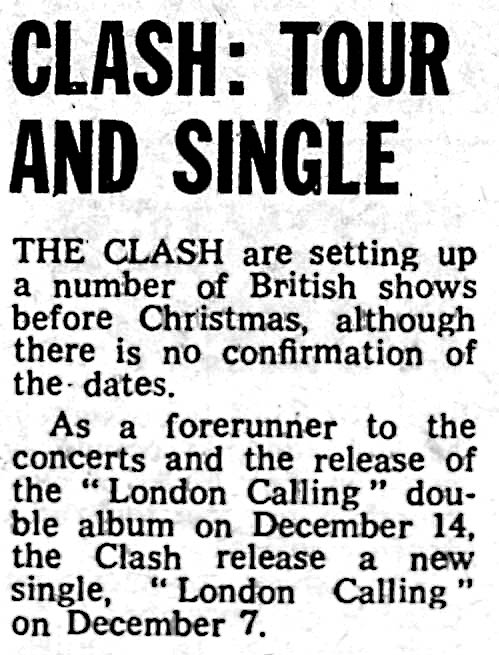

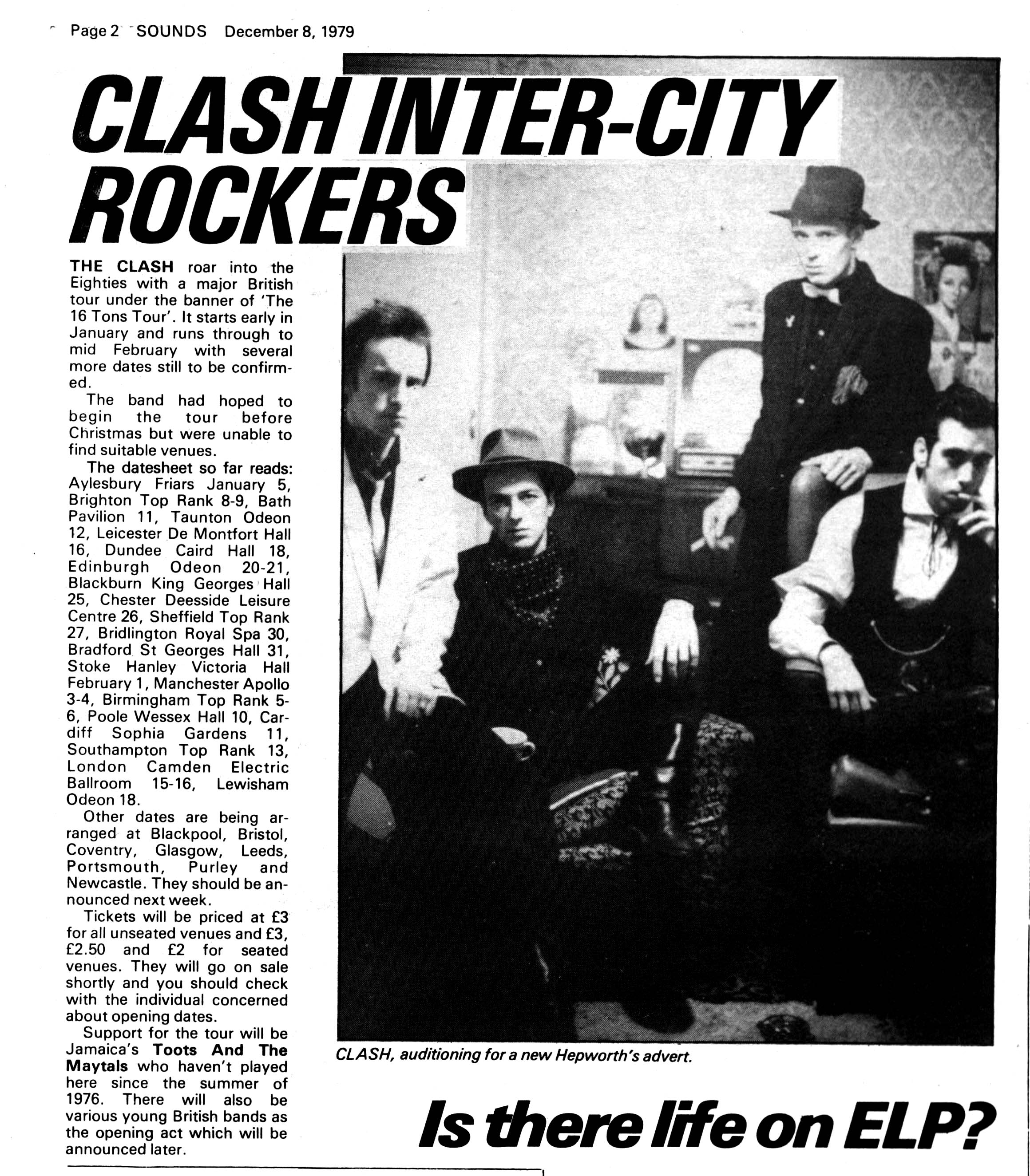


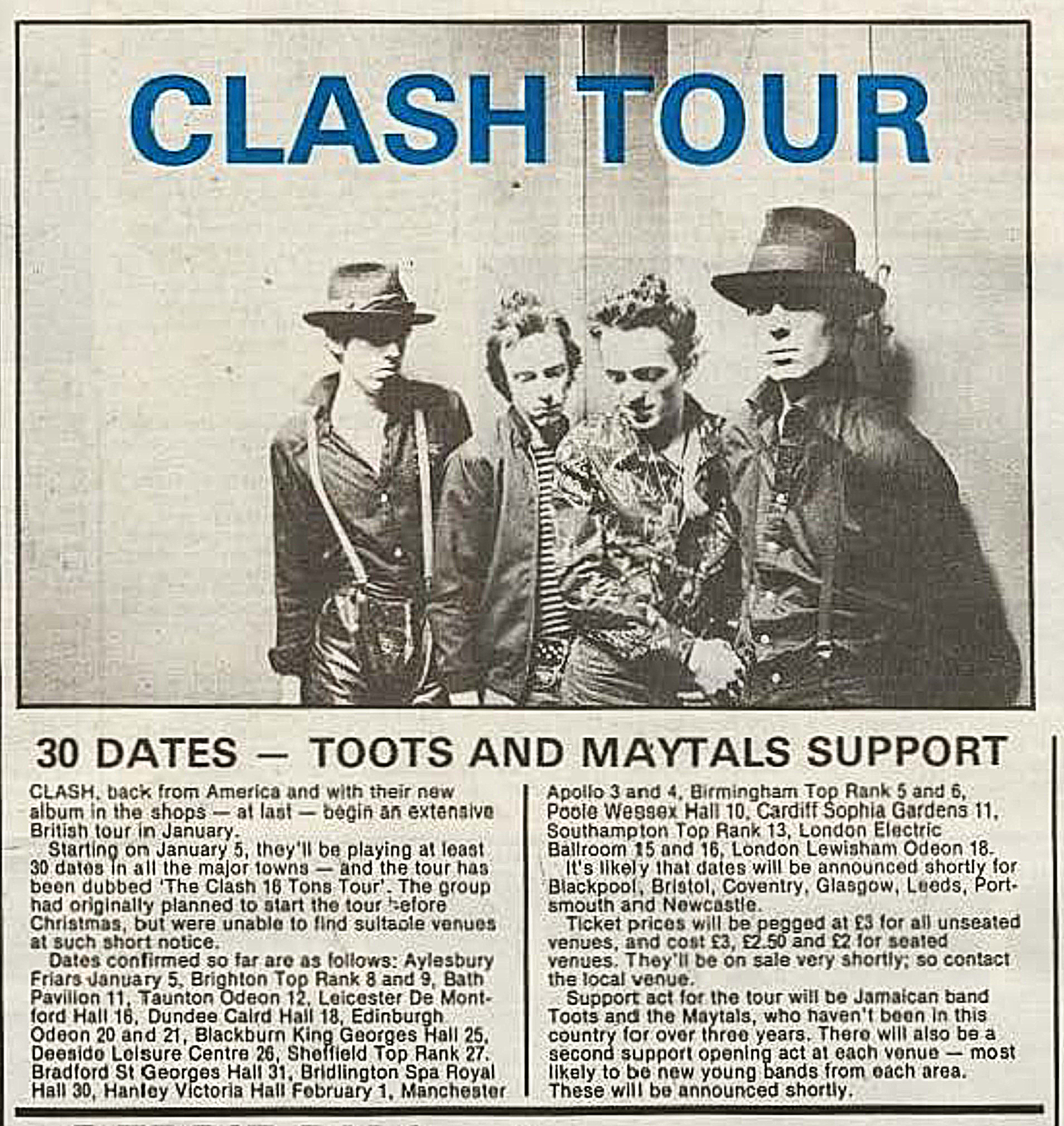


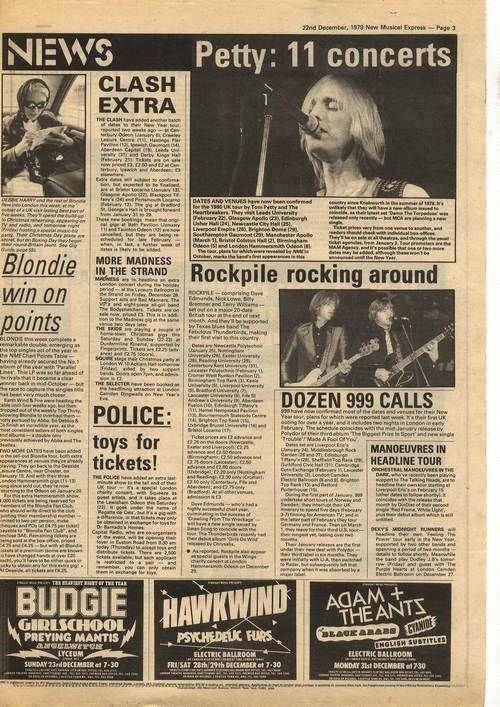
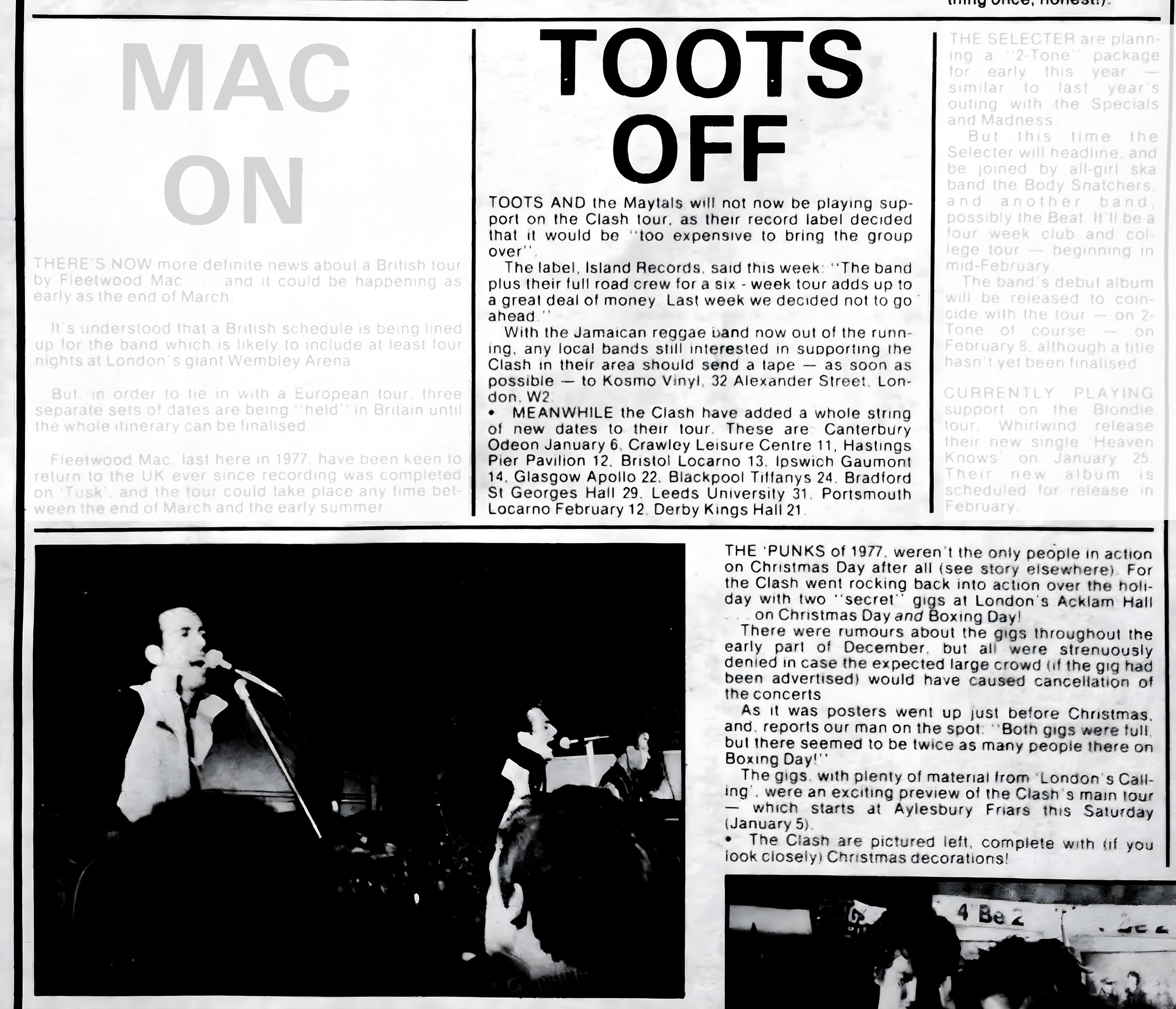
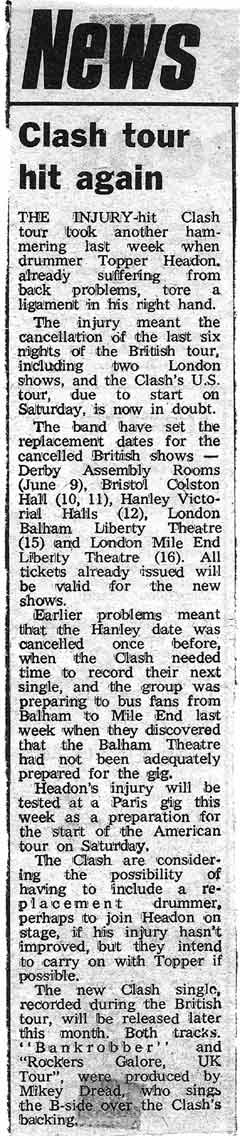
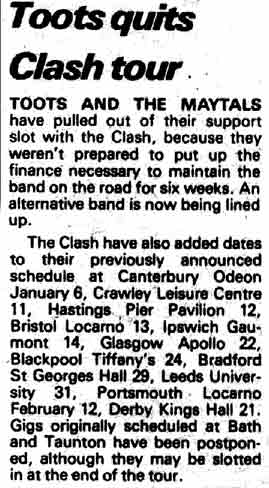
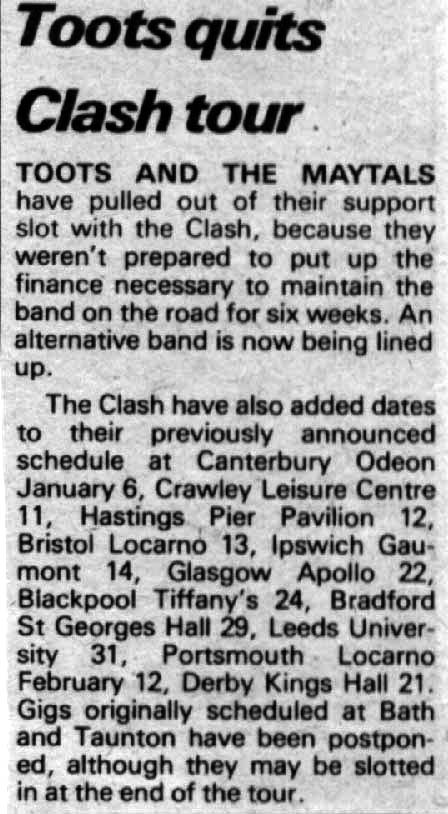
%20JAN%201980%20/1980%20MELODY%20MAKER%20(%20full%20page%20advert%20)%20JAN%201980%20.jpg)
%20JAN%201980%20/1980%20TH%c3%89%20CLASH%20_%20PUNK%20ATTITUDE%20ADVERT%20;0)%20%26%20TOUR%20DATES%20MELODY%20MAKER%20JAN%201980%20-%20FULL%20PAGE%20ADVERT%20/FIzhS1uWUAETP4B.jpg)

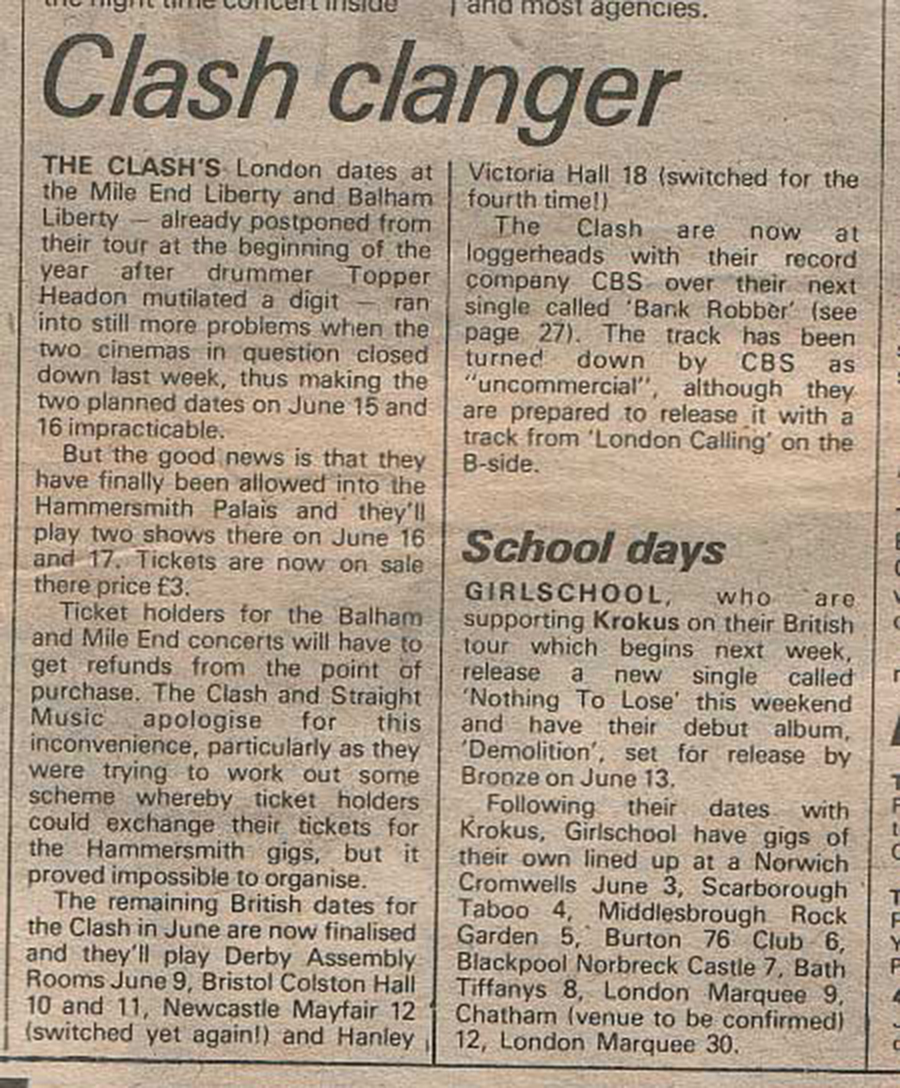

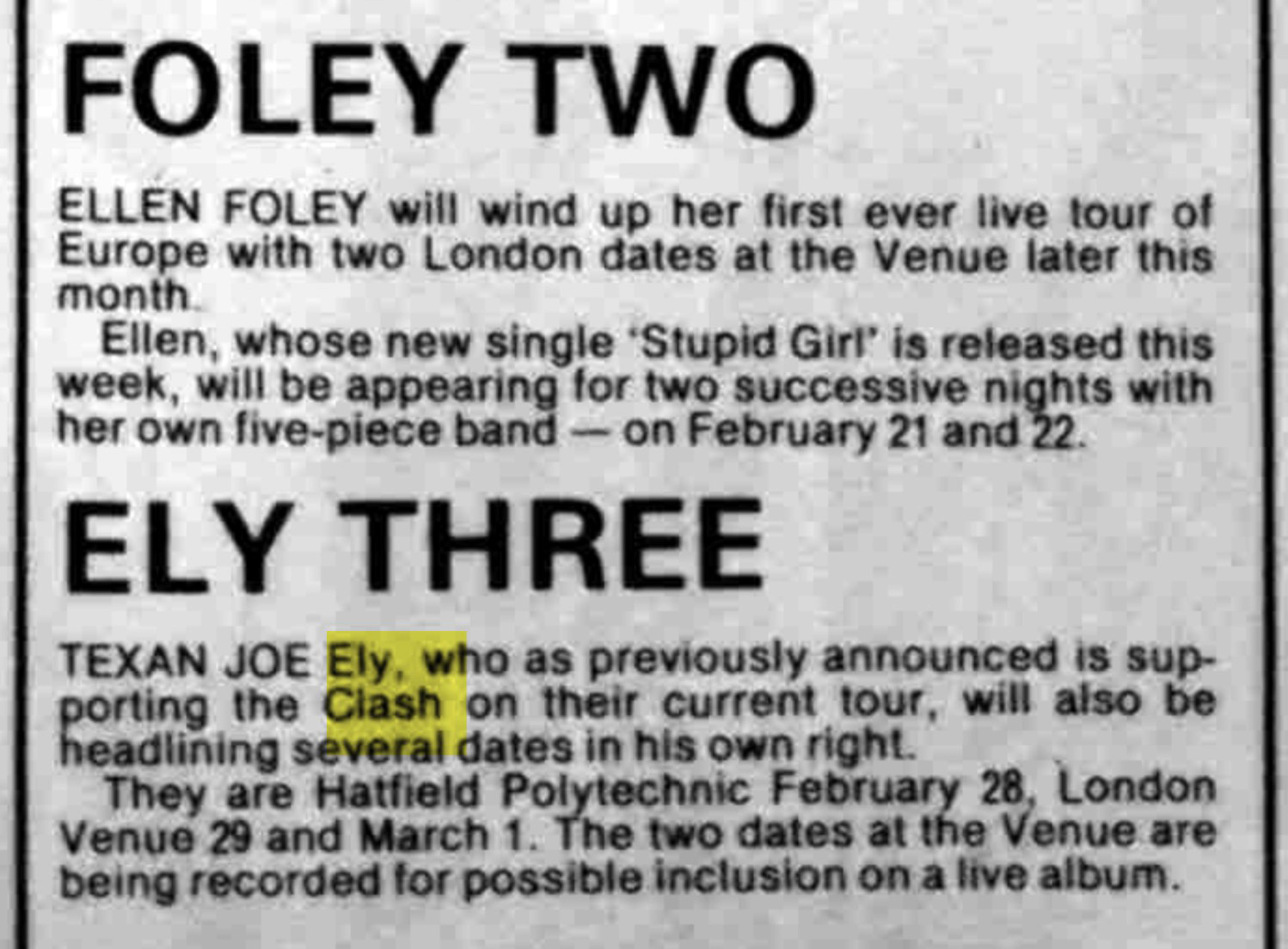

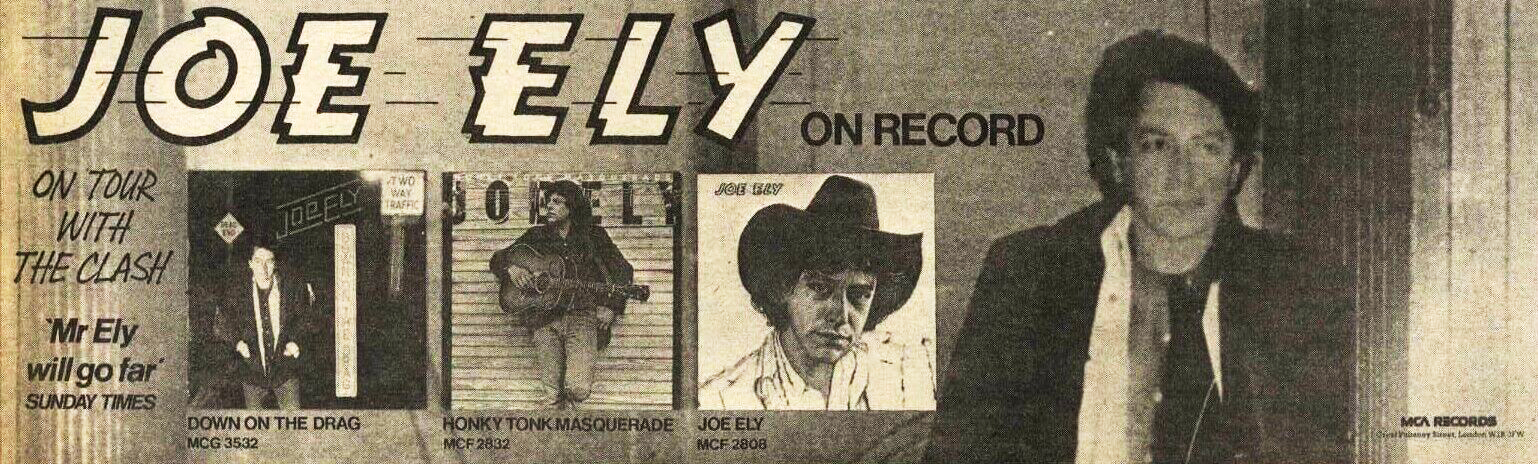



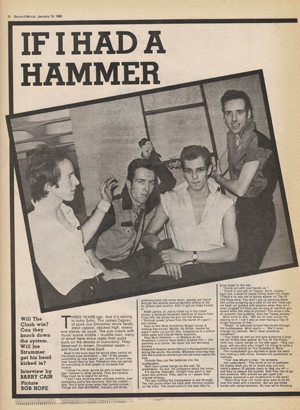


%20RM%20Interview/c.jpg)
%20RM%20Interview/3%20ad.jpg)
%20RM%20Interview/1.jpg)
%20RM%20Interview/2.1.jpg)
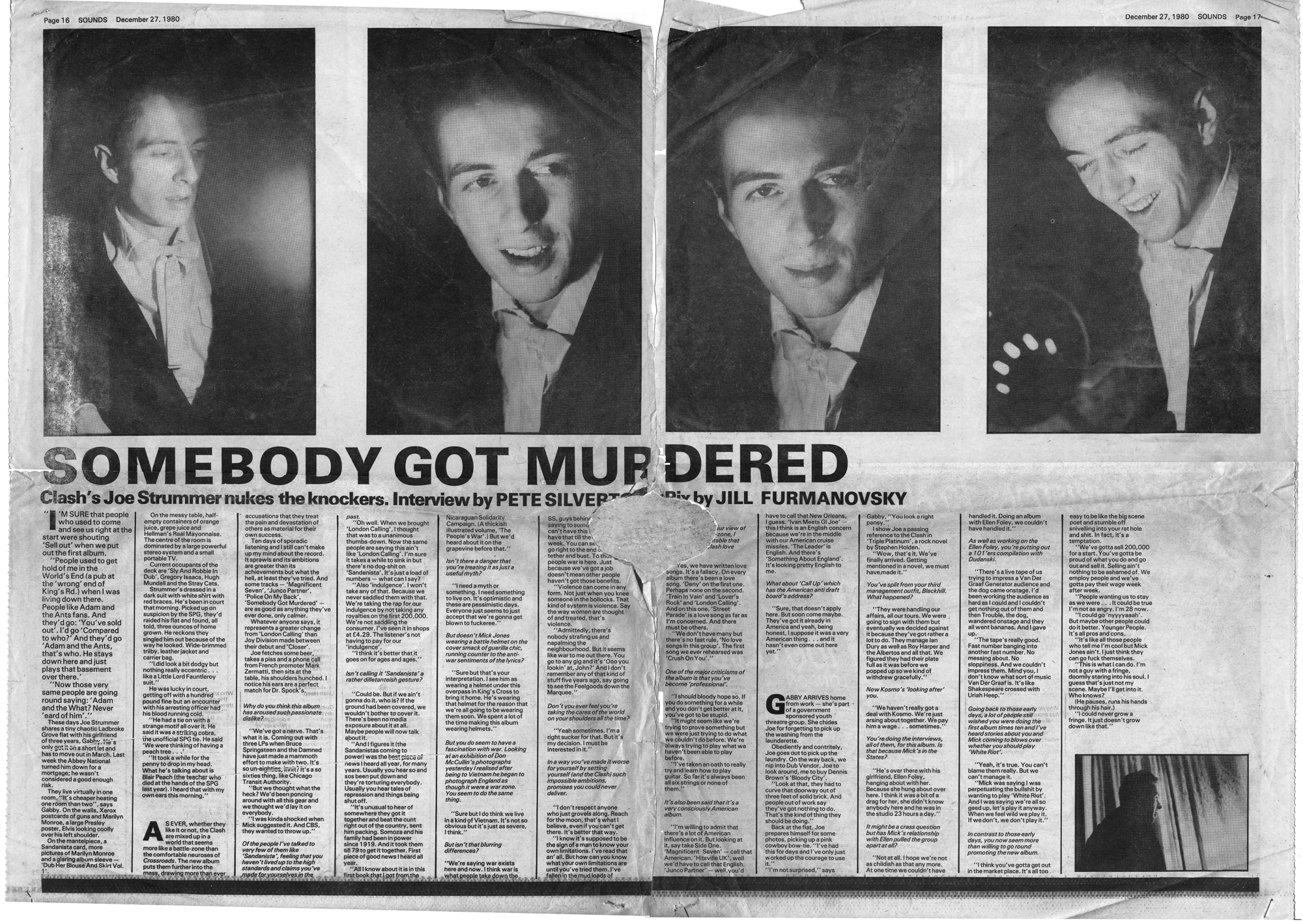
%20MM%20Interview/thumbs/1979%2012%2029%20MM%20Interview_00001.jpg)
%20MM%20Interview/thumbs/1979%2012%2029%20MM%20Interview_00002.jpg)
%20MM%20Interview/thumbs/1979%2012%2029%20MM%20Interview_00003.jpg)
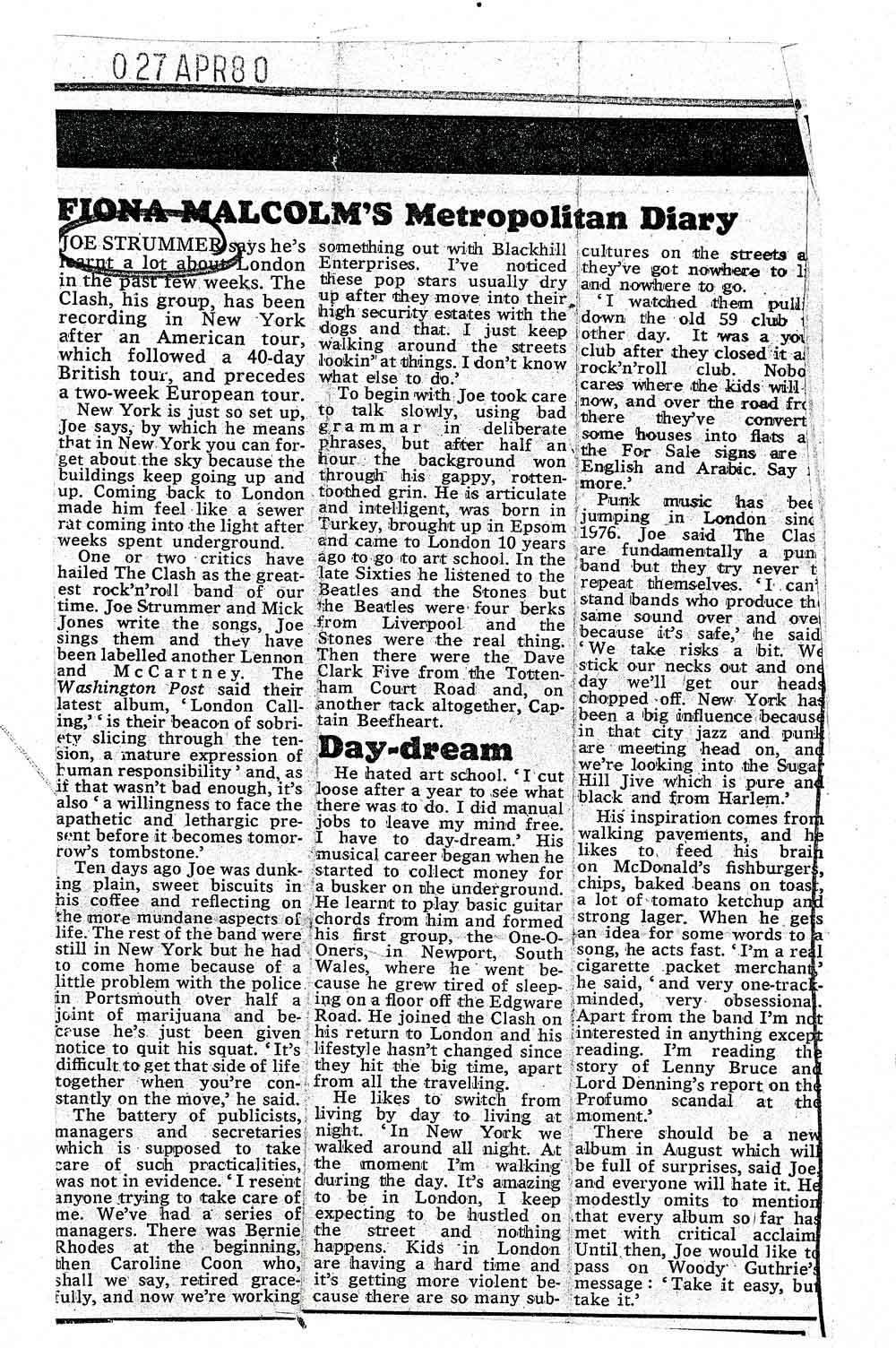





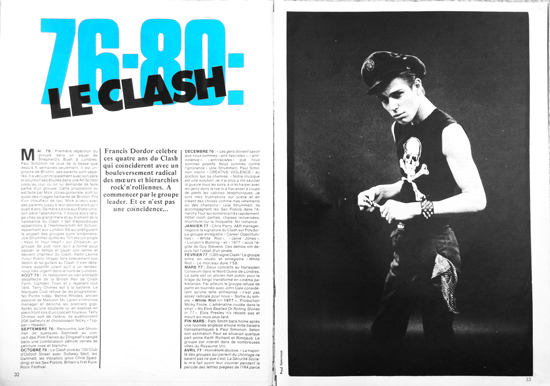





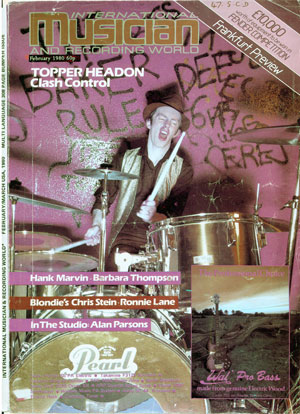


/2.jpg)
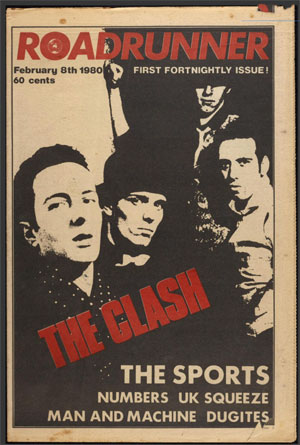





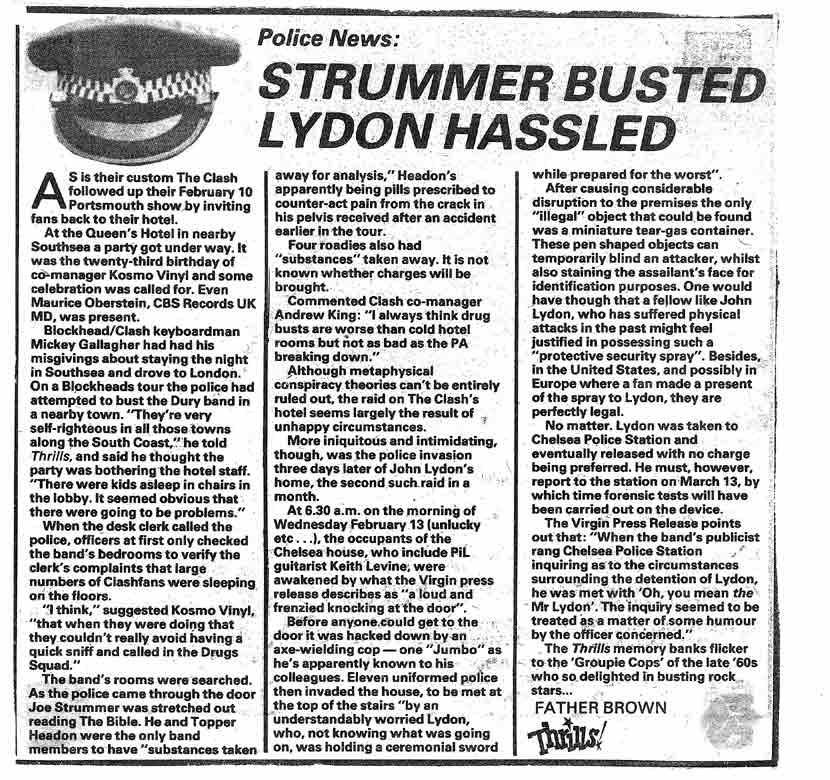
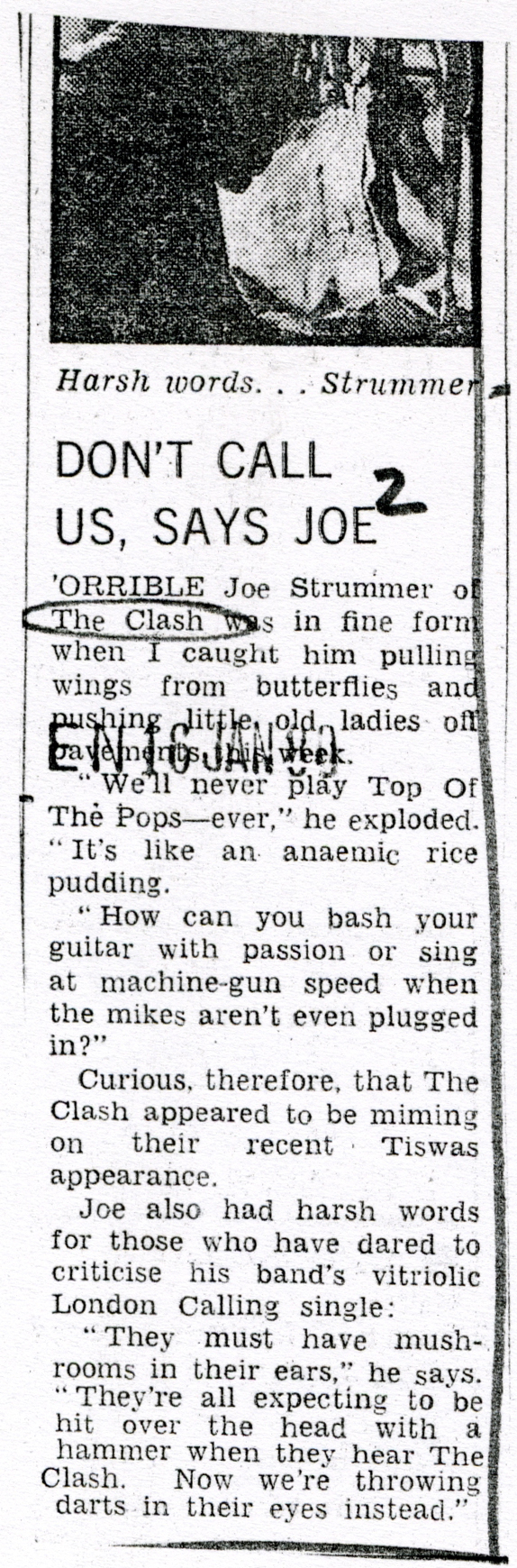
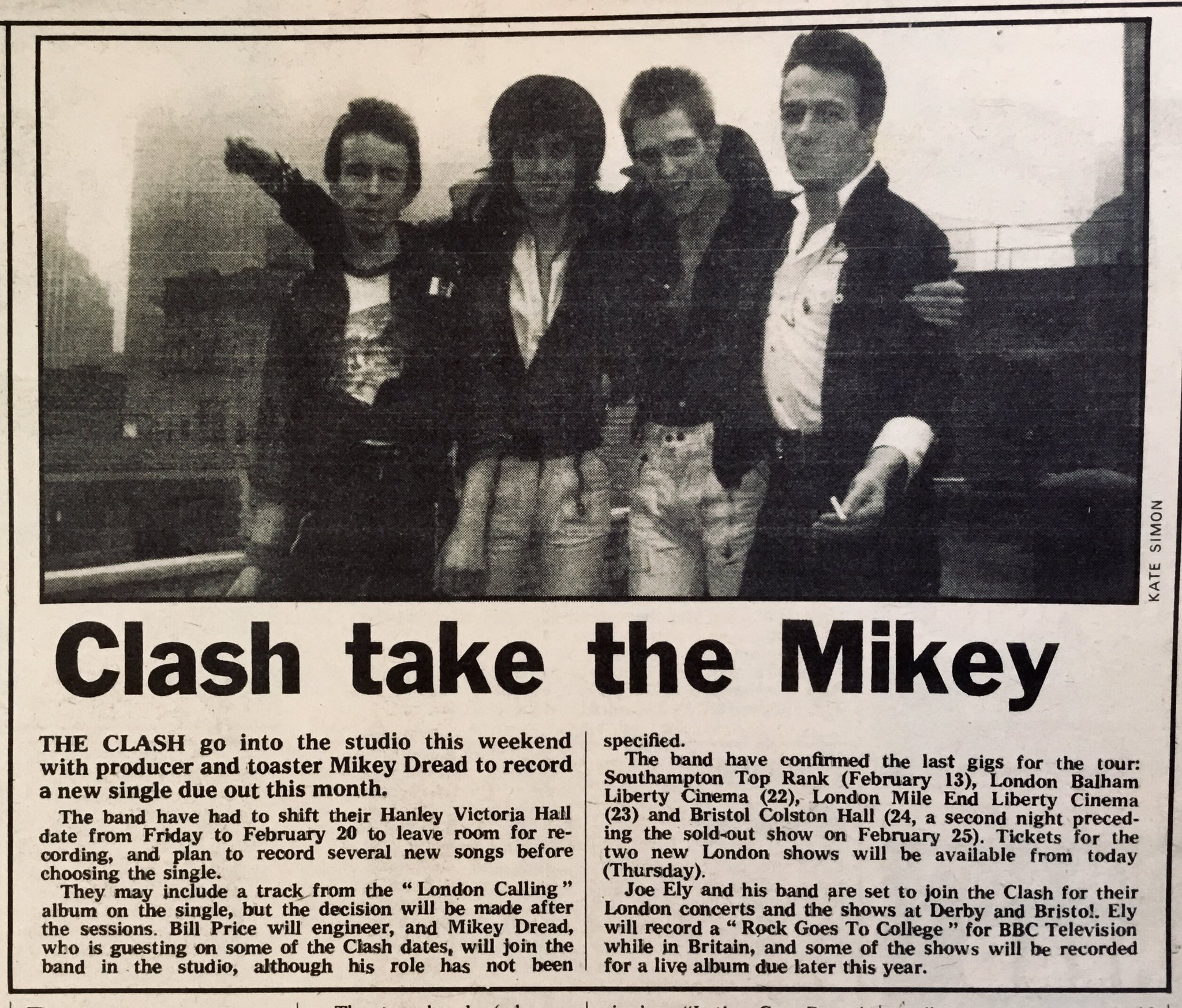
%20MM%20w%20Champion%20dog/12%2029%20MM%20with%20Champion%20dog.jpg)

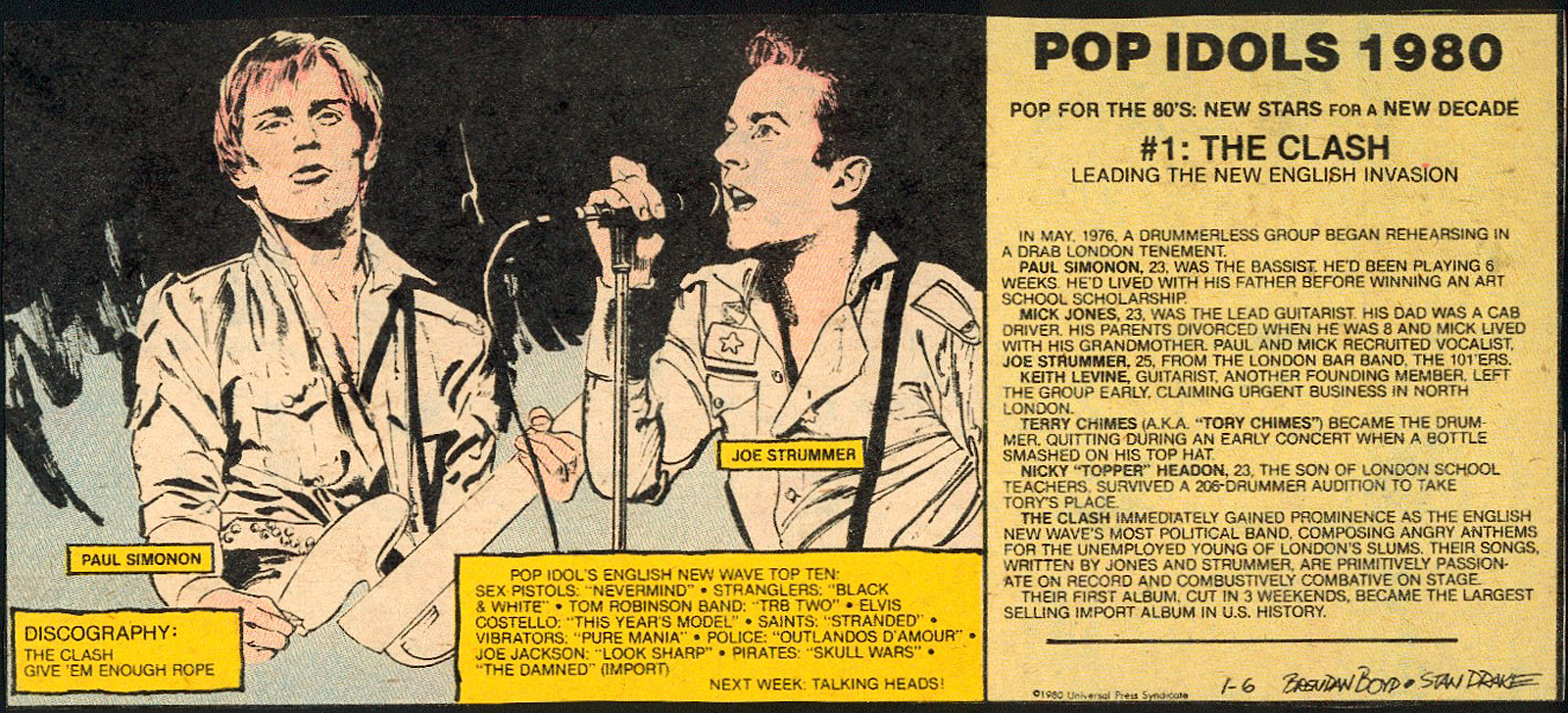
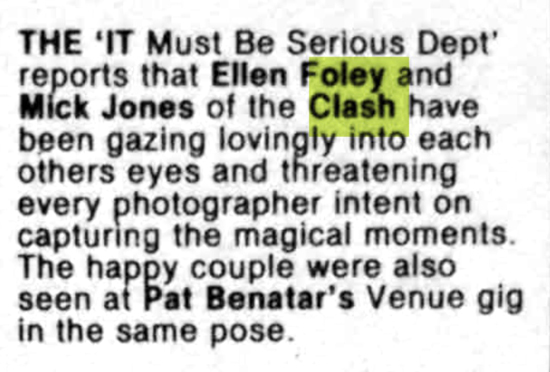
%20SENSIBLE%20ON%20CLASH/80%2000%2000%20Peroxide%20issue%202%20(1980)%20SENSIBLE%20ON%20CLASH.jpg)
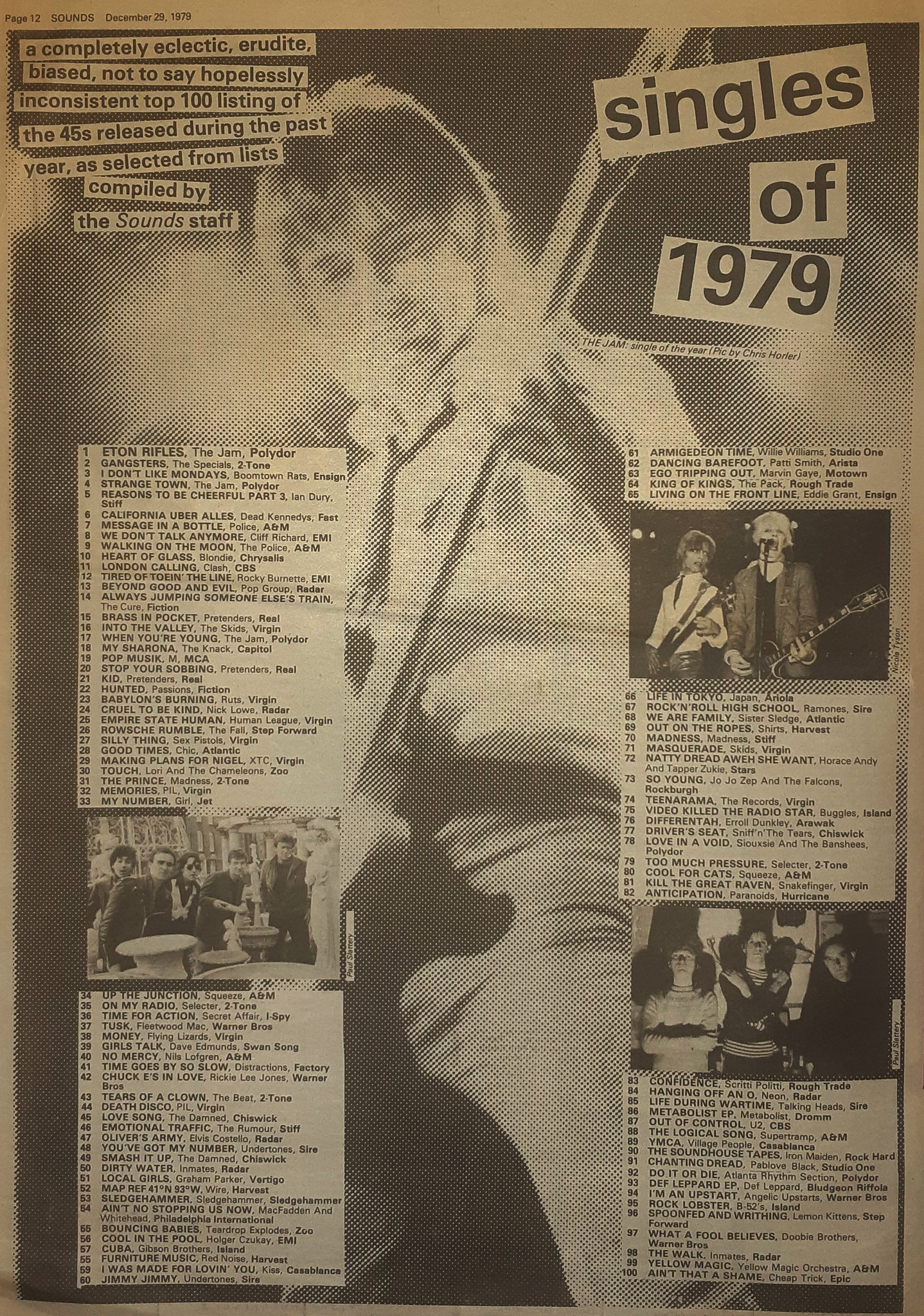



%20Rare%20UK%20Punk%20Fanzine%20Clash%20Interview,%20Joy%20Division/Cover-300.jpg)


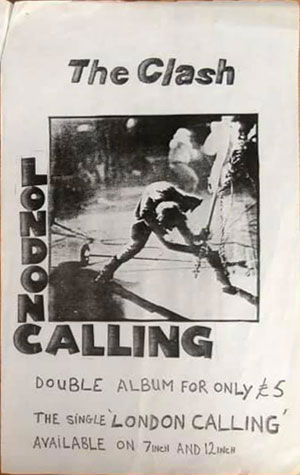
/cover.jpg)



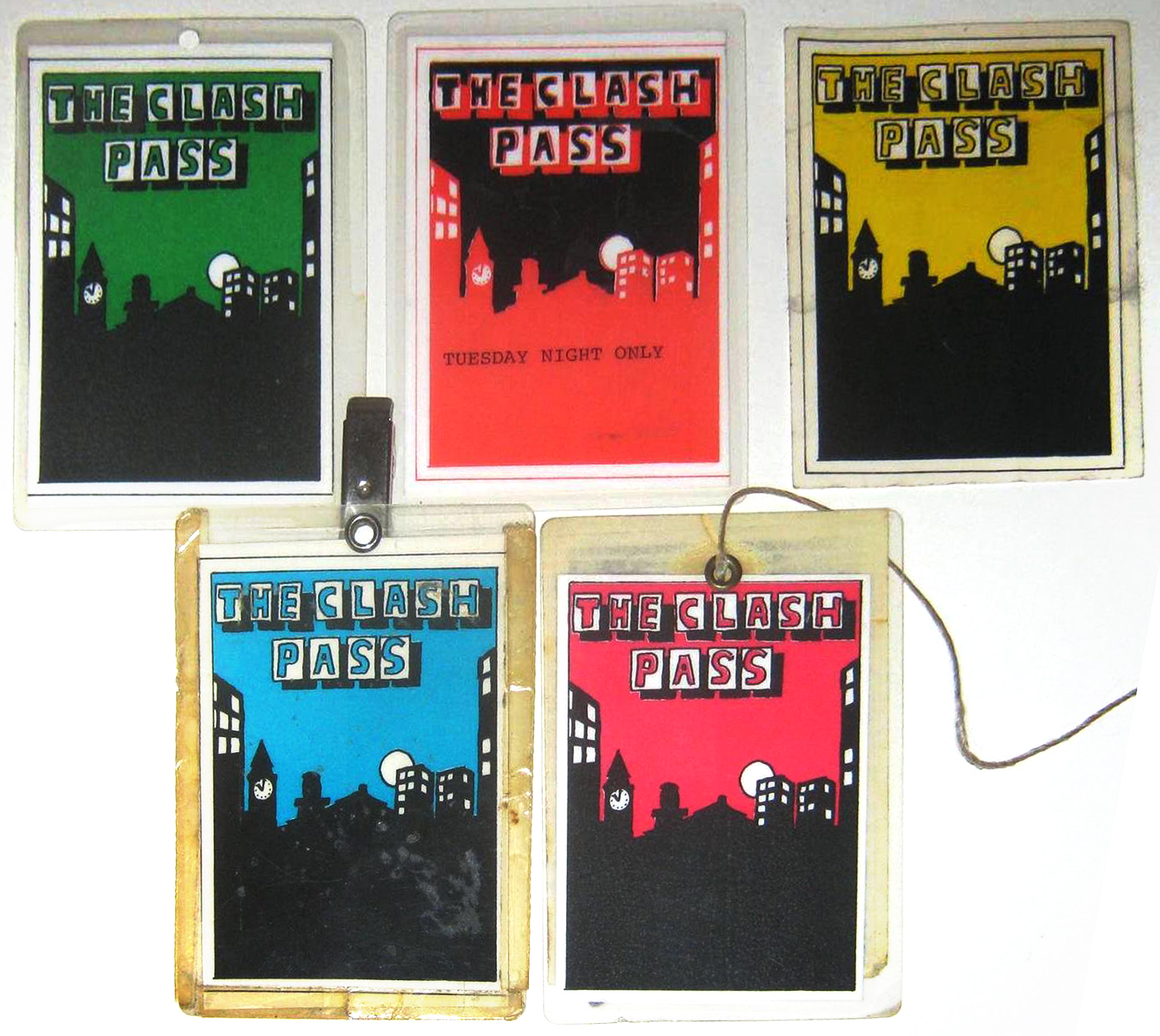



,%20JS%20int)/1.jpg)
,%20JS%20int)/2.jpg)