London Calling Single | DISCOGS

UK chart


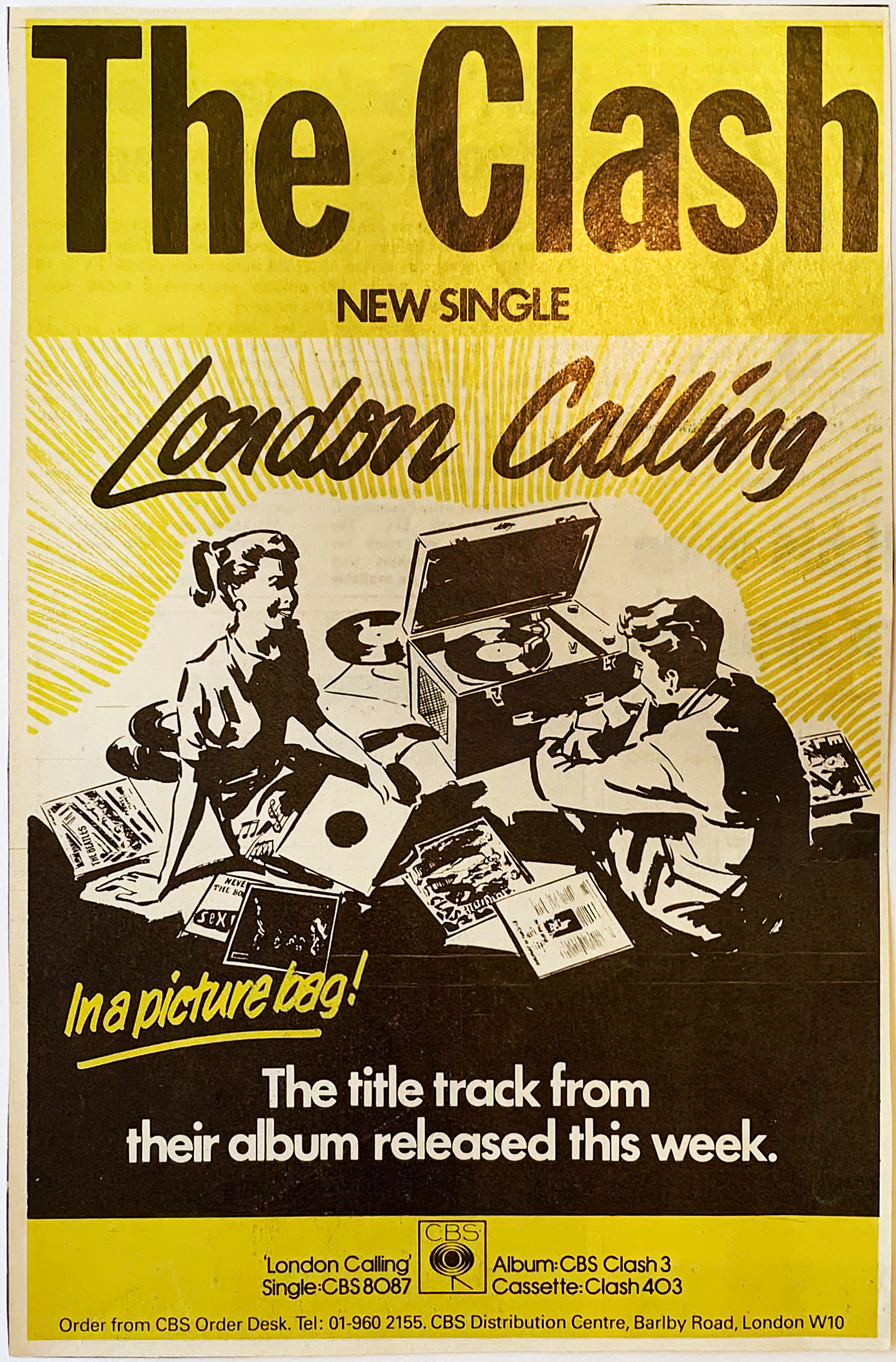
Adverts

Release

UK Reviews


Ray Lowry's sketches

The Clash – The Hand of Ray Lowry

A preliminary sketch of the B side to the London Calling single and the image that graced the back of 12" sleeve design.

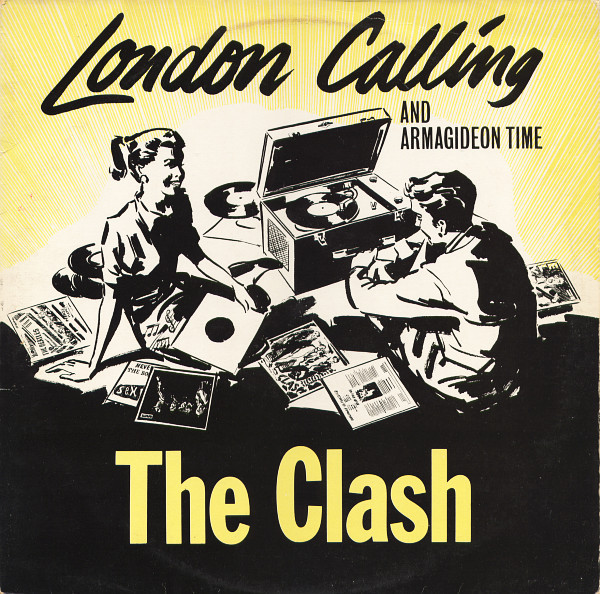
The single cover was designed by Ray Lowry , based on a 1950's standard HMV record sleeve, originally owned by Mick Jones' father.

A hand pulled screen print measuring 15" x  20" approx (outer dimensions) 12" x 12" (art dimensions) on Somerset 300 gsm paper | The Art print is approximately the size of an LP cover, in keeping with the theme | 

 " I have been a music person for all my life and having spent 30 years as a music programmer and D.J. and to be asked to create this print is very special, Ray's images sums up life on the road and Joe Strummer described him as The Clash's war artist."  Robin Ross

Once they are all sold, this image will not be screen printed again. 

Robin has had solo shows in London and New York and has shown his work at the Moscow Print market.

Robins work is collected world wide.


The Clash release the single ‘London Calling’

The Clash | Facebook

7th Dec 1979 - The Clash release the single ‘London Calling’. The cover artwork designed by Ray Lowry,  identical to Columbia sleeves but the blank 78 covers changed to classic rock and punk LP sleeves. How many albums can you name?


back to the top


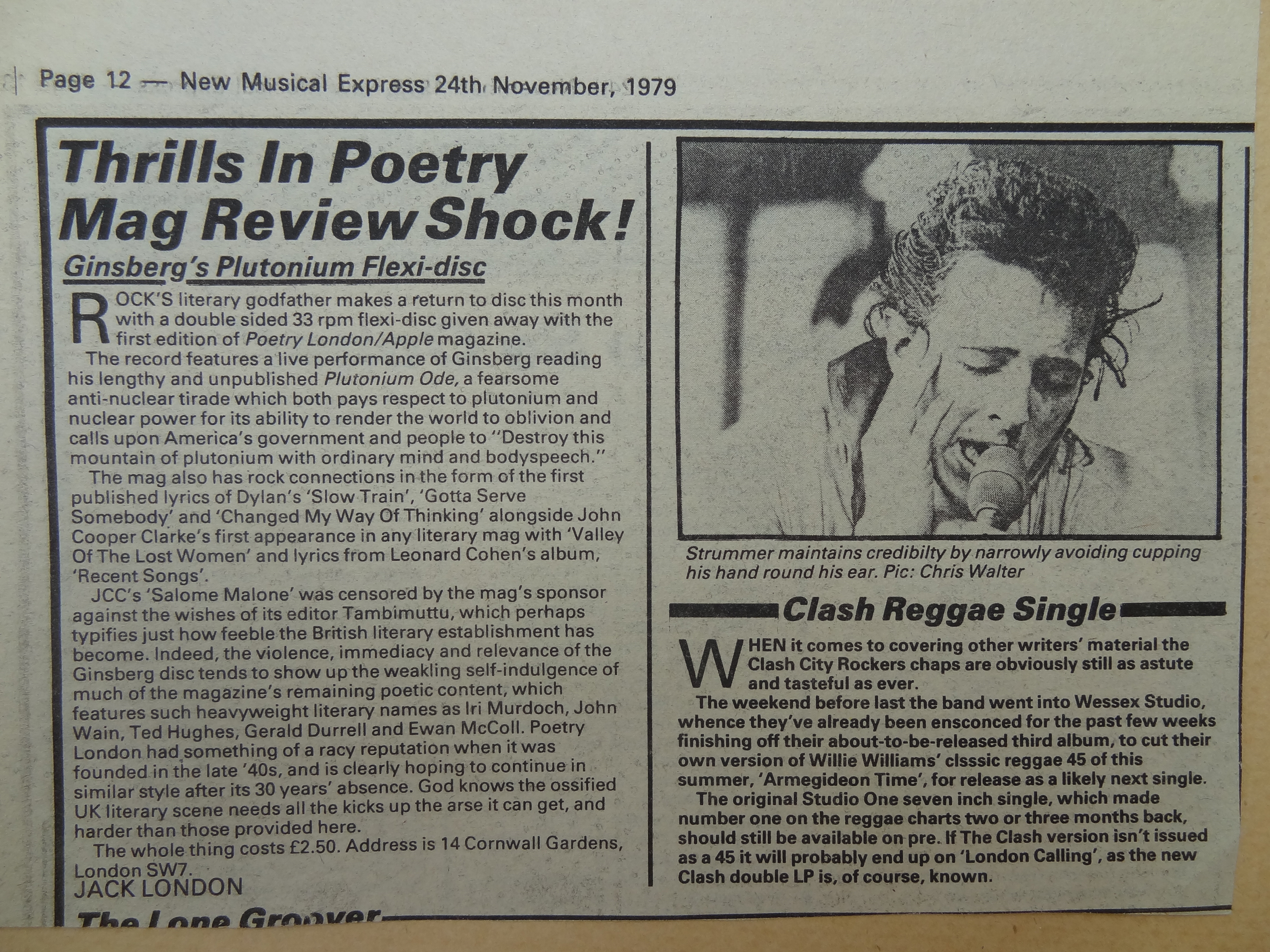
NME London Calling Armagideon Time single news

Page 12 New Musical Express 24th November, 1979

Clash Reggae Single

WHEN it comes to covering other writers' material the Clash City Rockers chaps are obviously still as astute and tasteful as ever.

The weekend before last the band went into Wessex Studio, whence they've already been ensconced for the past few weeks finishing off their about-to-be-released third album, to cut their own version of Willie Williams' clsssic reggae 45 of this summer, 'Armegideon Time', for release as a likely next single.

The original Studio One seven inch single, which made number one on the reggae charts two or three months back, should still be available on pre. If The Clash version isn't issued as a 45 it will probably end up on 'London Calling', as the new Clash double LP is, of course, known.

1979 11 24 - enlarge image


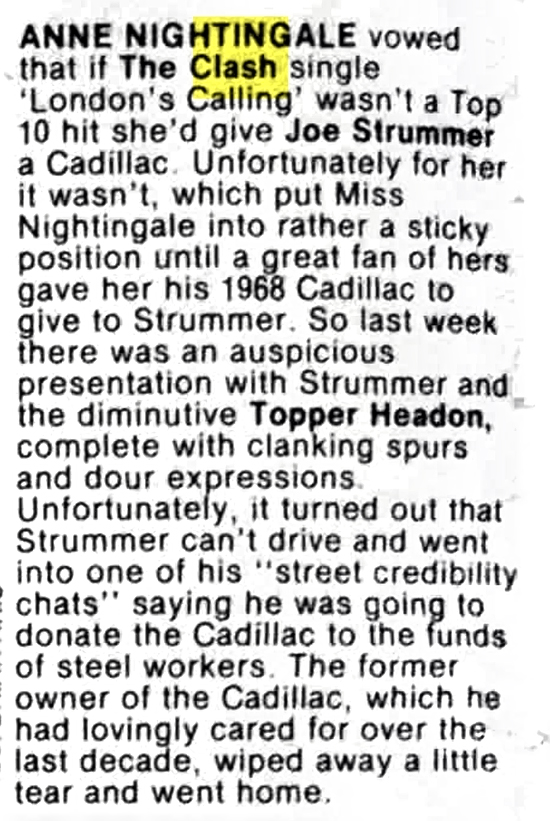
Record Mirror, BBC Radio DJ gives Joes his Cadilac

16 February 1980 - Enlarge image

ANNE NIGHTINGALE vowed that if The Clash single 'London's Calling' wasn't a Top 10 hit she'd give Joe Strummer a Cadillac. Unfortunately for her it wasn't, which put Miss Nightingale into rather a sticky position until a great fan of hers to gave her his 1968 Cadillac to give to Strummer. So last week there was an auspicious presentation with Strummer and the diminutive Topper Headon, complete with clanking spurs and dour expressions.

Unfortunately, it turned out that Strummer can't drive and went into one of his "street credibility chats" saying he was going to donate the Cadillac to the funds = of steel workers. The former owner of the Cadillac, which he had lovingly cared for over the last decade, wiped away a little tear and went home.


Smash Hits Lyrics


Joe Strummer's handwritten lyrics for The Clash's "London Calling"


LONDON CALLING - THE SONG

London Calling / Armagideon Time (CBS UK 8087)

UK Picture Sleeve (Red)

"London Calling" was released as a single in the UK on December 7, 1979, and is from the band's double album of the same name. This apocalyptic, politically charged rant features the band's post-punk sound, electric guitar and vocals.

The song was written by Joe Strummer and Mick Jones. The title alludes to the BBC World Service's station identification: "This is London calling …", which was used during World War II, often in broadcasts to occupied countries.

The lyrics reflect the concern felt by Strummer about world events with the reference to "a nuclear error" to the incident at Three Mile Island, which occurred earlier in 1979. Joe Strummer has said: "We felt that we were struggling about to slip down a slope or something, grasping with our fingernails. And there was no one there to help us."

The line "London is drowning / And I live by the river" comes from concerns that if the River Thames flooded, most of central London would drown, something that led to the construction of the Thames Barrier.

Strummer claimed the initial inspiration came in a conversation he had with his then-fiancee Gaby Salter in a taxi ride home to their flat in World's End (appropriately). "There was a lot of Cold War nonsense going on, and we knew that London was susceptible to flooding. She told me to write something about that," noted Strummer in an interview with Uncut magazine.

According to guitarist Mick Jones, it was a headline in the London Evening Standard that triggered the lyric. The paper warned that "the North Sea might rise and push up the Thames, flooding the city," he said in the book Anatomy of a Song. "We flipped. To us, the headline was just another example of how everything was coming undone."

Strummer's concern for police brutality is evident through the lines "We ain't got no swing / Except for the ring of that truncheon thing" as the Metropolitan Police at the time had a truncheon as standard issued equipment. Social criticism also features through references to the effects of casual drug taking: "We ain't got no high / Except for that one with the yellowy eyes".

The lyrics also reflect desperation of the band's situation in 1979 struggling with high debt, without management and arguing with their record label over whether the London Calling album should be a single- or double-album. The lines referring to "Now don't look to us / Phoney Beatlemania has bitten the dust" reflects the concerns of the band over its situation after the punk rock boom in England had ended in 1977.

The song fades out with a Morse code signal spelling S-O-S, reiterating the earlier urgent sense of emergency, and further alluding to drowning in the river.

Joe Strummer explained in 1988 to Melody Maker: "I read about ten news reports in one day calling down all variety of plagues on us."

This was recorded at Wessex Studios, located in a former church in the Highbury district of North London. Many hit recordings had already come out of this studio, including singles and albums by the Sex Pistols, The Pretenders and the Tom Robinson Band. Chief engineer and studio manager Bill Price had developed a slew of unique recording techniques suited to the room.

The single was produced by Guy Stevens and engineered by Bill Price.

Fellow punk band The Damned were recording overdubs to their album Machine Gun Etiquette in the studio, and as they were old touring buddies of The Clash they roped Strummer and Mick Jones into record backing vocals for the title song to their album - the shouted lines of "second time around!" in that song are actually Strummer and Jones in uncredited cameos.

Interestingly, the band initially wrote most of the London Calling album at the Vanilla rehearsal studios near Vauxhall Bridge in London. Roadie Johnny Green explained: "It had the advantage of not looking like a studio. Out front of a garage. We wrote a sign out front saying 'we ain't here.' We weren't disturbed."

With a great vibe going in the studio and having already recorded some demos with The Who's soundman Bob Pridden, Strummer had the crazy idea to record the entire album there and bypass expensive studio time. CBS refused point blank, so Wessex was chosen because it had a similar intimacy to Vanilla.

The B-side, a cover of reggae singer Willie Williams's Armagideon Times was recorded quickly on Bonfire Night in 1979.

The video was filmed at Cadogan Pier, next to the Albert Bridge in Battersea Park in London. It was directed by longtime friend of the band Don Letts, and made on a wet night in December 1979 which sees the band performing on a barge. Letts didn't have a happy time doing the video. He explained:

"Now me, I am a land-lover, I can't swim. Don Letts does not know that the Thames has a tide. So we put the cameras in a boat, low tide, the cameras are 15 feet too low. I didn't realize that rivers flow, so I thought the camera would be bouncing up and down nicely in front of the pier. But no, the camera keeps drifting away from the bank. Then it starts to rain. I am a bit out of my depth here, but I'm going with it and The Clash are doing their thing. The group doing their thing was all it needed to be a great video. That is a good example of us turning adversity to our advantage."


back to the top


Clash Single of the Week


SINGLE OF THE WEEK

THE CLASH: 'London Calling'/'Armagideon Time'/'Version' (CBS 12")

This is neither the time nor the place to put on record my dissent with the general office belief that the new Clash album represents a sell-out (which of course begs the question - selling out whom? if it means frustrating the wishes of UK Subs fans, I ain't gonna cry too loud) but, looking back on what I've written, I just have so I can leave that alone and rant and rave about how 'Armagideon Time' is the best white reggae record ever even the electric sitar or whatever it is solo and how it shows a depth of understanding of Jamaican rhythms that no other white boys even come near and a sense of maturity in the Clash's own sound.

Which brings us to this twelve-incher retailing at £1.59. 'London Calling' is 'London Calling', only more so. 'Armagideon Time' is even better than the Studio One original because while Willie Williams sometimes sounds like he's snoozing

through the track, Strummer brings his best raw passion and slurring to it.

Then, on the flip, comes the real reason to buy this. Two dubs of 'Armagideon Time', featuring the full range of dub effects without ever going in for all that overdone car-honking crap that you hear too often for anyone's sanity if you so much as go near a reggae sound system.

The two versions have their own distinctive atmospheres. The first, 'Justice Tonight' is sombre, melancholic even. The second, 'Kick It Over', is almost light-hearted, possibly because of Strummer's half played piano. Both, in their own ways, would brighten any home better than a whole catalogue of UK Subs albums and, if they serve to introduce anyone to the possibilities of the seventies most crazed collision between a backward society and modern technology, they've done more than their allotted task.

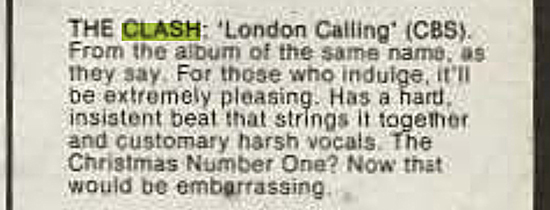
Record Mirror, Single from the album

8 Dec 1979

Enlarge image

THE CLASH: 'London Calling' (CBS).

From the album of the same name, as they say. For those who indulge, it'll be extremely pleasing. Has a hart. insistent beat that strings it together and customary harsh vocals. The Christmas Number One? Now that would be embarrassing.


Smash Hits review

London Calling, The Clash
THE CLASH: London Calling

(CBS). Pardon me for going against the party line on the subject of This Band, but they still play far too loud in the studio. Why won't Joe Strummer let us hear more than one word in every three? Why does all the rest get lost in echo? Until they face these elementary facts, sides like "London Calling" will always fail to condense all that fury and grandeur into a truly great record.

B side, "Armagideon Time", is their most successful attempt at reggae so far, with a bubbling bass and some very effective Middle Eastern guitar figures. I still love and admire them but, if they're going to reach the unconverted, more discipline is called for.

Enlarge image


SOUNDS SINGLE OF THE WEEK

8th, December 1979 Singles page reviewed by Alan Lewis. Single Of The Week The Clash's 'London Calling'


The Clash, SINGLE OF THE WEEK

THE CLASH: London Calling (CBS). A coincidence or more? - that at this moment in time the Clash should choose as their producer none other than Guy Stevens, a key figure in the original Mod era.

Stevens was DJ at the influential Scene Club, was in at the birth of Sue/Island Records before becoming a hippy and getting involved with Hapshash And The Coloured Coat, Mott The Hoople, etc. So are the Clash clutching at a bit of Mod credibility? Well, hardly, although this is certainly a 'different' sound: deep, dark, solid and immensely confident, with none of the slightly ragged edges one used to associate with the Clash.

The tune is as catchy as a cold and the rhythm sets a bold marching pace, but the lyrics are black and cynical: Phoney Beatlemania has bitten the dust... see we ain't got no swing except for the rain and the truncheon pain.... it's an apocalyptic vision of London in decay, with the underworld zombies coming out to prey on the remains, and Clash running with the pack, complete with Ripper-style bloodcurdling cries. A stygian bass riff underpins it all and there's even a 'psychedelic' guitar break (shades of Hapshash?).

The Clash's history has been full of frustrations, sloppy contradiction and compromise but you can forgive them anything when they make a record as complete and commanding as this, even if the lyric tends to repeat ground they've covered before ("London's Burning" etc).

The flip is them doing their white man in Ladbroke Grove reggae bit, which I've never found satsifying, and the sleeve shows a cleancut pair of 50s bobbysoxers listening to their Dansette surrounded by (it's implied) the all-time greats albums: Elvis, Beatles, Stones, Dylan, Pistols and, naturally, the first Clash album. Such modesty.

Enlarge image

Enlarge image


Review • PARTY LINE OF THE WEEK


THE CLASH: London Calling (CBS). Hello?

Hello? Operator, I think I've got a crossed line there's someone ploughing a pre-apocalyptic furrow on my phone. Apparently the Ice Age is coming and there's been a nuclear error, but this chap seems quite happy because he lives by the river. What does it all mean?

What it means, sir, is that The Clash have released a new slice of pop-demagoguery, one which displays a greater musical maturity than before without relinquishing the essential Clash spirit, their earlier abandonment replaced this time round by a tense restraint, as if The Police were pretending to be The Angelic Upstarts.

Ah! So it's a cold-blooded attempt at a chart hit?

Well, I don't know about that, sir, though it would be nice to see them on Christmas Top Of The Pops, wouldn't it? 'London Calling' is actually quite a spiffy little entree to the album of the same name, a plea for youthful solidarity set to a strident marching rhythm.

Does this mean The Clash are the Glenn Millers of the '80s?

We'll just have to wait and see whether they cross the channel by DC10, sir. Until then, it's chest out, stomach in, toe the line and thank God

and Guy Stevens for the powerful cleanliness of the production.

Does this mean that Hapshash & The Coloured Coat are hip again?

No, sir.

Enlarge image


Liverpool Echo LC 7" review

Friday 07 December 1979

As a complete contrast, another single out on OBS is worth a careful scrutiny this week. It's The Clash who've released London Calling from the new album of the same name.

The Clash are firmly convinced that they are rock and roll's future, and yet they've still to break into the big time in ferms of record sales.

London Calling is Strummer-Jones song delivered in true Clash style and with the right kind of push it could be the one they've been looking for to lead us into the Eighties.


Manchester Evening News
Bombshell end to the 70s LC

REPORTS by TONY JASPER - Tuesday 18 December 1979


POP PARADE

THERE can't be a bigger bombshell to end the 1970's record releases than the high-energy charged London Calling from Clash. The album comes with 18 tracks. is a double and has a special sale price of £5. Even Clash, it seems, have a soft heart when it comes to Christmas. London Calling will rocket up the LP charts. It's already received a major boost thanks to the knockout single London Calling. And a listen to the other LP cuts gives me the distinct impression that this is Clash's most accessible record yet.

Joe Strummer, Mick Jones, Paul Simonon and Topper Headon have been the subject of controversy for some time. They've had themselves banned from numerous halls.

Right: The Clash, Joe Strummer, Mick Jones, Paul Simonon and Topper Headon.

Their outspoken com- ments haven't pleased everyone. And I've certainly not gone along with their almost paranoic comments on modern society.

The band disclaim political allegiance. Many a fan and outside commentator has been uncertain whether they've run with the extremes of either camp.

One thing is for sure Clash cannot be ignored. The album London Calling will be hitting the airwaves for sometime. It's booked for the same success as The Clash and Give 'Em Enough Rope and remember, the latter in November '78 shot straight to number two and from it came the single hit Tommy Gun.

from these prices and there has been allowance in the latest figures for a special scheme affecting the record trade.

OH, YES, here is the great Christmas news you really want. Virgin Record Company say their singles will go up to £1.19 and their main albums will hit £5.49, It seems, though, they expect record dealers to discount

Enlarge image


North Wales Weekly News - The Clash Calling

LC Single and Deeside date - Thursday 13 December 1979


The Clash Calling

THE Clash are the latest group to be booked for North Wales' largest rock venue at Deeside Leisure Centre.

They will play at the centre on January 26 as part of a British tour. Tickets will go on sale next week, priced at £3, and again, It will be a standing-only show.

The Clash have a new single out called London Calling, a Mick Jones/Joe Strummer composition from their latest double album of the same name. The 18-track LP is the follow-up to Give 'Em Enough Rope, released last year.

London Calling sees the group moving further into heavy reggae with the lengthy Revolution Rock, Guns of Brixton and the carnival-flavoured Rudie Can't Fall.

Tickets for the Judas Priest show at the venue on March 23 are now on sale, priced at £3.

Enlarge image


Dream Deferred | The Clash a riot of our own

Hassan Mahamdallie, dreamdeferred, "the-clash-a-riot-of-our-own/" 8 January 2018

The Clash: a riot of our own

Punk and New Wave exploded onto the musical stage in 1976-77. The new music brought the bloated rock scene that came before it crashing down - and punk has shaped much of the music that has come since. Two years ago Hassan Mahamdallie began his occasional series on this blog - a personal, musical and political journey. He ends the series looking at one of the most important - if not the most important - punk bands of all time, the Clash....

Retrospective review of

White Riot 7"
Police and Thieves
Clash City Rockers 7"
Compleet Control 7"
Armagideon Time (LC12)
Live at Lyceum December, 1978


Pic%20credit%20Sonic%20Collective

(The Clash. Pic credit: Sonic Collective)

Punk and New Wave exploded onto the musical stage in 1976-77. The new music brought the bloated rock scene that came before it crashing down - and punk has shaped much of the music that has come since. Two years ago Hassan Mahamdallie began his occasional series on this blog - a personal, musical and political journey. He ends the series looking at one of the most important - if not the most important - punk bands of all time, the Clash.

Next week we will posting Hassan's list of his 10 favourite punk debut singles. We also intend to publish a downloadable compilation of Hassan's music posts here, with an introduction by a very special guest.


The Clash. Single No 1: White Riot (1977)

clashwhite-600x614

It's quite something, when you think about it, that the debut single of the most successful punk band of all, and my personal favourite, clocked in at just one minute fifty-eight seconds and was widely misinterpreted at the time as having racist overtones.

The Sex Pistols' Anarchy in the UK exploded in November 1976 like a random depth-charge, blowing all the accepted musical rules out of the water, but instant converts like myself had to wait another six months until we had something else to compare it to. So we could begin to join the dots: "That song is punk, and this one is also punk, so this must be what punk is. This is what it sounds like and this is what it is all about." All we could do in the intervening period was tune into the BBC Radio One John Peel show in the evenings to hear what new bands he was raving about.

If Anarchy in the UK had slashed a big X in the centre of a new soundscape, the Clash's debut single White Riot, released in March 1977, would be an arrow pointing us in a particular direction. Or at least that was the theory. But what direction? What exactly was a White Riot I asked myself? Wasn't that something that the razor-wielding Teddy Boys had been up to in Notting Hill in 1958 when they had attempted to pogrom the local West Indian population? Or what the Enoch brigade and the National Front (NF) would like to do us 'pakis' given half a chance?

It wasn't until the Clash included their interpretation of one of my all-time favourite songs, Junior Murvin's masterpiece Police and Thieves on the first album, that I realised where the Clash stood.

Police and thieves in the streets (oh yeah) Fighting the nation with their guns and ammunition Police and thieves in the street (oh yeah) Scaring the nation with their guns and ammunition…


Junior Murvin's Police and Thieves: 12" version. Produced by Lee 'Scratch' Perry (1976)

clashjunior

Later I came to understand that White Riot was a song of praise for the Black youth who had bravely fought the Met police to a standstill during the 1976 Notting Hill Carnival, and an admonishment to white youth who had yet to find their own route to confrontation with the state. Indeed White Riot was composed out of the first-hand experience of Clash singer Joe Strummer, bass player Paul Simonon and manager Bernie Rhodes, who had been caught up in, and participated in the rebellion against state repression and racism that flared in Notting Hill in the August of that searing long hot summer of '76.

White riot - I wanna riot White riot - a riot of my own White riot - I wanna riot White riot - a riot of my own

Black people gotta lot a problems But they don't mind throwing a brick White people go to school Where they teach you how to be thick

…All the power's in the hands Of people rich enough to buy it While we walk the street Too chicken to even try it

Everybody's doing Just what they're told to Nobody wants To go to jail!

White riot - I wanna riot White riot - a riot of my own White riot - I wanna riot White riot - a riot of my own

Are you taking over or are you taking orders?

Are you going backwards, Or are you going forwards? the song concluded, echoing CLR James's eloquent insight:

Times would pass, old empires would fall and new ones take their place. The relations of countries and the relations of classes had to change before I discovered that it is not the quality of goods and utility which matters, but movement, not where you are, or what you have, but where you have come from, where you are going and the rate at which you are getting there.


Single No 4: Clash City Rockers (1978)

clashcityrockers

The Clash were as much an expression of the UK reggae scene and Caribbean culture and rebel politics as they were of the pub rock and art-school scene. Joe Strummer had lived in a communal squat in Maida Vale, just north of Notting Hill. Mick Jones had been a south London schoolboy in Tulse Hill. Paul Simonon had been raised in Brixton and Ladbroke Grove, had grown up in and around London's Black community, and was a huge reggae fan - clearly manifested in his ska/reggae bass-playing style.

Before going on to manage the Clash, Bernie Rhodes had run a record shop in Kilburn specialising in reggae imports. Apart from using photo imagery from the '76 riot as backdrops to their gigs and on their record sleeves, the Clash were visually inspired by artwork they came across adorning Jamaican reggae album covers.

In 1977 the journalist, cultural activist and maybe best chronicler of punk Vivian Goldman wrote an insightful article in Sounds magazine that traced out the punky-reggae conversation that was going on at the time. Goldman wrote that, setting aside Don Letts' famed reggae DJ sets at punk gigs:

The main impetus for punk enthusiasm for reggae is down to the musicians. The Clash definitely lead the way - their cover of 'Police And Thieves' is the strongest vinyl evidence to date of new wave sympathy for their black peer group. Even down to the shot of the rioting under the Westway at the '76 Notting Hill Carnival on their album sleeve, the Clash have always laid their souls on the red, green and gold line. Bernie Rhodes was right when he described them as "a roots band.


Single No 3: Complete Control (1977)

clashcomplete

Complete Control

In September 1977 the Clash released their third single Complete Control. I rate it as one of their best. The composition, the guitar wall-of-sound, Strummer's incomprehensible growl, Mick Jones plaintive backing vocals, Nicky 'Toppe'r Headon's energetic beat, all come together - perfectly formed from start to finish.

Complete Control was produced by unique and hallowed Jamaican musical innovator Lee 'Scratch' Perry, who had admired the band's version of Junior Murvin's hit (although its disputed how much of his studio mix made it to the final cut), and the front cover was a photo of a reggae sound system bass speaker set.

In June 1978 the Clash were to return to the inspiration of Police and Thieves with the distinctive single (White Man) In Hammersmith Palais:

White youth, black youth Better find another solution Why not phone up Robin Hood And ask him for some wealth distribution.

And then of course there were the covers - notably Frederick 'Toots' Hibbert's (of Toots and the Maytals) Pressure Drop and Willi William's Studio One anthem Armigideon Time, as well as their own songs - including Paul Simonon's personal tribute to The Frontline - The Guns of Brixton - complete with reference to the anti-hero of the famous crossover 70s Jamaican rude boy movie:

You see, he feels like Ivan Born under the Brixton sun His game is called survivin' At the end of the harder they come


Single No 10: Armagideon Time. The flip side to London Burning (1979)

clasharma

Single No 9: The Cost of Living EP included a version of 1960s Bobby Fuller standard I Fought The Law. The EP was released in May 1979 to coincide with the General Election which put Margaret Thatcher in power.

Between 1977 and 1979 the Clash never stopped evolving their sound and subject material, and widening their political reach into areas I could appreciate and agree with, the opposite of their early "rivals" the Sex Pistols, who, for whatever reason you like to give, never moved forward musically, rapidly descended into both tragedy and farce.

In the same month as (White Man) In Hammersmith Palais was released, what was left of the Pistols messily exited musical history with the 12" single No One Is Innocent - a seedy karaoke sing-a-long with sad-sack train-robber in exile Ronnie Biggs:

God save Martin Boorman and Nazis on the run God save Myra Hindley God save Ian Brady Even though he's horrible and she ain't what you call a lady

Charming.

The icing on the cake? The Clash were the most exciting live band I have ever experienced - even beating my old favourites The Damned. I saw the Clash perform at The Rainbow, Finsbury Park in December 1977, at the Victoria Park Rock Against Racism gig in April 1978, Harlesden Roxy in October 1978 and at the Lyceum Ballroom on the corner of The Strand, central London, in December 1978.

In those days you had to rush to the venue ticket office as soon as the weekly music press announced that tickets had been released, queue up for hours, put up with passers-by stopping to gawp at the assorted rabble slumped untidily in the road (me and my fellow Clash fans), and hopefully make it to the box-office grill before the gig sold out, passing over some greasy bank notes to the ticket lady who had drawn the short straw that day. I remember going up to The Strand and queuing up to buy two tickets for a fiver -and thinking at the time that was a bit steep and it had better be worth it.


December 1978: The Lyceum ballroom in The Strand

clashsort

It was a phenomenal gig - Strummer spitting out lyrics through his crooked teeth, his left leg furiously pumping up and down to the beat, Mick Jones fronting up to his left, Paul Simonon, low slung bass across his hip to the right and Topper Headon hard at it on the drum kit at the back.

Tune after tune rocketed out from the stage into the auditorium one after the other in feverish bursts of hot energy - White Riot, City of the Dead, Remote Control, Janie Jones, What's My Name, Garageland, Tommy Gun, Drug-Stabbing Time, Capital Radio, Police and Thieves, I Fought The Law, Stay Free…I staggered away at the end, drenched with sweat, my ears ringing (as they would continue to do so for days after), completely numbed, on autopilot I crossed The Strand and over the Thames towards Waterloo Station and home.

Whatever individual thoughts and emotions that had been with me that day had been burned clean out of my skull. Strummer later recalled that those were the nights "when it burns. When you cease to be even anybody at all. Your just part of something. You don't know what your doing or saying. It burns and that is was the audience want to be part of, that burn".

You can watch a very good 9-minute film of the Clash live, from October 1977 below.
Online or archived PDF, archived PDF2


By Hassan Mahamdallie |
8 January 2018
Added to BMC July 2024

Online or Archived PDF

Punk and New Wave exploded onto the musical stage in 1976-77. The new music brought the bloated rock scene that came before it crashing down - and punk has shaped much of the music that has come since. Two years ago Hassan Mahamdallie began his occasional series on this blog - a personal, musical and political journey. He ends the series looking at one of the most important - if not the most important - punk bands of all time, the Clash.

Retrospective review of

White Riot 7"
Police and Thieves
Clash City Rockers 7"
Compleet Control 7"
Armagideon Time (LC12)
Live at Lyceum December, 1978


back to the top


www.blackmarketclash.co.uk

email blackmarketclash.co.uk@gmail.com

THE CLASH
1976  1977  1978  1979  1980  1981  1982  1983  1984  1985  THE CLASH: ALBUM BY ALBUM, TRACK BY TRACK 

STRUMMER, BAD, Pogues, films + : THE SOLO YEARS
THE 101ers: 1974-1976   SOLO YEARS: 1986-2025

STRUMMER & THE LATINO ROCKABILLY WAR
ROCK THE RICH 88-89   ROCK THE RICH 99-00  

STRUMMER & THE MESCALEROS
ROCK ART TOURS 1999   ROCK ART TOURS 2000   GLOBAL A GO GO TOURS 2001   GLOBAL A GO GO TOURS 2002   STRUMMER DEMOS OUTAKES

BOOKS, NEWSPAPERS & FEATURE MAGAZINES
THE CLASH YEARS –– 1975-1986 
THE SOLO YEARS –– 1987-2002 
RETROSPECTIVE FEATURE MAGAZINES –– 2002-2025  
BOOKS  OTHER LINKS  

THE CLASH AUDIO & VIDEO
THE CLASH INTERVIEWED – INTERVIEWED / DOCS

Sex Pistols / The Jam / The Libertines / Others
The Sex Pistols  The Jam  The Libertines  other recordings-some master