January to April 1977

Pre White Riot Tour


Index
Dates
Topper Joins, Chimes leaves
Don Letts Punk Rock Movie

Snippets
Posters
Adverts

UK Articles
US Articles
International Articles

Fanzines

Social Media
Magazines
Books
Photos

1977 magazines
1977 Sundry


Snippets

Alex Michon – visionary stylist who transformed The Clash

Alex Michon was the visionary stylist who transformed The Clash from standard punks into a paramilitary rock-and-roll force. Recruited from St. Martins by manager Bernie Rhodes in late 1976, she was tasked with creating a "uniform for the urban frontline."

Before she was a designer for The Clash, Michon grew up in Nottingham. She describes her childhood imagination as being heavily influenced by a "deep melancholia of the Russian soul," imagining herself among silver birches and cherry trees while writing poetry and wearing starched white dresses.

By late 1976, she was a 19-year-old art student at Central Saint Martins in London. She has described herself during this period as a "shy punk" who lived in second-hand men's clothes, inspired by the androgynous style of figures like Patti Smith.

Alex Michon – visionary stylist who transformed The Clash

The "Battle Ready" Brief

When manager Bernie Rhodes recruited Michon, he didn't ask for fashion; he asked for armor. He famously told her:

"Things are gonna get rough, so we're gonna need clothes that are tough. There's going to be fighting in the streets."

To prepare, Rhodes instructed Michon to watch the film "The Battle of Algiers" as a visual reference for urban guerrilla warfare. She was an official member of the "Clash collective," receiving the same £25 weekly wage as the musicians.

The Guerrilla Aesthetic

Michon rejected the haphazard safety-pin look of the Sex Pistols. Instead, she developed a structured, "functional-socialist" style. Key facts include:

The "Zip" Jacket: Inspired by Jackson Pollock, she created black cotton jackets with asymmetric, "exploding" zips.

Symbolic Stenciling: She integrated political icons, such as the "running policeman" from the Notting Hill riots, directly onto the fabric.

Functional Design: Every piece was practical. Joe Strummer's shirts often featured small, hidden pockets specifically for his guitar plectrums.

She returned to school as a mature student, graduating from Goldsmiths College in 1982 and later earning an MA in Fine Art from Central Saint Martins in 2003. Since 2004, she has been the co-director of the Transition Gallery in Hackney, East London. As of late 2025, she continues to maintain a busy professional life as an artist, director, and writer.

Postcard from Strummer to Alex Michon

The Creative Philosophy

Michon viewed the band as a collective. She famously noted that their clothes were meant to be a "manifesto on a hanger." Reflecting on the intensity of the era, she once stated:

"The clothes were about a sense of belonging to something that was bigger than just a band; it was a way of being in the world."

She stayed with the group until their 1983 dissolution, eventually transitioning into a career as a painter and director of London's Transition Gallery.

Reflecting on her motivations and the intersection of art and politics, she has stated:

"I love punk, passion, girls with guitars, rockabillys and misfits and I long for the eventual decline of capitalism."

Regarding the nature of her work, she has said:

"I think it is important for artists... to engage with what concerns them at the particular moment they are making the work."

The Clash - (Punk) Passion Is A Fashion - Punk 77
https://en.wikipedia.org/wiki/Alex_Michon


NME - Advert, date / source unknown

Clash Offer - Free EP

Enlarge image


Advert for Clash clothing

Enlarge image


https://www.facebook.com/ - WE LOVE THE CLASH | Facebook

Alex Michon clobber

Joe Swinford - The Clash missed an opportunity back in the day to make those Alex Michon threads commercially available. BOY sold the zip strides, but they were very poorly made, and didn't last long. 

I know Bernie had Upstarts, and made attempts to sell a few tees via the music press ads, but they should have "done a Beatles," and opened an exclusive Clash store. Look at the stuff Malcolm & Vivienne shifted connected to the Pistols!

I know there's a few variations of this gear doing the rounds these days,, but apart from a few great tees, it's pretty tacky stuff.

Obviously, I'm not going to wear that stuff in my mid 60s! I'd resemble someone in a Clash fancy dress parade.

BOY, Kensington Market, Beaufort Market, Seditionaries (very expensive) in London, and Paradise Garage in Bristol were my go to stores back in the late 70s and early 80s. Unfortunately, I no l Ionger own ANY of the gear I bought back then. We never thought about keeping stuff. Wear it til it fell apart! 

You guys have any memories of those stores and that clobber?


Advert, t-shirts


Joe Strummer on John Lennon

"Was Joe Strummer really critical on John Lennon?"

According to Bob Gruen, at a show in England, after the Clash performed "1977", Joe proclaimed, "But John Lennon Rules!" (after singing "no Elvis, Beatles, or the Rolling Stones") And Gruen claims that there is similarity between what both of the two had done. 

What Joe was critical about was rather Paul McCartney. And some insist that Joe was a huge Lennon fan. 

"But John Lennon Rules OK?"

"Positive light to the darkness of the Sex Pistols, the Clash released an incendiary eponymously titled first album in 1977, the year of punk, a Top Ten hit. With Strummer at the helm, the group toured incessantly: at a show that year at the University of Leeds, he delivered the customary diatribe of the times: 'No Elvis, Beatles or Rolling Stones… But John Lennon rules, OK?' He barked, revealing a principal influence and hero of his own…"

(from Chris Salewicz's book, "Redemption Song: the definitive biography of Joe Strummer")

fyr: https://www.quora.com/What-did-The-Clash-think-about-The...
*photograph: by Ray Stevenson (1977)

(4) ミズカミ タカシ - You can say that again. "Was Joe Strummer really... | Facebook


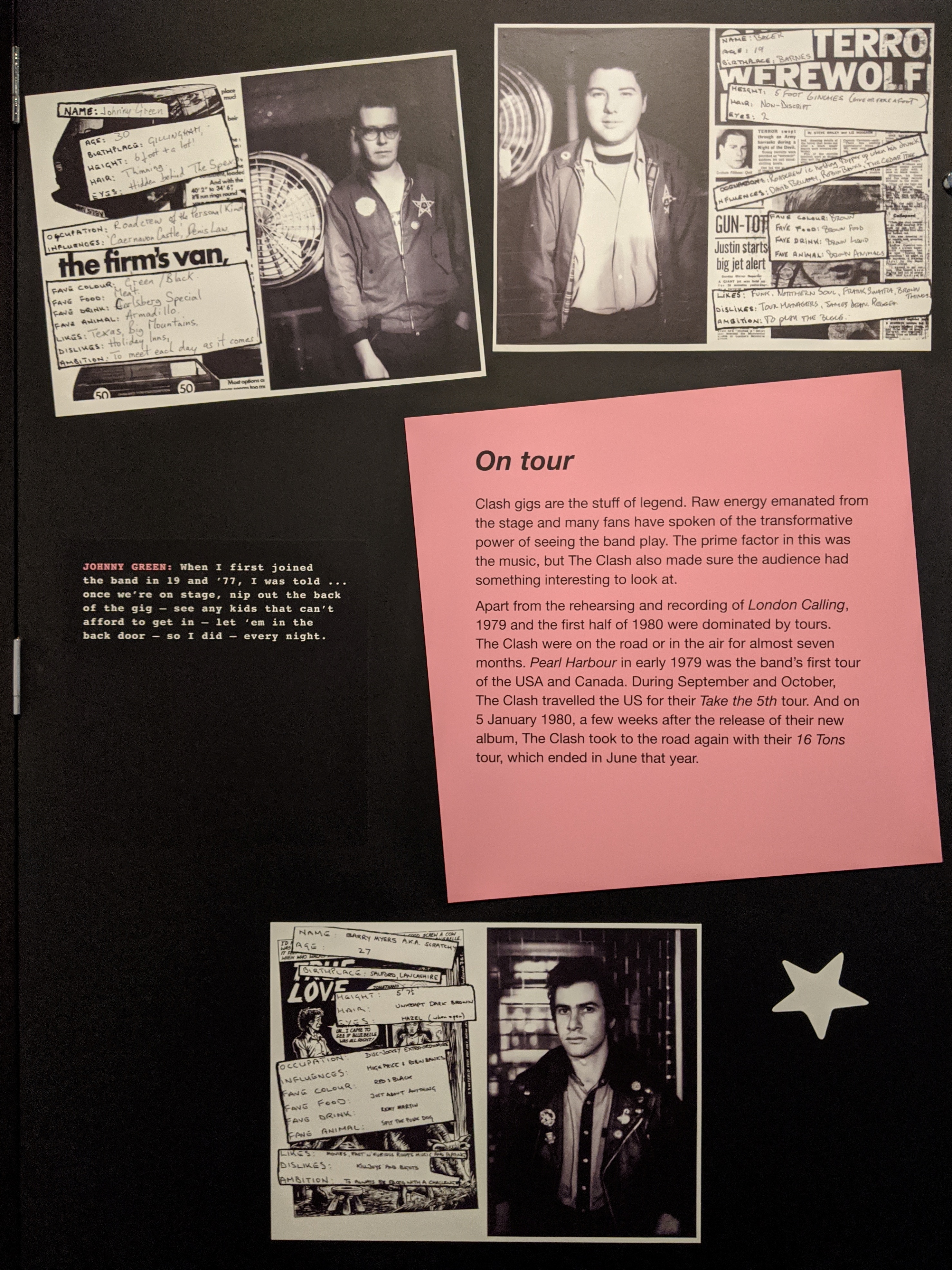
The Clash's Roadies

Display at The Clash musuem. From Armagideon Times Magazine.

Back to the Top


Posters

Poster

THE CLASH ON PAROLE | Facebook - https://www.facebook.com/

Back to the Top


Topper Joins, Chimes leaves

Melody Maker - 30 April 1977, Page 4, Published weekly by IPC Specialist and Professional Press Ltd., 24-34 Meymott Street, London SE1 9LU, Telephone 01-261-8000, IPC Business Press Ltd. For information and readers' queries ring 261 8480 or 261 8315. Telex 25137, BISPRS G

Clash new drummer, album, tidbits

The Clash have a new drummer. 21-year-old Nicky Headon (second from left), who joins the band on the eve of their first major British tour.

Headon, who previously worked as an office clerk, told the Melody Maker: "I can relate to the Clash on a political level. I've been through the unemployment bit. I've been made to take jobs that I didn't want at all.

"Captain Beefheart is my main musical influence. I like all sorts of music, anything with a lot of energy. "I knew Mick (Jones, the Clash's guitarist) from about a year and a half ago. For a week I played with his band, the Lon-don S.S., when Brian James of the try.

Damned and Tony James of Generation X were in it too. "Then I didn't see him for ages until I bumped into him at the the Kinks concert at the Rainbow last month. I'd never seen them play but I was really excited as soon as I did. They are incredible. I really wanted to join. They are by far far the best band in the coun-

The Clash's full line-up is now, left to right, Joe Strummer, Headon, Mick Jones and Paul Simonon. The band's new single, their follow-up to "White Riot." is "Janie Jones." a track from their debut album. The tour starts at Guildford Civic Hall on Sunday (May 1).

Enlarge image

Enlrage image


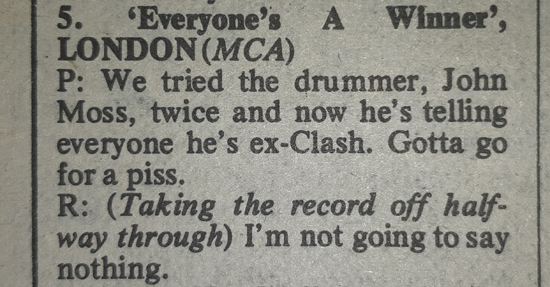
Paul Simonon, Sounds, "Record Review", 25th June 1977

Gotta go for a piss

Paul reviewing John Moss's new single

Paul dig at John Moss who made exagerated claims about having drummed for teh clash when in fact he attended the audition and was rejected.

5. 'Everyone's A Winner', LONDON (MCA)
P: We tried the drummer, John Moss, twice and now he's telling everyone he's ex-Clash. Gotta go for a piss.
R: (Taking the record off half-way through) I'm not going to say nothing.

Back to the Top


UK Articles

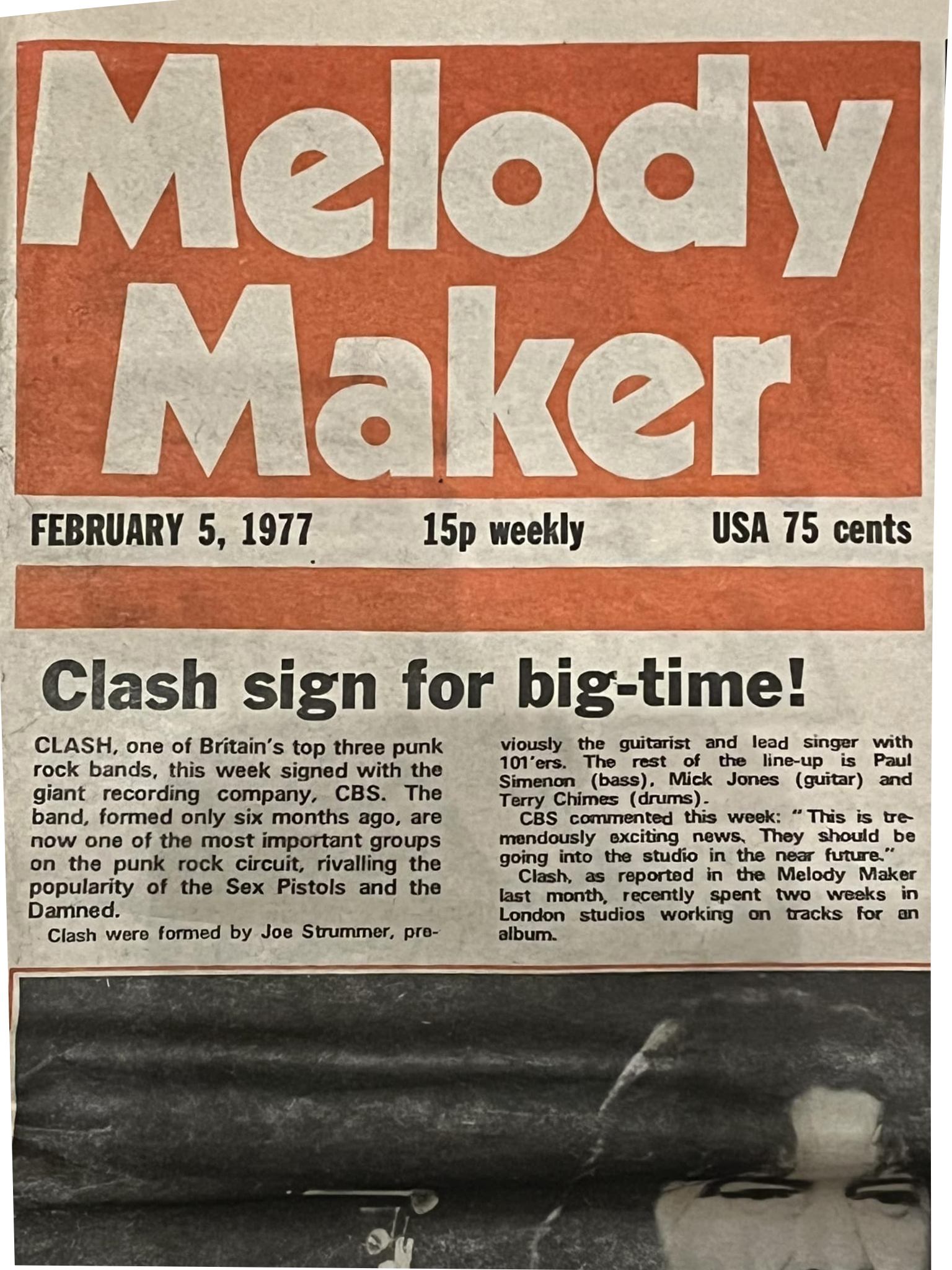
Melody Maker, FEBRUARY 5, 1977, 15p weekly, The Clash Official | Facebook - https://www.facebook.com/

Hey pop pickers - Melody Maker tips Clash for the big time

Clash sign for big-time!

CLASH, one of Britain's top three punk rock bands, this week signed with the giant recording company, CBS. The band, formed only six months ago, are now one of the most important groups on the punk rock circuit, rivalling the popularity of the Sex Pistols and the Damned.

Clash were formed by Joe Strummer, pre-viously the guitarist and lead singer with 101'ers. The rest of the line-up is Paul Simenon (bass), Mick Jones (guitar) and Terry Chimes (drums).

CBS commented this week: "This is tremendously exciting news. They should be going into the studio in the near future."

Clash, as reported in the Melody Maker last month, recently spent two weeks in London studios working on tracks for an album.

Enlarge image


Coon, Caroline. "Clash tilt for the Top / Clash Personality: Joe Strummer Talks to Caroline Coon." Melody Maker, vol. 52, no. 17, 23 Apr. 1977, pp. 29, 44, 48

Clash tilt for the Top

Clash tilt for the top: The Clash headline a show at London's Rainbow Theatre on May 9, supported by The Jam, Buzzcocks, Subway Sect, and The Prefects. Their 27-date UK tour includes stops in Edinburgh, Newcastle, and Brighton.

Clash personality: Joe Strummer discusses The Clash's CBS deal, punk's lack of radio support, and his disdain for venues like the Roxy. He reflects on his upbringing, his brother's suicide, and the band's political stance, dismissing rock's power to effect change but affirming his commitment to personal freedom.

— The Clash's UK tour (27 dates), Rainbow Theatre show (May 9), and mentions of The Jam, Buzzcocks, Subway Sect, The Prefects, and The Slits as support acts.

Read the article ...  

PDF1  |  PDF2


Silverton, Peter. Greatness from Garageland. Trouser Press, February 1978.

Greatness from Garageland

Text only. Scans wanted ****

– Reflection on The Clash at the height of their early fame, Peter Silverton charts the band’s rise from raw punk contenders to Britain’s greatest rock ‘n’ roll hope. Combining personal anecdotes, critical analysis, and cultural commentary, Silverton explores The Clash’s music, politics, image, and lasting significance within the punk movement and beyond.

– The Rainbow (9 May 1977), Silverton’s open declaration of admiration, placing The Clash in a lineage alongside Chuck Berry and The Rolling Stones.

Profiles of the band members, their backgrounds, personalities, and roles within The Clash’s dynamic, debunking the myth of their formation and recounting the gritty reality behind the band’s origins.

Clash vs. The Pistols and key early gigs, critical reactions, and how The Clash forged a distinct identity separate from the Sex Pistols.

Greatness from Garageland

Peter Silverton, Trouser Press, February 1978

UNANNOUNCED, TO SAY the least, a kid in boots, suspenders and short-cropped hair clambers through the photographers' pit and up onto the stage of London's Rainbow Theatre. Benignly ignored by band, stage crew and security alike, he wanders around the stage a little drunkenly, uncertain quite what to do now that he's made it up onto the hallowed, sacrosanct boards and is not making quite the impression he thought. Decision flickers across his face, lit by the giant spots, and he grabs hold of the sing-er's mike and prepares to join in on the harmonies. When the singer wants his mike back, the kid's frozen to the stand in fear-drenched exhilaration so the singer has to shout the lines over the kid's shoulder while the kid pumps in the response lines on perfect cue.

The encore over, the band leaves the stage and the kid's stuck there in front of two and a half thousand people and unsure what to do next. With the merest jerk of his head the bass player motions the kid to join the band backstage and everyone goes home happy.

Sounds like some fantasy of what rock 'n' roll should be about or at least a case of a cunning audience plant, doesn't it? It wasn't. It was The Clash. And it happened just that way at the first of their three nights at the Rainbow in December.

That's the thing about The Clash; they can break rules you hadn't realised existed till they trashed 'em. That's why, in a year, without any kind of Springsteen-like hype – except from zealot journalists like myself – they've gone from empty college and club halls to three nights at a major London venue. Like the Pistols, they're so special that they've created not only their own style but also their own rule structure. Only the most carping would say that The Clash are like anybody or anything else.

Because of events like the one just described, The Clash command an awesome respect, even adulatory deification from their fans. Some of them really do seem to expect The Clash to slip 'em the meaning of life in a three-minute rock 'n' roll song. Mind you, full-grown rock writers have been known to make the same mistake. And to think, all that achieved with only two national tours of Britain and but one album and three singles (in total 17 songs, 19 tracks) in general circulation.

And I still don't think The Clash realise themselves what kind of position they're in. It's as if they're (very understandably) scared of facing up to the fact of that worship and its implications.

Here's another little scene which might help explain what I'm getting at. A few days before I sat down to tap this through my crappy little Smith-Corona portable I found myself at a gig, competing with Clash meistersinger Joe Strummer for the bartender's attention. (Incidentally, I won.)

Having known Strummer for almost two years, I wasn't too surprised when, after exchanging the usual pleasantries, he turned on me a little drunkenly and demanded to know who my favourite English band was. More than a little embarrassed, I told him:

“Your lot.”

Nah, come on, he replied, “Tell me who you really think's the best.”

The Clash,” my voice getting louder. “Honest!”

Joe didn't believe. “I bet you'll tell the Hot Rods the same thing tomorrow.”

So, here in cold type, let's set the matter straight with an open letter.

Dear Joe,
The Clash are not only the best band in Britain. They're the best band in the world. (I think that for a magnitude of reasons I'll explain in good time.) For me, you're the latest in a straight three-act lineage: Chuck Berry, The Stones, The Clash. No one else comes near. The Beatles may have written better songs but... The Pistols may have been a bigger force of change but... Fercrissakes, if I didn't believe all this stuff, you don't think you'd catch me spieling out all these cascades of yeeugh-making praise, do you now? There's a whole lot more becoming things for an adult to do, you know.

Yours,
Pete

P.S. But I still don't believe that you're the saint, let alone godhead that some of your more impressionable fans crack you up to be. I know you're just as big a head-case as the rest of us.

Good. That out of the way, I can move on to telling you good and patient – you must be if you've got this far – readers just how and why The Clash have come to occupy such a prominent place in my – and a lot of other people's – affections.

The Clash at core are three people. Mick Jones on lead guitar, vocals and Keef lookalikes. He was in the London S.S., about whom the myths outweigh the facts at least tenfold. Paul Simonon plays bass, smiles a lot, lopes around like a grossly underfed gorilla on a vitamin B-and-methedrine cure for malnutrition and catches the fancy of more women than the rest of the band put together – Patti Smith, for example. Joe Strummer sings in a manner that some find so unmusical as to be repulsive (you find those kind of philistines everywhere) and others reckon is compulsive and entrancing. Joe was the leading light in the “world-famed” 101'ers and still plays the same tortured, demonic rhythm guitar that was the highlight of that band.

And then there's the fourth man, Nicky “Topper” Headon, the drummer. He gets left out of the central three because he's the last in a long line of skin-beaters with The ClashTerry Chimes (a.k.a. Tory Crimes) plays on the album – and, although Nicky's occupied the stool longer and deservedly so than anyone else, he's still relatively unimportant in the overall image of the band. But who knows, a year from now, he might be as important as Ringo was to the Fabs.

How did they come together? Well, not to put too fine a point on it, the line they usually hand out to gullible journalists is a heap of shit. They claim that Paul and Mick were trotting down Portobello Road one balmy Saturday, already intent on forming their own band, when they chanced upon Joe Strummer and, knowing him from the still-in-existence-at-this-point 101'ers, asked him to be their lead singer. After a couple of days to think it over, he junked the 101'ers and threw in his lot with Mick and Paul. That's the fantasy. The reality, as usual, is both more complex and much less romantic.

To explain for the benefit of future historians of the social mores of the seventies, I must backtrack to the first time I encountered Mr. Strummer.

I'd been writing for this rag for a bit and I'd decided I wanted to do a short piece on what it was really like for a struggling band in London, supposed Mecca of rock 'n' roll. On the recommendation of a friend who'd known Joe since schooldays, I went down to a truly scummy college benefit to check out the 101'ers.

At this point (two years ago) I was just emerging from a five-year period where I was so disgusted by the rock 'n' roll scene that I spent all day in bed listening to Chuck Berry and reading Trotsky. I'd come to like quite a few of the current pub rock bands but however much I enjoyed them, I knew in my heart of hearts, there was something lacking. And, although, if pressed, I'd say it had something to do with lack of stage presence, it wasn't till I saw Joe that night that I realised just what was lacking – full-blooded desperation to become a star and communicate with your audience and the sense to realise that not only is that a far from easy task but that, if you don't find your own way of doing it, you might as well junk the idea right there and then.

The 101'ers were an immensely loveable but generally pretty ramshackle bunch who'd rip through Chuck Berry and R&B numbers with not a trace of genuflection at the altar of the greats. What they – or rather what Joe took – was theirs/his.

I became so enamoured with the 101'ers that what had started out as a short article ended up as a veritable thesis which Trouser Press has on file (and I hope they don't dig it out, even if it is the definitive work on the subject). The day I mailed the piece, the band broke up. The rest of the 101'ers dropped into the limbo of obscurity but Joe, with much flourish, hair cutting and clothes altering, hooked up with Paul and Mick.

That something of the kind had been in the offing I'd suspected since I'd been with Joe watching the Pistols (who were at this time supporting the 101'ers). As someone else put it, he saw the light and the Sex Pistols simultaneously.

Meanwhile Mick Jones, Brian James (later of The Damned) and Tony James (now in Generation X) had been sorting out their chops in a basement under the name of the London S.S. and the tutelage of future Clash manager Bernard Rhodes, a close pal of Sex Pistols manager Malcolm McLaren. The London S.S., unable to locate a suitable drummer, never actually played a gig but, according to the few who've heard them, their tapes were very impressive.

When Brian James walked off/was pushed off to form The Damned, the rest of London S.S. faced up to facts, chucked in the towel and went their separate ways.

This is when Mick joined forces with Paul – who'd never even touched a bass before ("I used to be an art designer till I discovered the Clash") – and Keith Levine, who only stayed long enough to do a few early gigs and cop a co-credit for ‘What's My Name’ on the album. He was a great guitarist but… well, just check out ‘Deny’.

Masterminded by their hustler-manager with tertiary verbal diarrhea, Bernard Rhodes, the three of them persuaded Strummer over a period of time that he was exactly the vocalist they needed. When Joe was finally convinced, the four of them moved into an enormous (but very cheap) rehearsal studio of their own and began to audition drummers. Getting the name was easy enough. After an initial flirtation with Weak Heart Drops (after a Big Youth song), they plumped for the challenge of The Clash. But getting a drummer wasn't so easy.

They searched with an unusual but understandable and probably correct attitude toward drummers. To wit, drummers can't drum because they all suffer from a Billy Cobham complex and want to play as much as an egocentric lead guitarist. Therefore, drummers have to be taught to drum. And drummers, being by and large nutters, don't take too kindly to such condescension. Also, at this time, while the rest of the band were outwardly convinced they'd be an unqualified success, under the surface they were stone scared that they couldn't live up to even their own belief in themselves. The tensions in the Clash camp (late summer '76) were running so high that just sitting around the rehearsal studio could be an exceedingly uncomfortable experience.

But, after rejecting various drummers who were more in tune with the band's commitment but couldn't really hack out the relentless trip-trap bottom line, they settled on Terry Chimes, who didn't give a flying one about the politics (in the widest sense) of The Clash but made up for it by being one of the best drummers this side of Jerry Nolan.

Anyway, that's how they'd shaped up to the point of their early gigs, so that's enough of this hagiography. That's not nearly as important as why The Clash are the CLASH.

Scene One:
Bernie Rhodes holds Clash preview for the press in the studio, subtly paralleling Paris schmutter previews. Giovanni Dadomo of Sounds is suitably impressed and reports that The Clash are the first band to come along that look like they could really scare the Pistols.

Scene Two:
The reaction sets in. When The Clash support the Pistols at a London cinema gig, Charles Shaar Murray says that they're a garage band who ought to get back in the garage and leave the car motor running. (This prompts them to write ‘Garageland’.)

Scene Three:
The sides settled, every Clash gig becomes an event. When Patti Smith comes over, she sees The Clash at the Institute of Contemporary Arts and is so knocked out with them that she jumps up and "jams." And some kid in the audience does a mock-up of biting off someone's ear (with the aid of a tomato ketchup capsule) and the picture gets in the weekly music press. By the time they play the Royal College of Art (Arty lot, aren't they? Still, what do you expect? They all went to art college and wear some of the flashest clothes imaginable), emotions are running way too high. They play a set under the rubric "A Night Of Treason." (It was November 5th, the night that honours the burning of Guy Fawkes, the bloke who tried to blow up the Houses of Parliament.)

Some of the audience, when not lobbing fireworks around, take an extreme dislike to The Clash and start bunging bottles at the stage. The rest of the audience is split between Clash fans who already think their band can do no wrong and the uncommitted whose prevailing attitude is "Well, they are playing violent music and if you play violent, well you know what they say about what you sow..."

The band are certain how they feel about playing in a rain of bottles. Strummer lurches off stage and tries to sort out those responsible… personally.

The Clash style has been set. It’s a straight case of being ruthlessly certain about how you feel and what you want to do and making sure that no one gets in your way. Like the man said, "We ain't looking for trouble but if someone starts it, it ain't gonna be us that's gonna be on the losing side."

Remember this is back in '76 when punk was still seen overwhelmingly as being POLITICAL. More than anyone else it was The Clash that everyone held responsible for putting down a party line. Now they're all pretty much retreated from that position (except The Clash, they just smile Highway 61 smiles) and say aw, we're really only into having fun, maaan. But then, you've no idea what a relief it was to have songs about something else than falling in love with some acne-infested adolescent or what a drag it is to be slogging our guts out "on the road" and staying in all these faceless hotels (when most kids in England have never even stayed in a hotel) or pathetic dirges about let's have a little more rock 'n' roll.

I know rock 'n' roll is supposed to be about the banalities of the pubescent dream but it had pretty much got to the stage where the average rock 'n' roll song was indistinguishable from moon/June bilge. If The Clash have done nothing else, they've given a big help to kicking out all that garbage (of course, many others have been working to the same end).

Strummer certainly didn't come from any poverty-stricken background (on the other hand, he never really pretended to) but his songs were like a well-aimed boot plonked straight into the guts of an overfed and complacent music business.

And Mick Jones was no slouch either.

‘Career Opportunities’, for example:

They offered me the office
They offered me the shop
They said I'd better take anything they'd got
Do you wanna make tea at the BBC
Do you, do you really wanna be a cop
Career opportunities
The ones that never knock
Every job they offer you's to keep you out the dock
Career opportunities
The ones that never knock.

Okay, so it ain't gonna cop him a poetry prize (who wants 'em?) but it displays both a savage understanding of the demands for immediacy in a rock 'n' roll song and a large helping of witty comment on what it's like to be given the choice of one shitty job or another shitty job. Of course, The Clash never thought they could really change things. They're only (only!) a rock 'n' roll band, not a political party. But, if you're gonna sing about something, you might as well sing about something that doesn't usually make it onto pop singles.

Unfortunately, while they handled it, lesser talents came along and decided that they'd have to write ‘political’ songs and, as a matter of course, mostly came up with insulting simplicities like Chelsea's ‘Right To Work’.

And then, even more important, there was the music. Even early on (and especially after Small Faces addict Glen Matlock got the boot) the Pistols were very fond of heavy metal drones. I don't think The Clash even listened to HM. Joe only cared for ‘50s rockers (especially bluesman Clarence "Gatemouth" Brown, believe it or not) and reggae. Jones was deeply into Mott, which shows in The Clash's attitude toward their fans both in their songs and their stage demeanour. And Paul Simonon was into football (listen to the chant on ‘Janie Jones’) and painting (look at the clothes, stage backdrops and all their visual presentation).

By the time they'd done the Anarchy Tour with the Pistols, The Clash were in an unrivalled second position. They began to get the kind of press eulogies and fan worship that'd turn anybody's head. How could anybody fail to react to them?

Onstage, Strummer is so obviously a natural star, forcing his body and Telecaster to ever greater heights of pain/pleasure, grabbing the mic and screaming lines like he really does care.

Mick Jones bopping around like a younger Keef (yeah, that comparison again) doing a military two-step and sending out shards of steely guitar licks.

And Paul, lumbering around looking looser and more relaxed but thumping his bass while indulging in perverse, arcane calisthenics.

And the clothes. Obviously paramilitary in origin – zips and slogans featured very heavily – but whoever heard of an army splashing paint all over their tunics?

All this combines to make sure The Clash, even at their worst, are never mere music. I am absolutely convinced that it’s not only me that feels that they’re the ‘70s answer to the Stones. If asked, Clash fans will say they love 'em so much because “They're good to dance to” or “I fancy Mick Jones or “I just like 'em, that's all.” If that is all, why do they shout out for ‘White Riot’ all the time at gigs? It’s not one of The Clash's best songs, but it is the one that most represents where they’re coming from, what they stand for and, by extension, what particular fantasy they're enacting for their audience. If the kids just wanted to dance or screw, they could go to a disco/home to bed. They want and get more but their lack of articulacy prevents them explaining what. Where success and even the music are subordinate to the stance – they’re saying not we play rock 'n' roll but we are rock 'n' roll.

If Chuck Berry represents for me an idealised adolescence I never had, and the Stones were an adolescence that I lived through once removed because, like so many kids, I was too busy studying, The Clash are as good an excuse as any for me to live out a perfect adolescence ten years late. Hell, why else be a rock 'n' roll writer – there's more to it than freebie albums, you know.

Which is also why – just like the Stones – while The Clash will fire imaginations, they'll never become a grandiosely successful band. Some reckon they won’t make it in the States at all. I don't agree with that. Judging by the recent Rainbow shows, they’ve got enough classic big stage rock 'n' roll choreography worked out to handle any auditorium. And their newer songs, like ‘City of the Dead’ and the as-yet-unissued ‘White Man In Hammersmith Palais’ are played at a pace that even ears used to the Eagles can handle.

Also, by slowing matters down a trifle, they seem to have upped the energy level – too much speed becomes nothing but a fast train blur. They learned their lesson on the first English tour. The set started out at 45 minutes. By the end of the tour it was down to 29 minutes and that included all the album plus ‘1977’, ‘Capital Radio’ (only available on a limited edition giveaway – which is a pity because it's one of their best songs), their truly awful version of Toots and the Maytals’ sublime ‘Pressure Drop’, and ‘London's Burning’ – twice. It gave their roadies something to boast about but if you wanted to keep up with it, you had to snort at least 2 grams of amphetamine.

This drop in speed/rise in intensity is obviously partly a result of their smoking a lot more dope and listening to a lot of very spliffed-out rasta roots reggae. They realised you ain’t gotta run at full throttle to give out the necessary power.

Nonetheless, The Clash have come in for a lot of criticism. Ignoring the early jeers about unmusicality, the most hurtful has been that they’re a kind of punk Bay City Rollers, programmed to do just what their manager tells them to do. Quite simply, that’s like saying that the Stones were only Oldham’s puppets. Of course, Bernie being some kind of weird conceptual artist lams in a fair share of the ideas but, at the last resort, it’s Mick, Paul, Joe and Topper that cut the cake on stage and record.

Anyway, I reckon that carping like that is just more proof of The Clash’s importance. Nobody gets into the same kind of polarisations about, say, Slaughter and the Dogs or 999. People only get into heavy-duty arguments about bands that really matter.

Look. If you already like The Clash, you’ll like 'em even more live (if they play a good show – which admittedly, they don’t do as often as they should). If you hate The Clash, you’ll either learn the error of your ways when you realise what great little pop songs they write or continue to hate 'em. The choice is yours.

All I can say is that any band that can bring a relatively cynical scribbler like myself to gush like a besotted fan, has got to be one of the most special things to have ever happened.

© Peter Silverton, 1978


Needs, Kris. “Konkrete Klockwork.” Zigzag (UK), no. 71, Apr. 1977, pp. 38–40.

ZIGZAG: Konkrete Klockwork (2)

Kris Needs delivers a landmark profile of The Clash.

— Declares The Clash the most exciting group of the new wave, more important than Eddie & The Hot Rods or The Damned.

— First gig recalled: Tiddenfoot Leisure Centre, Leighton Buzzard, with an explosive White Riot.

— Profiles members Joe Strummer, Mick Jones, Paul Simonon, and drummer Terry Chimes; notes rehearsal base in Camden Town under manager Bernard Rhodes.

— Song inspirations: Notting Hill Riots (White Riot), vice queen Janie Jones (Janie Jones), London’s Burning on the Westway, dystopian 1977.

— History covered from London S.S. through The Heartdrops, to Joe quitting the 101ers.

Tiddenfoot Leisure Centre (first out-of-London gig 9 October 1976); 100 Club Punk Festival (20 Sept 1976); Screen on the Green (29 Aug 1976); ICA gigs (2nd and 23rd Oct 1976); RCA (5 Nov 1976); Roxy (1 Jan 1977); Anarchy Tour with Sex Pistols, Damned, Heartbreakers (Dec 1976); Harlesden Colosseum (11 Mar 1977).

— On the “Anarchy” tour: cancelled dates after the Sex PistolsBill Grundy scandal, leaving the band frustrated but politically hardened.

— Focus on the Harlesden Colosseum gig (March 1977): The Slits debut, Subway Sect revival, new-look Buzzcocks, capped by a ferocious Clash set.

— Recording insights: sessions with Guy Stevens, later replaced by Micky Foote. Songs include White Riot, 1977, Garage Land, and radical reggae cover Police & Thieves. — Notes the CBS contract, six-figure deal, and accusations of “selling out,” countered by insistence on artistic control. — Concludes that the debut LP will be “the most exciting album in years” and an all-time classic.

Read the article

PDF6  |  PDF1  |  PDF2  |  ALT-TEXT3  |  PDF4  |  Photos 5a, 5b  |  


SOUNDS Staff. "We Can Pick 'Em in '77." SOUNDS, no. January 1, 1977, pp. 4-5

We Can Pick 'Em in '77

SOUNDS journalists predict 1977's breakout acts, spotlighting The Clash as "the most exciting and original of the post-Pistols new wavers" with their "strong hooks and sartorial innovations"

— Features Giovanni Dadomo's prescient Clash analysis warning of their "dole queue rock" dilemma as they negotiate a major label deal, predicting their music could become "some of the finest recorded rock of the decade"

— Includes 30+ artist profiles ranging from reggae act Aswad ("a hydraulic power drill" of rhythm) to proto-punks The Saints ("outstripping the Ramones at their own game") and jazz innovator Jaco Pastorius ("pushing music to new limits")

Read the article ...

PDF


Cain, Barry. "A storm is coming: The Clash on punk's rise and political rebellion." Record Mirror, 9 April 1977, pp. 11

The Storm is Coming

The Clash's breakthrough moment as White Riot jumps 60 chart places and their debut album gains momentum, violent backlash against the band, including bricks thrown through windows by those who "can't identify with what we play", Strummer's manifesto declares war on media: "They want to stamp us out...we want to persecute them off the earth", 3-week album recording contrasted with with ELP's 2-year process, mocking progressive rock excess

Joe Strummer delivers apocalyptic visions of impending government control: "I see army conscription returning, identity cards, numbers", Mick Jones discusses the band's working-class roots and rejection of "love-song syndrome" rock, citing Phil Ochs as political inspiration

Read the Article

PDF1   |   PDF2    |   PDF3    |   PDF 4


Coventry Evening Telegraph - Tuesday 13 September 1977, PDF

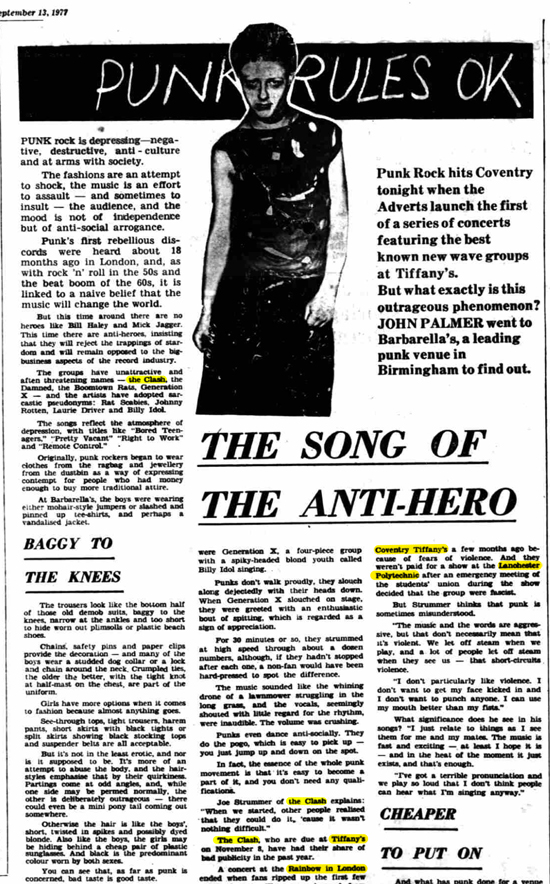
Punk Rules OK / The Song of the anti-hero / Baggy to the knees

Lengthy piece about punk clothes, mentions Tiffany's ban, Rainbow riot and Lanchester non payment.

Coventry Evening Telegraph, Tuesday, September 13, 1977

Punk rules ok
The song of the anti-hero

Punk rock hits Coventry tonight when The Adverts launch the first of a series of concerts featuring the best known new wave groups at Tiffany's.

But what exactly is this outrageous phenomenon? John Palmer went to Barbarella's, a leading punk venue in Birmingham to find out.

Punk rock is depressing, negative, destructive, anti-culture and at arms with society.

The fashions are an attempt to shock, the music is an effort to assault and sometimes to insult the audience, and the mood is not of independence but of anti-social arrogance.

Punk's first rebellious discords were heard about 18 months ago in London, and, as with rock 'n' roll in the 50s and the beat boom of the 60s, it is linked to a naïve belief that the music will change the world.

But this time around there are no heroes like Bill Haley and Mick Jagger. This time there are anti-heroes, insisting that they will reject the trappings of stardom and will remain opposed to the big-business aspects of the record industry.

The groups have unattractive and often threatening names: The Clash, The Damned, The Boomtown Rats, Generation X. And the artists have adopted sarcastic pseudonyms: Rat Scabies, Johnny Rotten, Laurie Driver and Billy Idol.

The songs reflect the atmosphere of depression, with titles like Bored Teenagers, Pretty Vacant, Right to Work and Remote Control.

Originally, punk rockers began to wear clothes from the ragbag and jewellery from the dustbin as a way of expressing contempt for people who had money enough to buy more traditional attire.

At Barbarella's, the boys were wearing either mohair-style jumpers or slashed and pinned up tee-shirts, and perhaps a vandalised jacket.

Baggy to the knees

The trousers look like the bottom half of those old demob suits, baggy to the knees, narrow at the ankles and too short to hide worn-out plimsolls or plastic beach shoes.

Chains, safety pins and paper clips provide the decoration and many of the boys wear a studded dog collar or a lock and chain around the neck. Crumpled ties, the older the better, with the tight knot at half-mast on the chest, are part of the uniform.

Girls have more options when it comes to fashion because almost anything goes.

See-through tops, tight trousers, harem pants, short skirts with black tights or split skirts showing black stocking tops and suspender belts are all acceptable.

But it's not in the least erotic, and nor is it supposed to be. It's more of an attempt to abuse the body, and the hairstyles emphasise that by their quirkiness. Partings come at odd angles, and, while one side may be permed normally, the other is deliberately outrageous — there could even be a mini ponytail coming out somewhere.

Otherwise the hair is like the boys', short, twisted in spikes and possibly dyed blonde. Also like the boys, the girls may be hiding behind a cheap pair of plastic sunglasses. And black is the predominant colour worn by both sexes.

You can see that, as far as punk is concerned, bad taste is good taste.

Barbarella's guests at the weekend were Generation X, a four-piece group with a spiky-headed blond youth called Billy Idol singing.

Punks don't walk proudly, they slouch along dejectedly with their heads down. When Generation X slouched on stage, they were greeted with an enthusiastic bout of spitting, which is regarded as a sign of appreciation.

For 30 minutes or so, they strummed at high speed through about a dozen numbers, although, if they hadn't stopped after each one, a non-fan would have been hard-pressed to spot the difference.

The music sounded like the whining drone of a lawnmower struggling in the long grass, and the vocals, seemingly shouted with little regard for the rhythm, were inaudible. The volume was crushing.

Punks even dance anti-socially. They do the pogo, which is easy to pick up — you just jump up and down on the spot.

In fact, the essence of the whole punk movement is that it's easy to become a part of it, and you don't need any qualifications.

Joe Strummer of The Clash explains: "When we started, other people realised that they could do it, 'cause it wasn't anything difficult."

The Clash, who are due at Tiffany's on November 8, have had their share of bad publicity in the past year.

A concert at the Rainbow in London ended when fans ripped up the first few rows of seats. They were banned from Coventry Tiffany's a few months ago because of fears of violence. And they weren't paid for a show at Lanchester Polytechnic after an emergency meeting of the students' union during the show decided that the group were fascist.

But Strummer thinks that punk is sometimes misunderstood.

"The music and the words are aggressive, but that don't necessarily mean that it's violent. We let off steam when we play, and a lot of people let off steam when they see us — that short-circuits violence.

I don't particularly like violence. I don't want to get my face kicked in and I don't want to punch anyone. I can use my mouth better than my fists."

What significance does he see in his songs? "I just relate to things as I see them for me and my mates. The music is fast and exciting — at least I hope it is — and in the heat of the moment it just exists, and that's enough.

I've got a terrible pronunciation and we play so loud that I don't think people can hear what I'm singing anyway."

Cheaper to put on

And what has punk done for a venue like Barbarella's? Manager John Tulley enthuses: "It's the biggest thing since Bill Haley and has done more for live music than The Beatles.

We have converted two of our clubs to punk now, and there are more bands, more promoters and more venues.

The violence that there is takes place on stage, and the kids get off on that — but there again there used to be mods and rockers a few years ago."

And the punk audience is increasing all the time. "We had The Boomtown Rats at Barbarella's for two nights and they sold the place out — and who are they?

Punk rock groups are cheaper to put on, and, when they get big, they don't ask for the £3,000 or £4,000 a night that some of the heavy rock bands want."

How are Tiffany's preparing for the punk invasion? A ban on punk was lifted a month ago, and then the manager, Aubrey Marsden, said: "The only thing the company draws the line at are striptease shows."

Enlarge image


Back to the Top


Fanzines

"Shosub, Sarah. "The Clash." MoreOn fanzine, issue #3, early 1977, pp. 3 pages,

The Clash: Interview

Sarah Shosub for MoreOn fanzine, issue no. 3, early 1977 interview Joe Strummer, Mick Jones, and Paul Simonon discussing their recent signing with CBS Records.

— The band defends the deal, with Strummer calling the label "a tool" and Jones recounting how they handed CBS a self-produced single to avoid outside interference, they quote a CBS executive's phrase "commercial limitation on radical behaviour" with sarcastic amusement.

— References a problematic gig at the Roxy Club, Covent Garden on 1 January 1977 where the sound was "really shitty."

— Discusses their ongoing search for a permanent drummer, mentioning Terry Chimes recorded four songs with them but wasn't a full member.

PDF1    PDF2    PDF3    PDF4

More On 3 with The Clash.

S.S. Won't the record deal inevitably change your attitudes in certain directions?

Mick Jones: Things do change.

Paul Simonon: Wait and see. Joe Strummer: Record companies are a tool, they make records so we go to them. The Buzzcocks doing it themselves have still formed their own tool: We've just signed to a big one, but it's still basically the same thing.

S.S. Surely it's not? CBS is a big-time organisation. Won't they make demands on you which are contrary to what you're meant to be about now?

M.J. No. The other night we went down to the studios and laid some tracks down ourselves. After two days CBS told us it was time we stopped arsing around and that we'd have to start working with a producer and all that. We handed them what we'd done and said here's the single and B-side OK?. They said O.K.

Joe Strummer: So we ain't got no problems.

M.J.: You know business men think they're gonna be boring but they're not, they're funny. I don't mean they tell us jokes, but they have a special way of saying things.

S.S.: Like what was it?

J.S.: (reading from the little yellow match box book) Write this down commercial limitation on radical behaviour that's what he said to us commercial limitation on radical behaviour.

P.S. Was that before or after he said he felt sick?

S.S. What did you mean when you said about ignorance being the most dangerous thing?

P.S. Urdur ur ur.

S.S. For all your political aspirations aren't you just indulging yourselves being rock and roll musicians?

J.S. What do you reckon I should do. Chuck a few bombs round and get put away for five years?

P.S. If you ask me throwing bombs about is a dodgy business,

J.S. It seems like years ago since we played. I feel like we haven't been playing for years. Like we've been missing for years. I feel like an old recluse.

S.S. What about the gig at the Roxy on January 1st?

J.S. It's a shame, we set up the gear really good and when the audience were all there it sounded really shitty.

S.S. What about a drummer?

M.J.: Having no drummer makes things a bit difficult. It's a tight situation imagine interviewing 200 drummers and every one of them thinking he's Billy Cobham. (Mick demonstrates how they do this)

J.S. Heavy, heavy. Then we say no, like this. (Mick demonstrates, a kinda boom-crash, boom-boom crash). Then they say gotcha and off they go again. Terry Chimes drums for us. We've been in the studio and we've done 4 songs with him.

S.S. Why isn't he actually in the group?

J.S. You ask Terry. Tell me what he says the answer to. Then you tell 'cause I'd like.

S.S. What about creativity? You've said a lot about it in interviews, aren't you a bit disappointed that the fans and some other groups that are about are not really being creative for themselves?

M.J.: It's good everyone's starting groups. There's really loads of them. People interpret it in their own way maybe lots of them choose an easy way, like a pack of safety pins.

S.S. What about actual musical standards. Don't you think that any of the groups are taking the easy way?

M.J.: Maybe that's the sound, like bit monotonous and tuneless, maybe that's the sound.

M.J.: We don't sound like that, hopefully but maybe the kids want it like that. There are a couple of strong groups, the others are on a different scale.

Interview: Sarah Shosub. Photos: Crystal Clear

https://stillunusual.tumblr.com/post/161780541671/more-on-fanzine

MoreOn fanzine  |  1977  |  3 pages


Tomorrow The World? fanzine  |  March 1977  |  Clash: pages 4

Tomorrow The World? fanzine

— Editrial, Interview with Joe Strummer, review of The Clash ST LP.

Read the fanzine 

PDF


Fanzines

Fanzines ––punk77.co.uk
Bored teenagers –– boredteenagers.co.uk/
stillunusual/ –– tumblr.com/stillunusual/
stillunusual/ –– stillunusual.tumblr.com/
Punk Fanzine Archives from around the world.
On the Other Hand


Back to the Top


Don Letts Punk Rock Movie

The Punk Rock Movie The Clash

1. White Riot from the 11 Mar 77 Harlesden Roxy;
2. 1977 from the 9 May 77 Rainbow;
3. Garageland from May 77 somewhere on the White Riot Tour

Youtube 1hr25mins

The Punk Rock Movie (also known as The Punk Rock Movie from England) is a British 1978 film that was assembled from Super 8 camera footage shot by Don Letts, the disc jockey at The Roxy club during the early days of the UK punk rock movement, principally during the 100 days in 1977 in which punk acts were featured at The Roxy club in London.

The spikiest home movie of the Seventies captured an embryonic rock revolution. ...Verité rock had become verité celluloid almost by accident.[1]

Roxy club disc jockey Don Letts was given a Super 8 camera as a present by fashion editor Caroline Baker.[2] When Letts started to film the acts at The Roxy, it was soon reported that he was making a movie, so Letts determined to film continuously for three months. He needed to sell his possessions in order to continue to purchase film.[1]

A preliminary, 60-minute version of the film was shown in autumn of 1977 at the Institute of Contemporary Arts in London. This resulted in the cover story, "Punk Home Movies" in Time Out magazine.[1]

The film features live footage of The Clash, Sex Pistols, Wayne County & the Electric Chairs, Generation X, Slaughter and the Dogs, The Slits, Siouxsie and the Banshees, Eater, Subway Sect, X-Ray Spex, Alternative TV and Johnny Thunders and The Heartbreakers. Backstage footage of certain bands, such as Generation X, The Slits and Siouxsie and the Banshees, is also included.[3]

All live footage was shot at the Roxy, except that of the Sex Pistols, who were filmed at The Screen On The Green cinema in London on 3 April 1977. The performance was Sid Vicious' first public concert with the band.[4]

The film was subject to limited theatrical release in 1978.[5] It was also subject to limited video release at that time by Sun Video (1978) and Danton Video (1980).[6] It was also released on video in 1992 by Studio K7. Versions of the film were released on DVD between 2006 and 2008, though these releases were subject to criticism for sound reproduction and digital transfers that were considered to be inferior to the original. In addition, concerns were expressed that the soundtrack now included overdubbed material, as opposed to the original live recordings.[7][8]


Punk Rock Movie: Full release
documentary directed by Don Letts

The Punk Rock Movie (directed by Don Letts, 1978) is a documentary pieced together from his Super-8 footage of the early London punk scene at the Roxy Club and beyond. It includes live performances and backstage material featuring Sex Pistols, The Clash, The Slits, Subway Sect, Siouxsie and the Banshees, and others

  • The Clash segments (notably early live footage at the Roxy, including I’m So Bored With the USA and London’s Burning) are included in Sony SoundSystem Boxset.

  • The film first screened in 1978 in London cinemas, then circulated in various unofficial formats (bootleg VHS, late-night screenings).

  • It eventually saw DVD reissues (notably in 2006 via Cherry Red) and later streaming availability, but always under Don Letts’ name.

BFI Library

The origial footgage can be found at the British BFI Insititue archive:

BFI | British Film Institute 1
BFI | British Film Institute 2
BFI | British Film Institute 3
BFI | British Film Institute 4
BFI | British Film Institute 5
BFI | British Film Institute 6


Posters

The Punk Rock Movie is a 1978... | Facebook
https://www.facebook.com/


Youtube

Search all on Youtube: "PUNK ROCK MOVIE" DON LETTS - YouTube


1: Full

The Punk Rock Movie Full 1978 Movie Don Letts - YouTube

1hr20mins


2: Full

The Punk Rock Movie (1978) - YouTube

1hr20mins


1977

THE CLASH - Punk Rock Movie 1977 (Original live audio from VHS master tape)


Don Letts Super 8 Medley 11:40

Official release on Sony Soundsystem Boxset minus Garagaland

White Riot 1:52 (Harlesden, 3 Mar 1977)
Janie Jones 1:73 (Harlesden, 3 Mar 1977)
City of the Dead 2:04 (late 1978, Sort it Out Tour?)
Clash City Rockers 2:15 (Lyceum 1979?)
White Man in Hammersmith Palais 2:53 (Lyceum 1979?)
1977 1:41 (The Rainbow, 9 May 1977)

Don Letts footage has recenty been released. A good listing of the contents of the The Clash's Sound System box set can be found at Discogs.


White Riot 1:52 (Harlesden, 3 Mar 1977)


Janie Jones 1:73 (Harlesden, 3 Mar 1977)


City of the Dead 2:04 (late 1978, Sort it Out Tour?)


Clash City Rockers 2:15 (Lyceum 1979?)


White Man in Hammersmith Palais 2:53 (Lyceum 1979?)


1977 1:41 (The Rainbow, 9 May 1977)


The Clash Don Lett's Super 8 Medley

Facebook post 1 and Facebook post 2


Social Media

Topper's first gig

The Clash | Facebook

"I first played the drums when I was thirteen. I was working at the butchers, cleaning up and I saved the money to buy a kit for £30" - Topper Headon, 1977


Mick meets Topper at Kinks gig

The Clash Official

Back to the Top


Magazines

The Punk Scene Magazine, 1977, 6 pages PDF

The Punk Scene: CLUBS, PUBS AND OTHER PUNK PLACES in which to be 'scene' --

1977 “Punk Zine” piece folds out into a poster of The Clash

CLUBS, PUBS AND OTHER PUNK PLACES in which to be 'scene' ---

The places where the new ew bands play are as important to the spreading of a cultas are the people who go there ... in fact they are created out of each other so to speak.

When punk rock first got off the ground, very few venues gave it leg room but the revitalising effect it has on the face of the music industry has also so ha happened to the tired old scene of the club circuit.

London, the Jeading capital in the whole caboodle, has sprung into action once again and places like THE MARQUEE the stomping ground of many pre-stardom attractions in its early days has once again become a good place to go for a glimpse of some of the ace punk bands. THE NASHVILLE, once the home of good old blue grass and the like, has nourished a few nights of revelry since it first allowed the punks in through its doors. And such stalwarts ar DINGWALLS and the re-established RAINBOW (recently ripped apart by over-excited punk followers on a special punk night, but none the worse for wear now), have harboured their share of the takings..

Plenty of small clubs, and down the country actually admitting to the rise in punk popularity and now have certain nights reserved. for a punk band only, all very optimistic stuff. It's very good news to see a sudden flux of of places to go where you can find rocking good bands being given the chance to "rip it up" once again (though not too literally, of course), where the customers are getting what they want and not what there is available within the limits of unambitious music.

THE ROXY, THE ROCK GARDEN, The Rainbow and The Marquee and the new MUSIC MACHINE are all such places in London alone and that's not including pubs such as The Nashville and HOPE AND ANCHOR. THE ROUNDHOUSE, too, has its share of the scene's happenings and outside the ry's capital there are no doubt endless lists of places where it is now possible to boogie to something other than black soul music.

Let's hope it lasts and that the good get ahead and the rest just keep on trying to Whatever else it's done it's certainly shaken us out of our lethargy and that has to be a good thing.

Written by Pat Johnstone Editor John Barraclough Published by TAA. Ltd 360 South Lambeth Road, London SW8

Typesetting by thorm Photosetting Cardiff Cofoundy Chromoscan Ltd. 3ton, Wootton Bassett Wilts Printed in England


THE PUNK SCENE

JUBILEE YEAR, ENGLAND 1977. The monarchy’s finest hour, a year of national pride, patriotism, and PUNK ROCK.

The latest craze of that ever commercial beast the music biz, first reared its rebellious head approximately six months ago and no one but the punks themselves really believed that it was anything more than a passing phase. With Stevie Wonder still singing songs about the ghetto, having just acquired the biggest ever record deal involving a solo artist, 13 million dollars worth in fact, and Rod and Britt taking over from Mick and Bianca in the Taylor/Burton tradition. rock and roll ain't exactly what it used to be. Led Zeppelin now make movies of their music and Queen went a whole year without a Tour in their homeland and Bert Weedon made it into the charts again. When the essence of rock is its closeness to the kids this makes things a wee bit off key.

The Hollywood glamour days have transferred all their dazzling ways onto the guys who once reflected the rhythm of our lives, and its left us with very sorry substitutes for the real thing. Those who have not succumbed to the limbo and the laser beam are few and far between, the dollar sign has tempted too many into tax exile. Though they still pull in the punters and turn record releases into gold and silver wall decorations, rock has been in need of some good old shake rattle and roll for quite some time.

Jagger spat his songs out all the way from middle-class Richmond to high finance and Fortnum and Mason but for a while there he was, the Devil incarnate to every law abiding parent and God in disguise to every bored body under 20 years of age. Now he and the others of that era are no longer in control or even for that matter in touch, with what is really happening down on the streets.

No one would deny our superstars the right to have their privacy but it's a slightly different matter when they become so remote that it's easy to forget what they look like and hard to remember what it was that first made you adore them.

But even punk rock isn't new and hasn't just been born. It's been there all the time. Now though it's not just a rock revival but a whole new generation's attitude to it... a rock revolution. No matter how things may change elsewhere in the music business there will always be bands who are willing to trek up and down the country night after night. playing their own music in country pubs and small-time clubs for fees that barely cover the costs of their expenses. Some of them are lousy, some are good, some" are nowhere at all and some have that raw touch of genious that gets lost in the cry for last orders. Many give up along the way, but stick it out or not, these are the bands that keep rock and roll alive.

Punk rock isn't only crude in fact some "Carry On" movies have more to answer for than that... but it is positive. Whatever they may say (or believe in at the moment) those involved in punk rock are hyping us again if they insist on an anti-establishment stance. It doesn't quite ring true to stick two fingers up to it all and then sign a deal for thousands of pounds. It will be interesting to see how long they last as the darlings of the scene and since only time and talent will sort that one out, pin back your ears, pass the glue and let's have a closer look at the new wave/punk rock who's who...


Title: The British New Wave or Will there always be an England? Author: Pete Silverton and Paul Rambali Publication: Trouser Press No. 18, February / March 1977 Pagination: pp. 12-16

The British New Wave or Will there always be an England?

This Trouser Press feature from February/March 1977 documents the rise of the British New Wave. It describes the transition from Pub Rock to Punk, citing high unemployment and economic instability as cultural catalysts.

The article details:

  • Sex Pistols: Covers their EMI contract, the Bill Grundy television incident, and the single "Anarchy in the UK".

  • The Damned: Discusses the band's formation, the single "New Rose", and their performance at the 100 Club.

  • Eddie and the Hot Rods: Traces their origins in the London pub circuit and the release of the album Teenage Depression.

  • The Clash: Notes their early live performances and songs like "White Riot" and "1977".

  • The Vibrators and Generation X: Provides brief histories of their formation and early singles.

  • Scene Dynamics: Defines the Pogo dance, DIY fashion, and the role of fanzines like Sniffin' Glue.

The feature concludes with a discography of recent British punk releases from labels such as EMI, Stiff, Island, and RAK.

Read the article  | Read the PDF 


Back to the Top


Books

Coon, Caroline. 1988: The New Wave Punk Rock Explosion. London: Omnibus Press, first published 1977, reissued 1982. ISBN 0-7119-0052-9.

Book: "The New Wave Punk Rock Explosion,' 1977

Caroline Coon’s 1988 captures the eruptive energy of the UK punk rock scene between 1976 and 1977 through first-hand observations, photography, and interviews. Though centred primarily on the Sex Pistols, the book importantly chronicles The Clash as key figures in the second wave of punk: politically motivated, street-level, and fiercely independent.

The book underscores Bernard Rhodes' influence (shared with Malcolm McLaren) in shaping The Clash, as well as their significant role in punk’s spread to France and their participation in events like the White Riot tour.

Caroline Coon, "1988: WHEN I FIRST interviewed the Clash in their barrack like studio in Chalk Farm, they had yet to sign a record contract, although they were already one of the punk scene's favourite bands."

This is one of several articles (Such as 'Down out and Proud', at the ICA) collated for her book. The text below focuses on reviews of The 100 Club Festival (20 September 1976) and The Clash at the RCA (5 November 1976).

Read the article

OnlinePDFAlt text


Punk Rock: Complete Guide to British & American New Wave by John Tobler, published in London by Phoebus Publishing, Language: English; 64 pages. 

PUNK ROCK: A COMPLETE GUIDE TO BRITISH & AMERICAN NEW WAVE

Wanted ****

Contents listed in 4 sections :  Punk Rock, Punk Influences, British Punk , American Punk dedicated to each. Written from the perspective of the time it gives a great snapshot of 1977 , especially some of the more obscure artists.

The book is essentially a gazetteer of artists, a half page of text and photos

Black & white photos throughout, including some obscure ones. Sections on the Cortinas, Chelsea, Radiators From Space, Eater, etc., as well as the expected Sex Pistols, Clash, Damned, Stranglers, etc Book Dimensions : 29.5cm x 22 cm x 0.5cm


Back to the Top


Photos

Open photos in full in new window


Circle Line - Chalkie Davies

Chalkie Davies (Welsh, born 1955) The Clash NME Cover Day Triptych, 1977, printed later black and white archival print, signed and numbered no.HC2 by the photographer in black ink to the lower margin, 46 x 104cm (18 1/2 x 41in) overall

"The shot on the left was taken on the Circle Line, and shows the laughter and camaraderie of The Clash. The middle picture was for the NME, but oddly, they thought it was a little 'too much like a press picture', so it wasn't used. The picture on the right is obviously of the Fosters taking effect. The three shots sum up the band nicely".
- Chalkie Davies


The very first photo of the Clash with Topper. After trying 400 drummers

Punk Rock | Facebook - https://www.facebook.com/

Punk Rock - The very first photo of the Clash with Topper. After trying 400 drummers, it was the right choice

Rusty Egan - I gave Topper Bernie Rhodes number after 3 months at rehearsals rehearsals Camden. Photo taken there paintings by Paul Simonon.


The Clash during the recording of their first LP, 1977

Celebrating British & Irish Entertainment: Classic & Current | Facebook
The Clash Official | Facebook


Adrian Boot, The Clash Story and all the important the photosessions_

THE CLASH
The Clash Archive
The Clash - Belfast -1977
The Clash - Camden -1977
The Clash - Westway -1977
The Clash - Backstage 1976-79
The Clash - Live
Big Audio Dynamite
Straight to Hell
The Clash - Soho - 1976

The Clash Story and all the important the photosessions.PDF

The Clash Story and all the important the photosessions.PDF


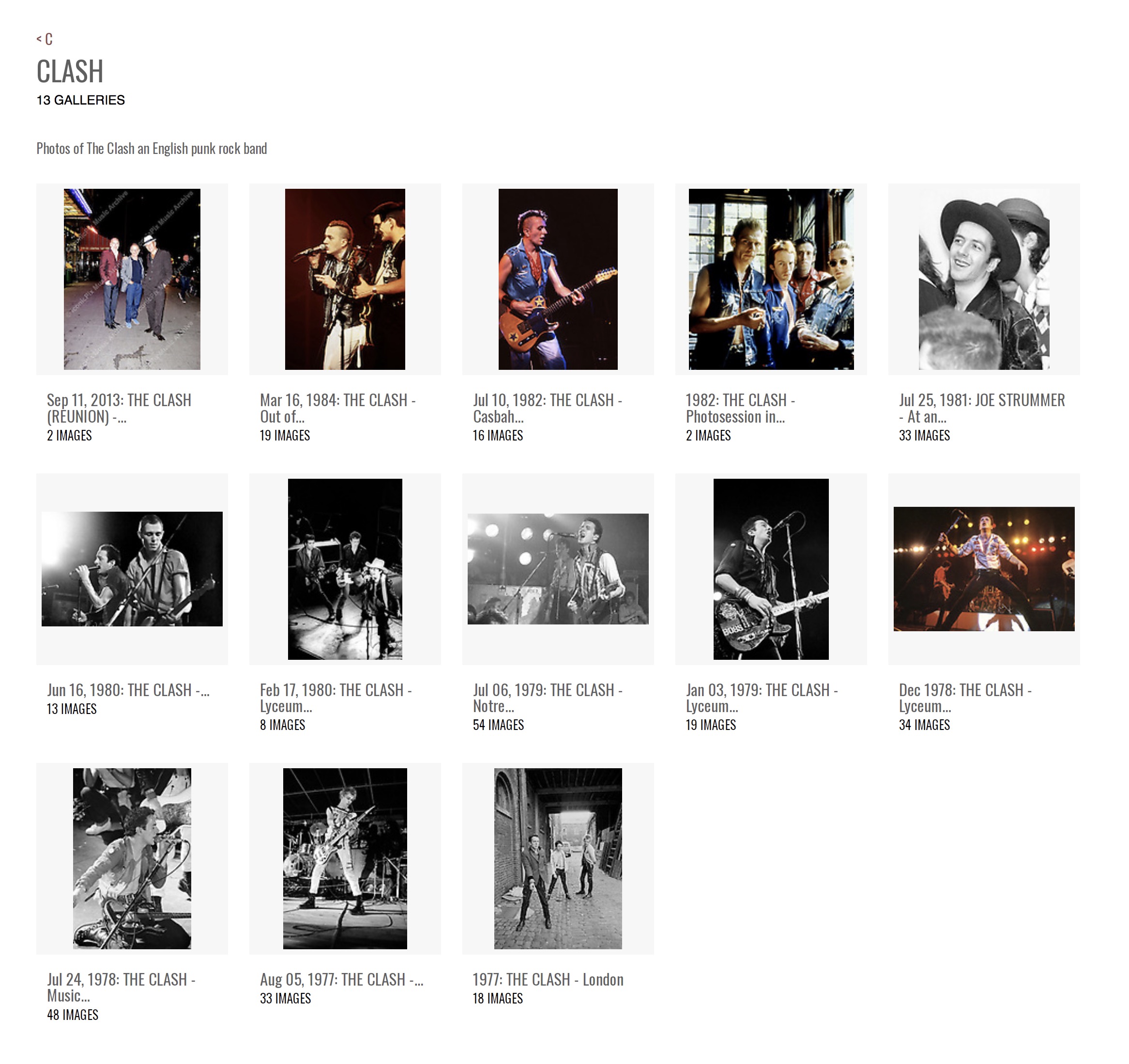
Iconicpix

1977: THE CLASH - London 18 IMAGES

13 Clash galleries


Chalkie Davies

The Clash And Tony Parsons

British punk group The Clash in conversation with NME journalist Tony Parsons, on the London Underground Circle Line in April 1977. Left to right guitarist Mick Jones, singer and guitarist Joe Strummer, bassist Paul Simonon and Tony Parsons. (Photo by Chalkie Davies/Getty Images


The Clash
British punk group The Clash in north London, April 1977. Left to right: guitarist Mick Jones, singer Joe Strummer (1952 - 2002) and bassist Paul Simonon. (Photo by Chalkie Davies/Getty Images)


The Clash
Guitarist Mick Jones and singer Joe Strummer (1952 - 2002), of British punk group The Clash, on the London Underground Circle Line in April 1977. (Photo by Chalkie Davies/Getty Images)


photo by Chalkie Davis

The Clash Official | Facebook - https://www.facebook.com


Caroline Coon and Paul Simonon, 1977  Photo by Sheila Rock

https://www.facebook.com/ - The Clash Official | Facebook


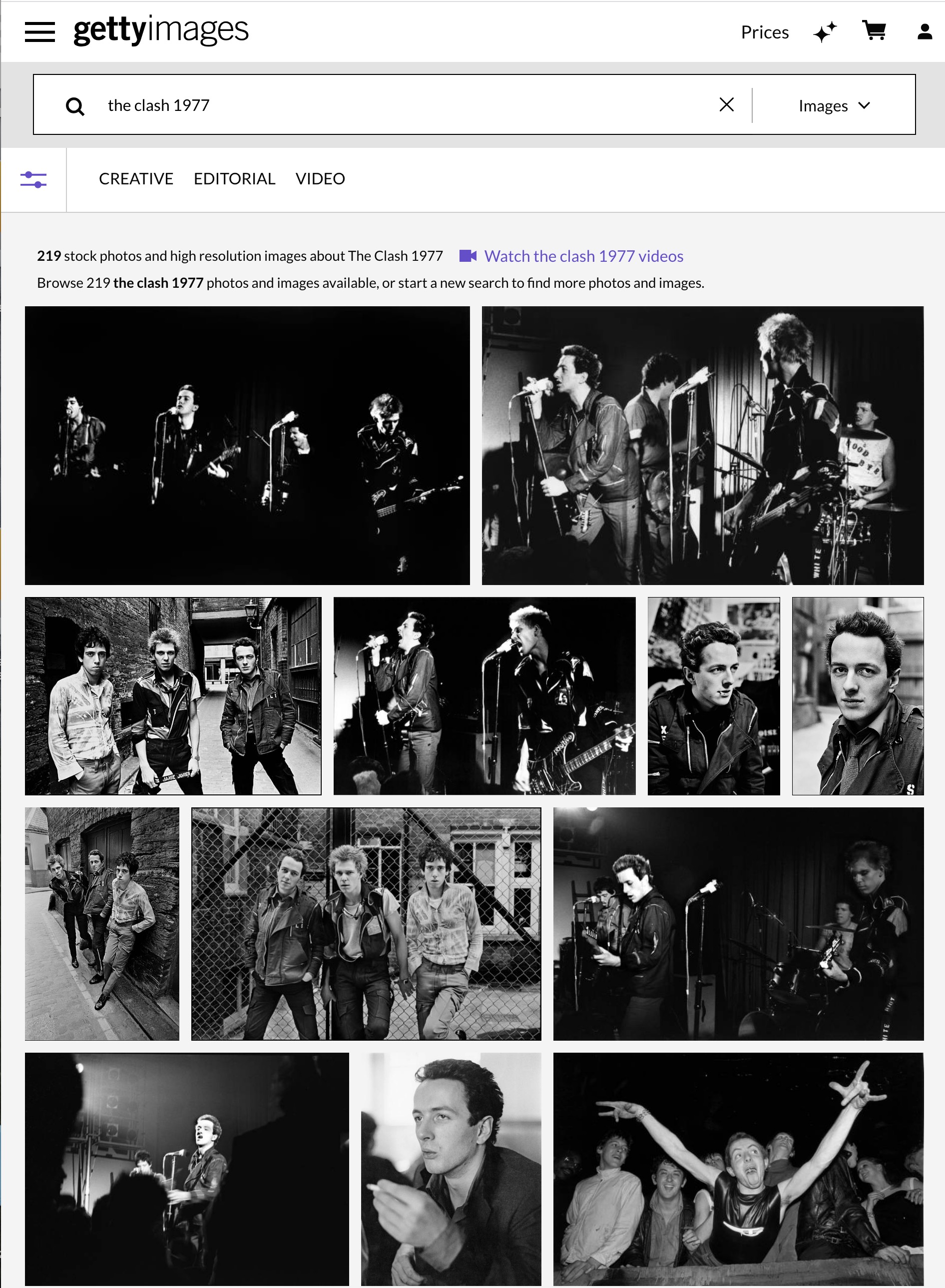
Getty Images; The Clash 1977

219 stock photos and high resolution images about The Clash 1977


Photos

Getty Images
Hundreds of great photos, catalogued and sourced - All Clash images

Alamy
The odd great photo, some sourced - All Clash images

Sonic photos
Around 50 images, sourced - All Clash photos

RockArchive
Around 50 images, sourced - All Clash images

Adrian Boot, The Clash Story and all the important the photosessions
ALL THE CLASH
The Clash Archive - The Clash - Belfast -1977 - The Clash - Camden -1977 - The Clash - Westway -1977 - The Clash - Backstage 1976-79 - The Clash - Live - Big Audio Dynamite - Straight to Hell - The Clash - Soho - 1976

Iconicpix
Thirteen galleries - 13 Clash galleries


Back to the Top


1977 Magazines

martin.james, CUEPOINT, MEDIUM, 5 May 2016, PDF1, PDF2

Weekend Punks: Tagging Along with The Clash

1977 was punk’s Year Zero, the year Joe Strummer and chums made their call to arms to the U.K. youth. Martin James heard the call, cheeked his mum and ‘ran away’ to join the ‘White Riot’ tour. 27 years on, he sat down with Messrs Jones and Simonon in a private bar in West London to reminisce....

Photo: Erica Echinberg / Getty

martin.james, CUEPOINT, MEDIUM, 5 May 2016

Weekend Punks: Tagging Along with The Clash

1977 was punk’s Year Zero, the year Joe Strummer and chums made their call to arms to the U.K. youth. Martin James heard the call, cheeked his mum and ‘ran away’ to join the ‘White Riot’ tour. 27 years on, he sat down with Messrs Jones and Simonon in a private bar in West London to reminisce.

It’s August 2004. I’m sitting in a private members bar on Portobello Road in west London with Paul Simonon and Mick Jones, both former members of The Clash. Mick is slumped in a voluminous sofa, his skeletal frame on the brink of being swallowed whole by the combination of an oversized pinstripe suit and generous soft furnishings. His receding hair is greased back and his sallow skin appears to shrink around his cheekbones and teeth. He reminds me of Dustin Hoffman’s Ratso character in Midnight Cowboy, but with added London cool.

Paul’s roguish good looks and sinewy frame have filled out with age. A hat hides his thinning hair and where once he came over as the band’s gun-wielding thug, he now has the air of amiable barrow boy-turned-art dealer. He continually leans forward, apparently reveling in the interview limelight. “People only ever wanted the singer or the guitarist in the old days,” he complains while tucking into a bowl of chips.

We’re here to discuss the reissue of the 1979 album London Calling, the record that saw The Clash flirting with rhythm and blues, reggae, ska and rock — in effect transcending their purist punk-rock origins. It’s a record that both men are fiercely proud of. Jones declares it to be “the sound of a real band really in tune with each other” while Simonon talks about “breaking free from what people expected of us.”

The story behind the album has been endlessly recounted in the years since it was first released. However, as the beers flow, talk comes round to the impact the band had on so many people. Jones’s conversation gradually descends into sniggers and quips while Simonon becomes ever more animated, talking with hazy-eyed nostalgia about the days when The Clash inspired kids to pack up their possessions and leave home in pursuit of the band.

“It’s true we connected with so many people in a very meaningful way,” says Paul. “What’s really nice is that I’ll meet people and they’ll chat to me like I’ve known them for ages — but they’ll be Clash fans. It’s like having this extended network of friends.”

Mick chips in: “Ultimately, though, we were just doing what we liked doing, playing the music that we liked — never thought about the effect we were having too much. We never had time to think about it.”

So what would you do if your kids ran away from home to follow a band? “I’d probably say ‘good for you — go for it,’” says Paul. “But only if it’s the Libertines,” adds Mick, who is their producer.

[photo: Janette Beckman]

I was 14 when I first left home to follow The Clash. It was early 1977 and the impact of punk rock was just beginning to be felt in the nation’s classrooms. Like so many kids of my generation the cocktail of punk’s apparent unbridled anger and my own hormones proved too potent to contain. In the course of what seemed like only a few weeks my voice broke, I gave my mum cheek, I cut my hair short, converted my flared jeans to drainpipes, acquired baseball boots and a ripped T-shirt, and got beaten up. This was for being a punk, setting a pattern that was to define the next few years of my life.

My first Clash gig was at the Harlesden Coliseum in 1977. I told my parents I was staying at a friend’s house. My friend did the same and we duly “left home.” For two kids from the middle-class town of Marlow-on-Thames it seemed like the punk rock thing to do.

Harlesden Coliseum was decrepit. The fake alabaster decor was in an advanced state of decomposition, the flecked wallpaper peeling off in strips to reveal disintegrating walls. The carpet was sticky underfoot, the air dense with the smell of damp, stale cigarettes and body odor. It constituted the perfect setting for my first encounter with the London punk scene. It also seemed the perfect venue for The Clash, who took the stage to taunts about their newly signed deal with Sony Records. The band’s reaction was to deliver a set of all-consuming ferocity.

The picture is still clear in my head: Joe Strummer screwing his face up to snarl at — rather than into — the microphone, his leg pumping uncontrollably like a piston; Mick Jones attacking his guitar and his amp as if he hated them (they kept packing up, as if they hated him); peroxide-blond bassist Paul Simonon swinging his instrument low like a weapon, a slow-burning cigarette hung constantly from his bottom lip in defiance of the laws of physics. It doesn’t go away, that kind of imagery, not when you encounter it for the first time.

‘London Calling’s’ iconic cover shot

After the gig I worked up the courage to approach Joe Strummer. He was holding court at a makeshift bar, enjoying a couple of beers and praise for the show. I waited until the crowd thinned, wandered over to him and said hello. He seemed to me to be the epitome of cool in his Clash uniform of heavily-stenciled combat gear. But it was his teeth that really compelled my attention. They appeared to be decaying in front of my eyes, ravaged, presumably, by a combination of negligence, bad dentistry and cheap speed. As he spoke a continuous stream of spittle flew from his mouth.

I attempted to make intelligent conversation. I asked him why he sang a song called “White Riot” while the DJ played reggae all night — did it, I wondered, annoy him at all? The spittle turned to froth. Did I not understand that “White Riot” was all about his respect for black people and their stand against oppression? Had I not listened to the lyrics, in which he sang that he wished white people would take the same positive position?

Well, no actually. First of all The Clash hadn’t actually released a record at this point so there was no way I could have analyzed his lyrics. Secondly, I hadn’t grown up in multi-racial Notting Hill Gate. And, despite going to gigs in the multi-racial town High Wycombe, I had never previously been forced to face up to my own inherent racism.

It was an attitude that had been borne from the simple fact that there were no black people in Marlow. I was ten when I met my first black kid. Some nice white middle-class family had adopted him. I can still remember being told in the playground that if the black kid touched me his color would rub off on me. As a 14-year-old, race riots — or indeed the very concept of “racism” — meant little to me.

So Strummer forced my eyes open. And to confirm my new-found awareness I started drinking Red Stripe in High Wycombe’s Rasta pub, The Red Cross Knight, and, when The Clash hit the road again in May 1977, skanked enthusiastically to the band’s version of Junior Murvin’s roots-rocking classic “Police and Thieves.” I became a vocal supporter of the Rock Against Racism movement. And when, in April 1978, The Clash played the RAR Carnival at Victoria Park in Hackney, there I was handing out badges, unquestioningly.

Paul Simonon plays the RAR Carnival at Victoria Park, London in 1978 [photo: Syd Shelton]

Back in Harlesden, however, the tongue-lashing Strummer meted out went on and on and left me reeling. This was not what one expected of narcissistic rock stars. But he did stop eventually, at which point he put his arm round my shoulders and told me to “piss off ‘ome.” I stumbled into the Harlesden streets feeling like I’d just been pulled up by a teacher. It was while I reflected somberly on this that I was knocked cold by another punk and robbed of the £1.20 I had to get home with. It wouldn’t have happened, of course, if my attacker had realized that I was now a close friend of Joe Strummer’s.

So how exactly did a middle-class kid from a middle-class town come to follow The Clash around? Well, as a young teenager it certainly wasn’t their political stance that excited me. At that time the dole meant nothing to me and, as I’ve already mentioned, I was completely ignorant of any concept of racism.

In retrospect I think I was drawn to the macho air that surrounded the band. It may not appeal much now, but as a teenage boy their tough-guy, outlaw image was something to aspire to. The Clash, far more than the Sex Pistols or the Damned, were a gang. And, more to the point, they made us — their hormonally challenged disciples — feel like we were also part of the same gang. They were, they argued, the same as us and everything about them portrayed an us-against-them attitude. It comes as no surprise to hear, more than 25 years later, Simonon still talking about his “network of friends.”

That gang vibe was a key component of the punk “stance.” Kids like me were never hard enough to be skinheads. In fact, like most punks, I was happier to write poetry than fight. But like it or not, aggro attended punk wherever it went. The media waged a daily war on us; complete strangers adopted the blood sport of “punk hunting.” We just took it on the chin, or wherever else the blows landed, because we had a cause. We were martyrs, the beatings a right of passage. We would show our wounds to younger, aspiring punks. The cuts and bruises were much, much more meaningful than button badges.

And we got great stories out of it: I remember bragging about being jumped on by a gang of Teds when in reality a single Elvis impersonator had punched me for spitting at him. We were only reducing ourselves to type. I was a punk: spitting is what we did. He was a Teddy Boy: hitting punks is what they did. He probably told his friends that he’d taken on a gang of us. The fact that we sat next to each other in double-English on a Tuesday afternoon would certainly have been left out of the narrative.

Punk offered the chance of reinvention. We were all keenly downwardly mobile, throwing away what we saw as the entrapments of middle-class life in favor of what we perceived to be working-class attributes. This meant swearing a lot, chewing imaginary gum and sneering at “the straights.”

The mad rush to punk self-reinvention was especially notable in the generation about to head off for university. Virtually every 18-year-old went off as a hippy, only to return at Christmas quoting the first Ramones album, hair shortened (side bits still over ears though), styled by Oxfam.

My own three-strong gang comprised Nutty (the son of a toilet-roll salesman), Gerrard (who later became briefly famous for finding an original painting by John Lennon in a skip) and myself. But by the summer of ’77 our number had swelled considerably. Among the future DJs, movers and shakers of the late 20th century, Roald Dahl’s grandson used to hang out with us. Can’t remember his name. He was at Eton at the time. And one of the girls started to bring along her boyfriend. His name was Steve Redgrave, a huge, quiet fellow. He wore a torn school shirt with the names of his favorite punk bands written in ballpoint all over it. But that was as far as he went. He had other interests. He amiably put up with us giving him stick for not being punk enough and puffing up and down the Thames in a rowing boat when he could be going to gigs and changing society.

At the time, the most uncool thing you could be was a “weekend punk.” It’s what the London cognoscenti called us Thames Valley youngsters, and that’s exactly what we were. Correspondingly, in time-honored anthropological fashion, we would sneer “weekend punk” at anyone who didn’t measure up to our exacting standards: wearing the right clothes, buying the right records or being seen at the right gigs. Steve Redgrave was a full day short of qualifying as a weekend punk.

In May 1977 I “left home” on a number of occasions to follow the Clash’s “White Riot” tour around the country. These adventures were funded by savings from odd jobs and, of course, Christmas, birthday and pocket money. I even started dealing in second-hand records at school and later, in a particularly enterprising move, selling such bootleg classics as the Sex Pistols’ Spunk.

We got to the gigs on a mix of naïvety and bravado. We often hitched and relied heavily on punks in other places for food. We sometimes even managed to grab a sandwich from the band and their entourage. Obviously, there was also a degree of subterfuge involved. In fact, you could say that The Clash taught me to lie convincingly to my parents and, on occasion, to my friends. My entire family were oblivious to what I was up to. Even today my parents refuse to accept that this episode in my life ever took place. At the launch for my most recent book my dad picked up a copy of my biographical blurb and, after reading about my Clash adventures, declared at the top of his voice that “this man is a liar!”

But I was never gone long enough for them to become suspicious. I was, however, now spending enough time in the band’s orbit to be on nodding terms with them. Joe I’d come to see less as a pedagogical figure and more as a cool older brother. Paul was always the one I most wanted to be like — he seemed street-tough but indefatigably concerned with the welfare of other people. Mick I was less sure of. His sneer was always unsettling. He had no inhibitions about showing his dislike for us juvenile weekend punks.

But I was having the time of my life. I’d been to Eric’s Club in Liverpool and the Electric Circus in Manchester. I’d joined in with my fellows and ripped up chairs at The Rainbow in London (an act that we repeated a year later for Siouxsie and the Banshees) and talked my way backstage on numerous occasions, to chat with Clash iconographer, film-maker and Roxy Club DJ Don Letts. I even blagged my way, blind drunk, into sleeping on the floor of one of the band’s hotel rooms in Leicester. To this day I’ve no idea whose.

The Clash performs during the On Parole Tour in 1978 [photo: Kevin Cummins / Getty]

Inthe year that followed I took in a few one-off dates around the country. Each time “leaving home” only to return early the next morning. It was in June, on the 1978 “Clash On Parole Tour” that I decided to bite the bullet and actually run away to follow the band on a permanent basis. The first date was at Aylesbury Friars. I was wearing white jeans, red military jacket (both embellished with home-sewn zips) and ripped Clash T-shirt.

After the gig one of the hangers-on (who I now realize was Ray Gange who starred in the Clash film Rude Boy — although I was studiously indifferent to the ever-present cameras at the time) handed me a button badge giving me backstage access. The dressing room was a whitewashed breezeblock box with mirrors on every wall. The floor was a rubble of beer cans, empty amphetamine wraps and comatose punks. I went straight up to Joe and told him I was coming on the road with the band. He told me to “piss off ‘ome” again. Undaunted, I turned up the following night at Queen’s Hall in Leeds. This time Joe told me I was an idiot. So I spent the night on the floor of Mick’s room, along with a horde of stranded fans eking out their own space among the cans, wraps and guitar cases.

I went straight up to Joe and told him I was coming on the road with the band. He told me to “piss off ‘ome” again. [photo: Erica Echinberg / Getty]

This wasn’t the greatest fun in the world and the following day I decided to go home. Paul rather sweetly did offer his floor on future dates if I decided to continue with the tour. However, by now I’d made the discovery that the romance was better than the reality. My bed at home in Marlow was preferable to Mick Jones’s hotel-room floor in Leicester and the illusion of being a part of The Clash’s extended family had somehow just dissolved. It had never figured in my fantasy that I’d actually have to share the experience with other fans.

In September 1999, at a party to celebrate the release of the posthumously released Clash live album From Here to Eternity, I reminded Joe about the time he stopped me from leaving home. He stared at me, obviously not believing his ears. I went on to explain how that experience had changed my life. His reply was typically direct: “Don’t blame me for your life — I don’t want that on my shoulders.”

“Like Joe said, we were just a band, we didn’t want the pressure of everyone else’s expectations on us,” says Paul Simonon, back again in the Portobello bar in 2004. But I have to leave, to catch the last train home. I make my excuses and a quick exit.

As I reach the door Paul comes running after me with his phone number. “If you’ve missed it, give me a call and you can kip at ours.” I feel like I’m 14 again — but I go home anyway.

Post script: A reflection It’s now 12 years since that meeting with Mick and Paul. Punk’s memory has been hijacked by the U.K.’s capital city through the Punk London celebrations of the so-called birth of punk in 1976. In retrospect the underlying theme of this story was the prominent part the suburbs played in the U.K. punk story and how history has become rewritten through the very un-punk canonization of bands like The Clash. In truth London was the focus, but the suburbs provided the engine. But that’s a story yet to be written…


Comments

Jay –– May 5, 2016 –– His reply was typically direct: “Don’t blame me for your life — I don’t want that on my shoulders.”

As a 15 year old I encountered the legendary Mr Strummer at Glastonbury. I told him what a fan I was and that he inspired me and he put his arm round my shoulders and whispered (as far as I can remember) “don’t copy me. Don’t idolise me. I don’t want people to think what I do is something to aspire to because… then they’re MY fault. Don’t be my fault” then he handed me a can of warm beer (red stripe, I think) and said “You’re a good kid, fuck off”

All Ears –– Jul 10, 2016 –– I’ll never forget the first time I saw “The Clash” album cover. Their bad ass stances, posing in the alley with armbands and flags, which showed they stood for something, short hair, opposite of the rockn’roll long hair, their attitude overflowing and the ripped up artwork that was so popular and modern at the time. Wow, I was totally smitten. I could not wait to buy the album. I just knew they had to be good and I was not disappointed. It wasn’t long until I got kicked out of the frat I was pledging to, once I cut my surfer hair and starting cranking “Career Opportunities” and “Garageland” in my room! The Clash saved me!

Donald Kelly –– May 7, 2016 –– Incredibly overrated group. The Clash were good for about 5 seconds and then they bought into the whole rock star thing and turned to complete shit and pumped out sell out after boring sell out top 40 crap music . Fuckin phonies and about as truly punk as The Bee Gees.


MOJO Magazine, August 1994 - Special Feature on The Clash's journey from Westway to Broadway. 20 pages

The Clash From Westway to Broadway

The Riot Act: John Ingham captures punk's chaotic rise in London, 1976.

– The Clash's mission to conquer America and redefine rock. Take the Fifth Tour 1979

– Ray Lowry’s sketches and memories from The Clash’s US tour.

The Clash on Broadway: Seventeen legendary nights at Bond's in New York, 1981.

Fifteen Years On, Joe Strummer reflects on The Clash’s American journey.


UNCUT 1977 *from the archives of NME, Melody Maker *Published 2015–2017.

The History of Rock 1977

— First offering for the Clash first album reviewed, page 68

— Letters Joe Strummer writes a letter to Melody Maker (23 April 1977) nixing
John Cale for bogus Roundhouse posters, page 91

— FEATURE: In Belfast, the Clash, "Desolation and chaos", October 1977, 6 pages, page 118

— FEATURE: NME April 2nd: "We ain't l ashamed to fight" The Clash, 6 pages, page 44

English.html  |  PDF


Reference: MOJO - Punk: The Whole Story (2006). For more, visit Archive.org

MOJO / Punk: the whole story

Contents (Clash only)

Eyewitness - The birth of punk at the 100 Club Festival, Sept 1976

Sniffin' Glue - How a fanzine became punk’s voice

The Clash Explode! - From squats to stardom: The rise of The Clash

Levene’s Departure - Internal conflicts reshape The Clash

What Happened Next - Post-punk journeys and transformations

Sandinista! — Genius or Folly? - The Clash’s ambitious triple album saga

Online viewer (very good)

Read the article


Retropective magazine features, audio, video

For a full catalogies of retropective articles in magazines, interviews and features on TV and radio go here.


1977 Sundry

Clash Map of London


Extensive archive

of articles, magazines and other from the Roxy gig to the White Riot Tour

Archive   Index   Dates   Topper Joins, Chimes leaves   Don Letts Punk Rock Movie   Snippets   Posters   Adverts   UK Articles   US Articles   International Articles   Fanzines   Social Media   Magazines   Books   Photos   1977 magazines   1977 Sundry    Audio / Video   


www.blackmarketclash.co.uk

email blackmarketclash.co.uk@gmail.com

THE CLASH
1976  1977  1978  1979  1980  1981  1982  1983  1984  1985  THE CLASH: ALBUM BY ALBUM, TRACK BY TRACK 

STRUMMER, BAD, Pogues, films + : THE SOLO YEARS
THE 101ers: 1974-1976   SOLO YEARS: 1986-2025

STRUMMER & THE LATINO ROCKABILLY WAR
ROCK THE RICH 88-89   ROCK THE RICH 99-00  

STRUMMER & THE MESCALEROS
ROCK ART TOURS 1999   ROCK ART TOURS 2000   GLOBAL A GO GO TOURS 2001   GLOBAL A GO GO TOURS 2002   STRUMMER DEMOS OUTAKES

BOOKS, NEWSPAPERS & FEATURE MAGAZINES
THE CLASH YEARS –– 1975-1986 
THE SOLO YEARS –– 1987-2002 
RETROSPECTIVE FEATURE MAGAZINES –– 2002-2025  
BOOKS  OTHER LINKS  

THE CLASH AUDIO & VIDEO
THE CLASH INTERVIEWED – INTERVIEWED / DOCS

Sex Pistols / The Jam / The Libertines / Others
The Sex Pistols  The Jam  The Libertines  other recordings-some master


Jun 76 - Black Swan , five piece ....

Sept 76 - 100 Club, London gigs ....

Dec 76 - Anarchy Tour ....

Jan / Mar - Early 77 Gigs ....

May 77 - White Riot UK Tour ....

Jul 77 - European Dates ....

Oct 77 - Out of Control UK Tour ....

Jan 78 - Sandy Pearlman UK Dates ....

Apr 78 - UK Festival Dates ....

Jul 78 - Out on Parole UK Tour ....

Oct 78 - Sort it Out UK Tour ....

Feb 79 - Pearl Harbour US Tour ....

Jul 79 - Finland + UK dates ....

Sep 79 - Take the Fifth US Tour ....

Dec 79 - Acklam Hall Secret Gigs ....

Jan 80 - 16 Tons UK Tour ....

Mar 80- 16 Tons US Tour ....

May 80 - 16 Tons UK/Europe ....

May 81 - Impossible Mission Tour ....

Jun 81 - Bonds Residency NY ....

Sep 81 - Mogador Paris Residency ....

Oct 81 - Radio Clash UK Tour ....

Oct 81 - London Lyceum Residency ....

Jan 82 - Japan Tour ....

Feb 82 - Australian Tour ....

Feb 82 - HK & Thai gigs ....

May 82 - Lochem Festival ....

May 82 - Combat Rock US Tour ....

July 82 - Casbah Club UK Tour ....

Aug 82 - Combat Rock US Tour ....

Oct 82 - Supporting The Who ....

Nov 82 - Bob Marley Festival ....

May 83 - US Festival + gigs ....

Jan 84 - West Coast dates ....

Feb 84 - Out of Control Europe ....

Mar 84 - Out of Control UK ....

April 84 - Out of Control US Tour ....

Sep 84 - Italian Festival dates ....

Dec 84 - Miners Benefit Gigs ....

May 85 - Busking Tour ....

Jun- Aug 85 - Festival dates ....

Sept 85 - European Tour ....

Jan 86 - Far East Tour ....


1986 onwards - Retrospective


74-76 - Joe with the 101ers ....

Jul 88 - Green Wedge UK Tour

Aug 88 - Rock the Rich UK Tour ....

Oct 89 - Earthquake Weather UK ....

Oct 89 - Earthquake Weather Euro ....

Nov 89 - Earthquake Weather US ....

Jun 99 - Comeback Festival dates ....

July 99 - Short US Tour ....

July 99 - UK Tour ....

Aug 99 - Festival Dates ....

Oct 99 - UK Tour ....

Nov 99 - Full US Tour ....

Dec 99 - European Xmas dates ....

Jan 00 - Australasian Tour ....

May 00 - Mini UK Tour ....

Nov 00 - supporting The Who Tour ....

Jul 01 - UK & US Instore Tour ....

Oct 01 - Full US Tour ....

Nov 01 - Japanese Tour ....

Nov 01 - Full UK Tour ....

April 02 - Brooklyn NY Residency ....

Jun 02 - UK Festivals ....

Jul 02 - Hootenanny Tour ....

Aug 02 - UK Festival Dates ....

Sep 02 - Japanesse Dates ....

Nov 02 - Bringing it all Back Home ....