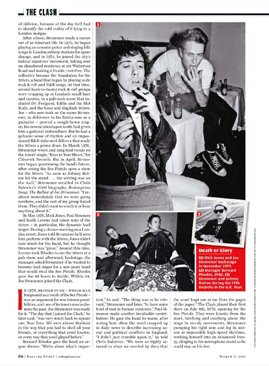
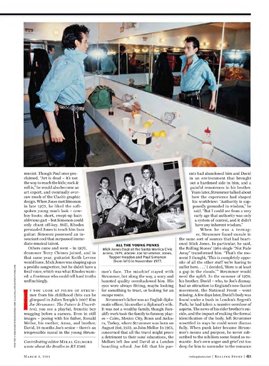
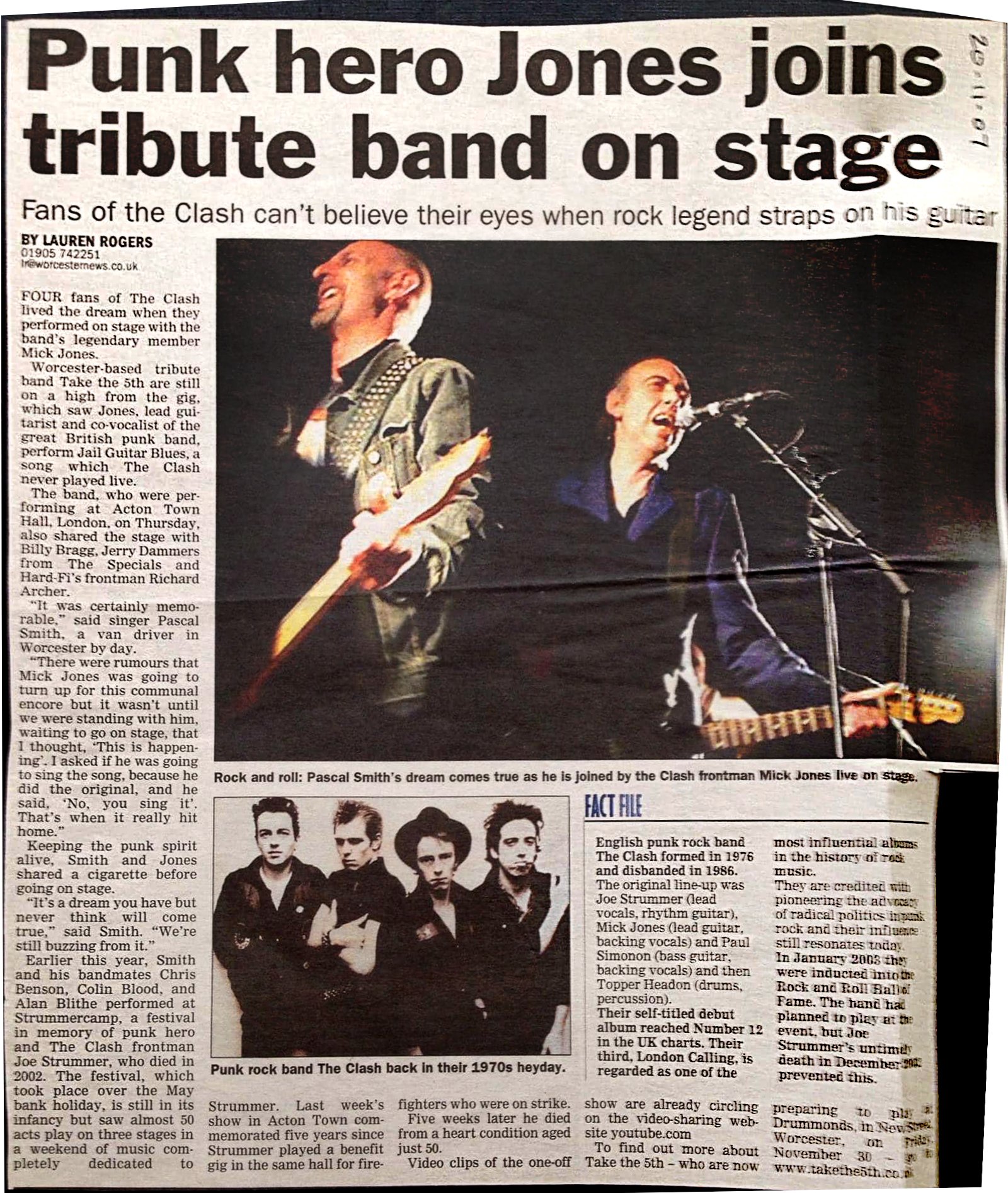
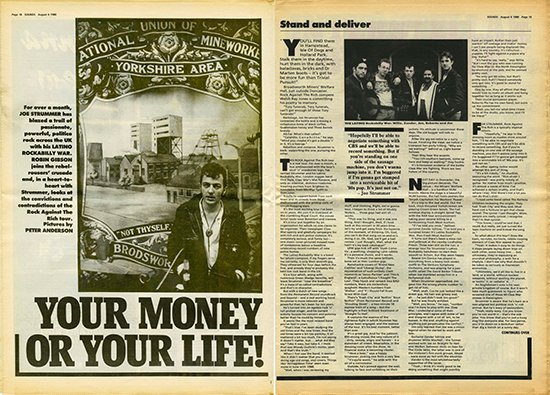
Here is a list of known articles from the last days of The Clash. If you know of anything that is missing please do let us know.

1. End of 85 and the ending of The Clash
2. 84-85 Retrospectives clippings articles
3. Retrospective Magazines go here
4. Radio-Retro-Interviews-Clash


Retropective magazine features, audio, video

For a full catalogies of retropective articles in magazines, interviews and features on TV and radio go here.


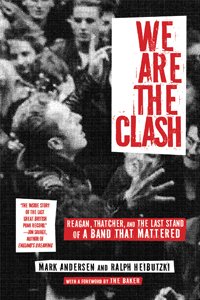
Andersen, Mark, and Ralph Heibutzki. 'We Are the Clash: Reagan, Thatcher, and the Last Stand of a Band That Mattered.' Akashic Books, 2018. Comment by Ralph Heibutzki

Did the other band members get much of a say

Ralph Heibutzki ---- "When I started working on this subject, so long ago, I asked all the new guys some variation on that question. The consensus I got back was that "Joe was the one doing the talking, so it seemed perfectly natural," as Nick Shepperd put it. He didn't recall any major issue or resentment over it.

And, while Joe Strummer did the talking, 95 percent of the tine, there are a handful of exceptions to that policy, that I've seen, mainly on the print journalism side. There's the Steve Morse interview, (mainly) conducted before the DC gig, where all five members are quoted, and it gives you some sense, at least, of what they were like collectively. The NY Times interview, which coincided with the UK tour, is another good example, plus quite a few of the busking show clips, where everybody did get a chance to chip in.

There's even a lengthy Paul Simonon interview with the student paper, the State News, advancing the MSU gig that I saw -- those are quite rare, given his pithy, soft-spoken nature. But that clip's one of my favorites, where he seemed to expound quite well, once he got warmed up. He comes across pretty well there.

It's interesting to ponder how that policy might have changed, had Clash MK II found its footing, but I'd also have to say that having a single spokesperson for any band -- or maybe two, if there's a Jagger/Richards, or Tyler/Perry dynamic going on -- isn't a radical idea, by any means. the obvious rationale being, "One message, one messenger."

And I'd reckon Bernard Rhodes, given his, shall we say, helicopter parent management style would have been a more enthusiastic exponent of such a notion than most."


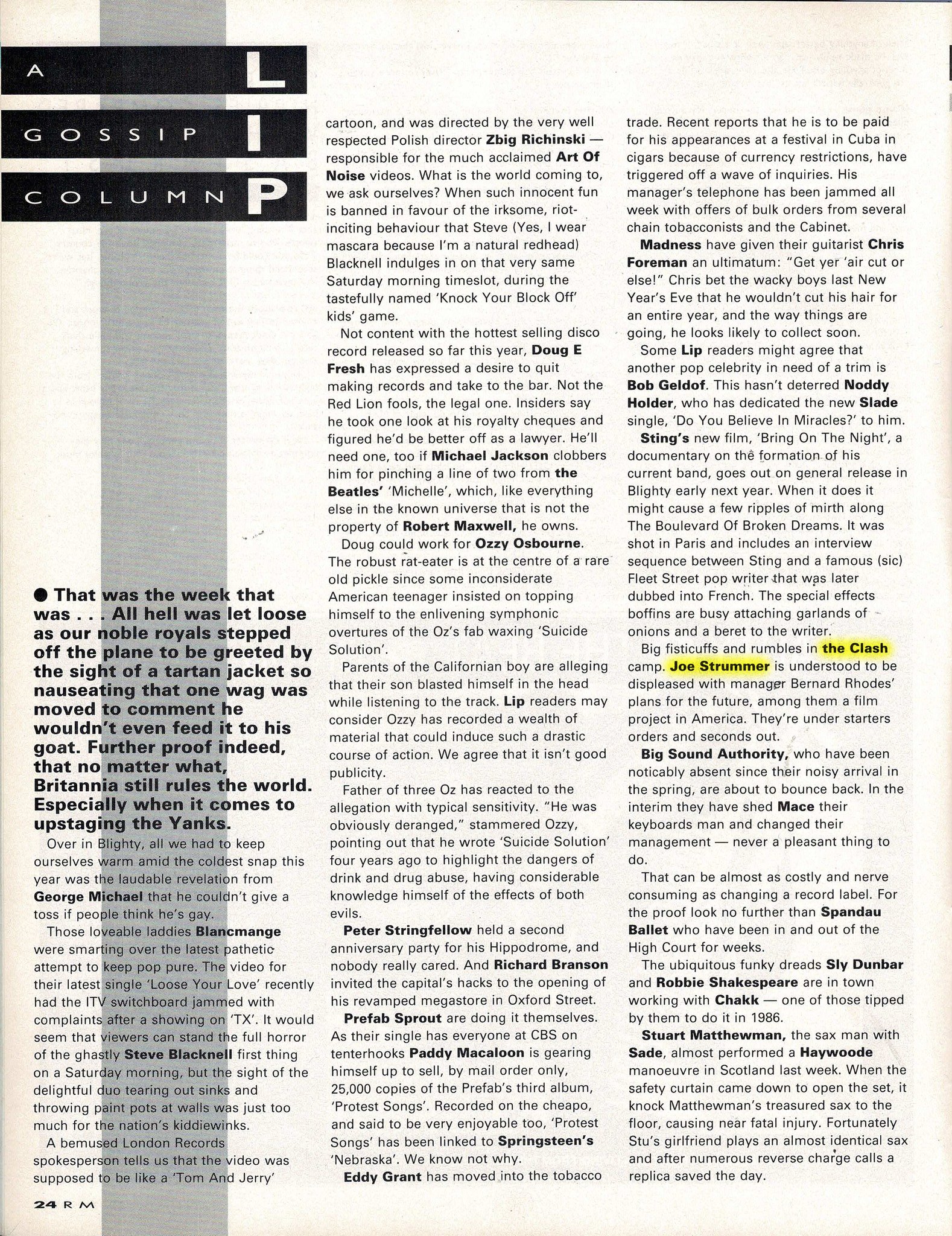
A Lip Gossip Column." Record Mirror, vol. 32, no. 41, 5 Oct. 1985, p. 24.

Gossip Clash film, unhappiness with Rhodes

Big fisticuffs and rumbles in the Clash camp. Joe Strummer is understood to be displeased with manager Bernard Rhodes' plans for the future, among them a film project in America. They're under starters orders and seconds out.

Enlarge image


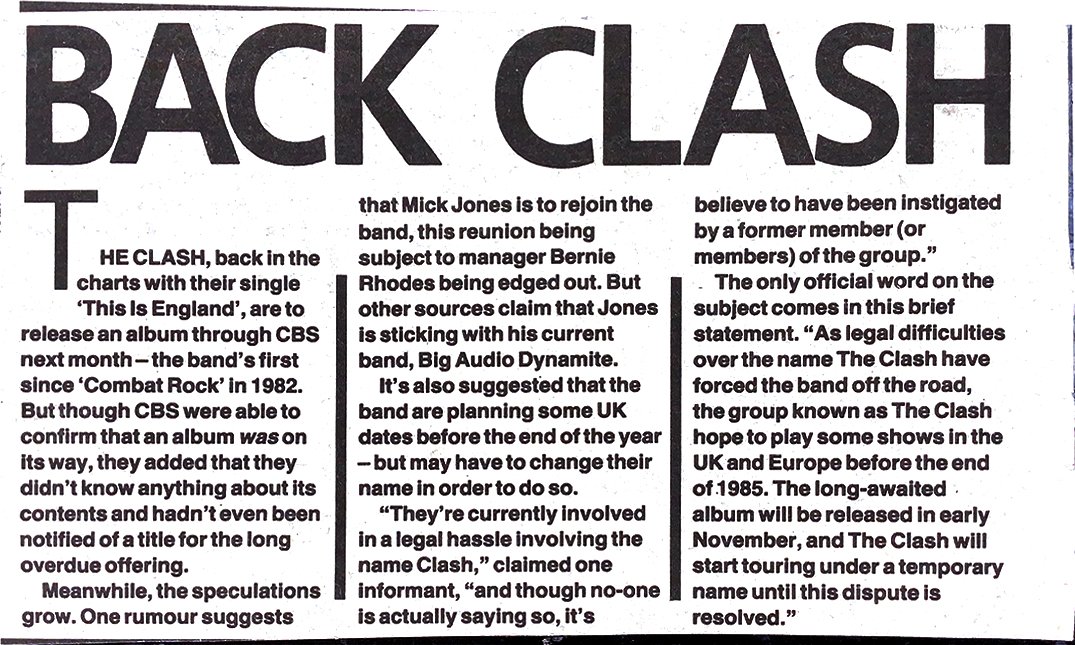
Back Clash

THE CLASH, back in the charts with their single "This Is England", are to release an album through CBS next month — the band’s first since Combat Rock in 1982.

But though CBS were able to confirm that an album was on its way, they added that they didn’t know anything about its contents and hadn’t even been notified of a title for the long overdue offering.

Meanwhile, the speculations grow. One rumour suggests that Mick Jones is to rejoin the band — this reunion being subject to manager Bernie Rhodes being edged out. But other sources claim that Jones is sticking with his current band, Big Audio Dynamite.

It’s also suggested that the band are planning some UK dates before the end of the year — but may have to change their name in order to do so.

"They’re currently involved in a legal hassle involving the name Clash," claimed one informant, "and though no-one is actually saying so, it’s believed to have been instigated by a former member (or members) of the group."

The only official word on the subject comes in this brief statement:

"As legal difficulties over the name The Clash have forced the band off the road, the group known as The Clash hope to play some shows in the UK and Europe before the end of 1985. The long-awaited album will be released in early November, and The Clash will start touring under a temporary name until this dispute is resolved."

Enlarge image


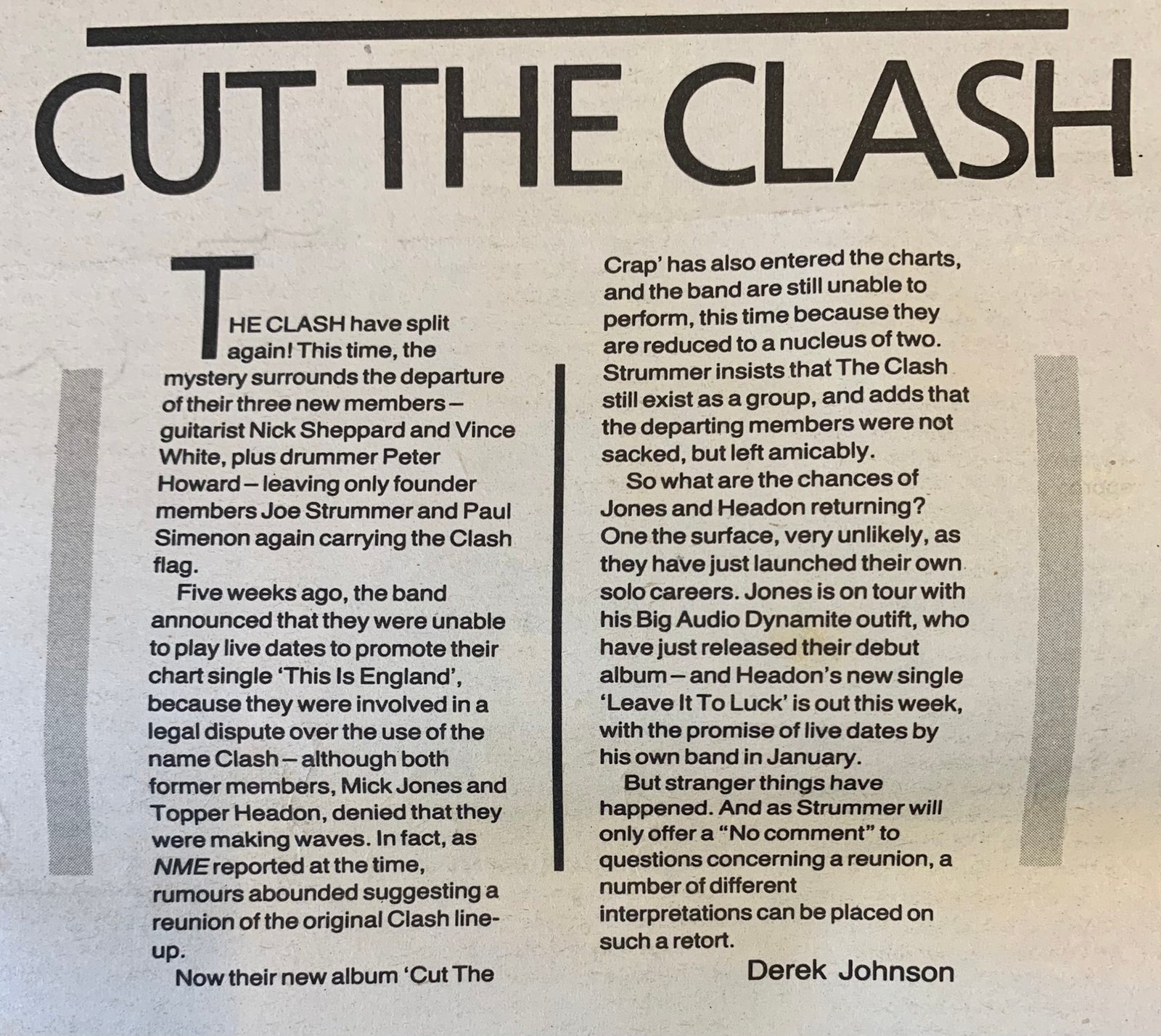
Johnson, Derek. "Cut The Clash." NME (New Musical Express), 23 Nov. 1985, p. 3.

Cut the Clash

The Clash have split again!

This time, the mystery surrounds the departure of their three new members - guitarist Nick Sheppard and Vince White, plus drummer Peter Howard - leaving only founder members Joe Strummer and Paul Simenon again carrying the Clash flag.

Five weeks ago, the band announced that they were unable to play live dates to promote their chart single 'This Is England', because they were involved in a legal dispute over the use of the name Clash - although both former members, Mick Jones and Topper Headon, denied that they were making waves. In fact, as NME reported at the time, rumours abounded suggesting a reunion of the original Clash line-up.

Now their new album 'Cut The Crap' has also entered the charts, and the band are still unable to perform, this time because they are reduced to a nucleus of two. Strummer insists that The Clash still exist as a group, and adds that the departing members were not sacked, but left amicably.

So what are the chances of Jones and Headon returning? On the surface, very unlikely, as they have just launched their own solo careers. Jones is on tour with his Big Audio Dynamite outfit, who have just released their debut album — and Headon's new single 'Leave It To Luck' is out this week, with the promise of live dates by his own band in January.

But stranger things have happened. And as Strummer will only offer a "No comment" to questions concerning a reunion, a number of different interpretations can be placed on such a retort.

- Derek Johnson

Source --- Enlarge Image


"Clash Crash." Record Mirror, Oct. 1985, p. 4.

Clash Crash

The Clash has lost three of its members. Guitarists Vince White and Nick Sheppard have gone together with drummer Pete Howard, leaving Joe Strummer and Paul Simenon to rebuild the line-up.

The split is said to be an amicable one, and The Clash say they'll be releasing a statement soon. The break has fuelled rumours that Mick Jones and Topper Headon will be rejoining The Clash. In the case of Jones especially, this would seem rather an odd move considering he's just formed Big Audio Dynamite.

All that Clash manager Bernie Rhodes will say at the moment is: "News will follow."

Oct 1985 Link 1 or alternatively Link 2


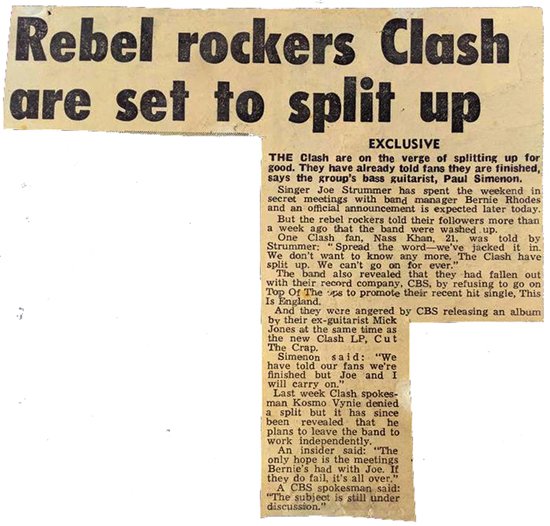
"Rebel Rockers Clash Set to Split Up." The Sun, Nov. 1985, p. 3.

Rebel Rockers Clash Set to Split Up

The Sun reports that The Clash are preparing to disband permanently, having already informed fans privately.

Tensions with CBS, lineup departures, and internal frustration underpin what may be the band's final days.


Rebel Rockers Clash Set to Split Up

The Clash are on the verge of splitting up for good. They have already told fans they are finished, says the group’s bass guitarist, Paul Simenon.

Singer Joe Strummer has spent the weekend in secret meetings with band manager Bernie Rhodes, and an official announcement is expected later today.

But the rebel rockers told their followers more than a week ago that the band were washed up.

One Clash fan, Nass Khan, 21, was told by Strummer: “Spread the word — we’ve jacked it in. We don’t want to know any more. The Clash have split up. We can’t go on forever.”

The band also revealed that they had fallen out with their record company, CBS, by refusing to appear on Top of the Pops to promote their recent hit single, This Is England.

They were further angered by CBS releasing an album by their ex-guitarist Mick Jones at the same time as the new Clash LP, Cut The Crap.

Simenon said: “We have told our fans we’re finished, but Joe and I will carry on.”

Last week, Clash spokesman Kosmo Vinyl denied a split, but it has since been revealed that he plans to leave the band to work independently.

An insider said: “The only hope is the meetings Bernie’s had with Joe. If they do fail, it’s all over.”

A CBS spokesman added: “The subject is still under discussion.”

Enlarge image


"The Clash." Sounds, 9 Nov. 1985, pp.

WANTED ****


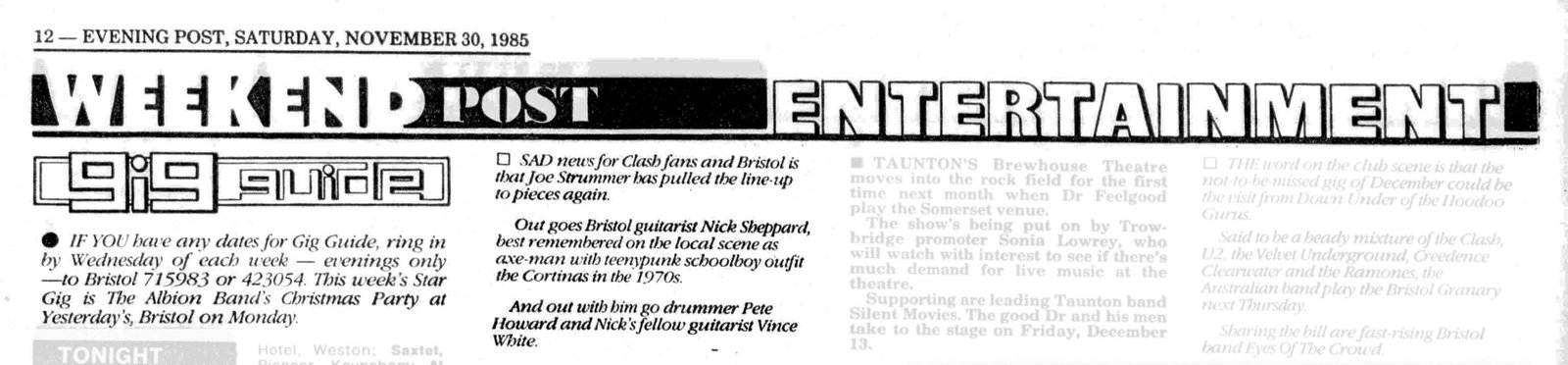
"Sad News for Clash Fans." Bristol Evening Post, 30 Nov. 1985, Weekend Post Entertainment, p. 12.

Clash Line-Up Falls Apart Again

Bristol Evening Post - Weekend Post Entertainment Section

SAD news for Clash fans - and for Bristol - as Joe Strummer has pulled the line-up to pieces again.

Out goes Bristol guitarist Nick Sheppard, best remembered on the local scene as the axe-man with teenypunk schoolboy outfit The Cortinas in the 1970s.

And out with him go drummer Pete Howard and fellow guitarist Vince White.

Enlarge mage


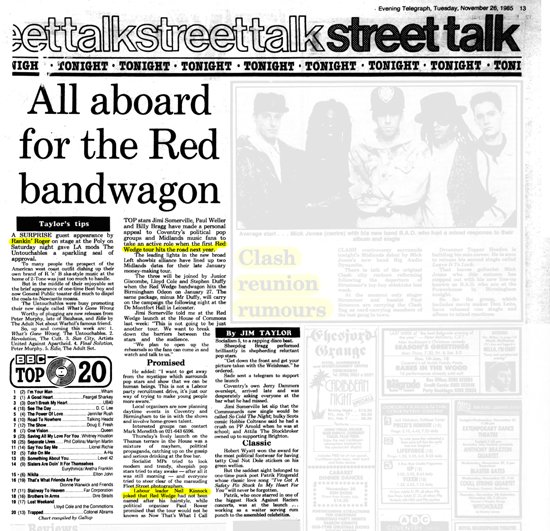
Taylor, Jim. "Clash Reunion Rumours." & "Red Wedge Appeal Launched" Coventry Evening Telegraph, 26 Nov. 1985, p. 13.

Clash Reunion Rumours as B.A.D. Debut in Midlands
& Red Wedge Appeal Launched

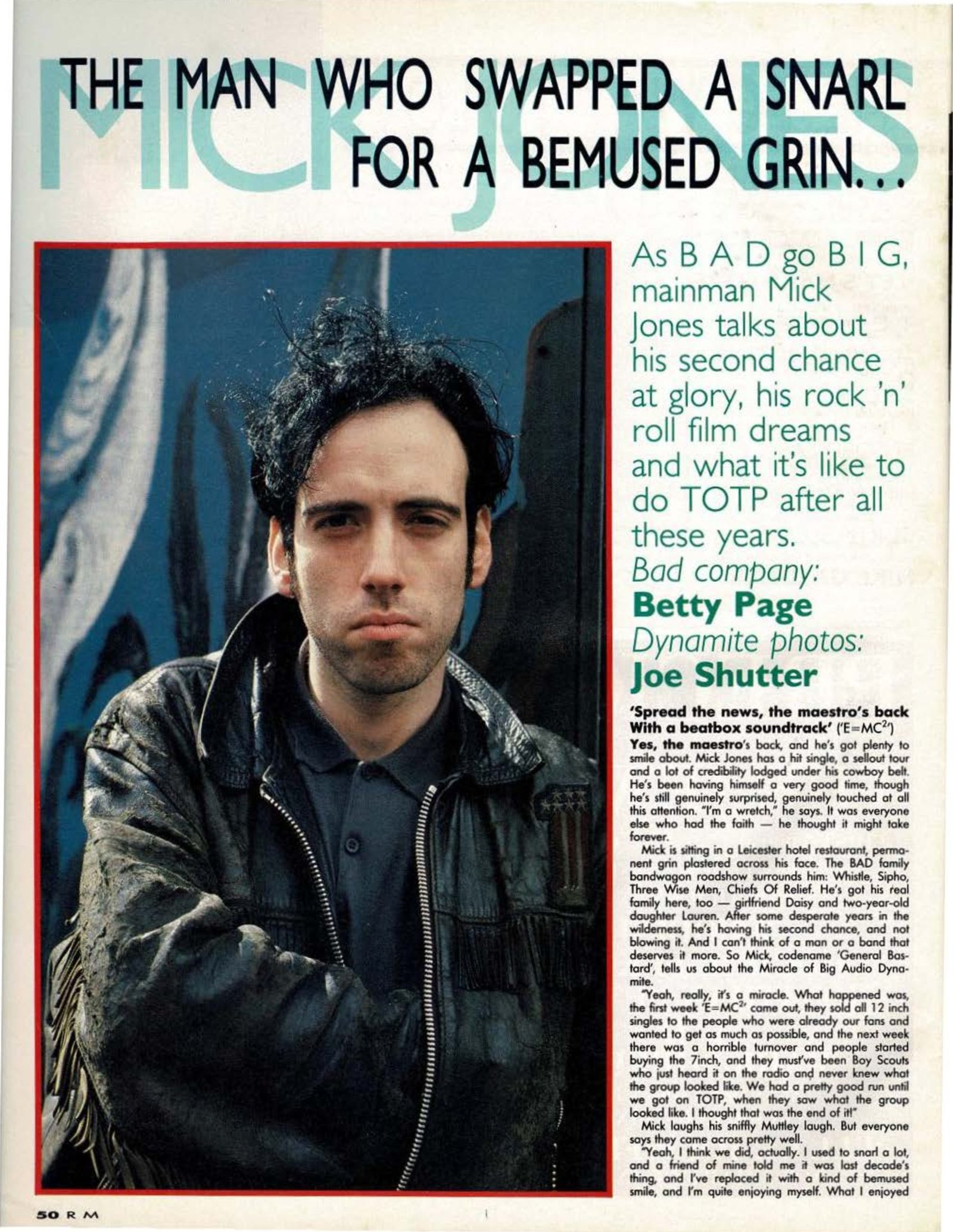
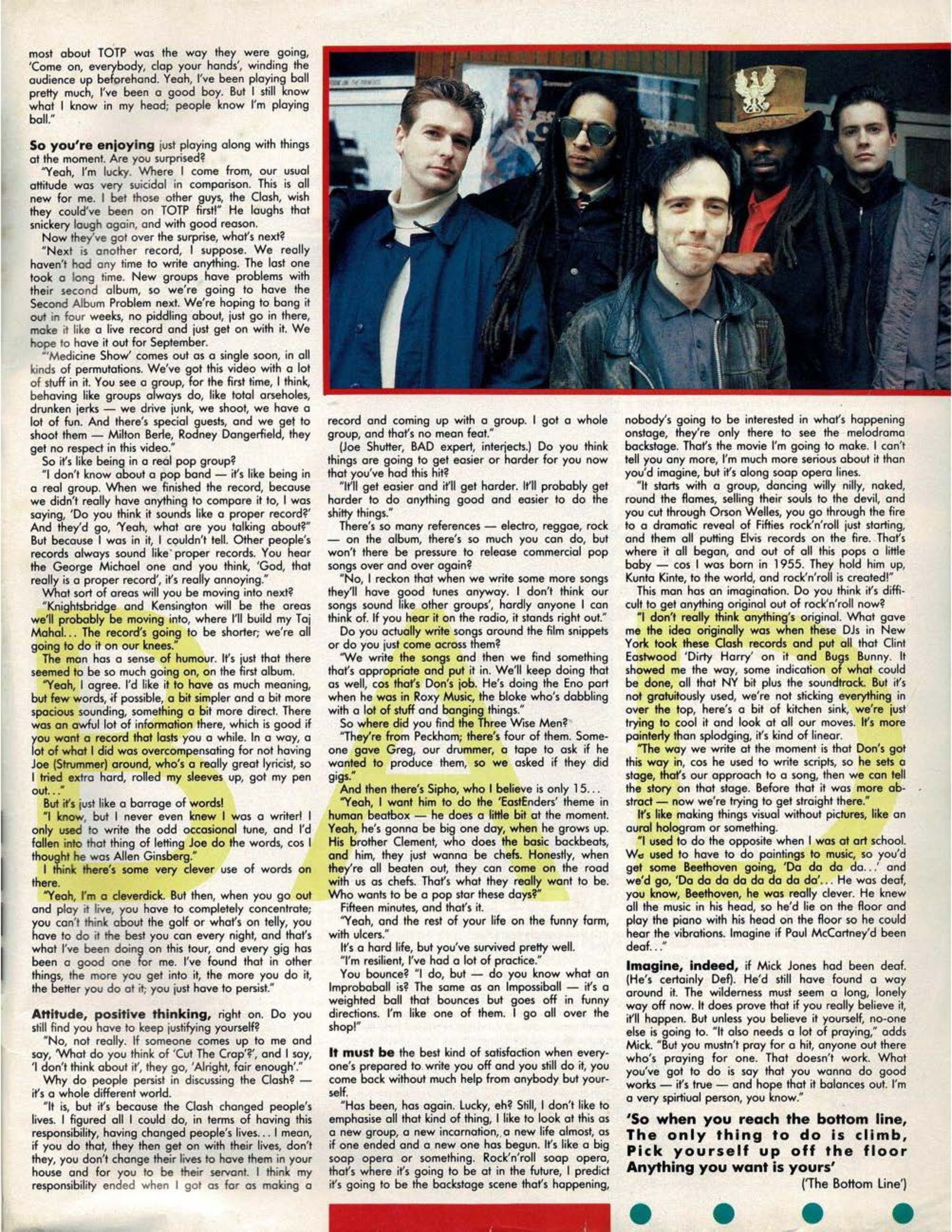
As Mick Jones debuts Big Audio Dynamite (B.A.D.) in Birmingham, rumours swirl of a possible Clash reunion. With only Joe Strummer and Paul Simenon left, the recent exit of Strummer’s “toy-boy sidekicks” has renewed speculation. Meanwhile, Topper Headon is preparing his second solo single, and B.A.D., which includes Don Letts, has released a single and album to mixed reactions.

The launch of the Red Wedge campaign brought Jimi Somerville, Paul Weller, and Billy Bragg to Parliament, urging Midlands youth to engage with political pop. The tour hits Birmingham and Leicester in January. Gossip at the event included Mick Jones’s lukewarm B.A.D. debut, Patrik Fitzgerald waiting tables, and Bragg rallying stars like a socialist shepherd.

Clash Reunion Rumours as B.A.D. Debut in Midlands

By Jim Taylor - Coventry Evening Telegraph, 26 November 1985, p. 13

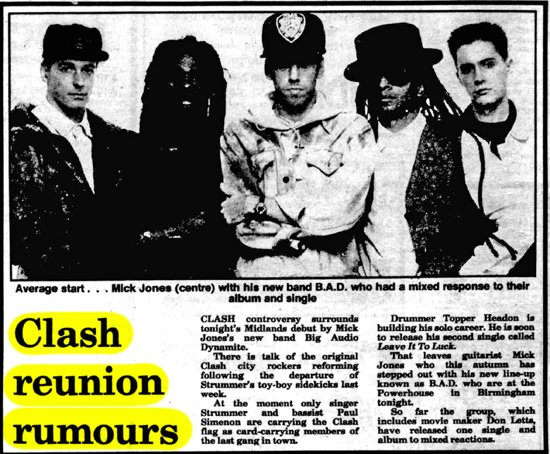
Clash controversy surrounds tonight's Midlands debut by Mick Jones's new band Big Audio Dynamite (B.A.D.), who appear at the Birmingham Powerhouse.

There is talk of the original Clash city rockers reforming, following the departure of Strummer's "toy-boy sidekicks" last week. At present, only singer Joe Strummer and bassist Paul Simenon remain carrying the Clash flag.

Mick Jones, now fronting B.A.D., has released one single and an album to mixed reactions. His new lineup includes filmmaker Don Letts.

Meanwhile, former Clash drummer Topper Headon is building his solo career and is set to release his second single, "Leave It To Luck."

-----

Evening Telegraph - Tuesday, November 26, 1985
Page 13 - Bettalkstreettalk
TONIGHT

All Aboard for the Red Bandwagon

Taylor's Tips

A SURPRISE guest appearance by Rankin' Roger on stage at the Poly on Saturday night gave L.A. mods The Untouchables a sparkling seal of approval.

To many people the prospect of the west beat outfit dishing up their can west coast outfit dishing up the American own brand of R'n'B ska-style music at the home of 2-Tone was just too much to handle.

But in the middle of their enjoyable set the brief appearance of one-time Beat boy and now General Public toaster did much to dispel the coals-to-Newcastle moans.

The Untouchables were busy promoting their new single cal called What's Gone Wrong. One worthy of plugging are new releases from Peter Murphy, late of Bauhaus, and Edie by The Adult Net about Warhol's famous friend.

So, and coming this week are:

  1. What's Gone Wrong, The Untouchables

  2. Revolution, The Cult

  3. Sun City, Artists United Against Apartheid

  4. Final Solution, Peter Murphy

  5. Edie, The Adult Set


BBC TOP 20

1 (2) I'm Your Man - Wham 2 (1) A Good Heart - Feargal Sharkey 3 (3) Don't Break My Heart - UB40 4 (18) See The Day - D. C. Lee 5 (4) The Power Of Love - Jennifer Rush 6 (10) Road To Nowhere - Talking Heads 7 (12) The Show - Doug E. Fresh 8 (7) One Vision - Queen 9 (23) Saving All My Love For You - Whitney Houston 10 (25) Separate Lives - Phil Collins / Marilyn Martin 11 (14) Say You Say Me - Lionel Richie 12 (5) Take On Me - A-Ha 13 (8) Something About You - Level 42 14 (9) Sisters Are Doin' It For Themselves - Eurythmics / Aretha Franklin 15 (6) Nikita - Elton John 16 (19) That's What Friends Are For - Dionne Warwick and Friends 17 (11) Stairway To Heaven - Far Corporation 18 (16) Brothers In Arms - Dire Straits 19 (17) Lost Weekend - Lloyd Cole and the Commotions 20 (13) Trapped - Colonel Abrams

Chart compiled by Gallup


Red Wedge Appeal Launched

TOP stars Jimi Somerville, Paul Weller and Billy Bragg have made a personal appeal to Coventry's political pop groups and Midlands music fans to take an active role when the first Red Wedge tour hits the road next year.

The leading lights in the new broad Left showbiz alliance have lined up two Midlands dates for their late January money-making tour.

The three will be joined by Junior Giscombe, Lloyd Cole and Stephen Duffy when the Red Wedge bandwagon hits the Birmingham Odeon on January 27. The same package, minus Mr Duffy, will carry on the campaign the following night at the De Montfort Hall in Leicester.

Jimi Somerville told me at the Red Wedge launch at the House of Commons last week: "This is not going to be just another tour. We want to break down the barriers between the stars and the audience. "We plan to open up the rehearsals so the fans can come in and watch and talk to us."

Promised

He added: "I want to get away from the mystique which surrounds pop stars and show that we can be human beings. This is not a Labour party recruitment drive, it's just our way of trying to make young people more aware."

Local organisers are now planning daytime events in Coventry and Birmingham to tie in with the shows and involve home-grown talent. Interested groups can contact Mark Meredith on 021-643 6596.

Red Wedge Launch - House of Commons

Thursday's lively launch on the Thames terrace in the House was a mixture of mayhem, political propaganda, catching up on the gossip and serious drinking at the free bar.

Average start. Mick Jones (centre) with his new band B.A.D., who had a mixed response to their album and single.

Socialism 5 - to a Rapping Disco Beat

Sheepdog Bragg performed brilliantly in shepherding reluctant pop stars.

"Get down the front and get your picture taken with the Welshman," he ordered.

Sade sent a telegram to support the launch.

Coventry's own Jerry Dammers overslept, arrived late and was desperately asking everyone at the bar what he had missed.

Jimi Somerville let slip that The Communards' new single would be called So Cold The Night; bulky Scots comic Robbie Coltrane said he had a crush on PP Arnold when he was at school; and Attila the Stockbroker owned up to supporting Brighton.

Classic Moments

Robert Wyatt won the award for most political footwear for having tatty Coal Not Dole stickers on his green wellies.

Final Notes

Socialist MPs tried to look modern and trendy, sheepish pop stars tried to stay awake - after all it was still morning - and everyone tried to steer clear of the marauding Fleet Street photographers.

Labour leader Neil Kinnock joked that Red Wedge had not been named after his hairstyle, while political organiser Paul Bower promised that the tour would not be known as Now That's What I Call Socialism 5.

The Saddest Sight...

The saddest sight belonged to one-time punk poet Patrik Fitzgerald, whose classic love song "Safety Pin Stuck In My Heart" will never be forgotten.

Patrik, who once starred in one of the biggest Rock Against Racism concerts, was at the launch - working as a waiter, serving rum punch to the assembled celebrities.

Miscellany

Drummer Topper Headon is building his solo career. He is soon to release his second single called Leave It To Luck.

That leaves guitarist Mick Jones, who this autumn has stepped out with his new line-up known as B.A.D., who are at the Birmingham Powerhouse tonight.

So far the band - which includes movie maker Don Letts - have released one single and an album, to mixed reactions.

Average start. Mick Jones (centre) with his new band B.A.D. who had a mixed response to their album and single.

Clash reunion rumours

CLASH controversy surrounds tonight's Midlands debut by Mick Jones's new band Big Audio Dynamite. There is talk of the original Clash city rockers reforming following the departure of Strummer's toy-boy sidekicks last week. At the moment only singer Strummer and bassist Paul Simenon are carrying the Clash flag as card-carrying members of the last gang in town.

Drummer Topper Headon is building his solo career. He is soon to release his second single called Leave It To Luck.

That leaves guitarist Mick Jones, who this autumn has stepped out with his new line-up known as B.A.D., who are at the Powerhouse in Birmingham tonight.

So far the group, which includes movie maker Don Letts, have released one single and album to mixed reactions.


Bushell, Garry. "Death of the Clash... the dream is over." Sounds, 21 & 28 Dec. 1985, p. 2.

Garry Bushell laments the death of the Clash in Sounds year end review

2 Death of the Clash...the dream is over. Sad but inevitable - we never changed a thing, but they didn't half write some red-hot rebel anthems along the way (one of the best being the farewell single 'This Is England'). And at least we've still got BAD to call our own. Archive PDF


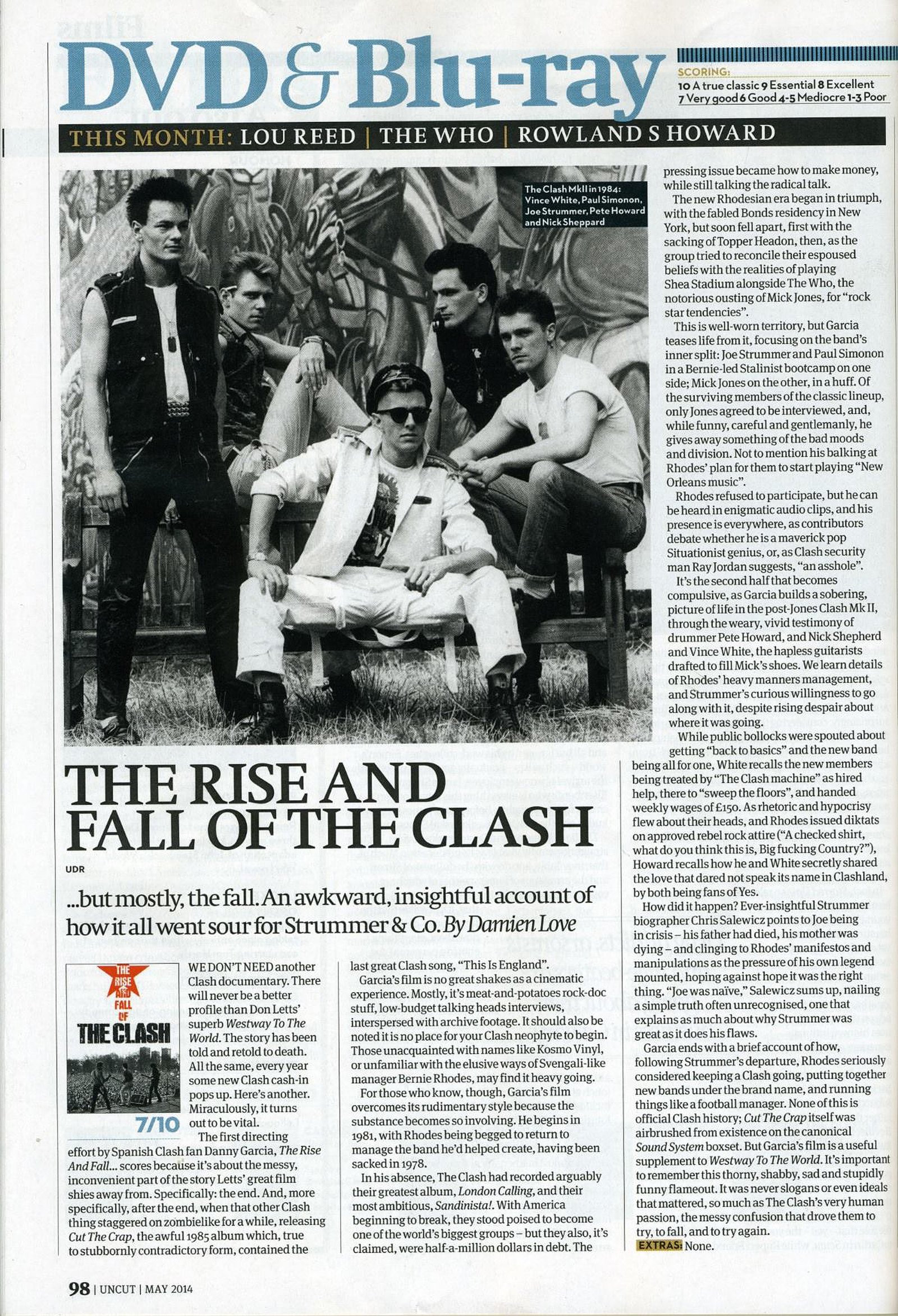
Love, Damien. Documenatry Film "The Rise and Fall of The Clash." Uncut, May 2014, pp. 98 - 99

FILM: The Rise and Fall of The Clash

Damien Love reviews The Rise and Fall of The Clash, a raw documentary by Danny Garcia exploring the band's chaotic post-1981 decline, internal rifts, and the troubled making of Cut The Crap. While lacking polish, the film offers crucial insight into the group's collapse and Joe Strummer's conflicted loyalties under Bernie Rhodes' influence.

DVD & Blu-ray / Review Score: 7/10


FILM: The Rise and Fall of The Clash

DVD & Blu-ray Review – UNCUT, May 2014
By Damien Love
Score: 7/10

...but mostly, the fall. An awkward, insightful account of how it all went sour for Strummer & Co.

We don't need another Clash documentary. There will never be a better profile than Don Letts' superb Westway To The World. The story has been told and retold to death. All the same, every year some new Clash cash-in pops up. Here's another. Miraculously, it turns out to be vital.

The first directing effort by Spanish Clash fan Danny Garcia, The Rise And Fall... scores because it's about the messy, inconvenient part of the story Westway shies away from. Specifically: the end. And, more specifically, after the end, when that other Clash thing staggered on zombielike, releasing Cut The Crap, the awful 1985 album which, true to stubbornly contradictory form, contained the last great Clash song, "This Is England".

Garcia's film is no great shakes as cinema. It's meat-and-potatoes rock-doc: low-budget talking heads, archive footage. It's also no place for a Clash neophyte. Those unfamiliar with names like Kosmo Vinyl or the elusive Bernie Rhodes may find it heavy going.

For those who know, though, Garcia's film overcomes its rudimentary style because the substance is so involving. He begins in 1981, with Rhodes being begged to return to manage the band he'd helped create, after being sacked in 1978.

In his absence, The Clash had recorded arguably their greatest album, London Calling, and their most ambitious, Sandinista!. With America beginning to break, they were poised to become one of the world's biggest groups—but also, it's claimed, were half-a-million dollars in debt. The pressing issue became how to make money, while still talking the radical talk.

The new Rhodesian era began in triumph, with the fabled Bonds residency in New York, but soon unravelled: first Topper Headon was sacked, then, amid the contradictions of playing Shea Stadium with The Who, Mick Jones was ousted for "rock star tendencies."

This is well-worn territory, but Garcia teases life from it, focusing on the inner split: Joe Strummer and Paul Simonon in a Bernie-led Stalinist bootcamp on one side; Mick Jones on the other, in a huff. Of the classic lineup, only Jones agreed to be interviewed—funny, careful, gentlemanly—but revealing of the deep divides. He balked at Rhodes' plan for them to start playing "New Orleans music."

Rhodes refused to participate, but is heard in enigmatic audio clips. His presence looms, as contributors debate whether he was a "maverick pop Situationist genius", or as Clash security man Ray Jordan says, "an asshole."

The film's second half becomes compulsive. Garcia builds a sobering picture of life in the post-Jones Clash Mk II, through vivid testimony from Pete Howard, Nick Sheppard, and Vince White. We learn about Rhodes' "heavy manners" management and Strummer's baffling loyalty despite evident despair.

While public statements spouted slogans about "getting back to basics", White remembers the new members being treated as "hired help," handed £150 a week. As rhetoric flew, Rhodes even dictated rebel-rock attire: "A checked shirt? What do you think this is, Big f---ing Country?" Meanwhile, Howard and White secretly bonded over a mutual love of Yes, taboo in Clashland.

How did this happen? Biographer Chris Salewicz points to Joe's personal crisis: "Joe was naïve," he concludes. His father had died, his mother was dying, and Joe clung to Rhodes' manifestos, hoping they were right. It's a simple but revealing truth—one that explains as much about his greatness as his flaws.

Garcia ends with Strummer's departure and Rhodes' serious consideration of assembling new bands under the Clash name, "like a football manager." None of this is official Clash history. Cut The Crap was airbrushed from the Sound System box set. But The Rise and Fall of The Clash is a necessary supplement to Westway. A document of a thorny, shabby, and stupidly funny flameout. It was never the slogans or ideals that mattered, so much as The Clash's human passion—the messy confusion that drove them to try, to fall, and to try again.

Extras: None.

Enlarge image


Morse, Steve. "New Rock Films Document Neil Young Solo, Clash Breakup." "FILM: The Rise and Fall of The Clash" The Boston Globe, 7 July 2012, link

New Rock Films: Neil Young's Solitude vs. The Clash's Collapse

Two films explore contrasting music legacies: Neil Young's quiet introspection and The Clash's turbulent end - "The Rise and Fall of The Clash." One is reflective; the other, a raw dive into punk's unraveling.


New rock films document Neil Young solo, Clash breakup

By Steve Morse Globe Correspondent,July 7, 2012, 6:00 p.m.

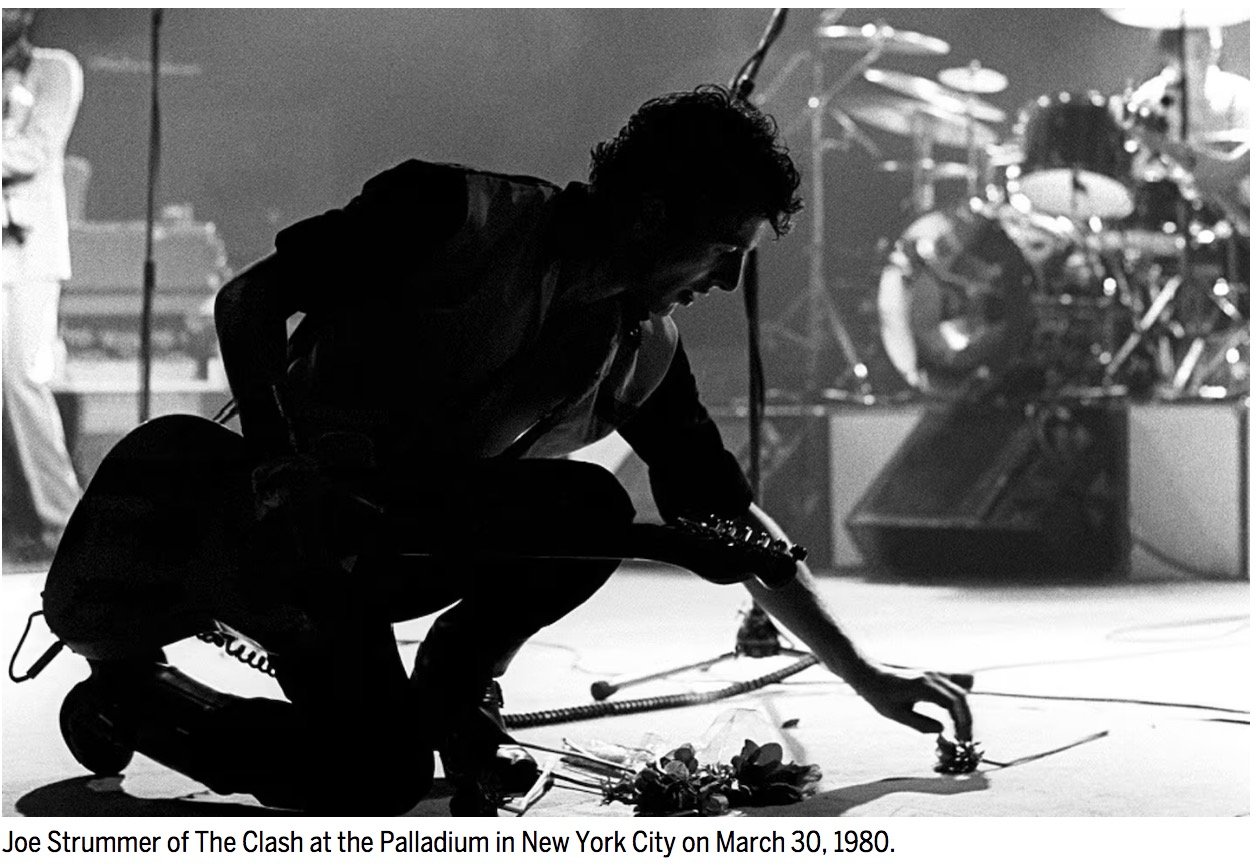
Joe Strummer of The Clash at the Palladium in New York City on March 30, 1980.

Rock 'n' roll artists, as we all know, can take dramatically different paths. Two new rock movies open this week, illustrating just how strangely divergent these paths can be. One is a glimpse at Neil Young mellowing into a solo act full of sweet nostalgia and spiritually enlightened songs, while the other is a tense, retrospective look at punk pioneers The Clash as they crumble and dissolve amid widespread bitterness and disgust.

Titled "Neil Young Journeys" and "The Rise and Fall of the Clash," they debut in Boston a day apart. The Young film, directed by Jonathan Demme (his third film documenting Young) opens Friday at the Kendall Cinema, while the Clash opus is a one-night stand Thursday at the Regent Theatre in Arlington, where director Danny Garcia will conduct a Q&A afterward. It's sure to be entertaining and maybe a little heated – some people still have strong feelings about The Clash, even though they broke up 27 years ago after a meteoric, hyper-manic run.

The Young movie finds him playing a laid-back but brilliant 2011 solo show at Toronto's Massey Hall, where he also played a famed gig in 1971 that finally came out a few years ago as a live CD. Young also reminisces breezily about his boyhood in nearby Omemee, Ontario, where he drives around and chats about his old fishing hole, school, and the local reverend’s house.

The Clash documentary, on the other hand, is a compelling but edgy tale of the band's still-angry, mudslinging "soap opera," to quote director Garcia in a recent phone interview from his home in Barcelona. More on that conflict in a minute.

Not surprisingly, the Young film will get better distribution and has already garnered a wealth of advance promotion. Young and Demme (who directed "The Silence of the Lambs" and "Philadelphia," as well as the first-rate concert movie "Stop Making Sense" about the Talking Heads) have a formidable track record. Their first film together, "Neil Young: Heart of Gold," in 2006, portrayed a Young concert at the old Grand Ole Opry site, the Ryman Auditorium, in Nashville, soon after he recovered from a brain aneurysm. Their second, "Neil Young Trunk Show," bowed in 2009.

This new one, unlike the Nashville concert, which was a special, one-time event, is simply the last stop on a tour backing his "Le Noise" album last year. "With 'Heart of Gold,' we staged that for the movie," Demme recently told Marshall Fine of Hollywoodandfine.com. "That show was never a tour. We had a costume designer and rehearsed it the way we would stage a show, with a visual script design for certain shots. It was completely hand-crafted. This film was inspired by an existing show, with us coming in to film it."

The music is a mix of Young classics ("Ohio," "Down by the River") with newer tracks from "Le Noise." The sound is astonishingly well-recorded (diehard Young fans will exult in that), and he plays a lot of solo electric, distortion-laced guitar that shows why he has been dubbed "the Godfather of Grunge," topped by some prepared, Daniel Lanois-produced sonic effects from the CD.

"Solo electric guitar has a different character when it's married to a hall with the right acoustic resources," Young also told Fine. "I had prepared sound from the album, so it was bionic, but still organic. The sound was bigger than life. I wanted to do the new songs, but also songs from my life. So there were seven from that (newer) album and eight songs from my life. I thought they could tell a story. I tried to think of it more as a play than a concert."

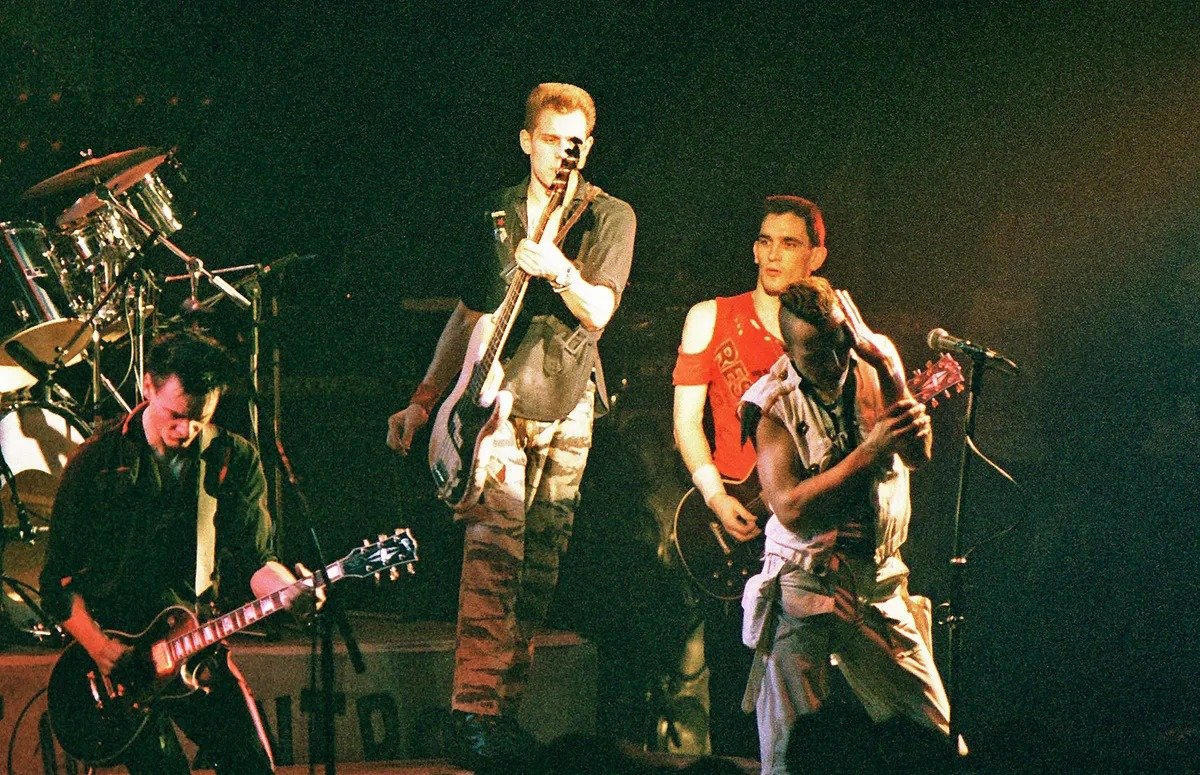
The Clash busking in 1985.

Some of the tour’s normal song order was changed in the final editing of the film, so Young ends up peaking with one song that was moved to the end, "Walk With Me," a tribute to his wife of many years, Pegi. "I don’t want to be on this journey alone," he sings poignantly. The overall result – of both the concert footage and the personal recollections as he drives in his 1956 Crown Victoria car to the show – reveals a contented soul who has endured conflict but has reached peace and self-fulfillment now.

Just the opposite of The Clash.

"The Rise and Fall of the Clash" is a head-first plunge into conflict and chaos. It’s not a rosy story, but it’s an essential one for Clash completists who wondered what the heck happened to their favorite band after it conquered the world in the late ’70s and early ’80s at the height of the punk era. The concert footage is extraordinary – from early clips of The Clash tearing it up at London’s 100 Club (previously unseen footage) to the Roundhouse, the Lyceum, and on up to New York’s Shea Stadium, where Mick Jones sings the hit "Should I Stay or Should I Go."

Alas, the fall was just as dramatic, but has not been as well-covered until now. There have been previous Clash movies such as "Westway to the World" and "The Future Is Unwritten," but they have not delved much into the last years.

"A lot of people don’t know about that later era," said director Garcia. "A lot of people think they were finished when Mick [was fired], but they were around for another 2½ years with replacement players."

It’s an ugly story that resembles a VH1 "Behind the Music" episode times 10. Clash guitarist Jones and manager Bernie Rhodes (who Garcia said had worked with Sex Pistols manager Malcolm McLaren and even named the Sex Pistols) originally put The Clash together. But Garcia noted that The Clash was a "fabrication." Unlike U2 or The Beatles, for example, whose members knew each other as kids, The Clash was a created band.

"Bernie chose [bassist] Paul Simonon for his looks because he looked like David Bowie," said Garcia, adding that Rhodes also told The Clash to write songs about "politics and not about love." The Clash wrote some of the great political punk of all time – from "I’m So Bored With the USA" to "Police on My Back" – but they couldn’t sustain any unity. They ended up kicking out drummer Topper Headon because of drugs. Several spokesmen in the film suggest that The Clash should have taken time off to let Headon enter rehab (he is clean and sober today), but Rhodes insisted that the band keep touring and get another drummer right away.

Eventually, Jones was pitted against Rhodes, singer Joe Strummer, and Simonon, so his days were numbered. His last gig was in California at the US Festival, where The Clash were paid $500,000. Jones recalls in the film that "there was a punch-up at the end, then Paul [Simonon] jumped in." Meanwhile, The Clash unfurled a banner at the end of the show that said "The Clash is not for sale!" By then, however, it was clear that the band was being co-opted by the system, other spokesmen say in the documentary.

The shock of the film is how raw the emotions still are. Rhodes and Simonon wouldn’t talk on camera (though Rhodes is thanked in the credits and Garcia said he was shown the script and approved it), but Jones speaks of how out of control the scene became. "It’s still a painful era for him," said Garcia. And when Strummer finally realized they had made a mistake and should invite Jones back, it was too late because Jones had joined another band, Big Audio Dynamite. Strummer even went to Nassau, rented a bike, and rode around for three days to find Jones, only to be rebuffed.

The later replacement members of The Clash – drummer Pete Howard and guitarists Vince White and Nick Sheppard – vent an incredible amount of anger at how they were treated. White says they were only paid a little over $300 a week. It’s sad punctuation to the legacy of a group that was once praised in the press as "the only band that matters."

Getting this film made at all is quite a coup for Garcia, who simply defines himself as a Clash fan. Now 41 years old, he first fell in love with the band at age 9 by listening to his older brother’s records. "I also remember riding on my bicycle and singing the chorus to the Clash song 'Spanish Bombs,’" said Garcia, citing a Clash song about the Spanish Civil War. "And I thought then, 'You will remember this moment all your life.'”

His film won’t get the attention of "Neil Young Journeys," but it’s well worth investigating if you care about the history of rock ’n’ roll. If you miss it in the theater, it will be out on DVD this fall.

Steve Morse can be reached at spmorse@gmail.com.

Show comments


Dangerous Minds. "The Clash's Forgotten Years, 1984-1986." Dangerous Minds, 9 Oct. 2014, 10:35 a.m., facebook

FILM REVIEW: The Rise and Fall of The Clash

The Clash's Forgotten Years: Strummer, Rhodes, and the Last Gasp

Between 1984 and 1986, The Clash continued under Joe Strummer and Paul Simonon, recording Cut the Crap and undertaking a radical busking tour. Often erased from official histories, this strange final era is explored in Danny Garcia's documentary The Rise and Fall of The Clash.


FILM REVIEW: The Rise and Fall of The Clash

The Clash's Forgotten Years: Strummer, Rhodes, and the Last Gasp

The Clash

The Clash busking in York, 1985 In its official version, the story of The Clash ends with the firing of lead guitarist Mick Jones in 1983. Though founding members Joe Strummer and Paul Simonon subsequently led a five-piece version of the group until the first months of 1986, it is not a polite thing to mention at parties. The 384-page coffee-table book The Clash devotes less than a single page to the final two and a half years of the band's career, and the 1985 album Cut The Crap has been left out of every Clash box set to date. In the words of Rolling Stone, "It doesn't count, and the whole thing has basically been erased from history. The Clash as we know them ended at the 1983 US Festival." The new Clash met the same fate as the new Coke.

While no one would dispute that it was a poor choice to fire Mick Jones, the Clash did a few things worth remembering between 1984 and 1986. Determined to make a radical break with stardom, they went on a busking tour of the U.K. that included a stop in the parking lot of an Alarm show, where the headliners reportedly came out to watch. Strummer never sounded so fired up in interviews as he did in 1984, and rock critic Greil Marcus reported that, despite the new Clash's shortcomings, he'd "never seen Strummer more exhilarated, or more convincing" than at a January 1984 show in California.

Strummer and Simonon interview, 1984 (part two) Danny Garcia's documentary The Rise and Fall Of The Clash, a whodunit about the breakup, is the first movie to shed light on this bizarre period. Based on interviews with original members Mick Jones and Terry Chimes, late-period members Pete Howard, Nick Sheppard, and Vince White, comrades Pearl Harbor, Viv Albertine, and Vic Godard, and others from the band's circle, the movie largely focuses on the role of manager Bernie Rhodes.

The Rise and Fall of The Clash trailer

Evaluations of Rhodes' actual contribution to the band vary widely, but most parties agree that Strummer trusted the manager while Jones did not. The Clash fired Rhodes in 1978-they were managed by big-timers Blackhill Enterprises during the recording of London Calling and Sandinista!-but they hired Rhodes back in 1981. "Joe wanted Bernie back because there was no excitement in the situation with Blackhill and Joe needed to have someone like Bernie around to give him confidence," Simonon says in the coffee-table book.

The documentary makes it clear that Rhodes exploited Strummer and Simonon's resentment of Jones's "rock star" behavior (dating models, showing up late, etc.) to force Jones out and seize control of the band. This part of the story reveals unfathomable dimensions of weirdness. For instance, according to Jones, in the days before he was fired, the band gathered in Rehearsal Rehearsals to write new material. There, Jones says, ruthless manager Rhodes had the Clash working on the follow-up to the platinum-selling Combat Rock, an album of... New Orleans jazz?

Rhodes' ascendancy culminated in the recording of Cut the Crap, an utterly strange hybrid of contemporary punk and hip-hop styles, co-written and co-produced by Strummer and Rhodes. Drum programming replaced Pete Howard's playing, and much of the material is covered with haphazard synth bleats that sound like a cat dancing on a Casio. There is a (perhaps apocryphal) story that a contemporary British music magazine dispatched Cut the Crap with the shortest record review ever printed: "Cut the 'cut the.'" Side two, however, has its moments:

Cut the Crap side two, track one: "This Is England" Cut the Crap side two, track two: "Three Card Trick"

There is a touching moment near the end of The Rise and Fall of The Clash. In a denouement worthy of a romantic comedy, Strummer, having suddenly realized he was mistaken to trust Rhodes and that Mick Jones had been his true and honest mate all along, rushes to Jones's house and finds his former bandmate waiting for a cab to the airport. They share a spliff, Strummer jumps in Jones's cab, and together they fly to Nassau. Jones wouldn't come back into the Clash, because he'd formed Big Audio Dynamite, but Strummer and Jones would collaborate on BAD's second album No. 10, Upping St.

Here's little-known footage of The Clash 2 performing "Brand New Cadillac" at the 1985 Roskilde Festival, one of their final performances:


Adamík, Petr. “Pearl Harbour: I Couldn't Get on the Radio Because of My Name.” Insounder, 13 Mar. 2024, https://insounder.org/pearl-harbour

"Paul and I discussed the break up of the Clash many times"

Pearl Harbour: I Couldn't Get on the Radio Because of My Name

In this interview, American singer Pearl Harbour reflects on her punk and rockabilly roots, her time with Pearl Harbour and the Explosions, and her connection to the UK punk scene.

She discusses industry challenges—including how her name once kept her off the radio—and her enduring passion for music.

Pearl E. Gates started her musical career in San Francisco in the 1970s where she formed part of the wild band The Tubes, which fused rock music, theater and cabaret in its shows. After a brief stint with another local band, Leila and the Snakes, she adopted the stage name Pearl Harbor (later changed to Harbour in Britain) in 1978 and recorded a well-received debut album for Warner Bros. with her new band, Pearl Harbor and the Explosions. Her desire to play rock & roll brought her to the UK, where she worked with artists such as Ian Dury & The Blockheads and The Clash. In 1982, she even married The Clash bassist Paul Simonon, with whom she lived for seven years. To mark the March release of the expanded edition of her iconic album Don't Follow Me, I'm Lost Too, Pearl gave us an exclusive interview.

You lived with your family in Germany until you were 17, but then you announced that you were moving to San Francisco. What led you to that decision? And why San Francisco?

Well, when I was seventeen years old, I was a bad teenager (chuckles). I was always in trouble and I knew I wanted to sing and to be in a band. I have four older brothers and one of them was in a band so I always wanted to do that too. I was still in high school and I said to my parents: "I don't wanna go to school anymore, I just want to play music and I wanna move to San Francisco." My parents asked me why San Francisco and I said: "I don't know. I just wanna go to California and San Francisco sounds like a good city." You know, my parents were angry with me because I was always in trouble so they said: "Fine, go!" (laughs).

My father bought me an one-way airplane ticket, gave me 75 dollars and said Goodbye. So I moved to San Francisco. I had never been there but I did know a couple of people who lived there so I was able to get in touch with them and I lived with them when I first moved there until I got a job and got my own place. I always thought that San Francisco was interesting because it was full of music, hippies and drugs and I liked all three of those things when I was seventeen years old in 1973.

You soon joined the famous band The Tubes. You were a dancer but did you also get the opportunity to sing with them?

They had a talent contest. People got up on stage and did singing, dancing or comedy, whatever. I won the contest by tap dancing. I was a tap-dancing boxer. And they asked me to be at their show. For the first few weeks, I just did tap dancing and all kind of silly things with them and then they asked me if I wanted to sing background vocals and I said yes. I did many shows with them, only in California. I did background vocals, percussion and dancing.

So, did your first musical steps start in San Francisco or did you get some experience when you were a teenager in Germany?

No, that was my first experience. When I was in high school I was in a selected group of singers so I sang when I was in high school but I'd never been in a band.

Try watching this video on www.youtube.com, or enable JavaScript if it is disabled in your browser.

In 1978, you came up with the stage name Pearl Harbor and started the band The Explosions - what's the story behind your name?

When I was in The Tubes, there was a woman, a keyboard player, her name was Jane Dornacker and she had an all-girl group called Leila And The Snakes. She asked me if I wanted to be in her band as well as The Tubes. After a while I stopped performing with The Tubes because they didn't really need me, they had so many people in their band. I just was in Leila And The Snakes for a year and a half. Performing with her band it was really fun and I learned how to be a good performer. I learned everything about being on stage through Leila And The Snakes. After a while I wanted to write my own songs so I told her I was leaving. I took the bass player and the drummer with me, they were brothers. It was during new wave and punk times, in 1977, so we wanted to have a name that sounded a bit sort of aggressive. We chose Pearl Harbor & The Explosions.

Pearl Harbour & The Explosions | Photo: courtesy of Pearl E. Gates

Pearl Harbor was still a fresh memory for Americans at that time. Wasn't the name Pearl Harbor & The Explosions a problem for you at times? Didn't that close some doors in the music world, I mean that they cancelled your shows or something like that?

Yes, it was a problem. I couldn't get on the radio because of my name. But to be honest, I didn't really care because I just wanted to do what I wanted to do. That's how I've always been and I'm still that way. I don't care if I am gonna get in trouble, I don't care if somebody doesn't like something. I just do what I wanna do. But yes, it's true that it wasn't a very smart move to call the band Pearl Harbor & The Explosions cause Americans did not like it.

You released a decent debut album with The Explosions, you toured quite a lot and you were on a roll. But then the band broke up and there was no second album. What was the main problem? Supposedly you guys didn't get along musically anymore, is that right?

That's right, we didn't get along musically because when we first started Pearl Harbor & The Explosions, we didn't know what were we going to do. I wanted to have a rock & roll band and they didn't. They were more into jazz, fusion. They were very good musicians, they called rock & roll mindless. When we were writing music together and rehearsing we were always arguing. They would come up with this music and say write lyrics to this and I was like: "I don't like this music." And they said: "Too bad cause we do." Anyway, I worked with them and we wrote enough music for an album. But it wasn't fun for me because I wanted to sing rock & roll. But I was so new, we were so young, twenty, twenty-one. We really didn't know what we were doing.

Then I met Kosmo Vinyl who worked with Ian Dury & The Blockheads and The Clash. I met him in a rehearsal studio. He saw our band and said that we were good. I told him that I wanted to sing rock & roll and he said that I should move to London. Soon as I finished touring to promote the album I moved to London. Warner Brothers records were very angry with me because they put a lot of money into promoting Pearl Harbor & The Explosions. They allowed me to record a solo album which is Don't Follow Me, I'm Lost Too. They didn't like it so then they threw me off the label (chuckles).

In the late 70s, there was a big punk explosion in London and Britain. Did you have any interest in this new music at the time?

Yes, I did. With Pearl Harbor & The Explosion and even Leila & The Snakes, we played with Elvis Costello & The Attractions on their first tour. We became friends and the band told me all about what was going on in London, about Stiff Records that had Ian Dury, Nick Lowe and Elvis, Wreckless Eric, all these great musicians. I learned about all of that. I mean, I had the Sex Pistols album, so I knew all about that. I'm not really keen on hardcore punk because it's a bit too aggressive and negative for me, I like things with a sense of humour. I did like The Clash because they were more musical and also more rock & roll. That's how I started working with The Clash and Ian Dury, and why I moved to London, through Kosmo.

So now an extended version of your solo album Don't Follow Me, I'm Lost Too is gonna be released. The album is full of rockabilly, rock 'n' roll and country influences. Was that album the direction you wanted to take with The Explosions?

Yes!

The record includes great musicians, members of The Clash, Wilko Johnson from Dr. Feelgood and Steve New from Rich Kids, as well as musicians from Ian Dury and The Blockheads. I think their keyboardist Mickey Gallagher even produced the album. Who chose this interesting team of people for your album?

Kosmo and myself. Kosmo was my manager and he was also the personal manager for Ian Dury and The Clash. Kosmo asked all these people from The Blockheads and The Clash if they would like to work with me. They heard some of my music, they met me and they knew that I knew my history of music and they liked me. They said: "Yes, let's do this." I said to Kosmo that I wanted to work with a rockabilly guitar player. He suggested Nigel Dixon from Whirlwind. They were a popular rockabilly band in London back then. I wrote a lot of my songs with Nigel and that was really fun experience. I used to go to his flat every day, we just sat around and drank beer and wored on music and that's how we wrote the album.

Pearl a Mick Jones (The Clash) | Photo: courtesy of Pearl E. Gates

After that, you often appeared on stage with The Clash when you sang "Fujiyama Mama" on their tour. Who came up with the idea to include you in their concert program?

After I recorded my album with Topper (Headon) and Paul (Simonon), they played on every song, Mick Jones played just on one song. After making the album with them, we became very good friends. After the album was finished, I started going out with Paul, he was my boyfriend after a while. I was always hanging around with The Clash. Lots of times my band would be the support act or I was on tour with them just because I wanted to be with Paul. When we were in Japan, they said: "Hey, why don't you come up on stage and sing 'Fujiyama Mama' for the Japanese crowd?" It was fun and after that, I appeared with them many times.

Try watching this video on www.youtube.com

You also appeared in the 1983 movie called Hell W10. That whole period seems to me as extremely creative, great were albums being made, movies, experimentation. How do you feel about that time?

I was so lucky to be in London and be with The Clash because they were always doing things. Just like you said, very creative times. They were always rehearsing, writing music, Joe always wanted to make films. Everybody was in their 20s and everybody had a lot of energy to do a lot of things. Nobody just wanted to sit home and do nothing. We were always doing something creative and it was really fun. The music scene in London, there were so many great bands and I really enjoyed going to concerts and shows every week. It was a wonderful time to be in London, I was very lucky.

In 1986, The Clash broke up. That was back when you were living with Paul. Did you discuss that situation together at home or did he not bother you with the band problems?

We discussed that many times. The Clash would have their band meetings in our house so a lot of times I would sit at the meeting and listen. I wouldn't really say much but if someone asked me what I thought, I would say something. I was very sad about it, I didn't want The Clash to break up but at the same time, they weren't happy. I think Joe had realized that he made a mistake by firing Mick Jones. The two of them were a great writing team. No matter who they hired after Mick left, nobody was ever as good as Mick and Joe. That was a mistake but they were young and they were angry with Mick. They wanted to keep playing, keep touring and Mick was tired. He said: "Let's take a break, I need a holiday." And they said: "No, you go on your holiday and you are not in the band anymore." That was a shame, that was too bad.

Pearl a Paul Simonon | Photo: courtesy of Pearl E. Gates

Did you have similar musical tastes? I mean, were you thinking about starting a band or some project together after The Clash broke up?

Yes, Paul and I liked the same kind of music, we both liked rockabilly, old 50s and 60s music, Paul especially liked old dub, reggae and ska. He taught me all about that. I loved that music. Every day at home he would play reggae records and play along with his bass. We liked the same music and that was really something that kept us together. And then when The Clash broke up, Paul and I put a band together with my guitar player Nigel Dixon as he was a good friend with Paul too. We started to write music, everything was fine and going great and then Bernie Rhodes, Clash's manager, came over and he said to Paul: "What are you doing, working with Pearl? Who do you guys think you are? Paul and Linda McCartney?" And I said to him: "Don't talk to me like that. We're having a good time. Leave us alone." He said to Paul he shouldn't be playing music with me and he should go to the United States with Nigel and buy Harley Davidsons, travel around, have some fun and come up with new ideas for the songs. He told him that they should put together a band without me. I thought Paul would say no but Paul said: "Oh yeah, you're right." It was horrible, I was so upset because my husband, my best friend and my guitar player, they left. They went to the United States and had a lot of fun. That was kind of the beginning of everything because I was so upset that Paul did that. That's what happened.

Robert DeNiro, Pearl a Paul | Photo: courtesy of Pearl E. Gates

There was the song "2 Bullets", written by Joe Strummer, which appeared in the Sid & Nancy movie.

When Joe was doing the music for the soundtrack for Alex Cox, Joe knew that I liked country music and that I could sing it. And he wanted to write a song for that scene when Sid Vicious was in Texas. He just called that he wrote a song for me and that it's gonna be in a movie, it will play on the radio for a minute and it will be really easy. I went to the studio, Joe played me a song, he sang it to me and handed me the lyrics. I told him I can do that. I did it very quickly, in one take and he said that it is great. I was like: "Oh no, I wanna do it better." But he said it was fine because it's just gonna be a small scene and you're gonna be singing from the radio so it doesn't matter that it is not perfect.

There's a forgotten album called Pearls Galore from 1983. Aren't there plans to re-release it as well?

I contacted Island Records in England and asked them but they said that I couldn't release it, then I tried to contact Epic Sony in Japan and they said the same. Maybe in another few years, they might change their mind but for the moment they said no. Not many people have heard it because they didn't really promote it properly and that one for Epic Sony, that was for Japan only.

Pearl Harbour | Photo: Greg Allen

Then in the 1990s, you made the Here Comes Trouble album, which featured another big punk rock name, Dead Kennedys' guitarist East Bay Ray. How did your collaboration happen?

When Paul and I split up, I moved back to San Francisco. I immediately wanted to put together a new band because that's all I knew how to do. I went to a lot of shows, I was trying to see all the local musicians and what was going on. There was a band called Buck Naked And The Bare Bottom Boys and they were a really funny rockabilly band. I loved them. I said to Buck who was the leader of the band that I would like to start a band with him. He said yes. I said: "How about picking up all your favourite musicians?" He had East Bay Ray on lead guitar. We just called all the people that he liked and everybody said yes.

If you have found an error or typo in the article, please let us know by e-mail info@insounder.org.

THE CLASH ON PAROLE | Facebook
https://www.facebook.com/

Archive PDF
Archive HTML


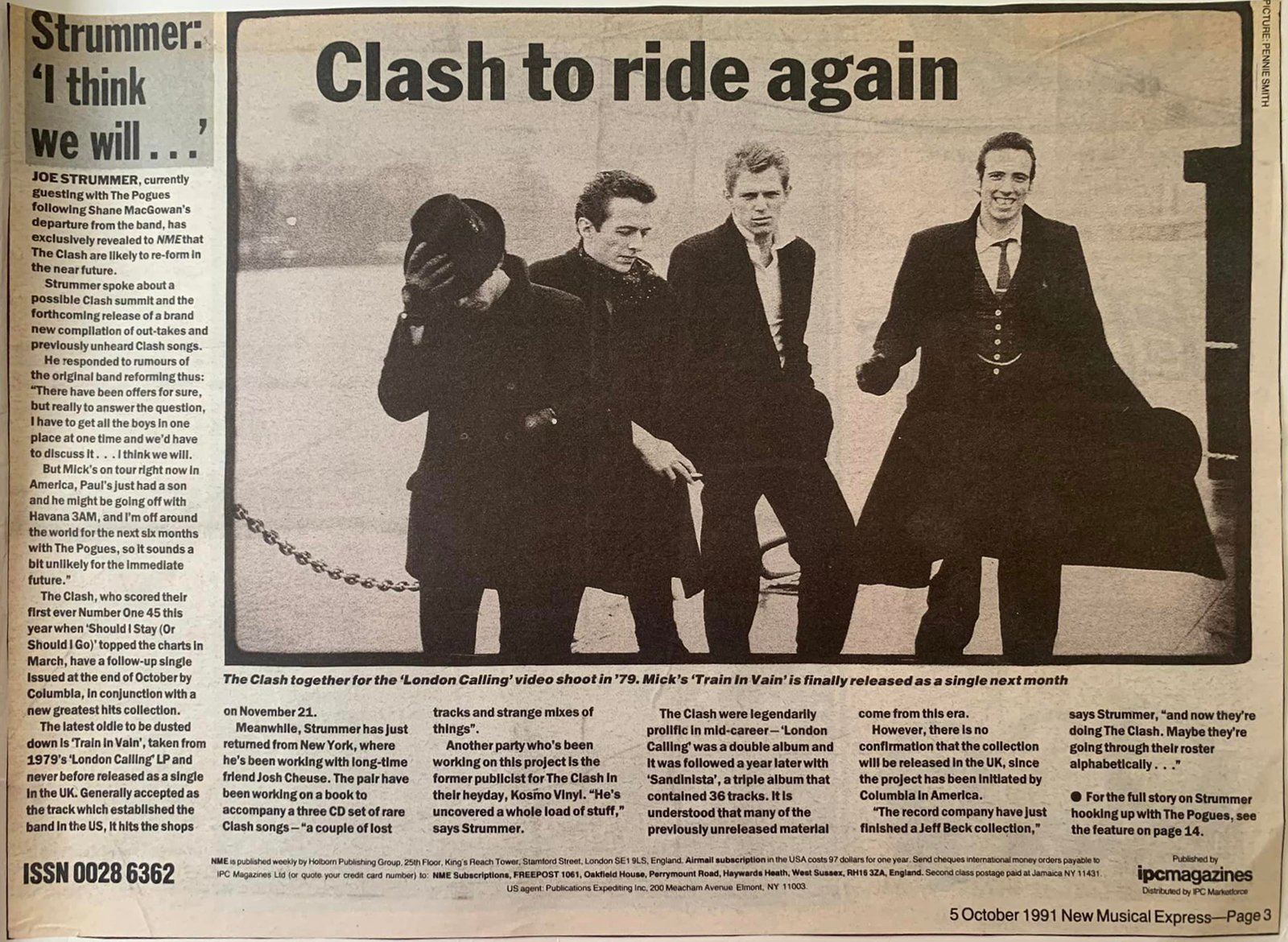
"Clash to Ride Again." *New Musical Express*, 5 Oct. 1991, p. 3. Photo: Pennie Smith

Clash to Ride Again
Strummer, "I think we will..."

Joe Strummer revealed that a Clash reunion is likely, though scheduling conflicts with Mick Jones and Paul Simonon may delay it.

A new compilation featuring unreleased tracks, including Train in Vain, is also planned alongside a three-CD retrospective project.

Clash to ride again

Photo: The Clash together for the *London Calling* video shoot in '79. Mick's *Train in Vain* is finally released as a single next month on November 21.

Strummer: 'I think we will...'

JOE STRUMMER, currently guesting with The Pogues following Shane MacGowan's departure from the band, has exclusively revealed to NME that The Clash are likely to re-form in the near future.

Strummer spoke about a possible Clash summit and the forthcoming release of a brand new compilation of out-takes and previously unheard Clash songs.

He responded to rumours of the original band reforming thus: "There have been offers for sure, but really to answer the question, I have to get all the boys in one place at one time and we'd have to discuss it... I think we will.

But Mick's on tour right now in America, Paul's just had a son and he might be going off with Havana 3AM, and I'm off around the world for the next six months with The Pogues, so it sounds a bit unlikely for the immediate future."

The Clash, who scored their first ever Number One 45 this year when *Should I Stay (Or Should I Go)* topped the charts in March, have a follow-up single issued at the end of October by Columbia, in conjunction with a new greatest hits collection.

The latest oldie to be dusted down is *Train in Vain*, taken from 1979's *London Calling* LP and never before released as a single in the UK. Generally accepted as the track which established the band in the US, it hits the shops next month.

Meanwhile, Strummer has just returned from New York, where he's been working with long-time friend Josh Cheuse. The pair have been working on a book to accompany a three-CD set of rare Clash songs-"a couple of lost tracks and strange mixes of things."

Another party who's been working on this project is the former publicist for The Clash in their heyday, Kosmo Vinyl. "He's uncovered a whole load of stuff," says Strummer.

The Clash were legendarily prolific in mid-career - *London Calling* was a double album and it was followed a year later with *Sandinista!*, a triple album that contained 36 tracks. It is understood that much of the previously unreleased material will be included.

"The record company have just finished a Jeff Beck collection," says Strummer, "and now they're doing The Clash. Maybe they're going through their roster alphabetically..."

For the full story on Strummer hooking up with The Pogues, see the feature on page 14.

Enlarge image


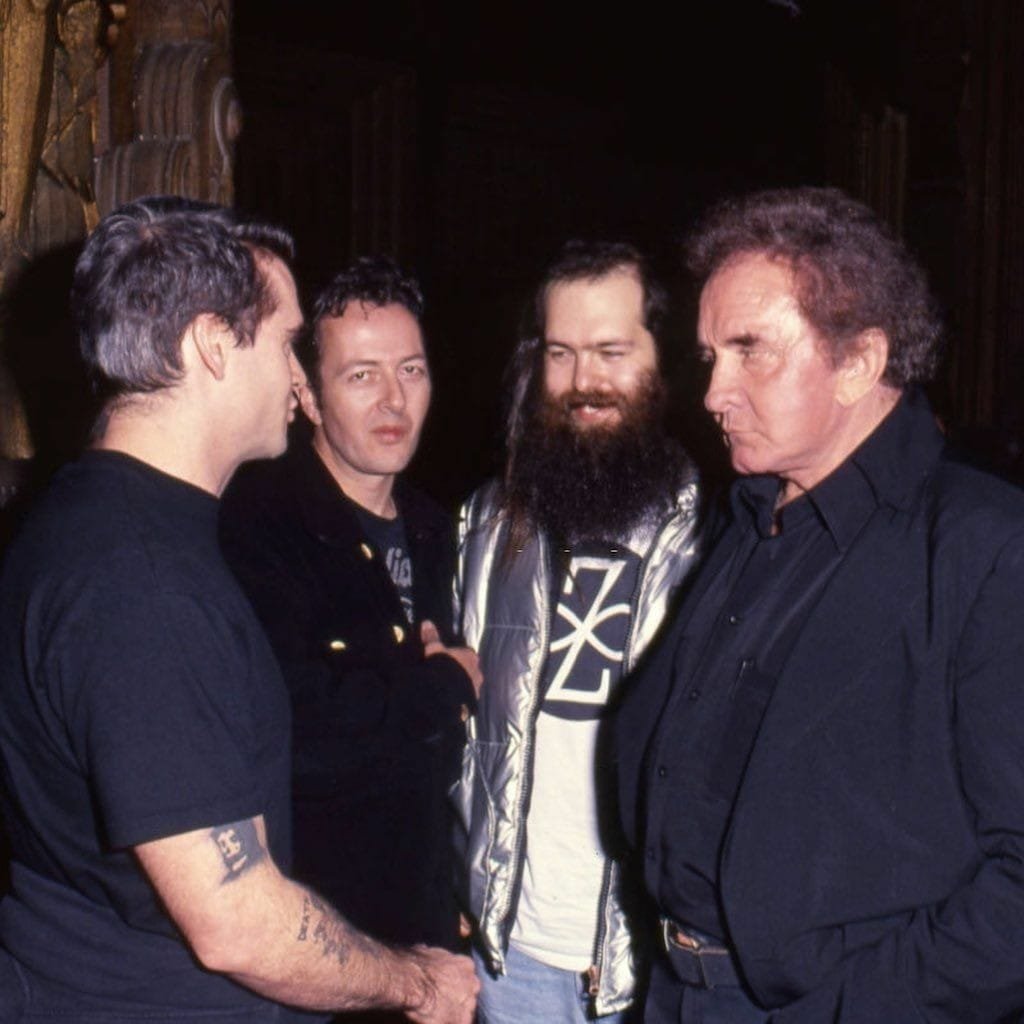
Backstage at the Pantages Theater, Los Angeles in 1995

The Clash Official | Facebook --- Henry Rollins, Joe Strummer, Rick Rubin and Johnny Cash form a ring of fire backstage at the Pantages Theater, Los Angeles in 1995


The Clash's Breakup & The Story of Cut The Crap

Rock N' Roll True Stories 17:09min


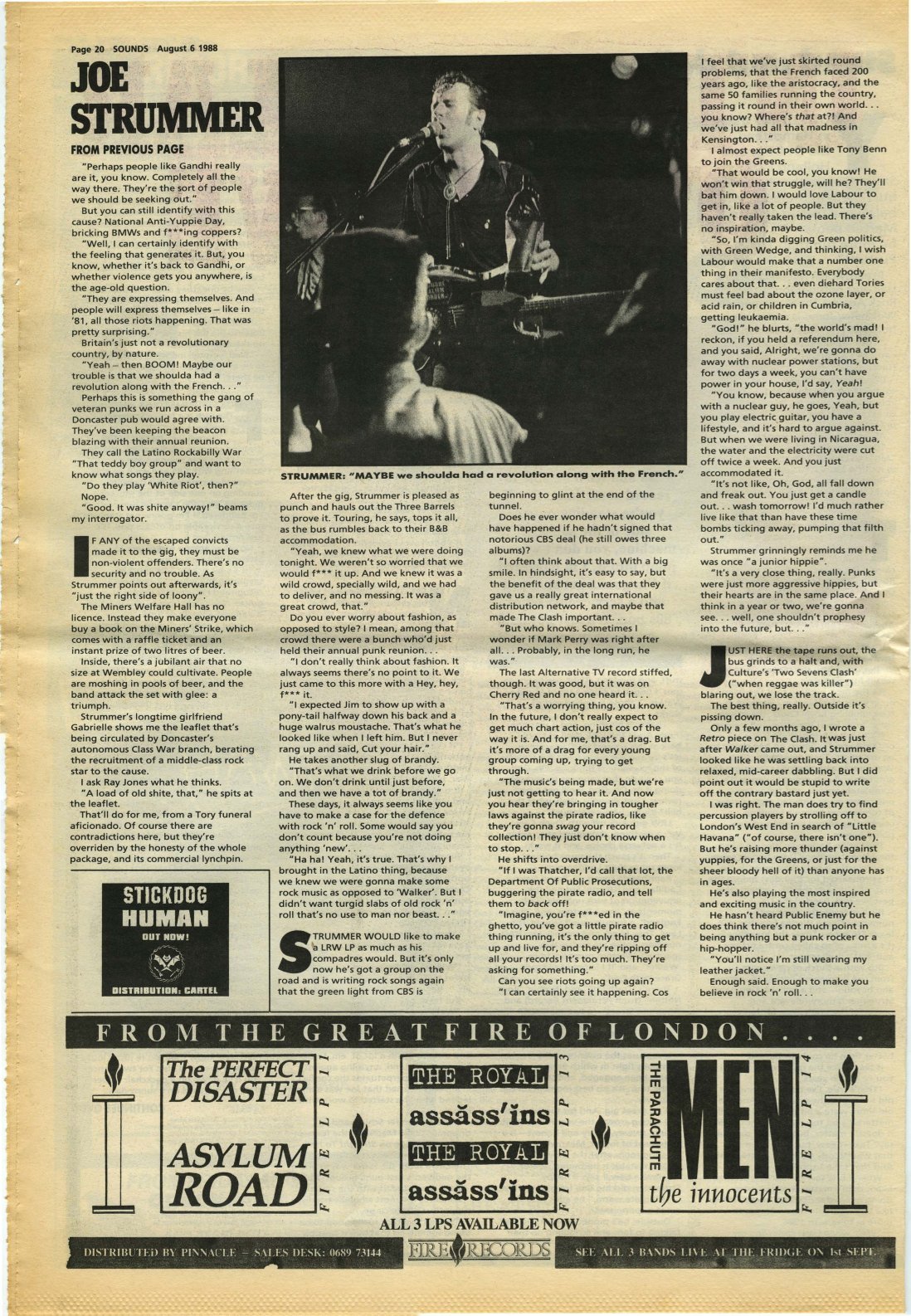
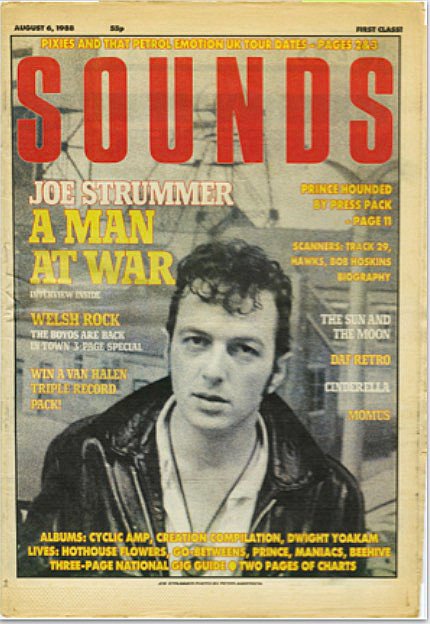
Savage, Jon. "Joe Strummer." Unpublished interview, 30 May 1988

Joe Strummer Jon Savage, unpublished, 30 May 1988

This interview was for Jon Savage's classic punk book England's Dreaming, and is published here in its entirity for the first time.

Written by Jon Savage, it is a thing of dark beauty. A real inside personal look at the West London squatter scene from the early 70's, through to the early dalliance of crossed, and eventually grudgingly aligned swords, with The Sex Pistols and the rest of the South Eastern England burgeoning punk scene. A tale of skullduggery, Bernie, Malcolm, opportunism, Viv, squatting, pubs, raw talent, riots, politics and a whole lot more. Enjoy. Warning, it is also long.

In this unpublished 1988 interview, Joe Strummer recounts the legendary busking tour and the creative resurgence that briefly energized The Clash post-Mick Jones.

He reflects candidly on the tensions with Bernie Rhodes, the making of Cut the Crap, and the struggle for artistic control in the band's final chapter.


Joe Strummer Jon Savage, unpublished, 30 May 1988

I'D LIKE to start with the busking tour - can you tell me what the point of that was? I

think Bernard suggested the busking tour. The point of it was he sensed that The Clash had become too prey to his ideas, he realised he had it under his thumb too much, and there wasn't a lot of life in there, so he said to us - what he expected us to do was to go up north, somewhere like Bradford and live in a house while we I don't know what. We just went up and kept moving, and to me it was the best tour that we ever did.

Where did you play?

I know you played in Leeds. We played a lot of gigs in Leeds, and in Glasgow, in York, we didn't get to play in Manchester, cos my voice had gone by then.

About twenty gigs?

More, much more. We would knock off eight or ten a day, we'd play in any pub, any club anywhere. The sets were ten numbers, maybe seven numbers the whole band. Three acoustic guitars and a pair of sticks. Pete would drum on anything, mostly a plastic chair. We played in some university in Glasgow or Edinburgh anyway, Paul and Nick and Vince would play acoustics and I'd just sing.

Was that all Clash stuff?

We played a couple of Cramps stuff, some Clash stuff and maybe a couple of standards. We used to play Movers and Shakers.

You didn't tape them did you?

No. There are tapes circulating around the north, apparently, and there are tapes of us rehearsing in someone's flat in, I don't know what city.

Was that it after that, or did you do another tour after that?

When we came back to London after that busking tour, we felt we had something good going inside the group, but as soon as we came back and met Bernie and Cosmo in Holland Park, later I understood that Bernie felt it was slipping from his control, 'cos he didn't know where we were, and we only came back 'cos I'd lost my voice. Bernie didn't like that it was slipping out of his control, so somehow he put a stop to the good feeling that we had at that moment.

I fell out with Bernie after we returned from Munich, where we recorded the tracks, somewhere between that and when he began to mix it.

So the LP's release was something you had no control over?

Absolutely none. But Bernie's trip was at the time, he wanted to know what it was like to be Mick Jones. Mick used to sit in that seat where you arrange the songs, and produce them, and once he'd encouraged me and the rest of us to get rid of Mick, I didn't realise until after the Cut the Crap sessions that that was Bernie's trip. He was fed up with organising tours and stuff, he wanted to get right in on the music. He hated song writing 'cos it was the one mysterious area where he couldn't go. He hated that. He wanted to reduce songs to slabs of bacon off the roast, he didn't see why it should be strange. He hated the tortured artist thing that Mick would lay on him, it was slightly out of his grasp. He used to say to me, I've analysed life so completely - that it's boring. I used to look at him and think, that's insane. Song writing was one of the things he didn't understand how it was done, and he resented that, he wanted to do the pop Svengali thing, he could make the boots, the t-shirts, the look, the direction, everything, but when it came to the songs, that was the one thing that he couldn't understand.

Maybe that's what Bernie should have done?

Come on then Bernie, Malcolm is doing it. Come on!

Is that why he had his nose done?

I think that was just to make himself more beautiful.

There's a lot of stuff to get through. But I'd like to talk about where the 101ers started. Where you played, what the arena was at that time.

I'd been on a busking tour of Europe with Tymon Dogg, and when we came back he moved into the squat at 23 Chippenham Road, we were loose kind of people, we had two squats going, and one was at 101 Walterton Road, and the other was at Chippenham Road. Eventually we took over the whole area, 'cos 23 ran the local restaurant, that tea room, and we put the group together that everyone would go and see. I always felt that the cultural life of all those hundreds of squats around Elgin Avenue and Shirland Road, eventually our two squats were the lifeblood of the area, 'cos none of us were into heroin, or alcoholics, you know. We managed to be good. After I came back from that busking tour I moved into 101, more to get away from Tymon - you know when you've been very close to someone in very harrowing circumstances? I continued busking in the underground, but it got too heavy, when they started putting microphones and speakers in the tunnels, so I was looking for a way round it.

I looked into the Elephant and Castle pub on Elgin Avenue and I saw this Irish trio playing. We weren't even allowed in that pub, if they saw us they threw us out 'cos they knew we were squatters and they didn't want it. I was looking at this Irish trio playing and I thought, I could do that! So I thought it would be a good way to get over the summer, I thought it would be an easier way of earning money than running from these transport cops down the tube. It seemed like less hassle. This was '74.

Me and Tymon went to Europe in '74 so it would have been late summer '74. I went back to 101 and tried to put a group together. Big John was trying to learn the saxophone, and I got Patrick to play the bass, but we had no money or equipment. I had this friend called Dick the Shit, who I still owe this money to, I borrowed his bass guitar and amp and speaker, and suddenly we were happening, we had a bass rig, which we set up in the basement, and we begged borrowed or stole stuff until we had a drum kit and I bought a guitar for £20 off Mickey Foot's brother, a Hofner. Somehow we got hold of a drum kit. Antonio, this guy from Chile, 'cos after the right-wing coup in Chile we had a lot of refugees come over and two of them moved into our squat, Antonio, who was a drummer, and the sax player, who's still going, made a song called Rubber Hammer, Alvarro.

None of us could really play except for Alvarro, and he'd been playing in rock'n'roll bands for years, playing horn, we had a sax section, with him and Big John, Patrick on bass, Antonio on drums, we had a group, but we learnt six numbers: Bony Moroney, Gloria, Route 66, Too Much Monkey Business and two others. So we managed to get a gig at the Royal College of Art, where there was a Chilean refugee's art exhibition, we went down and set up our pathetic equipment, a mike stand that required two bricks to hold it upright. There was like two people there, and we played our five or six cruddy rock'n'roll numbers.

This Chilean guy came down saying, get out of here, you're playing this imperialist rock'n'roll! And I thought, blimey! This guy's got a hard-on, you know, and we split.

There was this teacher who lived with us called Ros, and I said we should hire the room above the Chippenham as a club, but we were scared to do it, and this girl Ros physically dragged me over to the Chippenham one day and forced me to ask the landlord to hire the room on Wednesday nights. It cost a quid for the room. We called it the Charlie Pig Dog Club, 'cos there was a dog in the squat that was a cross between a pig and a dog.

Then every Wednesday night we'd go up there, and charge 10p to get in, I leafleted all the squats in the area, and soon we had quite a jumping scene, we'd learn a couple of numbers every week and add them to our set, and we learned standing in front of those gypsies and squatters and lunatics - you can't really learn unless you're playing to people. You see the effect of what you've done. We were also doing gigs at the Brixton Telegraph, we did another Chilean benefit, and Matumbi were heading and they lent us their equipment. I always thought how great that was, 'cos we were a really dishevelled looking bunch of people, dressed in rags.

There were so many squats then, that's all gone.

There were streets and streets, a real community. There were certain areas that were being left to run down, the councils hadn't got it together.

You could see London visibly decaying through the early 70s.

Elgin Avenue was because someone in the council had decided they were going to knock all these down, about a hundred fine Victorian terrace houses, and it was between deciding and them actually knocking them down that the squat culture flourished on that street.

To go back a bit, how did you get to be a busker?

I did that because Tymon Dogg, who was the musician of our community at that time, I went with him bottling as it's called, because you're supposed to have a fly in a bottle in one hand and collect money with the other hand, and the musician knows that you haven't stolen any money if the fly is still in the bottle. It comes from Mississippi, that's why you're called the bottler when you're collecting. I used to collect for him. I knew I wasn't any musician, I was already about twenty-one, and I never played, so I got a ukulele, and I used to play Chuck Berry songs on this ukulele.

One day in Green Park, down in the tunnels, he said to me right, I've just heard there's a patch going at Leicester Square, you do this patch and I'll go off to the next one. And suddenly there I was alone, for the first time in my life, and a thousand people came rushing past, and I was going "Sweet Little Sixteen dingadingadingading" I thought, wow, I'm playing, and there's no-one here to help me!

Did you get any money?

Yeah, we used to prefer what was called the loony shift, between ten and eleven or later in Oxford Circus or Leicester Square, where everyone is drunk, or out on the town, and they see a couple of ragamuffins, and they go heey, give 'em a tenner, I mean 10p. So we used to earn somewhere between four and five pound an hour. Good money. I found the highest paid hour was the loony hour. There was a slight drawback 'cos some drunks would come through and they'd try and - somehow the fact that you were defenceless down there always protected you, in the end.

It wasn't so violent then, though.

Not like it is now. It changes so slowly you don't notice.

So when did you leave school?

I left in June '70 at seventeen and went to the Central School of Art in the September, and then by June '71, that was it.

You did a foundation course?

Yeah. I applied to Stourbridge and Norwich and was refused by both. I remember coming back from Norwich, I was apprehended on the train without a ticket with my portfolio, and slung off at this godforsaken place in the middle of nowhere, with this huge portfolio, so I dumped the portfolio in a skip and hitched back to London, and that was the end of my art career.

Did you not like it?

I was in boarding school, locked up really good for nine years, and all of a sudden you're staying at a hostel in Battersea, with no-one to say what to do, where to go. It was 1970, and there was drink and drugs, and by the end we were doing acid and I never went near the art school.

I went to university in '72 and the place was awash. I've still never seen so many drugs in one place. It was just that time.

Yeah it was an experimental time, it was great. It was bit much for a young guy to handle. By the end of the year we'd moved into this rented house in Palmer's Green, me and the most partying people on the course, we were getting really wild. We were examining the way to live.

Where did you go to school? City of London Freemen's School?

It's in Ashtead, about five miles south of Epsom. It was mixed. If it hadn't been mixed it would have been really hell. I ran away when I was nine. I didn't get very far. Me and this guy who was slightly older, Paul Warren, he said, come on, let's run away. I said yeah, let's go, and we left one Tuesday lunchtime. We were walking near Epsom and we saw this policeman and we knew it was the middle of school hours and he was bound to say what are you two doing, so we took this long detour, and while we were walking, the geography master came by in a car. Bundled us in, and back at the school this fascist guy shouting at us, how dare you leave school without your caps, and I remember thinking, what an idiotic question. We're running away, man, you don't run away with your cap on. It was only a couple of weeks after my ninth birthday. My dad was in the Foreign Office, so I think he was in Tehran, but the place they put me in was really horrible. Before that I hadn't been in England at all. I'd had a great life, in Egypt and Mexico and Germany. It was great. But suddenly it was like Tom Brown's Schooldays.

I went to that school, Rugby!

Oh my god.

So what did you do after you left Central?

A dead loss, you know. A couple of the guys from art school who were as wild as I was, and like me hadn't managed to get in anywhere else, we ended up in a place called Dowhouse Farm in Blandford in Dorset 'cos Robert Basie knew Jeremy Cooper whose father owned the farm, so we worked the hardest that year on the farm.

Then we moved back to London and got a horrible flat in Harlesden where there were about ten of us living. We hadn't discovered squatting yet. A lot of people were already squatting, but I got a job in an Allied Carpets warehouse, as a sign painter, which was quite a good groove for about three months, until they asked me, are you going to get into this seriously, and I said, you must be fucking joking, I was just doing it for money to keep body and soul together, and as soon as I said that I was back on the carpet cutting floor.

Then I came back one time after I'd been for a drink at the Memphis Bell with this girl I was friendly with from the local supermarket, and I arrived back at the flat and there was this police car outside the flat, and all our stuff was being thrown out of the window. The Irish landlord had bunged the cops a few quid to get rid of us.

Me and Tymon had found this black guy in the park who'd given us a fright, and being hippies we'd invited him back to our place to live, 'cos he didn't have anywhere to live. And as soon as the landlord found out we had a black guy living in the flat, he nicked our giros. I wasn't getting a giro, but some of the others were. We'd all been evicted, a gang of toughs had rushed in, beat everybody up, slung 'em out, he'd bunged the cops a few quid.

It was when I started to learn about what was justice and what wasn't. I started learning about the Rent Act, but when I got back from the warehouse, all our stuff was in the road, and the cops were there, laughing at us.

Up to that moment I'd been doing it by the book - you rent a flat, you try and find some way to get along. I actually had a copy of the '65 Rent Act' on me, and I went along to the cop and said you can't do this according to section whatever, opened it up and he went, don't fucking tell me about the law, Sonny Jim, you know?

From that moment on, if we wanted a house we just kicked the fucking door in. We wanted electricity, we just jammed wires into the company head. Bollocks.

Had you lost touch with your parents?

From the time I went to London they freaked out, as people used to say. Obviously I fell out with my parents. But you know what it was like at boarding school, you had to become somebody on your own at the age of nine, and it's hard to get back. I suppose I resented them without being aware of it. My parents were somebody I saw once a year from then on. They were five thousand miles away in Tehran. The Foreign Office paid for one flight a year, then Lord Plowden came out with a report that recommended they paid for two. So after a few years I could see them at Christmas and in the summer, but for the first few years I saw them in the summer. And at half term when all the other boarders were going thank Christ we're getting out of here, for me sometimes we'd go to Scotland and stay on my mother's farm. Pavlova Britain was my friend at school, he was the drummer in 999. Me and him were a deadly duo. He used to take me down to his father's farm in East Sussex. I fell out with my parents from the age of nine, I suppose, and freaking out in London didn't help.

How do you get on with them now?

They're dead. When The Clash became really happening, my father for the first time in his life was really proud of me. That helped. But you can't really heal a lifetime's just because your records are selling. It's not his fault, it's mine, I never really got off my high horse. I didn't know I was sitting on it, but I realise it now.

Men don't get off that high horse until their late twenties, early thirties.

Now, I'd be able to say to him, cor what a lot of shit we've been through together. But we were touring Italy when he suddenly took ill and died. I hate not having that final conversation with him.

So for eighteen months you squatted and had a good time?

Well no, I had another adventure. We were sleeping in Dave and Gail Goodall's flat in Edgware Road, they had a two room flat. This was in between Harlesden and squatting. I was holding down that carpet job, and what was the upshot of it? All our records were smashed. We were slung out of the flat illegally. I went to the Harassment Officer at Brent Council, I was the only one of our group who really cared to follow things through. I went to a hearing and they stitched me right up. There were these eight law students up at the back and I remember screaming at them, I'm not something to fucking study, this is people who've been done over. They hustled me out, it was a rent tribunal.

Anyway me and Tymon were sleeping on this kitchen floor. I had acquired a drum kit through a swap in my last year at school, and it was in the garage in my parents' bungalow in Purley, and so I knew a friend of mine had got into art school at Newport in south Wales, so I hitched down there. I knew a girl at Cardiff art school and I went to see her and she said basically, piss off. I went to see Forbes in Newport and I thought I might as well stay in this town cos I can't make it in London, it was too heavy, there was nowhere to live and so on. I

got the drum kit down to Newport and bartered my way into the art school group by swapping the drum kit. It was called The Vultures. We played the art school and the Kensington Club in Newport. We used to do Can't Explain, Tobacco Road, r'n'b. I took jobs there, I was grave digging there for three months during the winter of '72/'73. I was cutting grass on Malpas estate.

I was the king of the fly-mo. But that fell apart after a while and I went straight into the squatting.

It was very organised then as well. Didn't you have a squatter's union?

Yes we did. We had a lovely bit of paper printed: "This premises has now been occupied." We knew all the legal ins and outs. You'd go in there, bang, change the locks, yeah. Property is nine tenths of the law, we were really organised.

So you had the 101ers, and this club which was jumping. What happened then?

They were going to close the boozer down, 'cos it was getting out of hand. The cops were coming down every week. Some gypsies started to move in. When we were living at 101, on one side of us we had a house full of junkies, and they managed to put light bulbs in, but the council had been through ripping out anything, water, lights, smashing floorboards and so on. We'd go in there and rebuild them, the wires. We had an expert who'd come down, and he was the bravest guy. I saw him jamming wires into the company head, right into Battersea power station, I've seen him blown back across the room, showers of sparks thirteen feet long.

These junkies had got their lights going but there were no switches, and I went round there to see this guy who played harmonica, there he was lying in this room with only a mattress in it, with this bulb burning away. There isn't any way of turning it off - we have to unscrew the bulb. That was on one side, these junkies lying there with these bulbs burning away day and night, and on the other side there was a gang of really terrible alcoholics, you know those people who are usually in the park. God, the horrible fights and shit, it was the pits.

One day Dan Keller came to the door, and I went like this, pretending to hit him, cos he was a bit of a dozy boy, just for a laugh, and down the bottom of the steps this guy was walking by, and he pulled a hatchet out of his pocket, and he ran up the steps going Aaaaaaagh!!!

I pulled Dan in and shut the door, but it had been kicked in hundreds of times and it was just cheap panels, and the hatchet came right through the door and he was screaming, YOU KILLED MY WIFE!!! One move, anything could happen.

Eventually Alan Jones from Melody Maker, who's now the editor but at the time it was his first reporting job, I'd known him from Newport, he was a student at the college. I got him to come to the Pig Dog, hoping that we'd get a bit of press, and he wrote four lines at the bottom of their gossip column. Me and Big John took this four lines down to the Elgin and we showed it to the landlord, and he read it and said, right lads, Monday then. I'll give you ten pounds. That's when we got onto the circuit. That's when The Pistols first came across me. Sid Vicious - I don't think John did, but anybody who was anybody eventually turned up down there on Thursdays. Although we didn't realise it, we were at least playing very fast music.

I went to talk to Roger, and he said by that time the original pub rock bands got really boring. Dr Feelgood started it, but you had the rougher faster 101ers, the Count Bishops, people like that. I suppose that's true.

Those earlier pub rock bands disappeared up their own arseholes trying to play like Memphis Sweet Style, but we couldn't play at all, we knew how to bash the shit out of a number. By the time we hit the Elgin, it was Snakehips Dudanski on drums, Evil on lead guitar, me singing and Mole on bass.

When did Boogie come in?

After Boogie got out of prison, for some reason he was into the music, and he used to come down and say he could get us played on Charlie Gillett's programme. So we taped some music and sent it to him, and we all crouched round the radio in the squat. By now we were squatting over at Orsett Terrace, and Charlie Gillett goes, what's this, sounds like hundred mile and hour race along rubbish, and he didn't even play it, just dismissed it in half a sentence. What a crushing blow that was. Tiberi had said he could get us on the radio.

I was the one who christened him Boogie, 'cos the first time he came round the squat he was smoking Winston and at the time a packet of Winston seemed rather glamorous, almost like having a Cadillac, so I called him Boogie after the John Lennon, Dr Winston O'Boogie, remember? When he pulled out his fags I said, you must be Dr Winston O'Boogie. And the Boogie bit stuck.

With him and Mickey Foot helping us we started to become a real little operation. Mickey was a contact from Newport. He was attending the college of art.

He did the Black Arrows amongst all that as well. Him and Bernie were a right little team for a while, after The Clash started. Bernie needs to have a lieutenant.

Malcolm had Nils, and then Boogie.

Mick Jones sacked Mickey Foot for speeding up 'Clash City Rockers'! I suppose Cosmo took over that role. But it wasn't bad speeded up, I think Mickey was probably right. There are few honourable men in these stories, but Mickey was one of them.

Did you meet the Pistols first, or Bernie first? How did it all happen? You're with the 101ers, you're doing well.

We're doing well, we've got a single out, but I got a feeling that we were invisible, we were working very hard, loading the van, driving up north, unloading, playing the gig, loading it up again, driving down again, unloading again 'cos we didn't want to get the gear nicked.

We did twelve gigs in fourteen days in places like Sheffield, and we couldn't afford to stay up there, it was up and down every day. We were invisible, we weren't getting anything in the papers. Then one day the Sex Pistols were supporting us at the Nashville, and that was when I first saw them. I walked through the corridor, and we'd done our sound check and in came these Sex Pistols people, I remember looking at them as they went past: Rotten, Matlock, Cook, Jones, McLaren, and coming up the rear was Sidney, wearing a gold lamé Elvis Presley jacket, and I thought groups in those days didn't talk to each other, it was extremely cut-throat.

You fought for gigs, but I thought I'd talk to them, and I said to Sid, that's a nice jacket you've got there, mate. He looked at me and went, yeah, it is, I got it down at Kensington Market. We were humans, talking. Then I walked out onstage while they were getting their sound check together and I heard Malcolm going to John, do you want those kind of shoes that Steve's got, or the kind that Paul's got? What sort of sweater do you want? and I thought, blimey, they've got a manager, and he's offering them clothes! To me it was incredible. The rest of my group didn't think much of all this, but I sat out in the audience, there can't have been more than forty people in the whole boozer, they did their set, and that was it for me.

The difference was, we played 'Route 66' to the drunks at the bar, going, please like us. But here was this quartet who were standing there going, we don't give a toss what you think, you pricks, this is what we like to play, and this is the way we're gonna play it. Regardless of whether you like it or not. That was the difference.

Did Lydon say anything to the audience?

Yeah, he pulled out this huge snot rag and blew his nose into it, and he went, if you haven't guessed already, we're the Sex Pistols. Really, come on, you know, and they blasted into 'Substitute', or 'Submission', or something.

The material they were playing at first wasn't that different from what you were doing, was it?

No. They were doing 'Stepping Stone', which we did occasionally, but they were light years different from us. They were on another planet in another century, it took my head off. I understood that this was serious stuff, they honestly didn't give a shit. John was really thin, and kept blowing his nose between numbers. That's almost all he'd do between numbers. The audience were shocked. That's when I fell out with the rest of the group, 'cos after that I started going down to Tuesday nights at the 100 Club, it started happening there. That's when Bernie came up to me and said, give me your number, I want to give you a call about something.

That was it, the last few gigs that we had booked, the Pistols took them over. We had supported Kilburn & The High Roads at some north London college or other, and a couple of Nashville slots, but I split the group up, cos Bernie called the squat and Dan Keller, the bass player at the time, pretended to be me, and that's when I said, it's not happening. Evil was wearing Hawaiian shirts, and I was saying, look at what's happening, we've got to move with the times, and they thought I was going mad. They were probably right, but it was certainly more interesting than what we were doing.

You were suddenly faced with the present. And the future, and you had to make a decision, it was an emotional thing. It was a case of, jump that side of the fence or you're on the other side. It sorted people out. That t-shirt that Bernie designed, Which Side of the Bed? Brilliant, but it was so clear. I thought that was the finest thing he ever did.

That t-shirt was the reason that Mick Jones first spoke to Bernie. They were in the Nashville, again. Mick was looking for a piano player for the Hollywood Brats, or whatever was the name of the group he was in at the time, and he thought that Bernie might make a good piano player cos he had an interesting t-shirt. That's how they first conversed, over that t-shirt.

Anyway, Bernie called me at the squat and Dan pretended to be me, and didn't tell me about the call, we had a gig that night at the Golden Lion, Bernie and Keith Levene came down. By this time I'd fired Evil, and had Martin Stone on guitar, and I saw Bernie and Keith and went outside and spoke to him, and I decided to go with him at that moment. The next day or two I met him at Paddington and we drove to Shepherd's Bush to the squat where Paul and Keith and Mick and Viv Albertine were staying, and put the group together.

So that story about Portobello Road wasn't true?

Lisson Grove Labour Exchange? You see I was gigging around, and I'd just done a gig at Acklam Hall with the 101ers, it was a really good one, and the next morning I was signing on at Lisson Grove and I was aware that there were these people staring at me on this bench, and as I was queuing I was thinking there was going to be a ruck. It was Paul and Mick and Viv, and they'd seen me, in the weeks that Bernie had pulled Mick and Paul out of London SS and put them together, and they'd seen me at gigs around the manor, and that's why they'd been staring at me. I didn't talk to them, if they'd have come up to me, I'd have probably swung at one of them. Get it in first, 'cos when people stare at you that long, y'know, and Lisson Grove was the worst place on earth. I'd seen them but never met them, and it wasn't until Bernie drove me round.

What was it like, that squat?

Their squat was a bit nicer than the ones round here, it was above, there was an old biddy living down below, and the electricity was still in place. It looked slightly more like a normal home.

Didn't you play your first gig in Sheffield?

Yeah, the Mucky Duck at the Black Swan, supporting the Pistols. It was really funny. We had a number called 'Listen', which started with an ascending progression of a couple of bars which began the set for some reason, and Paul had never played a gig in his life, and he got up, nervous, and went right up the scale.

Why didn't you come in?

I wasn't much of a musician myself, and I was waiting for the D note or something, and he started to go up the frets one by one-it threw us right off, we all just collapsed laughing. For a while the Pistols didn't see us as a threat, cos we were mates and all part of the same scene.

And the Bernie and Malcolm connection, I suppose. By that time Malcolm and Bernie had fallen out over the swastika thing-not the chaos armband but the swastika armband, 'cos Bernie was a Jewish refugee from the oppression in Europe, or rather his mother was, so it was close enough for him to take that seriously, whereas I don't know where Malcolm came from. Malcolm didn't give a shit, he was selling Nazi memorabilia in the shop, and I also heard that Bernie was upset about the little boy t-shirt. I agree with Bernie, it was messing with things they didn't understand. At the 100 Club when Siouxsie asked to borrow our equipment for her first gig, Bernie said no, not unless you take off that swastika armband.

What were the Pistols like at the Black Swan? I get the impression they were really brilliant at those northern gigs in the summer.

They were brilliant, they were firing on all strokes. We had a sort of Roxy Music audience. The Pistols had had a few Jonh Ingham articles, right, that one in Sounds, but it wasn't a lot for people to go on. It was a Sunday and I remember being amazed that at least two or three hundred people turned up. Girls in leopard skin overcoats, the tail end of that Roxy thing, sharkskin suits, that type of thing. They were very receptive.

That must have been the best time for them, cos they were beginning to find their audience, and they didn't have all the hassle?

Yeah, they weren't expected to be Rotten. They were enjoying their music, and they were being very courageous too. Like, new numbers were coming up.

Did you talk to them much at that time?

Me and Rotten never got on. Couldn't be expected to, really. I got on very well with Glen and Steve. I still get on well with Paul. He's a nice geezer. But what impressed me with Steve, we'd have this game going where he'd come up to me with his guitar and go, what's that? He'd be holding down a chord, and I had to look at his fingers and go, it's a C ninth. That shows that Steve had probably stopped nicking them and started playing them only a year before, and yet he could do much more exciting chords than I could, I was still into, just slide your fingers up and down like that. But Steve was already into jazz shapes and inversions, he really knew his fret board. It was brilliant. And he got that sound, straight into a Fender Twin Reverb, no pedals, it was the way he hit it.

What sort of numbers had you worked out for that first gig?

I suppose some of those ones that I can't identify, 'Listen' and a few of the Clash standards. I suppose we had about ten numbers.

Did you wear the paint-spattered gear?

Yeah, we didn't have anything else. It was cheap. All the stuff about Pollock was a bit of a veneer on it, 'cos what actually happened was Bernie rented that British Rail warehouse in Camden Town and we painted it. We didn't have any overalls or anything, no clothes at all. We got all covered in paint and saw it was a good cheap way to put an image together, something to wear onstage. We didn't have the backup of the Sex boutique, Bernie had already broken away from that. Paul knew something about Pollock, he'd just come from art school.

So it was a bit like the Who, smashing up the instruments and then calling it auto-destruction?

Yeah, after the fact. But it was out of necessity. We had to adapt what stuff we could find in second-hand shops, which was really horrible. We used to take jackets round to the car spray shop in the railway arches round the corner and say, Okay Pete, give us a spray.

You were wearing that jacket in the first showpiece gig?

Then we got into stencils and stuff, I think Bernie got us into that.

How much was Bernie guiding you and packaging you?

Very much so, I would say. He said to us, write about what's important. He never actually said write about this or that, but he used to watch us rehearse and say this is good, this is bad. He was very creative, his input was everything.

Where did his ideas come from? He seems like an old-style coffee bar intellectual?

Right, he'd read all the books, knew all the trends. He probably suggested, after the Pollock business, look at Jasper Johns, and we ended up stencilling words on. I never knew much about that Situationist stuff, to this day, but he probably suggested that we write words on our clothing.

So the next gig you played was the Showcase?

Yeah, then a few gigs supporting Crazy Cavan at the Roundhouse and ULU.

What was the point of the Showcase?

Just to get a bit of press, but not many people turned up. There was about seven people there. It was quite hard to find.

How many gigs did you do with Keith?

Six or seven, I'd guess.

The fest was after Keith had left, wasn't it?

The tape was the 23rd of September, maybe August. 'White Riot' was written after the bank holiday in August, so we would have been working on it in September. Is 'White Riot' on that tape? No, we were still working on it. The reason for all the chat was that Keith broke a string, he had to go find a string, put it on and come back out, tuned up. I don't know why we didn't just kick into the next number-that's what I'd do now, 'cos we had three damn guitars. After that gig Bernie was laughing. He said, where did you get those old Johnny Rotten scripts from?

I used to always have a transistor radio with me, 'cos there were those cool pirate stations, you could flip between them. I was carrying a radio at the riot, 'cos I remember somebody tried to mug it off me. I didn't let 'em. But we didn't have spare guitars then, so I just switched on the radio and held it up to the mike. Dave Goodman was hip enough to put a delay on it, and it happened to be a discussion about the bombs in Northern Ireland, and there were some journalists who couldn't believe that it hadn't been set up. It was pure luck. I suppose, instead of having something to say. It's just reminded me what that radio was about.

We'd decided, as a question of purity, that we were never going to say anything in between numbers. It probably only lasted a few gigs, but we'd stand there all solemn in between songs, but then when someone broke a string...

Was that idea of being pure very important?

Yeah, we'd look at everything and think, is this retro? There's a picture there of the Chuck Berry is Dead shirt that I painted. If it was old, it was out.

Is that why quite a lot of these songs got the boot?

Yeah, we thought they weren't good enough. I'd forgotten they existed.

Why did 'I'm So Bored With You' change to 'I'm So Bored With The USA'?

I'd gone to the squat in Shepherd's Bush, and Mick had this riff. I thought he'd said I'm So Bored With The USA, so I jumped up and said, that's great. Let's write some lyrics. He said, it's not that, it's I'm So Bored With You. But he agreed that USA was much better. It was more interesting.

When Mick wrote it, it was a love song. But I thought it was more interesting, 'cos Kojak and all that stuff was big at the time. Columbo. That lyric's not bad, even now, although it's cave man primitive-it says a lot of truth about the dictators, Yankee dollar talk to the dictators of the world.

Ted remembers you going down to Rock On and looking for 'Junco Partner'.

By James Wayne, that's the person I learned it off. Ted's first stall was in the back of that one now. There's an interesting guy in there now that I go in and get ancient obscure records off, a guy called Mark the Ted. It's a really great store.

So what was the Screen on the Green gig like?

The Pistols were brilliant that night. We built the stage, and The Outlaw Josey Wales was playing that day, and two of us were elected to sit there and watch the gear, 'cos our gear and the Pistols' gear was underneath the stage while the film was showing during the day. I remember sitting there watching The Outlaw Josey Wales about two and a half times through, and about the third time, three black blokes shot underneath the stage trying to grab some of the gear. We leapt up, grabbed them, and hustled them out the back door-they never got anything.

We weren't very good that night 'cos we were exhausted from building that stage. We were up very early, unloading the scaffolding and building the stage.

Were they playing funny games with the sound mixers as well?

I'm not sure about that.

Somebody said they were. I remember how mean we were to the Buzzcocks, 'cos we were the London crews, and we looked at them sitting in a row thinking, you measly berks from the north, you know? There was no solidarity. Now I really like those Buzzcocks records. It shows how mean we were-we didn't think of them as part of our scene. But they were very good that night, the Buzzcocks.

That was the night that Charles Shaar Murray wrote that we were the type of garage band that should be speedily returned to the garage, preferably with a motor left running. I remember we were slightly pissed off by that.

He had to eat humble pie after that?

I read his things and think, look mate, it's not my fault your crummy rhythm and blues band didn't make it. He's beating us with that stick. Nick Kent had that same thing. I don't want to be a writer-I could never be a writer. Nick had that group, the Subterraneans.

If he hadn't been taking so much drugs, he might have made it. Nick makes me crack up.

'Cos we were taking them as well?

We were all on speed. Not that we could afford it that much, but our drug intake was financially limited. Our idea of a good time was scoring a lump of dope the size of four match heads. Now and then we'd get some blues or a little bit of sulphate, but Keith was much more pro on the speed-sometimes I'd see him with a plastic bag of resiny balls, speed in a very pure form.

Keith began to lose interest, and I lost my temper with him when he rang up and we were doing White Riot. He said, what you working on, the White Riot tune? I said, well, there's no need for me to come up then, is there? I said make that never, man.

Bernie was quite shocked when he arrived at rehearsals and you'd sacked him. Keith was always a favourite of his. When he'd come to the Golden Lion that night, he'd come with Keith. I can see now that he was worried about losing control, 'cos we'd done something without him.

You had a hole to fill in the sound, didn't you?

Mick and Keith had a competition about who was going to be the lead guitar player, so Mick was quite pleased that Keith was sacked.

Did he write anything?

The chorus of What's My Name.

It must have been just before I saw you at Fulham Town Hall. There could only have been about two hundred people at that stage, less. That was the hardcore, those in the know in the West London area. I'd been a real big Kinks and Small Faces fan, and I'd come out and I'd been waiting for it. I'd been out of London for six months and couldn't find any pub rock concerts. I didn't go to the 100 Club, the Pistols weren't playing much at that point, and me and the girl who became Poly Styrene both took speed and went along to this concert-and that was it.

At that concert, somebody asked Bernie if he was Gene Vincent!

What did it feel like doing those concerts? The Pistols weren't playing and you were coming up real fast, weren't you?

No, I don't remember noticing. We were just doing what came naturally-we had a group, a set, a will to perform. From that moment that the Pistols perceived us as a threat, out the window went punk solidarity. We still had solidarity on the Anarchy tour, but the Damned were kicked off the tour pretty sharpish. I can't remember why.

They decided to play for the councillors?

Thought crime! We had to audition to see if our stuff was decent. Imagine!

Tell me about the Notting Hill Riot?

For some reason, we weren't really aware of the carnival, but we knew it was on, so we went down to check it out. It was a lovely day. Me, Bernie, and Paul were under the Westway on Portobello Road, just grooving to the reggae. I can still see that coke can - about twenty coppers came through in a line, and I saw this coke can fly over and hit one of them on the head. Immediately, twenty more cans were in the air, and then the crowd parted to get away from the targets.

There was a whole line of cops crouching, swivelling this way and that, trying to see who they should attack. The women began to scream. Me, Bernie, and Paul were thrown back against the wire netting as the crowd surged back. I thought we were all going to fall down into this bay underneath the Westway, but the wire held. Bernie's glasses flew off. I lost Paul and Bernie for a minute.

Chaos was breaking out all over the Grove. Ladbroke Grove was lined with rebels, and cop cars were speeding through - these Rover 2000s - being pelted with rocks, cobblestones, and cans as they came through. It was like a bowling alley. I thought, fucking hell! and ducked into the Elgin and said, gimme a couple of drinks here! I downed one and took the second outside.

Standing there, I saw Paul with one of those plastic cones. A police motorcycle came bombing down the road, and Paul slung this plastic cone across the road, hitting the front wheel of the motorbike, but the rider managed to keep on the bike and carried on.

Then it was like Zulu. The coppers started coming down from the north end of Ladbroke Grove in a line, and we started chucking everything we could at them. The fight boxed into these six streets here, and we were boxed in with the rest of them. Me and Paul were standing on Lancaster Road, and I hadn't really noticed that all the white faces had gone.

Suddenly this young posse came up, and one said, "Yo man, what you got in that pocket there?" I had this transistor radio, but I also had a brick in the other pocket. I said, "Don't say that shit to me. If you're not ready to fight, what the fuck you doing here?" The posse shrank back, 'cos I was shouting really loud, and eventually an old guy came up and said, "Leave these guys alone."

Then darkness fell and it got really ugly. We trudged back to the squat. Sid was there, and we said, "Sid, where've you been? There's been a most amazing riot." Sid said, "Come on then, let's go and look again."

We went back to have a look. By that time there was a crowd of like five hundred young black guys around the Metro club. We were walking up Tavistock Road, and a black woman leaned out of her window and shouted at us, "Don't go up there boys, they're going to kill you."

We said bollocks, but another black woman came out of a basement somewhere and grabbed us. We could see there were these five hundred youths, the hard core of the hard core. They weren't fighting-they were just standing, because the police were regrouping.

That was when I realised I had to write a song called White Riot. I realised it wasn't our fight. It was the one day of the year when the blacks were going to get their own back against the really atrocious way the police behaved.

I went up on the Sunday and there was this spontaneous chant going on: "Coming, Coming, Coming Down." It was really heavy. There were police everywhere. I thought, "This isn't their party, what are they here for?" That must have been one of the first recent urban riots.

I'd never tried to set light to a car before, but there was a car flipped on its side down on Ladbroke Grove. There was a burning car a couple of blocks away, and I was admiring it, thinking, "What a lovely plume of smoke that car is making." I had a box of Swan Vestas on me, so I approached this car. Two or three young black blokes came up, and we were trying to set this car alight. We never did get it alight.

Who took the pictures there?

Rocco McAuley. He's now a porn photographer. He lived in the squat at Orsett Terrace. I was living with Palmolive-we split up before punk really happened-but we had a Spanish connection and Rocco somehow came in there.

Did you ever go down to the Sex shop?

No, it was completely off my turf. I had no idea what was going on down there. I was in the hippy squat end of the scene.

By the autumn you had Subway Sect in there as well?

Yeah, they were Bernie's discovery. Vic was always very close to Bernie's heart, much more so than the Clash ever were. They were brilliant. Bernie used to tell me he'd get demo tapes and in the middle of a song, he'd stop, and with the tape still running, he'd light a cigarette, smoke the whole thing, and then carry on from where he left off. It's a Vic thing.

Who did the posters for the ICA gigs?

Bernie. We didn't have any books.

The ICA was the famous Shane and Jane incident. Yeah. I've got a good Rocco story there. He's Spanish, he comes to England, marries a woman to stay in the country, and he's just learning English - learning that he wanted to be a photographer. The punk spirit inhabited him, and we were playing either the ICA or the RCA, I can't remember which, and he was taking photographs of us. On the second number, he was just about to take a picture when this hippy jumped onstage and started idiot-dancing. He put down his camera and went, "Will somebody get this hippy off the stage? What is this? I'm not taking a picture till this hippy gets off the stage!"

The next day he found out it was Patti Smith, and he could have sold those pictures to the music press. To me, he was the purest man in the house, because he wasn't going, "Wow, it's Patti Smith! Terrific." He didn't even know. He was seeing it true and clear: there was a hippy on the stage!

What happened at the RCA?

There was a big fight, me and Sid waded in. After bottles started coming over, we'd finished our set, but I knew as soon as we finished I was going to go over there and get stuck in. I could see roughly where it was coming from.

Was that the first time that had happened?

I think so. It was drunken, oldish students. But they were throwing glass bottles, they could have murdered somebody. I put down my guitar at the end of the last number, went straight off the side of the stage. Sid had been really supporting us. I stormed off the stage, through the swing doors into the auditorium, Sid was with me. I saw this student with a beard that I'd recognized from the stage, and hit him so fucking hard, he went down, poleaxed.

It was all dark, and somebody was going, "Hey-" and I turned round and smashed this other guy in the face. Sid was getting stuck in too. I looked round for the rest of the band, and they weren't there. Me and Sid went back after we'd sorted out these bozos, who were chicken and ran away. I said, "Where were you?" They said, "Oh, we got caught in the crowd, couldn't quite get through the glass doors!"

I remember the disco was playing "I Wanna Be Your Dog," it was perfect. It was only my second or third punk gig, and there was this fight going on in the middle of the floor. I thought, Mmm this is something new.

I think it was Edwin Pouncey playing the discs that night, aka Savage Pencil.

How did you get the name The Clash?

For about a weekend, we were called the Psychotic Negatives, then we were the Weak Heart Drops, after a lyric in a Big Youth record. Then Paul thought of the name The Clash.

I think May 2nd, '79 was when the Cost of Living EP came out. I'd designed the cover as a DAZ packet, and on the back, remember they used to have this woman holding up a sheet with a basket of washing going, "How wonderful and white my washing is!" I said to Mick, "I want to make that woman Margaret Thatcher, and I want a swastika in off-white, imperceptibly there." He went, "I'm not having politicians on rock'n'roll records!" So I dropped that idea, but I wish we'd done it, in view of what's happening now. Anyway, who cares about that.

That's where I'm ending the book, with Thatcher winning the election, and the court case. It was the end of an era, and we couldn't survive that era either. We went on and had some success in America for a couple of years, but all the fun had gone out of it, really.

Can you remember much about the CBS negotiations?

Are you kidding? We went down to sign with Polydor, and the cab took us to Soho Square instead - we were completely in the dark. We didn't know anything. Mick was the one who was sharpest about business, but we let Bernie handle everything. We were really the people we were supposed to be. What did we know about record companies and contracts?

What about the Anarchy tour? What can you remember about that?

That was when the balloon went up, because they'd done that Grundy thing, and the Sex Pistols were the hottest news in the country. The Sun and all those papers were following them around, we were confined to hotel rooms, gigs were being cancelled everywhere, and wherever the coach pulled up there was a choir of religious people singing, like from the deep south or something.

I remember going down to the bar and bringing up a tray of pints, because the Pistols definitely weren't allowed out, and they didn't want any of the musicians pumped by any of those gutter people. We felt pretty small just then, because the Pistols were front page news and we were just nothing - bottom of the bill.

The best time we had was in Bristol. We checked into this bed and breakfast, and I was so tired I fell asleep immediately - it was like four or five to a room. Meanwhile Bernie and Malcolm decided this wasn't really happening, and they walked over to the Holiday Inn, checked everybody in there, and everybody moved - but I was forgotten about, fast asleep in this bed and breakfast, till eventually Debbi came and woke me up and brought me over.

Good times were had there. They broke into the swimming pool at night - rock'n'roll madness. That was when Mickey Foot got the scar on his forehead - he got completely drunk and dived into the shallow end of the pool and split his head open on the tiles. He was staggering around, laughing his head off, blood gushing everywhere. Madness.

What was the problem you were having with your drummer at that stage, Terry?

Terry wanted to join a pop group and get a Lamborghini, your average suburban kid's dream, right? We used to have discussions, we were quite rigorous, and when he said this about the Lamborghini, it was heresy! We were laughing and jeering at him, and he took it very seriously, and one day he just didn't show up for rehearsals. He phoned up and said he quit. But he was cool enough to come and do the album with us, because we'd rehearsed the numbers with him.

You had problems finding another one, didn't you?

Yeah, all the drummers that later became known in London, we rehearsed.

Who did you do the Roxy Club on New Year's Day '77 with?

A bloke called Rob Harper, who said he was nineteen but was actually 35. Eventually he became the mentor of the New Hearts, and they dumped him, stabbed him in the back a good one. But he played a tour with us, the Anarchy tour, I think.

Did you feel that gig was in any way special?

It was special in that the club was opening, and we all felt good about that. But Johnny Thunders had just sold me his Gretsch White Falcon, because they were desperate to score.

And you had a shirt with 1977 on it, that's right when you did Harlesden, that was the first time you changed out of the paint spatter stuff?

Yeah, that was when Bernie found Alex Michon, and Paul and Bernie began to design clothes for us. We all threw our bit in. First it was just a zipper here, and it grew into pockets and D-rings and stuff. I think Bernie was probably repeating his Sex shop experience - that painting dead men's clothes wasn't really it, it had gone as far as it could. We moved one step away again.

That was the night the Buzzcocks wore their Mondrian shirts, really cool. I bet they painted that themselves.

When did you do the album, in March? You seemed to move away from personal songs to songs more about issues. Is that fair?

We'd got so involved in the lifestyle of the group that we no longer had lives to write about. I think Bob Dylan feels that today, being singer-songwriters, he hasn't really got a life to write about - it's too far removed from people's ordinary experience.

The Pistols didn't write much either after a while. After they sacked Matlock, that was the end, because Matlock was the tunesmith. That shows how crazy they were, just because he liked the Beatles, they sacked him.

With the album, were you trying to write songs about specific things, rather than just write about yourselves?

'Bored With The USA' goes on about heroin coming back in body bags, soldiers becoming addicted, and the way American foreign policy operated imperialistically on any right-wing bastard who wasn't a communist - they'd support them, you know.

Did that come from discussions within the group?

Yeah, after these discussions, Bernie would say, "an issue, an issue, we'll all fall down."

But he never told you what to write?

No, he just said, "Write about what's important, don't write about love, really. Write about what's affecting you, what's important."

To me, a really important thing was from seeing you, I had a particular image of The Clash, then you had that really good piece in the NME, with Tony Parsons - The Circle Line interview - that seemed to change it into something a lot more sociological, more to do with high-rise and tower blocks.

How did you feel about that? Did you feel that confined you?

No, when you're part of it, you're so close to it it's hard to get an overview. Sometimes I wished I could have a weekend off - not that there was anywhere to escape to - but when you're young and stupid, you don't think about anything. You just go straight ahead.

© Jon Savage, 1988

-----

4 Responses to “Unpublished Joe Strummer Interview Part-1”

  • […] 1988 unpublished interview (in 3 parts) […]
    Joe Strummer 1952-2002 « Resurrection Neon said this on December 21, 2009

  • I live in 23 Chippenham road and am the grown child of the squatters, my parents wee squatting here when joe strummer and Tymom were, and my mum helped run the ‘tea room’.. I remember Micky Foote being around why I was a child and the joe strummer yours are still stopping outside my house regularly… I feel privileged and want to know more
    Alys said this on September 14, 2022

  • Great blog you have hhere
    Glen said this on March 1, 2023

  • I wonder who your Mum was, Alys? I knew the folks in Chip road, especially Dave and gael, Tymon and Helen. I moved into 101 Walterton with a bunch of mates from Stevenage just after the band moved out. I also worked in That Tea Room. Crazy crazy times.
    Bernieman said this on February 4, 2024

Online article

Part 1 PDF
Part 2 PDF
Part 3 PDF


Martin, Gavin. "The End of The Clash - by Joe Strummer." Uncut, introduced by Tom Pinnock, 17 Aug. 2012, uncut.co.uk/

The end of The Clash - by Joe Strummer

This month's issue of Uncut (September 2012, Take 184) features Joe Strummer on the cover - inside is an in-depth exploration of his secret history, after The Clash split up to his redemption in the late '90s. To complement this, our archive feature this week finds Strummer looking at the demise of The Clash - from their epic Sandinista! album to their bitter disintegration.

This excerpt is taken from a longer piece in the September 1999 (Take 28) issue of Uncut. Words: Gavin Martin


The end of The Clash - by Joe Strummer

A plan to "hit up the singles scene" with a blitz of five or six releases throughout 1980 stalled at the first hurdle. The sufferation ballad "Bankrobber", featuring Jamaican DJ/toaster Mikey Dread, was recorded after a show in Manchester in February and delivered to CBS boss Mo Oberstein. In Strummer's words, the song's lyric "really twisted his clock", and he refused to release it. But after it sold steadily as a Dutch import all summer, Oberstein relented. The single was released in August, reaching Number 11 in the charts.

1980 was a year of constant touring and another management split from Blackhill. "I don't know why, man," says Joe. "They probably sent us a large bill for their services." With no one apart from former Blackhill employee, press agent, and full-time Clash fellow traveller Kosmo Vinyl to guide them, and with Paul Simonon looking after the accounts, The Clash roamed wild and free.

When they arrived back in New York during a touring break in May, the band were able to indulge their deepest - some would say barmiest - musical excesses, gleefully slipping the leash after the taut discipline of the London Calling sessions.

"That tour of America, we were really stoking - 20 hot gigs in a row. Can you imagine it? Gigs can be sort of so-so, but these were all hot. Flaming hot. Twenty of them - bam, bam, bam, one after another. We hit New York, and we blasted straight into the studio."

Joe continues:

"This is something I must recommend to other groups. Normally after a tour, we used to go home and lie down for a few weeks. But we came off that tour full of go. We had nothing written. You don't write on tour - it takes all your concentration just to survive the gig. Afterwards, you run around town to find interesting hipsters, go to all the hotspots until everything has closed down. The adrenaline is furious. You're wired as hell."

"Anyway, at the end of that tour, we'd had 20 hits - 20 cities in a row. We didn't particularly know anywhere in New York, so we went into Electric Ladyland. Every day, we just showed up and wrote phantasmagorical stuff. Everything was done in first takes, worked out 20 minutes beforehand. What we did was go to the core of what we are about - creating - and we did it on the fly. Three weeks of unadulterated joy."

"We were in New York and I never went out."

He's exhaling a joint now, thinking about what he's just said.

"I never went out in New York! I can't believe it. Maybe once, to get a beer. But it was the most beautiful time ever - to be at 8th Street, in Jimi Hendrix's studio, everything on a roll."

"You know what New York was like then? You'd get up at 10 in the morning, get a cab to go to the studio - rocketing downtown, the driver would stick his hand back with a grass joint. Cool as fuck! I was thinking, 'This is New York.' We'd play until we couldn't stand up. And it was good. I stand by that album. I'm proud of all our records. Even the crap ones."

The album that resulted was the triple vinyl opus, Sandinista!, named after the revolutionary Nicaraguan group Moe Armstrong had told them about.

Its six sides were diverse to the point of collapse - gospel, swing, jigs, skanking reggae, kiddie chorus versions of "Guns Of Brixton" and "Career Opportunities", an experimental instrumental cut-up modeled on The Beatles' "Revolution 9" called "Mensforth Hill", a waltz, a calypso, even Strummer singing scat on Mose Allison's "Look Here". Punk's "no future" credo had been swapped for an all-governing "no rules" policy.

Amid the sprawling indulgence, however, there were bright moments - notably "The Magnificent Seven", a radical departure that was perhaps the first Britrock/rap crossover. Written by Jones after a record-buying trip to Brooklyn, the track pointed toward the direction his post-Clash career would take with Big Audio Dynamite.

"Jonesy was always on the button when it came to new things," says Strummer now. "That stuff we made the week after he came back from Brooklyn with those Sugarhill records - it all still rocks. This was 1980. And I've got to say, the next year, when we played Bonds in New York, the Brooklyn crowd bottled Grandmaster Flash off our stage."

"Now they're all 'hip hop wibbly wibbly wop, it don't stop,' with the funny handshakes and all that. But when we presented it to them then - they bottled it off. Grandmaster Flash doing 'The Message', and it was bottled off."

The group's practical politics were never more evident than in their hard-won album pricing policy. As with the double London Calling, the triple-LP Sandinista! sold for the price of a single album - but only after CBS had demanded a commensurate cut in royalties.

"They said, 'If you want to put out Sandinista! you have to do it for no royalties.' So we said, 'OK, shove it up your bum, that's what we'll do. You think you're calling our bluff - we'll do it.'"

"Of course, they got even more angry when Bruce Springsteen went to them and said, 'How come those Limey tosspots are doing a triple album and I can't do a double?' and then went off and did The River."

For the two tracks with Mikey Dread, they flew down to Jamaica to record at Channel One Studios in Kingston. It was their first time on the island since writing the second album. Strummer remembers it as fun - but hairy.

"We had to run for it. We recorded 'Junco Partner', and it sounded great. All the Dreads were outside cheering. I was sitting at the piano figuring out the chords for the next song. Mikey tapped me on the shoulder and said, 'Quick, we've got to go. The drugmen are coming to kill everyone!'"

"We didn't know, but we were meant to pay tithe of honour to these guys. Of course, being disorganised as ever, we didn't have a bean between us. So we jumped in a Renault station wagon - all of us, several other people and all our guitars - and we drove off down the road. But it weren't no Harder They Come-style getaway. It was more Jacques Tati."

But how much of Sandinista! - described in Uncut last year as one of the greatest long-players of all time, a paragon of eclecticism and an index of possibilities - does Strummer think really stands up to scrutiny now?

"All of it," he responds without hesitation, adding: "Ask the skinheads in Perth. They take acid and listen to it all night, the whole way through."

During the Sandinista! recording sessions in New York, The Clash met up with director Martin Scorsese, who gave the group small parts as extras in the Robert De Niro vehicle he was then making - The King Of Comedy. Not that the band made the most of their golden opportunity to star alongside one of contemporary cinema's greats.

"We loused that one big time," says an honest Strummer, still regretful after all these years. "Nil points for us that day. We were meant to interfere with the De Niro and [Sandra] Bernhard characters as they came down the boulevard. There was nothing said and suddenly there's Robert De Niro. Today, I'd know - 'Hey, get in the picture!' - but we just kind of stood there, bumbling around."

In early 1981, there was nowhere left to turn. Strummer persuaded the others to accept Bernard Rhodes back as manager.

"We were drifting and I saw my chance. We wanted some direction to the thing because Sandinista! had been a sprawling six-sided…masterpiece. You got to get out there and fight like sharks - it's a piranha pool. And I wanted to reunite the old firm, like in The Wild Bunch. Get the old gang together again and ride again. I knew we had something in us.

"We didn't know anything about anything. We were buffoons in the business world. Even Mick wanted him back, because he's not stupid and he had to admire Rhodes' ability to make things happen and, even better, to get things over."

"Did we notice the difference? Immediately. It was all his idea to go into major cities with a crew and stay there. We were always noticing that: going into town and out again was kind of unsatisfactory. So it was Bernie's idea to go in there and do seven nights - New York, Sydney, Tokyo. And we did them. The shows were great because you could hang out with people, get a feel for the place, and get the true idiots coming every night.

"When we played Paris, the English punks would come over and they got to know the French punks. There was some nice scenes in the back alleys."

Throughout the latter half of 1980, right up to November 1981, The Clash toured constantly in Europe and America - but never in Britain. During their time away, riots raged in Liverpool, London, Manchester and Bradford. As Thatcher's policies hit hard in the inner cities, the violent confrontations depicted on The Clash's debut album actually appeared to be happening.

In July 1981, The Specials' chart-topping "Ghost Town" captured the mood of urban despair, but the prevailing trends were New Romanticism and bright electro pop - Depeche Mode, Heaven 17, Adam And The Ants, Spandau Ballet and Duran Duran. In this climate, The Clash were derided as failed rebels, irreverent poseurs - deserters even.

Worse, they were - to deploy a derogatory term coined by Wah!'s Pete Wylie - rockist. All those nasty guitars in an era of synthesisers? Wrong time, wrong place, mate. The Clash were about to be dismissed as brutally as the punks had dismissed the hippies five years before.

With Rhodes back in the driving seat, internal divisions within the band grew. Strummer concurs with lenswoman Pennie Smith's observation that the spats were like lovers' quarrels - they ended as soon as they began - but the signs of a real split were beginning to appear.

In December 1981, Topper Headon was fined Ј500 after being busted for heroin possession at Heathrow airport.

"Unless you accept treatment, you will be the best drummer in the graveyard," warned the sentencing magistrate.

Topper's addiction signaled the beginning of the end for The Clash. It still pains Strummer to talk about how the drummer was sacked.

"Bernie said, 'He's a junkie, he has to go.' Ignorance ruled the day. We knew nothing about heroin."

In fact, it was during the sessions for 1982's Combat Rock at New York's Electric Ladyland, when Headon's addiction was becoming critical, that the drummer devised the brilliant "Rock The Casbah" - a song that Strummer dedicates to him every time The Mescaleros play it, and which became their only American Top 10 single in November '82.

"I saw it with my own eyes - Topper Headon's great talent," says an awestruck Strummer, who had been unaware of the drummer's versatility up to that point. "I swear in 20 minutes he'd laid down the whole thing: bass, drums, piano. He laid them all himself. It took other people by surprise. Jonesy really wasn't into that tune when we released it as a single. We had to persuade him a bit. I think he thought it was a bit comedic."

"When you're concentrating on the latest masterpiece you've carefully put together and someone comes up with something so fast, it can be a little… disorientating," he goes on, the hint of a sneer creeping into his voice.

Jones' "latest masterpiece" for The Clash's fifth album was "Should I Stay Or Should I Go", which would eventually top the British charts in 1991 after being revived for a Levi's advert. Years later, Paul Simonon would recall that, when the song was recorded, Jones and Strummer were barely on speaking terms. It's now read as a direct comment by the guitarist on his future in the band.

Did Joe hear it that way? "No comment." Didn't he tell you what it was about? "You do understand what 'no comment' means, don't you?"

Despite the Sandinista!-style failed experiments - the Allen Ginsberg guest spot on "Ghetto Defendant", the half-cocked rap of "Overpowered By Funk" - the best of Combat Rock showed The Clash reasserting their core values, under siege but fighting.

Far from being a fatuous exercise in gung-ho chic, "Straight To Hell" evoked a mood of fatalism and despair that ranged from dole queue Britain to Vietnam, evincing a rare blend of bruised anger and compassion for victims of war, oppression, and organised human stupidity.

Though Strummer's defiant "Know Your Rights" battle-cry received scant airplay and failed to make the singles chart in April - the same month a British fleet sailed toward the Falklands - Combat Rock itself reached Number Two.

Once-disillusioned fans rallied round the Clash flag. Reviewing the album in NME, journalist X Moore - also frontman for skinhead radical soul activists The Redskins - declared it "an inadvertent counterblast to The Falklands, too important to be lumped with the other dross, by a band too important to tear themselves apart."

According to Strummer, making the album amid simmering tensions and the usual organizational chaos had been an often exhausting and dispiriting experience.

"We were so stupid," he says. "Things got jammed up again. The company needed another album, so we ended up recording on tour. At first, it was just us knocking it out in Electric Ladyland, trying to mix it, and it sucked. We toured Australia, and each night after the show in Sydney we'd go down and mix the album. But, of course, that sucked as well. So we got back home and then we just brought [producer] Glyn Johns in. We had to beg him, really, because he didn't like producing stuff he hadn't recorded. He gave it a go and got it into a listenable shape. He saved it at the 11th hour, really. But otherwise no one knew what they were doing. They say record companies fashion shit, but in our case it was always a shambles waiting to happen."

On the eve of the Know Your Rights tour in April '82, Strummer went missing. Before I've managed to finish the sentence, "Like a rat leaving a sinking ship," he's on the defensive.

"I never left the group!" he insists, setting the record straight - a mythical interlude in a story chock-full of apocryphal rumours - once and for all. "I fucked off to Paris because Bernie Rhodes told me to. He had forgotten about the fact that we had a huge walk-up. It's something I still have. A walk-up means people who don't buy tickets for your shows up-front. You mightn't sell a huge advance. But with a walk-up you'll sell out, piss easy. For me, it's a real honourable thing to have. It means you've got hipsters in the crowds who don't plan things in advance. That's the crowd you want.

"Bernie forgot about it," he continues. "There was a gig in Inverness that wasn't sold out, but we could have filled it easy. He panicked and said, 'Someone's got to break their arm or something, you'll have to disappear.' I felt like disappearing anyway. I was supposed to call him when I went away but I thought, 'This has got to look good.' So I really did disappear."

On Strummer's return from Paris, Topper Headon was sacked from the band and old hand Terry Chimes brought back in. That's when Joe realised The Clash were as good as finished.

"I don't think, honest to God, we ever played a good gig after that," is his honest assessment now of The Clash's final phase. "Except for one night in New Jersey, we played a good one, but I reckon that was just by the law of averages. Out of a 30-gig tour, one night was OK - you've got to say it's a fluke."

At the end of 1982, supporting The Who on their farewell stadium tour, Strummer saw The Clash's future. And it was dinosaur-shaped.

"We did eight gigs in super-stadiums, all the biggest joints - LA Coliseum, Oakland Coliseum, Shea Stadium. I realised that was where we were heading and it didn't look good. We just had to crash and die. I never said nothing to nobody about it, but I was in deep shit with that in my mind."

Pennie Smith reckons The Clash fell apart in front of her eyes, as she shot the cover photo for Combat Rock on a deserted railway line in Thailand in March '82.

But first with Chimes and then with Pete Howard on drums, Strummer, Jones and Simonon fought on through a strained American tour in 1983, playing their last show together at the three-day US Festival on May 28, 1983.

That September, a Clash press release was issued, declaring Mick Jones had "strayed from the original idea of The Clash" and had been duly sacked.

"It was all my fault. I let Bernie take over," admits Strummer, ever ready to play martyr for the cause. "I think Bernie wanted to be like Malcolm [McLaren] and find out what it's like to be a musician in your own right [Rhodes' former employer had, by summer '83, reinvented himself as a pop star]. That threw us. We were musicians who never thought about being managers. So when the manager wanted to be musician, we weren't prepared for it."

"Bernie wanted to arrange and produce and shape material. I suppose it must be boring selling stuff that he had no control over. It must be frustrating, like the coach of the football team standing on the sidelines shouting, 'Pass it you c**!'"*

They must want to run in and do it themselves. "It's the same with the music world. If you're doing all the multitude of things these guys do, obviously you're going to start wanting to mess around with the lyrics, get that middle-eight over there. But I didn't see that at the time. Bernie had this sort of rule of terror, because he wanted to maintain his position. Perhaps that's what human beings are truly like. It always seems to go back to the Borgias - power struggles, the machinations of holding on to power. What we should have done after Combat Rock was take a year off. I don't know why nobody turned around and said, 'Look, you've just knocked out 16 sides of long-playing vinyl in five years, you got to take a rest.' Kurt Cobain could have done with that advice, too. Songs don't come often. I'm with The Stone Roses - let's leave a good five years between each record."

And yet, even with Jones gone, there was little time to rest. Strummer returned with a back-to-basics street punk incarnation of The Clash in 1984. Waging war on pretty boy pop, they went on a busking tour and announced that drugs were out.

"That was Bernie's new regime. It didn't last long. After two weeks, we were gagging for it."

Dramatic changes in Strummer's personal life - he became a father for the first time, his dad died suddenly and his mother was diagnosed with terminal cancer - undoubtedly allowed Rhodes to gain increased control. A sense of desperation was fuelling him as the band seemed to be imploding, defeated by forces they'd once set out to conquer.

He recalls writing "This Is England", the last great song to go under The Clash's name, on one string of a ukulele, "feeling like a no-good talentless fuck." He didn't even get to hear Rhodes' atrocious mix of the Cut The Crap album until it was released in November 1985.

By then, The Clash were nearly over. They were finally declared dead in December '85.

Almost immediately, Strummer went to see Jones in the Bahamas, where he was working with Talking Heads' Tina Weymouth. Over the course of a long weekend, they got burgled, witnessed a near-fatal car smash, and ended up in a crack house looking to score weed. Strummer's apologies were accepted, and personal difficulties were patched up. But his old partner was doing fine with BAD and didn't want to relive the good old bad old days.

Indeed, subsequent attempts to reform The Clash have always been initiated by Strummer, not Jones - to which he readily admits.

"Yeah," he says, "but I'm not that big on pride, you know? Mick had more occasion to be proud because of what happened and the way it had ended. I had to eat humble pie. I deserved to."

Online:
September 2012, Take 184

Archive PDF


Knowles, Chris. “Straight To Hell – The Final Days Of The Clash.” Classic Rock, no. 80, July 2020. LouderSound, loudersound.com Republished/extract: Date of Publication, 01 July 2020

Back-stabbing, bullying, busking: how The Clash disintegrated

The official announcement in September 1983 confirmed Mick Jones’ departure from The Clash, though tensions had split the band long before. Disputes over tour plans, album content, and musical direction caused a rift between Jones and the rest of the group, led by Strummer, Simonon, and Bernie Rhodes.


Back-stabbing, bullying, busking: how The Clash disintegrated

(Image credit: Brian Rasic / Getty Images)

The official statement, released September 10, 1983, was brief and blunt: 'Joe Strummer and Paul Simonon have decided that Mick Jones should leave [The Clash]. It is felt that Jones drifted away from the original idea of the group...'

If you had asked anyone in the know, they would have told you that The Clash were dead long before that axe fell. The band had divided into two camps - Mick Jones on one side and everyone else on the other. Strummer, Simonon and manager/svengali Bernie Rhodes constantly rowed with Jones over contentious issues like tour schedules, album lengths and The Clash's musical direction.

Jones had also become obsessed with the New York hip-hop scene and was growing tired of his second banana role in the band. On-stage, Jones had reinvented himself as The Clash's co-lead singer. Off-stage, he spent his time messing around with beatboxes and synthesisers while his Les Paul collection gathered dust in the corner.

On Jones' insistence, a brief holiday break in 1982 had stretched into a nine-month indolence. Not only was nothing being worked on, but the boys were not on speaking terms. The Clash's only activity in 1983 was a mini-tour leading up to an appearance at the mammoth, three-day Us Festival in California.

The Clash were a man short at the time. Drummer Topper Headon had been sacked the year before and his predecessor/replacement Terry Chimes signed up for the Combat Rock tour but chose not to stay on. Following a series of auditions, an astonishingly powerful and prodigious 23-year-old from Bath named Pete Howard came onboard to slam the cans. But Pete was soon to discover that this dream gig was more like a nightmare. The Clash's ongoing, behind-the-scenes dysfunction was not going to make his job an easy one.

Pete: "After the auditions, they basically just said, 'Go away and learn everything.' Not 'these songs' - everything. We had some rehearsals in Notting Hill, and basically Mick wouldn't turn up. If he turned up at all, he would turn up three hours after everyone else had. The tension between Mick and Joe was palpable."

After the Us Festival, the band did very little. "I didn't get a phone call for four months," says Pete Howard. "And then all of a sudden I got this incredibly fucking vitriolic phone call from Joe, saying 'I fuckin' sacked the stoned cunt! Whose side are you on, mine or his?' And I was like, 'Uh-uh-uh… yours, Joe, yours!'"

The band wasted little time in replacing Mick. A series of auditions were held at The Clash's rehearsal space, Lucky 8. The lucky applicant was 24-year-old Nick Sheppard, former guitarist for 70s punk act The Cortinas. Marathon rehearsals were held and over a dozen new Strummer songs were worked on.

"It was more a back to basics approach, after the excesses of Mick's last days," says Sheppard, "[Joe's new songs] were far more of an eclectic bunch of tunes than we ended up with. Lots of world music influences - Latin, African grooves - that kind of thing."

However, 'that kind of thing' wasn't what Rhodes had in mind for the new Clash. 'Back to Basics' was soon upgraded to 'Back to Punk Rock', or 'Rebel Rock' as Joe rechristened it. After a couple weeks of rehearsals, another new guitarist, Gregory "Vince" White, was brought on board. The new Clash became a three-guitar band.

A middle-class boy from a wealthy family, 'Vince' was 'punked'. "Vince's real name is Greg," says Sheppard, "but he was told that he had to change it because it wasn't cool enough. Paul said, 'Name me one cool guy called Greg.' To which Vince instantly replied, 'Gregory Isaacs' [aka 'the Cool Ruler']. That shut everyone up!"

A rowdy new batch of face-punching rants was eventually chosen to be played on tour. Three Card Trick, Jericho, Are You Ready For War, The Dictator, Sex Mad War, Glue Zombie and This Is England displayed rockabilly, funk, reggae, surf and Brazilian influences, but were wrapped up in an iron-hard blanket of guitar aggro that strongly recalled second album Give 'Em Enough Rope.

"I felt a similarity of intent between the new songs and that era, although it was never specifically mentioned," says Nick. "I think the twin Les Paul sound lent itself very well to that style, and songs from that period translated very quickly to the new set-up. Bernie was adamant that we both play Les Pauls: he wanted the Pistols' guitar sound."

After rehearsals, Joe would subject his new band to marathon pub sermons. Strummer was a man on a mission - a mission to save the world from Ronald Reagan and Duran Duran. Combat Rock's success had done nothing but bolster Strummer's messianic complex. The mandate of the new Clash was nothing less than total revolution.

Seeking to secure the Clash name, a mini-tour was booked in Southern California in January '84, a mere few weeks after the new line-up had been in existence. Despite touring without record company support, the dates received a substantial amount of press attention, adding to the pressure on Strummer to make it all work.

The credit or blame for the new Clash would fall solely on his shoulders, and he was touring with a band unaccustomed to large venues. Of the new members, only Howard had played to more than 200 people. And as if there wasn't enough pressure to begin with, Mick's zealous legal team harassed the new Clash at every turn, seemingly just out of spite.

"The pressure on Joe was big," says Pete Howard. "I mean, fucking hell, Bob Dylan came back to see him after we played. And Joe - he was crying. There was a lot to take on. In that respect, I can understand why he had to see himself as being in fighting form. He believed in Bernie as his trainer, very much like a boxer."

Nick: "I always thought we should have done some commando-style secret club gigs before we played any halls or arenas. If you've never played those big stages, there's a lot of adjusting to do."

Without a record to promote and no corporate advertising, most gigs were not on the scale of the 1982 US tour. Except in San Francisco. There the new Clash played to a capacity crowd of over 10,000 gone-apeshit fans. San Francisco was chafing under Ronald Reagan's rule and the new Clash were treated as conquering heroes. It should come as no surprise that a Clash-influenced punk scene emerged not long after in the Bay Area.

After California, the band flew to Europe and found that The Clash were superstars on the continent. They were front-page news in the European music press and headlined larger venues than they were used to playing in the US and UK. Then, in late February, while preparing to play the first of two nights at Milan's Palasport stadium, Joe received news that his father had died.

"I only saw my father once a year [after being sent to boarding school]," Joe had told the LA Times in December 1983. "He was a real disciplinarian, who was always giving me speeches about how he had pulled himself up by the sweat of his brow: a real guts and determination man. What he was really saying to me was, 'If you play by the rules, you can end up like me.' And I saw right away I didn't want to end up like him."

The Clash live at the Brixton Academy, 1984 (Image credit: Getty Images)

Strummer's relationship with his family was strained. Joe once said that if he had seen his father more than once a year he "probably would have murdered him." His only sibling, brother David, had succumbed to mental illness and committed suicide in 1971. In his increasingly volatile state of mind, this latest tragedy was the last thing Strummer needed.

"When we were in Milan, Joe was fucking mental," remembers Howard. "He stayed up for about three days drinking bottle after bottle of brandy, and berating everyone around him for their weaknesses, and just really fucking losing it. We had a couple of days off or something, and we didn't see him. And then he came back. We were all soundchecking and Vince was pissing and moaning saying, 'I can't hear my fucking guitar in the monitor.' And it led to an argument. Bernie was going, 'Look at you. You're so fucking pathetic. You're so middle-class, you're so fucking weak.' He said, 'Look, this guy here's just fucking buried his father, and you don't hear him talking about it, do you?' I remember that time very clearly as being among the worst."

"I didn't find out what had happened until the next day," says Nick. "He didn't know us that well, so I guess he didn't feel comfortable sharing his hurt with us."

In the UK, the pressure was even more intense. For the past four years, the press slagged The Clash for abandoning punk and now they were slagging them for returning to it. Though the NME admitted through gritted teeth that the tour was a 'lightning sell-out', long time Clash-basher Gavin Martin dismissed a Brixton date as 'the heaviest and most orthodox rock show I've ever seen The Clash play.'

The Clash - Give Em Enough Rope album review
How The Clash changed my life, by Tom Morello
The Clash, Buzzcocks, The Slits, Subway Sect: Live In 1977
Fly On The Wall: Joe Strummer Runs Paris Marathon

"After the first album, The Clash hardly ever got good press," says Sheppard. "Have a look at the recent NME collection of Clash articles."

The critics were also put off by the paramilitary ambience of the new Clash shows and what Lola Borg of Record Mirror described as their fans' 'total hero worship'. Strummer also had a beef with The Clash's fans due to the revival of 'gobbing' (the charming punk custom of honouring your favourite band by spitting on them). Strummer had contracted hepatitis in 1978 from a well-aimed gob, and following the death of his father he had no intention of humouring this repugnant ritual. After facing a nightly rain of phlegm, Strummer's string snapped. Towards the tour's end, he singled out a gobber and, well, threatened to kill him.

A bootleg of the Brixton Academy gig, March 16, 1984, captures his rage: "Are you a gobber? Have you spat on me? Well, get the hell off here then, you berk!" he shouts from the stage. "Listen! I'm prepared to murder someone tonight! I don't give two fucks! I want some fucking human respect - when I clear my throat, I do it on the floor! I'm serious! I'm prepared to kill someone! I don't give a fuck anymore! Blood - if you want it, let's have it! Let's get down to it! And fuck the lot of you!"

Following this drama, the band then returned to the US for a relentless two-month jaunt. Having experienced several difficult tours, Joe and management laid down the law to the new lads. Joe, obsessed with military metaphors, repeatedly referred to his band in interviews as his 'new recruits' and his 'new platoon'. Bernie, for his part, saw himself as The Clash's drill instructor.

(Image credit: Getty)

Pete: "There was a lot of [the attitude that] when you're on the road, that's it. You don't contact your fucking family. If you do, you're a pussy. No girlfriends on tour, we don't want women around. Bernie used to frequently talk about boxers not being allowed to fuck their wives before a fight. And I do understand where that comes from, because if you're going to look at yourself in the world arena, then you have to be up for the competition."

But Bernie was also more abrasive and abusive. "He'd ask questions like 'What would you do with a million dollars?' to which every answer proved you were an idiot," says Nick. "I stared at his 'new' nose and said I'd have my ears pinned back. It was like being hauled into the headmaster's office, and served as much purpose."

Pete: "It was constantly, every day, 'Right, tonight you're going to wear sunglasses.' And then after that show, it was like, 'You look like a wanker in sunglasses. Never wear them again.' I remember having an argument with [Clash road manager] Kosmo Vinyl once. I was saying, 'This is like being in the fucking Moonies. You've got this fucking dwarf Buddha standing up there handing out dictums, and you have to follow them. I don't think like that, I don't want to live that way.' And he just said, 'That is how it is. You take it with Bernie or you don't take it at all.' And then he went on to tell the story about Bernie turning Joe from a nothing to a something. And he said, 'If you don't believe that Joe is an iconic figure, then that's your issue. But most of the world who know of him do believe that, and Joe believes that Bernie made him that.'"

For all of his middle class pedigree, Vince White was the wildest card in the deck. Though picked primarily for his Townshend-like antics during his audition, Vince had the chops to back up his pose. But there was something feral about him, a hint of barely suppressed violence in his perpetual smirk. Bernie would soon discover he got more than he bargained for when he brought Vince aboard.

"Bernie was going out with this kind of crazy wild-child girl from Detroit who was probably a third his age," says Sheppard. "We were all in a restaurant, everyone was there around the table. And this girl had been flirting around a bit for days. Anyway, she got up and went out. Then Vince, about two minutes later, got up and went out. And when they both came back in, [we knew] they'd been fucking in the car park. I don't know if Bernie sussed it or not, but he didn't give it away.

"My bedroom in the hotel was next to Bernie's, and me and Nick could hear this argument beginning, so we basically brought everyone in, and we were all in my bedroom leaning against the wall, pissing ourselves laughing at Bernie, with that 'ridiculouth lithp' of his, going 'You slag, you fucked my fucking bird? You slag!' To be honest, my respect for Vince went up quite considerably after he'd done that. It was one in the eye from all of us, really."

Nick: "Bernie brought Vince in as 'The Punk' and got what he asked for."

As the tour progressed, Joe introduced subtler tracks from Sandinista! and Combat Rock into the set. Under the heavy duty discipline, the once-ragged band had matured into a raging, razor-sharp, rock'n'roll leviathan. "We were definitely a heavier, more hard rock proposition than the previous incarnation," says Nick. "Our versions of Broadway, Magnificent 7 and Rock The Casbah didn't mess about."

The boys in the band, White, Simonon, Sheppard and Strummer (Image credit: Getty Images)

The reviews praised the power of the band, but questioned the relevance of punk in 1984. Which is not to say punk wasn't still in favour with the punters. The band's entrance into the mainstream had brought a younger and more athletic audience whose approval was often displayed through acts of mayhem. Near-riots broke out at venues in Philadelphia, Chicago and Providence. But as the tour progressed, nerves began to fray. Like the original Clash, the new band soon discovered that Rhodes' Spartan ideals didn't apply to himself: he flew between gigs, while the band spent "three months in a fucking Greyhound bus because we were so fucking middle class that we were used to luxury."

"[That sort of suffering] doesn't make you into an elite, mean killing machine. It just makes you angry," says Pete. "We were at a soundcheck at a gig and Bernie just said something that was just one thing too fucking far, and I just left and packed my bag. One of my biggest regrets is that I didn't leave at that point because I would have liked to have fucked Bernie over, for him to have to cancel gigs. But he actually curled around my legs like a fucking cat: 'You know, you've got to understand the pressures, we really value you being in it, blah blah blah.' Two days later, he was being exactly the same all over again."

The band had some good times, too. "We saw Black Flag in Atlanta. We had other great days off in Chicago, Kansas City and Detroit,"* says Sheppard. "Shopping, eating soul food, watching protest marches, being taken out by great looking girls - I've had worse jobs, believe me.

"In Philadelphia, we stayed at the same hotel as The Grateful Dead*. When I got on the bus in the morning neither Joe nor Kosmo had been to sleep, and Joe had this pillow of 'hippy hair': Kosmo had set up a Mohawk barber service in the Dead's entertainment suite and cut mohawks all night!"

Paul Simonon, who had chafed under Mick's excesses, enjoyed his time with the new Clash and acted as a mentor to them. Pete:

"Everybody was sort of muttering, 'If Joe could get away from Bernie, then this thing could be really good.' And Paul was very much of that party. He'd never really stick his neck out about it, but he was one of us mutterers who were going on about Bernie the whole time."

The band returned from their US marathon, ready to go into the studio and do the album. But then came the news that Joe's mother was diagnosed with terminal cancer. Right on the heels of his father's death, the news sent Joe into an emotional tailspin and The Clash's back was broken for good. Joe left the band to fend for themselves. A mini-tour of Italy in September was undertaken without Joe rehearsing with the band.

Joe's sole preoccupation in the second half of 1984 was tending to his dying mother. The Clash withered without his involvement. Rhodes took advantage of Joe's plight and finally seized his long-sought "complete control" of The Clash. He booked a studio in Munich to record a new Clash album, the notorious Cut The Crap.

Most of the backing tracks were assembled by anonymous studio musicians, using the very synthesisers and drum machines that led to Mick Jones' dismissal. Pete Howard was replaced by some dolt with a drum machine, which was like replacing a Maserati with a Matchbox. When White and Sheppard were finally summoned to provide guitar overdubs, they were stunned to discover that the album was nearly complete.

(Image credit: Getty Images)

Inevitably, Joe and Bernie soon fell out. Rhodes took the master tapes from the Munich sessions and disappeared. Boxed in by his new contract, Joe was powerless to stop him. He went so far as to track down Mick Jones in the Bahamas and beg him to rejoin The Clash, only to be rebuffed. The album was one of the most disastrous ever released by a major artist and a complete failure artistically and commercially.

To get out of a depression, the band went on a 'busking tour' of the north of England in May '85. Paul Simonon later called it one of the band's best times, but it couldn't last. Strummer called a band meeting in October.

"We sat down, and Joe said, 'It's over'," says Pete Howard. "He gave us a thousand pounds each. I said, 'You followed Bernie's advice, and this is where it got you.' He said, 'Yeah, I know.'"

In 1999, Joe tore himself out of his 10-year retirement, formed a new group and called them the Mescaleros with strong parallels with Clash II: the mix of new, Clash-like material and Clash favourites, along with the multi-guitar frontline, was taken right from Joe's 1984 playbook. After an appearance in Australia in 2001, Joe hooked up Nick Sheppard and healed old wounds.

"Joe apologised for what happened," says Sheppard. "I told him I didn't regret a moment. I know we were never the 'classic' Clash, but I've moved on, made some great music, and have a great life."

Now playing with the highly regarded indie band Queen Adreena, Pete Howard never had the opportunity to square things with Joe. While recording a new album with the Mescaleros, Joe died in his home just before Christmas 2002.

"Before he died, Joe said something in an interview. He said, 'I felt really sorry for Pete, Vince and Nick, because you had a chemistry between four people that worked really well, and there was no way anyone could have replaced that.'

"And I felt somewhat exonerated by that. Because I was limping, mentally, for a while."

Last Man Standing

In 1999, bassist Paul Simonon - the only member of The Clash who was in the band from the beginning until the bitter end - spoke about the last days of The Clash.

"How did it feel after Topper left? A bit empty. I mean, we didn't realise that you were supposed to go on holiday and have a break from each other. We just worked non-stop really, from day one onwards. Inevitably it's gonna catch up on you. Me and Joe were just pretty much sick of waiting for Mick to turn up and problems with his reliability and we just said, 'Well, sod it.' And that was it - we just asked him to leave.

"But it was interesting in a way 'cos one time in rehearsal, Joe got a piece of chalk and drew a line on the floor and said, 'On this side there's the musicians, and on this side there's the entertainers.' And it was Topper and Mick on one side and me and Joe on the other. It was like: so there's a few wrong notes - who cares, really? We want to see some people jumping around, we wanna see some excitement, we wanna be entertained, not us all standing dead still getting it all right. You may as well listen to the record.

"I suppose the end really came when Mick was out of the group. 'Cos with drummers we always had this sort of: they were there, and then they weren't. But when Mick was out that was a big change because the musician of the group had left."

Simonon and Bowie backstage at Shea Stadium, 1982 (Image credit: Getty Images)

"But then again, after Mick left, we had a pretty good time. We did loads of shows around America with these new guys, and we did the 'Busking Tour' which was really exciting [in May 1985, The Clash hitchhiked and busked around the north of England, at one point following Clash-copyists The Alarm from gig to gig]. Why did we choose the Alarm? Why not? Just to wind them up, really.

"It was just being playful. We didn't ever speak to them - they were probably very pissed off. Their bouncers were trying to get rid of us, red paint was chucked at us - it just made it more exciting. It was the last thing we should have done, really, but we had a lot of fun - it was as exciting as the Anarchy tour. You didn't know where you were going to go next or what was gonna happen and I really enjoyed that.

"I think the last show we played was probably in Greece at some festival and that was really great. We had three guitars by that point, so it gave me a bit more space in some ways. I'd been practising break-dancing for some reason and in the middle of The Magnificent 7, I took the bass off and started spinning around. We were just so comfortable on stage by that point, it didn't matter - it just mattered that people got a good show."

- Interview: Scott Rowley

The Clash Albums Ranked From Worst To Best - The Ultimate Guide

Chris Knowles

Chris Knowles is the author of the novel He Will Live Up in the Sky. He is also the author of The Secret History of Rock 'n' Roll: The Mysterious Roots of Modern Music, the Eagle Award-winning Our Gods Wear Spandex: The Secret History of Comic Book Heroes (RedWheel Weiser), and the critically-acclaimed Clash City Showdown: The Music, The Meaning and The Legacy of The Clash.

He's co-author of The Complete X-Files: Behind the Series, the Myths, and the Movies (Insight Editions), the authorised companion to the long-running TV series.

Online
Archived PDF


Gilmore, Mikal. "The Fury Power of The Clash: How the Anger That Fueled the Only Band That Mattered Also Tore It Apart." Rolling Stone, 3 Mar. 2011, pp. 60 - 8 pages. rollingstone.com.

THE FURY POWER OF THE CLASH

HOW THE ANGER THAT FUELED THE ONLY BAND THAT MATTERED ALSO TORE IT APART

Mikal Gilmore explores how the intense anger and political passion that propelled The Clash to iconic status also contributed to their internal strife and eventual breakup. The article highlights the band's profound impact on music and culture, while examining the personal and creative conflicts that led to their downfall.


THE FURY POWER OF THE CLASH

HOW THE ANGER THAT FUELED THE ONLY BAND THAT MATTERED ALSO TORE IT APART

BY MIKAL GILMORE MARCH 3, 2011 rollingstone.com ROLLING STONE page 60

Contributing editor MIKAL GILMORE wrote about the Beatles in RS 1086.

THE CLASH THE MOMENT THAT BEST EXEMPLIFIED THE CLASH didn't come in England, where they helped tear rock & roll history in half. Nor in America, where they fought for a recognition that, once won, helped pull them apart. Instead, it took place in August 1977, at a music festival in Liиge, Belgium. The band was playing before 20,000 people and had been under fire from a crowd that was throwing bottles at the stage. But that wasn't what bothered lead singer Joe Strummer. What enraged him was a 10-foot-high barbed-wire fence strung between concrete posts and forming a barrier between the group and the audience - dividing, as one reporter put it, the privileged from the less privileged. "Why is this space here?" the singer demanded to know. Strummer jumped from the stage and attacked the fence, trying to pull it down, while guitarist Mick Jones, bassist Paul Simonon and drummer Topper Headon played on warily. Festival stage guards dragged Strummer back, while the Clash's crew struggled to pull security off Strummer. Later, Simonon told writer Chris Salewicz, "It didn't seem like a gig. It was more like a war."

The Clash were the only performers at the show who tried to do anything about the obstacle. They were more willing to run the risk of the crowd than to tolerate barbed wire that was meant to fend off that crowd. This is more or less what the Clash were about: fighting the good fight that few others would fight. They first made their mark in British music in early 1977 with "White Riot," a provocative song about frustration with brutal authority. It was the time of the Sex Pistols, the band that spearheaded punk as a musical and cultural uprising that blazoned discontent with British society. The Clash would outlast the Sex Pistols and come to epitomize punk, then outdistance the movement with sounds and ambitions all their own, until the band's effective end in 1983. Along the way, they asserted the boldest political worldview of any artists in popular music's history, moving from the narrow obsessions of U.K. punk sedition to the fiery reality of the world outside. The first time I met the band - in London, Christmas week, 1978 - Strummer told me, "We're trying to do something new; we're trying to be the greatest group in the world, and that also means the biggest. At the same time, we're trying to be radical - I mean, we never want to be really respectable and maybe the two can't coexist, but we'll try."

But the Clash's story isn't just about ideals. It is also about power, who has it and who doesn't in the real world, and in the band. By the time the Clash's mission was done, they had suffered derision, heartbreak and betrayal, at their own hands. "[As] it got bigger and bigger," Strummer said years later, "I felt worse and worse. It had something to do with what those songs are saying."

★★★ "WE'RE TRYING TO BE THE BIGGEST GROUP IN THE WORLD AND RADICAL AT THE SAME TIME," SAID STRUMMER. "MAYBE THE TWO CAN'T COEXIST." ★★★

MICK JONES, JOE STRUMMER and Paul Simonon - the three enduring members of the band - each came from disrupted family lives, the sort of privation that would cause them to form a new union, but also never to fully trust that union. Jones, who wrote and arranged much of the band's music, was born in June 1955 to parents who quarreled intensely. "They had a bomb shelter in the basement of the flats," Jones recalled in Don Letts' documentary Westway to the World. His grandmother would take Mick down to the shelter when they argued, "and we'd wait for the raid to pass." When he was eight, Mick's parents divorced and his mother moved to the United States, leaving Mick in the care of his grandmother. "Psychologically," he said, "it really did me in." In 1968, Jones found recompense in the guitar power that he heard in Cream's Disraeli Gears, though in the years that followed he favored the more unkempt sounds of the Rolling Stones and Mott the Hoople, and American bands like the MC5, the Stooges and the New York Dolls. He took up guitar seriously in 1972, with the aim of forming a raunchy band. In early 1975, he founded the group London SS - a workshop unit more than anything else.

That same year, Mick Jones met Bernard Rhodes during a rock & roll show at a dingy pub. Rhodes - in some ways the most crucial and troubling figure in the Clash's story - was the son of a Jewish woman who fled Germany in 1945 while pregnant with Bernard, who was born in London's East End (according to Clash biographer Pat Gilbert, Rhodes' mother bought a birth certificate on London's black market to establish his citizenship). Rhodes never knew his father, and perhaps that lack played a part in the curious dynamic that later developed between him and Joe Strummer. When Mick Jones met him, Rhodes was printing T-shirts for conceptualist entrepreneur Malcolm McLaren at the controversial rock & roll boutique Sex, on London's King's Road. Both McLaren and Rhodes had been enamored of the Situationists, a Marxist movement that promoted provocative art ideas as the means to political change and that played a part in the May 1968 Paris revolts. McLaren wanted to apply Situationist principles to London's rock & roll scene, which had grown out of touch with Britain's social realities. He'd been looking to the New York scene that produced Patti Smith, Television, Richard Hell, Talking Heads and, perhaps most important, the Ramones, who created the breakneck template for punk. McLaren was determined to relocate that new sound and attitude to London, yet recast it for a disruptive cultural impact aimed at British social mores and the rock status quo. He found his means in the Sex Pistols, a band assembled by a Sex shop regular, guitarist Steve Jones. Once Rhodes introduced McLaren to John Lydon, an otherworldly singer with a strange charisma soon to be known as Johnny Rotten - the Sex Pistols were ready to move into notoriety and legend. However, McLaren pushed Rhodes away from any oversight of the band. There was a competitive edge between the two men, and McLaren - who envisioned orchestrating the new scene that would outrage popular music - wasn't eager to share the moment.

Rhodes, though, didn't intend to take a minor role in this cultural event; he wanted a band of his own to mastermind. In Mick Jones, he saw a quick learner with a necessary core belief that rock & roll should work as an agitation. Some of the musicians who moved in and out of Jones' London SS were also part of the scene around the Sex Pistols, including Keith Levene, an early guitarist in the Clash. Rhodes was looking for an equivalent to Johnny Rotten, and Jones hoped he'd found that person in Paul Simonon, a lanky young man with craggy good looks. Like Jones, Simonon came from a broken family. His parents separated when he was seven, and in his teens, he lived with his father, an art teacher and devoted communist. Though Paul once proclaimed, "Art is dead it's not the way to reach the kids; rock & roll is," he would also become an art expert, and eventually oversaw much of the Clash's graphic design. When Jones met Simonon in late 1975, he liked the soft-spoken young man's look - cowboy boots; short, swept-up hair; oblivious gait - but Simonon could only chant off-key. Still, Rhodes persuaded Jones to teach him bass guitar: Simonon possessed an insouciant cool that surpassed immediate musical talent.

Others came and went. In 1976, drummer Terry Chimes joined, and in that same year, guitarist Keith Levene would leave. Mick Jones was shaping up as a prolific songwriter, but he didn't have a feral voice, which was what Rhodes wanted: a frontman who could tell hard truths unflinchingly.

IF YOU LOOK AT FILMS OF STRUMMER from his childhood (bits can be glimpsed in Julien Temple's 2007 film Joe Strummer: The Future Is Unwritten), you see a playful, frenetic boy mugging before a camera. Even in still images posing with his father, Ronald Mellor, his mother, Anna, and brother, David, 18 months Joe's senior - there's an irrepressible rascal in the young Strummer's face. The mischief stayed with Strummer, but along the way, a wary and haunted quality overshadowed him. His eyes were always flitting, maybe looking for something to trust, or looking for an escape route.

Strummer's father was an English diplomatic officer, his mother a diplomat's wife. It was not a wealthy family, though Ronald's work took the family to faraway places - Cairo, Mexico City, Bonn and Ankara, Turkey, where Strummer was born on August 21st, 1952, as John Mellor. In 1961, concerned that all the travel might prove a detriment to their sons' educations, the Mellors left Joe and David at a London boarding school. Joe felt that his parents had abandoned him and David in an environment that brought out a hardened side in him, and a painful remoteness in his brother. Years later, Strummer talked about how the experience had shaped his worldview: "Authority is supposedly grounded in wisdom," he said. "But I could see from a very early age that authority was only a system of control, and it didn't have any inherent wisdom."

When he was a teenager, Strummer found morale in the same sort of sources that had heartened Mick Jones. In particular, he said, the Rolling Stones' 1964 single "Not Fade Away" transformed him. "That's the moment I thought, 'This is completely opposite of all the other stuff we're having to suffer here.... I decided, 'Here is at least a gap in the clouds.'" Strummer would need the uplift. In the summer of 1970, his brother, David - who, to Joe's dismay, had an attraction to England's neo-fascist movement, the National Front - went missing. A few days later, David's body was found under a bush in London's Regent's Park; he had taken a massive overdose of aspirin. The news of his elder brother's suicide, and the impact of making the formal identification of the body, left Strummer unsettled in ways he could never discuss fully. When punk later became Strummer's means and purpose, he never subscribed to the nihilism some found so romantic. Joe's own anger and grief cut too deep for him to surrender to the romance.

PHOTO: FROM TOP: D BOB GRUEN/WWW.BOBGRUEN.COM: ALLAN BALLARD/SCOPEFEATURES.COM PHOTO: ALL THE YOUNG PUNKS Mick Jones (top) at the Santa Monica Civic Arena, 1979. Above: Joe Strummer, Jones, Topper Headon and Paul Simonon (from left) in November 1977.

Of oblivion, because of the day he'd had to identify the cold reality of it lying in a London morgue. After school, Strummer made a career out of an itinerant life. In 1972, he began playing an acoustic guitar and singing folk songs in London subway stations for spare change, and in 1974, he joined the city's radical squatters' movement, taking over an abandoned residence at 101 Walterton Road and making it livable, rent-free. The collective became the foundation for the 101ers, a band that began by playing early rock & roll and R&B songs. At that time, several back-to-basics rock & roll groups were cropping up at London's small bars and taverns, in a pub-rock scene that included Dr. Feelgood, Eddie and the Hot Rods, and the loose and slapdash 101ers. Joe-who now took on the name Strummer, in deference to his limitations as a guitarist-proved a rough-hewn singer; his several misshapen teeth had given him a guttural embouchure. But he had a galvanic sense of rhythm and an impassioned R&B-informed delivery that made the 101ers a prime draw. In March 1976, Strummer wrote and sang lead vocals on the 101ers' single, "Keys to Your Heart," for Chiswick Records. But in April, Strummer began questioning the band's future, after seeing the Sex Pistols open a show for the 101ers. "As soon as Johnny Rotten hit the stand... the writing was on the wall," Strummer recalled in Chris Salewicz's 2006 biography, Redemption Song: The Ballad of Joe Strummer. "I realized immediately that we were going nowhere, and the rest of my group hated them. They didn't want to watch it or hear anything about it."

By May 1976, Mick Jones, Paul Simonon and Keith Levene had taken note of the 101ers-in particular, the dynamic lead singer. During a chance meeting on a London street, Jones told Strummer he'd seen him perform with the 101ers; Jones didn't care much for the band, but he thought Strummer was "great." Around this time, Levene took Rhodes to see the 101ers at a pub show, and afterward, backstage, the manager asked Strummer if he wanted to become lead singer for a new punk band that would rival the Sex Pistols. Rhodes gave Joe 48 hours to decide. Within 24, Joe Strummer joined The Clash.

IN 1976, BRITISH PUNK - WHICH HAD burgeoned as a result of the Sex Pistols - was an argument for new intense possibilities, and one of its tenets was to dismiss the past. Joe Strummer was ready for it. "The day that I joined the Clash," he later said, "was very much back to square one, Year Zero. We were almost Stalinist in the way that you had to shed all your friends, or everything that you'd known, or every way that you'd played before."

Bernard Rhodes gave the band an urgent decree: "Write about what's important," he said. "The thing was to be relevant," Strummer said later, "to have some kind of root in human existence." Paul Simonon made another invaluable contribution: He gave the band its name, after noting how often the word cropped up in daily news to describe increasing social and political conflicts in England. "I didn't just stumble upon it," he told Chris Salewicz. "We were so highly attuned to what we needed by then that the word leapt out at me from the pages of the paper." The Clash played their first show on July 4th, 1976, opening for the Sex Pistols. They were kinetic from the start, lurching and crashing about the stage in unruly movements, Strummer pumping his right arm and leg in unison at impossibly high-speed rhythms, working himself into an exhausted frenzy, clinging to his microphone stand so he could stay on his feet.

This was probably punk's most daring and exciting season, but there were occasional impulses that allowed ugly risks, including sporadic melees at shows. A greater concern was that a few regulars in London's punk scene began wearing Nazi fashion as a means to offending British sensibility. When Siouxsie Sioux of Siouxsie and the Banshees, on the same bill with The Clash at London's 1976 Punk Festival, showed up wearing a swastika armband, Rhodes refused to let her play with The Clash's equipment unless she removed the armband. Siouxsie's display had been a foolish and inexcusable gesture, especially given England's sociopolitical atmosphere at the time. The right-wing, often openly racist National Front was on the rise in the mid-1970s and had fought violently with leftist groups in London's streets. Many punks hadn't yet thought through the political implications of their movement, but The Clash already knew which side they stood on. In August 1976, after witnessing London police provoke a confrontation in a largely Black community-resulting in Britain's worst riot in almost two decades-Joe Strummer found his voice. In the song "White Riot," he pursued the truths underneath the incident:

"All the power's in the hands / Of the people rich enough to buy it... / Are you taking over / Or are you taking orders?"

With "White Riot"-the band's first single, in March 1977-The Clash seized ground as punk's moral center. Whereas the Sex Pistols addressed a darkness at the heart of all things-a rock & roll equivalent of Beyond Good and Evil-The Clash still envisioned a good despite evil. Johnny Rotten sang magnificently of an angry negativism, but it could be taken as a permission to something dead-ended. By contrast, Joe Strummer depicted cut-off lives trapped in tower tenements, minorities and young people subject to authoritarian power systems, bristling to make a hope of their own-even if it meant pushing back. On the back of the "White Riot" single sleeve, The Clash ran a quote from a flier for a controversial art exhibition of a few months before:

"A clash of generations is not so fundamentally dangerous to the art of government as would be a clash between rulers and ruled."

This is how The Clash announced themselves to the world.

THE CLASH'S increasing prominence would also challenge their credibility in unanticipated ways. In January 1977, Rhodes signed the band to CBS Records for £100,000. CBS was one of the biggest labels in the world, and the idea of endorsing a renegade act like The Clash bothered many at the company. Maurice Oberstein, managing director of CBS's U.K. division, dismissed those misgivings.

"There was a level of hysteria in the music industry that this is a music that we shouldn't be involved in," he told Jon Savage in England's Dreaming, a history of early punk in the U.K. "There is an inherent fear of the unknown... It seemed perfectly natural: I'd seen Elvis and the Beatles on Ed Sullivan. Suddenly, there was another bunch of screamers. The record companies are in business to make money, and I saw the potential that these artists had to be on our label rather than some other label... I wasn't looking at the Clash as a social phenomenon: We were just making records."

It was Oberstein's last point, however, that disturbed somebody like Mark Perry, whose punk fanzine Sniffin' Glue had championed the band.

"If you talk about what the Clash talked about in their songs," he told Marcus Gray, "then they completely sold out... It disappointed me immensely, and I said so. My big quote was, 'Punk died the day the Clash signed to CBS.'"

The criticism stung The Clash, but it also incited them to produce punk's first monumental album. The Clash, released in April 1977, displayed a band with both a raging attack and a tuneful pop sensibility, plus-in a haunting cover of Junior Murvin's "Police and Thieves"-an affinity for reggae music that would emerge as a fertile stylistic stream for the group. The album sold well in the U.K., rising to Number 12 on the U.K. album charts, to the bewilderment of many at CBS.

★★★ "THE DAY THAT I JOINED THE CLASH," STRUMMER SAID, "I WAS BACK TO YEAR ZERO. YOU HAD TO SHED ALL YOUR FRIENDS, EVERYTHING THAT YOU'D KNOWN." ★★★

But in the U.S., CBS's Epic Records refused the album and insisted on a more polished effort before presenting the band to American tastes. (The Clash ostensibly had been assured of creative control with CBS, but the label could still decline to release their recordings.) The band accepted the company's suggestion for a new producer, Sandy Pearlman, known for getting a forceful but clean sound with Blue Цyster Cult. By this time, drummer Topper Headon had replaced Terry Chimes in the band. Pearlman marveled at his abilities-especially when Headon played a complicated pattern backward with ease. During sessions that stretched through much of 1978, Pearlman and The Clash layered a sound that was less frantic than the first album's, but was anything but clean; rather, it was a dense blare. Mick Jones, already feeling hemmed in by the punk dogma of rigid harmonic and rhythmic constructions, worked overtime with Pearlman to build the new album's titanic roar.

"There are more guitars per square inch on this record," Pearlman told critic Greil Marcus, "than in anything in the history of Western civilization."

The finished work, Give 'Em Enough Rope, was released in November 1978. It soared to Number Two on the U.K. album charts, but despite Epic's insistence on more professional production, it didn't penetrate the Top 100 in America. (The Clash's first album, which Epic had initially refused to release, eventually fared much better in the U.S.) The slow-to-war American reaction had something to do with how punk was still regarded by many as an anomalous insurrection, though it may have owed as well to the album's cover image depicting a Chinese communist soldier advancing on horseback toward the body of a dead American cowboy.

The illustration wasn't simply a taunting poke at what The Clash saw as America's imperial hubris. It also proclaimed that Strummer and Jones were expanding their gaze beyond the confines of British society and politics and were now considering a world full of fearfulness and deathly struggle. The problems were complex, maybe even lethal. In "Guns on the Roof," Strummer sang,

"A system built by the sweat of the many / Creates assassins to kill off the few / Take any place and call it a courthouse / This is a place where no judge can stand."

Some British critics took issue with these views. Didn't Strummer worry, one interviewer asked in 1978, that he might seem to advocate violent terrorist acts?

"I'm impressed by what they're doing," Strummer replied, "and at the same time I'm really frightened by what they're doing. It's not an easy subject."

But Strummer knew the odds. In "(White Man) In Hammersmith Palais," he sang,

"It won't get you anywhere / Fooling with your guns / The British army is waiting out there / An' it weighs fifteen-hundred tons."

In truth, The Clash's political stance not only helped secure their place in rock & roll history, but it also proved prescient. A few months after Give 'Em Enough Rope, Conservative Party leader Margaret Thatcher came to power as Britain's prime minister, capitalizing on the nationalist sentiment advanced by the National Front. Thatcher's time came and went, and though one could say the same for The Clash, their truths still resonate. In the mournful "English Civil War," Strummer asked,

"Who got caught out on their unawares / When the New Party Army came marching right up the stairs."

More than 30 years later, the song's apprehension still seems to have a place in describing a present moment.

BY THE TIME "GIVE 'EM ENOUGH ROPE" came out, punk no longer existed as the same sort of insurgent experiment. In January 1978, the Sex Pistols toured America and then fell apart. In the aftermath, a new wave of bands began to favor the sort of abstruse post-punk music that Johnny Rotten (who resumed his given name, John Lydon) would make with former Clash member Keith Levene in Public Image Ltd.

The Clash, though, weren't anxious to heed anybody else's directions, and this included the supervision of Bernard Rhodes. For some time, Mick Jones had been growing wary of Rhodes' demands-especially in light of the manager's insistence that he be granted "complete control." Jones also worried that Rhodes might replace him with Sex Pistols guitarist Steve Jones, and made a pre-emptive move: In October 1978, The Clash fired the manager who had helped form the band and its purposes.

Rhodes shot back with graceless comments. "I took them off the streets," he said, "and made them what they are!" He later told writer Pat Gilbert, "I didn't realize that Joe was such a coward." However, Strummer-who seemed to need fatherly guidance even as he deprecated authority-had misgivings about Rhodes' dismissal.

"Bernie imagined the Clash," Strummer said in 1991, "and he built it to fit the specifications of his vision. The Clash wouldn't exist without Bernie's vision."

Rhodes won a court order that tied up The Clash's earnings, and the band turned to Epic Records to finance its first U.S. tour; the label grudgingly put forth a modest budget. Though they opened American shows with "I'm So Bored With the U.S.A.," The Clash were nonetheless fascinated with the myths and music of America. This was, after all, a country with remarkable music legacies-folk, blues, R&B, New Orleans jazz, country-western-plus it was the land that had delivered rock & roll in the 1950s. Punk may have claimed to spring self-willed in Year Zero, but The Clash understood that they weren't without essential precursors.

"When you've been into American music as long as I have," Strummer said, "to go there is a trip. To ride across the country-even better, on a bus-is another trip. It was fantastic. I got endless amounts of inspiration from it."

The Clash were nearing a pivotal moment. On one hand, Bernard Rhodes was gone; on the other, CBS Records still didn't have much faith in the band's appeal outside England. The Clash also knew they could not hold to punk's narrow aesthetic without running the risk of becoming static, or a dated curio. With Give 'Em Enough Rope, the band had sung about mortality, politics, freedoms and fates being up for grabs. Now, after touring America, The Clash were finding ways to infuse their themes and their sound with music that was at once historic-in some cases ageless-yet forward-leaning.

The band would bring all these influences to bear on a groundbreaking collection of songs. This time out, The Clash worked with producer Guy Stevens, who was respected for his recordings with Mott the Hoople but also known for drunken and unpredictable behavior. There were accounts of Stevens swinging a ladder over the heads of the musicians and pouring red wine across the keyboard of an expensive piano that Strummer was playing to realize the sound the producer wanted. (Stevens would die in August 1981, from an overdose of a drug he was taking to control his alcoholism.)

What resulted was one of rock & roll's most prodigious works. London Calling (released in the U.S. in January 1980) opened with the doomful undertow of its apocalyptic title track and closed with the surprising ache-and unabashed pop savvy-of Mick Jones' "Train in Vain." In between were 17 other songs, about defiance, revolution, war, apocalypse and death, but also about the freedom to display delight, vulnerability, doubt and courage in the same breath.

"I have lived that kind of day," Jones sang in the album's most affecting verse, from "I'm Not Down," "when none of your sorrows will go away... / But I know there'll be some way / When I can swing everything back my way."

Which is what The Clash had done: they made a masterpiece on their own terms-a work that has been cited as the best album of the 1980s. The Clash had seized an ambitious creative momentum that nobody since The Beatles had accomplished. By 1980, they were already being called "the only band that matters." And nobody has said that about any other band since-and made it stick.

★★★ JONES ONCE REFUSED TO PLAY "WHITE RIOT"; STRUMMER PUNCHED HIM. "YOU'RE LIKE A TEAM GOING ONSTAGE," HE SAID. "NO ONE LETS ANYONE DOWN." ★★★

So far, this may seem like a story of hard-fought idealism. The Clash genuinely shared the political values they expressed, and they never relinquished those beliefs. But The Clash were not an integral partnership like The Beatles, who had grown up together with a mutual history. There had been unease among The Clash since their earliest days-due partly to the unavoidable stress from working and traveling so intensively in such a short period of time. In particular, the relationship between Strummer and Jones was often embattled.

"We have rows almost every day," Strummer said in early 1978, "and we break up almost every day."

Sometimes those tensions flared in nasty ways. Backstage at a Sheffield, England, show in January 1980, Jones told Strummer he wouldn't play "White Riot" for an encore; he was tired of the song. The refusal turned into a shouting match, with Jones throwing a drink into Strummer's face. Joe punched Mick, "hard in the middle of the head," Strummer admitted later.

"There was real savagery in the attack," one witness said. "Mick was crying his eyes out." The band went back on and played "White Riot," but midway through, Jones set down his guitar and left the stage. Even so, there was a lot of affection between these men, and respect for each other's talents.

"Mick was my best friend at one time," Strummer later told music journalist Robert Hilburn.

With Bernard Rhodes gone, things improved for a time. The Clash had London Calling under their belts-it sold well in both England and the U.S.-and when the band assembled to record again in 1980, it had gained an openness to making music in styles outside punk's sonic regimen.

Mick Jones had developed an interest in New York's nascent hip-hop scene, Joe Strummer and Paul Simonon delved into reggae dub abstractions more deeply, Topper Headon experimented with jazz-informed rhythmic patterns, and collectively, they kept exploring rock & roll forms, though with uncommon textural elements.

At the project's end, The Clash emerged with 36 tracks encompassing a staggering stylistic diversity that ranged from mellifluous pop and soulful gospel to experimental tape collages, cutting-edge funk, and a poignant children's choral group-much of the music arranged in uncommon structures. It was enough material, Jones insisted, to justify the release of three long-playing vinyl albums in a single package, as Sandinista!

(The title-also Jones' idea-came from the song "Washington Bullets" and was a tribute to the Nicaraguan revolutionary movement that had overthrown corrupt and brutal dictator Anastasio Somoza Debayle in 1979. The Reagan administration was working at the time to unseat the Sandinistas.)

CBS Records was furious with the Clash-not because of the album's implicit Marxist sympathies, but because the band was releasing so much music at the price of a single album. Mick Jones declined any suggestions to cut back on the material, which led to a dividing point in the band's history. Over the years, Sandinista! has been viewed as both a magnificence of riches and as a bounty of disorder and indulgence, though it's a bulwark of originality that still plays beautifully.

In response to the Clash's obstinacy, CBS refused to tour the band, and Sandinista! did poorly in sales. Wounded by the lack of acceptance, Joe Strummer began to suspect that Mick Jones' freewheeling production style had been a fatal flaw. In the years that followed, Strummer would renounce the album as a mistake, though later in his life he again defended Sandinista!

Strummer decided to use the album's failure to correct what he saw as wrong in the first place. In early 1981, he gave the others an ultimatum: If the Clash wanted him to remain, they would have to re-hire Bernard Rhodes.

"I made Joe great," Rhodes told Chris Salewicz. "I knew how it worked."

Mick Jones was stunned. He despised Rhodes, and he felt the band had flourished creatively without him, but Strummer had left him with no options.

"I could quite easily have walked out then," Jones later said. "But it's like a marriage or the people you love: You cling on, hoping it's going to work."

It was during this period that Jones began growing distant within the band, keeping his own hours, enjoying live performances less. It was also a time in which drummer Topper Headon was running into serious difficulties. His extraordinary talents had been essential to the band's musical growth. But early on, he had taken to reckless drunken behavior, and then along the way developed a heroin habit.

In 1979, while in Lubbock, Texas, for a show, the drummer nearly overdosed, and in late 1981, he was arrested at Heathrow Airport for narcotics possession. Joe Strummer was growing disheartened over Headon's intractability and over his fluctuating beats onstage.

Meantime, Rhodes returned with big ideas-and big assertions. When a British reporter asked him how his role with the band had changed, Rhodes snapped back, "I own this group!"

To offset CBS's unwillingness to fund a tour, Rhodes booked the band for a series of dates in Times Square in New York, at Bond's Casino, beginning in late May 1981. Things seemed to misfire almost every inch of the way-fire marshals forced last-minute closures of the club, fans rioted, a disrespectful audience heaped abuse on the shows' openers-rap groups the Treacherous Three, and Grandmaster Flash and the Furious Five-and the Clash themselves delivered off-center performances (owing in part to Headon's drug use).

"Doing that 15 nights in a row, it nearly killed us," Strummer said. Yet overall, the event had a tremendous effect: It hoisted the Clash to headline news repeatedly, in one of the most important cities in the world.

PHOTO: © EBET ROSERTS PHOTO: COMBAT ROCK Joe Strummer, Mick Jones and Paul Simonon (from left) in Philadelphia on September 25th, 1982, the day of their JFK Stadium tour opener with the Who

Back in London, Strummer wanted the band to make a more accessible album, with a sound closer to its first effort. Jones, though, wanted the Clash to return to New York, to pursue a more technological and funk-infused direction. Communications became so uncomfortable that the songwriting partners took to collaborating through the mail, and at one session, Strummer drew a chalk line on the floor, dividing himself from Jones.

After Mick Jones thought he had a final version of the album, Strummer rejected the effort.

"Mick, I don't think you can produce," he said.

"You bastard," Jones replied. "I thought you were my friend."

Rhodes brought in Glyn Johns, who had worked in the war zone of the Beatles around the Let It Be sessions, to edit and mix tapes.

When the Clash's fifth album was released in May 1982 as Combat Rock, Joe Strummer's vision pretty much prevailed. Surprisingly, it proved fairly commercial and had the effect of finally delivering the Clash to the masses. Two singles, "Should I Stay or Should I Go" and "Rock the Casbah," made it onto U.S. singles pop charts, and the album itself became the Clash's best-selling. CBS was, for once, eager to put the band on the road.

But after some Scottish dates failed to sell out in advance, Bernard Rhodes panicked and approached Strummer.

"You've got to disappear," he said, figuring that a missing Joe Strummer would make headlines and stir interest.

When Strummer truly vanished-without telling Rhodes where he had gone-the manager panicked again. He hadn't told the other band members about the stunt, and after Strummer missed the tour's first date in Aberdeen, Scotland, a Clash spokesman appealed to him via the press to come back.

When the singer returned nearly a month later (he had been in Paris), he used the occasion for a big move: He had grown exhausted with drummer Topper Headon's promises to overcome his drug problem. Strummer called a meeting of the band and told the drummer,

"You're sacked."

Headon later said,

"I admit I lost track of what was going on, but I think we all did. Everyone was fucked up, whether it was drugs or drink."

Headon's problems grew worse for years-he was massively in debt to drug dealers; he broke a leg and claimed amnesia after falling through a motorcycle-garage skylight (during what police suspected was a robbery attempt); and in the late 1980s, he served a 15-month sentence for supplying heroin to a man who overdosed and died.

In 1998, Headon was so severely injured in a car accident that he was declared dead on arrival at the hospital; he recovered, to learn he had hepatitis C.

Strummer would later admit that losing Headon had been a severe blow to the Clash.

"I don't think we played a good gig after that," he told Chris Salewicz.

Jones had never liked Strummer's decision.

"I wouldn't have sacked anybody," he said.

The Clash persuaded Terry Chimes to rejoin them for their 1982 tour, which culminated in the band opening for The Who at several autumn stadium dates. As Live at Shea Stadium attests, the Clash-even without Headon-were still a superb performing band.

But conflicts between the group's ideals and the reality of its mass success, plus rancor, were taking a steady toll.

In May 1983, the band (now with Pete Howard on drums) appeared before its largest audience-an estimated 200,000 people-at the US Festival, a four-day event outside Los Angeles organized by Apple Computers co-founder Steve Wozniak.

Before Rhodes would allow the Clash to play, though, he goaded them into unnecessarily admonishing Wozniak for greed (the Clash received $500,000 for performing under a banner that read THE CLASH NOT FOR SALE).

As the Clash left the stage, the day's ill will reached its peak in a fistfight between band members and the festival's stage crew. It was the last show the original members of the Clash-Mick Jones, Paul Simonon, and Joe Strummer-played together.

Strummer had continued to feel that Jones was somehow failing the band.

"Mick was intolerable to work with by this time," he said in Westway to the World.

"When he did show up, it was like Elizabeth Taylor in a filthy mood."

In August 1983, Strummer called a band meeting.

"How have you enjoyed the last seven years?" he asked Jones.

"I think it's time for a parting of the ways."

Mick was sure this was Rhodes' doing.

"I asked the band who they wanted, Bernie or me," Jones later said.

"The group said they wanted Bernie, and then just looked at the floor. I couldn't believe my ears. I stood there for about 10 seconds, stunned. Then I just picked up my guitar and walked out."

Perhaps even Bernard Rhodes had been unprepared for the finality and brutality of the moment. He rushed after Jones and offered him a check.

"Like a gold watch-which added insult to injury," Jones recalled.

"But I took it anyway."

THE CLASH TRIED TO LUMBER on. Rhodes and Strummer re-cruited new members (Pete Howard stayed on drums; Vince White and Nick Sheppard joined on guitars and vocals), but there was no equanimity in the resulting lineup. Rhodes berated the new members regularly, in what Sheppard described as "dehumanizing sessions." When Strummer was around, he failed to intervene. Observers thought he seemed intimidated by Rhodes.

"I went into the situation thinking the Clash is a humanitarian band," Vince White later said. "But the reality is the complete opposite."

Strummer's commitment to the Clash now seemed sporadic; he was dealing with more preoccupying matters. His father, Ronald Mellor, died of a heart attack in early 1984, and then his mother fell ill. When Strummer appeared for rehearsals or performances, he said nothing about this to others.

"There was a point," Mick Jones told Chris Salewicz, "when you got right down to it and you couldn't quite go past. Years later, I casually asked one day, 'How's your mum?' We're in a loo somewhere, having a piss, and he says, 'She's got cancer.' There was stuff like that all inside. Really shocking even to look at."

As Anna Mellor was dying, Strummer sat at her bedside, but he also took her to task for the time she and his father had left him and his brother, David, at boarding school. Later, Strummer would say that he'd regretted not having come to better terms with his father; instead, he gave himself to work, to paying attention to the world more readily than to familial bonds.

In reproaching his mother, Strummer was trying to wrest some sort of hard-won reconciliation before it was too late. He nonetheless visited regularly in her last months, sometimes bringing with him his two daughters, Jazz and the newborn, Lola, to cheer her. Anna Mellor died in December 1986.

On the Clash's final work, Cut the Crap, Strummer shared writing credit with a new partner, Bernard Rhodes. Arriving in late 1985, the album proved a tough listen. Many of its songs had a false bravado about them, and the work's best moment, "This Is England," perhaps implied meanings that Strummer had never hoped for:

"This is England / What we're supposed to die for / This is England / And we're never gonna cry no more."

Strummer considered taking out ads denouncing the album, but instead he convened the band members at Paul Simonon's house and told them it was over. Rhodes wanted to keep the group going with Simonon as the frontman -

"I've got a bunch of assholes," Rhodes confessed, "and I'm going to see it as a bunch of assholes" -

but it didn't happen.

Strummer finally knew what he had lost in his firing of Mick Jones. He later blamed the decision on Rhodes, but in 2003, after Strummer's death, Simonon confided to Jones that the firing hadn't been Rhodes' doing; it was Strummer's incentive.

At the end of 1985, Strummer hunted down Mick Jones in the Bahamas, where his former partner was recording. Joe apologized for what he had done, for the unkind things he'd said in the press, and asked Jones if they could reconstruct the Clash. Mick was grateful for the apology, but he did not want to renew the band. Jones played Strummer tapes of music with his new band, Big Audio Dynamite.

"It's the worst load of shit I've ever heard in my life," Strummer told Jones. "Don't put it out, man. Do yourself a favor."

Strummer spent years in a malaise, regretting how he had ruined the Clash.

"I learned that fame is an illusion and everything about it is a joke," he told Chris Salewicz. He moved to various cities, drank a lot, turned volatile in a flash. He also provided good music for various films including Alex Cox's Sid and Nancy and Walker - and played starring roles in Cox's Straight to Hell (1987) and Jim Jarmusch's Mystery Train (1989).

However, his 1989 solo album, Earthquake Weather, felt unfinished and sold only a few thousand copies.

"I had to disassemble myself and put the pieces back together," Strummer said in 1988. "I'd lost my parents, my group. You want to think about things. You become a different person."

Gradually, Strummer worked his way back from what he called his "wilderness years." He'd had two daughters and a long relationship with one woman, Gaby Salter, and when that ended, he entered a happy marriage, in 1995, with Lucinda Henderson.

Beginning in 1999, Strummer made great work again with a new band, the Mescaleros - rhapsodic and forlorn music that searched the world for new sounds, and that was Strummer's way of keeping faith with his earlier values.

"I believe that mankind is inherently good," he told Lucinda, "and that good will always triumph."

Strummer kept hope that he could bring the Clash back together. After learning that the band had been elected to the Rock and Roll Hall of Fame, Strummer hoped to persuade Mick Jones and Paul Simonon to regroup for the occasion.

In the early afternoon of December 22nd, 2002, Strummer tried to fax Simonon a letter making his case. He put on a jacket, took the family dogs for a walk in the cold English air, then returned home about 3 p.m. and collapsed on a sofa. When Lucinda found him, his body was already turning cold. He died of a heart defect he had carried throughout his life, without knowing.

IF THERE IS A TRAGEDY IN THE CLASH's story, it is not that the band members lost faith in one another, nor that Joe Strummer suffered as a result of sundering that faith. The Clash had always run risks. By doing so, they didn't so much change what rock & roll could be, but instead renewed a promise that had always been in the music: That it was a disruption about liberation, about giving voice and courage to people who were too often denied voice. The Clash went further with this vision than anybody - than the Beatles or the Rolling Stones or Bob Dylan or Public Enemy because they revisited that ideal, in one form or another, over and over, without settlement. Joe Strummer told filmmaker Don Letts, "We were trying to grope in a socialist way toward some future where the world might be less of a miserable place than it is."

That sort of vision feels like something from a long time ago, another story of death and glory. Popular culture rebellions have grown smaller; popular fears loom bigger. The tragedy of the Clash isn't about the Clash itself - that they fought for something honorable yet defeated one another. The tragedy of the Clash is that we no longer allow the room for their sort of voice.

Archive PDF


Rogers, Lauren. "Punk Hero Jones Joins Tribute Band on Stage." InWorcesterNews.co.uk, 7 Nov. 2020, www.inworcesternews.co.uk

Punk hero Jones joins Strummer on stage

Fans of The Clash experienced a once-in-a-lifetime moment when Mick Jones joined the tribute band Take the 5th on stage in London, performing Jail Guitar Blues. The event celebrated Joe Strummer’s legacy and kept the punk spirit alive through heartfelt performances and communal camaraderie.

Punk hero Jones joins tribute band on stage

Fans of the Clash can't believe their eyes when rock legend straps on his guitar
BY LAUREN ROGERS

01905 742251, Inworcesternews.co.uk

FOUR fans of The Clash lived the dream when they performed on stage with the band's legendary member Mick Jones.

Worcester-based tribute band Take the 5th are still on a high from the gig, which saw Jones, lead guitarist and co-vocalist of the great British punk band, perform Jail Guitar Blues, a song which The Clash never played live.

The band, who were performing at Acton Town Hall, London, on Thursday, also shared the stage with Billy Bragg, Jerry Dammers from The Specials and Hard-Fi's frontman Richard Archer.

"It was certainly memorable," said singer Pascal Smith, a van driver in Worcester by day.

"There were rumours that Mick Jones was going to turn up for this communal encore but it wasn't until we were standing with him, waiting to go on stage, that I thought, 'This is happening.' I asked if he was going to sing the song, because he did the original, and he said, 'No, you sing it.' That's when it really hit home."

Keeping the punk spirit alive, Smith and Jones shared a cigarette before going on stage.

"It's a dream you have but never think will come true," said Smith. "We're still buzzing from it."

Earlier this year, Smith and his bandmates Chris Benson, Colin Blood, and Alan Blithe performed at Strummercamp, a festival in memory of punk hero and The Clash frontman Joe Strummer, who died in 2002.

The festival, which took place over the May bank holiday, is still in its infancy but saw almost 50 acts play on three stages in a weekend of music completely dedicated to Strummer.

Last week's show in Acton Town commemorated five years since Strummer played a benefit gig in the same hall for firefighters who were on strike. Five weeks later he died from a heart condition aged just 50.

Video clips of the one-off show are already circling on the video-sharing website youtube.com.

FACT FILE

English punk rock band The Clash formed in 1976 and disbanded in 1986. The original line-up was Joe Strummer (lead vocals, rhythm guitar), Mick Jones (lead guitar, backing vocals), and Paul Simonon (bass guitar, backing vocals) and then Topper Headon (drums, percussion).

Their self-titled debut album reached Number 12 in the UK charts. Their third, London Calling, is regarded as one of the most influential albums in the history of rock music.

They are credited with pioneering the advance of radical politics in punk rock and their influence still resonates today.

In January 2008, they were inducted into the Rock and Roll Hall of Fame. The band had planned to play at the event, but Joe Strummer's untimely death in December prevented this.

Take the 5th are now preparing to play Drummonds, in New Store Worcester, on Friday, November 30. www.takethe5th.com

Enlarge image


Gibson, Robin. "Your Money or Your Life! Joe Strummer." SOUNDS, 6 Aug. 1988, pp. 18-21. Photo by Peter Anderson. 4 pages

YOUR MONEY OR YOUR LIFE!

Strummer; A Man at War 3 page feature

Joe Strummer leads his Latino Rockabilly War on the Rock Against The Rich tour, blending passionate political messages with raw, energetic rock. The article explores Strummer's convictions, his critiques of the music industry, and his commitment to social causes amidst contradictions and challenges.


YOUR MONEY OR YOUR LIFE!

JOE STRUMMER

PHOTO, Strummer with NATIONAL UNION OF MINEWORKERS, YORKSHIRE AREA banner.

For over a month, JOE STRUMMER has blazed a trail of passionate, powerful, politico rock across the UK with his LATINO ROCKABILLY WAR.

ROBIN GIBSON joins the rebel-rousers' crusade and, in a heart-to-heart with Strummer, looks at the convictions and contradictions of the Rock Against The Rich tour. Pictures by PETER ANDERSON

Stand and deliver

YOU'LL FIND them in Hampstead, Isle Of Dogs and Holland Park. Stalk them in the daytime, hurt them in the dark, with balaclavas, bricks and Dr Marten boots - it's got to be more fun than Trivial Pursuit!"

Broadsworth Miners' Welfare Hall, just outside Doncaster. Rock Against The Rich compere Welsh Ray Jones is committing his poetry to memory.

"Tory funerals, Tory funerals, can't get enough of those Tory funerals!"

Backstage, Joe Strummer has connected the kettle and is mixing a voluptuous brew of black coffee, Guatemalan honey and Three Barrels brandy.

Ah-ha! What's that called?

"Carahillo. C-a-r-a-h-i-l-l-o," he says. "Mind you, maybe it's got a double 'r' in it. It's a toss-up."

Rebellion and romance. Strummer is back: supporting the one, pursuing the other.

HIS ROCK Against The Rich tour is a real tour. For over a month, a bus emblazoned with the tour's skull 'n' crossbones logo, has carried Strummer and his Latino Rockabilly War, London reggae band One Style, Class War's Mat Ronacre, and only an essential, skeleton roadcrew, trawling punters from Brighton to Aberdeen, from Merthyr Tydfil to Doncaster.

It culls its support bands from each town and its crowds from those disillusioned with the pitstop visits of circuit-hugging stars.

It's the most exciting tour I've been on in years. We join it in Liverpool at the crumbling Royal Court: the scouse ticket touts wear Benetton and trainers.

It's a tour put together by an organisation for which no one claims to be organiser. Their newspaper Class War openly and gleefully campaigns for anti-rich and anti-police violence. It's completely serious, and funny too - one classic cover pictured massed rows of tombstones below a headline celebrating record numbers of new police homes.

The Latino Rockabilly War is a band for whom Liverpool, if my fingers serve me correctly, is only their seventh gig. They rehearsed for four days before the first, and already they're probably the best live rock band in the UK.

It's a tour which, along with numerous Green Wedge benefits, will leave Strummer "near the breadline". It's a mass of so-called contradictions and that's in character.

But with a clutch of new songs - from the Permanent Record soundtrack and beyond - and a real working band. Strummer is more relevant and powerful than he's been for ten years.

He's turned into an ageless rock 'n' roll protest singer, and his current activity focuses his concern and potency better than he could by himself.

It seems like the most relaxed band you've had in years.

"That's true. I've been studying the old times and the new times. And the old times were a bit too panicky. It all mattered a bit too much. I'm not saying it doesn't matter, but... what did they say? Take it easy, but take it. I think that was Woody Guthrie's motto, yeah. And that's the truth."

When I first saw the band, it seemed like it didn't matter that you were doing age-old songs, and covers. Things like 'Armagideon Time' seem even more in tune with 1988.

"Well, when I was reviewing my stuff, and thinking, Right, we're gonna tour, I began to think a lot of Muddy Waters... those guys had sort of... works.

"That was his thing, and it was one thing. And I thought, Well, if I look back at this concert in 20 years time... let's try and get away from the hysteria of the moment, of thinking, Oh, God, you can't do that song cos so-and-so's doing it or, Oh, God, we'll get a bad review. I just thought, Well, what the hell? It's my back catalogue!"

LRW gigs kick off with 'Oyeh Como Va', a seething, chopping Latin rabble. It's a perverse choice, and it works.

Then it's much the same brilliant, loose set as their London gigs.

Ramshackle covers of 'Brand New Cadillac' and 'Ubangi Stomp', the rejuvenation of such unlikely Clash moments as 'Junco Partner' and 'This Is England', a tumultuous 'I Fought The Law'. They hijack and ransack two BAD numbers, there are melancholy spaghetti Western numbers from 'Walker', and 'If I Should Fall From Grace With God'.

There's 'Trash City' and 'Nothin' 'Bout Nothin' (from Permanent Record) and 'Shouting Street' a two minute 58 express train of a song but the highlight is their brilliant treatment of 'Straight To Hell'.

It captures the essence of the righteous fight in which Strummer has always been engaged, and the essence of the tour. It's his best moment, better than ever.

"Hopefully I'll be able to negotiate something with CBS and we'll be able to record something. But if you're standing on one side of the sausage machine, you don't wanna jump into it. I'm buggered if I'm gonna get stamped into a serviceable bit of '80s pop. It's just not on." - Joe Strummer

PHOTO: THE LATINO ROCKABILLY WAR: Willie, Zander, Joe, Roberto and Jim

It's a great gig. And for the jubilant, 850-strong crowd, the very nature of it - dirty, sweaty, angry and honest - is a statement of intent. Meanwhile, in the dressing room after the show, its financial status is becoming clearer.

"Have a beer," says a happy Strummer, picking one from a very few. "It's quite warm," he adds with the air of a connoisseur.

Outside, he's pinned against the wall, talking to fans and scribbling on their jackets. His attitude is uncommon these days. The old bugger will talk to anyone.

After the gig we retire to a curry house. Finishing the meal, we notice a Liverpool hen party trilling. "Why are we waiting?" behind us. Light banter follows.

Then they hear the accerits.

"You rich southern bastards, come up here and keep waiting!" they heckle.

It's bittersweet evidence of the battle Class War are fighting. There are two halves of this country.

NEXT DAY in Doncaster, the big picture descends. The venue - the Miners' Welfare Hall - is a hardline NUM branch. Above the stage is a beautiful NUM banner; the hall hosts posters like 'Smash Capitalism For Workers' Power'. It's a trip to the real world. Out the back, thick-throated Yorkshiremen are playing Crown Green bowls. The hall window display is straight Spinal Tap, with the RAR tour announcement taking poor second billing to a forthcoming Fresh Meat Auction.

"If I've told you once," bellows guitarist Zander Schloss, "I've told you a hundred times! It's Latino Rockabilly War, then Fresh Meat Auction!"

It turns out there's been a mass riot and jailbreak at the nearby Lindholms Prison. Three men still on the run: a strange tour for Strummer's Latino Rockabilly henchmen to start their assault on Britain. But they seem happy.

Bassist Jim Donica has played in everything from a heavy rock covers outfit to The Ventura Symphony Orchestra, and was playing for a jazz outfit called The David Becker Tribune when Joe stumbled across him in a Hollywood club.

When Strummer approached, Jim gave him the wrong phone number to get rid of him.

"Well, yeah. Cos he just looked like a street guy. His hair was greasy and, ah... he just didn't look too good!"

But he was finally enlisted.

"Well, you know," he says, "number one I'm here to play with Joe. Class War, I understand some of their principles, and I agree with some of 'em and disagree with a lot of 'em, to be honest. In the end, anything against anything just perpetuates the conflict."

Jim only learned that Joe was a minor legend when he started to work with him.

Guitarist Zander Schloss and drummer Willie MacNeil - the former worked with Joe on Straight To Hell and Walker, between stints on bass for The Circle Jerks, the latter was in one of the Midwest's first punk groups, Abuse - were more au fait with the situation.

Zander is the most wholeheartedly supportive of the cause.

"Yeah, I think it's really good to be doing something that might possibly have an impact. Rather than just wankin' off onstage and makin' money. I can't see people being displaced like that, in any country. It's ridiculous yuppies. I'll fight against a yuppie any day. Hahal."

"It's hard to say, really," says Willie. "But I met the guy who was running for Class War (in the North Kensington by-election) at the pub, and he seemed pretty cool.

"He only got 60 votes, but that's pretty cool, huh? I heard somebody only got two. It's good to stand for something."

One by one, they all affirm that they would love to make an album and hang together for as long as it works out.

Their crucial percussion player, Roberto Pla has his own band, but sums up the commitment.

"Well, you tell me what time I have to be at the studio, you know, and I'll be there!"

FOR STRUMMER, Rock Against The Rich is a typically atypical return.

"Hopefully," he says in the dressing room as roadies chink around him, "I'll be able to negotiate something with CBS and we'll be able to record something. But if you're standing on one side of the sausage machine, you don't wanna jump into it. I'm buggered if I'm gonna get stamped into a serviceable bit of '80s pop. It's just not on." No other ageing rocker would attempt this sort of thing. "It's a bit rickety," he chuckles, savoring the word. "Rick-et-ee! I recognised I was pretty rickety at guitar. No matter how much I practise, it's almost a waste of time. I've achieved a certain crudity, and that's where I stay. And there's not a lot you can do that's slick! "I read some band called The Railway Children reviewing the singles. They had 'Trash City' and they said, Must have cost a fortune to get that cheap sound! The cynics! I just thought, Wow, people are really cynical. I recognise that I'm that cynical. "You know, I could've said that. I could. But really, we just turned the tape machine on and kicked the song in."

So what about this tour? Does the basic, no-rules, no-limits, rabble-rousing element of Class War appeal to you? "Yeah. It makes it easy to do things. It stops people laying down trips on each other, some heavy line... but, ultimately, they're espousing an anarchist philosophy, a wish for a lifestyle. I don't see why that shouldn't be taken as seriously as Keynesian economics. "Ultimately, we'd all like to live in a land, or a world, without nuclear weapons, without spoiling the planet, or lootin' it, or radiatin' it..."

An Englishman's vote is his own private kingdom of course. But it won't take much guesswork to figure who scrawled one of those 60 Class War crosses in Kensington.

Strummer is aware that he's back as a non-aligned but political rock 'n' roll animal. But he's wary of saviourdom. "Yeah, really wary. Cos you know you're not worth it - that's the sick joke. You know that you're just a lousy slug like everyone else. For two pence, you'd lie down on a deckchair rather than dig a trench sunny day."

After the gig, Strummer is pleased as punch and hauls out the Three Barrels to prove it. Touring, he says, tops it all, as the bus rumbles back to their 8&8 accommodation.

FROM PREVIOUS PAGE "Perhaps people like Gandhi really are it, you know. Completely all the way there. They're the sort of people we should be seeking out. But you can still identify with this cause? National Anti-Yuppie Day, bricking BMWs and f**ing coppers?* "Well, I can certainly identify with the feeling that generates it. But, you know, whether it's back to Gandhi, or whether violence gets you anywhere, is the age-old question. "They are expressing themselves. And people will express themselves - like in '81, all those riots happening. That was pretty surprising."

Britain's just not a revolutionary country, by nature. "Yeah then BOOM! Maybe our trouble is that we shoulda had a revolution along with the French..."

Perhaps this is something the gang of veteran punks we run across in a Doncaster pub would agree with. They've been keeping the beacon blazing with their annual reunion. They call the Latino Rockabilly War "That teddy boy group" and want to know what songs they play. "Do they play 'White Riot', then?" Nope. "Good. It was shite anyway!" beams my interrogator.

Many of the escaped convicts made it to the gig, they must be non-violent offenders. There's no security and no trouble. As Strummer points out afterwards, it's "just the right side of loony."

The Miners Welfare Hall has no licence. Instead they make everyone buy a book on the Miners' Strike, which comes with a raffle ticket and an instant prize of two litres of beer.

Inside, there's a jubilant air that no size at Wembley could cultivate. People are moshing in pools of beer, and the band attack the set with glee: a triumph.

Strummer's longtime girlfriend Gabrielle shows me the leaflet that's being circulated by Doncaster's autonomous Class War branch, berating the recruitment of a middle-class rock star to the cause.

I ask Ray Jones what he thinks. "A load of old shite, that," he spits at the leaflet.

That'll do for me, from a Tory funeral aficionado. Of course there are contradictions here, but they're overridden by the honesty of the whole package, and its commercial lynchpin. "Yeah, we knew what we were doing tonight. We weren't so worried that we would f** it up. And we knew it was a wild crowd, specially wild, and we had to deliver, and no messing. It was a great crowd, that."*

Do you ever worry about fashion, as opposed to style? I mean, among that crowd there were a bunch who'd just held their annual punk reunion. "I don't really think about fashion. It always seems there's no point to it. We just came to this more with a Hey, hey..."

"I expected Jim to show up with a pony-tail halfway down his back and a huge walrus moustache. That's what he looked like when I left him. But I never rang up and said, Cut your hair." He takes another slug of brandy. "That's what we drink before we go on. We don't drink until just before, and then we have a tot of brandy."

These days, it always seems like you have to make a case for the defence with rock 'n' roll. Some would say you don't count because you're not doing anything new... "Ha ha! Yeah, it's true. That's why I brought in the Latino thing, because we knew we were gonna make some rock music as opposed to 'Walker'. But I didn't want turgid slabs of old rock 'n' roll that's no use to man nor beast..."

Strummer would like to make a Latino Rockabilly War LP as much as his compadres would. But it's only now he's got a group on the road and is writing rock songs again that the green light from CBS is beginning to glint at the end of the tunnel.

Does he ever wonder what would have happened if he hadn't signed that notorious CBS deal (he still owes three albums)? "I often think about that. With a big smile. In hindsight, it's easy to say, but the benefit of the deal was that they gave us a really great international distribution network, and maybe that made The Clash important... But who knows. Sometimes I wonder if Mark Perry was right after all... Probably, in the long run, he was."

The last Alternative TV record stiffed, though. It was good, but it was on Cherry Red and no one heard it. "That's a worrying thing, you know. In the future, I don't really expect to get much chart action, just cos of the way it is. And for me, that's a drag. But it's more of a drag for every young group coming up, trying to get through. The music's being made, but we're just not getting to hear it. And now you hear they're bringing in tougher laws against the pirate radios, like they're gonna swag your record collection! They just don't know when to stop..."

He shifts into overdrive: "If I was Thatcher, I'd call that lot, the Department Of Public Prosecutions, buggering the pirate radio, and tell them to back off! Imagine, you're f**ed in the ghetto, you've got a little pirate radio thing running, it's the only thing to get up and live for, and they're ripping off all your records! It's too much. They're asking for something."*

Can you see riots going up again? "I can certainly see it happening. Cos I feel that we've just skirted round problems, that the French faced 200 years ago, like the aristocracy, and the same 50 families running the country, passing it round in their own world... you know? Where's that at?! And we've just had all that madness in Kensington... I almost expect people like Tony Benn to join the Greens. That would be cool, you know! He won't win that struggle, will he? They'll bat him down. I would love Labour to get in, like a lot of people. But they haven't really taken the lead. There's no inspiration, maybe.

So, I'm kinda digging Green politics, with Green Wedge, and thinking, I wish Labour would make that a number one thing in their manifesto. Everybody cares about that... even diehard Tories must feel bad about the ozone layer, or acid rain, or children in Cumbria, getting leukaemia. God! he blurts, the world's mad! I reckon, if you held a referendum here, and you said, Alright, we're gonna do away with nuclear power stations, but for two days a week, you can't have power in your house, I'd say, Yeah!

You know, because when you argue with a nuclear guy, he goes, Yeah, but you play electric guitar, you have a lifestyle, and it's hard to argue against. But when we were living in Nicaragua, the water and the electricity were cut off twice a week. And you just accommodated it. It's not like, Oh, God, all fall down and freak out. You just get a candle out... wash tomorrow! I'd much rather live like that than have these time bombs ticking away, pumping that filth out."

Strummer grinningly reminds me he was once "a junior hippie." "It's a very close thing, really. Punks were just more aggressive hippies, but their hearts are in the same place. And I think in a year or two, we're gonna see... well, one shouldn't prophesy into the future, but..."

Just here the tape runs out, the bus grinds to a halt and, with Culture's Two Sevens Clash ("when reggae was killer") blaring out, we lose the track. The best thing, really. Outside it's pissing down.

Only a few months ago, I wrote a Retro piece on The Clash. It was just after Walker came out, and Strummer looked like he was settling back into relaxed, mid-career dabbling. But I did point out it would be stupid to write off the contrary bastard just yet.

I was right. The man does try to find percussion players by strolling off to London's West End in search of "Little Havana" ("of course, there isn't one"). But he's raising more thunder (against yuppies, for the Greens, or just for the sheer bloody hell of it) than anyone has in ages.

He's also playing the most inspired and exciting music in the country. He hasn't heard Public Enemy but he does think there's not much point in being anything but a punk rocker or a hip-hopper. "You'll notice I'm still wearing my leather jacket."

Enough said. Enough to make you believe in rock 'n' roll...

Archive PDF


Page, Betty. "The Man Who Swapped a Snarl for a Bemused Grin." Record Mirror, 10 May 1986, pp. 50-51.

THE MAN WHO SWAPPED A SNARL FOR A BEMUSED GRIN...

In this 1986 interview, Mick Jones reflects on life after The Clash, embracing success with Big Audio Dynamite and trading his punk-era snarl for a self-aware smile. Touching on music, legacy, and reinvention, Jones acknowledges The Clash's impact while pushing forward with BAD's innovative direction.

10 May 1986 Record-Mirror, page 50 - Mick Interview - 2 page

The man who swapped a snarl for a bemused grin

BAD and Mick post Clash

As BAD go BIG, mainman Mick Jones talks about his second chance at glory, his rock 'n' roll film dreams, and what it's like to do TOTP after all these years.

Words: Betty Page Photos: Joe Shutter

"Spread the news, the maestro's back With a beatbox soundtrack" - 'E=MC²'

Yes, the maestro's back, and he's got plenty to smile about. Mick Jones has a hit single, a sellout tour, and a whole lot of credibility lodged under his cowboy belt. He's been having himself a very good time - though he's still, genuinely and inescapably, surprised. Genuinely touched by all this attention.

"I'm a wretch," he says.

It was everyone else who had the faith. He thought it might take forever.

Mick is sitting in a Leicester hotel restaurant, a permanent grin plastered across his face. The BAD family bandwagon surrounds him: Whistle, Sipho, Three Wise Vise Men, Chiefs Of Relief. He's got his real family here, too - girlfriend Daisy and two-year-old daughter Lauren.

After some desperate years in the wilderness, he's having his second chance - and not blowing it.

And I can't think of a man or a band that deserves it more.

So Mick - codename General Bastard - tells us about the Miracle of Big Audio Dynamite.

"Yeah, really, it's a miracle. What happened was, first week E=MC² came out, they sold all the 12-inch singles to the people who were already our fans and wanted to get as much as possible. And the next week, there was a horrible turnover - and people started buying the 7-inch. They must've been Boy Scouts who just heard it on the radio and never knew what the group looked like.

We had a pretty good run until we got on TOTP - when they saw what the group looked like.

I thought that was the end of it!"

Mick laughs his sniffly, Muttley laugh.

But everyone says they came across pretty well.

"Yeah, I think we did, actually. I used to snarl a lot, and a friend of mine told me it was last decade's thing.

I've replaced it with a kind of bemused smile, and I'm quite enjoying myself.

What I enjoyed most about TOTP was the way they were going, 'Come on, everybody, clap your hands!' - winding the audience up beforehand.

Yeah, I've been playing ball pretty much. I've been a good boy. But I still know what I know in my head - people know I'm playing ball."

"Yeah, I'm lucky. Where I come from, our usual attitude was very suicidal in comparison.

This is all new for me.

I bet those other guys - The Clash - wish they could've been on TOTP first!"

He laughs that snickery laugh again - and with good reason.

"Next is another record, I suppose. We really haven't had any time to write anything. The last one took a long time.

New groups have problems with their second album - so we're going to have the Second Album Problem next.

We're hoping to bang it out in four weeks - no piddling about. Just go in there, make it like a live record, and just get on with it.

We hope to have it out for September."*

" Medicine Show comes out as a single soon, in all kinds of permutations.

We've got this video with a lot of stuff in it.

You see a group - for the first time, I think - behaving like groups always do: like total arseholes, drunken jerks.

We drive junk, we shoot, we have a lot of fun.

And there's special guests, and we get to shoot them - Milton Berle, Rodney Dangerfield - they get no respect in this video.

So it's like being in a real pop group."

"I don't know about a pop band - it's like being in a real group.*

When we finished the record - because we didn't really have anything to compare it to - I was saying, 'Do you think it sounds like a proper record?' And they'd go, 'Yeah, what are you talking about?'*

But because I was in it, I couldn't tell.

Other people's records always sound like proper records.

You hear the George Michael one and you think, 'God, that really is a proper record.' It's really annoying."

" Knightsbridge and Kensington will be the areas we'll probably be moving into - where I'll build my Taj Mahal ...

The record's going to be shorter, we're all going to do it on our knees."

The man has a sense of humour.

"It's just that there seemed to be so much going on, on the first album."

Yeah, I agree. He wants it to have as much meaning - but fewer words. If possible, a bit simpler. A bit more word-spacious sounding. Something a bit more direct.

"There was an awful lot of information there - which is good if you want a record that lasts you a while.

In a way, a lot of what I did was overcompensating for not having Joe (Strummer) around - who's a really great lyricist.

So I tried extra hard. Rolled my sleeves up. Got my pen out.

But it's just like a barrage of words!"*

"I know - but I never even knew I was a writer!

I only used to write the odd occasional tune. And I'd fallen into that thing of letting Joe do the words - 'cos I thought he was Allen Ginsberg ..."

And frankly, there's some very clever use of words on there.

"Yeah, I'm a cleverdick.*

But then, when you go out and play it live - you have to completely concentrate.

You can't think about the golf, or what's on telly - you have to do it the best you can every night.*

And that's what I've been doing on this tour.

And every gig has been a good one for me.

I've found that in other things - the more you get into it, the more you do it - the better you do at it.

You just have to persist."*

Attitude, positive thinking, right on. Do you still find you have to keep justifying yourself?

"No, not really. If someone comes up to me and says, what do you think of 'Cut The Crap', and I say, I don't think about it, they go, 'Alright, fair enough.'"

Why do people persist in discussing The Clash?

"It's a whole different world."

"It is, but it's because The Clash changed people's lives. I figured all I could do, in terms of having this responsibility, having changed people's lives... I mean, if you do that, they then get on with their lives, don't they? You don't change their lives to have them in your house and for you to be their servant. I think my responsibility ended when I got as far as making a record and coming up with a group. I got a whole group, and that's no mean feat."

(Joe Shutter, BAD expert, interjects.)

Do you think things are going to get easier or harder for you now that you've had this hit?

"It'll get easier and it'll get harder. It'll probably get harder to do anything good and easier to do the shitty things."

There's so many references - electro, reggae, rock - on the album, there's so much you can do. But won't there be pressure to release commercial pop songs over and over again?

"No, I reckon that when we write some more songs, they'll have good tunes anyway. I don't think our songs sound like other groups', hardly anyone I can think of. If you hear it on the radio, it stands right out."

Do you actually write songs around the film snippets or do you just come across them?

"We write the songs and then we find something and put it in. We'll keep doing that - what's appropriate - and put it in.V as well, 'cos that's Don's job. He's doing the Eno part when he was in Roxy Music - the bloke who's dabbling with a lot of stuff and banging things."

So where did you find the Three Wise Men?

"They're from* Peckham**, there's four of them. Someone gave Greg, our drummer, a tape to ask if he wanted to produce them, so we asked if they did gigs."*

And then there's Sipho, who I believe is only 15...

"Yeah, I want him to do the EastEnders theme in human beatbox - he does a little bit at the moment. Yeah, he's gonna be big one day, when he grows up. His brother Clement, who does the basic backbeat, and him, they just wanna be chefs. Honestly, when they're all beaten out, they can come on the road with us as chefs. That's what they really want to be. Who wants to be a pop star these days?"

Fifteen minutes, and that's it.

"Yeah, and the rest of your life on the funny farm, with ulcers."

It's a hard life, but you've survived pretty well.

"I'm resilient, I've had a lot of practice."

You bounce?

"I do. But do you know what an Improbaball is? The same as an Impossiball - it's a weighted ball that bounces but goes off in funny directions. I'm like one of them. I go all over the shop!"

It must be the best kind of satisfaction when everyone's prepared to write you off and you still do it - you come back without much help from anybody but yourself.

"Has been, has again. Lucky, eh? Still, I don't like to emphasise all that kind of thing. I like to look at this as a new group, a new incarnation, a new life almost - as if one ended and a new one has begun. It's like a big hit on a soap opera or something.Rock'n'roll soap opera - that's where it's going to be at in the future, I predict. It's going to be the backstage scene that's happening. Nobody's going to be interested in what's happening onstage, they're only there to see the melodrama backstage. That's the movie I'm going to make. I can't tell you any more - I'm much more serious about it than you'd imagine, but it's along soap opera lines."

"It starts with a group, dancing willy nilly, naked, round the flames, selling their souls to the devil. And you cut through Orson Welles, you go through the fire to a dramatic reveal of Fifties rock'n'roll just starting, and them all putting Elvis records on the fire. That's where it all began, and out of all this pops a little baby - 'cos I was born in* 1955**. They hold him up,* Kunta Kinte, to the world, and rock'n'roll is created!"

This man has an imagination.

Do you think it's difficult to get anything original out of rock'n'roll now?

"I don't really think anything's original. What gave me the idea originally was when these DJs in New York took these Clash records and put all that Clint Eastwood Dirty Harry on it and Bugs Bunny. Showed me the way - some indication of what could be done. All that NY bit plus the soundtrack. But it's not gratuitously used, we're not sticking everything in over the top - 'here's a bit of kitchen sink!' - we're just trying to cool it and look at all our moves. It's more painterly than splodging - it's kind of linear."

"The way we write at the moment is that* Don's** got this way in - 'cos he used to write scripts - so he sets a stage. That's our approach to a song. Then we can tell the story on that stage. Before that, it was more abstract. Now we're trying to get straight there."*

It's like making things visual without pictures - like an aural hologram or something.

"I used to do the opposite when I was at art school. We used to have to do paintings to music, so you'd get some Beethoven going - da da da da... and we'd go, da da da da da da da! You know,* Beethoven**, he was really clever. He knew all the music in his head, so he'd lie on the floor and play the piano with his head on the floor so he could hear the vibrations."*

Imagine if Paul McCartney had been deaf...

Imagine, indeed, if Mick Jones had been deaf. (He's certainly Def.) He'd still have found a way around it. The wilderness must seem a long, lonely way off now. It does prove that if you really believe it, it'll happen. But unless you believe it yourself, no-one else is going to.

"It also needs a lot of praying," adds Mick. "But you mustn't pray for a hit - anyone out there who's praying for one - that doesn't work. What you've got to do is say that you wanna do good works. It's true - and hope that it balances out. I'm a very spiritual person, you know."

'So when you reach the bottom line, The only thing to do is climb, Pick yourself up off the floor Anything you want is yours' ('The Bottom Line')

Archive PDF Mick Interview - 2 pages


the clash interviewed, on video, on audio


known audio

known video

1976

1976

76 08 Carnival Don Letts Josh Cheuse

76 11 -- The Clash Recording In Studio, 1970s Premium White Riot

76 11 Janet Street PorterLondon Weekend Show' from the UK tv,

76 12 09 Mcr? The Clash Live Performance, 1970s UK Premium

76 Joe Strummer talks about the impact seeing the Ramones at the Roundhouse in London on July 4th 1976 had on his life and how it helped launch the British punk scene

76 12-- Lydon on Strummer and recent Sex Pistols

1977


77 November, BBC Radio Interview John Tobler

Link | BBC Rock On feature Strummer, Jones, CBS tensions, New Wave rejection, controversial live ideals, National Front denouncement, violence at gigs.

1977

77 01 00 Pre White Riot Tour, Punk Rock Movie, montages

77 01 01 The Roxy Club

77 03 10 Harlesden

77 04 00 Beaconsfield

77 04 08 DOC YOUTUBE 'The Clash' album

77 05 00 BBC Documentary on 'Punk Rock' White Riot Tour Bernard Brookes

77 05 09 Rainbow

77 05 25 Brighton Uni of Sussex

77 05 –– Pressure Drop - London

77 08 05 Mont De Marsen ALL

  • 1. Original full length lots of bands (Clash=19mins), 1hr 11mins

  • 2. Duplicate of 4

  • 3. Documentary on Festival Punk Mont de Marsan France 1976 & 1977 54_53

  • 4. Festival Punk 1976 & 1977 Mont de Marsan France (Reportage ARTE octobre 2018) 4_41

  • 5. Punk News item 2_08

  • 6. Vie Moderne News item 2_14

  • 7. News Item Pop News 5.30

  • 8. Dubbed version with stills All Clash 1_06_09

  • 9. GerardHoltz annonce le premier festival punk a Mont de Marsan _45secs

  • 10. Alain Lahana interview 2015 (Festival Punk Mont de Marsan 76:77)

  • 11. The Clash 1977 08 05 Live Mont de Marsan Clash only punk festival 37_26 with stills

  • 12. Un reportage de France 3 Euskal Herri

  • 13. Le 17 août 1976, Mont-de-Marsan accueille le premier festival punk du monde. 40 ans déjà Fuck

77 09 28 French TV

77 10 Clash in Belfast

77 10? -- The Slits and The Clash at Cafe, Late 1970s, Don Letts Premium Footage

77 11 15 Manchester So it Goes

77 12 –– Clash videos

1978


1980 03 BBCR4 Jack Hazan & David Mingay (Rude Boy Directors)

Link | Interview about Rude Boy featuring The Clash (post-February 1980 UK release), covering British youth culture via Ray Gange, political themes (racial tension/police clashes), press criticism (Daily Mail's "filth" claim), behind-the-scenes stories (Gange's LA move, tracks like Police and Thieves), as rare punk-era BBC Radio 4 content


1978 10 Belfast Mater Hospital Radio, Strummer interview

Link | Recounts hepatitis quarantine delirium (imagined being WWII airman in Philippines), cancelled 1977 Belfast gigs (fans protested at Ulster Hall), defends Belfast crowds (no "gobbing"), criticises Rock Against Racism gig ("worst" due to backstabbing), and describes pre-show nervous rituals (solitary corner-sitting)


1977, 1978 & 1980 TV & BBC Radio Interviews

Link | Something Else interviews (1977-80).Joe and politics.

1978

78 01 00 Something Else

78 06 22 Tony Wilson interviews Joe Strummer & Topper Headon

78 07 00 Rude Boy

  • Backstage with The Clash Music Documentary The Clash A Riot on the Road

  • Best Punk Rock - Ray Gange Interview The Clash - 40 Years of Rude Boy

  • Ex-Clash Drummer Terry Chimes Reminisces On The Band’s Earliest Gigs

  • Ex-Road Manager Johnny Green Describes The Experience Of A Clash Performance

  • Illustrator Ray Lowry Describes Watching A Young Clash In Performance

  • Illustrator Ray Lowry Discusses Creating Drawings For The Clash

  • Johnny Green Discusses The Diverse Musical Influences Of The Clash

  • Johnny Green Explains How He Became Road Manager For The Clash

  • Johnny Green reads from "A riot of our own" The Clash Ray Lowry exhibition 1 Jul 2010 Pt 3

  • Johnny Green The Clash Road Manager Gives A Reading and Q&A Session at The Ilkley Playhouse

  • Johnny Green | A Riot of Our Own | Night and Day with the Clash | Rock City Networks

  • Josh Cheuse on his first time in the studio with @The Clash and @Joe Strummer Official

  • RAY GANGE - Roadie in Rude Boy - interview on the set of the film London Town.

  • Ray Lowry Exhibition 2008 featuring Johnny Green

  • Rude Boy - Deleted Scenes

  • RudeBoy Interview with Rude Boy Ray Gange

  • RudeBoy Interview with The Clash Road manager Johnny Green

78 07 02 Manchester Rock Revolution

78 11 00 Slits and Joe Strummer on bus

78 12 26 From Them To Us - Radio Ulster punk documentary

79 01 03 London Lyceum Don Letts Premium

Punk in Belfast - Trailer 1978 - YouTube

1979

1979 Vancouver & Canadian Radio Interviews
(January–February 1979) - 3 differing sources

Link | Punk ideals - authenticity - National Front opposition - CBS record deal critique - live aggression - US/Canada tour experiences - fan connection & accessibility - Stay Free & Complete Control - media misrepresentation - collaboration with Pearlman - Mick Jones & Ritchie Blackmore - album evolution & raw sound - rejection of elitism - London roots - selling out debates - global punk impact - violence at shows - identity & message - The Slits - Generation X - lyrical intent - production values - challenging rock star clichés.


1979 09 17 Detroit - Radio Interview Only

Link | Punk


1979 09 19 WBCN Boston Theatre Radio Interview

Link | Punk


1979 12 Unknown Inter. with Joe f_b 'Rock On' interview with Joe

Link | Punk

1979

79 01 06 RARE INTERVIEW-SATURDAY MORING SHOW-LWT-6 JANUARY 1979

79 01 31 & 79 02 15 Bo Diddley talks about The Clash

  • 1. Bo Diddley talks about opening for The Clash generally Commodore Ballroom

  • 2. News piece, Bo Diddley Opening for Clash Washington, DC

79 03 08 Alright Now

79 07 00 The Clash London Calling Sessions

79 08 04 Ruisrock

  • 1. Original audio and remixed video of the Clash (good) 2_04

  • 2. Dubbed, video remix from studio version of White Riot 2_04

  • 3. Fans footage and interviews overdubbed by Clash studio material

  • 4. Ruisrock organisers footage

79 09 17 Detroit

79 09 20 NYC Palladium

  • 1. The Clash on PM Magazine 1979

  • 2. Rare Super 8 footage

  • 3. News clip "The punk movement.."

  • 4. Paul Simonon Recalls A Great Moment in P Bass History | Fender

  • 5. Proof LC bass

79 09 25 Montreal Super 8 (silent)

79 09 26 Toronto

79 12 27 Concerts for Kampuchea

79 12 27 The Clash and Mikey Dread Performing at Hammersmith Palais 1_59

1980

1980 00 00 Radio Interview Duncan Gibbons 1980

1980 01 11 BBC Roundtable (13 tracks)

1980 03 07 Mick _ Paul _ Joe _ Topper interview

1980 06 01 Bologna

1980 12 00 BRMB Radio Interview 2

1980 12 00 BRMB Robin Valk interviews Joe Strummer (Sandinista)


1980 BBC Radio 1 Interview John Tobler

Link | BBC Rock On, Jones, and Simonon discussing London Calling's £5 pricing, National Front denouncement, and early US tours, London Calling

1980

80 01 05 Aylesbury

  • 1. 8_04

  • 2. News piece

  • 3. Ian Dury Sweet Gene Vincent

  • 4. 7_59 BEST?

80 01 05 Tiswas

80 02 00 BBC Nationwide

80 02 18 Lewisham Odeon

80 02 27 Paris

  • 1. Europe TV 37_31 (same as 5)

  • 2. INA London Calling 3_31

  • 3. News piece _59secs

  • 4. Europe TV 12_23

  • 5. Europe TV 41_18 (plus intro)

  • 6. FULL REBROADCAST 2006 40_51

  • 7. Europe TV clips

80 03 00 US News piece

80 03 07 New York

80 03 08 New Jersey

80 03 09 Boston

80 03 10 Detroit

  • 1. Detriot Punks Just Safe European Home dubbed best

  • 2. PeaceJam (streteched)

80 04 25 ABC Fridays

  • 10_40 good misses end

  • 12_32 has more ending

  • Lesser

  • Shout Factory individual songs

80 06 01 Bologna

80 06 03 Turin

  • 1. The Clash Torino stereovision DVD best] 480p, time 2643

  • 2. Viv Westwood piece with PRO snippets, not relevant

  • 3. Coreca Sweda Tommy Gun

  • poorer versions

80 06 16 Hammersmith Palais

1981

1981 00 00 KRO Dutch Radio Interview

1981 05 08 Paris Interview Paul Mick RADIO 7

1981 05 08 Tom Snyder interview

1981 05 10 KRO Dutch Radio Interview

1981 05 23 Florence Mick Interview

1981 05 28 Bonds Mick Backstage Interview

1981 05 28 BONDS Radio And TV Interviews

1981 06 06 Tom Snyder interview

1981 09 23 French Interview

1981 11 00 Combat Rock US Interview

1981

81 04 27 Barcelona original

81 05 28 Bonds

  • 1. Clash on Broadway Reels WANTED****

  • 2. Bonds full live show 3 June WANTED****

  • 3. Clash on Broadway 52mins (West Way to The World uncut) (private collection, new tracks from the 13th) WANTED****

  • 4. Press Conference

  • 5. Private footage outside (seconds) during self made Radio Clash?

  • 6. Clash on Broadway mix 22_27

  • 7. Westway to the World DVD

  • 8. Bonds News reports 5_57

  • 9. Official The Magnificent Seven & Radio Clash (Official Video)

  • 10. London Calling, Magnificent 7 & Safe European Home (nights unknown)

  • 11. Magnificent 7 (edited) from 2nd June

  • 12. This Is Radio Clash (Live Revolution Rock) (Bonds backdrop)

81 06 03 Full concert WANTED****

81 06 05 Tom Snyder

  • 1. Tom Snyder (Behind the Camera) Magnificent Seven

  • 2. Punk Doc

  • 3. Tom Snyder (old dVHS tape)

  • 4. Prob best 18_20

81 09 Mogador news Report

81 10 02 Vienna

  • 1222 Better version

  • 1619 BEST

  • 1654 Lesser version includes credits

81 10 22 Lyceum filmed by Stewart Copeland

81 11 00 Joe Strummer & Paul Simonon on CBS New York News 1982 Recording Combat Rock in NYC

81 11 19 MTV Cadilac Clash giveaway news clip at 27_53

1982

1982 00 00 Gun shaped interview single

1982 02 01 Interview [from FM Broadcast Master]

1982 02 07 Wellington Radio Interviews (recorded 2000) (bad)

1982 02 12 Australian interview Kosmo Vinyl The Clash

1982 02 25 Hong Kong (v4_REMASTERED) The Academic Community Hall, Hong Kong Baptist University, Kowloon Tong, Hong Kong

1982 05 08 BBCR1 ROCK ON Mick interview on Sandinista & Combat Rock

1982 05 31 Asbury Park (Unseen video tracks, interview) (missing main interview)

1982 06 –– BBCR1 Kid Jensen Interview Joe Strummer talking from NY

1982 06 00 TCRS Presents RADIO CLASH with DJs, Joe Strummer & Paul Simonon - Broadcast DBC 1982. by Trash City Radio Show

1982 07 00 Joe Strummer Interviewed by Lisa Robinson

1982 07 15 Newcastle interview after gig

1982 08 13 Chicago Interview

1982 10 00 US Interview Autumn

1982 10 02 Binghampton Radio Interview (master)

1982 10 13 BBCR6 Don Letts & Mick Jones on Clash at Shea Stadium - Interview_broadcast Oct2008

1982

82 02 01 Tokyo

82 02 Kosmo Vinyl The Clash Australian interview, 1982

82 02 Revolution Rock NBC Live at Five w_ Strummer and Simonon (US TV - not broadcast 6_04)

82 04 24 Combat Rock on Epic Records US advert

82 04 Futura 2000 on Combat Rock

82 05 00 The Clash Recording Combat Rock in NYC includes BONDS

82 05 02 Asbury Park

  • 1. MTV report Asbury Park – Size 640 x 480, time 00_01_31

  • 2. Widely shared video tracks (part 2)

  • 3. Rarer video plus interviews (part 1)

82 05 20 Lochem (broadcast in New Zealand) (Reelin' In The Years Archives) 480p

82 05 Ellen Foley - Should I Stay or Should I Go | The Story Behind The Song

82 06 00 US Tour Joe Paul Mick on US Tour, Topper sacked incl London Calling BONDS

82 08 31 Pier 84 interview

82 09 05 Canadian TV City Limits

82 09 30 Detroit CNN Report Police on My Back

82 10 00 Saturday Night Live

  • 1. Rebroadcast, full, best 7_21

  • 2. Saturday Night Live Full Show

  • 3. Tracks (no point)

  • 4. Not bad 7_33

82 10 09 The Clash - Should I Stay or Should I Go (Live at Shea Stadium - Official 4K Video)

82 11 17 Jamaica 82

  • 1. A Little More of Guns of Brixton (poor audio) - cuts

  • 2. News Report (Canadian TV?) Mick int, Police on My Back (full)

  • 3. Historica Films INTERVIEW WITH PAUL SIMONON & KOSMO VINYL OF THE CLASH

  • 4. News report (all bands), Paul int 3_07

  • 5. Dubbed Audio (2025) (Audio in iTunes)

82 BBC Kid Jensen Joe Strummer and kosmo radio interview 1982

A Conversation with Kosmo Vinyl

Bob Weir tells a story about Joe Strummer and Ron "Pigpen" McKernan

DERBY Mick Jones & Kosmo Vinyl

Newcastle

1983

1983 07 00_ French Interview

1983

83 00 00 MTV - Martha Quinn block Hell W10

83 05 28 Live at US Festival 1983

  • 1. Clash Kosmo Vinyl Us Festival -- MV3 Vj's 1983 Richard Blade

  • 2. Spanish TV Know Your Rights, translated Joe comments

  • 3. London Calling alt TV angle

  • 4. Full

  • 5. Historica Films London Calling

  • 6. Edited 9_30

1984

1984 00 00 Joe Strummer US Radio Interview on 'New Clash' and Mick

1984 01 03 Strummer Radio Interview (Fantastic)

1984 02 00_ UK Interview

1984 02 13 Bristol - Interview - Nick Sheppard 1984

1984 02 16 Paul interviewed backstage

1984 02 17 Swedish Radio Interviews

1984 03 01 Paris Radio Interview (Paul_Joe_anti-Thatcher)

1984 03 01 Paris Radio Interview (Strummer)

1984 05 29 Eugene backstage interview

1984 09 04 BBCR1 Janice Long Interview with Joe

1984

84 00 00 AUDIO Joe Strummer Interview Ltd Edition picture disk

84 01 00 The Clash - January Interview Entertainment tonight Series 3

84 01 03 AUDIO Strummer Radio Interview (Fantastic)

84 01 19 Santa Barbara BS Interview

84 02 00 Italian TV - Rai Mr Fantasy

  • 1. Full but poor 17_33

  • 2. No start but longer end than short version 9_37

  • 3. Start but cuts off 9_07

  • 4 Starts but cuts off 8_29

84 02 12 Drammen Norway TV Interview with Joe Strummer and The Clash

84 02 23 Paris "Jt. 13th" Interview (France) '84

  • 4_05

  • 6_08

  • 8_18

84 02 27 Milan Italy News Show interview Intervista Italia 1984

  • 2_21

  • 7_53 better

84 04 00 Canada Tour Bus

  • time 01_38

  • time 10_55

  • time 5_27

1985

1985 00 00_ French Interview

1985 05 09 Radio York Interview

1985

85 05 14 Edinburgh VIDEO Busking

85 05 17 Glasgow

85 06 28 Roskilde

85 07 13 Guehenno

  • 1. Teaser 2_21

  • 2. Short video 1_45

  • 3. ELIZER FESTIVAL VIDEO Athens and Guehenno 52_57

  • 4. Guehenno Video Doc 1hr20mins

85 07 21 Rock in Athens

  • 1. Athens Joe Strummer TV Interview London

  • 2. Rock in Athens 1985 (720x480) Spanish

  • 4. ROCK IN ATHENS VIDEO, 3 hours, 272p

  • 5. Backstage incl interviews 8_53, 8_02, 2_11

  • 6. Rock in Athens 1985 - The Stranglers - Golden Brown

  • 7. News Clip 7_19

  • 8. Rare retro news report

1986

1986 00 00 Unknown Joe_Love Kills interview

1986 10 25 BBCR1 Andy Kershaw

1986 Mick _ Sat Night Live (Andy Kershaw) Mick on Clash split, BAD 2LP

1986

1986 07 00 Love Kills Video

1987

1987 BBCR1 Janice Long Interview with Joe reviewing records (with Neil Tennant)

1987_ BBC Alan Whiting BBC Radio interview Joe Strummer

1987

1987 00 00 Trash City Video

1987 10 09 Joe Strummer Interview (Straight To Hell Dennis Hopper Joe Strummer) 2.44

1988

1988 00 00 BBCR1 Simon Mayo Joe interviewed

1988 00 00 Joe Pogues [Death or Glory LP]

1988 00 00 Mick Jones interviewed on Johnney Walker

1988 00 00 Rapido

1988 00 00 That Was Then This Is Now' Ch4

1988 00 00 UK TV Ch4

1988

1988 00 00 JOE STRUMMER rare interview 1988 (UK 'Night Network CH4) The Clash

1988 04 17 MTV’s 120 Minutes with Kevin Seal interviewing Joe Strummer in 1988 Filmed at ‘Scrap bar’ in New York City 6.23

1988 06 Joe Strummer And The Pogues Short Interview Sky TV 06:88 (Canadian TV) - YouTube

1988 07 17 Tabernacle London Live Joe Strummer

1988 07 29 Wired Channel 4

1988 Magenta Devine interviews with Joe Strummer circa 1987 following the filming of Straight to Hell

Joe Strummer talks about The Pogues, 1988 (From Town & Country DVD)|

1988 Rapido Joe Strummer

1989

1989 –– –– Interview MTV

1989

1989 00 00 Paul, Don Letts, interviewed

1989 05 21 The Pogues with Joe Strummer The Session

1989 10 00 Joe_Stummer - ISLAND_HOPPING

1989 10 07 Manchester

1989 10 20 France (Nancy Paris?) Sndck

1989 10 29 Modina Italy

1989 11 11 US TV Palladium NYC + Interview + BAD

1989 11 22 Santa Monica CA

1989 11 25 Music. Truth interview Mick Jones Antenna 2

1989 Joe Strummer - Interview, canal boat, Chris Salewicj, MTV Spotlight 1989

1989 MTV Joe Strummer under the 120-X-ray (1989)

1990

1990 00 00 Ch4 Rapido

1990 Joe Interview Ch4 1990

1990

1990 'Burning Lights' by Joe Strummer From the film 'I Hired a Contractkiller' (1990) by Aki Kaurismäki.

1990 00 00 Ch4 Sessions w Pogues

1990 00 00 JOE STRUMMER - CLASH - Art Fein's Poker Party

1990 00 00 Rapido [German]

1990 00 00 That Was Then This is Now Mick Interviewed

1990 12 10 Pogues Electric Ballroom

1990 Interview Manu Chao and Santi - Video Ina.fr Joe STRUMMER from the group "The Clash"

1990 MTV Rockumentary

Havana 3am Reach the Rock Single - Phils Compilation

Joe Strummer on Portobello Road in 1990 talking about tabloid scaremongering

Planet Rock Profiles Joe Interview Part 1 Part 2

1991

1991 00 00 Broadway Interviews

1991 00 00 The Sounds Podcast with Joe Strummer

1991

1991 00 00 Completetly Pogued

1991 00 00 MTV News Pogues

1991 00 00 MTV Pogues Toronto

1991 10 00 MTV Pogues

1991 10 19 Strummer & Pogues Newport Different Planet Tour

1991 Joe Strummer fronts The Pogues in Toronto - Much Music 10 1 91

The Clash MTV Rockumentary HQ ( Complete) 1991

1992

1992 00 00 Ch4 Joe

1993

1993 00 00 Chef Aid Interview-video

1993 Watch Jim Jarmusch’s film contains Strummer Rose Of Erin

Johnny Cash Joe Strummer -The Story Behind An Iconic Photo -( Jim Herrington ) - YouTube

1995

Joe strummer about the rave scene

JOE STRUMMER VERY RARE INTERVIEW 1995 for French Rock n Folk Magazine

Rare Interviews

1997

1997 08 00 Fuji Rock Festival Joe Strummer

1997 Tunnel of Love (no Strummer in it) (1997)

1998

1998 00 00 (part of Westway) Interview w_Mick & Joe NYC & Paul in London

1998

1998 Chef Aid South Park Interview with Joe Strummer - cuts-poor

1999

1999 00 00 High Times Interview

1999 00 00 Philadelphia 93.3 Radio MMR Intro

1999 00 00 Radio Popolare

1999 00 00 Rock Art Interview (TV audio)

1999 00 00_ KCRW USA Radio Interview Morning Becomes Eclectic

1999 10 30 USA National Public Radio

1999 Hultsfredfestival Interview 1999

1999

1999 00 00 Joe interview Rock Art

1999 00 00 Joe Strummer - Various Short Interviews 1-7

1999 00 00 Joe Strummer Interview US

1999 00 00 Topper Interview

1999 00 00 Yalla Yalla Video

1999 06 07 Glasgow King Tuts

1999 06 12 Joe Strummer - Tony Adams - Live NPA French TV

1999 06 19 Hulsfredfestival Interview

1999 06 26 Glastonbury

1999 06 26 Joe at Cambridge Folk Festival

1999 08 21 Cologne Bizarre Festival

1999 09 00 Fuji Rock Fest

1999 09 00 Fuji Rock Joe Strummer's walkabout

1999 09 04 Bologna Independents Day Festival

1999 11 00 SwedishTV Musicbyran

1999 11 20 Live at Toronto Warehouse

1999 11 23 New York Palladium HBO

1999 11 24 Philadelphia [master]

1999 11 25 Conan O'Brian US-TV

1999 Glastonbury

1999 Joe Strummer interviewed at home 1999

1999 Joe Strummer shares his favorite '90s punk bands (1999 interview) #joestrummer #theclash #90spunk

BBC2 Later Jools Holland Paul Mick

COMPILATION of Joe in Japan 1982-2002

DAVE HOLMES interview

Interview with Joe Strummer Bologna Italia 1999 [originale, in inglese]

NewMusic interview with The Clash's Joe Strummer (RIP) with George Stroumboulopoulos

2000

2000 00 00 Ch4 Punks Top 10 (No3 Clash) Channel 4 TV Punks Top Ten

2000 11 00 A Beginners Guide to Reggae Mark Lamaar Paul Simonen 1

2000

2000 00 00 Joe Strummer Interview

2000 00 00 Johnney Appleseed Interview

2000 00 00 Johnney Appleseed video

2000 00 00 Planet Rock Profile

2000 00 0? UKTV Festival Interview

2000 05 13 UKTV BBC2 Later with Jools Holland

2000 06 30 Lido De Jesolo [master] BeachBum Festival

2000 10 27 UKTV C4 London -100 Club

2000 11 15 Wembley Arena supporting the WHO DVD

2000 11 15 Wembley Nov 2000

2000 Joe Strummer - Planet Rock Documentary Profile

Strummer 100 Club White Man Mescaleros

TOTP Johnny Appleseed single

2001

2001 00 00 High Times Interview

2001 07 21 BBC Radio 2 ~ Interview with Jonathan Ross

2001 07 21 BBCR2 interview with Jonathan Ross

2001 12 12 WDOA Joe Interview

2001

2001 -- -- Strummer various 2001 2002

2001 00 00 Joe Strummer Mescaleros

2001 07 00 Strummer Interview 30min

2001 07 24 London InStore

2001 07 24 Times Sq New York Virgin Megastore [master]

2001 07 24 USTV NBC Late Night with Conan O'Brian

2001 07 25 HMV Toronto Canada

2001 07 27 Joe Strummer-Live @ Tower Records Sunset Strip 2001

2001 08 01 Asigiri Jam Festival

2001 08 01 Los Angeles Tower Records InStore

2001 10 03 USTV Late Show w David Letterman

2001 10 06 Joe Strummer, Atlantic City prior to gig

2001 10 12 Dick Rude inteerviews Joe Strummer

2001 11 11 Brixton

2001 11 12 Newcastle

2001 11 17 Seattle Groundwork Festival

2001 11 20 Birmingham & 2000 08 20 V2000 Chelmsford

2001 11 24 Brixton Academy London

2001 11 30 Athens

2001 11 30 Joe Strummer & The Mescaleros - Live in Athens Sporting 30.11.2001

2001 an interview of Joe made in 2001 by my late friend Nikola "Hellboy" Acin

2001 Joe Strummer can't play guitar (2001) | Tracks ARTE

2001 Joe Strummer Interview, 2001

Interview with JULIAN YEWDALL who talks about his new beautiful photo book "A Permanent Record"

Joe Strummer's Don't Forget Your Alive Interview (July 26, 2001)

Julien Temple interview about Joe Strummer & The Clash, live on Later With Jools Holland

2002

2002 00 00 BBC Radio Punky Reggae Party

2002 00 00 BBCR6 Gideon Coe

2002 00 00 BBCR6 Soundbites

2002 03 11 BBC Radio 6 Johnney Green on Tom Robinson Show

2002 12 23 Obituaries

2002 Gideon Coe Joe Interview

2002

2002 04 00 Brooklyn VCD 4th & 5th

2002 04 04 Interview with Joe Strummer NYC

2002 04 04-05 Jolly's Dig Cam VCD St Annes Brooklyn

2002 04 05 St Annes NYC Joe Strummer "Walk on the wild side"

2002 04 05 St Annes, Brooklyn upgrade

2002 04 06 St Annes Warehuse, Brooklyn upgrade

2002 07 05 HOOTENANNY San Francisco Shoreline Amphitheatre

2002 07 06 HOOTENANNY Los Angeles, Orange County

2002 07 07 HOOTENANNY FESTIVAL San Diego, Embarkadero

2002 07 11 Shepperds Bush Empire VCD

2002 07 12 Manchester Move Festival [12fps!]

2002 08 03 Shepherds Bush DVD

2002 08 03 UKTV BBC Cambridge Folk Festival

2002 11 04 Acton Town Hall Firemans Poor

2002 11 15 Acton Town Hall 320x240

2002 11 16 TJs Newport 320x240

2002 11 17 Bridgewater Palace 320x240

2002 11 17 Bridgewater Palace DVD & VCD

2002 11 21 Sheffield 320x240

2002 11 22 Liverpool

2002 11 22 Liverpool 320x240

2002 11 22 Liverpool Soundcheck DV poor copy

2002 12 20 UKTV Strummer death

2002 Death Report- Joe Strummer (2002)

2002 Footage I shot on the little Sony DCR-PC10 of Joe Strummer and the Mescaleros performing "Shaktar Donetsk" at the Virgin Megastore in NYC, July 2001 for the release of GLOBAL A GO-GO on Hellcat Records

2002 Joe Strummer & The Mescaleros - Redemption Song

2002 Newsnight

Joe Strummer & Dick Rude - Global Boom Box

Joe Strummer The Clash Rare Interview

101.9 RXP Matt Pinfield and Mick Jones

2003

2003 04 19 BBCR2 Mark Lamaar 'A Tribute to Joe Strummer'

2003 05 BBC Radio London The Clash with Gary Crowley with Mick and Paul

2003

2003 03 00 RnR HoF Planet Rock

2003 05 00 Joe Strummer - Channel 4 tribute

2003 07 17 BBC3 Dom Jolly [idiot] Paul Simonon interviewed

2003 07 17 Paul Simonen on BBC3 Dom Jolly Programme

2003 10 00 Coma Girl Video

2004

2004 2012 Clash in New Zealand 1982 Revolution Rock

2004

2004 00 00 Jools Holland wMick Paul LC25

2004 00 00 Newsnight London Calling 25yrs

2004 05 06 Carbon Silicon Nottingham Rescue Rooms

2004 The Clash - UK Music Hall of Fame (2004)

2006

2006 08 16 Radio 1's Music Interviews

2008

2008 06 00_ BBR6 Music 6mix (Summer08)

2009

2009 10 12 BBR6 Music Replay

2011

2011 05 15 Radio Interview (Mick Jones)

2011 05 15 Raised on Radio - Mick Jones Talks about The Clash, Sex Pistols,American Culture & more -Radio Broadcast 15_05_2011

2012

2012 Topper Headon interviews

2013

2013 00 00 BBC Radio Johnny Walker The Clash, radio interview, September 2013

2013 00 00 BBC Radio The Clash at Maida Vale Special Cerys Matthews hosts an audience with The Clash AUDIO ONLY

2013

2013 The Clash - Audio Ammunition 5 part Documentary Google

2014

2014 01 14 BBC Radio 6 Music (Radio Clash)

2014 11 18 Europhone Radio

2014

2014 Heyday The Clash Sky Doc

2014 The Clash - bbc4 documentary 2014

2015

2015 00 00 The Joe Strummer Story - Talking Movies with Julien Temple - BBC America

2016

2016 04 06 Radio Interview

2016 00 00 BBCR6 Don Lett's Hour Long Clash retrospective audio only

2016

2016 00 00 Mick Jones Interview Directed & Produced by Craig Thomas For Sabotage Times

2018

2018 'JOE STRUMMER 001' - Brand new footage and unreleased songs

2019

2019 00 00 BBC Radio 6 Music - Cerys Matthews (broadcast Dec 2019)

2019

2019 Ann Scanlon presents A Love Letter to… Joe Strummer (Part 002)

2025

2025 04 John Lydon Blasts Late Joe Strummer's 'Pseudo Anxiety and Champagne Socialism'

Various

If Music Could Talk

Legacy Podcast

Maximum Clash_ The Unauthorised Biography Of The Clash

Mutiny on the Airwaves

Raw & Unfiltered The Interviews CD

Viva Joe Strummer_The Clash And Beyond

Various

A Conversation with Kosmo Vinyl

C4 JoeTribute

Illustrator Ray Lowry Discusses Creating Drawings For The Clash

Janie Jones The 101ers w: Mick Jones

Joe Strummer discusses Bernie Rhodes (The Clash's manager)

Joe Strummer's Manager, Gerry Harrington on Managing The Clash

Joe Strummer, The Clash y su Spanish bombs reviven en Granada

Joe Strummer’s Morris Minor and an LA police chase

Johnny Green reads from "A riot of our own" The Clash Ray Lowry exhibition 1 Jul 2010

Johnny Green The Clash Road Manager Gives A Reading and Q&A Session at The Ilkley Playhouse

Johnny Green | A Riot of Our Own | Night and Day with the Clash | Rock City Networks

KOSMO VINYL AND DANNY BAKER

Kosmo Vinyl Crashes A Clash Track

Mick Jones + Paul Simonon ~ The Clash ~ 2003 interview

Mick Jones TWTTIN Interview

Mick with the Mighty Wah!

MickJ Diesal Award

Ray Lowry Exhibition 2008 featuring Johnny Green

Remembering Joe Strummer. Mick Jones, The Clash

THE CLASH - BBC RADIO 4 - FRONT ROW - 9 AUGUST 2013 - FULL INTERVIEW

The Clash bassist Paul Simonon speaks to Gary Kemp and Guy Pratt | IN FULL | Rockonteurs

The Clash History

The Clash Mick Jones & Paul Simonon, Radio interview September 2013

The Clash, radio interview, 2017 - The Best Documentary Ever

The Interviews

Obituries

Obituries

2025 04 John Lydon Blasts Late Joe Strummer's 'Pseudo Anxiety and Champagne Socialism'

The Clash DVD's

JOE STRUMMER - A Tribute - Roots Rock Rebel DVD.dvdmedia

Lets Rock Again DVD.dvdmedia

London Calling & Other Clash DVD

Phil's Clash Comp.dvdmedia

Punk Generation DVD.dvdmedia

Punk in England DVD.dvdmedia

Punk in London DVD.dvdmedia

Punk In London Orig DVD.dvdmedia

Straight to Hell DVD.dvdmedia

The Clash - Live

The Clash - Live: Revolution Rock DVD.dvdmedia

The Clash - London Calling DVD.dvdmedia

The Clash - London Calling.dvdmedia

THE CLASH - Music In Review DVD 01.dvdmedia

THE CLASH - Music In Review DVD 02.dvdmedia

The Clash - Rude Boy Original DVD.dvdmedia

The Clash - Rude Boy Special Edition DVD.dvdmedia

The Clash - TV Calling 77-83 DVD.dvdmedia

The Clash - Ultimate Review - Punk Icons DVD.dvdmedia

The Clash - Up Close and Personal Ray Lowry DVD.dvdmedia

The Clash - Westway to the World DVD.dvdmedia

The Clash Sound System.dvdmedia

The Future is Unwritten DVD.dvdmedia

The Greatest Punk Hits DVD.dvdmedia

The Punk Rock Movie DVD.dvdmedia

THE_SEX_PISTOLS.dvdmedia

Tory Crimes & Other Tales; Bored with the USA DVD.dvdmedia

Tory Crimes & Other Tales; The Punk Era DVD.dvdmedia

Up Close and Backstage with The Clash | Music Documentary | The Clash A Riot on the Road

Viva Joe Strummer DVD.dvdmedia

Other

Career opportunities live + radio Interview with Joe Strummer

DAVE HOLMES INTERVIEW Joe Strummer's surprise song for Johnny Cash sparks a legendary gathering!

Documetaries

Joe Strummer And The Pogues Short Interview Sky TV 06:88

JOE STRUMMER | Icon Art Gallery interview with photographer

Josh Cheuse on working with Joe Strummer

Julien Temple talks to thelondonpaper about Joe Strummer

Meeting Joe Strummer on BBC6 Music

The Joe Strummer Interview, ep. 4

Youtube Collections

post Clash other band members

Havana 3am

Havana 3am:BAD

Mick Jones Interview

Topper Headon interviews


www.blackmarketclash.co.uk

email blackmarketclash.co.uk@gmail.com

THE CLASH
1976  1977  1978  1979  1980  1981  1982  1983  1984  1985  THE CLASH: ALBUM BY ALBUM, TRACK BY TRACK 

STRUMMER, BAD, Pogues, films + : THE SOLO YEARS
THE 101ers: 1974-1976   SOLO YEARS: 1986-2025

STRUMMER & THE LATINO ROCKABILLY WAR
ROCK THE RICH 88-89   ROCK THE RICH 99-00  

STRUMMER & THE MESCALEROS
ROCK ART TOURS 1999   ROCK ART TOURS 2000   GLOBAL A GO GO TOURS 2001   GLOBAL A GO GO TOURS 2002   STRUMMER DEMOS OUTAKES

BOOKS, NEWSPAPERS & FEATURE MAGAZINES
THE CLASH YEARS –– 1975-1986 
THE SOLO YEARS –– 1987-2002 
RETROSPECTIVE FEATURE MAGAZINES –– 2002-2025  
BOOKS  OTHER LINKS  

THE CLASH AUDIO & VIDEO
THE CLASH INTERVIEWED – INTERVIEWED / DOCS

Sex Pistols / The Jam / The Libertines / Others
The Sex Pistols  The Jam  The Libertines  other recordings-some master


Jun 76 - Black Swan , five piece ....

Sept 76 - 100 Club, London gigs ....

Dec 76 - Anarchy Tour ....

Jan / Mar - Early 77 Gigs ....

May 77 - White Riot UK Tour ....

Jul 77 - European Dates ....

Oct 77 - Out of Control UK Tour ....

Jan 78 - Sandy Pearlman UK Dates ....

Apr 78 - UK Festival Dates ....

Jul 78 - Out on Parole UK Tour ....

Oct 78 - Sort it Out UK Tour ....

Feb 79 - Pearl Harbour US Tour ....

Jul 79 - Finland + UK dates ....

Sep 79 - Take the Fifth US Tour ....

Dec 79 - Acklam Hall Secret Gigs ....

Jan 80 - 16 Tons UK Tour ....

Mar 80- 16 Tons US Tour ....

May 80 - 16 Tons UK/Europe ....

May 81 - Impossible Mission Tour ....

Jun 81 - Bonds Residency NY ....

Sep 81 - Mogador Paris Residency ....

Oct 81 - Radio Clash UK Tour ....

Oct 81 - London Lyceum Residency ....

Jan 82 - Japan Tour ....

Feb 82 - Australian Tour ....

Feb 82 - HK & Thai gigs ....

May 82 - Lochem Festival ....

May 82 - Combat Rock US Tour ....

July 82 - Casbah Club UK Tour ....

Aug 82 - Combat Rock US Tour ....

Oct 82 - Supporting The Who ....

Nov 82 - Bob Marley Festival ....

May 83 - US Festival + gigs ....

Jan 84 - West Coast dates ....

Feb 84 - Out of Control Europe ....

Mar 84 - Out of Control UK ....

April 84 - Out of Control US Tour ....

Sep 84 - Italian Festival dates ....

Dec 84 - Miners Benefit Gigs ....

May 85 - Busking Tour ....

Jun- Aug 85 - Festival dates ....

Sept 85 - European Tour ....

Jan 86 - Far East Tour ....


1986 onwards - Retrospective


74-76 - Joe with the 101ers ....

Jul 88 - Green Wedge UK Tour

Aug 88 - Rock the Rich UK Tour ....

Oct 89 - Earthquake Weather UK ....

Oct 89 - Earthquake Weather Euro ....

Nov 89 - Earthquake Weather US ....

Jun 99 - Comeback Festival dates ....

July 99 - Short US Tour ....

July 99 - UK Tour ....

Aug 99 - Festival Dates ....

Oct 99 - UK Tour ....

Nov 99 - Full US Tour ....

Dec 99 - European Xmas dates ....

Jan 00 - Australasian Tour ....

May 00 - Mini UK Tour ....

Nov 00 - supporting The Who Tour ....

Jul 01 - UK & US Instore Tour ....

Oct 01 - Full US Tour ....

Nov 01 - Japanese Tour ....

Nov 01 - Full UK Tour ....

April 02 - Brooklyn NY Residency ....

Jun 02 - UK Festivals ....

Jul 02 - Hootenanny Tour ....

Aug 02 - UK Festival Dates ....

Sep 02 - Japanesse Dates ....

Nov 02 - Bringing it all Back Home ....