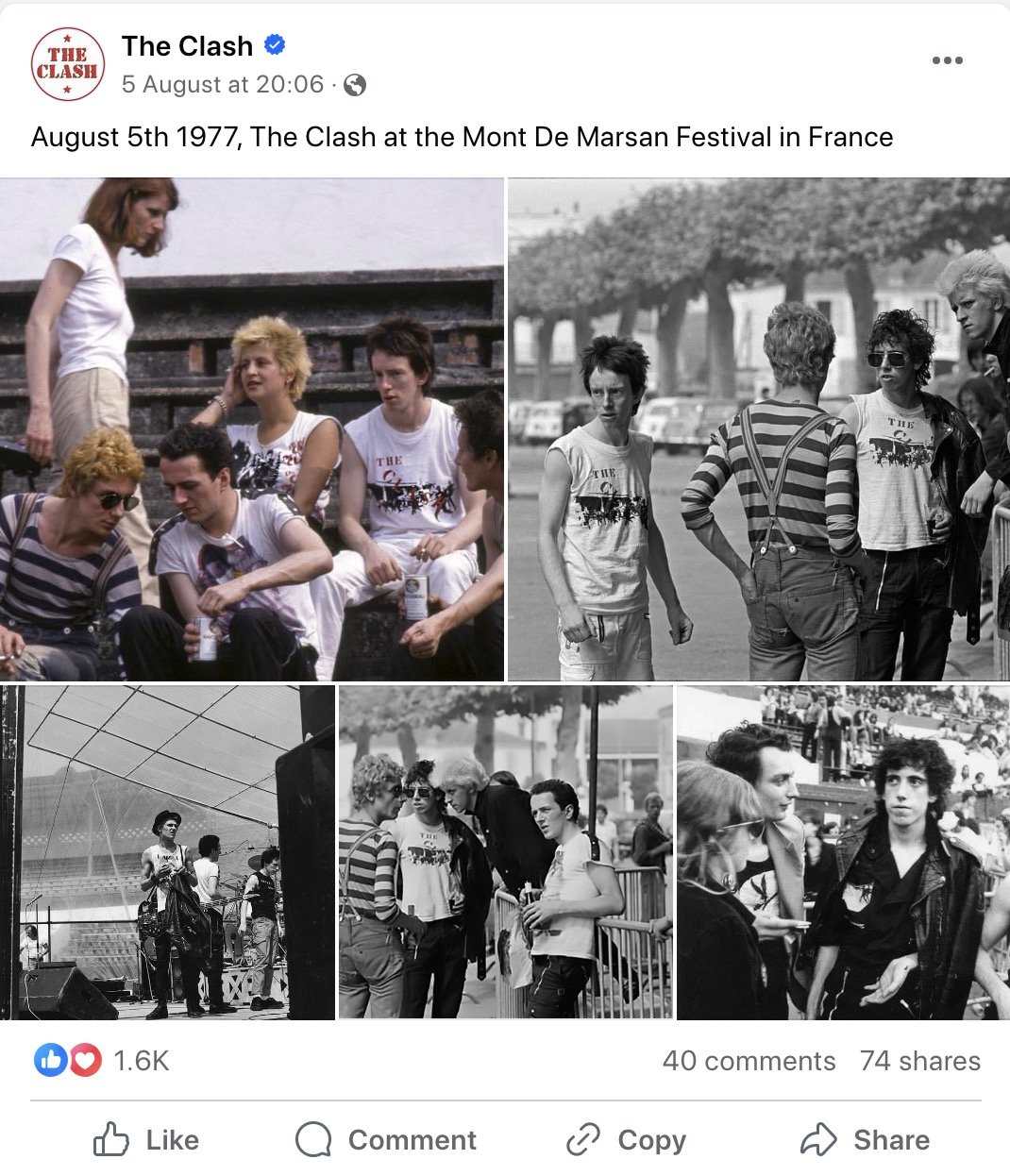
Friday 5 August 1977

Mont de Marsan
Punk Festival, France

Also performing at Festival over 5th & 6th August;
The Damned, The Jam, The Boys, Eddie & The Hot Rods & Dr.Feelgood

updated 5 Jan 2010 - added Festival Video, Gig Video and Gig Video remastered, a lot of new text, added two stage photos plus Rock n Stock Magazine
updated - added ticket - xmas 2013
updated Dec 2014 - added video details
updated Dec 2014 - better poster & backstage pass
Updated 29 Jan 2017 - added links top bands & bkgrd info
updated 3 April 2020 - huge update
updated Dec 2023 addd Getty image, added 5 new photos
updated Jan 2024 added new posters, ticket, article and video trailer


INDEX
Recordings in circulation
Background
Tickets, Posters
Other
Venue
Gig Review
News Reports
Books
Magazines
Comments
Social Media
Photos


Recordings in circulation

Possible from two sources with video sources.

Audio 1 - full gig alt source

Sound 2.5 / 5 - 1hr 6mins –  low gen? – 21 tracks

Capital Radio (full tape)


Audio 2 - Mont de Marsan LP

Sound 3 - 52mins - low gen? - 19 track
this has a shorter run in to Londons Burning


Audio 3 - Capital Radio (LP)

Capital Radio (full tape)


Audio 4 - Audio from Video

Better versons of Complete Control and Londons Buring circulate possibly from video


Audio 5 –London's Burning - from video

Capital Radio (full tape)


Sources

two sources for this gig

There seems to be two sources for this gig, both are very good and re-capturing the sound and atmosphere at the festival. One is the LP, a widely circulated early Clash bootleg, which was later remastered to a limited edition CD.

fullish tape

The other recently circulated recording has almost the complete set, adding White Man in Hammersmith Palais, Police & Thieves and the first 1977, but missing Career Opportunities to a tape switch. The LP/CD source includes a full Career Opportunities.

The second full tape source is better in quality, is complete and more enjoyable than the boot LP/CD. This source is either from the master tape or very low generation and is an excellent audience recording only marred by top end distortion from Joe’s rhythm guitar, which becomes worse during the “loud” sections.

fullish tape

A third and totally complete full tape source exists and has a Frenchman introducing Le Clash before the band quickly fire into London Burnings. This tape is of poor quality but does include every song including Career Opportunities.

overall

The short mp3 file left is Complete Control, one of the more distorted songs. Many of the others are far better, as they are not as loud. Instrumentation is clear particularly lead guitar which is excellent. Bass comes through clearly on songs like White Man and Police & Thieves. Vocals are a little distant but this appears from comments on stage to be due to the PA rather than the recording. Three of the highlights of the set are the three songs missing from the LP/CD.

LP/CD source

The LP/CD source is slightly muddy in sound, with less range but still a very good audience recording. Lead guitar is again very clear and there is much less of the top end distortion, making the preference between the two sources a matter of individual choice. Certainly on the more distorted songs on the tape source, the differences between the sources, in terms of enjoyment, blurs.


Video

The video of The Clash is poor audio and there are copies ciculating which have subsequently been dubed with the better audio recording. Thread on video at Mont De Marsan.


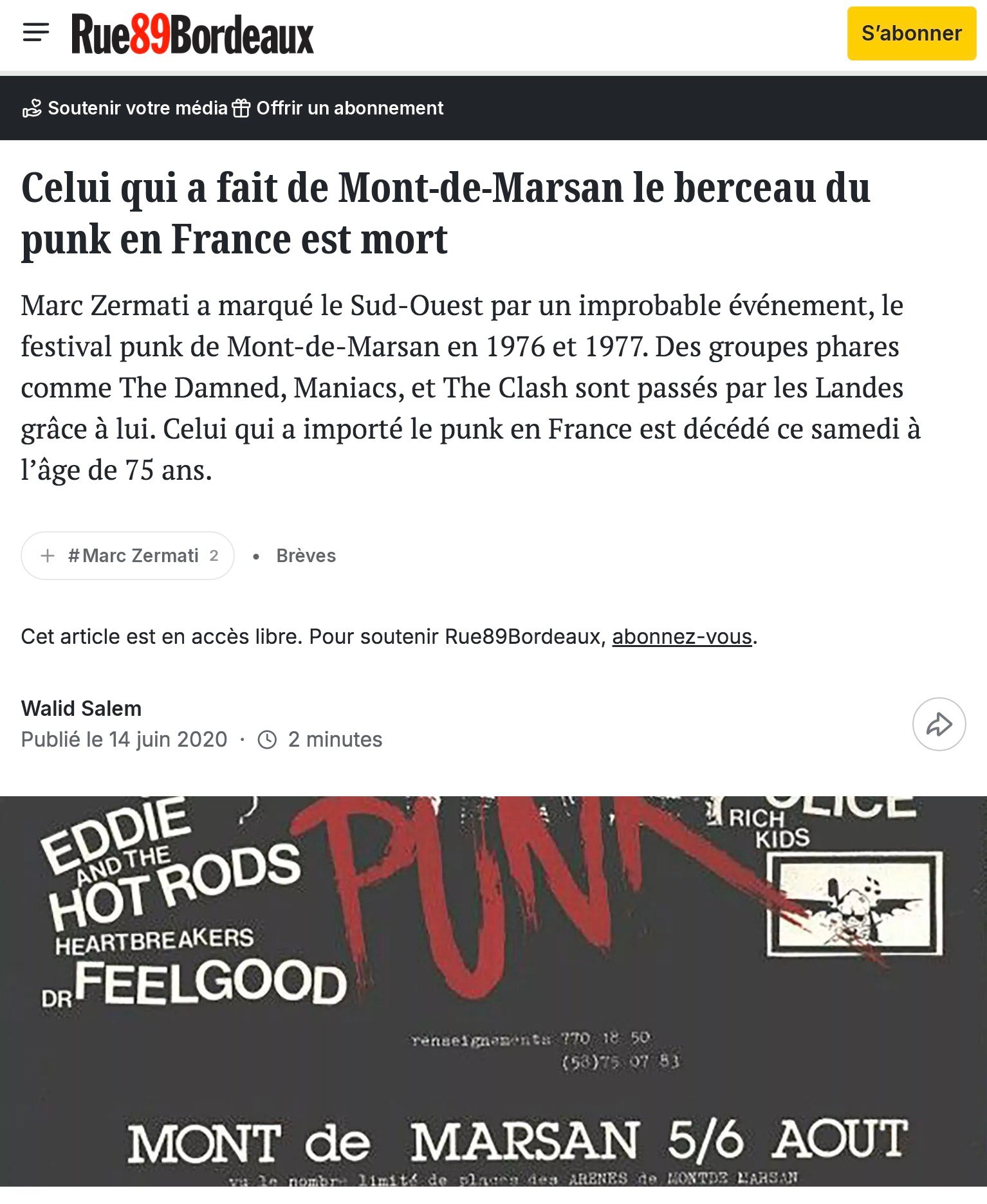
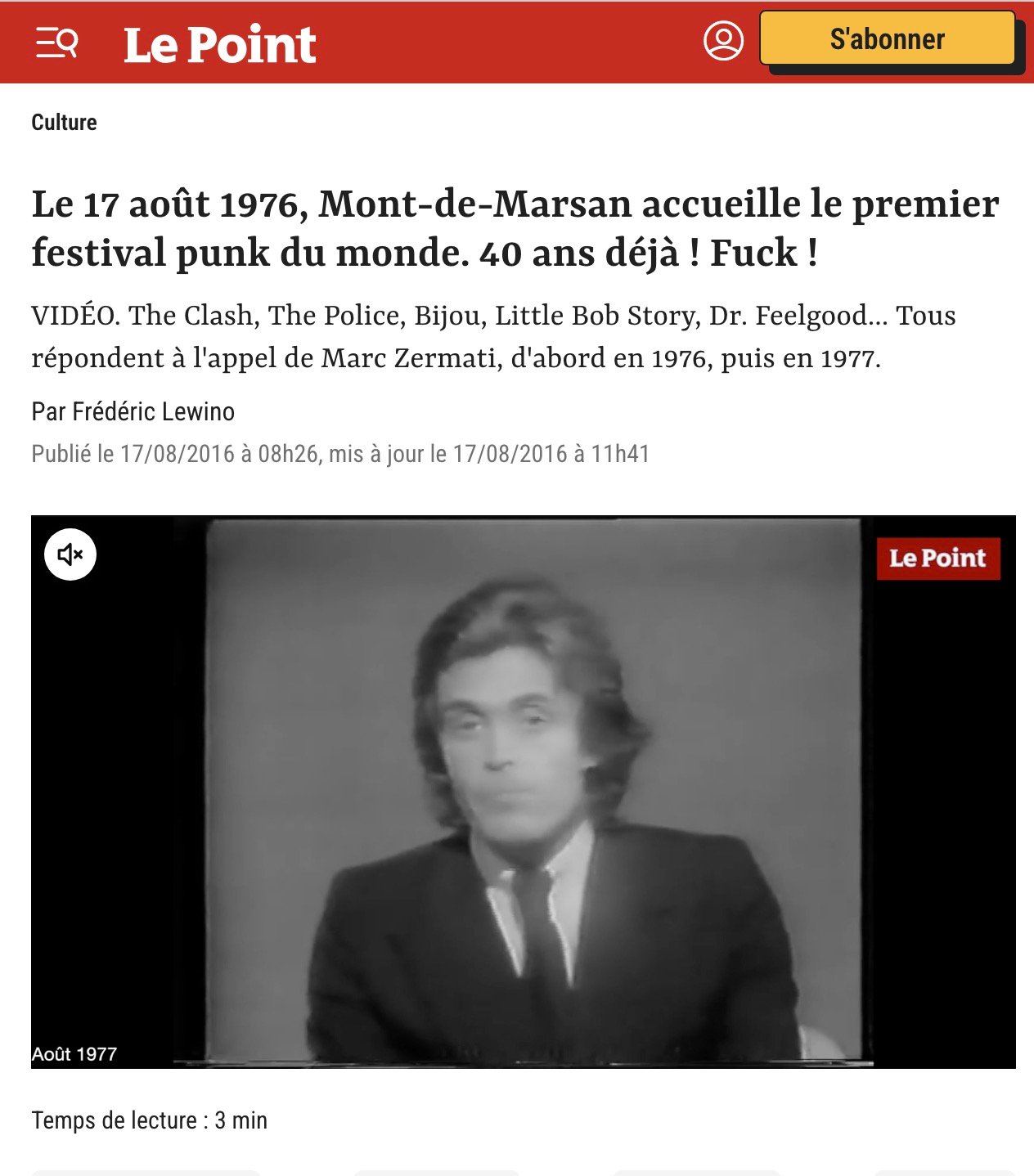
Le 17 aoùt 1976, Mont-de-Marsan accueille le premier festival punk du monde. 40 ans déja?

(Video 1)

Le Point website / article


On August 17, 1976, Mont-de-Marsan hosted the world's first punk festival. 40 years already! Fuck!

VIDEO. The Clash, The Police, Bijou, Little Bob Story, Dr. Feelgood... All answered Marc Zermati's call, first in 1976, then in 1977.

By Frédéric Lewino, Published on 08/17/2016

[Translated] On August 17, 1976, the inhabitants of the peaceful sub-prefecture witnessed the arrival of an exuberant horde ready to do battle with primitive, explosive rock. Punk rock!!! There were only between 600 and 1,000 of them, but what a look! Extravagant! Surprising! Piercings and orange hair, torn T-shirts and filth. Joints and beer. They came from England, the Netherlands, Spain, and all over Europe. But the atmosphere remained good-natured. No broken windows, no cops. Everyone headed to the Plumaçon arenas, from which a rain of decibels burst forth from noon.

The bands parade on stage, The Count Bishops, Eddie and the Hot Rods, Tyla Gang, Little Bob Story, Shakin' Street with the singer Fabienne and then, above all, The Damned. To tell the truth, only the latter really embodies punk, the other bands play more pub-rock, proto-punk. It was not until the second edition of the festival, in 1977, that a downright punk line-up with The Clash, The Police, The Damned, Bijou, Dr. Feelgood, Asphalt Jungle was announced. Only the Sex Pistols were missing.

Only the Damned caused a bit of trouble, but nothing serious. Their bassist even toasted the local paratroopers, calling them cool skinheads.

Today, several people are furiously claiming to be the father of this legendary festival. No matter whose brains came up with the idea, the man who was able to bring it to life by bringing in all the founding punk bands was a young pied-noir named Marc Zermati. In 1972, he opened a record store in Les Halles, the Open Market, where all the American and English punk musicians would meet. With Pierre Thiollay, he founded the Skydog label, which managed all the bands taking part in the festival. Moreover, Zermati claims to have coined the word punk with Yves Adrien and others. The Sex Pistols also owe him a little. "I attended all the McLaren meetings in London to decide on their name."

In 1976, during a conversion, the idea of ​​organizing a punk rock festival was born. Zermati immediately took charge. "We wanted to bring together and affirm the punk movement in France and elsewhere!" A friend from Mons, André-Marc Dubos, found the Mont-de-Marsan arenas for free, another obtained authorization from the prefect. At the last minute, the latter and the mayor wanted to cancel the event, because incidents had disrupted a rock concert in Arles, but the local commissioner was a pied-noir like Zermati. The ban was therefore lifted. "Only the Damned caused a bit of trouble, but nothing serious. Their bassist even toasted the local parachutists by calling them cool skinheads," Zermati recalls.

Mythical

The following year, the mayor did not want to hear about another edition, but it was a municipal election year. Under the threat of the submission of a rival electoral list, he gave in. This time, 4,500 punks crammed into the arenas to listen to Dr. Feelgood, The Damned and The Clash for two days. And still Little Bob Story, the band from Le Havre who were a hit in England. Zermati remembers: "The Jam musicians were taken away by the local police for swimming in the municipal fountain. A supermarket was looted. Nothing serious. Invited by the mayor and the prefect to dinner, they congratulated me on the smooth running of the festival." On the other hand, the concert given by Lou Reed the day after the festival was more eventful. "Kids attacked the arenas with Molotov cocktails."

And if, the following year, there was no third edition of the Mont-de-Marsan festival, it was the fault of local promoters, according to Zermati "They never wanted to reimburse our expenses. They had double ticketed. I had to sell the Open Market to cover the expenses." Today, the Mont-de-Marsan punk festival has acquired a mythical dimension. Punk is not dead!

Note that Little Bob continues to travel the rock roads with his new band Little Bob Blues Bastards. At seventy years old, he retains the same energy as forty years ago. His latest album Howlin' is a little gem of concentrated energy.


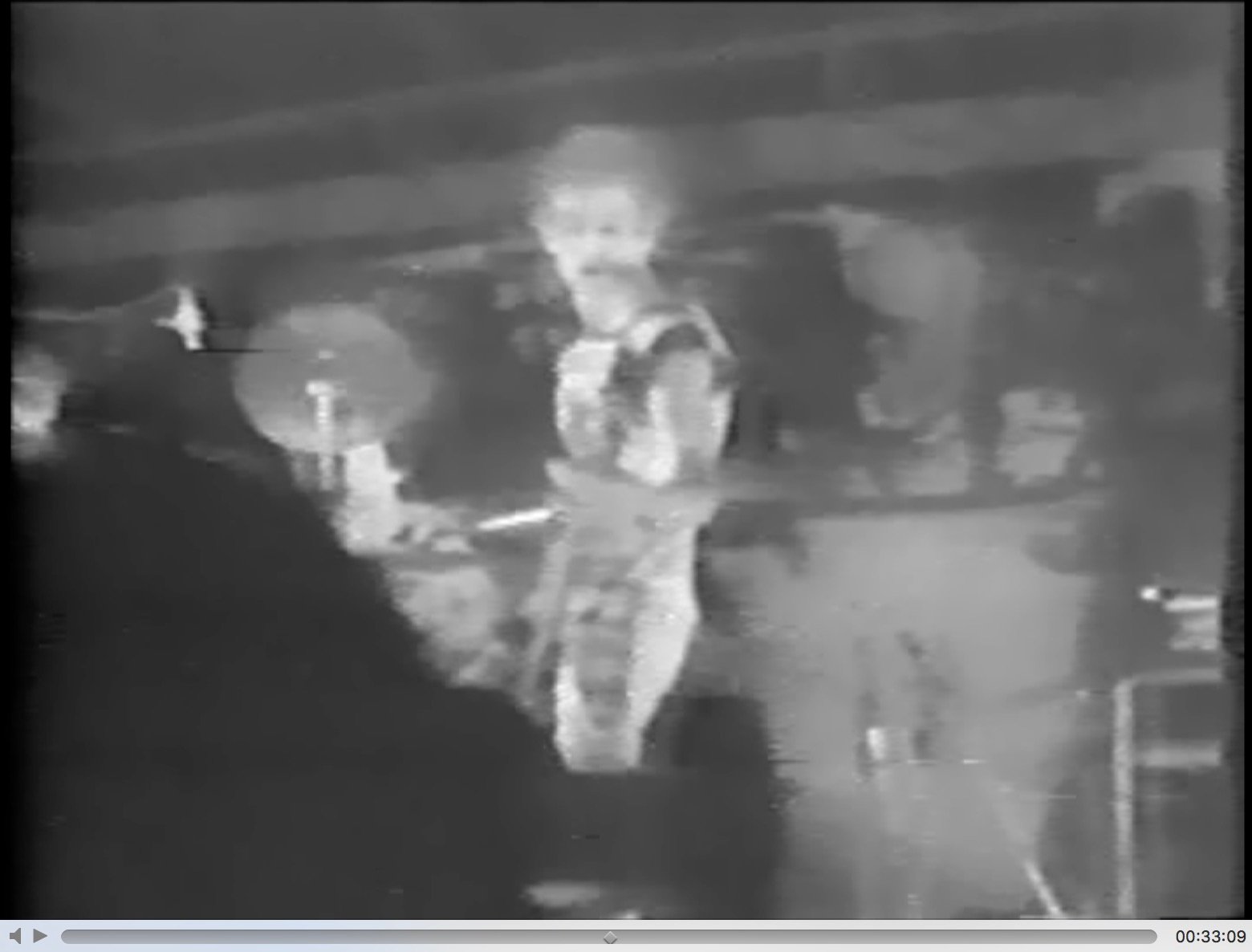
Video - full Clash performance

(Video 2)

Original sound dubbed with Clash footage using stills inbetween.

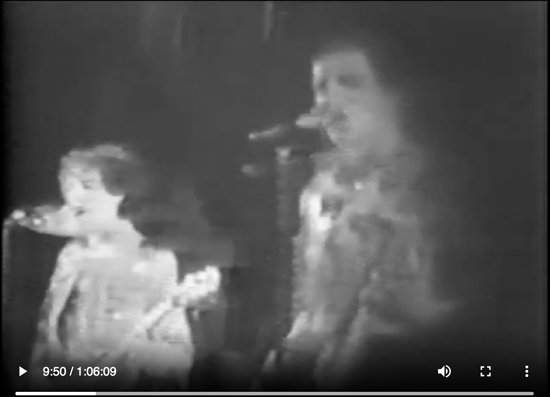
Black & White - Grainy very poor picture (pro shot)/Sound muffled-ok

Various artists

40min London Burning - The Clash
42min Capital Radio - The Clash
44min 1977 - The Clash
45min Complete Control - The Clash
48min Pressure Drop - The Clash
50min Bored with the USA - The Clash
52min White Man in Hammersmith Palais (edit) - The Clash
53min Cheat (edit) - The Clash
55min Hate and War (edit) - The Clash
56min Police & Thieves (edit)- The Clash
57min Slits?

290p / 1h 11mins

Open in full in new window


Documentary, Festival Punk 1 Trailer

(Video 3)

FESTIVAL PUNK 1976 - 1977 [ MONT DE MARSAN FRANCE ] CLASH DAMNED
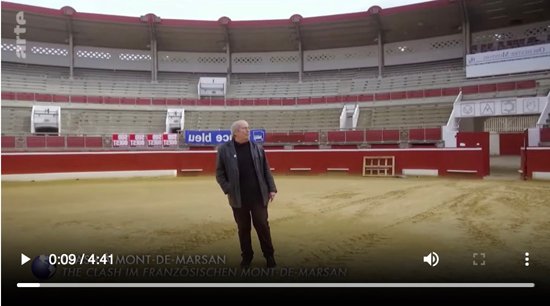
4.41mins / colour, French

'Festival Punk 1976 & 1977 Mont de Marsan France (Reportage ARTE octobre 2018)' - 4.41mins / colour, French, avec comme guide, le local André Marc Dubos, l'un des organisateurs de ce mythique festival ! ARTE octobre 2018

1080p / 2:41mins

Open in full in new window


Documentary, Festival Punk 2

(Video (Audio Only) 4)

'Festival Punk Mont de Marsan France 1976 & 1977'
54.43mins / colour, French

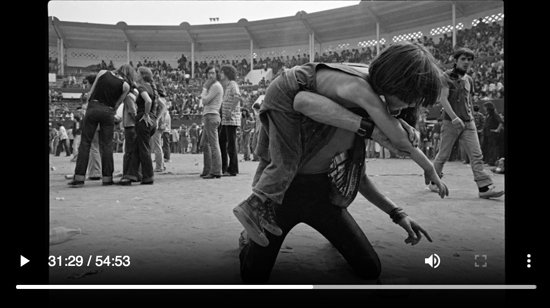
Festival Punk Mont de Marsan France 1976 & 1977 , l'explosion Punk par Fabrice Drouelle France Inter novembre 2017 avec Caroline de Kergariou scénariste et auteur dramatique . Photos de Jean Gaumy 1977.

720p / 54:53mins

Open in full in new window


News item - Pop News

(Video 5)

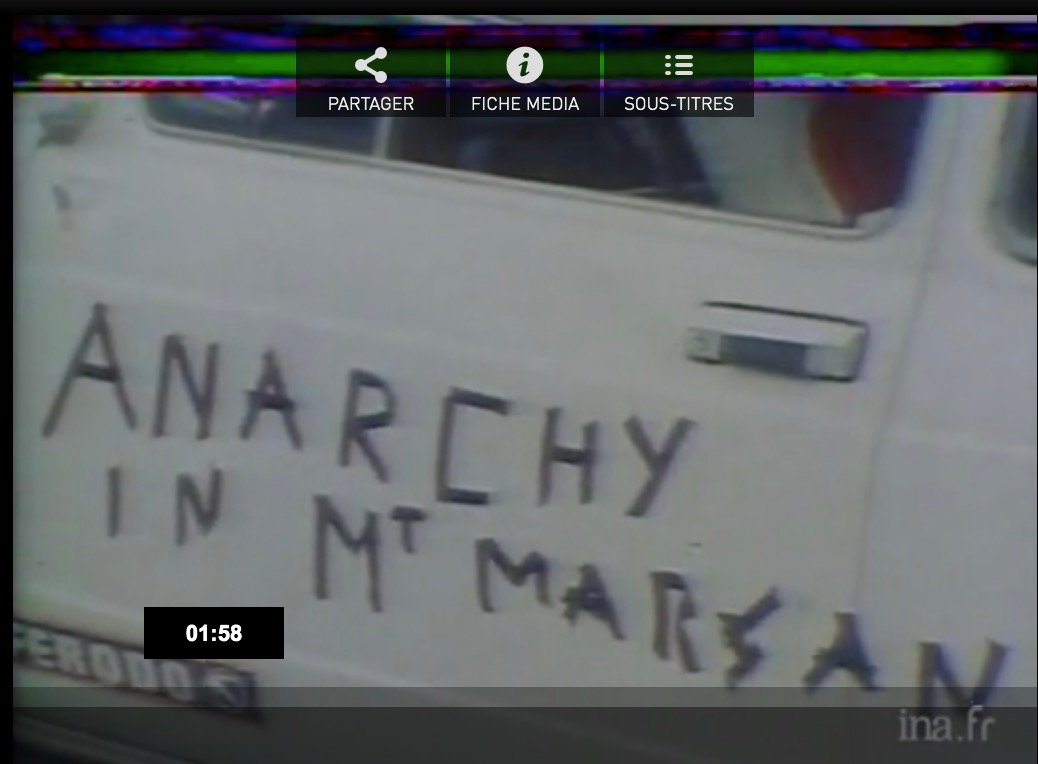
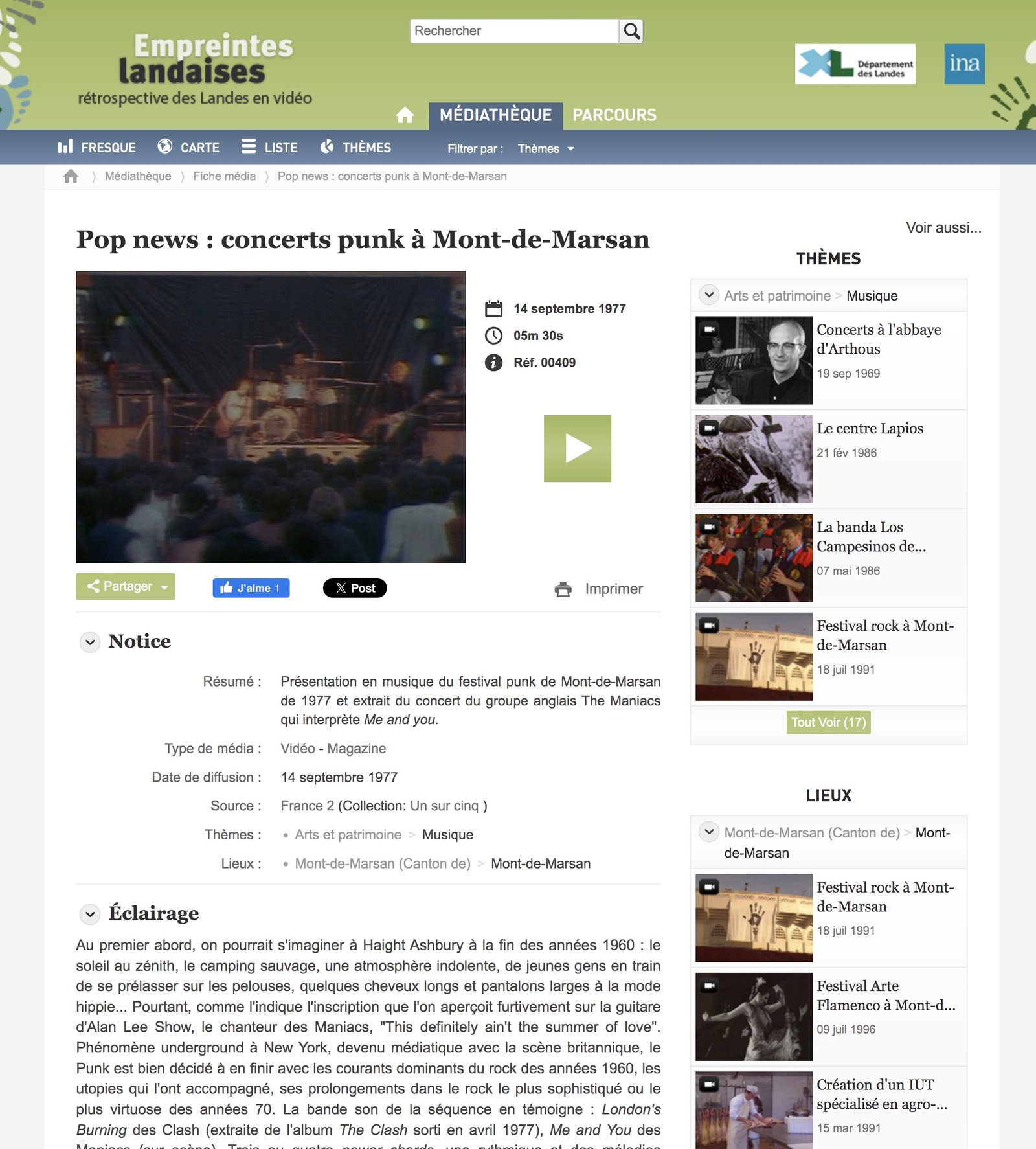
September 1977 - 5mins 30secs

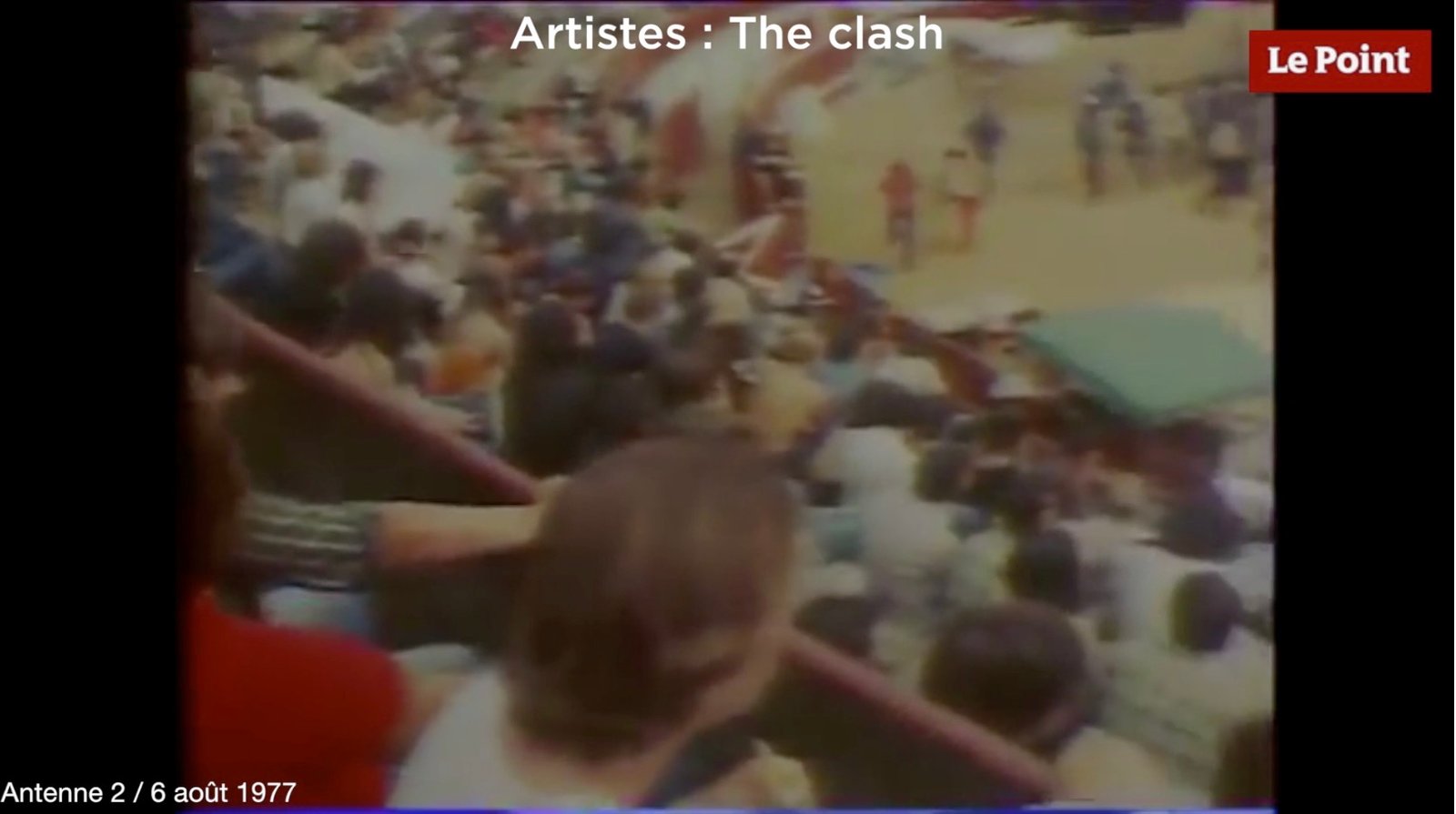
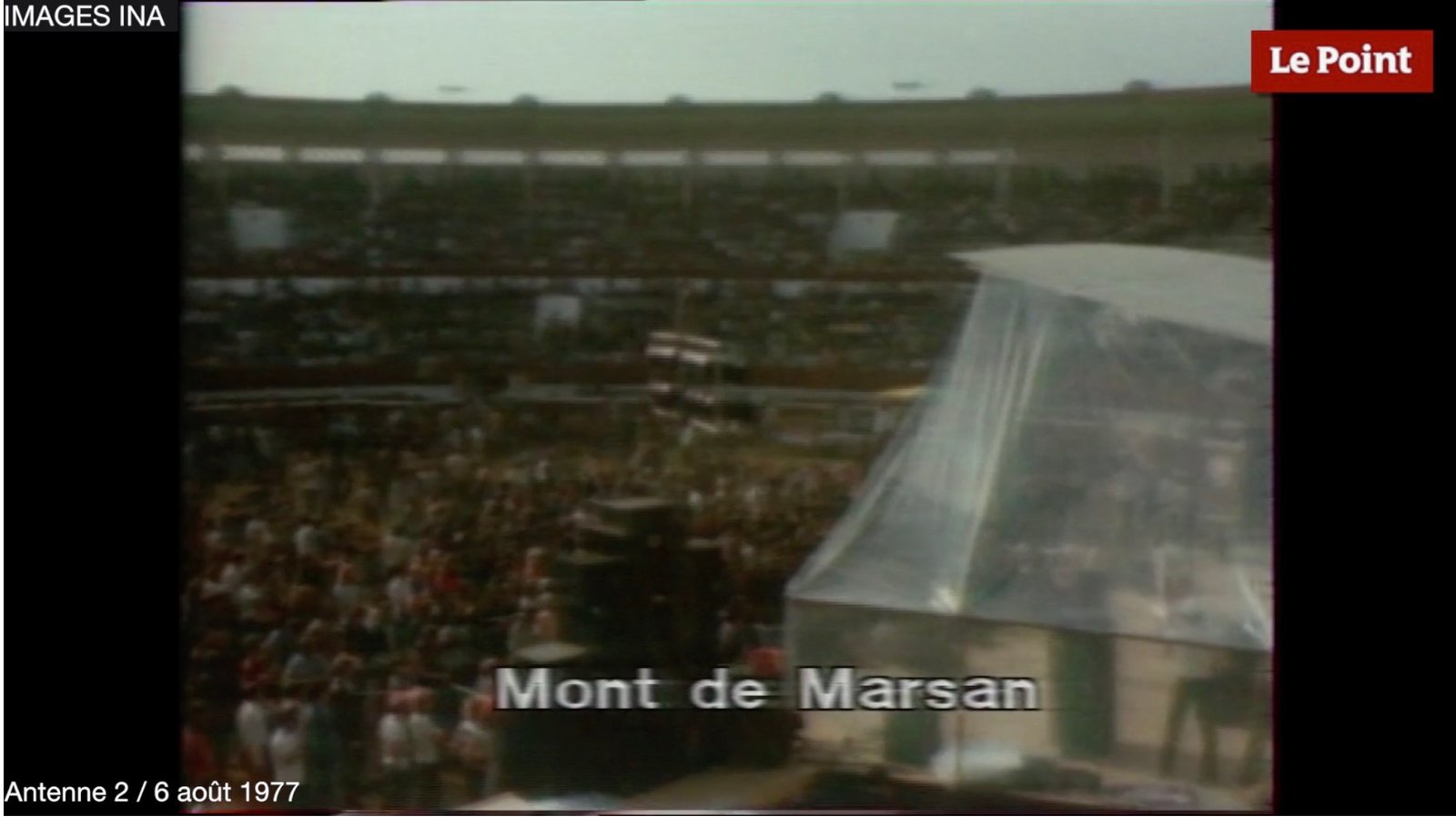
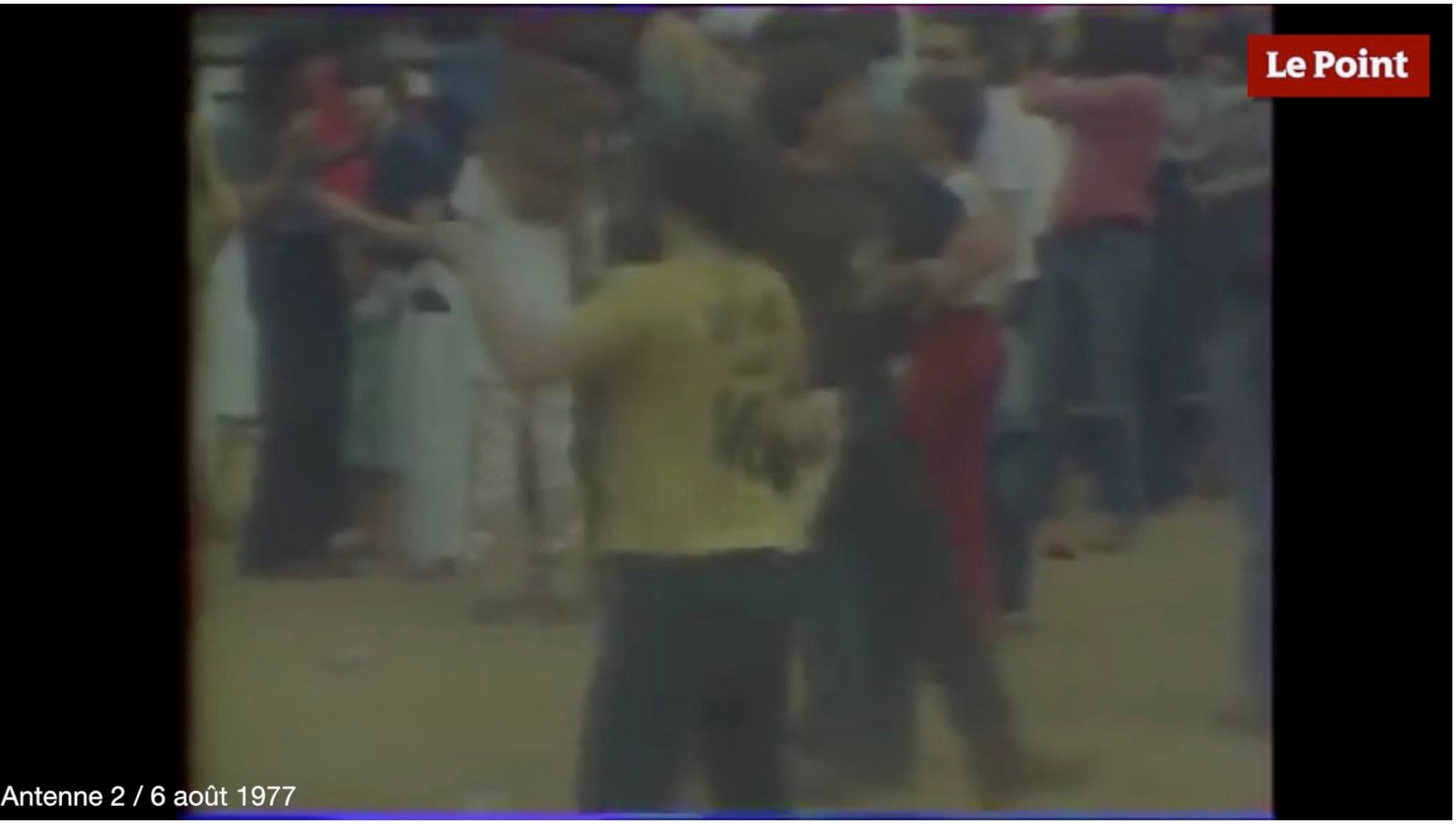
Reportage de Pop News sur Antenne 2 en septembre 1977 Shots of Festival, Crowd, Town plus some bands. Shots dubbed over with one Clash trackand one Damned track ... Shows the Clash in the stand

360p / 2:08mins

Open in full in new window
Alt video


News item - ina-fr

(Video 6)

September 1977 - 2mins 08secs

Reportage sur le festival punk de Mont Marsan. Alternance d'images d'un groupe sur scène et de festivaliers dont les tenues sont largement montrées. Images d'archive INA Institut National de l'Audiovisuel http://www.ina.fr

360p / 5:30mins

Open in full in new window


News item - Vie Modene

(Video 7)

September 1977 - 2mins 14secs - reportage de Pop News sur Antenne 2 en septembre 1977
News report mostly fan shots, no Clash

Video 'Vie Moderne' Hot Cuts from Mont-de-Marsan
Réalisé par : Jean-François Roux, Produit par : Vidéostone Distribution, Genre : Documentaire. Année : 1977 Date de sortie en salle : 12/10/77, Pays : France. Acteurs; Clash, Damned, Boys, Police, Eddie and the Hot Rods, Shaking Street, Doctor Feelgood

Documentaire musical sur le festival « punk rock » de Mont-de-Marsan. Tourné en vidéo. I'm looking for a French movie about Punk Festival in Mont-De-Marsan on August 5, 1977 called "HOT CUTS FROM MONT DE MARSAN" with Clash and Police footages. http://www.encyclocine.com/

280p / 2:14mins

Open in full in new window


Dubbed version with stills - All Clash

(Video 8)

Black & White - av picture breaks up with stills to fill in (pro shot)/Sound dubbed from audio source. Ends with Police and Thieves

The Clash only
00min Intro
01min London Burning (edit) - The Clash
02min Capital Radio - The Clash
04min 1977 - The Clash
05min Complete Control - The Clash
08min Pressure Drop (edit) - The Clash
09min The Prisoner - The Clash
11min Bored with the USA - The Clash
12min White Man in Hammersmith Palais (edit) - The Clash
14min Cheat (edit) - The Clash
15min Hate and War (edit) - The Clash
16min Police & Thieves (edit)- The Clash
Video ends with dubbed audio and remaining audio from Clash

Open video in New Window 1hr 06:09


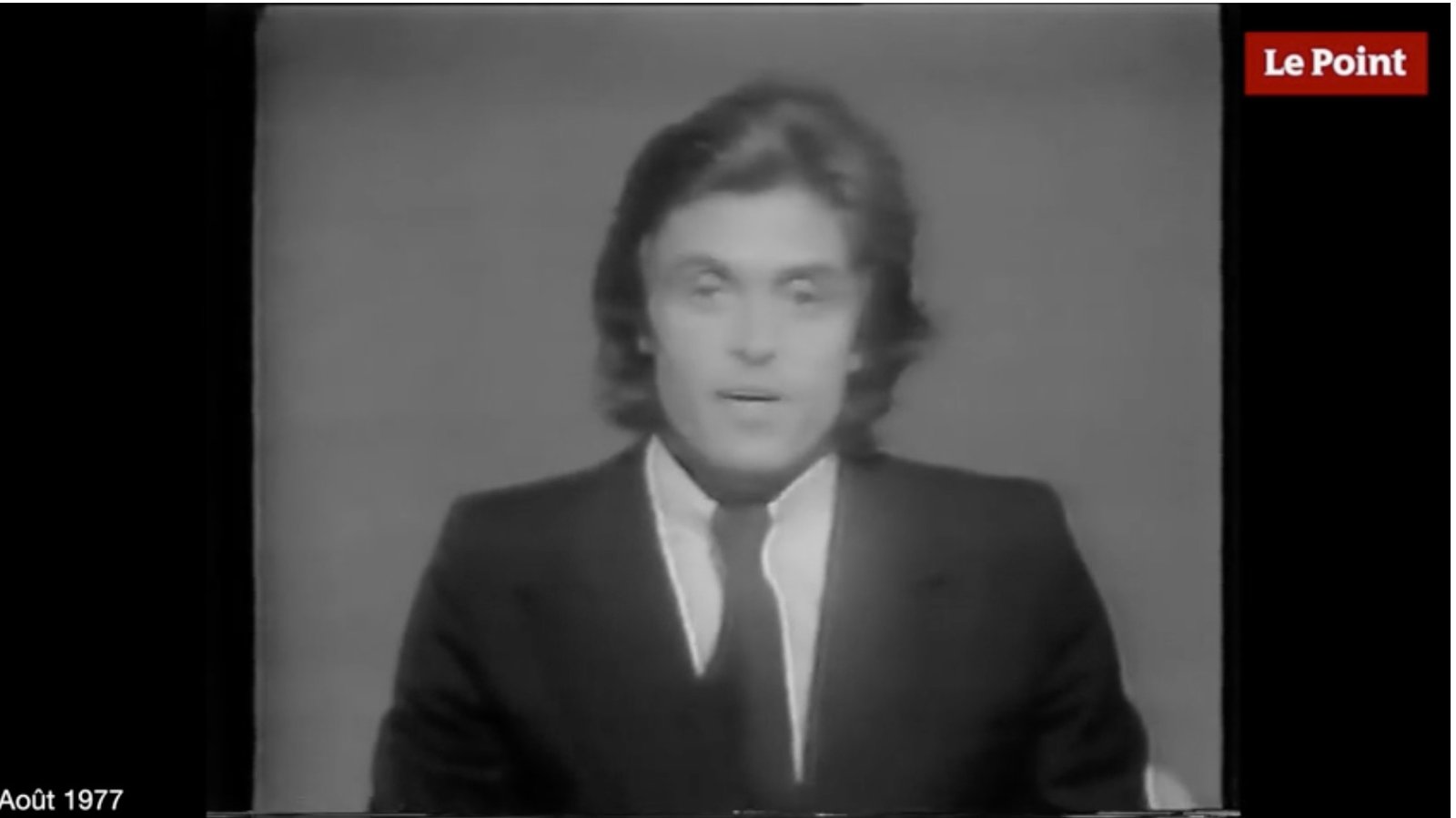
Gerard Holtz annonce le premier festival punk a Mont de Marsan

(Video 9)

l'annonce télévisée du 1er festival punk en france,plus exactement a Mont de Marsan et c'est ce gros naze de gérard holtz qui s'y colle!

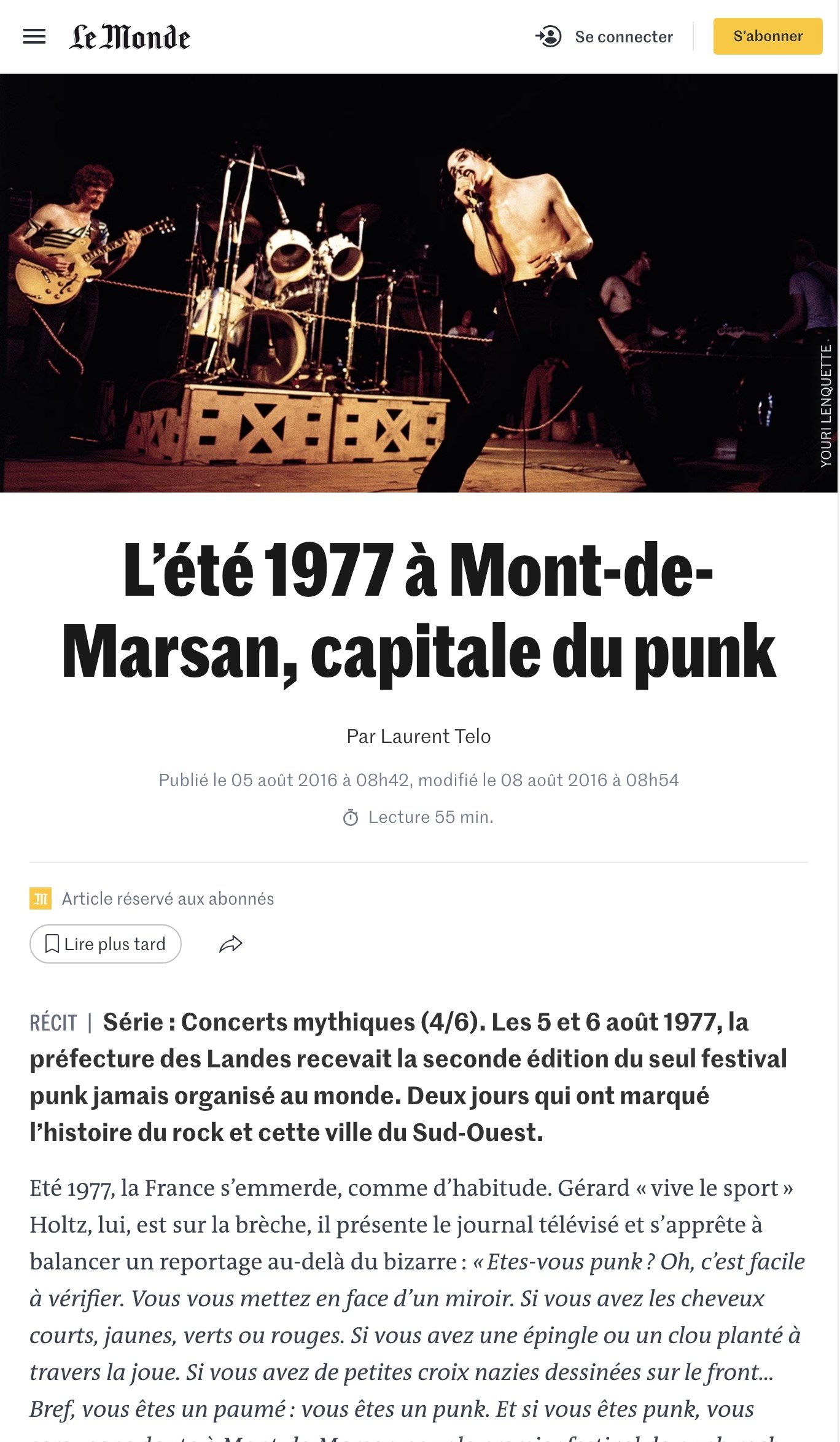
STORY SERIES : Legendary Concerts (4/6). On August 5 and 6, 1977, the Landes prefecture hosted the second edition of the only punk festival ever organized in the world. Two days that marked the history of rock and this city in the South-West.

Summer 1977, France is bored, as usual. Gérard "long live sport" Holtz, for his part, is on the breach, he presents the television news and is preparing to drop a report beyond the bizarre: "Are you punk? Oh, it's easy to check. You stand in front of a mirror. If you have short, yellow, green or red hair. If you have a pin or a nail stuck through your cheek. If you have little Nazi crosses drawn on your forehead... In short, you are a loser: you are a punk. And if you are punk, you will probably be in Mont-de-Marsan for the first punk-rock festival, the music of this new social phenomenon. Marginal, of course, like all these movements. From our special correspondent, blah-blah-blah."

480p / 0:45secs

Open in full in new window


Alain Lahana interview 2015
Festival Punk Mont de Marsan 76/77

(Video 10)

Reportage Spicee : https://www.spicee.com/fr Alain Lahana interview 2015 Fondateur de la Société Le Rat des Villes - Management et production d'artistes tels que Patti Smith, Iggy Pop, Fefe, Zaza Fournier, Giedré,

1080p / 10:03mins

Open in full in new window


Live Mont de Marsan (Clash only) punk festival

(Video 11)

1 minute long [1:06]

Open in full in new window


Un reportage de France 3 Euskal Herri

(Video 12)

360p / 1:25mins

Open in full in new window


Le 17 août 1976, Mont-de-Marsan accueille le premier festival punk du monde. 40 ans dèjà Fuck

(Video 13 two versions)

720p / 2:05mins
720p / 1:05mins

Open in full in new window 720p / 2:05mins
Open in full in new window 720p / 1:05mins


Back to the top


Background

European Punk Festival at Mont De Marsan

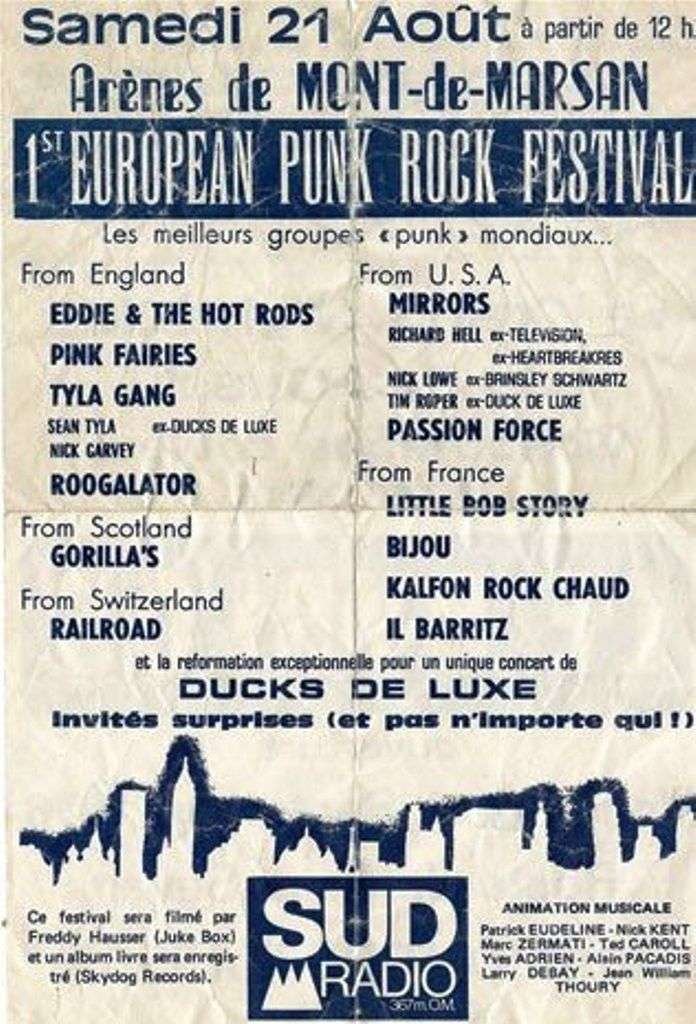
The first Mont De Marsan festival had taken place a year earlier (Saturday 21 August 1976). An affair that had lasted from noon to three o'clock in the morning and was the first European two day festival of the punk movement. It was organized by Marc Zermati director of Skydog Records label. The line up included: Eddie and the Hot Rods (England), Ducks Deluxe, Brinsley Schwartz, Kursaat Flyers, Doctor Feelgood, Pink Fairies, Tyla Gang, Roogalator (England), The Gorillas (Scotland), Railroad (Switzerland), The Damned, Passion Force, Little Bob Story (Le Havre), Bijou, Biarritz and Kalfon It Hot Roc. Teh 1976v festival atrracted around 600 to 700 people.

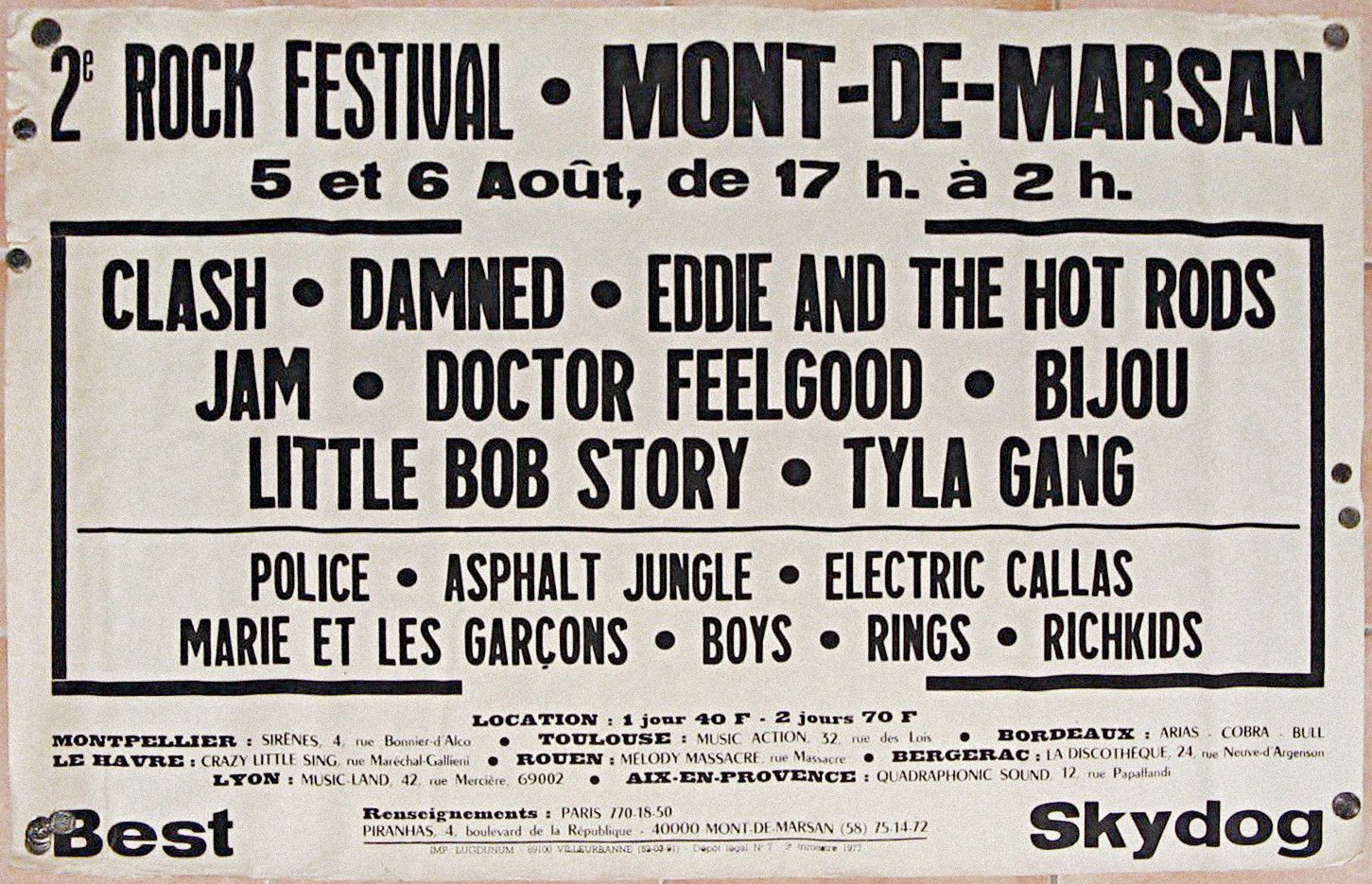
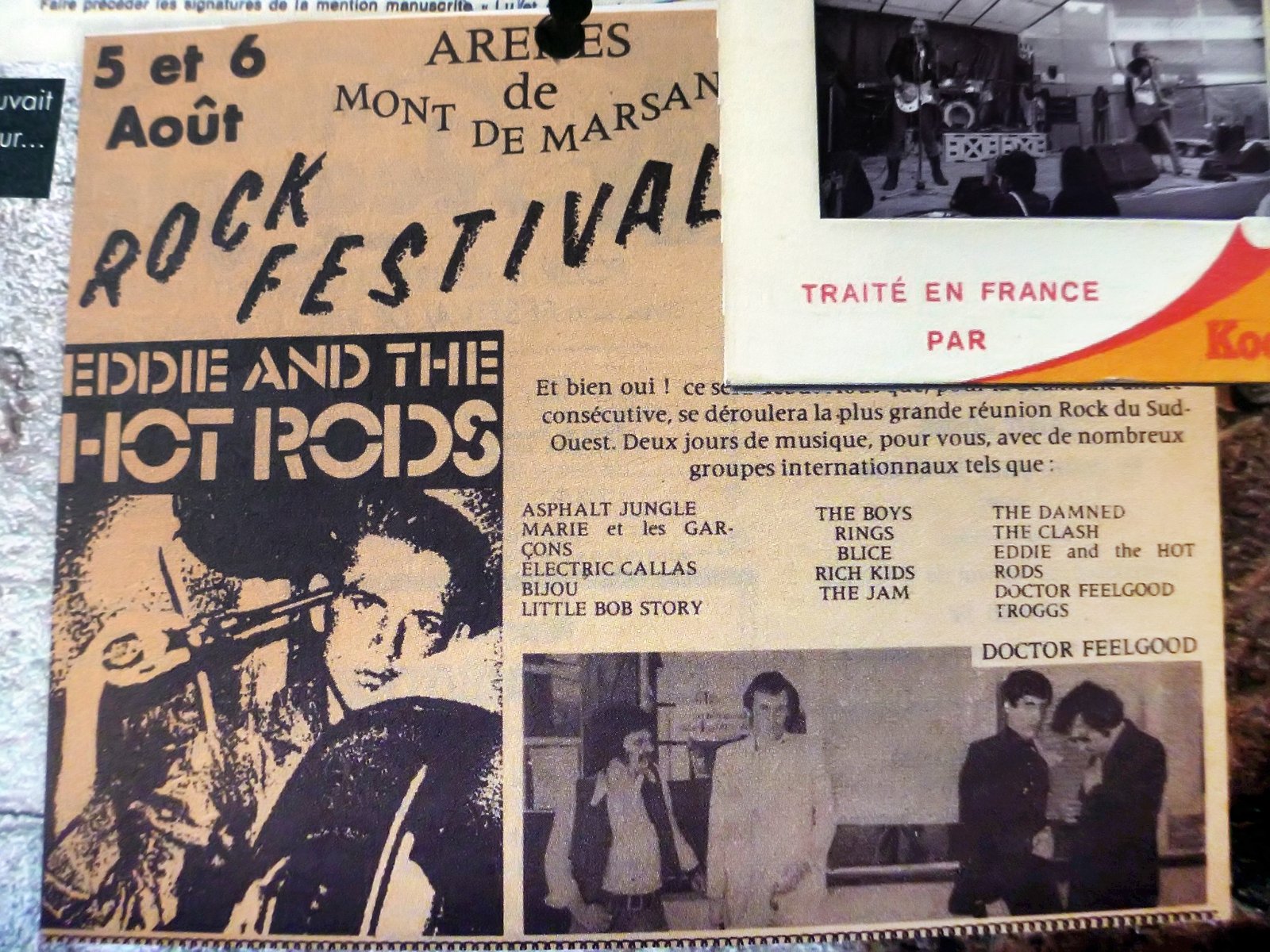
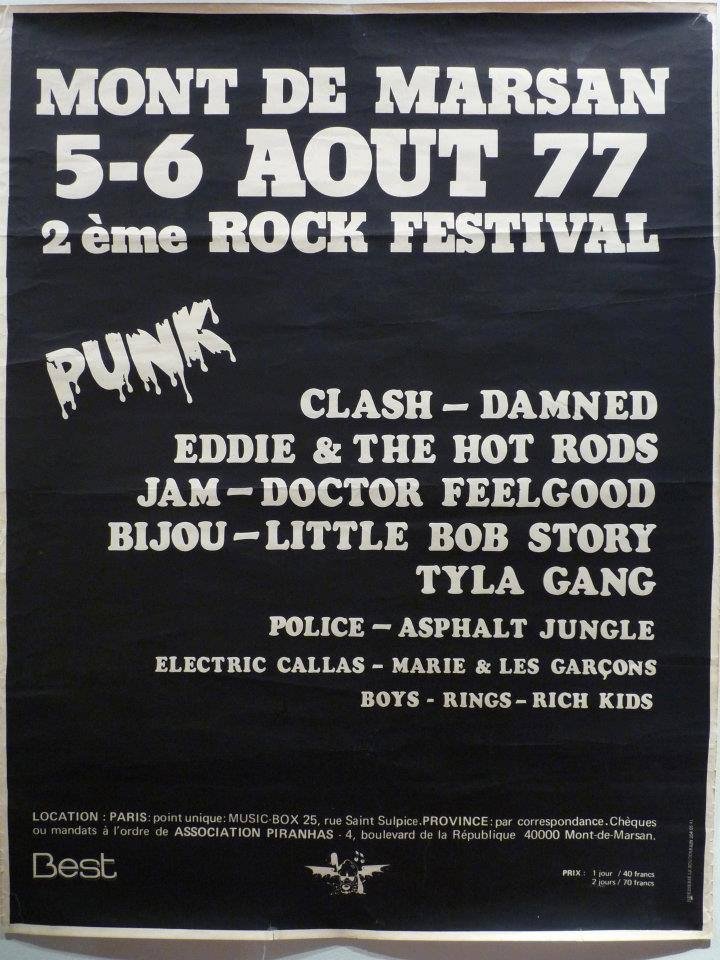
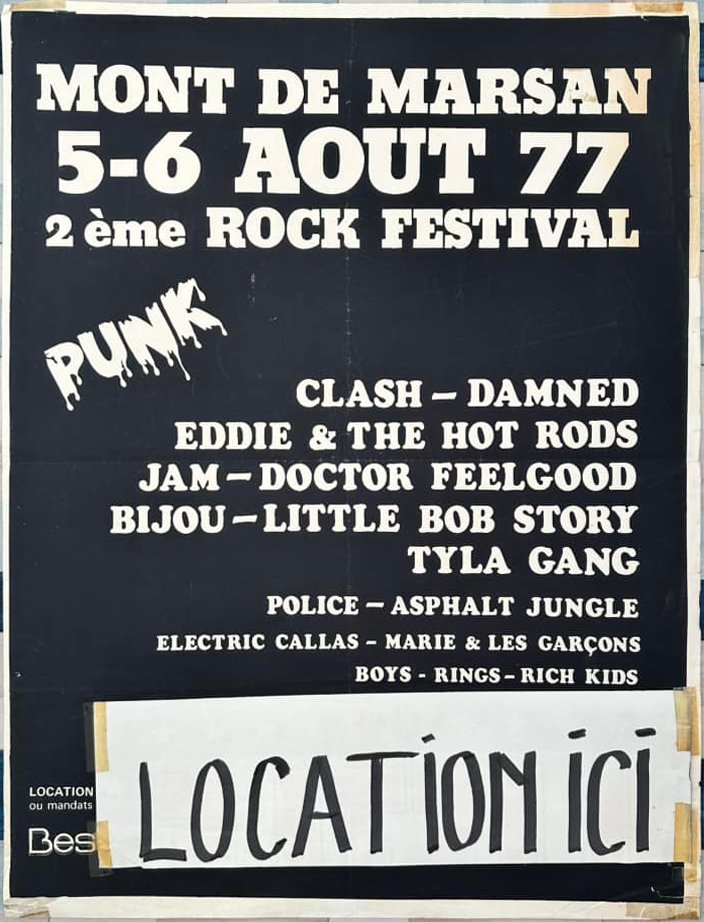
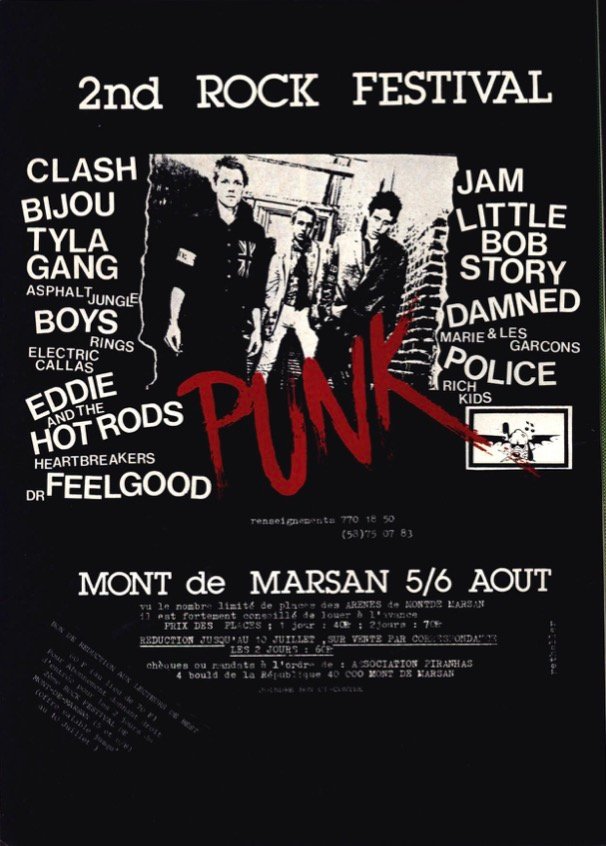
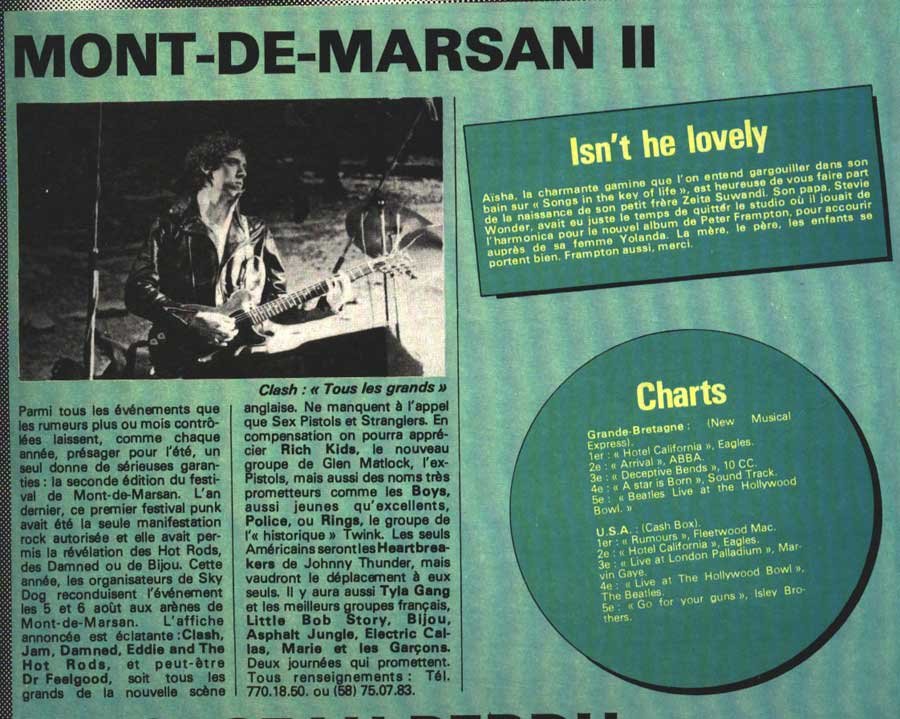
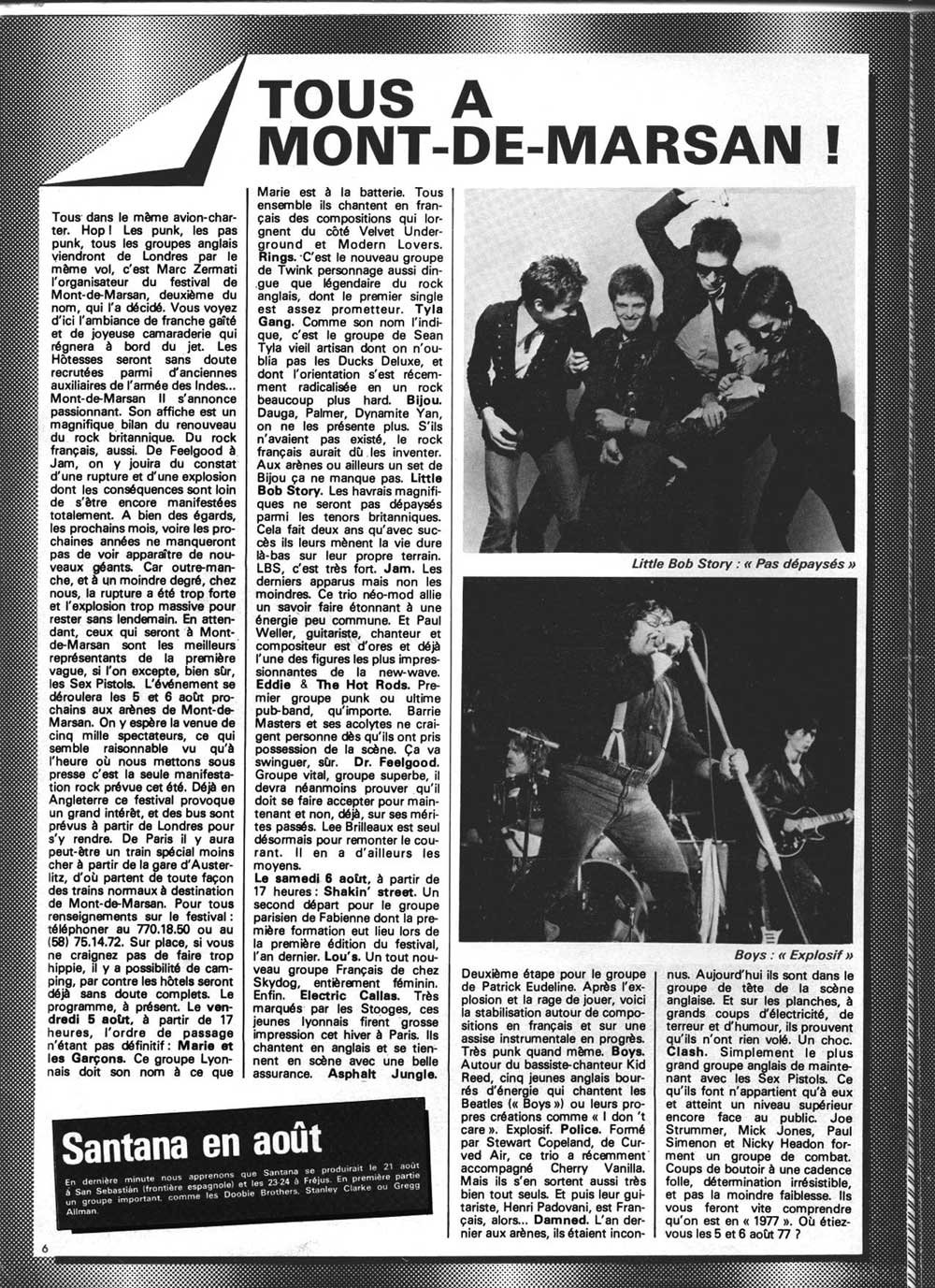
The following year (5 and 6 August 1977) there was a second Mont-de-Marsan punk festival. 1977 included groups Little Bob Story, The Damned, Bijou, The Clash (a Pirate 33 towers had been recorded for the occasion), The Police, Rings, Maniacs, Lou's, Shakin'Street, Mary and the Boys, Tyla Gang, Boys, Hot Rods, Doctor Feelgood and Asphalt Jungle (led by Patrick Eudeline). It was also noted the passing of Lou Reed the day after the festival. The festival of 1977 attracted more than 4000 spectators and it was subject of a documentary film by Jean-François Roux called Hot Cuts From Mont-de-Marsan.


The 1977 festival was more punk

Dominique Laboubée (Dogs guitarist)

"There were two Mont-de-Marsan festivals. One in 1976 and another in 1977. The 1976 festival was more pub rock than punk with bands like the Tyla Gang and the Hammersmith Gorillas. The only real punk band was the Damned. They were great, really young and wild, destroying everything on stage. The 1977 festival was more punk, and there were many more people, with bands like the Clash, the Damned, the Police (with the first line-up), Chelsea, the Jam (who refused to play for reasons of timing!) At both festivals, there were a lot of French bands and they were awful, except Little Bob and Bijou."


First gig since the White Riot tour

This is the first gig since the White Riot tour at the end of May, a layoff of 2 months in which Mick and Joe had been busy writing new songs which were debuted at Mont de Marsan; White man In Hammersmith Palais, Complete Control, Clash City Rockers, The Prisoner. Complete Control, City of the Dead and Pressure Drop were to be recorded soon after in August with the assistance of Lee Perry (who gets a name check during Police and Thieves).

Even with these new songs the band repeat several songs; 1977, Complete Control and London's Burning as the set is much longer than the usual 45 minute set, clocking in at 65 minutes. Only 2 of the album songs were not included Deny and 48 hours.

All the songs are performed confidence. The Clash add to this with one of their most raging punk performance's ever.

No doubt all the bands were keen to impress amongst peers, and the Clash enjoying being back on stage after a 2 month break.


Organized by Marc Zermati director of Skydog Records

Saturday 21 August 1976, noon to three o'clock in the morning, was held for two days the first European festival of the punk movement to the arenas of Mont-de-Marsan, organized by Marc Zermati director of Skydog Records label. Now Playing: Eddie and the Hot Rods (England), Ducks Deluxe, Brinsley Schwartz, Kursaat Flyers, Doctor Feelgood, Pink Fairies, Tyla Gang, Roogalator (England), The Gorillas (Scotland), Railroad (Switzerland), The Damned, Passion Force, Little Bob Story (Le Havre), Bijou, Biarritz and Kalfon It Hot Roc. This first version of the festival will bring together around 600 to 700 people.

5 and 6 August 1977, held the second festival punk of Mont-de-Marsan, including groups with Little Bob Story, The Damned, Bijou, The Clash (a Pirate 33 towers had been recorded for the occasion), The Police, Rings, Maniacs, Lou's, Shakin'Street, Mary and the Boys, Tyla Gang, Boys, Hot Rods, Doctor Feelgood and Asphalt Jungle (led by Patrick Eudeline). It was also noted the passing of Lou Reed, the day after the festival punk. In the end, the festival of 1977 not less than 4000 spectators and it was subject of a documentary film by Jean-François Roux called Hot Cuts From Mont-de-Marsan.


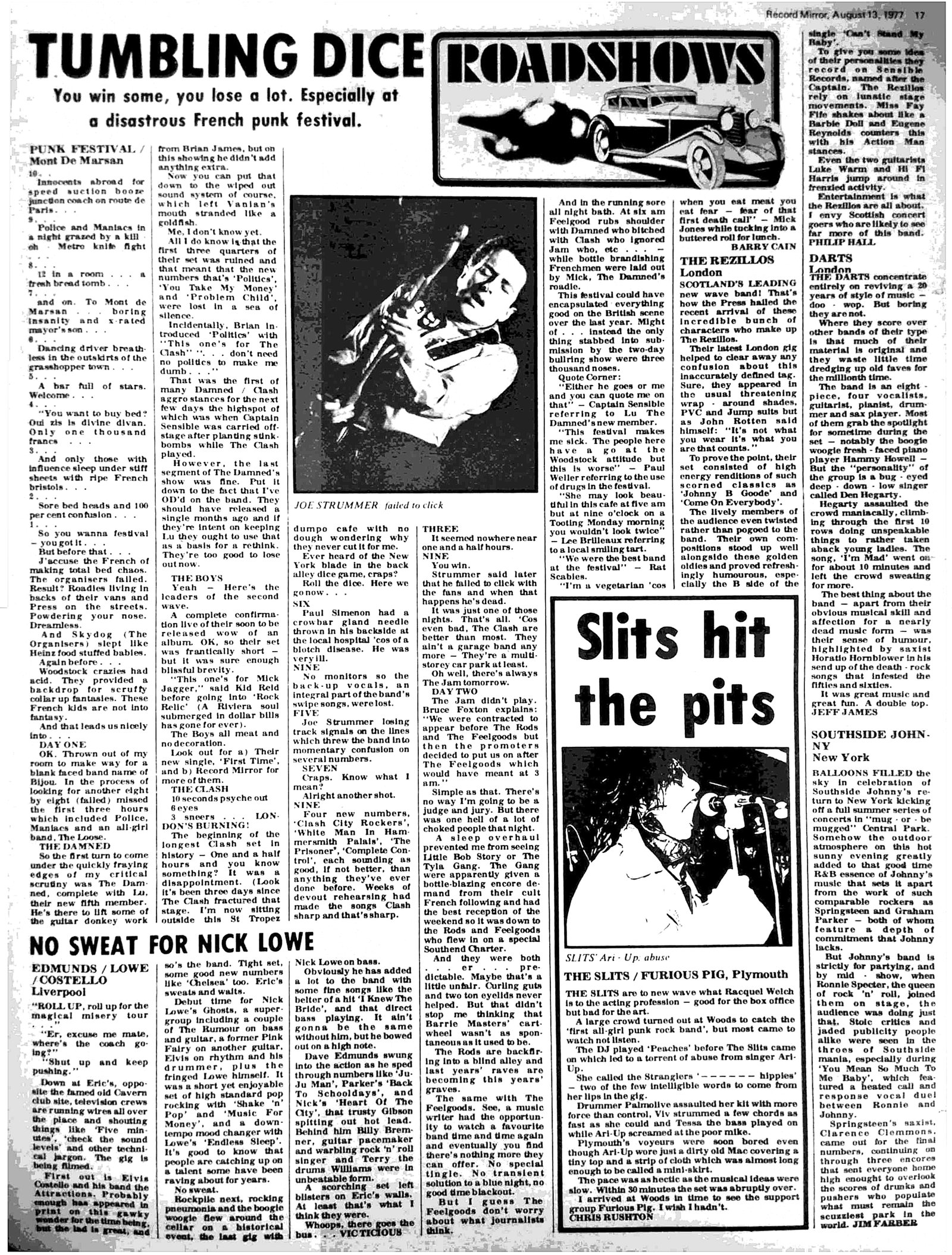
RECORD MIRROR: 6 August 1977

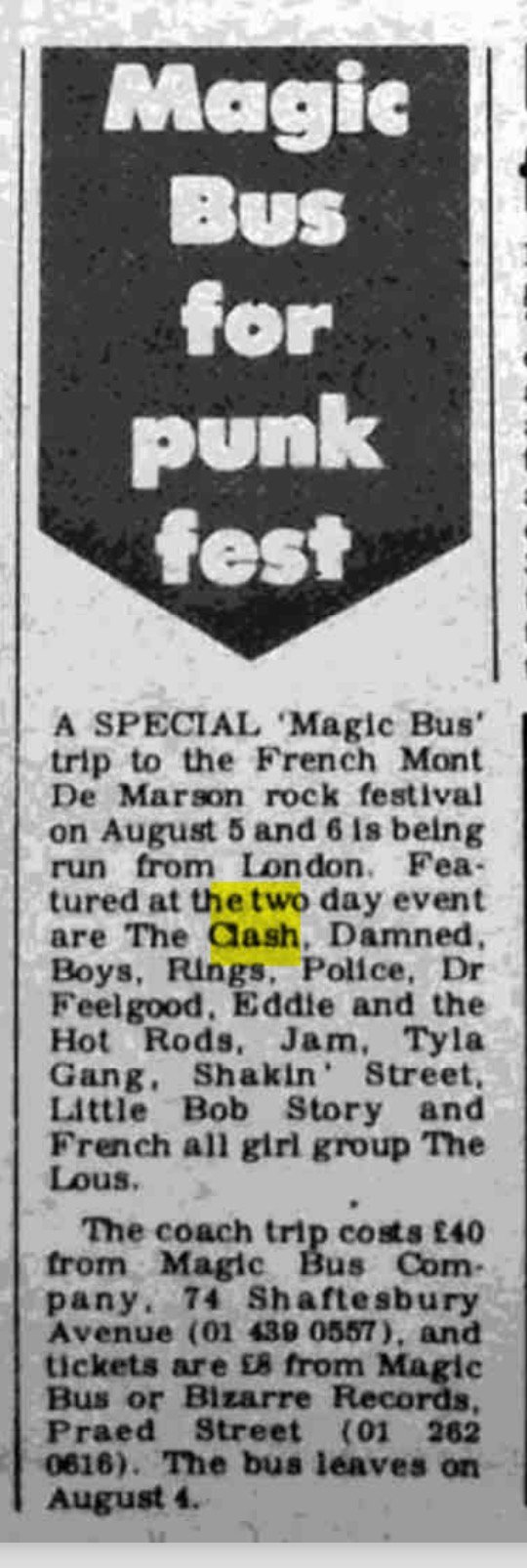
MAGIC BUS FOR PUNK FEST

RECORD MIRROR: 6 August 1977

MAGIC BUS FOR PUNK FEST

A SPECIAL 'Magic Bus' trip to the French Mont De Marson rock festival on August 5 and 6 is being run from London. Fea-tured at the two day event are The Clash, Damned, Boys, Rings, Police, Dr Feelgood, Eddie and the Hot Rods, Jam, Tyla Gang, Shakin' Street, Little Bob Story and French all girl group The Lous.

The coach trip costs £40 from Magic Bus Com-pany. 74 Shaftesbury Avenue (01 439 0557), and tickets are 18 from Magic Bus or Bizarre Records, Praed Street (01 262 0616). The bus leaves on August 4.

Enlarge Image


unkown publication, Punk Rock - Line up at M2M 1977 | Facebook

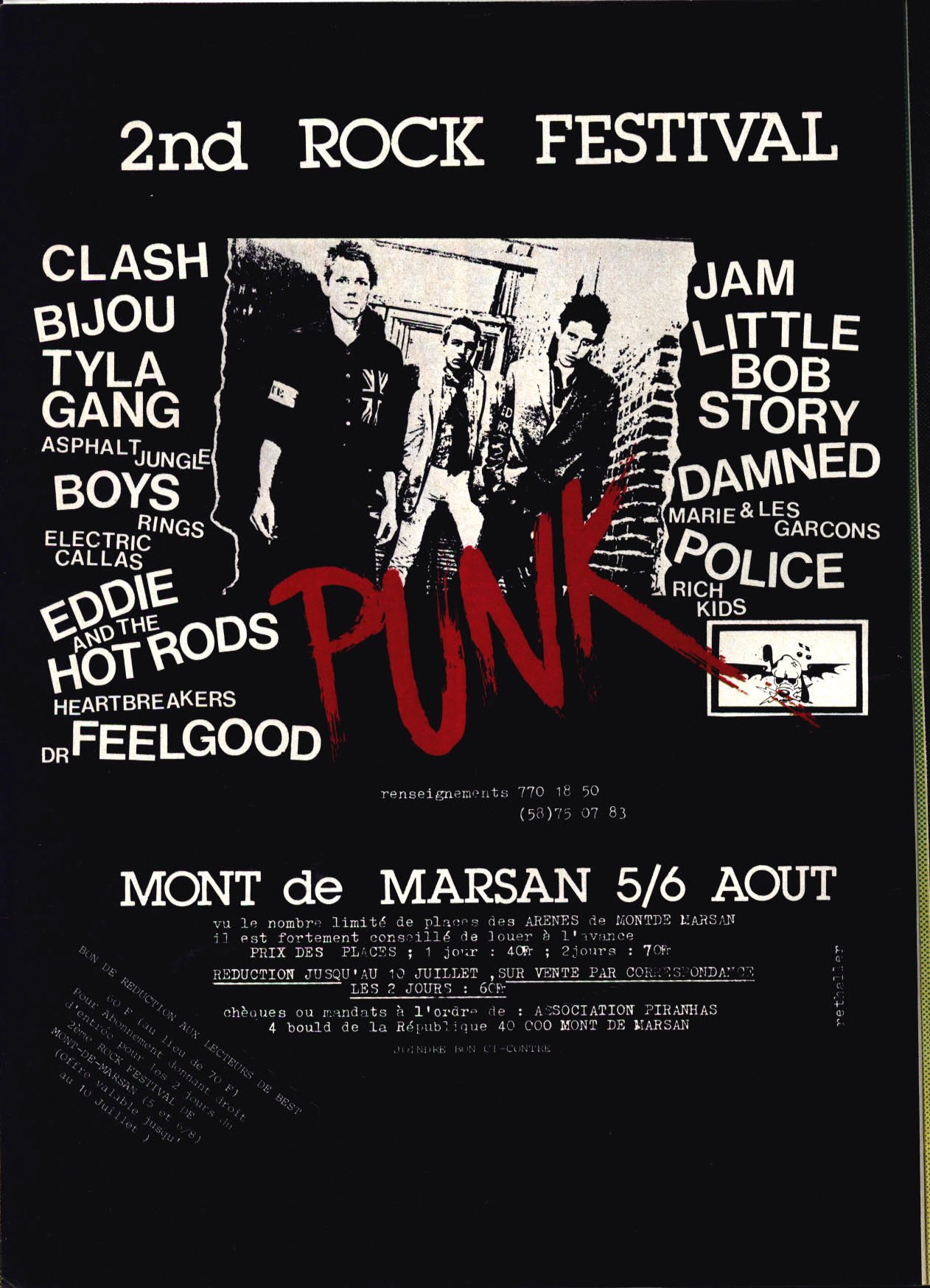
Mont de Marsan line up

Enlarge Image

Back to the top


Tickets, Posters, Adverts

Posters


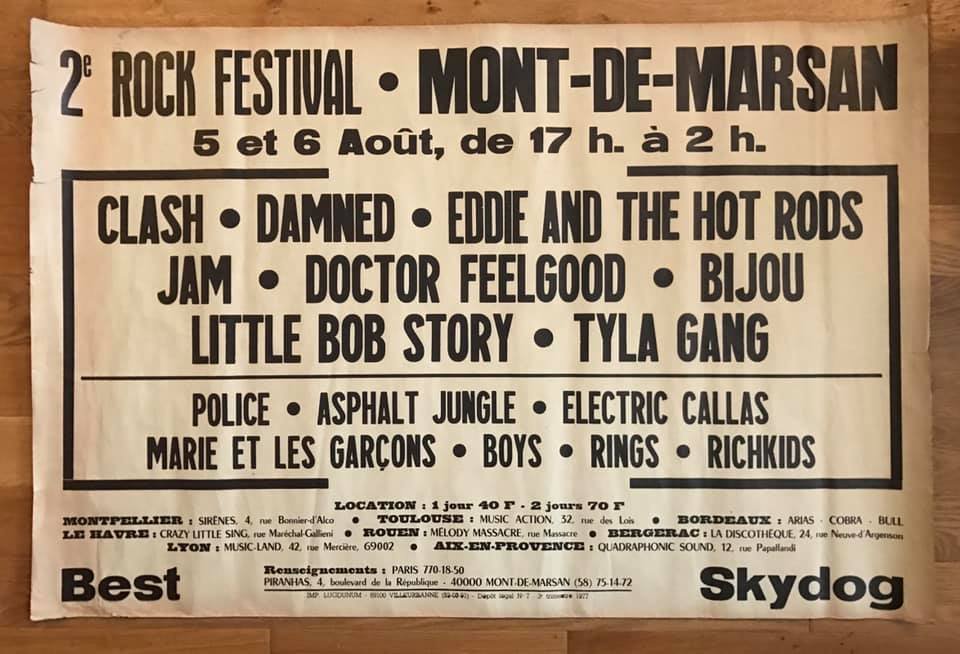
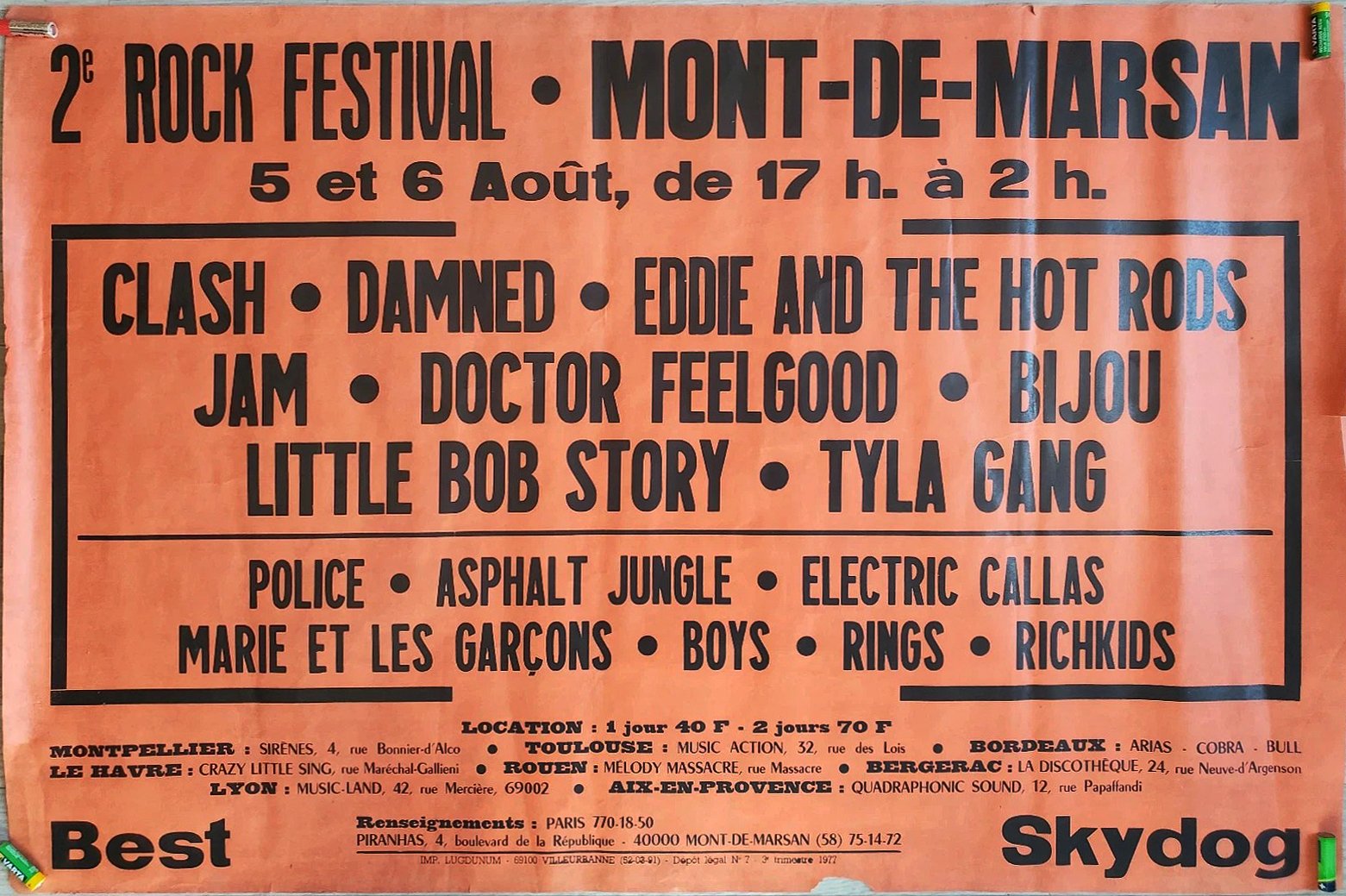
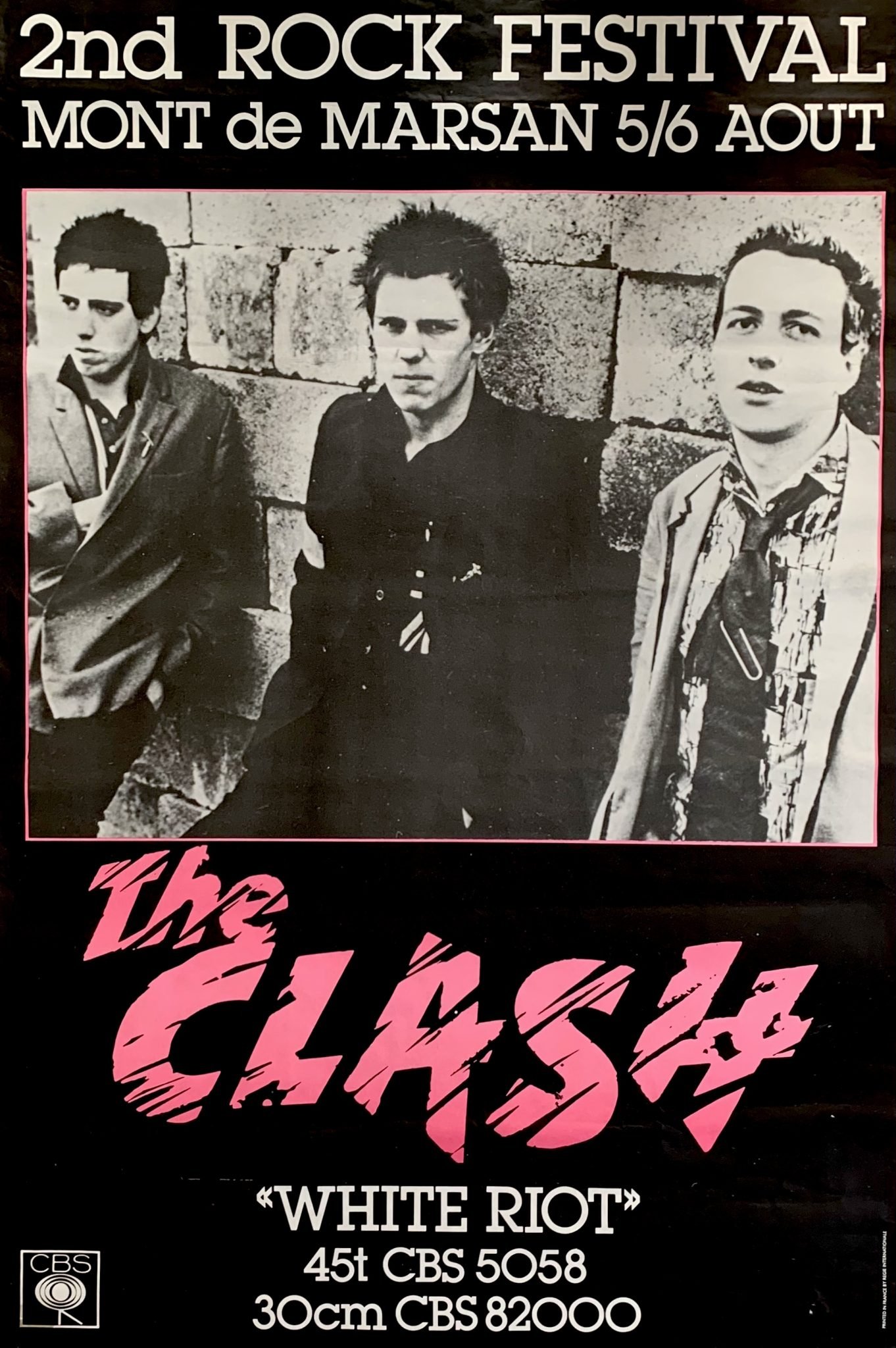
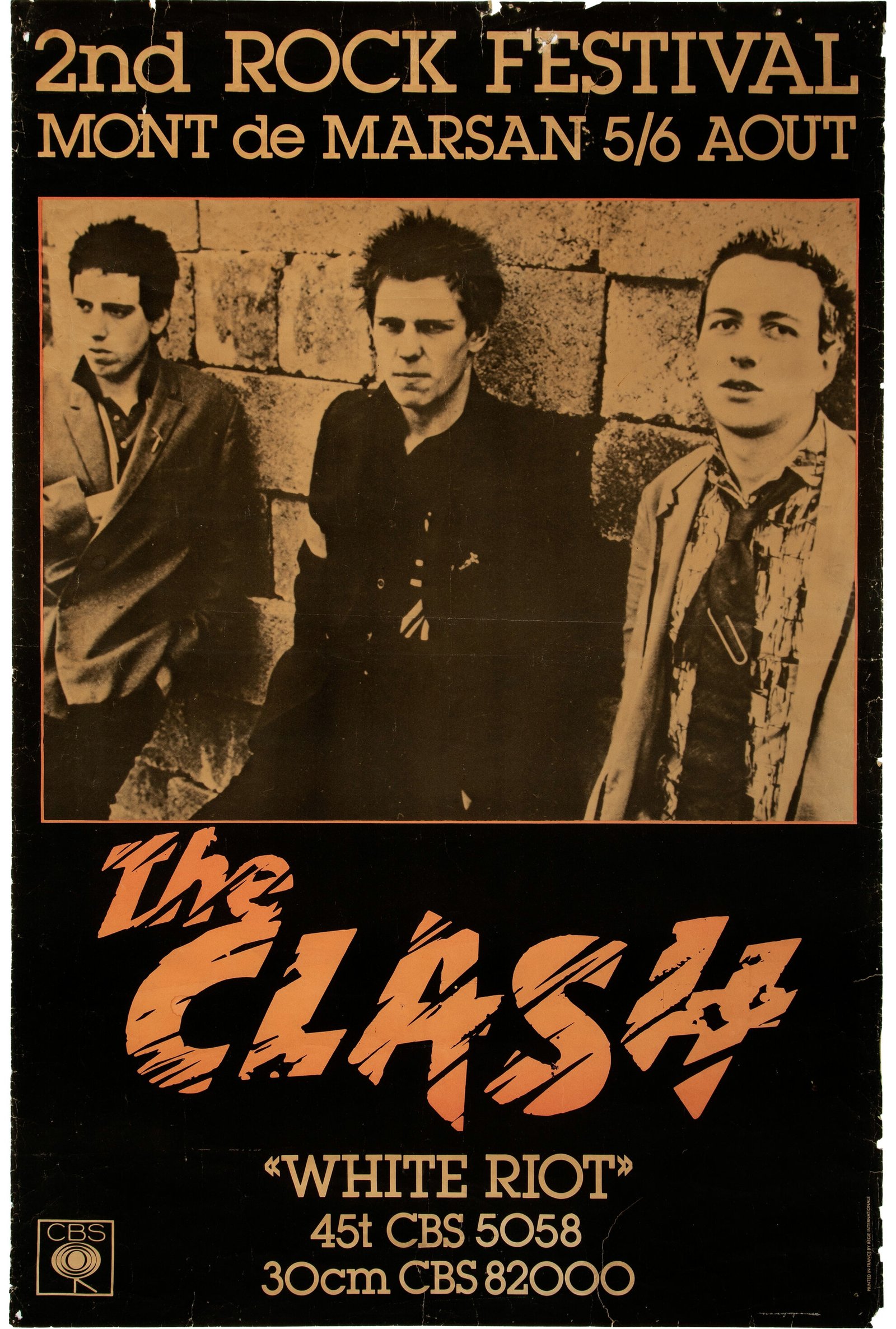
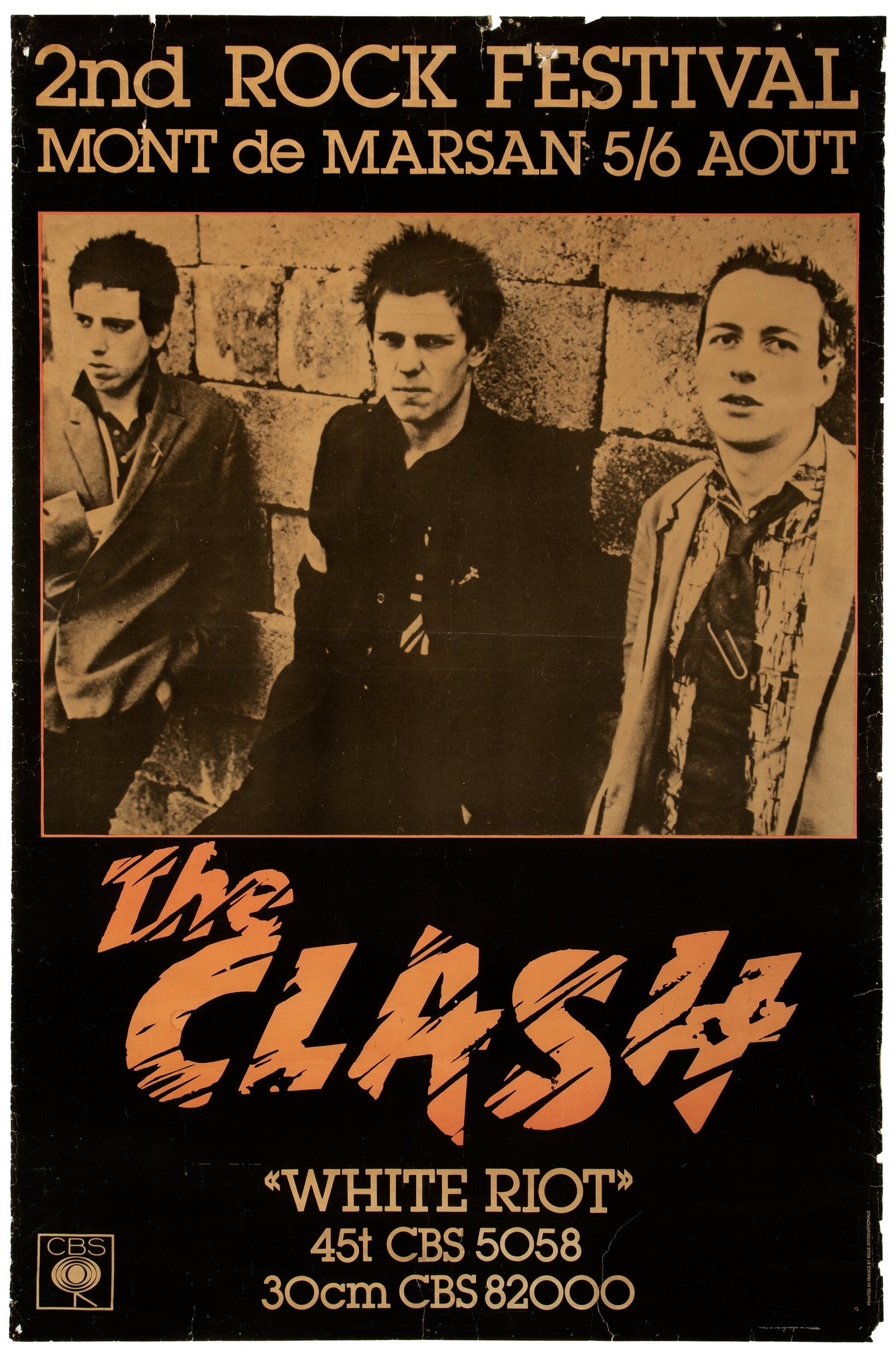
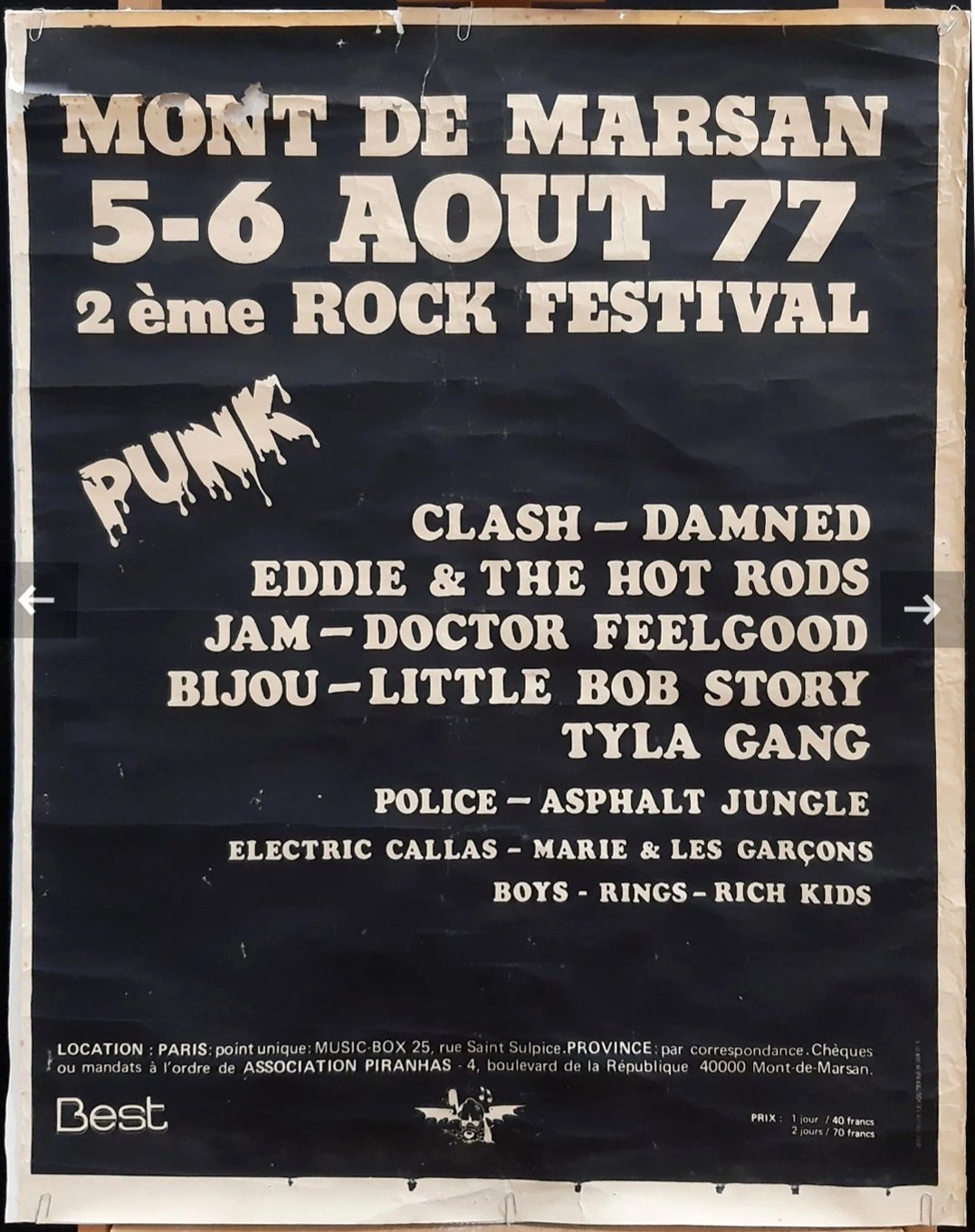
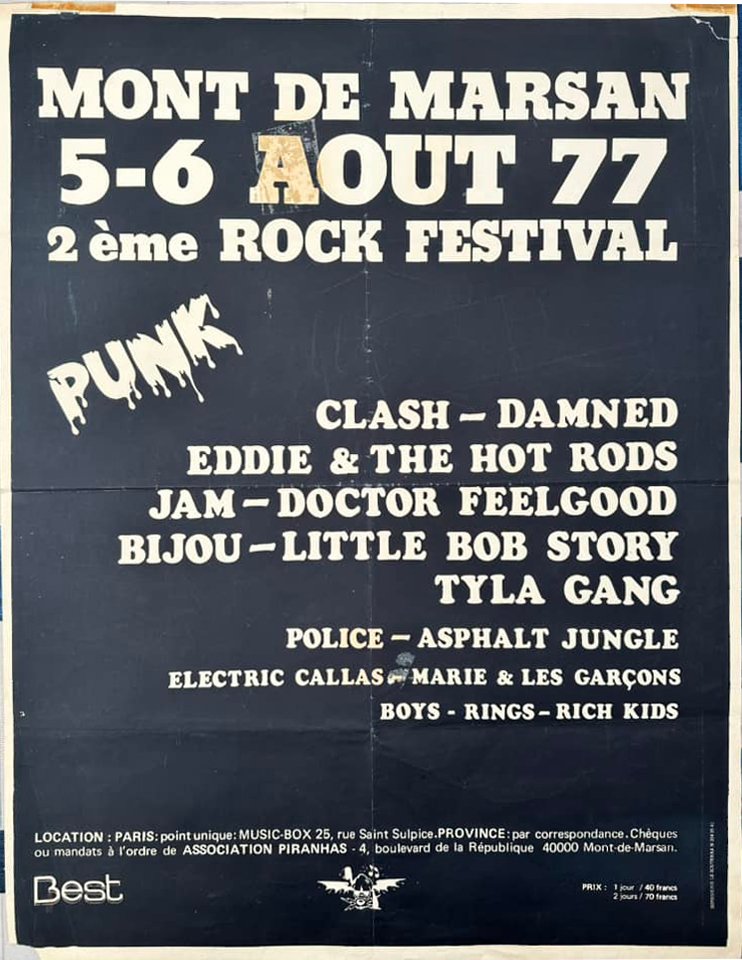
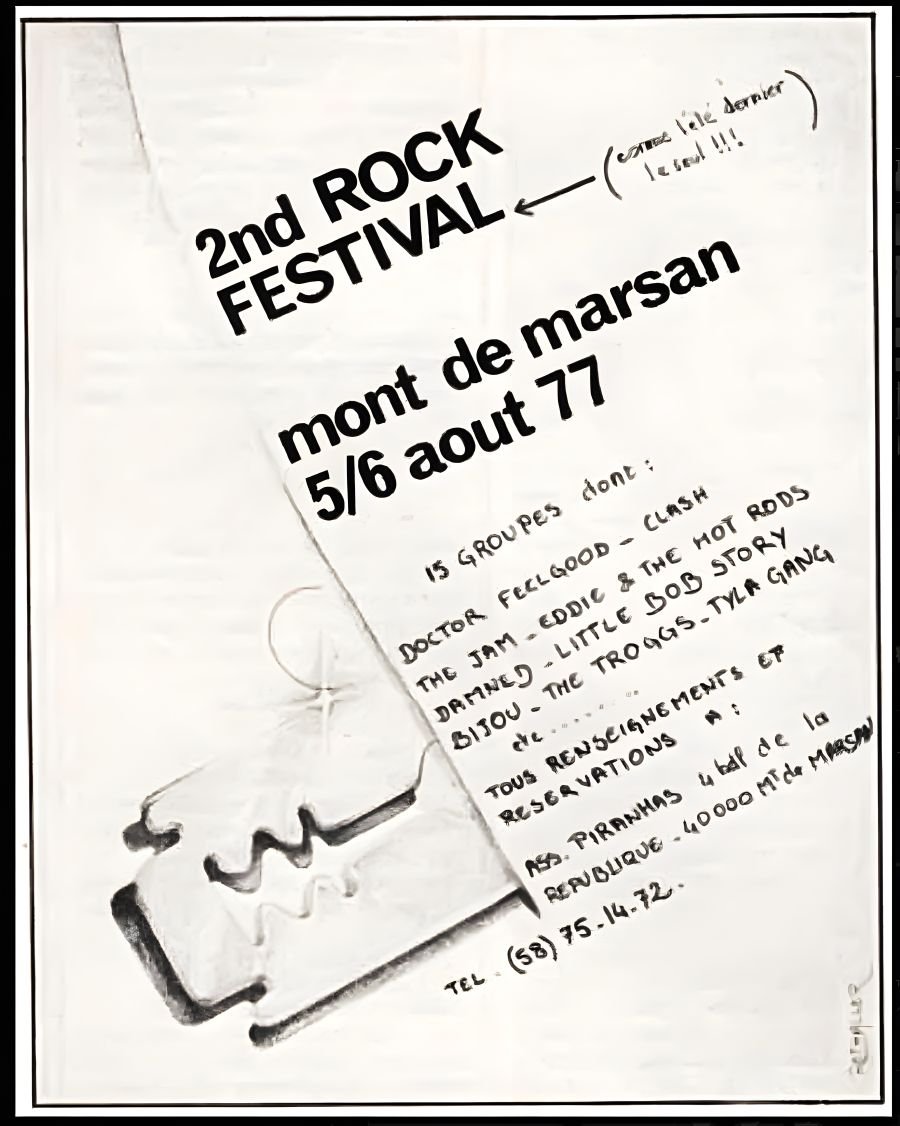
Huge 1977 French Concert Poster, Advertising Debut Single "White Riot"

Record Mecca Auctions: The Clash - Huge 1977 French Concert Poster, Advertising Debut Single "White Riot" A large and impressive French concert poster advertising The Clash's appearance at the 2nd Mont de Marsan Punk Festival, and the release of their debut single, "White Riot." Though French president Valery Giscard D'Estang had banned rock festivals, Europe's first punk festival in took place in August 1976 in the small French city of Mont de Marsan. A second festival was held there the following year, featuring The Clash, as noted on this poster, as well as The Damned, Eddie & The Hot Rods, Dr. Feelgood, The Police, and a number of French groups.

This impressive poster was formerly owned by the festival's organizer and Skydog Records owner, Marc Zermati. It measures 30 3/4″ x 40 1/2″ and is in very good+ condition, with handling and some soft horizontal creasing from having been rolled. There is some tape residue on the back at the bottom corners from having been attached to a wall, but this is invisible on the front. "Printed in France by Regie Internationale" appears on the bottom right edge.

The only example we've seen of this rare poster. With Recordmecca's written lifetime guarantee of authenticity, and a letter from the former owner noting this was formerly in the collection of Marc Zermati.

From the Concerts Fandom website: The Mont de Marsan Punk Festivals were held twice in August 1976 and 1977, in a small city in the deep South West of France, Mont de Marsan…during a time where the conservative President Giscard D'Estaing had outlawed music festivals entirely.

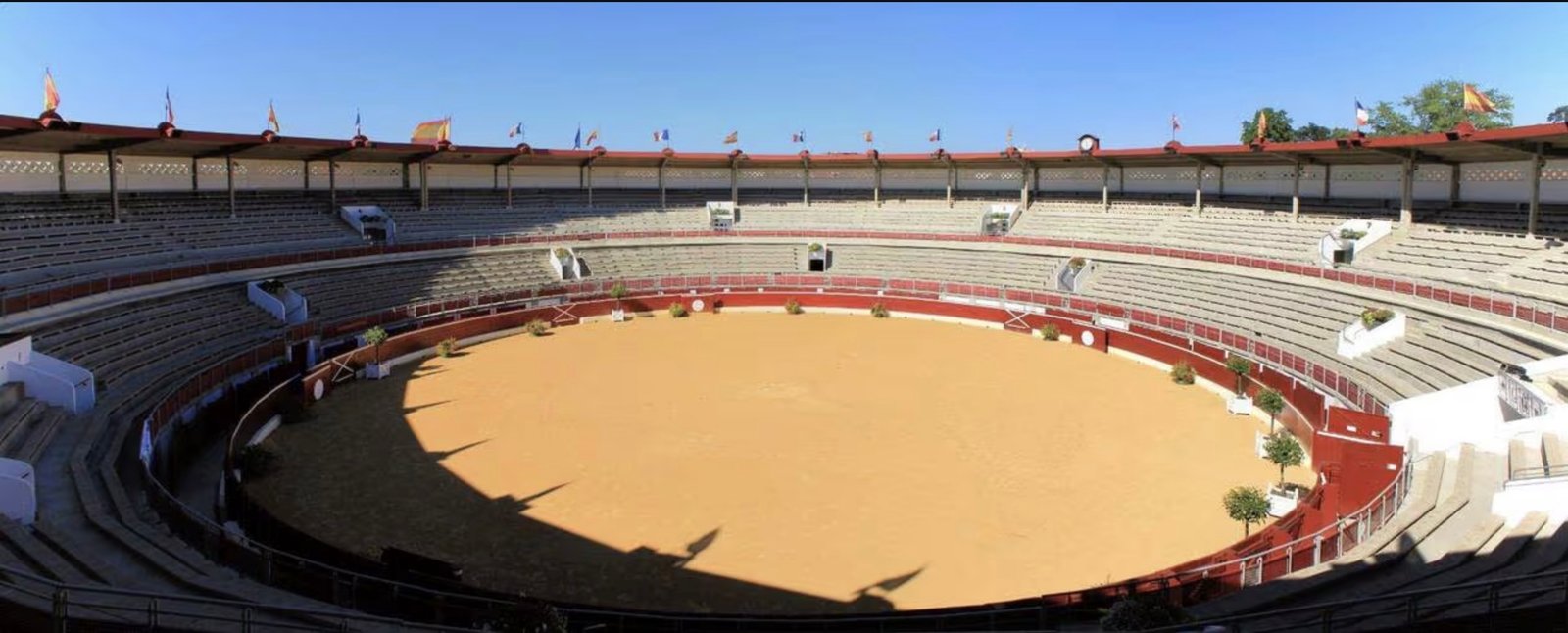
The first took place in August 1976. Marc Zermati [of Skydog Records] was in close contact with Malcolm McLaren and the burgeoning British music scene. Whilst Paris boasted a hub of Punk fans and followers, devotees of the New York Dolls and keen observers of the scenes brewing in London, the choice of location was far from arbitrary. Due to the banning of outdoor music events, Zermati hooked up with his contacts in the sleepy city of Mont de Marsan in order to keep a low profile and avoid persecution…The Arenes de Plumaçon, a bullfighting ring, was chosen as the venue, and the festival was marketed as the first Punk Rock Festival in Europe. Headlining were Eddie and the Hot Rods, and the Pink Fairies, but the highlight was an appearance by The Damned. Supposedly, the Sex Pistols were invited but refused, having seen Eddie and the Hot Rods headlining and owing to some prior beef with Zermati. But amongst the attendees, quoted somewhere between 600-1400, was a young Ian Curtis, with his wife Deborah.

The second festival in the bullring saw 4000 attendees gather under the blistering Landes sun, to see The Damned return, alongside other British acts like The Police, The Clash, Dr Feelgood and Eddie and the Hot Rods who also returned to headline Sunday. French acts included Strychnine, Marie et les Garçons and Asphalt Jungle. The Jam were unable to perform, but much to the enjoyment of the audience, Lou Reed played the arena on the Monday night.

In 1978, the authorities prevented the festival from taking place and it was "relocated" to La Rochelle. It was necessary for the organizers to wait for the arrival of the new mayor, Philippe Labeyrie, in 1983 to bring the festival back to Mont-de-Marsan for three more editions, in 1984, 1985 and 1986. It was then more rock, with punk being a little out of fashion. The Pogues and Nina Hagen participated. However, without financial support from the city, the festival disappeared after the fifth edition.


THE CLASH - RARE 1977 FRENCH CONCERT POSTER.

Sold at Auction. A rare original poster advertising the 'Second Punk Festival' in August 1977 in Mont De Marsan, France with performance by The Clash. Measures approx 30Ωx46ºin. VF condition, some creasing and edge wear, light tears along edge. Sold for £1,600 Hammer Price


Clash City Collectors | Facebook - https://facebook.com/

Clash City Collectoes | Facebook


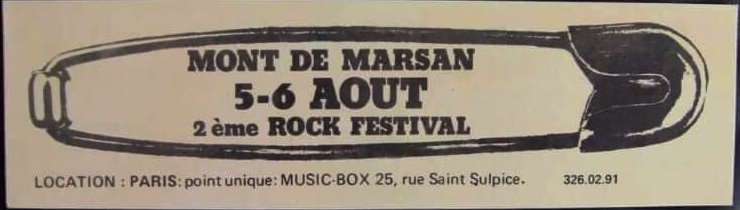
Adverts


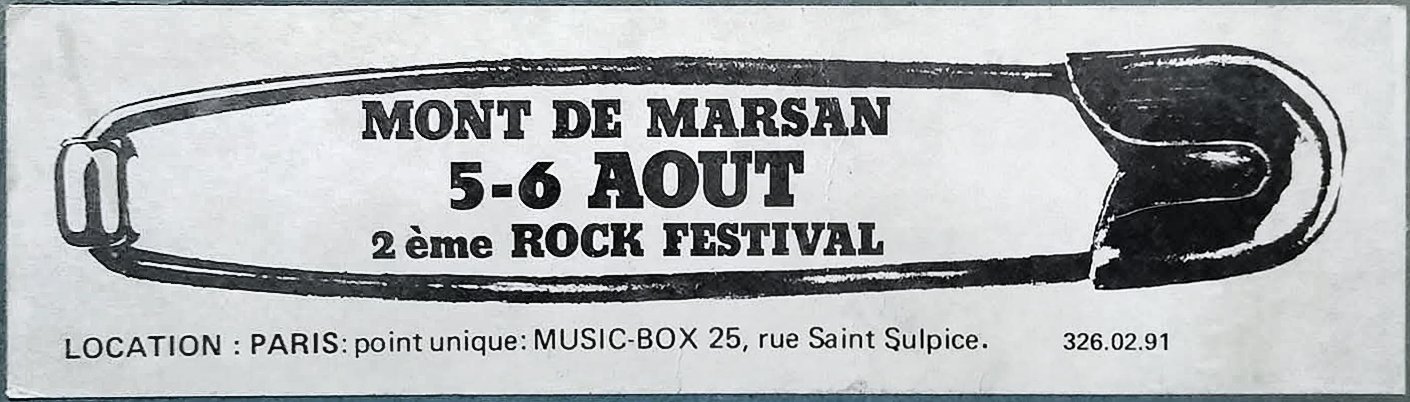
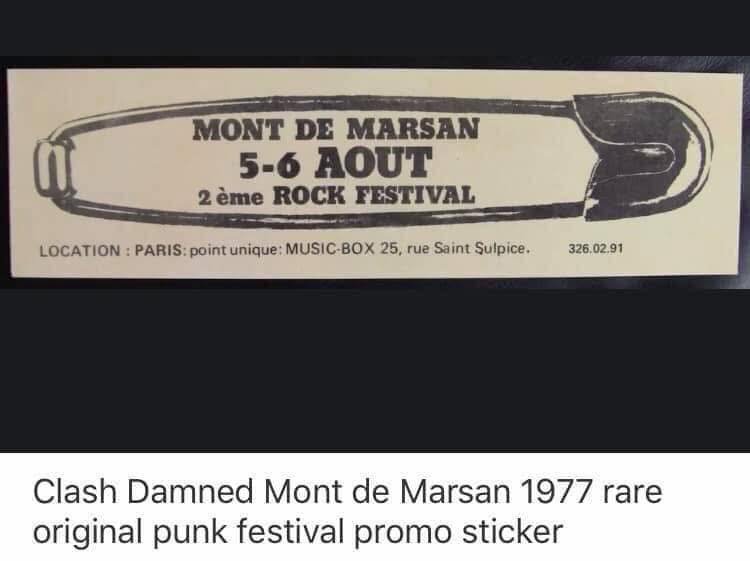
Sticker


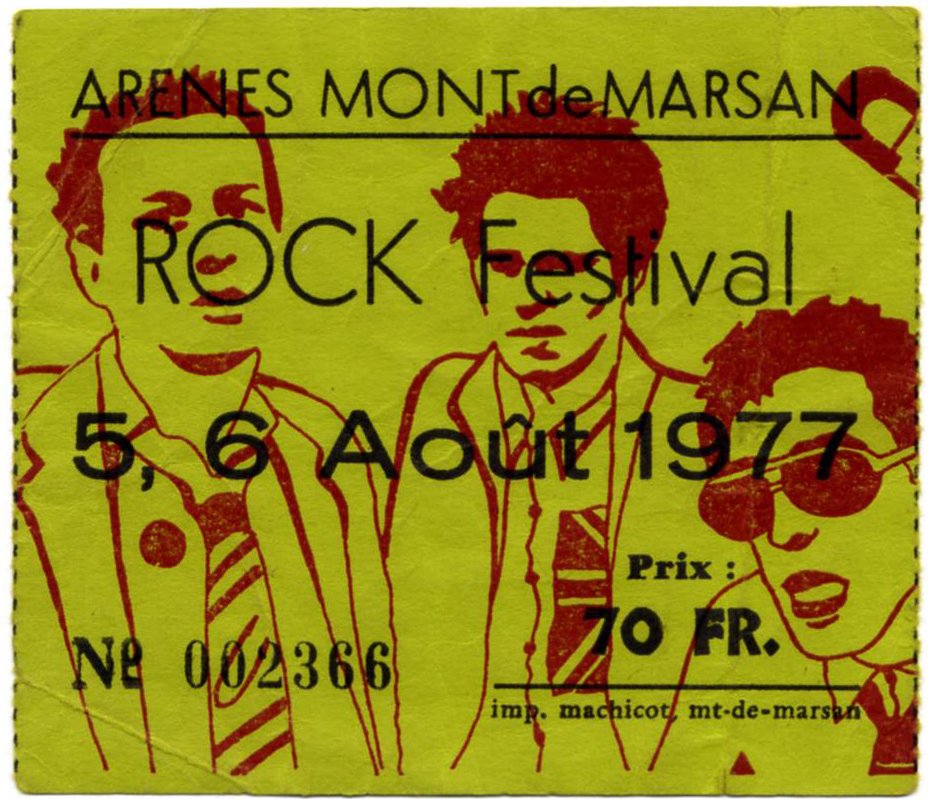
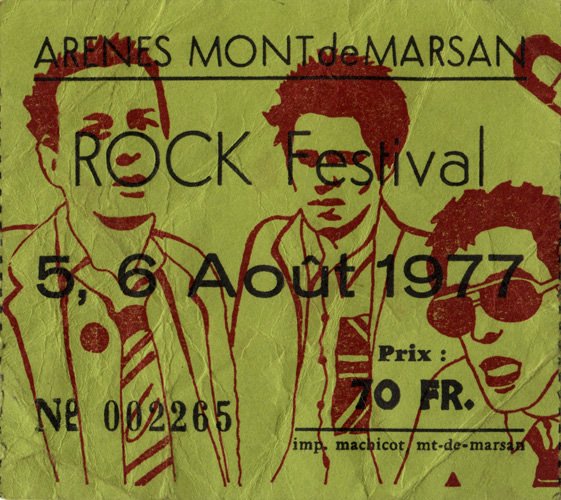
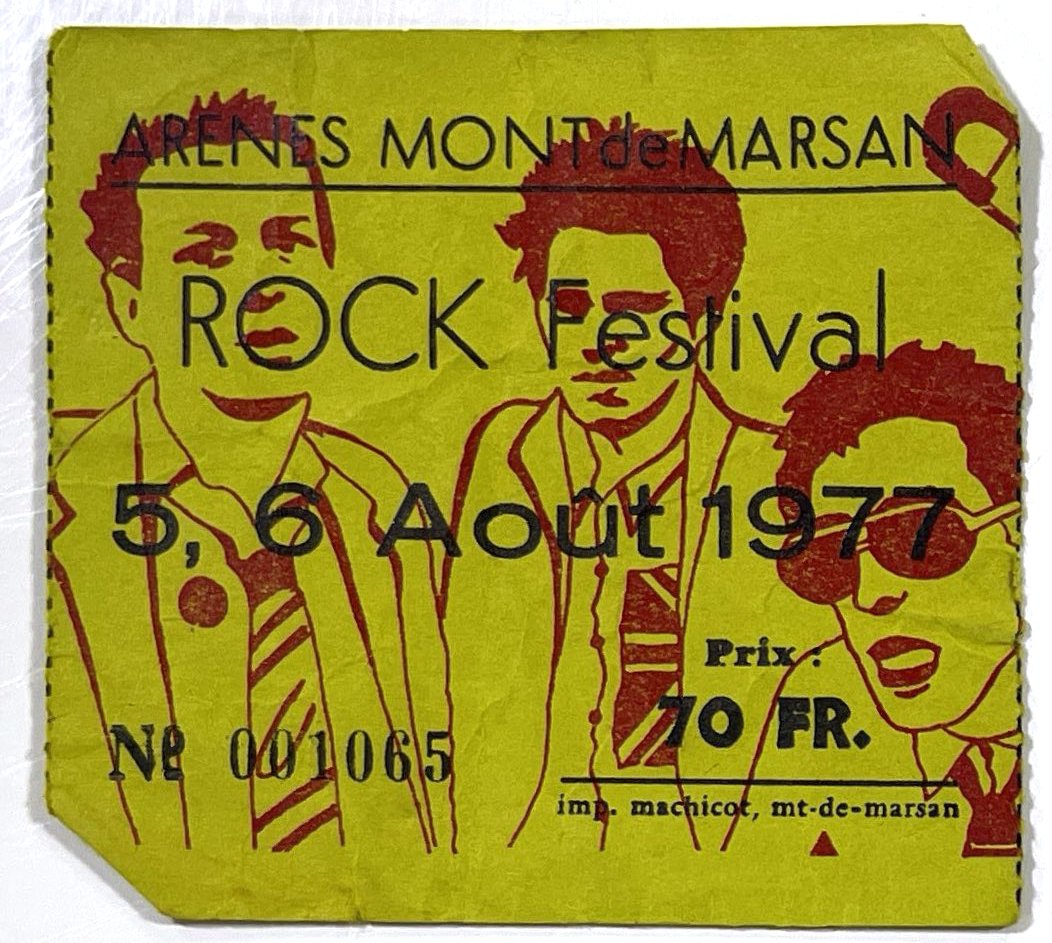
Tickets

An original ticket kindly shared by Jean Luc Mosnier
https://www.facebook.com/ - Clash City Collectors | Facebook

Christophe Prévost ––– Mon ticket


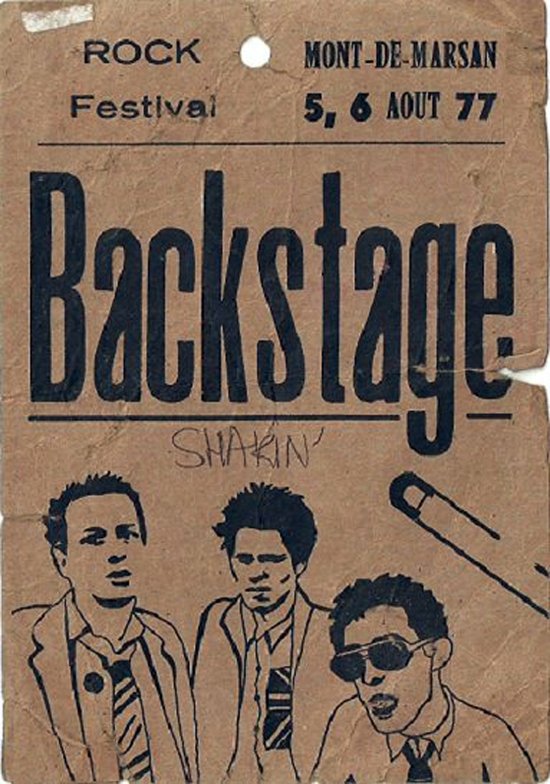
Backstage Pass

Clash City Collectors | Facebook


Other

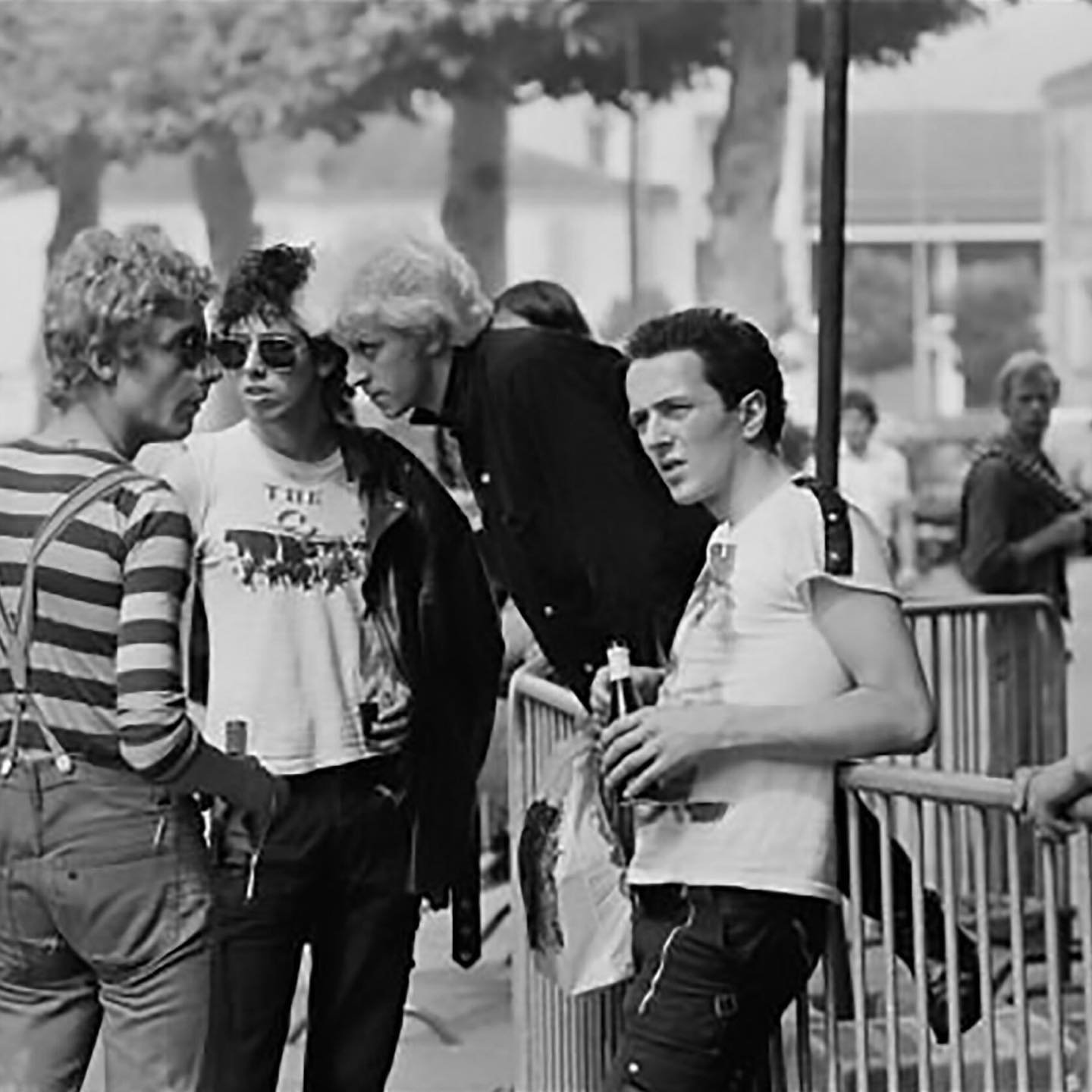
PHOTO

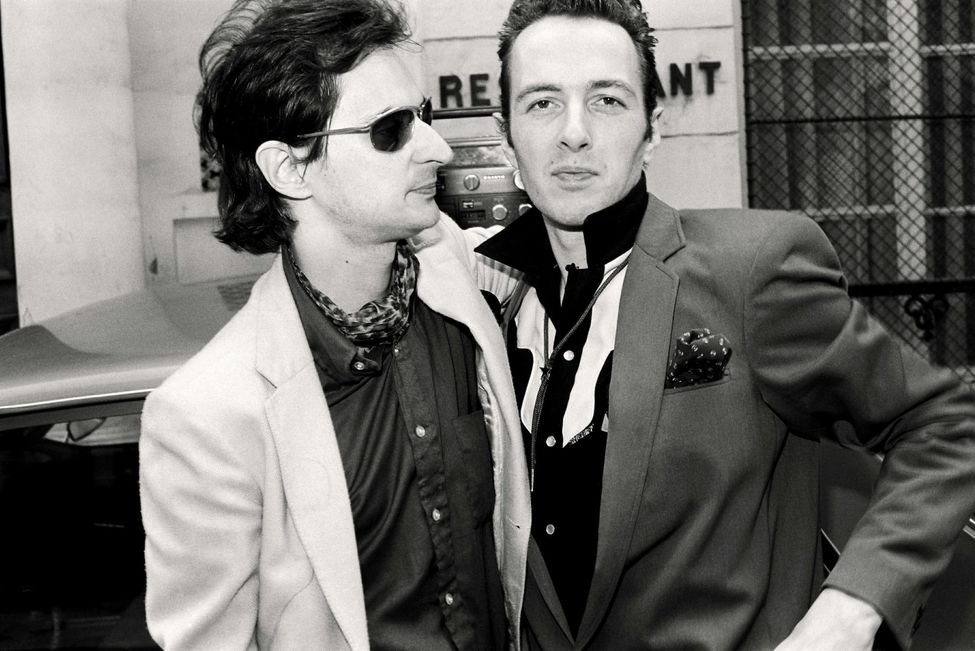
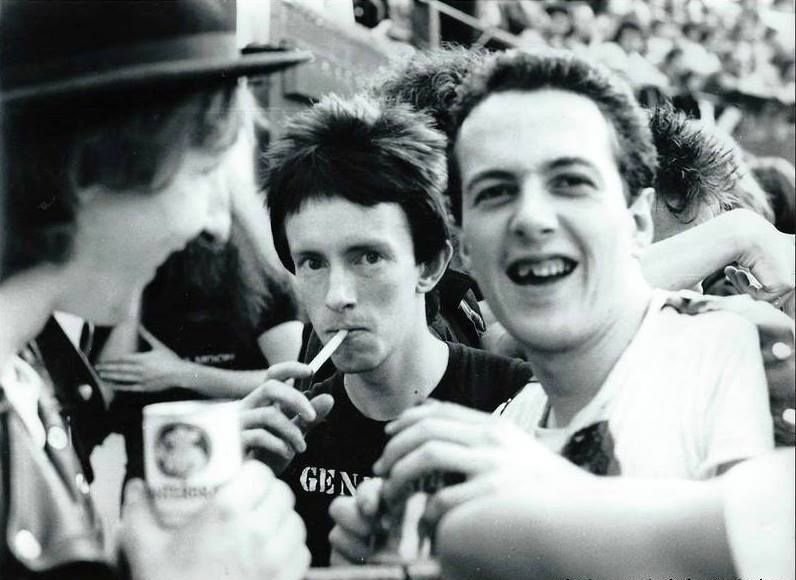
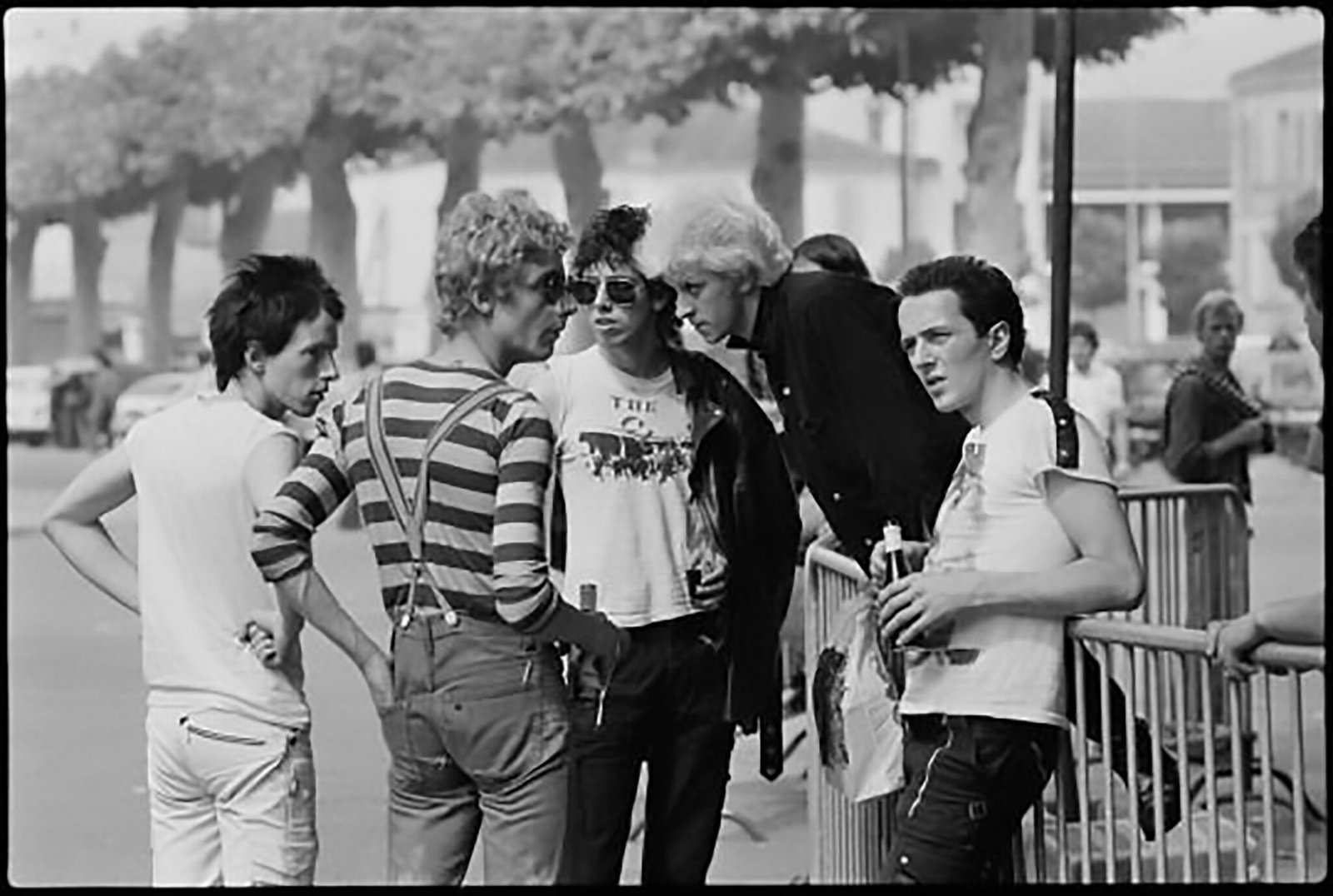
Robin Banks, Mick Jones, Steve Strange, Joe Strummer

Back to the top


Venue

Mont de Marsan Festival, France

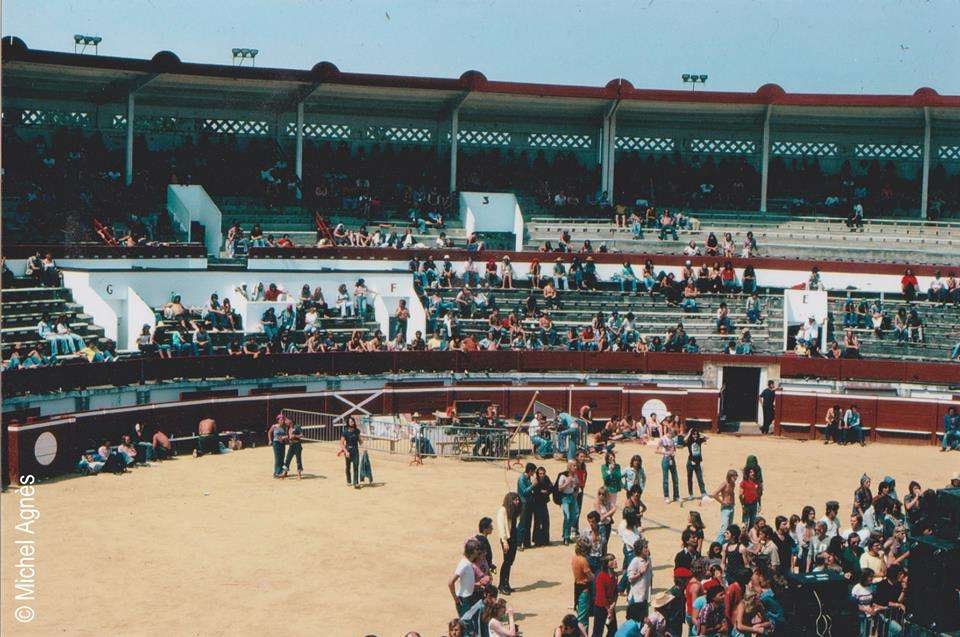
The Mont de Marsan Punk Festivals were early punk rock music festivals held in 1976 and 1977 in the small city of Mont de Marsan in southwestern France at L?Arenes de Plumaçon. Chosen for its low profile in the sleepy city of Mont de Marsan. The city is primarily known for its bullfighting traditions and the annual Fete de Madeline, an Arte Flamenco festival, which is among the most prestigious in the world. The Punk festivals took place in the Plumaçon bullfighting arena. Arènes du Plumaçon bullring, was built in 1897 in Neo-Moorish style and is still actively used today for bullfights, concerts, and other events. As of now, the bullfighting ring still exists and the city of Mont de Marsan continues to host festivals, although they are not punk rock festivals.

The festival was organised by Marc Zermati, owner of the Open Market record shop in Paris which was an early supporter of punk rock. Zermati had connections in Mont de Marsan and chose the city's bullring as a venue due to its remoteness and the mayor's support. The festival was organized by Marc Zermati, a key figure in the punk rock movement [31].

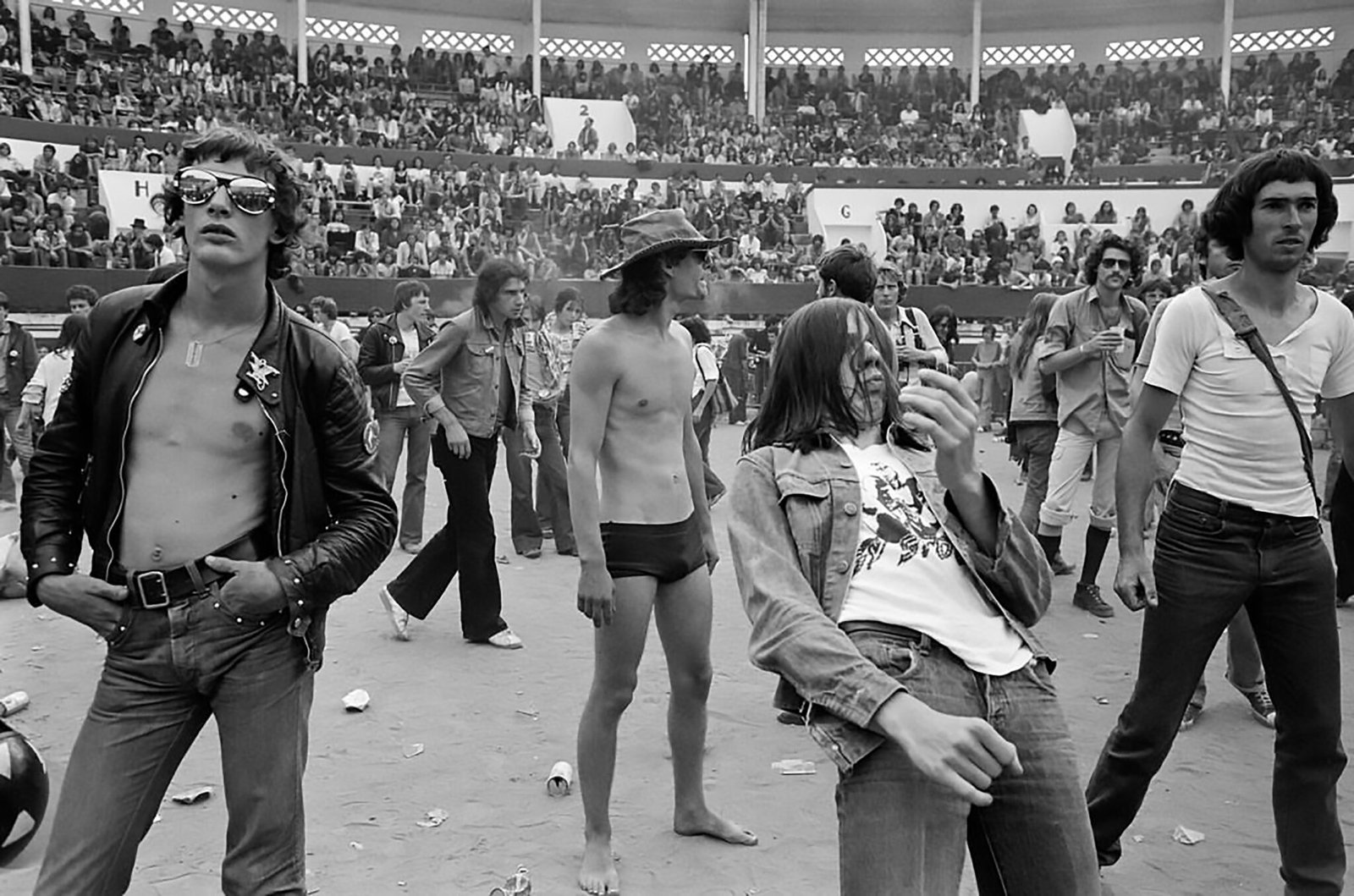
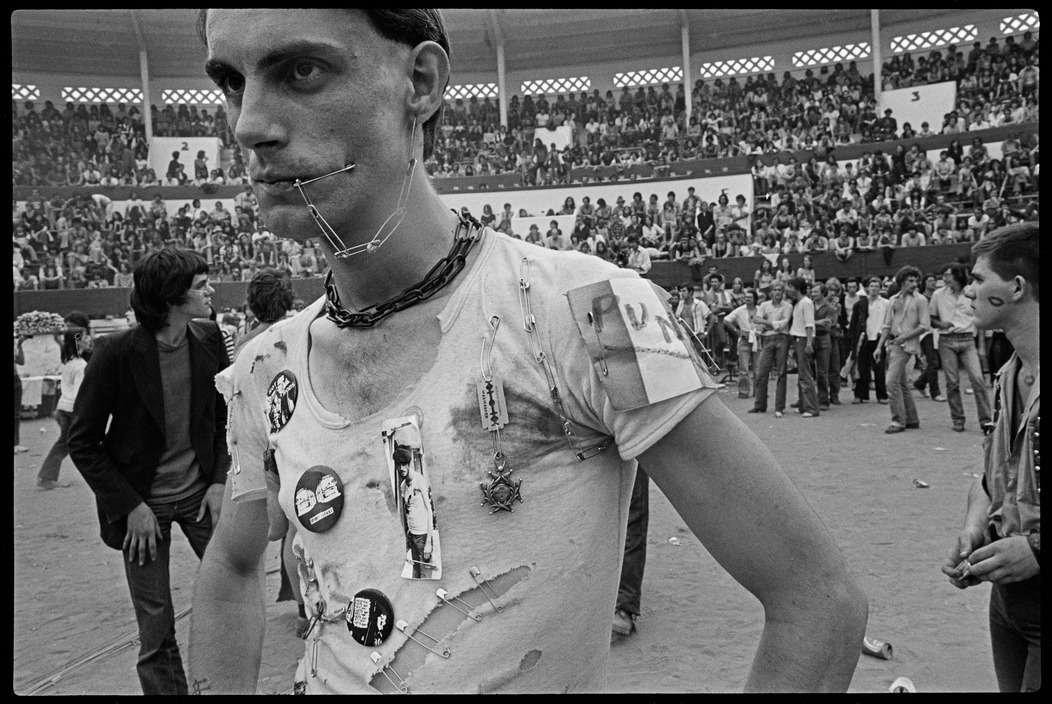
The festival was attended by around 4000 people, who gathered under the hot sun of Landes [32] and drew punk fans from across Europe and shocked the local residents of Mont de Marsan, who were not accustomed to seeing mohawks, leather jackets, and safety pins descending on their small town. Nevertheless, the back-to-back punk festivals in 1976 and 1977 cemented Mont de Marsan's place in punk history for hosting these groundbreaking early events.

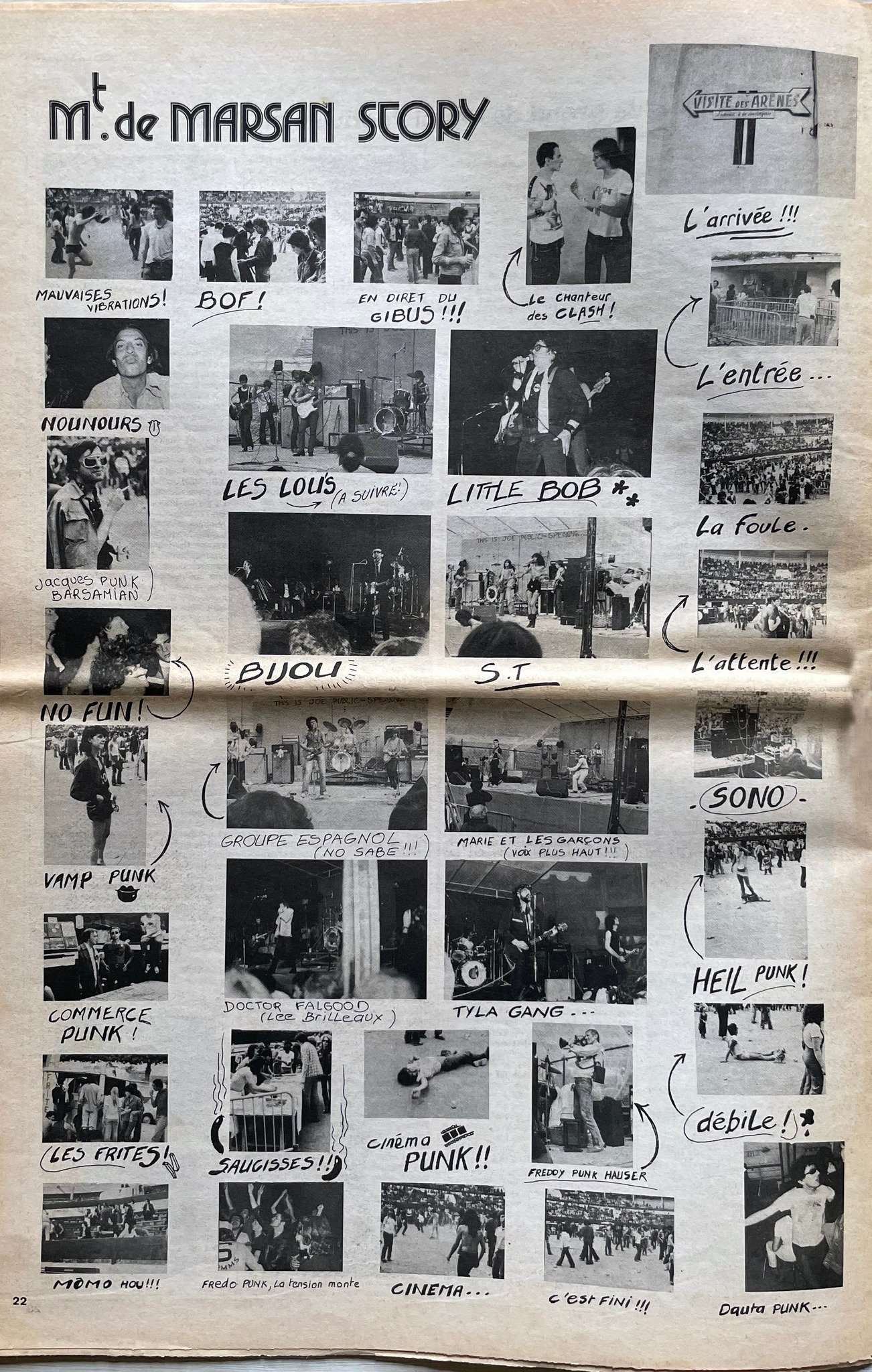
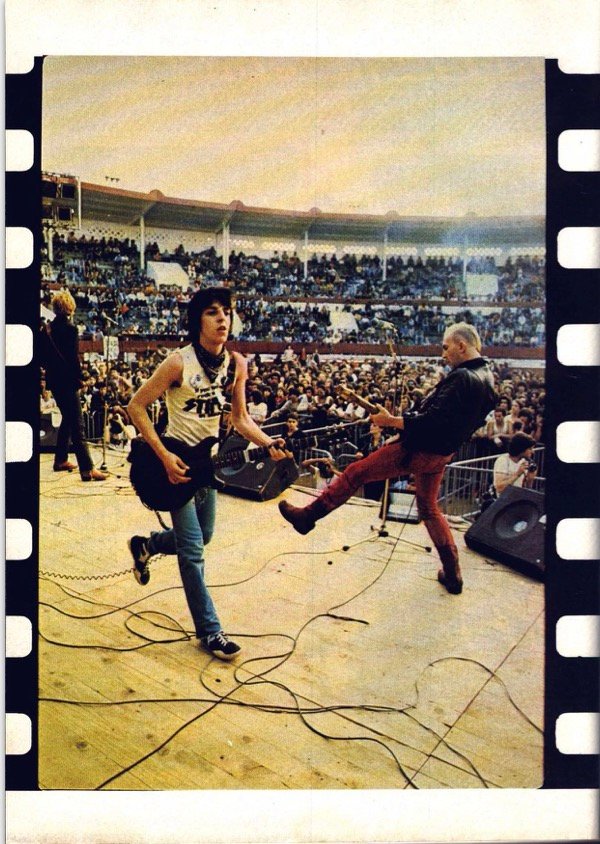
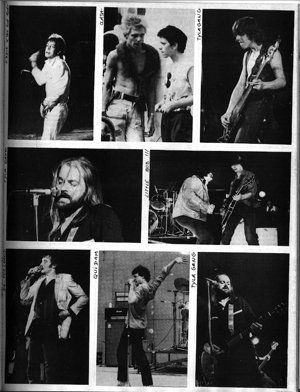
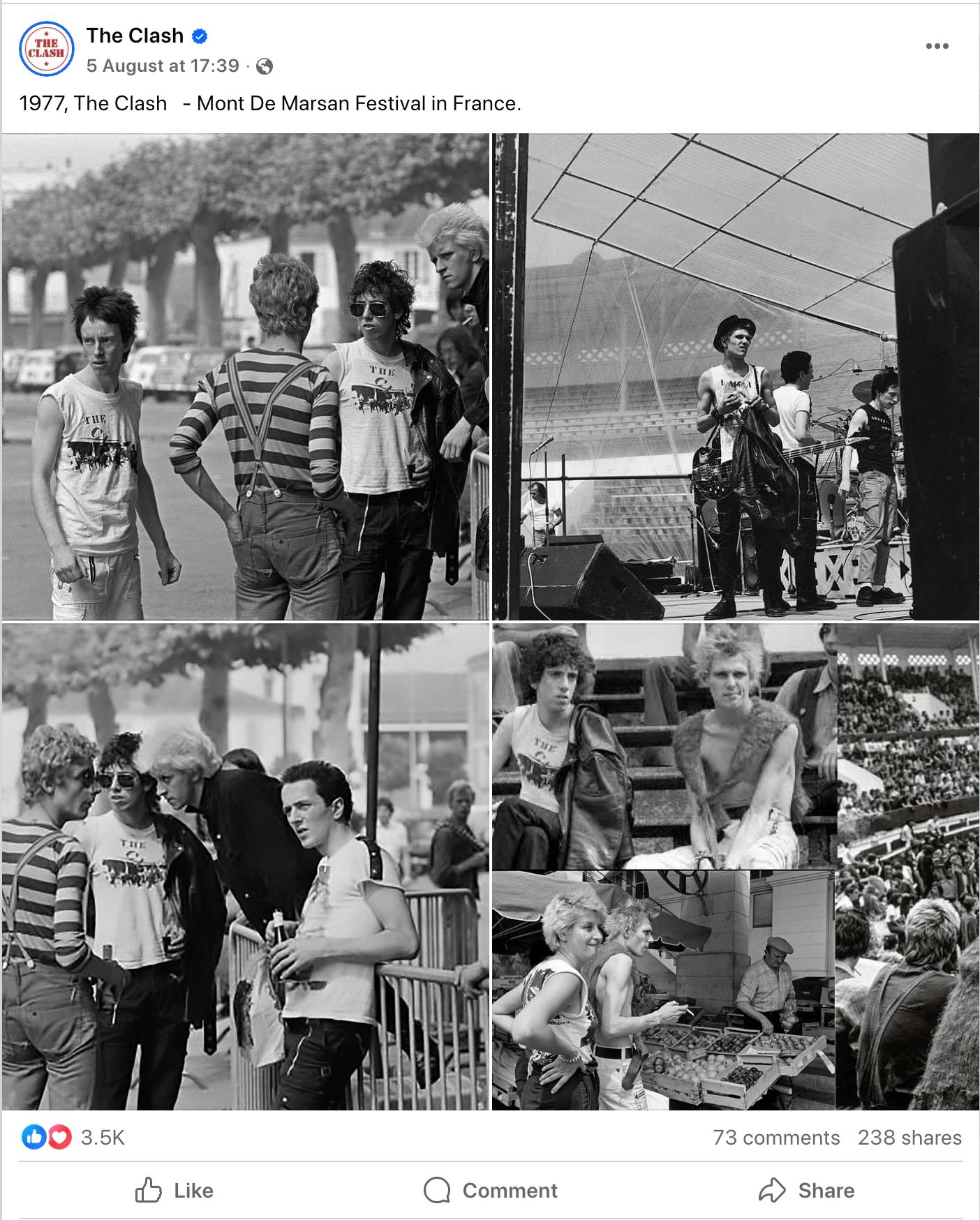
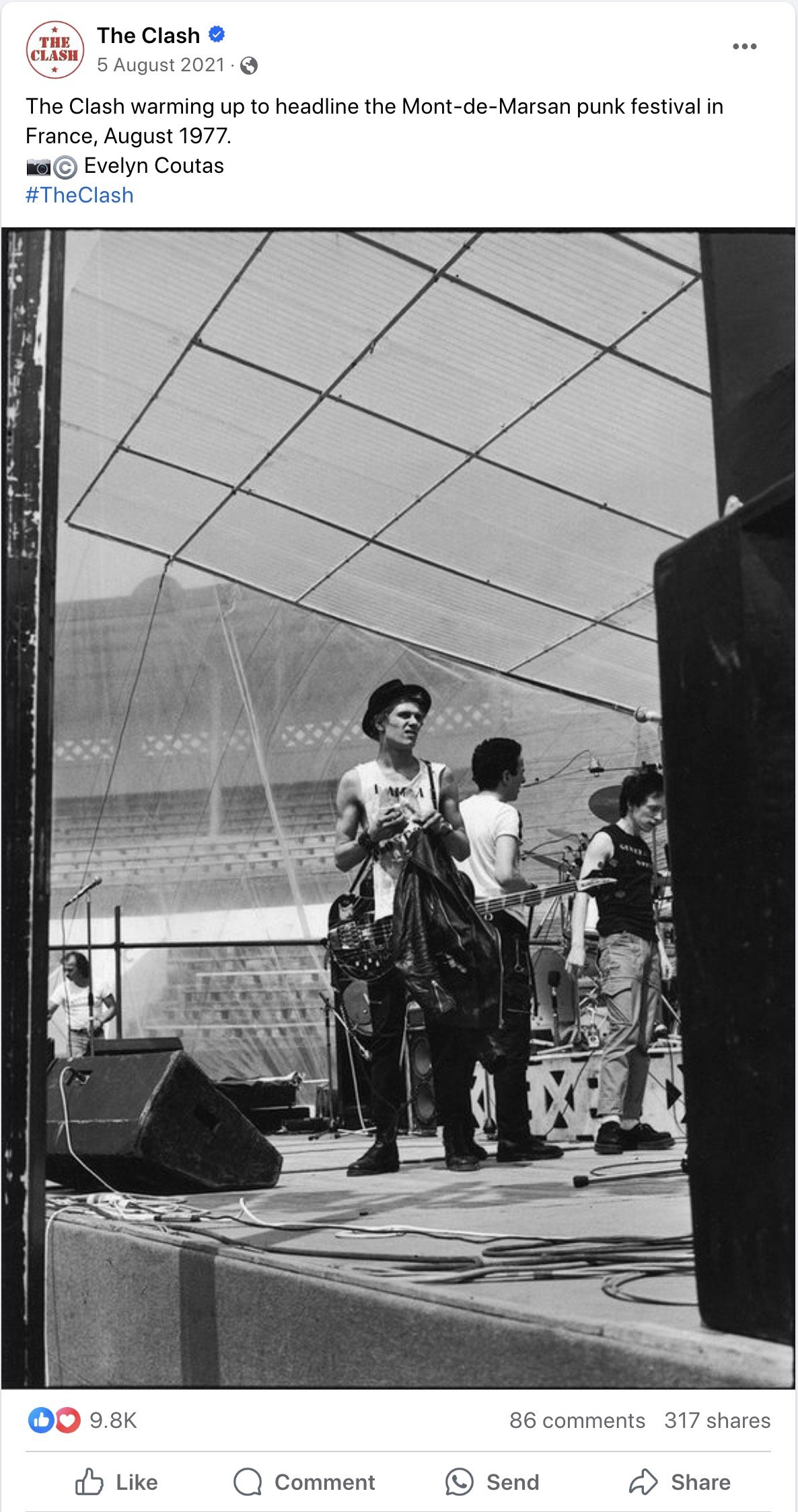
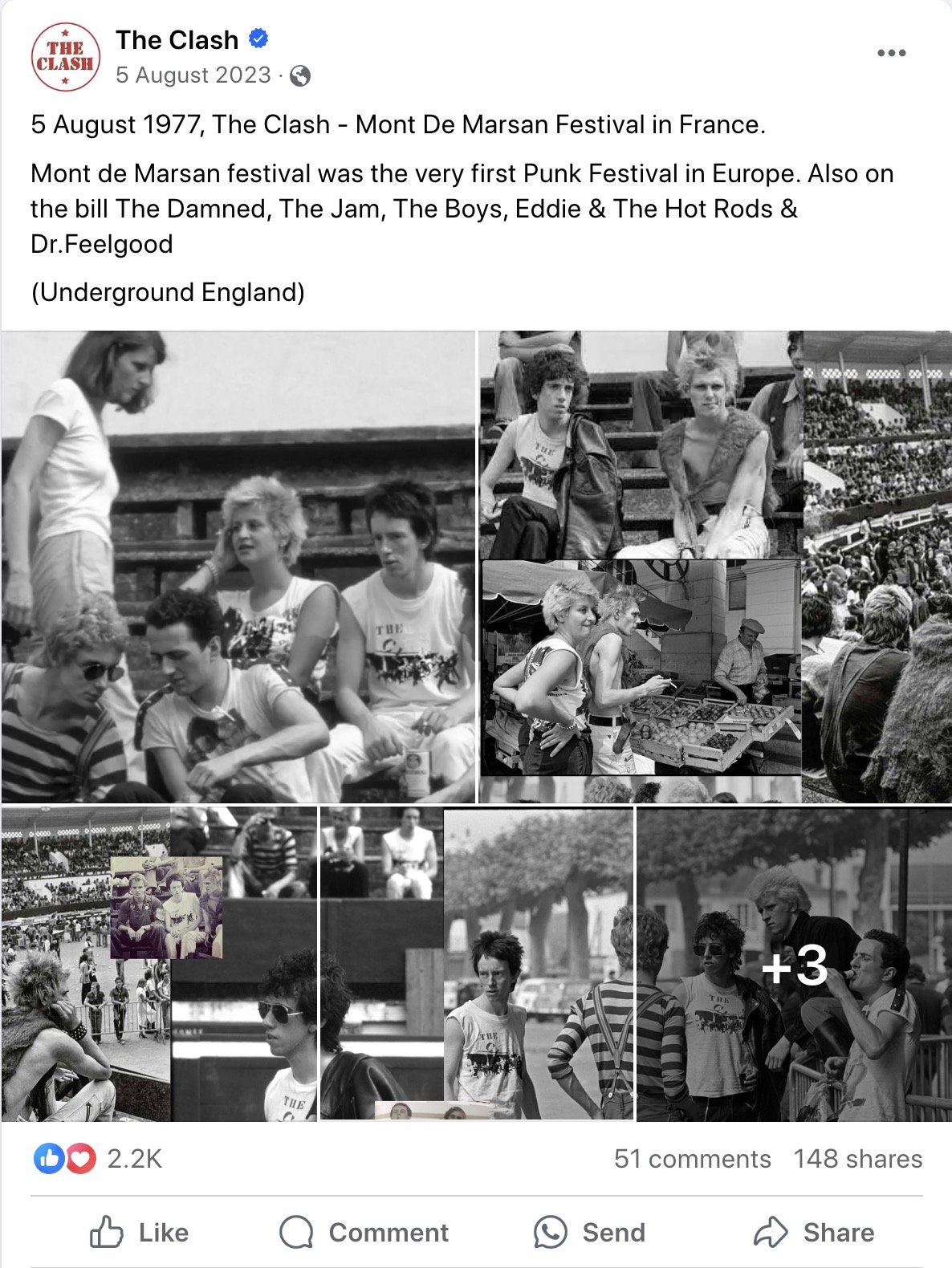
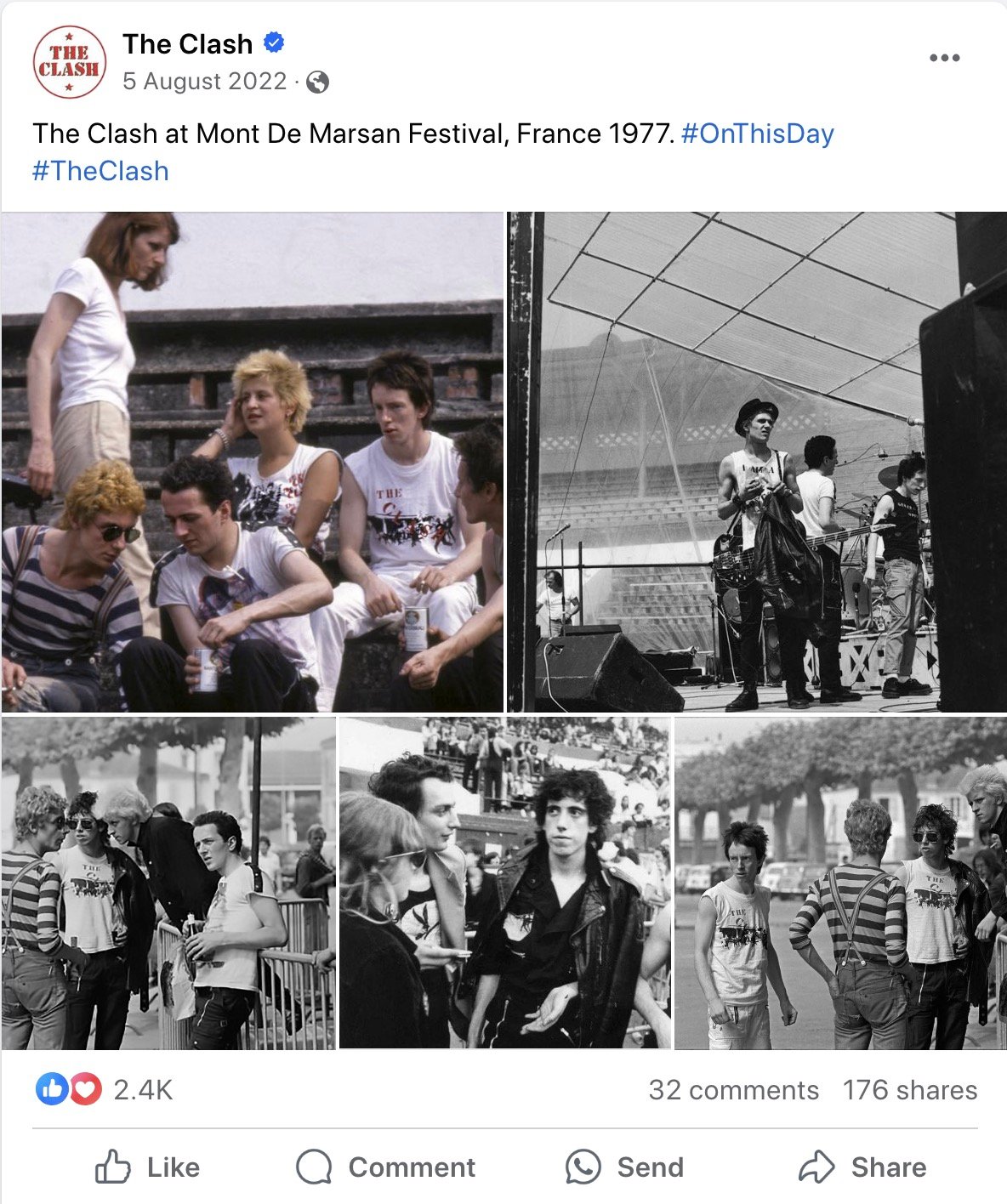
Photos of Joe Strummer and Mick Jones performing live at the festival can be found in the George Bodnar Archive[26] and in Ian Dickson's museum[28] as well as Jean Gaumy. There are also videos of The Clash's performance at the festival available on YouTube[27][29][30].

Links - 1 Aural Sculptors - 2 Far Out Magazine - 3 Clash Wiki - Complete Control - 4 Iconic Pix - 5 All Flamenco - 6 Simple Wikipedia - Mont-de-Marsan - 7 YouTube - Mont-de-Marsan - 8 Concerts Wiki - Mont de Marsan Punk Festival - 9 Discogs - Clash Live At Mont De Marsan 1977 - 10 SFAE - The Clash in Concert - 11 HALSHS - Punk at the Plumaçon - 12 Guide des Landes - 13 Underground England - 14 Wikipedia - Rock Festival - 15 Clash Wiki - The Prisoner - 16 Encyclopedia Britannica - Mont-de-Marsan - 17 France This Way - 18 YouTube - Mont-de-Marsan - 19 France Voyage - 20 Magnum Photos - 21 Olydea - Mont-de-Marsan - 22 The Police Wiki - 23 Wikipedia - Mont-de-Marsan - 24 Information France - 25 YouTube - Mont-de-Marsan - 26 Iconic Pix - 27 YouTube - Mont-de-Marsan - 28 SFAE - The Clash in Concert - 29 YouTube - Mont-de-Marsan - 30 YouTube - Mont-de-Marsan - 31 Far Out Magazine - 32 Underground England

Back to the top


The Gig

...Punk Festival. Around 3,000 people turned up for the two day event

This is a terrific performance and a very good recording and an essential bootleg of early clash performances at the second European Punk Festival at Mont De Marsan, a small town in southwest France near the Spanish border.

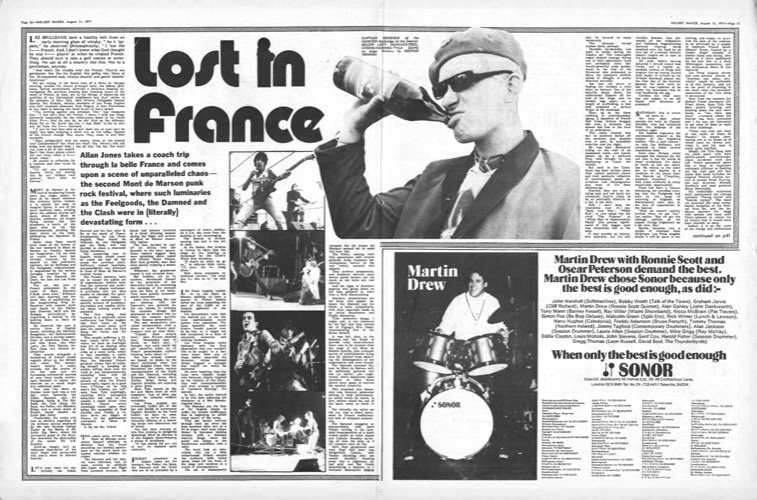
Alan Jones in the Uncut magazine (UK - Oct 2001) laughs about the riotous atmosphere surrounding the festival, of the drunken mayhem caused by the groups ‘enjoying their holiday in the sun’.

Strained band relationships before, dispitated in the extreme heat. The Damned, previously outcasts for their anti-Punk/Pistols appearance at their first festival and subsequent show of dialoyalty on the Anarchy Tour were forgiven. Though earlier in the day when Captain Sensible set off a stink bomb on the stage, an angry Joe Strummer retorted, “they’re fucking jealous, they can just fuck right off”.

However Paul suggests “and another thing we ain’t got a sense of smell!” calming the situation. The Jam too had had a run in as support act during mays White Riot Tour and pulled out amidst acrimony. Mick noted that ‘all the groups agreed to bury the hatchet by the end of the festival’. This did not stop Captain Sensible maniacally chain whipping a bush, because it looked strange, amphetamine psychosis!


Track by track

1. London’s Burning
Performance starts with a shouted London’s Burning , then the band crash in for a great fast version . The quality and intensity of performance continues in the same vein throughout. There are vocal problems in the mix, with Joe & Mick asking for them to be turned up. Vocal levels improve at first chorus.

2. Capital Radio

3. 1977

4. Complete Control
“Listen, I can’t speak French, so listen, can you hear the vocals?, un nouveau chanson!” No I don’t trust you etc, or controlled in the mind etc lyrics yet.

5.
“A new song” The Prisoner

6. I’m So Bored with the USA Some lyric changes.

7. White Man In Hammersmith Palais
“We’re now gonna play some UK pop reggae”. Song addressed to “punk rockers of Europe”, with instead of the later Burton suit’s lyrics which would have not gone down well with Weller and Co present (but totaly pisssed - they jumped in then town centre fountains to sober up!) in the audience, “hippies of the USA, millions of Yen down Japan way”. Not the great climax to the song yet but still excellent performance.

8. Cheat

9. Hate and War “the only thing you’ve got today”

10. Police & Thieves
Bass comes over clearly, very good performance, lead guitar crystal clear “johnny be good &, johnny too bad , John Perry & Lee Perry” One short tape drop out on one channel.

11. Clash City Rockers

12. Remote Control

13. Career Opportunities

14. Janie Jones

15. White Riot

16. Garageland

17. 1977 Almost as good as the first but Joe mistakenly repeats the first verse & catches up only on the final “1984 “!

18. What’s My Name

19. Complete Control

20. Protex Blue The weakest song and performance

21. Mont de Marsan’s Burning “ Look we don’t know when to go”

Back to the top


News Reports

Liberation newspaper, by Sophian Fanen, published on July 12, 2013, Online link or text below

"No future" in Mont-de-Marsan

Europe’s first punk festival took place not in England but in Mont-de-Marsan in 1977, where organisers briefly turned a quiet French town into a welcoming refuge for emerging punk, hosting The Clash, The Damned, The Police, and others in an unexpectedly calm, good-natured atmosphere.

Liberation newspaper, by Sophian Fanen, published on July 12, 2013, Online link or text below

"No future" in Mont-de-Marsan

Home / Culture / Music / Series

It happened. The first punk festival in Europe did not take place in England, but in France, in the Landes.

by Sophian Fanen
published on 12 July 2013 at 7:06 p.m.

The Plumaçon Arenas (“little feather” in Gascon) have a rather charming name. Yet, at the end of the 1970s, they played a very particular role in the explosion of a shouty kind of rock, a music that rejected studio polish and slick, pomaded crooners: punk.

It was right there, in 1977, inside this Mont-de-Marsan venue, that the first punk festival in Europe took place. While the movement was being hunted down by British authorities, the prefecture of the Landes became, for two days—from 5 to 6 August—the refuge of a philosophy that would change the way music was made, by showing a generation that a guitar, an amplifier, and three chords were enough to express oneself.

In 1976, Marc Zermati and his label Skydog Records had attracted 1,500 people for a warm-up edition that struggled against authorities terrified by the idea of hordes of mohawked youths invading the town. “We were received by the prefect a few days before the festival,” later recalled André-Marc Dubos, one of the organisers, to Sud-Ouest. “I told him: ‘It’s simple—if the guys turn up and there are no concerts, they’ll trash everything. It’ll be worse than if the festival actually happens!’” In the end, everything went well—well enough for the same team to scale things up the following year.

The Clash then played in front of 4,000 people, alongside The Damned and newcomers The Police, while The Jam, led by Paul Weller, refused to play after the French kings of the moment: Little Bob Story. Also on the bill were Asphalt Jungle, with Patrick Eudeline on vocals, and the now-forgotten Tyla Gang, who won unanimous praise from the press.

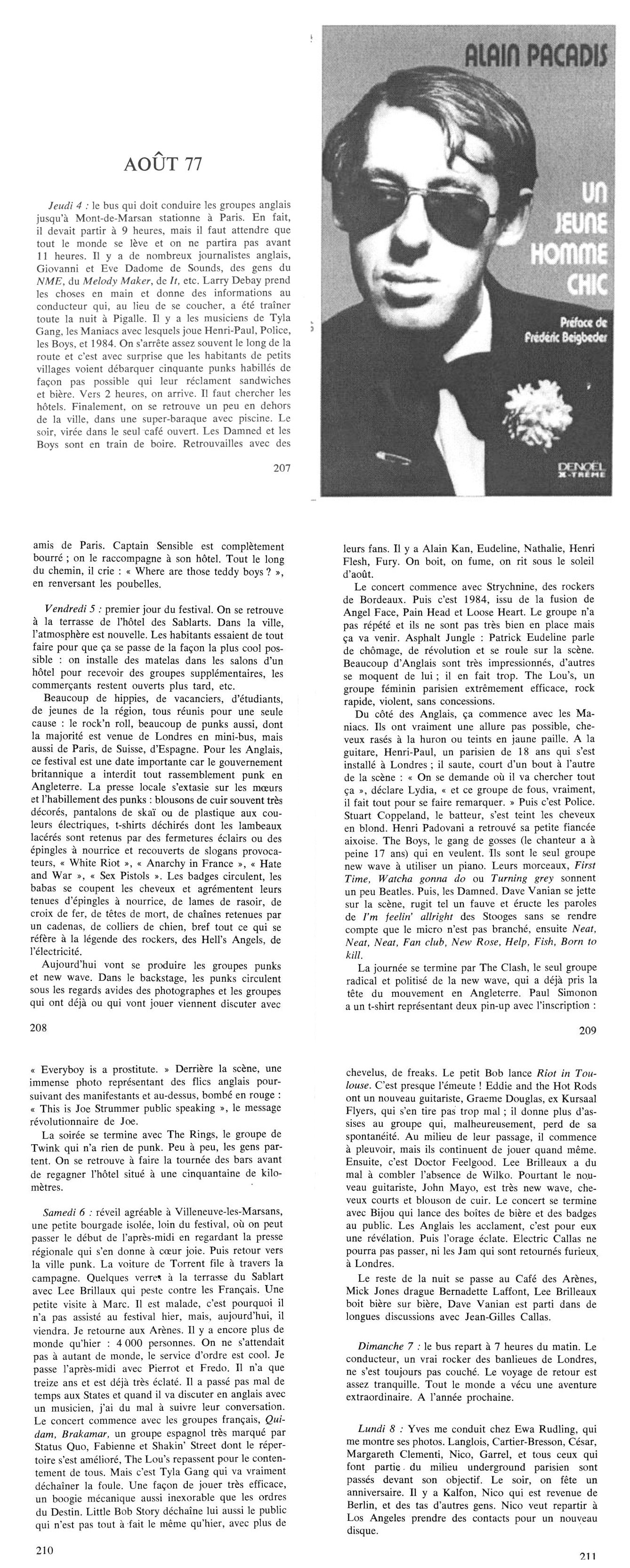
As for the feared hordes of raving lunatics, reality was far removed from that image: articles from the time instead describe a good-natured festival. Alain Pacadis, who made the trip for Libération, recalls “a calm little town [trying] to do everything so that things would go as smoothly as possible: mattresses were set up in hotel lounges […], the Café des Sports opposite the arenas stayed open all night. Beer flowed freely and the people of Mont-de-Marsan didn’t take offence when they saw joints being passed around.”


French

Accueil / Culture / Musique

Série

«No future» à Mont-de-Marsan

Ça a eu lieu. Le premier festival punk d’Europe n’a pas eu lieu en Angleterre mais en France, dans les Landes.

par Sophian Fanen

publié le 12 juillet 2013 à 19h06

Les arènes du Plumaçon («petite plume» en gascon) portent un nom bien mignon. Pourtant, à la fin des années 70, elles jouent un rôle particulier dans l’explosion d’un rock gueulard, une musique qui rejette la joliesse des studios et les crooners gominés : le punk.

C’est bien là, en 1977, dans cette enceinte de Mont-de-Marsan, que se tient le premier festival punk d’Europe. Alors que le mouvement est pourchassé par les autorités britanniques, la préfecture des Landes devient pendant deux jours, les 5 au 6 août, le refuge d’une philosophie qui va changer la façon de faire de la musique en montrant à une génération qu’une guitare, un ampli et trois accords suffisent pour s’exprimer.


En 1976, Marc Zermati et son label Skydog Records ont attiré 1 500 personnes pour une édition d'échauffement qui s'est débattue contre des autorités effrayées à l'idée de voir des hordes de jeunes à crête envahir la ville. «On a été reçu par le préfet quelques jours avant le festival, a depuis raconté André-Marc Dubos, l'un des organisateurs, à Sud-OuestJe lui ai dit : "C'est simple, si les mecs arrivent et qu'il n'y a pas de concerts, ils vont tout saccager. Ce sera pire que s'il y a le festival !"» Tout s'est finalement bien passé, assez pour que la même équipe remette ça en grand l'année suivante.


The Clash jouent alors devant 4 000 personnes, avec The Damned et les nouveaux venus The Police, tandis que les Jam, de Paul Weller, refusent de jouer après les rois français de l’époque : Little Bob Story. On y croise aussi Asphalt Jungle, avec Patrick Eudeline au chant, et les oubliés Tyla Gang, qui font l’unanimité dans la presse.

Quant aux hordes de fous furieux redoutées, on en est loin, les articles de l'époque décrivant plutôt un festival bon enfant. Alain Pacadis, qui a fait le voyage pour Libé, se souvient ainsi d'«une petite ville calme [qui essaye] de tout faire pour que ça se passe de la façon la plus cool possible : on installe des matelas dans les salons des hôtels […], le Café des sports en face des arènes reste ouvert la nuit. La bière y coule à flots et les Montois ne s'indignent pas quand ils voient tourner des joints».


Rock & Folk Magazine

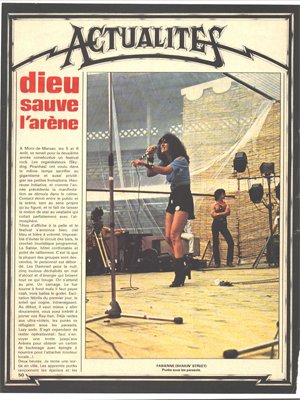
Actualties - dieu sauve l'arene

The piece describes the 5–6 August festival in Mont-de-Marsan, where a mix of major and small bands played in a relaxed, stardom-free setting marked by heat, beer, and tensions between The Clash and The Damned. Standout sets from The Damned, The Clash, Little Bob, and Bijou contrast with weaker performances from others, yet the event remains calm and successful. It ends with Lou Reed’s late, uneven set, featuring “Sweet Jane” and “Heroin”, which closes the weekend on a subdued note.

Rock & Folk Magazine

Actualties - dieu sauve l'arene

God Save the Arena

In Mont-de-Marsan, on 5 and 6 August, a rock festival took place for the second consecutive year. The organisers (Skydog, Piranhas) wanted at the same time to make concessions to gigantism and also to give priority to small bands. A happy initiative, and as in the previous year the event took place calmly. Close contact between the audience and the stage, both literally and figuratively, and the fact of leaving the notion of stardom in the cloakroom fitted perfectly with the atmosphere.

Headliners aplenty and the festival looks promising: blue skies and beer in abundance. Impossible to avoid the circuit of bars, the pre-planned tourist detour. Le Sablar, a comfortable hotel and rallying point. It is there that most of the bands are staying; the staff are overwhelmed. The Damned for the night: five little maniacs unleashed, short on alcohol and energy, smashing everything that moves. One expects the worst. A bloodbath. The bar is running full throttle but you have to pay cash, three francs a cup. Feverish excitement of the first day, the sun pounding down relentlessly. At first, it’s better to take it easy; you’d do well to wear your Ray-Bans. Already stiffened by ultraviolet light, the punks take refuge under parasols. Lazy sods.

Still, you have to remain operational: you have to trek all the way to the Arenas to obtain a backstage pass secured with a safety pin (local colour…). Two hours. I try a trip into town. Apprentice punks shake down grocers and the—

PHOTO: FABIENNE (SHAKIN’ STREET) — Punks under parasols.
50

PHOTO: LOU’S — Friday and Saturday.

Giant radar dishes in keeping with tradition. “Who’s got a Valstar?”, “Pass me your bottle opener”, nothing nasty. On the edge of a pavement, a hippie in a hurry to keep up with fashion gets his hair clipped short, modified punk style, para… It smells like a festival.
In the central cafeteria, local Rockys strut about, smelling of pizzas and not missing a chance to mock a retard who dared to go out without his plastic banana on his head. Back at Le Sablar, I run into Mick Jones, hollow-eyed, badly shaved, looking like Keith Richards. Everyone knows each other, cool vibe — except between The Clash and The Damned, where things are turning sour. The Damned refuse to play in front of the set installed by The Clash, a huge riot photograph. Rat Scabies, Captain Sensible, hysterical louts, gesticulate and pace the wings, drifting in a cloud of perfection. Joe Strummer sports his anarcho-syndicalo-Trotskyist air that throws Kronenbourg off course. The terrace of Le Sablar is packed; punks swap scribbled T-shirts and smash into rare badges. Everyone looks like bats exposed to the pallid midday light. Seventeen-year-old kids with blasé expressions…

Friday

1984 opens the festival with five well-tightened numbers, in exchange for hotel and travel. Then Lou’s, Asphalt Jungle, and the Maniacs from London, all under torrid heat. Next Police, followed by The Damned, and luckily when they hit the stage it’s night. Hypnotised spectators press against the barriers like a starving pack. Dave Vanian exorcises demons, plunges into the crowd and bursts forth from a thousand outstretched hands. He clings to the PA columns, ready to topple backwards. The spotlights halo him. Bare-chested, possessed by his persona. A Damned set not to be forgotten any time soon…

Then there are The Boys and The Clash, replaying for their fans and for the hundredth time their colourful class-struggle cinema. During the show, stink bombs explode on stage. Strummer, body shaking with rage, screams into the mic: “Do you understand… it’s those arsehole Damned who are jealous!” And they launch into one of their standards, politically weekly style. Strummer foams and wrecks three guitars, he’s going to kill them. Captain Sensible gets thrown off stage by the crew; he’s K.O. That’ll teach him. Two a.m., Rings come on to close a more-than-satisfying day. The party continues until morning in the small town, bars and hotel rooms under siege. Punks relive the good moments on mini-cassette. A few more beers before sleeping, brain scrambled.

Saturday

There’s something for everyone. Today it’s rock’n’roll’s turn, with a few exceptions. Plenty of French bands again: Shakin’ Street, Lou’s again (which seems a mistake, since the Lyon band Electric Callas won’t be able to play for lack of time). Another Lyon group, Marie et les Garçons, draws attention with its sophisticated rock, strongly inspired by The Velvet Underground and The Modern Lovers. The crowd’s eyes are glued to the stage, swinging silently. Progressive catalepsy: the air grows scorching, the day fades between the greasy chords of Sean Tyla, a giant who hasn’t resurfaced since the wreck of Ducks Deluxe. He persists in a sticky boogie; the audience goes wild. I’m afraid I understand. Little Bob no longer needs introduction; he scores the biggest success of the festival. Seeing the crowd’s response with my own eyes, I’m close to believing they expect national-hero stature. For over an hour — which is nothing when you know little Bob’s stamina — two thousand people stomp on the floor, trying to overwhelm security to get closer. It cracks during “High Time”; kids climb onto adults’ shoulders, the phenomenon engulfs everything, hard to believe. The Hot Rods next: a sharp drop, but nothing compared to Feelgood’s vertical fall. The Lords, despite adding a heavyweight guitarist (ex-Kursaal Flyers), are heading towards slackness and boredom. Who’ll want to listen to them in a year? Just like Feelgood, not pretty to watch. Lee Brilleaux is a sponge — two days glued to the Sablar bar, bloated, vacant stare. He blew it, man.

On stage he hauls the audience between each song and won’t be paid in return. Had he played the Casino de Biarritz, we’d have been less bored. Then, after the giants of giants, Bijou storms the stage around three in the morning. Set your watches — rock’n’roll is here to stay! Bijou proves today that it can easily and confidently cross the borders of the Hexagon. “La Fille du Père Noël”, Dutronc’s hit, well hammered out, and it all ends in a good old-fashioned brawl with Kanterbrau boxes to introduce the third encore… Finally, the gag: thunderstorm and downpour. Everything ends in a rout, rain and night washing clean a very punk Mont-de-Marsan, a very successful festival. Two days…

PHOTO: MONT-DE-MARSAN — Bats in the sun.
PHOTO: MARIE ET LES GARÇONS — “Who’s got a Valstar?”
53

A festival and dolce-vita rock without incident. We can draw very positive conclusions: firstly, Skydog is not as “shambolic” an organisation as previously claimed; or at least there has been clear progress, all in good spirits. Secondly, a small two-day festival is better than a massive concentration-camp-style gathering for often unruly rock crowds that generate violent clashes. Nothing of the sort in Mont-de-Marsan: in two days, medics treated just one injury and a few cases of sunstroke…

Lou Reed

Very few punks stayed to listen to Lou. The town has changed; hotels are closed for inventory. The Arena gates are tightly controlled; backstage today access is drip-fed. Everything bears the stamp of K.C.P. organisation. As for Lou, he’s announced for nine o’clock but appears on stage two hours late. No comment. Blue lighting heralds his arrival; he opens with “Sweet Jane” and five thousand people snigger in unison. It’s enough to make you cry. We’re in for a string of songs. With “Rock And Roll Heart”, he still gets by reasonably. The bastard, it’s like he’s doing it on purpose. Anyway, the crowd sees nothing wrong. A disappearing species — long, filthy hair, eyes like marbles rolling in their sockets. You feel good. With “Kicks” the atmosphere thaws, and Lou Reed strings together “Satellite Of Love” and an unpublished number (?) like a pearl necklace. It’s over… a bit sadly, just enough for two encores: “Bangin’ On My Drum” and, cheekily, to finish: “Heroin”. Bye bye, darling… A lovely dream blown away. Don’t you think this story’s dragging on a bit? — STÉPHANE PIETRI.


French

ACTUALITÉS

dieu sauve l’arиne

À Mont-de-Marsan, les 5 et 6 août, se tenait pour la deuxième année consécutive un festival rock. Les organisateurs (Skydog, Piranhas) ont voulu dans le même temps sacrifier au gigantisme et aussi privilégier les petites formations. Heureuse initiative, et comme l’année précédente la manifestation se déroula dans le calme. Contact étroit entre le public et la scène, tant au sens propre qu’au figuré, et le fait de laisser la notion de star au vestiaire qui collait parfaitement avec l’atmosphère.

Têtes d’affiche à la pelle et le festival s’annonce bien, ciel bleu et bière à volonté. Impossible d’éviter le circuit des bars, le crochet touristique programmé. Le Sablar, hôtel confortable et point de ralliement. C’est là que la plupart des groupes sont descendus, le personnel est débordé. Les Damned pour la nuit, cinq loulous déchaînés en mal d’alcool et d’énergie qui brisent tout ce qui bouge. On s’attend au pire. Un carnage. Le bar tourne à fond mais il faut payer cash, trois balles le godet. Excitation fébrile du premier jour, le soleil qui cogne, intransigeant. Au début, il vaut mieux y aller doucement, vous avez intérêt à porter vos Ray-ban. Déjà raides aux ultra-violets, les punks se réfugient sous les parasols. Lazy sods.

S’agit cependant de rester opérationnel : faut s’envoyer une trotte jusqu’aux Arènes pour obtenir un carton de backstage avec épingle à nourrice pour l’attacher (couleur locale…). Deux heures. Je tente une sortie en ville. Les apprentis punks rançonnent les épiciers et les

PHOTO: FABIENNE (SHAKIN’ STREET) Punks sous les parasols.

50


PHOTO: LOU’S Vendredi et samedi.

Radar géants conformément à la tradition. « Qui a de la Valstar ? », « Passe-moi ton décapsuleur », rien de méchant. Sur le bord d’un trottoir, un baba pressé de se mettre au goût du jour se fait couper les cheveux en brosse, style punk modifié para… Ça sent bon le festival.
À la cafétéria du centre, les Rocky des environs se pavanaient, sentant des pizzas et ne se privant pas de charrier un attardé qui a osé sortir sans sa banane en plastique sur la tête. De retour au Sablar, je croise Mick Jones, les yeux battus, mal rasé, un air de Keith Richards. Tout le monde se connaît, ambiance cool, sauf entre les Clash et les Damned où ça tourne au vinaigre. Les Damned refusent de jouer devant le décor installé par les Clash, une immense photo d’émeute. Rat Scabies, Captain Sensible, loubards hystériques, gesticulent et arpentent les coulisses, dérivent dans un nuage de perfection. Joe Strummer arbore son air d’anarcho-syndicalo-trotskiste qui déjoue la Kronebourg. La terrasse du Sablar est noire de monde, les punks échangent des tee-shirts barbouillés et cassent contre des badges rares. Tous ressemblent à des chauves-souris exposées à la lumière blafarde du midi. Des gosses de dix-sept ans à l’air blasé…

Vendredi
1984 ouvre le festival avec cinq morceaux bien ficelés, en échange de l’hôtel et du voyage. Puis les Lou’s, Asphalt Jungle et les Maniacs de Londres, le tout sous une chaleur torride. Ensuite Police suivi des Damned, et heureusement quand ces derniers montent sur scène il fait nuit. Les spectateurs hypnotisés se pressent contre les barrières comme une meute affamée. Dave Vanian exorcise, plonge dans la foule et jaillit de mille mains tendues. Il s’agrippe aux colonnes de la sono, prêt à basculer en arrière. Les projecteurs l’auréolent. Torse nu, possédé de son personnage. Un set des Damned qu’on n’est pas près d’oublier…

Ensuite il y aura les Boys et les Clash rejouant pour leurs fans et pour la centième fois leur cinéma en couleur de lutte des classes. Pendant le show, des boules puantes viennent éclater sur la scène. Strummer, le corps secoué de rage, hurle au micro : « Vous comprenez… ce sont ces enculés de Damned qui sont jaloux ! » Et ils enchaînent sur un de leurs standards à la Politique-hebdo. Strummer éructe et bousille trois guitares, il va leur faire la peau. Captain Sensible se fait virer de la scène par le staff, il est K.O. Ça lui apprendra. Deux heures du matin, les Rings viennent clore cette journée plus que satisfaisante. La fête se prolonge jusqu’au matin dans la petite ville, bars et chambres d’hôtels pris d’assaut. Les punks revivent les bons moments sur mini-cassette. Encore quelques bières avant d’aller dormir, la cervelle dépenaillée.

Samedi
Il en faut pour tous les goûts. Aujourd’hui c’est au tour du rock’n’roll, à quelques exceptions près. Encore beaucoup de groupes français : Shakin’ Street, les Lou’s de nouveau (ce qui semble une erreur puisque le groupe lyonnais Electric Callas ne pourra pas jouer, faute de temps). Une autre formation venue de Lyon, Marie et les Garçons, fait remarquer son rock sophistiqué, fortement inspiré du Velvet et des Modern Lovers. Le public a les yeux rivés sur la scène et swingue en silence. Catalepsie progressive : l’air devient brûlant, le jour s’évanouit entre les accords graisseux de Sean Tyla, géant qui depuis le naufrage de Ducks Deluxe n’a pas refait surface. Il persiste dans un boogie poisseux, l’assistance est déchaînée. J’ai peur de comprendre. Little Bob, ce n’est plus la peine de le présenter, c’est lui qui remporte le plus gros succès du festival. Et en constatant de visu l’accueil du public, je ne suis pas loin de croire qu’il attend la stature de héros national. Durant plus d’une heure, ce qui n’est rien quand on connaît l’endurance du petit Bob, deux mille personnes trépignent sur la piste, essayant de déborder le service d’ordre pour s’approcher du groupe. Ça craque pendant « High Time », les petits grimpent sur les épaules des grands, le phénomène submerge tout, on a du mal à y croire. Les Hot Rods ensuite : on dégringole d’assez haut, mais ce n’est rien comparé à la chute verticale de Feelgood. Les Lords, malgré l’apport d’un guitariste de grande envergure (ex-Kursaal Flyers), sont sur la voie de la mollesse et de l’ennui. Qui voudra les écouter dans un an ? C’est comme Feelgood, qui n’est pas très beau à voir. Lee Brilleaux est une éponge, il a passé les deux jours accroché au bar du Sablar, bouffi, le regard vide. Il a foire, mec !

Sur scène, il remorque le public entre chaque morceau et ne sera pas payé de retour. L’aurait-il joué à l’affiche du Casino de Biarritz, on se serait moins fait suer. Donc, après le grand des grands, Bijou investit la scène sur le coup de trois heures du matin. Réglez vos montres, rock’n’roll is here to stay ! Bijou démontre aujourd’hui qu’il peut aisément et sans complexes franchir les frontières de l’Hexagone. « La Fille du Père Noël », le tube de Dutronc, bien martelé, et tout se termine sur une bonne vieille bagarre à coups de boîtes de Kanterbrau pour introduire le troisième rappel… Enfin, le gag : orage et grosse averse. Tout se termine en débandade, sous la pluie et dans la nuit pour laver à grande eau un Mont-de-Marsan très punk, un festival très réussi. Deux jours…

PHOTO: MONT-DE-MARSAN Chauves-souris au soleil.

PHOTO: MARIE ET LES GARЗONS « Qui a de la Valstar ? »

53


de fête et de dolce-vita rock sans incident. On peut en tirer ici les conclusions très positives : primo, Skydog n’est pas une organisation aussi « foireuse » qu’on a pu le prétendre auparavant ; ou du moins il y eu de nets progrès, et le tout dans la bonne humeur. Deuxio, il vaut mieux un petit festival sur deux jours qu’un grand rassemblement genre camp de concentration pour public rock souvent pas très docile, qui engendre des heurts violents. Rien de tel à Mont-de-Marsan : en deux jours, les secouristes récoltèrent seulement un blessé et quelques insolations…

Lou Reed

Très peu de punks sont restés pour écouter Lou. La ville a changé, les hôtels sont fermés pour inventaire. Les portes des Arènes sont bien contrôlées, côté coulisses aujourd’hui on passe au compte-goutte. Tout porte la marque de l’organisation K.C.P. Quant à Lou, il est annoncé pour neuf heures mais il fait son apparition sur la scène avec deux heures de retard. Sans commentaire. Un éclairage bleuté annonce son arrivée, il attaque avec « Sweet Jane » et cinq mille personnes gloussent de conserve. C’est à pleurer. On est bon pour l’enfilade des morceaux. Avec « Rock And Roll Heart », il ne s’en tire encore pas trop mal. Le salaud, on dirait qu’il le fait exprès. De toute façon, le public n’y voit que du feu. Une faune en voie de disparition, les cheveux longs et crasseux, les yeux comme des billes qui roulent dans leurs orbites. On se sent bien. Avec « Kicks » le climat se dégèle, et Lou Reed enfile « Satellite Of Love » et un inédit (?) comme un collier de perles. C’est fini… un peu tristement, juste assez pour qu’il y ait deux rappels : « Bangin’ On My Drum » et pour finir, au culot : « Heroin ». Bye bye, chéri… Un joli rêve envolé. Vous ne trouvez pas que cette histoire traîne en longueur ?

STÉPHANE PIETRI.


7 pages, ROCK IN STOCK No. 5 Sept 1977

Festival de Mont de Marsan
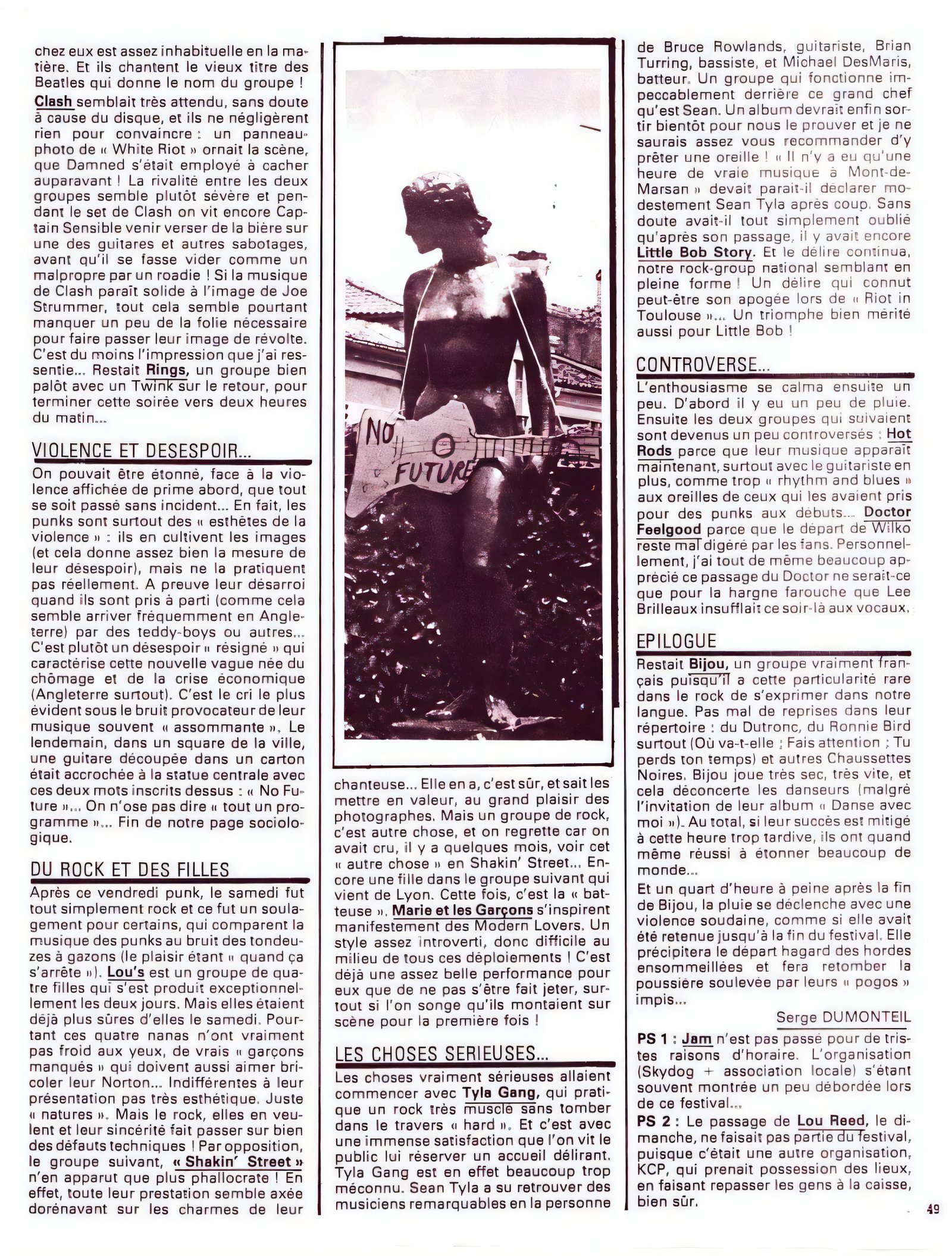
L'arene des punks ...

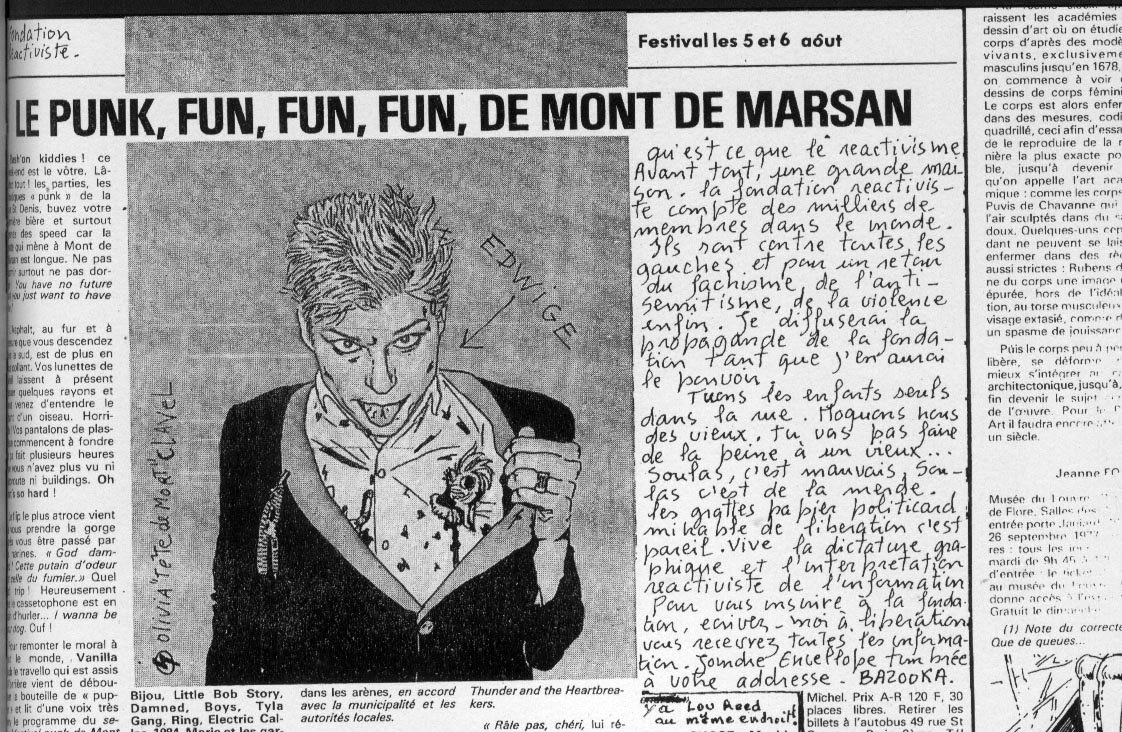
In ROCK IN STOCK number 5 of September 1977 , our report (rather rushed) of the punk festival held in the Mont de Marsan arenas on August 5 and 6.

On the program: Asphalt Jungle (we weren't kind to them), Maniacs, Police, Damned, Boys, Lou's, Shakin' Street, Marie et les Garçons, Tyla Gang, Little Bob Story, Hot Rods, Dr Feelgood and Bijou. (We didn't have a very "orthodox punk" point of view, to say the least...)

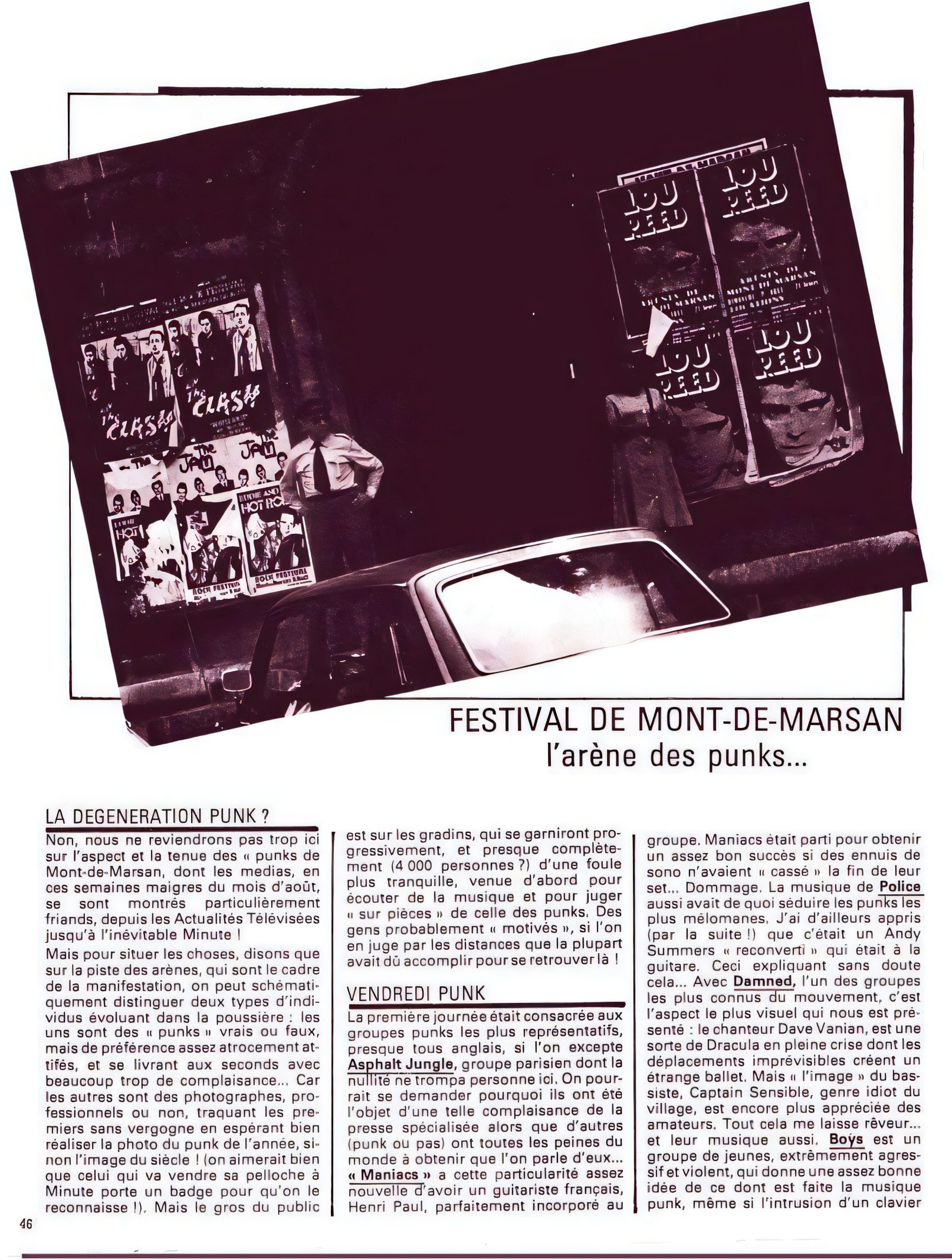
[By the way, note the optical effect below...]

7 pages, ROCK IN STOCK No. 5 Sept 1977

Festival de Mont de Marsan
L'arene des punks ...

THE PUNK DEGENERATION?

No, we will not return too much here on the aspect and the tenue of the punks of Mont-de-Marsan, of which the media, in these lean weeks of August, were particularly fond, from the Actualités Télévisées to the inevitable Minute!

But to situate things, let's say that on the arena track, which is the setting for the event, one can schematically distinguish two types of individuals evolving in the dust: some are punks true or false, but preferably quite atrociously dressed, and yielding to the second with far too much complacency... Because the others are photographers, professional or not, tracking the former shamelessly hoping to achieve the photo of the punk of the year, if not the image of the century! (we would very much like the one who is going to sell his film to Minute to wear a badge so that we recognize him!). But the bulk of the public is on the stands, which will gradually, and almost completely (4000 people ?) fill up with a quieter crowd, come first to listen to music and to judge on the spot that of the punks. Probably motivated people, judging by the distances most had to travel to get there!

MONT-DE-MARSAN FESTIVAL the arena of the punks...


FRIDAY PUNK

The first day was devoted to the most representative punk groups, almost all English, with the exception of Asphalt Jungle, a Parisian group whose nullity fooled no one here. One might wonder why they were the subject of such complacency from the specialized press while others (punk or not) have all the trouble in the world getting people to talk about them... Maniacs has this rather new peculiarity of having a French guitarist, Henri Paul, perfectly incorporated into the group. Maniacs was on track for a pretty good success if sound problems hadn't « cut short » the end of their set... Too bad. The music of Police also had something to attract the most music-loving punks. I also learned (afterwards!) that it was a reconverted Andy Summers who was on guitar. This undoubtedly explaining that... With Damned, one of the most famous groups of the movement, it is the most visual aspect that is presented to us: the singer Dave Vanian, is a sort of Dracula in full crisis whose unpredictable movements create a strange ballet. But the image of the bassist, Captain Sensible, like a village idiot, is even more appreciated by amateurs. All of this leaves me dreamy... and their music too. Boys is a group of young people, extremely aggressive and violent, which gives a pretty good idea of what punk music is made of, even if the intrusion of a keyboard at their home is quite unusual in this matter. And they sing the old Beatles title which gives the name of the band I Clash seemed highly anticipated, no doubt because of the record, and they spared no effort to convince a photo-panel of White Riot adorned the stage, that Damned had previously tried to hide | The rivalry between the two groups seems rather severe and during the Clash set we still saw Captain Sensible come and pour beer on one of the guitars and other sabotages, before he got thrown out unceremoniously by a roadie! If the music of Clash seems solid like Joe Strummer, all this yet seems to lack a little of the necessary madness to put across their image of revolt. That's at least the impression that I felt... There remained Rings, a very pale band with a washed-up Twink, to end this evening around two in the morning...


VIOLENCE AND DESPAIR.

One might be astonished, faced with the violence displayed at first glance, that everything passed without incident... In fact, punks are mostly aesthetes of violence: they cultivate the images (and this gives a fair measure of their despair), but do not actually practice it. Proof of their dismay when they are taken to task (as seems to happen frequently in England) by teddy-boys or others.... It is rather a resigned despair that characterizes this new wave born of unemployment and the economic crisis (England especially). It is the most obvious cry beneath the provocative noise of their often mind-numbing music ». The next day, in a square in the town, a guitar cut out of cardboard was hung on the central statue with these two words inscribed on it: No Future... One doesn't dare say it's quite a program... End of our sociological page.


OF ROCK AND GIRLS

After this punk Friday, Saturday was simply rock and it was a relief for some, who compare punk music to the noise of lawnmowers (the pleasure being « when it stops). Lou's is a group of four girls who performed exceptionally both days. But they were already more self-assured on Saturday. Yet these four women are really not afraid of anything, real tomboys who must also like to tinker with their Norton... Indifferent to their not very aesthetic presentation. Just natural. But rock, they want it and their sincerity makes up for many technical shortcomings | In contrast, the following band, Shakin' Street» appeared all the more phallocentric | Indeed, their whole performance now seems focused on the charms of their singer... She has them, that's for sure, and knows how to show them off, to the great pleasure of photographers. But a rock band is something else, and we regret it because a few months ago, we thought we saw that something else in Shakin' Street... Another girl in the next band who comes from Lyon. This time, it's the drummer». Marie et les Garçons are clearly inspired by the Modern Lovers. A rather introverted style, therefore difficult in the midst of all these displays! It is already quite a performance for them not to have been thrown out, especially if one considers that they were going on stage for the very first time!


THE SERIOUS THINGS...

The really serious things were about to begin with Tyla Gang, who practice a very muscular rock without falling into the hard rock trap». And it's with immense satisfaction that we saw the public give them a delirious reception. Tyla Gang is indeed far too little known. Sean Tyla has managed to find remarkable musicians in the person of Bruce Rowlands, guitarist, Brian Turring, bassist, and Michael DesMaris, drummer. A band that functions impeccably behind this great leader that is Sean. An album should finally be released soon to prove it to us and I cannot recommend it highly enough that you lend an ear! There was only one hour of real music in Mont-de-Marsan» must have modestly declared Sean Tyla after the fact. He had undoubtedly simply forgotten that after their passage, there was still Little Bob Story. And the delirium continued, our national rock-group seeming in great form | A delirium which perhaps knew its peak during « Riot in Toulouse »... A triumph well deserved also for Little Bob !


CONTROVERSY.

The enthusiasm then calmed down a little. First there was a little rain. Then the two groups that followed became a little controversial: Hot Rods because their music now appears, especially with the extra guitarist, as too rhythm and blues» to the ears of those who had taken them for punks at the beginning... Doctor Feelgood because the departure of Wilko remains poorly digested by the fans. Personally, I still very much appreciated this passage of the Doctor if only for the ferocious aggression that Lee Brilleaux instilled in the vocals that evening.


EPILOGUE

There remained Bijou, a truly French band since it has that rare particularity in rock of expressing itself in our language. Quite a few covers in their repertoire of Dutronc, of Ronnie Bird especially (Où va-t-elle; Fais attention; Tu perds ton temps) and others Chaussettes NoiresBijou plays very dry, very fast, and this disconcerts the dancers (despite their album's invitation Danse avec moi). In total, if their success is mixed at this too late hour, they have still managed to astonish many people...

And a quarter of an hour barely after the end of Bijou, the rain suddenly starts with a sudden violence, as if it had been held back until the end of the festival. It will precipitate the dazed departure of the sleepy hordes and will make the dust raised by their impious « pogos» fall back down...

Serge Dumonteil

PS 1: Jam did not perform for sad timetable reasons. The organisation (Skydog association locale) often seemed a little overwhelmed during this festival...

PS 2: The passage of Lou Reed, on Sunday, was not part of the festival, since it was another organisation, KCP, which took possession of the premises, making people pay again at the box office, of course.


ORIGINAL FRENCH

LA DÉGÉNÉRATION PUNK?

Non, nous ne reviendrons pas trop ici sur l'aspect et la tenue des punks de Mont-de-Marsan, dont les medias, en ces semaines maigres du mois d'août, se sont montrés particulièrement friands, depuis les Actualités Télévisées jusqu'à l'inévitable Minute !

Mais pour situer les choses, disons que sur la piste des arènes, qui sont le cadre de la manifestation, on peut schématiquement distinguer deux types d'individus évoluant dans la poussière: les uns sont des punks vrais ou faux, mais de préférence assez atrocement attifés, et se livrant aux seconds avec beaucoup trop de complaisance... Car les autres sont des photographes, professionnels ou non, traquant les premiers sans vergogne en espérant bien réaliser la photo du punk de l'année, sinon l'image du siècle ! (on aimerait bien que celui qui va vendre sa pelloche à Minute porte un badge pour qu'on le reconnaisse !). Mais le gros du public est sur les gradins, qui se garniront progressivement, et presque complètement (4000 personnes ?) d'une foule plus tranquille, venue d'abord pour écouter de la musique et pour juger sur pièces de celle des punks. Des gens probablement motivés, si l'on en juge par les distances que la plupart avait dû accomplir pour se retrouver là !


FESTIVAL DE MONT-DE-MARSAN l'arène des punks...

VENDREDI PUNK

La première journée était consacrée aux groupes punks les plus représentatifs, presque tous anglais, si l'on excepte Asphalt Jungle, groupe parisien dont la nullité ne trompa personne ici. On pourrait se demander pourquoi ils ont été l'objet d'une telle complaisance de la presse spécialisée alors que d'autres (punk ou pas) ont toutes les peines du monde à obtenir que l'on parle d'eux... Maniacs a cette particularité assez nouvelle d'avoir un guitariste français, Henri Paul, parfaitement incorporé au groupe. Maniacs était parti pour obtenir un assez bon succès si des ennuis de sono n'avaient « cassé » la fin de leur set... Dommage. La musique de Police aussi avait de quoi séduire les punks les plus mélomanes. J'ai d'ailleurs appris (par la suite !) que c'était un Andy Summers reconverti qui était à la guitare. Ceci expliquant sans doute cela... Avec Damned, l'un des groupes les plus connus du mouvement, c'est l'aspect le plus visuel qui nous est présenté : le chanteur Dave Vanian, est une sorte de Dracula en pleine crise dont les déplacements imprévisibles créent un étrange ballet. Mais l'image du bassiste, Captain Sensible, genre idiot du village, est encore plus appréciée des amateurs. Tout cela me laisse rêveur... et leur musique aussi. Boys est un groupe de jeunes, extrêmement agressif et violent, qui donne une assez bonne idée de ce dont est faite la musique punk, même si l'intrusion d'un clavier chez eux est assez inhabituelle en la ma-tière. Et ils chantent le vieux titre des Beatles qui donne le nom du groupe I Clash semblait très attendu, sans doute à cause du disque, et ils ne négligèrent rien pour convaincre un panneau-photo de White Riot ornait la scène, que Damned s'était employé à cacher auparavant | La rivalité entre les deux groupes semble plutôt sévère et pen-dant le set de Clash on vit encore Cap-tain Sensible venir verser de la bière sur une des guitares et autres sabotages, avant qu'il se fasse vider comme un malpropre par un roadie! Si la musique de Clash paraît solide à l'image de Joe Strummer, tout cela semble pourtant manquer un peu de la folie nécessaire pour faire passer leur image de révolte. C'est du moins l'impression que j'ai res-sentie... Restait Rings, un groupe bien palòt avec un Twink sur le retour, pour terminer cette soirée vers deux heures. du matin...

VIOLENCE ET DESESPOIR.

On pouvait être étonné, face à la vio-lence affichée de prime abord, que tout se soit passé sans incident... En fait, les punks sont surtout des esthètes de la violence: ils en cultivent les images (et cela donne assez bien la mesure de leur désespoir), mais ne la pratiquent pas réellement. A preuve leur désarroi quand ils sont pris à parti (comme cela semble arriver fréquemment en Angle-terre) par des teddy-boys ou autres.... C'est plutôt un désespoir résigné qui caractérise cette nouvelle vague née du chômage et de la crise économique (Angleterre surtout). C'est le cri le plus évident sous le bruit provocateur de leur musique souvent assommante ». Le lendemain, dans un square de la ville, une guitare découpée dans un carton était accrochée à la statue centrale avec ces deux mots inscrits dessus: No Fu-ture... On n'ose pas dire tout un pro-gramme... Fin de notre page sociolo-gique.

DU ROCK ET DES FILLES

Après ce vendredi punk, le samedi fut tout simplement rock et ce fut un soula-gement pour certains, qui comparent la musique des punks au bruit des tondeu-zes à gazons (le plaisir étant « quand ça s'arrête). Lou's est un groupe de qua-tre filles qui s'est produit exceptionnel-lement les deux jours. Mais elles étaient déjà plus sûres d'elles le samedi. Pour-tant ces quatre nanas n'ont vraiment pas froid aux yeux, de vrais garçons manqués qui doivent aussi aimer bri-coler leur Norton... Indifférentes à leur présentation pas très esthétique. Juste natures. Mais le rock, elles en veu-lent et leur sincérité fait passer sur bien des défauts techniques Par opposition, le groupe suivant, Shakin' Street» n'en apparut que plus phallocrate | En effet, toute leur prestation semble axée dorénavant sur les charmes de leur

chanteuse... Elle en a, c'est sûr, et sait les mettre en valeur, au grand plaisir des photographes. Mais un groupe de rock, c'est autre chose, et on regrette car on avait cru, il y a quelques mois, voir cet autre chose en Shakin' Street... En-core une fille dans le groupe suivant qui vient de Lyon. Cette fois, c'est la bat-teuse». Marie et les Garçons s'inspirent manifestement des Modern Lovers. Un style assez introverti, donc difficile au milieu de tous ces déploiements ! C'est déjà une assez belle performance pour eux que de ne pas s'être fait jeter, sur-tout si l'on songe qu'ils montalent sur scène pour la première fois !

LES CHOSES SERIEUSES...

Les choses vraiment sérieuses allaient commencer avec Tyla Gang, qui prati-que un rock très musclé sans tomber dans le travers hard». Et c'est avec une immense satisfaction que l'on vit le public lui réserver un accueil délirant. Tyla Gang est en effet beaucoup trop méconnu. Sean Tyla a su retrouver des musiciens remarquables en la personne

de Bruce Rowlands, guitariste, Brian Turring, bassiste, et Michael DesMaris, batteur. Un groupe qui fonctionne im-peccablement derrière ce grand chef qu'est Sean. Un album devrait enfin sor-tir bientôt pour nous le prouver et je ne saurais assez vous recommander d'y prêter une oreille! Il n'y a eu qu'une heure de vraie musique à Mont-de-Marsan» devait paraît-il déclarer mo-destement Sean Tyla après coup. Sans doute avait-il tout simplement oublié qu'après son passage, il y avait encore Little Bob Story. Et le délire continua, notre rock-group national semblant en pleine forme Un délire qui connut peut-être son apogée lors de « Riot in Toulouse »... Un triomphe bien mérité aussi pour Little Bob !

CONTROVERSE.

L'enthousiasme se calma ensuite un peu. D'abord il y eu un peu de pluie. Ensuite les deux groupes qui suivaient sont devenus un peu controversés: Hot Rods parce que leur musique apparaît maintenant, surtout avec le guitariste en plus, comme trop rhythm and blues» aux oreilles de ceux qui les avaient pris pour des punks aux débuts... Doctor Feelgood parce que le départ de Wilko reste mal digéré par les fans. Personnel-lement, j'ai tout de même beaucoup ap-précié ce passage du Doctor ne serait-ce que pour la hargne farouche que Lee Brilleaux insufflait ce soir-là aux vocaux.

EPILOGUE

Restait Bijou, un groupe vraiment fran-çais puisqu'il a cette particularité rare dans le rock de s'exprimer dans notre langue. Pas mal de reprises dans leur répertoire du Dutronc, du Ronnie Bird surtout (Où va-t-elle; Fais attention; Tu perds ton temps) et autres Chaussettes NoiresBijou joue très sec, très vite, et cela déconcerte les danseurs (malgré l'invitation de leur album Danse avec moi). Au total, si leur succès est mitigé à cette heure trop tardive, ils ont quand même réussi à étonner beaucoup de monde...

Et un quart d'heure à peine après la fin de Bijou, la pluie se déclenche avec une violence soudaine, comme si elle avait été retenue jusqu'à la fin du festival. Elle précipitera le départ hagard des hordes ensommeillées et fera retomber la poussière soulevée par leurs « pogos» impis...

Serge DUMONTEIL

PS 1: Jam n'est pas passé pour de tris-tes raisons d'horaire. L'organisation (Skydog association locale) s'étant souvent montrée un peu débordée lors de ce festival...

PS 2: Le passage de Lou Reed, le di-manche, ne faisait pas partie du festival, puisque c'était une autre organisation, KCP, qui prenait possession des lieux, en faisant repasser les gens à la caisse, bien sûr.


Best Magazine? Review of the Festival by Francis Dordor

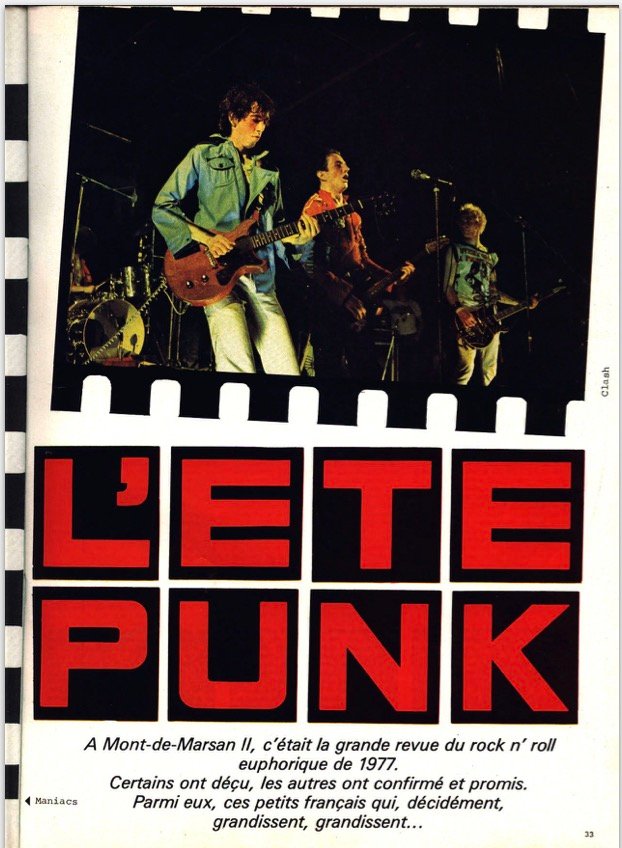
L'ete Punk, SUMMER PUNK

The article is a vivid, often sarcastic review of the 1977 Mont-de-Marsan II punk festival, contrasting local media hysteria with relatively minor incidents, dissecting uneven sets by British bands (notably the Damned-Clash feud and Jam's no-show), and ultimately celebrating the explosive performances and growing stature of several French groups such as Lou's, Maniacs, Tyla Gang, Little Bob Story, and Bijou.

Best Magazine? Review of the Festival by Francis Dordor

L'ete Punk, SUMMER PUNK

At Mont-de-Marsan II, it was the great mass of epic rock ’n roll of 1977.
Some disappointed, the others confirmed and promised.
Among them, those little French bands who, decidedly, are growing, growing…

Best 33

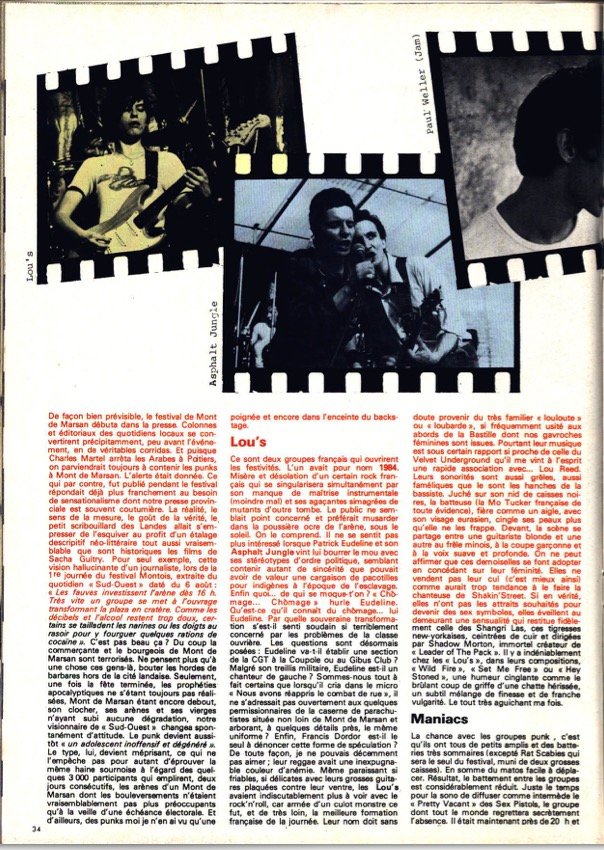
PHOTO: Lou’s
PHOTO: Asphalt Jungle
PHOTO: Paul Weller – The Jam

In a very predictable way, the Mont-de-Marsan festival began in the press. Columns and editorials in the local daily newspapers were flung back and forth in haste, shortly before the event, into genuine bullfights. And since Charles Martel stopped the Arabs at Poitiers, one always expects as much from the punks at Mont-de-Marsan. The alert was given. What, on the other hand, was published during the festival already responded far more frankly to the need for sensationalism, to which our provincial press is often accustomed. Reality, a sense of proportion, a taste for truth — the little scribbler from the Landes was quick to sidestep them in favour of a neo-literary descriptive display just as plausible as the historical accuracy of Sacha Guitry’s films. As a sole example, this hallucinatory version from a journalist, on the first day of the Mont-de-Marsan festival, taken from the daily Sud-Ouest dated August 6:

“The wild beasts invade the arena from 4 p.m. Very quickly a group gets to work, turning the plaza into a crater. Since the decibels and alcohol remain too mild, some slash their nostrils or fingers with a razor in order to smuggle in a few rations of cocaine. ‘Isn’t that beautiful?’ As a result, the shopkeeper and the bourgeois of Mont-de-Marsan are terrified. They think of only one thing, those people: driving the barbarian hordes out of the Landais city. Only once the festivities are over, the apocalyptic prophecies having still not come true, Mont-de-Marsan still standing, its bell tower, its arenas and its virgins having suffered no damage, our visionary from Sud-Ouest completely changes attitude. Punk suddenly becomes a harmless, degenerate adolescent. The fellow himself becomes contemptuous, which does not, however, prevent him from harbouring the same insidious hatred toward some 3,000 participants who filled, two consecutive days, the arenas of a Mont-de-Marsan whose upheavals were probably no more worrying than on the eve of an electoral deadline. And anyway, punks, I only saw a handful of them, and still inside the backstage enclosure.”


Lou’s

Two French groups opened the festivities. One was called 1984. Misery and desolation of a certain French rock which simultaneously distinguished itself by its lack of instrumental mastery (the lesser evil) and its irritating, mutant similarities from beyond the grave. The public did not seem concerned and preferred to wander in the ochre dust of the arena, under the sun. One understands them. They felt no more interested when Patrick Eudeline and his Asphalt Jungle came down from the north with their political-order stereotypes, seeming to contain as much sincerity as the value of a cargo of trinkets for natives at the time of slavery. Come on then… who are they trying to kid? “Unemployment, unemployment,” howls Eudeline. What do we say unemployment… he, Eudeline. By what sovereign transformation has he suddenly felt so terribly concerned by the problems of the working class? The questions are now posed. Doesn’t Eudeline have a disco at the CGT in La Coupole or at the Gibus Club? Despite his military fatigues, is Eudeline a left-wing singer? Are we quite sure that when he shouted into the microphone “We have won the street battle,” he was not openly addressing the few leave-holding parachutists from the nearby barracks of Mont-de-Marsan wearing, apart from a few details, the same uniform? Finally, is Francis Dordor the only one to believe in this form of speculation? In any case, I could not decently like it; their reggae had an unmistakable anaemic colour.

Even appearing so fragile, so delicate with their big guitars pressed against their bellies, Lou’s had undeniably far more to do with rock ’n roll, for armed with a monstrous backside, they were, by a very long way, the best French formation of the day. Their name no doubt comes from the very familiar “louloute” or “loubarde,” so frequently used around the Bastille, from which our female street urchins hail. Yet their music is in certain respects so close to that of The Velvet Underground that a quick association with Lou Reed came to mind. Their sonorities are as hollow, as famished as the bassist’s hips. Perched on her nest of black cases, the drummer (the French Sue Tucker, obviously), proud as an eagle, with her Eurasian face, lashes her skins rather than strikes them. At the front, the stage is shared between a guitar and a bass, and another with delicate features, a boyish haircut and a suave, deep voice.

One cannot claim that these young women gain acceptance by sacrificing their femininity. They do not sell their arses (which is better that way) as the singer of Shakin’ Street tends to do. If, in truth, they do not have the desired attractions to become sex symbols, they nonetheless awaken a sensuality that faithfully restores that of The Shangri-Las, those New York tigresses created by Shadow Morton, immortal creator of “Leader of the Pack.” There is undeniably, in Lou’s compositions — “Wild Fire,” “Set Me Free,” or “Hey Stoned” — a flashy mood like the burning swipe of a bristling cat, a subtle blend of refinement and frank vulgarity. The whole thing very enticing, I must say.


Maniacs

The good thing with punk groups is that they all have small amplifiers and very basic drum kits (except Rat Scabies, who would be the only one at the festival equipped with two bass drums). In short, optional and stripped-down momentum. The result: the interval between groups is considerably reduced, just long enough for the PA to broadcast as an interlude “Pretty Vacant” by the Sex Pistols, the group whose absence everyone secretly regrets. It was now close to 8 p.m. and

34


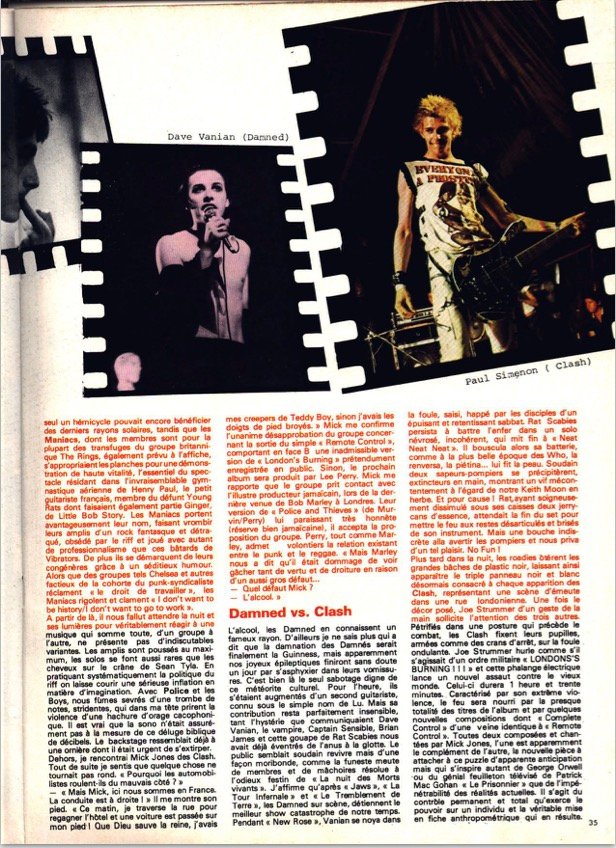
PHOTO: Dave Vanian (Damned)
PHOTO: Paul Simonon (Clash)

Only a semicircle could still benefit from the last rays of sunshine, while the Maniacs, whose members are mostly defectors from the British group The Rings, also scheduled on the bill, took over the stage for a demonstration of high vitality, the essence of the spectacle residing in the unbelievable aerial gymnastics of Henry Paul, the small French guitarist, member of the defunct Young Rats, which also included Ginger from Little Bob Story. The Maniacs wear their name well, blowing their amplifiers apart with a fantastical, deranged rock, obsessed with the riff and played with a professionalism these bastards from The Vibrators never had. Moreover, they stand out from their peers thanks to a sediment of humour. While groups like Chelsea and other nuisances from the punk-syndicalist cohort demand “the right to work,” the Maniacs laugh and proclaim “I don’t want to work.”

From there on, we had to wait for nightfall and lights to truly react to music which, all things considered, from one group to another, presents no indisputable variations. Amps are pushed to the maximum, solos become as rare as hair on Sean Tyla’s scalp. By systematically practising the policy of the riff, one allows a serious inflation in imagination to run free. With Police and the Boys, we were served a trumpet of shrill notes, which in my head took on the violence of a cacophonous horde. It is true that the sound was certainly not up to the measure of this biblical deluge of decibels. The backstage already resembled a rut from which it was urgent to escape.

Outside, I met Mick Jones from The Clash. Immediately I felt something was wrong.

“Why do motorists drive on the wrong side?”
“But Mick, here we are in France. Driving is on the right!”

He showed me his foot. “This morning, I crossed the street to return to the hotel, a car ran over my foot! God save the Queen, I had my Teddy Boy creepers on — otherwise my toes would have been crushed.”

Mick confirms to me the group’s unanimous disapproval regarding the release of the single “Remote Control,” behaviour in the face of an inadmissible sale of “London’s Burning,” supposedly recorded live. Otherwise, the next album will be produced by Lee Perry. Mick reports that the group got in touch with the illustrious Jamaican producer during Bob Marley’s last visit to London. Their version of “Police and Thieves” (by Junior Murvin) appeared very honest (reservedly Jamaican); he accepted the group’s proposal. Perry, like Marley, willingly admits the relationship between punk and reggae.

“But Marley told us it was a shame to see so much virtue and uprightness wasted because of such a big flaw.”
“What flaw, Mick?”
“Alcohol.”


Damned vs. Clash

Alcohol — the Damned know it well. Besides, I no longer know who said that the damnation of the Damned would ultimately be at Guinness, but apparently their cheerful epileptics will no doubt one day end up asphyxiating in their own vomit. That is truly the only advantage of a mediocre culture. For now, they had added a second guitarist, known simply as Lu. But his contribution remained perfectly imperceptible, so much had the hysteria of their communicator Dave Vanian, the vampire, Captain Sensible, Brian James, and this soup of Rat Scabies already ripped open our throats from the back. The audience seemed to survive, but in a morbid way, like a sinister pack of limbs and jaws bent on odious feasts from “Night of the Living Dead.”

“After Jaws, The Towering Inferno and The Earthquake, the Damned on stage hold the best catastrophic show of our time.”

During “New Rose,” Vanian drowned in the crowd, seized, snatched by the disciples of an exhausting and resounding sabbath. Rat Scabies persisted in beating hell out in a nervous, incoherent solo that ended “Neat Neat Neat.” He then shoved his drum kit, like in the Who’s finest days, knocked it over, trampled it, finished it off. Suddenly two firefighters rushed in, exhausted in rags, before expressing sharp displeasure toward our budding Keith Moon. And for good reason! Rat, having carefully hidden two jerrycans of petrol under his cases, was waiting for the end of the set to set fire to the disarticulated, broken remains of his instrument. But an indiscreet mouth went to warn the firefighters and deprived us of such pleasure. No Fun!

Later in the night, the roadies remove the large black plastic tarpaulins, thus revealing the triple black-and-white panel now consecrated at every Clash appearance, representing a riot scene in a London street. Once the set is in place, Joe Strummer, with a wave of his hand, solidifies the attention of the other three. Petrified in a posture preceding combat, the Clash fix their pupils, armed like switchblades, on the undulating crowd. Joe Strummer howls as if issuing a military order:

“LONDON’S BURNING!!!”

And this electric phalanx launches a new assault against the old worlds. This will last one hour and thirty minutes. Characterised by extreme violence, the fire is fed by almost all the album’s tracks and several new compositions, including “Complete Control,” as vehement as “Remote Control.” Both written and sung by Mick Jones, one is apparently the complement of the other, the new piece attached to this puzzle of apparent anticipation, inspired as much by George Orwell or David McGoohan’s brilliant TV series The Prisoner as by impenetrable current realities. It concerns the permanent and total control exercised by power over an individual and the true anthropometric filing that results.

35

PHOTO: Little Bob
PHOTO: Lee Brilleaux (Dr. Feelgood)
PHOTO: Eddie & The Hot Rods

A real nightmare which corresponds, after all, only to the system that we are subjected to today.
If there is one group — a single one — with which Clash can identify, it is definitely the MC5. On this point, the resemblance between Mick Jones and Wayne Kramer is striking, Kramer lately from his cell in the penitentiary of Lexington, Kentucky, where he is serving a four-year sentence for drug trafficking, engaged himself in parallel with the British New Wave and with the guerrilla of the White Panthers, from which the notion of Guitar Army emerged. But the battles differ. For the moment Joe Strummer is trying to get rid of a bold Yankee detection that neutralises his TV screen. “I’m so bored with the U.S.A.”

They would perform three reggaes that night: “Police and Thieves,” “Pressure Drop” by Toots, and a new composition by M. Jones, “White Man In The Hammersmith Palais,” with in its very heart a very beautiful progression — melodic, fiery, gripping — with a solo by Jones that was truly moving. A great wind of pathos swept over the arena and its shadows, and Joe Strummer had promised us: “I’m gonna cry a new punk song.”

Other zeniths were reached: “1977,” “White Riot,” “Cheat,” and “Garageland.” Strummer, foam on his lips, metamorphoses into an uncontrollable pile-driver and agonises with the most poignant Clash composition to date: “What’s My Name.” Or the existential malaise lived in 1977.

“What’s wrong with me, I’m not how I want to be. I tried acne cream and I tried it so much that now I shave the walls. What is my name… my naaaame… I got arrested in a street fight, but I swear this curse isn’t mine… WHAT IS MY NAAAME… MY NAAAME…”

But that nausea, the Clash actually felt its real effects. Suddenly Joe Strummer grabs the microphone; the monitors ring out; seized by the whitest fury he bellows:

“Listen, the Damned have just thrown stink bombs onto the stage. And all that because THEY ARE JEALOUS!!!”

Na na na. Indeed, Captain Sensible, hidden behind the amps, made a brief appearance on stage to crush at Paul Simonon’s feet some of those delicious little ampoules he had bought earlier that day in “Farces et Attrapes” of Mont-de-Marsan. In the Clash camp, the reaction was special: not to wait. A roadie shoved the Captain, who — protesting — was violently pushed into the void. The bassist of the Damned crashed heavily onto a protective rail and did not get up. An ambulance was called because Sensible was slow to regain consciousness. Exit the Captain.

The next day, the Damned and the Clash met and signed an armistice, in front of a bottle of BORDEAUX.


So sad about Jam

While the Hot Rods were threatening to return immediately to England if they were not provided with a personal park, I was busy arranging an interview with the Jam for the following morning. For me, there was no doubt — the Jam were going to be the apotheosis of this festival. In terms of apotheosis, the group of Paul Weller could not play, for reasons as inconsistent as differences in shadow-cells of former musicians and journalists sleeping outside or in overcrowded rooms.

The Skydog/Piranhas organisation was visibly overwhelmed by events. It seems that the Jam’s defection was caused by the ultimatum posed by Doctor Feelgood, who under no circumstances wanted to play after five p.m. Faced with this injunction, Skydog/Piranhas had to play tight on the chessboard of time and rather chaotically moved pawns and major pieces, without taking into account what the contracts stipulated.

Yet on the morning of August 6, Paul Weller was surprisingly confident. This nineteen-year-old young man is at the head of one of the best rock ’n roll formations today.

For him, there is not the slightest doubt:

“Listen, I feel the criticisms about the Jam very deeply, because I am bloody convinced that we are the best group in the world.”

Paul has to shout to make himself heard, because we are in the circular corridor of the arena and the Hot Rods are in the middle of their sound check, giving his words an incredible meaningful power. We go on to recount the numerous clashes between punks and teddy boys in England.

Paul Weller: “What’s the difference? It’s all rock ’n roll. I’ve often seen teddies dancing and jumping at our concerts. Johnny Rotten likes Shakin’ Stevens and the Sunsets. It’s the same music, it’s Eddie Cochran — we’re on the same side. These street fights mean nothing, absolutely nothing.”

Francis Dordor: And the inter-group quarrels, the ones the British press reports to us?

P.W.: “All that is part of the business. For me, it’s about encouraging the hysteria punk arouses. It’s the same approach that provokes hatred between punks and teds — most often based on petty public jibes. When I read in an English weekly that I no longer dared see Eddie for this fashion-shoot for Vogue magazine, I had to answer that Clash did the same for Penthouse without anyone mentioning it. But I’m not particularly proud of that, because it has no importance for Joe Strummer.”

F.D.: People often reproach you for your conservative statements…

P.W.: “Once and for all, we have nothing to do with that crap. I don’t believe in political action and I don’t believe in politicians. All of this is just another fable, an invention by journalists.”

F.D.: Which groups in English music matter to you?

P.W.: “The Jam and the Sex Pistols!”

36


Sean Tyla

F.D.: (Trick question). Yet you are wearing a “Damned” badge on the album cover?

P.W.: (Laughs) I didn’t even know their music when the photo was taken. I really like their image.

F.D.: Because you dress like Mods, you signed on the same label, because you play music more oriented toward the Who…

P.W.: If the Who had a great influence on us, it is limited to the “Who Sell Out” period. I can’t stand Tommy and very little else.

F.D.: Do you perform Who songs on stage?

P.W.: Yes, “So Sad About Us.”

That same evening, Paul Weller, Bruce Foxton and Rick Buckler would not play any Who classic. So sad about Jam.


Sean! Bob!

The infernal cycle resumed its crashing rhythm. Still worrying, however, was the extraordinary passivity of the public since the beginning of this festival. The energy produced on stage seemed to act on the stands like a force of inertia rather than movement. This remained true until the arrival of the Tyla Gang. Sean Tyla, once again, had put on his boiler suit and looked like a long-haired plumber or a Christ from London’s suburbs. And it was he who finally lifted the fine ochre dust of this too-quiet “crater,” with his heavy, rigorous rock. Sean was somewhat the lout of this festival, growing old thanks to the craft’s finesse. His trombone he took as a revenge, rancid from years of misfortune, from Ducks Deluxe to this new addition, Tyla-Gang.

“I know very well you don’t buy my records,” he shouted to the excited crowd. Perhaps, dear Sean, their distribution should be properly ensured. The Tyla Gang owe their success above all to their obvious professionalism and to the vehement contrast they offered with the groups that preceded them. The nature of their music — as boogie-cannon as trombone and solos — this enormous sound, cut radically against previous screechings. It was good, the boogie of the chainsaw massacre.

However — and I cannot argue it otherwise — it was Little Bob Story who sent me to the scaffold. Perhaps I had the most privileged moment, but I remain with the real impression that this was the best performance of the festival. Yet L.B.S. played according to a routine already well established with a signboard of hard-hitting pieces from their early days: “I Need Money,” “Lucille,” “All or Nothing” and those from the new album “Little Big Boss,” “dedicated to a sinister character haunting our airwaves,” announced Bob — “Riot in Toulouse,” “You Make Me Crazy.”

Little Bob, in his red cry, the echo rebounding off the circular walls only to plunge back into the furnace. During “Riot in Toulouse,” Ginger carved a magnificent feedback from his guitar directly into the amp and spun around like a whirling dervish to break the spell. The iron framework covering the stage became a high-voltage pole on a stormy night.

“For whom strike these lightning bolts over your heads?” Bob shouted to his group.

A few days later, Ginger left L.B.S.

After that, I must tell you that Eddie and The Hot Rods were truly Teenage Depression. So depressing that the group made it rain. After that we were treated to the festival’s meanest show: Doctor Feelgood, who in 45 minutes managed to botch his repertoire, now entirely oriented toward rhythm’n’blues. Besides, the crowd didn’t care, too tired, and reacted only in Pavlovian fashion when Brilleaux and his men concluded with “Carol” and “Great Balls of Fire.” A joke!

I confess I was truly annoyed, because it was largely due to this stingy Feelgood that the Jam did not play. Wilko, where are you now?
It was two in the morning and everyone was slowly dying of fatigue in an arena still quite full.


Bijoux

When the organisers asked Bijoux whether they had any fears about playing after Feelgood, our three Mods replied in chorus:

“We don’t care, we’d even play after the Beatles.”

Vanity is the daughter of success. Palmer arrived like a fury. At the height of their excitement, it took him a good minute to manage to plug in his guitar. Convulsively, Bijoux revved up and took several minutes to find the right tempo. “Animal” was perfect, and “Marie France” deserved to be known in the freshness of the night.

Bijoux soon appeared as the only group capable of making one forget Jam’s withdrawal — the only group able to bring to this avalanche of chords, breaks, and solos the touch of sophistication so sorely lacking in this festival. Dauga even treated himself to a slice of pogo on “Fais Attention” during the third reprise of Ronnie Bird’s “Où va-t-elle?” and “Je ne nais pas.”

What somewhat spoiled my pleasure was that the Bijoux set turned into a promotional operation, complete with beer-can and badge distribution. I had never seen a group buy the audience a drink to get an encore. Truth be told, they didn’t need it — for them, victory had long been assured.

The last, most significant image was the wild silhouette of Palmer wandering alone between the plane trees of the plaza, facing the arena. The young man seemed very moved.

Finally, after two days of electrical overloads, the storm broke.

FRANCIS DORDOR

37


French

L’ÉTÉ PUNK

À Mont-de-Marsan II, c’était la grande messe du rock ’n roll épique de 1977.
Certains ont déçu, les autres ont confirmé et promis.
Parmi eux, ces petits français qui, décidément, grandissent, grandissent…

Best 33

PHOTO: Lou’s
PHOTO:  Asphalt Jungle
PHOTO: Paul Weller The Jam

De façon bien prévisible, le festival de Mont de Marsan débuta dans la presse. Colonnes et éditoriaux des quotidiens locaux se renvoient précipitamment, peu avant l’événement, en de véritables corridas. Et puisque Charles Martel arrêta les Arabes à Poitiers, on n’en attendra toujours autant des punks à Mont de Marsan. L’alerte était donnée. Ce qui par contre, fut publié pendant le festival répondait déjà plus franchement au besoin de sensationnalisme, dont notre presse provinciale est souvent coutumière. La réalité, le sens de la mesure, le goût de la vérité, le petit scribouillard des Landes allait s’empresser de l’esquiver au profit d’un étalage descriptif néo-littéraire tout aussi vraisemblable que sont historiques les films de Sacha Guitry. Pour seul exemple, cette version hallucinante d’un journaliste, lors de la 1re journée du festival Montois, extraite du quotidien « Sud-Ouest » daté du 6 août :
« Les fauves investissent l’arène dès 16 h. Très vite un groupe se met à l’ouvrage transformant la plaza en cratère. Comme les décibels et l’alcool restent trop doux, certains se taillent les narines ou les doigts au rasoir pour y fourguer quelques rations de cocaïne. “C’est pas beau ça ? Du coup la commerçante et le bourgeois de Mont de Marsan sont terrorisés. Ne pensent plus qu’à une chose ce gens-là, bouter les hordes barbares hors de la cité landaise. Seulement, une fois la fête terminée, les prophètes apocalyptiques ne s’étant toujours pas réalisées, Mont de Marsan étant encore debout, son clocher, ses arènes et ses vierges n’ayant subi aucune dégradation, notre visionnaire du “Sud-Ouest” change totalement d’attitude. Le punk devient aussi tôt un adolescent inoffensif et dégénéré. Le type, lui, devient méprisant, ce qui ne l’empêche pas, pour autant d’éprouver la même haine sournoise à l’égard de quelques 3 000 participants qui emplirent, deux jours consécutifs, les arènes d’un Mont de Marsan dont les bouleversements n’étaient vraisemblablement pas plus préoccupants qu’à la veille d’une échéance électorale. Et d’ailleurs, des punks moi j’en ai vu que une poignée et encore dans l’enceinte du backstage. »

Lou’s

Ce sont deux groupes français qui ouvrirent les festivités. L’un avait pour nom 1984. Misère et désolation d’un certain rock français qui se singulariseraient simultanément par son manque de maîtrise instrumentale (moindre mal) et ses agacantes similitudes mutantes d’outre tombe. Le public ne sembla pas concerné et préféra musarder dans la poussière ocre de l’arène, sous le soleil. On le comprend. Il ne se sent pas plus intéressé lorsque Patrick Eudeline et ses Asphalt Jungle vinrent du nord avec leurs stéréotypes d’ordre politique, semblant contenir autant de sincérité que pouvait avoir de valeur un cargaison de pacotille pour indigènes à l’époque de l’esclavage. Enfin quoi… de qui se moque-t-on ? « Chômage, chômage », hurle Eudeline. Qu’est-ce qu’on dit chômage… lui Eudeline. Par quelle souveraine transformation est-il senti soudain si terriblement concerné par les problèmes de la classe ouvrière ? Les questions sont désormais posées. Eudeline n’a t-il pas une disco au CGT à la Coupole ou au Gibus Club ? Malgré son treillis militaire, Eudeline est le chanteur de gauche ? Sommes-nous à fait certains que lorsqu’il cria dans le micro « Nous avons gagné le combat de rue », il ne s’adressait pas ouvertement aux quelques permissionnaires de la caserne de parachutistes située non loin de Mont de Marsan arborant, à quelques détails près, le même uniforme ? Enfin, Francis Dordor, est-il le seul à en croire cette forme de spéculation ? De toute façon, je ne pouvais décemment pas aimer ; leur reggae avait une impugnable couleur d’anémie. Même paraissant si fragiles, si délicates avec leurs grosses guitares plaquées contre leur ventre, les Lou’s avaient indiscutablement plus à voir avec le rock’n’roll, car armé d’un cul monstre, fut, et de très loin, la meilleure formation française de la journée. Leur nom doit sans doute provenir du très familier « louloute » ou « loubarde », si fréquemment usité aux abords de la Bastille dont nos gavroches féminines sont issues. Pourtant leur musique est sous certain rapport si proche de celle du Velvet Underground qu’il me vint à l’esprit une rapide association avec Lou Reed. Leurs sonorités sont aussi crêles, aussi faméliques que le sont les hanches de la bassiste. Juché sur son nid de caisses noires, la batteuse (la Sue Tucker française de toute évidence), fière comme un aigle, avec son visage eurasien, cingle ses peaux avec qu’elle ne les frappe. Devant, la scène ne partage entre une guitare et une basse et une autre au frêle minois, la coupe garçonne et à la voix suave et profonde. On ne peut affirmer que ces demoiselles se font adopter en cédant sur leur féminité. Elles ne vendent pas leur cul (c’est mieux ainsi) comme aurait trop tendance à le faire la chanteuse des Shakin’ Street. Si en vérité, elles n’ont pas les attraits souhaités pour devenir des sex symbols, elles éveillent au demeurant une sensualité qui restitue fidèlement celle des Shangri Las, ces tigresses new-yorkaises, ce qui fit leurs créatrices par Shadow Morton, immortel créateur de « Leader of the Pack ». Il y a indéniablement chez les Lou’s, dans leurs compositions, « Wild Fire », « Set Me Free » ou « Hey Stoned », une humeur clinquante comme le brûlant coup de griffe d’une chatte hérissée, un subtil mélange de finesse et de franche vulgarité. Le tout très aguichant ma foi.

Maniacs

La chance avec les groupes punk, c’est qu’ils ont tous de petits amplis et des batteries très sommaires (excepté Rat Scabies qui sera le seul du festival muni de deux grosses caisses). En somme, du moment facultatif et déplacassé. Résultat, le battement entre les groupes est considérablement réduit juste le temps pour la sono de diffuser comme interlude « Pretty Vacant » des Sex Pistols, le groupe dont tout le monde regrette secrètement l’absence. Il était maintenant près de 20 h et

34


PHOTO: Dave Vanian (Damned)
PHOTO: Paul Simonon (Clash)

seul un hémicycle pouvait encore bénéficier des derniers rayons solaires, tandis que les Maniacs, dont les membres sont pour la plupart des transfuges du groupe britannique The Rings, également prévu à l’affiche, s’appropriaient les planches pour une démonstration de haute vitalité, l’essentiel du spectacle résidant dans l’invraisemblable gymnastique aérienne d’Henry Paul, le petit guitariste français, membre du défunt Young Rats dont faisaient également partie Ginger, de Little Bob Story. Les Maniacs portent avantageusement leur nom, faisant rompre leurs amplis d’un rock fantasque et détraqué, obsédé par le riff et joué avec un professionnalisme que ces bâtards de Vibrators n’ont jamais eu. De plus ils se démarquent de leurs congénères grâce à un sédiment d’humour. Alors que des groupes tels Chelsea et autres facheux de la cohorte du punk-syndicaliste réclament « le droit de travailler », les Maniacs rigolent et clament « I don’t want to work ».
À partir de là, il nous fallait attendre la nuit et les lumières pour véritablement réagir à une musique qui, somme toute, d’un groupe à l’autre, ne présente pas d’indiscutables variantes. Les amplis sont poussés au maximum, les solos se font aussi rares que les cheveux sur le crâne de Sean Tyla. En pratiquant systématiquement la politique du riff on laisse courir une sérieuse inflation en matière d’imagination. Avec Police et les Boys, nous fûmes servis d’une trompette de notes stridentes, qui dans ma tête prirent la violence d’une horde cacophonique. Il est vrai que le son n’était assurément pas à la mesure de ce déluge biblique de décibels. Le backstage ressemblait déjà à une ornière dont il était urgent de s’extirper.
Dehors, je rencontrai Mick Jones des Clash. Tout de suite je sentis quelque chose ne tournait pas rond. « Pourquoi les automobilistes roulent-ils du mauvais côté ? »
— « Mais Mick, ici nous sommes en France. La conduite est à droite ! »
Il me montra son pied. « Ce matin, je traverse la rue pour regagner l’hôtel, une voiture est passée sur mon pied ! Que Dieu sauve la reine, j’avais mes creepers de Teddy Boy, sinon j’avais les doigts de pied broyés. »
Mick me confirme l’unanime désapprobation du groupe concernant la sortie du simple « Remote Control », comportement en face à une inadmissible vente de « London’s Burning » prétendument enregistrée en public. Sinon, prochain album sera produit par Lee Perry. Mick me rapporte que le groupe prit contact avec l’illustre producteur jamaïcain, lors de la dernière venue de Bob Marley à Londres. Leur version de « Police and Thieves » (de Junior Murvin), fut paraissant très honnête (réservé bien jamaïcain), il accepta la proposition du groupe. Perry, tout comme Marley, admet volontiers la relation existant entre le punk et le reggae. « Mais Marley nous a dit qu’il était dommage de voir gâcher tant de vertu et de droiture en raison d’un aussi gros défaut. »
— « Quel défaut Mick ? »
— « L’alcool. »

Damned vs. Clash

L’alcool, les Damned en connaissent un fameux rayon. D’ailleurs je ne sais plus qui dit que la damnation des Damnés serait finalement à Guinness, mais apparemment leurs joyeux épileptiques finiront sans doute un jour par s’asphyxier dans leurs vomissures. C’est bien là le seul avantage d’une médiocre culture. Pour l’heure, ils s’étaient augmentés d’un second guitariste, connu sous le simple nom de Lu. Mais sa contribution resta parfaitement insensible, tant l’hystérie de son communicant Dave Vanian, le vampire, Captain Sensible, Brian James et cette soupe de Rat Scabies, nous avait déjà éventrés de l’arrière de la glotte. Le public semblait survivre mais d’une façon morbide, comme la funeste meute de membres et de mâchoires résolue à d’odieux festins de « La nuit des Morts vivants ».
« Après « Jaws », « La Tour Infernale » et « Le Tremblement de Terre », les Damned sur scène, détiennent le meilleur show catastrophique de notre temps. Pendant « New Rose », Vanian se noya dans la foule, saisi, happé par les disciples d’un épuisant et retentissant sabbat. Rat Scabies persista à battre l’enfer dans un solo nerveux, incohérent, qui mit fin à « Neat Neat Neat ». Il bouscula alors sa batterie, comme à la plus belle époque des Who, la renversa, la piétina, lui fit la peau. Soudain deux sapeurs-pompiers se précipitèrent, exténués en haillons avant un vif mécontentement à l’égard de notre Keith Moon en herbe. Et pour cause ! Rat ayant soigneusement dissimulé sous ses caisses deux jerricans d’essence, attendait la fin du set pour mettre le feu aux restes d??ar??culés et brisés de son instrument. Mais une bouche indiscrète alla avertir les pompiers et nous priva d’un tel plaisir. No Fun !
Plus tard dans la nuit, les roadies ôtent les grandes bâches de plastique noir, laissant ainsi apparaître le triple panneau noir et blanc désormais consacré à chaque apparition des Clash, représentant une scène d’émeute dans une rue londonienne. Une fois le décor posé, Joe Strummer d’un geste de la main solidifie l’attention des trois autres. Pétrifiés dans une posture qui précède le combat, les Clash fixent leurs pupilles, armées comme des crans d’arrêt, sur la foule ondulante. Joe Strummer hurle comme s’il s’agissait d’un ordre militaire : « LONDON’S BURNING !!! » et cette phalange électrique lance un nouvel assaut contre les vieux mondes. Celui-ci durera une heure et trente minutes. Caractérisé par son extrême violence, le feu sera nourri par la presque totalité des titres de l’album et par quelques nouvelles compositions dont « Complete Control » d’une véhémence à « Remote Control ». Toutes deux composées et chantées par Mick Jones, l’une est apparemment le complément de l’autre, la nouvelle pièce à attachée à ce puzzle d’apparente anticipation mais qui s’inspire autant de George Orwell ou du génial feuilleton télévisé de David McGohan « Le Prisonnier » que d’impénitrables réalités actuelles. Il s’agit du contrôle permanent et total qu’exerce le pouvoir sur un individu et la véritable mise en fiche anthropométrique qui en résulte.

35


PHOTO: Little Bob
PHOTO: Lee Brilleaux (Dr. Feelgood)
PHOTO: Eddie & The Hot Rods

Un vrai cauchemar qui ne correspond somme toute qu’au système que nous subissons aujourd’hui.
S’il est un groupe, un seul auquel Clash peut s’identifier, c’est définitivement le MC5. Sur ce point, je trouve flagrante la ressemblance entre Mick Jones et Wayne Kramer qui dernièrement de sa cellule du pénitencier de Lexington, dans le Kentucky, où il purge une peine de 4 ans pour trafic de drogue, en lutte lui-même en parallèle la New Wave britannique et que la guérilla des White Panthers dont est issue la notion de Guitar Army. Mais les batailles diffèrent. Pour l’instant Joe Strummer tente de se débarrasser d’une hardie détection yankee qui neutralise son écran de télé. « I’m so bored with the U.S.A. ». Ils feront trois reggaes, ce soir-là, « Police and Thieves », le « Pressure Drop » de Toots et une nouvelle composition de M. Jones, « White Man In The Hammersmith Palais », avec en plein cœur, une très belle progression, mélodique, fougueuse, empoignante d’un solo de Jones tout à fait émouvant. Un grand vent de pathos couvrait l’arène et ses ombres et Joe Strummer nous l’avait promis : « I’m gonna cry a new punk song ». D’autres zéniths furent atteints, « 1977 », « White Riot », « Cheat », ou encore « Garageland ». Strummer, écume aux lèvres se métamorphose en marteau-pilon sans contrôle et agonie avec la plus poignante composition des Clash, à ce jour « What’s my Name ». Ou le malaise existentiel vécu en 1977. « Qu’est-ce qui déconne avec moi, je ne suis pas comme je veux. J’ai essayé de la crème contre l’acné et je l’ai tant essayée que maintenant je rase les murs. Quel est mon nom… mon noooom… Je me suis fait arrêter dans un combat de rue, mais je juge ce sacrement pas… QUI EST MON NOOOOM… MON NOOOOM… »
Mais cette nausée-là, les Clash en perçurent effectivement les effets réels. Soudain Joe Strummer se saisit du micro ; les balances retentissent, atteint de la furie la plus blanche, il éructe : « Écoutez, les Damned viennent de jeter des boules puantes sur la scène. Et tout ça parce qu’ILS SONT JALOUX !!! ». Na na na. Effectivement, Captain Sensible, dissimulé derrière les amplis, fit une brève apparition sur la scène pour écraser aux pieds de Paul Simonon quelques-unes de ces délicieuses petites ampoules achetées le jour même dans « Farces et Attrapes » de Mont-de-Marsan. Dans le clan des Clash, la réaction a été spéciale : ne pas attendre. Un roadie bouscula le Captain, puis celui-ci s’insurgeant, le roadie le précipita violemment dans le vide. La bassiste des Damned s’écrasa lourdement sur une barre de protection et s’en releva point. Une ambulance fut dépêchée car Sensible s’attardait à reprendre connaissance. Exit le Captain.
Le lendemain, les Damned et les Clash se réunissent et signèrent une armistice, devant une bouteille de BORDEAUX.

So sad about Jam

Alors que les Hot Rods menaçaient de rentrer immédiatement en Angleterre si on ne leur procurait pas un parcersonne, moi je me préoccupais d’arranger une interview avec les Jam pour le lendemain matin. Pour moi cela ne faisait aucun doute, les Jam allaient être l’apothéose de ce festival. En fait d’apothéose, le groupe de Paul Weller ne put jouer, pour des raisons aussi inconsistanties que les différences de cellules d’ombre d’anciennes musiciens et journalistes d’aller couchers dehors ou dans des chambres surpeuplées. L’organisation Skydog/Piranhas était visiblement dépassée par les événements. Il semble que la défection des Jam ait pour cause l’ultimatum posé par Doctor Feelgood qui me voulait en aucun cas passer après cinq après-midi. Devant cette injonction Skydog/Piranhas durent jouer serré sur l’échiquier du temps et déplacèrent plutôt anarchiquement les pions et des grosses pièces, sans pour autant tenir compte de ce que stipulaient les contrats.
Pourtant le matin du 6 août, Paul Weller était étonnamment confiant. Ce jeune homme de 19 ans, est à la tête d’une des meilleures formations du rock’n’roll actuel.

Pour lui cela ne fait pas l’ombre d’un doute :
« Écoutez, je ressens très profondément les critiques à propos des Jam, parce que je suis foutrement persuadé que nous sommes le meilleur groupe au monde ». Paul est obligé de hurler pour se faire entendre parce que nous sommes dans le couloir circulaire de l’arène et que les Hot Rods sont en plein sound check, ce qui donne une incroyable puissance significative à ses mots. Nous en venons à relater les nombreux affrontements qui opposent punks et teddy boys en Angleterre.
Paul Weller : « Quelle est la différence ? Tout ça c’est du rock’n’roll. J’ai souvent vu des teddy danser sauter à nos concerts. Johnny Rotten aime Shakin’ Stevens and the Sunsets. C’est la même musique, c’est Eddie Cochran, nous sommes du même côté. Ces combats de rue ne signifient rien, strictement rien ».
Francis Dordor : Et les querelles inter-groupes, celles que nous rapporte la presse britannique ?
P.W. : Tout ça c’est une partie du business. Pour moi, il s’agit d’encourager l’hystérie que suscite le punk. C’est une démarche identique à celle qui fait lever des haines entre punks et teds. Le plus souvent cela repose sur des futilités genre de joutes publiques. Lorsque j’ai lu dans un hebdomadaire anglais que je n’osais plus voir Eddie faire ce pascher pour magazine Vogue, j’ai bien été obligé de répondre que Clash en avait fait autant pour Penthouse, sans que personne ne le mentionne. Mais je ne suis pas particulièrement fier de ça, parce que ça n’a aucune importance pour Joe Strummer.
F.D. : Un vous reproche très souvent vos propos conservateurs…
P.W. : Une bonne fois pour toute, nous n’avons rien à voir avec cette merde. Je ne crois pas en l’action politique et je ne crois pas aux politiciens. Tout ceci est une fable de plus une affabulation de journalistes.
F.D. : Quels sont les groupes qui dans la musique anglaise, ont pour vous de l’importance ?
P.W. : Les Jam et les Sex Pistols !

36

Sean Tyla

F.D. : (Question piège). Pourtant vous portez bien un badge « Damned » sur la pochette de l’album ?
P.W. : (Rires) je ne connaissais même pas leur musique lorsque la photo fut prise. J’apprécie énormément leur image.
F.D. : parce que vous êtes habillés comme des Mods, que vous avez signé sur le même label, parce que vous jouez une musique plus axée sur Who…
P.W. : Si les Who ont eu une grande influence sur nous, celle-ci est limitée jusqu’à l’époque de « Who Sell Out ». Je ne supporte pas « Tommy » et très peu le reste.
F.D. : Reprenez-vous des titres des Who sur scène ?
P.W. : Oui, « So sad about us ».

Le soir même, Paul Weller, Bruce Foxton et Rick Buckler ne devaient pas jouer de classique des Who. So sad about Jam.

Sean ! Bob !

La ronde infernale reprit son rythme fracassant. Inquiétante néanmoins devenait l’extraordinaire passivité du public depuis le début de ce festival. L’énergie produite sur scène semblait agir sur les gradins comme une force d’inertie et non motrice. Ce fut vrai jusqu’à l’arrivée du Tyla Gang. Sean Tyla, une fois de plus, avait revêtu son bleu de chauffe et ressemblait à un plombier chevelu ou à un Christ de la banlieue londonienne. Et ce fut lui qui fit enfin lever la fine poussière ocre de ce « cratère » trop tranquille, avec son rock pesant et rigoureux. Sean était un peu le malotru de ce festival, vieillissant grâce à toutes les finesses du métier. Son trombone, il le prit comme une revanche, rancie par les années de débine, de Ducs Deluxe à cette nouvelle addition Tyla-Gang. « Je sais très bien que vous n’achetez pas mes disques » lança-t-il à la foule exaltante. Il faudrait peut-être, mon cher Sean, que leur distribution soit correctement assurée. Ce succès, Tyla Gang le doit surtout à son évidente professionnalisme et au véhément contraste qu’il provoquait avec les groupes qui se succédaient avant lui. La nature de sa musique, aussi bogogie canon que du trombone et de ses solos, ce son énorme, tranchait radicalement avec les stridulations précédentes. Ce fut bien, et le boogie du massacre à la tronçonneuse. Pourtant et je ne saurais argumenter en conséquence, ce fut Little Bob Story qui m’envoya à l’échafaud. Peut-être ai-je le moment le plus privilégié, mais je reste avec cette réelle impression d’avoir assisté là à la meilleure prestation de ce festival. Et cependant L.B.S. tournait selon une routine déjà bien établie avec un placard enchaînant de morceaux percutants de leurs anciens, « I need money », « Lucille », « All or nothing » et ceux du nouvel album « Little Big Boss », « dédié à un sinistre personnage sévissant sur nos ondes » annonça Bob, « Riot in Toulouse », « You make me crazy ». Le petit Bob dans son cri rouge, l’écho percutant des remparts circulaires pour revenir plonger dans la fournaise. Pendant « Riot in Toulouse », Ginger sculpta sur sa guitare un magnifique larsen à même l’ampli et vrillera sur lui-même comme un derviche tourneur pour mettre fin au magnétisme. L’armature de fer qui couvrait la scène devint un pilone de haute tension un soir d’orage. « Pour qui sont ces éclairs qui sifflent sur vos têtes ? » lança Bob et à son groupe.
Quelques jours après, Ginger quittait L.B.S.

Après ça, je dois vous dire qu’Eddie and The Hot Rods ce fut vraiment la Teenage Depression. Tellement déprimant que le groupe fit pleuvoir. Après ça nous eûmes droit au show le plus mesquin du festival. Doctor Feelgood qui en 45 minutes réussit à bâcler son répertoire, désormais intégralement orienté vers le Rhythm’Blues. D’ailleurs le public s’en foutait, trop fatigué et n’eut qu’une réaction pavlovienne lorsque Brilleaux et ses hommes conclurent avec « Carol » et « Great Balls of Fire ». Un comble ! J’avoue l’avoir eu mauvaise en réalité que c’était en grande partie à cause de ce Feelgood rapias que les Jam ne jouèrent pas. Wilko où es-tu donc ? Il était deux plombe du matin et tout le monde mourrait lentement de fatigue dans une arène toutefois bien garnie.

Bijoux

Lorsque les organisateurs demandèrent aux Bijoux s’ils n’avaient pas quelques craintes de se produire après Feelgood, nos trois mods répondirent en chœur : « Nous on s’en fout, on passerait même après les Beatles ».
La vanité est fille du succès. Palmer arriva comme une furie. Au comble de leur excitation il mit une bonne minute avant de réussir à brancher sa guitare. Convulsivement, Bijoux emballa et mit plusieurs minutes avant de trouver le régime idéal. « Animal » fut parfait, et « Marie France » gagnait à être connue dans la fraîcheur de la nuit. Bijoux apparut bientôt comme le seul groupe pour, autant faire oublier le décrochage de Jam, le seul capable d’apporter à cette avalanche d’accords, de breaks, et de solos, le zeste de sophistication qui fit tant défaut à ce festival.
Dauga s’est même payé une tranche de pogo sur « Fais Attention » à la troisième reprise de Ronnie Bird avec « Où va-t-elle ? » et « Je ne nais pas ». Ce qui vint un peu gâcher mon plaisir, c’est que le set de Bijoux tourna en opération promotionnelle avec distribution de boîtes de bières et de badges. Je n’avais jamais vu un groupe payer un coup au public pour avoir un rappel. A vrai dire, ils n’en avaient pas besoin, pour eux, c’était depuis longtemps gagné. La dernière version, là plus significative aussi, ce fut la folle silhouette de Palmer errant seule, entre les platanes de la plaza, face à l’arène. Le garçon semblait très ému.
Enfin après deux jours de surcharges électriques, l’orage creva.

FRANCIS DORDOR

37


Le Punk, fun, fun, fun, de Mont de Marsan

This Libération piece presents the 5-6 August Mont-de-Marsan punk festival as a deliberately provocative collision of music, media satire and extremist imagery, mixing radical "reactivist" rhetoric and graphic shock tactics with performances by bands such as Bijou, Little Bob Story, The Damned, The Boys, Tyla Gang, Rings, Electric Callas and Johnny Thunders & the Heartbreakers, staged officially in the arenas under municipal approval.

Le Punk, fun, fun, fun, de Mont de Marsan

Festival 5 and 6 August

Foundation Reactivist.

What is reactivism? Above all, a great house. The reactivist foundation has thousands of members around the world. They are against all lefts and in favour of a return to fascism, to anti-Semitism, to violence. Finally, I will spread the propaganda of the foundation for as long as I have the power to do so.

Let us kill children alone in the street. Let us provoke chaos among the old. Aren’t you hungry for hatred, old schmuck — it’s bad sense, no, it’s shit.

Paper graffiti, Holocaust, militia of liberation — nothing is the same. Long live graphic dictatorship and the reactivist inter-dictatorship of information.

For a morality of the editorial desk, write to me at Libération; you will receive all the information. Stamped envelope to your own address.
BAZOOKA

Reactivist auto-mortality
EDMIGE

Bijou, Little Bob Story, in the arenas, in agreement with the municipality and the local authorities.

The Damned, The Boys, Tyla Gang, Rings, Electric Callas.

Thunder and the Heartbreakers.

“Don’t grumble, darling, he—”

Libération


Rue89Bordeaux, Walid Salem, Published June 14, 2020  

Marc Zermati, The man who made Mont-de-Marsan the cradle of punk in France has died

Marc Zermati, who turned Mont-de-Marsan into the unlikely cradle of French punk by staging the 1976–77 festivals that brought The Damned, The Maniacs, and The Clash to the Landes, has died at 75. Founder of the influential Skydog label and a defiant champion of underground rock during an era of government bans, he used local connections to secure the Plumaçon arenas and push a radical new sound into conservative 1970s France, leaving a legacy far larger than his public name recognition.

Rue89Bordeaux, Walid Salem, Published June 14, 2020  

Marc Zermati, The man who made Mont-de-Marsan the cradle of punk in France has died

The man who made Mont-de-Marsan the cradle of punk in France has died

Marc Zermati left his mark on the South-West with an improbable event, the Mont-de-Marsan punk festival in 1976 and 1977. Leading bands like The Damned, Maniacs, and The Clash passed through the Landes thanks to him. The man who brought punk to France died this Saturday at the age of 75. 

Don't bother looking! Marc Zermati is not really known to the general public. Even if you are told Skydog, it must not help you. However, this label that he founded in 1972 between Paris and Amsterdam revolutionized the history of French rock. A few years later, this native of Algiers injected a politically incorrect musical current into France, passing through Mont-de-Marsan, punk.

Marc Zermati (Wikipedia)

In the 1970s, the sound of the Sex Pistols and the Damned made Valéry Giscard D'Estaing's France grind its teeth to the point that the government in power banned the organization of festivals. Marc Zermati, a seller of imported garage rock and pub rock vinyls in a store in Les Halles de Paris, the Open Market, made it his mission to resist. His rear base would be in the Landes.

Why Mont-de-Marsan?

For two years, Mont-de-Marsan, the city of garbure and rugby, saw its Plumaçon arenas labeled No Future. The first punk festival in history was born with, in 1976, Dr Feelgood and The Damned, and in 1977, The Clash and Maniacs, to name but a few. The studded rendezvous fell through for the simple reason that "some guys took off with the car" would later admit the man who would rather call himself a "modernist".

Why Mont-de-Marsan? Because "we had a local relationship that could get us the arenas," Marc Zermati said in an interview with Vice in 2016 .

"I was very stressed by the problems caused by the ambient non-professionalism and at the same time I was extremely happy to have been able to create this festival with our team from London and Paris without forgetting the contribution of "duduche" [in reality Dudu, Editor's note], a local promoter."

"It wasn't very easy," he adds. But that was without counting on André-Marc Dubos, the famous "Dudu", organizer, in these same arenas, of a concert in 1973 by Nico, Warhol's favorite and icon of the Velvet Underground, who said to those around her all the good things she thought of the city.

"It's a city where nothing was happening," says André-Marc Dubos in a report on Arte . "It's a military city with paratroopers, an air base... in August, it's dead calm."

Marc Zermati died this Saturday at the age of 75. But punk is not dead.


Buzz on the web, By Franco Onweb, Online or Archive PDF

Mont de Marsan festival: a story is created 1976 and 1977

By Franco Onweb

The article recounts how the 1976 and 1977 Mont-de-Marsan festivals, created by Marc Zermati, became a pivotal cultural shock in France, introducing fast, aggressive music soon labelled “punk” and featuring bands like The Clash, The Jam, The Police, The Damned, and The Maniacs alongside key French groups. Though many performances were uneven, the events profoundly shaped attitudes, aesthetics, and future culture well beyond the Landes, leaving a vivid local memory of the moment punk arrived.

Buzz on the web, By Franco Onweb, Online or Archive PDF

Mont de Marsan festival: a story is created 1976 and 1977

By Franco Onweb

On 21 August 1976 and 5 and 6 August 1977, in the Mont-de-Marsan bullring, a festival took place that was going to change an enormous number of things. At the initiative of Marc Zermati, several groups performed. They broke radically with the spirit of the time. They produced short, fast songs, driven by a rhythm that blew everything apart. Worse still, these groups had short hair and didn't wear flared trousers… The press, seeing these strange characters arrive, christened them "punk"! History was made in Mont-de-Marsan, and today much of what we listen to, read, watch, or even the way we dress comes from what happened over three nights in August 1976 and 1977.

Two books have just been published to celebrate the two festivals: Punk sur la ville by Alain Gardinier and Massacre des bébés skaïs ou le festival de Mont-de-Marsan by Thierry Saltet. Two books that celebrate what was the great mass, a cultural turning point, and the moment when history was made.

The bands, then. The first year, the festival lasted only a single day and was mainly oriented toward pub rock. Performances included Dr. Feelgood, Eddie and the Hot Rods, the French group Little Bob Story, as well as Shakin' Street (with Louis Bertignac and Corinne Mariennau), but also Jean-Pierre Kalfon and Bijou, with 1,000 spectators there to applaud them.

The following year was very heavy going indeed: over two days one could see The Clash, The Jam, The Police (in a four-piece formation with the Frenchman Henri Padovani on guitar), The Damned, and the Maniacs (a New York-based formation with the Frenchman Henri-Paul Tortosa), as well as a strong French delegation with Asphalt Jungle (the group of Patrick Eudeline), 1984, Little Bob Story, Strychnine, and the Lou's. On the third night, a concert by Lou Reed allowed the organisers not to lose too much money.

In the audience, one could spot personalities such as Billy Idol, Siouxsie, and Ian Curtis (future singer of Joy Division). In the opinion of many, apart from The Damned, the performances by the groups were fairly mediocre (notably The Clash, by their own admission), but the reality was there nonetheless, and Mont-de-Marsan was going to change mentalities. Perhaps the funniest aspect remains how this quiet town in the Landes experienced the arrival of the punks in the city. Anecdotes abound, and one thing is certain: 37 and 38 years later, the entire town still remembers it.

That's it: just three days in Mont-de-Marsan - three days during which a new history was built, three days that allowed the majority to discover something else, and some finally put it down in writing.


Best Magazine:

Mont-De-Marsan II

Mont-de-Marsan II is presented as the most significant rock event of the summer, bringing together on 5-6 August an exceptional first wave of British punk and new wave acts-led by The Clash, The Jam, The Damned, Eddie & The Hot Rods and Dr Feelgood-alongside emerging French groups, in a festival organised by Marc Zermati that symbolised a decisive rupture and the explosive renewal of rock culture in both Britain and France.

Best Magazine:

Mont-De-Marsan II

Among all the events that more or less controlled rumours lead us, as every year, to anticipate for the summer, only one offers serious guarantees: the second edition of the Mont-de-Marsan Festival. Last year, the first punk festival was the only authorised rock event, and it allowed the revelation of Eddie & The Hot Rods, The Damned, and Bijou. This year, the Skydog organisers are renewing the event on 5 and 6 August at the Mont-de-Marsan arenas.

The announced bill is dazzling: The Clash, The Jam, The Damned, Eddie & The Hot Rods, Dr Feelgood — in short, all the leading figures of the new English scene. The only absentees are The Sex Pistols and The Stranglers. By way of compensation, audiences will be able to enjoy French Kids, the new group from Glen Matlock, ex-Pistols, as well as several very promising names such as The Boys, as young as they are excellent, Police, or Rings, the group of the legendary Twink.

The only Americans will be Johnny Thunders’ Heartbreakers, with the absence of Be-Bop Deluxe noted — they alone. There will also be Tyla Gang and the best French groups: Little Bob Story, Bijou, Asphalt Jungle, Electric Callas, Marie et les Garçons. Two days that promise a great deal.

All information: Tel. 770.18.50 or (58) 75.07.83

The Clash: “All the greats”

**ALL TO MONT-DE-MARSAN!**

Everyone on the same charter flight. Hop! Punks, non-punks — all the English groups will come from London on the same flight. It is Marc Zermati, organiser of the Mont-de-Marsan Festival, second of the name, who decided this. You can already imagine the atmosphere of gaiety and cheerful camaraderie that will reign on board the jet. The hostesses will no doubt be recruited from former auxiliaries of the Army of the Indies

Mont-de-Marsan II is shaping up to be exciting. Its poster offers a magnificent overview of the renewal of British rock — and French rock too. From Dr Feelgood to The Jam, what will be played there is the observation of a rupture and an explosion whose consequences are still far from having fully manifested themselves. In many respects, the coming months — even the coming years — will not fail to see new giants emerge. For across the Channel, and to a lesser extent here at home, the break was too strong and the explosion too massive to have no future.

For now, those who will be at Mont-de-Marsan are the best representatives of the first wave — except, of course, The Sex Pistols. The event will take place on 5 and 6 August at the Mont-de-Marsan arenas. Five thousand spectators are expected, which seems reasonable given that, at the time of going to press, this is the only rock event planned this summer. Already in England, the festival is generating considerable interest, and buses are planned from London to attend. From Paris, there may even be a cheaper special train departing from Gare d’Austerlitz, from where regular services already run to Mont-de-Marsan.

For all festival information: phone 770.18.50 or (58) 75.14.72.
On site, if you are not afraid of being a bit too hippie, camping is possible — hotels, on the other hand, will almost certainly already be full.


The programme

Friday 6 August, from 5 p.m. (running order not final):

Marie et les Garçons
This Lyon-based group owes its name to the fact that Marie is on drums. Together they sing in French, performing compositions that lean toward The Velvet Underground and The Modern Lovers.

Rings
The new group of Twink, a figure as unhinged as he is legendary in English rock, whose first single is quite promising.

Tyla Gang
As the name suggests, this is Sean Tyla’s group, whom we will not forget from Ducks Deluxe, and whose direction has recently radicalised into much harder rock.

Bijou
Dauga, Palmer, Dynamite Yan — they need no introduction. Had they not existed, French rock would have had to invent them. At the arenas or elsewhere, a Bijou set never disappoints.

Little Bob Story
The magnificent band from Le Havre will not be outclassed among the British heavyweights. For two years now they have successfully been giving them a hard time on their own territory. L.B.S. is very strong indeed.

The Jam
The latest arrivals, but by no means the least. This neo-mod trio combines remarkable know-how with uncommon energy. And Paul Weller, guitarist, singer and composer, is already one of the most impressive figures of the new wave.

Eddie & The Hot Rods
First punk group or ultimate pub band — it doesn’t matter. Barrie Masters and his acolytes fear no one once they take possession of the stage. It’s going to swing, for sure.

Dr Feelgood
A vital group, a superb group, which will nonetheless have to prove that it deserves acceptance for the present moment — not merely for past achievements. Lee Brilleaux now stands alone against the current, and he certainly has the means.


Saturday 6 August, from 5 p.m.:

Shakin’ Street
A second departure for Fabienne’s Parisian group, whose first incarnation took place at the festival’s first edition last year.

Lou’s
A brand-new French group from Skydog, entirely female.

Electric Callas
Strongly influenced by The Stooges, these young musicians from Lyon made a big impression in Paris this winter. They sing in English and hold the stage with fine assurance.

Asphalt Jungle

Santana in August

At the last minute we learn that Santana will perform on 21 August in San Sebastián (Spanish border) at 11:45 p.m.
In support: a major group, such as The Doobie Brothers, Stanley Clarke, or Gregg Allman.

Little Bob Story: “Not out of place”
The Boys: “Explosive”


French

MONT-DE-MARSAN II

Parmi tous les événements que les rumeurs plus ou moins contrôlées laissent, comme chaque année, présager pour l’été, un seul donne de sérieuses garanties : la seconde édition du festival de Mont-de-Marsan. L’an dernier, le premier festival punk avait été la seule manifestation rock autorisée et elle avait permis la révélation des Hot Rods, des Damned ou de Bijou. Cette année, les organisateurs de Skydog reconduisent l’événement les 5 et 6 août aux arènes de Mont-de-Marsan. À l’affiche annoncée sont éclatante : Clash, Jam, Damned, Eddie and The Hot Rods, Dr Feelgood, soit tous les grands de la nouvelle scène anglaise. Ne manquent à l’appel que Sex Pistols et Stranglers. En compensation on pourra apprécier French Kids, le nouveau groupe de Glen Matlock, l’ex-Pistols, mais aussi des noms très prometteurs comme les Boys, aussi jeunes qu’excellents, Police, ou Rings, le groupe de l’historique « Twink ». Les seuls Américains seront Heartbreakers d’un Johnny Thunder, mais absence de Be Bop Deluxe… seuls. Il y aura aussi Tyla Gang et les meilleurs groupes français, Little Bob Story, Bijou, Asphalt Jungle, Electric Callas, Marie et les Garçons. Deux journées promettent.
Tous renseignements : Tél. 770.18.50. ou (58) 75.07.83.

Clash : « Tous les grands »


TOUS A
MONT-DE-MARSAN !

Tous dans le même avion-charter. Hop ! Les punk, les pas punk, tous les groupes anglais viendront de Londres par le même vol, c’est Marc Zermati l’organisateur du festival de Mont-de-Marsan, deuxième du nom, qui l’a décidé. Vous voyez d’ici l’ambiance d’une gaieté et de joyeuse camaraderie qui règnera à bord du jet. Les hôtesses seront sans doute recrutées parmi d’anciennes auxiliaires de l’armée des Indes… Mont-de-Marsan II s’annonce passionnant. Son affiche est un magnifique bilan du renouveau du rock britannique. Du rock français, aussi. Dee Feelgood à Jam, on y jouera du constat d’une rupture et d’une explosion dont les conséquences sont loin de s’être encore manifestées totalement. A bien des égards, les prochains mois, voire les prochaines années ne manqueront pas de voir apparaître de nouveaux géants. Car outre-Manche, et à un moindre degré, chez nous, la rupture a été trop forte et l’explosion trop massive pour rester sans lendemain. En attendant, ceux qui seront à Mont-de-Marsan sont les meilleurs représentants de la première vague, si l’on excepte, bien sûr, les Sex Pistols. L’événement se déroulera les 5 et 6 août prochains aux arènes de Mont-de-Marsan. On y espère la venue de cinq mille spectateurs, ce qui semble raisonnable vu qu’à l’heure où nous mettons sous presse c’est la seule manifestation rock prévue cet été. Déjà en Angleterre ce festival provoque un grand intérêt, et des bus sont prévus à partir de Londres pour s’y rendre. De Paris il aura peut-être un train spécial moins cher à partir de la gare d’Austerlitz, d’où partent de toute façon des trains normaux à destination de Mont-de-Marsan. Pour tous renseignements sur le festival : téléphonez au 770.18.50 ou au (58) 75.14.72. Sur place, si vous ne craignez pas de faire trop hippie, il y a possibilité de camping, par contre les hôtels seront déjà sans doute complets.

Le programme, à présent. Le vendredi 6 août, à partir de 17 heures, l’ordre de passage n’étant pas définitif : Marie et les Garçons. Ce groupe Lyonnais doit son nom à ce que Marie est à la batterie. Tous ensemble ils chantent en français des compositions qui lorgnent du côté Velvet Underground et Modern Lovers. Rings. C’est le nouveau groupe de Twink, personnage aussi dingue que légendaire du rock anglais, dont le premier single est assez prometteur. Tyla Gang. Comme son nom l’indique, c’est le groupe de Sean Tyla dont on n’oubliera pas les Ducks Deluxe, et dont l’orientation s’est récemment radicalisée en un rock beaucoup plus hard. Bijou. Dauga, Palmer, Dynamite Yan, on ne les présente plus. S’ils n’avaient pas existé, le rock français aurait dû les inventer. Aux arènes ou ailleurs un set de Bijou ça ne manque pas. Little Bob Story. Les havrais magnifiques ne seront pas dépassés parmi les ténors britanniques. Cela fait deux ans qu’avec succès ils leurs mènent la vie dure là-bas sur leur propre terrain. L.B.S. c’est très fort. Jam. Les derniers apparus mais non les moindres. Ce trio néo-mod allie un savoir faire étonnant à une énergie peu commune. Et Paul Weller, guitariste, chanteur et compositeur est d’ores et déjà l’une des figures les plus impressionnantes de la new-wave. Eddie & The Hot Rods. Premier groupe punk ou ultime pub-band, qu’importe. Barrie Masters et ses acolytes ne craignent personne dès qu’ils ont pris possession de la scène. Ça va swinguer, sûr. Dr. Feelgood. Groupe vital, groupe superbe, il devra néanmoins prouver qu’il doit se faire accepter pour maintenant et non, déjà, pour ses mérites passés. Lee Brilleaux est seul désormais pour remonter le courant. Il en a d’ailleurs les moyens.

Le samedi 6 août, à partir de 17 heures : Shakin’ Street. Un second départ pour le groupe parisien de Fabienne dont la première formation eut lieu lors de la première édition du festival, l’an dernier. Lou’s. Un tout nouveau groupe Français de chez Skydog, entièrement féminin. Enfin, Electric Callas. Très marqués par les Stooges, ces jeunes lyonnais firent grosse impression cet hiver à Paris. Ils chantent en anglais et se tiennent en scène avec une belle assurance. Asphalt Jungle.

Santana en août

En dernière minute nous apprenons que Santana se produira le 21 août à San Sebastian (frontière espagnole), à 23 h 45. En première partie un groupe important, comme les Doobie Brothers, Stanley Clarke ou Gregg Allman.

Little Bob Story : « Pas dépaysés »

Boys : « Explosif »


Evening edition Ouest-France, https://euro.dayfr.com/local/2445483.html, Brice MICLET,

Nearly 50 years ago, hundreds of punks made Mont-de-Marsan their rallying point

The article recounts how the quiet town of Mont-de-Marsan unexpectedly became the birthplace of Europe’s first punk festival in 1976–77—an event illustrated through featured photos of The Clash, the Plumaçon arenas, and the festival crowds, and further documented by two video sources with transcripts (the ARTE documentary detailing the explosive arrival of punk in the Landes and the France Inter – Affaires Sensibles broadcast analysing punk’s cultural impact), together showing how this unlikely provincial gathering helped spark the wider French punk movement.

Il y a près de 50 ans, des centaines de punks faisaient de Mont-de-Marsan leur lieu de ralliement - Edition du soir Ouest-France - 11/07/2024

Nearly 50 years ago, hundreds of punks made Mont-de-Marsan their rallying point - Evening Edition Ouest-France - 11/07/2024
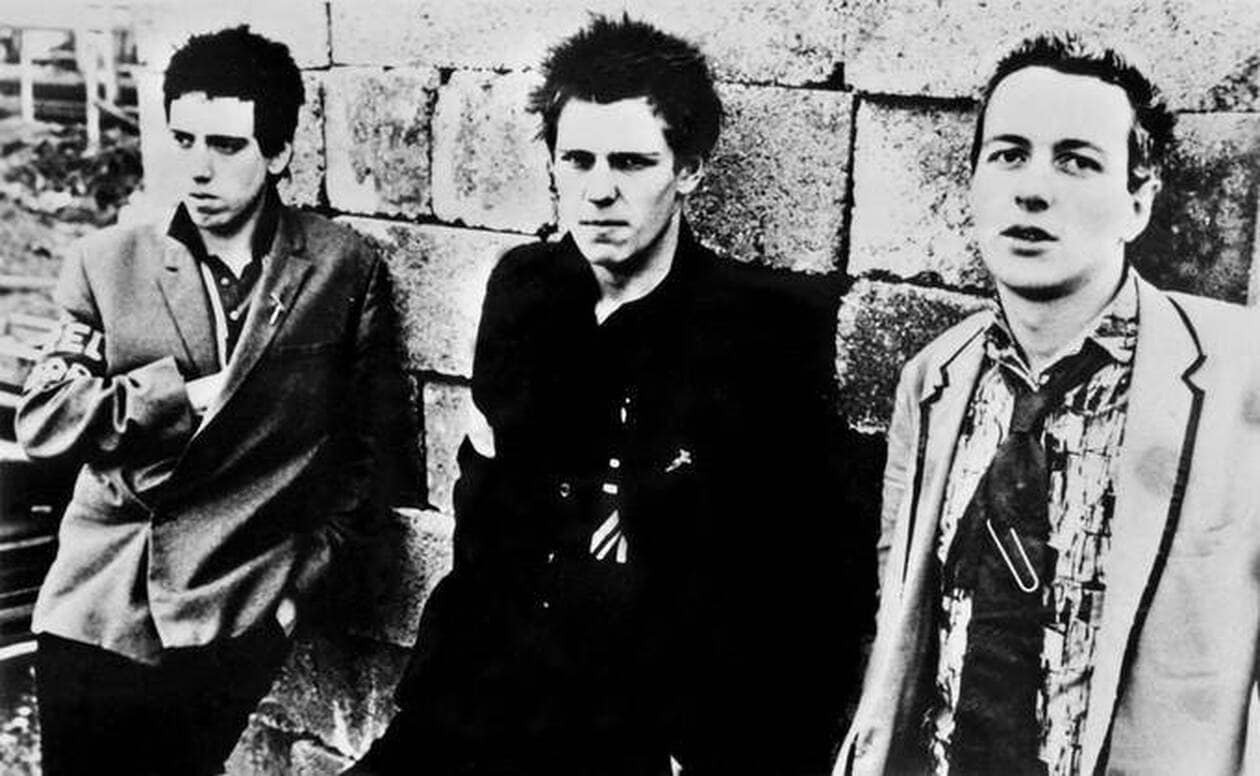
Thursday 11 July 2024 Festival stories (1/7)

The London group The Clash was scheduled for the second edition of the Mont-de-Marsan punk festival. A pirate 33-rpm record was in fact recorded on that occasion. (Photo: AFP)

Magazine

Nearly 50 years ago, hundreds of punks made Mont-de-Marsan their rallying point

For the first episode of our summer series on festival stories, we head to Mont-de-Marsan. It was here that, in 1976, the very first punk festival in Europe took place, in the heart of the city of the Landes and its Plumaзon Arenas. A look back at this local pride which contributed to the recognition of this music in France.

For a long time, they argued fiercely with books, articles, blogs, comments on social networks… The founders of the Mont-de-Marsan punk festival never stopped quarrelling over who, exactly, had the idea of inviting the British group The Damned to headline a concert evening organised on 21 August 1976 in the Plumaзon Arenas, at the heart of the Landais town.
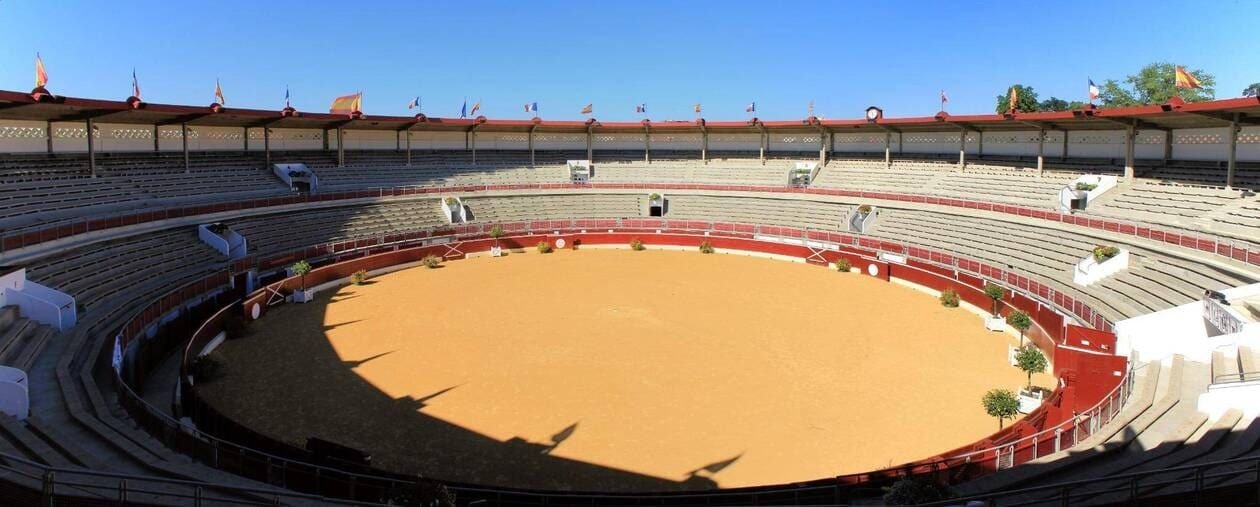
The festival took place in the Plumaзon Arenas. (Photo: Julien Daniel / CC BY-SA 3.0 / Wikimedia Commons)

All the actors of the time nevertheless agree in saying that the leader of this adventure was indeed Marc Zermati, formerly founder of the French rock label Skydog Records, who died in 2020. It was he, mainly supported by Andrй-Marc Dubos, Pierre Thiollay and Larry Debay, who transformed this trial run into a major event, later managing to bring together European heavyweights such as The Clash, The Police, Dr. Feelgood, and many others, on 5 and 6 August 1977.
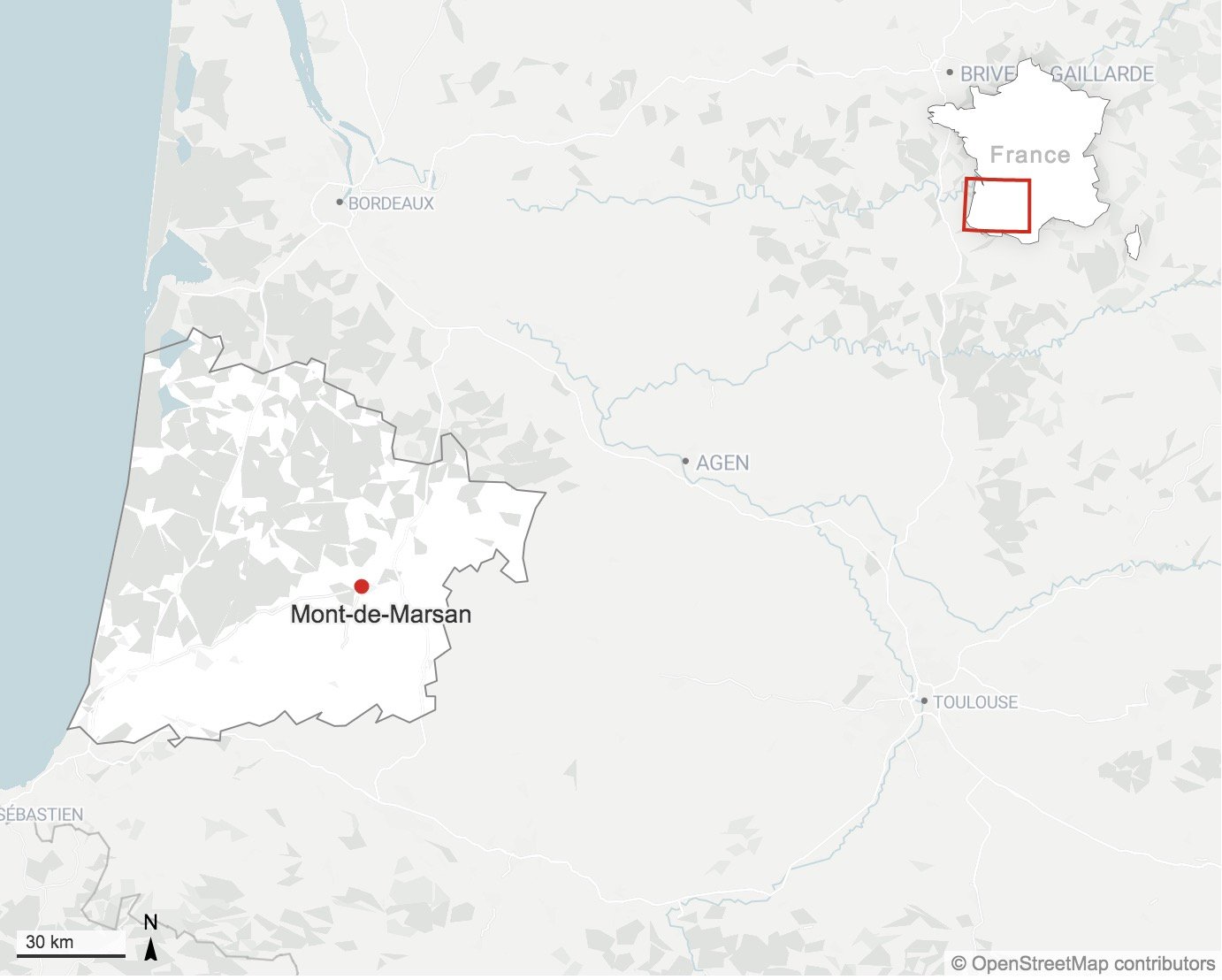
The first punk festival in Europe therefore did indeed take place in the south-west of France, a few days before the 100 Club in London, despite being located in a city that was the epicentre of the genre, organised its own event.

Read also: Star of Hellfest, metal music has real things to say - here is what its songs tell

Seven years of prohibition

Local pride and an entire musical aesthetic, the Mont-de-Marsan punk festival had five editions between 1976 and 1986, with a seven-year hiatus from 1977 to 1984. But it is indeed the 1977 edition that remains the most vivid in collective memory.

https://www.youtube.com/watch?v=NMBZFTGgUHY

Transcript below, archive video here
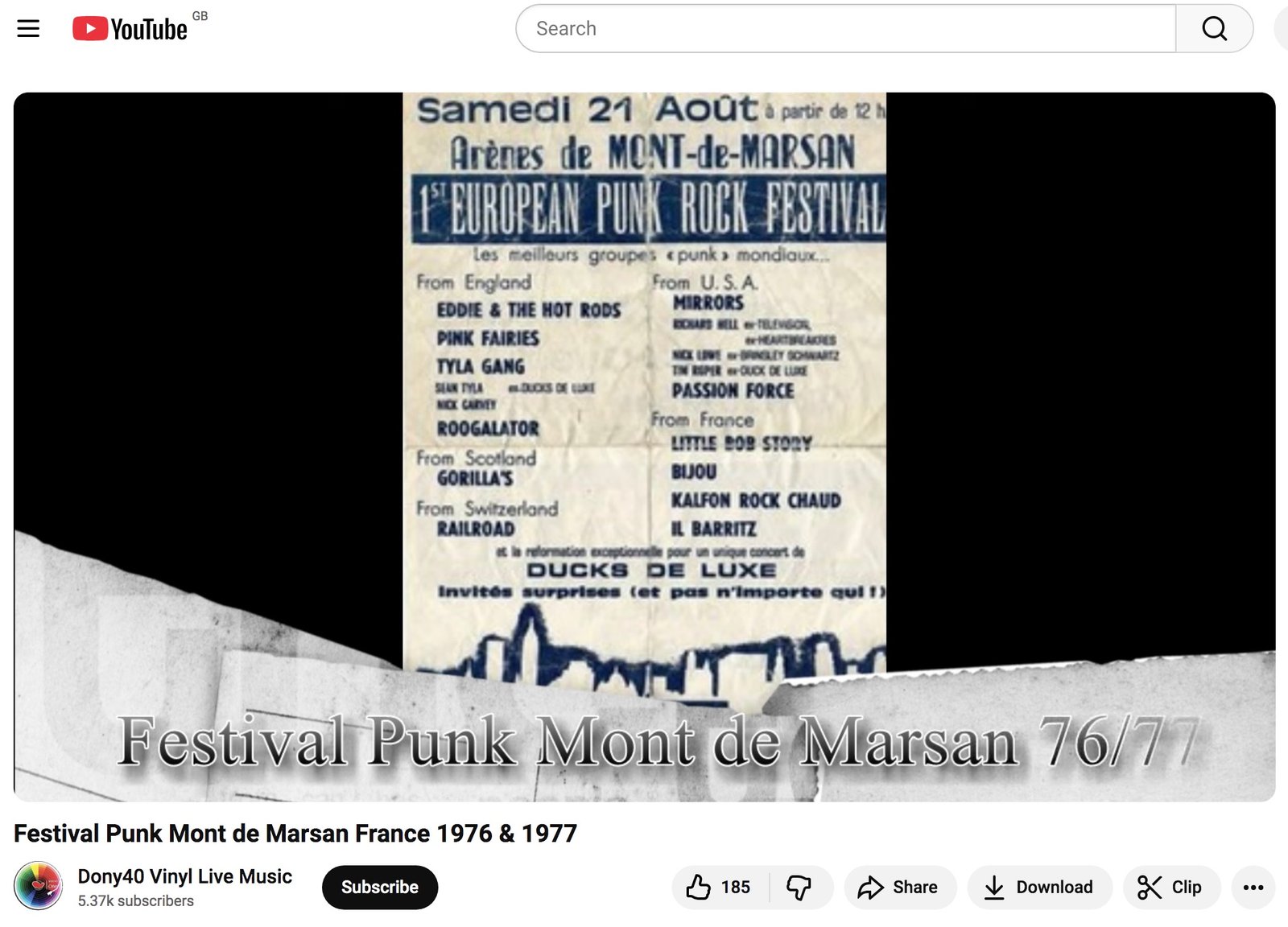
Three thousand people churned up the earth of the arenas, attending performances of very uneven quality. The spectators, seated in the stands, threw their beers at those in the pit, without committing too many excesses nonetheless, behaving themselves more than one might imagine. The festival-goers mainly created, for two days, a strange atmosphere within the Landais town. Holidaymakers in search of calm rubbed shoulders with agitated punks, of whose existence most of them had previously been unaware.

After this second edition, the mayor of Mont-de-Marsan, Charles Lamarque-Cando, prevented the event from being renewed. It was only after his departure from city hall in 1983 that the new municipality, led by Philippe Labeyrie, authorised the resumption of festivities, for three final editions (1984, 1985, and 1986).

Read also: What does it mean to be punk today?

A festival that helped import punk into France

https://www.youtube.com/watch?v=TImP6BL7vPM

Transcript below, archive video here
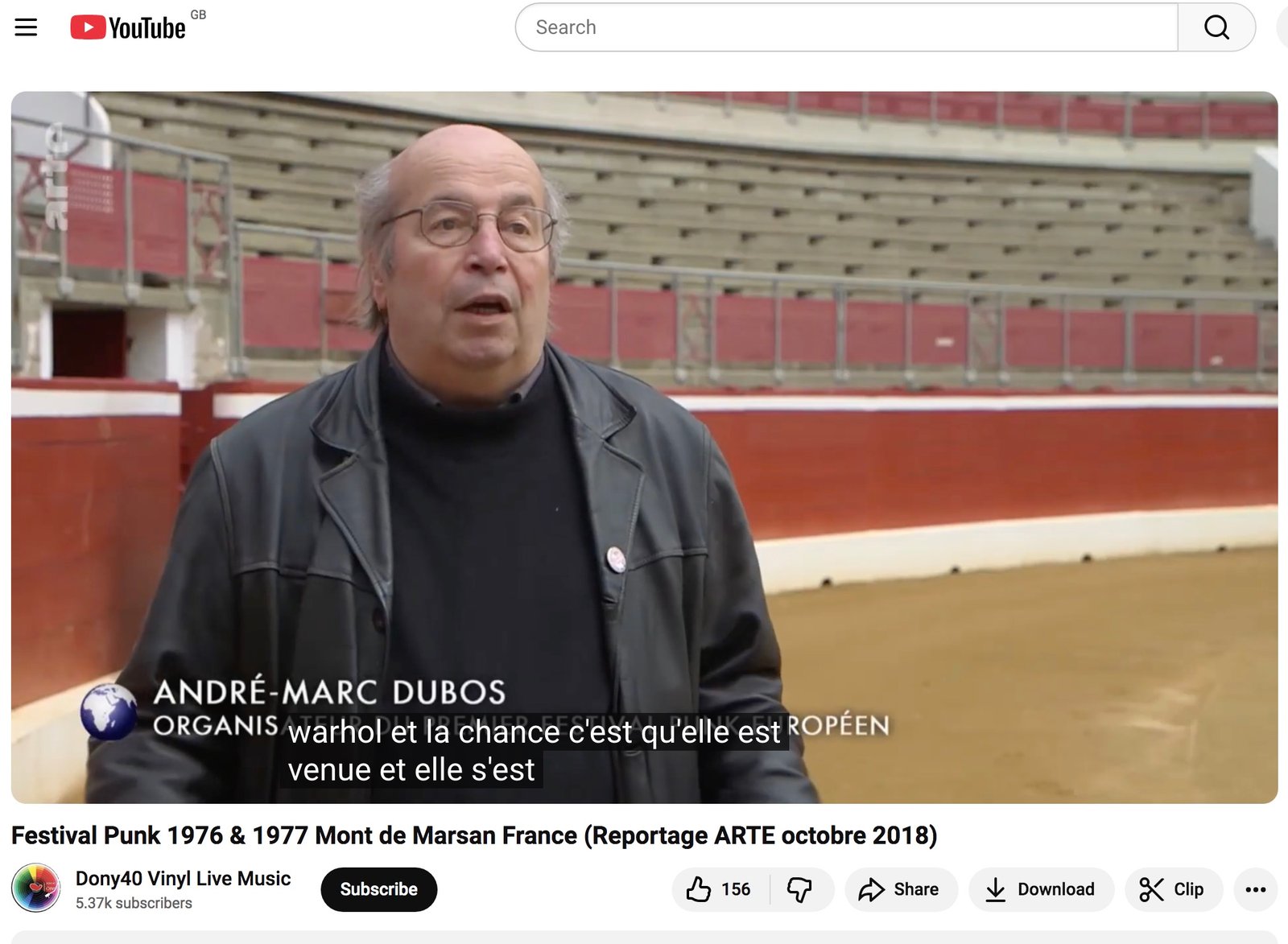
Marc Zermati is not only the creator of an emblematic festival and a rock record label. He is regularly considered as the one who imported punk into France. Even if this status is quite debatable, historical reality being certainly far less simplistic, he worked towards structuring and recognising this music in our country.

The Mont-de-Marsan festival, the object of a small cult, has also been recounted in an excellent book entitled Punk sur la ville, published in 2014 by journalist Alain Gardinier. The best gateway into a major chapter of festival history in France.

Festival Punk 1976 & 1977 - Mont-de-Marsan, France

00:00:00 - 00:00:12

00:00:12 - 00:00:42 Today on Affaires Sensibles, the punks. Who could have believed that the first punk festival in the world would take place in France, in the heart of the Landes, in the city of Mont-de-Marsan, in Languill, under the pines? Who could have imagined that hundreds of young punks would cross expanses of forest and pastureland to come and listen to little-known bands? And yet, the organisers believed in it. In 1976, several hundred punks thus gathered in the south-west of France to listen to the flagship groups of this emerging movement.

00:00:42 - 00:01:09 The festival, however, was a failure, somewhat too far ahead of its time. But a year later, in August 1977, the second edition is in full swing. This time, the public, the press, and the artists are present. So how, in the space of just 12 months, did a musical movement, after all marginal, manage to conquer the whole of Europe? Because in just one year, it became a musical genre, a culture, and sometimes a rallying cry. A phenomenon that still marks us today: punk.

00:01:09 - 00:01:39 Through this adventure, it is also the musical history of 1976 and 1977 that we are going to tell you. Our guest today, Caroline de Cargariou, screenwriter, author at Editions Perrin of No Future, une histoire du punk, published this year. Affaires Sensibles, a programme on France Inter in partnership with the INA, prepared today by Gabriel Debray, coordination Christophe Barrиre, direction Fabrice Legle. Fabrice Drouel, Affaires Sensibles, on France Inter.

00:01:43 - 00:02:10 Mont-de-Marsan, 5 August 1977. On the terrace of the café on Place Jean Jaurиs, Gйrard cannot believe his eyes. For thirty years that he has lived in this town in the Landes, prefecture of the department of the same name, he has never seen anything like it. Before him, it is almost a sacrilege. Two guys with provocative looks are bathing in the fountain. Music.

00:02:10 - 00:02:37 These two boys are called Captain Sensible and Dave Vanian from the group The Damned. They have removed their Doc Martens boots and plunged their feet into the flower-decorated basin. It is incredibly hot on this 5 August 1977, nothing like a foot bath to cool off. Around them gravitates a small crowd of women with eccentric hairstyles and clothes mended with safety pins. Beer in hand, they stroll through the streets laughing loudly.

00:02:37 - 00:03:02 It has now been two days that Gйrard has noticed these strange silhouettes in town. Gangs of young people with marginal looks have arrived and taken up residence at the Hфtel du Sablard, right next to the square, where he had indeed seen the posters plastered on the walls of the town announcing the Punk or Pink festival - nobody really knew how to say it at the time. And he is beginning to understand what it is all about…

00:03:02 - 00:03:15 In front of the Plumaзon Arenas, in any case, the crowd is beginning to grow. It is the second edition of this punk festival. The previous year, it had been an event. Think about it - the first festival of its kind, not in France, but in the world.

00:03:15 - 00:03:42 But the arenas had remained rather empty, probably a little too far ahead of fashion. Punk had not yet found its audience in France. But for this 1977 edition, there is now a crowd. It must be said that the organisers of the Mont-de-Marsan Festival are enthusiasts. Punk, they have known and listened to it for a long time, even before it was really called that. They simply said "rock" or "pub rock" when it was played in pubs. Logical.

00:03:42 - 00:04:05 The idea for the festival emerged in the mind of Marc Zermati, the French punk gentleman. He lives in Paris, but he comes from the Landes. With his friends from the region, he dreams of bringing their favourite bands to the deep south-west, far from everything - a bit like themselves. In the racks of his record shop, Open Market, in Paris, Marc has collected the best albums by The Ramones, Patti Smith, The New York Dolls, and The Stooges, all raw and angry American groups that he adores.

00:04:05 - 00:04:32 And little by little, their younger brothers - almost their heirs - joined them in the bins. London groups possessed by the urge to play loud and fast. French bands shouting their disgust with Giscardian society. Germans in crisis in the face of communism. So many marginal groups sketching the outlines of a new counter-culture, conscious and convinced that they have things to say about their time.

00:04:32 - 00:04:49 It just so happens that in this year 1977, punk has become the number-one trend in the world of rock. A quirk of fashion or a true cultural revolution? How has a music so confidential, confined to the dark clubs of European capitals, become in so little time one of the greatest musical movements of the last fifty years?

00:04:55 - 00:05:24 September 1976, Paris, Les Halles district. Around the Fontaine des Innocents, the paving stones are rather deserted. It is ten o'clock, young people are sleeping in, the street sweepers have already finished their morning choreography, and only a few tourists wander around in search of souvenirs to take home. In Les Halles, shops are starting to open. Slightly tired, Marc Zermati lifts the shutter of his record shop, Open Market.

00:05:24 - 00:05:38 He opened this shop in 1972 to sell the music he loves - vinyl records by American and English rock groups that cannot be found at FNAC.

00:05:38 - 00:06:05 One of the records that sells best in his shop is by an American group that rocks hard. First of all, they have a look. Long hair, black leather jackets, ripped trousers, worn socks. The group was formed in 1964 in New York. Their songs come back again and again.

00:06:09 - 00:06:35 It so happens that in this year 1977, punk has become the number-one trend in the world of rock. A quirk of fashion or a genuine cultural revolution? How has a music so confidential, locked away in the dark clubs of European capitals, become in such a short time one of the greatest musical movements?

00:06:35 - 00:07:04 Marc Zermati is a fan of that kind of energy - the kind that drives the audience mad, makes them want to fight, to smash everything. His record selection focuses on these groups, still hard and around. And for the festival being prepared in Mont-de-Marsan, he wants to do the same. He has no desire to put forward the same groups as everyone else. No. He wants to show this new raw, violent rock. And if the first attempt during the summer of 1976 was a failure, as we said, Marc Zermati remains determined. There will be a second edition.

00:07:04 - 00:07:24 Because he senses that the wind is beginning to turn in the right direction. For some time now, more and more young people with astonishing looks have been gathering around his shop, invading the neighbourhood. The movement is even beginning to interest the media, who do not quite know which end to grab it from - as illustrated by Gйrard Hulse on Antenne 2.

00:07:24 - 00:07:42 Different times, different morals. Are you punk? It's easy to check. You stand in front of a mirror. If you have short red hair, if you have a pin or a nail stuck through your cheek, if you have little Nazi crosses drawn on your forehead - in short, you're a loser and you're a punk. That's the English translation.

00:07:42 - 00:08:00 Marginal, of course, like all those movements of revolt that have followed one another since the zazous, the rockers, and the hippies. With punk, the philosophy is simple: total revolt, always further into provocation.

00:08:00 - 00:08:20 Because yes, young people have had enough of the gentle pop of the 1970s, which does not even allow them to exorcise the malaise of the era. All over the world, the golden years, the glorious trends, are beginning to tarnish. Unemployment is rising, the two oil shocks have confronted the West with the greatest crisis since 1929, and have ushered us into the regrettable period we are still living in today.

00:08:20 - 00:08:38 So music becomes a means of fighting the prevailing gloom. And punk feels good. It is an outlet, as explained by Alain Pacadis, journalist specialising in punk and a punk musician himself. This was in 1978 on the programme À suivre, which in fact was never broadcast.

00:08:38 - 00:09:07 Compared to the hippie movement, which was a non-violence thing - people sitting on the ground at concerts, not moving - punk took the opposite route, obviously: moving as much as possible. There is a whole cult of the image of violence, as in rock, which is part of sadomasochism: dog collars, all that. And in London, it's very, very widespread. At a concert, everyone pretends to fight while not really fighting. It's purely an external image.

00:09:07 - 00:09:22 People dance the pogo, pushing one another until they fall to the ground. But still, care must be taken that nobody is really hurt.

00:09:22 - 00:09:49 Gradually, this casual and brutal attitude spreads through the Parisian nights. More and more clubs welcome this extreme population, hungry for sensation. Evenings also see the appearance of new drugs. The psychotropics loved by the hippies are replaced by amphetamines, which push bodies to their ultimate limits and keep them awake all night long. But in Paris, for the moment, it is still only a minority of young people who follow the movement. And it is in England, the homeland of rock, that the mayonnaise really takes.

00:09:56 - 00:10:16 1975, King's Road, in London. One year before the first punk festival, this is where the phenomenon swells. In front of the shop of Vivienne Westwood and Malcolm McLaren, soberly named Sex, the street is teeming with people. Dozens of young Londoners gather there every day. They linger endlessly on the pavements, drinking beers and comparing their clothes.

00:10:16 - 00:10:35 Some display swastikas, others slogans written by hand on the leather of their jackets such as "No future" or "I hate Pink Floyd". Their faces are pierced, tattooed, their hair coloured, asymmetrically cut and burnt with gel or beer.

00:10:35 - 00:10:58 But punk goes beyond mere appearance. The movement is total. It touches music. Art becomes a societal phenomenon. Punks create their own language, thus excluding part of society. Invading space, they produce the event. They are a rupture within conservative England of the 1970s. Their rebellious attitude is constructed in reaction to the era itself.

00:10:58 - 00:11:26 Government policy is aggressive toward the working classes, living conditions are harsh, power cuts are frequent, unemployment is high. So for English youth, even those from the middle classes, the future holds little hope. Idle, they are bored. Pop culture, designed to entertain them, no longer amuses them. The Beatles, The Stones are judged smooth and are rejected. Malcolm McLaren explains on Antenne 2 what the essence of punk fashion is.

00:11:26 - 00:11:51 The strategy of culture, for the most part, does not show us how to rediscover the basic laws, how to plunge back to the roots. In fact, what we are doing with music that is fashionable is really a conscious search to discover, across all eras, the authentic values that are ours.

00:11:57 - 00:12:22 His Sex shop thus quickly becomes the heart of this new King's Road movement, a research space for an identity specific to this counter-culture. On the racks of Sex, the clothes are deconstructed, the materials synthetic, flashy. Leather is used to reference sadomasochistic culture. Trouser legs are restrained by straps that sometimes make walking difficult. You even see some people hopping to move around.

00:12:22 - 00:12:36 The look also carries a political message. The Union Flag, the flag of the Commonwealth, is diverted, as is the image of the Queen. The aim is obviously to provoke, and ugliness is embraced.

00:12:36 - 00:13:04 Nevertheless, at Sex, it is not only the clothes that are designed to shock. The shop's décor is no less extreme. The floor and walls are covered with a viscous, pink coating that evokes the interior of a female vagina. A hole is pierced in the ceiling, as if a bomb had exploded in the building. And then, in a protruding cage, a live rat gnaws at a piece of flesh - the destroy attitude.

00:13:04 - 00:13:20 But the clothes sold at Sex are expensive, too expensive for young customers who live only on the meagre pocket money given to them by their parents. No matter: Vivienne Westwood claims it openly. She is there to inspire. As they wander through the racks, customers indeed find ideas - all that remains is to reproduce them with whatever is at hand.

00:13:20 - 00:13:43 So everyone tries their hand at sewing, détourning objects, wielding scissors. Do it yourself are the watchwords. Do it yourself. The media don't want to talk about their music? No problem. They create their own newspapers. And once again, improvisation rules. Collages are made, texts written and photocopied endlessly. The golden age of fanzines begins.

00:13:43 - 00:13:58 Little by little, thanks to these fanzines brought back from London by enthusiasts, all of Europe is swept up by the movement. In Paris too, conservatives discover this provocative wave and mistrust it. Buttoned-up France does not like these scruffy, drugged youths.

00:13:58 - 00:14:23 It is also because if the musicians are in their twenties, their fans are much younger. So the parents of teenage punks begin to worry. The mother of a punk wished to remain anonymous. What bothered you in this phenomenon? He began to want to dress a bit like the punks. I had discovered in his wardrobe a torn jacket, patched up with safety pins. And I told him that I didn't like that.

00:14:23 - 00:14:48 The punk phenomenon frightened you. Through what means did you know about it? That is to say, did you try to inform yourself about what it really was? No, not that I tried to inform myself, but the weekly magazines informed us. The Match, the Elle. And my son said that it wasn't the truth, that it wasn't real punk. But then I said to him, well, what is it then?

00:14:49 - 00:15:16 Then he says: "It's too complicated, you won't be able to understand, it's a story of discomfort." It seems to me that they are a bit like the blousons noirs of the time, returning in another form today. Even if the punk wave begins to touch all of Europe, it is London, and more particularly King's Road, which remains the epicentre of the movement. And it is in this atmosphere, provocative yet not without humour, that one of the most decisive encounters in the history of this music will take place.

THE SEX PISTOLS FORM

00:15:22 - 00:15:51 We are in August 1975. Two young punks loiter in front of the shop and talk with Malcolm McLaren. They want to form a group, but they lack a singer. No matter - McLaren has a sense of enterprise. And he senses here an opportunity to advertise his shop. An idea crosses his mind - the idea that will make history. "I don't know who will sing for you, but you will be called the Sex Pistols, the sex pistols." They will be his emissaries.

00:15:51 - 00:16:20 Other guys have heard the exchange. "You should take John, he's good, he's got class." The John in question is called John Lydon, alias Johnny Rotten. He has already been noticed for his assurance on stage in pub rock groups. Added to this is one of the shop's employees, a certain Glenn Matlock on bass - and that's it, the Sex Pistols are formed. Malcolm McLaren immediately becomes their manager. Their style is marked by a deep nonchalance and a sharp, rebellious humour.

THE "GOD SAVE THE QUEEN" SCANDAL

00:16:25 - 00:16:49 And it is precisely this behaviour that will raise them to the rank of myths. In January 1977, England celebrates the jubilee of Queen Elizabeth II. Hundreds of demonstrations, meals and events are organised throughout London in honour of the monarch. McLaren, in all his marketing genius, chooses that very day to schedule his protégés in concert on a boat, on the Thames, and to release their new single God Save the Queen.

00:17:08 - 00:17:32 God save the Queen The fascist regime It made you a moron Potential hate bomb God save the Queen She ain't no human being There is no future In England's dream

REACTIONS - CENSORSHIP - MEDIA HYSTERIA

00:17:39 - 00:18:03 Outraged headlines multiply in the press. "Shocking! Punish the punks!" The provocation is supreme in Great Britain, where the crime of lèse-majesté still exists. And of course, the success matches the blasphemy: immense. The single is immediately placed at the top of the charts. Which displeases the authorities, who ask shops to falsify the figures and lower the title in the rankings.

00:19:14 - 00:19:41 But this strategy is not enough to silence the Pistols. Global success follows and the punk movement explodes. It becomes a real phenomenon that interests sociologists and philosophers. A certain Jacques Attali, an expert on youth culture, speaks about it on television on the programme Hebdo Chansons, Hebdo Musique in 1977 on France 2. "There exist ways of making music, of inventing it, of creating it…"

00:20:09 - 00:20:28 Jacques Attali: "…of living it in places much closer to people, where each person creates their own instruments, creates their own music, and in any case lives it in a creative way. I believe that what we have just seen perhaps indicates quite well the extraordinary destruction of past culture…"

00:20:28 - 00:20:49 "…in the capitalist economy in general, from which this revolt can be born. And it is perhaps in this sense that this music is interesting, as being the mark of a death and at the same time a rebirth." "For you, Patrick Juvet, disco is not at all the same thing…" Patrick Juvet: "You know, I think one must be very careful, when trying to reflect on a culture, not to put labels on things…"

00:20:49 - 00:21:17 "…Because a great creator in himself is not 'something', he is part of a current, of a phenomenon. And whatever the creator, he is only the reflection of a general current. His genius is his own, obviously. But for a sociologist, or someone who observes society - particularly the relationship between music and society - one must above all be careful not to classify individuals…"

00:21:17 - 00:21:33 In no time at all, the phenomenon crosses the Channel. In his Parisian shop, the Open Market, the rare records begin piling up under the counter: young French bands setting themselves to punk. He then takes advantage of his own label, Skydog, which he created a few years earlier, to produce some of them.

00:21:34 - 00:21:53 In the aisles of the Open Market, people trade the fanzines made with whatever means they have, in the English style. Bands form by the dozen in the clubs of Paris, London, Berlin, Belfast, and disband just as quickly - because punk has no ambition. You pick up a guitar, you turn the volume to maximum, and that's enough to play on stage in front of a half-grumbling public.

00:21:54 - 00:22:15 The music industry is lost. What to do with this wave of non-artists who nevertheless manage to unite a following? What to do with these young rebels who refuse to obey producers, who smash hotel rooms, take drugs, fight in concert halls?

00:22:15 - 00:22:38 It is said that once, during a Sex Pistols concert, Vivienne Westwood, bored, decided to slap the woman next to her - whom she didn't even know - yes, just for fun. A huge brawl followed, in which Johnny Rotten himself joined, laughing. Spectacular, certainly - and therefore potentially profitable - but extremely risky for those handling the production.

00:22:38 - 00:22:59 The punk legend grows. Stories circulate about ears torn off with teeth, cuts from smashed bottles. If there is a market, the strategy becomes clear: sign the group that manages to condense the movement while taking the fewest risks.

00:22:59 - 00:23:19 For Marc Zermatti, in the midst of organising the second Festival Punk de Mont-de-Marsan, the choice is obvious: the group he needs is the Sex Pistols. At EMI, one of the biggest record companies in England, the conclusion is the same. They're the stars: attitude, efficient songs, rebellion, notoriety, the look.

00:23:19 - 00:23:41 Especially since the bassist Glenn Matlock has recently been replaced by a new wild man, Sid Vicious - Sid the Vicious. This guy is completely unhinged, does not hesitate to smash beer bottles with his teeth during concerts. Guaranteed spectacle. EMI signs with McLaren. It is the first contract in history between a punk group and a major record company.

00:23:41 - 00:23:52 In parallel, while the Sex Pistols are forming, Bernie Rhodes, a friend and admirer of McLaren, decides to follow his example and takes another band under his wing - that will be The Clash.

00:23:56 - 00:24:24 Unlike the Pistols, who are mediocre musicians whose sound is marked by basic riffs and shouted lyrics, The Clash, on the other hand, have a far more elaborate style. Their music breathes reggae influences, the lyrics are more constructed, the texts committed - and let us not be afraid of words - their music sometimes brushes against masterpiece territory, notably on their first album titled simply The Clash, with in particular London's Burning. In a programme on France 2 in 1977, Philippe Manoeuvre questions them about their political commitment.

00:24:24 - 00:24:51 "And I think The Clash are quite well known among all the English punk groups for being the most politicised of all. I think you have been said to be a political group." "Yes, I have said it. Yes, that's true. OK, yes, it's true, it's a political group." "How? I mean, how does it work in everyday life to be a punk political group in England?" "Oh, it's true. It's street politics. It's not party politics."

00:24:51 - 00:25:19 "It's not a left-wing or right-wing party, it's life in the street." Indeed, throughout their history, The Clash's songs pay tribute to political movements that took place in England at the time. Between 1972 and 1985, riots are frequent in London and throughout the United Kingdom. The policies of Margaret Thatcher, terribly austere, increase the precariousness of many populations.

00:25:19 - 00:25:46 In medium-sized towns, miners launch historic strikes. In working-class neighbourhoods, riots multiply. In 1976, for example, the Jamaican carnival of Notting Hill degenerates. The event inspires The Clash to one of their most famous songs, White Riot. Finally, the West Indian carnival of Notting Hill, in a suburb of London, ended in riot last night. Some young people of Jamaican origin began throwing bottles at the security forces.

00:25:46 - 00:26:02 Street fighting, batons, wounded. The toll of this riot: 391 injured. And despite these incidents, the organisers nevertheless decided that the carnival would take place again the following year.

00:26:02 - 00:26:18 And two tendencies that will mark punk then emerge. With The Clash, music is made almost seriously, at least within a political approach, retaining from punk its mistrust of authority and its rhythmic efficiency. With the Pistols, nihilism and rejection of institutions dominate, with a certain humour.

00:26:18 - 00:26:45 Well then, Marc Zermatti wants both of them - yes, The Clash and the Sex Pistols. If the Sex Pistols play at Mont-de-Marsan, the festival will be a smash hit. But despite all the negotiations he undertakes, the group's manager, Malcolm McLaren, refuses. He doesn't care about this French festival so far from London. No - he is aiming for the United States, where he plans to send the Sex Pistols on tour.

00:26:45 - 00:27:13 It is perhaps for the best; the Pistols are among the most uncontrollable. And in the end, Marc Zermatti does rather well anyway. He has more than one trick up his sleeve. And above all, The Clash agree to come. So, on paper, the bill is impressive. On the English side: The Clash, The Police, The Jam, The Damned - excuse the understatement. On the French side: Stinky Toys, Bijou, Dr. Feelgood - enough to draw a crowd.

00:27:13 - 00:27:42 The sun is crushing, it is the beginning of August in the Landes. Inside the arenas, excitement rises. So, before opening the gates, the organisers spread kilos of baguettes with pâté and rillettes and roll out beer barrels. Punk makes you hungry and thirsty. In the stands, the musicians arrive a little early in a big yellow bus, empty beers and enjoy the sun. Then they are joined by the crowd of enthusiasts and the curious on the ring of the Plumaзon Arenas.

00:27:42 - 00:28:09 Around 5 pm, the concerts begin. Little-known French bands chain together their overexcited seven-inchers. Several faces appear who will later mark the history of music in France, such as Йlie Janneteau, leader of Stinky Toys. At the end of the afternoon, they launch their effective hit Plastic Faces. "Élie, maybe you should very quickly tell how you met." "We met in high school." "Which one?" "Victor Hugo and Charlemagne." "And was it a good atmosphere?"

00:28:09 - 00:28:26 "Yes, we were all drunk, it was great." "All drunk?" "Completely, yes." "And the group name, what exactly does it mean?" "Toys means toys, and stinky?" "It means smelly." "Smelly toys?" "Yes." The song is Plastic Faces. Plastic Faces, Stinky Toys.

00:29:12 - 00:29:28 Subtitling ST' 501

00:31:00 - 00:31:04 This is…

00:31:14 - 00:31:37 Certainly, beer is going down fast, but everyone behaves rather well. At 7 pm, it is The Police who take the stage, with on bass the young Sting, already dyed blond. The music is loud, but the audience applauds politely and pogoes gently. Pogote, a neologism straight out of pogo, the punk dance which consists of jumping until the end of your strength - a sort of trance - but which can also be danced more gently.

00:31:37 - 00:31:55 So much so that in Mont-de-Marsan, the atmosphere is that of a classic rock festival. Very good - but where has the punk lightning gone? Fortunately, The Damned are there to do honour to their movement. Captain Sensible, their leader, is annoyed to be playing before The Clash, presented as the festival's headliners, even though they were already there the previous year.

00:31:55 - 00:32:19 Captain Sensible also did not appreciate the little whim of Joe Strummer, singer of The Clash, who had an enormous photograph of demonstrators fighting with police displayed at the back of the stage. The very image that adorns their album sleeve. For The Damned, there is no question of playing under these conditions - they are here to make sound, not politics.

00:32:19 - 00:32:49 The organisers negotiate. During The Damned's concert, a black tarp covers The Clash's image. But that does not calm them. In the dressing rooms, they continue to fire themselves up with heavy doses of whisky and speed. Then it is The Clash's turn - Joe Strummer's gang - to take the stage to play their punk infused with reggae. They begin with this anthem in honour of the London riots titled London's Burning.

00:32:50 - 00:33:18 The Damned are backstage, plotting their revenge. In the middle of the fourth song, Strummer can scrape his guitar with all his strength - no sound comes out. Behind the curtain, Captain Sensible, drunk as a barrel, laughs. He has just unplugged his enemies' amplifier cables and is gloating.

00:33:18 - 00:33:40 The time it takes for people to fully understand the breakdown. A foul smell invades the stage and spreads to the audience. It is the smell of stink bombs that The Damned, like insolent little kids, have just hurled onto the stage. The Clash's crew does not let it pass. Captain Sensible is thrown backward, back first, against the safety barriers. He comes out of it unharmed. Drugs are good anesthetics.

00:33:40 - 00:34:09 The essence of punk, then, is expressing insolent nonchalance, coupled with a slightly regressive bodily humour, and a certain insensitivity to pain - not to say a taste for violence. The punk movement seems at the peak of its glory. The second Mont-de-Marsan festival is a success; the records of the few stars of the movement are selling like hotcakes, even the bands' television appearances, though extremely provocative, are a success.

00:34:14 - 00:34:41 Bearing the gold trim of punk as it was born in its own county. Like the music it carries, the history of punk was fast and effective. In 1978, the first rumblings are already being felt. Sid Vicious, the new bassist of the Sex Pistols, has found himself a new girlfriend, Nancy Spungen. Now Nancy is a drug addict and, very quickly, she drags Sid into her passion for heroin. Sid Vicious becomes more and more difficult to control.

00:34:41 - 00:34:50 Without a metronome for his bandmates, and on 14 January 1978, Johnny Rotten can no longer stand it and decides to leave the group.

00:34:50 - 00:35:12 So now with Jean-Bernard Hébé, the host of "Post-Restante" on RTL, I would like to evoke the punk phenomenon. The most famous group of this art decided to scuttle itself at the height of its glory after only six months of existence. It is the Sex Pistols. So who were they, these Sex Pistols, Jean-Bernard Hébé? Sex Pistols, there were four of them. The two most famous members already had exotic-sounding names, to say the least, since they were…

00:35:12 - 00:35:25 Jeannot le Pourri, Johnny Rotten, and Sid Vichouste, Sid the vicious. At the beginning, the goal of the Sex Pistols was to play in very small clubs for five or six hundred people and truly be in contact with the audience.

00:35:25 - 00:35:48 And then it became bigger and bigger; they became superstars. And Johnny Rotten, in a magnificent, superb gesture, committed suicide - almost in the literal sense, actually. And they decided to stop. So the Sex Pistols no longer exist. We are going to, I think, shed a few tears - at least I am.

00:35:48 - 00:36:18 A few months later, Sid Vicious is found half unconscious next to his girlfriend Nancy Spungen, who has been stabbed to death. The bassist is charged with murder, then released on bail. He ends up dying of an overdose in February 1979. At the same time, the streets of London see new looks appear. Eyes are made up in black, colours are flashier, punk tartans are traded in for darker clothes. A new wave arrives: the New Wave brings the punk deluge to an end.

00:36:21 - 00:36:37 But the movement continues to resonate today, and irony of ironies, one even finds a certain chic in claiming to be punk. Can we then say, according to the set phrase, that punk is not dead?

00:36:55 - 00:37:20 Subtitling MFP.

00:37:20 - 00:37:40 Here we go.

00:37:40 - 00:38:05 Subtitling MFP.

00:38:05 - 00:38:33 Subtitling ST' 501.

00:38:33 - 00:39:02 Subtitling ST' 501.

00:39:02 - 00:39:22 France Inter, Affaires Sensibles, Fabrice Drouel. Today, the punks. Our guest, Caroline de Cargariou, hello.

00:39:22 - 00:39:46 Hello to you. You are a screenwriter and dramatic author; you have notably written several works of fiction for Affaires Sensibles. So you are, shall we say, concerned by or touched by, I don't know, the punk movement as early as 1977, and you have written for several music magazines, and above all you are the author of this large book entitled No Future, a History of Punk, published by Perrin. First question: were you yourself a punk?

00:39:46 - 00:40:15 Before answering that indiscreet question, I would like to come back to two small clarifications in relation to what was said previously. Punk was not at all a reaction to the England of Margaret Thatcher, because she only came to power in the spring of 1979, whereas English punk began roughly in mid-1975. It was later that the myth of anti-Thatcher punk crystallised.

00:40:15 - 00:40:42 Many modern myths form like that. And they always correspond to deep psychological realities. But it is false. And second thing: Johnny Rotten, to my knowledge, never sang before the Sex Pistols in pub rock bands. So if that is true, it is confidential information hidden at the bottom of a Swiss bank vault. There you go.

00:40:42 - 00:41:04 To answer your question, yes. I collided with the punk movement in June 1977. It really was a revelation and I have been punk ever since. What does it mean to be punk? And today, for you?

00:41:04 - 00:41:31 At 40 years old, it has developed both temporally and spatially, so it has begun to take on very, very different faces. At the beginning, punk is a musical movement based on forgetting the past - at least the recent past. At the end of the first half of the 1970s, music had become bloated,

00:41:31 - 00:41:59 learned, experimental. It was floating music, pieces lasting between 15 and 30 minutes, which were generally impossible to reproduce live. Musicians were very, very distant from the audience - by age, by level of wealth, and by dexterity, virtuosity. That is what punks rose up against… Because you would say that punks are more virtuosic than Pink Floyd, would you?

00:41:59 - 00:42:12 I said that punks rose up against virtuosity. They rise up against quality, against virtuosity - it is a way of being. Yes, absolutely, because they find it boring.

00:42:12 - 00:42:29 Oh really? You find it boring? You have the right to find it boring, to find the Beatles boring, to find Floyd boring. You can - that is part of taste. The Beatles were not in the picture at that time. The groups that punks attacked were, for example, Yes.

00:42:29 - 00:42:57 Ah yes, Yes. Well, they did say it anyway… Yes, they said they hated Floyd, they said it quite openly. Johnny Rotten, who is a clever little guy who likes irony, had indeed made that "I hate Pink Floyd" T-shirt, but he admitted very, very quickly that he liked them a lot. So there was a hidden meaning then? Yes. Well.

00:42:57 - 00:43:11 Listen, for Alain Pacadis, we're going to listen to an archive and then come back to our discussion. Of course, punks are romantics. I don't know if you think they are romantics too. In any case, he says it at Nicole Cornu-Longlois's microphone in 1978 on Antenne 2

00:43:11 - 00:43:40 In some respects, of course, punks resemble the romantics, because first of all they are young - very young - they are 14, 15, 16 years old, and obviously, among punks there is a certain despair in the face of the impossibility of doing anything. The Sex Pistols, the number one punk group in England, always say: "No future, there is no future for us, there is no future for us in the society in which we live, and there is only one solution: to flee, to flee into the dream, to flee into another world."

00:43:40 - 00:44:01 And to get wasted, to stun themselves by drinking, dancing. Punk dances are very violent. The pogo, you just have to jump very violently. And it is in that sense that punks resemble the romantics a little. Do you think punk is romantic too?

00:44:01 - 00:44:30 Perhaps not in the sense Alain Pacadis means. And I do not think punks are despairing. They are rather enraged. I am speaking of English punks, because the situation is somewhat different elsewhere. English punks are enraged at the economic situation they face. Indeed, they tell themselves they have no future in the environment of 1977 England. But I do not think they are giving up. On the contrary - they are going to fight.

00:44:31 - 00:44:53 So that is the English example, which set the tone. There is punk in France, punk in Germany. What are the differences? Was it an export? Was it distorted? Or were we really in the spirit of the English? In France, for example. Let's not forget Germany, because I am thinking of Nina Hagen. And then France, of course, with our punk groups.

00:44:53 - 00:45:15 Punk emerged at roughly the same time in four capitals - well, capitals, large cities: New York, London, Paris, and Brussels. And that comes from the fact that the actors of punk at the time were very, very few - maybe fifty - and they exchanged…

00:45:15 - 00:45:44 Parisians went regularly to New York and brought back ideas, photos, music to Paris. Michel Esteban, for example, who would go on to found a fanzine. Chris Stein of Blondie was in London, presumably around '74. He heard a track by Dr. Feelgood, a London pub rock band.

00:45:44 - 00:46:12 He brought the record back to New York, and that inspired Blondie - the leanness of Blondie. So there were these circulations constantly. And that is also true for London and Brussels. These four punk scenes are very close cousins. Punk would then also spread elsewhere, in Germany, in West Berlin, and also in East Germany. And Nina Hagen was originally in East Germany.

00:46:12 - 00:46:42 And how could punk arrive - which is nevertheless deviant for a system like the East German totalitarian system - and express itself? It is the public enemy number one. I imagine so, yes. It could not express itself at all. It expressed itself underground, or in art galleries, in Protestant churches. There was a kind of no man's land of Protestant churches in East Germany. So punks could express themselves there, to the great horror of the faithful,

00:46:42 - 00:47:02 and of the pastors as well. But still, it was a space of freedom. They tried to bypass censorship by every possible means, but they did not always do it subtly. There were lyrics that were explicitly "crush the cop like a pancake."

00:47:02 - 00:47:31 I don't know whether that person really had a taste for life in East Germany at that time. Most of the musicians ended up in prison. It is not surprising given the nature of the regime and the nature of this culture. One could say that punk leads to everything, provided that one gets out of it. I am thinking of The Clash, of course. But we will come back to The Clash. First, another question. For you, if you had to name the emblematic group

00:47:31 - 00:47:53 of punk culture, which one would it have been? The Sex Pistols? It was the Sex Pistols. Why? Yes, yes, absolutely. Because they defined the punk canon: the way of playing, the sound, the way of singing. Johnny Rotten explained that his very, very particular way of singing - he evokes a braying donkey -

00:47:53 - 00:48:09 came from the fact that he was from a Catholic and very practicing family. And when he was a child, he frequented churches a lot and there were choirs.

00:48:09 - 00:48:28 Children who had pretty voices were recruited for the choir and everyone knew what happened to the children in the choir. So there were already cases of pedophilia at that time. So he wanted to escape that and he…

00:48:28 - 00:48:46 he decided to sing badly in order not to be recruited into choirs. That is what he says, at least. I quite like that anecdote. So, at the opposite extreme of that, as I was saying, punk leads to everything provided you get out of it, there is The Clash, which is punk,

00:48:46 - 00:49:02 but which, from its very first album, simply called The Clash, already takes enormous care with arrangements, with music. There is a blending between punk and reggae. I am thinking of the track which is a marvel, Police and Thieves, which appears on The Clash. So here it is something else - we are still punk, but we could also say we are in refinement.

00:49:03 - 00:49:22 Yes, absolutely, because Joe Strummer is much older; he is already an old pub-rock musician. He has a great deal of experience and, moreover, most of the melodies on this first Clash album do not sound very punk because they do not sound very new.

00:49:22 - 00:49:44 When the Sex Pistols album comes out, everyone is stunned, because it resembles nothing else. The Clash album is very well received, but it already resembles things that have been done before. And in particular, if you know the 33-rpm record by the 101ers, which was Joe Strummer's pub-rock band just before The Clash

00:49:44 - 00:50:06 you will see that you really find very, very similar elements. And then he will also plunge into traditional English music, into children's ballads. And obviously reggae is the thing we hear the most. So there are many influences. So it is not a young, fresh, and spontaneous music like the Sex Pistols.

00:50:07 - 00:50:23 Through everything you are saying, I hear that for punk culture, it is not the music that matters, it is the attitude. At the same time, one can love the music - it is rather complicated. Can one love the music and love the punks? Yes.

00:50:23 - 00:50:47 The attitude of punks toward music is very simple. It comes from this reaction against very bloated, sophisticated music, against which they rose up. They say to themselves: it would be a shame to have to wait until one has done twenty years of conservatory to make music. They want to make music.

00:50:47 - 00:51:09 That remains, all the same, the main motivation. Music is the starting point. But afterward, it will take on extraordinary proportions. It will become political, philosophical. It will touch other arts and the whole world. But at the start, it is true, it is music. And this generation wants to make music

00:51:09 - 00:51:34 without being forced to buy extremely expensive instruments, to surround oneself with a philharmonic orchestra, to play in a football stadium. That is the basic principle of punk: do it yourself, meaning economy of means. Was there a schism in punk between the supporters of the path taken by the Sex Pistols and the supporters of the path taken by The Clash, for example?

00:51:34 - 00:51:51 At the beginning, punk is very, very diverse. So there is not going to be any schism. If there is a schism, it will come much later. Because at a certain point, as in any movement, there is formatting, there is a crystallisation of the canon. So that will come later. But at the beginning…

00:51:51 - 00:52:06 …in fact, it is above all the Sex Pistols who are going to have an influence. Each time there is a Sex Pistols concert somewhere, there are three or four groups that form. Those groups are not going to copy the Sex Pistols; they are going to do their own thing.

00:52:06 - 00:52:24 You were talking earlier about punk art that does not only affect music. Where did punk invest art? Essentially in street art. Street art is, in a way, the do-it-yourself of painting.

00:52:24 - 00:52:40 At that time, artists - young artists especially, particularly those working figuratively - had no hope of finding a gallery, whether in London, Paris, or perhaps more so in New York.

00:52:40 - 00:52:56 And they said to themselves: let us take matters into our own hands, especially in the Les Halles district of Paris. There was Beaubourg under construction, the Halles being demolished. There were hoardings everywhere. They took over the hoardings.

00:52:56 - 00:53:25 And they said to themselves: our gallery is going to be the street. And that is how it started, with people like Speedy, Graffito. Much later, there was Jef Aйrosol, who was inspired by a Clash concert, behind whom Futura 2000 was painting a wall mural. There were also the VLP. In short, all street artists come from the punk spirit.

00:53:25 - 00:53:54 Last thing: some people consider that being punk today is quite chic - it is even the height of chic. How can we explain this change of status for this movement which was nevertheless intended to be marginal? Isn't that surprising? Yes, it is absolutely surprising. Already the word punk is very surprising because at the beginning, under Shakespeare's pen, it meant prostitute. And little by little, over the centuries, it came to mean loser. And it became…

00:53:54 - 00:54:24 …punk, punk musician. And from the moment punk began to spread across the world, and this movement which seemed marginal actually showed that it was not marginal at all - because it resonated with universal values - it became a compliment. Thank you very much, Caroline Cargariou, for this insight into the punk movement that you know so well, to the point of having written a book about it, called No Future, une histoire du punk, published by Perrin. Thank you, goodbye. Thank you.

00:54:27 - 00:54:48 This was Affaires Sensibles today. Les punks, a programme you can listen to again as a podcast on franceinter.fr. Also visit the Affaires Sensibles Facebook page. Thanks to Philippe Duclos, who handled the technical side today. Tomorrow, we will discuss the Bruay-en-Artois case.

-

Festival Punk 1976 & 1977 Mont-de-Marsan France

(ARTE report, October 2018)

00:00:03 - 00:01:05 The unmissable Plumaзon arenas conceal a completely different story, that of a sudden flowering of punk, a mythical episode in the history of this musical current. Beneath its good-natured appearance collapses Marc Zermati, the boss who was at the origin of this small seismic shock. At the beginning of the 1970s, nothing ever happened anyway when wandering around France in a dead town where people were bored stiff, and so we decided to do concerts, and we did a first concert in 1973, and we were lucky to have Nico, she had played, and Fellini.

00:00:38 - 00:01:30 In La Dolce Vita, she was in The Velvet Underground, she toured with Warhol, and the lucky thing is that she came and found it very good here. She stayed three days, she did not want to leave anymore, and when she went back up to Paris, her manager at the time telephoned me and said: "But what did you do to Nico?" And I said: "What did we do?" But she spread it all over Paris that you have to go and play in Mont-de-Marsan. Thanks to, or because of, this publicity, Andrй-Marc decides to organise a…

00:01:04 - 00:02:12 …festival, this time much noisier, more worrying for the local authorities: it will be a festival of panic. [Applause] [Music] It acts as a bomb for a good reason: never had anything like this happened in a provincial town. And since Mont-de-Marsan is a military town, especially at the time, there were the paratroopers, the air base. In August, when usually it is dead calm, the arenas are stormed by a fauna more accustomed to stadiums and smoky back rooms.

00:01:38 - 00:02:43 The pens reserved until then for bulls are put to use. We had also organised all the musicians' dressing rooms as well as eating areas, bars for the musicians. Those who wanted to go straight onto the track went out through the corridors, what are called the chute corridors, where the bulls come out, onto the stage moulded into the curve of the arena. Fifteen still-unknown groups coming from England, the United States, Switzerland, and France crank up the atmosphere. The pinned-on reputation anyway a bad one…

00:02:11 - 00:03:07 …there were many venues that no longer wanted to receive them, and groups were above all very protest-driven against power. It is a shock for the population, a shock especially for the authorities who nevertheless tried to ban it, thinking there would be damage with all these people who were going to arrive. This first festival, it is clear, only lasted one day without causing any notable incidents, but afterwards the town hall no longer wanted to hear about punks. The organisers, they…

00:02:38 - 00:03:52 …manage to do it again. The police commissioner of the time did not want to hear about it, saying: "I cannot ensure the security of the town." And he went on holiday in August 1977. The punk movement is then at its peak. The arenas will host a mythical line-up: The Clash, The Damned, The Police, Lou Reed. A horde of fans descends on this town unknown on the festival map. [Music] The English are astonished to be in an arena, punk, than the court…

00:03:19 - 00:04:18 …ideologues, no but frankly, that then, passing over one's head, no but I say, that did not exist. Madame Voile, and especially The Clash, monopolise the word. Sting in the stands. French television is forced to relay the event, which seems to overtake everyone. Too sharp, too clean, unexpected, really not forbidden as an atmosphere. Objective: frighten, shock, shake up habits. Objective failed, it has to be said - at least in Mont-de-Marsan - because they only succeeded in provoking curiosity…

00:03:49 - 00:04:48 …amazement, indifference sometimes, perhaps also pity on the part of the Montois, the inhabitants of Mont-de-Marsan. In reality, the punks are not going to cause more damage than the Landes calves or the participants who ravaged local fêtes. And the only incidents there were: twelve ducks stolen, one shop window broken. The bistros were full, there were purchases everywhere, and I had, in particular, a lady who ran a perfume shop who told me: "You know, I worked very well during your festival." Before…

00:04:20 - 00:04:56 …Thursday anyway I did not understand, and they tell me here I sold all the mascara, things for the eyes, everything for make-up for the time, which she sold, before there were no such things. The festival, the Mont-de-Marsan arenas, will remain a mythical event in the history of punk, and in the life of this quiet prefecture of the Landes.

----

French original text

PHOTO 1

Jeudi 11 juillet 2024

Histoires de festivals (1/7)

Le groupe londonien de The Clash était programmé lors de la seconde édition du festival punk de Mont-de-Marsan. Un 33 tours pirate a d'ailleurs été enregistré à cette occasion. (Photo : AFP)

Magazine

Il y a près de 50 ans, des centaines de punks faisaient de Mont-de-Marsan leur lieu de ralliement

Pour le premier épisode de notre série d'été sur les histoires de festivals, direction Mont-de-Marsan. C'est ici qu'a eu lieu, en 1976, le tout premier festival punk d'Europe, au cœur de la ville des Landes et de ses arènes du Plumaçon. Retour sur cette fierté locale qui a contribué à la reconnaissance de cette musique en France.

Longtemps, ils se sont écharpés à grands coups de livres, d'articles, de blogs, de commentaires sur les réseaux sociaux… Les fondateurs du festival punk de Mont-de-Marsan n'ont eu de cesse de se disputer quant à savoir qui, exactement, a eu l'idée de convier le groupe britannique The Damned à devenir la tête d'affiche d'une soirée de concerts organisée le 21 août 1976 dans les arènes du Plumaçon, au cœur de la ville landaise.

PHOTO 2

Le festival a eu lieu dans les arènes du Plumaçon. (Photo : Julien DANIEL / CC BY-SA 3.0 / Wikimedia Commons)

Tous les acteurs de l'époque s'accordent cependant à dire que le meneur de cette aventure est bel est bien Marc Zermati, auparavant fondateur du label rock français Skydog Records, et décédé en 2020. C'est lui, principalement épaulé par André-Marc Dubos, Pierre Thiollay et Larry Debay, qui a transformé ce coup d'essai en événement de taille, parvenant par la suite à rameuter des pointures européennes telles que The Clash, The Police, Dr. Feelgood et bien d'autres, les 5 et 6 août 1977.

PHOTO 3

Le premier festival punk d'Europe a donc bien eu lieu dans le sud-ouest de la France, quelques jours avant que le 100 Club de Londres, pourtant situé dans une ville épicentre du genre, n'organise son propre événement.

Lire aussi : Star du Hellfest, la musique metal a de vraies choses à dire, voici ce que racontent ses chansons

Sept années d'interdiction

Fierté locale et de tout une esthétique musicale, le festival punk de Mont-de-Marsan aura connu cinq éditions de 1976 à 1986, avec une pause de sept ans de 1977 à 1984. Mais c'est bien celle de 1977 qui reste la plus vivace dans la mémoire collective.

https://www.youtube.com/watch?v=NMBZFTGgUHY

Trois mille personnes ont alors retourné la terre des arènes, assistant à des prestations de qualités très variables. Les spectateurs, installés dans les gradins balançaient leurs bières sur ceux situés dans la fosse, sans trop commettre de débordements pour autant, se tenant plus à carreau qu'il n'y paraît. Les festivaliers ont provoqué surtout, deux jours durant, une drôle d'ambiance au sein de la ville landaise. Les vacanciers, en quête de calme, côtoyaient des punks énervés dont ils n'avaient pour la plupart même pas conscience de l'existence.

Après cette deuxième édition, le maire de Mont-de-Marsan, Charles Lamarque-Cando, a empêché la reconduite de l'événement. Ce n'est qu'après son départ de la mairie en 1983 que la nouvelle municipalité, menée par Philippe Labeyrie, autorisera la reprise des festivités, pour trois ultimes éditions (1984, 1985 et 1986).

Lire aussi : C'est quoi être punk aujourd'hui ?

Un festival qui a permis d'importer le punk en France

https://www.youtube.com/watch?v=TImP6BL7vPM

Marc Zermati n'est pas seulement le créateur d'un festival emblématique et d'une maison de disques rock. Il est régulièrement considéré comme celui qui a importé le punk en France. Même si ce statut est tout à fait discutable, la réalité historique étant très certainement bien moins simpliste, il a œuvré à la structuration et à la reconnaissance de cette musique en nos contrées.

Le festival de Mont-de-Marsan, objet d'un petit culte, a été quant à lui raconté dans un excellent livre intitulé Punk sur la ville, publié en 2014 par le journaliste Alain Gardinier. La meilleure porte d'entrée vers un pan majeur de l'histoire des festivals en France.

---

Festival Punk Mont de Marsan France 1976 & 1977

00:00:00 - 00:00:12

...

00:00:12 - 00:00:42

Aujourd'hui dans l'affaire sensible, les punks. Qui aurait pu croire que le premier festival punk du monde aurait lieu en France, au cœur des Landes, dans la ville de Montmarsan, à Languille, sous les pins ? Qui aurait pu imaginer que des centaines de jeunes punks viendraient traverser les étendues de forêts de pâturage pour venir écouter des groupes méconnus ? Pourtant, ces organisateurs, eux, y ont cru. En 1976, quelques centaines de punks se retrouvent donc dans le sud-ouest de la France pour écouter les groupes phares de ce mouvement naissant.

00:00:42 - 00:01:09

Le festival, pourtant, est un échec, un peu trop en avant sur son temps. Mais un an plus tard, en août 1977, la deuxième édition bat son plein. Le public, la presse et les artistes, cette fois, sont au rendez-vous. Alors, comment, en l'espace de seulement 12 mois, un mouvement musical, somme toute marginale, a-t-il réussi à conquérir l'Europe entière ? Car, en seulement un an, il est devenu genre musical, culture et parfois cri de ralliement. Un phénomène qui nous marque encore aujourd'hui, tel est le punk.

00:01:09 - 00:01:39

A travers cette aventure, c'est aussi l'histoire musicale des années 76 et 77 que nous allons vous raconter. Notre invitée aujourd'hui, Caroline de Cargariou, scénariste, elle est l'auteur aux éditions Perrin de No Future, une histoire du punk publiée cette année. Affaires Sensibles, une émission de France Inter en partenariat avec l'INA, préparée aujourd'hui par Gabriel Debray, coordination Christophe Barrère, réalisation Fabrice Legle. Fabrice Drouel, Affaires Sensibles, sur France Inter.

00:01:43 - 00:02:10

Mont Narsan, 5 août 1977. Sur la terrasse du café de la place Jean Jaurès, Gérard n'en croit pas ses yeux. Depuis 30 ans qu'il habite dans cette ville des Landes, préfecture du département du même nom, il n'avait jamais vu ça. Devant lui, c'est presque un sacrilège. Deux types au look provocateur sont en train de se baigner dans la fontaine. Musique

00:02:10 - 00:02:37

Ces deux garçons s'appellent Captain Sensible et Dave Vagnon du groupe de Damned. Ils ont retiré Lord Doc Martins et plongé dans le bassin orné de fleurs. Il fait incroyablement chaud en ce 5 août 77, rien de tel qu'un bain de pied pour se rafraîchir. Autour d'eux gravite une petite foule de femmes, la coiffure excentrique et aux vêtements reprisés avec des épingles à nourrice. Bière à la main, ils déambulent dans les rues en riant fort.

00:02:37 - 00:03:02

Ça fait maintenant deux jours que Gérard a remarqué ces silhouettes étranges dans la ville. Des grades de jeunes au look de marginal ont débarqué et élu domicile à l'hôtel du Sablard, juste à côté de la place, où il avait bien vu les affichettes tapissées sur les murs de la ville qui annonçaient le festival Ponk ou Pink, on ne savait pas comment dire à l'époque. Et il commence à comprendre quand même de quoi il s'agit. ...

00:03:02 - 00:03:15

Devant les arènes de Plumasson, tout cas, la foule commence à grandir. C'est la deuxième édition de ce festival punk. L'année précédente, c'était un événement. Pensez donc, le premier festival du genre, non pas de France, mais du monde.

00:03:15 - 00:03:42

Or, les arènes étaient restées un peu vides, un peu trop en avance probablement sur la mode. Le punk n'avait pas encore trouvé son public en France. Mais pour cette édition 77, là, il y a foule. Il faut dire que les organisateurs du Festival de Mont-de-Marsan sont des passionnés. Eux, le punk, ils le connaissent et l'écoutent depuis longtemps, même avant qu'on ne l'appelle vraiment comme ça. On disait en Corée simplement « rock » ou « pub rock » quand il était joué dans les pubs. Logique.

00:03:42 - 00:04:05

L'idée du festival a émergé chez Marc Zermatti, le monsieur punk français. Il vit à Paris, mais il vient des Landes. Avec ses copains de la région, il rêve de faire venir leur groupe favori dans le sud, très à l'ouest, un peu comme eux. Dans les rayons de l'Open Market, son magasin de disques, à Paris, Marc a collectionné les meilleurs albums des Ramones, Patti Smith, des New York Dolls et des Stooges, autant de groupes américains bruts et énervés qu'il adore.

00:04:05 - 00:04:32

Et petit à petit, leurs jeunes frères, presque des élitiers, les ont rejoints dans les bacs. Des groupes londoniens qui ont la rage de jouer fort et vite. Des français qui crient leur dégoût de la société giscardienne. Des allemands en crise face au communisme. Autant de groupes marginaux qui dessinent les contours d'une nouvelle contre-culture, conscients et sûrs qu'ils ont des choses à dire sur leur temps.

00:04:32 - 00:04:49

Il se trouve qu'en cette année 77, le punk est devenu la tendance numéro un dans le monde du rock. Aléas de la mode ou véritable révolution culturelle ? Comment une musique si confidentielle, confinée aux clubs obscurs des capitales européennes, est-elle devenue en si peu de temps l'un des plus grands mouvements musicaux des 50 dernières années ?

00:04:55 - 00:05:24

Septembre 1976, Paris, quartier des Halles. Autour de la fontaine des Innocents, les pavés sont plutôt déserts. Il est 10 heures, les jeunes font la grasse matinée, les balayeurs ont déjà fini leur chorégraphie matinale et seuls quelques touristes flânent à la recherche de souvenirs à rapporter chez eux. Dans les Halles, les boutiques commencent à s'ouvrir. Un peu fatigué, Marc Zermatti relève la grille de son magasin de disques, l'Open Market.

00:05:24 - 00:05:38

Cette boutique, il l'a ouverte en 1972 pour vendre la musique qu'il aime, des vinyles de groupes de rock américains ou anglais qu'on ne peut pas trouver à la FNAC.

00:05:38 - 00:06:05

L'un des disques qui se vend le mieux chez lui est celui d'un groupe américain qui bombe. D'abord, ils ont un look. Cheveux longs, perfecto noir, pantalons déchirés, chaussettes usées. Le groupe s'est formé en 1964 dans un New York. Ses chansons reviennent. Des Français qui crient leur dégoût de la société giscardienne. Des Allemands en crise face au communisme. Autant de groupes marginaux qui dessinent les contours d'une nouvelle contre-culture, conscients et sûrs qu'ils ont des choses à dire sur leur temps.

00:06:09 - 00:06:35

Il se trouve qu'en cette année 77, le punk est devenu la tendance numéro un dans le monde du rock. Aléas de la mode ou véritable révolution culturelle ? Comment une musique si confidentielle, confinée aux clubs obscurs des capitales européennes, est-elle devenue en si peu de temps l'un des plus grands mouvements musicaux ?

00:06:35 - 00:07:04

Marc Zermatti est fan de cette énergie-là, celle qui rend fou le public, donne envie de se battre, de tout casser. Sa sélection de disques se concentre sur ces groupes-là, encore Hard and Around. Et pour le festival qui monte à Mont-de-Marsan, il veut faire la même chose. Il n'a aucune envie de mettre en avant les mêmes groupes que les autres, non. Il veut montrer ce nouveau rock brut, violent. Et si la première tentative pendant l'été 1976 a été un échec, on l'a dit, Marc Zermatti reste déterminé. Il y aura une deuxième édition.

00:07:04 - 00:07:24

car il sent que le vent est en train de tourner dans la bonne direction. Cela fait d'ailleurs quelques temps que plus en plus de jeunes au look étonnant se retrouvent autour de sa boutique envahissant le quartier. Le mouvement commence même à intéresser les médias qui ne savent pas très bien par quel bout le prendre, à l'image de Gérard Hulse, sur Antenne 2.

00:07:24 - 00:07:42

Autre temps, autre mœurs, êtes-vous punk ? C'est facile à vérifier, vous vous mettez en face d'un miroir, si vous avez les cheveux courts, rouges, si vous avez une épingle ou un clou planté à travers la joue, si vous avez de petites croix nazies dessinées sur le front, bref vous êtes un paumé et vous êtes un punk, c'est la traduction anglaise.

00:07:42 - 00:08:00

Marginal, bien sûr, comme tous ces mouvements de révolte qui se sont succédés depuis les azous, les rockers et les hippies. Avec le punk, la philosophie est simple, révolte intégrale, toujours plus loin dans la provocation.

00:08:00 - 00:08:20

Mais oui, les jeunes en ont assez de la pop gentille des années 70 qui ne leur paie même pas d'exorciser le mal-être de l'époque. Un peu partout dans le monde, les années dorées, les trends glorieuses commencent à ternir. Le chômage augmente, les deux chocs pétroliers ont mis l'Occident face à la plus grande crise depuis 1929 et nous ont fait entrer dans la période regrettable que nous connaissons aujourd'hui.

00:08:20 - 00:08:38

Alors la musique devient un moyen de combattre la morosité ambiante. Et le punk fait du bien. Il est un exitoire, comme l'explique Alain Pacadis, journaliste spécialisé dans le punk et musicien punk lui-même. C'était en 1978 dans l'émission À suivre, qui ne fut jamais diffusée d'ailleurs.

00:08:38 - 00:09:07

C'est par rapport au mouvement hippie qui était un truc de non-violence, les gens qui étaient assis par terre à un concert, qui ne bougeaient pas. Et les puns, comme ils ont pris le contre-pied, c'est évidemment de bouger le plus possible. Il y a tout un certain culte de l'image de la violence, comme dans le rock, qui fait partie du sadomasochisme, les colliers de chiens, tout ça. Et à Londres, c'est très très répandu, à un concert, tout le monde fait semblant de s'adresser, tout en ne se battant pas vraiment, c'est uniquement une image extérieure.

00:09:07 - 00:09:22

Les gens dansent le poko, se poussent les uns les autres jusqu'à ce qu'ils tombent par terre. Mais quand même, il faut attention à ce que personne ne soit vraiment blessé.

00:09:22 - 00:09:49

Progressivement, cette attitude désinvolte et brutale gagne les nuits parisiennes. De plus en plus de clubs accueillent cette population extrême, avide de sensations. Les soirées voient aussi apparaître de nouvelles drogues. Les psychotropes dont les hippies étaient fans sont remplacés par des amphétamines qui poussent les corps dans leur dernier retranchement et gardent éveillés toute la nuit. Mais à Paris, pour le moment, ce n'est encore qu'une minorité de jeunes qui suit la mouvance. Et c'est en Angleterre, la patrie du rock, que la mayonnaise prend.

00:09:56 - 00:10:16

1975, King's Road, à Londres. Un an avant le premier festival punk, c'est là que le phénomène gonfle. Devant la boutique de Vivienne Westwood et Malcolm McLaren, sobre bordelais sexe, la rue grouille de monde. Des dizaines de jeunes londoniens s'y donnent rendez-vous chaque jour. Ils viennent tout le temps sur les trottoirs, buvant des bières et comparant leurs vêtements.

00:10:16 - 00:10:35

Certains arborent des croix gammées, d'autres des slogans écrits à la main sur le cuir de leur veste comme « No future » ou « I hate Pink Floyd ». Leurs visages sont percés, tatoués, leurs cheveux colorés, coupés de façon asymétrique et brûlés avec du gel ou de la bière.

00:10:35 - 00:10:58

Mais l'un-punk dépasse le simple look. Le mouvement est total. Il touche la musique. L'art devient un phénomène sociétal. Les punks créent leur propre langage, excluant ainsi une partie de la société. Envahissant, ils produisent l'événement. Ils sont une cassure dans l'Angleterre conservatrice des années Thatcher. Leur attitude, rebelle, se construit en réaction à l'époque, justement.

00:10:58 - 00:11:26

La politique du gouvernement est agressive envers les classes populaires, les conditions de vie sont rudes, il y a des coupures de courant fréquentes, un fort taux de chômage. Alors, pour la jeunesse anglaise, même issue de la classe moyenne, l'avenir présente peu d'espoir. Désovrés, ils s'ennuient. La culture pop, faite pour les divertir, ne les amuse plus. Les Beatles, les Stones, sont autant de groupes qu'ils jugent lisses et qu'ils rejettent. Malcolm McLaren explique pour Antenne 2 ce qu'est l'essence de la mode punk.

00:11:26 - 00:11:51

La stratégie de la culture, pour une grande part, ne nous montre pas comment retrouver les lois de base, comment plonger aux racines. En fait, ce que nous faisons avec la musique qui est dans la mode, c'est vraiment la recherche consciente pour découvrir, à travers toutes les époques, les valeurs authentiques qui sont les nôtres.

00:11:57 - 00:12:22

Sa boutique sexe, donc, devient rapidement le cœur de cette nouvelle mouvance d'Eastroy, un lieu de recherche pour une identité propre à cette contre-culture. Dans les rayons de sexe, les vêtements sont déstructurés, les matières sont synthétiques, flashy. On utilise du cuir pour rappeler la culture sadomasochiste. Les jambes des pantalons sont entravées par des sangles qui rendent parfois la marche difficile. On en voit même quelques-uns sautiller pour se déplacer.

00:12:22 - 00:12:36

Le look porte aussi un message politique. L'union flag, le drapeau du Commonwealth, est détourné tout comme l'image de la reine. Le but est évidemment de provoquer que la laideur est assumée.

00:12:36 - 00:13:04

Pour autant, chez Sexe, il n'y a pas que les vêtements qui sont faits pour choquer. La décoration de la boutique non plus ne fait pas dans la dentelle. Le sol et les murs ont été recouverts d'un revêtement visqueux et rose qui rappelle l'intérieur d'un vagin féminin. Un trou est percé dans le plafond, comme si le bond avait éclaté sur l'immeuble. Et puis dans une cage qui dépasse, un rat vivant ronge un morceau de pince et la destroy attitude.

00:13:04 - 00:13:20

Mais les vêtements vendus chez Sexe sont chers, trop chers pour leurs jeunes clients qui ne vivent que du maigre argent de poche que leur donnent leurs parents. Pas grave, Vivienne Wassoud le revendique, elle est là pour inspirer. En traînant dans les rayons, les clients trouvent en effet des idées, non plus qu'à les reproduire avec les moyens du bord.

00:13:20 - 00:13:43

Alors, tout le monde s'essaie à la couture, détourne des objets, donne des coups de ciseaux. Do it yourself, sont les maîtres mots. Fais-le toi-même. Les médias ne veulent pas parler de leur musique ? Pas de problème. On crée son propre journal et là encore, c'est la débrouille qui prime. On fait des collages, on écrit des textes qu'on photocopie à la chaîne. L'âge d'or des fanzines commence.

00:13:43 - 00:13:58

Petit à petit, grâce à ses fanzines, ramené de Londres par des passionnés, c'est toute l'Europe qui est gagnée par le mouvement. A Paris aussi, les conservateurs découvrent cette vague provocatrice et ils s'en méfient. La France corsetée n'aime pas ces jeunes débraillés et drogués.

00:13:58 - 00:14:23

C'est aussi parce que si les musiciens ont la vingtaine, leurs fans, eux, sont beaucoup plus jeunes. Alors les parents d'ado punks commencent à s'inquiéter. La mère d'un punk a voulu rester anonyme. Qu'est-ce qui vous gênait dans ce phénomène ? Il a commencé à vouloir s'habiller un peu comme les punks. J'avais découvert dans son armoire une veste déchirée, reprise par des punks de sûreté. Et je lui ai dit que ça ne me plaisait pas.

00:14:23 - 00:14:48

Le phénomène punk vous faisait peur. Par quel biais le connaissiez-vous ? C'est-à-dire, vous avez cherché à vous informer sur ce que c'était réellement ? Non, pas que j'ai cherché à m'informer, mais les revues hebdomadaires nous en ont informé. Les Match, les Elle. Et mon fils disait que ce n'était pas la vérité, que ce n'était pas ça le vrai punk. Mais alors, je lui ai dit, mais c'est quoi alors ?

00:14:49 - 00:15:16

Alors il dit c'est trop compliqué, vous ne pourrez pas comprendre, c'est une histoire de gêne. Moi il me semble que ce sont un peu les blousons noirs de l'époque qui reviennent sous une autre forme maintenant. Même si la vague punk commence à toucher toute l'Europe, c'est Londres et plus particulièrement Kings Road qui reste l'épicentre du mouvement. Et c'est dans cette ambiance, provoquante mais pas dénuée d'humour, que va avoir lieu l'une des rencontres les plus déterminantes de l'histoire de cette musique.

00:15:22 - 00:15:51

Nous sommes en août 75. Deux jeunes punks traînent à l'avant de la boutique et discutent avec Malcolm. Ils ont envie de monter un groupe, mais ils sont en mal de chanteurs. Qu'à cela ne tienne, Malcolm McLaren a l'esprit d'entreprise. Et il flaire là une opportunité pour faire de la pub pour sa boutique. Une idée lui traverse alors l'esprit, l'idée qui fait date. Je ne sais pas qui pourra chanter pour vous, mais vous vous appellerez les Sex Pistols, les pistolets de sexe. Ils seront ses émissaires.

00:15:51 - 00:16:20

D'autres types ont entendu l'échange. « Vous devriez prendre John, il est bon, il a la classe. » Le John en question s'appelle John Hedon, alias Johnny Rotten. Il s'est déjà fait remarquer pour son assurance sur scène dans des groupes de pub rock. S'ajoutent là les employés de la boutique, un certain Glenn Matlock à la base, et voilà, les Sex Pistols sont formés. Malcolm McLaren devient immédiatement leur manager. Leur style est marqué par une profonde désavolture et un certain humour acide et rebelle.

00:16:25 - 00:16:49

Et c'est bien ce comportement qui les élèvera au rang de mythes. En janvier 1977, l'Angleterre célèbre le jubilé de la reine Elisabeth. Des centaines de manifestations, repas, événements sont organisés dans tout Londres en l'honneur de la marque. Malcolm McLaren, dans tout son génie marketing, a choisi ce jour-là pour programmer ses poulains en concert sur un bateau, sur la talise, et sortir le nouveau single de Sex Pistol, « God Save the Queen ».

00:17:08 - 00:17:32

God save the Queen The fascist regime It made you a moron Potential hate bomb God save the Queen She ain't no human being There is no future In England's dream

00:17:39 - 00:18:03

Sous-titrage ST' 501

00:18:18 - 00:18:41

m

00:19:14 - 00:19:41

Shocking ! Punissez les punks ! Les titres outrés se multiplient dans la presse. La provocation est suprême en Grande-Bretagne où le crime de lèse-majesté existe encore. Et bien évidemment, le succès est à la hauteur du blasphème. Immense ! Le single est immédiatement placé en tête des charts. Ce qui ne plaît guère aux autorités qui demandent aux boutiques de falsifier les chiffres et de faire baisser le titre dans les classements.

00:19:44 - 00:20:09

Mais cette stratégie ne suffit pas à faire taire les pistoles. Le succès planétaire, le mouvement punk, explose. Il est mondial et devient un vrai phénomène qui intéresse sociologues et philosophes. Un certain Jacques Atteli, expert en jeunisme, en parle à la télévision dans l'émission Hebdo chansons, Hebdo musique en 1977 sur France 2. Il existe des façons de faire de la musique, de l'inventer, de la créer.

00:20:09 - 00:20:28

de la vivre dans des endroits beaucoup plus proches des hommes où chacun crée ses propres instruments où crée sa propre musique et en tout cas la vie de façon créative je crois que c'est peut-être un moment où ce que nous venons de voir indique assez bien l'extraordinaire destruction de la culture passée

00:20:28 - 00:20:49

dans l'économie capitaliste en général, que peut naître cette révolte. C'est peut-être en cela que cette musique est intéressante, comme étant la marque d'une mort et en même temps d'une renaissance. Pour vous, Patrick Juvet, disco en français, ce n'est pas du tout la même chose. Vous savez, je crois qu'il faut faire très attention quand on essaie de réfléchir à une culture, de ne jamais mettre des noms.

00:20:49 - 00:21:17

Car un grand créateur en lui-même n'est pas quelque chose, il s'inscrit dans un courant. Dans un phénomène. Et quel que soit le créateur même, il n'est en lui-même que reflet d'un courant général. Son génie, lui, est évidemment propre. Mais pour un sociologue ou quelqu'un qui regarde la société, et les rapports entre la musique et la société en particulier, il faut surtout prendre garde à ne pas classer les individus... ...

00:21:17 - 00:21:33

En un rien de temps, le phénomène traverse la Manche. Dans sa boutique parisienne, les marques hermétiques commencent à rouler sous les disques de jeunes groupes français qui se mettent au punk. Il profite alors de son propre label, Skydog, qu'il a monté quelques années plus tôt pour en produire quelques-uns.

00:21:34 - 00:21:53

Dans les rayons de l'open market, on se passe des fanzines fabriquées avec les moyens du bord, à la mode anglaise. Les groupes se montent par dizaines dans les clubs de Paris, Londres, Berlin, Belfast, et se démontent aussi vite car il n'y a pas d'ambition dans le punk. On prend une guitare, on pousse le son au maximum et c'est suffisant pour jouer sur scène devant un public déjà ronquin.

00:21:54 - 00:22:15

L'industrie musicale est perdue, mais que faire de cette déferlante de non-artistes qui réussissent pourtant à fédérer un public ? Que faire de ces jeunes rebelles qui refuseront de se plier au conseil des producteurs, qui cassent des chambres d'hôtels, se droguent, se battent dans les salles de concert ?

00:22:15 - 00:22:38

On raconte qu'une fois au cours d'un concert des Sex Pistols, VN Westwood, qui s'ennuie, aurait décidé de filer une claque à sa voisine qu'il ne connaissait pas, oui, juste comme ça, pour s'amuser. S'en est suivi une énorme baston à laquelle Johnny Rotten, le chanteur des Sex Pistols, en personne s'est joint, en se marrant. Spectaculaire, certes, donc potentiellement lucratif, mais aussi extrêmement risqué pour les professionnels de la production.

00:22:38 - 00:22:59

La légende punk prend de l'ampleur, on raconte des histoires d'oreilles rachées avec les dents de coupure avec des tessons de bouteille. S'il y a bien un marché, toute la stratégie consistera donc à signer le groupe qui réussira à condenser le mouvement tout en prenant le minimum de risque.

00:22:59 - 00:23:19

Pour Maryse Armaty, qui est en pleine programmation du deuxième festival punk de Mont-de-Marsan, c'est une évidence, le groupe qu'il lui faut, c'est bien les Sex Pistols. G.E.M.I., l'une des plus grandes maisons de disques d'Angleterre, la conclusion est la même. Ce sont eux les stars, ils ont tout, l'attitude, les chansons efficaces, la rébellion, la notoriété et le look.

00:23:19 - 00:23:41

D'autant que depuis peu, le bassiste Glenn Matlock a été remplacé par une nouvelle bête de scène, un certain Sid Vicious, Sid le vicieux. Ce type-là est déjanté, n'hésite pas, cassé avec ses dents des bouteilles de bière en plein concert. Grand spectacle assuré. EMI signe avec McLaren, et c'est le premier contrat de l'histoire entre un groupe punk et une grande maison de disques.

00:23:41 - 00:23:52

En parallèle à la formation des Sex Pistols, Bernie Rhodes, un pote et admirateur de McLaren, décide de suivre son exemple et prend sous son aile une autre formation, c'était bien les Clashs.

00:23:56 - 00:24:24

Contrairement aux Pistols, qui sont de piètres musiciens et dont le son est marqué par des riffs basiques et des paroles hurlées, les Clash, eux, ont un style beaucoup plus élaboré. Leur musique transpire les influences reggae, les paroles sont plus construites, les textes engagés, et n'ayons pas peur des mots, leur musique parfois tutoie le chef-d'oeuvre, notamment dans leur premier opus intitulé tout simplement Clash, avec notamment London's Burning. Dans une émission de France 2, en 1977, Philippe Manoeuvre les interroge sur leur engagement politique.

00:24:24 - 00:24:51

Et je crois que Clash est quand même assez connu au milieu de tous les groupes punk anglais pour être le plus politisé de tous. Je pense que tu as été dit être un groupe politique. Oui, je l'ai dit. Oui, c'est vrai. Ok, oui, c'est vrai, c'est un groupe politique. Comment ? Je veux dire, comment ça fonctionne dans la vie de tous les jours d'être un groupe politique punk en Angleterre ? Oh, c'est vrai. C'est une politique de rue, ce n'est pas des partis politiques.

00:24:51 - 00:25:19

Ce n'est pas un parti politique à gauche ou à droite, mais c'est la vie dans la rue. C'est vrai, tout au long de leur histoire, les chansons des clashes rendent hommage aux mouvements politiques qui ont eu lieu à l'époque en Angleterre. Entre 1972 et 1985, les émules sont fréquentes à Londres et dans tout le Royaume-Uni. La politique de Margaret Thatcher, terriblement austère, a augmenté la précarité de nombreuses populations.

00:25:19 - 00:25:46

Dans les villes moyennes, les mineurs montent des grèves historiques. Dans les quartiers populaires, les émeutes se multiplient. En 1976, par exemple, le carnaval jamaïcain de Notting Hill dégénère. L'événement inspirera au clash l'une de leurs chansons les plus célèbres, White Riot. Finalement, le carnaval antillais de Notting Hill dans la banlieue de Londres s'est terminé en émeute hier soir. Quelques jeunes d'origine jamaïcaine ont commencé à lancer des bouteilles sur les services d'ordre.

00:25:46 - 00:26:02

Combats de rue, matraques, blessés. Bilan de cette émeute, 391 blessés. Et malgré ces incidents, les organisateurs ont décidé quand même que le carnaval aura lieu l'année prochaine.

00:26:02 - 00:26:18

Et deux tendances qui marqueront le punk se dessinent alors. Chez les Clash, on fait de la musique presque avec sérieux, en tout cas dans une démarche politique, gardant du punk sa défiance de l'autorité et son efficacité rythmique. Chez les Pistols, on respire le nihilisme et le rejet des institutions avec un certain humour.

00:26:18 - 00:26:45

Eh bien, Marc Zermatti les veut tous les deux, oui, les Clash et les Pistols. Si les Sex Pistols jouent à Mont-de-Marsan, le festival fera un carton. Mais malgré toutes les négociations qu'il engage, le manager du groupe, Malcolm McCarren, refuse. Il n'a que faire de ce festival Frenchie, si loin de Londres. Non, lui, il vise les Etats-Unis, où il a prévu d'envoyer les Sex Pistols en tournée.

00:26:45 - 00:27:13

C'est un moindre mal, les pistoles sont des plus incontrôlables. Et puis finalement, Mark Zermattis en est bien sorti. Il a plus d'un tour dans son sac, celui-là. Et surtout, les Clash ont accepté de venir. Donc, à mon marcent, la fiche est belle. Côté anglais, on trouve donc The Clash, Police, The Jam, The Damned, Excusé du Peu. Côté français, les groupes se nomment Sinky Toys, Bijoux, Dr. Feelgood, De Quoi Faire Venir du Monde.

00:27:13 - 00:27:42

Le soleil est écrasant, c'est le début du mois d'août dans les Landes. Dans les arènes, l'excitation monte. Alors, avant d'ouvrir les portes, les organisateurs tartinent des kilos de baguettes de pain avec du pâté et des rillettes et sortent les fûts de bière. Le punk, ça creuse et ça donne soif. Sur les gradins, les musiciens arrivent un peu plus tôt dans un gros bus jaune, vident des bières et profitent du soleil. Puis, ils sont rejoints par la foule des passionnés et des curieux sur l'intermédiaire des arènes de Plumasson.

00:27:42 - 00:28:09

Vers 17h, les concerts commencent. Des formations françaises peu connues enchaînent les 7 survoltés. On croise plusieurs têtes qui marqueront l'histoire de la musique en France comme Elie Jatneau, leader des Stink Toys. En fin d'après-midi, ils balancent leur tube efficace Plastic Faces. Elie, il faudrait peut-être très vite raconter comment vous vous êtes rencontré. On s'est rencontré au lycée. Quel lycée ? Victor Hugo et Charlemagne. Et alors, c'était une bonne ambiance ?

00:28:09 - 00:28:26

Oui, on était tous sous, c'était bien. Tous sous ? Complètement, oui. Et le groupe, le nom, ça veut dire exactement quoi ? Toys, c'est jouets, et Stinky ? C'est puants. Des jouets puants ? Oui. La chanson ? C'est Plastic Faces. Plastic Faces, les Stinky Toys.

00:29:12 - 00:29:28

Sous-titrage ST' 501

00:31:00 - 00:31:04

c'est

00:31:14 - 00:31:37

Certes, la bière descend à grande vitesse, mais tout le monde se tient plutôt bien. À 19h, c'est le groupe The Police qui entre en scène avec à la basse le jeune Sting déjà teint en blond. La musique est forte, mais le public applaudit sagement et pogote gentiment. Pogote, néologisme tout droit sorti du pogo, danse punk qui consiste à sauter jusqu'au bout de ses forces, une sorte de trance, mais qu'on peut danser également plus sagement.

00:31:37 - 00:31:55

Si bien qu'à Mont-de-Marsan, l'ambiance est celle d'un classique festival rock. Très bien, mais où est passée la foudre punk ? Heureusement, les Dames sont là pour faire honneur à leur mouvement. Captain Sensible, leur leader, est vexé de jouer avant les clashs, présentés comme la tête d'affiche du festival alors qu'ils étaient déjà là l'an dernier.

00:31:55 - 00:32:19

Captain Sensible n'a pas non plus apprécié le petit caprice de Joe Strummer, le chanteur des Clash, qui a fait afficher en fond de scène une immense photo de manifestants en train de se battre avec la police. L'image même qui orne la pochette de leur album. Pour les Danes, pas question de jouer dans ces conditions, eux, ils sont là pour faire du son, pas de la politique.

00:32:19 - 00:32:49

Les organisateurs leur richent. Pendant le concert de Bain, une bâche noire recouvre la photo des Clash. Mais ça ne suffit pas à les calmer, alors dans les loges, ils continuent à se chauffer à grand renfort de whisky et de speed. Puis c'est au tour des Clash, la bande de Joe Strummer de monter sur scène pour jouer leur tube punk teinté de reggae. Ils commencent par cet hymne en l'honneur des révoltes londoniennes intitulé « London's Burning ».

00:32:50 - 00:33:18

Les Dames sont en backstage et fomentent leur vengeance. Au milieu de la quatrième chanson, Stromer a beau gratter sa guitare de toutes ses forces, aucun son n'en sort. Derrière le rideau, Captain Sensible, rond comme une barrique, se marre. Il vient de débrancher les prises des amplis de ses ennemis et jubile.

00:33:18 - 00:33:40

Le temps comprenne bien la panne. Une odeur immonde envahit la scène et gagne le public. C'est l'odeur des boules puantes que les dames de tels petits gamins insolents viennent de balancer sur scène. Le staff des clashs ne se laisse pas faire. Captain Sensible est projeté le dos en premier contre les barrières de sécurité. Il s'en sort indemne. Les drogues sont de bons anesthésiants.

00:33:40 - 00:34:09

L'essence du punk, c'est donc exprimer une désinvolture insolente, doublée d'un humour de corps ancré un peu régressif, et une certaine insensibilité à la douleur, pour ne pas dire un goût pour la violence. Le mouvement punk semble au sommet de sa gloire. Le deuxième festival de Mont-de-Marsan est une réussite, les disques des quelques stars du mouvement se vendent comme des petits pains, même les apparitions des groupes à la télé, pourtant extrêmement provocatrices, sont un succès.

00:34:14 - 00:34:41

Portant les ors du punk tel qu'il est né son comté. A l'image de la musique qu'il porte, l'histoire du punk fut rapide et efficace. En 1978, les premiers remous se font déjà sentir. Sid Vicious, le nouveau bassiste des Sex Pistols, s'est trouvé une nouvelle petite copine, Nancy Spegan. Or, Nancy est une toxicomane et rapidement, elle embarque Sid dans sa passion pour l'héroïne. Sid Vicious devient de plus en plus difficile à canaliser.

00:34:41 - 00:34:50

Sans métro pour ses camarades, et le 14 janvier 1978, Johnny Rotten ne le supporte plus et décide de quitter le groupe.

00:34:50 - 00:35:12

Alors maintenant avec Jean-Bernard Hébé, l'animateur de Post-Restante sur RTL, je voudrais évoquer le phénomène punk. Le groupe le plus fameux de cet art a décidé de se s'aborder en pleine gloire après six mois d'existence seulement. Il s'agit des Sex Pistols. Alors qui étaient-ils ces Sex Pistols, Jean-Bernard Hébé ? Sex Pistols, c'était quatre. Les deux membres les plus célèbres avaient des noms déjà exotiques, c'est le moins qu'on puisse dire, puisqu'il s'agissait de...

00:35:12 - 00:35:25

Jeannot le Pourri, Johnny Rotten et Sid Vichouste, Sid le vicieux. Au départ, le but des Sex Pistols, c'était de jouer dans des tout petits clubs pour cinq ou six cents personnes et vraiment d'être au contact du public.

00:35:25 - 00:35:48

Et puis c'est devenu de plus en plus gros, ils sont devenus des superstars. Et Johnny Rotten, dans un superbe geste magnifique, s'est suicidé, presque au vrai sens du terme d'ailleurs. Et ils ont décidé d'arrêter. Alors les Sex Pistols n'existent plus. Nous allons, je crois, verser quelques larmes, en tout cas moins.

00:35:48 - 00:36:18

Quelques mois plus tard, Sid Vicious est retrouvé à moitié inconscient à côté de sa copine Nancy Spagen, morte poignardée. Le bassiste est accusé du meurtre, puis relâché sous caution. Il finit par mourir d'overdose en février 1979. Au même moment, les rues de Londres voient apparaître de nouveaux looks. Les yeux sont maquillés de noir, les couleurs flashier, les motifs écossais du punk troqués pour des fringues plus sombres. Une nouvelle vague fait son arrivée, la New Wave met enfin à la déferlante punk.

00:36:21 - 00:36:37

Mais pourtant, le mouvement continue à résonner aujourd'hui, et comble de l'ironie, on trouve même un certain chic à se revendiquer punk. Peut-on dire alors, et selon la phrase consacrée, que punk is not dead ?

00:36:55 - 00:37:20

Sous-titrage MFP.

00:37:20 - 00:37:40

C'est parti.

00:37:40 - 00:38:05

Sous-titrage MFP.

00:38:05 - 00:38:33

Sous-titrage ST' 501

00:38:33 - 00:39:02

Sous-titrage ST' 501

00:39:02 - 00:39:22

France Inter, Affaires Sensibles, Fabrice Drouel. Aujourd'hui les punks, notre invitée Caroline de Cargariou, bonjour.

00:39:22 - 00:39:46

Bonjour à vous. Vous êtes scénariste et auteur dramatique, vous avez notamment écrit plusieurs fictions pour Affaires Sensibles. Alors vous êtes, on va dire, concerné ou touché, je ne sais pas, par le mouvement punk dès 1977, et vous avez écrit pour plusieurs magazines musicaux, et vous êtes l'auteur surtout de ce gros livre intitulé No Future, une histoire du punk, publié aux éditions Perrin. Première question, avez-vous été punk vous-même ?

00:39:46 - 00:40:15

Avant de répondre à cette question indiscrète, je voudrais revenir sur deux petites précisions par rapport à ce qui a été dit précédemment. Le punk n'a pas du tout été une réaction à l'Angleterre de Margaret Thatcher, parce que celle-ci n'est arrivée au pouvoir qu'au printemps 1979, alors que le punk anglais a démarré à peu près au milieu de 1975. Mais c'est plus tard que le mythe du punk anti-Thatcher s'est cristallisé.

00:40:15 - 00:40:42

Il y a beaucoup de mythes modernes qui se forment comme ça. Et ça correspond toujours à des réalités psychologiques profondes. Mais c'est faux. Et deuxième chose, Johnny Rotten, à ma connaissance, n'a jamais chanté avant les Sex Pistols dans des groupes de pub rock. Alors si c'est vrai, c'est une information confidentielle qui est cachée au fond du coffre de banque suisse. Voilà.

00:40:42 - 00:41:04

Pour répondre à votre question, oui. J'ai percuté le mouvement punk en juin 1977. Ça a été vraiment une révélation et je suis toujours punk depuis. Qu'est-ce que ça veut dire être punk ? Et aujourd'hui, pour vous ?

00:41:04 - 00:41:31

à 40 ans il s'est développé et temporellement et dans l'espace donc il a commencé à prendre des tas de visages très très différents au départ le punk c'est un mouvement musical qui est basé sur l'oubli du passé du moins du passé récent à la fin de la première moitié des années 70 la musique était devenue boursouflée

00:41:31 - 00:41:59

savantes, expérimentales. C'était la musique planante, des morceaux qui faisaient entre 15 et 30 minutes, qui généralement étaient impossibles à reconstituer sur scène. Les musiciens étaient très très éloignés du public, et par l'âge, et par le niveau de fortune, et par la dextérité, la virtuosité. C'est contre ça que les punks se sont... Parce que vous diriez que les punks sont plus virtuoses que les Pink Floyd, vous ?

00:41:59 - 00:42:12

J'ai dit que les punks se sont élevés contre la virtuosité. Ils s'élèvent contre la qualité, contre la virtuosité, c'est une façon d'être. Oui, absolument, parce qu'ils trouvent que c'est ennuyeux.

00:42:12 - 00:42:29

Ah bon ? Vous trouvez que c'est ennuyeux ? Vous avez le droit de trouver que c'est ennuyeux, que les Beatles sont ennuyeux, que Floyd est ennuyeux ? On peut, ça fait partie des goûts. Les Beatles n'étaient pas en lice à cette époque-là. Les groupes auxquels les punks se sont attaqués, c'est Yes, par exemple.

00:42:29 - 00:42:57

Ah oui, yes. Bon, ils ont dit quand même... Si, ils ont dit qu'ils détestaient Floyd, ils le disent en toutes lettres quand même. Johnny Rotten, qui est un petit malin qui aime bien la dérision, avait effectivement fabriqué ce t-shirt « I hate Pink Floyd », mais il a avoué très très vite qu'il l'aimait beaucoup. Il y avait un sens caché alors. Oui. Bon.

00:42:57 - 00:43:11

Écoutez, pour Alain Pakadis, on va écouter une archive et on va revenir à notre discussion. Bien sûr, les punks sont des romantiques. Je ne sais pas si vous pensez qu'ils sont romantiques également. En tout cas, il le dit au micro de Nicole Cornu-Longlois en 1978 sur Antenne 2. ...

00:43:11 - 00:43:40

Sur certains aspects, évidemment, les punks rejoignent les romantiques, parce que d'abord ce sont des jeunes, ils sont très jeunes, ils ont entre 14, 15, 16 ans, et évidemment, il y a chez les punks un certain désespoir devant l'impossibilité de rien faire. Les Sex Pistols, le groupe punk numéro un en Angleterre, disent toujours « nos futurs, il n'y a pas de futur pour nous, il n'y a pas de futur pour nous dans la société où nous vivons, et il n'y a qu'une solution, c'est de fuir, c'est de fuir dans le rêve, de fuir dans un autre monde ».

00:43:40 - 00:44:01

Et de s'éclater, de s'étourdir à force de boire, de danser. Les danses punk sont très violentes. Les pogo, il suffit de sauter de manière très violente. Et c'est en ce sens que les punks rejoignent un peu les romantiques. Vous pensez que le punk est romantique, vous aussi ?

00:44:01 - 00:44:30

Peut-être pas comme l'entend Alain Pakadis. Et je ne pense pas que les punks soient désespérés. Ils sont plutôt en rage. Je parle des punks anglais parce que la situation est un petit peu différente ailleurs. Les punks anglais sont en rage contre la situation économique qui leur est faite. Effectivement, ils se disent qu'ils n'ont pas de futur dans l'environnement de 1977 en Angleterre. Mais je ne pense pas qu'ils baissent les bras. Au contraire, ils vont se battre.

00:44:31 - 00:44:53

Alors, ça c'est l'exemple anglais, qui a fait école. Il y a du punk en France, du punk en Allemagne. C'est quoi les différences ? Est-ce que ça a été une exportation ? Est-ce que ça a été dénaturé ? Ou est-ce qu'on était vraiment dans l'esprit des Anglais ? En France, par exemple. On a magie de l'Allemagne, parce que je pense à Neil Hagen. Et puis la France, bien sûr, avec nos groupes punk. Le punk est...

00:44:53 - 00:45:15

a émergé à peu près au même moment dans quatre capitales, enfin capitales, grandes villes qui sont New York, Londres, Paris et Bruxelles. Et ça vient du fait que les acteurs du punk de l'époque sont très très peu, ils sont une cinquantaine et ils s'échangent.

00:45:15 - 00:45:44

Des parisiens vont très régulièrement à New York et rapportent des idées, des photos de la musique à Paris. Michel Esteban, par exemple, qui va fonder un fanzine. Chris Stein de Blondie est à Londres, sans doute en vers 74. Il écoute un morceau de Dr. Feelgood, qui est un groupe londonien de pub rock.

00:45:44 - 00:46:12

il revient avec le disque à New York et ça va l'inspirer pour Blondie pour la maigreur de Blondie donc il y a des circulations comme ça en permanence et c'est vrai aussi pour Londres, Bruxelles et donc ces 4 punks là sont très proches parents le punk va faire aussi école ailleurs en Allemagne en Allemagne de l'Ouest, à Berlin et également en Allemagne de l'Est et Nina Hagen est en Allemagne de l'Est au départ

00:46:12 - 00:46:42

Et comment le punk arrive, qui est quand même déviant pour un système comme le système totalitaire est-allemand, peut-il s'exprimer ? C'est l'ennemi public numéro un. J'imagine, oui. Il ne peut pas du tout s'exprimer. Il s'exprime de manière souterraine ou dans des galeries d'art, dans des églises protestantes. Il y a une espèce de no man's land des églises protestantes en Allemagne de l'Est. Donc les punks peuvent s'exprimer là, à la grande horreur des fidèles.

00:46:42 - 00:47:02

Et également des pasteurs. Mais enfin, c'est un espace de liberté. Ils vont essayer de contourner la censure par tous les moyens, mais ils ne le font pas toujours finement. Il y a des paroles qui sont explicitement « écrabouiller le flic comme une crêpe ».

00:47:02 - 00:47:31

Je ne sais pas si cette personne a vraiment le goût de la vie en Allemagne de l'Est à cette époque-là. La plupart des musiciens vont se retrouver en prison. Ce n'est pas étonnant vu la nature du régime et la nature de cette culture. On pourrait dire que le punk mène à tout à condition d'en sortir. Je pense au groupe Clash bien sûr. Mais on reviendra à Clash. D'abord une autre question. Quel est pour vous le groupe, s'il fallait donner le groupe emblématique ?

00:47:31 - 00:47:53

de la culture punk, ça a été lequel ? Les Sex Pistols ? Ce sont les Sex Pistols. Pourquoi ? Oui, oui, tout à fait. Parce qu'ils ont défini le canon punk, la façon de jouer, le son, la façon de chanter. Johnny Rotten a expliqué que sa façon très très particulière de chanter, il évoque un âne qui braille,

00:47:53 - 00:48:09

venait du fait qu'il est d'une famille catholique et très pratiquante. Et lorsqu'il était enfant, il fréquentait beaucoup les églises et il y avait des chorales.

00:48:09 - 00:48:28

Les enfants qui avaient de jolies voix étaient recrutés pour la chorale et tout le monde savait ce qui arrivait aux enfants de la chorale. Donc il y avait déjà des affaires de pédophilie à cette époque. Donc il a voulu échapper à ça et il s'est...

00:48:28 - 00:48:46

il a décidé de mal chanter, pour ne pas être recruté dans les chorales. Voilà ce qu'il dit en tout cas. J'aime bien cette anecdote. Alors, aux antipodes de cela, je disais, le punk mena tout à condition d'en sortir, il y a Clash, qui est punk, mais qui dès son premier opus, qui s'appelle The Clash, tout simplement,

00:48:46 - 00:49:02

prend déjà un soin énorme dans les arrangements, dans la musique, il y a un métissage entre le punk et le reggae, je pense au morceau qui est une merveille, Police and Thieves, qui se trouve sur Clash. Donc là c'est autre chose, on est dans autre chose, on est dans le punk mais on va dire qu'on est aussi dans le soin.

00:49:03 - 00:49:22

Oui, tout à fait, parce que Joe Strummer est beaucoup plus âgé, c'est déjà un vieux musicien de pub rock, il a une grosse expérience et d'ailleurs la plupart des mélodies de ce premier album de Clash ne sonnent pas très punk parce qu'elles ne sonnent pas très nouveau.

00:49:22 - 00:49:44

Lorsque l'album des Sex Pistols sort, tout le monde est ébéné, parce que ça ne ressemble à rien. L'album de Clash est très apprécié, mais il ressemble déjà à des choses qui ont été faites. Et en particulier, si vous connaissez le 33 tours des One-Ear Wooners, qui est le groupe de pub rock de Joe Strummer, juste avant Clash...

00:49:44 - 00:50:06

Vous verrez que vous retrouvez vraiment des choses très très proches. Et puis il va aussi plonger dans la musique traditionnelle anglaise, dans les balades pour enfants. Et évidemment le reggae, c'est la chose qu'on entend le plus. Donc il y a beaucoup d'influence. Donc ça n'est pas une musique jeune, fraîche et spontanée comme Sex Pistols.

00:50:07 - 00:50:23

À travers tout ce que vous dites, j'entends que pour la culture punk, ce n'est pas la musique qui compte, c'est l'attitude. En même temps, on peut aimer la musique, c'est assez compliqué. Est-ce qu'on peut aimer la musique et aimer les punks ? Oui.

00:50:23 - 00:50:47

L'attitude des punks par rapport à la musique est très simple. Elle vient de cette réaction aux musiques très boursouflées, sophistiquées, contre lesquelles ils s'élevaient. Ils se disent, ça serait dommage d'être obligé d'attendre d'avoir fait 20 ans de conservatoire pour faire de la musique. Ils veulent faire de la musique.

00:50:47 - 00:51:09

Ça reste quand même la motivation principale. La musique, c'est le départ. Mais après, ça va prendre des proportions extraordinaires. Ça va devenir politique, philosophique. Ça va toucher d'autres arts et le monde entier. Mais au départ, c'est vrai que c'est de la musique. Et cette génération a envie de faire de la musique.

00:51:09 - 00:51:34

sans être obligé d'acheter des instruments extrêmement chers, de s'entourer d'un orchestre philharmonique, de jouer dans un stade de foot. Ça, c'est le principe de base du punk, do it yourself, c'est-à-dire l'économie de moyens. Est-ce qu'il y a eu un schisme dans le punk entre les partisans de la voix empruntée par Sex Pistols et les partisans de la voix empruntée par Clash, par exemple ?

00:51:34 - 00:51:51

Au début, le punk est très très diversifié. Donc il ne va pas y avoir de schisme. S'il y a schisme, ça viendra beaucoup plus tard. Parce qu'à un moment, comme dans tout mouvement d'ailleurs, il y a un formatage, il y a une cristallisation du canon. Donc ça, ça va venir plus tard. Mais au départ...

00:51:51 - 00:52:06

d'ailleurs ce sont surtout les Sex Pistols qui vont avoir une influence. A chaque fois qu'il y a un concert des Sex Pistols quelque part, il y a trois ou quatre groupes qui se forment. Ces groupes-là ne vont pas copier les Sex Pistols, ils vont faire leur truc.

00:52:06 - 00:52:24

Vous parliez tout à l'heure d'art punk qui ne touche pas que la musique. Où le punk a-t-il investi l'art ? Essentiellement dans le street art. Le street art, c'est un petit peu le do-it-yourself de la peinture.

00:52:24 - 00:52:40

À cette époque-là, les artistes, les jeunes artistes, surtout ceux qui faisaient du figuratif, n'avaient aucun espoir de trouver une galerie, que ce soit à Londres ou à Paris ou peut-être plus à New York.

00:52:40 - 00:52:56

Et ils se sont dit, prenons-nous en main, surtout dans le quartier des Halles à Paris. Il y avait Beaubourg qui était en construction, il y avait les Halles qui étaient en destruction. Il y avait plein de palissades partout. Ils ont investi les palissades.

00:52:56 - 00:53:25

Et ils se sont dit, notre galerie, ça va être la rue. Et c'est comme ça que ça a démarré, avec des gens comme Speedy, Graffito. Bon, beaucoup plus tard, il y a eu Jeff Aerosol, qui a été inspiré par un concert de Clash, justement, derrière lesquels Futura 2000 faisait une peinture murale. Il y a eu les VLP. Enfin, tous les street artists sont issus de l'esprit punk.

00:53:25 - 00:53:54

Dernière chose, certaines personnes considèrent qu'être punk aujourd'hui c'est assez chic, c'est même le comble du chic. Comment expliquer ce changement de statut pour ce mouvement qui était pourtant à vocation marginale ? C'est étonnant ça ? Oui, c'est tout à fait étonnant. Déjà le mot punk est très étonnant parce qu'au départ, sous la plume de Shakespeare, il veut dire prostituée. Et peu à peu, au fil des siècles, ça devient paumé. Et ça devient...

00:53:54 - 00:54:24

punk, musicien punk. Et ça, à partir du moment où le punk a commencé à investir le monde, et ce mouvement qui paraissait marginal, en fait, montre qu'il n'est pas du tout marginal, parce qu'il rencontre des valeurs universelles, ça devient un compliment. Merci beaucoup, Caroline Cargariou, pour cet éclairage sur ce mouvement punk que vous connaissez si bien, au point d'en avoir écrit un livre, qui s'appelle une histoire du punk no future, chez Perrin. Merci, au revoir. Merci.

00:54:27 - 00:54:48

C'était Affaires Sensibles aujourd'hui. Les punks, une émission que vous pouvez réécouter en podcast sur franceinter.fr. Rendez-vous également sur la page Facebook d'Affaires Sensibles. Merci à Philippe Duclos qui était à la technique. Aujourd'hui, demain, nous évoquerons l'affaire de Bruyant en Artois.

--

Festival Punk 1976 & 1977 Mont de Marsan France (Reportage ARTE octobre 2018)

00:00:03 - 00:01:05

incontournable arènes du plumaçon qui cache une toute autre histoire celle d'une floraison soudaine de punk un épisode mythique dans l'histoire de ce courant musical sous ses airs bonhommes s'effondrer mat du boss qui est à l'origine de ce petit séisme au début des années 70 il ne se passait jamais rien quand même en rôdant la france est dans une ville commission s'emmerder et donc on a décidé de faire les concerts et on a fait un premier concert en 1973 et on a eu la chance d'avoir ni qu elle avait joué et fellini

00:00:38 - 00:01:30

dans la l'ofce vita elle était dans le velvet underground elle a tourné avec warhol et la chance c'est qu'elle est venue et elle s'est trouvée très bien ici elle est restée trois jours elle voulait plus repartir et quand elle est remontée à paris son manager de l'époque m'a téléphoné mais dit qu'est ce que vous avez fait un ico et j'ai qu'est ce qu'on a fait mais elle se répand dans tout paris qu'il faut aller jouer à mont-de-marsan grâce ou à cause de cette publicité andré marc décide d'organiser un

00:01:04 - 00:02:12

festival cette fois ils voient plus bruyants plus inquiétant pour les autorités locales ce sera un festival de panique [Applaudissements] [Musique] ça fait office de bombes pour une bonne raison il ne s'était jamais rien passé de tel dans une ville de province et comme à mont de marsan est une ville militaire surtout à l'époque j'avais les parachutistes la base aérienne mois d'août où passait bien que d'habitude c'est le calme plat les arènes sont prises d'assaut par une faune plus habitué aux stades aux arrières salles

00:01:38 - 00:02:43

enfumées les chorales réservée jusqu'ici aux taureaux sont mises à contribution nous avions organisé aussi toutes les loges des musiciens plus les espaces repas barre pour les musiciens ceux qui voulaient aller directement en piste il sortait par les couloirs ce qu'on appelle les chick rcd couloir où sortent les taureaux sur la scène moulée dans l'arrondi de la reine 15 groupe encore inconnus venus d'angleterre des états unis de suisse et de france font monter l'ambiance l'épinglé de toute façon une mauvaise

00:02:11 - 00:03:07

réputation il y avait beaucoup d'endroits qui ne voulait plus les recevoir et groupe surtout été très revendicatif contre le pouvoir c'est un choc pour la population c'est un choc surtout pour les autorités qui ont quand même essayé de faire interdire en pensant qu'il y aurait des dégâts avec tous ces gens qui allaient arriver ce premier festival est clair n'aura duré qu'une journée sans provoquer d'incidents notables mais par la suite la mairie ne veut plus entendre parler des punks les organisateurs eux

00:02:38 - 00:03:52

réussissent à récidiver le commissaire de police de l'époque qui ne voulaient pas en entendre parler cela dit moi je ne peux pas assurer la sécurité de la ville et lui il est parti en vacances en août 1977 le mouvement punk est alors à son apogée les arènes vont accueillir une programmation mythique les clashs damned de police lou reed une horde de fans débarque dans cette ville inconnue au bataillon des festivals [Musique] les anglais ils sont stupéfaits d'être dans une arène et punk que la cour

00:03:19 - 00:04:18

idéologues non mais franchement alors ça alors passer au dessus de la tête non mais je dis ça va pas que ça existait mme voile et en particulier les clashs monopoly son mot sting dans les gradins la télévision française est bien obligé de relayer l'événement qui semble dépasser tout le monde trop pointu propre inattendu vraiment pas interdites comme ambiance objectif faire peur choqué bousculer les habitudes objectif raté il faut bien le dire du moins à mont-de-marsan car ils n'ont réussi à susciter que curiosité

00:03:49 - 00:04:48

étonnement indifférence parfois peut-être aussi pitié de la part des montois les habitants de mont-de-marsan en réalité les punks ne vont pas causer plus de dégâts que les vachettes landaises ou les participants ont raviné des fêtes locales et les seuls incidents qui a eu 12 canard voler une vitrine cassée les bistrots était plein il ya eu des achats un peu partout et j'ai eu en particulier ne dame qui tenait une parfumerie ce qui m'a dit vous savez j'ai très bien travaillé pendant votre festival avant

00:04:20 - 00:04:56

jeudi quand même je ne comprenais pas et me disent ici j'ai vendu tout le mascara des trucs pour les yeux tout pour les maquillages pour l'époque qu'elle a vendu d'état avait pas de trucs le festival les arènes de mont-de-marsan restera un événement mythique dans l'histoire du punk et dont la vie de cette tranquille préfecture des landes

Archive PDF


Le Point, By Frédéric Lewino Published on 08/17/2016

On August 17, 1976, Mont-de-Marsan hosted the world's first punk festival. 40 years already! Fuck!

VIDEO. The Clash, The Police, Bijou, Little Bob Story, Dr. Feelgood... All answered Marc Zermati's call, first in 1976, then in 1977.

Le Point, By Frédéric Lewino Published on 08/17/2016

17 August 1976: Mont-de-Marsan Hosts the World's First Punk Festival. Forty Years Already! Fuck!

Video archived here, transcript below

On 17 August 1976, the residents of the peaceful sub-prefecture of Mont-de-Marsan witnessed the landing of an exuberant horde ready to do battle with a primitive, explosive form of rock. Punk rock!!! They were only between 600 and 1,000, but what a sight! Extravagant! Surprising! Piercings and orange hair, torn and filthy T-shirts. Joints and beer. They came from England, the Netherlands, Spain, and from all over Europe. And yet the atmosphere remained good-natured. No smashed shop windows, no police. Everyone headed toward the Plumaçon arenas, from which a rain of decibels burst forth starting at noon.

Bands filed onto the stage: The Count Bishops, Eddie and the Hot Rods, Tyla Gang, Little Bob Story, Shakin' Street with singer Fabienne, and above all The Damned. Truth be told, only the latter truly embodied punk; the other groups played more pub rock or proto-punk. It would take the second edition of the festival, in 1977, for a fully punk lineup featuring The Clash, The Police, The Damned, Bijou, Dr. Feelgood, and Asphalt Jungle. The only absentees were the Sex Pistols.

Only The Damned caused a bit of trouble, but nothing serious. Their bassist even shared drinks with the local paratroopers, calling them cool skinheads.

Today, several people fiercely claim paternity of this mythical festival. It hardly matters whose brain first produced the idea: the man who managed to make it concrete by bringing together the founding punk groups was a young pied-noir named Marc Zermati. In 1972, he had opened a record shop in Les Halles, Open Market, where all American and British punk musicians gathered. Together with Pierre Thiollay, he founded the Skydog label, which managed all the bands appearing at the festival. Moreover, Zermati claims authorship of the word punk itself, alongside Yves Adrien and others. The Sex Pistols owe him something too. "I took part in all of McLaren's meetings in London to decide their name."

In 1976, during a conversation, the idea of organizing a punk rock festival was born. Zermati immediately took charge. "We wanted to bring together and assert the punk movement in France and elsewhere!" A local friend, André-Marc Dubos, secured the Mont-de-Marsan arenas free of charge; another obtained the prefect's authorization. At the last minute, the prefect and the mayor tried to cancel the event, because incidents had disrupted a rock concert in Arles, but the local police commissioner was a pied-noir like Zermati. The ban was lifted. "Only The Damned caused a bit of trouble, but nothing serious. Their bassist even shared drinks with the local paratroopers, calling them cool skinheads," Zermati recalls.

Mythical

The following year, the mayor no longer wanted to hear about another edition-but it was an election year. Under the threat of a rival electoral list being filed, he backed down. This time, 4,500 punks packed into the arenas over two days to hear Dr. Feelgood, The Damned, and The Clash. And once again Little Bob Story, the band from Le Havre, which was making a sensation in England. Zermati remembers: "The musicians from The Jam were picked up by the local police for bathing in the municipal fountain. A supermarket was looted. Nothing serious. Invited to dinner by the mayor and the prefect, they congratulated me on the good conduct of the festival." By contrast, Lou Reed's concert the day after the festival was more turbulent. "Kids attacked the arenas with Molotov cocktails."

And if there was no third edition the following year, according to Zermati, it was the fault of local promoters: "They never wanted to reimburse our expenses. They ran a double ticketing system. I had to sell Open Market to cover the costs."

Today, the Mont-de-Marsan Punk Festival has acquired a mythical status. Punk is not dead!

It should be noted that Little Bob continues to tour the rock circuits with his new group Little Bob Blues Bastards. At seventy, he still has the same energy he had forty years ago. His latest album, Howlin', is a small jewel of concentrated energy.

Transcript

00:01
If you have a safety pin or a nail driven straight through your cheek, if you have little Nazi crosses drawn on your forehead, in short, you’re a lost cause and you’re a punk — that’s the English translation. And if you’re a punk, you will without any doubt be tonight or tomorrow at Montmartre 100 for the first punk rock festival.

00:49
The objectives: to scare, to shock, to shake up habits — objectives failed, it has to be said, at least in Mont-de-Marsan, because they only managed to provoke curiosity, amazement, indifference sometimes, perhaps even pity on the part of the Montois, the inhabitants of Mont-de-Marsan — in other words, the natives, curious parodies of words. Some arrive in sports cars, others barefoot; here, the punk from the lower districts, there, the perfumed punk.

00:01
Si vous avez une épingle ou un clou planté à travers la joue, si vous avez des petites croix nazies dessinées sur le front, bref vous êtes un paumé et vous êtes un punk, c'est la traduction anglaise. Et si vous êtes punk, vous serez sans aucun doute ce soir ou demain à Montmartre 100 pour le premier festival de punk rock.

00:49
Objectifs faire peur, choquer, bousculer les habitudes, objectifs ratés, faut bien le dire, du moins à Mont-de-Marsan, car ils n'ont réussi à susciter que curiosité, étonnement, indifférence parfois, peut-être aussi pitié de la part des Montois, les habitants de Mont-de-Marsan, autrement dit, les indigènes, curieuses parodies des mots. Certains arrivant, voiture de sport, d'autres nu-pieds, ici le punk des bas quartiers, au toit le punk parfumé.


FRENCH

Le 17 août 1976, Mont-de-Marsan accueille le premier festival punk du monde. 40 ans déjà ! Fuck !

La newsletter culture

Tous les mercredis à 16h

Recevez l'actualité culturelle de la semaine à ne pas manquer ainsi que les Enquêtes, décryptages, portraits, tendances…

En vous inscrivant, vous acceptez les conditions générales d'utilisations et notre politique de confidentialité.

La newsletter culture

Tous les mercredis à 16h

Recevez l'actualité culturelle de la semaine à ne pas manquer ainsi que les Enquêtes, décryptages, portraits, tendances…

En vous inscrivant, vous acceptez les conditions générales d'utilisations et notre politique de confidentialité.

Le 17 août 1976, les habitants de la paisible sous-préfecture assistent au débarquement d'une horde exubérante prête à en découdre avec un rock primitif, explosif. Le punk rock !!! Ils ne sont qu'entre 600 et 1 000, mais alors quelle dégaine ! Extravagante ! Surprenante ! Piercing et cheveux orange, tee-shirts déchirés et crasse. Joints et bière. Ils viennent d'Angleterre, des Pays-Bas, d'Espagne, et de toute l'Europe. Mais l'atmosphère reste bon enfant. Pas de vitrines brisées, pas de flics. Tous se dirigent vers les arènes du Plumaçon d'où jaillit une pluie de décibels dès midi.

Les groupes défilent sur scène, The Count Bishops, Eddie and the Hot Rods, Tyla Gang, Little Bob Story, Shakin' Street avec la chanteuse Fabienne et puis, surtout, The Damned. À vrai dire, il n'y a que ce dernier à vraiment incarner le punk, les autres groupes jouent plutôt du pub-rock, du proto-punk. Il faudra attendre la deuxième édition du festival, en 1977, pour une programmation carrément punk avec The Clash, The Police, The Damned, Bijou, Dr. Feelgood, Asphalt Jungle. Seuls manquent à l'appel les Sex Pistols.

Seuls les Damned ont fait un peu de bordel, mais rien de sérieux. Leur bassiste a même trinqué avec les parachutistes du coin en les traitant de skinheads cool.

Aujourd'hui, plusieurs personnes revendiquent rageusement la paternité de ce festival mythique. Peu importe de quel cerveau a jailli l'idée, l'homme qui a su la matérialiser en faisant venir tous les groupes fondateurs du punk est un jeune pied-noir nommé Marc Zermati. En 1972, il avait ouvert un magasin de disques dans les Halles, l'Open Market, où tous les musiciens punks américains et anglais se donnaient rendez-vous. Avec Pierre Thiollay, il fonde le label Skydog qui manage tous les groupes participant au festival. Du reste, Zermati revendique la paternité du mot punk avec Yves Adrien et d'autres. Les Sex Pistols lui doivent aussi un peu. « J'ai participé à toutes les réunions de McLaren à Londres pour décider de leur nom. »

En 1976, lors d'une conversion, naît l'idée d'organiser un festival de rock punk. Aussitôt, Zermati prend tout en main. « Nous voulions regrouper et affirmer le mouvement punk en France et ailleurs ! » Un ami montois, André-Marc Dubos, dégotte gratuitement les arènes de Mont-de-Marsan, un autre l'autorisation du préfet. Au dernier moment, celui-ci et le maire veulent faire annuler l'événement, car des incidents ont perturbé un concert rock à Arles, mais le commissaire local est un pied-noir comme Zermati. L'interdiction est donc levée. « Seuls les Damned ont fait un peu de bordel, mais rien de sérieux. Leur bassiste a même trinqué avec les parachutistes du coin en les traitant de skinheads cool », se rappelle Zermati.

Mythique

L'année suivante, le maire ne voulait plus entendre parler d'une nouvelle édition, mais c'est une année d'élection municipale. Sous la menace du dépôt d'une liste électorale rivale, il cède. Cette fois, 4 500 punks s'entassent dans les arènes pour écouter durant deux jours Dr. Feelgood, The Damned et The Clash. Et toujours Little Bob Story, le groupe du Havre qui fait un malheur en Angleterre. Zermati se souvient : « Les musiciens de Jam sont embarqués par la police locale pour s'être baignés dans la fontaine municipale. Un supermarché est pillé. Rien de grave. Invité par le maire et le préfet à dîner, ils m'ont félicité pour la bonne tenue du festival. » En revanche, le concert donné par Lou Reed le lendemain du festival a été plus mouvementé. « Des kids ont attaqué les arènes à coups de cocktails Molotov. »

À Découvrir Le Kangourou du jour Rйpondre Et si, l'année suivante, il n'y a pas eu de troisième édition du festival de Mont-de-Marsan, c'est la faute de promoteurs locaux, selon Zermati « Ils n'ont jamais voulu rembourser nos frais. Ils avaient fait une double billetterie. Il m'a fallu vendre l'Open Market pour couvrir les dépenses. » Aujourd'hui, le festival punk de Mont-de-Marsan a acquis une dimension mythique. Punk is not dead !

À noter que Little Bob continue à parcourir les routes du rock avec son nouveau groupe Little Bob Blues Bastards. À soixante-dix ans, il conserve la même énergie qu'il y a quarante ans. Son dernier album Howlin' est un petit bijou d'énergie concentrée.

Video: Le 17 août 1976, Mont-de-Marsan accueille le premier festival punk du monde. 40 ans déjà Fuck

2:05mins, 720p

Open video in new window (720p)


L'été 1977 à Mont‑de‑Marsan, capitale du punk By Laurent Telo, published 5 August 2016 https://www.lemonde.fr/ PAYWALL, ARTICLE WANTED ****

L'été 1977 à Mont-de-Marsan, capitale du punk

Article Summary: L'été 1977 à Mont‑de‑Marsan, capitale du punk By Laurent Telo, published 5 August 2016

L'été 1977 à Mont‑de‑Marsan, capitale du punk By Laurent Telo, published 5 August 2016 https://www.lemonde.fr/ PAYWALL, ARTICLE WANTED ****

L'été 1977 à Mont-de-Marsan, capitale du punk

  • This in-depth piece (estimated 55‑minute read) explores the second edition (5-6August1977) of the Mont‑de‑Marsan Festival Punk, held in the Plumaçon arenas in southwestern France lemonde.frfr.wikipedia.org

  • The festival was organized by Skydog label founder Marc Zermati, alongside key collaborators Pierre Thiollay, Larry Debay, André‑Marc Dubos, and others fr.wikipedia.org

  • Highlights included performances by The Clash (with a bootleg live recording circulated from the event), The Police, The Damned, The Boys, Dr. Feelgood, and several leading French punk acts fr.wikipedia.org

  • The festival drew thousands, marking a pivotal moment in punk history - Mont‑de‑Marsan was dubbed the "punk capital" due to its prominence in the global punk movement fr.wikipedia.org

  • A documentary titled Hot Cuts From Mont‑de‑Marsan by Jean‑François Roux captured the festival's essence lemonde.fr

YOURI LENQUETTE

Summer 1977 in Mont-de-Marsan, capital of punk

Published on August 5, 2016

Story Series: Legendary Concerts (4/6). On August 5 and 6, 1977, the Landes prefecture hosted the second edition of the only punk festival ever organized in the world. Two days that marked the history of rock and this city in the Southwest.

Summer 1977, France is bored, as usual. Gérard "Vive le sport" Holtz is on the alert, presenting the news and preparing to deliver a report that's beyond bizarre: "Are you a punk? Oh, it's easy to check. You stand in front of a mirror. If you have short, yellow, green, or red hair. If you have a pin or a nail stuck through your cheek. If you have little Nazi crosses drawn on your forehead... In short, you're a loser: you're a punk. And if you're a punk, you'll probably be in Mont-de-Marsan for the first punk-rock festival, the music of this new social phenomenon. Marginal, of course, like all these movements. From our special correspondent, blah-blah-blah."

"Gégé" was already slightly theatrical, but it is true that on the asphalt of the main street of the Landes prefecture, a two-way zoological experience is taking place that summer. There is indeed a slight thermal shock between the landing of inevitably radioactive zombies, having largely exceeded the prescribed dose, very interested in the advent of absolute evil, and the natives of Mons divided into three "peaceful" tribes, sedentary and secular: the soldiers, the rugby players and the aficionados who love cows whose arenas, called Plumaçon, in the city center, have been requisitioned by our new punk friends.

Even the geraniums faint

Inside, it's not exactly "Intervilles," but a musical din, whether spontaneous or appalling, depending on your taste. It doesn't matter, everyone has a common goal: to make the Rolling Stones look like a choir of anemic virgins. The auditory compass of the neighboring bowls club is dislocated, even the geraniums are fainting. Michel Ponge, Armagnac producer: "It was a shock. The people of Mons discovered that something else could be happening in their town."

You have 88.15% of this article left to read. The rest is for subscribers only. Read more

--

L'été 1977 à Mont‑de‑Marsan, capitale du punk

By Laurent Telo - Le Monde (5 August 2016)

This article captures the extraordinary transformation of Mont‑de‑Marsan - a quiet provincial town in southwestern France - into Europe's temporary punk capital during **5-6 August 1977**. Under organizer Marc Zermati of Skydog Records, the festival rang in its second edition at the bullring, Arènes du Plumaçon, drawing an estimated **4,000 spectators** amidst local curiosity and police scrutiny .

Festival Origins & Planning

The first edition, in August 1976, is widely considered the **first punk festival in Europe**, preceding London's 100 Club by a month . Backstream publications emphasize that this "European debut" of punk happened before most UK events.

"Mont‑de‑Marsan was the home to the very first Punk Rock festival in Europe… one in 1976, a month before even the 100 Club had opened."

For 1977, Zermati enlisted collaborators Pierre Thiollay, Larry Debay, and the local activist André‑Marc Dubos to ramp up the scale. Despite intermittent local opposition, the event again proceeded in August, with a bold line-up and significant media attention.

Line‑Up & Performances

The two‑day festival offered a cross-section of UK punk, French bands, and pub‑rock acts:

  • 5 August 1977: Strychnine, Lou's (all-female punk act), 1984, Asphalt Jungle, Maniacs, The Police, The Damned, The Boys, The Clash, Rings.

  • 6 August 1977: Brakaman, Lou's (again), Shakin' Street, Marie et les Garçons, Tyla Gang, Little Bob Story, Bijou, Eddie and the Hot Rods, Dr Feelgood (without Wilko Johnson)

Notably, The Jam and Electric Callas were scheduled but canceled their appearances

The Clash & "Pirate" Recording

A "pirate" live LP of The Clash extra‑officially recorded that weekend became widely traded, adding to the band's legend

The Police's Rare Line‑up

On the first night The Police performed in their rare four‑piece format (featuring Andy Summers and Henry Padovani) - a fact noted by rock historians.

Festival Atmosphere

The tone of Telo's coverage combines vivid imagery with cultural insight: "The dusty bullring filled with leather jackets and spiked hair… the anger of youth clashing with provincial conservatism." - paraphrased from Telo's description

Media responses were mixed - the Dutch music weekly Oor heavily criticized Lou's as "slum girls" and their sound as "in search of what it is". Yet images from Magnum photographer Jean Gaumy show punks flicking cigarettes, dancing in the stands, and redefining rural social space .

Film & Documentation

Jean‑François Roux produced a gritty 1977 documentary titled "Hot Cuts From Mont‑de‑Marsan", featuring live footage of The Clash, The Damned, The Police, The Boys, Eddie & the Hot Rods, and more. Excerpts from French TV also captured the event's raw energy, with stand cutaways filled with leather and spikes

Legacy & Cultural Impact

  • The festival filled 4,000‑strong crowds, demonstrating punk's growing continental appeal .

  • A vicious cycle: financial losses and social resistance hampered future editions until the early 1980s, when rival mayoral leadership revived it .

  • Pioneering acts like Asphalt Jungle and Stinky Toys went on to define the domestic punk sound .

  • Marc Zermati himself received acclaim for launching punk festivals in 1976 and '77, later celebrated in retrospectives after his death in 2020.

Illustrative Quotes

"The real punk movement started in New York, and Paris came before the UK because we were really connected to New York..."

- Marc Zermati, reflecting on cross‑Channel currents "One month before the 100 Club… Mont‑de‑Marsan was the home to the very first Punk Rock festival in Europe."

- history note on the 1976 edition


Record Mirror - 13 August 1977

Review Tumbling Dice

You win some, you lose a lot. Especially at a disastrous French punk festival.

The Record Mirror review portrays the August 1977 Mont-de-Marsan punk festival as a chaotic, badly organised ordeal marked by travel disasters, accommodation misery and promoter failure, offset by strong moments from The Boys and promising new Clash material, frustration over The Jam's cancellation, mixed and weary receptions for The Damned, Eddie & The Hot Rods and Dr. Feelgood, and an overall sense that punk's raw energy survived despite exhaustion, confusion and squandered potential.

Record Mirror - 13 August 1977

Review Tumbling Dice

You win some, you lose a lot. Especially at a disastrous French punk festival.

10. Innocents abroad for speed suicides, booze-queues catch en route to Paris. . .

9. Police and Maniacs in a night grazed by a kill oh . . Metro knife fight . . .

8. In a room . . . a fresh bread tomb. . .

7. and on. To Mont de Marsan . . . boring insanity and X-rated mayor-sons . . .

6. Dancing driver breath-less in the outskirts of the grasshopper town . . .

5. A hat full of stars. Welcome . . .

4. “You want to buy bed?” Our taxi’s divine divan. Only one thousand francs . . .

3. And only those with indecent sleep under stuff sheets with ripe French bristols . . .

2. Sore heads and 100 per cent confusion . . .

1. So you wanna festival – you got it. . .

But before that . . . J’accuse the French of making total bed chaos. The organisers failed. Result: Roadies living in shacks off their vans and Press on the streets. Powdering your nose. Dreamless. . .

And Skydog (The Organisers) slept like Heinz food stuffed babies.

Again before. . . Woodstock crazies had acid. They provided a backdrop for scruffy grow up fantasies. These French kids are not into Fantasy.

And that leads us nicely into. . .


DAY ONE

OK. Thrown out of my room to make way for a blank faced band name of Bijou. In the process of looking for another eight by eight (failed) I missed the first three hours which included Police, Maniacs and all-girl band, The Loonies.


THE DAMNED

So the first turn to come under the quickly fraying edges of my critical scrutiny was The Damned, complete with Lu (their new fifth member). He’s there to lift some of the guitar donkey work from Brian James, but on this showing he didn’t add anything extra.

Now you can put that down to the wiped out sound system of course which left Vanian’s mouth stranded like a goldfish.

Me, I don’t know yet. All I do know is that the first three quarters of their set was ruined and that meant that the new numbers that’s “Politics”, “You Take My Money” and “Problem Child” were lost in a sea of silence.

Incidentally, Brian introduced “Politics” with “This one’s for The Clash!” . . . don’t need no politics to make me dumb. . .

That was the first of many Damned / Clash aggro stances for the next few days the highspot of which was when Captain Sensible was carried off-stage after landing stink-bombs while The Clash played.

However, the last segment of The Damned’s show was fine. Put it down to the fact that I’ve OD’d on the band. They should have released a single months ago and if they’re intent on keeping Lu they ought to use that as a basis for a rethink. They’re too good to lose out now.


THE BOYS

Yeah. Here’s the leaders of the second wave.

A complete confirmation live of their soon to be released wow of an album. OK, so their set was frantically short – but it was sure enough blissful brevity.

(This one’s for Mick Jagger, said Kid Reid before going into Rock Relic (A Riviera soul submerged in dollar bills has gone for ever)).

The Boys all meat and no decoration. Look out for a) Their new single, “First Time”, and b) Record Mirror for more of them.


THE CLASH

10 seconds psyche out
6 eyes
3 sneers

LONDON’S BURNING!

The beginning of the longest Clash set in history – one and a half hours and you know something? It was a disappointment. (Look it’s been three days since The Clash fractured that stage. I’m now sitting outside this St Tropez dumpo cafe with no dough wondering why they never cut for me. Ever heard of the New York blade in the back alley dice game. craps? Roll the dice. Here we go now . . .


SIX

Paul Simonon had a crow bar gland needle thrown in his backside at the local hospital (cos of a blood disease. He was very ill).

NINE

No monitors so the back-up vocals, an integral part of the band’s swipe songs, were lost.


FIVE

Joe Strummer losing track signals on the lines which threw the band into momentary confusion on several numbers.

SEVEN

Craps. Know what I mean.

Alright another shot.


NINE

Four new numbers, “Clash City Rockers”, “White Man In Hammersmith Palais”, “The Prisoner”, “Complete Control”, each sounding as good, if not better, than anything they’ve ever done before. Weeks of devout rehearsing had made the songs Clash sharp and that’s sharp.


THREE

It seemed nowhere near one and a half hours.

NINE

You win.
Strummer said later that he failed to click with the fans and when that happens he’s dead. It was just one of those nights. That’s all. ’Cos even bad. The Clash are better than most. They ain’t a garage band any more – They’re a multi-storey car park at least. Oh well, there’s always The Jam tomorrow.


THE JAM

The Jam didn’t play. Bruce Foxton explains: “We were contracted to appear before The Rods and The Feelgoods but then the promoters decided to put us on after The Feelgoods which would have meant at 3 am.”

Simple as that. There’s no way I’m going to be a judge and jury. But there was one hell of a lot of choked people that night.


A sleep overhaul prevented from seeing Little Bob Story or The Tyla Gang. The Gang were apparently given a bottle-blazing encore demand from their cult French following and had the best reception of the weekend so it was down to The Rods and Feelgoods who flew in on a special Southend Charter.

And they were both d i c t a b l e. Maybe that’s a little unfair. Curling guts and two ton eyelids never helped. But that didn’t stop me thinking that Barrie Masters’ cart-wheel wasn’t as spontaneous as it used to be.

The Rods are back firing into blind alley and last years’ raves are becoming this years’ graves.


The same with The Feelgoods. See, a music writer had the opportunity to watch a favourite band time and time again and eventually you find there’s nothing more they can offer. No special tingle. No transient solution to a blue night, no good time blackout.

But I guess. The Feelgoods don’t worry about what journalists think.

Enlarge Image or Archive PDF


Empreintes Landaises, Pop news: September 14, 1977, Ref. 00409

Pop News: Punk Concerts in Mont-de-Marsan

punk concerts in Mont-de-Marsan

Musical presentation from the 1977 Mont-de-Marsan punk festival and excerpt from the concert of the English group The Maniacs performing Me and you.

Media type: Video - Magazine Broadcast date: September 14, 1977
Source : France 2 (Collection: One in five) - Mont-de-Marsan

Empreintes Landaises, Pop news: September 14, 1977, Ref. 00409

Pop News: Punk Concerts in Mont-de-Marsan

punk concerts in Mont-de-Marsan

full video at top or on the site

Pop News: Punk Concerts in Mont-de-Marsan

14 September 1977 05m 30s Ref. 00409

Summary: Musical presentation of the 1977 punk festival in Mont-de-Marsan, including an excerpt from the concert by the English group The Maniacs performing Me and You.

Media Type: Video - Magazine Broadcast Date: 14 September 1977 Source: France 2 (Collection: Un sur cinq)

Locations: Mont-de-Marsan (Canton of) → Mont-de-Marsan

Context: At first glance, one might imagine being in Haight Ashbury at the end of the 1960s: blazing sun, wild camping, an idle atmosphere, young people stretched out on the lawns, a few long hairs and wide trousers in hippie style. Yet, as the inscription briefly visible on the guitar of Alan Lee Show, singer of The Maniacs, proclaims: "This definitely ain't the summer of love."

Underground in New York and made famous through the British scene, punk was determined to break with dominant 1960s rock-the utopias surrounding it and its evolution into the more sophisticated, virtuoso rock of the 1970s. The soundtrack of the segment proves the point: London's Burning by The Clash (from the album The Clash, released April 1977), and Me and You by The Maniacs, live on stage. Three or four power chords, rough-edged rhythm and melody, lyrics amounting almost entirely to the title-raw energy stripped of artifice.

After entering history by hosting the first European punk festival (21 August 1976), Mont-de-Marsan repeated the experience with a second edition on 5 and 6 August 1977. As the previous year, it was organised by Marc Zermati and his label Skydog Records, with the local Piranhas association. At its peak, the festival drew around 4,000 spectators-mostly from Great Britain, but also from Switzerland, Spain, Paris, and Aquitaine.

Headlining were two of the three most influential bands of the first British punk wave: The Clash and The Damned (only the Sex Pistols were missing). The Damned, already present in 1976, had since become the first British punk group to release a single (New Rose, Stiff, October 1976), an album (Damned Damned Damned, Stiff, February 1977), and to enter the UK charts. The Clash had just signed with CBS Records in January and released their debut album The Clash. Both bands were already recognised pillars of the English scene.

Their rivalry produced the most colourful incident of the festival, widely reported in the rock press: after trying to sabotage The Clash's performance with stink bombs and unplugged jacks, Captain Sensible (of The Damned) was forcefully thrown off stage by a roadie and later carried away unconscious by medics.

Also appearing was the English group The Police, almost completely unknown to the public at the time. At the festival they unusually appeared as a quartet with two guitarists: Sting, Stewart Copeland, Andy Summers, and Henry Padovani. A few days later Padovani left, reducing The Police to the well-known trio.

Louis Bertignac and Corine Marienneau also appeared within Shakin' Street, fifteen days before Téléphone would be signed by Pathé-Marconi and achieve success by the end of the year.

Beyond the major or emerging groups, the festival's lineup provided a snapshot of new rock scenes on both sides of the Channel, from pub rock (Eddie & the Hot Rods, Dr. Feelgood) to punk rock (The Clash, The Damned, The Maniacs, Asphalt Jungle), alongside styles influenced by underground scenes in New York and London from the late 1960s to the 1970s. The festival also highlighted the links between the British punk scene and a much less-remembered French punk scene.

Concerts began Friday 5 August in the afternoon before a sparse crowd, with two French bands: Strychnine (Bordeaux) and 1984 (Paris). Most of the programme followed from 5 p.m.: The Lou's, then Asphalt Jungle, The Maniacs, The Police, The Damned, The Boys, The Clash, The Rings. Saturday's lineup was musically less punk: Quidam, Brakamar, then The Lou's again, Shakin' Street, Marie et les Garçons, Tyla Gang, Little Bob Story, Eddie & the Hot Rods, Bijou. The Jam and Electric Callas were also scheduled and present but did not play before a thunderstorm stopped the concert during the night. Their absence was also attributed to an overstretched organisation forced to reshuffle running orders at the last minute.

The day after the festival (7 August), Lou Reed entered the arena for a concert organised by KCP, drawing nearly 5,000 people.


French

Pop news : concerts punk à Mont-de-Marsan

14 septembre 1977

05m 30s

Réf. 00409

Notice

Résumé :

Présentation en musique du festival punk de Mont-de-Marsan de 1977 et extrait du concert du groupe anglais The Maniacs qui interprète Me and you.

Type de média :

Vidéo - Magazine

Date de diffusion :

14 septembre 1977

Source :

France 2 (Collection: Un sur cinq )

Thèmes :

Lieux :

Éclairage

Au premier abord, on pourrait s'imaginer à Haight Ashbury à la fin des années 1960 : le soleil au zénith, le camping sauvage, une atmosphère indolente, de jeunes gens en train de se prélasser sur les pelouses, quelques cheveux longs et pantalons larges à la mode hippie... Pourtant, comme l'indique l'inscription que l'on aperçoit furtivement sur la guitare d'Alan Lee Show, le chanteur des Maniacs, "This definitely ain't the summer of love". Phénomène underground à New York, devenu médiatique avec la scène britannique, le Punk est bien décidé à en finir avec les courants dominants du rock des années 1960, les utopies qui l'ont accompagné, ses prolongements dans le rock le plus sophistiqué ou le plus virtuose des années 70. La bande son de la séquence en témoigne : London's Burning des Clash (extraite de l'album The Clash sorti en avril 1977), Me and You des Maniacs (sur scène). Trois ou quatre power chords, une rythmique et des mélodies taillées à la serpe, des paroles qui se résument à peu près au seul titre de la chanson, en somme l'énergie brute du rock dépouillé de ses artifices.

Après être entrée dans l'histoire en accueillant le premier festival punk européen (21 août 1976), Mont-de-Marsan récidive avec une deuxième édition du festival ces 05 et 06 août 1977. Comme l'été précédent, il est organisé par Marc Zermati et son label Skydog Records, en collaboration avec l'association locale Piranhas. Au plus fort du festival on compte quelques 4000 spectateurs, essentiellement venus - selon les témoignages - de Grande-Bretagne, mais aussi de Suisse, d'Espagne, de Paris et d'Aquitaine [1].

En tête d'affiche figurent deux des trois groupes les plus influents de la première vague punk britannique : The Clash et The Damned (seuls les Sex Pistols manquent à l'appel). Les Damned étaient déjà présents à la première édition du festival en 1976, ils sont devenus depuis le premier groupe punk britannique à sortir un single (New Rose, Stiff, octobre 1976), un album (Damned Damned Damned, Stiff, février 1977), et à entrer dans les charts outre-manche. Les Clash viennent de signer avec la major CBS Records en janvier et de sortir leur premier album, The Clash. Les deux groupes sont déjà reconnus comme des piliers de la scène anglaise. Leur rivalité s'illustre dans l'épisode le plus pittoresque du festival de Mont-de-Marsan, relayé par l'ensemble de la presse rock de l'époque : après avoir tenté de saboter la performance des Clash à grands renforts de boules puantes et de jacks débranchés, Captain Sensible (des Damned) est énergiquement vidé de la scène par un roadie et ramassé inconscient par les secours [2].

On note également la participation du groupe anglais The Police, presque totalement inconnu du public jusqu'ici. Au festival il se présente exceptionnellement en quatuor, avec deux guitaristes : Sting, Stewart Copeland, Andy Summers et Henry Padovani. Quelques jours après leur passage au festival, ce dernier quitte le groupe et The Police se réduit à la formation en trio que l'on connaît [3]. Louis Bertignac et Corine Marienneau y font également une apparition au sein du groupe Shakin' Street, quinze jours avant que Téléphone soit signé par Pathé-Marconi et rencontre le succès dès la fin de l'année.

Au delà de ces groupes phares ou en devenir, la programmation du festival livre un instantané de la nouvelle scène rock des deux côtés de la manche, du pub rock (Eddie & the Hot Rods, Dr. Feelgood) au punk rock (The Clash, The Damned, The Maniacs, Asphalt Jungle), en passant par une variété de styles globalement influencés par les scènes underground new-yorkaises ou londoniennes de la fin des années 60 aux années 70. Le festival punk de Mont-de-Marsan met également en lumière la connection qui existe à l'époque entre la scène punk britannique et une scène punk française bien moins restée dans les mémoires.

Les concerts débutent le vendredi 05 août après-midi, devant un public clairsemé, avec deux groupes français : Strychnine (Bordeaux) et 1984 (Paris). L'essentiel de la programmation se poursuit à partir de 17h avec The Lou's, puis Asphalt Jungle, The Maniacs, The Police, The Damned, The Boys, The Clash, The Rings. Celle du samedi relève moins du punk en termes de style musical. Sur scène se succèdent le groupe Quidam, Brakamar, puis The Lou's (de nouveau), Shakin' Street, Marie et les Garçons, Tyla Gang, Little Bob Story, Eddie & the Hot Rods, Bijou. The Jam et Electric Callas étaient eux aussi prévus à l'affiche du festival et était présent sur les lieux, mais n'ont pas eu le temps de jouer avant qu'un orage ne mette fin au concert dans le courant de la nuit. Leur absence sur scène a été également mis sur le compte d'une organisation dépassée par les évènements, et qui a du bricoler l'ordre de passage des groupes jusqu'au dernier moment [4]. Le lendemain du festival (07 août), c'est au tour de Lou Reed d'entrer dans l'arène ; le concert est organisé par KCP et réunit près de 5000 personnes [5].

[1] Composition of the public according to the report by Alain Pacadis, "White Flash / Eté Punk", Libération , August 11, 1977. Article reproduced in Nightclubbing , p.261-264. [2] Episode recounted in particular by Francis Dordor in Best , October 1977, p.36.
[3] 'The white-hot arenas', online article, www.sudouest.fr, May 29, 2010.
[4] A point addressed in particular by Francis Dordor, op. cit ., p.36: "The Skydog/Piranhas organization was visibly overwhelmed by events. [...] they had to play tight on the chessboard of time and rather anarchically moved the pawns and the big pieces, without necessarily taking into account what the contracts stipulated."
[5] Stéphane Piétri, "God saves the arena", Rock & Folk n°129, October 1977, p.54.
Bibliography:
- DORDOR, Francis, "L'été Punk", Best , October 1977, p.32-37. - DUMONTEIL, Serge, "Festival de Mont-de-Marsan: the arena of punks...", Rock en stock n°5, September 1977, p.47-49.
- JACKSON, Brenda, and PONS, Alain, "Mont-de-Marsan, the unique", Best , October 1976.
- LOGIVIERE, Régis, "Punk Landes", Rock & Folk n°117, October 1976, p.41/42.
- PIETRI, Stéphane, "God saves the arena", Rock & Folk , October 1977, n°129, p.50-54.
- sn, "Mont-de-Marsan II", Best , July 1977, p.11. - sn, "All in Mont-de-Marsan!", Best , August 1977, p.6. - EUDELINE, Christian, Our Punk Years: 1972-1978 , Paris: Denoël, 2002.
- GRAY, Marcus, Last Gang in Town: The Story and Myth of the Clash , New York, Henry Holt & co, 1995.
- PACADIS, Alain, Nightclubbing / Chronicles and articles 1973-1986 , Paris: Denoël, 2005.
- PACADIS, Alain, A chic young man , Paris: Delanoël, 2002.
- SAVAGE, Jon, England's Dreaming , St. Martin's Griffin, 2002.
Stephane Escoubet

Open the article


2011, column Rock & Folk, " Rock'n'Roll Manifesto" Marc Zermati, 2 pages

Rock & Folk " Rock'n'Roll Manifesto - Marc Zermati

A first hand account by Doctor Z recounts the chaotic, euphoric, and culturally pivotal 1977 Mont-de-Marsan punk festival, portraying it as a defining moment where emerging punk bands, rebellious youth energy, organisational turmoil, and raw musical force converged to cement punk rock's legitimacy in France.

PS 2011! In his column on the back page of Rock & Folk " Rock'n'Roll Manifesto for the use of younger generations ", Marc Zermati published two pages on his memories of Mont-de-Marsan 2, an event of which he was the main organizer, it should be remembered…

Without doubt much more relevant than our report on Rock en Stock…

Now that the corresponding issues (529 and 530) of this magazine (bible!) are no longer on sale, we allow ourselves to so to add them to this web page dedicated to the event… [And sorry for the hair on the scans. We offer it to you…]

2011, column Rock & Folk, " Rock'n'Roll Manifesto" Marc Zermati, 2 pages

Rock & Folk " Rock'n'Roll Manifesto - Marc Zermati

Doctor Z Rock'n'Roll Manifesto for the Use of Younger Generations
2nd ROCK FESTIVAL - MONT-DE-MARSAN - 5/6 AUGUST
Clash WHITE RIOT 45 rpm CBS 5058 30 cm CBS 82000
MONT-DE-MARSAN 2 5 & 6 AUGUST 1977

This is precisely the way these fashion-industry guys manage groups they treat like boy bands, convinced that replacing members is no problem at all. That, incidentally, is what Malcolm thought about the Sex Pistols, who should have been there. Malcolm decided otherwise. Fortunately, "Bernie will no longer come to France," being unfamiliar with French management practices. He realised his own incompetence and would therefore remain merely the punk guru of Joe Strummer. We would later see the damage done and the destruction of the group…

As for Freddy, problems arose with the A2 technicians, who sabotaged the recording - the same old refrain, it was too loud for them. Freddy filmed the festival without sound. Returning from London a few years later, I found the solution: bands agree to play over the images, thereby doubling the sound. But the karma was bad - Freddy had stored the film reels at his grandmother's place, in a cellar that was unfortunately flooded. A vision: reels floating on water, the end of our dreams and illusions of a punk Woodstock.

I learn today that DVDs circulate of Clash, Damned, etc., filmed by punks in the arenas. All our punk friends from Barcelona and Madrid came in force this time, no fewer than ten or fifteen coaches.

Maniacs: Henri-Paul delivers strongly. The little punk brother is ready; he plays extremely well, has absorbed rock lessons in the London basements and at the Open. He was even approached by Malcolm to play in the Sex Pistols. Could Malcolm have tolerated him? Not sure.

The Police: Henry Padovani landed the best amplifier, which would likely mark the turning point of his eventual ousting. Before the summer - an old sixties guitarist - Joe played with Zoot Money, a yellowish aura, very London. In a furious Bournemouth, Henry managed to assert himself.

Damned tear the arenas apart. Who's faster? Rat destroys his drum kit. Captain Sensible is in top form; Dave exaggerates, gothic white.

The Boys: "I Don't Care", extremely young. They are bursting with punk energy - musically flawless as well.

Clash: clarity and structure. Fueled by angel dust, Captain Sensible tries to dismantle the amplifiers while Clash play "Garageland". It's all about jealousy. Captain Sensible pulls more stunts by throwing an impressive number of stink bombs onto the stage - enough to scratch nerves: a punk joke, sabotage! Chased by the roadies, the Captain takes refuge on the roof of a bus. It takes some time before he agrees to come down.

The newspaper Popu Uno produces a special Mont-de-Marsan issue (the only surviving newspaper: Punk Rock Festival). Interdiction de Perpétuité and Martin, Breton friends, preserve it. They also interview several of my friends at the time. Not to be missed: the paradox of "having no news" from P. Martin before the locals disappeared. That Saturday, we awaited Tyla. Friday: from London to Skydog, live interview - later. And let us not forget that this year more than fifteen thousand people were expected. Last year, fewer than ten thousand. This year, twenty thousand would be surpassed.

Asphalt Jungle, Patrick Eudeline, prominently present that year, would carry the punk manifesto: vomited normality.

We had to leave to bring back the groups who had already played. I was especially eager to retrieve Feelgood. Our ambulance could do no better - tensions flared and hoteliers had to be reassured. It was like the darkness of English cellars. The Captain had left behind numerous foul stench attacks, true punk magic, scuttling everything. Covered by the roadies. Festival crescendo. Everything was there.

It was time for him to agree to come down.

DOCTOR Z www.skydog.fr "The punk manifesto begins - youth, revival, benevolence, Fabienne. Love."

Doctor Z Rock'n'Roll Manifesto for the Use of Younger Generations

MONT-DE-MARSAN 2 - Part Two

PHOTO: Little Bob

On 6 August, I manage to walk with a cane and am escorted to the Arenas. My condition is difficult to manage, but the force of passion and fabulous music prove far more effective, and within a few hours I am once again able to move around the terraces, where The Jam are waiting for me with their agent. They do not want to play after Little Bob Story. Yes indeed, the English clearly recognise the power of LC5 du Havre, they are afraid of suffering by comparison. Vincent Palmer and Bijou accept without hesitation. They achieve extraordinary success. You should have seen the faces pulled by The Jam - Paul, Bruce, and Rick. They were paid, but they did not play. A shame. I even think this model cost them their career in France. They should have done as well as Clash, Damned, and others.

The highlight of the day - indeed of the second day, and of the entire festival - is the staggering performance by Tyla Gang, an unstoppable show. I had tears in my eyes. All the kids on their feet. God is there, as a reporter from Le Monde would later write.

Yes, the media did eventually send journalists. I was no longer portrayed as a neo-Nazi gang leader, as media scribblers had claimed months earlier. Yes, punks can play rock. The movement - ephemeral, certainly - was underway. For us, it was also the beginning of the end. Partway through the following year, with the death of Sid Vicious, it ended.

Second day: pub rock, etc. Bramah, espadrilles with little interest, play classic seventies rock. Lou's, favourites Sacha, Ralph, Popo, and Toto. They would be the only ones to live in love with The Clash, joining the band on tour as support acts in England.

Shakin' Street deliver a better performance than at the first festival. Fabienne wears a Skydog badge on her chest. In the readers' letters of Best, someone asks who the man in white is kissing Fabienne Shine full-on at the Mont-de-Marsan arenas. I will remember it for a long time - it was Brenda who had to reply to the readers of Best.

Marie et les Garçons, the Velvet Underground of Lyon, who had not yet really worked at that point, were still with Skydog. Little Bob Story, with Ginger on guitar, lives up to expectations. Bijou, fabulous, surprise again with friends like Jack Riviera, Nick Lowe, and others. Yes, the group was supposed to be on Skydog, and the first album should have been produced by Nick Lowe and Dave Edmunds, but the fundamentalist Strange wanted the record made in France. Jean-Michel Dougnac at Phonogram - who, incidentally, would do nothing for the group despite Thouzzy's efforts - a shame.

This exceptional show explodes at the end of the festival in an electric orgy. Alas, despite expectations, Electric Callas cannot play - the rain turns the stage into a mud bath.

Eddie & The Hot Rods, with Lew Lewis on harmonica, live from Canvey Island. Already well-known in France, the group deliver a show whose pogos are hugely appreciated by the punks. Canvey are more migrant than students from the Beaux-Arts of London. In any case, the energy is there. These guys have the same rage as all punk bands and already know how to play. Everything coming out of the South End UK belongs to the Detroit USA lineage.

Dr Feelgood (without Wilko), a solid performance. What can be said without Wilko? John Mayo, more classical, is nevertheless an extraordinary guitarist.

Local supermarkets are also destroyed. Kids raid the shops - pure fun. On the last night, invited to dinner by the mayor, along with the Pied-Noir commissioner from a Texas backwater. A bit tense due to the extent of the damage: all hotel room doors have also been smashed. The mayor raises his arm, congratulating us on the first two days of the festival, yet astonished by the riot caused by an autonomous punk band. Molotov cocktails, etc.

Lou Reed's day would fall under the more traditional and more professional organisation of KCP.

Compliments of the time: promoters who take all the risks are capitalists. Let's hand everything over to security - I must say that KCP is a company run by real friends who helped from the very beginning of my career as a promoter, starting with the first Flamin' Groovies concert at the Olympia. Therefore, despite criticism, I strongly reject this stupid attack.

Charles brings Bernadette Lafont to dinner; obsessed, she also goes on to astonish local political figures, helping to make the dinner more convivial. The reception is royal. The population adores the youth and feels they behaved well.

DOCTOR Z / VISION www.skydog.fr


French

Doctor Z Manifeste Rock'n'Roll à l'usage des jeunes générations

2nd ROCK FESTIVAL - MONT-DE-MARSAN - 5/6 AOUT

Clash WHITE RIOT 45t CBS 5058 30cm CBS 82000

MONT-DE-MARSAN 2

5 & 6 AOUT 1977

C'est bien la façon de ces mecs de la mode, de gérer le groupe qu'ils prennent pour un boy band, persuadés qu'il suffit de remplacer les membres sans problème. C'est d'ailleurs ce que pense Malcolm pour les Sex Pistols qui auraient dû être là. Malcolm en a décidé autrement. Heureusement, « Bernie ne viendra plus en France », ne connaissant pas le management hexagonal. Il a compris son incompétence, ne sera donc que le gourou punk de Joe Strummer. On verra plus tard les dégâts et la destruction du groupe…

Pour Freddy, viennent les problèmes avec les techniciens de A2 qui sabotent l'enregistrement, toujours la même rengaine, c'est trop fort pour eux… Freddy filmera le festival sans le son. De retour de Londres quelques années plus tard, j'ai la solution : les groupes acceptent de jouer sur les images et ainsi doubler le son. Mais le karma n'est pas bon : Freddy a entreposé les bobines de film chez sa grand-mère dans la cave qui a malheureusement été inondée. Vision, les bobines flottant sur l'eau s'achèvent, fin de nos rêves et illusions sur le Woodstock punk.

J'apprends aujourd'hui que circulent des DVD des Clash, Damned, etc., filmés par des punks dans les arènes. Tous les amis punks de Barcelone, Madrid, sont en nombre cette fois, pas moins de dix ou quinze autocars.

Maniacs : Henri-Paul assure grave. Le petit frère punk est prêt, il joue super bien, a assimilé les leçons rock dans les caves de Londres, et à l'Open. Il aurait d'ailleurs été sollicité par Malcolm pour jouer dans les Sex Pistols. Est-ce que Malcolm aurait pu le supporter ? Pas sûr. The Police : Henry Padovani a catalysé le meilleur ampli, ce sera sans doute le tournant de son éviction. Avant l'été (vieux guitariste des sixties), Joe a joué avec Zoot Money, une aura jaunâtre très London. À Bournemouth furieux, parviendra à émettre Henry.

Damned déchirent les arènes. Qui va plus vite ? Rat détruit sa batterie. Captain Sensible est en pleine forme, Dave exagère, blanc gothique. The Boys : « I Don't Care », extrêmement jeunes. Ils sont pleins d'une énergie punk. Musicalement parfaits, en plus.

Clash : clarté et carrés. Défensés à l'ange dust, Captain Sensible essaye de débarquer les amplis lorsque les Clash jouent « Garageland ». Tout n'est qu'affaire de jalousie… Captain Sensible fera encore des siennes en balançant sur la scène un nombre impressionnant de boules puantes, de quoi à gratouiller : punk joke sabotage ! Poursuivi par les roadies, le Captain se réfugie sur le toit d'un bus. Il faut quelque temps pour qu'il accepte de descendre.

Le journal Popu Uno fera un numéro spécial Mont-de-Marsan (seul journal survivant : Punk Rock Festival). Interdiction de Perpétuité et Martin, amis bretons, gardent ça. Ils interviewèrent encore mes divers copains du moment. À ne pas rater : le paradoxe « n'ayant pas de nouvelles » du P. Martin avant que les locaux ne disparaissent. Ce samedi-là, on attend Tyla. Vendredi de Londres à Skydog live interview, plus tard. À ne pas oublier que cette année-là le public attend plus de quinze mille personnes… L'année dernière, moins de dix mille. Cette année, vingt mille devraient être battus.

Asphalt Jungle, Patrick Eudeline, principalement présents cette année, mèneront le manifeste punk : normalité vomi.

Nous devons partir ramener les groupes qui ont déjà joué. J'ai une hâte particulière de ramener Feelgood. Notre ambulance ne pourra pas faire mieux : le torchon brûle et les hôteliers doivent être rassurés. C'est un peu le noir des caves anglaises… Le Capitaine a laissé traîner de nombreuses puanteurs, une vraie magie punk, sabordage ! Pourvoir par les roadies… Montée du festival ! Tout est là.

Il était temps pour qu'il accepte de descendre.

DOCTOR Z www.skydog.fr « Le manifeste punk commence, la jeunesse, le revival, la bienveillance, Fabienne. Love. »

Doctor Z Manifeste Rock'n'Roll à l'usage des jeunes générations


MONT-DE-MARSAN 2 2e partie

PHOTO: Little Bob

Le 6 août, j'arrive à marcher avec une canne et me fais accompagner aux Arènes. Mon état est difficile à gérer mais la force de la passion, de la musique fabuleuse sont là d'une plus grande efficacité et, en quelques heures, j'arrive aussi à me déplacer sur les gradins, où les Jam m'attendent à leur agent. Ils ne veulent pas jouer après Little Bob Story. Ah oui, les Anglais reconnaissent bien la puissance du LC5 du Havre, ils ont peur de subir. Vincent Palmer et Bijou accepteront sans problème. Ils auront un extraordinaire succès. Il faut voir la gueule que tirent les Jam, Paul, Bruce, et Rick. Ils ont été payés, mais ils n'ont pas joué. Dommage. Je pense d'ailleurs que ce modèle leur a coûté leur carrière en France. Ils auraient dû faire aussi bien que Clash, Damned et autres.

Le moment fort de la journée, je dirais l'événement du second jour, mais aussi de tout le festival, est la stupéfiante prestation du Tyla Gang et leur show imparable. J'en avais les larmes aux yeux. Tous les kids debout. Dieu est là, comme écrira le reporter du Monde.

Oui, les médias ont quand même envoyé leurs journalistes. Je ne suis plus un chef de bande néo-nazi comme le disaient quelques mois plus tôt les scribouillards des médias. Oui, les punks peuvent jouer du rock. Le mouvement, éphémère certes, est en marche. Pour nous, c'était aussi le début de la fin. Une partie de l'année plus tard avec la mort de Sid Vicious, la fin.

Deuxième jour, pub-rock, etc. Bramah, espadrilles sans grand intérêt, donne dans le classique rock seventies. Lou's, les favorites Sacha, Ralph, Popo et Toto. Elles seront les seules à vivre dans l'amour du Clash et participeront aux tournées du groupe, invitées des premières parties en Angleterre. Shakin' Street livre une meilleure prestation qu'au premier festival. Fabienne porte sur la poitrine le badge de Skydog. Dans le courrier des lecteurs de Best, on demande qui est l'homme en blanc qui embrasse à pleine bouche sur les arènes de Mont-de-Marsan Fabienne Shine. Je m'en souviendrai longtemps, c'est Brenda qui devait répondre aux lecteurs de Best.

Marie et les Garçons, Velvet Underground de Lyon, qui n'avaient pas encore travaillé à cette époque, étaient encore chez Skydog. Little Bob Story, avec Ginger à la guitare, sera à la hauteur de l'attente. Bijou, fabuleux, surprendra encore par ses potes de Jack Riviera, Nick Lowe et autres. Oui, le groupe devait être sur Skydog et le premier album aurait dû être produit par Nick Lowe et Dave Edmunds, mais cette intégriste Strange voulait faire leur disque en France. Jean-Michel Dougnac pour Phonogram, qui soit dit en passant ne fera rien du groupe malgré les efforts de Thouzzy - dommage. Ce show exceptionnel explosera la fin du festival dans une orgie électrique. Hélas, malgré l'attente, Electric Callas ne pourra jouer, la pluie transformera la scène en pataugeoire. Eddie & The Hot Rods, avec Lew Lewis à l'harmonica, en direct de Canvey Island. Le groupe qui a déjà sa notoriété en France assurera un show dont les punks ont beaucoup apprécié les pogos. Canvey sont plus migrants que les étudiants des Beaux-Arts de Londres. En tout cas, l'énergie est présente. Ces mecs ont la même rage que tous les groupes punks et savent déjà jouer. Tout ce qui vient du South End UK s'inscrit dans la lignée de Detroit USA.

Dr Feelgood (sans Wilko), bonne prestation. Que dire sans Wilko ? John Mayo, plus classique, est également un extraordinaire guitariste.

Les supermarchés du coin seront aussi détruits. Les kids dévalisent les magasins, que du fun. Dernier soir invité à dîner par le maire, le commissaire pied-noir de la ville du fin fond du Texas. Un peu tendu par l'importance des dégâts : toutes les portes des chambres d'hôtel ont aussi volé en éclats. Le maire lève le bras, nous félicitant pour les deux premiers jours du festival, mais aussi étonné de l'émeute causée par une bande punk autonome. Cocktails Molotov, etc. Le jour de Lou Reed passera sous l'organisation plus traditionnelle et plus professionnelle de KCP.

Félicitations de l'époque : les promoteurs qui prennent tous les risques sont des capitalistes. Donnons tout à la garde, je dois dire que KCP est une société dirigée par de vrais amis, qui ont aidé dès le début de mon engagement de promoteur avec le premier concert des Flamin' Groovies à l'Olympia. Alors, en dépit des critiques, je désapprouve vivement cette stupide attaque.

Charles amène au dîner Bernadette Lafont, qui, obsédée, ira aussi ahurir les responsables politiques locaux, contribuant à rendre ce dîner plus convivial. L'accueil a été royal. La population adore les jeunes et trouve qu'ils se sont bien comportés.

DOCTOR Z / VISION www.skydog.fr


Rock en stock No.7

Photos

Open photos


Guardian, 17 June 2020, Posted on September 1, 2020

The Hippest Man in Paris, Marc Zamati RIP
My tribute to the late Marc Zermati

Marc Zermati, the 74-year-old founder of Skydog and organiser of the first punk festival at Mont-de-Marsan, is remembered as a pioneering, rebellious force who helped bring underground US/UK rock to conservative France, championed bands like The Clash, and shaped early punk history, even as his later troubles and divisive views complicated his legacy.

Guardian, 17 June 2020, Posted on September 1, 2020

The Hippest Man in Paris, Marc Zamati RIP

Zermati, who has died aged 74, was an anglophile dandy whose label Skydog crash-landed rock'n'roll into conservative France

Marc Zermati with the Clash's Joe Strummer. Photograph by Catherine Faux (Dalle/Avalon.red)

Marc Zermati, who died of a heart attack on Saturday at the age of 74, was a true underground legend: a national treasure France had never heard of and probably did not deserve. Rock Is My Life — the title of a 2008 exhibition celebrating his career on the radical fringes of the music business - would serve as a fitting epitaph.

Skydog, which Zermati co-created with Pieter Meulenbrock in 1972, was the first modern indie label, directly inspiring the launch of Chiswick and Stiff in England — its most successful release was the Stooges' Metallic KO in 1976. As a promoter Zermati organised the world's first punk festival, at Mont-de-Marsan, and introduced bands such as the Clash to a French audience. His heroin addiction and wheeler-dealing landed him on the wrong side of the law, and in latter years his curmudgeonly rightwing views alienated many people. But as one of the earliest champions of punk his importance in rock history cannot be overstated; if cut, he would have bled vinyl.

Zermati was born into a family of Sepharadi Jews in Algiers. Growing up against the bloody background of the war of independence, he took refuge in rock'n'roll records imported from the US, which were more readily available — as he often boasted — than in metropolitan France.

Like so many other pieds-noirs (the name given to people of European origin born in Algeria under French rule) the family fled to la métropole in 1962, when the country gained independence. Zermati would always entertain a conflicted relationship with his new homeland, which he deemed backward-looking and inimical to youth culture. Lest we forget, the 1968 student uprising was sparked off by a protest against single-sex halls of residence at Nanterre — France, at the time, was not all nouvelle vague flair and post-structuralists zooming around in sleek Citr&?uml;ens.

It was in fact often very conservative — socially and culturally — and pop music from the US or the UK was frequently met with xenophobic contempt. In interviews, Zermati recalled how the police would constantly harass, and sometimes even arrest him on account of his long hair, and how he would escape to London, where he felt free, as often as possible. In recent years he bemoaned the "Toubon law", introduced in 1996 to compel radio stations to play at least 40% francophone songs, singling it out as yet another instance of Gallic insularity — further proof that France and authentic rock music were incompatible.


Un reportage de France 3 Euskal Herri

1:25mins, 360p

Open video in new window (360p)


00:01 The punks are back, never short of insolence, coming to remind us that the first punk festival in history took place in Mont-de-Marsan. While France was purring through the summers of 1976 and 1977, a bunch of angry young lads crossed the Channel to staple the youth's ears. Alain Gardinier, guardian of the Rock Temple, has drawn from it a thoroughly invigorating book, Punk sur la ville. What's funny is that this particular town suddenly found itself hosting the whole thing.

00:26 Through the mediation of mates who decided on a whim - right, let's put on a festival. And then Marc Zermati said: we're going to do a punk festival, because he'd just come back from London. But there were four punk groups. Four groups that were going to become cult: The Damned, The Police, The Jam, and above all The Clash. Not so punk, actually. And there you have the Clash contract.

00:50 Where it states that they wanted a first-class hotel - it wasn't yet a hotel chain at the time - and that they wanted to be paid in cash, up front. Alain Gardinier unearthed the punk archives notably thanks to this record dealer from Biarritz who found him collector vinyls. This is the original 1977 French pressing.

01:07 The festival struck only twice. The town of Mont-de-Marsan did not adhere to the punk revolution. There was one shop window smashed and twelve ducks stolen. In the police report: twelve ducks stolen. In short, the mayor blew a fuse and banned the festival. It worked out well - the punks didn't like the future anyway.

00:01

Les punks sont de retour, jamais à part d'une insolence, ils viennent nous rappeler que le premier festival punk de l'histoire a eu lieu à Montemarsan. Pendant que la France ronronne en ses étés 1976 et 77, des petits gars énervés traversent la Manche pour agrafer les oreilles de la jeunesse. Alain Gardinier, gardien du Temple Rock, en tire un livre bien revigorant, punk sur la ville. Ce qui drôle, c'est que cette ville-là s'est retrouvée tout d'un coup à héberger ce truc.

00:26

par l'entremise de copains qui ont décidé sur un coup de tête, allez on va faire un festival. Et puis Marc Zermatti a dit, on va faire un festival punk parce qu'il revenait de Londres. Mais il quatre groupes punk. Quatre groupes qui vont devenir cultes, The Dam, The Police, The Jam et surtout The Clash. Pas si punk en fait. Et voilà le contrat de Clash.

00:50

où il est dit qu'il veut aller un hôtel première classe, alors ce n'était pas le hôtel, la marque à l'époque, et il voulait être payé cash avant. Alain Gardini a exhumé les archives du punk notamment grâce à ce disqueur de Biarritz qui lui a trouvé des vinyles collector. C'est l'original en pressage français de 1977.

01:07

Le festival n'aura frappé que deux fois. La ville de Montemarsan n'adhérent pas à la révolution punk. Il y a eu une vitrine de pétés et 12 canards de volets. Dans le rapport de police, a 12 canards de volets. Bref, le maire a pété les plombs et il a interdit le festival. Ça tombait bien, les punks n'aimaient pas le futur.


Video: Le 17 août 1976, Mont-de-Marsan accueille le premier festival punk du monde. 40 ans déjà Fuck

2:05mins, 720p

Open video in new window (720p)


Back to the top


Books

Citation: Alain Pacadis , Un jeune homme chic ( Denoël X-Trême ), August 1977 , pages 207-211 , Août 77 .

Un Jeune Homme Chic French
Alain Pacadis -

This document is a chronicle from Alain Pacadis ’ book Un jeune homme chic , detailing the legendary punk festival in Mont-de-Marsan during August 1977 . It captures the chaotic energy, performances, and late-night antics of the scene.

Citation: Alain Pacadis , Un jeune homme chic ( Denoël X-Trême ), August 1977 , pages 207-211 , Août 77 .

Un Jeune Homme Chic French
Alain Pacadis -

AUGUST 77

Thursday 4 : The bus that is to take the English groups to Mont-de-Marsan is parked in Paris . In fact, it was supposed to leave at 9 o'clock, but we have to wait for everyone to get up and we won't leave before 11 o'clock. There are many English journalists, Giovanni and Eve Dadomo from Sounds , people from NME , Melody Maker , It , etc. Larry Debay takes charge and gives information to the driver who, instead of going to bed, spent the whole night hanging around Pigalle . There are the musicians of Tyla Gang , the Maniacs with whom Henri-Paul plays, Police , the Boys , and 1984 . We stop quite often along the road and it is with surprise that the inhabitants of small villages see fifty punks dressed in impossible ways climb out and demand sandwiches and beer. Around 2 o'clock, we arrive. We have to look for hotels. Finally, we end up a bit outside the city, in a super-shack with a pool. In the evening, a trip to the only open café. The Damned and the Boys are busy drinking. Reunions with friends from Paris . Captain Sensible is completely drunk; we escort him back to his hotel. All along the way, he screams: "Where are those teddy boys?" , while knocking over trash cans.

Friday 5 : First day of the festival. We meet up on the terrace of the Hôtel des Sablarts . In the city, the atmosphere is new. The inhabitants try to do everything to make it go as coolly as possible: they set up mattresses in the lounges of a hotel to accommodate extra groups, the shopkeepers stay open later, etc.

Many hippies, vacationers, students, young people from the region, all gathered for a single cause: rock'n roll; many punks too, the majority of whom have come from London in mini-buses, but also from Paris , Switzerland , and Spain . For the English, this festival is an important date because the British government has banned all punk gatherings in England . The local press ecstatic over the morals and dress of the punks: leather jackets often highly decorated, skaï or plastic pants in electric colors, torn t-shirts whose shredded scraps are held together by zippers or safety pins and covered in provocative slogans: White Riot , Anarchy in France , Hate and War , Sex Pistols . Badges circulate, the "babas" (hippies) cut their hair and embellish their outfits with safety pins, razor blades, iron crosses, skulls, chains held by a padlock, dog collars—briefly, everything that refers to the legend of rockers, the Hell's Angels , and electricity.

Today the punk and new wave groups are going to perform. Backstage, the punks circulate under the greedy eyes of photographers, and the groups who have already played or are about to play come to chat with their fans. There is Alain Kan , Eudeline , Nathalie , Henri Flesh , Fury . We drink, we smoke, we laugh under the August sun.

The concert begins with Strychnine , rockers from Bordeaux . Then it’s 1984 , born from the fusion of Angel Face , Pain Head , and Loose Heart . The group hasn't practiced and they aren't very well-coordinated, but it will come. Asphalt Jungle : Patrick Eudeline talks about unemployment and revolution and rolls around on the stage. Many English people are very impressed, others make fun of him; he does too much. The Lou's , a Parisian female group, extremely effective, fast rock, violent, without concessions.

On the English side, it starts with the Maniacs . They truly have an impossible look, hair shaved like Mohicans or dyed straw yellow. On guitar, Henri-Paul , an 18-year-old Parisian who settled in London ; he jumps, runs from one end of the stage to the other: "One wonders where he gets all that," declares Lydia , "and this group of crazies, really, they do everything to get noticed." Then it's Police . Stewart Copeland , the drummer, has dyed his hair blond. Henri Padovani has found his little fiancée from Aix . The Boys , the gang of kids (the singer is barely 17) who really go for it. They are the only new wave group to use a piano. Their songs, First Time , Watcha Gonna Do , or Turning Grey sound a bit like the Beatles . Then, The Damned . Dave Vanian throws himself onto the stage, roars like a wild beast, and belches the lyrics of I'm Feelin' Alright by the Stooges without realizing the mic isn't plugged in, then Neat, Neat, Neat , Fan Club , New Rose , Help , Fish , Born to Kill .

The day ends with The Clash , the only radical and politicized group of the new wave, who have already taken the lead of the movement in England . Paul Simonon has a t-shirt representing two pin-ups with the inscription: "Everybody is a prostitute" . Behind the stage, a huge photo representing English cops chasing protesters and above, spray-painted in red: "This is Joe Strummer public speaking" , Joe 's revolutionary message.

The evening ends with The Rings , Twink 's group, which has nothing punk about it. Little by little, people leave. We find ourselves doing a tour of the bars before returning to the hotel located about fifty kilometers away.

Saturday 6 : Pleasant awakening in Villeneuve-de-Marsan , a small isolated town, far from the festival, where one can spend the early afternoon watching the regional press enjoy themselves. Then back to the punk city. Torrent ’s car speeds through the countryside. A few drinks on the terrace of the Sablart with Lee Brilleaux who fumes against the French. A short visit to Marc . He is sick, which is why he didn't attend the festival yesterday, but today he will come. I return to the Arènes (The Arenas). There are even more people than yesterday: 4,000 people. We didn't expect so many people; the security service is cool. I spend the afternoon with Pierrot and Fredo . He is only thirteen and is already very "spaced out." He spent quite a bit of time in the States and when he chats in English with a musician, I have trouble following their conversation. The concert begins with the French groups, Quidam , Brahamar , a Spanish group very much influenced by Status Quo , Fabienne , and Shakin' Street whose repertoire has improved; The Lou's play again to everyone's satisfaction. But it’s Tyla Gang that is really going to unleash the crowd. A very effective way of playing, a mechanical boogie as inexorable as the orders of Destiny . Little Bob Story also unleashes the audience, which isn't quite the same as yesterday, with more "long-hairs" and freaks. Little Bob launches into Riot in Toulouse . It’s almost a riot! Eddie and the Hot Rods have a new guitarist, Graeme Douglas , ex- Kursaal Flyers , who holds his own well enough; he gives more foundation to the group which, unfortunately, loses its spontaneity. In the middle of their set, it starts to rain, but they keep playing anyway. Next, it’s Dr. Feelgood . Lee Brilleaux has a hard time filling the void left by Wilko . However, the new guitarist, John Mayo , is very new wave, short hair and leather jacket. The concert ends with Bijou throwing beer cans and badges to the audience. The English cheer them; for them, it’s a revelation. Then the storm breaks. Electric Callas won't be able to play, nor The Jam , who returned furious to London .

The rest of the night is spent at the Café des Arènes , Mick Jones hits on Bernadette Laffont , Lee Brilleaux drinks beer after beer, Dave Vanian has gone off into long discussions with Jean-Gilles Callas .

Sunday 7 : The bus leaves at 7 in the morning. The driver, a real rocker from the London suburbs, still hasn't gone to bed. The return journey is fairly quiet. Everyone has lived through an extraordinary adventure. See you next year.

Monday 8 : Yves drives me to Ewa Rudling 's, who shows me her photos. Langlois , Cartier-Bresson , César , Margareth Clementi , Nico , Garrel , and all those who are part of the Parisian underground scene have passed before her lens. In the evening, we celebrate a birthday. There is Kalfon , Nico who has returned from Berlin , and tons of other people. Nico wants to go back to Los Angeles to make contacts for a new record.


AOÛT 77

Jeudi 4 : le bus qui doit conduire les groupes anglais jusqu'à Mont-de-Marsan stationne à Paris . En fait, il devait partir à 9 heures, mais il faut attendre que tout le monde se lève et en ne partira pas avant 11 heures. Il y a de nombreux journalistes anglais, Giovanni et Eve Dadomo de Sounds , des gens du NME , du Melody Maker , de It , etc. Larry Debay prend les choses en main et donne des informations au conducteur qui, au lieu de se coucher, a été traîner toute la nuit à Pigalle . Il y a les musiciens de Tyla Gang , les Maniacs avec lesquels joue Henri-Paul , Police , les Boys , et 1984 . On s'arrête assez souvent le long de la route et c'est avec surprise que les habitants de petits villages voient débarquer cinquante punks habillés de façon pas possible qui leur réclament sandwichs et bière. Vers 2 heures, on arrive. Il faut chercher les hôtels. Finalement, on se retrouve un peu en dehors de la ville, dans une super-baraque avec piscine. Le soir, virée dans le seul café ouvert. Les Dammed et les Boys sont en train de boire. Retrouvailles avec des amis de Paris . Captain Sensible est complètement bourré ; on le raccompagne à son hôtel. Tout le long du chemin, il crie : "Where are those teddy boys ?" , en renversant les poubelles.

Vendredi 5 : premier jour du festival. On se retrouve à la terrasse de l'hôtel des Sablarts . Dans la ville, l'atmosphère est nouvelle. Les habitants essaient de tout faire pour que ça se passe de la façon la plus cool possible : on installe des matelas dans les salons d'un hôtel pour recevoir des groupes supplémentaires, les commerçants restent ouverts plus tard, etc.

Beaucoup de hippies, de vacanciers, d'étudiants, de jeunes de la région, tous réunis pour une seule cause : le rock'n roll, beaucoup de punks aussi, dont la majorité est venue de Londres en mini-bus, mais aussi de Paris , de Suisse , d' Espagne . Pour les Anglais, ce festival est une date importante car le gouvernement britannique a interdit tout rassemblement punk en Angleterre . La presse locale s'extasie sur les mœurs et l'habillement des punks : blousons de cuir souvent très décorés, pantalons de skaï ou de plastique aux couleurs électriques, t-shirts déchirés dont les lambeaux lacérés sont retenus par des fermetures éclairs ou des épingles à nourrice et recouverts de slogans provocateurs, "White Riot" , "Anarchy in France" , "Hate and War" , Sex Pistols . Les badges circulent, les babas se coupent les cheveux et agrémentent leurs tenues d'épingles à nourrice, de lames de rasoir, de croix de fer, de têtes de mort, de chaînes retenues par un cadenas, de colliers de chien, bref tout ce qui se réfère à la légende des rockers, des Hell's Angels , de l'électricité.

Aujourd'hui vont se produire les groupes punks et new wave. Dans le backstage, les punks circulent sous les regards avides des photographes et les groupes qui ont déjà ou qui vont jouer viennent discuter avec leurs fans. Il y a Alain Kan , Eudeline , Nathalie , Henri Flesh , Fury . On boit, on fume, on rit sous le soleil d'août.

Le concert commence avec Strychnine , des rockers de Bordeaux . Puis c'est 1984 , issu de la fusion de Angel Face , Pain Head et Loose Heart . Le groupe n'a pas répété et ils ne sont pas très bien en place mais ça va venir. Asphalt Jungle : Patrick Eudeline parle de chômage, de révolution et se roule sur la scène. Beaucoup d'Anglais sont très impressionnés, d'autres se moquent de lui ; il en fait trop. The Lou's , un groupe féminin parisien extrêmement efficace, rock rapide, violent, sans concessions.

Du côté des Anglais, ça commence avec les Maniacs . Ils ont vraiment une allure pas possible, cheveux rasés à la huron ou teints en jaune paille. A la guitare, Henri-Paul , un parisien de 18 ans qui s'est installé à Londres ; il saute, court d'un bout à l'autre de la scène : "On se demande où il va chercher tout ça" , déclare Lydia , "et ce groupe de fous, vraiment, il fait tout pour se faire remarquer." Puis c'est Police . Stuart Coppeland , le batteur, s'est teint les cheveux en blond. Henri Padovani a retrouvé sa petite fiancée aixoise. The Boys , le gang de gosses (le chanteur a à peine 17 ans) qui en veulent. Ils sont le seul groupe new wave à utiliser un piano. Leurs morceaux, First Time , Watcha gonna do ou Turning grey sonnent un peu Beatles . Puis, les Damned . Dave Vanian se jette sur la scène, rugit tel un fauve et éructe les paroles de I'm feelin' alright des Stooges sans se rendre compte que le micro n'est pas branché, ensuite Neat, Neat, Neat , Fan club , New Rose , Help , Fish , Born to kill .

La journée se termine par The Clash , le seul groupe radical et politisé de la new wave, qui a déjà pris la tête du mouvement en Angleterre . Paul Simonon a un t-shirt représentant deux pin-up avec l'inscription : "Everyboy is a prostitute" . Derrière la scène, une immense photo représentant des flics anglais poursuivant des manifestants et au-dessus, bombé en rouge : "This is Joe Strummer public speaking" , le message révolutionnaire de Joe .

La soirée se termine avec The Rings , le groupe de Twink qui n'a rien de punk. Peu à peu, les gens partent. On se retrouve à faire la tournée des bars avant de regagner l'hôtel situé à une cinquantaine de kilomètres.

Samedi 6 : réveil agréable à Villeneuve-les-Marsans , une petite bourgade isolée, loin du festival, où on peut passer le début de l'après-midi en regardant la presse régionale qui s'en donne à cœur joie. Puis retour vers la ville punk. La voiture de Torrent file à travers la campagne. Quelques verres à la terrasse du Sablart avec Lee Brilleaux qui peste contre les Français. Une petite visite à Marc . Il est malade, c'est pourquoi il n'a pas assisté au festival hier, mais, aujourd'hui, il viendra. Je retourne aux Arènes . Il y a encore plus de monde qu'hier : 4 000 personnes. On ne s'attendait pas à autant de monde, le service d'ordre est cool. Je passe l'après-midi avec Pierrot et Fredo . Il n'a que treize ans et est déjà très éclaté. Il a passé pas mal de temps aux States et quand il va discuter en anglais avec un musicien, j'ai du mal à suivre leur conversation. Le concert commence avec les groupes français, Quidam , Brahamar , un groupe espagnol très marqué par Status Quo , Fabienne et Shakin' Street dont le répertoire s'est amélioré, The Lou's repassent pour le contentement de tous. Mais c'est Tyla Gang qui va vraiment déchaîner la foule. Une façon de jouer très efficace, un boogie mécanique aussi inexorable que les ordres du Destin . Little Bob Story déchaîne lui aussi le public qui n'est pas tout à fait le même qu'hier, avec plus de chevelus, de freaks. Le petit Bob lance Riot in Toulouse . C'est presque l'émeute ! Eddie and the Hot Rods ont un nouveau guitariste, Graeme Douglas , ex Kursaal Flyers , qui s'en tire pas trop mal ; il donne plus d'assises au groupe qui, malheureusement, perd de sa spontanéité. Au milieu de leur passage, il commence à pleuvoir, mais ils continuent de jouer quand même. Ensuite, c'est Doctor Feelgood . Lee Brilleaux a du mal à combler l'absence de Wilko . Pourtant le nouveau guitariste, John Mayo , est très new wave, cheveux courts et blouson de cuir. Le concert se termine avec Bijou qui lance des boîtes de bière et des badges au public. Les Anglais les acclament, c'est pour eux une révélation. Puis l'orage éclate. Electric Callas ne pourra pas passer, ni les Jam qui sont retournés furieux, à Londres .

Le reste de la nuit se passe au Café des Arènes , Mick Jones drague Bernadette Laffont , Lee Brilleaux boit bière sur bière, Dave Vanian est parti dans de longues discussions avec Jean-Gilles Callas .

Dimanche 7 : le bus repart à 7 heures du matin. Le conducteur, un vrai rocker des banlieues de Londres , ne s'est toujours pas couché. Le voyage de retour est assez tranquille. Tout le monde a vécu une aventure extraordinaire. A l'année prochaine.

Lundi 8 : Yves me conduit chez Ewa Rudling , qui me montre ses photos. Langlois , Cartier-Bresson , César , Margareth Clementi , Nico , Garrel , et tous ceux qui font partie du milieu underground parisien sont passés devant son objectif. Le soir, on fête un anniversaire. Il y a Kalfon , Nico qui est revenue de Berlin , et des tas d'autres gens. Nico veut repartir à Los Angeles prendre des contacts pour un nouveau disque.


...relevant clash pages PDF


Reference: Alain Gardinier (Ed.), Nos années punk , 2016 (reprint/collection), Festival de Mont-de-Marsan chapter.

Book: Nos Annees French punk

This compilation captures the raw, chaotic energy of the 1977 Mont-de-Marsan Festival , featuring testimonies from members of The Police , Asphalt Jungle , and Marie et les Garçons about the early French punk scene.

Reference: Alain Gardinier (Ed.), Nos années punk , 2016 (reprint/collection), Festival de Mont-de-Marsan chapter.

Book: Nos Annees French punk

Mont-de-Marsan Festival, August 5, 1977

ALAIN PACADIS: "Then there is 1984 , born from the fusion of Angel Face , Pain Head , and Loose Heart . The band hasn’t practiced and they aren't very well-coordinated, but it will come..." (A stylish young man).

PIERRE COUSSEAU: This festival is very important, and we are participating through Marc Zermati , who signed us shortly after on his label, Skydog . We are the only French band to join the bus where all the English musicians are already: Boys , Maniacs , Police with the French guitarist Henri Padovani . Meeting Police is important; we often see them playing in Paris , and to us, they are already old. They had great experience and belonged almost to another generation. We are incredibly sectarian, and to us, they are rather cheesy. We had been waiting for something for years, and suddenly it was happening. We had the impression of being at the heart of current events, and of course, we showed off quite a bit. On the bus, the Police musicians took the back seats, as if they wanted to distance themselves from the other bands. Later, I realized they were attentive spectators rather than actual actors. It’s no coincidence, by the way, if they are one of the few bands to have hit it big shortly after, and if they lasted for several years.

HENRY FLESH: No one speaks to the guys from Police ; on the other hand, in the bus, we don't miss a single chance to tease them.

PIERRE COUSSEAU: At Mont-de-Marsan , all the press agencies are sending their photographers to build up a photo archive on punks. It’s the first time I’ve seen so many at once. The stage is set up on part of the bleachers, and there is an entire section reserved for musicians where the public cannot go. You can see the Damned , The Clash , Police , and the photographers never stop shooting us. It’s a true frenzy that we had never experienced before. You really get the feeling that something is happening. It allows us to meet other people, and especially to realize that this isn't a uniquely Parisian movement. In Lyon , the exact same thing is happening with Marie et les Garçons or Electric Callas . It was as if our horizon suddenly expanded. The people from Lyon are a bit set back from the punk imagery, probably because they don't go to London like we do. On stage, we don't play many songs because we don't have a very elaborate repertoire. We haven't recorded anything yet, and we are condemned to play in the afternoon, around 2:00 PM . At that hour, in an arena in full sun in the month of July, it’s a true hell. Our songs are hyper-fast, and by the second one, we are literally exhausted. We have a bit of an impression of a white light, as if we were passing through an oven. It sounds like nothing; you can't hear anything.

STÉPHANE PIETRI: " 1984 opens the festival with five well-crafted songs, in exchange for the hotel and the trip..." ( Rock & Folk No. 129).

MICHEL MELLOCK: It’s really not our best performance; it’s too hot and we have a lot of trouble playing. We also feel a bit out of step with people like Sting . I remember that we covered " Dirt " by the Stooges , otherwise they are original compositions. Me, I rip off a few parts from David Bowie bootlegs; I remember a riff I swiped from a live recording, I am still very influenced by Mick Ronson .

HENRY FLESH: We play in front of practically no one in the full sun, but we are quite happy to be there. We aren't paid, just reimbursed for expenses. For me, the big flash is still The Clash . I am delighted to see them again and to be able to talk to them. We don't cover any of their titles, but on the other hand, we play " Keys To Your Heart " by the 101'ers .

JEAN-WILLIAM THOURY: At the first Mont-de-Marsan , we played in the afternoon. For the second, Marc Zermati , the organizer, told us: "You're going on, you're going on!" But he didn't schedule us. All the bands were under pressure; Dr Feelgood was a huge hit. The Jam , who were supposed to follow, totally chickened out. Marc turned to us and said: "And you, the Bijou , you don't want to go, do you?" We told him okay. It was a bit double or nothing, but since the crowd was already super excited, we just had to deliver. I always considered that Dr Feelgood , that night, played our opening act. They built up the excitement, and we were able to close. It was madness. I couldn't help but get on stage for the encore to pretend to play the harmonica on " Où va-t-elle ? "

DOMINIQUE LABOUBÉE: When the first Clash album was released, they performed in Rouen on April 26, 1977 , and it was a massive shock. We also went to the two Mont-de-Marsan festivals as spectators, because we didn't play there. I cut my hair in 1977 , after a short intermediate stage where they were much less long. A moment where it seems a bit stupid to continue having long hair.


PUNK FESTIVAL of Mont-de-Marsan, August 5, 1977

ALAIN PACADIS: " Asphalt Jungle : Patrick Eudeline talks about unemployment, revolution, and rolls around on stage. Many English people are very impressed, others make fun of him; he does too much..." (A stylish young man).

PATRICK EUDELINE: Just after the room, probably at the beginning of summer, we went to the town of Elbeuf . The mayor's son is a punk, and he lent us a rehearsal space, an abandoned factory, to practice for the Mont-de-Marsan festival. His father is a pharmacist, and I saw the plan immediately. I was really afraid of having to eat with the father, and what was bound to happen happened: we robbed the pharmacy right before leaving for Mont-de-Marsan . Meanwhile, the manager of the Stinky Toys , who were our direct competitors, called Marc Zermati to announce that we wouldn't be coming. This was totally false, and when we arrived on site, we got yelled at by Marc even though we weren't aware of anything, and above all, our sound system was unplugged. We were a bit late, and instead of taking our time, we had to set everything up at top speed. We obviously didn't have time for a sound-check. Regarding the look, I had just cut my hair, and I had a sort of fatigue/camo gear like Donovan . I wasn't really satisfied with my look, especially since I ran into Mick Jones who was perfect. He wore a superb leather jacket and his hair was starting to grow back. He looked like Keith Richards . I felt self-conscious. I tried to put my hand on my leather to avoid singing in camo but I didn't have time. On stage, I saw the crowd and I saw dozens of guys with a kind of rag in one hand and a tin can in the other. They were taking Dipertrot , you have to pass it through a rag. It’s natural but it’s a kind of sedative for elephants, a bit like Super K today. I tried to avoid that kind of product that makes you sleep for forty-eight hours and that's it; it’s not that interesting. Riky 's jack was too short and it kept unplugging while we were playing. These are just details, but the result was that we did a shitty concert. Additionally, Marc Zermati got his cash box stolen; at one point he came to see us to announce: "It’s so-and-so who stole the cash box!" With us, we already had Chino , who would become our bassist-saxophonist. From his saxophone, he pulled out a gun and aimed at the guy to get the cash box back. Every time we were paid, but since we had to rent the truck and the sound system, we had almost nothing left. Regarding the lineup, The Clash was great, Bijou was perfect, and there was also 1984 who was very strong. For the others, I know exactly what they want to do and where they are going, and even if I appreciate it, it doesn't impress me.

ÉRIC TANDY: I see Asphalt Jungle in Paris and in Mont-de-Marsan in 1977 . The previous year, at the first festival, we were all there.


AUGUST 6, 1977

ÉRIK FITOUSSI: It started getting serious with the first concert in '75 ; the following year I even dropped out of medical school. What was happening between us was extremely strong, and we didn't want anything else. At the beginning of '77 , we came to Paris with our cassettes, and we met Marc Zermati in his store, Open Market . I even lived at his place for a few days; nothing concrete happened, but we stayed in touch. And a few weeks later, we learned that he had programmed us for his Mont-de-Marsan festival, our first big date. Until then, we had opted for several pseudonyms: Femme Fatale and Café Bizarre with Jangil on vocals; NY 35 for the two initials of the city of New York , 3 because it was our third public appearance, and 5 because we were five musicians; Les Garçons Sauvages ; Les Garçons . Marc Zermati renamed us Marie et les Garçons ; I remember him saying to us: "You don't look very wild, I'm going to call you Marie et les Garçons . That will be better!" At Mont-de-Marsan , for me, there were only two punk bands, Electric Callas and Asphalt Jungle . The first were ready to break everything; they brought something truly disturbing, unsettling in the good sense of the word. The punks of the time were mostly young guys who had just cut their hair, nothing more.

JEAN-MARC VALLOD: We played at the second Mont-de-Marsan just before Dr Feelgood . This festival gave us incredible credibility. Suddenly, we went from the rank of a small band from Lyon to the status of an international band. At nineteen, we saw everyone, and we measured ourselves against these English formations, which had absolutely nothing to do with scouring the bars and clubs back home. It was the big leap. Just before Mont-de-Marsan , the lineup changed a bit. Patrick asked everyone to play with us. At the very beginning, there was Marie 's brother, Philippe Girard , who was the drummer, with a buddy of his, Christian Faye , on guitar. Érik and I were guitarists, Patrick Vidal on bass, and Marie on vocals. The first lineup, with three guitars, was very difficult to manage. The best musician remained Érik ; he had some notions of music and at least he knew how to play, we didn't. Faye had the distinction of having a big amp and a big guitar; it made a racket. I moved to bass later while Patrick started singing, which was practically the final lineup. One of the first tracks we worked out was " Editions Of You " by Roxy Music ; I don't know why, we all focused on this cover, but at least it worked. Philippe , Marie 's brother, left, and she replaced him. We played like that for almost a year, until Mont-de-Marsan .

STÉPHANE PIETRI: " Marie et les Garçons stand out with their sophisticated rock, strongly inspired by the Velvet and the Modern Lovers . The audience has its eyes fixed on the stage and swings in silence. Catalepsie..." ( Rock & Folk No. 129).

ÉRIK FITOUSSI: At Mont-de-Marsan , we managed to go on after Shaking Street ; 1984 played the same day. It went very well, and our repertoire matched what you hear on the 76 77 compilation released later. It’s more rock than what we would do later. The supposed punk public was only 75% so; safety pins in the mouth could almost be counted on the fingers of one hand. Our image, for that reason, shocked the audience. The band consisted of Jean-Marc Vallod on bass, Patrick and me on guitars, and Marie on drums. We realized that Jean-Marc was a bit too rock for us, not only musically but also and especially from an attitude standpoint. We preferred to continue working with Jean-Pierre Chameau .

PATRICK VIDAL: It was the first time we played really in front of people; we didn't have a commercial record released yet. Our first real date. Some time before, we had bought Rock News at a kiosk, and we suddenly felt less alone; we realized for the first time that bands like Stinky Toys , Angel Heart , or Loose Heart existed in Paris . We sent our cassette to Michel Esteban , who immediately offered to record a 45 rpm . That didn't materialize with Zermati ; we didn't get along that well. I also think he let things drag on, whereas with Michel Esteban , things moved very fast.

SERGE DUMONTÉ: " Marie et les Garçons are clearly inspired by the Modern Lovers . A fairly introverted style, therefore difficult in the midst of all these displays! It was already a fairly beautiful performance for them not to get kicked off, especially considering they were going on stage for the first time..." ( Rock en stock No. 5).


Festival de Mont-de-Marsan, le 5 août 1977

ALAIN PACADIS : « Puis c’est 1984 , issu de la fusion de Angel Face , Pain Head et Loose Heart . Le groupe n’a pas répété et ils ne sont pas très bien en place mais ça va venir… » (Un jeune homme chic).

PIERRE COUSSEAU : Ce festival est très important, on y participe par le biais de Marc Zermati qui nous signe peu de temps après sur son label, Skydog . Nous sommes le seul groupe français à intégrer le car dans lequel se trouvent déjà tous les musiciens anglais : Boys , Maniacs , Police avec le guitariste français Henri Padovani . La rencontre de Police est importante, on les voit souvent jouer à Paris , et pour nous, ils sont déjà vieux. Ils ont une super expérience et appartenaient presque à une autre génération. Nous sommes vachement sectaires, et pour nous, ils sont plutôt ringards. Nous attendons quelque chose depuis des années, et d’un coup c’était en train de se réaliser. Nous avions l’impression d’être au fait de l’actualité, et bien sûr nous frimions pas mal. Dans le car, les musiciens de Police occupent les places du fond, comme s’ils avaient voulu prendre quelques distances avec les autres groupes. Plus tard, j’ai compris qu'ils étaient plutôt des spectateurs attentifs que des véritables acteurs. Ce n’est d’ailleurs pas un hasard s’ils sont l’un des rares groupes à avoir cartonné peu de temps après, et s’ils ont duré plusieurs années.

HENRY FLESH : Personne n’adresse la parole aux types de Police , par contre dans le car, on n’en rate pas une pour les chambrer.

PIERRE COUSSEAU : À Mont-de-Marsan , toutes les agences de presse dépêchent leurs photographes pour se constituer un fond de documentation sur les punks. C’est la première fois que j’en vois autant d’un coup. La scène est aménagée sur une partie des gradins, et il y a toute une partie réservée aux musiciens, où il n’est pas possible d’installer le public. On peut y voir les Dammed , The Clash , Police et les photographes ne cessent de nous mitrailler. C’est un véritable délire que nous n’avions pas encore vécu. On a vraiment l’impression qu’il se passe quelque chose. Ça nous permet de rencontrer d’autres personnes, et surtout de nous rendre compte que ce n’est pas un mouvement uniquement parisien. À Lyon , il se passe exactement la même chose avec Marie et les Garçons ou Electric Callas . Comme si notre horizon s’élargissait d’un seul coup. Les Lyonnais sont un peu en retrait de l’imagerie punk, sans doute parce qu’ils ne se rendent pas à Londres comme nous. Sur scène, on ne joue pas énormément de morceaux car nous n’avons pas un répertoire très élaboré. Nous n’avons encore rien enregistré, et sommes condamnés à jouer en après-midi, vers 14 heures . À cette heure-là, dans une arène en plein soleil au mois de juillet, c’est un véritable enfer. Nos morceaux sont hyper rapides, et dès le deuxième nous sommes littéralement épuisés. Nous avons un peu l’impression d’une lumière blanche, comme si nous étions en train de passer dans un four. Ça ne rend rien, on n’entend rien.

STÉPHANE PIETRI : « 1984 ouvre le festival avec cinq morceaux bien ficelés, en échange de l'hôtel et du voyage… » ( Rock & Folk n° 129).

MICHEL MELLOCK : Ça n’est vraiment pas notre meilleure prestation, il fait trop chaud et on a beaucoup de mal à jouer. On se sent aussi un peu trop en décalage avec de gens comme Sting . Je me souviens que l’on reprend « Dirt » des Stooges , sinon ce sont des compositions originales. Moi, je repique quelques plans sur des pirates de David Bowie , je me souviens d’un riff que j’avais piqué sur un live, je suis encore très influencé par Mick Ronson .

HENRY FLESH : On ne joue devant pratiquement personne en plein soleil, mais nous sommes plutôt contents d'être là. Nous ne sommes pas payés, juste défrayés. Pour moi, le grand flash c'est encore The Clash . Je suis ravi de les revoir et de pouvoir leur parler. On ne reprend aucun de leurs titres, par contre on joue « Keys To Your Heart » des 101'ers .

JEAN-WILLIAM THOURY : Au premier Mont-de-Marsan , nous jouons l'après-midi. Pour le second, Marc Zermati , l’organisateur, nous dit : « Vous allez passer, vous allez passer ! » Mais il ne nous programme pas. Tous les groupes sont sous pression, Dr Feelgood fait un véritable tabac. Jam qui doit suivre se dégonfle carrément. Marc se tourne vers nous et nous dit : « Et vous les Bijou , vous ne voulez pas y aller, vous ? » On lui répond d'accord. C'était un peu quitte ou double, mais comme le public était déjà super excité, nous n'avions plus qu'à assurer. J'ai toujours considéré que Dr Feelgood , ce soir-là, avait assuré notre première partie. Ils ont fait monter l’excitation, et nous, on a pu conclure. Ça a été la folie. Je ne peux m'empêcher de monter sur scène au rappel, pour faire semblant de jouer de l'harmonica sur « Où va-t-elle ? ».

DOMINIQUE LABOUBÉE : Lorsque le premier album du Clash est commercialisé, ils se produisent à Rouen , le 26 avril 1977 , et l'on prend une énorme claque. Nous nous rendons également aux deux festivals de Mont-de-Marsan , en tant que spectateurs, car nous n'y jouons pas. Je coupe mes cheveux en 1977 , après un petit stade intermédiaire où ils sont beaucoup moins longs. Un moment où il semble un peu con de continuer à avoir les cheveux longs.


FESTIVAL PUNK de Mont-de-Marsan, le 5 AOÛT 1977

ALAIN PACADIS : « Asphalt Jungle : Patrick Eudeline parle de chômage, de révolution et se roule sur la scène. Beaucoup d’Anglais sont très impressionnés, d’autres se moquent de lui ; il en fait trop… » (Un jeune homme chic).

PATRICK EUDELINE : Juste après la pièce, sans doute au début de l'été, on se rend dans la ville d' Elbeuf . Le fils du maire est punk, et il nous prête un local, une usine désaffectée, pour répéter en vue du festival de Mont-de-Marsan . Son père est pharmacien, et je vois tout de suite le plan. J'ai vraiment peur d'aller bouffer avec le père, et arrive ce qui devait arriver, on braque la pharmacie juste avant de partir pour Mont-de-Marsan . Entre-temps, le manager des Stinky Toys , qui sont nos concurrents directs, téléphone à Marc Zermati pour lui annoncer que l'on ne viendra pas. C'est totalement faux, et lorsqu'on arrive sur place, on se fait engueuler par Marc alors que nous ne sommes au courant de rien, et surtout notre sono est débranchée. On est un peu à la bourre, et au lieu de prendre notre temps, on doit tout installer en quatrième vitesse. On n’a bien évidemment pas le temps de faire un sound-check. Côté look, je viens de me couper les cheveux, et j'ai une sorte de treillis comme Donovan . Je ne suis pas vraiment satisfait de mon look, surtout que je croise Mick Jones qui est parfait. Il porte un superbe perfecto et ses cheveux commencent à repousser. Il ressemble à Keith Richards . Je me sens complexé. J’essaie de mettre la main sur mon cuir pour ne pas chanter en treillis mais je n’ai plus le temps. Sur scène, je vois le public et je vois des dizaines de mecs avec dans la main une sorte de chiffon et dans l'autre une boite de conserve. Ils prennent du Dipertrot , il faut le faire passer à travers un chiffon. C'est naturel mais c'est une sorte de somnifère pour éléphant, un peu comme le Super K aujourd'hui. J'essaie d'éviter ce genre de produits qui te fait dormir quarante-huit heures et point à la ligne, ça n'est pas si intéressant que ça. Le jack de Riky est trop court et il ne cesse de se débrancher alors que nous sommes en train de jouer. Ce ne sont que des détails, mais le résultat est que l’on fait un concert de merde. De plus, Marc Zermati se fait piquer la caisse, à un moment il vient nous voir pour nous annoncer : « C’est machin qui a piqué la caisse ! » Avec nous, il y a déjà Chino , qui deviendra notre bassiste-saxophoniste. De son saxophone, il sort un flingue et braque le mec pour récupérer la caisse. À chaque fois nous sommes payés, mais comme on doit louer le camion et la sono, il ne nous reste quasiment rien. Au niveau de la programmation, The Clash est génial, Bijou est parfait et il y a aussi 1984 qui est très fort. Pour les autres, je sais exactement ce qu'ils veulent faire et où ils veulent en venir, et même si j'apprécie, ça ne m’impressionne pas.

ÉRIC TANDY : Je vois Asphalt Jungle à Paris et à Mont-de-Marsan en 1977 . L’année précédente, au premier festival, nous y sommes tous.


LE 6 AOÛT 1977

ÉRIK FITOUSSI : Ça devient sérieux dès le premier concert en 75 , l'année suivante j'abandonne même mes études de médecine. Ce qui se passe entre nous est extrêmement fort, et l'on n'a envie de rien d'autre. Au début de l’année 77 , on vient à Paris avec nos cassettes, et l'on rencontre Marc Zermati dans son magasin, l' Open Market . J'habite même quelques jours chez lui, il ne se passe rien de concret, mais on reste en contact. Et quelques semaines après, on apprend qu'il nous a programmés à son festival de Mont-de-Marsan , notre première grosse date. Jusque-là, nous avions opté pour plusieurs pseudonymes : Femme Fatale et Café Bizarre avec Jangil au chant ; NY 35 pour les deux initiales de la ville de New York , 3 parce que c'est notre troisième apparition en public, et 5 parce que nous sommes cinq musiciens ; les Garçons Sauvages ; les Garçons . Marc Zermati nous rebaptise Marie et les Garçons , je me souviens qu'il nous dit : « Vous n'avez pas l'air très sauvages, je vais vous appeler Marie et les Garçons . Ça ira mieux ! » À Mont-de-Marsan , pour moi, il n'y a que deux groupes punk, Electric Callas et Asphalt Jungle . Les premiers sont prêts à tout casser, ils apportent quelque chose de vraiment très gênant, dérangeant dans le bon sens du terme. Les punks de l'époque, ce sont surtout des jeunes mecs qui viennent de se couper les cheveux, rien d'autre.

JEAN-MARC VALLOD : Nous jouons au deuxième Mont-de-Marsan juste avant Dr Feelgood . Ce festival nous donne une crédibilité incroyable. D'un coup, nous passons du rang de petit groupe lyonnais au statut de groupe international. À dix-neuf ans, on voit tout le monde, et on se mesure à ces formations anglaises, ce qui n'a absolument rien à voir avec le fait d'écumer les bars et les clubs de chez nous. C'est le grand saut. Juste avant Mont-de-Marsan , la formation bouge un peu. Patrick demande à tout le monde de jouer avec nous. Au tout début, il y a le frère de Marie , Philippe Girard , qui est batteur, avec un pote à lui, Christian Faye , à la guitare. Érik et moi sommes guitaristes, Patrick Vidal à la basse et Marie au chant. La première formation, avec trois guitares, est très difficile à gérer. Le meilleur musicien reste Érik , il possède quelques notions de musique et au moins lui sait jouer, nous pas. Faye a la particularité d'avoir un gros ampli et une grosse guitare, ça fait du boucan. Je passe après à la basse alors que Patrick se met au chant, ce qui est pratiquement la formation définitive. L'un des premiers titres que l'on met au point c'est « Editions Of You » de Roxy Music ; je ne sais pas pourquoi, on se focalise tous sur cette reprise, mais au moins ça tourne. Philippe , le frère de Marie , s'en va, et elle le remplace. On joue ainsi pendant presque un an, jusqu'à Mont-de-Marsan .

STÉPHANE PIETRI : « Marie et les Garçons font remarquer son rock sophistiqué, fortement inspiré du Velvet et des Modern Lovers . Le public a les yeux rivés sur la scène et swingue en silence. Catalepsie… » ( Rock & Folk n° 129).

ÉRIK FITOUSSI : À Mont-de-Marsan , on réussit à passer derrière Shaking Street , 1984 joue la même journée. Ça se passe très bien, et notre répertoire correspond à ce que l'on entend sur la compilation 76 77 parue ultérieurement. C'est plus rock que ce que l'on fera plus tard. Le public supposé punk ne l'est qu'à 75 % , les épingles de nourrice dans la bouche se comptent presque sur les doigts d'une main. Notre image, pour cette raison, choque le public. Le groupe est constitué de Jean-Marc Vallod à la basse, Patrick et moi aux guitares, et Marie à la batterie. On se rend compte que Jean-Marc est un peu trop rock pour nous, pas seulement sur le plan musical mais aussi et surtout du point de vue attitude. Nous préférons continuer de travailler avec Jean-Pierre Chameau .

PATRICK VIDAL : C’est la première fois que l’on joue vraiment devant des gens, nous n’avons pas encore de disque commercialisé. Notre première vraie date. Quelque temps auparavant, nous avons acheté Rock News dans un kiosque, et l’on s’est soudain senti moins seul, nous nous rendions compte pour la première fois, qu’il existait à Paris des groupes comme Stinky Toys , Angel Heart ou Loose Heart . On envoie notre cassette à Michel Esteban , qui nous propose tout de suite d’enregistrer un 45 tours. Cela ne s’est pas concrétisé avec Zermati , nous ne nous entendions pas tellement. Je crois aussi qu’il fait traîner les choses, alors qu'avec Michel Esteban , les choses vont très vite.

SERGE DUMONTÉ : « Marie et les Garçons s’inspirent manifestement des Modern Lovers . Un style assez introverti, donc difficile au milieu de tous ces déploiements ! C’est déjà une assez belle performance pour eux que de ne pas s’être fait jeter, surtout si l’on songe qu’ils montaient sur scène pour la première fois… » ( Rock en stock n° 5).

English Word Count (Translation): ~1,245 words

...relevant Clash pages


Book - Punk rock Festival Mont de Marsan 1976 & 1977, Written by Thierry Saltet

Punk festival Mont de Marsan1976 & 1977
"The massacre of the skai babies"- By Thierry Saltet

Thierry Saltet’s definitive book chronicles the 1976-1977 Mont-de-Marsan Punk Festivals . Through 25 interviews, it details legendary performances by The Clash , The Damned , and The Police , capturing European punk’s chaotic origins.

The story of the historic first punk rock festival of Mont de Marsan, 1976 & 1977, written by Thierry Saltet and prefaced by Marc Zermati, "The massacre of the skaï babies". A year of research, 25 recent interviews with key protagonists make this work a reference on the subject.

The festival with its before/after, the programming and the organization, the performances on stage of groups that would become legendary: Clash, Damned, Bijou, Little Bob Story, Eddie & the Hot Rods, Doctor Feelgood, Police, Tyla Gang, Shakin'Street, Gorilla's, and Lou Reed who gave a concert in these same arenas the day after the 1977 festival.

Sale price for mainland France: 30 euros, free shipping.

The story of the first European punk rock festival of Mont de Marsan (1976 & 1977), written by Thierry Saltet, foreword by Marc Zermati. A year of research, recent interviews with key actors make this book a reference on the subject.

Events before and after the festival, programming and organization, bands that became legendary on stage: Clash, Damned, Eddie & the Hot Rods, Bijou, Little Bob Story, Dr Feelgood, Police, Tyla Gang, Shakin'Street, Gorillas... and Lou Reed who gave a concert the day after the festival in 1977.

Price: 36 euros, international shipping for Europe and other countries than France included.

Link


Thierry Saltet Le Masacre des Bebes Skai Punk Rock Festival Mont de Marsan 1976 1977

Thierry Saltet’s "The Massacre of the Skaï Babies" is the definitive 268-page history of the Mont-de-Marsan festivals. Featuring 25 interviews and rare photos, it captures European punk’s legendary, chaotic birth.

"The massacre of the skai babies" Punk rock Festival Mont de Marsan 1976 & 1977, Written by Thierry Saltet, with a preface by Marc Zermati, it is a year of research on the historic first punk festival and 25 recent interviews with protagonists which make this work already a reference on the subject. Limited edition, 268 pages, 15.5 x 23.5 cm format. With numerous reproductions of documents in the text, and 24 full-page color photos, most of them previously unpublished.

Price France only: 30 euros, free shipping. Secure payment by Paypal or credit card. >> Published on November 2, 2013, you can order it from JULIE PRODUCTIONS

October 2013: Punk is definitely part of culture these days: exhibitions, books... But 37 (and 36) years later, a book on the Mont-de-Marsan punk festival can still surprise you ...

For the neophyte the subject may undoubtedly seem a little cramped...

However, you should know that Mont-de-Marsan has been nicknamed the punk Woodstock! And immerse yourself in the inspired text by Thierry Saltet to better understand the richness of the subject and the ambition of the project. You will see how the author went well beyond these festivals.

First, by putting everything very precisely in context: France in these Giscardian years, the state of rock then, French rock and its eternal complex, the advent of punk in England, etc. In the same way, all the characters of the adventure, the organizers as well as the groups, are described with all their "thickness", their history before, what led them to be there at that moment, and their history after...

So, even if it is a specialist book with countless details, we do not get bored, especially thanks to the accuracy of the analysis, but also to the colorful style and the omnipresent humor (but sufficiently end so as not to be disturbing).

We know we're not going to remember half of all these details (well, I don't know about you...) but we don't care. What matters is that we relive the adventure (for someone who was there, like yours truly... at least in 77) with many other dimensions. Of course, we wonder how this guy (Thierry S) can bring such an event (well, two even…) back to life with this luxury of details. But that must be the characteristic of good historians, who love their subject, and who know how to collect a multitude of information, then compare it...then make a beautiful synthesis by telling the story with grace.

Book launch with video and book review here


Glossy book: Punk Sur La Ville, 150 unseen photos

Alain Gardinier’s Punk sur la Ville! documents the historic 1976-1977 Mont-de-Marsan festivals. Featuring 150 rare photos, it captures legendary performances by The Clash and The Police in rural France .

Glossy book: Punk Sur La Ville, 150 unseen photos

Alain Gardinier Punk on the city!
The first punk festival in history

Alain Gardinier / Punk on the city! The first punk festival in history / Editions Atlantica / Launch / Wednesday June 4 at 6:30 pm, evening to mark the release of Punk sur la ville by Alain Gardinier published by Atlantica.

Punk on the Town! - The First Punk Festival in History, Mont-de-Marsan, 1976-1977

The first Punk concert festival in history was not organized in London or New York, but in France, in the Landes sub-prefecture, in Mont de Marsan! Despite the fear of elected officials and some of the inhabitants that a horde of crested men would set the city on fire and blood, The Clash, The Police, The Jam, The Damned, Little Bob Story, Eddie and the Hot Rods, Bijou, Doctor Feelgood, Shakin' Street, Asphalt Jungle, etc. arrived in the city of Mont-de-Marsan in July 1976 and then in August 1977.

These groups would perform in the Plumaçon arenas, braving, in a fraternal and good-natured atmosphere, the burning sun then the storms, the sound cuts and the stink bombs!

Based on the stories of participants, organizers, musicians and ordinary spectators, this book, full of anecdotes and featuring 150 unpublished photo and documents, reconstructs the history of a fundamental episode of the punk movement, but also of rock culture.

Using the format of the vinyl 33 rpm records of yesteryear, Punk sur la Ville! brings back to life these two editions of a short-lived but crucial festival.

Present at the second edition of the festival, Alain Gardinier is today reviving his contacts and connections to revive an essential part of the history of the 'seventies'.

Link, Review Bang Bang


Punk sur la ville ! - le premier festival punk de l'histoire, Mont-de-Marsan, 1976-19771977

Alain Gardinier’s book captures the historic 1976-1977 Mont-de-Marsan festivals. Featuring 150 rare photos, it details how legendary bands like The Clash and The Police launched the punk movement in France .

The first Punk festival in history wasn't organized in London or New York, but in France, in the sub-prefecture of Landes, in Mont-de-Marsan! Despite the fear of the elected officials and some residents that a horde of mohawked punks would set the city on fire and bloodshed, bands like The Clash, The Police, The Jam, The Damned, Little Bob Story, Eddie and the Hot Rods, Bijou, Doctor Feelgood, Shakin' Street, Asphalt Jungle, etc. arrived in the town of Mont-de-Marsan in July 1976 and then again in August 1977.

These groups performed in the PlumaÁon arenas, defying, in a friendly and cheerful atmosphere, the scorching sun and then storms, sound cuts, and stink bombs! Based on accounts from participants, organizers, musicians, and ordinary spectators, this book, filled with anecdotes and offering 150 unpublished photos and documents, reconstructs the history of a fundamental episode in the punk movement as well as in rock culture. Emulating the format of vintage 33 rpm vinyl records, Punk sur la Ville! brings back to life these two editions of a fleeting but pivotal festival.

Amazon.co.uk or borrow from French library


bangbangblog JUNE 17, 2014, (Book by Alain Gardinier, Atlantica edition)

PUNK SUR LA VILLE, THE TRUE STORY OF THE MONT DE MARSAN FESTIVAL1976-19771977

Alain Gardinier’s book deconstructs the Mont-de-Marsan myth, chronicling the 1976-1977 festivals. Through rare archives and hilarious anecdotes, it tracks the amateur beginnings of icons like The Clash , Police , and Joy Division .

The Clash, The Damned, The Police, The Jam. 1976, 1977, Mont de Marsan, Landes prefecture, first punk festival in history. Here, we've all heard a little bit about it, but it was a bit like ancient Greece, the line between History and Mythology was blurred. So, Alain Gardinier, writer, journalist, was at the L'Escampette bookstore in Pau to tell the truth and to present his book Punk sur la Ville. The title is striking, it sounds a bit like the invasion of Warsaw by Genghis Khan's Mongol hordes, but it wasn't the case. The mayor and his advisors were the only ones to freak out. In this burning post-Madeleine August, the people of Mons are taking a dip on the coast or at the Campet and LamolËre festivals. That said, he explains very well that in this old Giscardian France, the Landes city was not exactly the asshole of rock'n'roll and that the fact that the festival was set up in the PlumaÁon arenas was not a total coincidence. There was a connection there with Marc Zermati, the pope of the Parisian underground at that time who always had one foot and one ear on the London scene. He's the one who finds promising young bands who have only a few concerts under their belt and who are too happy to leave their English cellars for the sun of the South of France, and who get paid (a little) for it.

So the author did a hell of a job of research. He was only at the 1977 edition, which is already not bad, since the 76 edition was really confidential, budget: barely 45,000 francs. He tells things as they were, without adding his own layer. He tells the story of the beautiful amateurism and the beautiful faith of the organizers who even beat each other up to the making of rillettes sandwiches. The groups of friends who crossed France in 4Ls. There are all the period docs found in an attic in Mons, management reports on a squared sheet, one-page, three-figure engagement contracts, firefighters' reports for a sprain and two illnesses when a massacre was predicted. And press articles. The one from Charlie Hebdo by Jacky Berroyer is hilarious. More into ethnology than music, he observes punk in freedom. "They look at themselves in the mirrors of the bars as much as the boulevard chicks. The difference: They are dirty and studied. What a great deal!" HAHA! And photos, black and white and color, double pages and testimonies of groups that may not have lasted more than three months.

Simply talking about what was in 1979 like Alain Gardinier does and knowing what happened today is great. "Police, at the time, it wasn't great. And then in PlumaÁon, they saw the Clash playing reggae and two months later they released Roxanne" And yes, history lesson, page 213, chapter 9. No, don't look for it, it's not there. All that to say that what obviously makes the myth of Mont de Marsan is that these groups that were only made up of wanking kids became famous for some, to the point of being archi-mythical. For example, in 1976, there weren't many people, but on the bus coming down from England, there was a guy in a black jacket called Ian Curtis who would soon found Joy Division. And yes. Meanwhile, in the Escampette bookstore, it turns into a discussion between veterans. A man saw Mick Jones get his foot crushed by a car in the Sablar roundabout, not understanding why they were driving backwards here. It is also for this kind of anecdote that you should buy this book.


THE UNDERESTIMATOR

Book: Punk Rock Festival Mont de Marsan 1976 & 1977

FULL TEXT: Thierry Saltet’s book ‘Punk Rock Festival Mont de Marsan 1976 & 1977’ offers a detaliled account of what went down during those days, find it here, along with countless photos of the bands: https://www.facebook.com/FestivalPunkMontdeMarsan/

Rat Scabies of The Damned, Topper Headon & Joe Strummer of The Clash as documented by Patrick Fontaine at Mont de Marsan ‘77 festival.


Book: Babylon's Burning

Brian James recounts Rat Scabies ’ nervous breakdown in France due to non-stop partying. Despite finishing their second album with Lu Edmonds , James felt the Damned effectively ended when Rat left.

...an audition – when the band returned to Mont-de-Marsan , where a punk festival was being held again in August, he quickly lost his mind.

Brian James : Rat had a sort of nervous breakdown. Because of the partying twenty-four hours a day. In France , he lit a small campfire in the middle of his hotel room, emptied two bottles of brandy, and tried to jump out the window. At that point, we had already recorded the second album... For me, The Damned came to an end when Rat left... because Rat and I had formed the band.

Although the album had been finished with Scabies – and with the second guitarist Lu Edmonds , who hadn't so much spent time there, as survived it,


une audition – quand le groupe est revenu à Mont-de-Marsan , où se tenait de nouveau un festival punk en août, il a vite perdu les pédales.

Brian James : Rat a fait une sorte de dépression nerveuse. À cause de la fête vingt-quatre heures sur vingt-quatre. En France , il a allumé un petit feu de camp au milieu de sa chambre d’hôtel, vidé deux bouteilles de brandy et essayé de sauter par la fenêtre. À ce moment-là, on avait déjà enregistré le deuxième album... Pour moi, les Damned ont pris fin quand Rat est parti... parce que Rat et moi avions formé le groupe.

Bien que l’album ait été terminé avec Scabies – et avec le second guitariste Lu Edmonds , qui n’avait pas tant passé, que survécu à,

Link

Back to the top


Magazines

Banks, Robin. “Belgium’s Burning! The Clash in Europe.” Zigzag (UK), no. 76, Sept. 1977, 7 pages. Includes review of Complete Control / City of the Dead.

Belgium’s Burning! & Mont de Marsen

Robin Banks recounts The Clash’s infamous appearance at the Bilzen Jazz Festival (11 Aug 1977, Belgium), where the group confronted hostility from hippies and jazz fans, violent crowd missiles, and a barbed wire barrier separating audiences.

— Plus a review of the The Clash’s at the Mont de Marsen Festival (5 Aug 1977, France), where the group confronted hostility from hippies and jazz fans, violent crowd missiles, and a barbed wire barrier separating audiences.

— A review their new single Complete Control and B-side City of the Dead is praised

— At Bilzen festival, flying bottles, rocks, and bolts, backstage aftermath saw Jones declaring, “We showed ’em tonight”, clutching a rock as a souvenir.

Mont de Marsan festival with The Clash’s standout set, plus features on Sham 69, Subway Sect, Steel Pulse, and Motorhead.

English.html  |  PDF  |  PDF2


Parsons, Tony. "They Came. They Saw. They Pogoed: The Texts of Festival Part 77 - Mont de Marsan Festivale du Punk." New Musical Express, 13 Aug. 1977, pp. 18-19

They came, the saw, they pogoed

Tony Parsons documents the chaotic 1977 Mont de Marsan punk festival in southern France, featuring The Clash, The Damned, and other UK acts

The Clash deliver the festival's standout performance despite tensions after Captain Sensible disrupts their set with stink bombs, The Damned debut new guitarist Lou while Rat Scabies trashes his kit and Captain Sensible ends up hospitalized after a retaliatory attack

The Jam controversially withdraw when bumped from their scheduled slot, leaving Paul Weller frustrated

— Atmosphere mixes camaraderie and rivalry, with backstage antics involving Joe Strummer, Mick Jones, and Paul Simonon (playing despite glandular fever), local acts like Shakin' Street and Bijou impress, while drug use and poor organization create chaos throughout the event

English.html  |   PDF1  |   PDF2 (poor)  |  
English.html (best)  |   PDF3 (best)


Jones, Allan. "Lost in France: Allan Jones at the Mont de Marson punk rock festival." Melody Maker, 13 August 1977, pp. 26-27, 41

Lost in France

Allan Jones documents the chaotic second Mont de Marson punk festival in southern France, featuring The Clash, The Damned, and Dr. Feelgood amid technical disasters and drunken antics

— The disastrous coach journey from Paris and chronicles on-stage meltdowns including The Maniacs' bassist attacking equipment and Captain Sensible being stretchered off after stink bomb prank

The Jam arrested for fountain-diving while naked, Rat Scabies vomiting in hotel lobby, and violent encounters with French paratroopers

— Details musical performances: The Damned battling sound failures, The Clash's politically charged set interrupted by Sensible, and Dr. Feelgood's midnight frenzy saving the festival

— Highlights Tyla Gang as musical standouts with "Young Lords" and "Suicide Jockey" amid otherwise shambolic French bands like The Lous

— Quotes Lee Brilleaux's relentless anti-French tirades throughout, culminating in backstreet bar declaration: "I 'ate the f----- French"

English.html  |  PDF


Uncut Magazine October 2001

no scan as yet


March 15, 2022, Underground England

PUNK AT THE PLUMACON
THE FIRST EUROPEAN PUNK FESTIVAL

Organized by Marc Zermati, the Mont-de-Marsan bullring hosted Europe’s first punk festivals in 1976 and 1977. Defying national bans, the events featured The Damned, The Clash, and The Police.

March 15, 2022, Underground England

PUNK AT THE PLUMACON
THE FIRST EUROPEAN PUNK FESTIVAL

Punk at the Plumaçon. The first European Punk Festival

https://underground-england.com/
punk-at-the-plumacon-the-first-european-punk-festival/

One of the most outrageous and Punk moments of ’76-77 didn’t take place in the UK, or the USA. It oddly enough took place in a small city in the deep South West of France: Mont de Marsan. A small city not known for much more than Bull Fighting and it’s annual Fete de Madeline.

However, Mont de Marsan was the home to the very first Punk Rock festival in Europe… twice. One in 1976, a month before even the 100 Club had opened. And a second in 1977.  More remarkable is the fact that it took place during a time where the conservative President Giscard D’Estaing had outlawed music festivals entirely. Which places the entire operation most definitely in our Top Ten Punk achievements of all time….and it was all down to the work of a man named Marc Zermati.

The first took place in August 1976. Zermati was, at that time, the Director of Skydog records, and was in close contact with McLaren and the burgeoning British music scene. Whilst Paris boasted a hub of Punk fans and followers, devotees of the New York Dolls and keen observers of the scenes brewing in London, the choice of location was far from arbitrary. Due to the banning of outdoor music events, Zermati hooked up with his contacts in the sleepy city of Mont de Marsan in order to keep a low profile and avoid persecution. To make matters worse, youth movements in France at that time were feared more so than they were in the UK- with Punks being quickly likened to Neo-Nazis, or worse.

Mont de Marsan Michel Agnes

L’Arenes de Plumaçon, a bullfighting ring, was chosen as the venue, and the festival was marketed as the first Punk Rock Festival in Europe. Albeit, not purely Punk, some will argue… the line up was more Pub Rock than Punk Rock. Headlining were Eddie and the Hot Rods, and Pink Fairies… the crowd had longer hair and wider flares than one might expect for a Punk Rock weekender. But of course, premiere Punk prodigies The Damned, having been the first to do everything before anyone, were the only genuine Punk highlight of the weekend. Supposedly, the Sex Pistols were invited but refused to attend, having seen Eddie and the Hot Rods headlining and owing to some prior beef with Zermati. But amongst the attendees, quoted somewhere between 600-1400, a young Ian Curtis attended all the way from Manchester with his wife Deborah.


Mont de Marsan Poster

For Punk purists, the second festival’s lineup will more likely bring greater satisfaction. The Damned returned, alongside other British music nobility like The Police, The Clash and Dr Feelgood. The Police were more of an opening act… and Eddie and the Hot Rods still made it for the Sunday headline. The motley crue of baby ‘n’ sunburnt faced British bands played alongside some brilliant French outfits like Strychnine, Marie et les Garçons and Asphalt Jungle. The Jam were set to perform but were unable to- yet unrelated to the festival, but much to the enjoyment of the audience, Lou Reed played the arena on the Monday night.


The floor of the Bullring at the Mont de Marsan festival

The bullring saw 4000 attendees gather under the blistering Landes sun. The audience pierced their faces and shaved their heads from the pit. A remarkable feat, a bygone dream for those Punk fans today. Always the champion of British Subculture, we insist on sharing the credit for landmarks like this. Bravo Marc Zermati.


The Clash at Mont de Marsan


IAN CURTIS AT MONT DE MARSAN


MONT DE MARSAN CALLING


PINNED and READY


The Slits at Mont de Marsan in 1977


Punk arrives in Europe

Underground Soundwave presents an ongoing series of reports on emerging and established bands with close-up Q&As, new release reviews and gig reports with a special emphasis on supporting diversity in music, women in music, independent labels and venues and the local music scene.

Brought to you by Underground – the brand of the Original Allgender Creeper shoe and other British subculture styles.

Archive PDF

Back to the top


Comments

A French fans eye view

The festival was organised by Skydog . There lots of English bands who stayed at "Le Sablar" hotel.

The DAMNED were the most exiting. The French local press was frightened by this Punk festival. Sud Ouest Newspaper (06.08.77) quoted "Like wild animals they invaded the arena. The group started playing immediately, transforming the arena into a crater. The decibels and alcohol weren't strong enough, so, they cut their nostrils and fingers with razors to take rations of cocaine!"

In fact, the festival was very peaceful, calm with few punks. The audience: 2,500 or 3,000 people.

French bands from Paris started: 1984, ASPHALT JUNGLE and The LOU'S. After 8 P.M., MANIACS, POLICE and The BOYS. The sound was very bad.

A journalist spoke to Mick JONES
"This morning I crossed the road and a car run over my feet; God save the queen, I was saved by my creepers. But, why do they drive on the wrong side of the road?"

The DAMNED gave a great concert (see the movie). Later that night, the roadies took the black cover off the LONDON RIOT SCENE. Joe began "LONDON'S BURNING" and it lasted 90 minutes. During the gig, CAPTAIN SENSIBLE stamped on some stink bombs on stage. The rodies threw him out violently. CAPTAIN was injured and taken away in an ambulance. The day after. The DAMNED and The CLASH signed an armistice and drank a bottle of Bordeaux french wine-.

At 2 A.M., The RINGS finished the first day. 

The second day was more rock'n'roll. A lot of French bands: SHAKIN' STREET,LOU'S (encore), MARIE ET LES GARCONS. At night, TYLA GANG, LITTLE BOB STORY (French star in ‘77), HOT RODS, Dr FEELGOOD and BUOU (another French celebrity);

The JAM couldn't play cos FEELGOOD don't wanna play after midnight. Just after the end of the show, a big storm broke out. The day after, LOU REED played at the same place (different organisation) with 5,000 people. 


Mario Eleno Lyrico ––– I was there and the first band on the reel is Strychnine from Bordeaux youtube.com/


Blackmarketclash | Leave a comment


Did you see The Clash!

Please leave a comment

Leave your comment here on the Blackmarketclash's FB page (above/below)
Or alternatively leave a comment here

Email:

All help appreciated. Info, articles, reviews, comments or photos welcome.
Please email blackmarketclash

More comments here I saw the Clash

Back to the top


Social Media

Festival punk Mont de Marsan 1976-1977

Festival punk Mont de Marsan 1976-1977 | Facebook


The Clash Official | Facebook

All FB posts on Clash Official
All FB posts


The Clash | Facebook

1977, The Clash   - Mont De Marsan Festival in France.


The Clash warming up to headline the Mont-de-Marsan punk festival in France, August 1977.

Facebook post


5 August 1977, The Clash - Mont De Marsan Festival in France

Facebook post


The Clash at Mont De Marsan Festival, France 1977

Original: Facebook post
Repeated here: https://www.facebook.com/ - The Clash | Facebook


August 5th 1977, The Clash at the Mont De Marsan Festival in France

https://www.facebook.com/
The Clash | Facebook

Back to the top


Photos

Text


Extensive archive of articles, magazines and other from the tour of Europe in the summer 1977

Archive - Dates - Posters - Snippets - UK Articles - International Articles - 1977 Magazine articles - Photos - Audio / Video - 1977 General


www.blackmarketclash.co.uk

email blackmarketclash.co.uk@gmail.com

THE CLASH
1976  1977  1978  1979  1980  1981  1982  1983  1984  1985  THE CLASH: ALBUM BY ALBUM, TRACK BY TRACK 

STRUMMER, BAD, Pogues, films + : THE SOLO YEARS
THE 101ers: 1974-1976   SOLO YEARS: 1986-2025

STRUMMER & THE LATINO ROCKABILLY WAR
ROCK THE RICH 88-89   ROCK THE RICH 99-00  

STRUMMER & THE MESCALEROS
ROCK ART TOURS 1999   ROCK ART TOURS 2000   GLOBAL A GO GO TOURS 2001   GLOBAL A GO GO TOURS 2002   STRUMMER DEMOS OUTAKES

BOOKS, NEWSPAPERS & FEATURE MAGAZINES
THE CLASH YEARS –– 1975-1986 
THE SOLO YEARS –– 1987-2002 
RETROSPECTIVE FEATURE MAGAZINES –– 2002-2025  
BOOKS  OTHER LINKS  

THE CLASH AUDIO & VIDEO
THE CLASH INTERVIEWED – INTERVIEWED / DOCS

Sex Pistols / The Jam / The Libertines / Others
The Sex Pistols  The Jam  The Libertines  other recordings-some master

Setlist

1
2
3
4
5
6
7
8
9
10
11
12
13
14
15
16
17
18
19
20
21
22

Londons Burning
Capital Radio
1977*
Complete Control
Presure Drop
The Prisoner
I’m So Bored with the USA
White Man in Ham Palais*
Cheat
Hate and War
Police and Thieves*

Clash City Rockers
Remote Control
Career Opportunities*
Janie Jones
White Riot
Garageland
1977
What’s My Name
Complete Control
Protex Blue
Londons Burning

bold = video (see below)


Black & White - poorish picture breaks up with stills to fill in though it's pro shot.

Sound is dubbed from audio source.
19mins footage.

The Clash only section

00min Intro
01min London Burning (edit)
02min Capital Radio
04min 1977
05min Complete Control
08min Pressure Drop (edit)
09min The Prisoner
11min Bored with the USA
12min White Man (edit)
14min Cheat (edit)
15min Hate and War (edit)
16min Police & Thieves (edit)

Video ends with dubbed audio and remaining audio from Clash

BW footage exists of other bands plus a 2 x 5mins colour documentrary with fans


There are several sights that provide setlists but most mirror www.blackmarketclash.co.uk. They are worth checking.

from Setlist FM (cannot be relied on)

from Songkick (cannot be relied on)
... both have lists of people who say they went

& from the newer Concert Database and also Concert Archives

Also useful: Ultimate Music database, All Music, Clash books at DISCOGS

Articles, check 'Rocks Back Pages'


Stream, download, subscribe

Stream and download The Clash here:
https://TheClash.lnk.to/BestOfAY

Subscribe to The Clash's YouTube channel:
https://TheClash.lnk.to/YouTube_Subsc...

Blackmarketclash downloads
Requests


Follow The Clash:

Official website - https://www.theclash.com/
Facebook -
  / theclash  
Twitter -
  / theclash  
Instagram -
  / the_clash  


Follow The Clash on :

Twitter: http://bit.ly/I0EsOs
Facebook:
http://on.fb.me/1eQ196D
Subscribe to our channel to watch more:
http://bit.ly/1jY5CFd


UK & European dates '77

ARTICLES, POSTERS, CLIPPINGS ...

A collection of
- Tour previews
- Tour posters
- Interviews
- Features
- Articles
- Tour information

from the European Summer Dates.
Articles cover the month of June to September 1977.


Extensive archive of articles, magazines and other from the tour of Europe, summer 1977

Archive

Dates

Posters

Snippets

UK Articles

International Articles

1977 Magazine articles

Photos

Audio / Video

1977 General


VIDEO AND AUDIO

Video and audio footage from the tour including radio interviews.


BOOKS

Return of the Last Gang in Town,
Marcus Gray

Link


Passion is a Fashion,
Pat Gilbert

Link


Redemption Song,
Chris Salewicz

Link


Joe Strummer and the legend of The Clash
Kris Needs

Link


The Clash (official)
by The Clash (Author), Mal Peachey

Link


Other books


I saw The Clash

Hundreds of fans comments about the gigs they went to...

What do you remember about seeing the Clash? Leave your comment


Wikipedia - band mambers

Wikipedia - The Clash

Search all of facebook

Search all of Twitter

Search for a local library

Search auction site

Search flickr

Search Instagram

Search the internet

Search The Internet Archive
A complete treasure trove of archive of audio (official, unofficial), readable books, magazine

[BMC lists]

The Clash Books
The Clash Magazine Features
The Clash articles, clippings
The Clash Fanzines
The Clash interviewed

The Clash on film
The Clash live
The Clash tribute albums
The Clash official releases


Magazine searches

UK newspaper archive

English Newspapers

The Free Library

Rocks Back Pages

Trouser Press
all editons digitised

Creem Magazine [US]

Rolling Stone Magazine

Record Mirror [UK]

Rockscene Magazine [US]

Boston Rock [US]

Internet Archive

British Library [UK]

Washington Digital Newspapers

Search CD & LP

Nothing Else On Flickr
Large catalogue of music magazines

Fanzine searches

UK Fanzines

Slash Fanzine [US]

No Mag Fanzine [US]

Damage Fanzine [US]

Dry zines Fanzine [US]

Memorabilia search

Auction sites

Great for rare sales such as posters & tickets

Bonhams

Record Mecca

Gotta have rock and Roll

Worthpoint

Omega

The saleroom

We buy rock n roll

Sothebys

Facebook Concert Memorabilia

Photos.com
includes images

Heritage Auctions
Past - Current

ValueYourMusic
Free Music Items Price Guide

Omega Auctions

Bonhams

Autographs & Memorabilia

Sothebys

The-saleroom

Christie’s


Image search

Getty Images The Clash here
Need to vary search and year

The Clash Art for Sale - Fine Art America
Collection of Clash images, need to vary search and year

Rock Archive Photos

WireImages here

Brixton Academy 8 March 1984
ST. PAUL, MN - MAY 15
Other 1984 photos
Sacramento Oct 22 1982
Oct 13 1982 Shea
Oct 12 1982 Shea
San Francisco, Jun 22 1982
Hamburg, Germany May 12 1981
San Francisco, Mar 02 1980
Los Angeles, April 27 1980
Notre Dame Hall Jul 06 1979
New York Sep 20 1979
Southall Jul 14 1979
San Francisco, Feb 09 1979
San FranciscoFeb 08 1979
Berkeley, Feb 02 1979
Toronto, Feb 20 1979
RAR Apr 30 1978
Roxy Oct 25 1978
Rainbow May 9 1977
Us May 28 1983

Photoshelter here

Sep 11, 2013: THE CLASH (REUNION) - Paris France 2 IMAGES
Mar 16, 1984: THE CLASH - Out of Control UK Tour - Academy Brixton London 19 IMAGES
Jul 10, 1982: THE CLASH - Casbah Club UK Tour - Brixton Fair Deal London 16 IMAGES
1982: THE CLASH - Photosession in San Francisco CA USA 2 IMAGES
Jul 25, 1981: JOE STRUMMER - At an event at the Wimpy Bar Piccadilly Circus London 33 IMAGES
Jun 16, 1980: THE CLASH - Hammersmith Palais London 13 IMAGES
Feb 17, 1980: THE CLASH - Lyceum Ballroom London 8 IMAGES
Jul 06, 1979: THE CLASH - Notre Dame Hall London 54 IMAGES
Jan 03, 1979: THE CLASH - Lyceum Ballroom London 19 IMAGES
Dec 1978: THE CLASH - Lyceum Ballroom London 34 IMAGES
Jul 24, 1978: THE CLASH - Music Machine London 48 IMAGES
Aug 05, 1977: THE CLASH - Mont-de-Marsan Punk Rock Festival France 33 IMAGES
1977: THE CLASH - London 18 IMAGES

Photofeatures

Any further info, articles, reviews, comments or photos welcome.

Submit an article here

We are looking for scans - articles - tickets - posters - flyers - handbills - memorabilia - photos - comments / any information - you might have.

Please like and post on our Facebook page or alternatively email blackmarketclash

You can also follow us on Twitter
We also have a Clash Twitter list
of other notable Clash Twitter accounts here

Blackmarketclash Links
Extensive links page can be found here with links to web, twitter, Facebook, traders etc..

If Music Could Talk
The best Clash messageboard and which also has links to downloads on its megalists

www.Blackmarketclash.co.uk
Go here for uploads and downloads. It's not a massive space so its on an as and when basis.

Also go to 101 Guitars for downloads
Guitars 101

For the more ambitious, create a DIME account

Remastered audio
https://www.youtube.com/@bazarboy75

Contact your local library here and see if they can help.

If you are searching for articles in the USA - DPLA Find the local US library link here

WorldCat? - find your local library Link

British Newspaper Archive - United Kingdom Link

Newspaper ARCHIVE - USA+ Link

Historical Newspapers - USA & beyond Link

Elephind.com - international Link

New York Times - USA Link

Gallica - France - Not very helpful Link

Explore the British Library Link

Trove - Australia National Library Link

The Official Clash
Search @theclash & enter search in search box. Place, venue, etc

The Official Clash Group
Search @theclashofficialgroup & enter search in search box. Place, venue, etc

Joe Strummer
And there are two Joe Strummer sites, official and unnoffical here

Clash City Collectors - excellent
Facebook Page - for Clash Collectors to share unusual & interesting items like..Vinyl. Badges, Posters, etc anything by the Clash.
Search Clash City Collectors & enter search in search box. Place, venue, etc

Clash on Parole - excellent
Facebook page - The only page that matters
Search Clash on Parole & enter search in the search box. Place, venue, etc

Clash City Snappers
Anything to do with The Clash. Photos inspired by lyrics, song titles, music, artwork, members, attitude, rhetoric,haunts,locations etc, of the greatest and coolest rock 'n' roll band ever.Tributes to Joe especially wanted. Pictures of graffitti, murals, music collections, memorabilia all welcome. No limit to postings. Don't wait to be invited, just join and upload.
Search Flickr / Clash City Snappers
Search Flickr / 'The Clash'
Search Flickr / 'The Clash' ticket

I saw The Clash at Bonds - excellent
Facebook page - The Clash played a series of 17 concerts at Bond's Casino in New York City in May and June of 1981 in support of their album Sandinista!. Due to their wide publicity, the concerts became an important moment in the history of the Clash.
Search I Saw The Clash at Bonds & enter search in red box. Place, venue, etc

Loving the Clash
Facebook page - The only Clash page that is totally dedicated to the last gang in town. Search Loving The Clash & enter search in the search box. Place, venue, etc

Blackmarketclash.co.uk
Facebook page - Our very own Facebook page. Search Blackmarketclash.co.uk & enter search in red box. Place, venue, etc

Search all of Twitter
Search Enter as below - Twitter All of these words eg Bonds and in this exact phrase, enter 'The Clash'

www.theclash.com/
Images on the offical Clash site.
http://www.theclash.com/gallery

www.theclash.com/ (all images via google).
Images on the offical Clash site. site:http://www.theclash.com/