Updated October 2020 - added Ray Stevenson photo
updated May 2021 added advert
updaetd August 2022 added MoreOn fanzine
updated Dec 2023 - new footage on Youtube
updated November 2024
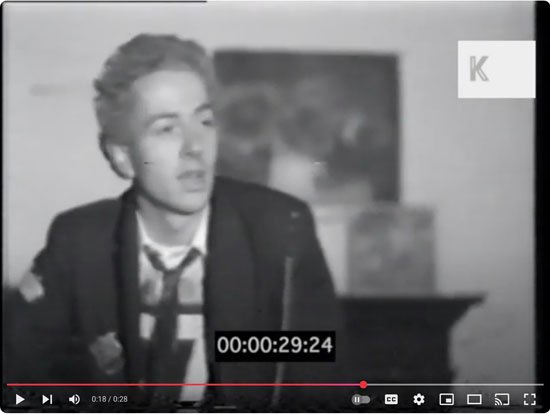
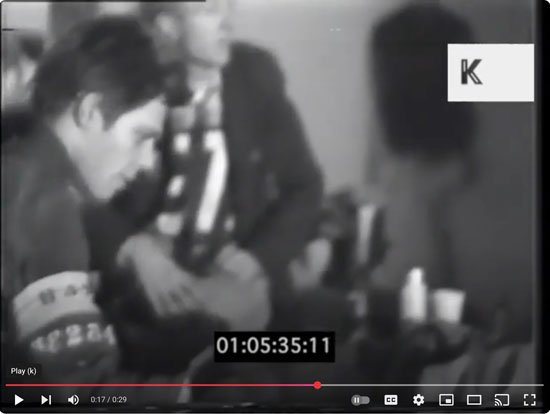
The Punk Rock Movie (also known as The Punk Rock Movie from England) is a British 1978 film that was assembled from Super 8 camera footage shot by Don Letts, the disc jockey at The Roxy club during the early days of the UK punk rock movement, principally during the 100 days in 1977 in which punk acts were featured at The Roxy club in London.
The spikiest home movie of the Seventies captured an embryonic rock revolution. ...Verité rock had become verité celluloid almost by accident.[1]
Roxy club disc jockey Don Letts was given a Super 8 camera as a present by fashion editor Caroline Baker.[2] When Letts started to film the acts at The Roxy, it was soon reported that he was making a movie, so Letts determined to film continuously for three months. He needed to sell his possessions in order to continue to purchase film.[1]
A preliminary, 60-minute version of the film was shown in autumn of 1977 at the Institute of Contemporary Arts in London. This resulted in the cover story, "Punk Home Movies" in Time Out magazine.[1]
The film features live footage of The Clash, Sex Pistols, Wayne County & the Electric Chairs, Generation X, Slaughter and the Dogs, The Slits, Siouxsie and the Banshees, Eater, Subway Sect, X-Ray Spex, Alternative TV and Johnny Thunders and The Heartbreakers. Backstage footage of certain bands, such as Generation X, The Slits and Siouxsie and the Banshees, is also included.[3]
All live footage was shot at the Roxy, except that of the Sex Pistols, who were filmed at The Screen On The Green cinema in London on 3 April 1977. The performance was Sid Vicious' first public concert with the band.[4]
The film was subject to limited theatrical release in 1978.[5] It was also subject to limited video release at that time by Sun Video (1978) and Danton Video (1980).[6] It was also released on video in 1992 by Studio K7. Versions of the film were released on DVD between 2006 and 2008, though these releases were subject to criticism for sound reproduction and digital transfers that were considered to be inferior to the original. In addition, concerns were expressed that the soundtrack now included overdubbed material, as opposed to the original live recordings.[7][8]
BBC Documentary, unseen Julian Temple Footage
Footage broadcast on the BBC, January 2015 The BBC broadcast a documentary from the Roxy using footage provided by Julian Temple. However the footage is all chopped up into snippets.
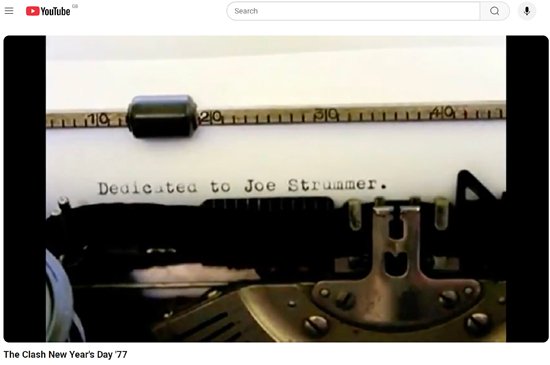
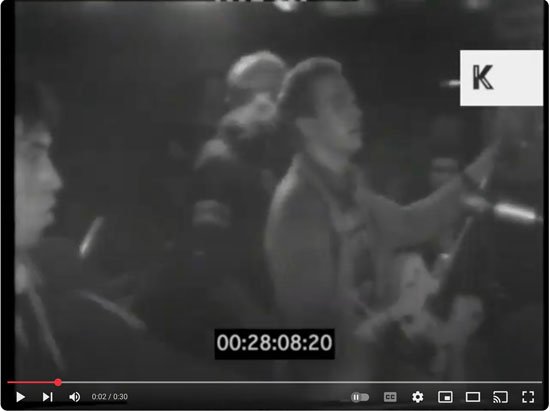
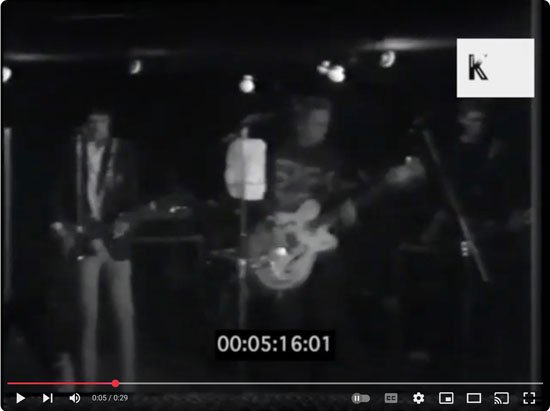
Built around the earliest, until now unseen, footage of the Clash in concert, filmed by Julien Temple as they opened the infamous Roxy club in a dilapidated Covent Garden on January 1st 1977, this show takes us on a time-travelling trip back to that strange planet that was Great Britain in the late 1970s and the moment when punk emerged into the mainstream consciousness.
Articles:
1. NME: Unseen footage of The Clash's 1977 New Year's concert at the Roxy surfaces
Known to contain several concerts including The Roxy 1 Jan 1977 and Harlesden plus Rehearsals footageJulian Temples 1976 footage 18 hours - included Roxy/Anarchy Tour/Harlesden/Rainbow - only the footage that was used in the film eventually got digitised because it was shot on an obscure format that does exist anymore and so it cost a fortune to put onto tape.
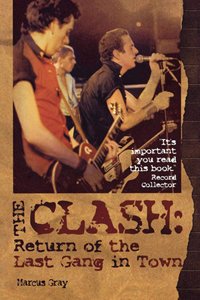
Book: Return of the Last Gang in Town
Julian Temple's early footage
[Extract] ... Malcolm’s (Mclaren) band had a promo film, so Bernie’s (Rhodes) band had to have one too.
Julien’s (Temple) black and white footage of the Clash at Rehearsals, on the Anarchy Tour, at the Harlesden Coliseum and in the Beaconsfield studio had been shot prior to the Clash’s latest image change and so was outmoded.
In 1999, Julien would contribute clips of the various bands on the Anarchy Tour, the Clash rehearsing ‘What’s My Name?’ with Rob Harper, the band overdubbing vocals to ‘I’m So Bored With The USA’ at Beaconsfield, and the band posing on the balcony outside 111 Wilmcote House, to Don Letts’s Clash documentary Westway To The World.
His own Sex Pistols documentary, The Filth And The Fury, was finally released the following year.
Julien claims to have over 50 hours of Clash footage from the 1976-77 period, most of which has never been seen.
Clips of Julien Temple's footage opening the infamous Roxy club on BBC4 doc
The Roxy and the first Clash gig since the Anarchy Tour.
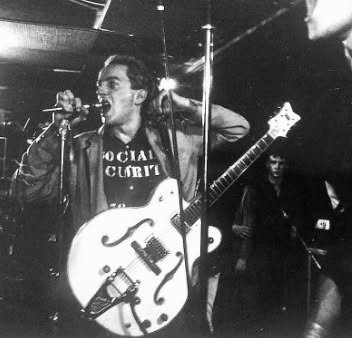
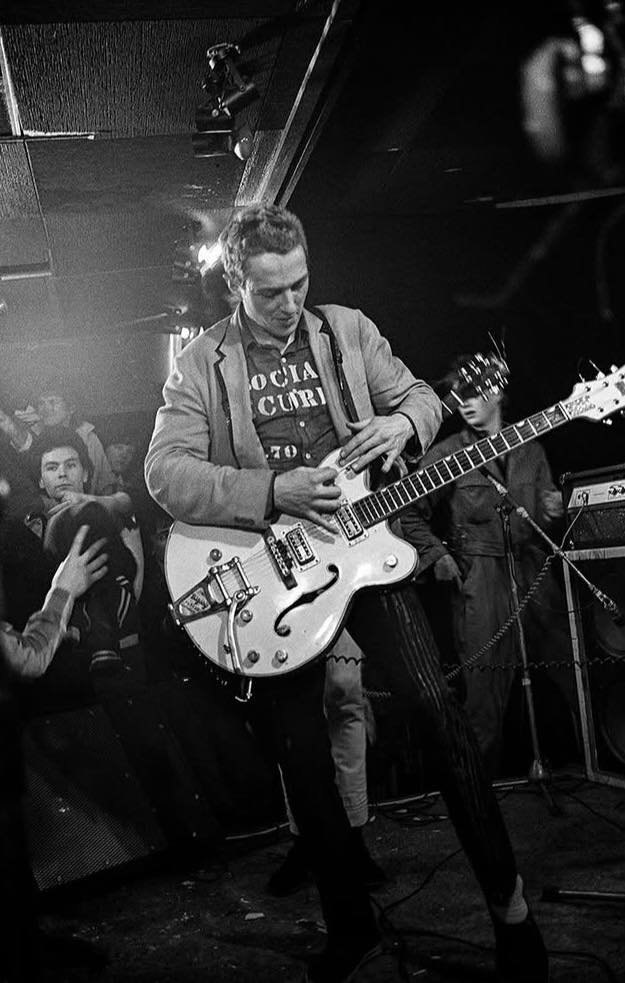
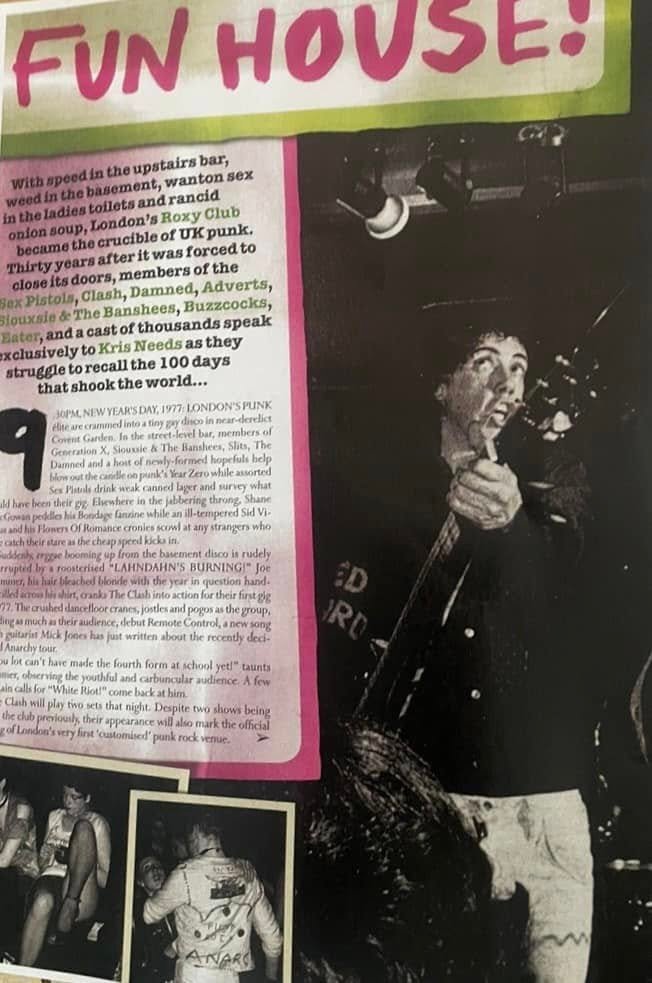
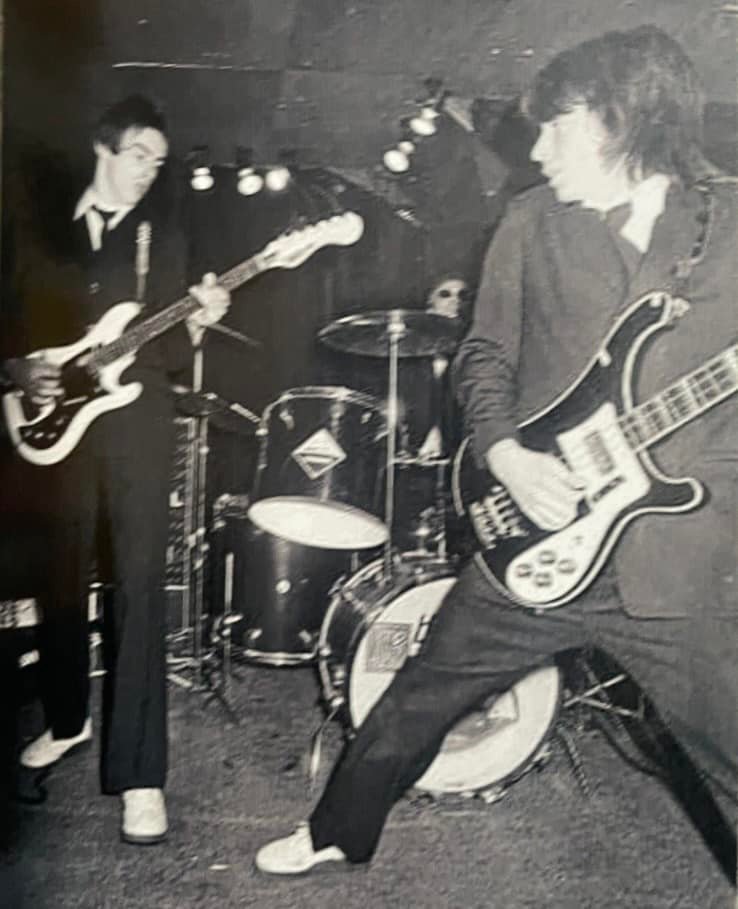
It was also Rob Harper's last gig as drummer. Joe used a large Gretsch-style guitar and had 1977 daubed on the front of his shirt (see pic).
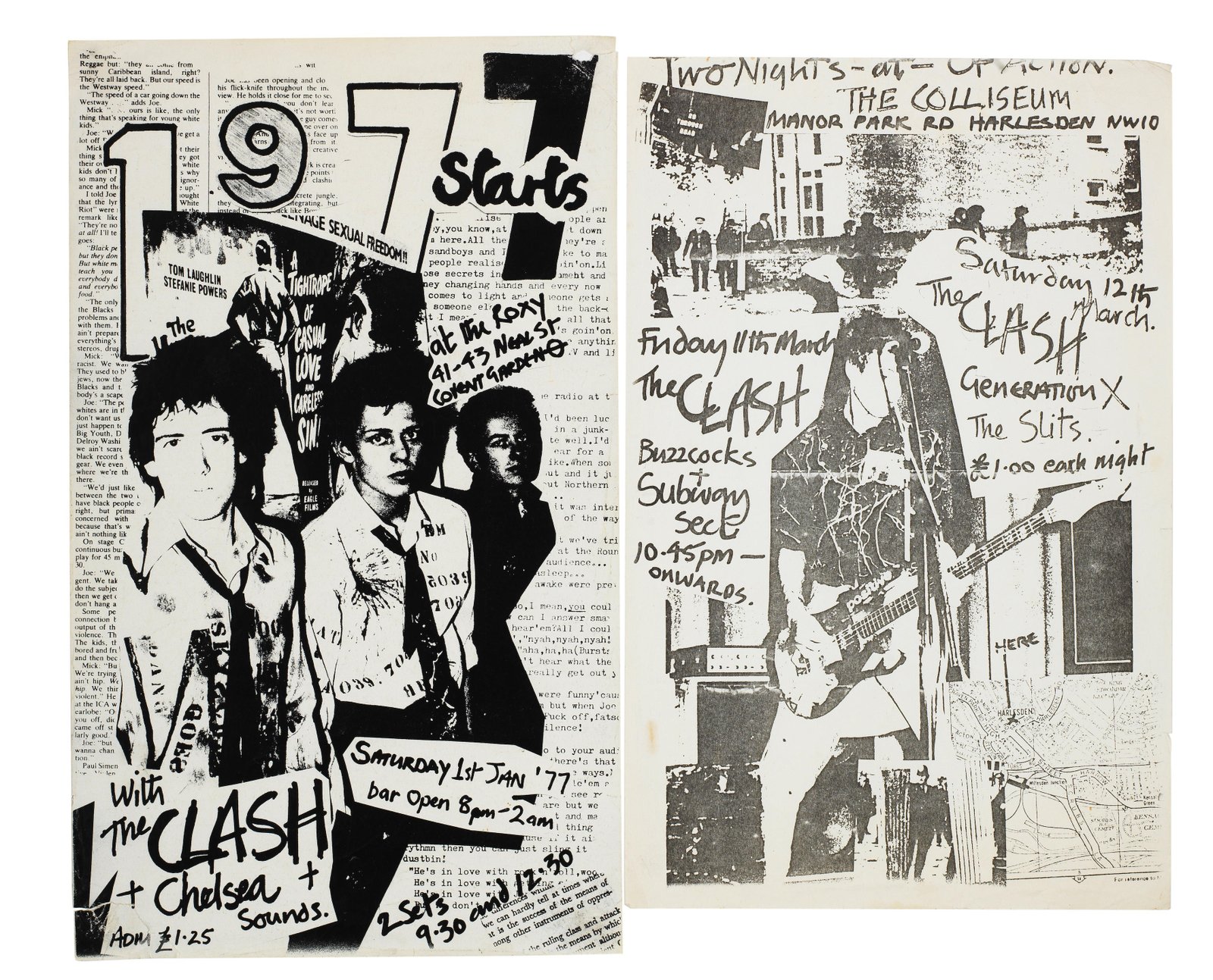
The Roxy was packed to capacity with 400 witnessing two frantic sets at 9-30 and 12-30.
John Lunn –– The official opening night of the roxy club in neal street covent gardens the support band was chelsea the roxy was called shagaramas before the roxy it was a gay club
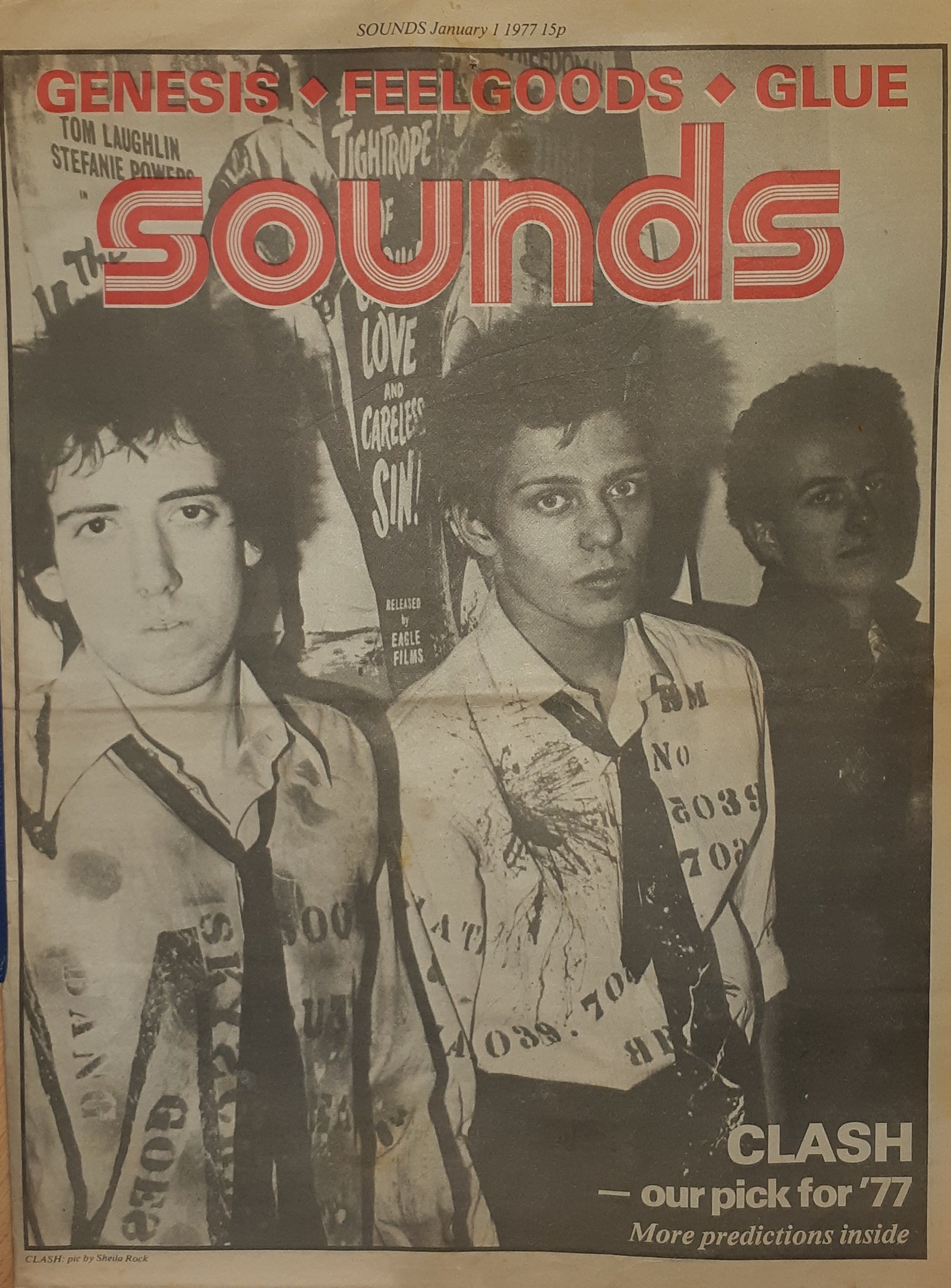
SOUNDS Staff. "We Can Pick 'Em in '77." SOUNDS, no. January 1, 1977, pp. 4-5
We Can Pick 'Em in '77
— SOUNDS journalists predict 1977's breakout acts, spotlighting The Clash as "the most exciting and original of the post-Pistols new wavers" with their "strong hooks and sartorial innovations"
— Features Giovanni Dadomo's prescient Clash analysis warning of their "dole queue rock" dilemma as they negotiate a major label deal, predicting their music could become "some of the finest recorded rock of the decade"
— Includes 30+ artist profiles ranging from reggae act Aswad ("a hydraulic power drill" of rhythm) to proto-punks The Saints ("outstripping the Ramones at their own game") and jazz innovator Jaco Pastorius ("pushing music to new limits")
David Lynch— Bluesky ––– My membership card for The Roxy punk club….. I joined on the opening night to see The Clash!!!!! – David Lynch @davidlynch333.bsky.social
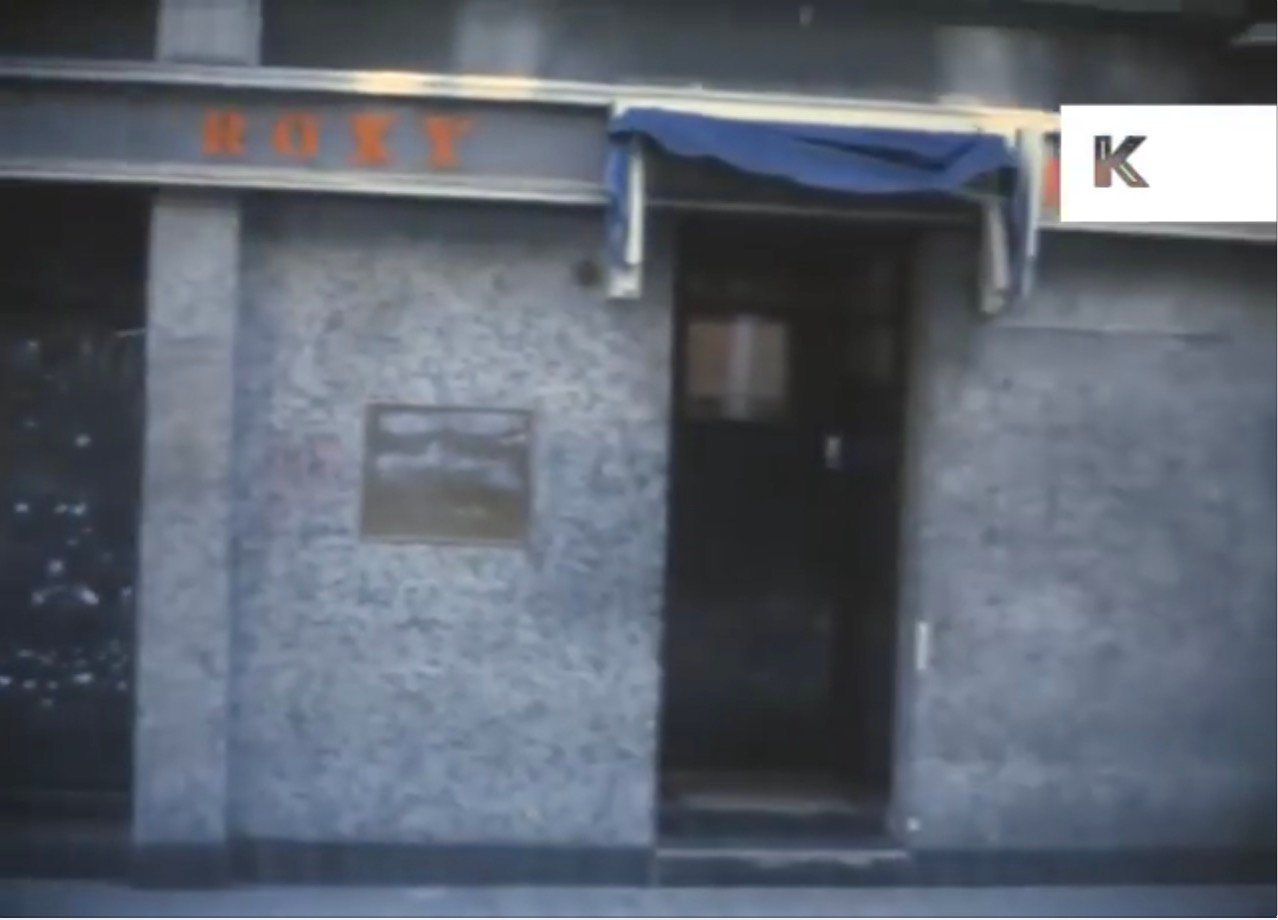
The premises had formerly been used as a warehouse to serve the Covent Garden wholesale fruit and vegetable market. In 1970 they were converted to a late-night bar called the Chaguaramas Club. At that time it was owned by record producer Tony Ashfield, who had several hits with 1970s reggae star John Holt, with whom he formed a company called Chaguaramas Recording Productions, probably after Chaguaramas Bay in Trinidad.
The Roxy was started by Andrew Czezowski, Susan Carrington and Barry Jones. The space was small, and spread out on two levels, which contained little more than a bar and a dance floor.
In December 1976, Czezowski organised three gigs at the Roxy. They financed the venture with borrowed money (Jones, a musician, pawned his guitar to stock the bars, and hire sound equipment, etc.). The first show, on 14 December, was Generation X, a band Czezowski managed. The second on the following night was the Heartbreakers. The third, on 21 December, featured Siouxsie and the Banshees and Generation X. However, it was the Clash and the Heartbreakers that headlined the official gala opening on 1 January 1977 which was filmed by Julien Temple and finally screened on BBC Four on 1 January 2015 as The Clash: New Year's Day '77.
The only thing that could count as a "scene" is the Roxy. And the Roxy is a dormitory. The last time I went I was feeling really uppity. I stood in the middle and looked around and all these people were slumped around dozing! I threw tomato sauce on the mirror and stormed out. And I haven't been back there. I don't think I will go back there. The sooner it closes the better.
—Joe Strummer
Don Letts was the resident DJ at the club and he was instrumental in encouraging punk rockers to embrace reggae.[citation needed]
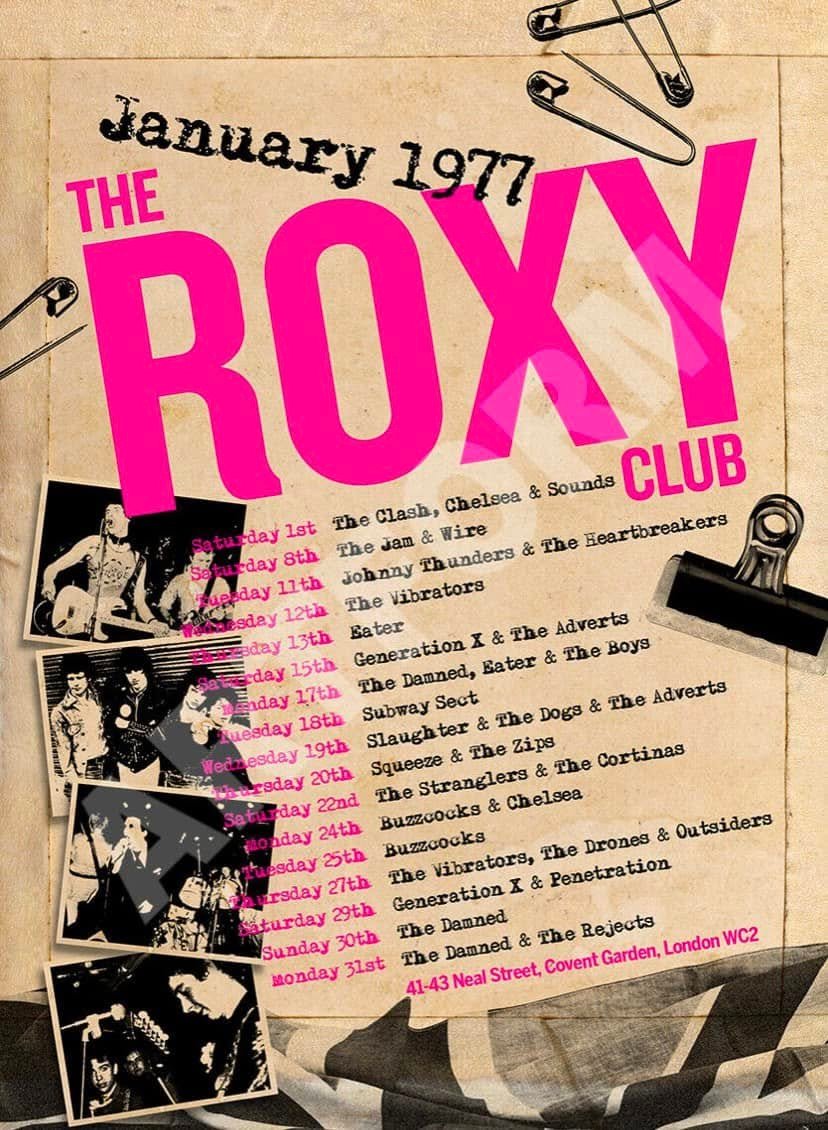
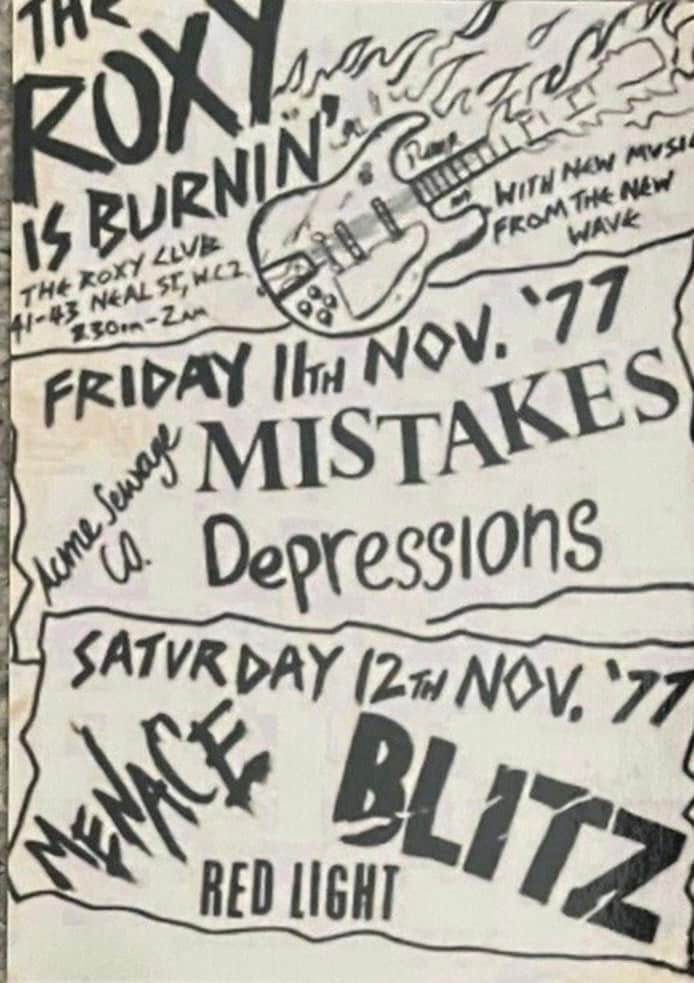
The Roxy Club was officially opened with a performance by the Clash on 1 January 1977. It quickly became established as the leading punk venue but closed after less than four months. These flyers show something of the range of bands that played at the club and are typical of the low-budget, DIY style of punk flyers and fanzines at the time.
See these items in our free Punk 1976-78 exhibition, part of the Library’s #punk40 celebrations. http://bit.ly/29QvaHh
punk77.co.uk/roxyclub77
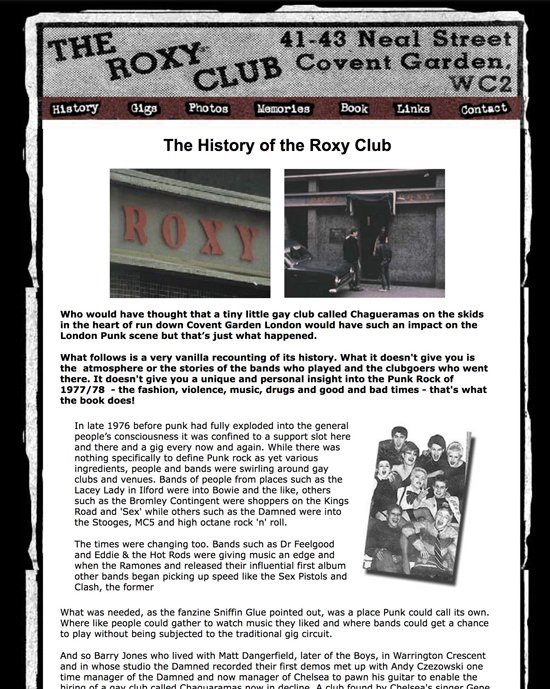
A short history of the Roxy Club
What was needed, as the fanzine Sniffin Glue pointed out, was a place Punk could call its own. Where like people could gather to watch music they liked and where bands could get a chance to play without being subjected to the traditional gig circuit.
And so Barry Jones who lived with Matt Dangerfield, later of the Boys, in Warrington Crescent and in whose studio the Damned recorded their first demos met up with Andy Czezowski one time manager of the Damned and now manager of Chelsea to pawn his guitar to enable the hiring of a gay club called Chaguaramas now in decline. A club found by Chelsea's singer Gene October as a place for his band to rehearse and play some gigs.
Who would have thought that a tiny little gay club called Chagueramas on the skids in the heart of run down Covent Garden London would have such an impact on the London Punk scene but that's just what happened.
What follows is a very vanilla recounting of its history. What it doesn't give you is the atmosphere or the stories of the bands who played and the clubgoers who went there. It doesn't give you a unique and personal insight into the Punk Rock of 1977/78 - the fashion, violence, music, drugs and good and bad times - that's what the book does!
In late 1976 before punk had fully exploded into the general people's consciousness it was confined to a support slot here and there and a gig every now and again. While there was nothing specifically to define Punk rock as yet various ingredients, people and bands were swirling around gay clubs and venues. Bands of people from places such as the Lacey Lady in Ilford were into Bowie and the like, others such as the Bromley Contingent were shoppers on the Kings Road and 'Sex' while others such as the Damned were into the Stooges, MC5 and high octane rock 'n' roll.
The times were changing too. Bands such as Dr Feelgood and Eddie & the Hot Rods were giving music an edge and when the Ramones and released their influential first album other bands began picking up speed like the Sex Pistols and Clash, the former
What was needed, as the fanzine Sniffin Glue pointed out, was a place Punk could call its own. Where like people could gather to watch music they liked and where bands could get a chance to play without being subjected to the traditional gig circuit.
And so Barry Jones who lived with Matt Dangerfield, later of the Boys, in Warrington Crescent and in whose studio the Damned recorded their first demos met up with Andy Czezowski one time manager of the Damned and now manager of Chelsea to pawn his guitar to enable the hiring of a gay club called Chaguaramas now in decline. A club found by Chelsea's singer Gene October as a place for his band to rehearse and play some gigs.
By the time the club opened for Chelsea gigs it had been renamed the Roxy, Chelsea had split with members Idol and James and Towe forming Generation X and it was they who played on closely followed by the Heartbreakers fresh off the aborted Anarchy Tour.
The success of the gigs meant Andy Barry and Ralph could make a a go at running a club. With that in mind they took on the lease and opened on New Years day with the Clash.
These were closely followed by more gigs featuring more experienced bands like the Damned and newer like there Adverts and Eater given a chance to play in front of a like minded audience. With a place to play established all the faces on the scene like the Bromley lot, Soo Catwoman etc and early punk fans made an appearance.
As new bands played the audience would often comprise members of said bands. Others energised by what they had seen would start bands, fanzines or make clothes. In between bands Don Letts would spin heavy dub grooves and whatever few punk records were about at the time.
From the off the Roxy was in a precarious position and the boys had overcommitted on what they could play in rent. A robbery following the Stranglers gig didn't help either. Also present was an attempt to wind the club down following from complaints fro m residents but appeals were keeping it afloat. But the Roxy ploughed on putting on a succession of new and old bands some good and some awful.
In march it held an American week featuring punk stars from across the pond from CBGB's and Max showed put a more professional, showbizzzy style of punk in contrast to the UK's more urban politicised style - the Heartbreakers, Wayne County and Cherry Vanilla.
With worries over possible eviction this was quickly followed up with hurried recordings over a couple of weekends of Wire, Adverts, Eater, Johnny Moped, Buzzcocks, Unwanted, X Ray Spex and Slaughter & the Dogs. Other bands recorded but not featured included the Boys, Siouxsie and the Slits. The recordings were financed and to be by released by Harvest EMI under guidance of producer Mike Thorne.
The worries came true as following a Siouxsie & the Banshees/Violators gig, Andy Barry and the whole crew were ousted. Legend has this as the golden period as the '100 days' of the Roxy and for many the club closed and they never went back.
But it didn't close….a misguided attempt to vary the programme in late April early may had rock 'n' roll bands (Teds and Punks were now in open street warfare captured in the media) and
In July the 'Live at the Roxy' album was released and astoundingly made the top 20 the first since the Bangladesh Concert was released.
A new owner was appointed to the Roxy, a certain Kevin St John, a man with a colourful past and at the time a colourful present.
Gigs at the Roxy continued apace with the Saints and the Radiators from Space and even an impromptu appearance by the granddaddy of Punk Iggy Pop. By now a second or even third wave of bands were coming through starting to make waves such as Sham 69, Menace and Killjoys. Along with a deluge of bands hitching a ride on the punk bandwagon or just starting and who needed a place to play. there was a home for them all at the Roxy.
At Christmas a 48 Hour party was held followed by 2 nights of recording for another live abum featuring the Jets, UK Subs, Blitz, Crabs, Bears, Plastix, Open Sore, Red Lights and Billy Karlof.
Moving into January bands like Adam & The Ants and The Psychedelic Furs got their first break here. No more big names - more a seedbed for new bands - and another venue on the gig circuit for bands to play. The Roxy also lost its final appeal and was due to close at the end of March/April.
To highlight its plight Jock McDonald was brought in to publicise the closure which included various stunts but to no avail. The gigs began to wind down with more audition nights and even the inclusion of a regular gay night.
Finally in April the Roxy shut its doors for good with a party that involved drinking the rest of the booze there and smashing the place up.
In May the album was released to mainly negative reviews and a short tour of two dates in Scotland to promote the album was arranged by Kevin St John which involved putting the bands up in a YMCA and giving them no money. The final calamity occurred on the last night when bands equipment was mysteriously stolen.
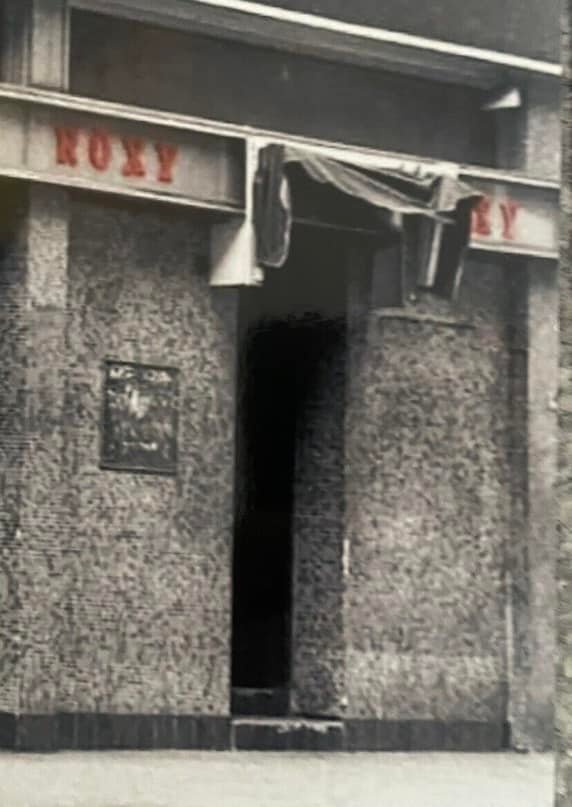
In late 1978 the Roxy was broken into and squatted by Jock McDonald in an effort to get it going again but was forcibly ejected by Police. Eventually the place was gutted, done up and given a change of use.
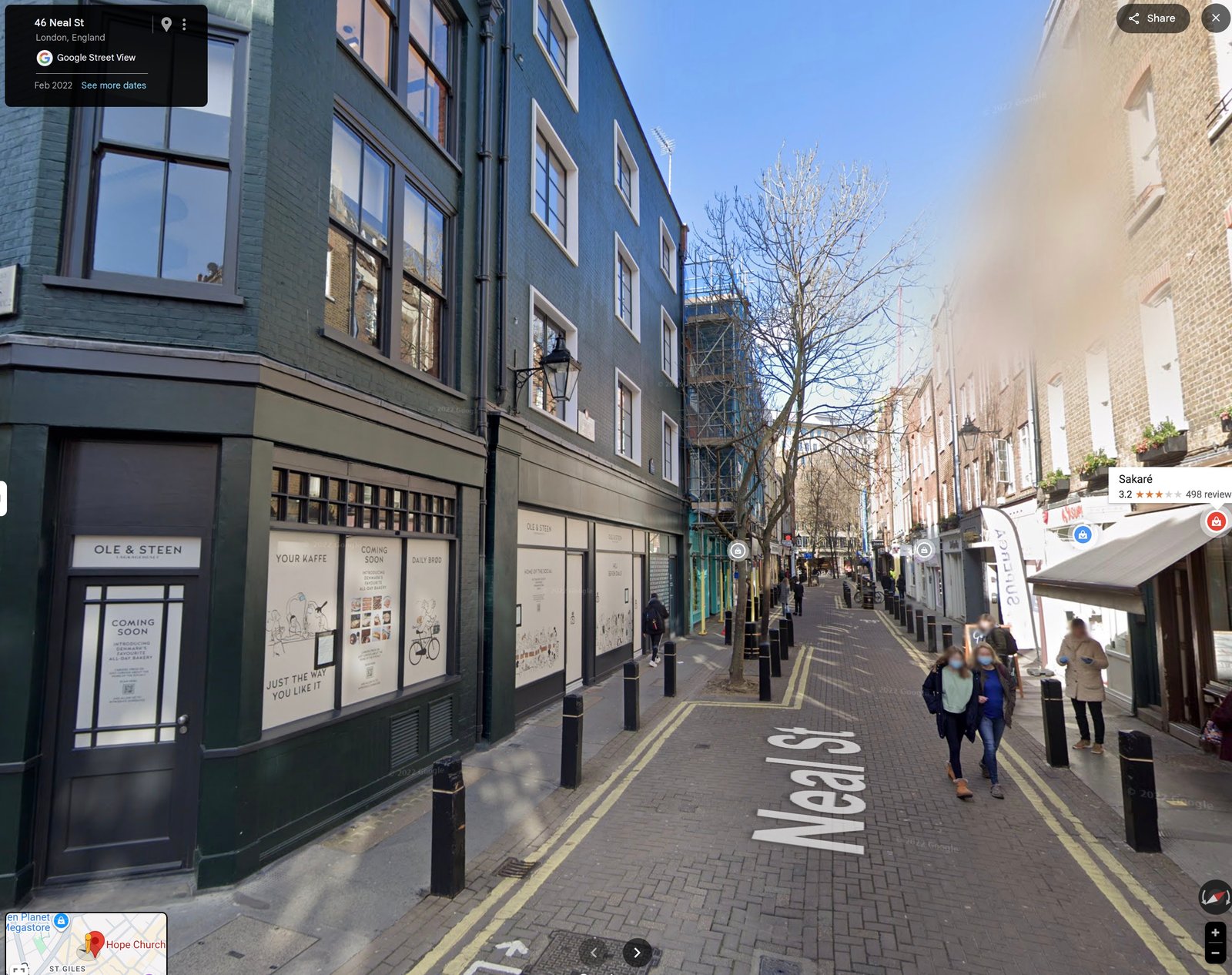
Today in 2007 its currently a Speedo shop.
Af Amelia Abraham, VICE MAGAZINE, "Filth, Fury and Fags", January 5, 2015,
Filth, Fury and Fags – Julien Temple Filmed the Breakout of British Punk
Julien Temple filmed the Breakout of British Punk. we talked to the great music documentarian about immortalising The Sex Pistols and The Clash on film.
januar 5, 2015, Amelia Abraham, VICE MAGAZINE
Filth, Fury and Fags - Julien Temple Filmed the Breakout of British Punk
Mick Jones and Joe Strummer, The Clash. Photo via.
Julien Temple is the great British music documentarian. He began his career filming The Sex Pistols and The Clash's earliest gigs in 1970s London - at now legendary venues like The 100 Club and The Roxy - and turned the footage into the feature films The Great Rock 'n' Roll Swindle and The Filth and The Fury. Later on, Temple put together the 'Best Of' and 'Greatest Hits' films for the likes of The Rolling Stones, Blur, Bowie and The Culture Club.
After sitting on some of his early footage of The Clash for almost 40 years, Temple has just put together a new film called The Clash: New Years Day 1977, centered around a gig they played on the 1st of January at The Roxy. The documentary contextualises that moment in time and space for punk by pitting chaotic live footage of the band alongside talking heads of regular Londoners on their hopes and fears for the New Year.
I talked to Temple about how the new film pays homage to The Clash frontman, Joe Strummer, who died 12 years ago last month.
VICE: What are your earliest memories of cinema and how did you get into filmmaking?Julien Temple:
I didn't really see any movies at school - apart from maybe A Hard Day's Night , which everyone saw. But when I was 18 I went to see a film with some friends of mine, Jean Luc Godard's Les Mépris, or Contempt. I hadn't seen any art films, so I was kind of shocked. Apart from Brigitte Bardot reclining naked across the cinema screen, I couldn't understand any of it. I had to go back five or six times, secretly, to get my head around the grammar of it. I ended up really liking it. And so that was the first film I really got into.
Later, I was studying architecture at Cambridge and got very bored with it, so started a film society. My college - King's - was the only college without one. It meant we could then see 75 films a week on 16mm prints because all the colleges hired free movies and you could swap them around. That way, you could spend all of your time watching films.
The first film I actually made was called The Tunnyng of Elynour Rummyng, which was a John Skelton poem about a witch who brewed psychedelic ale at the top of a hill. I made that with a bunch of students and friends and, with it, got in to the National Film School. I was studying there when I came across The Sex Pistols.
How did you first meet them?
I used to go walking in the East End and the docks on a Sunday. It was great because they'd just been closed down so it was this wonderfully derelict, atmospheric space with rusting cranes and ships. Ghostly quiet. One summer afternoon in 1975, I heard the sound of a Small Faces song on the wind and followed it to an old warehouse. The door was open and I went up these rickety stairs and, as I got higher and higher, I could hear some people just destroying this song. They were shouting, "I want you to know that I hate you, I don't love you."
When I got to the top of the stairs it opened up into this kind of loft and my head poked up from the stairwell with a worm's eye view of this extraordinary, silhouetted band who seemed like nothing you'd expect a band to be; spiky hair, skinny legs, mohair stripe jumpers in black and yellow and black and red. They looked like weird cartoon monsters from space.
No other band was like that. This was a very, very new sensation.
Did you speak to them?
I asked them what they were doing, and they were just rehearsing. They hadn't played a gig, actually, so it was a very fortuitous encounter. I asked them if they might be interested in doing a soundtrack for my little student film that was set in the 60s - because I loved the Small Faces - and they told me to fuck off. But they did say they were going to do a gig, so I watched them rehearse for a bit and went back to West London and told all my mates I'd just seen this incredible band. They asked me their name and I realised I'd forgotten to ask.
Still from The Filth and The Fury (Julien Temple, 2000)
How did you find them?
I spent weeks looking in music papers trying to see a name of a band that could possibly be them and as a result I missed the first gig but I later saw this thing saying "Sex Pistols" and I thought that it must be them because it was such a great name.
When I went to the second gig I realised I should film it. It was at the Central School of Art [now Central St. Martins' old Holborn campus]. Sid was there, and Susie. The audience was tiny but theatrical - the same as the band. It was very clear that this was something great. I got a key cut to the film school camera room so that I could take a camera out at night as long as I put it back in the morning. There are 50,000 iPhones at a gig these days, but back then I was the only person with a camera.
Amazing. Did you go on to strike up a relationship with them because you filmed them so often?
Well, yes, I suppose so, but I was a middle class cunt and they were very keen to point that out at every opportunity. They would kick me whenever they could, spitting at the camera and hitting the lens. But yeah, we did develop a friendship - or an understanding, certainly.
The Sex Pistols became huge - or at least hugely notorious - so various people were making films about them. Only, they kept coming and going. They went from Ken Loach for a moment to Stephen Frears for a moment, and then Russ Meyer did it while I was his assistant, and then that all fell apart. Princess Grace of Monaco refused to let Twentieth Century Fox - of which she was on the board - make that film, so we were left with the film I'd shot over time and bits of stuff from television and so on. We made this kind of Godardian, ten-lessons-in-how-to- swindle-your-way-to-the-top-of-the-music-industry-type film. Me and Malcolm [ McLaren] wrote and made it together.
How did you come across The Clash?
Well I knew Joe Strummer from the squats in West London, or, rather, I knew of him. He knew of me because there was one house that bizarrely still had milk delivered to its doorstep among all these squats. So, if you were up late or hadn't gone to bed, you could always find a bottle of milk for your tea. I would meet Joe Strummer approaching this doorstep and either he got there before me or I got there before him. So we were aware of each other. I also knew his band. I used to go and see them at the Elgin pub in Notting Hill.
Still from The Clash: New Year's Day 1977 (Julien Temple, 2014)
How do you remember him?
He was kind of a hippy at that point. I next saw him outside the 100 Club in Oxford Street at the Punk Festival with the Pistols, and he was standing there with short, bleached hair like Marlon Brando in Julius Caesar - like, too much bleach on his head - and I thought: 'he's this hippy guy, he's never going to make it'. I didn't think he could possibly pull off being like The Sex Pistols. But then we went downstairs where The Clash played a gig and he was extraordinary.
Your film about them aired for the first time on New Years Day this year. Why only now? After so much time?
I was allowed for a while to film The Clash in that autumn of 1976 up until early 1977 and then I was told by their manager that I couldn't, that I had to choose between The Sex Pistols or The Clash. Bernie [ Rhodes] was like that. He'd issue ultimatums. I'd filmed them for six weeks rehearsing and working up their songs, and then they were on the Anarchy Tour with the Pistols and he wouldn't let me carry on filming. There's also the fact that I'd filmed on a really early reel-to-reel video thing - you wound the tape on yourself and it was on your shoulder as you were filming, so it's a really funky quality, shall we say.
So the whole thing was aborted. I've had the footage lying around for for 40 years. It's a unique thing because it's the last film artefact of British punk that hasn't been seen. It's an interesting insight into that period of time, before punk broke. It's been very nice to be able to finally make something of it. Especially as this is the time of year that Joe died. So really, it's dedicated to him.
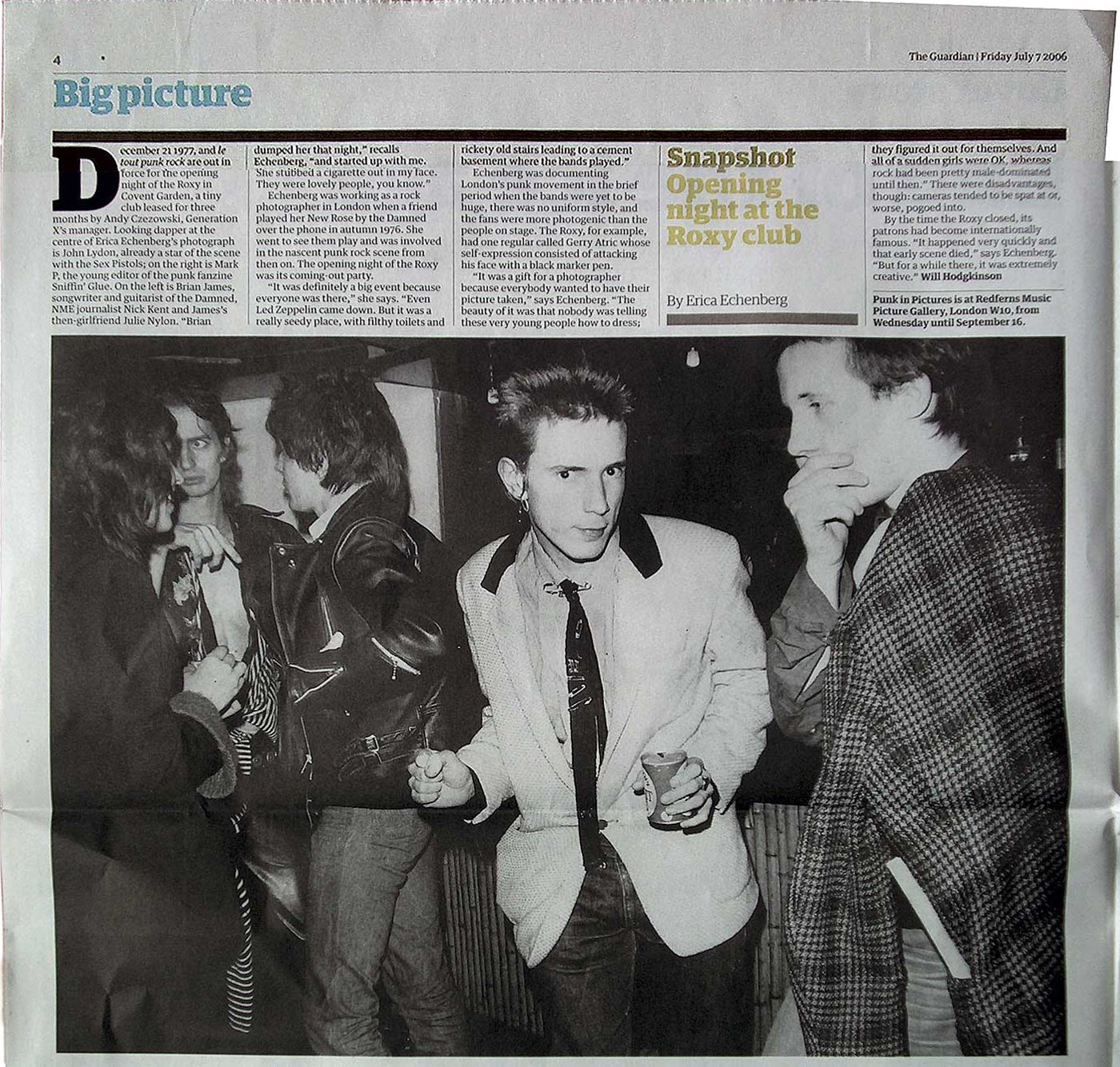
The Guardian, Friday July 7 2006, by Punk photographer Erica Echenberg, PDF
Snapshot Opening Night of The Roxy Club
December 21 1977, and le tout punk rock are out in force for the opening night of the Roxy in Covent Garden...
Big picture, By Erica Echenberg, The Guardian | Friday July 7 2006, Page 4
Snapshot Opening night at the Roxy club
December 21 1977, and le tout punk rock are out in force for the opening night of the Roxy in Covent Garden, a tiny club leased for three D months by Andy Czezowski, Generation X's manager. Looking dapper at the centre of Erica Echenberg's photograph is John Lydon, already a star of the scene with the Sex Pistols; on the right is Mark P, the young editor of the punk fanzine Sniffin' Glue. On the left is Brian James, songwriter and guitarist of the Damned, NME journalist Nick Kent and James's then-girlfriend Julie Nylon. "Brian
dumped her that night," recalls Echenberg, "and started up with me. She stutibed a cigarette out in my face. They were lovely people, you know."
Echenberg was working as a rock photographer in London when a friend played her New Rose by the Damned over the phone in autumn 1976, She went to see them play and was involved in the nascent punk rock scene from then on. The opening night of the Roxy was its coming-out party.
"It was definitely a big event because everyone was there," she says. "Even Led Zeppelin came down. But it was a really seedy place, with filthy toilets and rickety old stairs leading to a cement basement where the bands played."
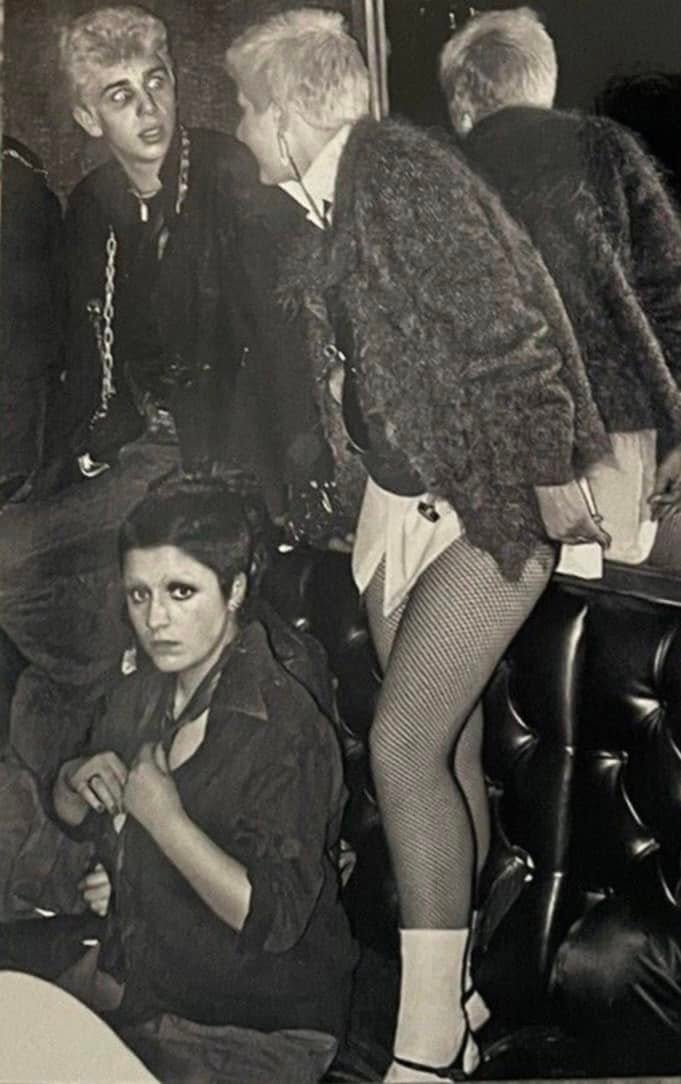
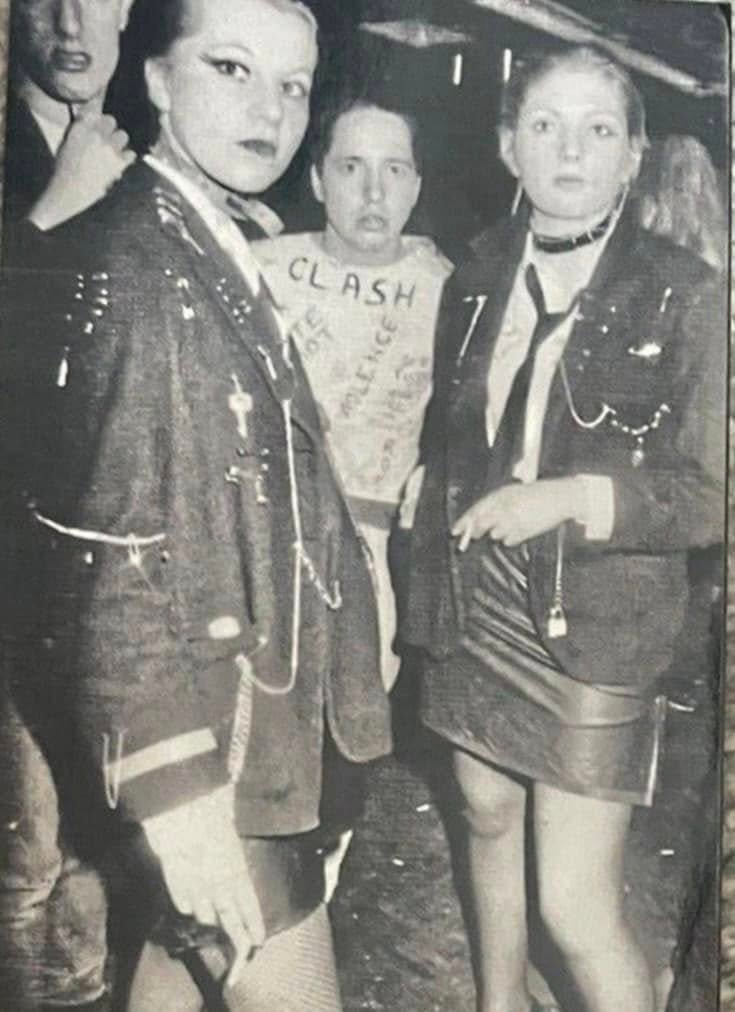
Echenberg was documenting London's punk movement in the brief period when the bands were yet to be huge, there was no uniform style, and the fans were more photogenic than the people on stage. The Roxy, for example, had one regular called Gerry Atric whose self-expression consisted of attacking his face with a black marker pen.
"It was a gift for a photographer because everybody wanted to have their picture taken," says Echenberg. "The beauty of it was that nobody was telling these very young people how to dress; they figured it out for themselves. And all of a sudden girls were OK, whereas rock had been pretty male-domnated until then." There were disadvantages, though: cameras tended to be spat at or, worse, pogoed into.
By the time the Roxy closed, its patrons had become internationally famous. "It happened very quickly and that early scene died," says Echenberg "But for a while there, it was extremely creative." Will Hodgkinson
Punk in Pictures is at Redferns Music Picture Gallery, London W10, from Wednesday until September 16.
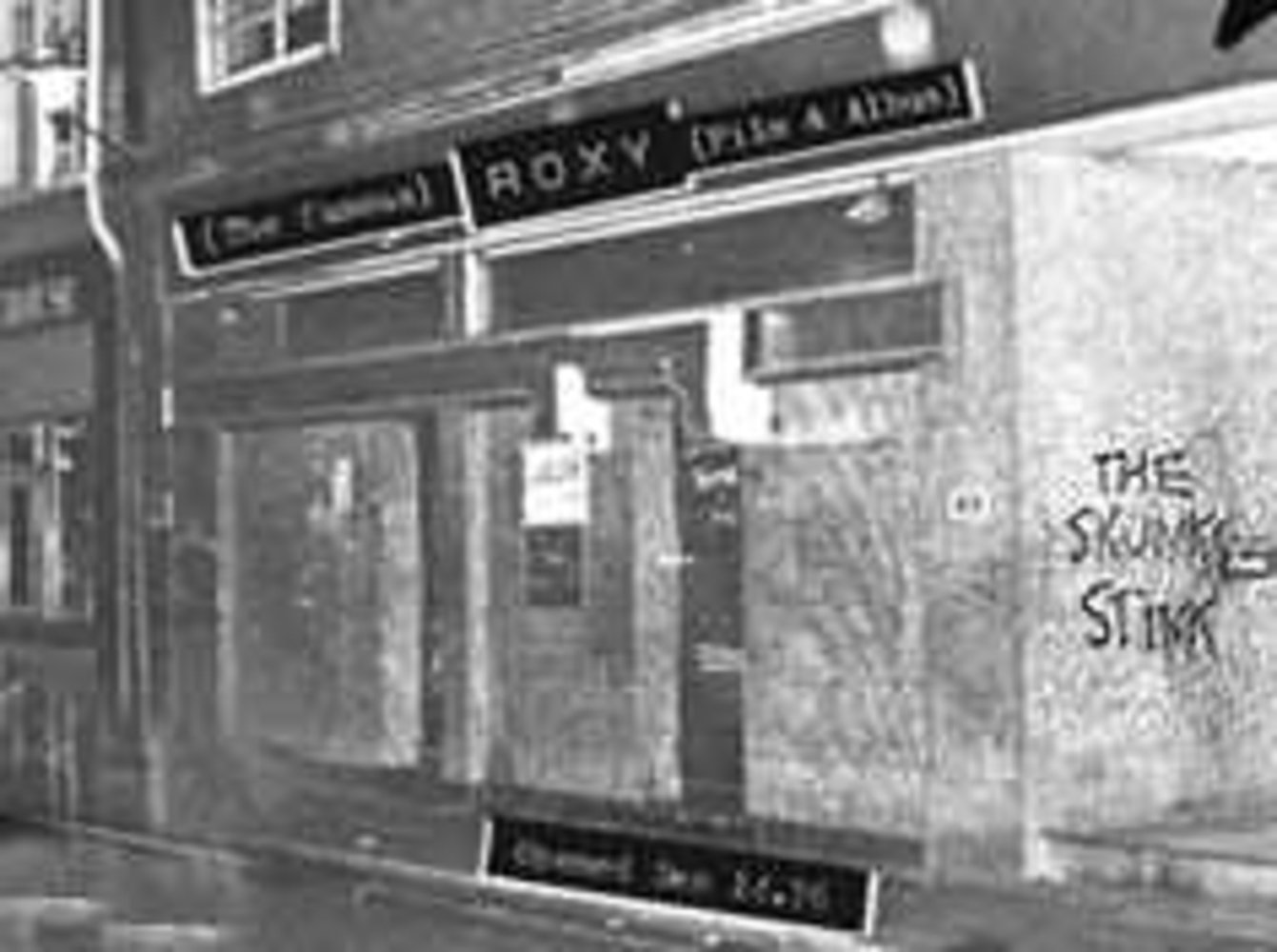
Opened 14th December 1976 - 24th April 1978 "The Roxy Club", Convent Garden, 41-43 Neal Street, London WC2 (tel. 836 8811):
Open every night except Fridays during January, From 1st of February open 7 nights a week, Free membership. Open 8.30 p.m. to 2 a.m. Admission fee varies (normally £1), Free admission on non-group nights during January. Used to be a gay London nightspot in Covent Garden called "Shageramas", 'Andy Czezowski' converted the club into London's first live punk rock venue called "The Roxy".
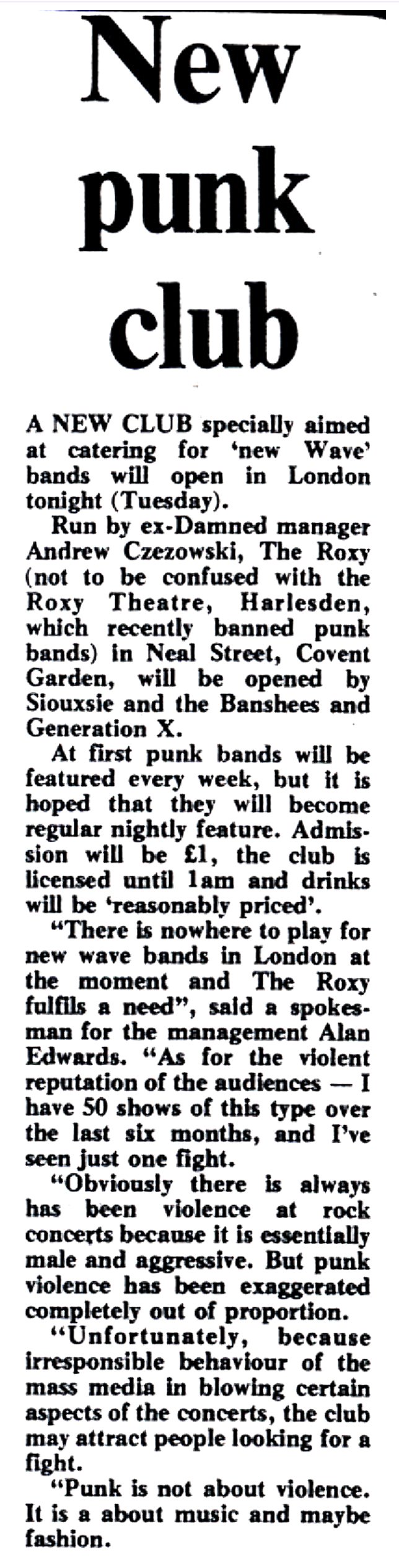
New punk club
A NEW CLUB specially aimed at catering for 'new Wave' bands will open in London tonight (Tuesday).
Run by ex-Damned manager Andrew Czezowski, The Roxy (not to be confused with the Roxy Theatre, Harlesden, which recently banned punk bands) in Neal Street, Covent Garden, will be opened by Siouxsie and the Banshees and Generation X.
At first punk bands will be featured every week, but it is hoped that they will become regular nightly feature. Admis-sion will be £1, the club is licensed until lam and drinks will be 'reasonably priced'.
"There is nowhere to play for new wave bands in London at the moment and The Roxy fulfils a need", said a spokes-man for the management Alan Edwards. "As for the violent reputation of the audiences-I have 50 shows of this type over the last six months, and I've seen just one fight.
"Obviously there is always has been violence at rock concerts because it is essentially male and aggressive. But punk violence has been exaggerated completely out of proportion. "Unfortunately, because irresponsible behaviour of the mass media in blowing certain aspects of the concerts, the club may attract people looking for a fight.
"Punk is not about violence. It is a about music and maybe fashion.
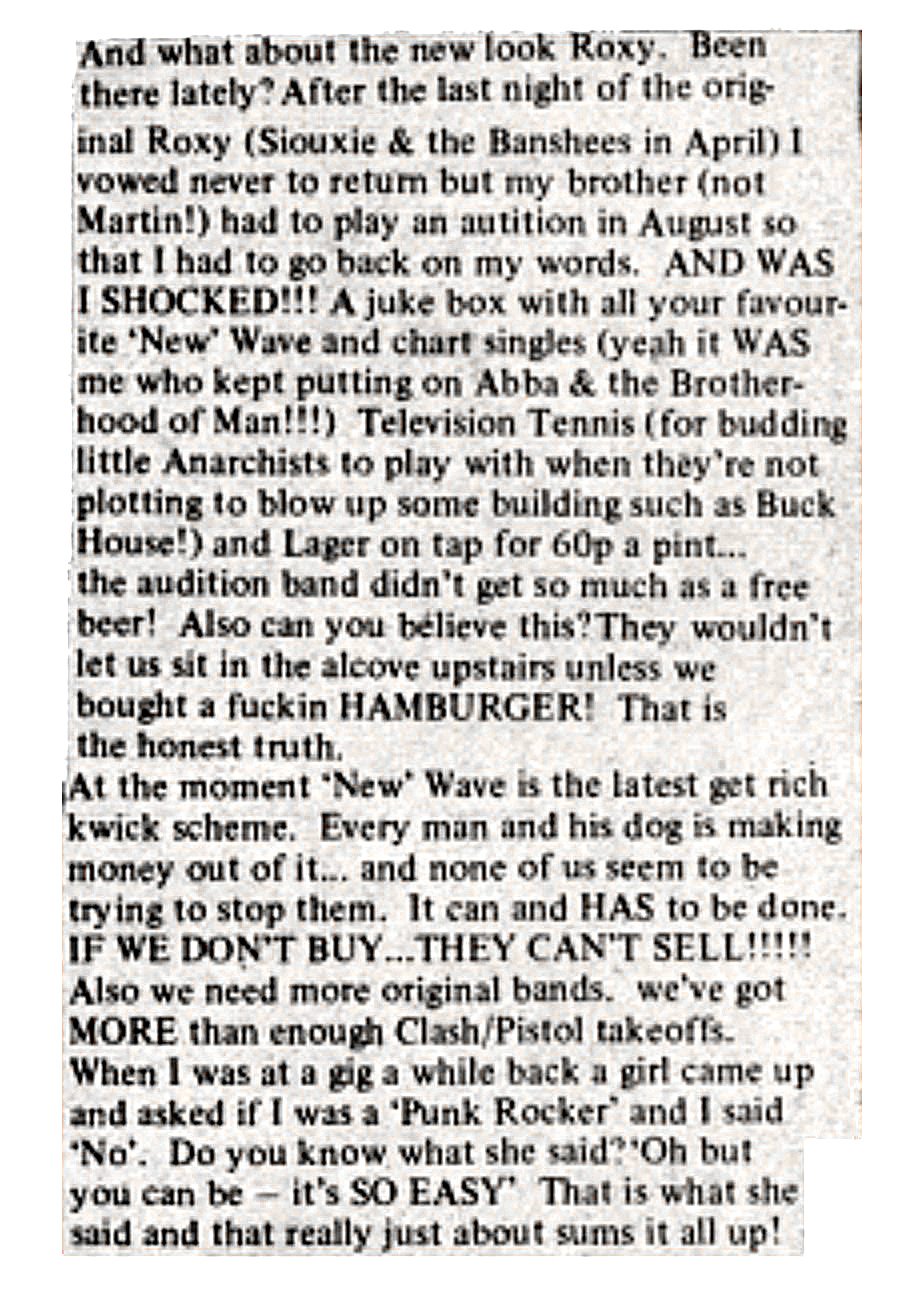
Hamburger at the new Roxy
And what about the new look Roxy. Been there lately? After the last night of the original Roxy (Siouxie & the Banshees in April) 1 vowed never to return but my brother (not Martin!) had to play an autition in August so that I had to go back on my words. AND WAS I SHOCKED!!! A juke box with all your favour-ite 'New' Wave and chart singles (yeah it WAS me who kept putting on Abba & the Brother-hood of Man!!!) Television Tennis (for budding little Anarchists to play with when they're not plotting to blow up some building such as Buck House!) and Lager on tap for 60p a pint... the audition band didn't get so much as a free beer! Also can you believe this? They wouldn't let us sit in the alcove upstairs unless we bought a fuckin HAMBURGER! That is the honest truth.
At the moment 'New' Wave is the latest get rich kwick scheme. Every man and his dog is making money out of it... and none of us seem to be trying to stop them. It can and HAS to be done. IF WE DON'T BUY...THEY CAN'T SELL!!!!! Also we need more original bands. we've got MORE than enough Clash/Pistol takeoffs. When I was at a gig a while back a girl came up and asked if I was a 'Punk Rocker' and I said 'No'. Do you know what she said? "Oh but you can be it's SO EASY' That is what she said and that really just about sums it all up!
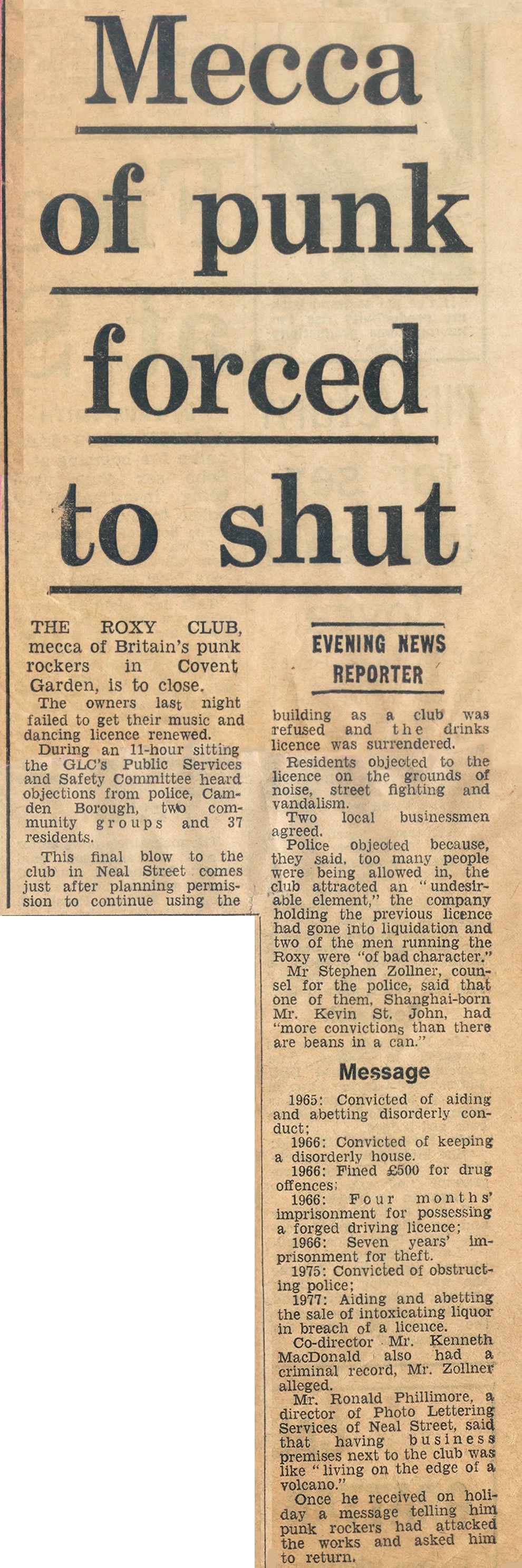
Mecca of punk forced to shut
EVENING NEWS REPORTER
THE ROXY CLUB, mecca of Britain's punk rockers in Covent Garden, is to close. The owners last night failed to get their music and dancing licence renewed.
During an 11-hour sitting the GLC's Public Services and Safety Committee heard objections from police, Camden Borough, two community groups and 37 residents.
This final blow to the club in Neal Street comes just after planning permission to continue using the building as a club was refused and the drinks licence was surrendered.
Residents objected to the licence on the grounds of noise, street fighting and vandalism. Two local businessmen agreed.
Police objected because, they said, too many people were being allowed in, the club attracted an "undesirable element," the company holding the previous licence had gone into liquidation and two of the men running the Roxy were "of bad character."
Mr Stephen Zollner, counsel for the police, said that one of them, Shanghai-born Mr. Kevin St. John, had "more convictions than there are beans in a can."
Message
1965: Convicted of aiding and abetting disorderly conduct;
1966: Convicted of keeping a disorderly house.
1966: Fined £500 for drug offences;
1966: Four months' imprisonment for possessing a forged driving licence;
1966: Seven years' imprisonment for theft.
1975: Convicted of obstructing police;
1977: Aiding and abetting the sale of intoxicating liquor in breach of a licence.
Co-director Mr. Kenneth MacDonald also had a criminal record, Mr. Zollner alleged.
Mr. Ronald Phillimore, a director of Photo Lettering Services of Neal Street, said that having business premises next to the club was like "living on the edge of a volcano."
Once he received on holiday a message telling him punk rockers had attacked the works and asked him to return.
And what about the new look Roxy. Been there lately?
And what about the new look Roxy. Been there lately? After the last night of the original Roxy (Siouxsie & the Banshees in April) I vowed never to return but my brother (not Martin!) had to play an audition in August so that I had to go back on my words. AND WAS I SHOCKED!!! A juke box with all your favourite 'New' Wave and chart singles (yeah it WAS me who kept putting on Abba & the Brotherhood of Man!!!) Television Tennis (for budding little Anarchists to play with when they’re not plotting to blow up some building such as Buck House!) and Lager on tap for 60p a pint... the audition band didn’t get so much as a free beer! Also can you believe this? They wouldn’t let us sit in the alcove upstairs unless we bought a fuckin HAMBURGER! That is the honest truth.
At the moment 'New' Wave is the latest get rich kwick scheme. Every man and his dog is making money out of it... and none of us seem to be trying to stop them. It can and HAS to be done. IF WE DON’T BUY...THEY CAN’T SELL!!!!! Also we need more original bands. we’ve got MORE than enough Clash/Pistol takeoffs. When I was at a gig a while back a girl came up and asked if I was a 'Punk Rocker' and I said 'No'. Do you know what she said? 'Oh but you can be – it’s SO EASY'. That is what she said and that really just about sums it all up!
A NEW CLUB specially aimed at catering for ‘new Wave’ bands will open in London tonight (Tuesday).
A NEW CLUB specially aimed at catering for ‘new Wave’ bands will open in London tonight (Tuesday).
Run by ex-Damned manager Andrew Czezowski, The Roxy (not to be confused with the Roxy Theatre, Harlesden, which recently banned punk bands) in Neal Street, Covent Garden, will be opened by Siouxsie and the Banshees and Generation X.
At first punk bands will be featured every week, but it is hoped that they will become regular nightly feature. Admission will be £1, the club is licensed until 1am and drinks will be ‘reasonably priced’.
“There is nowhere to play for new wave bands in London at the moment and The Roxy fulfils a need”, said a spokesman for the management Alan Edwards. “As for the violent reputation of the audiences — I have 50 shows of this type over the last six months, and I’ve seen just one fight.
“Obviously there is always has been violence at rock concerts because it is essentially male and aggressive. But punk violence has been exaggerated completely out of proportion.
“Unfortunately, because irresponsible behaviour of the mass media in blowing certain aspects of the concerts, the club may attract people looking for a fight.
“Punk is not about violence. It is a about music and maybe fashion.
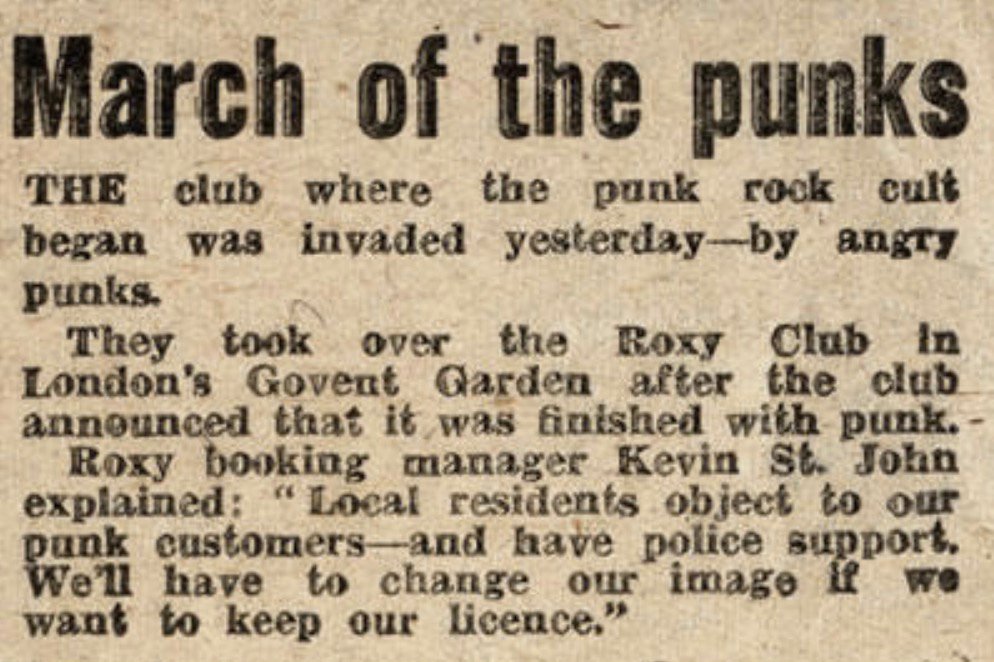
THE club where the punk rock cult began was invaded yesterday—by angry punks.
They took over the Roxy Club in London's Covent Garden after the club announced that it was finished with punk.
Roxy booking manager Kevin St. John explained: “Local residents object to our punk customers—and have police support. We’ll have to change our image if we want to keep our licence.”
Mecca of punk forced to shut
THE ROXY CLUB, mecca of Britain’s punk rockers in Covent Garden, is to close. The owners last night failed to get their music and dancing licence renewed.
THE ROXY CLUB, mecca of Britain’s punk rockers in Covent Garden, is to close.
The owners last night failed to get their music and dancing licence renewed.
During an 11-hour sitting the GLC’s Public Services and Safety Committee heard objections from police, Camden Borough, two community groups and 37 residents.
This final blow to the club in Neal Street comes just after planning permission to continue using the building as a club was refused and the drinks licence was surrendered.
Residents objected to the licence on the grounds of noise, street fighting and vandalism.
Two local businessmen agreed.
Police objected because, they said, too many people were being allowed in, the club attracted an “undesirable element,” the company holding the previous licence had gone into liquidation and two of the men running the Roxy were “of bad character.”
Mr Stephen Zollner, counsel for the police, said that one of them, Shanghai-born Mr. Kevin St. John, had “more convictions than there are beans in a can.”
Message
1965: Convicted of aiding and abetting disorderly conduct; 1966: Convicted of keeping a disorderly house. 1966: Fined £500 for drug offences; 1966: Four months’ imprisonment for possessing a forged driving licence; 1966: Seven years’ imprisonment for theft. 1975: Convicted of obstructing police; 1977: Aiding and abetting the sale of intoxicating liquor in breach of a licence.
Co-director Mr. Kenneth MacDonald also had a criminal record, Mr. Zollner alleged.
Mr. Ronald Phillimore, a director of Photo Lettering Services of Neal Street, said that having business premises next to the club was like “living on the edge of a volcano.”
Once he received on holiday a message telling him punk rockers had attacked the works and asked him to return.
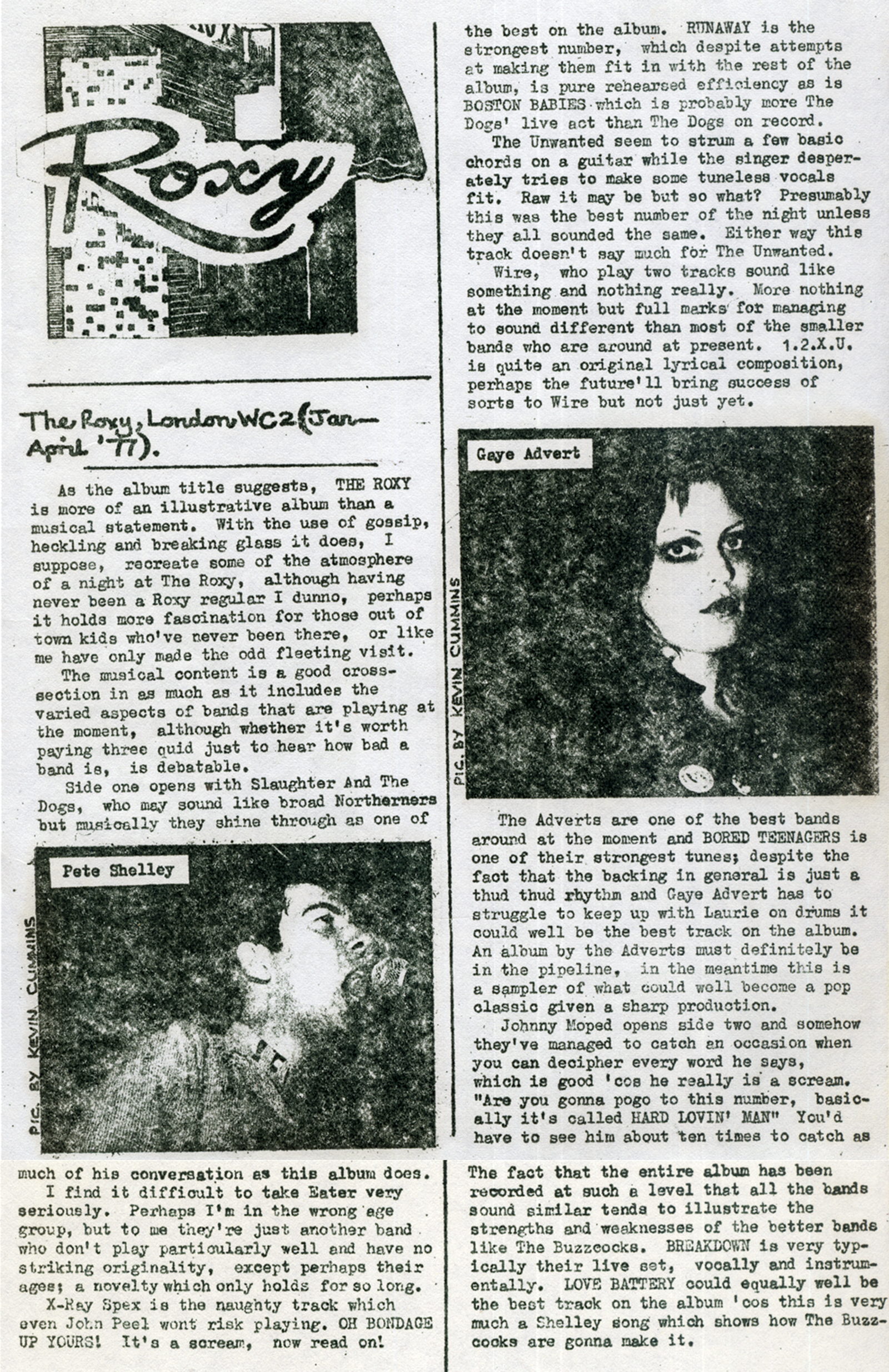
As the album title suggests, THE ROXY is more of an illustrative album than a musical statement.
As the album title suggests, THE ROXY is more of an illustrative album than a musical statement.
With the use of gossip, heckling and breaking glass it does, I suppose, recreate some of the atmosphere of a night at The Roxy, although having never been a Roxy regular I dunno, perhaps it holds more fascination for those out of town kids who’ve never been there, or like me have only made the odd fleeting visit.
The musical content is a good cross-section in as much as it includes the varied aspects of bands that are playing at the moment, although whether it’s worth paying three quid just to hear how bad a band is, is debatable.
Side one opens with Slaughter And The Dogs, who may sound like broad Northerners but musically they shine through as one of the best on the album. RUNAWAY is the strongest number, which despite attempts at making them fit in with the rest of the album, is pure rehearsed efficiency as is BOSTON BABIES which is probably more The Dogs' live act than The Dogs on record.
The Unwanted seem to strum a few basic chords on a guitar while the singer desperately tries to make some tuneless vocals fit. Raw it may be but so what? Presumably this was the best number of the night unless they all sounded the same. Either way this track doesn’t say much for The Unwanted.
Wire, who play two tracks sound like something and nothing really. More nothing at the moment but full marks for managing to sound different than most of the smaller bands who are around at present. 1.2.X.U. is quite an original lyrical composition, perhaps the future’ll bring success of sorts to Wire but not just yet.
Gaye Advert (Pic. by Kevin Cummins) Pete Shelley (Pic. by Kevin Cummins)
The Adverts are one of the best bands around at the moment and BORED TEENAGERS is one of their strongest tunes; despite the fact that the backing in general is just a thud thud rhythm and Gaye Advert has to struggle to keep up with Laurie on drums it could well be the best track on the album. An album by The Adverts must definitely be in the pipeline, in the meantime this is a sampler of what could well become a pop classic given a sharp production.
Johnny Moped opens side two and somehow they’ve managed to catch an occasion when you can decipher every word he says, which is good 'cos he really is a scream. "Are you gonna pogo to this number, basically it's called HARD LOVIN' MAN" You'd have to see him about ten times to catch as much of his conversation as this album does.
I find it difficult to take Eater very seriously. Perhaps I’m in the wrong age group, but to me they’re just another band who don't play particularly well and have no striking originality, except perhaps their ages; a novelty which only holds for so long.
X-Ray Spex is the naughty track which even John Peel wont risk playing. OH BONDAGE UP YOURS! It’s a scream, now read on!
The fact that the entire album has been recorded at such a level that all the bands sound similar tends to illustrate the strengths and weaknesses of the better bands like The Buzzcocks. BREAKDOWN is very typically their live set, vocally and instrumentally. LOVE BATTERY could equally well be the best track on the album 'cos this is very much a Shelley song which shows how The Buzzcocks are gonna make it.
The Clash - Live at the Roxy, New Year's Day 1977 (Video)
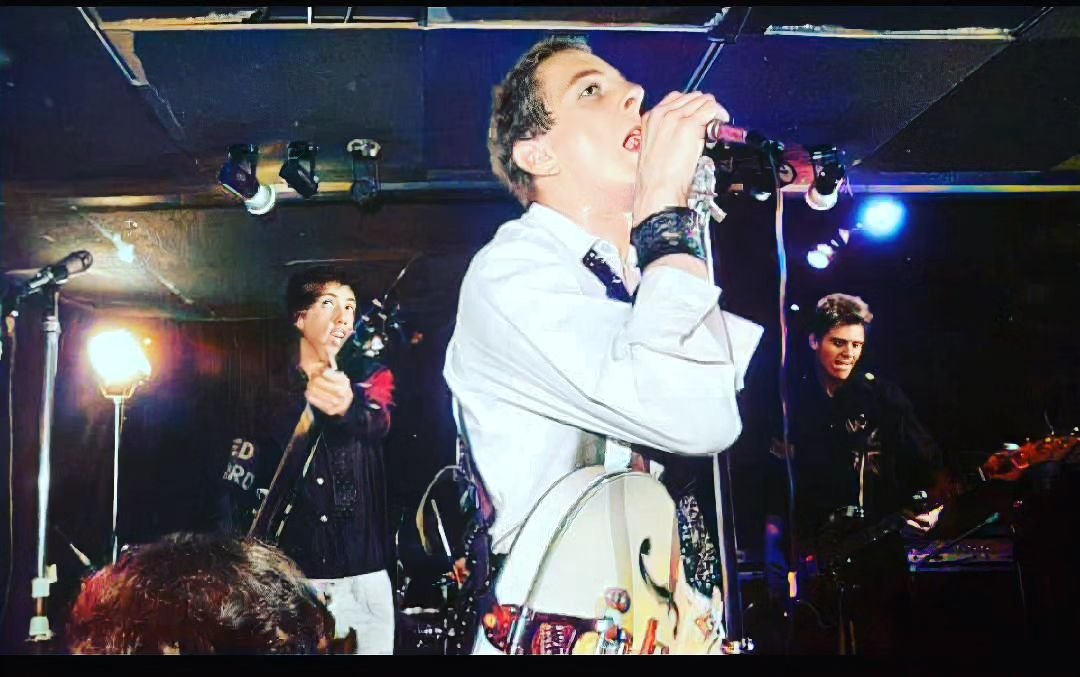
Enlarge On Jan. 1, 1977, Joe Strummer took center stage at London’s burgeoning punk rock refuge, the Roxy. As if presciently ordaining himself the harbinger of what was in store for the pivotal year, “1977” was scrawled boldly across the frontman’s tattered white collared shirt as he and his fellow Clash comrades stormed through two back-to-back sets, officiating both the launch of the Roxy as a cultural touchstone and the explosion of the U.K. punk movement as a whole....
On Jan. 1, 1977, Joe Strummer took center stage at London’s burgeoning punk rock refuge, the Roxy. As if presciently ordaining himself the harbinger of what was in store for the pivotal year, “1977” was scrawled boldly across the frontman’s tattered white collared shirt as he and his fellow Clash comrades stormed through two back-to-back sets, officiating both the launch of the Roxy as a cultural touchstone and the explosion of the U.K. punk movement as a whole.
After an unsuccessful run as an “alternative" nightclub called Chaguaramas, situated in the Covent Garden neighborhood of London, Andrew Czezowski, then-manager of the Damned and Generation X, took ownership of the building. Initially intended as a place for his client acts to rehearse, he along with partners Barry Jones and Susan Carrington soon pawned a number of their personal possessions, furnished the venue, and stocked the bar, reviving the haunt as the Roxy, hoping to do for London’s punk scene what CBGB did for New York.
The music scene within which the Clash had been slowly ingratiating themselves had begun years before the fabled New Year's gig, but it had been trammeled by censorship, infamy, and poor luck. 1976’s Anarchy Tour, wherein the band, accompanied by Johnny Thunders’ Heartbreakers, supported the Sex Pistols on a string of ill-fated dates, the majority of booked appearances had been canceled due the pressure of local political interests or the volume of protest demonstrators. By the time the tour had dissolved in scandal on Christmas Eve, as retold in Nick Crossley’s Networks of Sound, Style and Subversion: The Punk and Post-Punk Worlds of Manchester, London, Liverpool and Sheffield, 1975-80, almost two-thirds of the 20-odd scheduled dates were killed before a note had been played.
The ill-repute earned by the failed Anarchy Tour mostly plagued the Sex Pistols, however, as they headlined the bill while the Clash occupied the most modest slot, below that of the Heartbreakers. With hardly a reputation visible enough to damage, they were best positioned to recover. De facto Sex Pistols documentarian Julian Temple, whose forgotten footage of the Roxy evening (embedded above) was finally unearthed for the 2015 BBC Four documentary, The Clash: New Year's Day '77, told the network at the time of the release, “The Clash weren't known at all outside a very small circle, but I thought they were an incredible band in the making.”
Armed with a sharpened assortment of politically militant punk rock anthems-in-waiting, most of which would eventually appear on their eponymous debut three months following the Roxy gala, Temple recorded subterranean Clash rehearsals, capturing now-familiar numbers in their embryonic form. Where the Sex Pistols expressed their subversive proclivities with sneering confrontation and a manic public image (and in a sense, establishing the “punker” archetype), the Clash honed more melodic and informed song structures and envisaged a more focused and clear-cut ideological vision.
But it wasn’t the Clash’s brand of more organized and presentable subversion that was originally slated to break in the newly rebranded Roxy. As Marcus Gray put it, in his book The Clash: Return of the Last Gang in Town, “The Clash agreed to headline the 1 January 1977 Roxy opening night, thus beginning the new year with a highly symbolic act: stepping on the Sex Pistols’ shoes.”
The suggestion is only slightly hyperbolic, as it was Pistols manager Malcolm McLaren, in his characteristically mercurial fashion, who pulled his clients out of the gig at the last minute as a result of the fallout following the Pistols' infamous appearance on the Today show. Still, the symbolism of the turn of events is not exaggerated. The memorably turbulent, not to mention capacity-defying, performance was the first of a series of overtures that would propel the Clash past the perpetually embattled Sex Pistols in the U.K. punk rock hierarchy.
The Roxy’s reign, on the other hand, would be short-lived: it shuttered its doors in April 1978, little over a year after its grand opening. But not before cementing its legacy by cycling through the gambit of prominent English punk acts of the era, from street-punk squatters like Crass and Slaughter and the Dogs to art-school post-punks Wire and Siouxsie and the Banshees. Despite the brevity of the Roxy’s run, the bands it hosted and movement it helped launch proved bigger and more lastingly influential than the Clash and their contemporaries could have predicted.
PREVIOUSLY UNSEEN FOOTAGE OF THE CLASH ON NEW YEAR'S DAY, 1977
On the liner notes of their first LP Two Sevens Clash, roots reggae band Culture claimed that Marcus Garvey had prophesied that the date July 7, 1977, "when the two sevens clash," would herald great conflagration. Whether Garvey said it or not (some hold that Culture just made the story up), it's safe to say that 1977 was a year of great chaos. As the Clash sang around that time, "Danger stranger / You better paint your face / No Elvis, Beatles, or the Rolling Stones / In 1977." The tumult of that year is amply demonstrated in 1977, a documentary by Julien Temple, director of The Great Rock'n'Roll Swindle and The Filth and the Fury, built around never-before-seen footage he shot of the Clash's early gig at the Roxy on January 1, 1977, a gig that more or less ushered in both the Roxy and the Clash as punk fixtures, although the band ended up lasting a lot longer than the venue.
Temple's documentary is a marvelous hodgepodge of footage covering U.K. anarchy in all its forms as the nation ushered in a tense new year. In the first few moments a fellow introduces a TV program in which every single member of the studio audience is named "Smith" by more or less declaring that the economic outlook in 1977 was likely to be lousy. Meanwhile, some other guy, on location at Stonehenge, welcomes in ‘77 by chugging some "champers." The found footage of random British TV, which has nothing to do with the Clash, the Roxy, or punk, is every bit as fantastic as anything else in the movie.
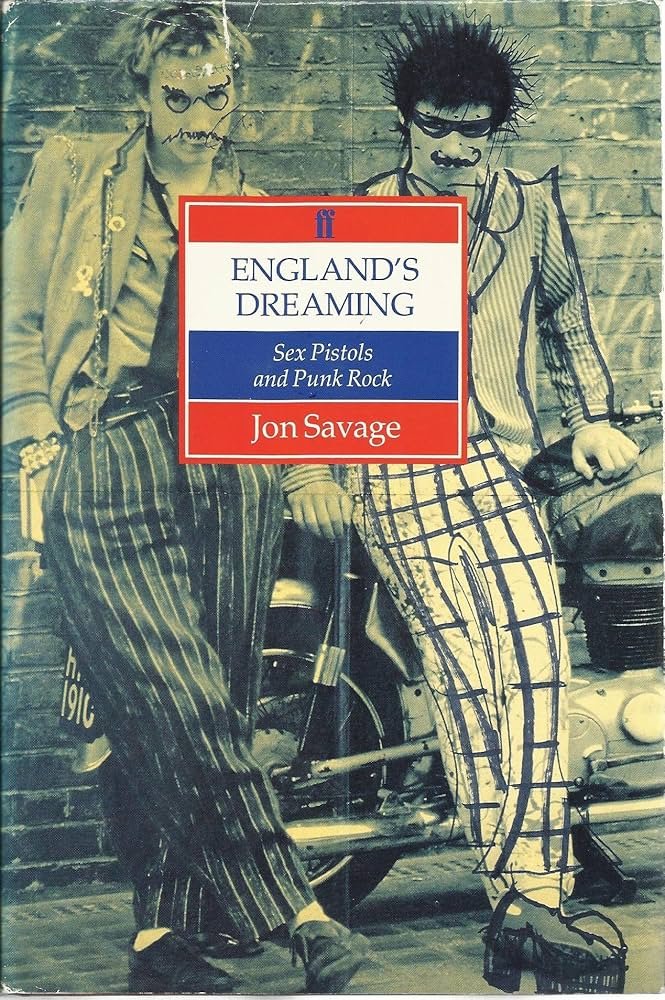
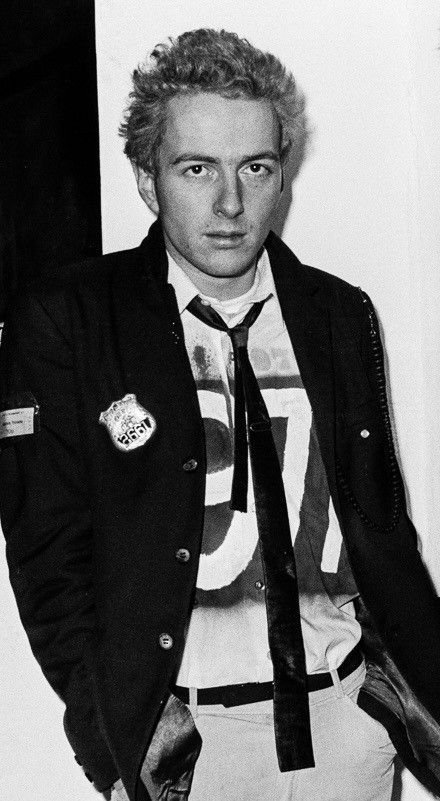
As January 1, 1977, neared, the newspapers were full of "shocking" stories about punk, particularly the newly famous Sex Pistols. The Pistols and the as-yet-little-known Clash as well as Johnny Thunders' Heartbreakers were in the midst of the Anarchy Tour, which was most notable for venues pulling out and cancelling gigs for fear of mayhem and adverse publicity. As Jon Savage wrote in England's Dreaming, The Clash "were the true victors of the Anarchy Tour: benefiting from the publicity but not embroiled in controversy, they were the group to watch. To celebrate, Strummer specially customized a white shirt with a massive ‘1977' on the front."
The Roxy had recently been a "cheesy" gay club, to use Temple's word, called Shaggarama. For the first three months of 1977, before the punk crowd moved on, the list of musical performers who played the Roxy is a veritable Who's Who of Punk: The Buzzcocks, the Damned, Siouxsie & The Banshees, the Jam, the Stranglers, Sham 69, the Only Ones, Wire, the Adverts, X-Ray Spex, the Slits, XTC, and many more; even the Police played there. As Temple says, "With hindsight, the Roxy has taken on the aura of being vital to the early days of Punk, which may be an exaggeration. ... in fact the Punk crowd soon lost interest in it and moved on. The Roxy got worse and worse and lasted about 100 days."
The Clash, having successfully introduced themselves in the Anarchy Tour, understood that they were on the precipice of something big. Their regular drummer, Terry Chimes (Strummer nicknamed him "Tory Crimes") had gotten tired of the heavy-handed management style of Bernard Rhodes and opted out of the show. The Clash auditioned roughly 20 drummers in Camden Town, finally settling on Rob Harper, who was reportedly "scarred for life by the experience." At the Roxy gig, they sang a new song, "I'm So Bored with the USA," which wouldn't see a studio recording until March.
As you watch the documentary, it becomes clear that Temple's footage of that important New Year's Day gig doesn't really stand up on its own—you can find better Clash footage out there—which partially explains the strategy of buttressing it with huge chunks of highly resonant footage of U.K. during 1977. You see the Clash prepping for the show, you see lots of Malcolm McLaren and Johnny Rotten; Margaret Thatcher gets in there as well, of course. You see riots and reggae and regular Britons being staunch. It's a great strategy, and the result is a terrifically diverting 75 minutes of punked-out bliss.
Be sure to watch it soon—this premiered on BBC Four just two days ago, and now it's on YouTube—there's no telling how long it will stay there.
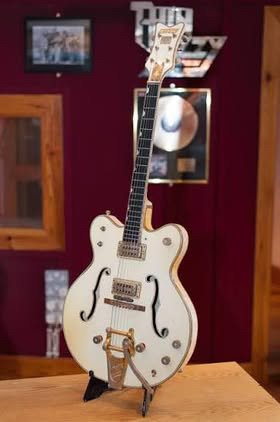
Joe with a Gretsch White Falcon
The Clash at the opening night of the Roxy Club , January 1 st , 1977.
Pete Shells ––– With the Gretsch White Falcon that Joe got from Johnny Thunders, Steve Jones got it from Joe and Phil Lynott got it from Steve. It now lives in the Dublin Music Museum.THE CLASH ON PAROLE | Facebook
— Review of The Clash's explosive two-set performance at the Roxy club on January 1st, 1977, declares The Clash, not the Sex Pistols, as the most important and committed band on the scene
vincentcaruso, Published: December 31, 2016, online
When the Clash Opened the Roxy on New Year's Day
On Jan. 1, 1977, Joe Strummer took center stage at London's burgeoning punk rock refuge, the Roxy. As if presciently ordaining himself the harbinger of what was in store for the pivotal year, "1977" was scrawled boldly across the frontman's tattered white collared shirt as he and his fellow Clash comrades stormed through two back-to-back sets, officiating both the launch of the Roxy as a cultural touchstone and the explosion of the U.K. punk movement as a whole.
After an unsuccessful run as an "alternative" nightclub called Chaguaramas, situated in the Covent Garden neighborhood of London, Andrew Czezowski, then-manager of the Damned and Generation X, took ownership of the building. Initially intended as a place for his client acts to rehearse, he along with partners Barry Jones and Susan Carrington soon pawned a number of their personal possessions, furnished the venue, and stocked the bar, reviving the haunt as the Roxy, hoping to do for London's punk scene what CBGB did for New York.
The music scene within which the Clash had been slowly ingratiating themselves had begun years before the fabled New Year's gig, but it had been trammeled by censorship, infamy, and poor luck. 1976's Anarchy Tour, wherein the band, accompanied by Johnny Thunders' Heartbreakers, supported the Sex Pistols on a string of ill-fated dates, the majority of booked appearances had been canceled due the pressure of local political interests or the volume of protest demonstrators. By the time the tour had dissolved in scandal on Christmas Eve, as retold in Nick Crossley's Networks of Sound, Style and Subversion: The Punk and Post-Punk Worlds of Manchester, London, Liverpool and Sheffield, 1975-80, almost two-thirds of the 20-odd scheduled dates were killed before a note had been played.
The ill-repute earned by the failed Anarchy Tour mostly plagued the Sex Pistols, however, as they headlined the bill while the Clash occupied the most modest slot, below that of the Heartbreakers. With hardly a reputation visible enough to damage, they were best positioned to recover. De facto Sex Pistols documentarian Julian Temple, whose forgotten footage of the Roxy evening (embedded above) was finally unearthed for the 2015 BBC Four documentary, The Clash: New Year's Day '77, told the network at the time of the release, "The Clash weren't known at all outside a very small circle, but I thought they were an incredible band in the making."
Armed with a sharpened assortment of politically militant punk rock anthems-in-waiting, most of which would eventually appear on their eponymous debut three months following the Roxy gala, Temple recorded subterranean Clash rehearsals, capturing now-familiar numbers in their embryonic form. Where the Sex Pistols expressed their subversive proclivities with sneering confrontation and a manic public image (and in a sense, establishing the "punker" archetype), the Clash honed more melodic and informed song structures and envisaged a more focused and clear-cut ideological vision.
But it wasn't the Clash's brand of more organized and presentable subversion that was originally slated to break in the newly rebranded Roxy. As Marcus Gray put it, in his book The Clash: Return of the Last Gang in Town, "The Clash agreed to headline the 1 January 1977 Roxy opening night, thus beginning the new year with a highly symbolic act: stepping on the Sex Pistols' shoes."
The suggestion is only slightly hyperbolic, as it was Pistols manager Malcolm McLaren, in his characteristically mercurial fashion, who pulled his clients out of the gig at the last minute as a result of the fallout following the Pistols' infamous appearance on the Today show. Still, the symbolism of the turn of events is not exaggerated. The memorably turbulent, not to mention capacity-defying, performance was the first of a series of overtures that would propel the Clash past the perpetually embattled Sex Pistols in the U.K. punk rock hierarchy.
The Roxy's reign, on the other hand, would be short-lived: it shuttered its doors in April 1978, little over a year after its grand opening. But not before cementing its legacy by cycling through the gambit of prominent English punk acts of the era, from street-punk squatters like Crass and Slaughter and the Dogs to art-school post-punks Wire and Siouxsie and the Banshees. Despite the brevity of the Roxy's run, the bands it hosted and movement it helped launch proved bigger and more lastingly influential than the Clash and their contemporaries could have predicted.
Film footage
Edited version of Julian Temple's film on The Clash, originally shown on BBC4. All other footage removed, just pure Clash!
@steve-dn8ru –– link –– Richard Strange from The Doctors Of Madness in the crowd as well at 2.40 @treatmentbound –– link –– I think that's Shane MacGowan @ 14:33--he had the worst teeth in 1970's UK!
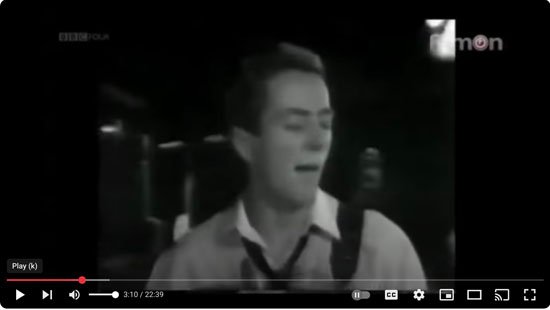
Below: The Clash - Live at the Roxy, New Year's Day 1977 (Video) - YouTube
Edited version of Julian Temple's film on The Clash, originally shown on BBC4. All other footage removed, just pure Clash!
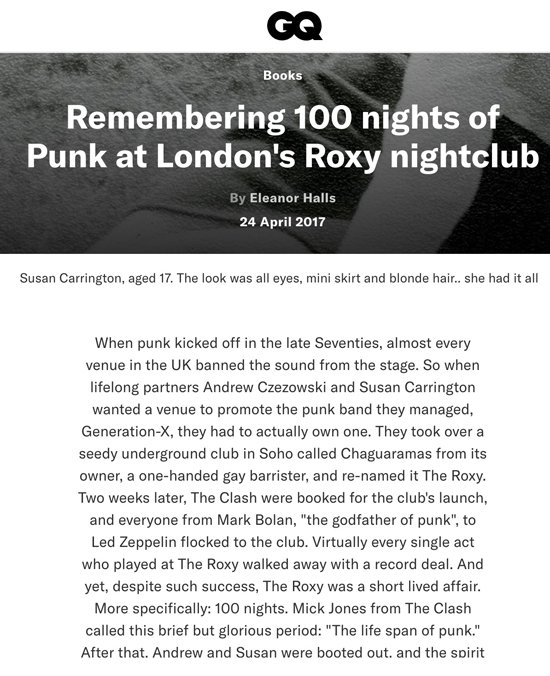
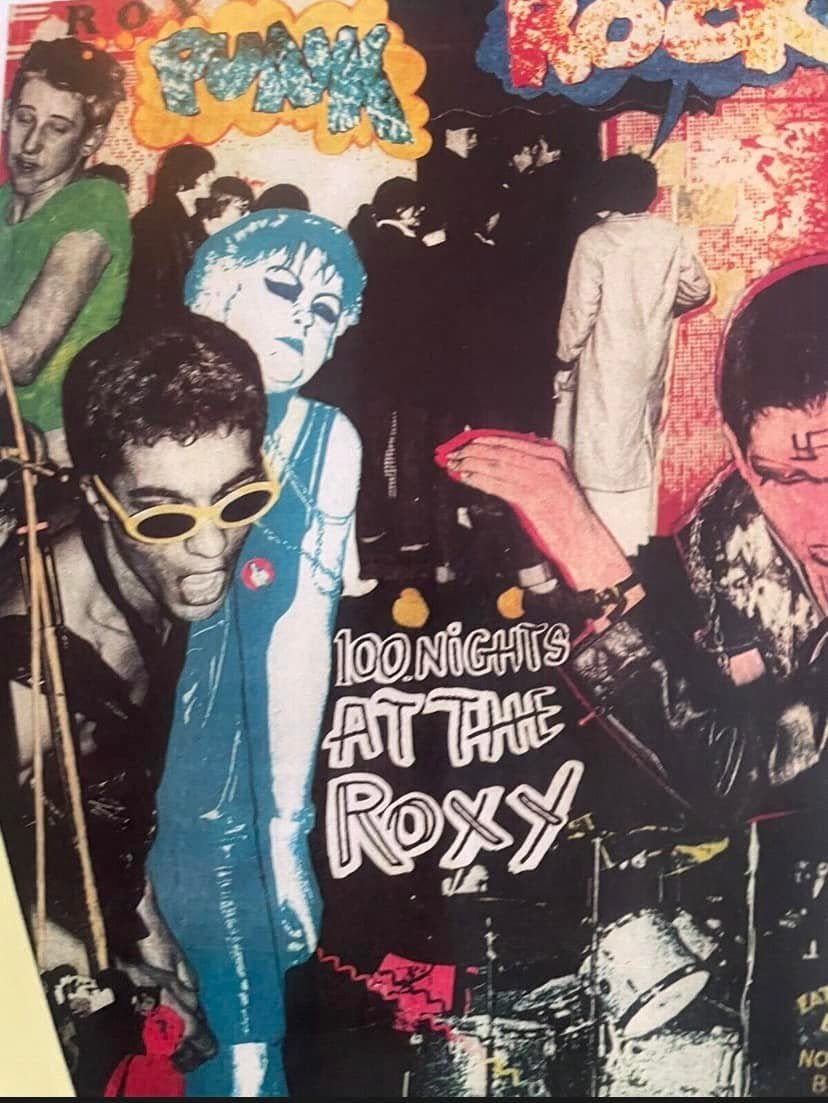
BOOK REVIEW by Eleanor Halls, "100 nights of Punk at the Roxy nightclub in London ", British GQ Magazine, 24 April 2017
Remembering 100 nights of Punk at London's Roxy nightclub
When punk kicked off in the late Seventies, almost every venue in the UK banned the sound from the stage. So when lifelong partners Andrew Czezowski and Susan Carrington wanted a venue to promote the punk band they managed, Generation-X, they had to actually own one....
BOOK REVIEW by Eleanor Halls, "100 nights of Punk at the Roxy nightclub in London ", British GQ Magazine, 24 April 2017
100 nights of Punk at the Roxy nightclub in London
When punk kicked off in the late Seventies, almost every venue in the UK banned the sound from the stage. So when lifelong partners Andrew Czezowski and Susan Carrington wanted a venue to promote the punk band they managed, Generation-X, they had to actually own one.
They took over a seedy underground club in Soho called Chaguaramas from its owner, a one-handed gay barrister, and re-named it The Roxy. Two weeks later, The Clash were booked for the club's launch, and everyone from Mark Bolan, "the godfather of punk", to Led Zeppelin flocked to the club.
Two weeks later, The Clash were booked for the club's launch, and everyone from Mark Bolan, "the godfather of punk", to Led Zeppelin flocked to the club. Virtually every single act who played at The Roxy walked away with a record deal. And yet, despite the venue's success, it stayed open only 100 nights - a glorious period Mick Jones from The Clash called "The life span of punk."
Virtually every single act who played at The Roxy walked away with a record deal. And yet, despite such success, The Roxy was a short lived affair. More specifically: 100 nights. Mick Jones from The Clash called this brief but glorious period: "The life span of punk."
After that, Andrew and Susan were booted out, and the spirit of punk moved on. Now, the couple have released the world's first duography, The Roxy Our Story: The Club That Forged Punk In 100 Nights Of Madness, Mayhem And Misfortune (Carrczez, £20) which uses newspaper clippings, gig posters, old photographs and excerpts from the couple's respective diaries to chart the rise and fall of punk at The Roxy.
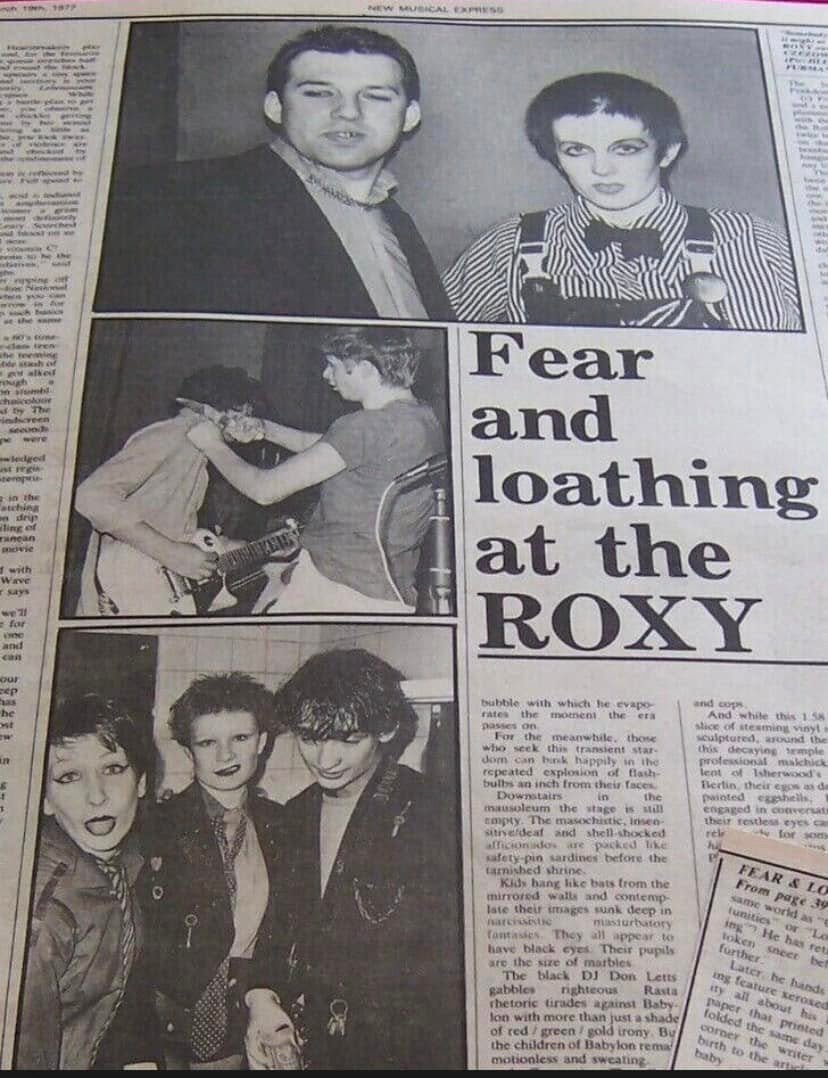
Today, a plaque outside the former club (41-43 Neal Street, Sven Dials) will be formally unveiled by special guests, and tomorrow, a free punk exhibition, "Fear And Loathing At The Roxy", will run for two weeks from 26 April to 10 May at 10-35 Neal Street. When Punk kicked off in the late Seventies, almost every venue in the UK banned the sound from the stage, fearing its aggression and otherness.
So when lifelong partners Andrew Czezowski and Susan Carrington wanted a venue to promote the punk band they managed, Generation-X, they had to actually own one. They took over a seedy underground club in Soho called Chaguaramas from its owner, a one-handed gay barrister, and re-named it The Roxy.
In the end though it would not be the Pistols who played but their nearest rivals to the Punk crown, the rapidly improving Clash who had accompanied them on the ill fated Anarchy Tour. Andy did a deal with Bernie Rhodes, the Clash's manager....
In the end though it would not be the Pistols who played but their nearest rivals to the Punk crown, the rapidly improving Clash who had accompanied them on the ill fated Anarchy Tour. Andy did a deal with Bernie Rhodes, the Clash's manager.
Book: The Roxy WC2 - A Punk History
Andy Czezowski (Roxy Club Partner) Bernie Rhodes and the Clash had come down to see Generation X and the Heartbreakers. I had met Bernie several times before and I said ‘how about playing?' and they thought great! great! great! and we booked them in for January Ist 1977 which was a Saturday night.
The deal would suit both parties. For the Roxy it needed an act that would guarantee a crowd. For the Clash, like the Heartbreakers who played the Roxy to get some money, there must have been an element of desperation. Unlike the Sex Pistols, they had no record company funding and in effect no publicity as the Anarchy Tour was the Pistol's show. They were just the support to the Sex Pistols and were frustrated at the reaction to Punk Rock that caused the cancellation of nearly all the gigs on tour. Strummer confided to Caroline Coon the following April that at the time he was broke, hungry and depressed.
Joe Strummer (the Clash) When I got back to London on Christmas Eve I felt awful. I was really destroyed, because after a few days you get used to eating. We were eating Holiday Inn rubbish, but it was two meals a day. And when we got off the coach we had no money and it was just as awful. I felt twice as hungry as I'd felt before. The poster for the gig was designed by Sebastian Conran" and advertised the Clash playing two sets. Caroline Coon, Meoldy Maker 23.4.77
The poster depicted them as a three piece missing out Rob Harper who had le a drummed on the ill-fated Anarchy tour. The poster also detailed Chelsea getting a belated debut at the Roxy as support for the Clash.
Barry Jones (Roxy Club Partner) don't remember the first Roxy posters I did. I know that the Clash did their own for that opening gig. But I do remember on the day before the New Years eve gig going round the West End at midnight plastering up those freaking flyers with Joe and Mick. We had a bagful and we were all over the town doing it.
The posters attracted the right crowd
Anon. A group of us from round here decided to go to this big do. It was the Clash who were playing, opening up the Roxy. Oh it was excellent. You just got in there and there were all these Punks and freaks. It was a whole new scene and yet you felt really part of it. You felt that you were part of something, you were something different. Peter Everett, You'll Never Be 16 Again, 1986
Taking the stage at 9.30 p.m. the Clash ripped through an energetic set with Strummer playing a semi acoustic Gretsch and a wearing a shirt with an appropniately giant ‘1977' daubed across the front. To the right, Paul Simonon stands having had his bass, complete with chord letters marked on the frets, tuned by guitarist Mick Jones.
The crowd reacted accordingly.
Andy Blade (Eater) All of a sudden the Roxy erupted into a frenzied blur of pogo dancing, coloured lights and noise. It felt like someone tossed a grenade into the room. Andy Blade, The Secret Life Of A Teenage Punk Rocker, 2005
Other clubgoers recall the crush
Debbie Davis (Roxygoer) It was packed down the front with heaving bodies and the heat was unbelievable. We were jumping up and down, a great big mass of people with sweat pouring off us and the music was relentless and bloody loud.
Meanwhile Andy Blade took advantage to engage in other more tried and tested rock 'n' roll pursuits.
Andy Blade (Eater) We made our way closer to the front, three giggling schoolgirls in carefully ripped uniforms recognized us from the latest edition of Jackie magazine...I charted to the prettiest one amongst them...She then steered and manoeuvred me out of the room and onto the fire escape stairs, sat me down and undid my belt. Oh well I'd seen the Clash before anyway. Andy Blade, The Secret Life Of A Teenage Punk Rocker, 2005
Meanwhile for Rob Harper of the Clash at the back on drums it was a painful experience.
I had to have bandages on my fingers,' recalls Rob. ‘I did myself in, and at the end I thought, "That's over thank God!" Afarcus Gray, The Clash: Return Of The Last Gang In Town, 2001
However Rob hadn't noticed the gig poster advertising a second set by the Clash and he had to do it all again! Scheduled to come on at 12.30 a.m. they appeared at midnight.
Marco Pirroni (the Models) I just remember them coming on onstage at the stroke of midnight and them playing ‘1977' which of course it was.
Shanne Bradley (Nipple Erectors) Yes the night was packed but the sound was bad. I'd seen them before this at the 100 Club etc but never a huge fan. I'd previously seen the 1001 ers (sic) in a pub with the Sex Pistols and Joe Strummer shakin' all over in a sweaty zoot suit grunting rock ‘n' roll. I just could not get this image out of my head ever! Sorry Joe RIP you were a great person!
The Clash ran though their second set in an equally spirited fashion and included a new song by Mick Jones called ‘Remote Control,' written about the troubled Anarchy Tour. The gig was reviewed in the fanzine 48 Thrills by Adrian Thrills.
Adrian Thrills (48 Thrills Fanzine) "You lot can't have made the fourth form at school', jeered Joe Strummer at the bunch of apathetic discos who just stood and stared at the Clash during their second set at the Roxy.
The Clash were great despite sound problems and the size of the Roxy (they were too powerful for it with their new PA). Over the last couple of months and with their travels on the world's most cancelled tour, they've been working hard on their set. There are changes and some great new songs, especially Hate & War and Remote Control. They've speeded up White Riot and it sounds even better.
Even on the small stage at the Roxy they moved like maniacs in both sets. Joe's got a flashy new big white guitar which looks great, tho' I stll prefer the tinnier sound that he got from the rusty old one he used to have.
The Pistols started the scene but right now the Clash are more important to it...the most committed group, the toughest, most frantic, most powerful...right. 48 Thrills #2, 1977
Si Haseldon was a punk fan aged 15 then who had travelled down to the Roxy club from Manchester to see the Clash. Previously, he had caught them at the Electric Circus and bought an impoverished Joe Strummer a drink.
Si Haseldon (Roxygoer) The Clash gig is still one of the best, most exciting pigs I've EVER been to. And, at the end of one of the Roxy Clash sets, Joe Strummer came back out, bent down to pick up his guitar, looked me square in the eye and said "Electric Circus two weeks ago - you bought me a drink - Cheers" and gave me his plectrum and a towel, much to the disgust of some halfwit stood next to me who tried to "liberate" them from me. My mate Barney gripped him round the neck and walked him outside shall we say!
The Clash gig at the Roxy was a sell out and the club's first week's rent was taken care of. Now they had to keep making money and keep the club going. The Roxy was on its way.
Magazines
"Shosub, Sarah. "The Clash." MoreOn fanzine, issue #3, early 1977, pp. 3 pages,
The Clash: Interview
— Sarah Shosub for MoreOn fanzine, issue no. 3, early 1977 interview Joe Strummer, Mick Jones, and Paul Simonon discussing their recent signing with CBS Records.
— The band defends the deal, with Strummer calling the label "a tool" and Jones recounting how they handed CBS a self-produced single to avoid outside interference, they quote a CBS executive's phrase "commercial limitation on radical behaviour" with sarcastic amusement.
— References a problematic gig at the Roxy Club, Covent Garden on 1 January 1977 where the sound was "really shitty."
— Discusses their ongoing search for a permanent drummer, mentioning Terry Chimes recorded four songs with them but wasn't a full member.
S.S.Won't the record deal inevitably change your attitudes in certain directions?
Mick Jones: Things do change.
Paul Simonon: Wait and see.Joe Strummer: Record companies are a tool, they make records so we go to them. The Buzzcocks doing it themselves have still formed their own tool: We've just signed to a big one, but it's still basically the same thing.
S.S.Surely it's not? CBS is a big-time organisation. Won't they make demands on you which are contrary to what you're meant to be about now?
M.J.No. The other night we went down to the studios and laid some tracks down ourselves. After two days CBS told us it was time we stopped arsing around and that we'd have to start working with a producer and all that. We handed them what we'd done and said here's the single and B-side OK?. They said O.K.
Joe Strummer: So we ain't got no problems.
M.J.: You know business men think they're gonna be boring but they're not, they're funny. I don't mean they tell us jokes, but they have a special way of saying things.
S.S.: Like what was it?
J.S.: (reading from the little yellow match box book) Write this down commercial limitation on radical behaviour that's what he said to us commercial limitation on radical behaviour.
P.S.Was that before or after he said he felt sick?
S.S.What did you mean when you said about ignorance being the most dangerous thing?
P.S.Urdur ur ur.
S.S.For all your political aspirations aren't you just indulging yourselves being rock and roll musicians?
J.S.What do you reckon I should do. Chuck a few bombs round and get put away for five years?
P.S.If you ask me throwing bombs about is a dodgy business,
J.S.It seems like years ago since we played. I feel like we haven't been playing for years. Like we've been missing for years. I feel like an old recluse.
S.S.What about the gig at the Roxy on January 1st?
J.S.It's a shame, we set up the gear really good and when the audience were all there it sounded really shitty.
S.S.What about a drummer?
M.J.: Having no drummer makes things a bit difficult. It's a tight situation imagine interviewing 200 drummers and every one of them thinking he's Billy Cobham. (Mick demonstrates how they do this)
J.S.Heavy, heavy. Then we say no, like this. (Mick demonstrates, a kinda boom-crash, boom-boom crash). Then they say gotcha and off they go again. Terry Chimes drums for us. We've been in the studio and we've done 4 songs with him.
S.S.Why isn't he actually in the group?
J.S.You ask Terry. Tell me what he says the answer to. Then you tell 'cause I'd like.
S.S.What about creativity? You've said a lot about it in interviews, aren't you a bit disappointed that the fans and some other groups that are about are not really being creative for themselves?
M.J.: It's good everyone's starting groups. There's really loads of them. People interpret it in their own way maybe lots of them choose an easy way, like a pack of safety pins.
S.S.What about actual musical standards. Don't you think that any of the groups are taking the easy way?
M.J.: Maybe that's the sound, like bit monotonous and tuneless, maybe that's the sound.
M.J.: We don't sound like that, hopefully but maybe the kids want it like that. There are a couple of strong groups, the others are on a different scale.
Paul Bower - It wasn’t a great club. Tiny. Overpriced warm beer and very posey. Electric Circus in Manchester and the Outlook in Doncaster topped it. 100 Club on Oxford Street better.
I was there on that freezin cold New Year’s Day evening
Daryl Humphreys - I was there on that freezin cold New Year’s Day evening with practically no public transport to be had. They opened with the 1977 track off the soon to be released 1st album and together with the corresponding shirt made a spectacular splash for the launch of the Roxy and what was to a brilliant year for punk
Mark Sherlock - Saw the Clash several times in a couple of years though,including at the Lacy Lady in Oct/Nov 76 and at the New Years Day opening of the Roxy.And of course the 100 Club Punk festival!!
Heard that The Pistols were playing, so got there to find it was The Clash. Life-changing!!
Steve Summersbee ––– Went there for the first time, after seeing The Damned at Hope & Anchor. Word was going round that Pistols were playing, so got there to find it was The Clash. Life-changing!! Facebook
Daryl Humphreys ––– I was there that day, standing on the seats at the back to get a decent view. They were brilliant
Punk Rock: The Clash at the opening night of the Roxy Club , January 1 st , 1977. From John Ingham's " Spirit of 76 London Punk Eyewitness ".
Strummer with that historic Gretsch White Falcon
Ranking Fred - (Different clothes) They played two times on dis date, matinee & evenin' Ian. different drummer by show (The 1977 was the later gig?)
Michael J Phillips - Strummer with that historic Gretsch White Falcon - owned by Johnny Thunders, Steve Jones and Phil Lynott (think it went from Thunders to Strummer, then to Jonesy and eventually Lynott) - some history
January 1, 1977 London, England The Clash played the official grand opening of The Roxy Club, punk's first venue. The building in Covent Garden had been a wholesale fruit and vegetable warehouse before becoming a music venue. Joe Strummer played a White Falcon.
Roxy Photos - general
Extensive archive
of articles, magazines and other from the Roxy gig to the White Riot Tour
Brixton Academy 8 March 1984
ST. PAUL, MN - MAY 15
Other 1984 photos
Sacramento Oct 22 1982
Oct 13 1982 Shea
Oct 12 1982 Shea
San Francisco, Jun 22 1982
Hamburg, Germany May 12 1981
San Francisco, Mar 02 1980
Los Angeles, April 27 1980
Notre Dame Hall Jul 06 1979
New York Sep 20 1979
Southall Jul 14 1979
San Francisco, Feb 09 1979
San FranciscoFeb 08 1979
Berkeley, Feb 02 1979
Toronto, Feb 20 1979
RAR Apr 30 1978
Roxy Oct 25 1978
Rainbow May 9 1977
Us May 28 1983
Sep 11, 2013: THE CLASH (REUNION) - Paris France 2 IMAGES
Mar 16, 1984: THE CLASH - Out of Control UK Tour - Academy Brixton London 19 IMAGES
Jul 10, 1982: THE CLASH - Casbah Club UK Tour - Brixton Fair Deal London 16 IMAGES
1982: THE CLASH - Photosession in San Francisco CA USA 2 IMAGES
Jul 25, 1981: JOE STRUMMER - At an event at the Wimpy Bar Piccadilly Circus London 33 IMAGES
Jun 16, 1980: THE CLASH - Hammersmith Palais London 13 IMAGES
Feb 17, 1980: THE CLASH - Lyceum Ballroom London 8 IMAGES
Jul 06, 1979: THE CLASH - Notre Dame Hall London 54 IMAGES
Jan 03, 1979: THE CLASH - Lyceum Ballroom London 19 IMAGES
Dec 1978: THE CLASH - Lyceum Ballroom London 34 IMAGES
Jul 24, 1978: THE CLASH - Music Machine London 48 IMAGES Aug 05, 1977: THE CLASH - Mont-de-Marsan Punk Rock Festival France 33 IMAGES
1977: THE CLASH - London 18 IMAGES
Joe Strummer And there are two Joe Strummer sites, official and unnoffical here
Clash City Collectors - excellent
Facebook Page - for Clash Collectors to share unusual & interesting items like..Vinyl. Badges, Posters, etc anything by the Clash. Search Clash City Collectors & enter search in search box. Place, venue, etc
Clash on Parole- excellent Facebook page - The only page that matters Search Clash on Parole & enter search in the search box. Place, venue, etc
Clash City Snappers Anything to do with The Clash. Photos inspired by lyrics, song titles, music, artwork, members, attitude, rhetoric,haunts,locations etc, of the greatest and coolest rock 'n' roll band ever.Tributes to Joe especially wanted. Pictures of graffitti, murals, music collections, memorabilia all welcome. No limit to postings. Don't wait to be invited, just join and upload. Search Flickr / Clash City Snappers Search Flickr / 'The Clash'
Search Flickr / 'The Clash' ticket
I saw The Clash at Bonds - excellent Facebook page - The Clash played a series of 17 concerts at Bond's Casino in New York City in May and June of 1981 in support of their album Sandinista!. Due to their wide publicity, the concerts became an important moment in the history of the Clash. Search I Saw The Clash at Bonds & enter search in red box. Place, venue, etc
Loving the Clash Facebook page - The only Clash page that is totally dedicated to the last gang in town. Search Loving The Clash & enter search in the search box. Place, venue, etc
Blackmarketclash.co.uk Facebook page - Our very own Facebook page. Search Blackmarketclash.co.uk & enter search in red box. Place, venue, etc
Search all of Twitter Search Enter as below - Twitter All of these words eg Bonds and in this exact phrase, enter 'The Clash'


 No known audio
 The Punk Rock Movie
 1976/77 Julian Temple's early footage 50hrs


 [Extract] ... Malcolm’s (Mclaren) band had a promo film, so Bernie’s (Rhodes) band had to have one too.



%20nme%20nov%201976/1976%20SEX%20PISTOLS%20-%20DAMNED%20-%20CLASH%20(%20early%20daze%20)%20nme%20nov%201976.jpg)








/48%20THRILLS%201977%20No.2.html/48%20THRILLS%201977%20No.2_files%20copy/1_500h.jpg)
/48%20THRILLS%201977%20No.2.html/48%20THRILLS%201977%20No.2_files%20copy/2_500h.jpg)



 "The New Year was heralded, not by the Sex Pistols, but by the Clash's performance at a new club in Covent Garden, the Roxy"
/1977/_Gigs/1977%2001%2001%20-%20Roxy%20Club%20Covent%20Garden%20London/1977%2000%2000%20Moreon%20Fanzine%20No3%20Early%201977%20Roxy%20CBS/1977%2000%2000%20Moreon%20Fanzine%20No3%20Early%201977%20Roxy%20CBS.html/1977%2000%2000%20Moreon%20Fanzine%20No3%20Early%201977%20Roxy%20CBS_files/1977%2000%2000%20Moreon%20Fanzine%20No3%20Early%201977%20Roxy%20CBS-1.jpg)
.html/1977%2000%2000%20Moreon%20Fanzine%20No3%20Early%201977%20Roxy%20CBS_files/1.jpg)
.html/1977%2000%2000%20Moreon%20Fanzine%20No3%20Early%201977%20Roxy%20CBS_files/2.jpg)
.html/1977%2000%2000%20Moreon%20Fanzine%20No3%20Early%201977%20Roxy%20CBS_files/0.jpg)



.jpg)
.jpg)
.jpg)

















 The Official Clash
  Clash City Snappers

