Tuesday 31 August 1976

The 100 Club, London

Supporting the Sex Pistols

- updated 8 Feb 2008
- updated 7 July 2008 - added photo


INDEX
Recordings in circulation
Background
Tickets, Posters
Other
Venue
Gig Review
News Reports
Books
Magazines
Comments
Social Media
Photos


Recordings in circulation

Audio 1

No overamplification, audience, some muffling
Low gen - Sound 3.0 - 38 mins - Tracks 14 / Songs 13

Whats My Name


Sound Quality

Good sound for the recording. Some muffling, distance but the much of the sound is clear and sounds from a low source. Enjoyable and on a par with other good recordings from the era.

Back to the top


Background

Unreleased songs

Contains the early unreleased Clash tracks; I Know What To Think Of You, I Never Did It, How Can I Understand The Flies, Mark Me Absent and I'm So Bored with You (not yet USA).


The Clash — 31 August 1976, The 100 Club
(supporting the Sex Pistols)

At their fourth live show, The Clash took the stage at The 100 Club supporting the Sex Pistols. When Keith Levene broke a guitar string, the band were briefly stalled. Joe Strummer later recalled his improvisation switching on a transitor radio: “There was a really heavy news bulletin… Dave Goodman put a hip dub echo on the mic, so the announcer was saying, ‘Bomb-bomb-bomb, Piccadilly-piccadilly-piccadilly’” (The Clash, official oral history, the big pink book).

An eyewitness said: “I was there. Keith Levene guitar strings broke and Strummer put on a transistor radio whilst they were repaired” (Blackmarketclash). What could have been a moment of hesisisation and doubt turned into theatre.

The small Oxford Street basement shook with intensity. As Mark Perry wrote in Sniffin’ Glue: “CLASH. The Clash were really good… probably the most powerful band on the scene… they should soon build up a loyal following, they fucking deserve it” (via Internet Archive). To those crammed into the club, the verdict was obvious, this was not just another support act but a group already demanding attention.

In the weeks ahead, change was coming. “Years later somebody told me that Malcolm had invited some Americans to The 100 Club… they saw us and went home thinking they'd seen the Pistols… It must have been a bit difficult for Malcolm to say they'd seen the wrong group” (Joe Strummer, The Clash (official)).

But behind the scenes, Keith Levene was already on his way out — he would play his last show with the band at the Roundhouse in early September. The 100 Club appearance captured both the chaotic birth of The Clash and and the shaping of their future.


Tickets, Posters, Adverts

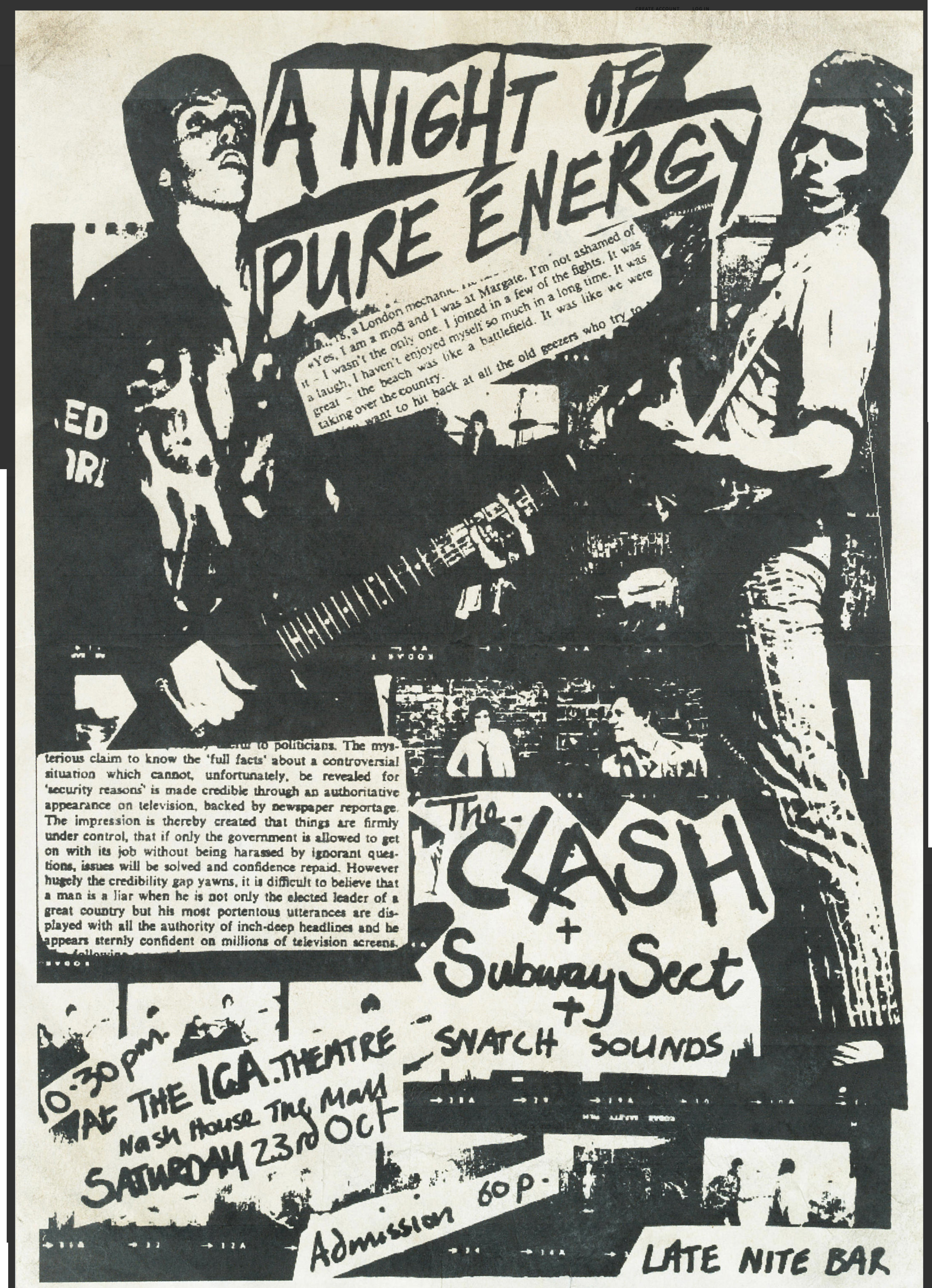
Poster from the 100 Club gig

This is an original which sold at Bohnams


Melody Maker. Date unknown Link

Adverts


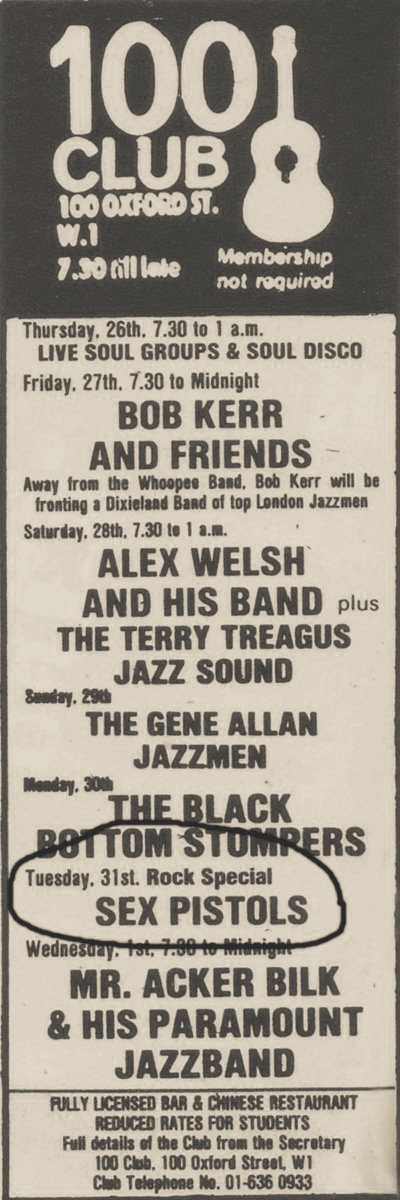
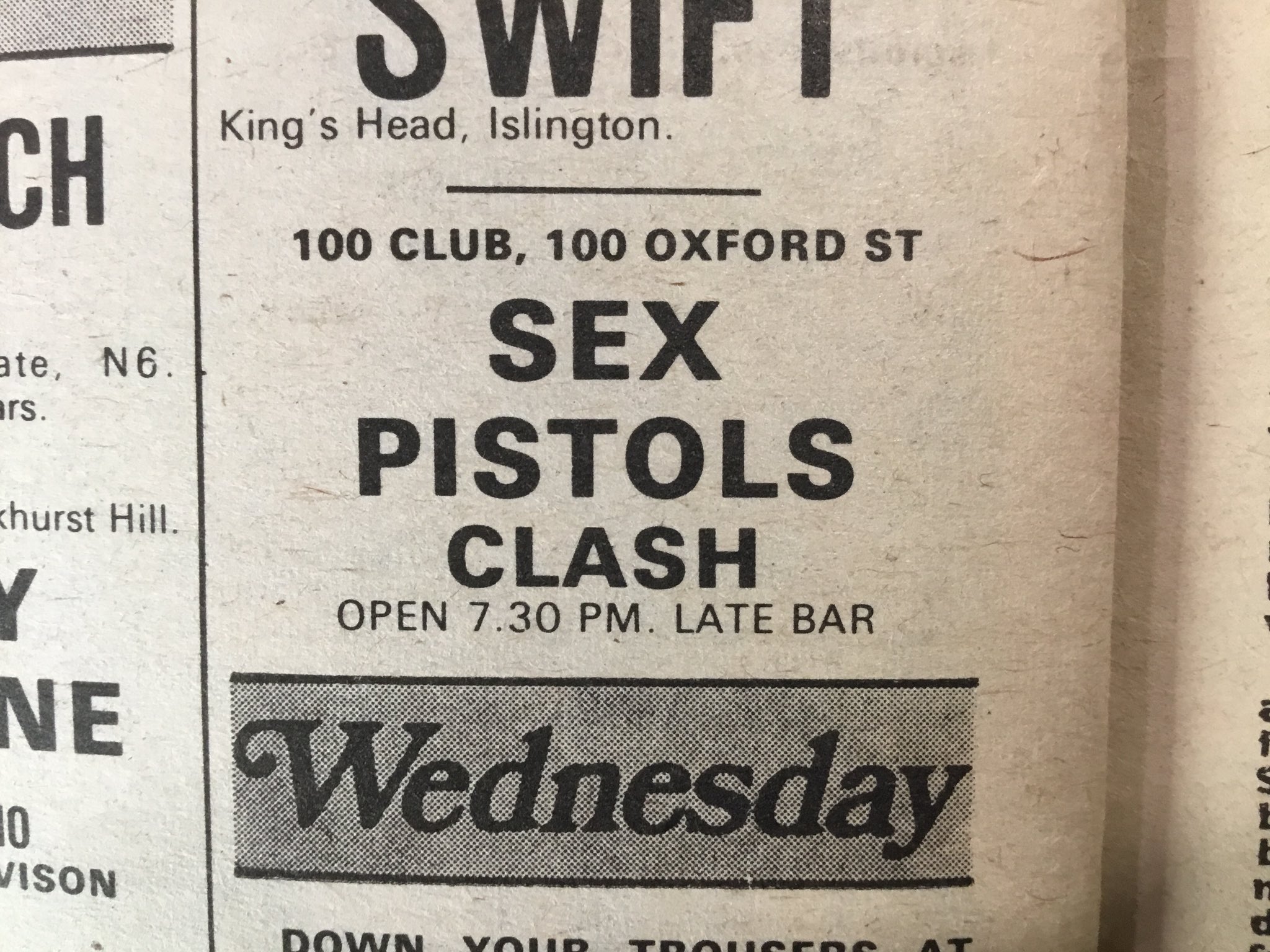
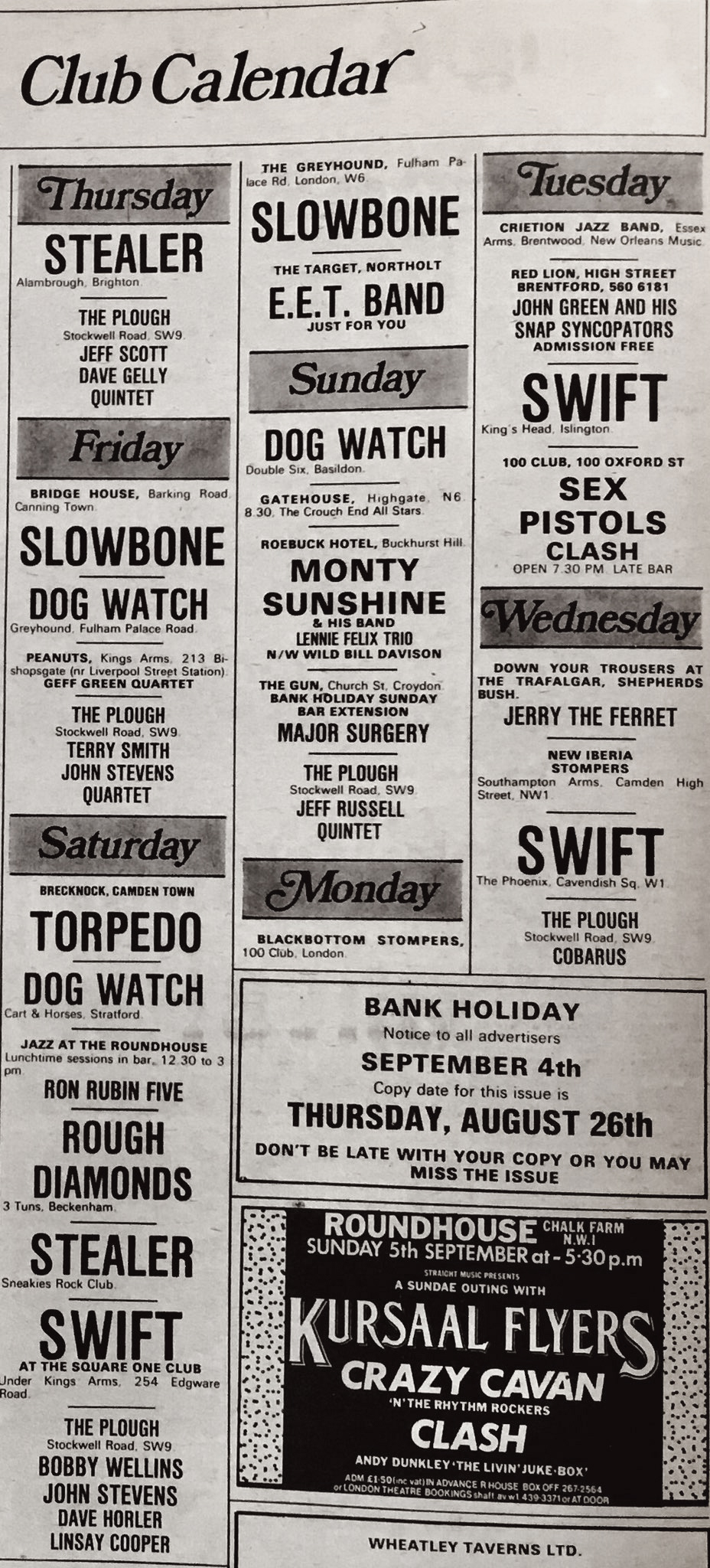
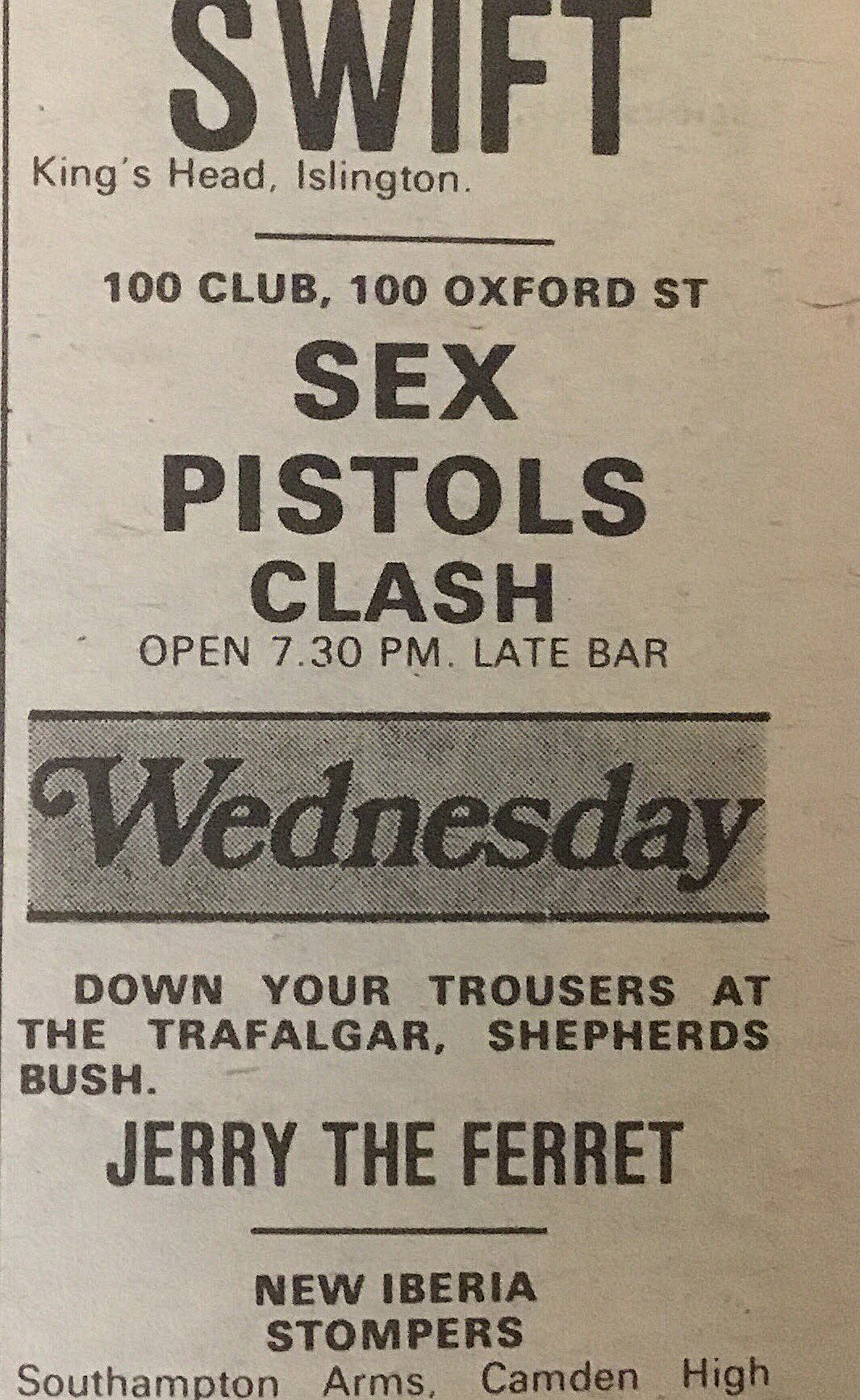
Tuesday 31st August - Melody Maker


Other

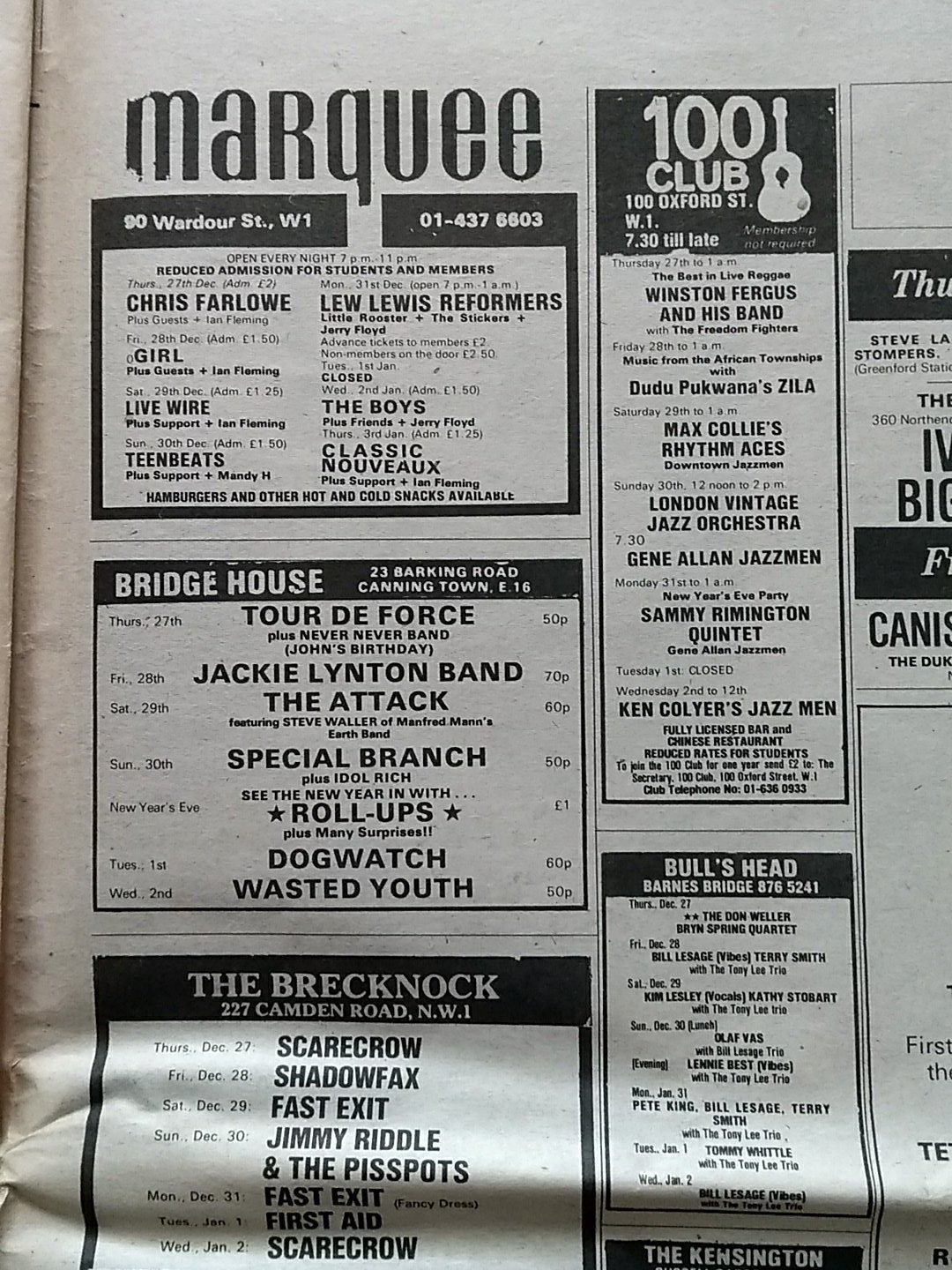
Melody Maker - spoof ads for spoof bands

How this is connected to this gig I dont know except the Pistols played under many suedonyms and Jackie Lynton Band and Jimmy Riddle and the Pisspots and various names. Except this is from Thursday 27th December 1979! We suspect this MM staff taking the piss?

Back to the top


Venue

The 100 Club

The History of the 100 Club
Wkipedia - 100 Club

The 100 Club is a historic music venue located at 100 Oxford Street, London, England, which has been hosting live music since 1942. It has played a significant role in the development of various music scenes, including the birth of punk with iconic performances by bands like The Sex Pistols, The Clash, and Siouxsie & The Banshees.

The venue has also been associated with other genres, such as reggae, indie, and rock, and has hosted performances by a wide range of artists, including The Rolling Stones, The Jam, and Paul McCartney. The 100 Club's rich history and intimate setting have made it an institution for secret shows by major acts. The venue's legacy is documented in a new book that celebrates its 75-year history[2][3][5].

As for the specific request regarding The Clash, the band played at the 100 Club during the first international punk festival in September 1976, which is considered a watershed moment for the punk rock movement. The gig showcased eight punk rock bands, including The Sex Pistols, The Damned, and The Clash, and is historically significant as it helped propel punk rock from the underground into the mainstream music scene[1][2].

100 Club Punk Special - Wikipedia - Information about the 100 Club Punk Special, a significant two-day event held at the 100 Club venue in London in 1976, showcasing eight punk rock bands.

100 Club - Wikipedia - Details about the 100 Club, a historic venue in London that has championed various groundbreaking music scenes, including the birth of punk with bands like The Sex Pistols and The Clash.

100 Club Official History - The official history of the 100 Club, a venue that has put on live music since 1942 and has been a significant part of various music movements, including the birth of punk.

Nancy and Dolls at 100 Club - A blog post about a specific event at the 100 Club, providing insights into the performances and the atmosphere of the venue.

The 100 Club Stories Book Anniversary - An article discussing the significance of the 100 Club and its role in hosting iconic gigs by bands like The Clash, Sex Pistols, and The Damned.


The Gig

...

...


News Reports

Mark Perry, Sniffin Glue, Issue 1, Autumn 1976

CLASH. The Clash were really good.

Internet Archive

CLASH. The Clash were really good. They seem to be getting better every time I see'em. Their set was more loose and expres-sive than before. They've dropped a member and they are probably the most powerful band on the scene at the moment. The response from the audience was pretty good but they're still yet to find their own audience. They're gonna start heading in clubs so they should soon build up a loyal following, they fucking deserve it.


Letter relates to the SexPistols gig at the 100 Club

Sounds 18th September 1976 - Sex Pistols Archive FB

Back to the top


Books

31 August 1976, The 100 Club, London, with The Sex Pistols, Page 80

BOOK; THE CLASH (official)

Internet Archive

JOE: Since the mid-1960s I tried to keep a transistor radio with me all the time so I could listen to the pirate stations in school break times. At The 100 Club, when we supported the Pistols, we'd decided that because we were punks we wouldn't talk to the audience, we'd just play, straight from one song to the next.

That was great as long as you didn't have to stop, but Keith Levene broke a string and there was a horrible gap — there we were in a club with three or four hundred lunatics all lagered up and foaming at the mouth, and I couldn't just stand there and look at them, it would be ridiculous.

So I grabbed my transistor radio from the top of the piano where I'd thrown it as we went on, turned it on and held it up to the microphone. It just happened that there was a really heavy news bulletin or panel discussion about the IRA and the bombing campaign that was going on in London being broadcast. Dave Goodman, who was the Pistols' soundman, had the nous to put a hip dub echo on the mic, so the announcer was saying, ‘Bomb-bomb-bomb, Piccadilly-piccadilly-piccadilly', and it filled the gap so well that it's become a kind of punk folk tale.

It was just a bit of luck. But after that gig we abandoned that stance and started speaking to the audience.


PAUL: Years later somebody told me that Malcolm had invited some Americans to The 100 Club that night to see the Pistols, but they saw us and went home thinking they'd seen the Pistols. They said to Malcolm: ‘Yeah it's a really great show, but we didn't know you had two guitars.' It must have been a bit difficult for Malcolm to say they'd seen the wrong group.

Back to the top


Pat Gilbert: Passion is a Fashion

That week. The Clash played two more gigs - at the 100 Club on 31 August (supporting The Pistols) and at the Roundhouse on 5 September (with The Kursaal Flyers and Crazy Cavan). The latter proved to be a disaster, not least because Joe's attempts to educate/rile/convert the audience between songs resulted in a barrage of guffaws and heckles. After the show, Bernie told the group they were 'shit' and enquired where Joe had found 'those old Johnny Rotten scripts'. It was to be Keith Levene's last gig with the group.

'It was obvious to me there was a problem,' explains Micky Foote. 'There was a problem with him and Mick, and a problem with his reliability. Reliability is very important. He was doing too much speed. You're never gonna get on with someone who wasn't there.'

Chimes disagrees: 'Keith was always around as far as I can remember, though Joe did call him Phantom the Guitar Player.'

Joe: 'Our idea of a good time was scoring a lump of dope the size of a match head. Now and then we'd get some blues or some sulphate. But Keith was more pro on speed. He took it in a very pure form.' Strummer had taken onboard Bernie's suggestion 'to write about what's happening' and penned a song about the events at Notting Hill - 'White Riot'. According to Joe, Keith wasn't interested in rehearsing it. Levene felt that it was musically regressive and lyrically crass. But his waning commit- ment arguably had roots in deeper reservations about the group.

Micky Footer 'I don't think it was dangerous enough for him. He was hanging out with Sid - it wasn't really a druggy scene at that point but it was edgy. And it was all a bit, "Are you working with Joe Strummer from The lOTers? He's a bit old, isn't he?" It was a bit of a stigma. They found it more difficult to take him in as one of them because he was a bit older and a bit middle-class. Keith's scene dragged him out of it, as much as he didn't want to bond up with it.'

The 'problem' between Mick and Keith was mostly personal. Keith tells of Jones 'yelling' at him a lot, and chewing him out for faiUng to turn up to a rehearsal that a) allegedly hadn't even been arranged and b) was on a Saturday afternoon when Keith was working. Speaking to Perfect Sound Forever website, Levene claims Mick's antagonism stemmed from an incident in July, when Viv Albertine had announced it was Keith's birthday while they were waiting together at a bus stop.

' [Mick] found out that I was three years younger than him,' he says. 'Ever since that day, he was just this total fucking bitch cunt to me. There wasn't a thing I could do that wasn't wrong.' It's certainly possible that Mick's attitude towards his bandmate did change when he realised Keith was his junior. Since Levene was born in 1957 and Mick in 1955, there were two (not three) years between them, still a considerable gap at that age.

One afternoon at Rehearsals when Keith was absent, Mick instigated a discussion about Keith's role in the group. 'Mick was putting forward the idea in a very roundabout way that they didn't need three guitar players in the band,' recalls Terry Chimes. 'I wasn't listening very much, but Joe said, "Shall we get rid of him, then?" I jumped then, and thought, "You can't get rid of someone just on a whim." I thought it was Joe and his crazy behaviour. But Mick said, "I think you're right." And Paul, who didn't say very much, said, "I think you're right." I was shocked. So they'd all been thinking of this but never said it. But when Keith left it seemed easier to progress and get things done. He slowed it down.'

Micky Foote said: 'It was a shock when he got the boot. It was a situation of someone who's not really on it getting chucked out and then being "I'm really hurt, man". It was a classic case of I'd rather fuck off than you tell me to fuck off.'

Levene's quick and unsentimental sacking said a lot about the atmosphere of The Clash. Bernie had instilled in Joe, Mick and Paul a collective ruth- lessness that they'd used effectively and decisively. Keith was given no warning or second chance. His lack of commitment was rewarded with his instant dismissal. This wasn't a band that, like The Stones with Brian Jones or The Beatles with Pete Best, was going to let things fester or palm off harsh decisions on management.

Ironically, Rhodes was alarmed by their action. 'Bernie was quite shocked when he turned up at Rehearsals and I'd sacked Keith,' said Joe. 'He was a favouriteofBernie's.I canseenowthatBerniewasworriedaboutlosingcon- trol.' Keith Levene was soon airbrushed from the picture. A rumour began to circulate that put his dismissal down to hard drug use. He was the first victim of what Foote describes as 'friendly fire' in The Clash camp. There were plenty more victims to come.


Marcus Gray: Return of the Last Gang in Town

On 31 August 1976, the Tuesday immediately following the Riot, the Clash were again booked to support the Sex Pistols, this time at the 100 Club. The bill was completed by Birmingham’s increasingly confused glam rock band, the Suburban Studs. Once again, the Clash’s set was marred by equipment problems, this time when one of Keith Levene’s guitar strings broke. With no back up instruments, they were forced to wait until the string could be replaced, an unenviable position for any performers onstage in front of 200 people.

Joe improvised with the aid of a recent Portobello purchase. ‘I’d been lucky, and bought a cheap transistor radio in ajunk shop for ten bob [50 pence] and itworked quite well,’ he told the Sniffin’ Glue team the following month. ‘When someone broke a string, Igot itout, and itjust happened to be something about Northern Ireland.’ ‘A State of Emergency,’ added Mick, drawing a parallel between the Troubles in Ireland and those in Jamaica. Held up to a microphone, with heavy dub-style delay added by the Pistols’ quick thinking soundman Dave Goodman, the news report echoed around the 100 Club and turned a potentially embarrassing hiatus into a Clash Statement. “The club was filled with words like, bombs, bombs, bombs,’ Joe reminisced to Uncut’s Gavin Martin in 1999. ‘It sounded like a Radio Four discussion at the end of the world!’ Inspired by this fortuitous occurrence, the band would continue to experiment with variants on the spoken-word address for the remainder of their career, both live and on record.


Magazines

Music Reissues Weekly

Keith Levene and The Clash

Covers the first few months of The Clash from London SS to 101'ers to the first few gigs of the Clash and includes references to the gig at the Black Swan.

During this June 1976 rehearsal period, the as-yet unnamed outfit’s initial drummer was Paul Buck (later in 999 as Pablo Labritaine), who had been at school with Strummer. He left after two or three practices and Terry Chimes was once-again tapped. The line-up settled on Chimes, Levene, Jones, Simonon and Strummer. Finding a name was difficult – amongst those in the running were The Psychotic Negatives and The Heartdrops or Weak Heartdrops (from a Big Youth record). Simonon came up with The Clash.

A debut show was booked for 4 July, supporting Sex Pistols sat Sheffield’s Black Swan – on the same day The Ramones debuted in the UK at The Roundhouse. The Sheffield billing was “ex 101’ers.” It was deliberate that, Pistols aside, London’s punk élite would not have a chance to pronounce on the worthiness of the band.

Despite there being no sonic evidence for the Sheffield debut, a little is known about what was played. The band opened with an instrumental titled “Listen” and, according to Pat Gilbert's 2005 book Passion is a Fashion, also played “Protex Blue” and Mick Jones’ Sixties-style beatster “1-2 Crush on You.” The set additionally included 101’ers staples “Keys to Your Heart,” “Junco Partner” and “Too Much Monkey Business” along with a Who cover and The Troggs' “I Can’t Control Myself” (also covered by the early Buzzcocks). A 101’ers hangover clouded proceedings.

Music Reissues Weekly:

Keith Levene and The Clash Honouring the pivotal UK punk band’s short-stay early guitarist

by Kieron Tyler
Sunday, 27 August 2023

The latter-day Keith Levene, with The Clash a long way back in the rear-view mirror Forty-seven years ago this week, a new band called The Clash were seen by a paying audience in London for the first time. On Sunday 29 August 1976 they played Islington’s Screen on the Green cinema, billed between Manchester’s Buzzcocks – their earliest London show – and rising luminaries Sex Pistols. Doors opened at midnight. The anniversary needs marking.

At this point, The Clash had three guitarists. They were a five-piece band rather than the four-piece which became familiar. The guitarist who left a few weeks after the Screen on the Green outing was Keith Levene. Along with fellow guitarist Mick Jones and bassist Paul Simonon, he was a co-founder. Former 101’ers frontman and rhythm guitarist Joe Strummer was next on board, assuming the same role in the new band. The drummer they settled on by the Screen on the Green booking was Terry Chimes.

Sex Pistols Screen on the Green

When The Clash played the 100 Club a month later on 20 September – at what became known as the “Punk Festival” – Levene was out and they were the band which – despite some drummer wobbles – signed to CBS on 26 January 1977. What came next for The Clash is well known. Easily lost though is the story of what came first.

Remarkably, and despite his short stay in the band, there is an aural evidence of the formative, Levene-era Clash. The band played in front of audiences five times with him in the line-up – the last three appearances were recorded. The surviving audio from before and after Levene’s departure makes it possible to dig into his importance to the band and impact on their sound – and how The Clash changed after the departure of one of their co-creators.

Keith Levene, who died on 11 November 2022 at age 65, was a significant figure in British punk and what came in its wake. An accomplished, self-taught guitarist his pre-punk adventures included working as roadie for Yes in 1972 and 1973. After leaving The Clash, he spent some of late 1976 in a band named Flowers of Romance with, amongst other in-crowd punks, Sid Vicious and a pre-Slits Viv Albertine. They never played live. In late 1977, he was in a short-lived band named Drunk & Disorderly with Rat Scabies, who had just left The Damned – they played live twice supporting The Clash at London’s Rainbow. Then, from May 1978, Levene became integral to John Lydon’s post-Pistols band Public Image Ltd, who he left in 1983. Following this, his path was erratic. He was the only person to play with members of all three of The Clash, The Damned and Sex Pistols. Becoming a member of The Clash was the opening shot.

An examination of the set lists from Levene’s stay in The Clash makes it obvious this was different to what CBS signed in early 1977. Songs were played live which were never recorded: “Deadly Serious” (also known as “Going to the Disco”), “How Can I Understand the Flies?” “I Know What to Think About you,” “I Never Did it,” “Mark Me Absent” and “Sitting at My Party.” These sat alongside others which were released: “1977,” “48 Hours,” “Deny,” “I'm So Bored With you” (later reconfigured as “I'm So Bored With the USA”), “Janie Jones,” “London's Burning,” “Protex Blue” and “What's My Name.” Of those lacking later studio versions, “Deadly Serious,” “How Can I Understand the Flies,” “I Know What to Think About you” and “Mark Me Absent” remained in the live set after Levene had gone. His departure did not markedly affect the material played on stage.

Scrolling back, as recounted in Marcus Gray’s 1995 book Last Gang in Town, Levene first met Mick Jones through a mutual friend named Alan Drake, the potential singer for a new band Jones wanted to form in Spring 1976 after his spell in the rehearsal-only London SS. Levene came on board, probably as result of encouragement by Malcolm McLaren associate Bernard Rhodes, who had managed The London SS. McLaren had Sex Pistols on his books so Rhodes wanted a competitor band. Also around was another London SS alumnus, neophyte bassist Paul Simonon.

Pictured left, The Clash rehearsing in June 1976 with Paul Buck on drums. Keith Levene, right

In April or May 1976. Mick Jones, Keith Levene and Paul Simonon had the skeleton of a new band. Drake dropped out and a few rehearsals were held with a singer named Billy Watts. Drummer Terry Chimes – another fleeting London SS member – arrived after he was phoned by Rhodes. Watts and Chimes were gone by the time Levene and Rhodes approached the recently Sex Pistols-smitten 101’ers frontman Joe Strummer at a 25 May Pistols gig at the 100 Club to see if he’d join the band they were touting. Despite the imminent release of his band’s debut single “Keys to Your Heart” and the following he had fronting a band familiar on the college and pub circuit, Strummer pitched in with the unknowns and began rehearsing with the new band in the first or second week of June 1976. The final 101’ers show was on 5 June.

During this June 1976 rehearsal period, the as-yet unnamed outfit’s initial drummer was Paul Buck (later in 999 as Pablo Labritaine), who had been at school with Strummer. He left after two or three practices and Terry Chimes was once-again tapped. The line-up settled on Chimes, Levene, Jones, Simonon and Strummer. Finding a name was difficult – amongst those in the running were The Psychotic Negatives and The Heartdrops or Weak Heartdrops (from a Big Youth record). Simonon came up with The Clash. A debut show was booked for 4 July, supporting Sex Pistols sat Sheffield’s Black Swan – on the same day The Ramones debuted in the UK at The Roundhouse. The Sheffield billing was “ex 101’ers.” It was deliberate that, Pistols aside, London’s punk élite would not have a chance to pronounce on the worthiness of the band.

Despite there being no sonic evidence for the Sheffield debut, a little is known about what was played. The band opened with an instrumental titled “Listen” and, according to Pat Gilbert's 2005 book Passion is a Fashion, also played “Protex Blue” and Mick Jones’ Sixties-style beatster “1-2 Crush on You.” The set additionally included 101’ers staples “Keys to Your Heart,” “Junco Partner” and “Too Much Monkey Business” along with a Who cover and The Troggs' “I Can’t Control Myself” (also covered by the early Buzzcocks). A 101’ers hangover clouded proceedings. A retreat to rehearsing followed.

(Pictured right, The Clash rehearsing in late June or July 1976 with Terry Chimes on drums. Keith Levene, second right)

Next up, over a month on, was a showcase at their Camden rehearsal room on 13 August 1976 – an invitation-only event for booking agents, music journalists and record label people. This time, the band had to be sure it had the goods. Despite this being written about by Sounds’ Giovanni Dadomo and the presence of writers Caroline Coon and John Ingham, there is no record of what was performed. However if, as at Sheffield, R&B and 101’ers numbers were played, it would have been noted. Dadomo was thrilled by what he saw, writing “I think they're the first band to come along who'll really frighten the Sex Pistols shitless. Exciting isn't the word for it.”

In the early rehearsals Levene, like Strummer, played a Fender Telecaster. For the showcase and later, he had the more unusual, un-rock Mosrite guitar – perhaps influenced by The Ramones, whose guitarist Johnny also played a Mosrite: Levene had seen them at Dingwalls, near The Clash’s rehearsal studio, on 5 July 1976. The showcase ushered in a new-style Clash.

Focus arrives with the next three shows, the remaining trio Levene played with the band: The Screen on the Green (29 August); The 100 Club (31 August, supporting Sex Pistols for a third time); The Roundhouse (5 September, supporting Strummer’s former pub-rock peers The Kursaal Flyers). All were recorded.

In parallel, there is a written record from the time. The nascent Clash was an object of fascination.

Pictured left, The Clash rehearsing in late June or July 1976 with Terry Chimes on drums. Keith Levene, third right at microphone

On seeing them at The Screen on the Green, NME’s Charles Shaar Murray wrote “a group called Clash take the stage. They are the kind of garage band who should be speedily returned to their garage, preferably with the motor running, which would undoubtedly be more of a loss to their friends and families than to either rock or roll. Their extreme-left guitarist, allegedly known as Joe Strummer, has good moves, but he and the band are a little shaky on ground that involves starting, stopping and changing chord at approximately the same time.” While it’s odd the R&B-favouring Shaar Murray wasn’t aware of Strummer from The 101’ers, this review inspired the future Clash song “Garageland.”

The already converted Giovanni Dadomo was there too. In Sounds he wrote, The Clash “were amazingly good” despite “their equipment [doing] the band a grave disservice tonight, losing Joe Strummer's hard to mix vocals until they became an unintelligible mumble and generally poleaxing the band's nuclear potential.”

Also for Sounds, Chas de Whalley saw them at The Roundhouse and said “At least you can guarantee that any band formed by the 101’ers guitarist Joe Strummer will bristle with fire and energy. Unfortunately at the Roundhouse The Clash had little more on offer.”

Mixed views then. The audio of the Screen on the Green, 100 Club and Roundhouse shows brings a different perspective, especially on how Levene plugged into this new band.

At The Screen on the Green on 29 August The Clash take the stage and spend the first minute tuning up in front of a silent audience. Hardly nuclear. After the fiddling, the set opener is “Deny.” People in the audience start whooping. The live sound is fine. Jones has the rhythm guitar over which Levene superimposes jagged, spidery arpeggios. Next up is the Kinks/Who-style garage rocker “I Know What to Think About you.” Again, Levene is about irregular aural colour. His contributions render the songs off balance despite their relentless forward motion. When the well-known “Janie Jones” arrives, the difference between pre- and post-Levene band is set in stone: not as fast as later, with a metallic ring to the whole sound – not as in heavy metal, but a sharpness. It’s the same with the chugging “What’s My Name.”

Pictured right, The Clash during the 13 August 1976 showcase at their rehearsal room. Keith Levene, right

Two days later, supporting Sex Pistols at the 100 Club, there's the same restraint with the pacing and an equivalent textured approach to the overall delivery. No matter how crude the songs, Levene’s guitar brings a prickliness. “1-2 Crush on You” is more mod-flash Nuggets-style garage rocker than punk in the 1976 or 1977 sense. “What’s my Name” is most interesting as it has a clanging quality which was later lost.

On 5 September, at The Roundhouse, the measured tempo is still a defining feature. As is Strummer’s verbal baiting of the crowd, which doesn’t work: there are catcalls for The 101’ers. In terms of Levene’s presence, his soloing as part of the overall onward thrust brings a spikiness which was lost in the barrage which was later perfected. By accommodating Levene’s guitar, this version of The Clash was a more measured unit than what was on the horizon.

Sex-Pistols-100-Club-Punk-Festival

Regular shows and press coverage meant the band was progressing but after late August’s Notting Hill Carnival, which Strummer and Simonon attended, the former turned up at a rehearsal with a new song titled “White Riot.” Levene’s refusal to play a song with so provocative title is one reason he gave for leaving the band there and then. He also said he was increasingly sick of manager Bernard Rhodes’ constant programming-style verbiage and Strummer haranguing him about the band’s mission. He was also tiring of, as he saw it, rock ’n’ roll. Any or all of these resulted in him walking out, leaving his guitar feeding back while leaning on an amplifier.

Within a week or so, on 20 September, The Clash played at 100 Club punk fest without Levene and as a four-piece for the first time – on before Sex Pistols again. “White Riot” debuted as the set opener. The show was recorded and finds the band faster than earlier and more emblematically punch-it-out punk than before. The Sixties garage-rock edge and chiming textures Levene gave the band have already gone. Shows from Birmingham, Fulham Town Hall and The Royal College of Art in October and November 1976 are the same – the band has become The Clash: The Clash which would be caught on their debut album is within reach.

According to The Clash, Levene’s sole legacy was a co-writing credit the first album’s “What’s my Name.” But, as the recorded evidence from live dates shows, when he was on stage with the band in August and September 1976, his effect was to temper the coarseness while bringing an unpredictable edge. It is this sound, his sound, which left an imprint by resonating through the early Subway Sect as heard on their first single “Nobody’s Scared.” A slightly different, more abstract, legacy.

As to what the Keith Levene Clash would have sounded like had they signed to a label and recorded? Nothing they were doing then would have attracted a mainstream imprint. Levene's Clash would have had little chance in finding a wide audience. Nevertheless, Joe Strummer joined as he knew where music was going; after ditching The 101’ers, The Clash was his lunge for the brass ring. And manager Bernard Rhodes was only interested in a major label for his charges. Such a scenario meant there was no place for an individualistic guitarist. If Levene had stayed, he would have become collateral damage. There was no chance of an alternative history for UK punk.

Link -
archived PDF
added July 2024


Comments

Michelle Brigandage - I was there. Keith Levene guitar strings broken Strummer and transistor whilst repaired


Blackmarketclash | Leave a comment


Did you see The Clash!

Please leave a comment

Leave your comment here on the Blackmarketclash's FB page (above/below)
Or alternatively leave a comment here

Email:

All help appreciated. Info, articles, reviews, comments or photos welcome.
Please email blackmarketclash

More comments here I saw the Clash

Back to the top


Social Media

#OnThisDay in 1976,

The Clash perform at Punk Special at The 100 Club

All FB posts --- The Clash FB

Back to the top


Photos

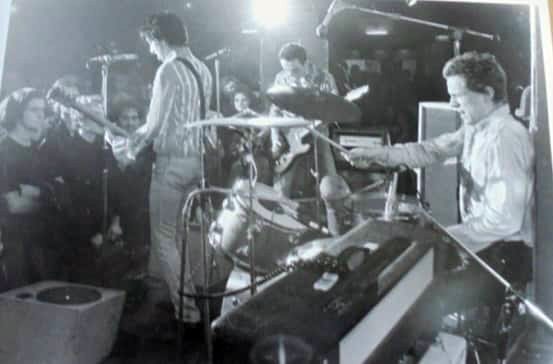
The Clash at the 100 club

Open photos in full in new window


The Sex Pistols, Clash were on at the 100 Club, London

Punk Rock | Facebook - https://www.facebook.com/

Back to the top


Extensive archive

of articles, magazines and other from the early gigs in 1976

Archive - Snippets - UK Articles - Video Audio - Social media - Fanzines Blogs - Retrospective articles - Photos


www.blackmarketclash.co.uk

email blackmarketclash.co.uk@gmail.com

THE CLASH
1976  1977  1978  1979  1980  1981  1982  1983  1984  1985  THE CLASH: ALBUM BY ALBUM, TRACK BY TRACK 

STRUMMER, BAD, Pogues, films + : THE SOLO YEARS
THE 101ers: 1974-1976   SOLO YEARS: 1986-2025

STRUMMER & THE LATINO ROCKABILLY WAR
ROCK THE RICH 88-89   ROCK THE RICH 99-00  

STRUMMER & THE MESCALEROS
ROCK ART TOURS 1999   ROCK ART TOURS 2000   GLOBAL A GO GO TOURS 2001   GLOBAL A GO GO TOURS 2002   STRUMMER DEMOS OUTAKES

BOOKS, NEWSPAPERS & FEATURE MAGAZINES
THE CLASH YEARS –– 1975-1986 
THE SOLO YEARS –– 1987-2002 
RETROSPECTIVE FEATURE MAGAZINES –– 2002-2025  
BOOKS  OTHER LINKS  

THE CLASH AUDIO & VIDEO
THE CLASH INTERVIEWED – INTERVIEWED / DOCS

Sex Pistols / The Jam / The Libertines / Others
The Sex Pistols  The Jam  The Libertines  other recordings-some master


Setlist


1
2
3
4
5
6
7
8
9
10
11
12
13

Opening
Deny
1-2 Crush On You
I Know What To Think Of You
I Never Did It
How Can I Understand The Flies
Protex Blue
Janie Jones
Mark Me Absent
Deadly Serious (Dig a Hole)
48 Hours
I'm So Bored With You
What's My Name
1977


EARLY GIGS '76,
LOTs of ARTICLES, POSTERS, CLIPPINGS ...

A collection of
• Tour previews
• Tour posters
Interviews
• Features
• Articles
• Tour information

from early 1976 upto the Anarchy Tour, December 1996.


Extensive archive of articles, magazines and other from the early gigs in 1976

INDEX

Archive
Snippets
UK Articles
Video Audio
Social media
Fanzines Blogs
Retrospective articles
Photos


Early gigs '76, Anarchy Tour
VIDEO AND AUDIO

Video and audio footage from 1976


EARLY GIGS '76, BOOKS


Ignore Alien Orders: On Parole With The Clash
Tony Beesley & Anthony Davie

Extensive eyewitness coverage of the early years from the Black Swan pub onwards


All the Young Punks
The People's history of The Clash

All The Young Punks is a people’s history of The Clash, told through the memories of over 300 fans across nearly 150 gigs. From their punk beginnings in 1976 to global fame, the book captures the raw energy, political fire, and unforgettable stage presence of Joe Strummer, Mick Jones, Paul Simonon, and Topper Headon. Featuring a foreword by Billy Bragg, it’s a vivid tribute to the only band that mattered.


Return of the Last Gang in Town,
Marcus Gray

Black Swan pg142 ...
Rehearsal Rehearsals pg ...
Screen on the Green pg151, 164 ...
The 100 Club (Aug) pg160
Roundhouse pg160 ...
100 Club Festival pg164 ...
Tiddenfoot pg177 ...
Guildford pg178 ...
Aklan Hall pg178 ...
Uni of London pg178 ...
ICA (23 Oct) pg 176,180, 183 ...
Birmingham pg180 ...
RCA pg182 ...

Fulham pg182 ...
Ilford Lady Lacy pg185 ...
Birmingham (27th) pg ...
Wycombe pg187 ...
Lanchester Poly pg ...
Polydor demos pg188 ...
Janet Street Porter LWT pg ...

Passion is a Fashion,
Pat Gilbert

Black Swan pg95, 96 ...
Rehearsal Rehearsals pg ...
Screen on the Green pg ...
The 100 Club (Aug) pg ...

Roundhouse pg ...
100 Club Festival pg ...
Tiddenfoot pg114 ...
Guildford pg114
...
Uni of London pg114 ...
ICA (23 Oct) pg114 ...
Birmingham pg114 ...
RCA pg116 ...

Fulham pg116 ...
Ilford pg114,127 ...
Birmingham pg ...
Polydor demos pg117 ...
Janet Street Porter LWT pg 177 ...


Redemption Song,
Chris Salewicz

Black Swan pg ...
Rehearsal Rehearsals pg ...
Screen on the Green pg ...
The 100 Club (Aug) pg ...
Roundhouse pg ...
100 Club Festival pg ...
Tiddenfoot pg165 ...
ICA (23 Oct) pg ...
RCA pg168 ...
Fulham pg166 ...
Ilford pg170 ...
Wycombe pg170 ...
Lanchester Poly pg 173 ...
Polydor demos pg170 ...


Joe Strummer and the legend of The Clash
Kris Needs

Black Swan pg42 ...
Rehearsal Rehearsal pg43 ...
Screen on the Green pg44 ...
100 Club Festival pg ...
Tiddenfoot pg49 ...
ICA (23 Oct) pg54, 56 ...

Birmingham pg56 ...
RCA pg56 ...
Ilford pg64 (photo) ...
Birmingham pg ...
Fulham pg56 ...
Wycombe pg58 ...
Janet Street Porter LWT pg60 ...

Lanchester Poly (Rob Harper) pg61 ...

Polydor demos pg59 ...


The Clash (official)
by The Clash (Author), Mal Peachey

Black Swan pg ...
Rehearsal Rehearsal pg ...
Screen on the Green pg ...
The 100 Club (Aug) pg ...
Roundhouse pg ...
100 Club Festival pg ...
ICA (23 Oct) pg ...
Uni of London pg82, 87 ...
RCA pg83 ...
Janet Street Porter LWT pg60

Other books


There are several sights that provide setlists but most mirror www.blackmarketclash.co.uk. They are worth checking.

from Setlist FM (cannot be relied on)

from Songkick (cannot be relied on)
... both have lists of people who say they went

& from the newer Concert Database and also Concert Archives

Also useful: Ultimate Music database, All Music, Clash books at DISCOGS

Articles, check 'Rocks Back Pages'


Stream, download, subscribe

Stream and download The Clash here:
https://TheClash.lnk.to/BestOfAY

Subscribe to The Clash's YouTube channel:
https://TheClash.lnk.to/YouTube_Subsc...

Blackmarketclash downloads
Requests


Follow The Clash:

Official website - https://www.theclash.com/
Facebook -
  / theclash  
Twitter -
  / theclash  
Instagram -
  / the_clash  


Follow The Clash on :

Twitter: http://bit.ly/I0EsOs
Facebook:
http://on.fb.me/1eQ196D
Subscribe to our channel to watch more:
http://bit.ly/1jY5CFd


I saw The Clash

Hundreds of fans comments about the gigs they went to...

What do you remember about seeing the Clash? Leave your comment


Wikipedia - band mambers

Wikipedia - The Clash

Search all of facebook

Search all of Twitter

Search for a local library

Search auction site

Search flickr

Search Instagram

Search the internet

Search The Internet Archive
A complete treasure trove of archive of audio (official, unofficial), readable books, magazine

[BMC lists]

The Clash Books
The Clash Magazine Features
The Clash articles, clippings
The Clash Fanzines
The Clash interviewed

The Clash on film
The Clash live
The Clash tribute albums
The Clash official releases


Magazine searches

UK newspaper archive

English Newspapers

The Free Library

Rocks Back Pages

Trouser Press
all editons digitised

Creem Magazine [US]

Rolling Stone Magazine

Record Mirror [UK]

Rockscene Magazine [US]

Boston Rock [US]

Internet Archive

British Library [UK]

Washington Digital Newspapers

Search CD & LP

Nothing Else On Flickr
Large catalogue of music magazines

Fanzine searches

UK Fanzines

Slash Fanzine [US]

No Mag Fanzine [US]

Damage Fanzine [US]

Dry zines Fanzine [US]

Memorabilia search

Auction sites

Great for rare sales such as posters & tickets

Bonhams

Record Mecca

Gotta have rock and Roll

Worthpoint

Omega

The saleroom

We buy rock n roll

Sothebys

Facebook Concert Memorabilia

Photos.com
includes images

Heritage Auctions
Past - Current

ValueYourMusic
Free Music Items Price Guide

Omega Auctions

Bonhams

Autographs & Memorabilia

Sothebys

The-saleroom

Christie’s


Image search

Getty Images The Clash here
Need to vary search and year

The Clash Art for Sale - Fine Art America
Collection of Clash images, need to vary search and year

Rock Archive Photos

WireImages here

Brixton Academy 8 March 1984
ST. PAUL, MN - MAY 15
Other 1984 photos
Sacramento Oct 22 1982
Oct 13 1982 Shea
Oct 12 1982 Shea
San Francisco, Jun 22 1982
Hamburg, Germany May 12 1981
San Francisco, Mar 02 1980
Los Angeles, April 27 1980
Notre Dame Hall Jul 06 1979
New York Sep 20 1979
Southall Jul 14 1979
San Francisco, Feb 09 1979
San FranciscoFeb 08 1979
Berkeley, Feb 02 1979
Toronto, Feb 20 1979
RAR Apr 30 1978
Roxy Oct 25 1978
Rainbow May 9 1977
Us May 28 1983

Photoshelter here

Sep 11, 2013: THE CLASH (REUNION) - Paris France 2 IMAGES
Mar 16, 1984: THE CLASH - Out of Control UK Tour - Academy Brixton London 19 IMAGES
Jul 10, 1982: THE CLASH - Casbah Club UK Tour - Brixton Fair Deal London 16 IMAGES
1982: THE CLASH - Photosession in San Francisco CA USA 2 IMAGES
Jul 25, 1981: JOE STRUMMER - At an event at the Wimpy Bar Piccadilly Circus London 33 IMAGES
Jun 16, 1980: THE CLASH - Hammersmith Palais London 13 IMAGES
Feb 17, 1980: THE CLASH - Lyceum Ballroom London 8 IMAGES
Jul 06, 1979: THE CLASH - Notre Dame Hall London 54 IMAGES
Jan 03, 1979: THE CLASH - Lyceum Ballroom London 19 IMAGES
Dec 1978: THE CLASH - Lyceum Ballroom London 34 IMAGES
Jul 24, 1978: THE CLASH - Music Machine London 48 IMAGES
Aug 05, 1977: THE CLASH - Mont-de-Marsan Punk Rock Festival France 33 IMAGES
1977: THE CLASH - London 18 IMAGES

Photofeatures

Any further info, articles, reviews, comments or photos welcome.

Submit an article here

We are looking for scans - articles - tickets - posters - flyers - handbills - memorabilia - photos - comments / any information - you might have.

Please like and post on our Facebook page or alternatively email blackmarketclash

You can also follow us on Twitter
We also have a Clash Twitter list
of other notable Clash Twitter accounts here

Blackmarketclash Links
Extensive links page can be found here with links to web, twitter, Facebook, traders etc..

If Music Could Talk
The best Clash messageboard and which also has links to downloads on its megalists

www.Blackmarketclash.co.uk
Go here for uploads and downloads. It's not a massive space so its on an as and when basis.

Also go to 101 Guitars for downloads
Guitars 101

For the more ambitious, create a DIME account

Remastered audio
https://www.youtube.com/@bazarboy75

Contact your local library here and see if they can help.

If you are searching for articles in the USA - DPLA Find the local US library link here

WorldCat? - find your local library Link

British Newspaper Archive - United Kingdom Link

Newspaper ARCHIVE - USA+ Link

Historical Newspapers - USA & beyond Link

Elephind.com - international Link

New York Times - USA Link

Gallica - France - Not very helpful Link

Explore the British Library Link

Trove - Australia National Library Link

The Official Clash
Search @theclash & enter search in search box. Place, venue, etc

The Official Clash Group
Search @theclashofficialgroup & enter search in search box. Place, venue, etc

Joe Strummer
And there are two Joe Strummer sites, official and unnoffical here

Clash City Collectors - excellent
Facebook Page - for Clash Collectors to share unusual & interesting items like..Vinyl. Badges, Posters, etc anything by the Clash.
Search Clash City Collectors & enter search in search box. Place, venue, etc

Clash on Parole - excellent
Facebook page - The only page that matters
Search Clash on Parole & enter search in the search box. Place, venue, etc

Clash City Snappers
Anything to do with The Clash. Photos inspired by lyrics, song titles, music, artwork, members, attitude, rhetoric,haunts,locations etc, of the greatest and coolest rock 'n' roll band ever.Tributes to Joe especially wanted. Pictures of graffitti, murals, music collections, memorabilia all welcome. No limit to postings. Don't wait to be invited, just join and upload.
Search Flickr / Clash City Snappers
Search Flickr / 'The Clash'
Search Flickr / 'The Clash' ticket

I saw The Clash at Bonds - excellent
Facebook page - The Clash played a series of 17 concerts at Bond's Casino in New York City in May and June of 1981 in support of their album Sandinista!. Due to their wide publicity, the concerts became an important moment in the history of the Clash.
Search I Saw The Clash at Bonds & enter search in red box. Place, venue, etc

Loving the Clash
Facebook page - The only Clash page that is totally dedicated to the last gang in town. Search Loving The Clash & enter search in the search box. Place, venue, etc

Blackmarketclash.co.uk
Facebook page - Our very own Facebook page. Search Blackmarketclash.co.uk & enter search in red box. Place, venue, etc

Search all of Twitter
Search Enter as below - Twitter All of these words eg Bonds and in this exact phrase, enter 'The Clash'

www.theclash.com/
Images on the offical Clash site.
http://www.theclash.com/gallery

www.theclash.com/ (all images via google).
Images on the offical Clash site. site:http://www.theclash.com/