“Glasgow ban infuriates Sex Pistols” – Council pulls the plug, band threatens legal action
We had been set to bring the Anarchy Tour to the towering Glasgow Apollo, but the city fathers thought otherwise. On 7 December, the Aberdeen Press and Journal reported the Sex Pistols had “threatened legal action against Glasgow’s Lord Provost Peter McCann after the district council banned the group from appearing.”
The licensing committee withdrew the Apollo’s licence for that one night alone, effectively cancelling the show. Manager Malcolm McLaren, speaking from Leeds, fumed: “We are thoroughly disgusted. We are not going to tolerate this kind of censorship.” He blamed the Lord Provost for “instructing the district council to ban the group” and vowed: “We will be taking legal action against this man and we have the backing of the Musicians’ Union and EMI.”
Reaction in Scotland was sharply divided. The West Lothian Courier declared: “I’m no square but I’m glad to see Glasgow District Council have stopped these depraved purveyors of so-called punk rock, the Sex Pistols, from playing the Apollo Centre.”
The piece added hopefully: “I hope this sets the trend for other local authorities to follow. Punk rock never has and never will be a major force in contemporary music.”
For the Pistols, it was another humiliating blow—another night when The Clash, The Damned and The Heartbreakers were silenced along with them.
But for their supporters, the cancellation proved the point: that punk wasn’t just music, it was a fight against the establishment itself, and Glasgow had become one more battleground in that war.
West Lothian Courier –– Friday 03 December 1976, Link
GLASGOW APOLLO DATE
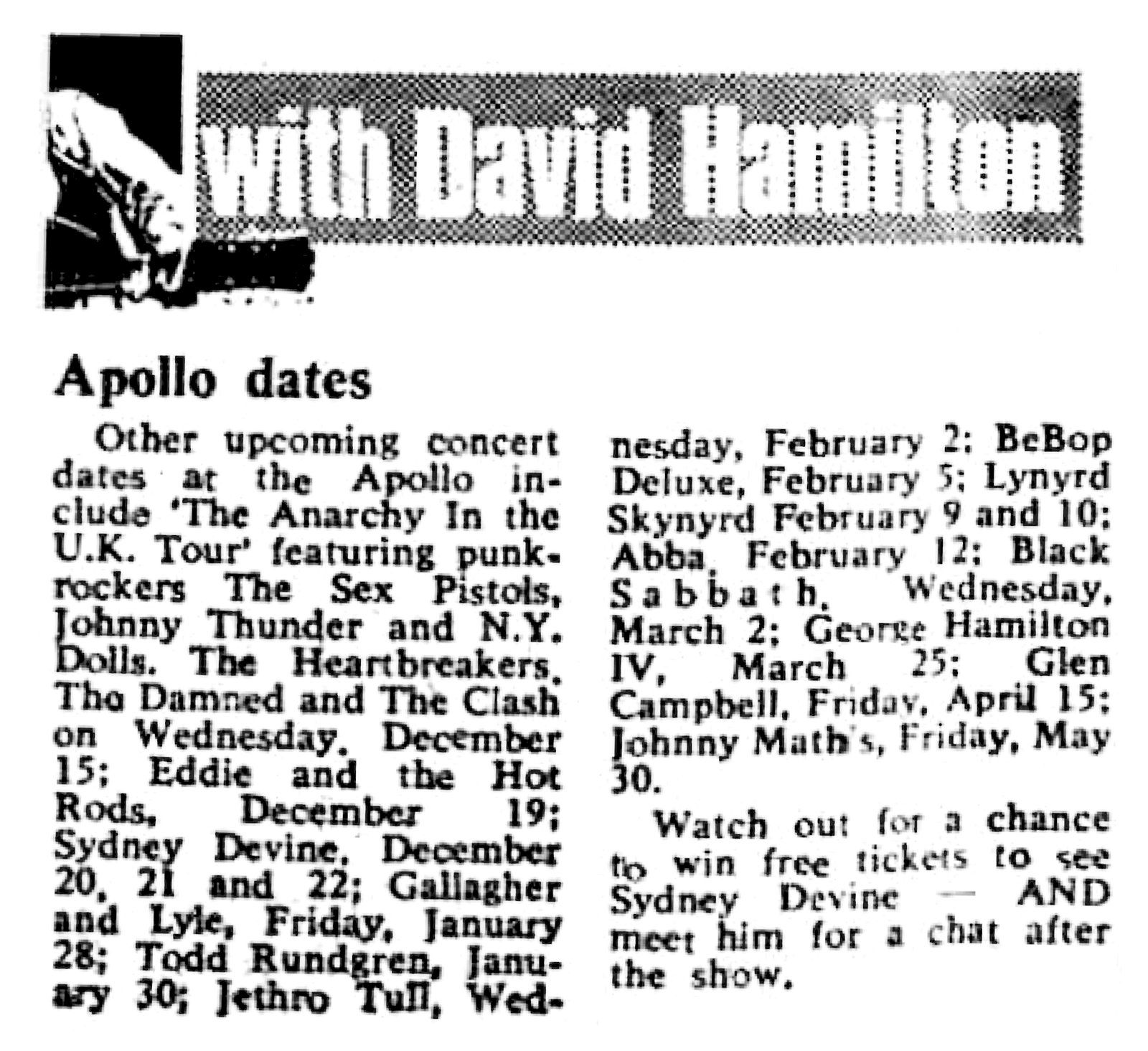
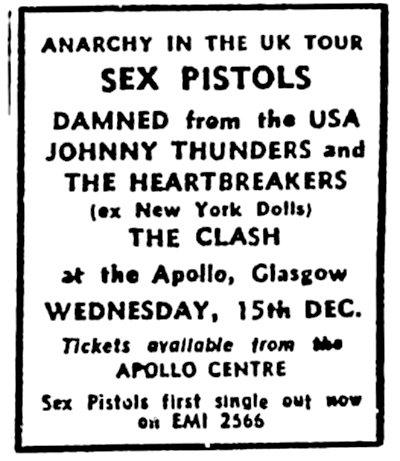
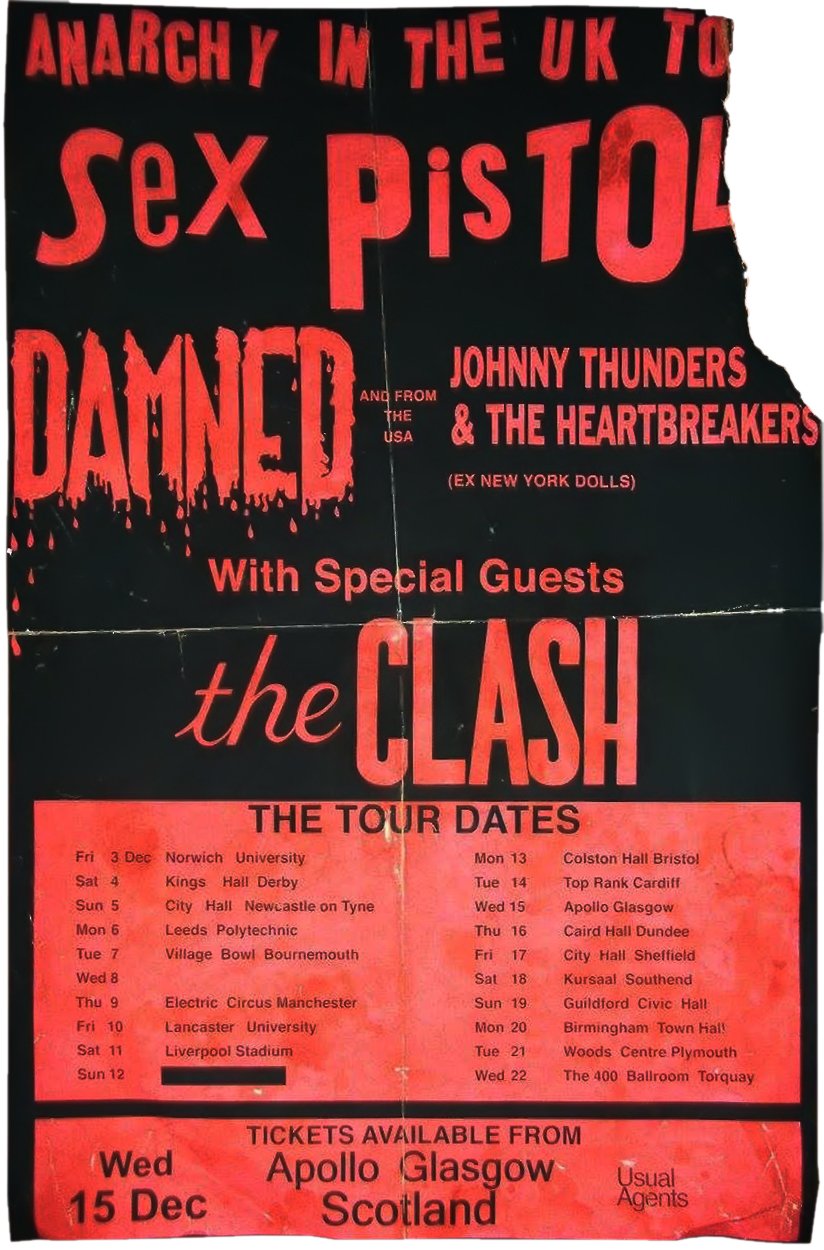
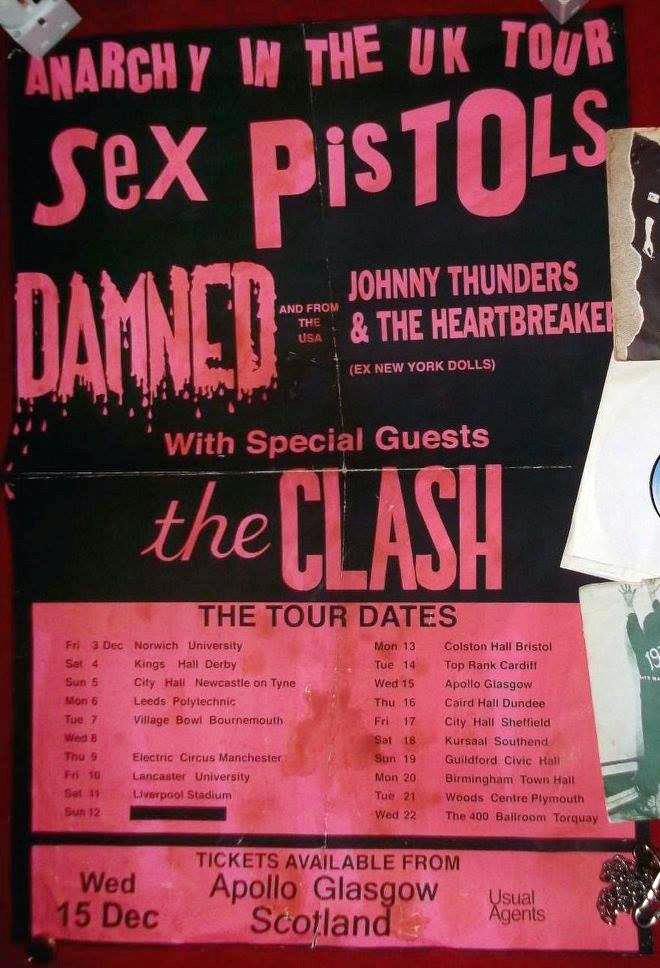
with David Hamilton, Apollo dates: Other upcoming concert dates at the the Apollo include 'The Anarchy In the U.K. Tour' featuring punk rockers The Sex Pistols, Johnny Thunder and N.Y. Dolls. The Heartbreakers, The Damned and The Clash on Wednesday, December 15;
Aberdeen Press and Journal –– Tuesday 12 December 1976, Link
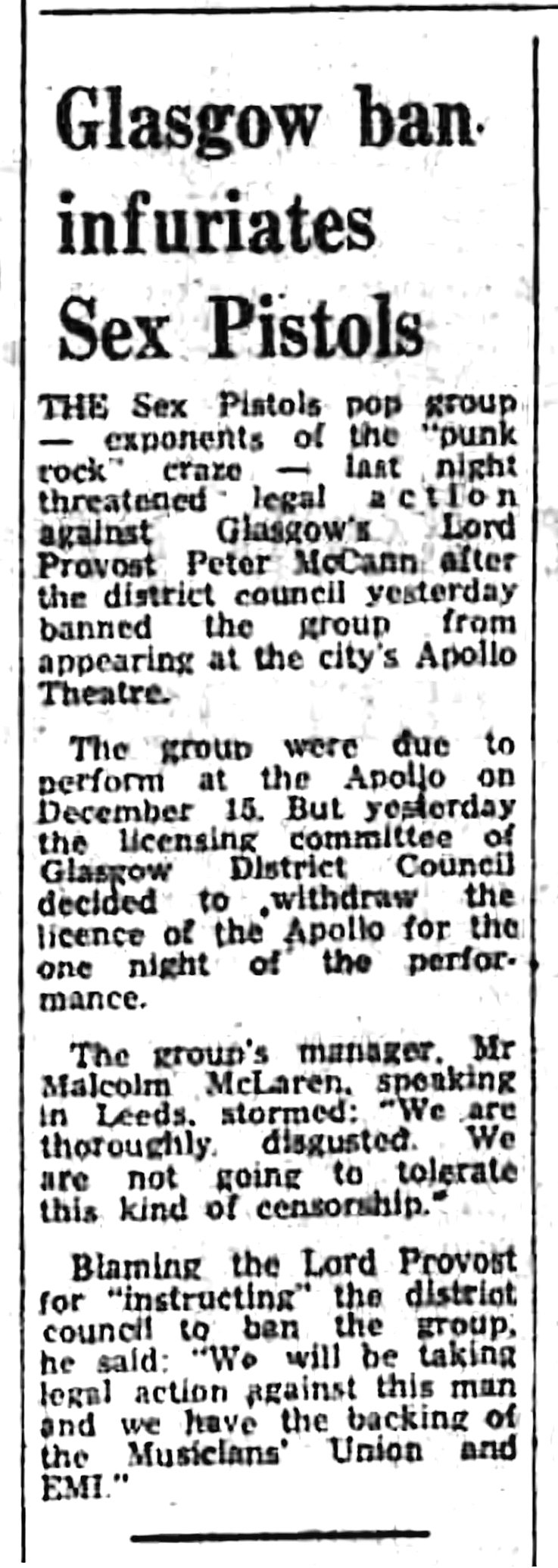
Glasgow ban infuriates Sex Pistols
THE Sex Pistols pop group exponents of the "punk last night rock craze threatened legal action against Glasgow's Lord Provost Peter MoCann alter the district council yesterday banned the group from appearing at the city's Apollo Theatre....
Glasgow ban infuriates Sex Pistols
THE Sex Pistols pop group exponents of the "punk last night rock craze threatened legal action against Glasgow's Lord Provost Peter MoCann alter the district council yesterday banned the group from appearing at the city's Apollo Theatre.
The group were due to perform at the Apollo on December 15. But yesterday the licensing committee of Glasgow District Council decided to withdraw the licence of the Apollo for the one night of the perfor mance.
The group's manager. Mr Malcolm McLaren, speaking in Leeds, stormed: "We are thoroughly disgusted. We are not going to toler to tolerate this kind of censorship."
Blaming the Lord Provost for "instructing" the district council to ban the group, he said: "We will be taking legal action against this man and we have the backing of the Musicians' Union and EMI."
West Lothian Courier –– Friday 10 December 1976, Link
GLASGOW COUNCIL BAN, A LOAD OF PUNK
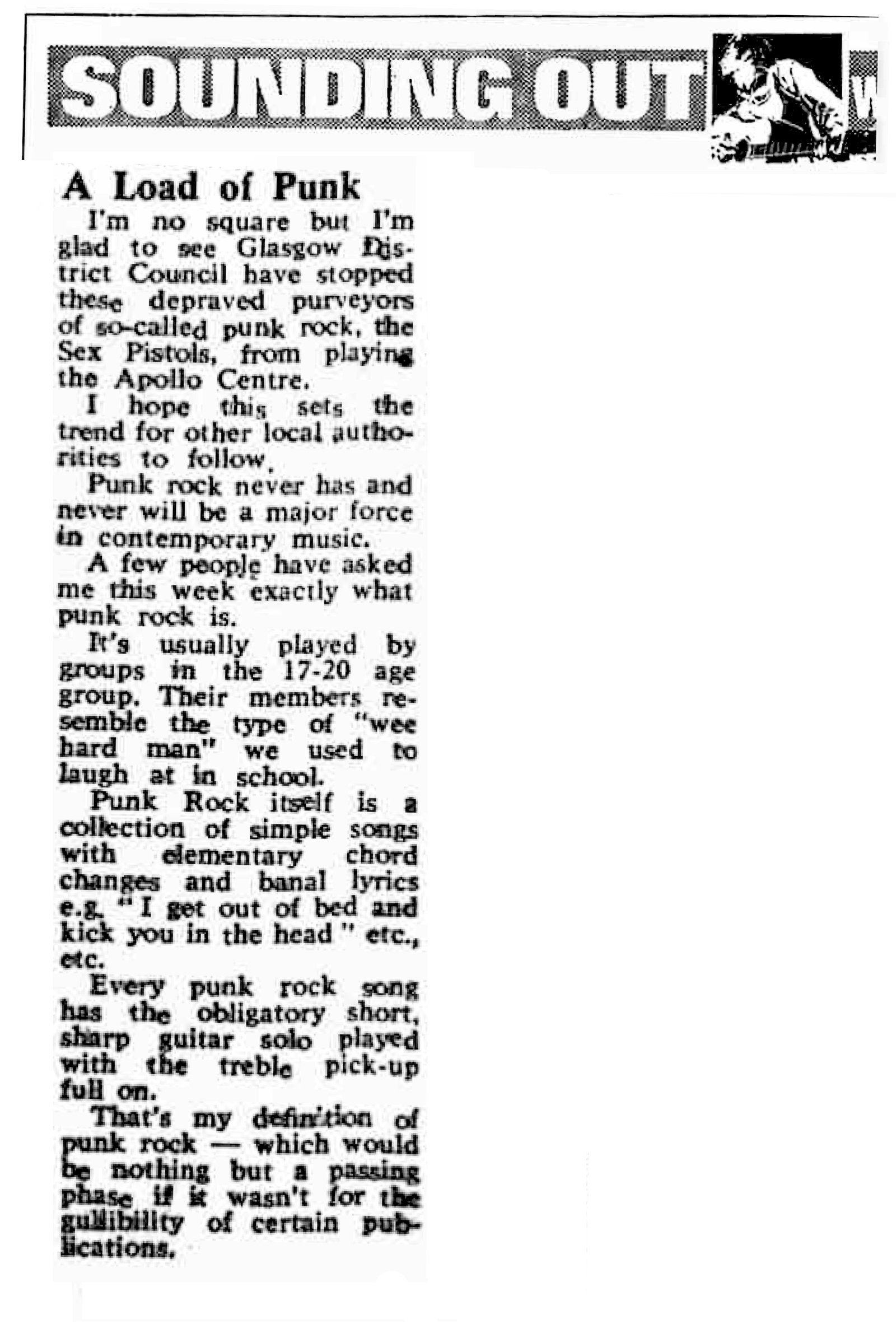
I'm no square but I'm glad to see Glasgow Dis-trict Council have stopped these depraved purveyors of so-called punk rock, the Sex Pistols, from playing the Apollo Centre.
GLASGOW COUNCIL BAN, A LOAD OF PUNK
SOUNDING OUT
A Load of Punk
I'm no square but I'm glad to see Glasgow Dis-trict Council have stopped these depraved purveyors of so-called punk rock, the Sex Pistols, from playing the Apollo Centre.
I hope this sets the trend for other local autho-rities to follow.
Punk rock never has and never will be a major force in contemporary music.
A few people have asked me this week exactly what punk rock is.
It's usually played by groups in the 17-20 age group. Their members re-semble the type of "wee hard man" we used to laugh at in school.
Punk Rock itself is a collection of simple songs with elementary chord changes and banal lyrics e.g. "I get out of bed and kick you in the head" etc., etc.
Every punk rock song has the obligatory short, sharp guitar solo played with the treble pick-up full on.
That's my definition of punk rock which would be nothing but a passing phase if it wasn't for the gullibility of certain pub-lications.
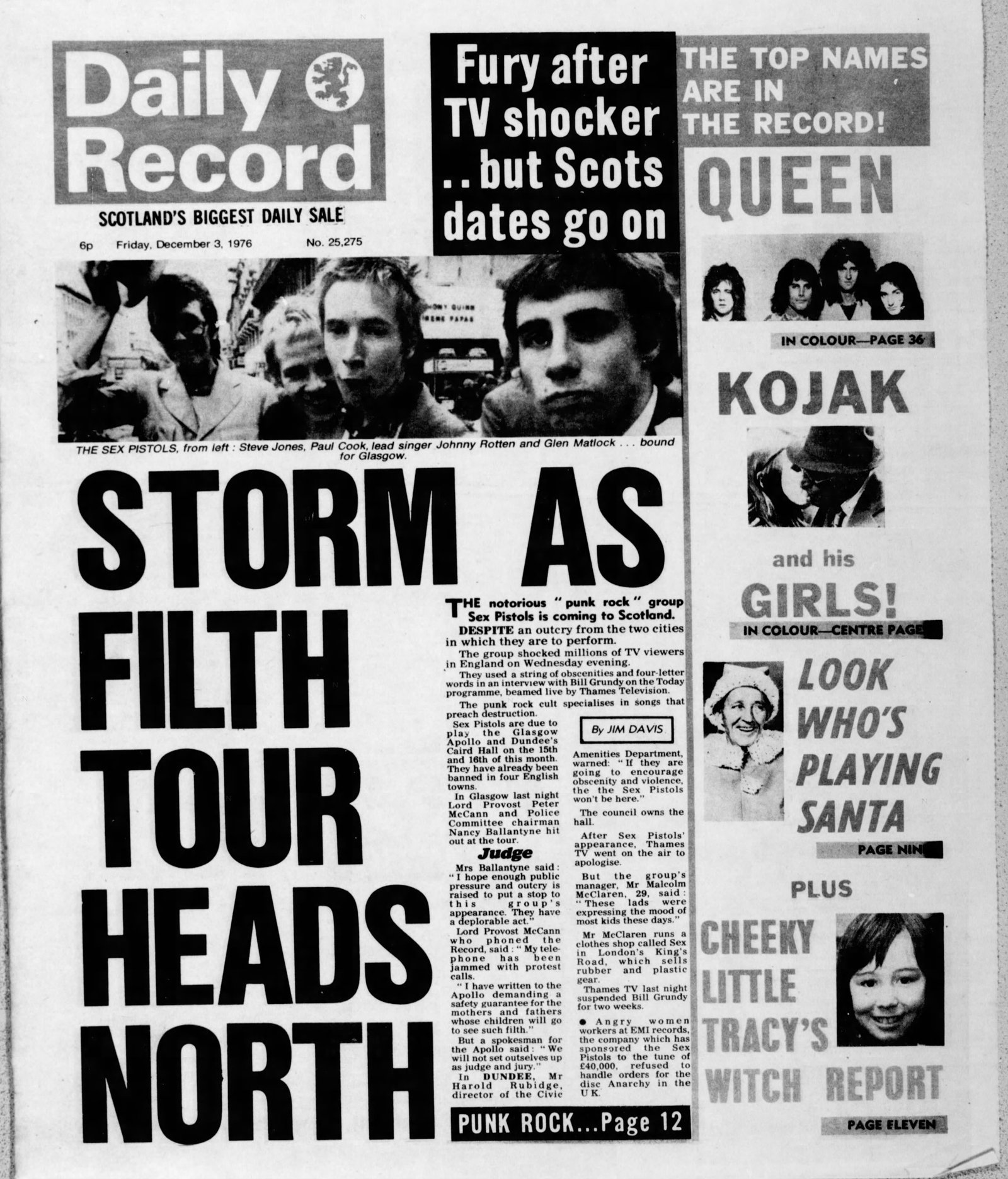
By JIM DAVIS, Daily Record (Scotland) 6p Friday, December 3, 1976.
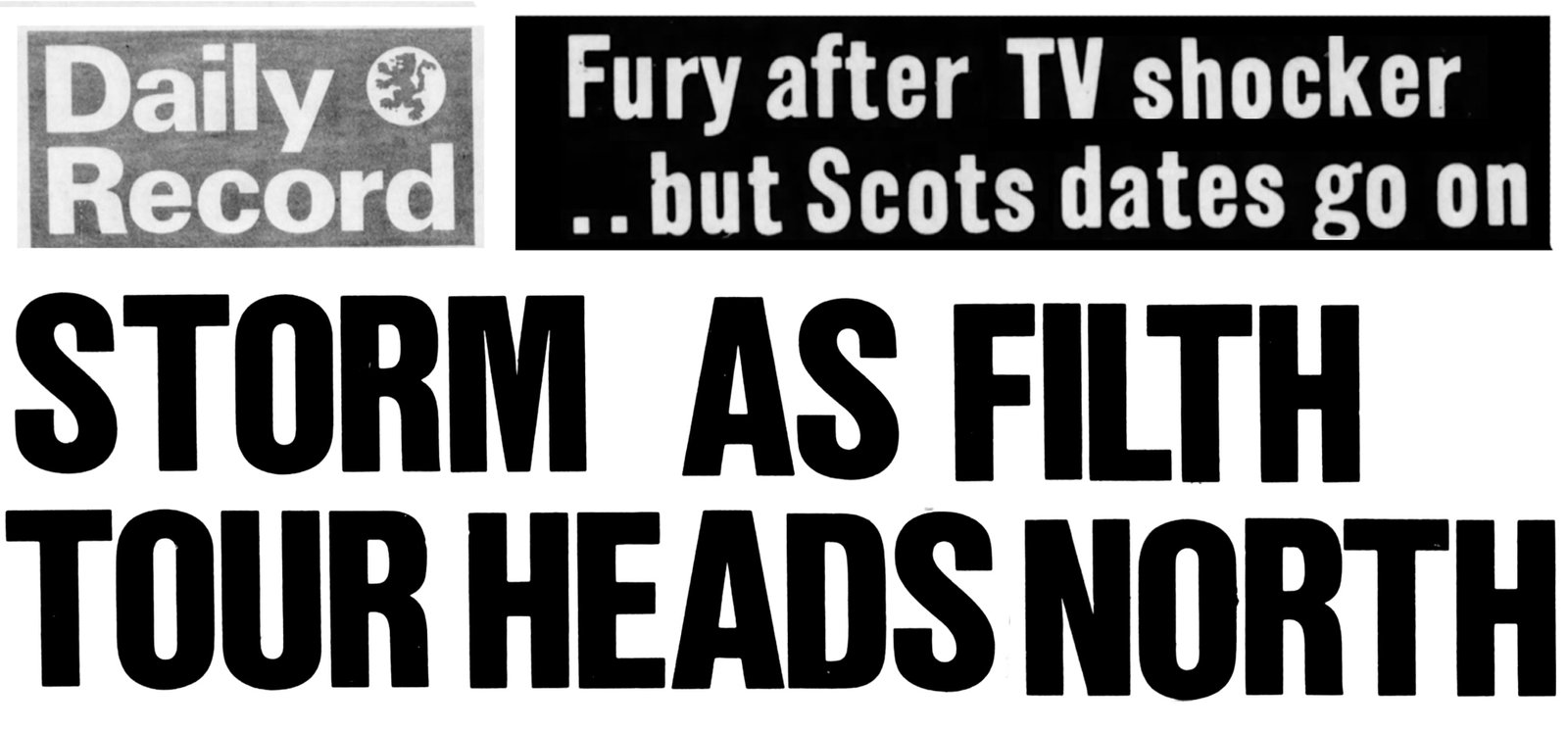
Storm as Filth Tour Heads North
Fury after TV shocker but Scots dates go on ..
THE notorious "punk rock" group Sex Pistols is coming to Scotland. DESPITE an outcry from the two cities in which they are to perform....
By JIM DAVIS, Daily Record (Scotland) 6p Friday, December 3, 1976.
Storm as Filth Tour Heads North
Fury after TV shocker but Scots dates go on ..
PHOTO: THE SEX PISTOLS, from left: Steve Jones, Paul Cook, lead Glen Matlock singer Johnny Rotten and bound for Glasgow
THE notorious "punk rock" group Sex Pistols is coming to Scotland. DESPITE an outcry from the two cities in which they are to perform.
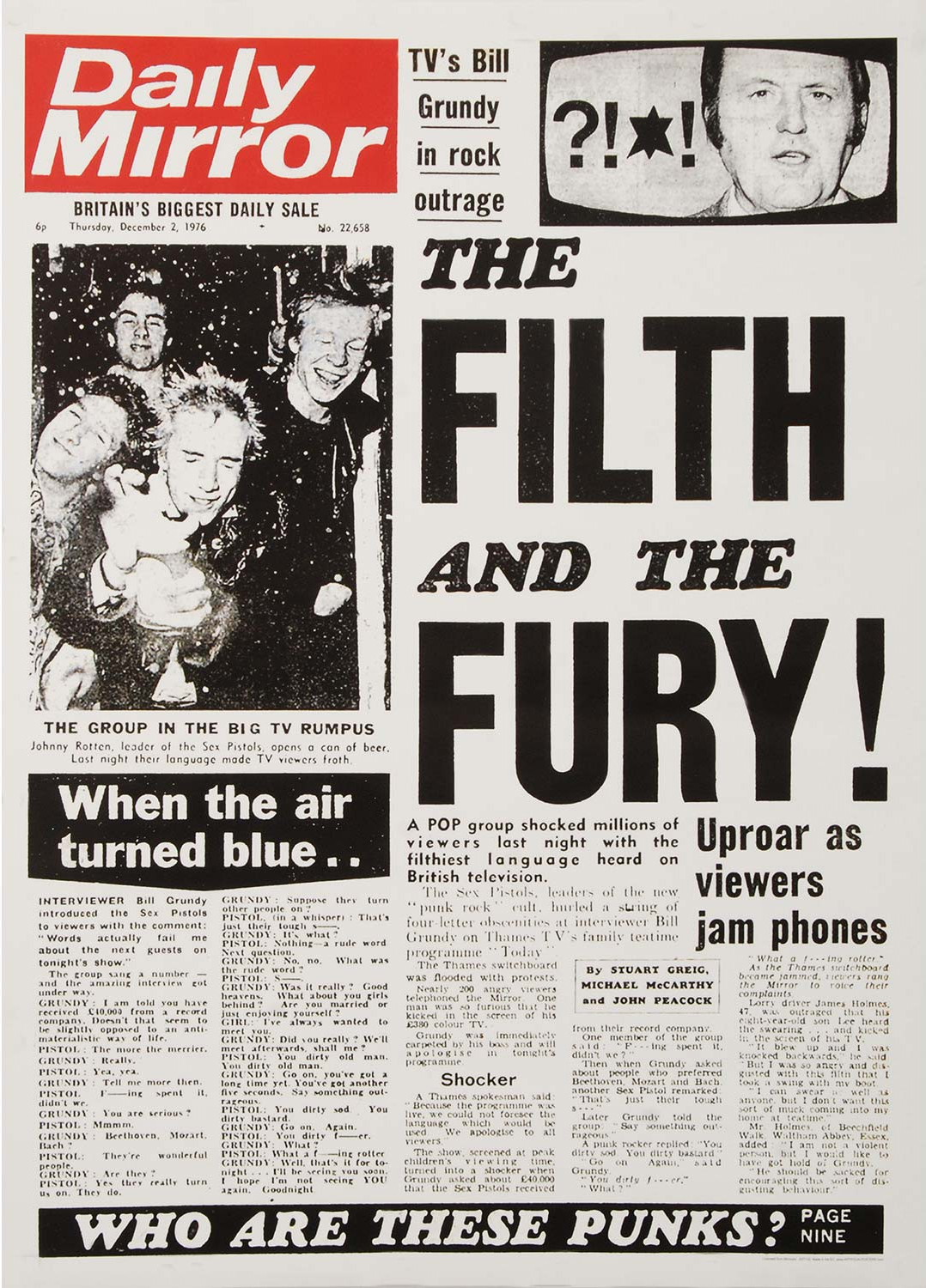
The group shocked millions of TV viewers in England on Wednesday evening.
They used a string of obscenities and four-letter words in an interview with Bill Grundy on the Today programme, beamed live by Thames
The punk rock cult specialises in songs that preach destruction.
Sex Pistols are due to play the Glasgow Apollo and Dundee's Caird Hall on the 15th and 16th of this month. They have already been banned in four English towns
In Glasgow last night Lord Provost Peter McCann and Police Committee chairman Nancy Ballantyne hit out at the tour.
Judge Mrs Ballantyne said: "I hope enough public pressure and outery is raised to put a stop to this group's appearance. They have a deplorable act.
Lord Provost MeCann who phoned the Record, said: My tele phone has been jammed with protest calls.
"I have written to the Apollo demanding a safety guarantee for the mothers and fathers. whose children will go to see such filth.
But a spokesman for the Apollo said: "We will not set outselves up as judge and jury."
In DUNDEE, Mr Harold Rubidge, director of the Civic Amenities Department, warned: "If they are going to encourage obscenity and violence, the the Sex Pistols won't be here."
The council owns the hall.
After Sex Pistols Thames appearance, TV went on the air to apologise.
But the group's manager, Mr Malcolm MeClaren, 29, said "These lads were expressing the mood of most kids these days.
Mr McClaren runs a clothes shop called Sex in London's King's Road, which sells rubber and plastic gear.
Thames TV last night suspended Bill Grundy for two weeks.
Angry women workers at EMI records, the company which has sponsored the Sex Pistols to the tune of Pistols £40,000, refused to handle orders for the dise Anarchy in the UK
PUNK ROCK... Page 12
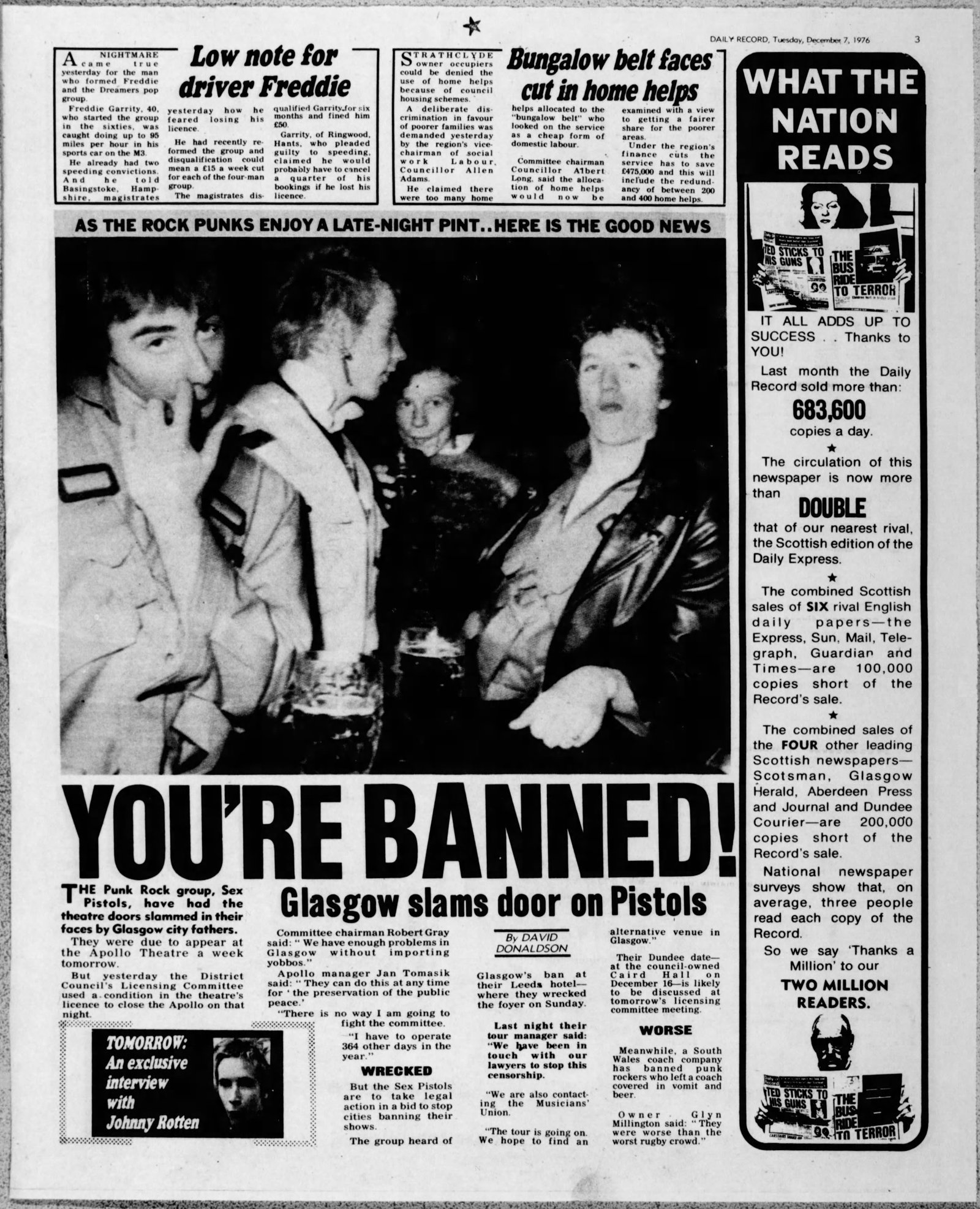
AS THE ROCK PUNKS ENJOY A LATE-NIGHT PINT.. HERE IS THE GOOD NEWS
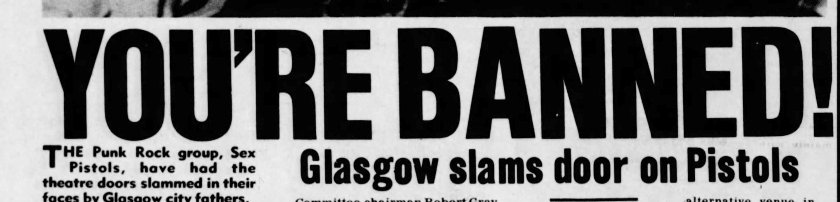
YOU'RE BANNED! Glasgow slams door on Pistols
By DAVID DONALDSON
THE Punk Rock group, Sex Pistols, have had the theatre doors slammed in their faces by Glasgow city fathers.
They were due to appear at the Apollo Theatre a week tomorrow. But yesterday the District Council's Licensing Committee used a condition in the theatre's licence to close the Apollo on that night.
TOMORROW: An exclusive interview with Johnny Rotten
Committee chairman Robert Gray said: "We have enough problems in Glasgow without importing yobbos." Apollo manager Jan Tomasik said: "They can do this at any time for the preservation of the public peace.' "There is no way I am going to fight the committee. "I have to operate 364 other days in the year."
WRECKED
But the Sex Pistols are to take legal action in a bid to stop cities banning their shows. The group heard of Glasgow's ban at their Leeds hotel-where they wrecked the foyer on Sunday.
Last night their tour manager said: "We have been in touch with lawyers to stop this censorship. our
"We are also contacting the Musicians' Union. "The tour is going on. We hope to find an alternative venue in Glasgow." Their Dundee date-at the council-owned Caird Hall December 16-is likely to be discussed at tomorrow's licensing committee meeting.
WORSE
Meanwhile, a South Wales coach company has banned punk rockers who left a coach covered in vomit and beer. Owner. Glyn Millington said: "They were worse than the worst rugby crowd."
Published 20th June 2025, Grant McPhee. Online | Archive PDF
Anarchy in the GCC
Retrospective on the Anarchy Tour
Published 20th June 2025, Grant McPhee
Anarchy in the GCC
A remarkable social event will occur in Glasgow this weekend – Scotland’s Second Summer of Punk. On the surface, the ‘Punk All-Dayer’ may seem a sorry excuse for the pensionable to relive their rebellious youth, all within the safe confines of Bellahouston Park, a figurehead of Glasgow respectability and the seeming antithesis of everything that ‘punk’ stood for. The credibility of the festival line-up too may also raise a few eyebrows due to a lack of many original band members, with some acts now approximating something closer to a tribute act than their 1977 heyday.
However, it is the group names themselves and what they represent that elicit intrigue due to their unique history within Glasgow. The most notorious in the festival line-up are the two groups who were once firmly instructed nearly 50 years ago – by the precise organisation now welcoming them back – that they would never be allowed to play in the city again. Yet here they are, now performing at one of the city’s summer musical highlights. These two bands are the Sex Pistols and the Stranglers. What has changed?
Of course, variations of these two groups have since played in Glasgow after 1977, although not in such an illustrious setting. And anyone who has seen their various iterations over those years will know that little of the ferocity of their performance has been diminished. Their appreciative audiences are still as unruly as ever and the power of the songs themselves have too little dimmed over that time either. While Radio Two may occasionaly play a few tracks, Bodies by the Sex Pistols is still unlikely to be heard on Cash in the Attic any time soon. Sex Pistols undoubtedly still have the ability to shock.
However, they are of a previous generation and that generation is, as much as we hate to admit it, of the past. And…they are now a little long in the tooth and age is seemingly not now seen as a threat to our society, at least not by those with guitars anyway. Old age is what has significantly changed since December 1976. Despite politicians in their 50s, 60s and 70s seemingly being hellbent on destroying the world, our elders singing songs to a group of equally aging fans (myself included) is apparently now safe and fine.
But…singing a song while you are young to others of a similar age is not fine. There needs to be a little qualification here: it is a certain type of young person, singing a certain type of song to a certain impressionable youthful generation that is what’s not fine. Anyone who has read a newspaper, watched television or used social media over the last month will be very familiar with the Irish group Kneecap and the calls for their exclusion at another certain Glasgow festival this summer. And their treatment is a very similar story to those of both the Sex Pistols and Stranglers in Glasgow.
Pop music is the greatest social democratisation of art, possibly ever, and its emergence offered an unique platform to its creators to air their views, which, despite huge changes, still exists today. It’s one of the few opportunities for young working-class youth to have their voice heard by so many and in such an egalitarian manner. And it’s one that offers huge power and responsibility. John Lennon was perhaps the greatest recipient and proponent of that power. While the press and public loved the humorous moptop press conferences of the early 1960s, the politicised Lennon of the late 60s and early 70s, commenting on the political hot potatoes of the day, drew attention from both fans and a society concerned by interference from those deemed not qualified to do so. Lennon’s role as a pop star offered him significant political and social influence over a generation of not just Beatles fans, but young people more widely.
Lennon’s generation and his affiliations with revolutionary politics are now, much like today’s Sex Pistols, just a part of history. They’re not preaching to the youth. They are no longer a threat because the youth of today have little interest in listening to an older generation. Kevin Macdonald’s recent (and excellent) One to One documentary on Lennon’s early 70s revolutionary politics is rendered little more than social history. Its message is still valid but neutered because it is now part of the establishment and as such there’s little threat of today’s young using it to hold their elders to account.
As has always been the case, the youth of today clearly want to listen to someone within their own generation who has not yet been tainted by authority. They want their voice heard, they want to know about injustices and they want to act upon them. They are waiting for a figurehead to speak for them and this is the real threat to society. Young, mostly working-class, youth with a voice and a will to change society will always be a threat. That hasn’t changed. Like Lennon’s message, the Sex Pistols of today are neutered by an audience who are no longer willing to change. The Sex Pistols and Stranglers history within Glasgow is a warning to the establishment. It’s a warning of the damage that trying to prevent your youth from being heard can do to your culture.
The beginning of their story in Glasgow is of course, the 1st of December 1976, and one of television’s most notorious live events: the Sex Pistols being interviewed on London television by Bill Grundy. It’s simple enough to take the viewpoint that the proceeding outrage was caused by the band’s swearing but this doesn’t adequately convey societies fear. The underlying outrage was not that the band swore on TV – it was they were seen to not care while doing so. There’s a difference. The band had revealed the wizard behind the curtain – that a dissatisfied youth don’t need to be controlled or scared by authority – and the youth then, as today, had the growing division between generations reflected back at them. From that moment, the band were seen as a threat that needed to be immediately curtailed.
In the following media storm Glasgow’s Daily Record – and the then Glasgow District Council – were suddenly made aware that the group were actually due to play at the Apollo Theatre two weeks later. Despite having played in Dundee just over two months previously with no incident, the entire establishment preceded to confront the band with ‘extreme prejudice.’ The Daily Record’s front page on the 3rd of December was emblazoned with ‘Filth Tour Heads North’. For the next 5 days, the paper had a full-on assault on the dangers the group might bring to Glasgow’s youth until the headline finally read: ‘You’re Banned – Glasgow Slams Door on Pistols’. Followed by:
“The Punk Rock group, Sex Pistols have had the theatre doors slammed in their faces by Glasgow city fathers…Yesterday the District Council Licensing Committee used a condition in the theatre’s licence to close the Apollo on that night. Committee chairman Robert Gray said ‘We have enough problems in Glasgow without importing yobbos’. Apollo manager Jan Tomasik said ‘They can do this at any time for ‘the preservation of the public peace. There is no way I am going to fight the committee. I have to operate 364 other days of the year.”
The saddest aspect of this ‘storm’ was how the media and Council colluded between themselves. Nobody in the council had actually even heard the band perform, nobody had listened to them – either literally or to what they clearly had to say about society. The event was shut down using a rarely used ‘get out’ clause in the Theatre Act, much to the dismay of the venue, who were firmly standing on the side of Glasgow’s culture.
Jan Tomasik (manager, Glasgow Apollo. Evening Times, 1976): ‘It would appear that our City Fathers have judged the Sex Pistols without ever having seen them on stage or having heard their ability. It would appear that the Lord Provost has no faith in the moral values of our city’s fine youngsters.’
The irony is this furore is what made the band so huge and accelerated their ability for social change, as guitarist Steve Jones commented, “Grundy didn’t just catapult us to a new level of fame, it took the whole thing into another dimension in a way that was hard to grasp…the best way I can think of describing how it felt is like in Star Trek when they are flying along normally in space, then Scotty presses the warp speed button and, whoosh.”
Similar processes to thwart performances were used UK-wide to deter what was known as ‘the Anarchy Tour.’ While the Sex Pistols were later forced to perform under a series of pseudonyms, ‘Punk’ in general was left to its own devices. In fact, it slowly blossomed. By 1978, even the Rolling Stones and Led Zeppelin were stripping back their sound to appeal to the ‘Year Zero’ ethos. By 1981, 50% of the UK music chart would be informed by 1977 punk, or those directly inspired by it.
Glasgow was another matter and ‘punk’ there had to be stopped at all costs. This was pursued relentlessly.
The prescribed narrative is that a City Hall concert by the Stranglers on the 22nd June 1977 led to ‘punk being banned’, due to the ‘rioting’ of fans and the ensuing press ‘outrage’. However, no evidence for this reality exists. Ironically, Glasgow District Council were fearful of the negative impact that potential Council-sanctioned further ‘bans’ would have. They allowed the concert to proceed and the press instead created the ensuring drama. Despite the bluster of ‘never again to punk’ and other out-of-context quotes from the council, there was no ‘ban’ and instead the decree that groups would be ‘judged individually’. And this is where events turn a little darker and wording has to be carefully guarded.
The subsequent six months of ‘punk’ in Glasgow contain multiple press stories and accounts from band management, promoters and group members; all very truthfully recounting stories of being banned from performing at a venue. I’ve gone through almost every Daily Record, Evening Times and Herald from 1977 and have handfuls of articles all confirming this. However, I’ve also gone through the entire Glasgow District Council archives from that period and the cupboards are virtually bare. There appears to be little official to corroborate these claims and reporting but there’s absolute certainty that venue owners were told they ‘would lose their licence’ if they allowed a punk band to play. I’ve spoken to nearly 100 people involved in the 1977 Glasgow music-scene during this period and I truly believe ‘threats’ of venues losing their licence were real. So, why is there a discrepancy between their accounts and what lies in the officialdom relating to them?
It should be noted that there were two differing types of licences used for venues allowing live music to be performed. One was the aforementioned Theatre Licence, an obligation for large venues such as the Apollo. This was a very strict legal requirement for a council officials to ‘sign off’ a theatre’s daily performance. For smaller venues there was the Entertainment Licence that would be renewed less frequently. The latter could arguably generate a potential conflict of interest for ie. police or Council officials being responsible for maintaining the livelihood of a venue proprietor’s business. It’s almost certain that in a small number of cases that this power was abused. And fear of ‘punk’ was certainly an excellent opportunity for this.
The net result of this combination of official and less official restricting of ‘punk’ music – by the Council and the media – was a creative still-birth within Glasgow. It was not just a small group of punk-bands who were denied the opportunity to perform and grow artistically; the infrastructure surrounding them was equally affected. Manchester, a city with similar socio-economic situation to Glasgow, embraced the Sex Pistols – they performed four times in 1976 (including two of the eventual seven Anarchy Tour dates) and also appeared on Granada Television. There’s a clear line of trajectory from their first Manchester appearance to that city’s later hugely significant music industry; it’s inarguable that Manchester’s music industry was responsible for the city’s financial and cultural rebirth after its late 70s post-industrial decline. The city acknowledges this abundantly with streets, buildings and venues dedicated to its punk heroes. Politicised youth and music has the power to change minds, and it can change a city.
Glasgow certainly caught up musically. Simple Minds laid many of the foundations that would lead to Glasgow’s European City of Culture status, and Postcard Records also brought significant media attention to the city. However, it’s abundantly clear that nearly two years of potential growth, between 1977 and 1979, were lost due to extremely repressive actions by the city towards its own youth. Another solid argument can be made that the reluctance to invest in musical venues, recording and rehearsal facilities, and most especially in the promotion of music itself, is what led to Scotland’s later near dominance within ‘DIY’ and ‘Indie Music’ – would Belle and Sebastian and Franz Ferdinand have been created without that struggle? However, it’s equally arguable – and heartbreaking – that the absolute Calvinistic approach towards Glasgow’s ‘punk’ music in 1977 ensured that many mostly working-class kids never had the opportunity to create and leave a legacy that enriched their city, and that’s culturally criminal.
This weekend is an excellent opportunity for Glasgow City Council, the media and politicians across all sides to reflect on the mistakes from 1976 and 1977. Listening to the young reaps rewards. There’s very little evidence that music will cause political revolution but there’s a huge amount of evidence that music will create and enrich people’s lives – financially and culturally. Don’t fear your youth, embrace them and help them as it will clearly help everyone. Don’t wait until 2075 and hold a Kneecap in the Park. Do something now. As to this weekend’s festival, it’s going to be fantastic.
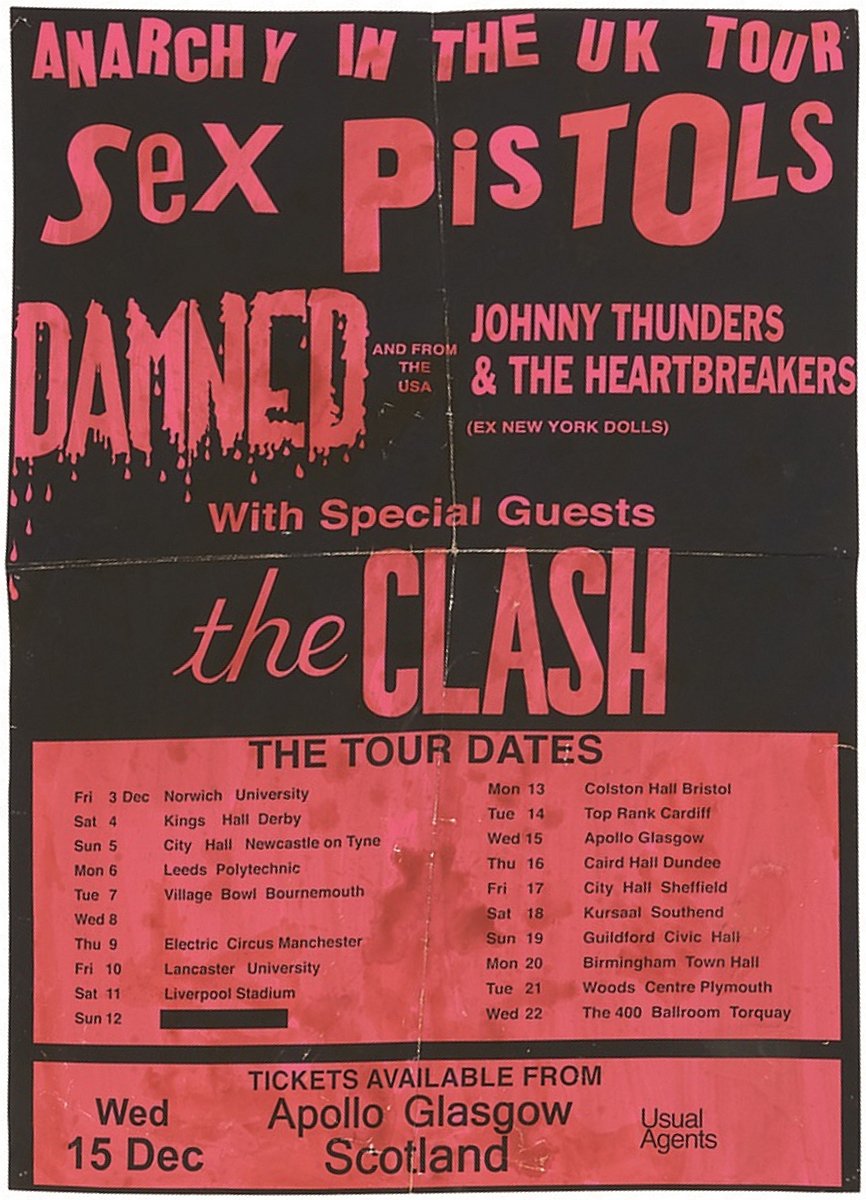
Tickets, Posters
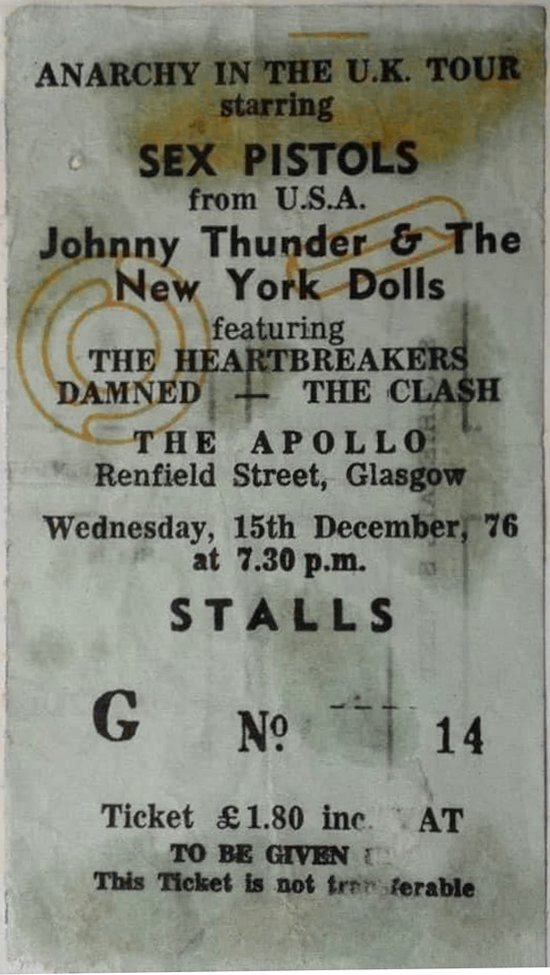
Ticket
ANARCHY IN THE U.K. TOUR starring
SEX PISTOLS from U.S.A.
Johnny Thunder & The New York Dolls
featuring THE HEARTBREAKERS DAMNED - THE CLASH +
THE APOLLO Renfield Street, Glasgow
Wednesday, 15th December, 76 at 7.30 p.m. STALLS, G, No 14
Ticket £1.80 inc. AT TO BE GIVEN E This Ticket is not transferable
From 1927 to 1985 the Glasgow Apollo was a landmark in Glasgow's architecture and culture. It opened as Green's Playhouse in 1927 and was built as a showpiece palace in the great era of live entertainment. It was a giant and elaborate building capable of seating up to 4,500 people. During these early days the cinema, ballroom, cafes and vestibules could cater for 10,000 people; incredible even by the standards of today's multiplexes.It was renowned before the Apollo era as a unique experience, and the rock'n'roll years only added to its fame.
In 1973 after the curtain was finally brought down on the Green's Playhouse and following a low budget "Changing Rooms" style makeover, The Glasgow Apollo was officially opened. The first ever gig at the Apollo was Johnny Cash. A few months later it was the Rolling Stones debut at the Apollo.
The Clash first played the Apollo in October 1977, returning in July 1978 just days before the venue's owner, Mecca, announced plans to convert the auditorium into a bingo hall. Apparently the Clash were told that their show was to be the last at the Apollo.
The infamous Apollo bouncers were going to get revenge on the Glasgow crowd for making their life hell over the years. The Clash played in a very tense atmosphere and found themselves asking the crowd and the bouncers to stop fighting on numerous occasions. The mayhem in the Apollo was filmed for Rude Boy and Joe and Paul were arrested for being drunk and disorderly after the gig. Rude Boy features fans of The Clash blocking the streets outside the Apollo before the 1978 gig.
The website www.inthewilderness.com provides some great stories about the bouncers including one when the bouncers met their match in the form of an unexpectedly violent source - David Soul's 13 year old teenybopper fans! Their screaming, hysterical crying, punching, kicking and spitting led to police eventually being deployed to keep them off the stage. The bouncers hid from the girls behind the thin blue line!
The Anti-Nowhere League had to do a runner after being annoyed at spitting tried to spit back on the audience but hitting the bouncers instead!Tears were shed for what looked like being the Apollo's swansong. But a big campaign by fans got underway immediately. Petitions were drawn up. Debates were carried on through council chambers and newspaper columns.
As a resultMecca had to change plan and 1978 became one of the best years in the Apollo's history. Tom Robinson and SLF reopened the Apollo on 29 September.
The building was in rapid decline in its last decade, the plaster, bricks and mortar rotted to dangerous degrees and was finally demolished in 1989.
"We are trying to create a definitive list of all the bands that played at the Green's/Apollo and to provide dates, ticket stubs, reviews and setlists. If you can add to our list or spot an error please let us know."
PHOTOS
Glasgow Apollo
The Glasgow Apollo Theatre, located at 126 Renfield Street in Glasgow city centre, Scotland, was a premier music venue from its opening on September 5, 1973, until its closure on June 16, 1985.
The venue was originally known as Green's Playhouse, a massive cinema thought to be the largest in Europe at the time of its opening. As the cinema declined, the building was rebranded as The Apollo by Unicorn Leisure, owned by Frank Lynch and Max Langdown
The Apollo was designed by architect John Fairweather in a style that accommodated both cinema and live performances. The building's capacity was 3,500, making it a significant venue for large-scale events in Glasgow.
The Apollo was demolished in September 1987, a couple of years after its closure. Despite its physical absence, the venue remains a cherished memory for many music fans and has been commemorated through websites like glasgowapollo.com, which has received over 12 million hits as of 2017. The site aims to create a definitive list of all the bands that played at the Apollo and provides a platform for sharing memories, ticket stubs, and setlists.
The Glasgow Apollo Theatre was a significant cultural landmark in Glasgow's music history. Although the building no longer stands, its legacy lives on through the memories of those who experienced its concerts and through the efforts of websites dedicated to preserving its history.
6. The Apollo Theatre - Memories of Glasgow's legendary rock venue. We look back at the music haven where punks clashed with bouncers, an emotional Ozzy Osbourne kissed the stage and it was £2.50 to get into the mosh pit... And let's not forget the Bouncy Balcony. here
7. A music fan still has a seat from Glasgow's famous rock mecca The Apollo Theatre. This must be gold dust as far as Glasgow music memorabilia is concerned! here
8. Was the Apollo the ultimate iconic venue: Herald
Did you see The Clash!
Please send us a comment
Leave your comment here on the Blackmarketclash's FB page (above/below) Or alternatively leave a comment here
Please email us at:
All help appreciated. Info, articles, reviews, comments or photos welcome. Please email blackmarketclash
PAGE 3 - The fallout, Tour collapses RevisedDates following the Grundy outrage
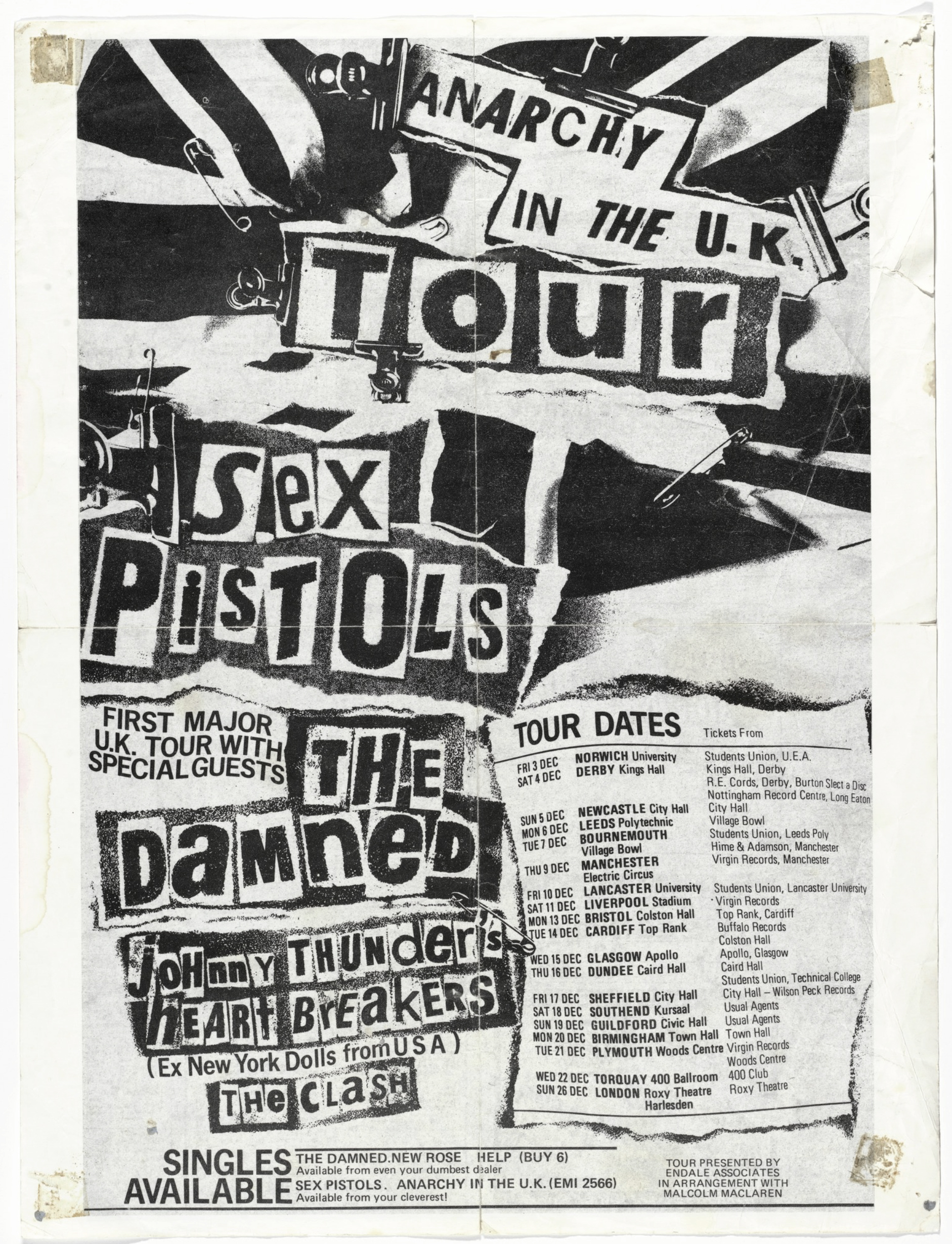
Anarchy Tour Adverts, before and after The fallout from Bill Grundy show
Feature Magazines Books (Anarchy Tour)
PAGE 3 - The fallout, Tour collapses RevisedDates following the Grundy outrage
Anarchy Tour Adverts, before and after The fallout from Bill Grundy show
Feature Magazines Books (Anarchy Tour)










.gif)