A Pistols recording exists from this gig but the taper only recorded the Pistols and the support slot, Johnny Thunders & the Heartbreakers.
Background
“No swearing in Leeds” – Pistols defy orders and fans walk out in disgust
We arrived in Leeds to headlines warning us that the Sex Pistols had been ordered not to swear on stage. Ian Steele, the Polytechnic Union’s vice-president, told us bluntly: “We were told that the group’s road manager has ordered the Pistols not to swear on stage. It seems to be an attempt to save the other concerts on tour while trying to preserve their image.”
City officials circled. Councillor Bill Hudson thundered, “The city would be far better off without them.” His colleague Patrick Crotty sniffed, “We are sorry the people studying higher education found it necessary to listen to such rubbish.”
Still, the Polytechnic gave the green light. About 500 tickets had been sold, and by nightfall the hall was filling with both students and outsiders waiting to see if punk’s most notorious group would rein in their tongues.
What unfolded was chaos without catharsis. Reporters Steven Kendall and Howard Corry of the Yorkshire Evening Post called it “a vile, disgusting show met with derision, scorn and hoots of laughter.” Fans streamed for the exits. Johnny Rotten, spitting beer across the front rows, sneered: “You’re just a load of dummies. You’re dead.”
When asked why he was leaving, student Bob Sinclair answered, “The question is not why am I leaving; but why did I ever come in the first place?”
Others were blunter: “They are rubbish. It is the worst group I have ever heard.”
Even as bottles and abuse flew back and forth, The Clash, The Damned and The Heartbreakers played their sets largely ignored, with one critic writing that all four bands blurred together.
By the end of the night, the Pistols had made their point – they would not be censored – but in Leeds they had also managed to alienate much of their audience.
SEX PISTOLS GET THEIR ORDERS:
NO SWEARING IN LEEDS
The controversial new punk rock band, the Sex Pistols, have been told to cut swearing from their concert at Leeds Polytechnic tonight....
Sex Pistols get their orders: No swearing in Leeds
The controversial new punk rock band, the Sex Pistols, have been told to cut swearing from their concert at Leeds Polytechnic tonight.
This was revealed today by Ian Steele, the Polytechnic Union’s vice-president for recreation and one of the concert organisers.
The concert has been given the go-ahead despite widespread cancellations for their tour, Anarchy in the U.K.
About 500 students and “outsiders” have bought tickets for the concert in the union assembly hall.
Mr. Steele said: “We were told that the group’s road manager has ordered the Pistols not to swear on stage. It seems to be an attempt to save the other concerts on tour while trying to preserve their image.”
The group started a major uproar last week when they used four-letter words on a television programme.
Mrs. Cris Tippie, Deputy Director of Education for Leeds, said the Education Department and Dr. Patrick Nutting of the Leeds Polytechnic Directorate did not propose to stop the group appearing. “What the Poly students’ union does in the assembly hall is up to them, providing there is no physical violence or damage to the building,” she said.
But there was strong reaction from some Leeds councillors today about the pop group.
Coun. Bill Hudson (Con., Alwoodley), Further Education Committee chairman, said: “The city would be far better off without them. There is little we can do to stop them now, but the situation over the use of the assembly hall at Leeds Polytechnic could be changed when the present agreement comes up for review shortly.”
Coun. Patrick Crotty (Con., Roundhay and Harehills), Education Committee chairman, said: “We are sorry the people studying higher education found it necessary to listen to such rubbish.”
Coun. the Rev. Michael Taylor (Lab., East and West Hunslet) said: “It’s a sad society which has lost its moral values: the control now was something such groups could get away with.”
Meanwhile, there were reports that the group had damaged the lobby of the Dragonara Hotel, Leeds. They were reported to have smashed a potted plant display.
One eye witness said they had thrown handfuls of soil about the hotel while smashing the plant pots.
But the hotel’s duty manager, Mr. M. Roddy, said today: “It’s all blown out of proportion. I’ve been on duty all weekend and, as far as I’m concerned, nothing happened.”
The Leeds Polytechnic, now known as Leeds Beckett University, gained historical significance as the opening venue for the Anarchy Tour on December 6, 1976.
This tour featured influential punk bands such as The Clash, the Sex Pistols, and The Damned, and is considered a pivotal moment in the history of punk music[1][2].
The building, originally constructed to house the educational institution, has a rich history as a center for education and culture in the region.
Leeds Polytechnic, now Leeds Beckett University, was built in the 19th century. The style of the building is characteristic of the architecture of that period, featuring elements of Victorian or Edwardian design, which were prevalent during the time of its construction.
Steven Kendall and Howard Corry, Yorkshire Evening Post –– 7th December 1976, PDF
JEERS FOR PUNK GROUP ROCK GROUP AS FANS WALK OUT: HOW THE SEX PISTOLS MISFIRED
The great Sex Pistols myth exploded in Leeds last night when a vile, disgusting show was met with derision, scorn and hoots of laughter from scores of fans. Many walked out on the dreadful debacle at the Polytechnic and those who stayed were told by lead singer Johnny Rotten: "You're just a load of dummies. You're dead." But, in fact, it was punk rock and its crude, mindless message that was dying...
Jeers for punk rock group as fans walk out How the Sex Pistols misfired
By Steven Kendall and Howard Corry
The great Sex Pistols myth exploded in Leeds last night when a vile, disgusting show was met with derision, scorn and hoots of laughter from scores of fans. Many walked out on the dreadful debacle at the Polytechnic and those who stayed were told by lead singer Johnny Rotten: "You're just a load of dummies. You're dead." But, in fact, it was punk rock and its crude, mindless message that was dying.
With the group's violent reputation trouble was expected but the apathy was such that excitement was virtually non-existent and only one fan with a truncheon was carried out. The sole casualty was a girl who trapped her arm in a door.
Catcalls The Pistols, who have drummed up so much controversy with their four-letter tirade on television, were left desperate and dejected; antagonistic in their brusque departure. Earlier, they set the tone for their abysmal performance of depravity rock by dedicating the first number to "Councillor Bill Hudson, of Leeds, and Bill Grundy and the Queen." They immediately broke orders from their manager not to swear by using a string.
When the group waited among catcalls to do an encore Rotten turned upon his fans and snarled: "Has the council banned you from clapping? If you don't like us, you know where the exit."
This punk rock fan at the concert wore a razor-blade earring. The obscenities at the start of the second number, Rotten took a swig of ale and spat it out all over the fans at the front. Throughout the show, Anarchy in the U.K. at the start of a tour hit by cancellations, the group came across as musically bereft, verbally crude.
Rubbish The beat, blasted out with ear-shattering force, was relentless and unimaginative. The lyrics were even worse, an abomination of bawled revolution like; "God save the Queen, there is no future."
As Rotten continued his avalanche of atrocities, some of the 300 fans started walking out and their verdict was unanimous: "What a load of absolute rubbish."
Kevin Petch, The Nook, Birstwith, said: "I only came to see what all the fuss was about. I wish I hadn't bothered. It was the worst concert I have seen in my life."
Another fan, Karl Stevens, of Farsley, said: "I've never heard anything like it. They are so bad it just isn't true."
Steve Green, an official at the Students Union, said: "It's not been a bad night. There has been trouble, although many people walked out. I think many people came out of curiosity as a result of the Sex Pistols reputation and the controversy surrounding them."
Supporting the Pistols on stage were three other punk rock bands, The Clash, The Damned and The Heartbreakers from New York. Their performances and punk rock in general were so similar that it was hard to tell when one finished and another started.
Leicester Daily Mercury – Tuesday 07 December 1976, Link
They're a waste of money LEEDS
SCORE of students left the concert given by the controver-sial punk rock group the Sex Pistols in disgust halfway through the show at Leeds Polytechnic last night....
Sex Pistols? 'They're a waste of money'
SCORE of students left the concert given by the controver-sial punk rock group the Sex Pistols in disgust halfway through the show at Leeds Polytechnic last night.
One said: "They are rubbish. It is the worst group I have ever heard. They did not shock me. Their music was just so bad."
Politics student Bob Sinclair. 21. said: "The question is not why am I leaving; but why did I ever come in the first place?" Other disgruntled students said they had wasted their money going to see the foul-mouthed band.
The organisers claimed the show was a sell-out.
Later, the deputy president of Leeds Polytechnic Students' Union, Mr. Jan Coxon, 24, said: "I don't know if the Sex Pistols will play here again. It depends on demand."
The group might play again at the Polytechnic later this werk, he said, but eight other concerts organised for the group have been cancelled.
The February 21, 1976, issue of theNew Musical Expresswarned readers: “Don’t look over your shoulder but The Sex Pistols are coming”. “They were like a million years ahead,” The Clash’s Joe Strummer later told his biographer Chris Salewicz...
The February 21, 1976, issue of theNew Musical Expresswarned readers: “Don’t look over your shoulder but The Sex Pistols are coming”. “They were like a million years ahead,” The Clash’s Joe Strummer later told his biographer Chris Salewicz. “I realised immediately we were going nowhere; the rest of my group hated them.” In December two bands were were sharing a coach the Anarchy Tour, which also featured Johnny Thunders’ band The Heartbreakers and The Damned. Nineteen dates were booked. But the bands performed just three times, the rest of the shows cancelled by order of the authorities who were, notcompletely without reason, fearful of fighting.
Anarchy Tour, L-R. Keith Paul, Jo Faul, Johnny Thunders, Ray Stevenson, Nils Stevenson, Walter Lure, Paul Cook, Leeds. Dec 1976
In 1996, Mojo magazine harked back:
Contrary to legend, the destination board on the (tour) bus did not read Nowhere. It was blank. The Sex Pistols, Heartbreakers (from New York), Clash and managers, promoters, roadies and photographers all got on board. The warm interior of the bus with its comfortably upholstered seats was a luxury. They were about to embark on the first full-scale punk tour of the UK.
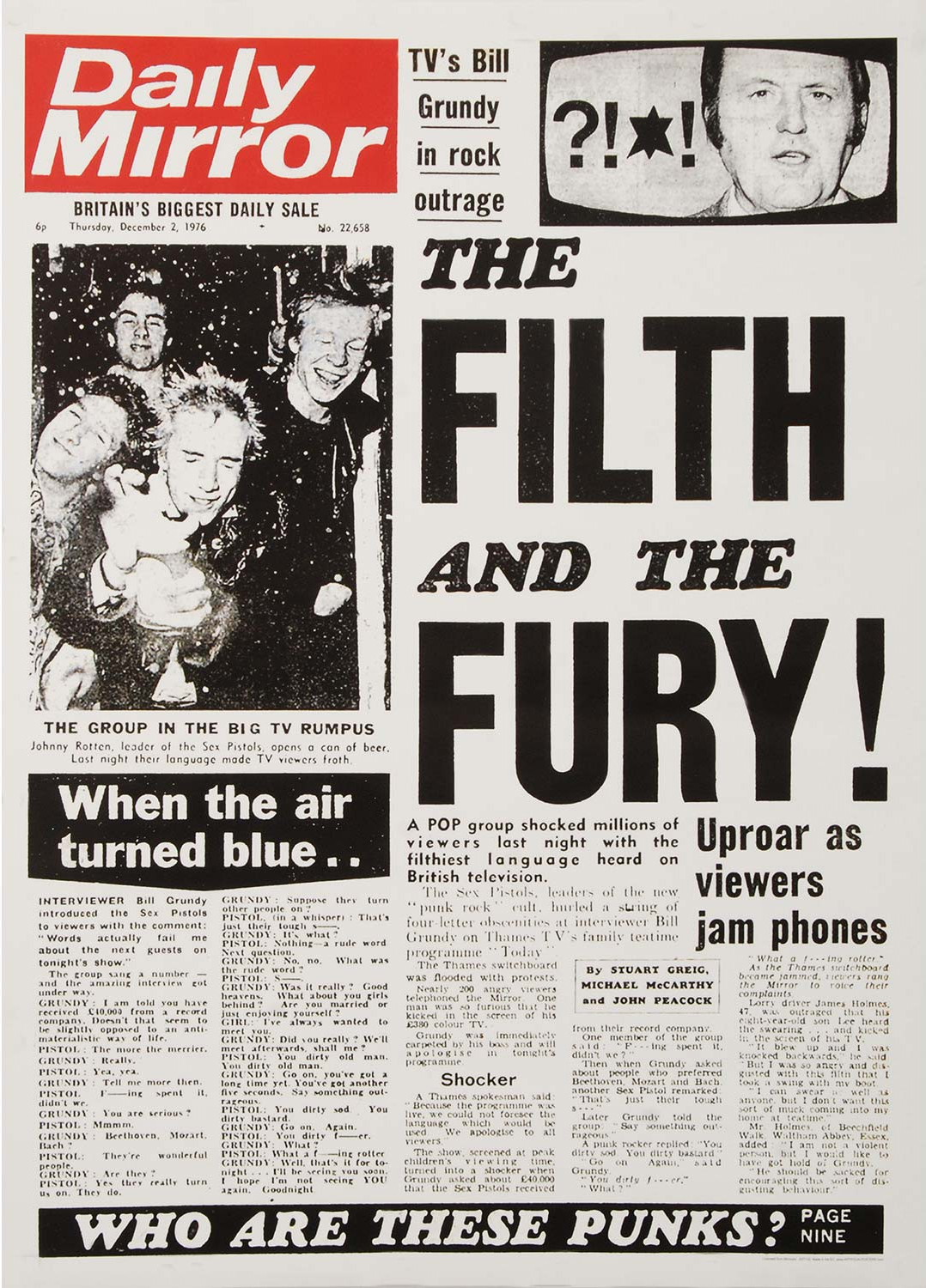
It was during rehearsals for this very tour – 2 days earlier – that the Pistols appeared on Bill Grundy. Anarchy In The UK had been released a few days previously. The Pistols actually arrived for the programme in a chauffeur driven limo. It was the first serious TV that the Pistols had. Malcolm McLaren’s reaction: “Fucking hell, the band have just sworn on live TV.”
Sex Pistols and The Clash – Johnny Rotten (left), Paul Simonon, Joe Strummer (right), Mick Jones (front) Anarchy Tour bus. Dec 1976
Steve Jones: You dirty sod. You dirty old man.
Bill Grundy: Well keep going, chief, keep going. Go on. You’ve got another five seconds. Say something outrageous.
Jones: You dirty bastard.
Grundy: Go on, again.
Jones: You dirty fucker.
Grundy: What a clever boy.
Jones: What a fucking rotter
– Today TV show, December 1 1976
Anarchy Tour bus. Dec 1976, Malcolm McLaren and The Sex Pistols.
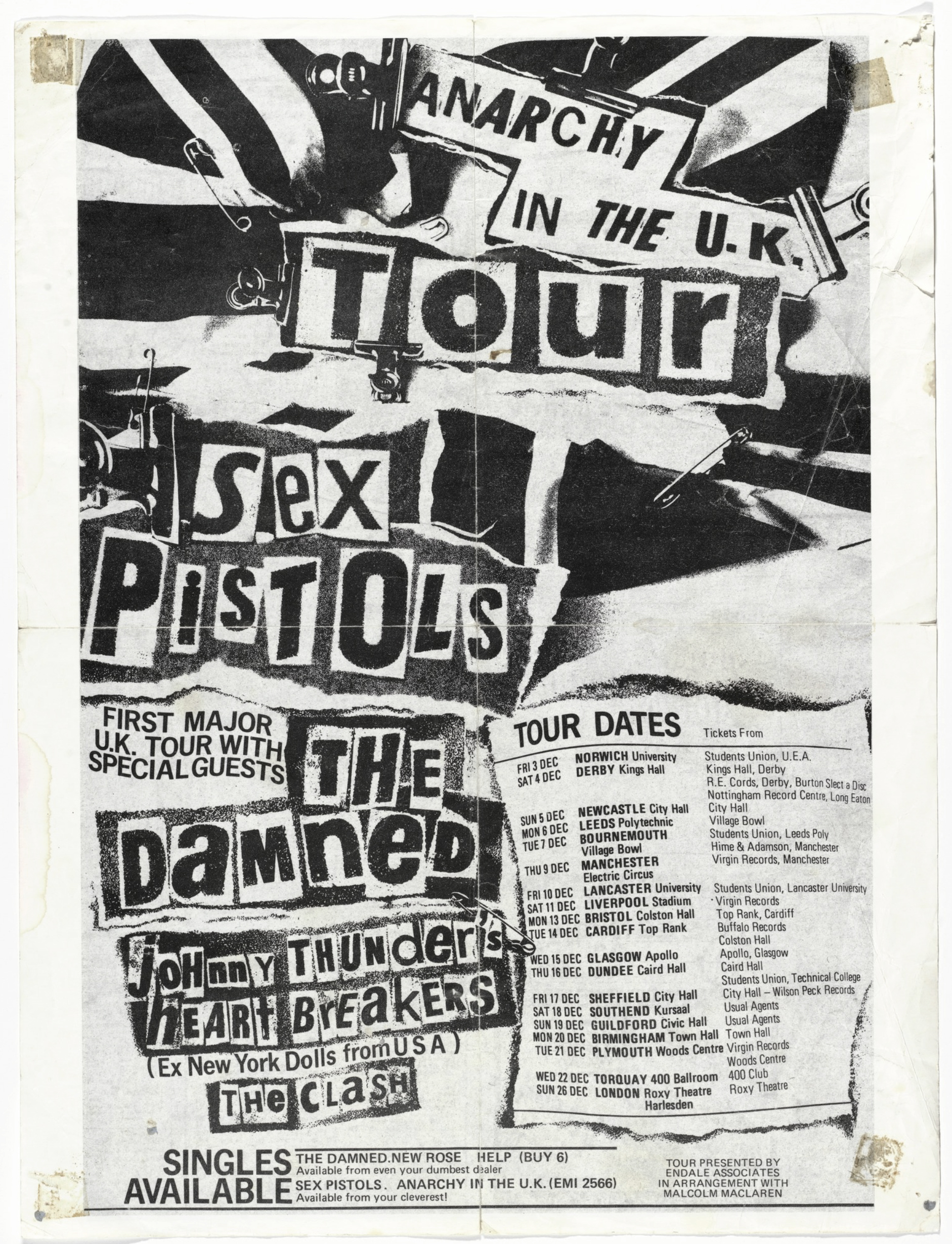
The first show was due to be held at the University of East Anglia (UEA) in Norwich on 3 December 1976. Billed as a “A Punk-Rock Evening”, tickets cost £1.25 in advance and £1.50 on the door, but collectors would pay many times that for one now. The concert never went ahead: earlier that day, vice-chancellor Dr Frank Thistlethwaite banned it “on the grounds of protecting the safety and security of persons and property”…
Only three of the scheduled gigs went ahead, along with four other rearranged shows. The tour finally started at Leeds Polytechnic on 6 December, with further dates at Manchester’s Electric Circus (9 and 19 December), Caerphilly’s Castle Cinema (14 December), Cleethorpes’ Winter Gardens (20 December) and Plymouth’s Woods Centre (21 and 22 December).
Johnny Thunders, Anarchy Tour – 1976
Paul Simonon, Goodman, Joe Strummer and Johnny Rotten. Anarchy Tour. Dec 1976
“We were getting used to the idea of spending long periods in our rooms, drinking beer, watching TV and reading about ourselves in the papers… Everybody thinks the Anarchy Tour was Hey! Hey! Hey! but it wasn’t. The main thing I remember is the boredom. We didn’t know what the fuck was going on.”
-Glen Matlock
The Damned, Anarchy Tour, Leeds – Brian James, Dave Vanian and Captain Sensible.
Joe Strummer and Johnny Rotten. Anarchy Tour. Plymouth. 1976
The Clash – Mick Jones with Debbie Juvenile and Tracey. Anarchy Tour, Britain – 1976
So they arrived in Derby only to be told the local council would let the other bands play, but not them – unless they were granted a private screening first. Malcolm knew that if they actually saw the Pistols play, they’d say no. But, if they refused to audition, they’d still be refused to play. Whatever, they still needed money to pay for the hotel.
So, the roadie and sound man got everything ready to make it look like they’d be appearing. Meanwhile Malcolm managed to persuade EMI to pay their bills. Malcolm announced: “We’re not going to encourage censorship. If we perform for these idiots we’ll end up doing matinees for every council in the country”
Everyone got back on the bus and Malcolm announced that Newcastle City Hall had been cancelled, to quote a councillor: in the interests of protecting the children. So the Anarchy tour was headed for Leeds… (ominous dot dot dot)
Johnny Rotten and Nils Stevenson, whose older brother Ray Stevenson took these photos. Nils would go on to managed Siouxsie and the Banshees
Johnny Rotten. Anarchy Tour. 1976
Sex Pistols – Johnny Rotten, Paul Cook and Glen Matlock, Anarchy Tour. ‘No publicity’. 1976
First of all the Damned left the tour. Their tour manager had said that they would audition for the council. The Sex Pistols were not happy when they heard about this. And, as a result, they got booted off the tour.
MALCOLM: I sacked The Damned because they were no fucking good…
CAPTAIN SENSIBLE says: When they asked us to do the tour, they needed us. We had been gigging a lot, so we had a reputation and a following. After the Grundy incident, the Pistols were the big deal and really didn’t need us to help sell tickets, so they dumped us.
– Mojo 1996
Sid Vicious, Nils Stevenson and Linda Ashby at Linda’s flat. 1976
Malcolm McLaren. Anarchy Tour. 1976
Sex Pistols – Steve Jones and Johnny Rotten, Anarchy Tour. December 1976
Dec 1976
PAUL SIMONON: The tour turned into a cause, in a way. Us kids just wanted to play. We were stuck in hotel rooms for a couple of days waiting to play, then we’d be told the gig was cancelled, so we’d wait another 3 days in the hotel room.
New Musical Express, Page 33, 11 December 1976, PDF
Out on the Town
Blank Generation out on the Road
Sex Pistols Damned Heartbreakers Clash Leeds ...
New Musical Express, Page 33,
On The Town
Sex PistolsDamnedHeartbreakersClashLeeds
Kenneth Anger called James Dean"a human ashtray." Maybe he should have waited twenty years to see the self-inflicted fag burns on Rotten's arms. "It's my body and I'll do what I like with it."
The Pistols come onstage at Leeds Poly to a smattering of applause, lots of abuse and a few objects thrown at them. No way is this mob gonna be like their pogoing London supporters. Glen Matlock & Steve Jones plug in and Paul Cook sits behind his kit as Rotten just hangs from the mike stand, rips open a can of beer, and burns the crowd with his glassy, taunting, cynical eyes. Spiky dyed red hair, death white visage, metal hanging from lobes, skinny leg strides, red waistcoat, black tie and safety pins he looks like an amphetamine corpse from a Sunday gutter press wet dream.
Something thrown from the audience hits him full in the face. Rotten glares at the person who did it, lips drawn back over decaying teeth. "Don't give me your shit," he snarls, "because we don't mess. This first number's dedicated to a Leeds councillor, Bill Grundy and the Queen fuck ya!"
And straight into a searing rendition of the blank generation anthem, Anarchy In The U.K. done even better than the single which just charted at 43. The rhythm section of Cook on drums and Matlock on bass are tighter than tomorrow, fully complimenting the pneumatic guitar work of Steve Jones and Rotten's deranged dementoid vocal.
It's a blistering start, but unfortunately for both the Pistols and the crowd it turns out to be the high point of the set. The crowd are way too restrained through Lazy Sod, No Future and Pretty Vacant, failing even to see the humour in the really cocked up intro of this song. Rotten glares at them. "You're not wrecking the place," he says. "The News Of The World will be really disappointed."
This gets a laugh, but the crowd don't seem to realize that the two things Rotten hates most are apathy and complacency, both of which are rife tonight at Leeds Poly.
"I hope you 'ate it!" he screams. "You don't like it then you know where the exit door is!" Earlier he had been taking a sip from a can of beer and then handing the can to the crowd. Now he spits at them.
Even with numbers that the crowd know, like the Who'sSubstitute or the Monkees'Stepping Stone, the punters never really get into it. Rotten's going crazy with angry frustration. A token object thrown from the audience hits him in the face. "You just stand there, you don't know whether you like it or not!"
The band eventually returns for a few more numbers. The Small Faces'What'cha Gonna Do 'Bout It has its lyrics changed to "Want you to know that I hate you baby, want you know I don't care," and then it's the last number, with the audience finally putting some effort into lifting the band. It's Iggy'sNo Fun, arguably the definitive Pistols live number, more than Anarchy.
Then they were gone and I felt for them. A string of cancelled gigs, the press labelling them Public Enemies No 1, and a frightened element of the rock press saying they can't play (obviously a lie) and when they finally get a chance to play the kids ain't all right. What a choker.
The Clash opened up the evening with a great set. Hard, committed, loud, brash, violent rock music, I got the impression they expected nothing from the audience or anybody else so that they didn't have the same problems as the Pistols. Joe Strummer, wearing a green sweatshirt emblazoned with the legend "Social Security £9.70 ignor 70", ignored the hecklers as he did the spoken intro to White Riot. It's their best song, all about what it was like to be caught up in the Notting Hill Riot without being either a cop or a black. "I wanna riot of my own".
Mike, the lead axe, in a paint splattered Union Jack shirt, bounds about like Townshend, looks like Keith Richards' grandson, and a lot of the time handles vocals with Strummer. Other songs include Bored With The U.S.A., London's Burning, Career Opportunity ("dedicated to all students") and 1977: "Hope I go to heaven, rock been too long on the dole… If you don't know why I call it dole queue then you ain't seen The Clash."
I enjoyed the Heartbreakers because they remind me of the New York Dolls the way they play, their songs and sometimes their visual. With ex-DollsJerry Nolan on drums and Johnny Thunders on leads (both of them with neatly shorn locks as a concession to the UK) you couldn't help but compare them to their days with Johansen, Sylvain and Kane. Well, they're not as good as the Dolls yet, the other two members of the band being less manic than the Dolls of old, but if they live long enough they could develop into something very fine.
"I Wanna Be Loved By You" by Needles Nohan, as Johnny Thunder calls him, has got hit single stamped all over it. And the Heartbreakers are certainly better than the Ramones.
I had eagerly awaited the appearance of the dole queuer supremos The Damned, but they turned out to be the biggest disappointment of the night. The downer of cancelled gigs, far too short a set, and behind-the-scenes problems all contributed to the lacklustre performance. And no one knew it better than Rat, Brian, Dave and the Cap. But I'd lay odds that next time out, anxious to prove themselves again, they'll be playing at the heights we expect from them and they expect from themselves.
Now listen good. If the pious hypocrites who rule our land ban this tour from appearing in your town then get off your lazy butt, go to the next town, or even the next town, until you get a chance to check it out. Because if you miss it this time round, I doubt very much if you'll ever get a chance to see a tour like this again. And if you don't see it then all I can say is you are no fun. Tony Parsons
"This I have got to see" murmurs a well-dressed young man to his better-dressed woman as a coach disgorges The Clash and their punk entourage into the foyer of the Metropole, one of Leeds' premiere hotels....
Politics of boredom - The Clash in Leeds
"This I have got to see" murmurs a well-dressed young man to his better-dressed woman as a coach disgorges The Clash and their punk entourage into the foyer of the Metropole, one of Leeds' premiere hotels. But the commissionaire doesn't blink when one of the few female punks strides past in torn black stockings and her "alluring corselette, superbly made in sensual easy-care fricel satin with gorgeous lace frills, and detachable suspenders."
"Rodent, which is my fucking room, my underpants stink" says Joe Strummer, his voice hoarse from yet another night shouting at the pogo-jumping punks in the Polytechnic. Rodent, recently promoted to tour manager, has spiky hair whose peroxide is turning orange, and his face is pretty much the same colour. "Rodent, dash upstairs and get the stickers out of my bag, there's a geezer here who wants some," demands a little bloke called Barry who turns out to be The Clash's manager. "Rodent get me a drink" says another punk, and Rodent runs off in three directions.
Frenzy It's a far cry from the ashen, sweating faces and the debris they've left behind in the Poly. At the end of the gig, the frenzied leaping and shouting dissipates into polite queuing for spare copies of The Clash's poster, as the two hundred committed punkers go home to stack their plastic shoes, coloured rimmed sunglasses, schoolboy shirts and ties, chains, safety pins and paper clips, ready for the next outing.
Meanwhile the punks settle into the red leather chairs of the Metropole and try and squeeze a pound or so out of Barry to get a drink. The Metropole has seen it all before, they didn't turn a hair at Rahsaan Roland Kirk and his band, and the punks are far better behaved. One businessman even stops to let a thickset punk with a manic smile brush his hair.
Youth vanguard? By this time your roving reporter has got himself in on the most bizarre interview of all time. Five trendy Japanese from CBS Japan, only one of whom seems to speak much English, are talking to Joe Strummer about the IRA, religion, The Beatles and politics, laughing with reserved enthusiasm at Joe's attempts to outrage us. Joe says the British have no business in Ireland, but he destroys the hopes of those who are trying to conjure up a working class youth movement out of punk's rebelliousness:
"I don't know no Marx, no Trotsky, no nothing. I know about fascism and I don't like it, but I don't know about communism. The Socialist Workers Party, you know, they keep coming up and saying" (Joe nudges a bewildered Japanese woman, imitating the mock friendliness of the comrades) "'Come and join us.' But they can fuck off, the wankers, that's just dogma, I don't want no dogma."
But your probing reporter, Arthur Sewer-Rat, has read many references to the role of The Clash as the new youth vanguard which has high regard for the culture and struggles of black youth. Joe, after all, has Ska and Dub neatly stencilled on his jacket and their best number that night had been an original punk version of Junior Marvin's reggae classic Police and Thieves. Plus the magnificent backdrop to their stage act was a picture of a scene from the Notting Hill Carnival riot. Surely the song White Riot is a political statement?
"No it fuckin ain't. Look, I'll tell you how it happened, right? I was at the Carnival right chuckin bricks, having a great time. A copper grabs me, but he lets me go, cos I'm white. Then, later on some black kids get hold of me. 'Hey mon, you give me a pound mon and we let you go'" (Joe does a passable imitation of cockney black street talk). "I give them the pound and I go home. I sit down and I think I can't fucking win, the police get me and the blacks get me, I'm pissed off right, and so I write it down 'I want a riot of my own.' That's all it is."
It could be added that not a word could be heard at the gig, and maximum pleasure was extracted by one punk who spent the whole evening leaning against the wall of speakers wincing with pain each time a number started. You can distinguish the words on the album, but it seems that only the intellectuals listen that hard. We can hope that the ideas of those punk groups who lean to the left will rub off on some fans, and we can hope that the neo-fascist punks will fade away. In the meantime, enjoy the style, energy and excitement. It is a boring, worthless dead world for most youth, and punk is a glorious moment of extremity.
The fanzine that documented when punk landed in Leeds
Despite tabloid fury, the gig at Leeds Polytechnic where the Pistols were supported by The Clash and Johnny Thunders and the Heartbreakers was given the go-ahead.
At that gig there were a lot of punks there but there was not really any trouble. A lot of people got converted that night. Though there were a lot of sound problems it was an exciting gig. Punk had announced itself.î
The first edition of New Pose [Fanzine], in June 1977, carried interviews with The Ramones and Talking Heads, who had played at Leeds Polytechnic a couple of weeks earlier, along with gig review of The Clash and Subway Sect and reviews of new singles by Blondie, Iggy Pop and The Jam.
The fanzine that documented when punk landed in Leeds
Published: Monday 18 June 2012
Martin Tindall, and The Ramones, below.
1977 Revisited: It was the musical era that polarised Britain, shocking and inspiring in equal measure – and Martin Tindall was there. He looks back with Duncan Seaman.
Martin Tindall vividly remembers his one and only encounter with Sid Vicious. The spiky-haired, snarling face of punk was at a gig in Doncaster in 1977 when the teenage fanzine writer approached him for an interview about his band the Sex Pistols. "Sid was there with two girls,"Martin recalls, 35 years later. "He picked up the fanzine, did a stupid laugh and threw it up in the air. That was the end of that."
The bass player – who would die two years later of a heroin overdose while on remand for the alleged murder of his girlfriend, Nancy Spungen – may not have been very accommodating towards the would-be music journalist from Leeds but many of his contemporaries were – as newly-republished editions of New Pose, Martin’s fanzine, show. As such, they are remarkable documents of an era in British music that shocked and inspired in equal measure. They are also perhaps the best-preserved records of the rapidly emerging punk and new wave scene in Yorkshire.
Martin was a 19-year-old art college dropout when he founded New Pose with his then girlfriend Jayne Cobbe. "Towards the end of 1976 the punk scene was happening in London," he remembers. "We’d been there a couple of times – once for The Stranglers and the Buzzcocks at the Roundhouse or the International College of Art. They were full of students sitting cross-legged on the floor with long hair then there was the early 70s type of rock fan and at the front were 20 or 30 thin-looking blokes with spiky hair and drainpipe trousers, pogoing to the band. We’d not seen anything like that in Leeds."
The arrival of the Sex Pistols’ Anarchy in the UK tour in Leeds in December 1976 changed everything. The band, fronted by the outspoken Johnny Rotten, had been banned from venues across the country after their guitarist Steve Jones swore in a televised interview with Bill Grundy. Despite tabloid fury, the gig at Leeds Polytechnic – where the Pistols were supported by The Clash and Johnny Thunders and the Heartbreakers – was given the go-ahead.
"Before the Anarchy tour we’d had Generation X and the Sex Pistols at the Fforde Green [the infamous pub venue in Harehills] but they had not been well-publicised," says Martin. "The ninth gig [on the Anarchy tour] was the Leeds one – and Leeds City Council passed it. At that gig there were a lot of punks there but there was not really any trouble. A lot of people got converted that night. Though there were a lot of sound problems it was an exciting gig. Punk had announced itself."
By the following spring many of the hottest names in London’s punk scene were heading for West Yorkshire and local musicians were starting punk bands of their own. They were helped by the fact that John Keenan, the influential Leeds promoter, was keen on the music.
For Martin Tindall, punk was easy to relate to. "Everybody admires bands where the singers are about eight years older than they are – so they say. What we were looking at were bands where the singer was about the same age as you. They were people you could speak to before gigs."
The first edition of New Pose, in June 1977, carried interviews with The Ramones and Talking Heads, who had played at Leeds Polytechnic a couple of weeks earlier, along with a gig review of The Clash and Subway Sect and reviews of new singles by Blondie, Iggy Pop and The Jam.
"Me and Jayne thought what we had to do is get something as good as the NME," says Martin. "If you went to a gig with a camera and wrote down as much as you could then you could start a magazine."
Unfortunately when the photographs were developed they realised their limitations. "They were shocking, absolutely terrible,"Martin chuckles. So they advertised for a photographer – and by the July edition, with a cover feature on The Stranglers, Steve Dixon had come on board.
Those first fanzines were photocopied by Jayne in her lunchbreaks at work. All the money from the 150 copies sold of edition one was poured into edition two, which had a print run of 200. By issue three they were confident enough in their handiwork to have 300 copies produced professionally – at Ipso Print in Leeds. "We sent it to major music papers to get it reviewed," says Martin. "The NME said it was the second best fanzine in the country. Sounds did a centre spread on it."
Gaining access to bands was surprisingly straightforward. "Everybody was really nice because they had not got a lot of press in the papers. The NME was dragging its heels a bit – it had to advertise for younger writers who were into this stuff [the new starters included Tony Parsons and Julie Burchill]. We’d knock on the [dressing room] door after a gig. We were in the Polytechnic anyway."
The New Pose team were also fervent concert-goers. "We went to every gig that we could go to," says Martin. "We went to Sheffield, Lancaster, out of the county. We had more energy in those days. You didn’t mind coming home on the last train at night or the first train in the morning. We were not bothered. You’d do a day’s work and get changed on the train into your punk gear. We did it many times."
A key feature of the fanzine was its cartoons. Mark Manning – later famous as the rock star Zodiac Mindwarp – drew a caricature of The Clash. "He went to every gig," recalls Martin. "He was there when I said I wanted to start this fanzine. I wanted illustrations like Punk magazine in the US which was almost as glossy as Playboy, but not quite. I’d go into Virgin Records [then on Queen Victoria Street, Leeds] and buy them or pinch them or borrow them. Having been to art college, I didn’t want it to be like other fanzines. Mark said, ‘I’ll do drawings for you’."
Ray Burns – better known as Captain Sensible – also drew an illustrated history of his band The Damned. "I met Captain Sensible in London," says Martin. "He actually got the wrong end of the stick. I thought he’d just do one drawing but he did a comic strip. We couldn’t really use it but we put it in anyway. People loved that. It’s one of the funniest things I’ve ever seen. He’s a natural comedian."
In the wake of New Pose’s success, Martin got a job at the Virgin store. Because of his knowledge of punk, he became their singles buyer. "I had no training. It took me a number of weeks but I got it up and running."
As the day job took over, Martin found he had less and less time to devote to the fanzine. "The other side was all the trouble-makers turning up to gigs. Also, bands I had written about, by the end of 1977 they were getting into the charts. I thought they didn’t need me any more. The Clash, The Adverts and The Stranglers were not selling records in the tens or twenties but in the hundreds. Even Siouxsie Sioux said mid-’76 to ’77 was the original punk scene, then it diversified. New bands started wearing swastikas."
The fifth edition of New Pose – featuring SOS and Jonathan Richman and the Modern Lovers – was its last. "I still went to all the gigs,"Martin says. "But I never had to pay for another gig. When you’re not in the crowd any more, you’re in the guest bar, you’re not at the cutting edge."
By 1981 Martin was manager of the enlarged Virgin store, on Briggate, working alongside Ian De-Whytell (who now runs Crash Records on The Headrow). After that, he worked for the film company Palace Pictures for eight years before becoming a taxi driver. Now aged 55 and living in Alwoodley, he’s proud of his achievements, which have subsequently been recognised in a couple of television histories of the punk era. "A lot of guys ended up being plumbers or working in an office, but I did not," he says.
He takes it as a badge of honour that New Pose has been pirated. "I was impressed I’ve been bootlegged by a guy in Manchester. I’m quite happy about that," he smiles. Complete sets of New Pose are available from Crash Records and Jumbo Records in the St Johns Centre, priced £10, or by mail order on eBay.
IT WAS hard to imagine how the sell-out first night of the Sex Pistols’ banned and besieged tour would go down with the students of Leeds Polytechnic....
Punk! On stage!
IT WAS hard to imagine how the sell-out first night of the Sex Pistols’ banned and besieged tour would go down with the students of Leeds Polytechnic. Although the single “Anarchy In The UK” is played on their refectory juke box, 95 per cent of them have never seen the band before. When The Clash stride on stage, the audience are subdued. They stood silently, the quietest rock and roll crowd I’ve seen in years. Lead vocalist Joe Strummer, with newly bleached hair, grabs the mike. “I’ve been going around for two days thinking Big Brother is really here,” he shouts, but the students, whose collective policy is obviously when in doubt don’t react at all, give him a blank.
The band’s fast, committed songs are the quintessence of new-wave rock and fight hard to stir the impassive crowd, but well though they play “White Riot,”“London’s Burning” and the debut of their new number, “Hate And War,” there are no encores.
The Heartbreakers (soon to be renamed the Junkies) managed to thaw the audience. Johnny Thunders (guitar, vocals) and Jerry Nolan (both ex-New York Dolls) with Walter Lure (guitar) and Billy Rath (bass) present speedy if traditional rock and roll. Johnny, moving like a pneumatic steer, slides through a slick battery of moody poses. Numbers like “Chinese Rock,”“Let Go” and “Born Too Loose” are delivered with raunchy, gut-level grind, and are free of the sound problems that plagued The Clash. They are explosively well-received and packed with dynamic energy.
When Johnny Rotten at last stands in the spotlight he is greeted like a trooper returned victorious from wars. “We’re dedicating this event to local councillors, Bill Grundy and the Queen,” he cynically leers. It’s a popular gesture. But, although the Sex Pistols are playing with the flood-gate release of frustration you’d expect from musicians locked in hotel bedrooms escaping the national press for four days, it takes Johnny a whole set to allay the audience’s suspicion of him.
Unimpressed by the local talents’ “London boys” taunts, he sneers, glares and finally goads the audience into a laughing reaction to his jokes. He steers the band through a trouble-free, thunderously powerful set, but after the encore, even though the students want him back for more, everyone is left wondering what all the fuss is about.
original source unknown, e-zine, Secret History of Leeds, Posted by LEEDS LIBRARIES on DECEMBER 7, 2016 PDF,
Behave or else, Uni tells fans
LEEDS MUSIC FANS could lose their biggest city rock venue… if they don’t behave themselves....
Behave or else, Uni tells fans
LEEDS MUSIC FANS could lose their biggest city rock venue… if they don’t behave themselves.
The warning comes this week from Leeds University’s new Entertainments Secretary, Andy Kershaw. Through Pop Post he gave this message to the fans who flock to the big name concerts at the university: “THE FUTURE OF PUBLIC GIGS AT LEEDS UNIVERSITY IS IN YOUR HANDS.”
The trouble has arisen because of several incidents of vandalism in the refectory where concerts are held, and across the campus. The authorities claim there has been damage by rock fans using the campus for gigs rather than in the refectory itself, and there is a risk that the concerts could become stopped.
“This is the last thing we want to happen,” said Andy. He added that the University “should not become an ivory tower, cut off from the city — it should be a part of the community.”
The concerts are staged by the Students Union, who hire the refectory from the University. Although there are many organisations who hire the hall for different purposes, the authorities are putting the blame for any damage on rock fans, which Andy said was “a little unfair to say the working assumption there is no proof that people from outside the university are to blame.”
Andy, a second-year politics student from Rochdale who has taken over the reins of Entertainments in a term fraught with problems, has won a bid of support in the arduous job of booking concerts by former Ents Sec Dave Lumb. Together they have almost finalised next term’s list, which includes Elkie Jackson, Wild Horses, Only Ones, Magazine, Brand X, and Average White Band.
WE SAY
Pop Post adds its voice to that of Leeds University Entertainments Secretary Andy Kershaw. It would be a tragedy if the public was barred from the concerts — not only for the rock fans of the city, but for the students themselves.
Leeds Uni concerts have won a well-deserved reputation for organisational excellence in the music business. The Uni’s team is one of the best in the country, and the concerts add Leeds to the few places on the college circuit that is not just student oriented.
That work of the high-spirited young professionals deserves as many bands and crowds as possible. It may be that the kids are to blame for a few rows of damage — but it is unfair to pin all the blame on the students themselves. It may be members of other organisations using the facilities.
Even with the fire limit reduction on crowds there is nowhere comparable in Leeds with the same facilities, atmosphere and circuit reputation.
We say: Let’s keep it that way.
Whether the kids of Leeds see the best bands depends on them — the balance is precariously hanging.
This story originally appeared in Leeds magazine. Music writer and former punk, Lucy O'Brien recalls Leeds in the punk and post-punk years.
"Anyone can do that, let's get a band together!'"
"All the Leeds post-punk musicians were inspired by the frenzied gigs they saw in Leeds. "I remember seeing the Anarchy in the UK tour at the Poly with the Clash and the Sex Pistols, thinking "I can do that. Anyone can do that. Right, let's get a band together!'" recalls Kevin Lycett, one of the founding members of the Mekons."
Everybody hold on tight
This story originally appeared in Leeds Magazine. Music writer and former punk, Lucy O'Brien recalls Leeds in the punk and post-punk years.
"It was fantastic to play on the same stage where the Who had once performed. It was a thrill. You feel like you’re in a room of great history," says Gang of Four vocalist Jon King, about the time the band played Leeds Refectory in 1979. Released in 1970, the Who’s album Live at Leeds was the peak of the first golden era of live music at the largest venue in Leeds. It sold throughout the world and cemented the University’s reputation as a key venue for top bands like the Rolling Stones, Led Zeppelin and Roxy Music.
There was a dip in the mid-70s when rock music went through an unexciting period, before anarchic punk announced the second golden era in 1977. A generation of Leeds bands emerged from the University and the Poly, from the Gang of Four, the Mekons and Soft Cell to the Sisters of Mercy, Chumbawamba and The Wedding Present. They’ve had a lasting musical influence, a fact underscored by two high-profile conferences on the post-punk era held at the University.
In September 2009, Philip Kiszely and Alice Bayliss brought together academics and performers to explore how post-punk is absorbed into the present and will project into the future. "Post-punk was an explosion of genre and style," says Philip. "The period is important musically because, for a short time at least, it seemed like anything was possible, and that the remarkable notion of real independence within the music industry might actually work."
All the Leeds post-punk musicians were inspired by the frenzied gigs they saw in Leeds. "I remember seeing the Anarchy in the UK tour at the Poly with The Clash and the Sex Pistols, thinking 'I can do that. Anyone can do that. Right, let’s get a band together!'" recalls Kevin Lycett, one of the founding members of the Mekons. A shambolic but high-energy punk band who emerged from the University’s fine art department, the Mekons regularly let people get up on the stage with them, removing the barrier between artist and audience. "It was incoherent, tribal and emotional. There was a feeling of high excitement," enthuses Kevin. "I remember a band called the Worst. And they were. But it was fantastic!"
Live music drew David Gedge from The Wedding Present to the University. "I could see all the bands I read about in NME and Sounds. It was a very vibrant place. The first week I got there, the Ramones were playing the Freshers’ Hop. It was great, a very surreal gig, with students fresh from home pogoing alongside six foot skinheads from the town."
Steve Henderson (Metallurgy 1975, MSc 1976, PhD 1980) was Ents Secretary at the time. He remembers that the Poly initially stole the march on the University, booking punk bands first. "I had nothing for the Freshers’ Hop and thought, what on earth do I do? I got my copy of NME (as we all did) and looked up tour dates for the Ramones. I noticed their one day off was the Freshers’ Hop. I rang their agent, a really cocky guy, who said, 'They need that day off.' I said, 'Oh right. Do they need the day off if I’m offering three and a half grand?' 'No, they don’t.'"
When Steve booked the spirited Ramones, he set the tone for the year. "They came on and did an hour and a half set. Each song was three minutes long and like being shot with a pistol. There were townies staggering around sniffing glue. Three cars were turned upside down outside and set on fire. Poor freshers."
There followed a raft of raucous punk and new wave acts at the Union including The Clash, The Jam, The Stranglers and Siouxsie and the Banshees. At first there was resistance to Steve’s booking policy. "All I got from the students was, ‘Why don’t you book student bands?’ These punk bands are just for people from the town.’"
Then, many students were more comfortable with the less challenging tones of artists like John Martyn and Lindisfarne. "There was a lot of folky stuff at the Union," recalls broadcaster Liz Kershaw (Textiles 1978). "It was so quaint. People took their own cushions to gigs and sat cross-legged. Then around 1977, the lads with long greasy hair and Led Zeppelin albums under their arms decided to cut it all off and go spikey. I lived in Lupton Flats at the time, and became an amateur hairdresser. I also remember them changing their 30 inch flared jeans for the tightest drainpipes."
For her, going to see The Clash at the Poly in 1977 was a pivotal moment. "I was wearing a leopard skin coat and flip flops. It was wild. A girl with full punk hair, make-up, a basque and suspenders head-butted me and I had a black eye. That black eye became my trophy!"
Despite early opposition, Steve gradually convinced the University and the Union that new wave acts were worth booking. The tipping point was Ian Dury & the Blockheads in 1979. Although they were Number 1 in the charts with Hit Me with your Rhythm Stick, Henderson struggled to persuade the Union committee that Ian Dury was worth booking. "I said, ‘I’ve got two nights of Ian Dury.’ The Deputy President said, ‘How much is that going to cost?’ ‘Three and a half thousand.’ ‘That’s unbelievable.’ ‘No, that’s three and a half thousand each night.’ He had a fit in the corner. ‘Do you honestly think this will sell?’ Everyone in the room burst out laughing."
Alumni recall the packed out Ian Dury concerts as the best gigs of the era. "It was hugely memorable for me because of the energy from the stage, especially from Mr Dury himself. A lesson in how to captivate an audience. And I can still feel that baseline in my chest," recalls Sue Rylance (French & Management 1982).
By 1980 the hippy influence had disappeared, and bands that first played Leeds as anarchic punks now returned as established stars. The Clash, for instance, played the Refectory that year as part of their 16 Tons tour and impressed Liz Kershaw’s younger brother Andy, who was then an enthusiastic Ents steward, spending more time in the Union than on his politics degree. "That was the greatest gig I ever saw in there. It was the last time they were all truly happy," he says. "They’d just released London Calling, the album where they fully bloomed as a band, allowing all their enthusiasms - reggae, R&B and country - to come through. They had big proper rock n’ roll songs, and by that stage they could play as well."
Several months after that gig, Andy became Ents Secretary and booked a stream of sell-out bands, from 1980 to 82. Your writer arrived at the University in 1980, and watched Siouxsie Sioux, all black spikey hair and smokey eyes, doing her freewheeling metallic dance. I also remember The Fall fronted by anti-hero Mark E. Smith, Iggy Pop, stripped to the waist pumping out the song The Passenger, and The Clash, doing an impromptu busk on the Union steps.
With a combination of determination and chutzpah (the same qualities that led him to Radio 1 and TV shows like Whistle Test), Andy brought the big tours to the Refectory. "I took my cue from Steve Henderson. He made a big impact, and the momentum carried it through. Plus the Refec was a 22,000 capacity venue. By default we were the equivalent of Newcastle City Hall or Manchester Apollo."
A remarkably diverse selection of music was on tap in Leeds. There was a healthy appetite for funk, with the Grand Funk Society and topline US artists like Bootsy Collins coming to play. Reggae also drew big crowds: many students recall Bob Marley performing in 1976. "He performed two shows in the same day, and it was so hot it was ‘raining’ indoors. There was a great atmosphere," recalls Mark Sheard (Economics & Textiles 1978). Reggae band Black Uhuru also created a stir. "That was the bloodiest concert I put on," remembers Andy, "People were trying to break in without paying and producing knives. There were fights and blood on the floor. The front door security men were throwing people out by the dozen. Thank God in those days we didn’t live in a culture of guns."
There was also the high glam of Kid Creole & the Coconuts and his glittery theatrical backing singers, big bands like UB40 and Dire Straits, rockers like Motorhead and Saxon, and cute chart pop acts like Haircut 100.
Musically the city as a whole was very active, with the Music for the Masses society in the Union fostering local bands, and enough punters to fill new venues - the Fan Club, the Phonographique, the Warehouse - as well as the big acts at the Union. The late punk poet and writer Seething Wells would drink in the Tetley Bar, and a 16 year old James Brown (later to become the founder of Loaded magazine) came to the Union to sell his fanzines.
The buoyant music scene sat alongside dark undercurrents of tension, including the threat of the Yorkshire RipperPeter Sutcliffe. The situation came to the heart of the University in November 1980 when English student Jaqueline Hill was murdered. "I lived in Harehills and the walk back at night was very frightening," recalls Emma Biggs (Fine Art 1980), a close friend of the Mekons. "Police did a whole series of interviews up and down our street, including some of the guys in our house." Until the Ripper was captured the following January, there was effectively an after-dark curfew on women. The University funded a Women’s Centre and a women’s minibus service.
As a reaction to this climate of fear, Leeds radical feminism was forged. A Reclaim the Night march through the town centre ended with 300 women trying to storm an Iron Maiden concert in the Refectory. When the police made arrests, women blockaded their van, chanting "Men off the streets!"Andy, also a volunteer minibus driver, later told Leeds Student: "All you are doing is antagonising the men who want to help you."
Leeds Women’s Action Group responded by saying: "We feel strongly that our actions were justified, and reflect the anger that women feel about male violence and intimidation."
But political tension went beyond the Ripper nightmare, a feeling that fed directly into the music of Leeds bands like the Gang of Four and Delta 5. "Leeds was an incredibly uncomfortable place," recalls Gang of Four guitarist Andy Gill. "In the late 70s it was an industrial city in decline. It attracted the activities of the BNP and the National Front, and crystallised a lot of ideologies that were forming and clashing at that time." When they first started the Gang of Four played a small gig in 1977 in the Tartan Bar. Two years later they were headlining at the Refectory. "Our music wouldn’t have sounded like it did if it hadn’t kicked off in Leeds," says Gill, "That became our starting point - something we tested everything against."
The Gang of Four created "some of the most jarring social critiques committed to vinyl" according to Simon Warner, popular music expert in the school of Music, when looking back at post-punk. Punk, says Simon, "was a moment in British music history which aimed to kick over the traces of the past. A younger generation of musicians like the Sex Pistols, The Clash coupled primal energy to a political drive to shake up the national scene."
Post-punk, however, was more arty and intellectual. "Some felt that post-punk was merely a sign that the industry had tamed the primitive anger of punk and found a way to market it on both sides of the Atlantic. But many of the groups who rode this next tide were not merely pawns of the rock business. There was still a fierce energy and often a subversive manifesto at work."
And, Simon confirms, Leeds bands were indeed part of a golden era of music. "While punk fizzled out relatively quickly, post-punk influenced later bands from Nirvana to the Red Hot Chili Peppers and Franz Ferdinand and it lasted well into the next decade."
When the Sex Pistols, Clash, Damned and Heartbreakers played Leeds Polytechnic on December 6 1976 David Whittaker was in the audience....
The Sex Pistols - The boy looked at Johnny
Memories by David Whittaker
When the Sex Pistols, Clash, Damned and Heartbreakers played Leeds Polytechnic on December 6 1976 David Whittaker was in the audience.
The performance was part of the ill-fated Anarchy in the UK tour.
My stand-out concert of all time was the Clash gig, in May 1982 at Leeds University, I've kept the ticket all this time, it cost £3.50.
"I saw a guy with green hair, a loud-mouthed Londoner who, was there as much to be seen as to see. I also remember Johnny Rotten, in an oversized red waistcoat and oversized, baggy black trousers, aiming negative remarks towards some local Leeds MP who had tried to ban the show."
"Johnny Thunders of the Heartbreakers (ex-New York Dolls) stood next to me and my two mates, glaring at us while the Pistols were playing. As soon as the two of us bumped eyes he looked away. Aggressively, I asked him 'Who are you f****** looking at?' I was young and full of false bravado."
"When Thunders was interviewed in Sounds magazine a while later, he described the fans in Leeds as 'they look as though if you bump eyes with them, as though they wouldn't hesitate to put a knife in you'. To this day, I hope he didn't mean me!"
"The show did one thing for me, introduced me to The Clash, a love affair that has lasted to this very day."
"I remember Captain Sensible of the Damned signing an autograph for a girl, when he had done it and left, I asked the girl if I could see it, she obliged. It read, 'I'm not signing my f******* name on this'. The show did one thing for me, introduced me to The Clash, a love affair that has lasted to this very day."
When the Sex Pistols, Clash, Damned and Heartbreakers played Leeds Polytechnic on December 6 1976 David Whittaker was in the audience. The performance was part of the ill-fated Anarchy in the UK tour.
"I later met Paul Simonon and Mick Jones, although, I never met Joe Strummer, even after a Mescaleros gig at the (then) Leeds Town & Country. I stood outside in the rain waiting to meet Joe, but I should have waited a little longer, now I will never meet him. RIP Joe."
"My stand-out concert of all time was the Clash gig, in May 1982 at Leeds University, I've kept the ticket all this time, it cost £3.50. The more you play the Clash's music the more it grows on you, it will stay with me forever. I've grown up with the Clash's music and other classic punk bands - it's a hard act to follow. There are no good bands around anymore, many younger people are into dance music and it just doesn't have the passion of live music."
Gavin Butt tells the story of the post-punk scene in the northern English city of Leeds, showing how bands ranging from Gang of Four, Soft Cell, and Delta 5 to Mekons, Scritti Politti, and Fad Gadget drew on their university art school education to push the boundaries of pop music....
Gavin Butt tells the story of the post-punk scene in the northern English city of Leeds, showing how bands ranging from Gang of Four, Soft Cell, and Delta 5 to Mekons, Scritti Politti, and Fad Gadget drew on their university art school education to push the boundaries of pop music.
On December 6, 1976, punk came to Leeds in the shape ofthe Anarchy in the UK tour. The gig, at the Polytechnic Assembly Hall, was the first to go ahead as the organiz-ers had planned. The Sex Pistols' expletive-ridden appear-ance on Thames Television's Today program, less than a week earlier, had created a storm of outrage in the national media, expressed most famously by the Daily Mirror's front-page December 2 splash "The Filth and the Fury!".
Pressured by such a vivid show of establishment indignation, university officials and councillors up and down the country moved quickly, banning the group from regional stages on the grounds that their would-be degeneracy, and sudden fame, might make up a potent enough cocktail to spark violent unrest among disaffected British youth. Prior dates in Norwich, Newcastle, and Derby had all been canceled on this pretext.
"society had lost its moral values."
But in Leeds, the gig had been booked by the student union, and in this town at least, the higher-ups refused to intervene. City councillors not happy with this said letting the gig go ahead showed "society had lost its moral values." But their sounding off was to no avail. In the end, the Leeds concert was one of only three of the original twenty dates to play as planned, along with those in Manchester and Plymouth.
The event offered four bands on one bill—with the Damned, the Clash, andJohnny Thunders and the Heartbreakers alongside the Sex Pistols—all ...(more) (need to buy the book!)
Book: Peter Smith, Sex Pistols: The Pride of Punk Google books
"a sell-out crowd gathered to witness.."
Wanted **** (Just the Anarchy Tour chapter)
By Peter Smith who was at Leeds Polytechnic, where "a sell-out crowd gathered to witness.."
Billy Aitken I think, starting at the front, its photographer Ray Stevenson, Jerry Nolan, Billy Rath, Walter Lure (standing), Joe Strummer (standing) maybe Bernie Rhodes sat beyond Joe at the back. Probably Johnny Thunders walking towards the camera. Great, rare shot link
In Pictures: The ‘Anarchy In The U.K. Tour' of 1976
British punk rock band The Sex Pistols perform live on stage at Leeds Polytechnic during their 'Anarchy Tour', Leeds, UK, 6th December 1976.
Leeds / Anarchy Tour / 6th December / Photos
PHOTO: Leeds before the gig
Billy Aitken I think, starting at the front, its photographer Ray Stevenson, Jerry Nolan, Billy Rath, Walter Lure (standing), Joe Strummer (standing) maybe Bernie Rhodes sat beyond Joe at the back. Probably Johnny Thunders walking towards the camera. Great, rare shot link
The Clash's Joe Strummer and John Lydon (then Rotten) in Leeds during the the Anarchy Tour
PAGE 3 - The fallout, Tour collapses RevisedDates following the Grundy outrage
Anarchy Tour Adverts, before and after The fallout from Bill Grundy show
Feature Magazines Books (Anarchy Tour)
PAGE 3 - The fallout, Tour collapses RevisedDates following the Grundy outrage
Anarchy Tour Adverts, before and after The fallout from Bill Grundy show
Feature Magazines Books (Anarchy Tour)


 No known audio or video


%20in%20%20Leeds%20during%20the%20the%20Anarchy%20Tour.jpg)




.gif)


